In short
Venture Unlocked Podcast Episode Summary
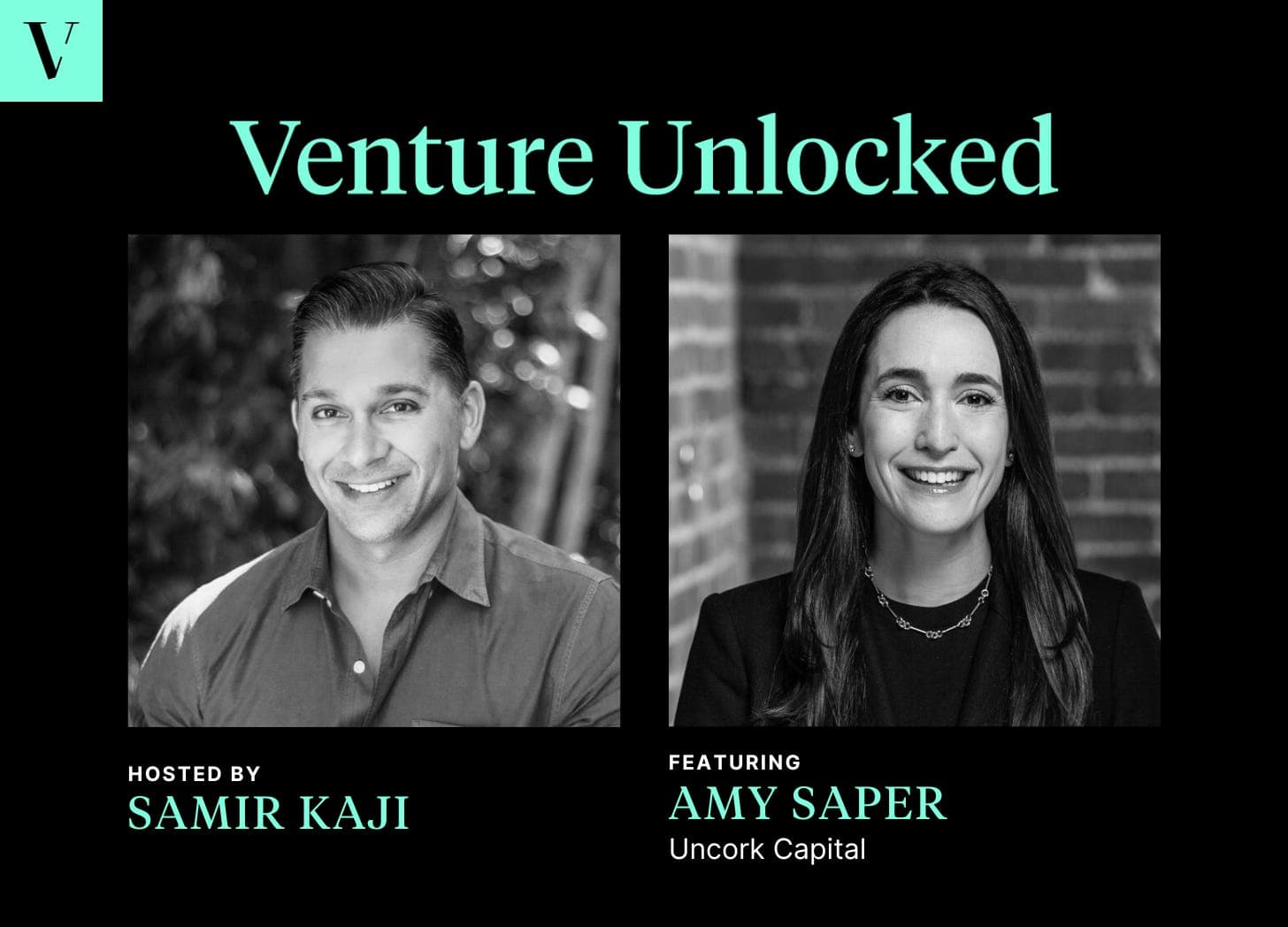
Episode Overview Title: Amy Saper of Uncork Capital on how startups should embrace constraints to foster creativity, and her learnings from being at Accel, X, Uber, and Stripe
Host: Samir Kaji Guest: Amy Saper, Partner at Uncork Capital Release Date: [Date not provided in transcript]
Podcast Description: Venture Unlocked is a guide for starting, operating, and scaling successful venture capital firms, hosted by Samir Kaji, who has over 20 years of experience in assisting startups and venture firms.
---
Key Points Discussed
- Amy Saper's Background
- Career Journey:
- Transitioned from Silicon Valley operator roles at Twitter and Stripe to venture capital.
- Worked at Accel as an early-stage partner leading seed and Series A investments.
- Joined Uncork Capital, focusing on seed-stage investments in B2B SaaS and fintech.
- Uncork Capital's Strategy
- Recent Funds:
- Raised $200 million seed fund (Uncork 7) and a $200 million opportunity fund (Uncork Plus 3).
- Firm Philosophy:
- Balances growth with specialization, aiming to be lead investors in competitive seed-stage deals.
- Embracing Constraints to Foster Creativity
- Impact of Constraints:
- Constraints inspire creativity and force startups to focus on core differentiators.
- Example from Twitter’s 140-character limit highlighting how limitations can shape innovative thinking.
- Challenges in Capital-Constrained Markets
- Advice for Startups:
- Importance of staying focused on essential goals and making strategic trade-offs.
- Emphasizes the need for startups to maintain lean operations and effectively manage resources.
- Product Market Fit in Venture Capital
- Evaluating Fit:
- Venture firms must align their value propositions with founders’ needs.
- Non-consensus investing is highlighted as a potential path for higher returns, particularly for founders who are less conventional.
- Non-Consensus Investing
- Identifying Opportunities:
- Emphasizes the importance of a strong technical team and market understanding.
- Highlights the significance of a founder’s ability to attract and develop talent.
- Founder Characteristics
- Key Traits:
- Ability to attract and manage talent is essential for successful founders.
- Founders should possess a growth mindset and an aptitude for learning and iteration.
- Collaborative Culture at Uncork
- Team Dynamics:
- Uncork fosters a collaborative environment where partners actively support each other and their portfolio companies.
- Lessons Learned
- Insights for New Investors:
- Challenge the status quo and follow a first-principles approach.
- Emphasis on the importance of being open to innovation and learning from diverse experiences.
---
Key Takeaways
- Embrace Constraints: Startups should view limitations as a pathway to innovation and clarity in focus.
- Strategic Fundraising: Startups need to carefully plan their funding rounds to ensure adequate runway for achieving growth milestones.
- Deep Network Utilization: Leverage existing networks to identify and connect with high-potential founders and investment opportunities.
- Value of Collaboration: A supportive, collaborative investment environment can enhance outcomes for both venture firms and the startups they fund.
---
Conclusion This episode of Venture Unlocked with Amy Saper provides valuable insights into the evolving landscape of venture capital, the importance of embracing constraints for creativity, and the characteristics that define successful founders. Amy’s journey as an operator transitioning to a VC offers a unique perspective on how to effectively evaluate and support startups in today's competitive market.
For more details, visit the [Venture Unlocked Substack](https://ventureunlocked.substack.com?utm_medium=podcast).
Written by AI. May contain mistakes. Listen to the episode to check what was said.
Transcript
Automatic transcript. May contain errors.0:00Welcome back to another episode of Venture Unlocked, the podcast that takes you behind the scenes of the business of venture capital. I'm Samir Khaji, and today we welcome Amy Saper, partner at Uncork Capital, where she invests in seed stage B2B SaaS and fintech companies. Before joining Uncork in 2023, Amy spent time as an operator at companies like Twitter and Stripe and also worked at Excel Partners. Today, Uncork has nearly a billion dollars in assets under management and recently closed two sets of funds, Uncork 7, a$200 million fund dedicated to seed stage investing, and Uncork Plus 3, a$200 million opportunity fund for breakout companies.
0:41During our conversation, Amy discussed her transition from being an operator to a VC, the learnings that she transferred over, and her view of why capital constraints foster creativity. This was a fun episode, so let's get right into it. In the fast-paced world of startups, every decision counts. And for venture-backed startups, choosing the right banking partner can make all the difference. That's why you need to consider Grasshopper Bank. Nationally chartered and headquartered in New York City, Grasshopper Bank is a client-first digital bank built to serve the business and innovation economy, combining the best of banking technology and years of industry expertise to deliver best-in-class experiences with trusted security and unparalleled support.
1:22Join the ranks of forward-thinking entrepreneurs who love their digital platform by applying online in as little as five minutes from any device today at www.grasshopper.bank. Grasshopper, where banking meets innovation. Samir Kaji is the CEO and co-founder of Allocate. Allocate and Venture Unlocked are independent of each other. Any statements or references made by Samir or his guests regarding third parties, investments, or securities are solely their views and opinions and are not intended as investment advice or an endorsement of such parties or securities by Samir, his guests, or Allocate.
1:57Allocate or its clients may maintain relationships with or investment positions in guests, third parties, or securities mentioned in this podcast. This podcast is for informational purposes only and should not be relied upon as a basis for investment decisions. Amy, it's so great to see you and thanks for being on today. Thanks for having me. I want to start off with going through your history because you've had a really interesting history at multiple really interesting operating companies, Twitter, Stripe, and ultimately you went into VC. And the first question I always ask people that work at these great companies and work within the industry, why make the change from working at companies to VC?
2:36So maybe you can go through that background. So when born and raised in Silicon Valley, I kind of grew up around technology and I knew that I wanted to be a part of the startup world in some capacity. And I really fell in love with the entrepreneurial ecosystem as an undergrad at Stanford. I was able to join a program called the Mayfield Fellows Program. I know you've actually had a number of other Mayfield Fellows in the podcast. Maybe you're familiar. It's a work study program that really exposes you to every aspect of the entrepreneurial ecosystem. And that's how I ended up at Twitter for my Mayfield Fellows internship.
3:09Started talking to the team when they were probably 150 or so people pre-revenue. First joined as an intern and converted to full-time. And Twitter had actually never hired a non-engineering intern before. So I had to write an email to then COO Dick Costolo outlining what I saw as the opportunities and how I thought I could contribute as a 21-year-old with effectively no work experience. And I'm very grateful that he took a chance on me. I'm still considering one of my closest mentors and advisors to this day. But over the course of four years, I got to wear a ton of hats. And I think you'll notice some common themes.
3:47I wrote a lot of my own job descriptions. So I just kind of threw myself at problems and opportunities I saw. I never paid a ton of attention to my job title or prior experience. And so this was everything from helping build APIs and SDKs for developers, helping small businesses use Twitter, launching new digital commerce products, which a fun fact there is actually how I met my husband. We teamed up on a Hack Week team. He was also working on Twitter at the time and won Hack Week and launched new commerce products. I got to oversee the launch of Twitter's business in 15 emerging markets and moved halfway across the world to Dubai and Singapore.
4:25And it was just an incredible journey going from kind of 200 to 4 ,000 employees, pre-revenue to a public company. Went back to the Bay Area to go to GSB, worked at Uber while I was there. And in my second year, I met John and Patrick Collison, so the founders of Stripe. I remember walking around the mission in San Francisco with Patrick, and I was just struck by his ability to both predict the future of commerce and sort of where Stripe needed to be based on where the market was moving and where he saw things going 10 years from now. And the very short term, which is that Stripe's desktop view of the dashboard was terrible and everyone kept complaining about it.
5:05And I thought that combination of kind of the 10 ,000 foot view and the 10 inch view, if you will, was so rare and something that I really look for in founders today. So I had the opportunity to join Stripe in this really unique role where I was the second marketing hire. We had maybe three product managers. I got to work directly for John Collison, and it was sort of a hybrid product management, product marketing role across Stripe's suite of APIs. So working directly with engineering teams and launching products for marketplaces, subscription businesses, and so forth. And I learned so much over the course of three years there that informs the way that I think today about business models, customer problems, how marketing and products should work together, how to think from first principles.
5:46And one of my favorite parts of my role at Stripe was getting to dive into these different business models, whether subscription businesses like Slack, marketplaces like Lyft or Shopify. And I started angel investing at Stripe as peers from my various networks, founded companies and sought out advice. So I realized that venture was a way to tie together those two things, my love of learning about new products and business models and forging those deep relationships with founders and others in the industry. And so I had the opportunity to move over to the venture side of things, having first learned that this was even a job as a Mayfield fellow back at Stanford, joined Excel as an early stage partner.
6:27It was just an unbelievable first experience in venture. So I spent four years there and got to lead investments in seed and series A companies ranging from AI-enabled applications like Gamma and Logicalope that changed the way people work to embedded fintech companies like Beam that are kind of bringing modern fintech tools to legacy industries, digital health companies like Sprinter and Well Theory that changed the way patients receive care today. But I realized over the course of my time there that I'm a startup person at my core. My heart is really in the earliest stages of company building.
7:02And from a cultural perspective, I just thought that maybe I was better suited for a smaller, leaner, more entrepreneurial firm environment. And I'd heard about Uncork through a number of different connections. A founder friend from business school who was now growth stage, but Uncork had led his seed. And he mentioned Jeff Clavier was the most useful board member he'd ever had. We had a shared investment where Uncork led the seed and Excel led the Series A. I had another close friend who was on a board with my partner, Andy Loughlin. And I heard that they were looking for a fifth partner. They reached out and it just seemed like the perfect fit.
7:38So I joined five months ago this past September, and I'm really loving it. I found this balance between a platform that has a real legacy and a strong reputation behind it with this more entrepreneurial approach to firm building that really resonated with me. So here I'm focused on SeedStage, B2B apps, and API-first companies, as well as B2B FinTech. Yeah, and it's hard to believe that Uncork has actually been around for as long as it Jeff being one of the first true seed stage firms out there, I think it's almost 20 years ago now, mainly his own capital at the beginning. And of course, the franchise has grown.
8:15Congrats on the most recent set of funds. I want to unpack a few things that you mentioned. I do want to talk about the culture of a firm and sort of juxtapose a little bit between working at a firm and working in a company. I had somebody that you worked with before, Adam Bain, on the podcast recently. And Adam is very much similar to, you know, early days at Twitter, helped grow the revenues from zero to a couple billion dollars, was there with Dick. And he actually drew a lot of these insights and thoughts of how he wanted to build a firm with Dick from his interactions with Bill Campbell and how they run their firm and what they think about.
8:55and one of the things I talked to him about is the similarities and in some cases, dissimilarities of working at a startup company that's growing in a startup firm. Now, both of the firms that you joined had been around for a while, of course, Excel being a longtime brand firm and Uncork being one of the first seed stage firms. But now that you've been in the business for four and a half years on the investing side as an institutional investor, maybe you can juxtapose a little bit between the experiences at Stripe and Twitter and what similarities are in running a venture firm? Yeah, no, I think there's a I think there are a lot of really interesting parallels between culture at various companies and culture and kind of operating principles and how you structure yourself as a venture firm.
9:43A couple of things come to mind. First is everything really comes down to serving your customers and aligning the whole company to do so. So in both instances, there might be multiple types of customers. At Stripe, perhaps that was startups versus late-stage companies or marketplaces versus subscription businesses. At venture firms, that might be your new founders that you're hoping to form new relationships with, as well as your growth stage founders that you've been working with for some time. And in addition, your other investors that you work with, your LPs. But really, at the end of the day, it comes down to your founders and your LPs?
10:19And are you building a great product or service and really delivering on what you have set out to deliver and aligning kind of the goals of the organization with what types of behaviors get rewarded, how you choose who to hire? So I think at the end of the day, that kind of customer orientation, if you will, is fairly shared and it just kind of represents itself in different ways. I think one of the more interesting comparisons, if you will, that I've been paying a lot of attention to lately is this tension between balancing kind of growth and expansion with specialization and sticking to your core, watching for scope creep, if you will.
11:00I think in the last couple of years, in particular in the pandemic era tech boom, a lot of companies and a lot of venture firms really expanded their products, the size of their team, the scope of, you know, the types of focus areas or stages that they might invest in. And I think we're starting to see that shift a little bit as companies realize that, hey, resources might be tighter and figuring out how you win in a competitive environment means sticking to your true competitive advantage and what you're really, really best at. And so there's no one right way to do that. But I think the challenge to keep in mind is making sure that you have a strategic rationale behind those reasons to expand your suite of products or your fund size or your focus.
11:51And so I do think that that's an area to pay attention to that we'll see movement here. Some obvious examples, meaning growth stage funds might be retreating from seed, for example. Certain funds we've seen kind of realign their sector focus areas. And we're seeing similar things with companies as well, you know, shutting off business lines and trying to sort of stay focused. And I think that's related to sort of the overarching theme of leaning into your competitive advantage. So if you're at a startup or a smaller fund, often that's your ability to move faster, create alignment more easily if you're focused on, you know, one key product or geo.
12:28So for Umpcork, that's North American-based seed stage technology companies. Like startups versus incumbents, I think smaller firms are better able to pivot and evolve their strategy and use speed as our advantage. In a deal process, we don't have a complex voting structure or the need to wait for a Monday partner meeting to make a decision. A startup doesn't have to wait for the biannual product road mapping two-week-long process with 75 decision makers. If they identify an opportunity, they can spin up a team and go tackle that. And then larger multi-stage firms and larger companies have their own advantages.
13:04But I think being really cognizant about that and leaning into that is something that I pay a ton of attention to. I'm a firm believer. There's no good cultures or bad cultures. I think Twitter, Uber, and Stripe, Excel, Uncork, they all had very strong cultures that were very distinct. And I think that I learned there are different things that I've taken away from each of those cultures that I think can be really productive. And, you know, conversely, things, elements from all of those cultures that maybe I think could be left behind. And so I think the same thing is true, whether you're building a company or a venture firm.
13:41I want to extend that analogy because I really do like the analogy of sticking with your core and certainly when money was easy to come by, and it was easy to come by for most of the 2010s. Of course, the last few years of the peak period and really peaking in 2021, people were able to raise money either as a company or as a firm. And at the company level, you were given a lot of capital because the supply was there. And oftentimes you were forced to either expand quicker than you were ready for, meaning different geos, different products, when you may not have had real product market fit or you were chasing revenue at the expense of unit economics.
14:21And at the fund level, we saw this too. Many firms were raising bigger and bigger firms, funds rather, they were doing SPVs, they were doing opportunity funds, and the capital was there. And it was really a function of adopting almost the business model of your funder versus what is right for you. When you think about that aspect of it, how do you know when it is time to expand scope or expand a product or when it's too preliminary? Because it's so easy to get caught into it when capital is there. So maybe talk a little bit about the Uncorked strategy because you did recently raise the seed stage fund, which is$200 million, and then you have the growth stage.
15:03I'd love to hear how you thought about it and how the team thought about this is the right strategy. And although we're expanding maybe the fund size, it's the right thing for us to do in staying within our focus and where we can win consistently. I think to the point around how did we decide on our fund strategy? And again, I will admit that I joined post-fundraise, so I was able to kind of have conversations through the team. And what really struck me about Uncork's strategy was it was really this nice balance of a fund size that supported our ability to be the lead investors and the first call, which was really critical to me.
15:40It was one of my favorite parts of my role at Excel. There are a number of different ways to to be an investor, but being the first phone call whenever anything good or bad happens at any time or day of the week is both a responsibility and an opportunity that I think is really exciting. And so having the fund size to support the larger rounds that are happening at the seed stage was critical. We wanted to be able to be in the most competitive deals in the best companies. companies and as our you know the average seed might have been 500k a decade ago now it's probably more like three or five million we need to be able to write those bigger checks we want to be at all the best companies and so i think our our round size reflects that and then similarly it does take companies a long time to to go public or achieve their ultimate liquidity event and so we really want it to be able to maintain our ownership over time and so having both the 200 million dollar seed fund and$200 million opportunity fund enables us to do that.
16:39And that balance was something that really appealed to me. I saw similarities, obviously on a smaller scale, with how Excel thought about partnering with founders at the multi-stage level. So no matter where you enter, whether it's seed A, B, growth or beyond, and being able to stick with founders for Uncork, we are often the first check, but then we'll stick with the company all the way through till their ultimate exit. Yeah, there's a lot there. And some of those things probably deserve a little bit more deeper conversation on the macro side. And whether it's the lengthening time companies are staying private and getting to an ultimate exit, the rising size of a seed round, and then of course, difficulty of getting downstream financing are all real right now.
17:27but right now I'd like to kind of focus on this concept of product market fit within a company you as an entrepreneur you know when you have product market fit not only are people willing to pay for your product but they're asking for it you're starting to see a real scale and you're now reaching a point where you're very clear that there is a viable business model In the world of venture capital with so many different firms, it takes a while to really understand if you have product market fit with the founders. Are you providing something meaningfully differentiated than other firms that allow you to see and win and build the right type of reputation that allows for long-term success?
18:10And given the fact that you can now look at your operating background and now you've been in venture, I'm really curious to know how you think about product market fit within a venture firm and what really is needed from a delivery standpoint to get true product market fit with the founders you work with. The way that I think about it is, you know, it's true that venture is becoming more crowded. I think Seed is incredibly crowded overall. Just like the founders are aligning their product or service with their customers, a VC has to align the ways that we provide value to our founders. And I think that for every VC, that is very, very different.
18:51And I think that it relates to your ability to both win the competitive deals and then also support them moving forward. So for me, when I'm trying to get into those competitive situations, it stems typically first from my network. I'm a very network-driven investor. So most of the investments I've done to date have been either first or second degree connections from my existing networks. I think three of the investments I let at Excel had a co-founder from Stripe, for example. And if not, they're likely an intro from a founder or operator that I've worked with. So I think the way that you get connected to the founder really helps.
19:29I, it by no means a celebrity VC, I don't tweet a ton, trying to blog a little bit more, but I really prefer to keep the spotlight on the founders I work with and not me as an investor. So this feels authentic to who I am. But it means if we've never worked together, you might not know my value add and how I show up for my portfolio. So I try to do this in multiple ways. I think in the earliest days, it tends to be customer intros, engineer intros, maybe angel investor ideas. and actually got feedback recently from a founder that I ended up not working with, but spent a bunch of time with who was surprised that I offered three customer intros and then sent them the same day.
20:08It turns out that saying what you're going to do and then delivering it goes a long way in this industry. I also like to show, not tell when it comes to value ads. I connect prospective founders with my existing founders who will underscore how I help tactically and have specific examples of ways that I've done that. They'll say that I'm always on and available no matter the time of day, the day of week. If I'm on vacation, if a founder needs me, I'm there. I think founders put their entire lives into their companies and their jobs are so much harder than ours. So I feel a responsibility to be as available as I can for my founders.
20:45I think the last thing that I'll say on product market fit is every VC has their own perspective, their own background in terms of what they're looking for. For me, I really gravitate towards technical founders that have a unique perspective on a market or customer problem. Ideally, they've worked directly in that area, who maybe are lighter on the go-to-market or storytelling side of things, because those are areas that I feel I can really complement them. And I think one of the benefits of leaning into your unique product market fit as an investor is it enables you to think outside the box or hunt outside the usual circles.
21:24So when I reflect on my ability to identify and source and win the kind of non-consensus deals, I think it's often because it's a setup that just really works for my unique background and characteristics. So there's my non-negotiables around what I'm looking for, which I mentioned, the high levels of technical abilities, their experience in the market. I have to be able to squint and see a really big market and have alignment with the founder and where things are moving. But I really invest in slope and not wide intercept. So I think certain things can be coached, like go-to-market chops, storytelling abilities.
22:07it's essential for founders to learn how to become great storytellers, but I don't think they need to have those skills from day one. John and Patrick did found Stripe with a mission to increase the GDP of the internet. I think the first tagline was like the new standard and online payments for developers or something that was not particularly catchy or inspiring. But they got better over time. And I think storytelling, defining your ICP and excruciating detail, those happen to be areas that I love and I have a ton of experience in. So founders don't have those skills. I'm able to test for a founder's ability to take feedback and iterate.
22:45And it really comes down to their rate of experimentation, not just with their products, but with all parts of their business. So if I can get comfortable with their slope, I don't care as much about the Y intercept. So for me, product market fit means identifying a founder and a team and a market and a product that fits my certain areas of focus, B2B apps, API-first companies, B2B fintech, with those sets of characteristics and areas where I think that my background and skillset can be uniquely complementary. I find that when I put myself in those scenarios, I'm both better able to win the deal and better able to really help them moving forward.
23:28Each founder, of course, and each founding team is going to have their unique strengths and weaknesses and figuring out where you can play coach and helping them get to that next level is obviously very important. You mentioned some of the non-negotiables, right? You have non-negotiables, then you have the negotiables. And in today's world, of course, while the seed rounds have gone up three to five million, what's also happened is the difficulty of raising that next round of capital at Series A, the goalposts have moved, the bar is higher, there's less capital. One of the things that stood out to me when I was looking at your background and thinking back on the Twitter days is I think it was Biz Stone said something around, when you have capital constraints or constraints in any way, it can launch creativity.
24:10And we're in a capital constrained market. Maybe unpack that a little bit, because I know that's something you also hold near and dear to your heart in terms of running a fund or helping founders. But how do you see these capital constraints actually helping founders in today's world? I'm a firm believer that constraints inspire creativity. You know, as you mentioned, this was one of BizStone, co-founder of Twitter, one of his favorite mantras. And at Twitter, it stems, you know, very literally from the fact that Twitter, that tweets used to be sent only via SMS. And back when Twitter was founded, SMS could only be 140 characters.
24:47140 character limit was stemmed from a very real constraint. But even once tweets started to be sent from mobile apps and desktop and that SMS constraint no longer existed, we found that maintaining that 140 character limit really encouraged people to think more thoughtfully around the message that they were trying to put out. And so I think that that sort of philosophy can be applied in lots of different ways. And one of the best ways I think startups have to compete is to stay laser focused on their core differentiators. So I'm ruthless about goal setting with my founders and I'll tie back anything strategic or resource related question to the goals that we've set.
25:26I think particularly in market environments like this, it's really important. I loved Frank Slootman's book, Amp It Up. Have you read that one? It's something, I've got to butcher the quote, but something to the effect of narrow the focus, increase the intensity. And I think this is one of the best ways a startup can compete. More often than not, I see startups taking on too many responsibilities, hiring too many people, expanding their product suite too quickly, when in fact, they can actually move faster by staying more focused. And so I think that's one of the unintended upsides of a slightly more challenging economic environment is that it's forcing founders to make these hard trade-offs earlier on and really figure out if they have product market fit, to question whether or not they really need to hire as big of a team as they do.
26:22And so I think leaning into those constraints, narrowing the focus, increasing the intensity can be really, really valuable. And honestly, I think that that's something that I mentioned, the creative constraints inspired by Twitter. I think Stripe at the era that I was there also did this primarily through headcount. So I wish I had, we used to share this graph that would plot Stripe's headcount growth relative to revenue compared to our peer set of companies. And Stripe was always an order of magnitude smaller from a headcount perspective. And so I think that that has a couple of implications.
Read the full transcript
26:58It means you have to be very particular about who you choose to interview and hire for your company because not everyone can operate well in that type of environment. But for the right type of employee who maybe leans a little bit more of general athlete versus specialist and who likes wearing multiple hats and who likes being scrappy, it can be a really incredible opportunity. So that is something that I think about when I'm talking to my founders and my startups in the early days is that when you can find that kind of win-win scenario with the employees who are self-selecting into being in an environment where they're actually excited about the fact that you might be pivoting and evolving and their job description might shift and don't see it as a threat, that you can really turn your headcount and your growth into an opportunity.
27:52And it makes it a lot easier to change course down the line and avoid the very unfortunate mass layoffs that we've seen in recent years if you start from the beginning in an environment where you're focused on constraints. The constrained market is fairly new. And actually, there's an entire generation of both investors and people that have founded companies that never actually operated in this constrained environment. So in many cases, people have had to hit this brick wall. And where they hire too much, they raise too much capital, maybe the valuation was too high. They've had to course correct in a pretty painful way.
28:29Now, for companies that are now starting, understanding that the market is much more constrained, one of the challenges is going from that Series C to Series A. It's not just how much you have to achieve, but you have a shot clock still. And that shot clock might be 18 months to 36 months. And you mentioned this aspect of narrowing focus. And as a founder, one of the tough things to balance, and we face this too in the company I run, is that we see so much opportunity that you want to start to chase all of these different shiny objects because you know the revenues there versus doing one thing and doing it really, really well and scaling on that.
29:10And before moving on to the next, what are you seeing, I guess, in terms of what's needed to get to that Series A? Because I think a lot of Series A investors still want to see a lot of growth. They want to see traction across multiple things. What are you advising your founders on how to balance between staying focused, maybe slower growth, but also understanding there's this time period where they have to raise more capital to be able to continue as a viable company. And that sometimes means expanding what you do. You've hit on an interesting distinction because I do think that one of the ways that startups can compete and win is with a faster rate of experimentation.
29:52So they can try a lot of things in quick succession. But then I think the key part is to identify and be ruthless with what's working and what's not. So it's not that they should just try one thing and stay constrained from day one, whether or not they're achieving any sort of product market fit. But once they've iterated on exactly who their ideal customer is and exactly what their sweet spot is, how they can deliver the most value, that's the point where you really want to stay constrained and pour fuel on the fire in a narrow capacity to give yourself the best chance of achieving your goal.
30:28And so I do think that balance is critical. And I think, you know, we mentioned on pork shifting, our fund strategy as seed routes have gotten larger. And I think that that's especially important in today's environment. And so sometimes I will give seed stage founders feedback that they might want to increase the size of their round slightly such that it buys them a little bit more time to hit those Series A milestones. And so ideally, you are raising enough for at least two years of runway, and you want to make sure that you have room for if things do take longer, that you're able to raise your Series A without needing a bridge.
31:05And so I think that's kind of one way that I've seen the market start to correct. I do think it's true that the bar is shifting at Series A. It is harder to raise follow-on capital. That being said, I think for great companies, it's absolutely still there. We've been fortunate that we've had a number of Uncourt companies and my own Excel companies that have raised Series A's in the last couple of months. And so those companies probably are a little bit further along in terms of the product market fit journey and the revenue numbers. And they would have been a couple of years ago. But I think going back to this point on constraints, staying focused and staying lean and preserving your runway and just giving yourself more chances to catch lightning in the bottle before you get to the Series A is really critical.
31:49If you hire a ton of people really quickly, it's going to be hard to do that. So I actually test for this when I'm talking to seed stage founders. And I'll have a direct conversation. I think, to me, the best tool that I have to figure out whether I think this founder is one who is going to be operating within constraints and stay nimble is to ask them to tell me about the round size and why they've decided to raise$4 million versus$6 million versus$2 million. and to actually work backwards from where does that get you? What milestones do you think you need to achieve to raise a really incredible series A?
32:23Now, how do we take that to a more extreme level of detail and go through specifically, who do you think you need to hire? How much are you going to pay those people? Where are you finding those people? And I learned a lot just from hearing about how the founder approaches those things. Maybe you don't need for AEs to hit a million in revenue. I'm a big believer in founder-led sales in the beginning, especially, you know, till that first million in revenue mark. Through having a conversation with the founder around what resources they need, you can sort of back into how that founder views operating with constraints.
33:03You mentioned something that I wanted to double click on. It's this notion that being lean, making sure you're raising enough money in today's environment to be able to give yourself enough time to experiment and hit the necessary bars to raise the Series A from a great group of investors. And when you're investing in some of these companies and founders, I put the founders in maybe two buckets. One is very consensus. It's a second-time founder. It's a third-time founder. It's in a market that has a huge tam, very easy to understand. And in those cases, generally speaking, your job is to figure out a way to convince that founder to allow you to invest.
33:45And those rounds tend to be bigger. And then there's the other group of founders, which could be the first-time founder operating in an industry that's a little harder to interrogate and understand. And for those founders, you may not be able to raise that$3 to$5. Maybe that's a$2 to$3 million round, yet they still face the same challenges in terms of getting to that Series A. How do you think about your model, your own mental model of investing? Because historically in venture, where some of the best returns have happened is when people have been non-consensus, investing in places where other people haven't, and founders that other people are not generally throwing term sheets at, but it is hard.
34:29And so how do you think about the winning versus discovering and doing those non-consensus deals and how do you mitigate the risk on the latter bucket? So I think starting with the latter bucket in terms of the non-consensus deals, I first and foremost rely, I think a lot of it comes down to sourcing. So I rely really heavily on my operating background, which is somewhat non-traditional adventure today. I'm lucky to have been a part of a lot of different organizations from Stanford, Twitter, Uber, Stripe. I have developed a really deep network of operators, angel investors, and executives at various tech companies who I chat with regularly, where maybe I'm the only seed stage GP that those folks know.
35:11So it's actually how I found my most recent investment. A friend of mine leads product at a growth stage AI company, and he told me about this new tool that his engineers were absolutely loving. And so before it kind of made its way into the radar of the who's who of seed stage venture capital, I was able to have a conversation with the founder, connect the team with a couple of potential early customers, diligence, and get to terms. And so I think that network plus speed is definitely something that I use, whether it's a competitive process or not. And then I think going back to how I get conviction on kind of non-consensus ideas, we've talked about some of my non-negotiables.
35:51So those have to be met. They have to be a strong technical team with a well-informed view on the market or our customer, what's changing. I have to have confidence that the market is big enough to support a billion or$2 billion exit to make our fund math really work. And if those things are there, then I can take risks in other areas. And so to me, being able to figure out the areas that I think the founder needs some work or needs some help on, I really test for their ability to take feedback. And I can do this live in a conversation. It will certainly be something that I talk about in references, whether on list or off list is where has this person really grown?
36:35How have they responded to constructive feedback? I think that, you know, founders have to have tough skin and they're going to be getting lots of feedback. They have to be able to move really quickly. They have to be able to take in new information and experiment. And so if I can get comfortable with their rate of learning, then I can get comfortable with the areas where they might seem sort of non-consensus or rough around the edges when it comes to taking the leap on that investment. You talk about the archetypes or the non-negotiables. Of course, those non-negotiables kind of inform your decision making, whether it's consensus or even a very consensus founder or market.
37:14Have your non-negotiables negotiables change over time? They have. One of the non-negotiables, one of the biggest takeaways I have for my time at Excel is that a founder has to be an incredible attractor of talent and developer of talent. And that is something that seems sort of empirically obvious. But when you look at what really separates the truly phenomenal founders who become exceptional growth stage CEOs and the ones who I've seen struggle or move more slowly, I think it comes down to their ability to identify, hire, and close that early talent. And I've seen this now sort of across the board in a number of different examples.
37:58And typically, it's 100 times harder than founders realize to hire really exceptional folks. And so there's a number of different ways that you can test for this, but I will often go a layer deeper around their hiring plan. And I don't want to hear we need an engineer or even we need a front-end engineer. I want to hear, I worked with this guy when I was at Snap and he was the 10X engineer that everyone wanted to work with. I've been stalking him for a year, getting coffee with him every three weeks. And I know that once we close the seed round, if I'm able to give him this opportunity, he's ready to come on board.
38:37I'm looking for founders that have shown examples of not just having the potential network to find those folks, but understanding how hard it is and how critical it is to bring those early hires on board. And so I think that's become a new one of my non-negotiables that I've kind of discovered through backing founders that really have that skill and some where it's just been harder to develop. Is that a trait that can be learned or is that a trait that's innate? Because you have worked at places, the Twitters and the Stripes, where the talent that they were able to acquire was absolutely exceptional and a big part of the success story.
39:17It is something that can be learned. Obviously, it's easier to reference if someone has been a manager or been a hiring manager, developed teams before because I can think about examples there. However, it's different being able to attract someone to join Stripe when you're growing really quickly. And a lot of people want to be a part of a rocket ship is very different than joining a, you know, risky startup that has no revenue and has a lot to prove. And so I do think that it can be learned. And that's something that I've been able to kind of suss out through conversations. Actually, one of my, one of the founders that I worked with at Excel, who I previously worked with at Stripe, went the staff engineer route at Stripe.
39:57So he wasn't managing teams. And so that was a, an open question. And through the course of our conversations around making this investment, I got to see up close and personal through both connecting him with potential engineers from other great companies like Robin Hood and so forth, and then talking to those individuals about how inspired they were to go work for this guy. It gave me enough confidence that he had kind of the innate characteristics that would make him really good at it, even though he had never actually hired and managed a team before. And so I think that there are ways that I certainly think it can be learned.
40:32But I also think that honestly, with all of these skills, an aptitude and interest in learning is so tied with success. And this was something that, you know, I think Patrick Collison had in spades, he would read like three books a week. And famously, you would find him kind of rolling the halls at Strife with his nose in a book. He would bring politicians, CEOs, dignitaries. And his side of a successful conversation was if he had basically not talked at all and just asked them questions. It was just so, despite having achieved so much success at such a young age, was just so hungry for all of the things that he still had to learn.
41:14And so I think whether that's learning how to become a great hiring manager, a great storyteller, a great product builder. I think a proven interest in this kind of insatiable love for learning and a clear talent around experimentation and iterating quickly is more important than prior experience in any one of those areas. I want to come back to where we started. I asked you some of the similarities and maybe dissimilarities of an operating company versus a fund. Now you joined Uncork and as Uncork grows over time, you're going to acquire talent, you're going to bring new people on. And within a venture fund, the people are the intellectual property at the end of the day.
42:00Maybe talk to us what made Jeff and Tripp and Andy and the rest of the team so attractive to you and how they were able to attract talent like yourself. And how did that inform how you're going to hire people in the future? What was most striking to me is that But prior to meeting and spending time with the Uncork team, I kind of had this mental model of venture. And remember, Excel is the only venture firm I've ever been a part of. And so in my mind, you could either go raise your own funds, be a solo GP, kind of lose the sort of team aspects that I really loved and spend half your time or more on the fundraising side of things, but have agency and the ability to move quickly.
42:42or you could be a part of a storied multi-stage firm where you've had all the resources and brands that you wanted, but maybe things moved a little bit more quickly. You didn't have as much control over the firm building decisions. And Uncor was this really special balance to me that I had never seen before where we had this incredibly loyal LP base, many of whom were shared with Excel, which gave me a lot of confidence and a really strong community and network where if you polled different people who had been a part of the Uncork network, whether they were founders or co-investors, just the feedback around the Uncork's ability to bring together a community was really paramount.
43:23And that was something that really stood out to me. I'm a competitive person, but I'm a collaborative person. And I think it's hard to find a combination where when we're trying to compete and win a seed deal, everyone kind of shares that same competitive drive, but we don't see venture as a zero-sum game. And we appreciate and understand that we actually need to build those relationships with angel investors, pre-seed funds, growth stage investors. And that just really appealed to me and kind of spoke to my strengths around the network really driving so much of my career. And so I think that was certainly part of it.
43:57Obviously, the results kind of speak for themselves. I wanted to join a top-performing seed fund. Uncork consistently when I would talk to my friends at Sequoia or Andreessen or even Excel was always one of the names that they would track very closely. So I think those things really appealed to me. And then I think more than anything, it's a collection. So we're a generalist fund, but everyone has their areas of focus. And it's collaborative in a way that I found really unique, where a lot of venture firms can kind of feel like lone wolf games. And at the end of the day, you're the board member, you're the investor, you're winning the deal.
44:34But I've now seen this up close and personal in the last five months. And I've been able to both help out with companies where the investment obviously predated me and get on the phone with founders and help them walk through authority issues. I've had a lot of founders ask for help on getting access to new beta products or people at Stripe. And then similarly, when I'm trying to win a deal, my partners have gone above and beyond to connect their founders with the prospective founder and share what the experience is like as an Uncork founder to connect the founders with prospective customers that are from their own personal networks.
45:06And so I think that sort of collaborative approach to investing really appealed to me. And I think that there's something really special about being a generalist fund that's made up of individuals with particular areas of focus and expertise. And so we have a mix of former founders, career investors, company builders like me. And I think it enables us to provide just a really rich and multifaceted experience for our founders. And so that was something that kind of pushed me over the edge in terms of joining Uncork. Now it's been half a decade as an institutional investor, longer when you count your angel track record in terms of investing in companies.
45:47What's the one thing that you know now that you wish you knew when you started investing? Throw the rulebook out the window and question the status quo. You've probably picked up on the fact that I have a sort of healthy impatience and a discomfort with stasis. And I think it's one of the reasons I get along so well with founders. I didn't recognize it as such early on, but I'm not satisfied with an answer like, well, this is the way it's always been done. And I think when I look at the founders that I respect the most, they share that kind of disregard for the status quo, you know, in a healthy, polite way.
46:22I think John and Patrick would refer to this as thinking from first principles. And I think it's part of why they've been so successful with Stripe, not in spite of the fact that they didn't come from payments, but actually because of it. So I think chasing the hard problems and asking the tough questions early on and not being afraid to try a new approach can really lead to great outcomes. And I think kind of feeling comfortable with the discomfort and understanding that, you might not have had experience in a given area, but that doesn't mean that you can't potentially see around corners and identify what could be a really great new business opportunity.
47:03SpaceX is a great example of it. It's not like Elon Musk had a long history in a space as a business, but he realized that there was a better way to do it. And I would agree. In fact, my biggest pet peeve is when I do hear people say, well, that's the way we used to do it. Well, we're not building for something in history. We're building for the future. So great insight. Amy, this was a lot of fun. Congrats again on joining Uncork. It's a great group of people and really excited to see you and the firm grow. Also, thanks so much for having me, Samir. Thanks so much for listening to another episode of Venture Unlocked.
47:38We really hope you enjoyed it. To learn more about Amy or Uncork, be sure to go to the Venture Unlocked Substack at www.ventureunlocked.substack.com, where you'll find detailed notes of the show and a listing of past episodes. You'll also find us on Apple or Spotify, where you can subscribe to get all of the latest shows as soon as they're released.
48:13Thank you.
From the publisher
Follow me @samirkaji for my thoughts on the venture market, with a focus on the continued evolution of the VC landscape.
We are back with Amy Saper, partner at Uncork Capital. Amy shares her journey from Silicon Valley operator at Twitter and Stripe to venture capitalist. She talks about Uncork’s strategy, including its recent $200 million seed fund and $200 million opportunity fund, and how the firm balances growth with specialization.
Investors will find her perspective on non-consensus investing particularly compelling, as she outlines how she evaluates technical teams and market potential. Successful founders attract and develop talent. Finally, she reflects on her move to Uncork and shares her key learnings as an institutional investor.
A word from our sponsor
In the fast-paced world of startups, every decision counts. And for venture-backed startups, choosing the right banking partner can make all the difference. That’s why you need to consider Grasshopper Bank.
Nationally chartered and headquartered in New York City, Grasshopper Bank is a client-first digital bank built to serve the business and innovation economy, combining the best of banking technology and years of industry expertise to deliver best-in-class experiences with trusted security and unparalleled support.
Join the ranks of forward-thinking entrepreneurs who love their digital platform by applying online in as little as 5 minutes from any device today at www.grasshopper.bank.
Grasshopper - where banking meets innovation.
About Amy Saper:Amy Saper is a Partner at Uncork Capital, where she invests in seed-stage B2B SaaS, API-first, and fintech companies. Previously, she spent four years as an early-stage partner at Accel where she led seed and Series A investments in companies such as Gamma, Beam, Complete, and Sprinter Health.
Prior to her venture career, she worked at Stripe, Uber, and Twitter launching products, business lines and new markets, in product marketing, product management, business development and international expansion roles.
She received her BS and MBA from Stanford University.
In this episode, we discuss:
(02:27) Amy discusses her background, including her experience at Twitter, Stripe, and her transition to venture capital
(08:00) Joining Uncork Capital, the firm's history, and the recent funds they have raised
(09:14) Comparing the culture of a firm with that of a startup and discusses the importance of sticking to the core focus
(15:17) How Uncork Capital decided on its fund strategy and the balance they struck between fund size and being lead investors
(18:28) Product market fit in Venture firm and how she delivers value to founders
(24:27) How constraints can foster creativity and the importance of staying focused in a capital-constrained market
(28:49) The challenges startups face in raising Series A funding and the importance of balancing focus and growth.
(34:37) Non-Consensus investing and what she looks for in founders
(37:17) The importance of a founder's ability to attract and develop talent and shares her thoughts on whether this can be learned
(42:13) What attracted her to Uncork Capital and how the team dynamics influenced her decision
(45:40) The one thing she knows now that she wishes she knew when she started investing
I’d love to know what you took away from this conversation with Amy. Follow me @SamirKaji and give me your insights and questions with the hashtag #ventureunlocked. If you’d like to be considered as a guest or have someone you’d like to hear from (GP or LP), drop me a direct message on Twitter.
Podcast Production support provided by Agent Bee
This is a public episode. If you would like to discuss this with other subscribers or get access to bonus episodes, visit ventureunlocked.substack.com