In short
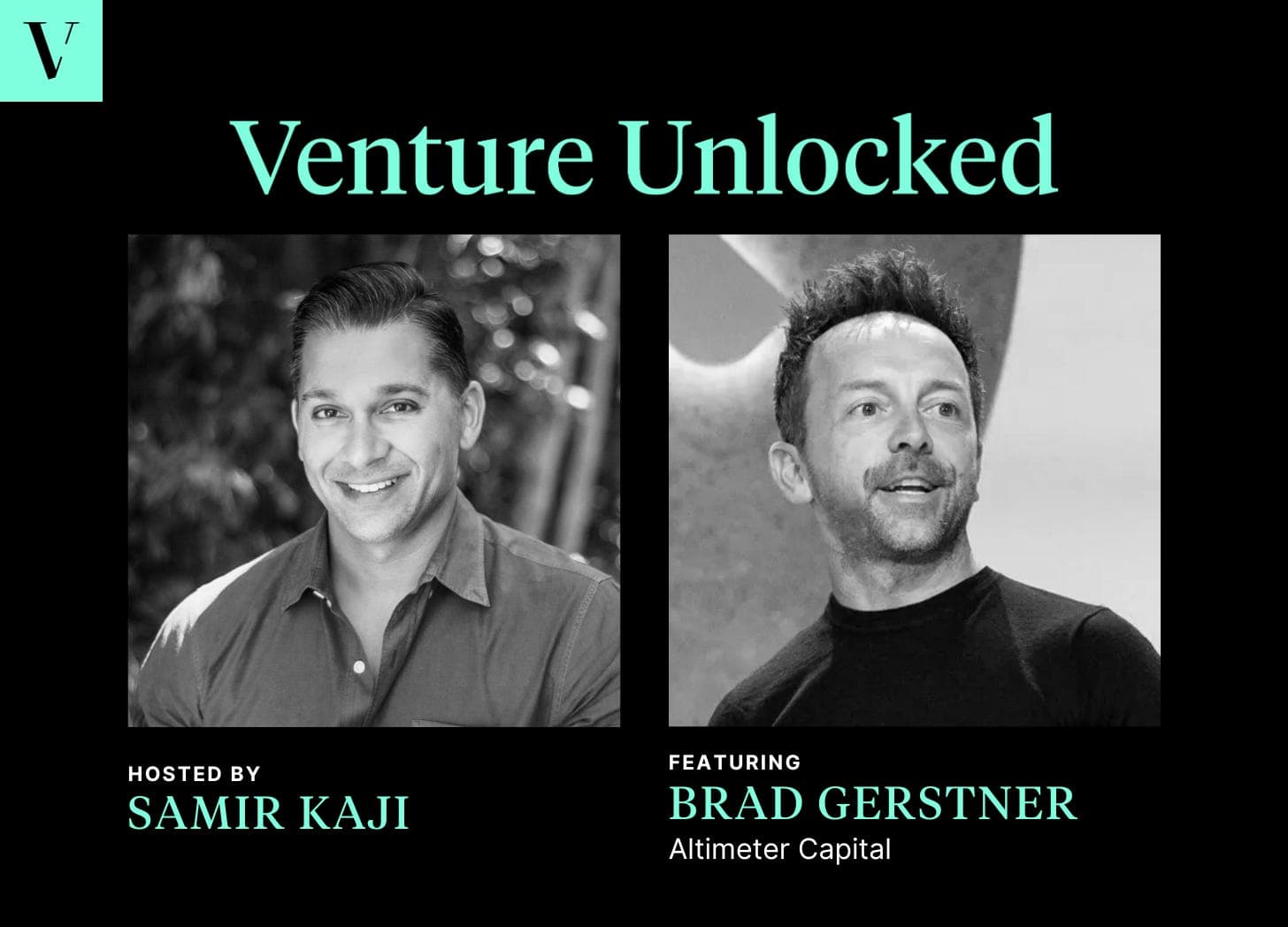
Podcast Summary: Venture Unlocked - Episode with Brad Gerstner
Podcast Overview Title: Venture Unlocked: The Playbook for Venture Capital Managers Host: Samir Kaji Description: This podcast aims to guide listeners through the intricacies of starting, operating, and scaling a successful venture capital firm. Samir Kaji shares insights acquired over more than 20 years of experience in assisting startups and venture firms.
Episode Details Episode Title: Brad Gerstner Talks AI, Tech Super Cycles vs. Market Cycles, and the Start of Altimeter as a $3MM Fund Guest: Brad Gerstner, Founder and CEO of Altimeter Capital
Key Themes and Topics Discussed
- Background of Brad Gerstner
- Early Life: Grew up in Indiana, influenced by his father's entrepreneurial journey in the auto parts manufacturing sector.
- Education Path: Shift from law school to pursuing technology and entrepreneurship.
- Silicon Valley Experience: Impulsive trip to Silicon Valley which demystified the tech landscape for him.
- Formation of Altimeter Capital
- Initial Fund Background: Founded in 2008 during the global financial crisis with a starting fund of $3 million raised from friends and family.
- Investment Philosophy: Focused and high-conviction approach, investing in companies like Snowflake and Unity.
- Hybrid Strategy: Combination of venture capital and public market sensibility.
- Insights on Venture Capital
- Competitive Advantage: Importance of providing intellectual resources alongside capital for founders.
- Cyclical Nature of Venture: Acknowledgment of the cyclical trends in venture capitalism and the impact of entry prices on investment success.
- Technology Super Cycles: Discussion on how technology super cycles can dramatically improve lives and industry outcomes, particularly in AI and cloud computing.
- The Role of AI in Business
- AI's Impact: Importance of AI in reshaping industries, enhancing customer experiences, and improving operational efficiencies.
- Evolution of Search Engines: Transition from traditional search engines to AI-driven answers, highlighting the transformative potential of AI.
- Investment Strategy and Valuation
- Valuation Discipline: Altimeter's disciplined approach in valuation and decision-making during the investment process.
- Fiduciary Responsibilities: Emphasis on board members' duties to all shareholders, fostering effective governance.
- Social Initiatives: Invest America
- Mission Statement: Aimed at improving financial literacy and economic participation for children born in America through a government-backed investment account initiative.
- Long-term Vision: Investment in children’s financial futures to empower them and bridge wealth gaps, fostering a more equitable society.
Conclusion The episode encapsulates Brad Gerstner's insights on the venture capital landscape, the significant role of technology and AI in reshaping economies, and the societal responsibilities of venture capitalists through initiatives like Invest America.
Key Takeaways
- The importance of understanding market cycles and the implications of venture capital investment strategies.
- The transformative potential of AI and tech super cycles in enhancing consumer and enterprise value.
- The role of venture capital in fostering inclusive economic participation for future generations through initiatives like Invest America.
---
For more detailed notes and ongoing commentary about the world of venture capital, visit [Venture Unlocked](https://ventureunlocked.substack.com).
Written by AI. May contain mistakes. Listen to the episode to check what was said.
Transcript
Automatic transcript. May contain errors.0:00Welcome back to another episode of Venture Unlocked, the podcast that takes you behind the scenes of the world of venture capital. I'm your host, Samir Akachi, and on today's episode, we're thrilled to bring on Brad Gerstner, founder and CEO of Altimeter Capital. Altimeter was first founded in 2008 during the global financial crisis with an initial fund of only$3 million, which Brad raised from friends and family. The firm takes an incredibly focused and high-conviction approach to investing and has backed companies such as Snowflake, Unity, Gusto, and Modern Treasury. Before Altimeter, Brad worked as a multiple-time entrepreneur, was a founding principal of General Catalyst and worked at Park Capital.
0:34He's also an active thought leader in all aspects of the innovation economy, including numerous media appearances and a recurring role on the popular All In podcast. He is also active in areas that seek to improve the future of the country through efforts such as Invest America. We had a wide ranging conversation that covered a lot of ground, including technology, super cycles, AI, and the state of the market today. This was a fun conversation for me, and I think you'll really enjoy it. So let's get right into the episode now. Samir Kaji is the CEO and co-founder of Allocate. Allocate and Venture Unlocked are independent of each other.
1:08Any statements or references made by Samir or his guests regarding third parties, investments, or securities are solely their views and opinions and are not intended as investment advice or an endorsement of such parties or securities by Samir, his guests, or Allocate. Allocate or its clients may maintain relationships with, or investment positions in, guests, third parties, or securities mentioned in this podcast. This podcast is for informational purposes only and should not be relied upon as a basis for investment decisions. Brad, it's so great to see you. Thanks for being on. Well, it's great to be here and no lack of things to talk about in the world.
1:43I think there's a lot to talk about. But before we go into current events and what we're all seeing, I actually want to go back. I mean, you were, you know, you were raised in Indiana and then ultimately made your way to the tech. I think you had a few journeys in being an entrepreneur before starting Altimeter. Give us the snapshot of what got you into tech and then ultimately some of the things that really inspired and guided starting Altimeter, I think, in 2008. Well, I mean, we could go in the Wayback Machine. You're right. I grew up in a small town in Indiana. My dad was first-generation college, first-generation founder, started a company in 1978 in the auto parts manufacturing business.
2:24Unfortunately, interest rates were 18%. Inflation was roughly the same. There was no such thing as venture capital. He borrowed money from the local bank. And, you know, like I was in fourth, fifth grade at the time, you know, this valiant effort as a entrepreneur, which in my mind was a quite a heroic thing he was trying to do, but ultimately wouldn't work. You know, so much of your adult life is trying to make sense out of your childhood. And here I saw this guy who was my hero, who was clearly going through a lot of personal trauma associated with this failure. And that really sent me down a path to trying to understand the world of business because the world of business could help me better understand why this could happen.
3:09My grandfather, and I've told the story, his father basically said to all the grandchildren, there are four of us, you're not allowed to become entrepreneurs. You have to become professionals. So I go to law school to honor his wish. But in classic romantic literature fashion, I had to come back and ultimately be an entrepreneur to slay the dragon. So I left law school while I was in law school, and I'd always been fascinated with technology. But 1996, the Netscape browser was introduced in 1994, end of 94, 96. I think Mark's on the cover of pretty much every magazine. I gathered my classmates in law school, got around the single computer in the library.
3:53I showed them the Netscape browser. I told him how this was going to change everything. Kind of fit of haste, I decided to buy a one-way ticket to Silicon Valley because I had really not traveled much. I had never been to California. And I wanted to see what this place was all about. I landed at SFO. I got in a taxi. This was pre-mobile phones, really pre-internet. And I said, take me to Silicon Valley. And he said, well, where? There are a lot of places in Silicon Valley. And I said, I don't know, a hotel. And he dropped me off at the Rosewood Hotel. I ended up walking around and went into the Venture Law Group, which was a law firm at the time that was taking equity stakes to help companies get started.
4:34But what it did is it planted its seed and demystified this place. It looked a lot like the place I was from. It was very rural. I'd go back to business school in 99. While I was there, everybody was trying to start a company. As the resident lawyer, they all asked me for my help and incorporating their business and getting their business going. And two, they were going around Boston pitching people to raise money for their ideas. And there were a bunch of really excellent firms in Boston, Charles River or Matrix or Greylock or just go through the list. But there's this scrappy start, a couple of guys who were doing some angel investing, David Fialco and Joel Cutler.
5:13They were talking about starting a venture firm, but hadn't really started it. All my friends found their way to them. And at one point in one of those meetings, David Fialco pulled me aside. He's like, we're not investing in any of these guys, but you got to come work with us. And so I started working with them during business school, helped them put together their launch deal, early online travel business. I would end up becoming the co-CEO of that business. We grew it to over a billion dollars in gross bookings over the course of two years and sold it to Barry Diller in May of 2000, announced the deal in May of 2001.
5:46It was quite a formative thing being around them at the start of this venture capital firm, around them as part of this launch deal. And then I thought, well, okay, I'm going to go back and work at this new venture firm. But I had been bitten by the founder bug, being CEO of a business with 1 ,200 employees, selling it successfully. And I had a friend, a classmate named Bejal Samaya, who now is one of the leaders at Lightspeed. And Bejal said, hey, Brad, I have an idea for a new business. It was a local search business. Think maybe Yelp before Yelp. So he and I decided to start that business instead of going back to venture capital.
6:22And we get some term sheets from venture capitalists, but we had made a little bit of money. We decide we want to own more of it. So we bootstrap it. We own it ourselves. We end up recruiting somebody at a price line to run it day to day and sold that business to a public company in Seattle called Marchex. And that was a lesson. The first one was we had a bigger outcome, but I owned a little. The second one I owned a lot. It was a needle mover for a poor kid from Indiana, just getting out of debt from business school, etc. And then, you know, I decided I wanted to go back to investing. But I had learned during that period of time that I really was fascinated by this intersection between public and private.
7:00I was convinced that companies were going to stay private longer. They were going to raise more capital in the private markets. and that those companies would scale on the back of the internet to a much larger scale before they went public. And that if you wanted to capture what had previously been IPO returns, you really needed to be a participant in the venture market. I had deep networks there. I had founder credibility there. And so I thought that was a competitive advantage for me. On the public side, I got my series seven and 63 during law school, day traded stocks to put myself through law school and business school.
7:35I was really fascinated with the public markets, but I had no real professional hedge fund experience. I'd gotten to know Seth Klarman, who ran Baopost, Paul Reeder, who ran Par in Boston at the time I was running that first startup. And I went to Paul Reeder and I said, hey, I'll work for you for free. You just have to have lunch with me every day for the next two years and teach me the hedge fund business. You know, little did I know it would turn into a lifelong friendship, a lifelong mentorship, lunch every day. We still talk every week. And I went to work for Paul and I built his technology practice, both the public market technology practice, where I managed a pool of capital, investing in things early like Google and Priceline.
8:20And then I ran a venture pool of capital where I led the series B and in Zillow, in ITA software and Faircast and Sidestep. And so we built in no time a really successful technology fund that today we'd call a crossover fund. We didn't use that nomenclature at that point in time. But Paul knew. I said at the time I started, I'm an entrepreneur. I'm a founder. If I love the business, I'm going to start my own. So hire me accordingly. And sure enough, at the end of 2007, I said to Paul that I was going to launch my own fund. I didn't know the world was going to melt down in 2008 the way that it did, you know, and I just got married had my first child There was a lot of pressure not to launch my fund by the fall of 2008 I mean this was really the end of times But because I had started two things really from scratch I thought that if you studied some of the great firms Including park capital the firm I was at that was started in the middle of the snl crisis with less than$5 million, or you studied Baupost that was started in 1981, really in the aftermath of those double-digit interest rates and inflation, or even Tiger, which was started in the aftermath of the Tiger shutdown and the dot-com blowup.
9:38Those distress-era funds did quite well. I lived a pretty simple life. I knew I didn't need a lot of money. I started with very little money in the fall of 2008. It took me a few years to get back to Silicon Valley and to launch our first formal VC fund. But by 2011, 2012, I was living out here. It was off to the races. That happened to be early in the super cycle of mobile and cloud. And so it turned out to be a pretty good time to deploy those first few funds. Yeah. And I want to come back to super cycles in a second. But going back, of course, raising that first fund during one of the toughest economic dislocations we've seen up until maybe today.
10:19But at the time, that was a$3 million fund. So mainly friends and family, you're describing sort of this new way of thinking about this, which is crossover. We call it, of course, now we've seen the D1s and the Tigers. But back then, there was very few investors that were doing both public and private investing. I think famously, I think Legg Mason invested in the Series C of Zillow since he brought Zillow up. I the company, which of course it wasn't turned out not to be a great sort of outcome for them. But when you were starting, was there some type of true north that you saw? Like, you know, forgetting about the fact that you really felt like you wanted to start something, you were an entrepreneur.
11:00But I've heard you talk about this notion of essentialism in how you run a business. Was that apparent to you then in terms of creating the cast of which Altimeter was founded on? I'll come back to essentialism in a second because that's always, it's kind of a life philosophy and a business philosophy of me. But the really driving motivation, listen, I had started two businesses. I knew, I looked at lots of businesses with General Catalyst, with Par Capital. Every business needs a competitive moat and a competitive reason to exist. Like the question was, why does the world need Altimeter? Like what do I bring that these other firms like Tiger and Co2 didn't bring, right?
11:42What do I bring that these great venture capital firms in Silicon Valley didn't bring? And my observation was this. I was a founder. I was a byproduct of Silicon Valley. I had raised money in Silicon Valley. Like I understood Silicon Valley. I understood the journey of founders. So I was of Silicon Valley. Like that was my DNA. And I happen to be pretty good at public market investing. When I looked at the guys in New York who I admired, like Philippe or Chase-a-Tiger or Dan Sundheim, they were public market investors. They were stock pickers in New York who had not started companies, tech companies like I did, but they happened to do venture capital.
12:25So I thought there was a real opportunity to be venture first and public market second, as opposed to the other way around. And that was a big differentiator. To live here, to wear the black t-shirt, to have stood in their shoes, to have hired, to have fired, to have built technology. And to this day, what Altimeter means more than anything else in the mind of the founder, in the mind of early stage GPs, is just that. We have public market sensibilities. We can help you scale your capital. But unlike a lot of those late stage investors. We live here. We stand in your shoes. We do what you do. We're going to help you build this business.
13:02And I think that's a big difference in the mind of founders and a big difference in the mind of the earliest GPs who are looking for somebody to partner with. So when we look back at the prior decade, and most of it, if not all, was marked by this zero interest rate policy that created these incredible tailwinds for both companies and funds. And you've said something that is around the notion that the best founders strategically pick their investors. And during that ZERP period, perhaps that wasn't always true because it was often who was willing to write the biggest check at the highest valuation.
13:39Now, as things have shifted back, where it does seem like founders care about strategic capital, I'm curious from your standpoint, what about a fund makes the best founders pick them? And how does that then create the model of altimeter? The most experienced founders understand that in the journey to build this giant outcome that they hope to build, they're choosing partners that provide capital and intellectual resources to increase the probability of their success. If you're a founder and what you're trying to do is minimize dilution in that round of financing, and that's your only lens, then you're probably not the right partner to us.
14:27Because that lens will ultimately undermine your ability to find ultimate success. Your lens should be, is this partner going to provide the type of capital and the type of intellectual expertise, whether it's marketing, whether it's customer introductions, whether it's recruiting, whether it's, are they going to provide those things in a way that increases our probability of success? And I just happen to think we do that better than most of these other folks, okay? Particularly the ones who are not here. Every day we get up, we have to earn the right to be the founder's choice of preference in those moments because they do have choice.
15:09What happened when the world lost its mind and we went to the zero interest rate band really in March of 2020, right? You got to take yourself back. We didn't know whether COVID was Ebola. We didn't know. We knew the virality was exceptionally high. We didn't know the lethality of COVID. But imagine COVID had been as lethal as Ebola and as viral as COVID. The Fed and Congress did what I think was the right and appropriate response. Unfortunately, I think we stayed in that posture too long. By the spring of 2021, we knew that supply chains were breaking, that inflation was rampant, the cost of a cargo container from China had gone up 10x, and we already had vaccines.
16:03So staying another nine months at zero made no sense to me. And I think that what we started saying to founders is be careful. You're acting as though we're going to have zero rates forever. You're making short-term decisions based upon the highest price. But if you get too high of price that you can't grow into before you burn this capital, then you're going to be faced with this really nasty choice, which is to do a down round, which is very dispiriting to your company. It will distract you. It will distract your team because that team that had gotten options priced at a billion now is underwater by 50 % or 70%.
16:46They're demoralized. But not surprisingly, nobody wanted to hear that in the spring or the summer of 2021. I went on CNBC in October of 21. I said a normalization process post-COVID would have rates go back to their January 2020 levels and would cause a 30 % correction in the NASDAQ and an even steeper correction in venture because the multiples were even higher. And that, in fact, occurred. And I would say it took until really Q2 of 2022 until the rest of the world came around and Silicon Valley sobered up and came around to that view that things had fundamentally changed. So what do you do during those times?
17:36Because I had this very same conversation with people during the course of 2021 when everything was up to the right. I think the number of unicorns that were minted during that 21 period It exceeded all the unicorns minted up to that point. And there was incentives built into the system to be able to raise bigger funds, put more money into companies for those founders to optimize on things that fundamentally the market was giving them. So you're now in a situation where you have capital to deploy both on the public and private side, knowing what you think is going to happen, which is this dislocation that is where gravity comes back into the world.
18:19But at the same time, you don't know for sure where rates are going to go. And so in some ways, you have to continue to participate with whatever the market clearing prices for these companies. How did you handle it internally? And what was that? What were those internal discussions? Well, I'll tell you, and let me be absolutely clear. I would like to say that we did everything perfectly. We certainly didn't. I said on many occasions during 2021, We're all gaslighting ourselves. When you're playing a sport, you can wish that the rules were different, but you kind of have to play the game on the field.
18:55And we're on the field. And I didn't want interest rates to be zero. I didn't want prices to be where they were, but that is the game we were forced to play. So at Altimeter, we talk about the future as a distribution of unknown and unknowable probabilities. Okay, so what we spend our time as a research institute doing is trying to discern how those probabilities for a set of future unknown events are going to play out. And what we knew by the summer of 2021 is that the probability that multiples would reset lower was much higher than what was being priced into the market. So on the public side, we started putting on hedges.
19:43Now, of course, we had committed to a lot of deals in Q1 and Q2, many of which closed in Q3 of that year. And by October 21, we were basically out of the market. We never say it's all or none because we don't know the future with that degree of certainty. But what we should be able to figure out is less or more. And in the venture world, you want to find that magic quadrant where we're early in a super cycle, but we're in the bottom half of pricing. And what was clear in the summer of 2021 is we were in the top third of pricing and we were later in a super cycle. And, you know, that tends to be a tough period in which to really run up the score.
20:30And as Bill Gurley reminds us all, he's a great friend. And his number one lesson is the venture business is a cyclical business. It is not suspended from the economic laws of gravity. Some people say, well, I'm just going to invest in great companies and they'll be worth more in 10 years. But as Warren Buffett says, every investment is determined by the price of entry. You've got to find that intersection. And now I happen to think as we sit here in Q3 of 2023, we're now in the bottom third of the pricing cycle. And we are very early in the next and very big super cycle, which is AI. So it reminds me more of the period from 2002 to 2005 or 2010 to 2013, 2014.
21:22I think this is a really interesting moment. But I would say late 20 and the first three quarters of 21 were particularly pernicious from a pricing perspective. And looking back, I mean, one of the things that is also this truism is you can't really time market. So it's hard to know exactly where you are. But you can have these probability based points of view where you can dial back or dial forward. And it sounds like in 2021, the decision was made primarily at the end that we were at this really difficult place where it wasn't just the clearing price of these companies, but the risk that was imbued by taking the level of capital that they were at the valuations in terms of if the market resets, where do these companies end up?
22:12And I think the tough thing for a lot of people to reconcile is this nature of looking at technology as this exponential curve. And we've seen this before, whether it's personal computing to the Internet, mobile cloud, now AI, versus the overlay of venture investing, which is highly cyclical. And it's really hard to make those decisions without really understanding exactly what ultimately is the right decision to make in that very moment. And we've seen people, really smart people that you and I both know, that were investing heavily through 2021 and were essentially gaslighting themselves into thinking that we were in a new paradigm where gravity wouldn't come into play.
22:56Now, things have changed, and I agree with you. But when you think about super cycles, I mean, you've been through these super cycles before. You mentioned coming to Silicon Valley, the internet was new, mobile and cloud and AI. What are the markers of a superciple from a technology standpoint where you can point to something as a material platform that companies and entire industries are going to be reshaped on? It's a great question. I want to come back to the other one in a minute about institutionally why people did too much. It's a really important conversation. Let's come back to that. But let's talk about the super cycle question.
23:33Ultimately, technology only has value if it improves lives and outcomes. Why was the internet going to be something that was as disruptive as it was? Because it held the promise to make all of our lives as consumers way better. We could discover information we previously couldn't discover it. We could discover it in a fraction of the time. We could have better life experiences, whether it was places we were going to travel or things we were going to do with our children or restaurants we were going to eat at a Friday night or knowledge that we were going to be able to share with our kids on how to do their algebra homework.
24:12Everything in our world improved because of this new thing. On the enterprise side, it allowed every enterprise in the world to connect. It allowed enterprises to communicate with customers in radically different and more efficient ways. and it allowed enterprises to radically reduce the cost of doing certain activities. Those two things, like when you touch all of enterprise and all of consumer in a way that is a step function different than the way the world operated before, that is, I think, prone to having extraordinary unlock of value. Let me juxtapose that against crypto as an example. People have said that I'm anti-crypto, which is not a fair characterization.
24:55I've been following crypto for 15 years or 13 years. If I think about, you know, some of the people I first heard about crypto from, the likes of Mickey Malka, you know, folks who sold their startups in South America, who had their profits inflated away by governments because they had currency controls. It would have radically improved the lives of those people had they been able to put their life savings in crypto and move that seamlessly out of the country. That is a real benefit to those citizens and those consumers living in those places. But when I saw a lot of the stuff that was being purported to be benefits of crypto in 2019, 2020, etc., I really didn't get it.
25:41I didn't see the benefits to the consumer beyond those original benefits that had been true for a decade, right, and that were really captured by Bitcoin. Like if you wanted to take advantage of that benefit for those citizens, then you could just buy Bitcoin. You didn't need to invest in all these other things. And so I said at the time, the total market cap of crypto, I think at its peak, was$3 trillion. And I looked around. I said, is it making companies' lives easier, better, cheaper, faster? No, I couldn't find a single enterprise that I talked to that said, we're using crypto and it's helping us better connect with our customers.
26:20or it's making running a call center cheaper. I couldn't find consumers, you know, outside of a few who had apes on their Twitter handles or whatever who said like, this is radically changed. And by the way, I was looking hard because if you're gonna be a venture capitalist, you better not be dogmatic. You better be open-minded to the possibility you're wrong and these things that you don't understand will become understandable. So I said 3 trillion represents a successful super cycle. That's what the entire cap of internet was in 2005. And I said, it's a super cycle in terms of valuation, but I don't see the delivery in making consumers' lives better.
27:02It's not helping me travel better. It's not helping me find a better restaurant. It's not helping educate my kids better. And so it was really those things when I say, is it real or is it a pretender in terms of a super cycle? Mobile devices, that made every consumer's life better. made every business's business better. The cloud computing didn't directly have a radical, you know, impact on consumers, though Google Docs and a lot of other things that consumers use were taking advantage of the cloud. But derivatively, it had a lot of benefit to consumers because the things that they, whether it was like they didn't know were going on in the background to lead to better targeting of ads or better targeting of content is because we're capturing all this data in the cloud.
27:48And so again, if you looked at it for the enterprise, part of the reason we were early to the cloud with Mongo and HubSpot and Twilio and Okta and Snowflake, et cetera, is because we had a belief when the rest of the world didn't, that the cloud was going to be cheaper, faster, and more performant and more secure. And those things would ultimately cause the replatforming of all of our compute into the cloud. And we knew because we're excited about this burgeoning thing around deep learning and augmented intelligence, that the only way we could ultimately build supercomputers to take advantage of all the world's data is if all the world's data was actually captured, frictionless, and in the cloud.
Read the full transcript
28:30So we viewed those things as like a condition required to get to this next big thing. And so now let's apply the same litmus test to AI. I started three internet search businesses, and our goal was to make consumers' lives better. As Rich Barton, the founder of Expedia and Zillow said to me in 1999, he said, Brad, you know that magical travel agent? She knows your family. She knows exactly what you're looking for. She knows the room you want to be in, the view you want to have, the tours you want to go on, the food you want to eat. Now, I didn't really know this person because I had never really used one.
29:05But he said, if you find that person, they make your life better. He's like, I want to put that person in every human's pocket. What we got instead were really kind of 10 blue links. 10 blue links was a hell of a lot better than the card catalog. It was better than going to the library and running research, but it wasn't answers. And even if you listen to Larry Page, what he said, you know, back in 2004, 2003, 2004, Larry wasn't satisfied with 10 blue links. He said the ultimate goal of Google is giving you the answer before you even ask the question. giving you the answer, not giving you 10 blue links, giving you the answer.
29:45And so here we are, you know, the companies I started with Bejal Samaya, OpenList, or Room77, which we sold to Google, every one of those companies was trying to find, use techniques to hack this information on the internet to provide answers. Here we are now, 15 years later, and what we're about to do is make a fundamental transition from the world's largest card catalog, Google, to an answer bot. A card catalog, Google, makes me go click on all the links and do the research and try to find the answer. The answer bot reads all of that for me. It studies all of it for me and it distills it and gives me the answer.
30:30Does that make every consumer's lives better? You bet your ass it does. It gets us to the information we want faster, more efficiently, whether it's educating our kids, figuring out how to deal with a malady they have, a cold, this, that, that. We just get the answers that are perfectly tailored for us. And we now have semantic engines. We now have neural networks. We now have computers with the supercomputing capability to have read all of the world's information and to distill that into answers. And the next bit, we're going to go from answer bots like ChatGPT and Claude to action bots. And these bots will not only know what hotel room I want to stay in, they'll book it for me.
31:16They'll book the restaurant. Now, I ask you, does that make your life 10 times better? when everybody gets back to Rich Barton's vision in 1999 of having the world's best personal assistant, a$200 ,000 person in their pocket who can do all the things that they wished that they could do if only they had the time and the energy. So check the box. It's a 10x better solution than the existing platform for the consumer. Now, how about for the enterprise? Does AI improve the world for the enterprise? Well, we were investors in an early AI company called ByteDance. Most people in the U.S. know it as TikTok.
32:00And when Yaming was in my office in 2015, I asked him a simple question. How are you going to target content to consumers when you don't have a social graph? I know how Mark Zuckerberg targets content because he knows what my friends look at. And so he shows me the same stuff. But how are you going to target content? And he said to me in 2015, Brad, AI is way more powerful than a social graph. He was early and he was right. So if you look at the most profitable AI engines in the world today, they are the recommender engines at ByteDance, Doyan in China, TikTok, you know, around the world and at Meta.
32:43right? What they use to power reels, stories, Instagram feeds, Facebook feeds, etc. That's an indication as to how you better use, you leverage AI to better connect with your customers. Now we're democratizing that and every business is going to get that goodness. So we're taking out the cost of running a business. We're driving their top line and we're increasing their bottom line by reducing costs. Now we've checked the box for the consumer 10 times better. We've checked the box for the enterprise 10 times better. So does it meet the conditions required to be the next big super cycle? I would say undoubtedly, and it may in fact be bigger than the internet itself in terms of the step function improvement for both consumers and enterprises.
33:26When you think about that aspect, and it's still fairly early, and of course this has been front and center of both mass media and mass audience, given OpenAI really brought it to light. the power of even something simple as a chatbot and some of the things that were generated from there. But ultimately, from an investing standpoint, you also have to think about the price clearing on many of these deals is incredibly high. So AI, not brand new, but right now in an incredibly frothy market where a lot of companies are getting funded at very high valuations, almost a divorce of reality for the rest of anything that else is that that is happening in tech.
34:12How do you think about that from an investing standpoint when you have to reconcile, I believe that this is going to be this massive super cycle. But are we in a period like 98, 99, maybe even 2000, where it was very clear the internet was going to be something, but the funding in that environment was often to companies that were marginal and at valuations that were not marginal. So how do you think about investing in this type of market? You know, I was up in Seattle last week and I saw Satya and my first AI investment was 2005 in a company called Faircast. I backed the head of AI out of the University of Washington to build a very innovative company called Faircast that was attempting to provide answers, not Blue Links.
35:01In 2008, we sold that company to Microsoft. Corsace used to be the head of Bing. And he said, yeah, we bought it because we knew we needed answers instead of Blue Links if we were going to unseat Google. Okay, think about that 15 years ago. And we were really early. and I've invested in chatbots over the last decade. Those of us who've been around augmented intelligence for a long time know just like mobile, there's been a lot of head fakes and that's why there was a healthy degree of skepticism including, and I think he's talked about it publicly by Bill Gates who said, I don't buy it. But now Bill is fully on board because he's seen what chat GPT 3.5 and 4 can do.
35:48But you're absolutely right. There are moments in time, particularly around super cycles, when the excitement can get ahead. You can get over your skis. When you know this thing is going to change the world, but you don't necessarily know exactly who the winners and losers are going to be. You don't really know where the durable value capture is going to be. Let me give you the example of internet search. I mentioned I started three internet search businesses, so something I studied a lot. In 1997-98, every venture capital firm in Silicon Valley, by 99, let's say, knew that the internet was going to be huge and that search, which organized all the world's information, would be a big and important business in that mix because they could collect a toll effectively for organizing the world's information.
36:40But who? Well, we know the 800-pound gorilla at the time was Yahoo. Right? They were the king of the heap. SoftBank had funded them. And it was on top of everything. And remember, the Yahoo homepage had turned into a portal. It offered everything. And AOL, of course, was huge. My friend Bob Pittman running that company. Of course, Jerry Yang running Yahoo. But remember all of the contenders, Excite, Infoseek, Go, Lycos. I mean, we could, 20 of them. In fact, remember Lycos. This is one like a case study. There was a bidding war for Lycos between Barry Diller and a guy named David Weatherall, who was then running a company called CMGI.
37:29And Barry really wanted to own Lycos. Remember, we had Ask Jeeves. We had all these. Barry wanted to own Lycos. And this was a tectonic battle. And ultimately, David Weatherall would win that company in 2000. He'd be on the cover of Time Magazine. He would give the speech at Harvard business school. He would buy the naming rights for Foxborough Stadium in Boston and rename it CMGI Stadium. And two years later, he was bankrupt. Now, was he right that the internet was going to be big? Yes. Was he right that search was going to be big? Yes. Right? But he picked the wrong horse. Or you could have just waited until 2003, 2004.
38:07Hell, you could have bought Google in the IPO and captured 95 % of all the upside ever created by internet search. Being right about the super cycle is not enough. Being right about the company is not enough. You're going to be right about the super cycle, right about the company and get the timing right. But if you ask me about this moment, I think, I don't think it's uniform. I think there are some companies that seem reasonably valued to me in AI, but I would say I agree with you over the last three quarters, So let's call it Q4 of 2022 through August of 23. There's been a lot of hype and a lot of things I think have been overvalued.
38:51I already see it coming out of the summer. We've hit a zone of disillusionment. The funding pace has slowed down into AI. As you mentioned, as to everything else, it's already slow. But the funding pace into AI has slowed down. I think we're going to enter a period here where the companies that are really delivering those benefits to the consumer and to the enterprise, they'll do well. And the pretenders are going to get hammered. At Altimeter, we're going to be doing this for the next several decades. AI, if it's as big as we all think it is, you know, you didn't have to invest in the Internet in 99 or 98.
39:26But you needed to do the research and the work to know what to invest in when it was safe to go in the waters. because if you think you can just time markets without doing the work, good luck. But we've done the work. It's painful to say no to companies that you like. But we've been disciplined about valuation. That's why we put money into a company earlier this year called Samua, which is building fully encrypted multi-party compute workspaces for AI workloads, which is doing incredibly well. So these companies providing the picks and shovels. But we've had to say no to almost all of the foundation model companies because even though their revenues are growing quickly, guess what?
40:13Lycos' revenue was growing quickly. Excite's revenue was growing quickly. Infoseek's revenue was growing quickly. Just because you have revenue that's growing quickly doesn't mean it's durable. Do I know, can I tell you with any degree of confidence, the durability of the revenues, much of which is experimental. Can I tell you anything about the durability of the revenues for companies like Jasper or companies like Cohere, etc.? Great companies, great founders, great entrepreneurs, right but very tricky at this moment in time so we're staying around the rim and you know we're getting a lot closer today because the prices are starting to settle and our visibility is starting to get better you've got to be a prepared mind when the moment comes because i do believe you've got to hold these two simultaneous truths that are in tension the ai is probably going to be even bigger than anybody currently understands or believes.
41:16It may in fact get there faster than anybody believes. But, you know, the risk reward of anointing somebody the winner today and paying the winner valuation today before you've seen that durability or enough visibility and to make that call can be dangerous. I think it's very well said. And I have, just because you do play on both the public and private markets. And oftentimes there's this massive disconnect between the two in terms of how companies are valued and what metrics are used to really define a company's value. I look at this period that we just exited of Zerp and it felt like revenues, and you mentioned this concept of durability of revenues.
42:04It felt like revenues were the single metric to define that downstream round or a company going public or SPACs, and we saw multiple expansion happen. In many ways, if you look at the late 90s, it was eyeballs, right? How many eyeballs do you get? You know, you could go public just based on eyeballs. In fact, I think even Amazon went public with about$15 million of trailing 12-month revenue. So where we are right now, I'd love to kind of get your take on these 1 ,200 unicorns or so that are in the private markets that have, in many cases, raised this quantum of capital that has now put them in a really tough position where maybe those revenues weren't durable, maybe the margins don't make sense, maybe the business model doesn't even have true product market fit.
42:53What is happening at the board level? Because I can imagine the early-stage seed investors versus the late-stage investors that have preferences, maybe on differing sides. What does this look like in your eyes in the next two years as we kind of get through the unwinding of the ZERP period? A couple of key points. One, you should follow me at AltCap on Twitter because I actually talk about a lot of these things. And there I posted, if you got a valuation over$2 billion and you got revenue, get your business public as soon as possible. That's ultimately the determinant of market clearing price.
43:26Instacart here is the case study. Last private round at$39 billion. It's public today at$7 billion. You can wish it were different. You can wish your business was different. You could think you should be valued at twice that, but that's the valuation. And that is your job. Your job is to do what is in the interest of all shareholders and get those investors to liquidity. Putting your head in the sand and pretending that the world's going to go back to the ZERP period is just delusional. It does a huge disservice to your employees, to your customers, to your investors, and to the health of the business.
44:00The sooner the boards, the founders, the companies, everybody around the table says, listen, we collectively made that decision to invest at that high valuation. Like we don't need to point fingers as to who's at fault. We just need to accept the reality that we're in a new interest rate paradigm and we're not going back there. And so our job as board members, and this is a huge point to me, I've been, you know, I'm trained as a lawyer. I famously resigned from all my boards because I think they're ineffectual. And I've become a strategic advisor to CEOs because I think I'm more valuable out of the boardroom than I am in the boardroom.
44:40But one of the things I help them deal with is ineffective boards. And one of the things we have today, we actually have representatives on these boards of early stage funds or late stage funds. And you even said they're protecting different interests. Well, guess what? They're both wrong. You know who they own a fiduciary duty to? Every single shareholder of the business, not to their LPs. You choose to join that board, you now have fiduciary duties to every shareholder. I see you shaking your head yes. Unfortunately, 90 % of the people actually on these boards don't know that. And so it's very frustrating to me.
45:22I've served on public boards. I've done a lot around corporate governance. And my view is, if you're doing your job, then you're speaking truth based on research in those boardrooms, okay, and you're helping these companies get to market clearing prices sooner rather than later, right? You're not allowing the delusion to continue. You're not allowing the companies to continue to burn hundreds of millions of dollars on products that aren't delivering. And you're not representing just the interest of your LPs. You're there taking all the stakeholders into account, as is your duty under corporate law.
45:59Yeah, and I'm definitely nodding my head. And certainly, I don't think it's happening at every single board. And it is something that is an incredibly tough dynamic. I know there's so much more we could talk about in terms of the market, what we see going forward. But an area that I'd like to end on, because I know it is an incredibly important part of both Altimeter as well as your journey, which is around mission orientation. And what maybe has to spend a little bit of time is talking about Invest America. What is it and why is it so important for you? Well, I mean, I think, you know, as I kind of go full circle to where I started my journey, I was trying to make sense out of a political and economic situation in the world that had caused my dad to go bankrupt.
46:45The economic situation was double digit interest rates and inflation. The political situation were hostages in Iran, an oil embargo in the Middle East, the depths of the Cold War, being fearful that we're going to have a nuclear weapons attack. In many ways, like my life has been dedicated to trying to understand the economic and political systems around us that gave rise to that. When I came home from Oxford, I went to work for Dick Lugar, my state senator, an incredible moderate Republican who helped architect the denuclearization post-Cold War with Sam Nunn in 1991. And that's when I worked with him in Washington, D.C.
47:21And it had a real impact on how I thought about the world. Dick ultimately asked me to accept an appointment as Deputy Secretary of State in Indiana after I graduated from law school, which I did. And that was kind of a stepping stone to running for governor or something in Indiana. But I was poor and I'd grown up poor and I realized I didn't want to beg for money, you know, my entire career. But having lived on the outside looking in, I was fascinated, you know, with all this. My grandfather, who was a welder, actually worked on some important things around World War II as a tradesman. He had saved, he sacrificed everything in life, left$100 ,000 to four grandkids,$25 ,000 each.
48:05I thought about the sacrifices he made to leave that to us. And so I was hell bent on using that money to get to the other side of the tracks, to become somebody inside the system. And I remember how I felt when I bought my first stock with that money. I felt for the first time like I was in the game. I had skin. I was an owner. right? I wasn't just on the outside on the other side of the tracks because frankly it was a world that was foreign to me. I ended up day trading that money to put myself debt-free through law school and business school and I always remembered that and I thought I'd go back into politics but I ultimately decided I could use this platform, my voice, the resources we have to affect change from outside the system in.
48:59It's not a huge surprise that, you know, 80 % of the, 70 % of the kids in this country, their parents don't own anything. They don't have an investment account. They don't have savings. And, you know, to think that those kids will be financially literate, to think that they'll understand the system. They feel like the system's rigged against them. Why do you think we have the populist protests we do in the world? Wealth concentration leads to a feeling of alienation. So I came up with this idea after consulting with lots of others. It's a very simple idea that's now being put into bipartisan legislation in the House and the Senate.
49:38But the idea is very simple. Every child born in America, there are 3.7 million children born in this country every year, gets a private investment account, a private account, their account, they own title to it. And the federal government just does two things. They facilitate setting up the account, but it's administered by the Schwabs or Black Rocks or Fidelities or whatever the world. But the federal government seeds it with a thousand bucks. And we say, corporations, if you want to match this for the kids of your employees, you can put up to$2 ,000 in tax-free. 401ks get 70 to 90 billion dollars of match every year these invest america accounts will get match and a child starting with five thousand dollars 30 years ago so that would be a 30 year a 29 30 year old today would have 275 thousand dollars in their account every child deserves skin in the game a shot to compete.
50:39And if we want to tear down the divisions in this country, we have to create a platform that includes everybody. And the most important 18 years of compounding in your life will be the first 18 years. Warren Buffett is famous for the snowball effect. Give me a really small snowball and a really long hill. I think it's a way to transform financial literacy because now in the sixth grade, when you want to talk about compounding, ownership, capitalism, math, you have all the kids in the classroom open their Invest America account. It's not just the kids in, you know, the affluent suburban schools.
51:20It's the kids in inner city Trenton. It's the kids in rural Indiana, right, who now have skin in the game. And let's talk about in sixth grade, how you got to$14 ,000 in that account. Let's talk about, you got five companies there, Apple, Tesla, United Health. You're a part owner in those companies. What does that mean? So they can't take it out. It compounds, you know, at age 20 or college age, they can take up to 20 % out for a qualified purchase of college or a new home. And the rest compounds until they're 50. But the psychological and behavioral benefits, savers save. They're healthier, they're happier, they're more educated.
52:02College graduation, high school graduation rates go up. All because we do something very simple. And by the way, this costs the U.S. government$3.7 billion a year. Just what we've spent on Ukraine would fund this program for 75 million children for 20 years. Now, let's talk about what has a more positive impact on the future of this country and on the future of American democracy than that, right? So I think it's not about how much we spend as a federal government. It's about the priorities of what we spend on, and there's no better investment than to invest in these kids. And so Invest America is putting together a huge tent of bipartisan supporters with some luck by the springtime of next year.
52:51Well, bipartisan legislation introduced in both the Senate and the House, and we can get this done. It's an amazing initiative and effort. Brad, if our listeners are looking to find out more or want to help in any way, how do they do so? You can go to InvestAmerica24 Twitter handle. It's probably the best way or InvestAmerica.com. But I would say follow us on Twitter. We're going to be updating there. We've got some leadership coming in to help run this. I'm funding it here at the start. We'll raise some capital in our 501c3 and c4. But most importantly, I don't care how this gets done, who does it.
53:35I just want to see everybody have a shot. And the age of AI, just like the information age that came before it, will lead to further concentrations in wealth. I don't want, that doesn't mean we should stop AI. because our strategic and national and economic security as a nation is to be leaders in AI. But we do have to be sober and deal with the natural consequences of human progress. And one of those consequences is we're going to have a lot of labor displacement. A lot of people lose their jobs, those call centers, etc., where it can now be run by AI. So we need to find multiple ways, job retraining, and this is economic participation.
54:21The upside of America is incredible. The next decade should be incredible for this country. Let's make sure that everybody shares in that upside, right? Participates in that upside. And there's only one entity in the world that can create universal participation, and that's the federal government. Yeah. I think it's, again, I'm just going to reinforce, I think it's such an important part in stopping the entropy of the middle class, which needs to be reinvigorated. So, Brad, this has been a really fun conversation. Thanks for sharing all the insights. Thank you. Thanks so much for listening to another episode of Venture Unlocked.
54:59We really hope you enjoyed our conversation with Brad. To learn more about him or Altimeter, be sure to go to VentureUnlocked.substack.com for detailed notes on the show, as well as my ongoing commentary about the world of venture capital. Venture Unlocked is also available on iTunes or Spotify for download. And while you're there, please leave us a rating and review as it really helps us out. And don't forget to hit the subscribe button in order to get each and every Venture Unlocked episode as soon as it's released.
55:34Thank you.
56:01Thank you.
From the publisher
Follow me @samirkaji for my thoughts on the venture market, with a focus on the continued evolution of the VC landscape.
We're thrilled to bring on Brad Gerstner, Founder and CEO of Altimeter Capital.
Altimeter was first founded in 2008 during the GFC with an initial fund of only $3 Million which Brad raised from friends and family. Today the firm employs both private and public strategies.
Altimeter takes an incredibly focused and high-conviction approach to investing and has backed companies such as Snowflake, Unity, Gusto, and Modern Treasury. And now manages a variety of venture and public funds, taking a hybrid and pragmatic approach to funding, using a variety of vehicles depending on stage and need to give companies and managers access to capital.
About Brad Gerstner:Brad Gerstner is the Founder and CEO of Altimeter Capital. Before Altimeter, Brad worked as a multiple-time entrepreneur, was a founding principal of General Catalyst, and worked at PAR Capital. He is also an active thought leader on all aspects of the innovation economy, including numerous media appearances and a recurring role on the popular All-In Podcast. And Brad is working to improve the future of the country through efforts such as Invest America.
He earned a bachelor’s from Wabash College, a JD from Indiana University, and an MBA from Harvard Business School.
In this episode, we discuss:
* (2:17) Brad discusses his early life in Indiana and the influence of his father's entrepreneurial journey.
* (3:23) Brad talks about his path to law school and subsequent shift towards technology and entrepreneurship.
* (4:10) His impulsive trip to Silicon Valley and his first experiences there.
* (7:18) Brad discusses his insights into public and private markets and the realization of the need to participate in the venture market.
* (11:24) He explains the motivation and founding principles behind Altimeter, focusing on competitive advantage.
* (12:28) Brad highlights Altimeter's unique approach, combining venture capital experience with public market sensibility.
* (14:02) He speaks about the importance of founders choosing partners that provide intellectual resources along with capital.
* (18:41) Brad reflects on Altimeter's investment strategy and acknowledges that they haven't always done everything perfectly.
* (20:44) He discusses the cyclical nature of the venture business and the importance of the price of entry in investments.
* (23:24) Brad talks about technology super cycles and how they improve lives and outcomes.
* (28:19) He elaborates on the role of cloud computing and AI in reshaping industries and improving consumer experiences.
* (30:09) Discussing the evolution of search engines, Brad talks about the transition from Google as a card catalog to an answer bot.
* (32:32) He shares insights on the power of AI in business and its impact on efficiency and profitability.
* (39:45) Brad explains Altimeter's disciplined approach to valuation and their investment decision-making process.
* (44:51) He emphasizes the fiduciary duties of board members to all shareholders and the importance of research-based decision-making.
* (47:11) Brad reflects on his work with Richard Lugar and his influence on Brad's view of the world.
* (50:59) He discusses the Invest America initiative and its goal to invest in the future of American children and democracy.
* (54:03) Brad talks about the need for job retraining and economic participation in the face of labor displacement caused by AI.
I’d love to know what you took away from this conversation with Brad. Follow me @SamirKaji and give me your insights and questions with the hashtag #ventureunlocked. If you’d like to be considered as a guest or have someone you’d like to hear from (GP or LP), drop me a direct message on Twitter.
Podcast Production support provided by Agent Bee
This is a public episode. If you would like to discuss this with other subscribers or get access to bonus episodes, visit ventureunlocked.substack.com