In short
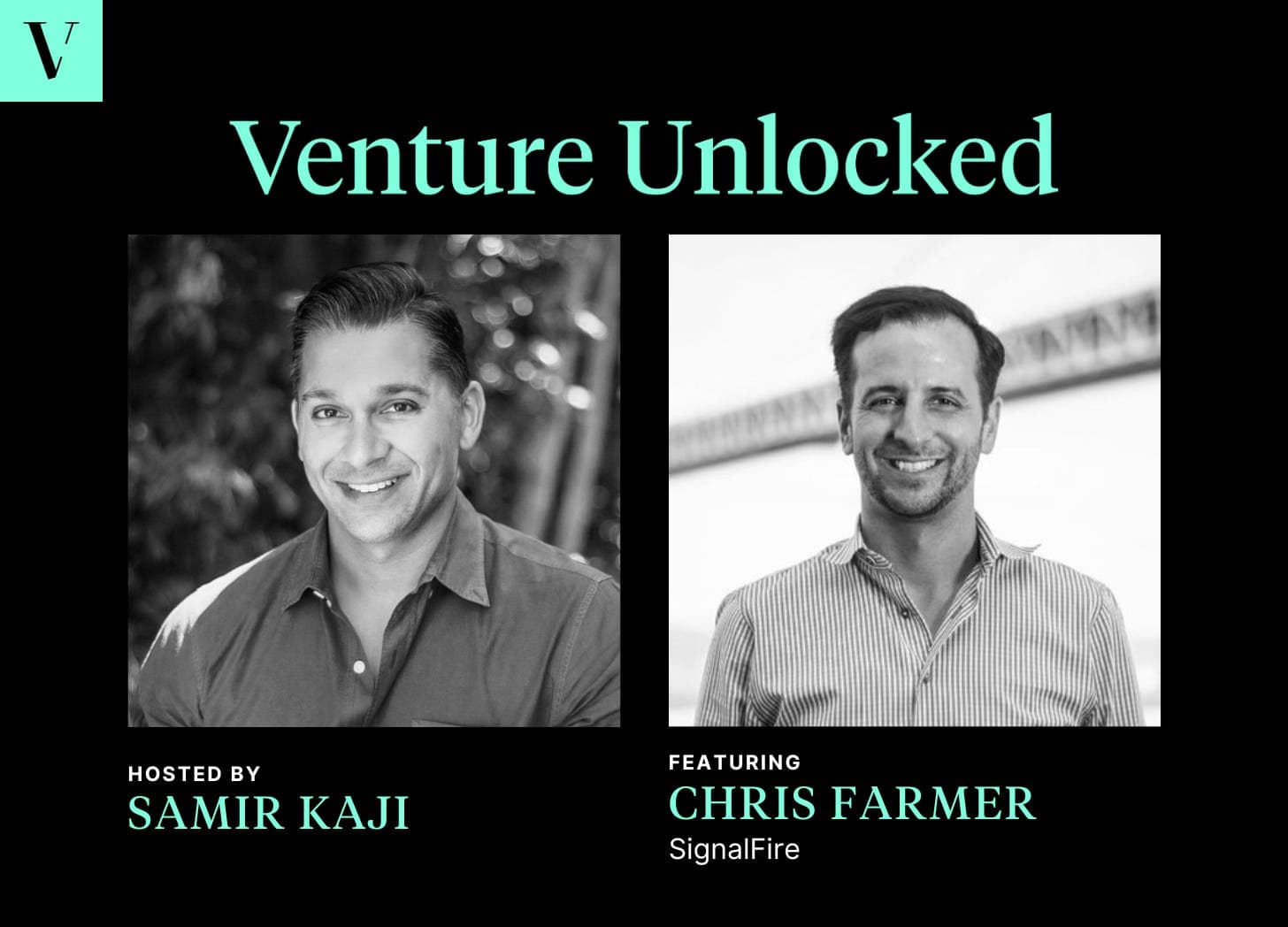
Venture Unlocked Episode Summary: Building a Next-Generation Tech-Enabled Venture Capital Firm with Chris Farmer of SignalFire
Podcast Overview
- Title: Venture Unlocked: The Playbook for Venture Capital Managers
- Host: Samir Kaji
- Guest: Chris Farmer, Founder and CEO of SignalFire
- Episode Title: Building a Next-Generation Tech-Enabled Venture Capital Firm
- Episode Description: Discussion focuses on how SignalFire leverages technology and data to disrupt traditional venture capital practices.
About Chris Farmer
- Founder and CEO of SignalFire, established in 2013 to transform venture capital.
- Previous experience includes:
- Vice President at Bessemer Venture Partners.
- Venture Partner at General Catalyst Partners, investing in companies like Coinbase and Stripe.
- An entrepreneurial history, including a turnaround of Skybitz, a SaaS company.
Key Themes and Discussions
Inspiration Behind SignalFire
- Origins: Founded as a bootstrap startup to challenge traditional VC models.
- Data-Driven Approach: Emphasis on leveraging data and algorithms to create a competitive advantage in sourcing and evaluating investments.
Organizational Design of SignalFire
- Tech Company Model: Unlike conventional VC firms, SignalFire operates like a tech firm, with structured roles similar to those in an operating company.
- Data Platform Utilization:
- Developed a proprietary data platform to streamline sourcing, evaluation, and support processes.
- Focus on systematic advantages through data and workflow improvements.
Core Functions of SignalFire
- Sourcing: Tracking extensive data on the startup ecosystem to identify potential investments.
- Picking: Combining data-driven insights with human judgment to evaluate investment opportunities.
- Winning: Enhancing portfolio support systems, including access to specialized advice and resources.
- Portfolio Support: Continuous engagement with portfolio companies to provide tailored support and avoid pitfalls.
- Portfolio Construction: Building a diversified and resilient portfolio based on data insights.
Data in Venture Capital
- Quantamental Approach: Blending quantitative data analysis with qualitative human insights to make informed investment decisions.
- Avoiding FOMO: Implementing a structured approach to deal sourcing that enhances efficiency and reduces reactive decision-making.
Navigating Market Dynamics
- Market Trends: Discussion on the impact of macroeconomic trends on valuation and investment strategies.
- Adjusting Strategy: Shift from higher-risk investments during market highs to more sustainable, lower-risk investments during downturns.
Challenges in the Venture Capital Landscape
- Resistance to Change: Traditional investors often hesitant to adopt data-driven models.
- Cultural Fit: Importance of finding team members who align with the data-centric approach of SignalFire.
Future Outlook
- AI and Technology Trends: High conviction in the potential of AI and its applications across industries, with a focus on building defensible business models.
- Investor Discipline: Importance of maintaining investment discipline in the face of market fluctuations and hype cycles.
Key Takeaways
- Emphasis on leveraging data and technology to create a more efficient venture capital model.
- Necessity for a systematic approach to sourcing and supporting portfolio companies.
- The importance of cultural alignment when recruiting for a data-driven investment firm.
- Recognition of the cyclical nature of venture investing and the importance of strategic risk management.
Closing Thoughts Chris Farmer's insights into building an innovative venture capital firm highlight the critical role of data and technology in transforming traditional investment practices. The conversation underscores the need for adaptability and discipline in navigating the evolving landscape of venture capital.
For more insights and details, listeners are encouraged to visit [Venture Unlocked](https://ventureunlocked.substack.com).
Written by AI. May contain mistakes. Listen to the episode to check what was said.
Transcript
Automatic transcript. May contain errors.0:00Welcome back to another episode of Venture Unlocked, the podcast that takes you behind the scenes of the business of venture capital. I'm your host, Samir Khaji, and on this week's show, we're excited to be joined by Chris Farmer, founder of SignalFire, a firm that was founded nearly a decade ago with the goal of disrupting the way venture capital is done. Unlike traditional VC firms, the firm has been built more like a company than a traditional asset manager, as it leverages a robust purpose-built data platform to augment its unique service model to entrepreneurs. Before starting SignalFire, Chris worked as a VP at Bessemer before moving on to focus on seed investing at General Catalyst, where he was involved with investments such as Coinbase, Stripe, and Venmo.
0:42Today, SignalFire manages nearly$2 billion in assets and has invested in companies such as Aura, Grammarly, and Rowe. During our conversation, we spent a lot of the time talking about his views on building a next-generation venture capital fund and the organizational design that goes behind it. I think you'll really enjoy hearing Chris's unique perspective on VC. Now let's get right into the show. Samir Kaji is the CEO and co-founder of Allocate. Allocate and Venture Unlocked are independent of each other. Any statements or references made by Samir or his guests regarding third parties, investments, or securities are solely their views and opinions and are not intended as investment advice or an endorsement of such parties or securities by Samir, his guests, or Allocate.
1:26Allocate or its clients may maintain relationships with or investment positions in guests, third parties, or securities mentioned in this podcast. This podcast is for informational purposes only and should not be relied upon as a basis for investment decisions. Hey, Chris, it's great to see you. Thanks for coming on. Thanks, Samir. I appreciate you having me. So I want to start in a slightly different place. I mean, you've run SignalFire now, I guess it's been 10 years. But I was looking at your website, something stood out to me. It said, we began our journey in 2013 as a bootstrap startup with a goal of disrupting the way venture capital is done.
2:01Now, there's a lot to unpack there. But ultimately, I want to know, what does that actually mean? What was that inspiration to start the firm, coming from more traditional firms like General Candles and Pessemer? The genesis of me applying data is I had run companies that had a data element to them as an operator early on in my career. And so when I got to Bessemer Venture Partners in the mid-2000s, I was covering wireless when the App Store came out. It seemed crazy to me to try to monitor the App Store completely visually. And this seemed like an awesome opportunity to apply data and algorithms to create a leaderboard, that type of thing.
2:46So that was sort of the initial wedge point, which is obviously a really narrow sort of scope. And then pretty quickly, it was clear that you'd end up with all social and ad supported gaming type applications, and you'd miss the transactional businesses or the SaaS businesses, etc. So it was very clear pretty quickly, you need to cut it with a lot more data sets in order to sort of filter through the noise, and that that needed to be approached sort of from scratch, as opposed to trying to append that into an existing venture fund. I started with a large research study of best practices and tried to take a playbook from every permutation of investing and operating.
3:30We interviewed about 170 different funds and fund types, everything from accelerators to incubators to venture funds to quant hedge funds to corporate venture groups, etc. and looked at how do you build systematic advantage through data, workflow, software, etc. No different than an operating company would benefit their sales team. And we actually took a lot more pages out of the corporate playbook than we did out of the venture playbook in the initial ideation. And I refined a bunch of these things with Jump Catalyst in the early 2010s before spinning out in 2013 with enough proof points that I was willing to sort of move from experiment into full commit mode.
4:13And the rest is history. What you're describing very much feels like a tech company, not a traditional venture. And we'll get into what it means to modernize venture and how you do it. You and I have talked about this. You always tell me I'm running a company that happens to invest. And that is the big unlock that I saw back in 2013. But what does that actually mean, that you're a tech company that happens to also invest in other tech companies? If you think of the venture industry in general, certainly from that era, you know, you basically hand someone a cell phone and an internet browser, email address and say, go hunt.
4:53I mean, there's no other industry that would ever run a sales process that way. And there's also no industry that would take basically the CEO equivalent and have them prospect, win deals, and then do a decade of customer success. And the odds that they're best in class at all of those things from sourcing, investment judgment, and being the best possible board member builder for the company are really low. And so you end up having to make a ton of compromises. And so we looked at it from a systems approach where, you know, if we have deal team members that are out hunting and trying to find the right entrepreneurs, why don't you give them qualified leads as a much more efficient way to focus their time rather than set up shop in this local Starbucks and say, I'm open for office hours, which just is insane to me.
5:43And we wanted to build a firm with structural advantage. My vision was to build the absolute best platform for the next generation of great investment talent to basically have the most leverage and maximize their odds of success. And if you could do that, you'd attract the best talent because why would you start somewhere else that just had brand, historical network, etc.? If you could build a true data advantage in a systematic way, you would attract the best talent. And then if you could attract the best talent, you'd ultimately build something institutional and much more scalable and much more persistent in producing outsized returns.
6:19That was sort of the philosophy going in. And so we broke the venture process into five core functions, sourcing, picking, winning, portfolio support, and portfolio construction, and then systematically applied first principles of how would you apply data workflow collaboration networks to each of those functions to do them sustainably in a better way than the venture industry had done historically. Let's go a little bit deeper. Obviously, you've mentioned all the things that do matter. It is sourcing, which used to be like, what network did you have? Who do you know? Picking at the early stages, largely founder-driven.
7:01Is the founder really interesting? Have they done it before? Are they really tackling a big problem and a big TAM? It's the winning, which is like, what is your value advantage? maybe you can break down each one of those pillars and how you've used data to really drive these more consistent outcomes in each one of those yeah so on the picking side of it it's what most people assume we're doing we're doing a lot more underneath the scenes to understand these things but on the sourcing side of it is we're tracking probably more data than anyone in the world on the startup ecosystem. So it's everything from consumer spend and behavior to app stores, to talent movements and clustering around companies' capital flows from smart money, chasing deals, et cetera, et cetera, as the same sort of lenses you would use as a human.
7:56You're just doing it at massive scale for 80 million entities, whether it's an open source project or a quote-unquote founder in stealth mode that hasn't even incorporated, right? You're tracking all of those even pre-formation. And we try to do things that humans do well. We're decidedly human in the loop. We're quantamental effectively. You know, humans are... Data is not going to be great at understanding the vision of a founder or the magnetism of a founder in the early days, etc. But humans are not great at tracking 80 million entities and monitoring them consistently versus episodically.
8:29And so we try to use the best of each technique and blend them together into something that is scalable, sustainable, institutionalized, and very systematic that brings a persistent edge to what we do. And so on the sourcing side, it's, you know, taking the lenses of these are my tastes, right? These are the things that I think are the characteristics of something that are important for an e-commerce company, you know, which is probably going to be more around frequency of transactions, repeat rates, you know, upsell, like all these types of things. Whereas, I don't know, the AI team may not even exist, let alone be important.
9:09Whereas if you're building an infrastructure company, it's going to start with team, team, team, right? And that's going to be, and maybe some smart money that rolls around it or an open source project or wherever it may be. The characteristics are very different for each type of company. And then we have put the team members into swim lanes and they're getting firehose of leads, alerts that are tracking from these millions of companies. So it's like a human loop cybersecurity system in a lot of ways. It's scanning all the startup activity out there and then highlighting, looking for outliers, clustering of exceptional talent, exceptional traction, or reviews or whatever it is that the community is, you know, that's out there in the public domain.
9:53And then we're giving highly qualified, basically SDR type leads to those deal team members to then go pursue the companies in their swim lanes. And what I love about it is it gets rid of the sort of paranoia of, oh my God, I've got to be at every event and do all this activity because I could run into the next Zuckerberg or Elon Musk at some party. And if I'm not there, I'm going to miss it. And now it allows you to sort of pull back, say, what are the characteristics? Let me scan this at scale. And it's as much about what meetings I don't take as what meetings I take. Because everyone is putting their best foot forward.
10:32And if you're building an AI company and have no AI talent on your team, that's probably not something that's going to get prioritized. and so on and so forth. If you have terrible retention rates with your customers, that's probably not something that's going to prioritize. But then you've got to bring the human in and understand the founder and the vision and where they're going because all you're seeing is a sampling of recent history of the company. And then you bring that human venture judgment overlaid on top of the data. But you also then, in the investment judgment piece, have the benefit of being able to see the peers and benchmark.
11:06work, right? Whereas, you know, if you're looking at company A, their competitor, company B, is not going to show you. They're just going to like, you know, open their books and show you all of their data because you're interested in investing in their competitor, right? Or if you're already invested in the competitor and then a subsequent follow-on round, they're certainly going to avoid you like the plague because they don't want to share any intelligence that you might use against them. And so having apples to apples comparisons that's independently generated from the companies gives you a sort of persistent advantage in just context and benchmarking for those investment decisions.
11:43And then ultimately winning is driven by, you know, founder MPS, et cetera. So we've built scalable systems. If you think of Y Cominers design like Stanford, you apply through an application, then run it through an algorithm. They then pull out GPA and test score equivalent characteristics of founders, put a human loop and interview them, buy a very cheap option, put them through a one-to-many support program, cherry-pick their best companies, bring in an optimized sort of fundraising environment, and then let, you know, hundreds of companies, you know, go at that point to sort of, you know, in a Darwinian-type fashion, all right, with the venture industry supporting the strongest ones over long periods of time.
12:26You know, they're designed like a university to be one-to-many. In many ways, we're designed, And if they're Stanford, we're Stanford Hospital, right? We're part teaching institution, part care institution. So we do hundreds of events a year for our portfolio companies, as much as the grad school version. We have a sales mastery series, a market mastery series, a talent mastery series, a people mastery series, which is more HR function and recruiting functions, et cetera. And then we have founder development programs and all sorts of things for scale. And then we have a network of hundred plus advisors that are specialists.
12:58So as a GP, I'm a general practitioner. I'm not, you know, I'm not the Swiss army knife to use to play that hospital analogy. But then I refer to a phlebotomist, podiatrist, psychocardiologist. We just have it all in network. Right. So you as a patient, as a founder, right, when something comes up, either preventative or acute care, you go to Stanford and know that they're going to have great care teams and all the different sub, you know, specializations that you might need. And we've done the same thing at a venture firm level. So it's a very different architecture than your typical venture firm.
13:30I'm a CEO, we have a CTO, we have a chief people officer, we have a CMO, all the different types of functions you'd expect in an operating company. And we use the same sort of technologies that a founder-facing developer tools or infrastructure company might use on everything from sourcing to support to onboarding to customer success, except for we're doing that as a venture fund. And the benefit, it turns out, we as VCs think we know everything, and the reality is we don't. We're good surface level at a lot of things, but we're not excellent typically at many things. And so this hybrid generalist specialist model actually produces much better results for the founders.
14:12Our MPS has been between something like 88 to 96 over the last seven, eight years. And over 85 % of our founders would say we're the most valuable investor on their cap table. And that's not because I'm the smartest guy in the room by any stretch of my imagination. It's because we have experts at the right time that we can introduce them to, to get the best possible judgment in that sort of acute problem. And that they have continuity of care from the deal team members and general partners, but they also get the specialist care. And we found that that's much more scalable. It's much more systematic.
14:47And frankly, you can't get orphaned as a company that happens. a lot of venture firms. If somebody transitions out, you have multiple touch points. And you're not just dealing with fire drills when something happens. You're able to much more systematically support companies preventatively before something happens versus like, here's something that aborted me and then overreact. It's just we look at it fundamentally differently in the way that we support portfolio companies. And that ultimately leads, that NPS leads to a closing playbook and reference ability because we don't have decades of brand to sort of rely on that really helps us close at a very high level over 90 % of our term sheets we win because it's just clearly night and day in the level of support and quality of support in a super tangible way.
15:32Then we use software as well to make these things scalable. We build a fellow SaaS recruiting platform, a full lead gen platform for our portfolio companies using the same data sets to take your ideal customer profile and then give you all the doppelgangers or a recruit candidate that you're doing and give you, you know, large scale lists of candidates that you can then pull into your ATS or, or generate lead lists that, that hands your recruiters. And we can support an unlimited number of recruiters at an unlimited number of companies at the same time, because it's built in data and software, right?
16:02And you can only get it through us if you're a portfolio company. I heard you say a few seconds ago that, you know, you have a CEO, you have a CTO, you have a CPO. I think in the early days, much of the team was actually engineers, not traditional investors. I thought we would have seen much more in terms of the use and application of data within venture firms. We haven't seen that much. In fact, I've seen it maybe pulled back a little bit in terms of people that are looking to build these models. And some of that has come because there's this natural tension point between does the data inform the decisions and the way the firm runs, or do the people then inform sort of the systems?
16:41How do you think about sort of these natural tension points? Because traditional investors at VC firms, it is, you know, I'm sitting across the founder, I'm looking into the future versus the data often is backward looking. So there's a bunch of reasons why. Well, some of them we were very fortunate to anticipate. Some of them have been surprises or learnings along this journey. If you look at the top quant hedge funds, because the way that they approach the business, the way that they recruit, the way that they construct a portfolio is radically different than a traditional analog hedge fund or mutual fund, right?
17:16There's only so many companies a human can analyze deeply in order to have conviction. And so they build much more concentrated portfolios and have a very different sort of approach. The reason the hedge funds that are quantitative tend to persist over much longer periods of time is they're taking many more micro risks and taking advantage of many more arbitrages over a much larger portfolio because they're rules and data-driven as opposed to sort of manual. So they may be in and out of a position in seconds, right, let alone by the end of the day, whereas many of the hedge funds are much longer duration because the opportunity cost of analyzing that company deeply takes a long time.
17:55So if you actually look at the quant hedge fund world, not a single one of the top quant hedge funds started as an analog fund and converted, right? They all started de novo as quant funds. Because Fidelity is not thinking about how to run fiber optics from Chicago to New York to shave milliseconds off a trade. Or how do I co-locate to the closest server to the exchange to shave another millisecond? Or how do I ingest that Goldman analyst report using NLP so I can trade off sentiment before you can read the first sentence as a human? It's not, you build different structural advantages. As a result of that, it's very hard for companies to sort of transform.
18:31We've seen the technology industry all the time to move from one paradigm to a modern technology stack or an AI-driven approach versus a sort of traditional SaaS approach, whatever it may be. It's very hard to reinvent yourself because in the quant hedge funds, the quants are the kings. In the traditional analog world, it's the portfolio managers or the analyst or whatever it is. And if you look at the venture world, it's the founder-facing deal partner that gets all the heat and light. right and the it the data guys are the it guys in the broom closet right and they're lucky they get any light you know let alone like free lunch this is where you know from day one we made everyone at signal fire on the investment team everyone on the entire firm gets carry we tell everyone on portfolio support you're a feedback luke on these companies and can help inform investment decisions they may not be deeply involved in the first investment but they're very deeply involved in follow-on investments in those decisions.
19:25How are they building their team? How are they converting customer leads? What is their learning trajectory? Because those are all leading indicators of ultimately how a company will thrive. And the engineers and data scientists are involved in the entire process. They source leads, they can help with diligence, and they actually do consulting advisory work to the portfolio to keep it interesting, but also to elevate them to their deserved stature as equals within these firms. From day one, we had no deal attribution. We did a lot of things structurally to make sure that they understood that this is a firm that deeply appreciated and cared about equally what they were doing on the engineering side as the quote-unquote deal team was doing on the founder-facing side.
20:09And all of that was critical to, we have the same CTO that we had for our founding. Our two top data scientists have been with us for close to a decade. You know, this is the consistency is very different than other venture firms who churn through whatever engineering efforts they have over and over and over again. And you also have to have a conviction and a tolerance to go through the mess of, I mean, we're seeing it in generative AI, right? The outputs on this stuff is noisy, right? And you've got to do all the annotations and the editing and the training to get it better and better and better.
20:41So we've been willing to go through that pain for a decade now. And that's very hard. No matter how much money you throw at this problem, it takes a long time in iteration to get it right. No different than the best LLM take tons of time and capital to sort of get them tuned to high fidelity. That's been something that's really hard to do in a traditional venture construct. As a senior partner, you're not incentivized to make a five, 10-year investment in technology that may not yield anything or may have negative yield in the short to medium term during your tenure. You're incentivized to throw bodies at the problem that will immediately pay dividends, even if it's not the right move long term strategically.
21:22When you look at all of those different sort of functions, I think about, we can go back to the earlier point of sourcing, picking, winning, portfolio support, portfolio construction. All of those things have what I see is a structural and systematic way of operating using both humans, as well as using sort of the technology that's purpose-built for what you do. When I think about those things, though, venture is a long feedback cycle. It takes a long time to know if you're doing well. At the same time, companies have OKRs. They have KPIs that they manage to. How do you think about sort of the success of this model, which is novel in terms of it takes a long time to get DPI.
22:04It could be 7, 10 years before you really know directionally where the portfolio is going to go. So how do you think about KPIs and OKRs? Yeah, I mean, the book on OKRs was literally written by venture capitalists, and yet almost no venture firms actually operate on that. We do, of course, and try to dog food our own thinking. But, you know, it's different for every function, right? On the sourcing side, you're looking at not necessarily the outcomes, but are these leads of companies that are high fidelity with companies that get invested by high quality investors upstream? If they are, I want to see that lead.
22:48Even if we choose not to invest, I want to see that lead in a window of time that I could have invested and led the deal. right it doesn't help me to get an alert after you know one of my peers has has led the investment that's a tombstone of a missed opportunity that's not that's not helpful signal on the portfolio support side are what's the engagement it's very much like a consumer enterprise app over 65 of our companies are on our platform on a weekly basis so you can look at utilization rates right this is product market fit the same things that we look at for a sas company apply to ourselves and what is the output of this right we use humans to train our founders and their teams on how to recruit and best practices and interviewing and calm studies and all this kind of stuff you know and techniques of sourcing but then we also give them sonar to make sure they're fishing in the right waters and give them leads on who's actionable right now who's in market who's showing signals of that who's high quality those types of things how do i give them additional information on how to contact them so they're not trying to do it through some channel that they ignore like, you know, LinkedIn Inmail or whatever it may be.
23:54All these things we're constantly doing. Then we do surveys and we do quantitative studies and we use the same analytics systems on usage that all of our portfolio companies would use, right, on their own products. Which pages are people visiting? What's the duration on it? How many people are using it? Are they the right people in the organization? Et cetera, et cetera, et cetera. We brought in product leaders who had run these types of products at Facebook and had founded companies. And so we have had a product who runs it no differently. We're selling and marketing to founders. So we brought in the CMO of Stripe, whose job on customer adoption was a freemium approach selling to founders as early as inception.
24:38It's the same sorts of techniques. We bring in domain experts that are going to use the same best practices. I mean, the irony is all these playbooks were written by our own founders many years ago. And the venture industry is just beginning to use any of them if they're using them at all. So there's very proven playbooks that we can use to make sure that we're making efficient, higher ROI investments. And we sunset products if it's not getting traction, no differently than a company would. And making sure that we then reallocate resources on things that are higher impact for our portfolio companies.
25:13And then the world changes. You know, it was all recruiting before the financial correction, but now it's on sales efficiency and other types of things as companies have to make better use of the resources that they have. You know, we have to adapt with the times and constantly be challenging ourselves and asking the hard questions. Are we getting the ROI? No different than the same sort of product review process would be at a tech company. Why do you think, I mean, if you kind of go back, I mean, venture has been around for 60 years, I think 70s and 80s, when it started to become a little bit larger and of meaningfulness in terms of some of the big firms coming to market.
25:52But it hasn't really changed too much in how it operates. There's been small changes around the edges, but fundamentally, what you're describing is a tech company and you have your clients, which are your portfolio founders. You have LPs that are your shareholders. You have your advisors that are acting as maybe the third part of this marketplace that are fundamentally adding value to this nucleus of overall value that you have as a company. Why do you think we haven't seen as much evolution in the venture market toward models like this? There have been lots of people who have tried. It's really hard to bootstrap.
26:32We had to do all sorts of unnatural things that causes all sorts of headaches and problems in order to get off the ground. For example, on our first fund, a$50 million fund, our AWS bill was half our management fee. Our credit card data set was more than the entire management fee, and we haven't hired anyone yet. And so we had to do corporate advisory and recruiting and all sorts of different things to have other sources of revenue outside of management fee, and we had to raise money from day one. And so we went out and found the most important angels and advisors and technologists, et cetera, in the ecosystem that had massive angel portfolios across them.
Read the full transcript
27:10And we systematically cherry-picked them over a couple of years of one-by-one-by-one recruiting them to raise millions of dollars for the operating company itself in order to basically deficit spend in the early years at a 5x or so multiple of management fee in order to take these losses on this bet that we were making that we could build a platform that would be much more systematic and institutionalized than your typical venture fund. But then you have a chicken-the-egg problem because no LP wants to jump into some new quantitative approach to venture if you haven't built the platform yet, right?
27:47But you can't pay for the platform if you haven't raised the capital yet. And so how do you balance these two things? And so we had to be really creative and scrappy, and the team did an exceptional job of having multiple jobs, VCs by day and management consultants by night to the Fortune 100. We did everything from merger and acquisition research to post-merger integration work to competitive intelligence to hedge funds, quant hedge funds, operating companies, etc. We had many of the Fortune 100 as clients in the early days in order to keep the lights on, in order to amortize the expense of the data.
28:25And most people that come into venture want to be venture capitalists. They don't want to do all those things. You know, it's really hard chicken and the egg problem, but we somehow managed to get through it. And I think a lot of other people haven't done that. You've seen like Google Ventures or KOTU or people that were existing entities that had sort of a quantitative orientation to them, you know, do permutations of this. but it's really hard to bootstrap from nothing. But then the irony is that if you don't start it from nothing and you try to append it to an existing organization, as I mentioned with hedge funds, it's very hard to make that transformation.
29:03And so the incumbents have really struggled to do it. And unless you had other revenue streams that could deficit spend for a substantial period of time, it's really hard to bootstrap off the ground. And I think that's what's constraining the amount of competition. And I can imagine those early days of if you had gone out and raise that$50 million fund without any of the data, and it was just a hypothesis, it would have been very, very tough. You had to show something. Thinking about sort of the evolution of the platform, of course, you're collecting more data points, you're evolving it, it's becoming smarter, you're figuring out what doesn't and does work.
29:37And that's great as you build more robustness in it. But at the end of the day, you're still adding people and you are adding people that are traditional investors who may not be used to this kind of model. So were there cultural characteristics that you looked for when you were looking for traditional investors? And what did you learn in terms of the right characteristics for these new type of models, like the one you run? One of my early learnings in recruiting was looking for people who were already doing the job on their own as a side hustle or whatever, but didn't realize that this even existed.
30:12And when they found that this existed, they were all in. They were predisposed to do it even before I had to sell it. So, for example, my co-founder and CTO, Ilya Kyrnos, had spent a decade at Google. And one of the things, in addition to doing all the search and infrastructure engineering types of stuff, his 20 % project was a prediction market using all of the sort of wisdom of the crowd of Googlers to predict which products were going to be successful and come out on time and all these types of things. So he already was predisposed to this, like, how can data be applied to the real world in order to predict eventual outcomes?
30:45I was introduced to him by the founder of Google Trends. You know, I was going up to like very specific people who had already shown a predilection. Other people like one of my partners, Wayne Hugh, had tried to build a, you know, like his own bootstrap version of this. And we've had a number of people over the years who have been at venture firms and said, oh, I want to create my own competitive advantage and try to do it on themselves in a bootstrappy kind of zero budget way. And then got frustrated. I'm like, oh my God, someone's going to build this for me to give me this advantage. and they were quick to jump on board and had pre-sold themselves.
31:19I didn't even need to do it. The hard work was done. The hard work was finding them, not convincing them that the data could give them advantage in this world. And the same was true of LPs. A lot of our early LPs had come from where technology had given them advantage ultimately in their own business, whether it was a technology business or the investment business or whatever it was. And so we had a lot of people who were new to venture, but were sort of very quantitated by nature. or quant hedge fund founders, or technology company founders. And then we were very fortunate to get some big fund of funds as well that had a very quantitative orientation to how they screen managers and were predisposed to believing that data would give you an advantage in the long term.
32:03And what I said is, if you believe in the judgment of people, the judgment of a person with a data advantage is going to win consistently. And that's what you've got to believe. This is not some black box AI thing. Even though we were using AI from day one, we actually downplayed it because people were afraid of the black box. Is the algorithm going to pick it? It's like, no, the algorithm is going to help deliver better leads to people and drive more efficiency in filtering and sourcing opportunities, give them more coverage than they'd be able to do manually. And then we're going to bring the best practices from that world.
32:38And so we also brought in Walter Korchuk, who'd run Summit Partners prior to that, which themselves used data at advantage from their founding in the 1970s. Their version was subscribing to every newspaper and looking for job listings as signs of growth. And we obviously did that at massive scale using data and search-like technologies. But he immediately recognized how you could uncover sort of hidden opportunities that as a result were in front of all of the venture capitalists, et cetera. But unlike Summit, which sort of we're finding like hidden gems and sort of off geography places, because we were getting in very early, we actually focused in the sort of most overcapitalized markets and said we want to get the things before and then get paid for the risk we're taking by having so much capital upstream that we get good markups for the traction that we're getting as opposed to buying later stage companies that other people don't know about.
33:30You mentioned something there that probably is a good segue, having some discipline, what you pay up for, getting that outsized return. In a time period that we've seen pre-2022, we were in the ZERP market for a long time. 2018, 19, particularly 20 and 21, everyone is overpaying. And I think, you know, we had this conversation just a few weeks ago where your actual valuation entry price actually decreased during that time, which is almost antithetical to hype cycles. What did the data show? How did you resolve your own investing sell during a time where, you know, you had capital deploy is really, really difficult to say no to deals?
34:202018 and 2021, we got very concerned about the untethering evaluations from relative traction. And it's no different than looking at the public markets and saying, what are the like PE ratios that companies are trading at? They fluctuate and sometimes they're under historical norms, they're way over historical norms, they're at all time highs. And we were effectively at like all time high territory. And I'm a big believer in gravity. I think it's an immutable force and eventually it sets in. Now, it may take longer than you expect, but it's pretty hard to stop. And so, you know, we were just looking at the uncoupling of traction, which we would have quantitatively relative to pricing.
35:00Right. And just saw that we were at relatively all time highs. That made me nervous and then wanted to trade risks. Right. And so we traded down risks. So we lowered our cost of entry into companies by a little over 20 % between 2018 and 2021 when our peer group was paying somewhere between 180 and 300 plus percent more for the same company. And so if you had a 9x portfolio, but you're paying 3x, which you were historically, that became a 3x portfolio. You had a 3x portfolio, that becomes a 1x portfolio, right? And the math is pretty simple. Unless something has fundamentally changed. And there are some arguments to it.
35:38The technology industry is bigger. It's now every industry, et cetera. But at the end of the day, you know, things tend to regress to sort of historical norms one way or another. And then it's upside if there is some structural shift. And so we said, you know, we're going to trade execution risk. We're going to trade financing risk, technology risk, et cetera, and go earlier. And so we had seed through B, and we basically stopped doing 80 Bs and went earlier. We did pre-seed. We added a pre-seed program, so pre-seed, seed, post-seed, A, aggressively layering up into companies, got higher ownership, and then we were willing to take dilution versus dollar cost averaging up with each subsequent round at disproportionately high follow -on rounds.
36:19The risk adjusted as you started to get into these really high revenue multiples on companies just felt detached from the true risk return profile of these companies. And so you can't leave the market and get out of it, but you can say, if the market's going to overpay for things, I'm going to bring net new companies in as opposed to be a price taker. We had a number of things, including adding different strategies to what we were doing to try and maintain as much discipline as humanly possible in a market where there was a lot of Kool-Aid drinking, right, and focus. And then we also shifted risk profiling.
36:57We looked at which were the most resilient sectors in economic downturns, and we heavily overweighted to defensive sectors and underweighted to sectors that we thought were going to get clobbered. So specifically, we overweighted to SaaS, infrastructure, cyber, health tech, etc., underweight D2C, ad-supported companies, R &D projects that were highly relying on the capital markets in order to fund these projects and had no real bridge to revenue, quantum computing, autonomous driving, those types of things. And so you can't just be like, oh, I'm going to cut costs and get to profitability when it's a massive R &D project.
37:34These are companies that can be like massive wipeouts. And we were underweight crypto because we really struggled to see the actual utilization of these things. We love the vision and the story, and there was incredible talent going into it. But we ended up massively underweight in that sector as well, which really hurt us in that period. So it took a lot of conviction to stay there, but it helped us a lot in 22, 23. One of the toughest things, obviously, to do is market time anything. It's very difficult to know where you are in a market cycle. You can feel heat or you can feel maybe like times like this where things have maybe been oversold to a certain degree.
38:11What has happened in venture, at least historically, is during these hot times, you don't know when it's going to end. Many times at the very tail end of a cycle, you do have people that think we're maybe in a new paradigm. Things have changed. Multiple expansion is here to stay. Now, history shows us that's not the case and things will eventually go back, as you mentioned, to gravity. But during that time, you also took risk as an organization that you were foregoing deals. And if this 2022 didn't happen and this continued to 23, 24, 25, you may look actually poor relative to your peer cohorts who got into deals who paid slightly more.
38:55How did you reconcile that risk calculus in your head? It was hard. It was hard on the internal team side. Some of the younger principals felt that we were being too cheap and, you know, weren't competitive. And they went to larger platforms that were going to be more aggressive. And we had LPs that were, you know, looking at our performance, we started dropping out of the top quartile on things. And because we were underweight, some of the hottest sectors like fintech and crypto and whatever, you know, that hurts you on the way up. right but then when the market corrects and you know we're up in quarters on you know in 22 or 23 or whatever it is then you're getting back slapped and congratulations from the same people that were kicking your teeth in two years ago which i always find interesting so it takes a lot of conviction but you know i learned this lesson early on in life as a former center professional blackjack player and these are situations i was a professional card counter was was keeping track of the deck and what is it was a very common issue in in blackjack in particular because you'd sit down at the table with 50 bucks and you just go on a run and you know you you take that 50 bucks and you turn into 500 now you feel like superman you were it's impossible for you to lose you just gotta you just are so good right and then you just cannot hit anything the dealer's gone from busting to hitting 20s and you're doubling down on your 11 and getting a five and you're like what the hell is going on?
40:17Why did my luck change so badly? And what happened was the aces of the face cards, the great setup came out on the first half of the shoe. And then the back half of the shoe is inherently, you know, like a bunch of small cards that are going to mean you're not going to hit your 21s and the dealer's not going to bust. And so you get back all the money, then you're going to hit the ATM to try and replenish and win it back. And the reality is you should walk from the table when the count moves against you. And if you look in 2010, there was scarcity of capital. You had three macro trends in mobile social cloud that were sort of massive technology disruptions.
40:51You could get in a really attractive pricing. Everyone was under, you know, had smaller funds that were too, you know, small by comparison. And so you could get, plant the seeds for fantastic returns. And then as you got to sort of mid-decade in 2015, 2016, the returns look so good that capital piled into the market. And now everyone's trying to deploy a multiple of the capital at much higher prices. Now you're paying three times for the same company, right? Thinking that this party is going to go on forever. When if you look at some of the best angels, you'll see them with their own pocketbooks.
41:24They just start angel investing. You're like, but you were so good at this. But what made them good, the fundamentals were no longer there. And so we just try to be cognizant of that as an institution. And sometimes you're much more aggressively risk on. And these are like sayings in the financial world. When there's blood in the streets, that's where you have your opportunity. And when everyone feels invincible and everyone's rushing into the market, that's when you should be a seller or sitting on the sidelines. It's really hard to execute in reality, and you can't sort of pull in and out of the venture market like that for structural and operational reasons.
42:04But you can rotate your orientation earlier, more price discipline. You know, you can shift to more defensive sectors, et cetera, that are more likely to weather the storm, just like you might shift from consumer discretionary to consumer durables. And there's lots of learnings across the investment world that we just try to apply in our own backyard. Yeah, it is tough. And look, I mean, there's a lot of incentives that lead people to raise bigger funds to deploy very quickly. We saw many funds actually deploy over a 12-month span and almost vintage-year funds. And there was a time where firms raised new funds every three or four years.
42:43And then it almost felt like it was every 12 months, every 18 months, new products during that time. We kind of went into this world where venture became kind of mass finance, lower hurdle rates, AUM gatherers. And things have definitely changed. We've seen that in 2023. So it'll be interesting to see how this next era, of course, we've talked about generative AI. I think there is a lot of heat there. but fundamentally it is a big platform similar to what we saw in 2010 with mobile and cloud tying this all together i'd love to hear just where you think we are right now and ultimately what are some of the things you think you'll see over the next 12 to 18 months in terms of how you operate as a business relative to maybe what you mentioned in 18 to 2021 you know i see there's a few areas that are, you know, people are very high conviction on as sort of major macro structural technology shifts.
43:40You know, one of them clearly is climate, which is not an area of our particular expertise. Another one is crypto, which was an area that we personally didn't have huge conviction on a lot of the use cases that we continue to monitor it. But AI obviously is one that's gotten a lot of hype, where we do have incredible conviction, particularly that we're an AI native fund from day one, investing in the application of AI into sort of myriad use cases. We have very particular views on where you're going to build defensibility and moats. And it feels like the market has been indiscriminate very quickly because it is probably the fastest sector to get to consensus across the entrepreneurial capital and corporate ecosystem simultaneously i've had one bc that's that's a legend in the industry in his 80s today and he said in his entire career he's never seen the converges of those three groups you know a lot of like the internet or crypto all these things took many more years to move from sort of fringe into the corporate mainstream and for the capital allocators to really sort of recognize it as an opportunity And it's pretty stunning how quickly that has happened.
44:50But that doesn't mean that a lot of these things are going to be defensible over time and are not going to commoditize. And I think a lot of the sort of foundational NLM pieces of it will accrue to the massive capital sources that can invest in the infrastructure like the Googles, the Microsofts, the Amazons of the world. but there are going to be tons of opportunities for startups who can build data network effects and moats and workflows, et cetera, that use AI as a wedge, but ultimately have a lot of stickiness to what they're doing. It helps them disrupt the last generation companies, but because of the workflow elements or whatever, they have more sustainability to what they're doing.
45:29So I think you have to be very selective in these things. Our data is super useful in helping to filter through the noise because just like everyone was a dot-com back in the 2000s. Now everyone's an AI company. And you have to see, is there really like a plus AI talent behind it? Because that's pretty foundational to this. But you need to bring together different groups. And so we started an AI lab, for example, to get in at the sort of ground floor, bringing corporates together, entrepreneurial talent from specific domains, and AI talent who's typically coming out of the consumer side of things.
46:01They all come from different ecosystems, So we want to be the nexus of them coming together to create these next generation companies using the data sets that these corporates may have as pilot customers, to train models, etc., to bring some sort of sustainable advantage versus everyone trying to create the same apps built on top of OpenAI, which is phenomenal as a product. It doesn't lead to enough differentiation for the upstream apps to likely have something sustainable unless they're really fortunate to build that in. Yeah, it goes back to a lot of companies I think are being funded at unbelievable valuations without really a defensible net mode.
46:39And we will see some follow up. But I do agree with you in the fundamental premise of AI as a major sort of platform, where we are going to see maybe some of the biggest changes. In fact, I think, has at least the potential to be bigger than mobile and cloud. I think it's just in the early days. I agree. I think it's going to be as big as any technology shift, if not larger than all of them combined that we've seen in human history. I mean, its impact is on every industry simultaneously and tons of workflows within it. So we're very high conviction on the future of venture and of the technology industry.
47:17And if you look at the market caps of the world, that's more of the consensus view than a contrarian one. But, you know, I think we just need to be really disciplined in how you navigate very early innings. And it's a marathon. And you've got to pick your battles as smartly as you can and hope that we get a little luck as well. Yeah, I think it just goes back to you can have a great technology that is truly paradigm shifting, but doesn't mean the investment case is always a good one. And that's, I think, what we'll see. But Chris, I really appreciate you coming on. This has been a lot of fun. Congrats on all the success so far at SignalFire.
47:53Thanks, Samir. It's great to chat, and I really appreciate you having me on. Thanks so much for listening to another episode of Venture Unlocked. We really hope you enjoyed our conversation with Chris. To learn more about him or SignalFire, be sure to go to VentureUnlocked.substack.com for detailed notes on the show, as well as my ongoing commentary about the world of venture capital. Venture Unlocked is also available on iTunes or Spotify for download. And while you're there, please leave us a rating and a review as it really helps us out. And don't forget to hit the subscribe button in order to get each and every Venture Unlocked episode as soon as it's released.
48:42Thank you.
From the publisher
Follow me @samirkaji for my thoughts on the venture market, with a focus on the continued evolution of the VC landscape.
We're excited to be joined by Chris Farmer, Founder and CEO of SignalFire, a firm that was founded nearly a decade ago with the goal of disrupting the way Venture Capital is done.
Unlike traditional VC firms, SignalFire has been built more like a company than a traditional asset manager, as it leverages a robust purpose-built data platform to augment its unique service model to entrepreneurs.
During our conversation, we spent a lot of the time talking about his views on building a next-generation venture capital fund and the organizational design that goes behind it.
About Chris Farmer:Chris Farmer is the Founder and CEO of SignalFire. He was previously a Venture Partner at General Catalyst Partners, supporting notable companies such as Alation, Coinbase, Stripe, and Venmo. Prior to this, Chris served as a Vice President at Bessemer Venture Partners specializing in digital media and mobile investments.
In addition to his venture capital experience, Chris has demonstrated his entrepreneurial prowess by spearheading the turnaround of Skybitz, a wireless-enabled SaaS company.
His career began on Wall Street in the private equity group of Cowen & Company, and he holds a B.A. from Tufts University.
In this episode, we discuss:
(02:13) The inspiration to start SignalFire after stints at iconic firms like General Catalyst and Bessemer(04:42) Being a tech company that happens to also invest in other tech companies?(07:21) How Chris uses data to source and evaluate new deals(16:53) Balancing a founder’s past performance and their future potential(22:13) Thinking about OKRs and KPIs when starting a different sort of firm(26:28) Why hasn’t venture itself seen more innovation as an industry(30:00) How he recruited and found the right team for this new model(33:30) Why data was able to help the firm to avoid the pitfalls of the recent bullrun market(38:58) Balancing data and FOMO as a firm(43:30) What the market will look like over the next 12-18 months
I’d love to know what you took away from this conversation with Chris. Follow me @SamirKaji and give me your insights and questions with the hashtag #ventureunlocked. If you’d like to be considered as a guest or have someone you’d like to hear from (GP or LP), drop me a direct message on Twitter.
Podcast Production support provided by Agent Bee
This is a public episode. If you would like to discuss this with other subscribers or get access to bonus episodes, visit ventureunlocked.substack.com