In short
Venture Unlocked Podcast: Episode Summary
Episode Title
Evolving Venture Liquidity Solutions with Gaurav Mathur of Pinegrove Capital Partners
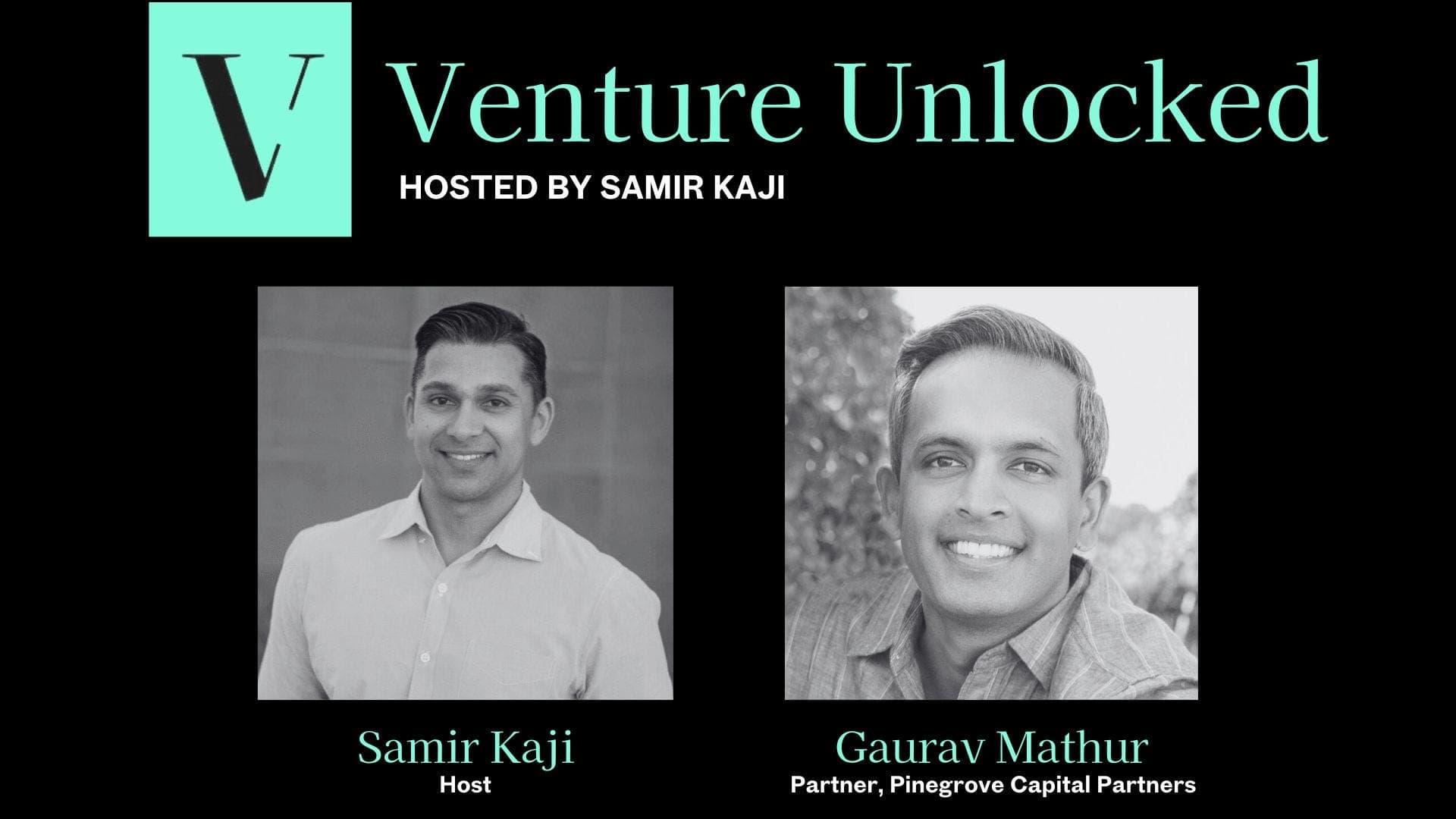
Podcast Description Venture Unlocked is a podcast focused on providing insights and playbooks for starting, operating, and scaling successful venture capital firms. Hosted by Samir Kaji, who has over 20 years of experience in the venture capital landscape, the podcast aims to offer guidance on VC fund management.
Guest Profile
Gaurav Mathur
- Title: Partner at Pinegrove Capital Partners
- Background:
- Co-founded Pinegrove in 2023.
- Over 18 years of experience at Goldman Sachs as Managing Director in Investment Banking.
- Holds a Bachelor of Science degree in Business/Commerce from the University of Virginia.
- Pinegrove Capital Partners:
- Focuses on venture investment solutions including fund of funds, venture debt funds, venture secondaries, and co-investments.
- Backed by a $500 million commitment from Sequoia Heritage and Brookfield Asset Management.
Episode Overview In this episode, Samir Kaji converses with Gaurav Mathur about the evolving landscape of venture capital, emphasizing the need for enhanced liquidity solutions and the growth of secondary markets. Key topics include:
- Growth of assets under management (AUM) in the venture capital sector.
- Mechanisms for generating liquidity such as continuation funds and secondary tenders.
- The importance of alignment between general partners (GPs) and limited partners (LPs).
Key Topics Discussed
- Growth of AUM in Venture Capital (3:53)
- Discussion of the significant increase in AUM in recent years.
- Comparison of venture funds' growth to private equity.
- Data-Driven Insights on Liquidity (6:11)
- Analysis of capital called versus distributed in venture capital, highlighting a high ratio indicating potential liquidity issues.
- Importance of consistent distribution to LPs.
- Private Markets Growth Forecast (11:03)
- Predictions on the continuation of growth in private markets.
- The impact of companies staying private longer, with average IPO timelines extending.
- Mechanisms for Generating Liquidity (17:00)
- Overview of liquidity-generating strategies including:
- Continuation funds.
- Strip sales.
- Secondary tenders.
- Alignment in Continuation Structures (21:28)
- Emphasis on the need for alignment in interests between GPs and LPs to facilitate successful liquidity events.
- Sizing Continuation Funds (29:44)
- Discussing the factors influencing the size of continuation funds and the dynamics involved in their setup.
- Exploring Strip Sales (31:36)
- Examination of how strip sales work as a liquidity mechanism and their growing acceptance in the venture landscape.
- NAV Lending as a Liquidity Tool (34:00)
- Discussion of the potential for NAV lending to provide liquidity options for GPs and LPs.
- Growth of Liquidity Solutions (37:35)
- Insights into how liquidity solutions are evolving in the venture capital market.
- Technology's Role in Liquidity (41:14)
- The potential for technological advancements to facilitate better liquidity options and transparency in transactions.
- Final Thoughts and Takeaways (45:55)
- Gaurav Mathur shares insights on the future of liquidity solutions in the venture capital sector and the role of technology in facilitating these changes.
Key Takeaways
- Evolution of Liquidity Solutions: The growth of venture capital has necessitated improved liquidity mechanisms to address issues like delayed exits and long holding periods.
- Importance of Alignment: Successful liquidity solutions hinge on alignment between GPs and LPs to ensure mutual benefits during transactions.
- Role of Technology: Advancements in technology are anticipated to streamline liquidity options, offering greater transparency and efficiency in secondary market transactions.
Closing Thoughts Samir Kaji encourages listeners to share their thoughts and questions about the podcast and its content on social media, and invites potential guests for future episodes.
Additional Resources
- [Venture Unlocked Substack](https://ventureunlocked.substack.com?utm_medium=podcast)
- Follow Samir Kaji on Twitter: [@samirkaji](https://twitter.com/Samirkaji)
- Pinegrove Capital Partners: [Website](https://pinegrovecp.com/)
---
This summary encapsulates the essential discussions and insights from the episode, providing a comprehensive guide to the evolving venture liquidity landscape as shared by Gaurav Mathur.
Written by AI. May contain mistakes. Listen to the episode to check what was said.
Transcript
Automatic transcript. May contain errors.0:08Welcome back to another episode of Venture Unlocked, the podcast that takes you behind the scenes of the business of venture capital. I'm your host, Samir Kaji, and today's guest is Gaurav Mathur, co-founder of Pine Grove Capital Partners. Pine Grove is a new secondaries firm that is backed by Sequoia Heritage and Brookfield Asset Management. Post their recent acquisition of SVB Capital, the firm now invests via secondaries, fund-to-funds, venture credit, and co-investments. As venture capital has grown as an asset class, the need for more robust and institutional liquidity solutions are needed.
0:40In my conversation with Garab, he brought his unique insights into where he sees the venture secondary market going, the inspiration for launching Pine Grove, and general trends that are emerging today, which he believes will be secular. Hope you enjoy our episode. Samir Khadji is the CEO and co-founder of Allocate. Allocate and Venture Unlocked are independent of each other. Any statements or references made by Samir or his guests regarding third-party investments or securities are solely their views and opinions and are not intended as investment advice or an endorsement of such parties or securities by Samir, his guests, or Allocate.
1:18Allocate or its clients may maintain relationships with or investment positions in guests, third parties, or securities mentioned in this podcast. This podcast is for informational purposes only and should not be relied upon as a basis for investment decisions. Gaurav, it's great to see you, man. Thanks for having me, Samira. Really appreciate that. So we're going to get into the world of secondaries and liquidity and in venture and growth, of course, today. Liquidity is such a hot topic given with the marketer the last two and a half years. But maybe a good place to start for us is let's talk a little bit about Pine Grove.
1:55What was the inspiration that led to you and Brian creating the firm and maybe some of the tailwinds and observations you saw that led up to it? We started building the plan around pine growth based on a simple thesis. In our observations, I had the fortune of spending 18 years at Goldman Sachs, my partner 17 years at Oak Tree. And as students of the capital markets, there's trends that drive growth in different asset classes. And I think a lot about studying those asset classes over the last couple of decades. And I try to create analogies on what was the creation or the impetus for new asset classes along the way.
2:41And in private equity secondaries, you had this growth in private equity. And then And you had this structural advantage in private equity whereby it led to a very robust secondaries market because the structure is such where you have middle market sponsors that are selling to other sponsors. Interesting. As the growth ballooned in private equity, it created a financing market. It created other tangential ways to invest. Think about private credit. there's a big boom in private credit as a result of regulatory driven changes, same in structured finance, et cetera. And then as we were observing venture and secondaries, a lot of the catalyst in our mind was similar, which was significant growth in the AUM of the asset class.
3:35If we tried to start Pine Grove a decade ago, I don't think the same ability to invest in different ways and the same adoption may have been there. But as a result of the significant growth over the last decade,$4 trillion of AUM,$3 trillion of unrealized assets, that creates an opportunity. And we said, within that opportunity, then how can we create a differentiated investing thesis and be a great partner to GPs, LPs, and founders, but with what we think needs to be a very flexible way to invest and provide solutions. Because at the end of the day, the structure, back to the structure around the way venture GPs and LPs think is quite different.
4:24Yeah. So when we think about the size of the market, obviously, we've seen the number of participants increase in terms of the funds have gotten bigger. We have certain firms, the Antaresans, the Sequoias, the world, which in many ways, you can draw the analogy to the big, the Blackstones, the Apollos, the Carlisles, the private equity. In many cases, the AUM, those firms are exceeding what was total in raised by VC funds in a single year back in 2009, 10, 11, and 12. And a lot of that's been driven by the fact that companies are staying private longer. 25 years ago, companies often would go public in four or five years.
5:02Now it's 12 years, maybe even 15 years in certain cases. But what's really changed? Because from an LP standpoint, the view on venture, long-term illiquid, if I want shorter-term illiquidity, I can do private credit, I can do private equity. Why do you think there's this shift in venture where people now are looking at, how do I now solve for this illiquidity that maybe in the past people were just willing to accept it within venture capital? I think it's the heart of an important trend, Samir, which is Fine, the size has changed, but I think there's the data behind what's then happening as a result of the size.
5:43And as you said, companies staying private longer by about 45, 50 % post-GFC. Let's ground ourselves maybe in some data that we look at that I think is important in answering the question. And then the psychology I think is just as important. One is you just look at the ratio of capital called versus distributed. That ratio is at an all-time high. It's about 4.5 times X today. And then you look at total exit value. That's gone back down to where it was seven, eight years ago. That's important data insofar as how do you then, as a GP, deliver DPI back to LP. So that's one that's pretty important, obviously.
6:36Second, I think, is within that, you have, regardless of the AUM, there's only been about 1 % of funds that were raised after 2019 and about 15 % of funds raised between 15 and 19 that have a 1x DPI. And this is back to kind of what we thought a lot about is we were building the business plan for Pine Grove. Is this a temporary situation or is this a long-term situation? When you ground yourself in the data and you look at the AUM combined with distribution data and you think forward, the shift that has to happen where there has to be a different liquidity mechanism that's consistent for GPs to be able to then manage their portfolios, be able to deliver more consistent DPI.
7:27And also, I think the conversation you and I have had, that unless that happens, the cost of capital in me rhymes. And so I think those are some important data points. Then the psychology. I think the psychology is just as important. We're at the beginning innings of all of this. There's an education element. There's some that have bought in, some that have not bought in. But if you think about a couple of fact patterns, there's been a familiarity, partly because of the growth in private equity secondaries, but also now in venture at the COO legal level, which is how do these transactions work?
8:04The second thing is just transfers. Transfers was a historical issue. Rofers was a historical issue. Just more willingness to think about transfers to the right counterparties, both acceptance from GPs, but as well as founders and founders understanding the importance of liquidity and liquidity provision to their employees, to their stakeholders that drives, at the end of the day, more liquidity and a better cost of capital. And so those are kind of the main things we think about. I do like this overall rubric of thinking of things in long term. Of course, right now, we're at a period of time where liquidity is paramount for so many people because what we did see in 2018, 19, and 20 is funds were raising.
8:48They were raising very quickly. They were deploying very quickly. LPs were writing checks at a pace historically not seen. And then, of course, as we got into 2022, the liquidity market changed. So you weren't getting the distributions, but you had made so many calls. But more longer term, if we look past 2024, and perhaps with Powell's comments, things become a little bit more bullish in the markets, we start to see IPOs come back in 2526. And there's a huge pipeline of companies that could, whether it's the Stripes, the Canvas of the world. How do you think the secondary market will evolve as the overall market sentiment perhaps improves over the next few years?
9:31I think the long-term dynamic is something whereby because of the IPO market, if you look back over the historical data in technology of venture-backed IPOs, it would be about 35 IPOs per year. Unless you're telling me that's going to 100 per year or 75 per year, the amount of value that can be exited and created through the public markets is no longer the amount that's needed for creating liquidity for the various stakeholders. Now you could say, well, the M &A market's going to take more as a percentage of the exit for venture-backed companies going forward, which I do think is going to happen.
10:21I think that's going to be a trend whereby you see more strategic and sponsor M &A for venture-backed companies, and that will fill some of the gap. But again, the sheer size of AUM in the market will not be contained to just those two exit mechanisms. Then let's roll the clock forward. We're just talking about the backlog. Now, if you look at the data, the amount of new companies that are being created, And this is where I think long term over the next 10 years, 15 years, if you and I are believers that technology is going to continue to be a bigger contributor to the percentage of GDP, who's going to finance that?
11:10Ventures going to finance that? Private markets are going to finance that. And we're seeing that trend in the next super cycle right now playing out in front of us. I think you're going to continue to see that. So I'm a believer that you'll see private markets continue to grow over the next decade, even as IPO markets open and many markets become more of an exit mechanism. Since we're rolling the clock forward a little bit, you know, just using some data as maybe a basis for the conversation. So private markets today, about 13 trillion plus. The expectation is by the turn of the decade, they get it gets to 20 trillion plus.
11:46A lot of that, of course, will be unrealized, particularly in certain areas like venture growth equity. I don't see the IPO market changing so that these billion dollar IPOs are viable again, where we're going to start to see 8000 plus public companies. So I agree there has to be a mechanism. I'd also say that one of the things we've seen, and I'd love to get your take on it, is historically in venture and growth, the LPs that were participating were almost solely institutions, endowments, foundations, pension funds that can have long-term poll periods. And over the last decade, it's been a lot of families.
12:24And for a family and individual that's investing, the illiquidity premium should be higher. And either to make up for the illiquidity premium, the funds have to perform better, or you have to figure out a way to get the liquidity earlier to be able to justify investing. How much of that do you think will drive maybe secondary demand in terms of the changing landscape of who's investing in these type of funds? I think the percentage of non-venture dollars invested into venture-backed companies increased to something around 35 % to 40 % over the last five, seven years versus historically it was 15%.
13:06And when you think about that, I think it is a very important component of what drives potential liquidity needs in the short term, because you had some investors that thought about the asset class slightly differently than maybe it panned out, number one. And then number two, to your point, what's going to happen? Is there going to be kind of a shift back to most of the seeding of venture assets going back to its core? Or is it going to be that the proliferation stays the way it was? You have more family offices, sovereign wealth funds, pension funds, et cetera, corporate venture ops, you have all kinds of new constituents.
13:50it. If I'm betting around this, the asset class is just so important. Put aside the last three to four years, we're going through a correction and we go through these corrections, you know, once every 10, 15 years. And once we get back to where value is being created, and again, if you believe that an investor long-term wants to back great companies, great founders, create value for their stakeholders, then it's still going to be once things normalize, appealing to many different types of investors. So yeah, I think, again, the percentage for private markets that secondaries constitutes is only around 3%.
14:32And that number, when you think about the fiduciary responsibility of a lot of private market investors, I just come back to as a student of the markets on that number, which is, shouldn't other constituents then add different ways to portfolio manage and then keep the cost of capital lower? And we should want to invite in all those different types of investors because it's A, going to make cost of capital lower. B, it's going to make for robust markets so that companies can operate in the private markets. And the last thing, during my years at Goldman, one of the things I was observing more and more was all of the conversations I was having with board members, with founders of companies was help me understand all the other ways I can finance my business other than just their equity.
15:25And so I think you're going to have more complicated capital structures, not for the sake of having them, but because companies are staying private longer, and they have to think a little bit more like a public company insofar as how they can finance their balance sheet. So there's different mechanisms historically that we've looked at. And I think the last stat I saw, and maybe you have a more updated stat, is like in the secondary market, about$100 billion. And that's a combination of both LP driven and GP driven. Historically, on the LP side, for a lot of folks, it's very inefficient to be able to transfer a position to sell it.
16:02There's not a central exchange. On the company side, we've seen things like SharesPost and other platforms that have allowed for some of this. And then on the fund side, which I do want to focus on GPLP for a second, is that GPs, in order to generate liquidity within venture, historically, it's been through secondary tenders. There's a raise being done. SoftBank is leading it. I have the ability to sell off some of my stake and then bring capital back to my LPs. But in private equity, we've also seen other things, strip sales, continuation funds. And historically, that has not been a mechanism used by GPs and venture capital.
16:42Largely, there's been a few exceptions here or there. I think we're starting to see some of those trend lines emerge where it's not a one-off, but it does seem like there's tailwinds around it. So let's maybe talk about the GP side. What are the mechanisms GPs can use to generate liquidity toward their LPs that are other than just your traditional tenders? Yeah, I think there's three main mechanisms we've seen develop. And it's early, as you said, in the proliferation of these different ways to create liquidity within a venture. But I think you're seeing more and more adoption. You're seeing more willingness to adopt.
17:23First, I think the most popular within private equity has been either single asset or multi-asset continuation vehicles. In a continuation vehicle, I think about it as simply a GP is ending up at or near the end of a fund life and they have surprised assets that they want to continue investing in, but they're at the end of their fund life. And so therefore they want to give their LPs the ability to take liquidity if they would like, but also the ability to continue investing in those assets, just given the power law nature of venture and given the exit mechanisms, as we've talked about have been lengthening.
18:14And therefore, when you think about either a single or multi-asset continuation vehicle, if I'm sitting in a LPC and a GP is conducting a continuation vehicle, I have two options. I can either go into the continuation vehicle, where that continuation vehicle might economics basically state as is, the GP's economics reset insofar as carried interest. Or if I as an LP would like to take liquidity for various reasons, I have the ability then to sell to a new third party that is going to now become the LP in that continuation vehicle. And so that's the simple way to explain the continuation vehicle.
19:01And I think the main things, the observations are a few things. One is what's the quality of the assets in that continuation vehicle for an LP to make the decision to either sell or continue? What are the economics, the carried interest economics? And where am I in the fun life versus the end of the life of its 10 years or with an extension? And so those are the main factors that end up going into the decision on the LP side. If we can go a level deeper, because I do think it's such an interesting topic. And there's a lot of GPs here listening of, do I do a continuation? What goes into it? How difficult is it?
19:44Publicly, Lightspeed has been announced as doing a continuation vehicle. In certain cases, as you mentioned, it could be a single asset, it could be multiple assets. But when something happens, let's just go through a hypothetical example. I'm a GP, I'm running a firm. I have a fund that's in year 10. There's invariably going to be assets still leftover. They're high quality assets, but I want to generate liquidity for my LPs. If it does roll into those interests, roll into the continuation, who sets the price? What are you typically seeing in terms of discounts? And then ultimately, maybe even speak about the LP economics, because if I'm paying$2.20 on the main fund, how do those then translate if I do decide to opt into the rollover, into the continuation?
20:32I always think about everything we try to do and the market's trajectory going forward as one word that's critical. It's alignment. And alignment to me, no matter the structure, no matter the transaction, is critical. At the end of the day, we're still in a relationship business, a people business. Venture was set up that way. The psychology is set up that way. And so generally, we try to approach everything from that perspective is long term thinking, how do we create alignment? How do you structure a deal whereby everybody walks away feeling good? And so to answer your question on that is when you're coming up at the end of the fun life, number one, the two, three years before people start thinking about, should I extend?
21:27then should I not? Or should I consider something else? I don't think someone's thinking about it much earlier. There might be certain situations where that happens, but not that often. Then who sets the price? That's important because obviously as a GP, you want to be able to turn to your LPs and say, look, there's a price that's being set. And the market generally focuses on discount. And we appreciate the discount that's being talked about usually in secondaries. And And those discounts vary anywhere from 20 % to 40 % on average. It just depends on single asset, multi-asset, vintage, quality of company.
22:06There's so much that goes into this. I don't like to use that. We really focus on intrinsic value at the end of the day. If the LP base and the GP is convinced that a lead of a continuation vehicle has come in and they analyze the single or the multi-asset portfolio, And there's some agreement with regards to where is intrinsic value. And of course, some discount that is applied for the transaction, the size, a secondary. That's the way we generally try to think about it. But a market lead for that continuation vehicle, whether it's Pine Grove, whether it's some other investors together are coming together to set value on the continuation vehicle itself using an analysis of intrinsic value.
22:53Then it's up to the LP at its option. Do they agree with that? Do they want to sell or do they want to then continue? So the LP then based on that intrinsic value has the option. Then the second thing I think you asked is on economics, it varies quite a bit. I think it varies on the manager. I think it varies on the assets that are being put into the vehicle. I think it varies based on how long they're thinking about continuing to hold on to these assets. The economics normally get set lower than where the economics were originally. You're asking the LPs to continue further than where they may have expected to be in those assets originally.
23:40And the GP wants them to continue investing beside them. And therefore, the economics aren't normally being set where they were originally. They're being set lower over a hurdle in the continuation vehicle that's being set up. And back to alignment. Getting feedback from the LPAC, getting feedback from the LPs, making sure it is the right portfolio, making sure that everyone is aligned and feels good about what are all the pieces of the puzzle coming together. I think all of that's important to have a successful continuation vehicle. If we look at it from the LP perspective, I do want to think about that from the standpoint of why would an LP do it or not do it.
24:23So if I'm sitting there in year 10 of a venture fund, even it's the end of the term life, you know, it's a 10-year, most are 10 plus one. Invariably, many of these funds last 15, 16 years before the last position. So in some ways, I'm already going to be in this position for whatever the manager continues until they sell that last position. So I don't have a lot of choices. What would be the reason for me not to sell? Is it just to get the liquidity at that point versus continuing to be part of those companies as they grow? What is the internal sort of rubric that LPs generally use to be able to make a decision on whether they're rollover?
25:06And what are the questions they should be asking GPs? One is just simply coming back to this notion of where DPI has been over the last decade, essentially. And I think the catalyst a lot of times is driven by first and foremost, do we want and need the liquidity based on what returns, what distributions I've gotten either from that manager or from the collective managers that I'm investing in? I think it kind of the decision making process starts there. Then it moves to, okay, in this case, what is the group of assets? Do I want to then continue investing in that group of assets? Then back to your point on price.
25:59How do I think about what is, again, the intrinsic value? Do I agree with the intrinsic value of these assets? And is that really kind of where I want to sell versus maybe then the alternative being, hey, I'll just hold on to these assets because I don't agree with that value. And I have the flexibility. Maybe I find liquidity somewhere else. And then lastly, I think, am I aligned on the economics that the continuation vehicle search? I think about those as the three decision points collectively driving the decision. But turning that decision on the GP side, when do you view it as an appropriate time for a GP to consider versus not?
26:45Because there's been a lot of conversation within the GP world. Should I do a continuation fund? There's some complexities. There's costs. It's not an easy thing to do today. There's obviously the discussions with the LPs, the person that's going to help steer this, the new continuation vehicle. But what have you seen be amenable from the LP side where GPs should say, this is a reasonable time within a fund's life to be able to at least consider a continuation fund? I think a little bit of it comes back to what am I solving for? As a, if I put myself into someone who's going to consider a continuation vehicle as a GP, and I say okay my goal at the end of the day is I told my LPs that 10 years I'm going to provide some distributions and it might be that some of these LPs have stuck with me through multiple funds I just great portfolio everyone knows that the length and timing of IPOs is extended out.
27:57But from a fiduciary perspective, I feel like I can use this vehicle in an aligned way to then drive liquidity back, which then creates potentially a better long-term relationship with that LP if they're looking for liquidity. Another LP might just say, GPX, YZ, don't do anything. I don't need you to. I can hold on forever. But if you have a diverse LP pool or you know, you know, the LPAC has really been talking about liquidity, wants liquidity. That's, I think, the first decision. The second, I think, what creates success and what one has to think about, is it something where things can get complicated?
28:41Also, is it in one fund or is it across multiple funds? That decision is important because then you're asking some LPs to think about potentially now reanalyzing what are the investments that were on other funds that now I need to think about investing in a new continuation of vehicle I'm going to roll into. Now, I think in that case, there's the pro and the con. There's the pro that maybe I'm getting more diversity. Maybe I'm getting other companies that I feel very passionately about. I wanted to be invested in that fund. I couldn't. So there is a pro there. And I'd say the kind of hurdle is just getting people comfortable with what is the new set of assets that I then have in the continuation vehicle.
29:23And then lastly, I think it comes down to when you speak with LPs and you talk about what's driving that continuation vehicle, at the end of the day, what are the assets you're asking me to continue into? I think that's the core of it. If you boiled it down and you said, hey, Gareth, what are LPs most focused on other than value? I think it just that comes down to what assets are you asking us to continue into? Talk a little bit about just the sizing of these things, because I do think the secondary market still continues to be very black boxy. It's wholly inefficient. It's not like I can go to a marketplace and set up a continuation fund.
Read the full transcript
30:03So given the complexities perhaps of starting and going through all the discussions to create a successful continuation fund, is there a certain size where underneath it, it doesn't make sense for the GP to do a continuation fund or a similar type of vehicle? I have not thought about it as size dependent, Samir, because back to the drivers that we talked about, the continuation vehicles we generally hear about and talk about is where NAV has gotten larger and therefore the liquidity constraint matters more. And so I wouldn't say it's like there's a bright line threshold. But I think what happens in my mind is the driver becomes, okay, the nav has increased and there's a value that's trapped.
30:55And where that value has trapped and that can create a return back to an LP where they can monetize that return. I think about it more that way, which is what is the value inherently that's trapped that by doing a continuation vehicle or a strip sale or some other form of liquidity allows an LP then to monetize in one way to de-risk their portfolio. I don't think about it as liquidity for the sake of liquidity, but it's what's underneath it and what's driving it. And what is it then creating? It's then creating an LP who monetizes and they monetize. And then they say, you know what? I now have dry powder.
31:36I can reinvest in the next fund. And that's pretty valuable, I think. Right. A few episodes ago, I had Ben Son from Primary Ventures and they actually did a, and you mentioned this, a strip sale, not a continuation fund, but a strip sale. I believe it was done with StepStone and it actually returned a multiple of the fund and it was a great outcome for everybody. Maybe talk a little bit about strip sales and where you see that as a viable opportunity for generating liquidity. And how should a GP think about, should I do a strip sale or a continuation fund? When you're thinking about the continuation vehicle, we talked through the option that you're getting an LP.
32:16It's really about, do I want to create this fork in the road for my LP base, sell or roll? And when I think about a strip sale, just, you know, for the, for your listeners, Samir, the buyer of a strip sale, that's working with the GP, maybe there's 10 positions in a fund, we would come to that GP and work with that GP and work on purchasing a certain percentage of the entire portfolio in a strip. Therefore, that would allow them and their LPs to continue staying invested in those companies over the long term. But it would allow them to create some de-risking if they want to due risk and ability to distribute back to LPs.
33:06Again, in these situations, I think there the decision is, okay, are my LPs comfortable? And I think this requires a lot of conversation with your LPAC and LPs. Are they comfortable with me making the decision as the GP on your behalf, which is I'm going to sell 20 % of the strip of all of these. Yes, on one side, you're getting distribution back and maybe that DPI now is going from 0.5 times to 0.75 times. That feels pretty good. On the other hand, maybe I am removing some of the upside in the performance of that fund. And that I think is the push and the pull. And in many regards, it could be, look, you're accomplishing both.
33:52You're de-risking a little bit, but you're delivering distribution. There's still a lot of upside in the portfolio as long as the ratio of the strip sale to what's left in the NAB of the fund is appropriate. Let's take a look at another option, which is completely different than a true secondary. But in other asset classes, we've seen things like NAB lending, where you can borrow against your net asset value. Is that something that you would expect to also see as a way to either back companies in a bigger way, right? So to be able to borrow against your existing stakes or even be able to borrow capital against the NAV to be able to send back to LPs?
34:35I do think you'll see a rise of various different products. I also think about because of the sheer size that we talked about, Samir, I use the kind of analogy of a productization of a market and a maturation of a market that has to happen at some point. And I think we're at that inflection point. And you've seen this in private equity. You've seen this in other asset classes. And in venture, I think there is NAV loans and then there is just simple preferred equity where there's not as much restrictions on covenants. It's more of an equity structure, but you're lending against a pool of collateral.
35:26And there I see preferred equity against a pool of collateral becoming something that gets adopted for various reasons. I'll give you an example. If you're a GP and you say, you know what? I actually don't want to sell anything in my portfolio and my LPs don't want me to sell anything in my portfolio. Could I then give my LPs the option? Again, it's option. It's optionality is valuable to all stakeholders in a world where there's a liquidity. Could I give my LPs the option to say, take 30 to 50 % liquidity against the net asset value of my fund in a simple preferred equity structure. And that would work as follows.
36:15I think it could be pretty simple. Let's use 40%. You can take 40 % against the value of the net asset value. You get a preferred equity structure whereby whoever the lender of that is, is getting a pick dividend and some equity share. And there the calculus is, okay, well, there's some dilution from that instrument or that lending in a preferred equity structure, but do I believe the value of the portfolio is going to increase in a manner whereby I'd rather take the preferred equity to create liquidity and bet that the portfolio is going to increase in value such that it makes more sense to do that rather than sell a portion of the portfolio.
36:59So I think about all of these as what are the puts and takes in a continuation vehicle? What are the puts and takes in a strip sale? And what are the puts and takes in a preferred equity vehicle where I think each GP or LP may have different needs and therefore they can think through each of these in a different way based on what they're trying to solve? That's what we've tried to do in setting up IronGov is let's be a solutions provider and really work with a blank sheet of paper. And by the way, along the way, Samir, I think there'll be other structures, other ways to create bespoke solutions for GPs and LPs.
37:40I 100 % agree with this notion that the need for liquidity is not a transient one. This is part of the ever-growing private market. It's the maturation of certain sectors like venture capital, which now are large enough to justify the financialization and maturity of the different financial products that are available. Private equity was in this certain area maybe 15 years ago. Now it's much, much different. If you look five, 10 years out and you think about what is going to drive this liquidity environment within the GPLP world, within venture and growth, outside of the more traditional M &A and IPO, is it going to be more GP driven?
38:23Or do you think there's mechanisms to make it easier for LPs to sell? What really drives the growth? It's interesting. If you look back at the data of overall secondaries, the secondaries asset class was predominantly LP driven. A decade ago, only 25 % of the overall secondaries market was from GPs. Today, roll the clock forward, it's around 50%. That's the overall secondaries market. And I think in venture, what you'll see over the coming four or five, six years is an adoption similar to what happened in private equity is you have about two to 3 % penetration in private equity secondaries. And in venture, it's only about 40 basis points.
39:17You'll continue to see more and more adoption. option? Will it end up like private equity numbers? I don't know. We don't know. The structure is so different, but I'm confident there's going to be quite a bit of growth and there's going to be product proliferation. I almost try to take the word secondaries out of all this because it's really just like in other asset classes, where are the ways that you can provide liquidity in an aligned manner? Because if we talked about credit markets and we said at secondaries, everyone's so used to secondary. Secondaries is such a big part of transacting. You think about equity markets, secondaries is such a big part of transacting.
39:56And I think we're at such a nascent part in the adoption of private markets. And structurally, I understand the reasons and the differences, of course. There's many different setups that are different in venture. But if I roll the clock forward, I think you're going to see something happen whereby you see more of an even split between the two because of some of the reasons we mentioned education adoption ease of transfer restrictions also it starts i think with founders at the end of the day as a gp you're backing a founder and you want to back that founder for the life cycle of their investment and how do you create alignment so the founder understands that liquidity is important And what's happening, we didn't spend as much time on this, but company tenders have picked up significantly.
40:46As we know, there's been a lot of publicity around company tenders. And as company tenders pick up, I think there's the realization that all stakeholders need to find ways to drive liquidity in a market that's this big. And so if it is starting to get larger and larger on the company side, then I think the ease at the GP level starts to become something whereby people adopt it quicker. And therefore, I think the GP liquidity solutions will grow in the next four or five years. If we then look at all of those components and ascertain there's going to be a level of growth that's going to continue, some is based on behavioral understanding and adoption of being able to do these things within an asset class historically that has not done this.
41:36What do you think the role of technology is in making this easier for both sides of the marketplace, GPs and LPs? I think there's a couple of things within the market structure that can happen over time. One, you've seen more and more marketplaces being set up with regards to allowing stakeholders to transact. And I think the more adoption of that, and that's really been in kind of more concentrated in the larger late stage pre-IPO companies. one of the things where if technology can create more transparency away from just a concentrated set of companies and you have a bit more transparency, you have a bit more of a two-way market as you move down the size of companies, I think that's going to be pretty meaningful to driving liquidity in the overall markets.
42:34I think it's going to take time. I think it will take time Because the adoption of driving liquidity means that there's a little less control then on what a cap table looks like. And therefore, how does that actually get done? How big can that market become when at the end of the day, the cap table and control around the cap table is so important? And so I think some of this comes back to what we were talking about as market structure, psychology. is that changing? Is it changing enough in a manner that everyone feels comfortable with? So that's one. I think the second thing is within technology, you think about marketplaces that have developed over time across credit, across equity, across other asset classes, technology has been a big driver, has been a big driver, especially when you think about the smaller end of the market, the smaller end of the credit markets, the smaller end of the equity markets.
43:29Now there's systematic trading, there's over-the-counter technology where transactions happen in a quick manner where buyer and seller are put together. I think if on the smaller end of the market, you were able to see technology allow for smaller transactions to take place in smaller size companies, I think that would matter significantly to liquidity provision, psychology, comfort around the asset class. And the last thing I think from a technology perspective that we think a lot about is one of the biggest issues, frankly, in venture markets that's a bit different than private equity markets is a lot of those companies in private equity were public at one point.
44:11There's a lot more information available. Is there going to be, and this is a little bit of technology, this is a little bit of psychology. Is there going to be just more information provision that becomes available over time that allows people to make a better judgment rather than having to say, hey, we're transacting at what you asked earlier at some discount to net asset value. More ability to interact and transact in an intrinsic way. And obviously that's tough. I think technology can play a role in that over time, but it'll take kind of companies changing the way that they provide information, when they provide the information, the frequency at which they provide the information.
44:53But those are the kind of three ways ICF. What do you see from a technology perspective? I would probably agree with you. I do think that in order to create real efficiency, we've seen many of these ATS systems that allow for buyer and seller. They work to varying degrees. Some have worked well. Things like rofers can create a lot of complexity into things, especially with companies. I think we're still so early in this market that it's hard not to believe that there's going to be a world ahead of us that in order to drive the type of volume that I think is possible within these liquidity solution markets, that there won't be a series of technology that's necessary to be able to drive more transactional efficiency and transparency.
45:40And I think transparency is a big piece of that. A lot of folks that I know are figuring this out. We at our company are also looking at how do we drive better liquidity options for the people that are investing in this asset category. I think it's going to take some time. I don't think this is a very easy fix, but it's very clear that the market size is there. This is such a fascinating conversation. I know there's so many things that we weren't able to talk about. Hopefully in the future we are. But Garab, I wanted to really thank you for coming on and educating us on the different mechanisms that are available and really some of the tailwinds that we might see on a go forward basis to make this easier for both LPs and GPs to generate liquidity in very useful and creative ways.
46:23I appreciate it, Samir. Look forward to discussing even further. Thanks for listening to today's show of Venture Unlocked. We really hope you enjoyed our conversation with Gaurav on secondaries. To get venture insights right to your mailbox, please subscribe to Venture Unlocked at VentureUnlocked.substack.com for the latest podcasts and news articles. You can also find the Venture Unlocked podcast on iTunes or Spotify. And don't forget to leave a rating as it really helps us.
46:57you
From the publisher
Follow me @samirkaji for my thoughts on the venture market, with a focus on the continued evolution of the VC landscape.
In this episode, I have the pleasure of conversing with Gaurav Mathur, Partner at Pinegrove Capital Partners. Together, we dive into the evolving venture capital landscape, focusing on liquidity solutions and the rise of secondary markets. Gaurav shares insights from his extensive experience, discussing the growth in assets under management, the trend of companies staying private longer, and the changing dynamics for limited partners. We explore mechanisms for generating liquidity, such as continuation funds, strip sales, and secondary tenders, emphasizing the importance of alignment between general partners and limited partners.
About Gaurav Mathur and Pinegrove:
Gaurav Mathur is a Partner at Pinegrove Capital Partners. Gaurav Mathur is a seasoned finance professional with extensive experience in investment banking and venture capital. In 2023, he co-founded Pinegrove with Brian Laibow through the backing of a $500 million commitment from Sequoia Heritage and Brookfield.
Prior to founding Pinegrove, Gaurav spent 18 years at Goldman Sachs as a Managing Director in the Investment Banking Division, leading the US Equity Private Markets. He began his career at PwC in the Dispute Analysis & Investigations Group. Gaurav holds a Bachelor of Science degree in Business/Commerce from the University of Virginia.Pinegrove Capital Partners is a venture investment platform that offers tailored solutions for fund managers, founders, and limited partners within the venture capital ecosystem. Their expertise includes fund of funds, venture debt funds, venture secondaries, and co-investments.
With combined assets under management exceeding $10 billion, Pinegrove is supported by sponsors such as Sequoia Heritage and Brookfield Asset Management. In May 2024, an affiliate of Pinegrove, backed by these sponsors, entered into a definitive agreement to acquire SVB Capital, the investment platform business of SVB Financial Group. This transaction was completed in September 2024.
Topics in this conversation include:
* Growth of AUM in Venture Capital (3:53)
* Data-Driven Insights on Liquidity (6:11)
* Private Markets Growth Forecast (11:03)
* Mechanisms for Generating Liquidity (17:00)
* Alignment in Continuation Structures (21:28)
* Sizing Continuation Funds (29:44)
* Exploring Strip Sales (31:36)
* NAV Lending as a Liquidity Tool (34:00)
* Growth of Liquidity Solutions (37:35)
* Technology's Role in Liquidity (41:14)
* Final Thoughts and Takeaways (45:55)
I’d love to know what you took away from this conversation with Gaurav Mathur. Follow me @samirkaji and give me your insights and questions with the hashtag #ventureunlocked.
If you’d like to be considered as a guest or have someone you’d like to hear from (GP or LP), drop me a direct message on X.
This is a public episode. If you would like to discuss this with other subscribers or get access to bonus episodes, visit ventureunlocked.substack.com