In short
Podcast Summary: Venture Unlocked - Episode with Mike Maples
Episode Overview
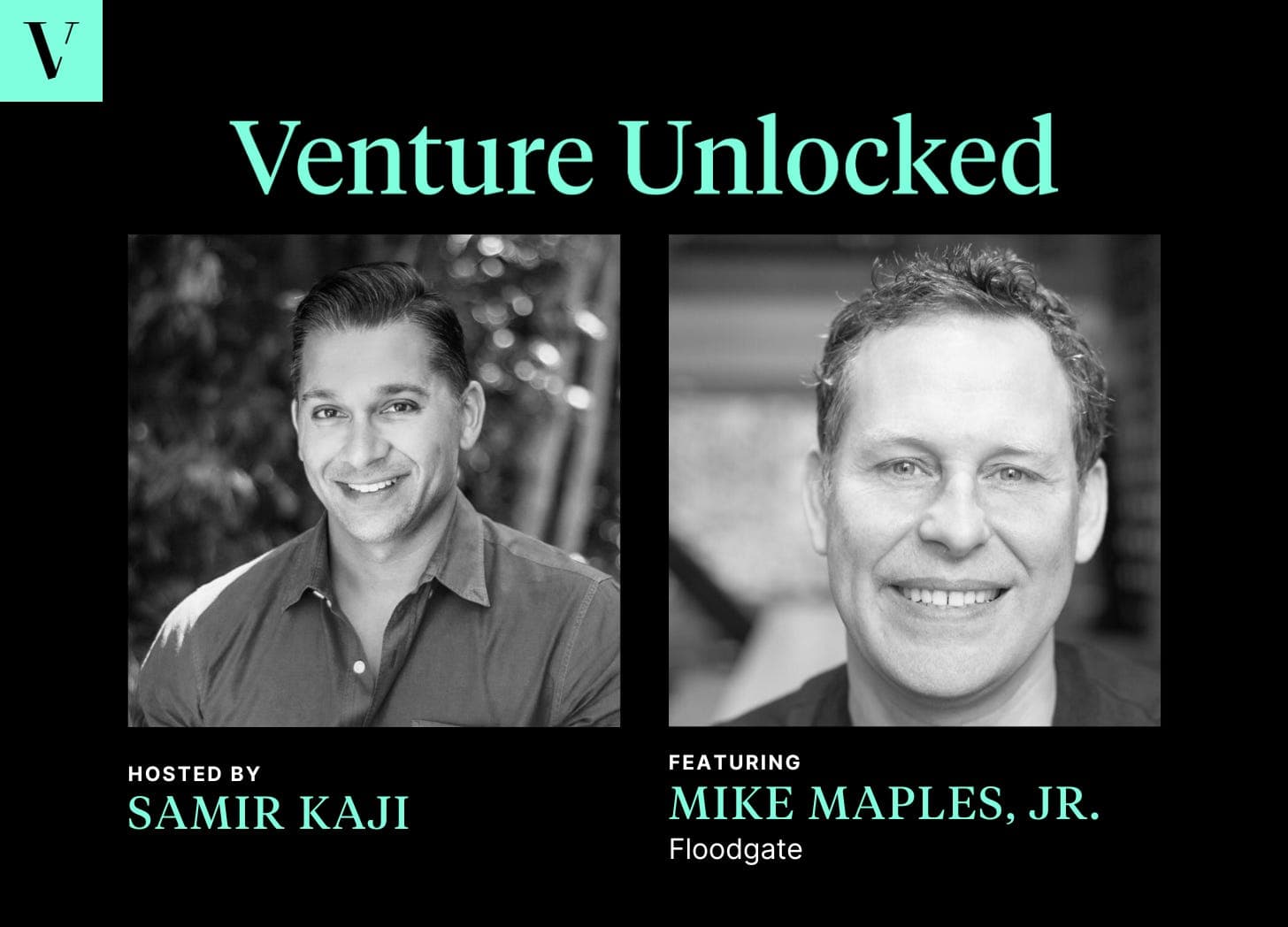
- Title: Finding greatness in non-consensus startups, the story of Twitch from Justin.TV, and why great companies need insights and inflection points with Mike Maples
- Host: Samir Kaji
- Guest: Mike Maples, Jr., co-founding Partner at Floodgate
- Release Date: Not specified in the transcript
Podcast Description *Venture Unlocked* is a podcast that provides insights into starting, operating, and scaling a successful venture capital firm. The host, Samir Kaji, brings over 20 years of experience in advising startups and venture firms.
---
Key Themes and Concepts
Introduction to Mike Maples and "Pattern Breakers"
- Mike Maples discusses his new book, "Pattern Breakers," which emphasizes identifying founders who are capable of breaking conventional patterns to achieve success.
- Maples shares insights gained from his 14 years at Floodgate, focusing on the role of major pivots in creating successful startups.
Key Concepts Discussed
- Founder-Future Fit
- The compatibility between the founder's vision and the future market needs.
- Example: Mark Andreessen’s development of the Mosaic browser as a reflection of a technological shift.
- The Importance of Pivots
- 80% of Floodgate’s returns came from companies experiencing significant pivots.
- Example: Twitch’s transition from Justin.TV showcases the importance of adapting to market demands.
- Inflection Points
- Critical moments that redefine a business's trajectory (e.g., the introduction of GPS in smartphones enabled ride-sharing).
- Understanding inflection points helps in assessing the timing and relevance of investments.
- Insights and Non-Consensus Ideas
- Founders must possess insights that deviate from conventional wisdom.
- Non-consensus ideas often lead to the most valuable innovations, as they target unmet needs.
- Patience as a Form of Arbitrage
- Emphasizing the benefits of long-term investment strategies over short-term gains.
- Investors should be willing to wait for the right opportunities rather than chasing hot trends.
---
Episode Highlights
Key Discussions and Takeaways
- Twitch and Its Evolution:
- Maples recalls the confusion when he realized he was a shareholder in Twitch after its acquisition by Amazon for $970 million. Reflects on how initial skepticism can obscure potential.
- Defining Pattern Breakers:
- Pattern breakers possess a unique insight into future trends, allowing them to create businesses that offer radical changes rather than slight improvements.
- Navigating Risk in Venture Capital:
- Discusses the paradox of needing to take risks to achieve outsized returns and how conventional risk assessments often lead to missed opportunities.
- Investment Thesis Evolution:
- Maples explains how his understanding of successful startups has evolved to prioritize authenticity and unique insights over traditional metrics.
- Role of Early Believers:
- Founders must attract early supporters who share their vision, as these “early believers” help shape the future of the startup.
---
Conclusion The conversation with Mike Maples provides valuable insights into the dynamics of venture capital, the significance of recognizing and nurturing non-consensus startups, and the strategies that can lead to successful investments. His frameworks for identifying pattern breakers and understanding the importance of inflection points are particularly useful for aspiring investors and entrepreneurs looking to navigate the complex startup landscape.
For further insights, listeners are encouraged to explore Maples' book "Pattern Breakers" and his Substack at [patternbreakers.substack.com](http://patternbreakers.substack.com).
---
Additional Resources
- Podcast Link: [Venture Unlocked](https://ventureunlocked.substack.com)
- Mike Maples on Twitter: [@Maples](https://twitter.com/Samirkaji)
- Pattern Breakers Podcast: [Listen Here](https://open.spotify.com/show/7aZwYWTrcNq5Z6e4l10cLV)
Feel free to follow the conversation on social media with the hashtag #ventureunlocked.
Written by AI. May contain mistakes. Listen to the episode to check what was said.
Transcript
Automatic transcript. May contain errors.0:00Welcome back to another episode of Venture Unlocked, the podcast that takes you behind the curtain of the business of venture capital. I'm your host, Samir Kaji, and today we're rejoined by a previous guest, Mike Maples of Floodgate, as we discuss his new book, Pattern Breakers. Mike was first on the pod in January of 2021, and it was great to catch up with him again, this time to discuss the importance of identifying founders that are pattern breakers in order to generate successful returns. In the scope of thinking about Pattern Breakers, we went through concepts such as Founder Future Fit, the winning formula of inflection plus insight, and his experience that so much of their returns have been from companies that have had some level of a major insider pivot.
0:42For those that are interested, you can find Mike's book, Pattern Breakers, and additional insights on his Substack at patternbreakers.substack.com. This was a fun one, so let's get right into it. Samir Kaji is the CEO and co-founder of Allocate. Allocate and Venture Unlocked are independent of each other. Any statements or references made by Samir or his guests regarding third parties, investments, or securities are solely their views and opinions and are not intended as investment advice or an endorsement of such parties or securities by Samir, his guests, or Allocate. Allocate or its clients may maintain relationships with or investment positions in guests, third parties, or securities mentioned in this podcast.
1:21This podcast is for informational purposes only and should not be relied upon as a basis for investment decisions.
1:51subscribe to it. Mike has some great articles and discussion about this, but maybe talk about what is a pattern breaker? How did you come up with the idea and what is the book about? Yeah. Like why even do a book in the first place? So about 10 years ago, Twitch was acquired by Amazon for$970 million and we made 84 times our money on that investment. And that's on the balance a good thing. But it was unsettling because I had forgotten until very recently that I was even a shareholder in Twitch. And so I had invested in a company called Justin TV, and it had pivoted into two companies, SocialCam and Twitch.
2:32SocialCam was acquired by Autodesk for$65 million. And I just figured that was the company. So I just kind of forgot about Twitch. Next thing I know, we have this big windfall. So I have to go to my LPs and fund one and explain to them, I'm sorry, this hasn't been in any of our financial statements. I haven't ever written anything down to reflect the fact that we own this Twitch stock, but we just had this exit with Amazon and 970 million. We made 84 times our money. What would you like me to do? Would you like me to restate my financials? Do I need to do the audits again? And every single LP said, nope, we're good.
3:07Just send us the money. I've got some champagne and everything else. Not the worst thing. Not the worst thing. But then here's what started to feel unsettling about it. That same week, I helped a founder shut his company down. And he'd done all the stuff you're supposed to do. He'd done the business model canvas, and he'd done great experimentation, and had a very experienced team of lots of skills. And it seemed like it would have been one of the most likely to succeed. And it would have been a Harvard Business School case study, other than the fact that it failed. And then I zoomed out a little bit and I realized 80 % of our exit profits in my first 10 years in the business had come from pivots.
3:50You know, ODO and Chegg went public within a week of each other in 2013. Both of them were crazy pivots. And then at the very time that Twitch was acquired, Lyft was starting to blow up. And it had pivoted from Zimride and it had launched an illegal service in San Francisco. And so I'm like, okay, what's going on here? You know, am I just a lucky fool? You know, Nassim Taleb in Fool by Randomness talks about this idea of the lucky fool who attributes their success to their skill or their planning or something that they got right, but they don't realize that it's mostly due to just luck. And so I thought, OK, if I'm a lucky fool, maybe I should just retire before I get exposed.
4:30And, you know, just there's all kinds of things to do with this world. So I went on this very long journey of trying to figure out, OK, what's going on here? And so pattern breakers is kind of the results of what I came to understand. So there there is a lot of randomness to startups, but it's not all an accident. That was kind of what I learned. And so I wanted to sort of capture my thoughts and I thought they could be helpful to founders and to investors and to people who wanted to understand startup capitalism a little bit better. Before we get into the components of what a pattern breaker is, and we can talk about insights and flexion points.
5:09And you mentioned companies like Lyft, for example. Lyft is not what it is without GPS on your phones. You know, you had other companies, Airbnb, like would not be a company if it didn't have something very similar in terms of this adoption of the sharing economy. Certainly, just in TV, I mean, the thought I remember looking at back and it was like this guy just live streaming his life and you're like, okay, who cares about those things? And yet there was some kind of unique insight. You talk about pivots first, and I really want to go back to this word pivot. Part of me thinks that pivot, there's a version of it, which is just learning as you go along.
5:47You have a hypothesis of a startup, and then you learn, and then you kind of make micro-pivots. But it sounds like what you're saying is a pivot that's actually material, where the business that you looked at up front is very different and almost sometimes fundamentally in a different industry than when you started. Brex was an example of one like that, where it was an AR, VR company, and then became, you know, a financial services company. Yeah, or, you know, ones that I never saw. Like, so I'm, when it comes to startups, I'm a little bit of a train spotter. I get irrationally interested in the minute details of these things.
6:20And we did this teardown of Zoom. And we tried to understand what did it look like at the time you would have decided to do the seed round. Well, the thing was called SASB, and he wanted to do a poor man's video conferencing that worked on mobile phones for consumers. And eight months later, he decides to pivot to B2B. There's just no way if you'd invested in or judged the product for what it is at the time you had to decide, there's just no way you would have invested. There's no way you would have. You would have had a failure of imagination and not seen it. And so then you start to say, well, what are you investing in?
6:52What I concluded is that you're investing in the authenticity of that founder to the future they're pursuing, along with the insight that they have about that future, and then their ability to pull it off. If you get too attached to the product for what it is, you'll miss where the real signal needs to come from. From an investing standpoint, you look at what is the TAM? What is the traction? What have they done before? What is the founder market fit? Is this going to work? Where do we see things? You kind of have this pattern of like things that you pencil out to. And maybe we go back to that Justin TV example.
7:26I actually didn't know that you hadn't had it on your financials and then obviously a great return. With Justin in particular, what got you excited to actually invest in a company, which at the time, I remember you telling me that you thought it was a crazy idea at first. Oh, yeah. And not just think it was, right? So, I mean, even Justin now knows it was a crazy idea. So it was a pretty random circumstance. So I was hanging out with the guys from Weebly and had just decided to invest. And I'm in a coffee shop. I don't think it's there anymore. Cafe Doge in Palo Alto on University Avenue. And then all of a sudden, this guy casts a silhouette in the door of this place.
8:06And you couldn't have missed it because it was this guy with a backpack and a camera on his baseball cap and wires going into this backpack. And it was wearing a hoodie. and I was like, man, that's a strange looking getup. Not thinking that I was going to meet this guy, and he walks in the place, and I'm still talking to Rusenko and Chris and these guys from Weebly, and they said, oh, by the way, did you get your email? I said, what are you talking about? What email? They said, well, we were wondering if you'd be willing to take a pitch from Justin Kahn. He's a friend of ours. We think that you might vibe with this guy.
8:39Right as they're describing that, Justin sits down at the table with us, And he's got me on the screen of his laptop because his camera is pointing right at my face from his camera on his baseball cap. And he says, I'm Justin Kahn. I've got this thing called Justin.TV, and I'm going to do a 24-7 reality show in my life. And I look at him, and at first I thought he was kidding me, right? I thought that there's no way that anybody thinks that that's a company. And I said, okay, Justin, what's the real idea? He goes, no, that's the idea. See, you're on the camera right now. I'm live casting you. and I'm like come on dude that's just that's stupid like that's just like not a business at all like it's not even reality tv what you're describing you know reality tv they record somebody's life for a whole week and condense it down to 20 minutes nobody wants to watch anybody's life 24 7 so you don't you don't even have the concept right that you're describing it with and so he's like come on you're supposed to be a seed investor why are you crapping all over my idea.
9:38Like, this is a terrible idea, but like, what, how does this even work? Right? Like, how did you get me to stream on your laptop? And like, what's, what's in your backpack? And so he says, well, we got this guy on our team named Kyle Vogt. He ended up starting Cruise later, Cruise Automation. And he goes, he's this technical genius and he's a super builder and he can build anything. And he's figured out a way to marry EVDO cellular with the internet. And, And, you know, we need EVO cellular because there's going to be a lot of places where there's no Wi-Fi. And I use the cellular network to stream and then I combine it with the capabilities of the Internet to stream.
10:14And I was like, yeah, that sounds like that would be hard to build. You know, that's interesting. But still, I was like, this idea is crazy. So I said, hey, look, I just need to sleep on it. So that night I go home. I read about Justin. And I find out that his prior company, he created an Ajax calendar called Kiko with this guy named Emmett Shear. And Google had decided to release Google Calendar. So they're like, OK, we're out of business. And so they decided to sell their company on eBay. And they sold it for$250 ,000, two guys 18 months out of college. And I remember thinking to myself, who does that?
10:52Like, how does it even occur to you to sell your company on eBay? Fortunately, like I didn't have the language to describe pattern breaking yet, but fortunately, I was just like, you know, I just kind of think this is the kind of guy who's going to make stuff happen. You know, I just think he's going to do wacky stuff that just might work. I think I'm going to give him some money. And so we did, you know, but like for the longest time, it was a little bit like Twitter with 140 characters or less. People would look at me and say, what on earth were you thinking giving money to these guys for this idea?
11:24That's the dumbest thing I ever heard. Some of the best companies of all time started off with things that at the time, people, everyone thought was stupid. Like no one agreed with it. And that's actually why they were able to build in a white space that no one saw. So it's almost looking into the future and having a unique insight. So you go back to Justin, this guy sells his company on eBay, which is, I've never heard of you. This is the first time I've heard of it to either of anybody doing that. But that goes down to the fundamental human level of what makes somebody tick and what are the things that you can look at to be able to say, is this somebody that has a unique insight or has the capacity to have a really interesting insight that others don't?
12:06If you look back at the 80 % that you mentioned that had these major pivots, was there anything that you could point to about the individuals? You can now say that now looking back, I could tell their pattern breakers based on what I know now? What I like to call founder future fit. An example that probably all of us will know is Mark Andreessen with the Mosaic browser. So he was a student at the University of Illinois in a supercomputer lab with a really fast network. And people probably don't remember this now, but the internet had just basically barely been made legal for business. It had only worked for government universities.
12:44And so Mark is tinkering with these early technologies of the World Wide Web, and he builds a browser, and it ignites a revolution. And what's interesting about that is a couple of things. The first is that people following the pattern were all talking about the digital superhighway. Everybody was saying, should the government build the digital highway? Should Time Warner build it? Should the telephone companies, maybe Microsoft Network, AOL? Mark didn't even know enough about business to know there was such a thing. He didn't know anybody was trying to build a digital superhighway, right? He'd never had a real job before outside of academia.
13:21So he's building this thing. Well, what was really happening was Mark was living in a time machine and he was living in a world that was going to be common to lots of other people pretty soon. So if you're Mark Andreessen, you're like, of course, everybody's going to have a computer with Pentium class processing or better. And of course, everybody's going to have graphical windowing interfaces. Of course, everybody's going to want to be able to hyperlink between websites. And so he just built the thing that was missing, the thing that he wanted to use for himself. How does that relate directly to your question then?
13:55In order to succeed in changing the future, you have to notice it better than other people do. You have to notice something other people don't notice. And this is true in any field. It's true when Einstein figured out general relativity. It's true when Van Gogh figured out how to paint with his kind of impasto style. Artists and people who live in the future notice things that other people don't notice. And the reason that they do is because by directly tinkering with these technologies, they experience firsthand the new ways of thinking, feeling and acting that's embodied and enabled by the technology.
14:32and as a result they're able to escape the patterns of the familiar they're able to escape the conventional because they're trying to implement the unconventional and so to them it doesn't even feel like they're being contrarian to them it feels obvious because to them it's like the the barrier that's in front of them that needs to be solved is what they do and so most people the mistake they make is they try to think of a startup and like when you try to think of a startup it's just kind of your opinion about the future. And so I get this all the time. I get last week, somebody pitched me on a mental health startup and they said, I believe in the future, mental health, mental health is a crisis.
15:09Somebody should solve that in the future. Somebody will solve it. And I'm like, okay, I agree. Why are you from the future? And they would say, well, in the future, you know, mental health needs to be solved. I said, look, I'm not interested in your ideas about the future. I'm interested in whether you're living in it. I'm interested that, you know, William Gibson, the cyberpunk author said the future is already here. It's just not evenly distributed. Why are you in a valid future before the rest of us? What specifically future are you in? Mark had an answer to that question, just like Bob Metcalf when he was at Xerox PARC and invented the ethernet.
15:45And just like Eric Yuan when he'd spent 10 years at Cisco WebEx before he started Zoom. And what people often don't realize is they don't just have a flash of insight necessarily. It feels that way to them, but the reason they have the flash of insight is because they think about it all the time, and they have thought about it all the time for a very long time. It's that authentic match. And then the other thing that's important here, there's the pattern-breaking ideas, but then there's the ability to start movements that catalyze that different future with early believers. Early believers are much more likely to believe an authentic person from the future, someone who really lives it, somebody who lives, eats, breathes, and sleeps that future, somebody who's a train spotter of that future, that person is going to attract early believers more likely than just somebody who's just doing a startup or thinking of a startup.
16:38And so having authenticity to the future is really important, I think. And it's one of the earliest detectable signals. You know, the product can change. The insight, I found, can't really change. and the insight usually comes from living in the future and building what's missing in that future. It's so interesting and I love the notion of founder future fit, which is of course different than what I mentioned earlier, which is founder market fit, i.e. they have experience. And one of the things that sometimes comes with founder market fit and we as human beings tend to reason by analogy, we have patterns and we kind of think about what happened in the past and try to apply it to something else that we believe is true and needs to be solved today.
17:19How do founders, like if you're talking to a founder, I would say most people do fall into this category of pattern matching. How do you think about breaking that habit and what kind of advice do you give for founders to be able to look at the future and not actually build for the past, which so many startups do and fall into the trap of? Yeah, so it's interesting. So the first thing I should probably note is that I don't think that pattern matching is bad per se and pattern matching breaking is good per se. Right. There are two different kinds of intelligence. And so, like, I don't need to reevaluate first principles when I brush my teeth in the morning or when I, you know, there's certain things that the way I do it is good enough.
18:01And in fact, the cognitive load of trying to come up with a new way wouldn't be justified. When we were cavemen and we didn't want to get eaten by saber-toothed tigers, it was good for us to know that when you hear one growling, run the other way. Don't say, well, is this the time that they're not going to try to eat me? You don't have time to reason that way. The human mind is a pattern matching system. And it's good that it is because it helps us survive. It helps us fit in communities. It helps us figure out who we should marry. It helps us figure out what career we want to pursue, how we achieve things, all that stuff.
18:36So the problem, though, is that there are times where there's a bias introduced by pattern matching that causes us not to see the possibility for the other pattern. The Wright brothers were not aero engineers. In fact, they weren't even really engineers at all to speak of. The New York Times, 69 days before they flew at Kitty Hawk, had an article that said it would take a million years to create a flying machine. And they had all these experts in academia and in the technology field at the time saying why it was a fool's errand. And so what happened there, it was the expertise that they had that blinded them to the possibility of a whole new way of thinking about something.
19:20But the Wright brothers weren't encumbered by that. They had a beginner's mind. They were a couple of bicycle mechanics. They just kept trying different things and tinkering until one day they showed how they had to revise our understanding of the science. to comprehend the fact that these guys made a flying machine. So quite often that happens. What I've come to learn, Samir, is that in business, it's the same type of thing when it comes to capitalism. Most of capitalism that happens is corporate capitalism. And corporate capitalism is about persistently compounding a set of advantages and correcting competitive barriers and having competitive moats that persist for a long time.
19:57And a lot of people invest that way and get really rich by doing it well. Buffett is one of the richest people on the planet by doing that. But Buffett doesn't bet on pattern breaking. Buffett bets on the fact that the pattern will persist longer than you think it will. You know, Geico is still the same business basically that it was in the 30s, and he's owned it, you know, for decades. But there's another way to do business, another way to create value, and that's to change the subject. A startup Capitalists doesn't win by persistently compounding, doesn't win by making things better at all. They win by denying the premise of the rules, throwing out the playbook and creating an entirely new playbook in its place.
20:42If we are a startup, we need to understand that at all costs, we need to avoid the comparison trap. We need to force a choice and not a comparison. Better doesn't matter in startups. They have to be radically different. And so that's part of what I learned is that a lot of these founders who weren't succeeding, they were following the best practices. They were executing their business as well, but they were doing so in pursuit of ideas that were an extension of the present rather than a radically different future. Often when you are investing, however, you're meeting the founder maybe for the first time or you've got to know them a little bit through a series of meetings.
21:20And sometimes it's hard to get the exact signals of determining, is this person a pattern breaker? Is there that founder future fit? I'm curious, just kind of looking back, were there situations where you backed somebody thinking that they weren't maybe necessarily the perfect pattern breaker, but they grew into it? Or conversely, the other way around, where you made an investment in somebody thinking they were a pattern breaker, and then ultimately they became conformist through time and maybe external factors and advice? I think so. Although it's part of my job is to try to cut through their attempts to convince me one way or the other.
22:00I'm trying to find who the real person is, right? So it's like there are a couple of things I've seen about pattern breakers that I think are important. The first is that they have pattern breaking ideas. And we touched on a couple of the elements on it, but we could drill down. You know, these ideas tend to embody inflections. And you want an inflection because it's the thing that allows you to change the subject. It's kind of like the rock in the slingshot if you're David. And then you want to have an insight. You want a non-consensus and right idea about the future. And ideally, that insight comes from directly living in the future because you discover the insight by identifying what's missing.
22:35The insight is the thing that allows you to be radically different rather than incrementally better. And so I think that what a lot of founders miss is that better doesn't matter with startups. Because if you're just better, then the customer won't be desperate enough for your empowerment. They'll be able to get a close to good enough solution from a pre-existing option. What we want is something that can't be reconciled with what's come before, that can't be compared with what's come before. When people took a Lyft ride for the first time, nobody said, how does that compare to taxis? Even the Cybertruck, this is why I like it.
23:12Not everybody does. You can say that Cybertruck is goofy. You can say it's stupid, ugly, whatever you want to say. But nobody after seeing a Cybertruck says, so how is that different from an F-150? You're either on Team Cybertruck or you hate it. But like it polarizes and great startup ideas have that quality. Most people don't like them, in fact, but a tiny number of people who are inclined to live in that same future as the founder are like, oh, my gosh, where have you been all my life? I've been waiting for something like this. Let's go. And it's these early believers that co-create the future with these founders.
23:49And so that's the second big part. Right. You've got to think different, come up with a different idea by living in the future and harnessing these powers. but then you have to act different. You have to start a movement that at first attracts only the early people ready to believe your insight. It doesn't make sense to spend time wasting time with people who won't believe yet. And you need to create a movement of the minority against the status quo of the majority. And so that's where being disagreeable comes in. And that's where good storytelling comes in. And that's where, you know, starting movements as the mechanism for change comes in.
24:23So like when I look at the founders, I'm like, okay, is this idea from the future? Do they have a valid insight? Did they come about it honestly? And then do I think these founders have the stuff to move people to that different future? Are they going to succeed in the real world getting real people to move in a real direction? In that scenario, you know, I think about, you know, some of these founders where they have a very different and maybe distinct view of what the future should be around whatever they're going after. And yes, you are looking at the person and are they really kind of that pattern breaker mentality.
24:57But one of the things that I've always thought about is like sometimes you're looking too far in the future as a investor doesn't work either because it's just too early. It's not ready. So think about Webvan, for example. Webvan was way before its time. Instacart was not. I feel like you still need to pair that insight with something that is inflecting right now, whereby it's not too far in the future and it's not going to work because you're too early? I love this question, right? And this is what perplexed me for so long. And inflection is a very intentional word here. You'll notice I didn't say improvement curve.
Read the full transcript
25:34So like Instagram, phone cameras were improving every year, but Instagram came out at an inflection point. And the inflection was that the cameras suddenly got good enough that people would use it as their regular camera. They thought it was good enough to take pictures that they would share on social media broadly all the time. The inflection for Lyft that we talked about was the GPS chip. So you could have been right about ride sharing as the future, but without the iPhone 4S, you couldn't implement that idea in a solution that would work. And so the iPhone 4S had this chip that would allow you to algorithmically locate someone within a meter.
26:14The inflection, I use that term because an inflection is a turning point. It's a point in time where something that was impossible yesterday suddenly became possible today. And that's really important in terms of getting the timing right, because I agree with you. I think that timing is the hardest risk to assess, maybe by even a wide margin of all these things. I like to say all of it will happen. All of it's been tried. I like to say every startup idea has been tried. Good ones, bad ones. You can almost assume everything's been tried. There's an efficient market for ideas. But all of them that are worth happening will happen.
26:53The question is just when and under what circumstances. And so the inflection not only gives the entrepreneur the unfair advantage, but it also, if it's understood correctly, gives me as an investor a way to assess the why now. And it gives me a way to say, OK, hmm, this entrepreneur is telling me that, you know, the iPhone 4S has a GPS chip. Now I can enable ride sharing. I couldn't have enabled that before. I'm like, that kind of makes sense. The inflection does another thing, though, that has really helped me a lot in recent years. Justin TV was a terrible idea, but it embodied a lot of really good inflections.
27:32And so sometimes you have a bad idea, but a good opportunity. The other thing I've learned is that as a seed investor, I need to sometimes protect the ideas that sound stupid, but that might lead to something great. Airbed and breakfast sounded crazy. Who's going to stay in a stranger's apartment and get served Pop-Tarts the next morning? That's crazy. But, you know, it turns out it's I think the company's worth like 100 billion dollars now. Right. And who's going to get in a stranger's car? That's crazy. But like what when you start to say, OK, well, hang on a second here. What's the inflection?
28:04You start to say, OK, maybe I should look a little closer at this. Maybe maybe this person is leveraging a form of empowerment. Maybe the implementation is going to move to something different. Maybe they're going to pivot to something else. but what they're pursuing is interesting and the future that they're coming from is compelling. And maybe I should take a risk and let this play out a little bit, see what happens, not be too attached to whether I exactly believe whether this idea works. So you want to protect ideas that sound bad, but that are potentially good, because those are usually the biggest ones.
28:39But then the other thing you want to do is you want to eliminate the ideas that sound plausibly good that aren't good. Sarah Leary, before she started Nextdoor with Nirov, they started Fanbase, Social Network for Sports Fans. Hey, that sounds good, right? Social Network's big, sports fans, lots of them. What's not to like? Well, it turns out that there are zero desperate people for a social network for sports fans. And so it's a failed startup. But everybody they pitched was like, this is brilliant. You're great entrepreneurs, brilliant idea, totally makes sense. And so a lot of times founders pursue an idea that sounds plausibly good, but that doesn't have the elements of a breakthrough embedded in it.
29:18And they find two years in that they wish they hadn't done it. Now they're stuck. They're pursuing it out of obligation and not passion. And so that's what the inflection helps me understand. Hey, don't dismiss this too quickly. Or that sounded really good, but I can't square it with this idea that it has an inflection. I can't find the inflection. And you have this formula like inflection plus inside. And then, of course, you're determining the inside of the human being and their ability to do this. It's really hard, by the way. These are two really hard things to do. I mean, you think about broadband.
29:53That allowed more people to be on their desktop internet. It created distribution. You see something like AWS, which actually AWS was one of the things that really changed the venture market. Because now you had these startups that could start without buying a bunch of databases. and spending a bunch of money on servers. You had the smartphone, which was the device that no one knew they had to have when it was launched. And of course, GPS. What do you see as the other inflection points? And maybe just right now, is there an inflection point that is not obvious? There's always inflections that are not obvious, right?
30:27So that's part of what's so inspiring about it to me. When the iPhone 4S came out, it was in all of our pockets. but occasionally somebody realizes that the thing in our pocket has the power to change the future. Most of us don't. Most of us just go about life the way we went about it and assume it'll be the way it has been. We assume that the future will be a forward projection of the present. I call it forecasting. That's what forecasting really is, right? And what the great founders do is they backcast. They say, I can only win if the future is radically different. If the future is a projection of the present forward, I'm going to lose because I'm going to play the comparison game and I'm going to play by other people's rules.
31:09Only if the future is radically different can I win. And so I have to start by presupposing that has to be true. And what I'm going to do is find radically different futures and work backwards. I'm going to backcast from those different futures. And then I'm going to pull different people who believe what I believe into that different future of my design. And so it's just a different kind of intelligence. You know, it's a it's a willingness to say it's axiomatic that I have to break the pattern to have any chance at success. And so I have to explore ideas that are out of the convention. I have to explore ideas, even if they're wrong, that break the pattern, because it's that's the subset of ideas.
31:49That's where I need to go fishing for ideas. And shifting more from an investor standpoint, there's the matrix. and I've seen this matrix of you can be right or wrong and you can be non-consensus or consensus. And the box that you typically want to be in is non-consensus and right, which provides the risk that you're going to be non-consensus and wrong and look like a fool. And you have to have people that can take that. Can you be consensus and right in venture? Never say never, right? But because all kinds of things can happen in venture. Companies could get acquired that got overpriced or people could just get lucky There's a lot of randomness.
32:28But I would say as a as a theory, you need to be non consensus and right. And there's a couple of reasons that's true. But by the way, I think that's true about life in terms of great outperformance. You know, like even if you and I are stock market investors, if we if we want to be consensus, we buy the index. If we want to be non consensus, we buy a stock. Not everybody realizes that when you buy a stock, you're being non-consensus, but you are because that stock has a price based on supply and demand and future expectations. NVIDIA is a great company. It may be a great company in the future, but it's priced as if that's true.
33:05So when you buy NVIDIA stock right now, half of the market thinks that you're overpaying. Half of the market thinks you're underpaying. But one thing is certain, if you buy NVIDIA instead of the index, you will either outperform the index if NVIDIA outperforms the index or you'll underperform the index. If you can only be an outlier in performance, if you risk being wrong, which means you have to depart from the consensus. There's no way to have outsized returns without taking the risk to achieve those outsized returns in any field, right? In stock picking, buying bonds, whatever. But it's even more extreme in startups because being incrementally better doesn't matter with startups, right?
33:47We have to be radically superior. We have to offer a radically different future. If everybody's offering apples, we can't be a 10 times better apple. We need to be the world's first banana. And we need to say, everybody who cares about bananas, I'm the only guy that's got them. But you have to decide. You can't be both. You can't care about both. That's the reason you need to depart from the consensus is if you're too much like the consensus, you're too much like what already people know, which means that your profits get arbitraged away for being right. Only by being non-consensus and right do you get paid for the risk you take.
34:21I totally agree with that. And it reminds me of a slightly tangential conversation I had with an LP recently around fund evaluation. And the person posed the question of whether loss rate was something that they should look at as a major determinant of whether to invest in a fund going forward. And the idea there is fewer losses mean that there's more shots at goal and more opportunity for companies to have exits that actually return something to the fund. I cited the primary venture study and they looked at great funds versus good funds. I don't remember the cutoff exactly. I think it was like 5 or 10x plus for a great fund.
35:04And then obviously underneath that for a good fund, which is about 3x. And they found very little difference in loss rates between these good and great funds. And perhaps even the great funds had a slightly higher loss rate. And this was based, I believe, on Horsley Bridge data. And it goes back to this notion of you have to be able to be non-consensus and right to get those big power law outliers that really drive huge magnitude of returns on a single company. And then, of course, the impact of the fund. And perhaps that's really needed as the core to generate alpha versus conformist investing, which might get you beta, but hard to really generate those great funds.
35:54I think that's right. So I've worked with Horsley Bridge on some of this data as well. And I went a little bit deeper into it. One of the things that I wanted to know is, okay, a 3x fund and a 10x fund, what is the real difference? And as you point out, the loss ratio is no different. I mean, it may be within a percentage point or two, but not material different. What matters is in the 15 % upside cases, the magnitude of how right you are. The 10x funds have more home runs and bigger home runs or grand slams even. One of the studies I did was what does a 10x fund look like? And what I've basically concluded, and I studied this over different decades and different timescales, but it turns out that the physics of a 10x fund haven't changed that much because the power law is still real.
36:44What I found was that if you want a 10x fund, you want about 9 % of your investments to make more than 20x on the first check. That's if you're a seed fund. And you want about 6 % of your investments to make more than 100x on the first check. And if you achieve that, you will very likely be a more than 10x fund. Now, you know, your check size has to be correspondent to your fund size, things like that. But that's the rough heuristic that I use. And so now let's say that you're making an investment decision as a seed stage VC. It's really a conditional probability statement. It is given that there's an 85 % chance that I'm wrong and I can't affect those odds.
37:29Like if somebody was not, if that weren't the odds, there'd be somebody who was like right way more often and we'd know why that is, right? So like given that there's an 85 % chance that I'm wrong, how right does this have to be to be worth doing? And so there are some ideas where you're just like, I can't see any way we would make 100x on the first check. I can't see any scenario ever where that would happen. And so you say, okay, it's really exciting. And this is where non-consensus comes in. Quite often, our best deals haven't been the most expensive deals. You know, Brian Chesky offered me to invest in Airbnb at 1.5 million pre money.
38:08We invested in Lyft at 5.5 post. I invested in Twitch at 3 million pre. That was a different time. But like, here's the thing. If you believe that the best ideas are non-consensus and right, it stands to reason that the most expensive seed deals are probably not the best deals, almost by definition, because if too many people like it, it's too consensus. And so if I was a founder and everybody's chasing my startup deal in the seed round, I would be nervous. It would give me pause. It would cause me to think maybe I'm doing something too obvious. Maybe I'm coming up with a pitch that's attractive to conventional thinkers rather than an idea that's non-consensus from a different future.
38:50You know, that kind of comes back to the non-consensus idea. But what we want to do when we write, say, an investment memo is the conditional probability of success in the rare event that we succeed. How big can it be? That's the hard part of the game. But it's foolish to say, my thesis is this is going to be a massive company. How can you say that when there's an 85 % chance it won't? Given that it's likely not to be, how could it be is what you care about. This is one of the toughest things as an investor, because I do believe that the consensus view in the market is that you do have to actually be non-consensus and contrarian to make real money in venture capital, or at least produce these potential great funds.
39:33But there are so many incentives for fund managers not to do it, particularly newer ones who may opt to do things that are more obvious, hot companies, second-time founder. And in those cases, it's safer to do because those companies are more likely to get follow-on financing from a wider audience of people who are willing to mark those up. And therefore, as a fund manager, you can live another day, raise another fund, and you can rinse and repeat over some period of time by getting pretty decent returns. But at the same time, that is also a really tough recipe in terms of generating those great funds that really create iconic firms.
40:17and it seems antithetical, but so much of venture should be risk-taking, but it does seem a lot of the market is around loss aversion and risk reduction versus risk-taking. That's right. Risk is something that's a hazard that you avoid, and that's the way you think about it if you're trying to persistently compound. Never interrupt something that's compounding. But risk, when you're a startup, is something you take. What I like to think of as an insight, when you think about it in the abstract, it's an underpriced, high expected value, risky future. What you're really betting on is a future that is risky, but that has wildly asymmetric upside if you take the risk and it goes your way.
41:04Most people won't take that risk because they think of risk as the probability of success or failure. They don't think of it as the expected value of success or failure. What I care about is the expected value of success or failure. That's why I need to get paid for the risk I take. I know I have to take a lot of risk. It's by definition I do. And so I have to find a way to take risks where the expected value is very high, even though the probability of it succeeding is low. That's why I pay a lot of attention to the inflections and the insights, because I think those futures are more worth pursuing.
41:36Those risks are more worth taking. And then I try to encourage the founder to learn whether they can take that risk out as quick as possible. Because if we can't, we might as well end soon and get our time back. But what we don't want is some slog where we go after something that's a B plus, B minus opportunity, but that's never going to move the needle on our fund. It's great to have these really interesting insights, have this rubric of how you identify a company, a founder, assess this concept of future founder fit, which is not easy for a number of different reasons. How has it informed the way you've evolved your investing thesis and just how you run Floodgate today versus maybe a decade ago?
42:17One of the things that I really appreciated about Dave Swenson at Yale was a lot of things, but one of the high order bits was that he understood that patience is a form of arbitrage. The disadvantage of highly liquid assets is that everybody trades in and out of them. and most people think that that makes them more valuable because you have more optionality. But what Swenson understood is that if you're prepared to hold an asset for a really long time that you believe in, you don't have to compete for that asset because most people aren't willing to do that. Swenson had an insight. His insight was that actually sometimes liquidity is more of a bug than it is a feature.
42:59Illiquidity can be a feature because liquidity ultimately doesn't matter. Success matters. Swenson figured this out before anybody else did. How did I try to internalize that when I think about our business? Part of it is when I think about sort of like my relationship with Ann, for example, we try to win partly just by having a temperament advantage. You know, we'll see like these crazy high price seed deals in AI, and some of them will probably work. And I wish them well. I root for all the startups. But we look at each other and we're like, I've seen this movie before. People are acting crazy here.
43:37And we're not under any pressure to do anything. I'm not some new partner trying to prove himself in his first five years. Ann isn't either. And so we're like, we don't have to do anything right now. We can just wait until times get a little bit more sane. Or we can focus our energies on parts of the market where people aren't so crazy. In venture, patience is also a form of arbitrage because it causes you to avoid the trap of saying, I need to show something to my LPs right now. I need to be doing deals that the LPs think is hot, so I'll be hot. I need to do deals to get my track record up as soon as I can.
44:15And I think that all of those instincts are wrong. They go completely against what you should be doing? You know, and when you start to feel a little more secure about it, you start to say, look, I'm going to, I'll recover if I do a crazy investment that doesn't work because they've seen me do crazy ones that did work. That's what they're paying me to do is non-consensus and right investments. Whereas if you're in a new firm and you got to prove yourself for the first five years, you're worried, okay, what if I strike out three times in a row? My people are going to think I'm no good at this. Patience is a huge form of arbitrage in any investing business, I find.
44:51And so that's helped us a lot, I think. And then the other person who helped me is Annie Duke. And so Annie was the first person I talked to extensively where it was like, every decision you make in venture, the first sentence is, I'm not certain, but here's how I'm thinking about it. There's a metaverse of outcomes, and here's how I'm handicapping those outcomes. But I'm not going to sit here and tell you I have a crystal ball because nobody does. But what I can do is I can construct the scenario plan. And then we should evaluate my decision based on the completeness of how I thought about it at the time, not resulting, not whether I won or lost, but whether my thought process was right at the time.
45:33Yeah. And this is just such a fascinating discussion to have. And I know that there's going going to be so many great nuggets in the book, and I'm looking forward to going through it. One of the areas that we didn't get to, and hopefully we will at a later time, is this notion of you might have founder future fit, but that founder still needs to bring others along with them to the future that they believe in. And that can be hard, especially when an idea sounds crazy. It is non-consensus and maybe completely different or opposite of what people that are experienced may think is the right way to do things.
46:14And this may be even presenting itself with you at Floodgate and how you do this in terms of being non-consensus, being a pattern breaker investor, and then bringing others that you hire along with that ride. You know, we'll save that for another time. This is a really fun conversation for me. And for those that are looking for the book, Mike, where do they find it? You can get it pretty much anywhere you buy books. So the book's called Pattern Breakers, Why Some Startups Change the Future. And then I've got a sub stack for people who don't want to fork the cash for the book. I've got a sub stack that kind of previews some of the ideas and it's patternbreakers.substack.com.
46:55Well, thanks so much for being on. Yeah, Samir, thanks for having me. It was a pleasure and always enjoy conversation with you, podcast or no podcast.
47:27Thank you.
From the publisher
Follow me @samirkaji for my thoughts on the venture market, with a focus on the continued evolution of the VC landscape.
We're re-joined by Mike Maples, Jr. of Floodgate, this time to discuss his just released new book "Pattern Breakers."
Mike was first on the pod in 2021 and it was great to catch up again, this time to discuss the importance of identifying founders who are true pattern breakers. We spoke about how his observations on the last 14 years at Floodgate inspired him to write the book.
We went through concepts such as founder-future fit, the winning formula of inflections and insights, and his experience that 80% of their returns have been from companies with some major insight or pivot.
You can find Mike's book "Pattern Breakers" and additional insights on his substack at patternbreakers.substack.com.
About Mike Maples, Jr.:Mike Maples, Jr. is a co-founding Partner at Floodgate. He has been on the Forbes Midas List eight times in the last decade and was also named a “Rising Star” by FORTUNE and profiled by Harvard Business School for his lifetime contributions to entrepreneurship.
Before becoming a full-time investor, Mike was involved as a founder and operating executive at back-to-back startup IPOs, including Tivoli Systems (IPO TIVS, acquired by IBM) and Motive (IPO MOTV, acquired by Alcatel-Lucent.)
Some of Mike’s investments include Twitter, Twitch.tv, Clover Health, Okta, Outreach, ngmoco, Chegg, Bazaarvoice, and Demandforce.
Mike is known for coining the term “Thunder Lizards,” which is a metaphor derived from Godzilla that describes the tiny number of truly exceptional companies that are wildly disruptive capitalist mutations. Mike likes to think of himself as a hunter of the “atomic eggs” that beget these companies.
Mike is the host of the Pattern Breakers podcast, which shares startup lessons from the super performers.
In this episode, we discuss:
(02:00) The story behind writing "Pattern Breakers" and the investment in Twitch and the importance of pivots
(04:07) Insights from returns on pivots and major insider pivots
(05:02) The concept of founder-future fit and initial skepticism
(07:04) The inflection point of Twitch pivoting from Justin.tv
(10:28) Authenticity and insights in startup founders
(14:32) The role of pattern recognition in startup success
(16:24) Creating movements and attracting early believers
(21:12) Importance of inflection points in startup success
(25:00) Non-obvious inflection points and backcasting
(29:52) The formula of inflection plus insight
(32:00) Non-consensus and right: key to venture success
(34:52) Venture capital and risk-taking
(38:00) Inflections and protecting unconventional ideas
(41:00) Patience as a form of arbitrage in venture investing
(45:00) Insights from Annie Duke on decision-making in venture capital
I’d love to know what you took away from this conversation with Mike. Follow me @SamirKaji and give me your insights and questions with the hashtag #ventureunlocked. If you’d like to be considered as a guest or have someone you’d like to hear from (GP or LP), drop me a direct message on Twitter.
Podcast Production support provided by Agent Bee
This is a public episode. If you would like to discuss this with other subscribers or get access to bonus episodes, visit ventureunlocked.substack.com