In short
Venture Unlocked: Episode Summary
Episode Title
Going Back to the Foundation of Kleiner Perkins with Mamoon Hamid Through Clear Business Model Focus and Culture
Podcast Overview
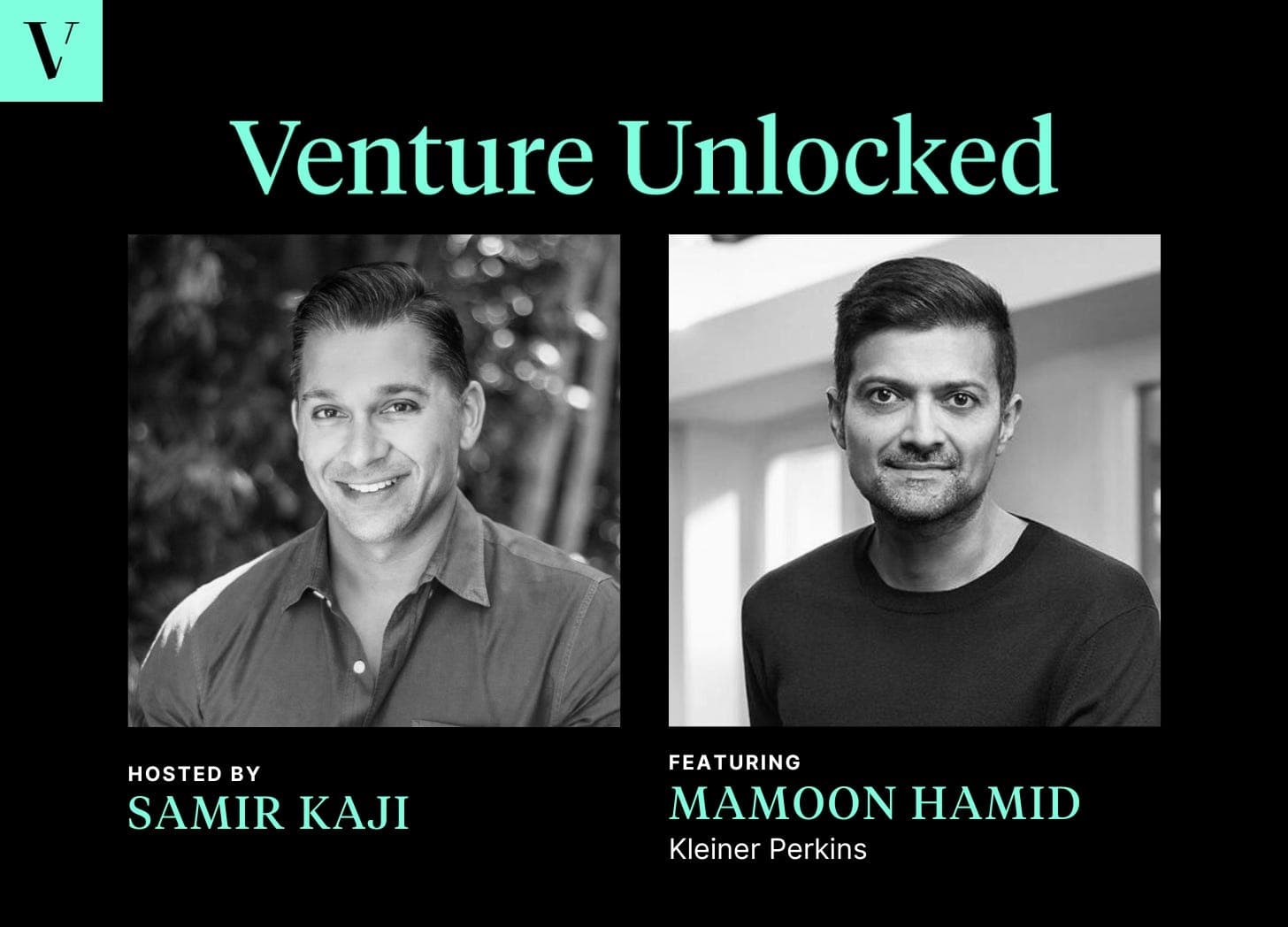
- Host: Samir Kaji
- Guest: Mamoon Hamid, Partner at Kleiner Perkins
- Focus: The historical significance and future vision of Kleiner Perkins, emphasizing culture and focus in venture capital.
Key Themes
- Historical Context of Kleiner Perkins: Established over 50 years ago, the firm has an illustrious track record of backing iconic companies such as Amazon, Google, and Uber.
- Mamoon Hamid’s Journey: Transitioning from an engineer to a venture capitalist, Mamoon joined Kleiner Perkins in 2017 to rejuvenate the firm’s legacy and mission.
Discussion Points
- Mamoon’s Background
- Early Career: Started as an engineer at Xilinx in 1997, intrigued by the role of venture capitalists in tech innovation.
- Path to Venture Capital: His experiences led him through tech support to due diligence and ultimately to business school at Harvard, anchoring his desire to be a venture capitalist.
- Joining Kleiner Perkins
- Motivation: In 2017, Mamoon recognized the need to refocus Kleiner Perkins on early-stage investing, returning to its core strengths after diversifying into various areas.
- Cultural Shift: Emphasized the importance of a strong, nimble team of domain experts to effectively support founders, aiming to replicate the firm’s historic success.
- Execution of Vision
- "Back to the Future" Strategy: Focused on early-stage investments while streamlining operations and decision-making processes.
- Cultural Framework: Developed core values and mission statements to align team members with the firm’s objectives:
- Mission: Be the first call for founders wanting to make history.
- Values:
- One Team, One Dream
- Pride and Excellence
- Operating in Real Time
- Positive Intent
- Hiring and Team Dynamics
- Recruitment Strategy: Focused on building a diverse yet cohesive team aligned with Kleiner’s refreshed values.
- Cultural Fit: Ensured new hires embodied the ethos of supporting founders over personal branding.
- Measuring Success
- OKRs (Objectives and Key Results): Regularly tracked investment decisions, assessing both successes and failures to refine judgment and decision-making.
- Founder Relationships: Emphasis on founder referrals as a primary source for new investments, illustrating the importance of positive engagement and reputational integrity.
- Future of Venture Capital
- Market Evolution: Discussed the influx of venture capital firms and the need for specialization in a saturated market.
- Return to Basics: Suggested a shift back to traditional growth investing, emphasizing the longevity and sustainability of venture funds amidst changing economic conditions.
- Key Learnings
- Personal Philosophy: Importance of playing to one’s strengths and maintaining a focused approach rather than being swayed by external pressures or trends.
- Long-term Vision: Emphasized stewardship over self-promotion in building a lasting and impactful venture capital firm.
Conclusion
- Final Thoughts: Mamoon’s insights provide valuable lessons on the balance between honoring a firm’s legacy and adapting to the evolving landscape of venture capital. His approach reinforces the significance of culture, focus, and genuine relationships in achieving sustained success in the industry.
---
For more insights and detailed notes from this episode, visit [Venture Unlocked](https://ventureunlocked.substack.com).
Written by AI. May contain mistakes. Listen to the episode to check what was said.
Transcript
Automatic transcript. May contain errors.0:00Welcome to another episode of Venture Unlocked, the podcast that takes you behind the scenes of the business of venture capital. I'm your host, Samir Kaji, and today we're thrilled to be joined by Mamoun Hamid, partner at Kleiner Perkins. As so many people know, Kleiner Perkins, which was founded 50 years ago, is one of the most storied franchises in the history of venture capital, having backed companies such as Genentech, Sun Microsystems, Amazon, Google, Twitter, and Uber. After stints at USVP and Social Capital, which he co-founded, Mamoun joined the firm in 2017 as part of a restructuring process to return the firm to being a boutique venture capital fund focused on early stage investing.
0:38Since then, they've backed companies such as Rippling and Figma. Mamoon and I spoke about how he and the team have executed on the mission of bringing Kleiner to what they have coined as going back to the future. While we covered a number of different topics, we really dug deep into the importance of culture and focus in building a long-term firm. This episode is a real treat to record, and I really hope you'll enjoy my conversation with Mamoon. So let's get right into the episode now. Samir Kaji is the CEO and co-founder of Allocate. Allocate and Venture Unlocked are independent of each other.
1:10Any statements or references made by Samir or his guests regarding third parties, investments, or securities are solely their views and opinions and are not intended as investment advice or an endorsement of such parties or securities by Samir, his guests, or Allocate. Allocate or its clients may maintain relationships with or investment positions in guests, third parties, or securities mentioned in this podcast. This podcast is for informational purposes only and should not be relied upon as a basis for investment decisions. Mamoun, it's so great to see you. Thanks for being on the show. So good to be here, Samir.
1:42Thanks for making some time for me. I want to go back a little bit, and I usually don't spend too much time on our guest's history, but you've had such an interesting ride, and I think it'll paint a nice mosaic of what you've been doing over the last six years at Kleiner. Maybe a good place to start is just let's go back into your background of how you got into tech, how you got into venture and what led up to you starting with Kleiner in 2017. I started in tech in 1997. I was a newly minted electrical engineer from Purdue. I moved to Silicon Valley to start my first job at a company called Xilinx.
2:19Turns out my first day on the job, I go to my cubicle. I'm presented with my own SunSpark workstation, which is a kind of a jaw-dropping thing because we had to share one of those amongst hundreds, if not thousands of engineering students at Purdue, where I went to college to have my own. And then, um, you know, at the time you're using the Netscape browser and, um, there's things like Amazon to buy books. And it turns out actually all those companies, um, I sort of wanted to understand like who's, who are, who's behind all these companies. And it turns out it's like great founders and venture capitalists.
2:54And the commonality across all of those companies, Xilinx, Sun Microsystems, Netscape, Amazon was Kleiner Perkins having led the Series A for all of those companies. And so for me, it was sort of a light bulb moment of, whoa, wait a second. There are these folks called venture capitalists who get to really back the future of the world really. And what a cool job that is. And so I got pretty interested in what are the backgrounds of the people. I think naturally, I think that you go towards trying to understand the people who do these jobs. And it turns out like, wait, wait a second. They were, many of them were electrical engineers like me and they'd worked in the semiconductor world or in the networking world.
3:40But they went to business school and I hadn't gone to business school. So, and I got into tech. I was really just an engineer. Of all things, I was doing technical support engineering at the time when I joined Xilinx in 1997. Being on the engineering side, of course, working within a company, seeing how companies are built is obviously really interesting. And a lot of people stay on that direct line, go from company to company, maybe start their own companies. What actually catalyzed the inspiration to go into the investing world? So my job initially was to help companies like Cisco and HP design in Xilinx FPGA, so programmable chips.
4:20And it was to help them roll out their routers and really be first line of support. Then I became a bit more elevated in my support where I got to work with very specific designs. For me, that was a view into the world of 1997, 98, 99, which was the networking.com boom and all the routers and switches that were being sold that had Xilinx FPGAs on them. So it was a first view into sort of relevant one step removed from all the action. It was, you know, all the stock price watching all our stocks and our customer stock prices just have a rocket rocket ship rides and then also come down. And so all of this was really interesting for a 19-year-old engineer.
5:05I started at Zylings when I was 19. So you're very young, you're very formative years of your life, you're still learning a lot. And for me, that was a very impressionable period of my time living on my own here in California, 6 ,500 miles away from my family in Germany. But really, it became all about Silicon Valley and what this place is made of, which is innovation, a brilliant technologist who go start companies. And the commonality amongst some of these brilliant companies was that there were venture capitalists, and especially firms like Kleiner Perkins behind them. And so I became pretty infatuated with the notion of venture capital.
5:42And so Xilinx actually had its own venture fund, not unlike corporate venture firms today. Even though I wasn't really qualified to make investment decisions, I was asked from time to time to evaluate some technology, some specific companies, software companies, hardware companies that Xilinx was looking at investing in. And so that was my first foray and first taste of actually what it took to do technical due diligence for our venture arm. That got me further into that. One day I decided, you know, if I truly want to be a venture capitalist and having at this point studied a lot of venture capitalists, the number one person on my list was that I studied was the John Doerr, the legendary John Doerr, who I get to be partners with now.
6:21And, you know, he was an electrical engineer from Rice, went to Harvard Business School. So guess what I did? I applied to Harvard Business School and only Harvard Business School. And a stroke of luck, I got in and I went. And my first year of business school, during my first and second year, I interned at a VC firm, a small VC firm, got me a bit more of a taste. And I was sold. I was sold that this is the job I want to do for the rest of my life. And what a beautiful thing is to work with these brilliant people who want to build businesses that make an impact on human life and make things better.
6:54The notion of going from like a chip that goes in a router and you're focused on making sure that works and it's bug free to backing technologists who do lots of different things but also go change the course of human life. I mean, that's the romantic view that I took. But that was the view I had about the role of the startup ecosystem, Silicon Valley, the involvement of venture capital in these amazing companies. And I was like, I want to do that job for the rest of my life. And so coming out of business school, that was it. I only tried to find a venture job. And I found a job at, I was fortunate enough to have a few offers, but the one offer that I ended up taking was at US Venture Partners.
7:38And they had a reputation for being sort of top tier at semiconductor investing, which is what I knew and what my area was. And so I went to USVP to help the partners there do diligence around semiconductor businesses And literally, I know that I, a few years later, become really a software investor, but that was my start. And so kind of going back, I mean, it was such an interesting time to cut your teeth. I think it was 2005-ish when you started at USVP. And I believe the firm at that point had been around for about 20 plus years at that moment. And you're right, it did establish itself as a great semi-investor.
8:14It was also the time where things like AWS, cloud computing, mobile, that really drove this Cambrian effect of so many more startups, the venture landscape changing. I know you left, you started, you co-founded Social Capital. And all of those now, it's really interesting joining a firm in 2017 in Kleiner, it's been around for 45 years when you joined. I see this kind of full circle, starting with a firm at the early days that had been around for a while, but you're still young, co-founding a firm which is running a business and now going into a firm like Kleiner that had four decades plus of so many great companies that's back, but it also had a lot of changes over time.
8:59And I'm always fascinated with how firms embrace long-term generational planning, longevity. Tell us what you saw with Kleiner. You mentioned at Xilinx being backed by Kleiner, now joining the firm that backed Xilinx. But what did you see at the time in 2017 that made it so interesting for you? What a storied firm, right? There's no question about it. I think in the 80s, Kleiner was started in 1972. And let's say in the late 70s, 80s, 90s, dominant, like clear, far and away number one firm in the world, like put venture capital on the map and the returns proved that it was the number one firm.
9:40I would say through the time of the Google IPO had probably produced more returns than any venture firm out there. That's not a fact, but that's my supposition here. To then have an opportunity to join this firm in 2017 was the opportunity of a lifetime. If you think about just my career, I spent six years at Xilinx, six years learning the craft of venture capital at USVP, and then having the opportunity then to build a business from scratch in social capital. So building a venture firm from scratch. And that was six years. And then getting a chance then to rebuild a venture firm that had probably the most storied history.
10:19To walk back, I think with success also come challenges and opportunities. I think most view them as opportunities, which are, so what do we do next? We've sort of nailed the internet. We can go do other things that others haven't done and allows us to make an even bigger impact. Clean energy. Let's go into China. Let's go invest in growth stage companies, a new category. So Kleiner, in fact, had many firsts. And with being so successful first, got to do many of these things first, which is be early in China, be, I think, among the first sort of growth funds to be raised, and then have a dedicated clean tech practice.
11:05Again, like very much a first for a generalist firm. And so with that, you want to expand the purview of your mandate because you think there are much, there's much greater opportunity to invest your, your LP dollars and generate even bigger returns. With that comes, if you're going to expand your mandate, you're going to bring on more people who are specialists. You're going to have more teams. It expands the footprint of a firm that are, are, are built really like just partnerships. And there is no CEO. There are leaders, but there's no like clear one leader who sets the tone of a firm or tells it.
11:42And that's just how venture firms are built. I fully subscribe to the venture firm partnership model, and that's what we are today. But just to give you a sense of 2017, taking stock of the situation and where things were, even though the firm continued to produce great returns, there was a real change moment that happened in 2017. Just to give you sort of a quick history there, I'd spent a couple of years prior to that with my partner, Touchline, who really was managing the firm at the time. And I had a long-term relationship with them. And he was really primarily responsible for recruiting me among some of the other partners.
12:20But Ted and I had a wonderful relationship to this day. And it was really around how can we do the right things to put us back where we belong and where we had been for many decades prior to that. Some of that involved just focus, focus on what we stood for, which is we were the preeminent venture capital firm, early stage venture capital firm for decades. And as I tried to go back and understand what made it so great, it was a bunch of technology forward technologists who deeply cared about the impact of technology on the world and who had worked inside of companies, built companies, understood what it took to have empathy with founders.
13:04But it was also a small group of folks. It was a six, seven, eight partner group. And that's about it. it wasn't some large spread out organization that had lots of partners and lots of junior folks. And it sort of, it wasn't dawned on me. It was sort of, seems a little bit obvious that that's where we had to go back to. I was going to maybe just think about, you know, that timeframe of, you know, you going through this blank sheet of paper and looking at Kleiner as this, you know, long storied firm that perhaps needed a little bit of a reboot in certain ways. Thinking about how do you get back to that point where Kleiner was in the 70s, 80s, and 90s.
13:44I was looking at the history of Kleiner and some of the best companies we've ever seen in technology. When you do go through what effectively is going back to basics or back to the future, oftentimes you're faced with some very difficult decisions to make. To be able to execute on that, talk to us, what did that blank piece of paper look like when you said focus, back to basics? What was that execution plan? Yeah, the back to basics was a lean, nimble team of early stage practitioners who mostly did series A's, some C's, some B's, and that was it. And they would cover core areas of IT, so enterprise, consumer, digital health, fintech coming of age, some hardware.
14:36But that was sort of the focus, which meant that left out biotech, which in itself is a different beast altogether, to understand the science, the molecules, the approach, the capital intensity, the funding models just are very different from the run-of-the-mill software business that we back. So that was not part of the Go Forward plan growth, which, as you know, spun out with Mary and her team. Growth for us wasn't the history of the firm. We were amongst the first to have had a growth fund. And it made total sense for Mary and her team to spin out and form bond capital. We don't have geographical funds.
15:24We don't have a Europe fund or a... We had a China fund and we no longer raise China funds. Managing that from here, being a tourist or a helicopter VC into China from here just was too much to do while you're trying to rebuild the core of Kleiner Perkins. And so we really decided that that wasn't going to be part of the strategy either. We had to make some tough choices and they hurt or they sting as you're doing them. But, you know, you come out of it on the other side, you realize like, should have done it sooner or, and I would say like our industry continues to grapple with those types of changes.
16:02It's not uncommon to hear those even today. We just got to be first in doing that because we got to be successful first. With success comes all this other stuff then. And then you have to go back to like, you know what, like kind of maybe stick to the knitting and just go back to the future. It's such an important point. And maybe just to reinforce it, I think a lot of people fail to actually confront really tough inflection points with hard actions. And often that's the deciding factor of longevity of a business versus not. Part of that is you want to still embrace the storied history, the culture that really got Kleiner to where it was, but also imbue it with this next generation thinking, going back to basics to a certain degree, but also adapting to what was a very different environment than when you started in 2005.
16:51Thousands of venture firms, funds getting bigger and bigger. How did you think about the culture of balance between the past and what you wanted to build in the future? In my first three months, I talked to every single person in the firm, sort of spent like 30 minutes with them, talked to a number of the former partners, half a dozen, maybe a dozen, to understand what really made them the best in the 80s and 90s. Just a learning, you know, listening tour. And it was sort of the obvious, which is like, we need to be small, nimble, fast moving domain experts in the areas that we invest in. Be the first call for founders who want to make history, which happens to be our mission at Kleiner Perkins.
17:31And we also came up with a set of values that we wanted to live by internally and an investment ethos that we wanted to have represent us externally. And that helped us form a bit of a North Star for the firm and the people going forward. And, you know, we continue to live by those. And I think it's really like it was a bring everyone on the same page type of moment. And candidly, like there are folks who don't believe that it's going to actually happen. And it all doesn't just happen overnight. It takes deliberate action and digesting those and then taking more action. And so this stuff cannot happen overnight.
18:10You know, it's a delicate balance in all of this. And so, but we did recruit a team soon after. So starting in January of 2018 and that whole year, I mean, just to give you a sense, January of 2018, Bucky Moore joins my partner today. March of 2018, Ilya Fushman, my partner, joined from Index. Later in the year, Annie Case joined us as an associate. She became a principal and she's a partner at Kleiner Perkins today. Josh Coyne, who was actually part of our growth fund, he went on an externship to Figma for a few months. And then he came back as an associate to our team in 2018 and he became a principal and then a partner.
18:53That core team has been together now for five years. We went, I wouldn't say a hiring spree, but we went to go recruit not only established venture capitalists like Ilya, but also folks who were up and coming like Bucky, who had been in a couple of venture firms himself. And he came on as a principal and very quickly became a partner. And Annie and Josh, who joined us as associates, not unlike many others of us, like me, who joined as an associate back in 2005, or Ilya, who joined Khosla in the late 2000s, or John Doerr, who joined Kleiner Perkins in the late 70s, or Brooke, who joined in the mid-70s, or Touchline, who joined in the mid-90s.
19:38So we believed in the adventure being a craft, and one that was best learned through practice rather than one that was just, you know, you came in as an ex-founder or someone who thought they knew what venture capital was and started firing away checks. That's the way we approach team building. It was obvious to us, it wouldn't be an overnight thing. We had to invest in it. But this group of five of us have been together now for average of five plus years now. And then we've since then recruited a couple of partners in the last 12 months, including Everett Randall, who actually was an associate with us in 2018.
20:16He went to Bond Capital and then the Founders Fund and then roundtripped back to us about a year ago. So Ev's back with us and he always belonged here and we continue to actually work with them. He had invested in Rippling and Stored and so we continue to have closeness to him. We added Leemarie Braswell this year as well as a partner. So we've now expanding our partner ranks as well. And I think we're actually in a pretty good spot now. One day we'll all look back and I think 2017, 18 will be one of the bigger inflection points in Kleiner's long-term history, at least from where I sit, just ostensibly having tracked this.
20:55And so much happened in terms of looking at these set of values. You talked about the hiring plan, but I'd love to hear what those values were and how that mapped back to the type of people that you wanted that were ready to, and I wouldn't say rebuild, I'd say re-energize the brand to where you wanted to take it. Totally. So, so yeah, I'll actually just read you our, our mission, our values. We know we start every offsite with it, every LP call with it. It's kind of like a, gets us started off on the right foot. Our mission is to be the first call for founders who want to make history and partner with them as company builders in pursuit of that goal.
21:34and we want to invest in these founders with an ethos, and that ethos involves a strong moral compass, a North Star, which is to serve humanity with the tools that are at our disposal. That's people, that's technology, that's capital. We want to work with folks who share that compass. We want to do it with humility. We want to do it with empathy. Last but not least is we want to win and win big at it. for our values, these are internal values that we have for each other and expectations we really have for each other. And they're used actually very commonly freely on a regular daily, weekly basis amongst team members.
22:15And I mean, in terms of like people just sign off their emails with them. Then the first value is one team, one dream. I would say just to give you a sense of one team, one dream, we have one set of meetings at the firm. Like there is a Monday morning meeting. It's in all hands. All the different functional groups are there from the investment team to the finance team, the ops team, the go-to-market team, our talent team, our IT team. Everyone's there. All the leaders and folks from those teams are there. And we start off our week with aligning ourselves. And then we go into an investment team meeting.
22:49But it is like we don't have many investment team meetings. We have one investment team meeting. We don't break up the investment team by consumer or enterprise. It's just one meeting. Everyone knows what everyone's working on and doing. There are no silos. Just to give you a sense of what does that value, one team, one dream stand for. It's like we're aligned. We're on the same team. We do things together and we have the same dream, which is to be the first call for founders. Our second value is pride and excellence. Take immense pride in your work. We're in the excellence business. We are in the 1 % of the 1 % of 1 % business backing those types of people who truly changed the course of humankind.
23:31Not everyone can do that, but exceptional and excellent people can do that. So if we want to back those kinds of people, we have to be excellent as well. And we have to take a lot of pride in being excellent. And not just as an investment team, but everybody on the team. It is that first interaction that whoever's setting up a meeting or when a founder shows up in the office, how they're greeted and treated, what kind of coffee cup they're offered, what kind of coaster or coaster or not. It's all these little details and they come back to being trying to be excellent at whatever you're doing. The third value is operating in real time.
24:07We're here to serve founders. And founders operate on a really short shot clock at all times for everything. If we're going to serve them well, we have to operate on founder time, which is real time. There's a sense of urgency that comes with it amongst every single person who works at Kleiner Perkins. And that sort of stems back from who our customer is. Our customer is a founder, is the CEO, the founder that we're working with, their team members. everyone around us is trying to do their best and is doing everything in it with the positive view in mind and it is assuming the best intention uh in the other person who may have done something which may have slighted you think may have slighted you but you know what like assume that they didn't intend on doing that and it was completely like a mishap of sorts or and that really is keeps people to think positively around the firm and it's again it seems like shouldn't everyone be positive.
25:03But I think when you make it explicit, there is no question about the fact that everyone is operating with this positive intent. These are a great set of values and presumably ones that you had thought of as you were coming into the role or shortly thereafter. And as you were bringing on the first set of people, were there any identifying traits or characteristics that you were looking for in people that were joining Kleiner to ensure that not only would they map back to the values that you had set forth, but also avoid some of the pitfalls that have plagued other firms in the past. Hiring is the absolute hardest thing for anyone, especially for a small firm like ours, about 50, 55 people.
25:44And if you're adding any net one add to the investment team, you're deliberating a lot and thinking a lot about are they going to be net additive to the culture, to these values that we have? well can they even ascribe to these values venture tends to attract personalities egos there's very little room for that at kleiner perkins this is about kleiner perkins not any personal brand of yours this is about the the success of the companies that we back and being at the service of those people rather than trying to personally benefit from the things that we do. That is a byproduct and it's great if it happens.
26:27The prioritization is founder first, we back them, their success results in Kleiner Perkins' success and, by the way, our partner's success. But that is the last of that in that chain there. And I think it requires that sort of person to accept that that's the kind of place it is. And it's not about the ego, not about the personal brand. And it's about this institution called Kleiner Perkins that we work for, that we dearly love, and that we want to have around for another 50 years. It's that mentality that it takes for an organization like ours to sustain itself. Because I'm just here as a steward to pass it on to the folks who are my younger partners.
Read the full transcript
27:10And for us to leave it to them, and then for them to leave it in someone else's good hands, You can only do that if you truly think of it as a stewardship of an exceptional firm. Let's maybe talk a little bit about the early days, I guess, investing in great companies, servicing those founders over time, that becomes the flywheel. You do great work with founders, they will refer you to other founders. And that net promoter score just increases over time. And it's what great firms are built on. But it takes a while to understand if things are working. And of course, now you've backed companies like Figma and so many other companies over the last five years, which all appear to be, many appear to be massive breakouts.
27:55So it seems like things are working. But how did you know in the early days that this re-energizing of Kleiner was working, that you had brought on the right people, that the overall story to the founder community, which is most important, was actually resonating. How did you test those things? What were those early markers? I guess I had a bit of a cheat code because I came from a complete challenger brand of a firm that got started from scratch in 2011, got to put ourselves on the map through a few investments that we'd done. Companies like Slack and Yammer sort of not only put us on the map, but gave us some early returns.
28:33To me, it was just that if we could do two really great investments that sort of put us back on the map as a top tier venture firm. We already have the brand. People already come to us for their companies and we can work on that. We can make that even better. But how about applying some really good judgment and nailing our first few investments? Myself, Ilya, Bucky, we had a clean slate and we had a lot of relationships with folks and founders. I would say a lot of goodwill. Actually, a lot of the founders took on to our challenger nature and this sort of underdog nature that, hey, we know what you guys are trying to do.
29:12We want to be part of this. Along with that come folks like Dylan Field, like Figma. Actually, it turns out it was my first investment when I got to KP. Ilya investing in the Series A at Loom soon after he joined and Joe and Vinay and Shahid and Bucky backing a month or two in, the guys at Netlify. So I think just like very quickly, we knew like we honed in on our domain expertise, like where we knew we could be dangerous and started sort of firing away. Turns out a number of those companies just grew so rapidly. What we thought would take, I don't know, five years for us to like see some progress because it takes five years for a Series A or Series B company to really look like something good or not so good.
29:55It happened a lot faster, candidly. And I don't think that was the expectation other than, you know, we were just applying our investment filter, our judgment on these companies and investing in some pretty high quality companies out of that first fund that we all started investing out of, which was KP17. You know, as you kind of listed out some of those names, of course, at the time you're making the investment, it's not completely clear that they were going to be massive category defining companies. And it does take some time for these companies to mature and exit and drive that ultimate TPI.
30:31So I'm curious, outside of looking back and saying, hey, we were able to get into these great companies that speaks to our overall investing acumen, our brand, the ability to get into these founders and have them take our capital. Are there any other OKRs within the firm that you track to create these consistent programmatic ways that the process is working? Our OKRs are somewhat constant. We have an offsite coming up in a week, so we're going to mix them up a little bit. But our OKR as an investment team, we have lots of different teams and every team has their OKRs. But at the end of the day, our job is to produce returns, and that comes from investing in great companies and helping them succeed.
31:11So on the OKR front, we track religiously all Series A's that get done by our peer set. And our peer sets tend to evolve, but it's about 40 to 50 firms just to have enough of an N on the company, on the firms. We look at every Monday, Series A's that that group of 40 or 50 firms had announced the week prior. And we look at seed Series A and Series B, actually. and we just mark it as, do we see it or do we not see it? And then we talk about, you know, if we saw it, then we usually know why we didn't move on with it, why we didn't invest in a company. We didn't see it. We sort of, if it's an interesting looking company, we talk about it for a bit.
31:52It's like, well, what happened there? Why, why did we not see it? You know, and we sort of have a little brief dialogue about it. And this happens every Monday. And then we tally it, tally it up over the course of a quarter. So the internal OKR for the last five, almost six years has been, let's see 60%, that series A cohort of companies that gets done by our peer set. At some point, we moved that up to 65 % because we were overshooting it. And then I think we may have peaked at like 70%. And we break it down by sector as well, like consumer, enterprise, fintech, digital health. And we also, if our coverage is too low, we're like, okay, should we be adding some coverage here if we're missing out on a lot of digital health businesses or something else.
32:35So that's part of the iteration around team composition, where we're missing is skipping a beat. Or if it's in a given a quarter, we see our dip below the 60, like what's going on, you know, we don't overreact to it. But if it's there's a pattern where our new normal is like 55%, there's, we want to understand what's going on. That's our first OKR is seeing in order to be a top tier venture firm, and in order to be the first call, or say you're the first call for founders, you have to see the right companies. Then to your point, you have to have incredible judgment, but it's hard to judge judgment until many years later.
33:13So we don't make that in OKR. We actually do a five-year sort of look back on judgment. And we did one at our last offsite, looking at all the companies that have become really successful and the ones that we actively decided not to invest in at those rounds that we saw them at. And then we talk about what were the failure modes we had around each of them. So literally, the list is not that long. You can go through that list in less than an hour if you go detailed discussion about every single company to identify failure modes. And again, those failure modes inform us how different people have different failure modes, actually.
33:54Some people, failure mode is people. Other people have a failure mode around pricing a deal. Other may have around overemphasis on go-to-market execution and passing based on what they saw. Some people take the false positive of good data. So everyone has different failure modes, I think. Going deep on it allows you to see your strengths and your weaknesses. And so we don't make judging an OKR because it's not real-time enough for us. but what we do make an OKR is winning and having a hundred percent win rate on an investment that we want to do and again we track every single loss and fortunately not too long of a list so but but if it's a loss we assess what the failure modes were in losses it really goes to the core of you know where do we need to improve I'll give you one example we don't do a good enough job selling ourselves or like overselling we you know I was reading on Twitter yesterday someone won a deal because they bake cookies.
34:53We don't bake cookies. And then you think, should we be baking cookies to win deals? And it's halfway serious. There's something in that, like expressing excitement to a founder. We may come across as too pragmatic and substantial, but not excited enough. And so we work on some things you have to work on. In any case, that's an OKR. And then let's see what else they're seeing. There's winning. Finally, you know, you have to work a deal and working a deal or company really an investment takes years of time as well. And so, again, it's hard to assess that, judge that and how each individual partner partners with their founders and how they work with them.
35:37So we don't make that an OKR, but that's sort of roughly like there's some easy OKRs in there that are number specific and you can track on a very regular basis. And it's a great way to get an earlier feedback loop versus saying I'm a great picker because you really don't know for a long period of time the consistency of that picking. And so sourcing, seeing the deals within your thesis that makes sense for you and seeing the key ones and then the ability to win them. It's one thing to see them, but if you can't win them, it actually doesn't mean anything, which actually speaks to then brand team overall value, real and authentically at least perceived in terms of what the founder sees of Kleiner and sees of your team?
36:19You mentioned earlier being the first call for an entrepreneur. What does that actually mean? And what actually generates being the first call for a particular founder? What do you do that really enables that? I think it's really a virtuous cycle that you have to being in to be a top tier firm, which in a virtual cycle only starts with having backed a few reputable founders who then speak very highly of you to founders who come to seek advice from them. And when they ask, who should I go talk to for my series A or my seed? And they say, you know, you should talk to X, Y, and Z at Kleiner Perkins because they're the best at enterprise security investing.
37:02They help you think through their business, like first customers, all the blocking and tackling that happens and they can vouch for it. And we actually did the analysis a couple years ago. It's been a while, but about 80 % of all investments that we actually do are through founder referrals. Whether there are founders or there are founders that we've spoken with who we didn't partner with, but we left them with an impression of having some competence and And actually, you know, where there's just a really positive relationship, even though we didn't invest. That's our biggest source of deals that we actually invest in.
37:41And that's, I think, is the strongest loop that you can be in is that founder referral loop. We want to be the first, second or third call. If you think about fundraising as a Series A or seed stage company, you're creating lists like who every smart company is going to create a list. are we on that first list of firms that you want to go talk to? And that's our aim and goal. And I think we're that in a number of areas and we're not in some other areas. And so we constantly think about, is it the addition of a certain skillset or partner that allows us to be the first, second, third call in that subsector?
38:20Is it some other sourcing mechanism? Is it more thought leadership? What is it that allows us to solve for being that first, second, third call? It's such an important thing to mention because if you focus on that as the ultimate outcome, you are going to get founders that ultimately understand how deep you go with them, this time you spent, the real-time responsiveness, and over time, they become your best salespeople, not you. That brings me to thinking about venture as a whole and maybe taking a 30 ,000-foot fee for second. 2005, you start, there's a few hundred firms. We actually went up to about 4 ,000 firms in 2021 with a long tail being a lot of these seed stage managers.
39:06And of course, during that same time where we saw zero interest rate policy, you had a lot of firms growing, adding new products, adding new geographies, growing in sizes and some firms being even in the hundreds of people now. How do you think the next 10 years of venture looks like How would you juxtapose that with the last 10 years? Yeah, I'm a firm believer in focus and specialization. It's either that or it's a platform. And you pick a lane and you go for it. And the lane of platform, firm, multi-product, multi-geography, looks more like a company in terms of number of people and the structure of the organization.
39:53and there are a number of those types of firms or you go down the path of partnership small well-connected everyone's in the same geography we're all in the same office we we live all around here over the next decade there will be the the series a firm you know the firms that we all know about some of them will be platform firms but others will be specialized sort of the boutique bespoke venture firms that have been around for a long time, partnerships. You may find a few new managers come make it through very hard, but it happens. Juxtaposing that to the last decade, maybe you're better suited to answer, how many Series A firms penetrated, became well-known over the last decade, and may think it's a thought exercise for you, but not that many.
40:45But what emerged was a new asset class for high like growth stage firms and firms that didn't exist in 2013 tiger co2 others that asset class just didn't wasn't wasn't around in 2013 you know what was around was the folks like ivp and meritech who did traditional like growth stage tech and then the hedge funds came in and other folks came in so what i i think the world kind of sort of goes back to what it used to be like then the last 10 years because most of these businesses don't need that much capital. Just don't. I mean, if you're a software business, why do you need to raise half a billion, a billion dollars of capital?
41:21So it just created, yeah, I mean, the term for guar comes to mind over stuffing companies. But yeah, it just didn't totally need to exist, the asset class. And so I think we go back to sort of more of the traditional growth investing because again, the public markets will value the companies just more rationally. And that will go back to how you value a growth stage company and how much capital you should commit to those sorts of companies. And it won't be the hundreds of millions of dollars at really, really large valuations and paying many years forward. That just won't be the case. I agree with you as well.
42:00And I do think the last decade, maybe even a decade plus, extracting out 2022 and 23 so far, we just had a capital cannon. You had so much liquidity sloshing around. You had a lot of firms that did well because of multiple expansion in the public markets. And to your point, we have 1 ,200 or so unicorns right now. We'll see how many of those show long-term resilience. But raising$300 million,$400 million to get to an exit was almost commonplace, particularly as we got closer to 2021. And I do think we go back to basics, similar to what you've done. I want to end maybe, and there's so much actually we could go into, but one of the things that I love asking our guests is thinking about their career and maybe the biggest learning they've had.
42:52And you've been through so much, you know, as an engineer, working at now three different firms, actually four different firms. What is the biggest learning you've had in your career as a VC? advice from one of my favorite colleagues of all time and my mentor, Erwin Fetterman, someone I just cherish spending any time with. It was just always that I got the sense that I need to go play my game. And that just extends to not just me, but to the other folks on my team, on our team, like that extends then to our firm. We need to go play our game, play on our turf and create our own turf, our own field, and play on that field so that we can play to win.
43:36Seems quite simplistic, but actually living, breathing, and operating that way is a very compelling way to control your destiny and do it with the tools that you have at your disposal and your repertoire of kicks and tackles as opposed to some other field that you just don't know what the rules of engagement are. you know, a philosophy that really works for me personally, and I think is definitely something that I, you know, share with our colleagues. It's such a good point. And certainly it seems intuitive that you would lean into your strengths and understand what your tools are. But what we found is one of the toughest things for fund managers is really staying in that strike zone, where they have the biggest asymmetric edges.
44:22And a lot of it's just because there's so much externalities out there that can push people out of that strike zone, whether it be the promise of more capital, more AUM, the ability to maybe expand into a passion area. And all of those things, of course, are challenging when they distract from not only the core mission, but where the manager is best suited. Mahmoud, this has been a great conversation. I really have enjoyed this conversation and you sharing all your insights. So thank you again for coming on. Thank you so much, Samir. Really appreciate it. Thanks so much for listening to another episode of Venture Unlocked.
45:02We really hope you enjoyed it. To learn more about Mamoun and Kleiner Perkins, be sure to go to ventureunlocked.substack.com where you'll find notes on the show as well as my ongoing commentary about venture capital. Be sure to also go to Apple Podcasts or Spotify. And while you're there, please leave us a rating and a review as it really helps us out. And don't forget to hit the subscribe button in order to get each and every Venture Unlocked episode as soon as it's released.
45:45Thank you.
From the publisher
Follow me @samirkaji for my thoughts on the venture market, with a focus on the continued evolution of the VC landscape.
We are excited to bring you our latest episode with Mamoon Hamid, Partner at Kleiner Perkins. As many know, Kleiner Perkins, founded over 50 years ago is one of the most storied franchises in the history of venture capital, having backed companies companies such as Genentech, Sun Microsystems, Amazon, Google, and Uber.
After stints at USVP and Social Capital (which he co-founded), Mamoon joined Kleiner in 2017 as part of a generational succession process. As part of this, Mamoon has focused heavily on returning Kleiner to the roots of it’s history as a premier boutique venture capital fund focused on early-stage investing. Since then, they’ve backed companies such as Rippling and Figma.
Mamoon and I spoke about how he and the team have executed the mission of bringing Kleiner to what they have coined as going back to the future. We covered a number of topics but dug deep into the importance of culture and focus.
About Mamoon Hamid:Mamoon Hamid is a Partner at Kleiner Perkins. He has been an early investor in and served on the boards of some of the most innovative software companies of recent times including Slack, Figma, Box and Rippling.
Prior to joining Kleiner Perkins, Mamoon was a co-founder of Social Capital. He started his venture career in 2005 at U.S. Venture Partners (USVP) where he eventually became Partner. Mamoon came to Silicon Valley in 1997 to join Xilinx, a Kleiner Perkins company, where he spent six years, initially as an engineer and later in product and marketing roles.
He has a B.S. in Electrical and Computer Engineering from Purdue University, an M.S. from Stanford University, and an MBA from Harvard Business School.
In this episode, we discuss:
(02:14) Mamoon’s journey to Kleiner Perkins(04:18) Jumping over from being an engineer to investor(09:26) What was interesting about joining Kleiner in 2017(14:18) What going back to the future meant to Mamoon(17:06) Balancing between the past and building for the future(21:26) Mapping core values to bringing on new team members to help execute(25:59) Traits he looks for when hiring(28:36) How he has picked so many breakout companies(31:35) OKRs that Kleiner Perkins tracks(37:15) What it means to be an entreprenuer’s first call(40:08) What does venture look like over the next ten years(44:07) Biggest learning in Mamoon’s career
I’d love to know what you took away from this conversation with Mamoon. Follow me @SamirKaji and give me your insights and questions with the hashtag #ventureunlocked. If you’d like to be considered as a guest or have someone you’d like to hear from (GP or LP), drop me a direct message on Twitter.
Podcast Production support provided by Agent Bee
This is a public episode. If you would like to discuss this with other subscribers or get access to bonus episodes, visit ventureunlocked.substack.com