In short
Podcast Summary - Venture Unlocked: Episode with Hernan Kazah
Episode Overview
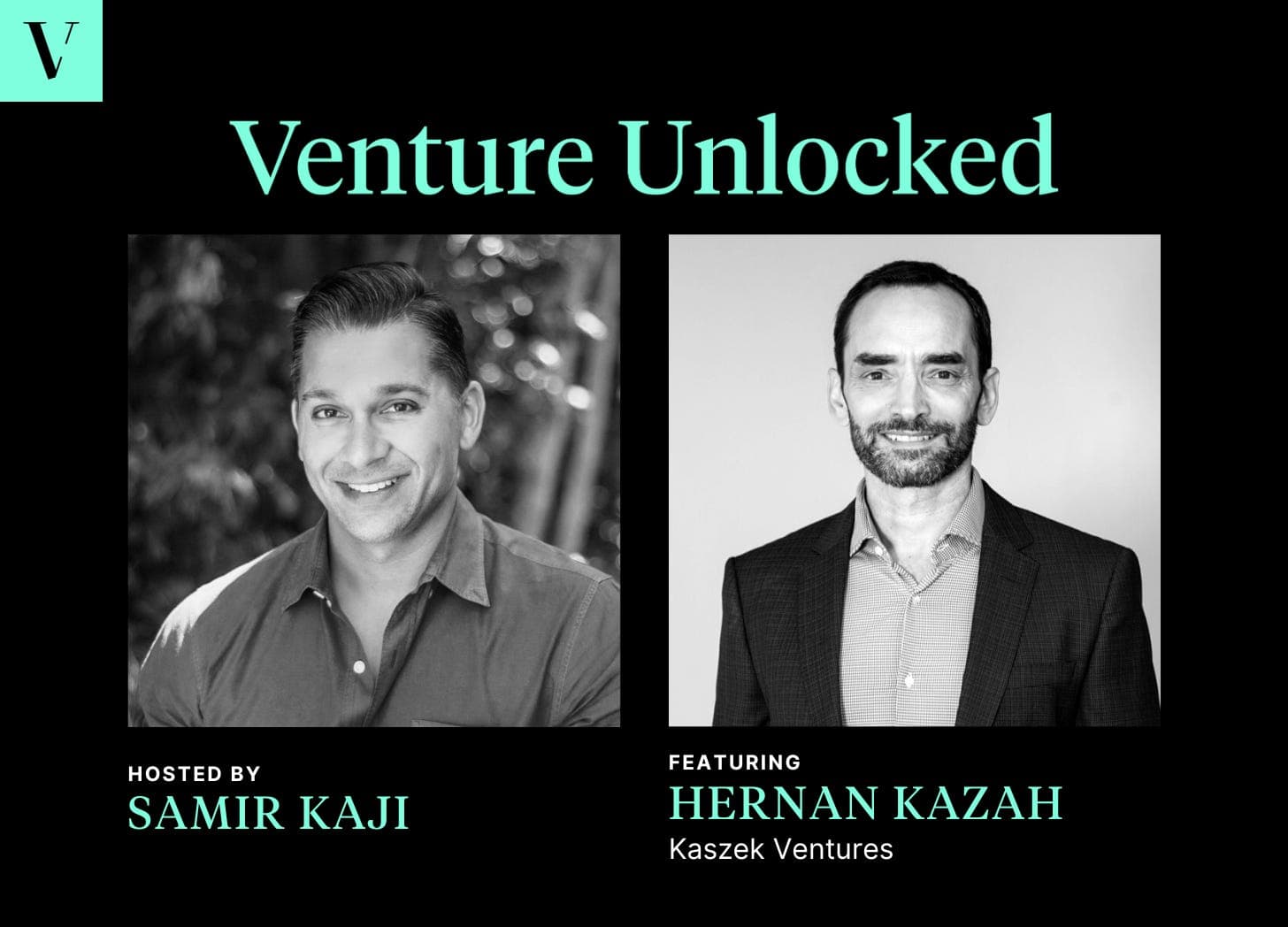
- Title: Hernan Kazah of Kaszek Ventures on investing in Latin America, learnings from building a public company, and working with founders
- Host: Samir Kaji
- Guest: Hernan Kazah, Co-Founder and Managing Partner of Kaszek Ventures
- Date: [Insert Date of Release]
- Link: [Venture Unlocked Podcast](https://ventureunlocked.substack.com?utm_medium=podcast)
About Hernan Kazah
- Co-Founder and Managing Partner of Kaszek Ventures, one of the largest venture capital firms in Latin America.
- Prior to Kaszek, Hernan co-founded MercadoLibre in 1999, a significant player in e-commerce in Latin America, which went public in 2008.
Key Discussion Points
Hernan's Journey into Technology and Investing
- Transitioned from entrepreneur at MercadoLibre to full-time VC in 2011.
- Notable experience with raising capital and navigating market challenges during the tech bubble burst.
Insights on Venture Capital in Latin America
- Market Growth: Recognized significant opportunities in Latin America for technology disruption.
- Investment Strategy: Focus on early-stage investments across various sectors including e-commerce, fintech, and mobility.
Building Kaszek Ventures
- Initial Fundraising: Initial fundraising was challenging due to the lack of a proven track record.
- Started with personal capital and connections from MercadoLibre.
- Ended up raising nearly $100 million for their first fund.
- Long-Term Vision: Aiming to create a firm that outlives its founders, focusing on relationships with limited partners (LPs).
Lessons from MercadoLibre to Kaszek
- Power Law: Early misconceptions about the distribution of returns in venture capital; most returns come from a small number of investments.
- Management Style: Shift from problem-solving to a focus on scaling successful companies; learning to identify winners and support them effectively.
Navigating Capital Scarcity
- Compared current capital scarcity to earlier challenges faced as entrepreneurs.
- Emphasized the need for startups to demonstrate sustainable business models and prudent resource management in a tighter capital environment.
Working with Founders
- Strives for a balance between being supportive and providing constructive critique.
- Advocates for transparency in discussions, fostering an environment where entrepreneurs are challenged to think critically about their strategies.
Key Takeaways from the Conversation
- Focus on Core Objectives: Importance of saying no to distractions and maintaining focus on core business goals.
- Self-Confidence vs. Humility: Successful decision-making requires a balance between confidence in one's vision and humility to accept new information.
- Value-Added Partnership: The role of a VC should align with the goals of founders, providing added value beyond just capital.
Conclusion Hernan Kazah's journey from entrepreneur to VC highlights the evolving landscape of venture capital in Latin America, emphasizing the importance of resilience, strategic focus, and meaningful partnerships with founders. The episode offers valuable insights for both emerging investors and entrepreneurs navigating the complexities of the current market.
---
For further insights and detailed notes, visit [Venture Unlocked](https://ventureunlocked.substack.com?utm_medium=podcast).
Written by AI. May contain mistakes. Listen to the episode to check what was said.
Transcript
Automatic transcript. May contain errors.0:00Welcome back to another episode of Venture Unlocked, the podcast that takes you behind the scenes of the business of venture capital. I'm your host, Samir Kaji, and on this week's show, we're excited to have Hernan Kaza, co-founder and managing partner of Kazaq Ventures. The firm launched in 2011 has become one of the largest and most well-known Latin American firms with nine funds under management, and over time, they've made early-stage investments in companies such as Nubank, Quinto Andar, Kavak, Creditas, and Nuvam Shop. Before becoming an investor, Hernan co-founded MercadoLibre in 1999, an online auction and e-commerce platform that later went public in 2008.
0:38At a market cap today of over$60 billion, the company represents one of the greatest entrepreneurial successes in that region. During our conversation, we spoke about the growth of Latin America, making the shift from a company builder to a full-time investor, and how founders and investors should think about the capital-scarce market we are navigating today. I think you're real again a lot hearing Hernan's insights. And without further ado, let's get right into the show. This episode is being brought to you by Grasshopper Bank. Privately owned and headquartered in New York City, Grasshopper Bank is built to serve the business and innovation economy.
1:14As a client-first digital bank, Grasshopper combines technology and years of industry expertise to provide clients with a best-in-class banking experience. Grasshopper's digital solutions are tailored for venture capital and private equity firms, startups, and small businesses. In addition, they also work closely with fintech-focused banking as a service and commercial API banking platforms. Serving clients globally, Grasshopper provides flexible, firm-focused lending solutions as well as dedicated relationship managers committed to meeting the unique needs of funds and companies alike. Grasshopper is a member of the FDIC and an equal housing lender.
1:50For more information, visit the bank's website at www.grasshopper.bank or follow on LinkedIn and Twitter. Samir Kaji is the CEO and co-founder of Allocate. Allocate and Venture Unlocked are independent of each other. Any statements or references made by Samir or his guests regarding third parties, investments, or securities are solely their views and opinions and are not intended as investment advice or an endorsement of such parties or securities by Samir, his guests, or Allocate. Allocate or its clients may maintain relationships with or investment positions in guests, third parties, or securities mentioned in this podcast.
2:28This podcast is for informational purposes only and should not be relied upon as a basis for investment decisions. Hernan, it's so great to see you. Thanks for being on the show. It's my pleasure. Thank you for inviting me. I think you have such an interesting story. And I love talking to people that went from being an operator to being a full-time investor, which you've done. But maybe we can just start with your background of how you got into technology and ultimately what led up to starting Kaizek in 2011. Sure. So going back in time and trying to summarize more than two decades into a few minutes, I went to the Stanford GSB for an MBA right in the middle of the first tech bubble.
3:14It was 97, 98, 99. And obviously during those days and being there, you could not avoid getting involved in technology. So there I started to work in some technology projects and I met there, who's today still a very good friend, Marcos Galperin. And he was also doing the same thing. And he was planning on launching what at the time was the eBay model in Latin America. And I was working on a different project. So we would exchange ideas and do some research. And eventually, luckily, I ended up dropping my project, joined Marcos and together we graduated in May 99, went back to Buenos Aires and we started Mercado Libre then.
4:10So Mercado Libre was, it was 1999, I believe, around 99, 2000, ultimately take the company public in 2007. You stay on until 2011. Throughout those times, it was a journey that you went through and you learn a lot during those times. What I love asking is the question around when When you decided to be a VC in 2011, what were some of the experiences at MercadoLibre that really informed the type of firm you wanted to build? So yes, we started the company in 1999 during a boom, bullish market. We raised capital then, and then we went back to the market in March 2000 when the bubble burst. And it was really difficult for us to raise capital then, but luckily we ended up closing around.
5:00And with that round that we ended up closing in May 2000, we realized that that was the round that had to take us to profitability. So we raised capital in May 2000, went public in August 2007, still with some of that capital in the bank, that capital that we raised in that round in 2000. and the company took some time to become profitable. By the end of 2005, we could have made it profitable, but we decided to bet more on growth and postpone for a few quarters profitability. And then by the end of 2006, beginning of 2007, the company was profitable and we IPO'd in the Nasdaq in August 2007. The public company stayed for a few more years.
5:58And then in the year 2011, I decided to leave Mercado Libre and together with Nicolás Secasi, who was also part of the founding team of Mercado Libre. In the early days of Mercado Libre, we used to have a table where Marcos, Nicolás and I would sit. We had worked together for over a decade. And today we decided to launch CASEK. What drove us there? On the one hand, we saw really in a very personal manner the advantage that technology was bringing to the region. We saw that all the trends that we were reading about the U.S. and maybe later on Asia were also happening in Latin America. there was indeed a lack a lack at that time but that did not mean that that was not going to happen in Latin America on the contrary we thought that in Latin America the opportunity for technology was larger in the case of Mercado Libre for instance we had the e-commerce side of the business and we realized that what Mercado Libre was creating into retail in the region was more significant versus what e-commerce players were doing in the U.S.
7:16Because in Latin America, if you lived in a large city, maybe you had access to some regional retailers. But if you lived in smaller towns, those regional retailers did not exist. So e-commerce was really providing extra value there. Then Mercolio also had payments and financing business. And in Latin America, financial inclusion is a big issue. The penetration of credit cards and banking is slow. So with technology, you could really disrupt that. And this is the one we looked into for education, for healthcare, and now into climate tech and other things. we believe that the value that technology brings into a region like Latin America is more significant versus what you have in other parts of the world, in particular in more developed areas of the world, because obviously you are leapfrogging what maybe incumbents or offline players have done in those more developed markets.
8:26So that was one thing that we saw very clearly, and we had no doubts that the full technology revolution was going to happen in Latin America. And also in our days as entrepreneurs, we had investors, but those investors were more like bankers, so financial institutions that saw what was going on in technology in other parts of the world and wanted to play the tech kind of investment side of it. But those were not investors that knew how to advise entrepreneurs. They did not know how to help entrepreneurs recruit talent, think about the product strategy, the technology strategy and those kind of things.
9:14So we thought that having built one of the most significant technology companies in the region, we had an edge versus all those other investors that were working in the industry. And also that we could connect better with entrepreneurs and be more of a value-add partner rather than just a provider of capital to those companies. I want to come back to that in terms of what does it mean to add value to companies because there's so many conversations around what does it mean? How do you really add value? How do you actually transform the arc of a company alongside the entrepreneur? And I know you think a lot about that and I want to come back to that in a second.
10:01But going back to 2011, Mercado Libre, I think when it went public, it was less than a billion dollar valuation. At the time, I think it was closer to 800 million. Now, obviously much bigger. But you saw all of these markers around Latin America, both being ripe for technology disruption, but also the growth of the area. And I think back in 2011, it wasn't very clear that where VC was going to go less than a half a billion was funded into Latin America more broadly. And what was the mental model of creating a firm versus actually starting a new company and taking advantage of this technology disruption that could happen?
10:38Clearly, in the year 2011, Mercolio still had a long way to go. We IPO'd at a valuation of$800 million. During the first day of trading, we passed the billion-dollar mark. And for us, that was amazing. Then the company went all the way up to$3-4 billion. And then, as you know, the global financial crisis hit, and Mercado Libre's shares went down 80%, 90%. So we IPO'd at$18 per share. Shares went up all the way to$80. And then when the financial crisis hit, they went down to$6. And by the way, it was interesting because obviously we were all scared about what could happen with the financial world and financial markets and financial institutions.
11:39But Mercolio kept on growing every single day. We were producing cash. We had zero debt. So we saw no reason why the company had to be valued at a fraction of what it was a few months earlier. So we remained focused on executing our business plan and happy to see that more and more buyers, sellers were interacting through our platform. And eventually, clearly things paid out. So by the year 2011, probably the valuation of the company was$5 billion and there was still significant upside. But the nature of our job had changed. We were really in the trenches in the early days and dealing with real life or death problems.
12:28And then the company slowly but still became more of a corporation, still a very agile corporation and with very significant growth ahead. I was a little bit different and our daily jobs were more about managing people rather than really adding value to what we thought was the most relevant piece. So I think that it's funny because the initial thinking that Nicolás and I had was we no longer want to be managers. We want to be closer to the action. But at the same time, we realized that maybe we didn't have the kind of energy we had in the early days of Mercado Libre when we were working 25 hours per day.
13:10So we thought that given our experience, given the opportunities we saw in the region, given what we wanted to do, becoming an investor was something very natural to us as a next step. And that's how we ended up doing that. What is funny is that today, CASEC has grown significantly. So we're back with our managers hat on, but it took at least a decade to go back there. People sometimes underestimate how long it takes to show success, build an organization, which you've successfully done now over, I think it's about 12 years now, running the firm. Tell us a little bit about the early days. So 2011, you decide to start a firm.
13:56First thing you have to do is fundraise. And coming from the background you did, it wasn't like you rolled off a big firm. You were operators turned VCs. How did you build that LP network and how did you focus on that first fundraise? It was a long process and it connects well with something that you mentioned earlier, Samir. But what we did initially was we decided to raise some capital from ourselves, from our friends at Mercolibre and get started with a smaller fund. We thought$50 million would be enough for what the region was at the time, etc. But then people started hearing about our new venture and they decided to join.
14:44So some of the investors at Mercolibre wanted to invest and some other people that maybe were not investors in the company but had known us over the years also wanted to invest. So we ended up raising close to$100 million, which is funny because at the time it looked like a lot of capital and now it's just marginal. Well, not that much, but a couple of years ago it was like nothing. And we started investing in those funds. We ended up investing in 24 companies that first fund. Our focus was early stage, so we would invest in seed, series A or series B and reserve some capital for follow-on rounds.
15:32And that's what we did with the first fund. And so it was basically ourselves, highly qualified friends and family. And then at the very end of the process, a fund of funds reached out and wanted to invest also. So we allocated some capital to them and they were the first institutional investors into the fund. we always thought that we wanted to build a firm that was going to stay here for the long run, that was going to hopefully outlive the founders, etc. So we liked the opportunity of having a more formal relation with one significant investor so we could get ready for what was going to happen in the following years.
16:22But what's interesting is that our pitch was, what I told you earlier, the growth of technology in the region, why we thought more value in the gap that technology would fill in Latin America, the terrific experience we had as operators ourselves, et cetera. And people bought that and that's why they wanted to invest. But it was interesting that the most common question then was, okay, I believe they're going to find great founders. I believe that those founders will want to work with you. I believe that you can add some value to those companies. And I know that you're planning to reserve some capital for follow on.
17:04But what happens next? Who's going to provide more capital once you deploy your second, third check? And reality was that we did not know. We were very confident that investors were going to go after good opportunities. And if we had good opportunities, we would present those to them and they would agree on investing in those companies. But we couldn't name precisely where that capital was coming from and couldn't give enough indications of what was going to happen. And it's interesting to see that in some of those rounds, we had to be very creative in helping the entrepreneurs find ways to access capital.
17:51In some cases, we used our relationships and connected a past investor of Mercado Libre with this company because we thought there was kind of common ground for getting interest there. Or we started reaching out to people that then would connect us with someone that would help that company raise. At the beginning, part of the value add, and that's part probably of the second question you had there, was helping companies fundraise. And we were very active there. We were kind of an M &A investment bank boutique helping those entrepreneurs find capital. Today, that's no longer needed because Latin America technology, Latin America is in the radar screen of all the relevant global investors.
18:42But at that time, that was an effort that we had to make. And interestingly, the first fund, there was one institutional investor. And then eventually, we added a couple more in our second fund. And by now that we've raised six times nine funds, because then we added to the early stage fund also an opportunity fund. Today, most of the capital comes from institutional investors. And within institutional investors, the ones we try to favor are the foundations or the endowments, those kind of investors that, on the one hand, are really long-term focused, value-add. On the other hand, those investors make our work more interesting, right?
19:31Because we're working for their missions, and that's part of the responsibility we have today, to return more capital so they can really have more impact in whatever mission they have, which are always really amazing missions. It's amazing to see both how you've scaled as an organization, the brand, what you've done in terms of the investing, going back to that fund one, which was$100 million. Of course, a lot of happy LPs having new bank in that fund one. But kind of going back for a second, you know, making that transition from working at a company and then actually starting and building a firm.
20:10Often there's this continuous learning curve that you have to go through. Tell us about maybe the first couple of years of learning. And did you, before you started the firm, seek out any mentors to help you make that transition? So we thought erroneously that moving from one side of the table to the other one was going to be very natural. We knew how to run a company. We knew how to build a tech platform. We knew how to hack the system here or there to increase growth or improve profitability, margins, etc. So we thought it was going to be, and we knew how to deal with investors because we had done that for a decade.
20:47So we thought that it was going to be very easy to move from one side to the next. But interestingly, some of those beliefs were right and many were wrong. And I think the two most important ones that we didn't get quite well was, one, this phenomenon of the power law. We thought that because we were former entrepreneurs and knew the region like nobody, etc., that we could really find many winners and that we could help many companies become winners, etc. And at the end of the day, we have the same concentration of results that you see across the industry globally. So you invest in 20, 30 companies per fund.
21:36and then when you look at the returns of those funds, even when they do really, really well, it comes out of one, two, three companies, most of it. So that was something that we did not understand well at the beginning. And then the other part is that I think when you're an entrepreneur, you're all the time thinking about winning and you don't want to lose any battle. So if there's a problem, you just go deep into it and look for ways to solve it. And if you cannot solve it the first time, you try again, you try again, you try again until you really solve it. And when you become an investor, obviously you want to help everyone and that's part of the reputation you build as a firm.
22:23And that's why then the following generation of entrepreneurs want to be part of your portfolio. But you need to understand that if you just work in a way trying to solve problems, Maybe you're not doing your job because it's more about being a catalyst to those companies that are doing really, really well and take them to 100 to 1 ,000 versus trying to save companies that are struggling between zero and one, zero and one, zero and one. And the initial natural reaction for people that had been in the operation, had been entrepreneurs, had been really trying to solve, as I said, life or death situation is to try to solve those companies.
23:05You didn't want to see anyone going down. And that was not the right thing to do. So we ended up learning that and trying to understand how to better calibrate our value add, our support to companies. Again, always helping entrepreneurs. That's something that is part of our brand. And you need to have that brand so the circle keeps on spinning and entrepreneurs tell new entrepreneurs that you're good for them. And not only the ones that do well, but also the ones that are struggling. So you get the next generation of entrepreneurs and then you do that again and you get the following generation of good entrepreneurs, etc.
23:46But you need to be smart and try to really put all your effort or most of your effort into Compact that will produce most of the results. You're touching on something really important, which is around how you also manage your time in terms of working with entrepreneurs. You know, an average, let's say an early stage fund invests in 25 to 40 companies. And it does usually follow that power law where 10 % of the companies will drive most of the returns. will be you'll have to have a fund returner, maybe two fund returners in there. Then you have 40 to 50 % of the companies that effectively return zero to 1x.
24:22And then you have things in the middle that are doubles and maybe triples, maybe a few singles along the way. But as you're building in the early days, you don't know for sure. Over the course of two or three years, you start to get the signal which companies are moving directionally. But how do you think about the messaging for those companies that are zero to one, because you want to retain your brand as being very founder supportive. But at the same time, there's only so many hours in a day. So how do you think about your time as the portfolio matures and you know which companies are breakout versus not?
24:56Yeah, so you don't know for sure, in particular, at the beginning, you start working with companies. And our thinking is that we make an investment if at the time of that first check, we believe that that company can be a fan maker. Obviously, then reality hits and for 80 % of the companies, that ends up not being the case. But we learned that over time. And sometimes you have entrepreneurs that are doing a great job and really working day and night and basically delivering on everything they told you they were going to do, but technology doesn't catch up with the market or maybe there's something that is not there and therefore they cannot build the kind of company they try to build.
25:42So you have to understand that it's more art than science in that regard. Because sometimes it's okay, you need to support the entrepreneurs so they can maybe pivot a little bit and try to recalibrate the business plan. In some other cases, you just need to be a little more patient. That's something that we've learned. Typically, when you are innovating at big scale, it takes time to really take off. And it's not that you are pursuing the wrong idea, but it's just that maybe timing is not exactly what you thought and you need to do more. So you need to react on what you see. Remain always open, be naive in that regard and be more of the believer than the one that says, you know what, this is enough.
26:32Let's shut it down. because you don't know. And reality is obviously then by year three, four, five, maybe things become very evident. And then you start managing a little more your time allocation and your resource allocation because not only us as partners, but we also have a couple of groups within the organization, one dedicated to technology and growth that try to work across the portfolio of helping companies in things related to technology, to online marketing to product usability. And then we have another group around HR that what they do is try to help recruit talent into the companies and then also try to implement good HR practices into those companies, et cetera.
27:21So the way we allocate the time of those two teams plus our time starts to become more evident by year three, four, five of the company. Before that, it's hard. And you need to call the shots on a daily basis. And sometimes you go really too much in one direction and then you correct. It's not perfect at all. And it's funny because we all the time tell our entrepreneurs that they need to create scalable platforms and that they need to be very precise on what to do and what not to do. we don't work our talk in that regard that much. One thing that's interesting is when you started Mercado Libre in the 99-2000 timeframe, obviously at the tail end of the dot-com, but even during that journey, going up to the public offering in 2008, capital was relatively scarce, especially in the area you were, but even more broadly.
28:20And then 2011, you start the firm, coming off the global financial crisis, wasn't quite clear at that time. We'd see so much capital available for startups for growth. And as we sit here at the midpoint of 2023, of course, we're back to a capital scarce market. And I'm curious how you think about as a firm, how to help companies navigate during a time where they have to show growth, but they also have to do in a very capital, non-intensive way. And coming off a period where a lot of entrepreneurs and founders have never seen anything like that. It's a very interesting point. And I think comparing what happened in the year 2000 and what happened today, the common thing is that capital is less available today as it was less available by then versus what had happened in the prior cycle when capital was very available, maybe too available.
29:22What is different is that when we started Mercolibre, there were no internet users. So we had to be patient because there was no critical mass. Technology and businesses are mainly around economies of scale. So that means that you need volume because serving 100 customers or serving 100 ,000 customers, it doesn't imply that you need to multiply your cost by 1 ,000, but your income does multiply by 1 ,000 typically. so you really want to reach scale and in those early days scale was not possible so you had to be patient and pace yourself not only because you had little capital but also because you had to wait for the market to get there when we started Mercado Libre internet penetration was 2 % and then it was 3 % and then it was 5 % and then broadband came and then eventually mobile internet came so we had to be very patient Today, you need to be very careful about how you handle resources because you don't have that much capital available.
30:28And you need to ensure that you can demonstrate that you're building a self-sustainable business, something that not today, because in this industry, you're all the time investing for the future. but in a reasonable future, you'd be able to self-sustain the company and not that you will need another round, another round, another round because light at the end of the tunnel is miles, miles, miles away. So that piece remains the same, but the difference is that today you do have critical mass out there. So if you hit product market fit today, you can really have a profitable business if you have the right business model.
31:07In the past, even with product market fit, you had to wait because costs were high and income was low and you needed more users to eventually get online and eventually to get into broadband, etc. So that's kind of what you need to somehow calibrate better today. It's not only about waiting. It's also about setting the right pace. So if you go too slow, someone may outpace you. If you go too fast, maybe you run out of capital and cannot demonstrate that what you're building makes sense. So we always tell entrepreneurs that it's around two things. One, product market fit. So do not accelerate too much if you don't feel you have it there.
Read the full transcript
31:51And what does product market fit mean? Could mean many things, but for us is somehow the growth engine is working. So retention becomes positive. So you add 10 customers and the following day, you don't have nine. You have 11 because things start to work. And slowly but steadily, you see that customers are happier and happier with your solution, etc. So you need to make sure that you have that. And then, on the other hand, you need to make sure that the marginal cost. So maybe total cost might be negative because, again, maybe you have too much infrastructure for the volume you have at the time.
32:28but marginal costs are lower than marginal income. And that's the key piece. So if you're buying something for 10 and selling that for 11, you might be fine. If you're buying something for 10 and selling that for eight, you might have a problem. So you need to really calibrate those two things and ensure also that you allow yourself some room for problems, right? Because as we were saying earlier, innovation takes time to take off. So even if you're on the right track, you think you have product market fit, something may not work on a quarterly basis. Then maybe when you look at the year, when we look at the history of the company, things seem to be terrific.
33:13But in a particular quarter, in a particular semester, things are slower. So you need to have some cushion there. And that's what we try to manage with entrepreneurs. And that was what we did a lot last year, right? So we came from a market of excesses where everyone raised too much capital and where many companies started to pursue too many projects. So maybe they had the core project and maybe one that was synergistic with it, but suddenly they had so much capital they started pursuing five, 10 projects at the same time. And we lost discipline. Everyone started to be very, very inefficient in terms of how to manage their resources, etc.
33:57So 2021, 2022, we started really helping companies refocus on their core projects. What is really what you're trying to build? What will really make your company different? Cut down on the other things and really recalibrate plans. So you would reduce your growth rate instead of growing 5x, maybe you grow 2x. But instead of burning$100 million just to exaggerate, you burn 5. So really calibrating that to ensure that whenever you go back to the market, you can clearly show that you have a sustainable business model, or maybe you even get to profitability. And then you look for more capital because you want to accelerate growth then.
34:45but that capital doesn't put you between a rock and a hard place. Yeah, I totally agree with that. And it's hard to change when you have so much capital being thrown at you. And it creates the culture of just growing very quickly and figuring things out later in terms of business fundamentals. And you mentioned the word discipline. And I think that's true. We're all returning to a world of forced discipline because of capital scarcity. Now, when you think about your role, and you're in a very unique position because you've been on both sides of the table. As an entrepreneur going to VC, one area that we've often seen VCs struggle with when they've made that shift is how to work with founders.
35:29So some have gone the route of getting too close, going too deep in the weeds, and almost trying to run the company, while others, perhaps as a function of having a bad experience as an entrepreneur, working with VCs, go and overrate to being so supportive of the founder, they kind of listen to anything. And I know you've thought about this a lot and want to act as this nice balancing point where you can be supportive, but also act as a very objective and clear sounding board. Maybe tell us a little bit how you do that and what that means for the firm. No, you're absolutely right. If you start a company during a period of scarcity, I think all the right elements come into play.
36:15First, you end up meeting only those entrepreneurs that are totally convinced about what they want to do. and they are not doing it because, oh, the market is easy, so I can fundraise and maybe explore this idea that I may want to pursue. In a hard market, the entrepreneurs you come across with are the ones that are totally convinced that they feel that they cannot do anything else but launch their company, right? So there's a positive selection process there. Then those companies, because they end up raising less capital, As an investor, you get typically a higher level of ownership, which is good for the return of the fund.
36:58But also, the companies really focus on what's important. So they don't kind of lose focus and start pursuing 20 things. They want to do just one thing really, really, really well. And what we say, great companies are built out of doing one thing extraordinarily well. Not too many okay, right? So there's a positive thing there. And then because the team needs or knows that they have to produce their own resources to eventually keep on growing, they really focus on building a sustainable business. So you do have the right DNA. The people you attract at the time also are people more committed with the mission and not so much with the market momentum, etc.
37:42So you end up creating a great, great initial kind of set of genes that will then help you long term. And it's much easier with that right set of genes to eventually decide, you know what, now the market is positive and we have lots of capital. So let's accelerate and let's go a little bit overboard with marketing or overboard with growth. But you do that with a very healthy base. This is exactly the contrary that happens when you get the company started with a very bullish market. So you raise more than you need and you start focusing on too many things because you, the entrepreneur, but also the investors tell you that you need to do more and grow faster, etc.
38:26So you start kind of generating a set of genes that are just developed for growth. We all pay attention to cost of capital. And then when you need to adjust, it's much harder to adjust that. versus the other scenario where you do have the right core, but then you need to adjust for faster growth. So I think in that regard, it's a much healthier situation than the one we're in now. And that has happened many times in the past, right? And it's when there are excesses in the market is because we all tend to overlook for risks and challenges and cost of capital and really focus on everything will work.
39:09And suddenly you go to the other end of the spectrum and you become very negative on everything. And you don't even believe that technology will work, et cetera. And it takes a few investors to start kind of saying, you know what? We've been too much to this side of the pendulum. I think it's time to start investing because now price risk reward makes sense. So they start adjusting things. So it's about ambition, perception of risk and perception of the upside that needs to be readjusted. And I think that now we're in that process. So if we just talk about CASEC, as I said, 2022, we basically worked with our companies to recalibrate their plans.
39:57The very, very few investments that we did were within the portfolio and just to help companies that we like, but maybe had a cash crunch, et cetera, get to the other side of the shore, et cetera. And now this year we're starting to invest in new companies. So we're building again our portfolio. And when you are an investor, you know this very well, Samir, you typically wear two hats. if you look at it for a longer period of time, it's 50-50. So 50 % you have the hat of portfolio formation and 50 % you have the hat of portfolio management. But then what happens within a year, within a quarter, it depends on the needs of the companies, of your portfolios, of the status of the market.
40:50So 2022 was a year of 100 % portfolio management. And this year, we're going back to the 50-50. We are still working actively with companies, but we're also looking into new opportunities. And probably if we go back to the second half of 2020 or 2021, it was too much around portfolio formation and not enough on portfolio management. And maybe said another way in terms of where you are, you're right. There's just two elements, which is portfolio management, which is working with the companies, helping to catalyze growth, adding value, looking at liquidity as avenue to generate capital back to the fund and back to the LPs.
41:37And then of course, the picking at the front end. But when we think about your arc going from operator to now 12 years as VC. I think you might be reaching longer time as a VC pretty soon than what you did at MercadoLibre. How have you sort of morphed your style toward entrepreneurs? Because I asked the question, but maybe I'll ask it in a different way. It is very difficult to think about what you want to be known for as a firm when working with founders. And some people say founder friendly and their definition is we're going to support the founder no matter what. There's other folks like Doug Leone and Mike Moritz and Sequoia who have been, they're very direct.
42:19They're always thinking about the shareholder. They've been very successful. Their interface is much different than a lot of other general partners. How have you evolved your own sort of model? And what do you think is the right model? So first, this year, I passed the mark. So now I have more time as an investor, as an entrepreneur operator. I thought that was never going to happen, but it has happened. Time goes by, I can say. But what you're saying is great. And what we try to do is to really add value to the companies. we say that our mission is to help entrepreneurs increase the chances of success that their ventures have.
43:05Obviously, 99 % of the work will come out of the founders, the team, etc. But we try to add that 1 % into the formula so chances of success increase. And for doing that, our style is to be brutally honest. We're not cheerleaders. We're not there for, hey, go, go, go. We've seen many, many board meetings where other investors are just applauding the entrepreneurs instead of raising their hand and trying to show them, I think they're wrong. Look at this. Look at that. At the end of the day, then the entrepreneurs are the ones that call the shots. Unless there's, I don't know, a very significant issue.
43:49We never, ever interfere. the entrepreneur and the entrepreneurs are the ones that make the final call we're more like contrarians in that regard and and if the entrepreneur confirms his or her belief fantastic we're happy but at least he or she thought twice before making that decision and if they prove us wrong we celebrate we're not in the business of trying to be right we're in the business of hopefully generating a good outcome for our lps we tend to be very very direct and it's interesting because in the long-term relationship that we've had with entrepreneurs, I think that permeates and people really value our style and they understand that our only intention is to improve the chance of success of the company and that's it.
44:39Short-term, sometimes it generates some friction and some entrepreneurs are very comfortable with that friction and some are a little more uncomfortable. But if you're really, really uncomfortable with that, maybe you're not the kind of entrepreneur you want to work with because when I work with people that again as I said about CASEC it happens with them they don't care about who's right they care about what's the best decision for the company how can we make this business successful and I think that is the way we try to position things so being entrepreneur friendly I don't know if it's the right definition for CASEC I think it's being entrepreneurs supportive being there for the long run, being totally available when there's a problem.
45:23I think we really deliver on those areas. Do we deliver in being the friendliest? We respect everyone and treat everyone with the highest possible respect. And if we disagree, we disagree on the matter, not on the person. We always have the highest respect for people individually. But we may disagree on business decisions. And we think that that creates a positive discussion. We don't do that for the sake of discussing. If we agree, we agree. And fantastic, we support it. But if there's something that we think is not clear enough or something that we think might not be the right answer for the challenge we're facing, we say it.
46:06Yeah, you know, it's interesting because I was talking to him. This is a different podcast. I don't know if it was picked up during the actual final release, but I asked this question about founder-friendly. and I said, hey, what does it mean to you? And they're like, well, we don't use that term here. He said, I'm shareholder aligned. And so any decision that I'm making is on behalf of all the shareholders, all the employees, the management, the preferred shareholders, and we are looking to get this company to the right place. Sometimes that's gonna require really tough decisions and tough conversations, but the more courageous conversations you have, the easier it becomes over time and the better value that you drive.
46:47And I thought that was a really interesting sort of way to think about it. I totally agree with that. And if you go back to our portfolio, there were some very tough discussions at some points. And if you speak with those entrepreneurs today, they are the ones that value cash the most because, hey guys, you really were there trying to do the right thing or maybe they ended up doing what they wanted to do, but at least they received our different thinking in a positive way. And sometimes they realize that what we're saying was right. And when things flow very naturally, and you know this, in this industry, even the most successful cases never go in a smooth ride.
47:32There's always some hiccups here or there and a problem. And if you just ignore those problems and keep on cheering for whatever the founder is saying, you're not doing your job. Totally agree with that. So I want to maybe end with a higher level question around two decades plus entrepreneur and investor. What is the best piece of career advice? And, you know, at the beginning of this conversation, we talked about two books that you thought your favorite, you know, Steve Jobs and Warren Buffett. And maybe you're pulling from those, but I'd love to hear, you know, what is the best piece of career advice you've ever received?
48:09Two things. One, more as an entrepreneur, but then it goes well into an investor as well, is this concept of management is about what not to do. And we talked a lot about today about it and picking what is your core and remain focused there versus trying to create many alternatives, etc. You need to be great at one thing, and that one thing means to say no, no, no many times. The same thing happens with entrepreneurs, so that's one important thing. And then the other one that probably goes into being an investor, but also it was very relevant when we were entrepreneurs, is you need to have the right combination when you're making a decision or when you're running a company or when you're planning for your portfolio formation, you need to have the right balance between being very self-confident and very humble at the same time.
49:10And sometimes those things look conflicting with each other, but I think they are not exactly the opposite. You need to have a view of the world and be convinced that that is the way things will work and try to set up your decision-making process around that view. but then be very humble that you don't know for sure that you're right. So if someone brings relevant information, you have to pay attention to that. Keep your confidence very high, but your ego very low. And that's something that naturally for human beings is not the normal status, right? So we need to be very aware of that and require lots of self-awareness to try to be there.
49:54And that is what allows you to make good decisions as an investor and very importantly also for founders to build the right company, define the right strategies, etc. Love that framing. And I think that's right. And even in my shoes as a founder, I always think about we have to have high conviction and confidence in what we can and are able to do, but still have that shred of doubt that creates that constant level of curiosity and understanding that there may be an opposing view that we're missing or there's a blind spot. So I really think that's a great piece of advice, Renan. This has been really fun going through the story of you, Kazek.
50:32You've built an incredible firm over a long period of time. And I'm very excited about continuing to have this discussion with you and following the arc of the firm. But thanks again for being on. No, thank you so much for the time, the great questions. I'm looking forward to staying in touch. Thanks so much for listening to another episode of Venture Unlocked. We really hope you enjoyed our episode with Hernan. To learn more about him or Kazak Ventures, be sure to go to VentureUnlocked.substack.com for detailed notes on the show, as well as my ongoing commentary about the world of venture capital.
51:09Venture Unlocked is also available on iTunes or Spotify for download. And while you're there, please leave us a rating and a review as it really helps us out. And don't forget to hit the subscribe button in order to get each and every Venture Unlocked episode as soon as it's released.
52:16you Thank you.
52:47Thank you.
53:17Thank you.
53:47Thank you.
54:17Thank you.
54:47Thank you.
55:17Thank you.
55:48Thank you.
From the publisher
Follow me @samirkaji for my thoughts on the venture market, with a focus on the continued evolution of the VC landscape.
On this week’s show, we’re excited to have Hernan Kazah, Co-Founder and Managing Partner of Kaszek, one of the largest Latin American firms with nine funds under management. The firm launched in 2011 and over time they’ve made early-stage investments in companies such as Nubank, QuintoAndar, Kavak, Creditas, and Nuvemshop.
Before becoming an investor, Hernan Co-Founded MercadoLibre in 1999, an online auction and e-commerce platform that later went public in 2008. At a market cap today of over $60B, the company represents one of the great entrepreneurial successes in the region.
During our conversation, we spoke about the growth of Latin America, making the shift from a company builder to a full-time investor, and how founders and investors should think about the capital-scarce market we are navigating today.
A word from our sponsor:
Privately owned and headquartered in New York City, Grasshopper Bank is built to serve the business and innovation economy. As a client-first digital bank, Grasshopper combines the best of banking technology and years of industry expertise to deliver best-in-class experiences with trusted security and unparalleled support. Grasshopper's digital solutions are tailored for venture capital and private equity firms, startups and small businesses, fintech-focused Banking-as-a-Service (BaaS) and commercial API banking platforms, and more.
Serving clients globally, Grasshopper provides flexible, firm-focused lending solutions, as well as a dedicated Relationship Manager committed to meeting the unique needs and strategic focus of your firm across all entities, including funds, general partner and management companies. Grasshopper is a member of the FDIC and an Equal Housing Lender.
For more information, visit the bank's website at www.grasshopper.bank or follow on LinkedIn and X.
About Hernan Kazah:Hernan Kazah is the Co-Founder and Managing Partner of Kaszek Ventures. Hernan has overseen Kaszek’s growth into the largest venture capital firm in Latin America. It has invested in more than 100 startups and is known for its ability to spot the next tech talent and hands-on approach.
Prior to investing, Hernan Co-Founded MercadoLibre, the most successful "from-garage-to-Nasdaq" startup story in Latin America to date, and one of the largest technology companies in the region.
He has a BA from the University of Buenos Aires and an MBA from Stanford.
In this episode we discuss:
(02:57) Hernan’s journey into tech and investing(04:39) Lessons from MercoadoLibre that he wanted to apply in building Kaszek(10:38) Why he decided to move to venture in 2011(14:11) The long process of building an LP base with an unproven theory(20:21) Advice and mentorship Hernan sought out prior to starting Kaszek(24:56) How Hernan manages his time to help his portfolio(28:57) Comparing the market of 1999/2000 with today’s market(36:04) What it means to support founders(42:33) Why Hernan is mostly handsoff in his portfolio companies(46:50) How to have tough conversations with founders(48:10) The best career advice he’s recieved
I’d love to know what you took away from this conversation with Hernan. Follow me @SamirKaji and give me your insights and questions with the hashtag #ventureunlocked. If you’d like to be considered as a guest or have someone you’d like to hear from (GP or LP), drop me a direct message on Twitter.
Podcast Production support provided by Agent Bee
This is a public episode. If you would like to discuss this with other subscribers or get access to bonus episodes, visit ventureunlocked.substack.com