In short
Venture Unlocked: Episode Summary
Episode Title
Jack Altman on the transition going from building a Unicorn with Lattice to starting a venture firm
Episode Description
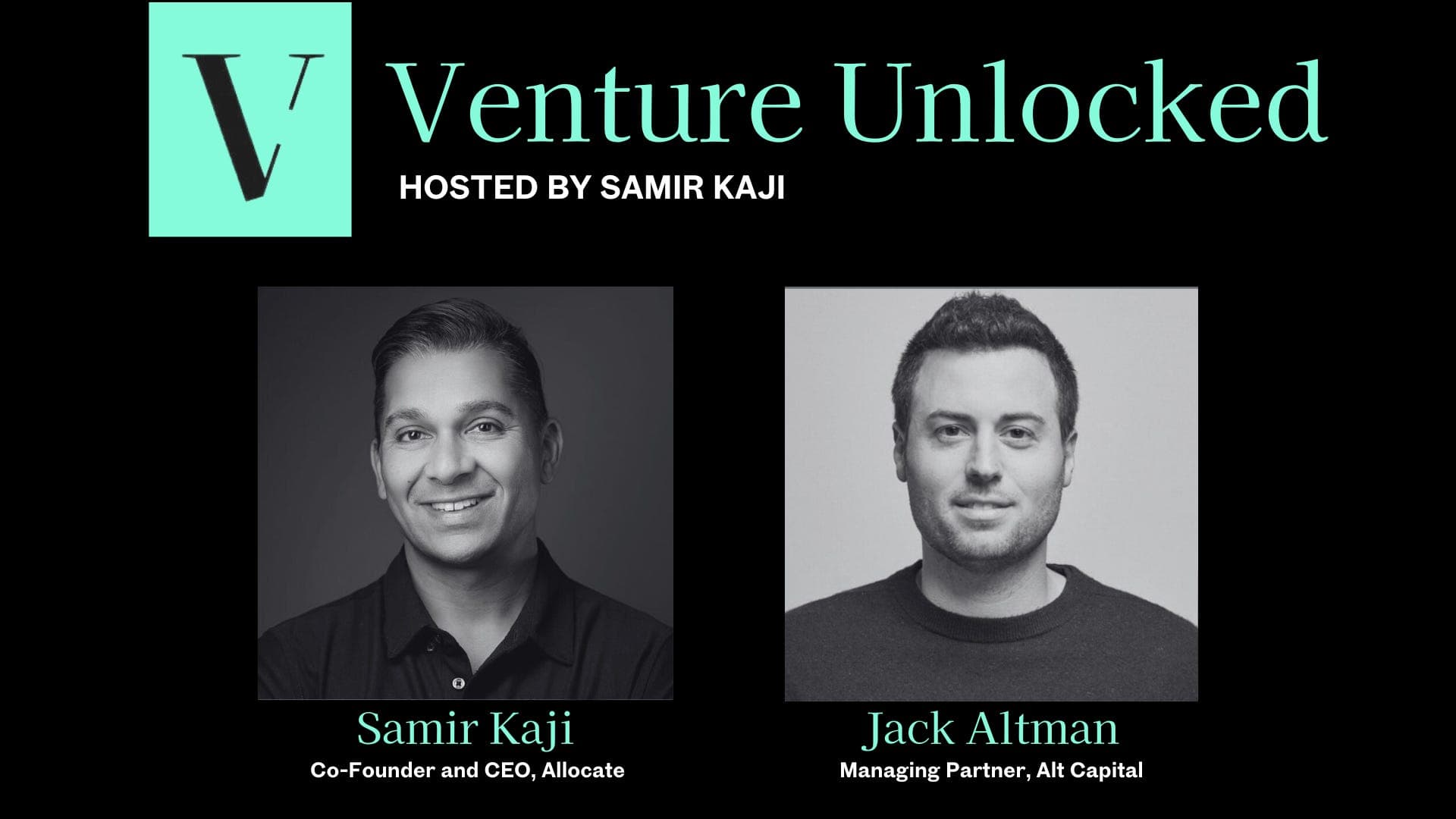
In this episode, Samir Kaji interviews Jack Altman, Managing Partner at Alt Capital, discussing Jack's transition from CEO of Lattice to venture capitalist. They explore venture investing nuances, founder relationships, early-stage investing, and insights about AI's impact on the market. Jack emphasizes the importance of backing founders in whom you have true belief, regardless of market fluctuations.
About Jack Altman
- Current Role: Founder and Managing Partner of Alt Capital (2024), a $150 million early-stage venture fund.
- Previous Experience:
- Co-founded and led Lattice, an HR platform valued at $3 billion.
- Background in corporate finance and business development with roles at Teespring and Hydrazine Capital.
- Investment Focus: Primarily in B2B software and hard tech.
Key Topics Discussed
- Transition from Operator to Investor (1:47)
- Differences between running a startup and a venture firm.
- The importance of relationships and personal connections in venture investing.
- Early Surprises in Running a Venture Firm (4:05)
- The day-to-day unpredictability of being a VC compared to a structured startup environment.
- Venture Capitalist Types and Motivations (6:37)
- Different motivations among VCs: relationship-driven, technology-focused, or deal-making enthusiasts.
- The Balance of Brutal Honesty and Founder Friendliness (9:51)
- Importance of providing tough feedback to founders for long-term success.
- Building a trust-based relationship for effective communication.
- Evaluating Founders (21:20)
- Importance of understanding a founder's motivations and outlier traits.
- Coherence in a founder’s vision and strategy.
- Measuring Success in Venture (26:53)
- Importance of feedback loops and identifying leading indicators of potential success over mere financial metrics.
- Fund Size and Strategy (37:45)
- Exploration of big vs. small venture firms and their distinct approaches.
- The necessity of having a coherent strategy tailored to fund size and investment goals.
- AI and Market Size (34:13)
- Discussion on the impact of AI on valuations and potential market growth.
- Speculation on whether current valuations reflect an underestimation of technological advancements.
Key Takeaways
- Founder Relationships: Strong, trust-based relationships with founders can lead to more effective guidance and better outcomes.
- Long-term Vision Over Short-term Metrics: Focus on long-term partnerships and backing founders you believe in, rather than being swayed by market fluctuations.
- Cohesion in Strategy: Successful VCs exhibit coherence in their investment strategy, aligning their approach with the realities of the market.
- Continuous Learning: The transition from operator to investor requires a mindset of continuous learning and adaptation.
Final Thoughts
Jack Altman’s insights reflect a deep understanding of the venture landscape, emphasizing the balance between relationship building, strategic coherence, and the evolving dynamics of technology sectors. His experiences underscore the value of backing exceptional founders and maintaining a long-term perspective in venture capital.
Call to Action
For more insights from Venture Unlocked, subscribe at [Venture Unlocked on Substack](https://ventureunlocked.substack.com). Follow Samir Kaji on Twitter for updates and discussions on the venture market.
---
This structured summary provides an insightful overview of the podcast episode, capturing key discussions and takeaways that are relevant for aspiring venture capitalists and those interested in the dynamics of startup investing.
Written by AI. May contain mistakes. Listen to the episode to check what was said.
Transcript
Automatic transcript. May contain errors.0:08Welcome back to another episode of Venture Unlocked, the podcast that takes you behind the scenes of the business of venture capital. In this episode, we are thrilled to be joined by Jack Altman, managing partner at Alt Capital. Jack launched Alt Capital after a long history both investing and operating, most recently as the founder and CEO of Lattice, which he started in 2015 and grew to unicorn status. As someone that's worked with VCs for over 20 years, some of my best conversations and insights have been gleaned by investors who were founders before. This conversation was no different as during our chat, we impact a lot of different things.
0:42including the similarities and differences of running a venture firm versus a startup, the learnings he's had from conversations through his podcast called Uncapped, where he's interviewed people like Peter Fenn from Benchmark, Vinod Khosla from Khosla Ventures, Mark Andreessen from Andreessen Horowitz, as well as his brother, Sam Altman, who is the founder and CEO of OpenAI. There were so many great nuggets and insights during this conversation, and I really hope you enjoy this episode. Samir Khadji is the CEO and co-founder of Allocate. Allocate and Venture Unlocked are independent of each other.
1:16Any statements or references made by Samir or his guests regarding third-party investments or securities are solely their views and opinions and are not intended as investment advice or an endorsement of such parties or securities by Samir, his guests, or Allocate. Allocate or its clients may maintain relationships with or investment positions in guests, third parties or securities mentioned in this podcast. This podcast is for informational purposes only and should not be relied upon as a basis for investment decisions. Jack, it's great to see you, man. What's going on? Thanks for having me. Yeah, so this will be fun.
1:51I always like talking to people that, and you fall into two of the buckets I really like, somebody that was an operator that became an investor. And then second, you have a great podcast. So you're a podcaster as well. And we'll get into that in terms of lessons and the like. But maybe a good place to start is really thinking about your history, right? So now you run a fund, Alt Capital, which is investing out of Fund One. But going into that, you are both an angel investor, obviously investing alongside your brother, but you are also an operator. And one of the questions I always like to ask people that are operators is, how did that operating experience inform what they wanted to build when they started a firm?
2:30Yeah, well, I mean, a lot of it is like pretty different. I mean, on some level, it's like a company is fully designed with the intention of scaling. The whole goal is to grow as much as possible. Whereas venture, at least the way I'm doing it so far, is very much designed not to scale. You only have so many hours in the day. It's based on a few number of relationships. You're not trying to build a huge team. So that's a pretty deep fundamental difference. Another big fundamental difference is, I think, as a founder or operator, there's sort of short feedback loops, and there's a lot of control over kind of everything.
3:13Both of those are the opposite in investing, where you have influence and long decision, but not control. And you have, and maybe don't even have influence, and then you have these very long decision or long feedback loops. So I think quite a lot is different. Obviously, there's like this substrate that's the same, which is the investor, the VC investors investing in the thing the operator was building, but it's pretty different. So I part of why I've been doing this podcast for the last few months is, it's just like an excuse to learn and seeing myself as like a total beginner on this whole thing.
3:44And just how can I, from a fully fresh brain, think about all of this from the beginning? Well, there's been a lot of folks that have obviously gone from operator or worked within a company or set of companies before going into the investing world. And you had one on your podcast recently in Mark Andreessen, who started with Ben in 2009, Andreessen, which now, of course, one of the biggest VC firms. Anything that surprised you, I guess, in the first couple years of running the firm? I don't know if it's a surprise, but I think that the day-to-day in a company is a lot more linear than the day-to-day as an investor.
4:18So running a company, you know the set of activities that are valuable and the set of activities that are not particularly valuable. You can still get into a lot of traps as a founder. Founders always know that it's like building product, talking to customers, building the team. Those are the healthy, good activities to be doing. And then there's a lot of other stuff that you got to do some of it, but you should mostly be minimizing it. Versus as a VC, I think there's less clarity on what that stuff is. And so the shaping of what a good day is like or what a good week is like, I don't think I have a great answer to that yet.
4:53I think I'm still experimenting and trying to figure that out. When you think about the day-to-day of a venture investor, there's a few components that are really critical of any firm. It's sourcing deals. Are you going to see the right entrepreneurs consistently? Can you pick over time? Can you show that you have some kind of picking acumen? It's the ability to win the deals that you want to get into because you're selling a commodity in capital. What's not the commodity is your network, your domain expertise, your ability to help. And then, of course, over time, you create the flywheel by getting a great reputation with founders who then allow you to win more consistently.
5:28When you started the firm, were there certain things you really thought you had this huge comparative advantage that you were indexing more heavily around those different components that I just mentioned? I mean, I knew that what I liked when I was building Lattice was having people around me who had been through the journey themselves. I actually am somebody who also believes there's a lot of value in like full time or like career long venture investors. And I think there's a mindset that exists there and there's experience that's useful. But I knew that I liked that. And so and I also just knew that's what I was going to be.
6:00And so I think for me, a lot of my orientation has always just been how do you set yourself up to authentically be whatever you are in the market? And that lets you have a much higher resonance with the people who want that thing. it also lets you live in your sort of in like your own sort of existence that is much more aligned and so for me I think there are founders who at certain junctures really value that and that's who I find myself speaking to most over some period of time you do this long enough and then it's like at some if you do this for if I do this for 10 or 20 or 30 more years at some point that's like a pretty long career as VC too but you know hopefully having been really through it once will keep me close to that.
6:41But I would say that's the biggest thing. But I don't know. I mean, the investing I did historically as an angel and then also somewhat institutionally, I've always been very people-driven. One of the things that I've learned from just enough time in the business in general, a little bit of time now as a VC, getting to talk to some awesome people doing the podcast, but also just through the course of day-to-day. There's a lot of really great people that are driven by very different things. There's a lot of VCs who are super relational. And like the thing that drives them is that they love having a certain relationship with the founder and they want to be the first call and they want to go through thick and thin with them.
7:22I think there's some people who just like love making deals and they love the chase and they love being in the mix and they love connecting with other investors and they love just having like the broad portfolio. There are some people who actually really just like love technology. And it's not even about the people. It's about They have a vision for here's what the future could look like. And as a VC, I get to help make that, at least help get that funded. And that's a cool thing. And there's probably a bunch of other motivations too. And I think all of them can work. But I think having clarity about what drives you and then that being in sync with the rest of what you do, I think that just leads to, definitely leads to a happier existence, but I'm sure it also leads to being more effective.
8:04One of the things that I've always wondered is you and I both, we have, we had VC-backed companies. I have a VC-backed company right now. Obviously, Lattice was VC-backed. And you become a consumer of the product too, right? So you start to get people that are board members and people that are on your cap table. And you actually learn a lot about what matters, what doesn't matter, what resonates with you as a founder. If you look back at your time with Lattice, which all the folks that were here on board, how much of those experiences informed what you wanted to provide for the founder? And maybe just talk about some of the folks that were on the board and what really actually moved the needle.
8:42Yeah, I lucked out. I had a great board, have a great board that I have learned a ton from that played different roles in different sort of chapters of the company. And I had Miles Grimshaw at Thrive, then Jason Pressman at Shasta, and then later also Vince from Thrive. And they've all been phenomenal. And I think watching them all be great board members and they all have their own sort of approaches and ways that they work with teams and areas that they focus on. I think simply by being the recipient of that board membership, that really gave me the real experience from the founder side of like what feels good, what's helpful, what I want to emulate.
9:26So I think having been on that side of it was really nice. And luckily I got the very good version of it. I have a ton of founder friends who couldn't stand their board felt like they created a lot more harm than value. I didn't have that experience, which is lucky. I actually think you could probably learn from that experience too, because you'd see what not to do. But this is like Vinod Khosla's thing that like the vast majority of investors either do nothing or harm. It's actually really hard to be helpful. So I actually got lucky that mine really were. Well, the other thing, and just since we're on the topic of Vinod, who I know was on your podcast recently, and I think Vinod obviously is one of the legends in the industry, is at Khosla, they have this true north that their relationship with founders is really around brutal honesty, right?
10:06It's like, what can help the company grow, even if it's a very tough conversation? And during the 2010s, a lot of the VCs kind of ran a playbook, which was the notion of founder-friendly, and founder-friendly meant you did whatever the founder wanted and you're the cheerleader versus in the boardroom or outside of the boardroom actually providing the tough feedback. And I think you've said this, which is, as an investor, you want to be long-term kind versus short-term nice. How does that manifest in terms of working with founders? It's way harder to be direct and harsh with founders than it is to just be a friendly cheerleader.
10:45And there's very few incentives to do it. And so the result is that most people won't share hard feedback. And I actually think that one of the most important reasons to build like a high trust relationship between the founder and the board member is so that is like a safe place to get that. I definitely got that from my board that did not sort of didn't mince words, didn't hide things that they wanted to say. That was really important to me. And I'm very much in the camp that like that's like a real kindness. Like if you care about somebody, you tell them, you know, what you think. Obviously, there's ways to caveat that.
11:24And it's also very important that that advice is calibrated. And so a lot of times you can say, hey, I really think this is a bad idea, but I'm not a trustworthy source. I'll say that to people all the time, actually. And I'll say, I really like when people share their confidence on something like, I think this and I'm 90 % confident versus I think this and I'm 50 % confident. And I think it takes a lot of reps between investors and founders to get to those levels of comfort and trust. And it's better when the founder is inviting the harsh feedback in a lot of instances and everything like that.
11:58But definitely when it's possible to create that relationship, it is way more productive. and great board members can have an influence with founders that it's not that it's better than execs at the company or co-founders or anybody else. It's just different. It's just its own thing. And it's like part of the tapestry of how a CEO who's like steering the car gets inputs and the earpiece as they're driving around the track. And I think if that one is set up to be impactful, It's really good. It's really tough because a lot of that feedback is going to resonate more when there is a level of trust and respect that's been established.
12:39So it's first board meeting, you just get to know somebody. It's very hard to say their baby's ugly and all their ideas are terrible. And so it has to create that trusted relationship. And one of the things Vinod, just because we're talking about Vinod right now, is that quote that you had of like, I think he said, 90 % of VCs actually detract value, then add value. and he also has sort of looked at things and said, okay, that brutal feedback is something that you have to earn. And there are a lot of people that dole out advice that probably haven't earned the right to provide that advice. How do you know as a VC, especially when you're first starting off, of when is the right time and have you earned the right to provide that founder that level of advice?
13:18A long time ago. So like when I was 22, 23, I was doing seed investing and I loved it, But I was like, I'm in no position to be doing this. And I just felt, I felt silly because I'm sitting there with founders who have more experience than me, who maybe have already built a company before, I've worked at a company. And I felt like I was in no place to give advice. Today, even though I've built a company, I often feel like I'm in no place to give advice to a founder who's in a completely different business or in a situation I've never been in, or who I think is just, which happens all the time, who I think is just better than me on a bunch of dimensions that are relevant to the situation at hand.
14:00So I don't think that it's like you've earned your stripes and now you always have advice. I really still think it's very tailored to the situation. But I think it helps to it helps to be in more situations where you feel equipped to give advice. And one of the things that comes with just age and experience is more self-awareness to in some ways, like the confidence to say, like, I'm out of my depth here. I don't know, this isn't like, I'm not the right person. Maybe I know somebody who can give you advice on this, but like, this just isn't me. Or to know, like, if you're on a board with multiple board members, to know when it's time to share what you think and when it's time to be quiet and listen to somebody else talk.
14:38So I think it's really situation specific. Since you're investing often seed series A is the core areas that you invest. At that point, a lot of the challenges of a company may not be obvious yet, right? And over time, those challenges change and there's different people on the board or on the cap table that can help with different things. When you have thought about how do you help companies the most at most at seed and series A, have you come up with your own rubric of like, what is that consistent value that I have to provide? Knowing that some of these journeys that these companies go on are going to come with problems that you can't solve or you can't help solve, but there's probably a common denominator of things that companies at zero to one need.
15:18This is not helpful to talking my own book. I'm not in the camp that VCs can be particularly helpful. And face ingrained in that fact is that I don't think I'm going to be outsized helpful. I think I can help as much as the next investor who does the baseline of things that you need from, you know, your VC to do, they need to open up a network that you might have because as a founder, you're focused on your company. As a VC, you do a ton of networking, that's useful. And so like, that's one avenue. and that ends up impacting candidates and customers and subsequent funding rounds. So there's that.
15:53There's, broadly speaking, there's like advice. Some of that's in the form of like, I don't know if you've heard the term like a rubber ducky in like an engineering where you're like just taught, simply having somebody that you can say everything you want to say to without judgment, you'll figure out the problem on your own. Sometimes it's being a rubber ducky. Sometimes it's actually having some experience that maybe points people in a good direction. but there's like advice and then there's like doing things like directly on behalf of the company which is maybe like closing candidates like closing customers like whatever else but all of that in totality I don't even try to I certainly want to be as good as the next person who's capable of helping on those things but if I'm completely honest about it I think it is more about picking somebody that's gonna make the journey more enjoyable and it's more about like like a quality of life thing, then that it's going to make your business succeed or fail, which I just don't buy.
16:48I do think that your board member is somebody that you end up talking to about high stakes things for years on end, who has a voice at your company. And for you, founder, it's like the thing that you care the most about outside of like people in your life. You're giving it like your all. And so somebody that you're choosing, you're going to have to like be on the phone with and they're going to like have a say and like your baby for a long time to come. And so I'm like, that matters, but I don't know that it makes that much of a difference from like outcomes. Yeah, well, you're touching on something that I think about because as a founder, like I have a VC on my board, I have a number of ones that are on the cap table that are now on the board.
17:30And one of the things is like each one of them fills, at least the ones that are critical to me in this juncture of the company, they all bring something different to the table. And what I found over time is there's like not one way to add value. I mean, there's simply not one way to run a VC firm or invest or how you work with founders. And there's multiple sort of ways that win. And you've seen this through some of the interviews you've had. And if you look at someone like a Mark Andreessen versus a Josh Koppelman versus a benchmark that operates in a certain way, it does show that there's not one size fits all.
18:00But at the same time, there are some patterns that I've seen with really successful people in venture. And this is a question from LPLand. And there's 4 ,000 different VC firms in the U.S. alone. What makes a good VC? Just based on your experience, both at Lattice and then, of course, the podcast that you've done and all the discussions you've done outside of the podcast, are there any common threads that you've seen for the most successful of VCs? One word that comes to mind is coherence. The great VCs have a coherent worldview, strategy, approach, fund size. Because all of these things make sense together.
18:40And so I don't know that I currently believe that it matters what your strategy is. But I do currently believe that you have to have a strategy and that you have to build around that strategy. And then I think you can make many different versions successful. But you know, a seed investor versus a growth investor versus a multi-stage, somebody who's focused on the US versus other geographies. And you can go on and on. And there's all these different parameters. And for each configuration, you can name somebody who's crushed it. And that to me says that there's like a lot of ways to win. But I think if you looked at all those successful groups or individuals, you would see some coherence.
19:24So I think to me, that's what I'm currently believing. Yeah, and I think the topic or the notion of coherence obviously goes to the founder world, too. You have to be very coherent of like, what is your swim lane? Why does this make sense? Why are you the right person to execute on it? And that requires a lot of self-awareness. And in venture land, where there are long feedback loops, you actually don't know if you're doing well for a very long time. And it's hard to even know if you're going to be a good investor unless you've done it consistently with many companies over very extended periods over multiple market cycles.
19:56So when you created AltCap, I'm just curious, like, what was that translation of coherence for you? Well, actually, I saw there's some quote that's like, when you start walking on the path, that's like when the path makes itself visible to you. That's not at all. That's totally butchered. But I believed I knew I liked to do investing. I knew it was what I wanted to have be hopefully my like next and enduring chapter. but I didn't come in thinking I knew exactly what was going to drive me, exactly how the market would receive me, exactly what my shape would be. And so I basically tried to put myself in a position where like a couple things could turn out to be true.
20:34And then I would both feel out like the Ikigai concept of like, do what you love, what the world needs, what you're good at, and try to find what that would be. So I didn't know exactly, but I knew about myself going back practice what can be the drivers. I knew for me that like people are what drive me. Relationships are what I care about. So early stages, what would, to me, is where those bonds get created. So I knew that, but I didn't know exactly what that would mean. But as time's gone on, I think more and more of the pieces have come together and I now can sort of describe it more succinctly.
21:09And I've whittled out some of the things I certainly don't want to be or don't care about, But it's an evolution. When you then, you mentioned getting people focused, especially at the early stage where an idea is not fully formed. Obviously, there's a lot of iteration. What do you index on, I guess, on the founder sides? Because so much of your underwriting, I'm assuming, is based on the founder and the founding team and your belief in them to be able to navigate whatever challenges ahead of them. I wish I had a good answer for this question. I don't really because what makes, like, I don't know if I could answer what makes for a good VC either because there's so many versions of it.
21:45And there's so many versions of great founders too. And so I could describe a set of attributes that one set falls into and that would be completely antithetical to a different awesome founder. So I do think there's probably some, the coherence concept I think matters a lot. I have found over time that understanding somebody's motivations as much as possible, and it's not like, tell me your motive, it's like, it's not some cookie cutter way, but getting a feel for what drives somebody. And it's such a hard journey to build a company. And so it's not just like a two month sprint. It's not two years.
22:20It's like a long time. And there's a lot of pain. And no matter how well it's going today, it might be going tough tomorrow. And so I think understanding people's motivations too. But yeah, I would say like a coherent person where all these pieces fit together into a story, deep understanding motivations and then outlier on some dimension that's hopefully relevant to the business. And that outlier could be, they could be a brilliant technologist, they could be unbelievably charismatic and leader of people, they could be sort of like a commercial savant, but they need to have something where you understand like an outlier aspect or ability that will translate hopefully into something unique happening with the company.
23:01Some of the best investors, we before this podcast started, we talked about something, a podcast that you're doing with somebody coming forward who's running, obviously, one of the top firms in the world, has been incredibly successful over time. And there's some level of consistency that you see from these top firms that are not just based on the brand of the firm they work with. In fact, the brand of the firm that they work at or have created has been actually the byproduct of them being very successful in creating a lot of outcomes for companies. And so there is something unique about people.
23:32And I've always had a hard time pinpointing exactly what it is. A lot of what I do when I'm even evaluating managers is really the intuition. There's a lot of intuition. And maybe that intuition is a pattern recognition that comes up. But I don't think there's a certain personality trait. I've seen people of all times be really successful. I think self-awareness is really critical of like, what is right for you? And what is the game that you're going to be able to win? But I also think that you're probably not giving yourself complete credit because I think there are some unique advantages that you can build that allow for more consistency.
24:07Just going back and thinking about some of the conversations you've had with some of the VCs, was there any system or machine that they had that created this consistency? Because you see it and you look at some funds and every single fund cycle, they're outperforming in some way. Well, there's both what am I learning from people as I talk to them? And then there's this like meta thing of what am I learning that they didn't say where I don't fully buy the story as they told it, where I think something else is explaining it. Not that I think anybody is deceiving. I think sometimes people don't understand the ingredients of their own success.
24:48I think sometimes good things happen for unclear reasons. So I don't think it's always so clear. I have yet to hear even the best VCs of all time. I think I'm yet to hear an articulation of what makes a great founder that the next person could put down as a rubric or say, oh, that makes sense. I'm going to try. That's going to work for me. I also, when you hear a lot of the stories of the great investments that have been made, they're, and who knows, because people evolve over time, but a lot of the stories of these epic investments happened around somebody where I don't know that it took a genius or it took a taste, an extremely high taste person to see that they were sitting in the presence of somebody great.
Read the full transcript
25:38I think there is such thing as taste. I think there is such thing as people who have outlier ability to smell greatness in other people. I also think that like way more than 50 % of people think they're better drivers than average, and probably way more than 50 % of people think they can read people better than average. Definitionally, almost nobody that either of us has ever met is actually outlier at identifying what great looks like. And so to me, there are other explanatory variables around why a firm might consistently do great. For example, if every fun cycle, you're somehow getting to be in the room with the next great entrepreneur.
26:21And each fun cycle, you're somehow meeting Travis Kalanick or pick your special entrepreneur. And you have the right somehow for one reason or another to win that deal. That seems like a believably repeatable setup to continue doing well. So it's not that I don't believe in picking. I do think that there's obviously people who are much better picking than others. But I think the ability to continue seeing great people and the ability to earn the right to invest in those companies, my suspicion is that those might be more important variables. I agree with that. And yet at the same time, I'll bring it back to something you said, which I totally agree with, which is within a company, you have very short-term feedback cycles.
27:04Like are people buying your products? Is it working? Are you recruiting great people? and even on a single day, you may have multiple sort of points of feedback that kind of help inform how you're doing. In venture, a lot of these things like we're doing well are basically backward looking and sometimes 10, 20 years back. As a new firm, how do you know what you're doing is actually working if the feedback cycles are seven to 10 years? I don't know that you do, is the short answer. I don't know if it takes seven to 10 years, but I think it takes a little bit longer. I think you can probably imagine that there would be some leading indicators.
27:40Have you had the access to see deals that turned out to be very good ones? If you try to look back over the last few years and assess your decisions, can you start to track whether the bucket that you did and the bucket that you didn't do, can you sort of start to see if your judgment was any good? are you getting access to invest in these companies are you earning allocations are founders saying good things about you to others which obviously makes that possible in the future so i think there are leading indicators way before markups and returning a lot of money to lps but i think it probably takes a little bit of time yeah i was talking about this around just measuring and kpis like how do you are there kpis as a venture firm that are not markups because i I think markups, especially in the first few years, really don't mean much.
28:29You can have false positives, false negatives, of course. And Mamoun from Kleiner, who was on the podcast about a year and a half ago, one of the things he said, I was like, how do you know that you're winning? Like, what is it that you guys look at? And they're like, well, look, anytime a company is funded by one of our, let's say, competitors, whether that's one of the top blue chip firms out there, we just asked, did we see it? And if we didn't see it, why didn't we see it? and then we try to backcast of all the things that we could do better and over time that percentage goes smaller and smaller maybe they saw that they didn't do the deal maybe they saw they didn't win the deal for some reason but it was a really unique way of just thinking about in the short term how do i know that for what we're doing we're actually being competitive in the space they play which is a different space than you play obviously at the smaller fund size and so i think there's probably things that you can measure that may not be perfect leading indicators, but at least provide you with process, the ability to have process improvements, which kind of leads me to zooming out for a second.
29:28Like I think about venture today, it's like this barbell, you have big firms, you have small firms. And there was a unique debate and maybe publicly between two folks who just have very different ways of thinking and very different business models. So like Josh Koppelman, of course, first round, very public and saying like these big firms, like not classic venture, of course, they play a very different game. It's hard to scale, definitely hard to return large multiples of capital. And then you have folks like Mark, of course, who came on and had some really salient points of why big firms actually exist.
30:00What's your take right now on the big versus small and just venture in general? Well, I think that this whole topic can be somewhat overdetermined. And there's a simpler truth underneath, which is if you're part of great companies, it'll sort of work out. And if you're not, it sort of won't. There's a lot more caveat to it than that, of course, because you can be at a really big fund and own a medium-sized piece of a good company and it doesn't end up doing that much. And of course, inverse examples. But I share that just to say that I don't know that this fund size debate is the most important part of the whole question of like what leads to successful venture businesses.
30:46There's also the question of what outcome are people optimizing to drive? And are you trying to optimize for cash on cash returns for your LPs? Are you trying to optimize for having impact in the industry? Are you trying to move technology forward in certain ways? Are you trying to build the biggest business that you can? Are you trying to span multiple asset classes? And I think depending on your answer to those, you'd say different things. And I think even a small firm like First Round, if they were purely looking to do one thing or another, would optimize their decisions further. And so would Andreessen.
31:24So I don't think anybody's playing a certain game. There's also a reality that, you know, people end up doing a certain thing and then we're all going to sort of articulate the bull case and the argument for why that thing to do is good. But directionally speaking, both of the points that they made, I think are roughly right. I think being a smaller firm realistically does make it easier to have outlier results. And I think being a bigger firm makes it easier to have more impact on the industry and the world. And both those can be true. I also do buy Mark's points that the big businesses might be way bigger than anybody thinks.
32:07And of course, when you have a huge fund, you have to really make sure that you're in those. But if you do that and you do it even later with huge dollars, I think it can work out. So I'm pretty positive some about all of this. And on some level, I think that if the trends are good enough, like there's going to be successful cases of all of these. So I don't find myself like super swayed by any of the arguments that one's better than another. I think they're just different businesses. I've said this a lot publicly and I've tweeted about it, I've written about it, I've said on this podcast that I think these are just different financial products.
32:41And putting on my LP or like an LP lens, if I were an LP, of thinking about this concept that as you get bigger and bigger, of course, your cash and cash multiples are going to be inversely related from a potential standpoint. Very hard to get a 10x on a$3 billion fund. It's just pure math. unless you're in the very biggest company in the world for that decade, then you might be able to get it. But it's very difficult. And we'll get to what outcomes look like in the future, because maybe that's a dated sort of view on things. But I've always viewed it as like the bigger firms, you're taking a very different risk return, you should not expect the same cash on cash multiple as the risk that I'm taking, investing maybe in a$50 million seed fund, where the longer time to liquidity, there's less, there's more risk, there's a number of different things, which I should get a better return.
33:30But they're different financial products. And I think a lot of the discourse publicly is people talking their own book. And it's like the demonization of the other side versus just accepting that these are sub asset classes within a venture in within an asset class that's just grown tremendously. Yep, totally agree. When you then think about I've been wrestling with this a lot. We've seen companies, especially during this AI, sort of like boom over the last three years that have gone from zero to 5 million, zero to 10, zero to 100 million, zero to a billion, zero to 4 billion, zero to 10 billion in revenues within a very short amount of time.
34:05And in the past, like we said, okay, if a company raises at a 15 billion, 20 billion, 100 billion dollar valuation of the private markets, that's crazy. And I found myself thinking that I need to suspend that disbelief because I do, you look at a company like NVIDIA worth$4 trillion in the public markets, and some of the top LLM companies doing$10 billion plus in revenue, do you ascribe to the fact that right now we may be underestimating the potential of how large technology companies can be? Or are we truly in just a massive hype cycle? I certainly hope we're underestimating it. You never know until the end.
34:43And I think it's very easy to all drink the Kool-Aid together. But yeah, I mean, my sense is that this is big and durable and very important. And one of the cool things is the cloud cycle warmed up the ground for billions of ready customers. And consumers have phones and internet and all the auxiliary products that make them ready to receive the next generation of whatever this AI generation of software turns out to be. And business users are used to huge amounts of cloud spend, and they have sophisticated processes to buy things. And they have employees who are not just inside tech who are well trained how to use software products.
35:26And so I think that there's a real readiness to adopt. And then you get overnight a bunch of products that are like 10 times better than the last generation of products. And that is a good setup for stuff to grow really fast and for that to make sense and not just be a big mirage. Clearly, there's going to be pockets where experiments are run that don't work. And there will probably be more of those than experiments that work, obviously. But it seems like there's a bunch of categories. Obviously, you mentioned LLMs, just simply consumer use case. That's obviously really big. Coding is obviously huge.
36:03Voice agents are a big deal. Customer support's really important. We're seeing this happen in verticals like legal and finance and accounting. And so I believe that it's going to be really big and it's going to be a huge replacement cycle of both software and labor and that those markets are tremendous, but we'll see. There's no doubt that AI is like one of the biggest platform shifts we've ever seen. And every sort of platform shift builds on the last one, right? You have the internet and then you have cloud and you have mobile and all this data that's now sitting on sort of the cloud, which now AI is now using to be able to create really interesting things on a co-pilot and now agents.
36:41But, you know, part of it is like, okay, we know this is coming. And we saw this even in the mid 90s, where the internet was very clearly to people that were very close to where it was going to be a thing. But the infrastructure was still pretty early in the 97, 98, 99 timeframe. And you had a lot of companies that were getting funded at crazy evaluations. Ultimately, many of them didn't make it. But then there was for DoorDash, for example, before that, there was like companies like Webvan or Instacart and Webvan in the past. And it's hard to know where we are in this AI cycle. But you know, like your brother's company, OpenAI, is doing 300 times the revenue of Amazon when it went public.
37:24So like it shows like the massive scale. What's really hard to understand, though, is as a venture investor, when you're investing in these companies that, particularly in the AI space, you're just going to pay higher valuations. I mean, there's just a bid-ass spread that's pretty wide that's growing. What are you underwriting to in the future? Because it used to be a billion-dollar outcome was massive. Depends what stage you invest. Yeah. Well, let's say Seed in Series A. Let's just call it Seed in Series A, where you are sort of navigating. I guess maybe I would still then go to depends on what you're the ownership that you're investing at and valuations and your fund size.
38:01And so this is where I think Josh from first round really said it right, which isn't it's pretty simple math on some levels. There's some variables that you have to put into the spreadsheet of out of 50 investments, how many do you think will really run? How big will those be? But, you know, if you say a few parameters about this is the fund size, this is the number of positions, this is the ownership, that tells you what you're underwriting to. And there's a lot of different strategies here. There's like a great, there's a really great investment group, box group, that does smaller ownership in tons of companies.
38:34and they invest in a bunch of things that have worked at like huge outlier sizes like cursor and when you do that the you're underwriting to needing to hit bigger stuff but you do more investments and then you're more likely to hit a cursor and things like that so again it just comes back to there's so many ways to do it well there just needs to be like an overall plan that makes sense yeah and there's also a lot of discourse about big fund sizes versus concentrated here's a way to do it people running monte carlos i've always said like there's never one way. Just what is the right way for you, given sort of your own sort of like comparative advantages, like people that have great access and it's a small fund, maybe you do more companies and reserve less.
39:13So there's a number of ways to do it. And I do agree that the outcomes are bigger, but it's still hard, right? I mean, even a$150 million fund to return a 3x with 20 % carry, it's really like owning 5 % of those companies that exit, it's about$8 billion in enterprise value, which means like any one company, you want it to return the fund, which is like a$2 billion plus exit. It does seem like that's more possible in today's world than it was in the past, which then leads me to fund size inflation, right? So a fund that used to be 50 million today, running the same strategy with the same ownership is probably 125 million.
39:52How do you think about the changes in the market as companies can consume more capital, maybe as they grow, maybe not in the early stages, and how that informs how you think about fund size. I mean, the easiest barometer across the industry, I would say, is YC and to look at valuations at YC Demo Day. And people love complaining about prices going up at YC Demo Day. And they used to be six, and then they were 10, and then they were 15, and now they're 30, and people are pissed. And maybe it's a big problem, but maybe the company is just going to be way bigger. That's what I think. And so that is to some extent just like a supply-demand empirical existence proof of where the market's at.
40:36And it tells you what the supply of dollars is willing to pay for your average YC seed stage company. And relative to the past, if you want the returns to be normalized, you need the companies to be three times bigger or five times bigger or whatever the difference is. Right. Right. Of course, on top of that is probably many people would share the view that venture is less likely to be as good of an asset class today as it was 15 or 20 years ago. We don't know that's true, though. But I've heard people say that, too. Yeah, I think that some of those are just basically, oh, so much money is being raised, there's so much competition.
41:15The reality in venture is it's always been weighted toward the top, top quartile, top decile. It's just driven a lot by this parallel dynamic. And so venture as a pooled asset class is not a very good asset class, just not. If I get 13%, 14 % returns as the median, I can do private equity and get much better returns, especially with less illiquidity and less risk. But it's at the top where you really get the juice. And so fundamental to that, I want to leave you on one last micro question before I zoom out one more time. And that's really around how you think about valuations, because I know in sort of the YC, like it being 30, 40,$40 million kind of caps on safes.
41:56You're not saying that valuation doesn't matter because valuation obviously is just pure math and it doesn't matter to a certain point. but how much of what you do at especially at seed is actually finding the non-consensus things where you're actually not paying that 30 you're paying five you're paying 10 you're paying 15 versus stuff that's a little bit more obvious where you can pay 30 and still feel fine like what is the breakout in your mind of a good portfolio i don't know if this is right i can just tell you my own set of tastes and preferences, which is I am more, if I'm doing a seed investment, I'm more focused on can we get enough ownership than I am on the valuation.
42:37And that I think stems from a belief that there's most companies, even most great companies won't drive most venture returns. Those are really rare. And so you definitely shouldn't be getting excited in my model, at least that often. In a different model, you can play a different game. And so by the time you do get there, it's much more, I mean, there's a limit to valuation. And so I don't have a perfect answer, but the more of the driving thing is the difference between paying 25 and 35 is less important than can I be in business with the founders in a substantial way and really have that be a fun driver if the experiment works out.
43:14So that's closer to how I think. Yeah, that makes sense. Not to say that I don't think about valuation or anything like that. Yeah. Well, maybe let's maybe end with a question, which I always ask every single guest. And kind of looking back, what is the single biggest lesson that you've learned that you know now that you wish you knew when you first started investing in companies? I think the biggest thing for me is once you find a founder or a business that you really believe in, it can be really scary. And there are a lot of cognitive biases that will make you not want to keep investing. Each round's way more expensive than the last.
43:52All these dynamics have changed. You can have all this regret that you didn't do something different before. But it's so rare to find those. and you're so much more able to assess it inside your existing portfolio of founders that you have real surface area with than on a net new investment. That I think having a mindset of just continuing to invest round after round in the companies that you have a lot of belief in, I think that's really important. Yeah. And it's a tough thing to do for those reasons that you mentioned, especially when you're running a smaller fund and you have more real estate in the fund with one company, but you look at some of the best funds of all time, they backed up the truck over and over.
44:36And there's some great examples like companies like Snowflake that had the same investor over multiple rounds, multiple funds. And I think it's interesting, but I think it also plays with the fact that people can win in different ways and you got to figure out your own rubric. But Jack, this has been a lot of fun. Thanks for coming on. Really enjoyed the conversation. Really fun. Thanks for having me. Thanks for listening to another episode of Venture Locked. We hope you enjoyed the conversation with Jack. If you'd like to get more Venture Unlocked content straight to your inbox, go to VentureUnlocked.substack.com and sign up.
45:08Or go to Apple Podcasts or Spotify and subscribe. Thanks again for listening.
From the publisher
Follow me @samirkaji for my thoughts on the venture market, with a focus on the continued evolution of the VC landscape.
Welcome back to another episode of Venture Unlocked, the podcast that takes you behind the scenes of the business of venture capital.
In this episode, I sit down with Jack Altman, Managing Partner at Alt Capital. We unpack Jack’s journey from Lattice CEO to venture capitalist. We dive deep into the nuances of venture investing, exploring how operators transition into investors, the importance of founder relationships, and the critical elements of successful early-stage investing. Jack shares candid insights about evaluating talent, providing tough feedback, and navigating the current AI technology landscape. His most compelling advice centers on the importance of backing founders you truly believe in, regardless of market fluctuations. As we discuss everything from fund strategies to valuation challenges, the conversation reveals the complex art of venture capital – a world where relationships, intuition, and long-term vision matter more than short-term metrics.
Thanks for listening to another episode of Venture Unlocked. We hope you enjoyed our conversation with Jack. If you’d like to get Venture Unlocked content straight to your inbox, go to ventureunlocked.substack.com and sign up, or go to Apple Podcasts or Spotify and subscribe. Thanks again for listening
About Jack:
Jack Altman is the founder and Managing Partner of Alt Capital, a $150 million early-stage venture fund he launched in February 2024 that has invested in Antares, David AI, Legora, and Owner, among others. Jack is also an investor in companies like Figma, Rippling, Writer, and Vanta. Prior to his career in investing, Jack co‑founded and led Lattice, an HR and people-performance platform that grew to serve thousands of global companies and reached a $3 billion valuation before he transitioned into his role as Executive Chairman. With a background that includes roles in corporate finance and business development, Jack honed his startup expertise at Teespring and Hydrazine Capital before building Lattice from the ground up. Now at Alt Capital, Jack combines his founder-to-investor experience to back innovators in B2B software and hard tech. He's launched initiatives like the Generate accelerator, offering expert mentorship and resources to AI-driven startups—underscoring his commitment to pragmatic, conviction-led investing.
Alt Capital is an early-stage venture firm focused on backing exceptional founders across industries, predominantly B2B software and hard tech. With a $150 million debut fund launched in 2024, Alt Capital takes a founder-first, conviction-driven approach to investing—leveraging Founder Jack Altman’s experience scaling Lattice into a $3B company to support startups through their earliest and most pivotal stages. Alt Capital prioritizes long-term partnership, practical guidance, and high-conviction bets over volume-based investing. In a short time, Alt Capital has already positioned itself as a go-to firm for ambitious founders building the next wave of category-defining companies.
In this episode, we discuss:
* Jack’s Transition: Operator to Investor (1:47)
* Early Surprises in Running a Venture Firm (4:05)
* Types of Venture Capitalists and Motivations (6:37)
* Brutal Honesty vs. Founder Friendliness (9:51)
* Earning the Right to Give Advice (13:19)
* What Makes a Good Venture Capitalist (18:22)
* Evaluating Founders: Motivations and Outlier Traits (21:20)
* Measuring Success in Venture: Feedback Loops and KPIs (26:53)
* Big vs. Small Venture Firms: Different Models (29:47)
* Venture as Different Financial Products (32:35)
* AI, Market Size, and Valuation Inflation (34:13)
* Underwriting and Fund Size Strategy (37:45)
* Biggest Lesson Learned in Venture (43:19)
* Final Thoughts and Takeaways (44:55)
I’d love to know what you took away from this conversation with Jack. Follow me @SamirKaji and give me your insights and questions with the hashtag #ventureunlocked. If you’d like to be considered as a guest or have someone you’d like to hear from (GP or LP), drop me a direct message on X.
This is a public episode. If you would like to discuss this with other subscribers or get access to bonus episodes, visit ventureunlocked.substack.com