In short
Venture Unlocked: Episode Summary
Episode Title
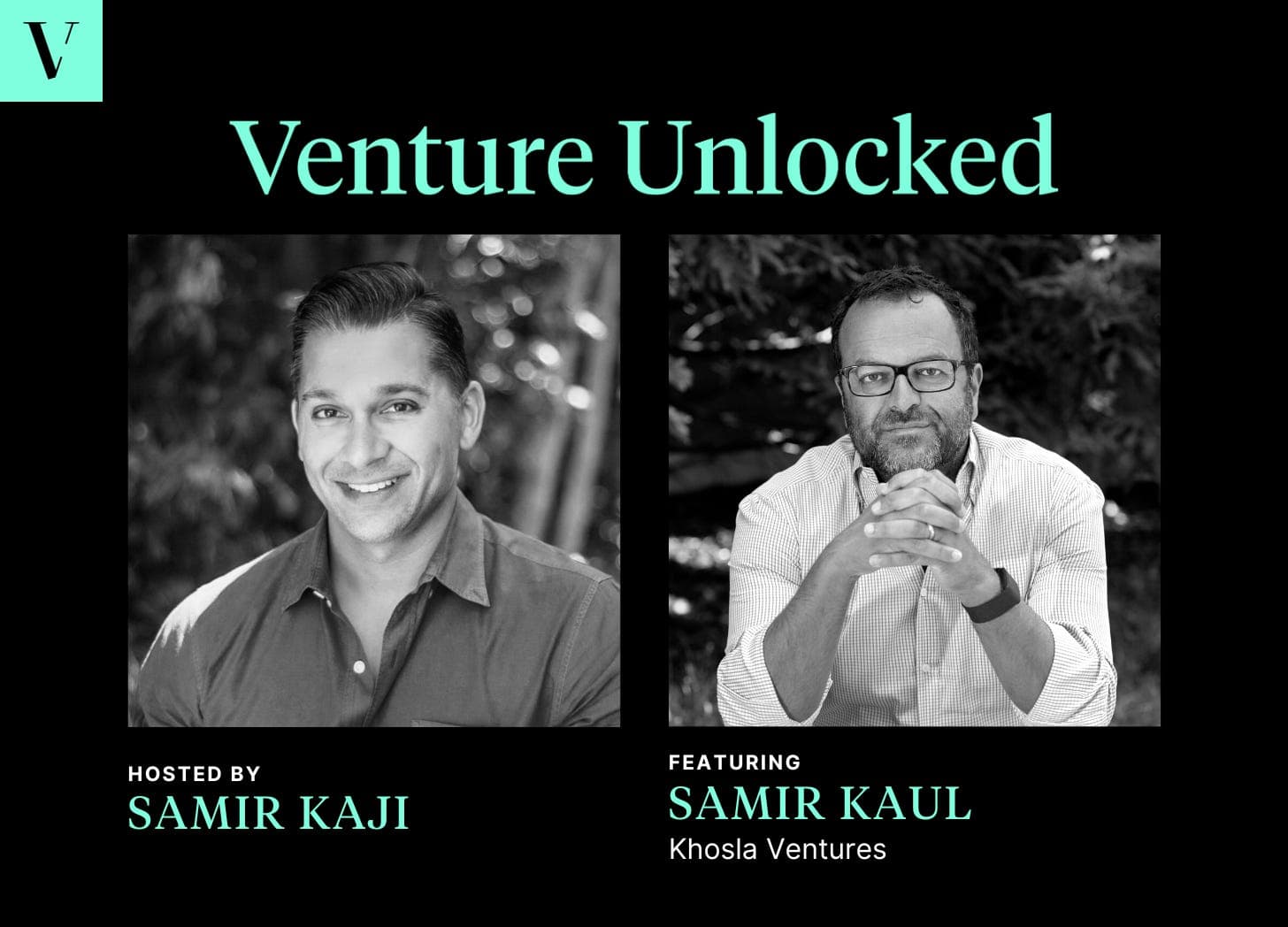
Khosla Venture's Samir Kaul on Building an Iconic, Durable Firm, and the Role of Non-Consensus Decision Making
Host
Samir Kaji
Guest
Samir Kaul, Founding Partner and Managing Director at Khosla Ventures
Podcast Overview
This episode of *Venture Unlocked* features a conversation with Samir Kaul, whose firm, Khosla Ventures, is recognized for its focus on addressing large, complex problems through technology investment. The firm, founded in 2004 by Vinod Khosla, manages over $15 billion in assets and has invested in several high-profile companies.
---
Key Topics Discussed
- Samir Kaul's Career Path
- Transition from scientist to venture capital.
- Early experiences at Flagship Ventures.
- Joining Vinod Khosla to establish Khosla Ventures.
- Firm Philosophy and Strategy
- Focus on technology-heavy investments.
- Emphasis on long-term sustainability and societal benefit.
- Commitment to investing personal capital alongside LPs.
- Characteristics of Successful Entrepreneurs
- Resilience and ability to accept and act on feedback.
- Importance of team-building and risk management.
- Adaptability in navigating startup challenges.
- Venture Capital's Evolving Role
- Beyond mere funding: helping entrepreneurs build lasting companies.
- Current shifts in the venture capital landscape post-2022.
- Investment Insights
- Learning from previous market cycles (2000 dot-com bust, 2008 financial crisis).
- High conviction trends and sectors, particularly in AI and sustainability.
- The role of discipline in investing amidst inflated valuations.
- Decision Making and Firm Culture
- The significance of non-consensus decision-making.
- Navigating board dynamics and differing VC opinions.
- The balance between tough love and support for founders.
- Hiring and Building a VC Team
- Challenges in finding suitable talent.
- Importance of cultural fit and alignment with the firm’s mission.
- Utilizing portfolio CEOs for candidate evaluations.
- Advice for Future VC Managers
- Prioritize capital allocation towards winners rather than fretting over losses.
- Understanding the power law in venture capital: a few successful investments will drive overall returns.
---
Key Takeaways
- Long-Term Focus: Khosla Ventures emphasizes investing in technology with a sustainable and societal impact, aiming to build companies that last.
- Non-Consensus Decision Making: The firm encourages rigorous debate and diverse opinions to foster innovative ideas and avoid groupthink.
- Resilience in Venture Capital: Experienced VCs must navigate volatility and learn from past mistakes to make informed decisions in turbulent markets.
- Value of Constructive Feedback: Providing honest and tough feedback to founders can be beneficial for company growth, drawing parallels to parenting.
---
Conclusion
This episode of *Venture Unlocked* provided a deep dive into the philosophy, strategies, and experiences of Samir Kaul at Khosla Ventures. It highlighted the importance of resilience, rigorous decision-making, and the commitment to investing in transformative technologies that address significant global challenges.
For more insights and detailed notes, visit [Venture Unlocked Substack](https://ventureunlocked.substack.com?utm_medium=podcast).
Written by AI. May contain mistakes. Listen to the episode to check what was said.
Transcript
Automatic transcript. May contain errors.0:00Welcome back to another episode of Venture Unlocked, the podcast that takes you behind the scenes of the business of venture capital. I'm your host, Samir Khadji, and in this episode, we have a conversation with Samir Cowell from Kostla Ventures. Founded in 2004, Kostla is one of the largest and most well-known venture capital firms in the world, and led by legendary investor and entrepreneur Vinod Kostla. The firm is known for investing in companies that are solving very large and complex problems. The firm currently has over$15 billion in AUM and has invested in companies such as Square, DoorDash, Stripe, OpenAI, and Impossible Foods.
0:33During the episode, Samir provided his insights in investing across cycles, the market insanity that we saw pre-2022, and how they approached both building a firm and investing. We recorded this prior to the news that Keith Raboi was rejoining the firm, hence no mention of it during the discussion. Hope you enjoy the conversation, and let's get right to it. Samir Kaji is the CEO and co-founder of Allocate. Allocate and Venture Unlocked are independent of each other. Any statements or references made by Samir or his guests regarding third parties, investments, or securities are solely their views and opinions and are not intended as investment advice or an endorsement of such parties or securities by Samir, his guests, or Allocate.
1:14Allocate or its clients may maintain relationships with or investment positions in guests, third parties, or securities mentioned in this podcast. This podcast is for informational purposes only and should not be relied upon as a basis for investment decisions. Samir, thanks for coming on today. Thank you for having me. So I want to start way back, actually, and go through your history of how you got into technology and venture. So maybe we can start with your background, working at Flagship, and then ultimately going to KV. I started my career as a scientist. And then after a few years of that, I went to business school where I met Newbarn as the founder of Flagship.
1:53And I joined force back in 2001, 2002. What I basically did with him was a little bit of investing in due diligence, but primarily finding academics with interesting technology and helping them commercialize it. And so we did a number of companies in therapeutics, diagnostics, and in kind of the tools market. Ultimately did one in renewable energy, which led me to Vinod. that Vinod was an investor with both his Kleiner and individual at, and three of the companies I started while at Flagship. When he left Kleiner and decided to start his own firm and focus on sustainability and renewable energy, in addition to traditional technology, but he hired, he said, let's join forces.
2:40We started the firm together, and I moved out to California in 2005, and the rest is history. Maybe we can go to the early days of KOSLA, And I'd love to hear from you, what were some of the strategic conversations you and Vinod and David had in terms of the type of firm you wanted to build, both from an investing standpoint, but also the overall operating ethos of the firm? Well, we always wanted to build a firm that was going to be technology heavy. We always felt like our edge would be our ability to evaluate technology, assess technical risk, prioritize technical risk, and have the appetite for risk that many others wouldn't have.
3:20That would be our differentiator as opposed to chasing the next fintech or social media or crypto deal where it affects the highest bid wins. And that works in bull markets like we had for about 10 years. We've lived through a lot of the tougher markets, dot com, 2008, etc. That doesn't hold forever. Technology is a sustainable long term advantage. That was what we wanted to focus on. We wanted to surround ourselves with investment professionals who were all technical, all had a real curiosity for technology. We wanted to provide industry-leading or top-decile returns, but we wanted to be proud of the companies that we invested in and felt like all companies should be society or mission positive while providing a return.
4:14We were going to also, unlike many firms, put a lot of our own money at risk. So, you know, we have always been our largest, our own largest LP. And so that was obviously from the beginning. As you, and this was during a time almost 20 years ago where, you know, now it seems like there's much more investing done in companies that have this intersection between science and technology. Some people call it deep tech. Of course, that term itself is a little bit amorphous. but you've been investing in things like sustainability, clean tech, really from the mid 2000s. When you think about some of the entrepreneurs that you're backing, obviously, in order to build a highly technical, defensible company, many of the entrepreneurs are people that are CS engineers, they're scientists.
5:04What do you look at when you are evaluating an entrepreneur to know if they are a KV type of entrepreneur and building the type of companies you're looking at back? What you want is someone that can take feedback well. We tend to be pretty direct. We're demanding. So you want someone that is going to run through walls to get the company successful, nimble on their feet. The only thing you can guarantee in life in startups is that the initial plan will not be the final business plan. They need to be great recruiters. The team you build is the company you build, and they have to be maniacal about retiring risk.
5:46And so you want to always lay out what are the binary risks to a company working or not, and as quickly as possible, retire those risks. You want to fail fast if you're going to fail. The worst companies are the ones that linger. You said something that I want to double click on, because I do think it goes to the overall ethos that you've created. So on the on the website, and I think I've heard you talk about I've heard Vinod talk about this, is that the concept of venture capital in terms of company building, so not just investing checks, but helping entrepreneurs build these long term companies that are built to last, requires a level of brutal honesty, versus hypocritical politics.
6:32And I think over the last decade, decade and a half, what we've seen is this concept of founder friendly being you do whatever the entrepreneur wants. You act as a cheerleader. And from what I've seen with Coastline, it is much more around let's be shareholder aligned. Let's build a company that's going to require some very tough conversation. How do you balance that level of tough conversation with this level of empathy that people are building really hard things and inherently within a startup, you're going to go through these ups and downs? People feel like you can't be founder friendly and tough.
7:10I actually think you can't be the opposite. You're not doing the founder a favor by letting them make mistakes or turning a blind eye when they're doing things that are wrong. you know the investors on we work's board weren't founder friendly to adam newman he got thrown out of his own fucking company because they allowed him to do a lot of silly things like build a sauna in his office or throw these crazy parties on the weekend or sell his own real estate like kind of you know inside baseball stuff but that didn't do this that wasn't made founder friendly the Company's not bankrupt. So just because they cheered on the person, that's not founder.
7:52That's hurting the founder. We're not tough on founders because we get our jollies by being tough. We're genuinely trying to help the founder build a great company. I have three kids. I let them know when they're making mistakes. And it's not because I want to be mean to them. It's because I love them. And you have to be honest and tough to make them better. Why would we get paid fees and carry if all we did was invest in a company, let the CEO, he or she do whatever the hell they wanted and have no input? Then we're like a hedge fund. We're just buying stock and selling stock. That's not what we do and that's not what we get paid to do.
8:28Now, we're pretty open about it because entrepreneurs should know what they're getting into when they work with us. If they want cheerleaders, there's plenty of firms they can go to. If they want someone that's going to be there Saturday night at midnight or jump on a red eye to go help recruit someone or close some sales deal, they'll come to us. So when you think about this, and I completely agree with everything you said, I think during the peak time of Zerp, everyone felt like in order to win deals, you had to be a certain way with founders to be able to get that high NPS score. I think that the more mature founders, the ones that have been around the block actually like somebody that is going to act as a real sounding board, is going to challenge certain hypotheses and help them build businesses.
9:17You talk about this on the website. Obviously, you let founders know what they're getting into when they take an investment from CoSlot. But oftentimes, you have an entire board around with other VCs that might have a different way of interfacing. So how does this manifest actually with the day-to-day with an entrepreneur, whether you're talking to a one-on-one or even within the dynamics of a boardroom when you have other VCs that might simply act as cheerleaders or simply lack the experience that you have in providing credible feedback to the entrepreneur? Well, in a broader word setting, it's hard to give that kind of feedback and be effective.
9:54I tend to save a lot of the toughest participants at the boardroom. I'm not going to shy away from it, but the dynamics there are different. You want to be careful. A lot of other VCs like to position us as the bad guys. So they'll stare at their shoes when there's something obvious that needs to be discussed at the boardroom. look the good ceos want to be told look the very good ceos could probably sell fund all their companies the reason why they take money is they want to help they want help and they want a sounding board they want people to give them advice and it's and if you look at the ceos in our portfolio the max lepchin's sam altman's the jack dorsey's you know these people have chosen no secret how we are to work with they've chosen to work with us multiple times time and time again because they appreciate the feedback and they're strong enough to know which things to listen to which things to discount and they want to be told because they want to get better that's pretty clear and in boardrooms i often find myself defending the ceo or than anybody else you know hey look let the person let he or she spend money on r &d uh it's okay they miss their sales number you know the goals are ambitious the prize is still there those kind of things like i usually end up being the biggest champion the irony is right in a more public setting i tend to be more of the champion look look at look at um the open ai drama right who was tweeting more in support of Sam Altman than Vinod.
11:31So at a public setting, we tend to be the biggest supporters of our CEOs, and they know we have their back. But one-on-one is what I say my toughest principle. We're not looking for an audience. Yeah, I'm glad you brought up some of those examples. And as we think about support of entrepreneurs, Vinod, for example, has been very publicly supportive of Sam through the entire OpenAI ordeal, which lasted about a week, actually. Thinking, I guess, maybe beyond that for a second, you've been around for 20 years now in this firm, and the venture market during that time has changed. And there have been a lot of people that have done well because of interest rates and the tailwinds that we saw.
12:20And the notion of founder-friendly, of course, as you mentioned, changed over time. One question I have, I guess, for you, just kind of zooming out, is how have you seen the evolution of venture during the time that Kostla has existed? And how has it potentially impacted how you work with founders and what you do in terms of creating these competitive edges? Well, I need dips who have made money in the last 10 years with zero interest rates. There are a lot of people who are riding high. And now, I think our LP spoke, we raised the largest fund we've ever raised. in a time where most VCs are condensing or going out of business because I think people love the venture asset class.
13:02They see that this is a great time to invest because prices are finally coming to reality in most cases. There's still some sectors who I think are pretty frothy. And we've been around the block. We've been there through dot-com, through 2008, through COVID, through all these things. We've seen really tough days. We've got to navigate it. A lot of these newer firms and even partners who are newer partners at established firms, I'm seeing it in boardrooms are, you know, like deer with their headlights because they don't know. They've not seen an inability to raise money. They've not seen the need to do 30, 40 percent rifts and layoffs.
13:42You know, they've not seen deadholders coming after them for breaking covenants. For a few years in there, we weren't that popular with some of our entrepreneurs because we were still trying to enforce discipline, not have crazy expenditures, and stay relatively out of the, you know, not over PR. Because we knew that eventually, frankly, it took longer for the doomsday to come than I thought it would, but it stayed. And now those CEOs are spending a lot more time with us because they know that we have the experience. It's not to say that there are a lot of other VCs that are out there that have had that experience.
14:20The guys at Andreessen or Sequoia, General Catalyst, and many others have been through all these ups and downs also. But we're definitely in the minority now. There's probably a dozen or so groups that have leadership who have been through tough times. A lot of the newer firms, I think, are going to struggle because it's hard. The first time, the first crises I experienced in this business was terrifying. Now you could be a little bit more even keeled. You don't want to overpanic. You don't want to overcut. You don't want to sell everything under the sun. You've got to be disabled. And you need to prioritize.
14:56You have a fixed closed-end fund. So you only have X number of dollars as reserves. So every company is not going to get reserves. Many companies that probably deserve a shot just aren't going to get there. Now the trick is how do you sell companies that don't meet the bar for getting further investment from you? And how do you pick the companies that are going to get more money and optimize those investments? And that's another thing is that you need to be realistic of what the right valuations is. The more experienced VCs don't care about some artificial vanity mark on your books. They want the company to be marked for success.
15:40So there's upside. So employees get upside. And that's another thing. A lot of VCs want to go out and try to raise other funds, and they're scared to mark down their investments. And that's, again, very short-sighted. I completely agree with that. And we certainly saw that in the 2010s, where because of the capital abundancy in the market, and the number of people willing to mark up companies, especially larger crossover funds, funds were able to mark up deals. And as a result, we're able to use those marks to raise subsequent funds and bigger funds. And of course, now everything's unwound. The two areas that seem somewhat insulated from the reset that we've seen over the last two years are seed stage financing and also anything that relates to AI.
16:27And of course, the discussion generally is around generative AI and the potential impact to enterprises and consumers in the future. And since you've been an investor, you were an early investor in OpenAI, have tracked AI, as well as some of the last technology super cycles, whether it be mobile cloud, the internet, wanted to get your take on how you compare the potential of the AI super cycle relative to some of the tech super cycles of the past. or it'll be bigger than anything that's been done before. But there's not like an AI company. Any company, even pharmaceutical companies or companies that you wouldn't think would incorporate wouldn't come to the tip of your tongue if you think about AI.
17:10AI is going to become like software or the internet or mobile or the iPhone. Unless a company has incorporated AI in whatever they do, supply chain, manufacturing, et cetera, et cetera, they will be left behind. That is clear. But if someone says, oh, I'm doing an AI company, that's probably just marketing bullshit. You should run away. If you've got someone that isn't incorporating AI in their short to near-term plan, I would run away. It's going to be a pervasive technology across law verticals. The valuations in AI right now are super high for the most part. There are some that are warranted and justified, but some are very, very high and are just following on.
17:51But if OpenAI is worth$86 million, we're worth 10 % of that, 5 % of that. Those are always kind of a fool's rush, right? Like a fool's error to do analysis like that. But that's how a lot of companies are getting valued right now. We've seen this in.com. We saw it in crypto. We saw it in clean tech. You have the version 1.0 where there's a lot of aduberance and a lot of disappointment. and then version 2.0 is much more robust and people learn their lessons you started in 99 so you'll know that the e-toys the etch.com volume, volume, volume despite the fact that every transaction was unprofitable was all the craves and if people left.com for debt I remember in 2002 I graduated with school, people were like wow the internet there's no more tech investing it's dead, blah blah blah and then you have Facebook Uber, Airbnb, Strikes, Square, DoorDash, you name it on and on.
18:54Probably the most richest, most lucrative part of venture capital was in tech 2.0. You're seeing that, you mentioned seed rounds are insulated because it's not that much money and not that much dilution. And seed checks, the funnel is just more. A lot of people can write a$50 ,000 check. the other area that we're seeing a lot of lifted valuation is in the sustainability area i lift through 1.0 i have all the scars on my back you've had some successes like lots of tech and tesla and but there were definitely some successes but for the most part it was you know at least 80 90 failed now you've got version 2.0 and people have learned a lot of the lessons you know that don't be dependent on subsidy.
19:41Be clever on capital allocation. Focus on the founder. Don't hire executives for portfolio or Shell or Exxon. We've learned a lot of that. Incorporated that. I'm really excited about that area. So my bet is that AI will go through the same thing. I think it'll be a quicker cycle. You'll have a bunch of companies that fail. You've already started to see some companies stumble. We'll see more of that. And then you'll see a second wave come that will be very powerful. So aside from OpenAI, we're the first PC investor. Most of our investing in kind of AI companies are what's next? What's next after LLS?
20:24What are some specific applications? Maybe it's in healthcare. Maybe it's in financial services. Maybe it's in legal services. Where can AI play a real role in more shorter or longer term and start investing in those areas right now? and stayed away from kind of the multi-billion dollar valuation mega growth round it would really with very few exceptions you stay away from those rounds and passed on a lot of those companies a lot of them are pretty good companies good teams but just we need better ways to deploy capital one of the things i do want to unpack a little bit more is something you alluded to so thinking back in 97 98 99 actually companies like pets.com or even Webvan.
21:07At the time, the infrastructure, the adoption wasn't there to sustain those companies. The distribution was there, of course. Webvan, ultimately now we have Instacart, right? It's good to bring that up because we invested a million bucks in Instacart for 10 % of the company. And the reason why Portiva had struggled to raise money at a better price was everyone kept bringing up Webvan. And it was still early days of the iPhone. But remember, you and I are old enough. WebFam was you got home, you wanted your dial-up AOL modem. You had a shitty user interface and you ordered groceries that took forever to get there.
21:42Instacart, you get your Uber on the way home, you press a few buttons and the ship's there by the time you get home. Very different. But you had to make that technical leap. Back then when Instacart started, people were still scared to put their credit card online. You had to make the leap that everyone was going to have an iPhone. WebFam was going to be more pervasive and faster, people would be very comfortable doing all commerce on their phone, and that people would figure out the delivery infrastructure, 1099 workers, all that stuff would all work, and people would do that. It's obvious now, but back then it wasn't, or we wouldn't have been able to own such a big chunk of the company for a small amount of money.
22:24Of course, that's the fundamental nature of being a successful VC, of seeing in the future and not being tethered to what has happened in the past, understanding that biases that may exist from past failures simply may not provide the map to the future territory. So a great example, but maybe going back to AI for a second, in particular, going back to the hypothesis of when you invested in open AI. At that time, it wasn't really in the public eye, generative AI, there was no chat GPT-3 people were using. But what did you see as you looked into the future that got you so excited about the opportunity?
23:00It was pretty simple. It did. And the firm has been pushing AI and thinking about what AI could do for a long time. So that's one. So anything, so probably very early days, we were looking at that area. And then second, more important than an idea or even the technology, at least to me, is the quality of the entrepreneur. And look, Sam Altman's a once-in-a-generation entrepreneur. There's not many people like Sam. There aren't many. He's super smart, very mission-driven. hard working, recruits well, raise money well. We would have invested in anything Sam was doing. I mean, case in point,$50 million, our single biggest check, first check ever, into a company that was actually structured as a non-profit.
23:42There's less than five people on the planet that we would have done that for. Sam happened to be one of them. So it really wasn't more complicated than that. Now that you mentioned things that you're looking at in the future, so it's the next generation of AI, the next generation of sustainability, startups, How do you know, because ultimately you want to invest before things become evident, but not too far in advance, i.e. the web van, the pets.com. What are the markers of timing when you're looking at things to invest in companies that are building for this future you believe in, but not something that might be 10 years away?
24:19So I don't think 10 years is too far. You know, we incubated QuantumScape 12 years ago, and, you know, they're a public company. You can read their reports on what their schedule is. I don't think that's too far. I think WebBand was early, but they spent too much money. But if the prize is big enough, I mean, we're investing in nuclear fusion, you know, which won't have a real commercial reactor until 2030. If the prize is big enough, the timeline is fine to be 10 years, 15 years, 20 years. but you need to spend you need to spend against that time so you can't spend it if you're going to be a commercial entity in two years if it's going to take you 10 years which should be doing this and and remember that's another reason why we like these some of these companies is that if the market is huge and the technology advantage is big enough you can wait you don't need to rush to market.
25:13While you're developing the technology, the burn rate, which is the most critical thing, is very controlled. $250 ,000 per year fully loaded per engineer. That's not going to change. That's what your burn rate is. What's unpredictable is when you go to market. So how many salespeople do you need? What's the quota? How long does it take them to spin up a salesperson? What's the sales cycle? What's the cost of customer acquisition? What's the retention rating those are all only knowable once you're in market so me personally i'd rather wait two years to enter a market with a clearly superior product versus a product that's just slightly better where i'm taking all that unknowable risk because i'll take the knowable risk of what the burden range is going to be and so if something is delayed which it almost always is i know okay i have a hundred engineers working on it that's 25 million bucks when i raise money when I look at my balance sheet and say, what's the minimum threshold I can hit before I need to put more money on the balance sheet?
26:16I know what the costs are. Where it starts to get scary is something like, people say, oh, well, you know, Claytech, it's super capital intensive. I mean, how much money have enterprise software companies raised? I mean, look at the history of Salesforce, Facebook, companies have raised a snowflake, billions of dollars for markets that aren't nearly as big as electricity or electric vehicles or you know these things the difference is you have this false sense of comfort that you don't need to raise that much money to get to a million euro or five million euro and that's true but your upside is also much lower for a crm company or hr tech company and most likely you're going to fire which is fine but the TAMs for nuclear fusion or plant-based foods or electric vehicles are just massive and so you can afford to wait until you got it right right and that's one of the the things that people have struggled with when they're thinking about these type of companies which yes there's a lot of technical risk but the TAMs are big the commercial application is big if they can solve and de-risk on the technical side.
27:31You have a natural moat because the amount of money and the time, you have a natural moat. It's not like someone coming quickly in Clubhouse or Cameo or some of these things where they get a lot of hype, they get a lot of usage, and the next few people say, I'm kind of bored of it. Be real. I mean, these companies, right, they get super hypey, super usage, and then the usage falls off. versus look at like a Tesla or these kind of bigger markets. Once the company's there, people will stop with it. Let's shift a little bit to the investing side. And in particular, when you look at these long-term trends that you have high conviction, AI is a great example.
28:10And I think most people would agree that it at least has the potential to exceed some of the big tech super cycles of the past. And yet when that happens, you have a lot of momentum, you have a lot of dollars flow in, and ultimately things like valuations creep up. to a point where they lack fundamental metrics in terms of what usually would make sense for a company generating either none or some small amount of revenue. And you have to reconcile that, of course, with your own investing thesis and what you look for from an ownership standpoint, the valuations you think allow for enough upside.
28:45How do you navigate that? And are there times where you make exceptions to your normal parameters of investing? We made an exception with Replit. We invested in a big valuation at Replit with Umjad because Umjad's an exceptional entrepreneur. And we believe in what he's doing, what he's building is critical. We like his go-to market experience. What Academy makes a lot of sense for his initial go-to market. We tell him that we believe he's an entrepreneur. There are a dozen or so other companies, similar valuation, similar traction that we passed on because we didn't have the same level of conviction.
29:17So it's a level of discipline, but not rigidity and an understanding of when you need to stretch the boundaries for the right individual. So it does sound that it's very much based on the individual and the founder. And the opportunity. How big is the upside big enough to make an exception? And that's one of the things about us, as you know, Samir, is that we don't have a veto in our shop. So if any of the four MDs want to do an investment, they can do it. And there's a real, but look, if someone makes a lot of bad investments, they get fired. We're not scared to do that. But if, you know, this business is all about power law, which means you have to shoot for asymmetric upside.
Read the full transcript
29:56To get asymmetric upside at this stage we invest in just very early, there's no fucking way you're going to get consensus. There's no way. If you're looking for consensus, you're going to, by definition, take away beta. If you take away beta, you take away asymmetric upside. OpenAI should return that fund three or four times over just by itself. You know, but it was a$50 million check into a nonprofit entity. What firm? And the reason why they're only VCs in there is, right? It's other firms that have consensus. There's no way they would have done that deal. That would have made it. Some jackass would have said no, you know, pretending to be super smart.
30:32But I don't pretend, you know, we don't pretend that any of us has a perfect lens on these things. And it allows us to really vigorously debate companies. And we can say, look, and we rate companies. We don't just make it qualitative. We score every company on a scale of one to four, where at any other firm of four would be a veto. But it gives you something to think about. I can't tell you that there are people we interview who are like, oh, man, I would have done Square, Stripe, and Airbnb. I couldn't do it. I couldn't get it through my partnership. I'm like, great. I'd love to be six foot tall, too.
31:09You know, like you run like Usain Bolt. It's just nonsense. So, you know, I could bring in the next square. Everyone could be a four. And I could choose to pass. And then it becomes square. That's all on me. I didn't have the conviction, courage and conviction in my investment. So it's really important, I think, in a business where you're rewarded by taking asymmetric risk to not be bogged down by consensus isn't going to happen everyone knows i mean like i think you and i've been around long enough where you've seen these firms where there's also politicking going on at the gp level it's like you vote for my deal i'll vote for your deal oh and then the person is asleep at the switch and not helpful like for our firm like david swen and i all add different values and if i didn't think they added value why would i give them any of my carry.
32:05And if I'm giving them my carry, they better be awake to the presentation and help and make it answer. But they've already kind of, if you horse traded in the morning before your Monday meeting, hey, vote for mine, I'll vote for yours. Then you're going to be on your iPhone, screw it around, I don't know what you're doing. And then also the entrepreneur gets posed. The entrepreneur doesn't get the benefit of the tough questions, it doesn't get the benefit of the whole help of the partnership. But better or worse, if you work with KB, you're working with all of us. Nobody has deal specific Gary, you know, a vigorous debate and people have different opinions that wants to make an investment.
32:38Everyone is working for that company. It's not, you know, we had people here who was not lasted, who would rather be right. And when they voted, didn't like a company, they'd root for it to fail versus be successful. And we weep that crap out. We don't have silos. Oftentimes, multiple of us work on a company. sometimes we rotate in and out uh we have no deal attribution as you know because you've been an lp if you don't give deal attribution you don't then it doesn't become political like oh that's my deal i get to work on it all right people are fighting for credit on who got the referral none of that happens here you know it's it's such probably a cultural shift for people that you might bring in from other organizations that are used to more consensus how do you get people comfortable because it's it's fine for you or david or svein or finote make a non-consensus decision do a deal that you have even if you're getting vigorous debate or contra reasons not to do a deal but they're not an fd has response for the deal so they have to work with one of us that hopefully they you know swen then got promoted with our most recent fd and he got promoted it but he worked with us as a partner where he couldn't do a deal without one of us giving him air cover uh and that's really important one of the main reasons there are a lot of reasons that people don't work out here and we're very quick on the draw that if someone doesn't work out we part ways in a friendly way but part ways because you're only as good as like the the worst investor at the table right so what happens this was another insight is at a firm where there isn't whether it's consensus driven the quality of due diligence also becomes worse.
34:23Because if you're an investor and you fall in love with an entrepreneur, you're now selling the investment to your partner. And what that means is that you're looking for all the positive attributes and not the negative. When I fall in love with an entrepreneur and I want to do the deal, I'll bring it to my partners and I know I can do it. So I'm not selling my partners. I'm saying here's why I'm excited. Here are the risks I've identified. here's why I think these risks are manageable with X amount of money. What do you guys think? What am I missing? Help me out. Help me identify risks I haven't identified.
34:59Introduce me to someone that would say, hey, that risk really isn't achievable with this round. You need more money for that. Or introduce me to someone that's done a similar type of whether it be customer acquisition or solving some material problem or something at another company. So you're going to people with help as opposed to a sales pitch. right and that would show so my due diligence is finding where is this company going to fail how can i figure that out as quickly and cheaply as possible and then is that worth the risk the reward worth that running that by my partner seeing if i'm thinking about it the right way as opposed to giving them a sales job where i'm not whether intentionally or nefariously or not just human nature is such that you probably aren't highlighting the negative things that people are saying could you could you also as the other firm you're fighting for allocation there's a fund is x size divided by x number of partners you're all fighting for dollars so if you and if you may not really like the other person because they kind of shit on your previous deal you're going to look for a reason to do it so that person just put on the brink of space and close the honest hey here's where i could i remember one of our most successful investments is a public company called Garden Health.
36:18We had nearly a billion dollars on it. And when I was doing the diligence, one of the world's most famous cancer biologists shit all over the company. That this is nonsense. These people are nonsense. And I still remember in my investment memo, I put all the reasons why I was excited. And I said, oh, by the way, this particular person who now is a huge fan of the field, it's kind of comedy now where I see him. He's a big, big name in the cancer biology field. He was super negative. I was insane for doing this. I wrote up exactly what he wrote and I highlighted it in the memo. I didn't write it in the order.
36:53I said, I'm still a one. I'm going to do this in basketball, but I want everyone to know this guy who knows more apparently than everyone else and wasn't shy about telling me how smart he was said this and I've highlighted it. If this thing fails, you can't come to me and say, oh, well, what about this? Put it right there. But you would never do that at a firm where I had to get consensus. You would bury that. It's a great story. And you're absolutely right. It would be buried because it would make it dead on arrival in a consensus firm. Speaking about building a firm around this ethos where people are willing to put their neck out there and make decisions on deals where they have high conviction, despite what others may think around the partnership.
37:38You also have to get the type of people that have that type of DNA that can do that. And it's not easy to do. Are there things that you do as part of the interview process for potential COSLA principals or other investing staff that allows you to determine what kind of person is going to be a successful COSLA investor? It's just super hard to find people. You're right. It's very hard to get certainly partner level people once they've been indoctrinated in another shop. We're so unique to come over to our shop. So where we've had, like, Swen was actually joined as a technical expert and then tried his hand in investing.
38:19It's done great. The next gen people actually have worked in our portfolio companies. So we've seen them for years and years. In the interview process, you do as many references, you spend as much time as you can. and usually I'll have my three or four favorite CEOs spend time with that person and get me a reading on what they want them helping. Do they think they know me pretty well? Do they think I'd get along? And you're still wrong. At least 30, 40, 50 % of the time. Even doing all that. Yeah, it is a difficult process. So I want to maybe end with a kind of look back question. Now you've been in venture for a quarter of a century.
38:59now almost Kostla from the founding days to where it is now, 20 years. If there was a single piece of advice you'd give yourself from 20 years ago, when it comes to investing running a firm, what would it be? You can only lose one time's your money, and you can make an infinite amount of money. So if a company is going down, be polite, be generous, be empathetic, but don't waste a lot of time trying to get a 70 cents off the dollar. Take that time, take that money, and put it into the winners because the power law always wins. And early on in my career, I fretted so much about losing money that it was just a waste of time and effort.
39:36If I had taken that time, I could maybe be in a company that was at 8x or 10x. That's much more effective use of time than getting$0.40 versus$0.10 in the dollar. It's hard for a lot of people to actually understand that. And I've looked at a lot of data on highly successful funds as well as funds that haven't done that well. And there was a high correlation of funds that did really well in terms of cash and cash returns, IRR, where the loss rates were actually really high. And in those cases, it was always this power law where you had one or two companies really drive the preponderous returns, but it didn't correlate to the actual loss rates.
40:12That's our fund. It's our fund because if you don't fail a lot, you're not taking enough grants. You're not going to get that A-spine upside, what we get paid to do. especially now, with interest rates where they are now, risk-free rate, you could make 6%, 7%, 8 % pretty easily. That means we need to make 25 % to 30 % net of fees at Gary to be worth the risk. You can't do that without at least one or two companies providing a multiple-to-fund return. It doesn't matter if you do a 2x fund but bat 75 % or bat 25 % and give us a 5x fund. It's very clear what people want. This has been a great conversation.
40:55I really enjoyed the insights. Congrats on the new set of funds and being able to deploy dry powder in a time where I think we're in this great intersection where we've seen the macro dislocation with what I think is going to be the next super cycle of technology with things like AI. So again, thanks for coming on. Thanks, Samir, for your time. Really enjoyed it. Thanks so much for listening to another episode of Venture Unlocked. We really hope you enjoyed it. To learn more about Samir or Kostla Ventures, be sure to go to the Venture Unlocked Substack at VentureUnlocked.substack.com where you'll find detailed notes of the show and a listing of the past episodes, along with other commentary I have on Venture Capital.
41:39You'll also find us on Apple or Spotify, where you can subscribe to get all of the latest shows as soon as they're released.
41:53Thank you.
From the publisher
Follow me @samirkaji for my thoughts on the venture market, with a focus on the continued evolution of the VC landscape.
We have a conversation with Samir Kaul from Khosla Ventures.
Founded in 2004, Khosla is one of the largest and most well-known venture capital firms in the world and led by legendary investor and entrepreneur Vinod Khosla. The firm is known for investing in companies that are solving very large and complex problems. The firm currently has over $15B in AUM investing in companies such as Square, Doordash, Stripe, OpenAI, and Impossible Foods.
During the episode, we covered investing across cycles, the market insanity we saw pre-2022, and how they approach both building a firm and investing.
Note: We recorded this prior to the news that Keith Rabois was rejoining the firm, hence no mention of it during the discussion.
About Samir Kaul:Samir Kaul is a Founding Partner and Managing Director at Khosla Ventures, and he specializes in investments across health, sustainability, food, and advanced technology sectors. His notable investments leading to successful exits through IPOs or acquisitions include companies like Vicarious Surgical, View, Guardant Health, Nutanix, Oscar, Quantumscape, Granular, SLD, NanoH2O, Iora Health, and Raxium. Additionally, he has played a pivotal role in investments in transformative startups such as Impossible Foods, Mojo Vision, Primer, and many others, demonstrating a keen eye for identifying and nurturing groundbreaking technologies and business models.
Before joining Khosla Ventures, Samir's career was marked by significant achievements in biotechnology and venture capital at Flagship Ventures and the Institute for Genomic Research, where he contributed to pioneering efforts in genomics and biotech startups like Helicos BioSciences and Codon Devices. His work in sequencing the Arabidopsis genome set new standards for efficiency and impact in the field of genomics. Beyond his professional endeavors, Samir is deeply committed to philanthropy, serving on the boards of the Tipping Point Community, UCSF Benioff Children’s Hospital, and the US Ski and Snowboard Association, showcasing his dedication to societal betterment and healthcare.
In this episode, we discuss:
(01:45) Samir’s career path to venture
(05:15) Traits of Successful Entrepreneurs
(06:04) Building Long-term Companies
(08:49) Venture Capital's Role Beyond Funding
(12:13) Evolution of Venture Capital
(16:15) AI and Tech Super Cycles
(22:24) Learning from Past Mistakes
(28:03) Investing in High Conviction Trends
(32:33) Firm Culture and Decision Making
(37:17) Hiring and Building a VC Team
(39:12) Advice to Younger Self
I’d love to know what you took away from this conversation with Samir. Follow me @SamirKaji and give me your insights and questions with the hashtag #ventureunlocked. If you’d like to be considered as a guest or have someone you’d like to hear from (GP or LP), drop me a direct message on Twitter.
Podcast Production support provided by Agent Bee
This is a public episode. If you would like to discuss this with other subscribers or get access to bonus episodes, visit ventureunlocked.substack.com