In short
Venture Unlocked Podcast Episode Summary
Episode Title
Navigating Growth Stage Investing in Today's AI Driven Market with Logan Bartlett of Redpoint
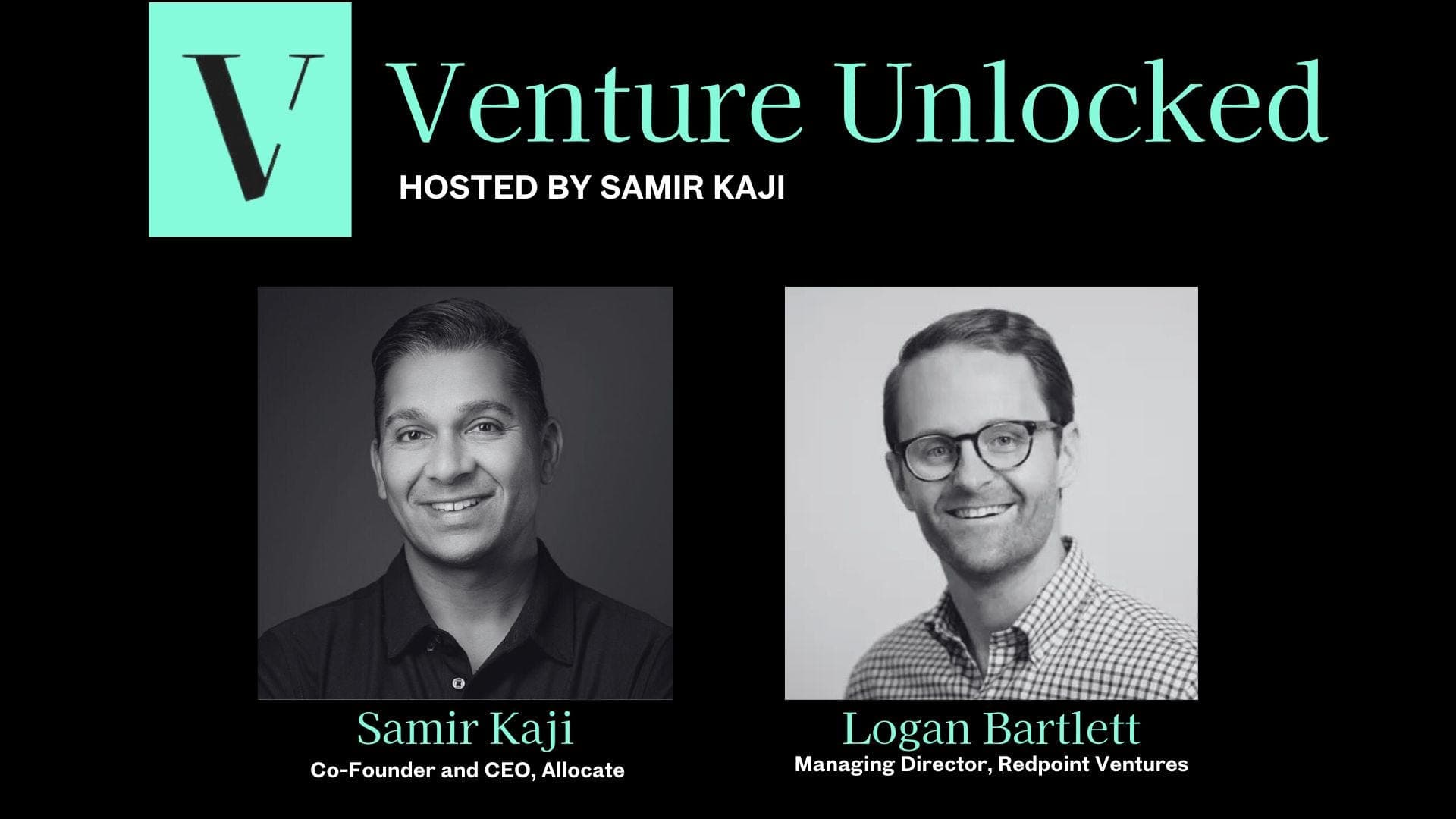
Host: Samir Kaji Guest: Logan Bartlett, Managing Director at Redpoint Ventures Date: [Link to the episode](https://ventureunlocked.substack.com)
---
Episode Overview In this episode, Samir Kaji and Logan Bartlett delve into the complex landscape of venture capital, particularly focusing on growth stage investing amidst the evolving AI market. The discussion encompasses challenges faced by unicorn companies, the impact of AI on traditional businesses, and strategies for successful startup investments.
Key Themes
- Logan Bartlett's Background
- Career Journey:
- Started in investment banking during the global financial crisis.
- Transitioned to software advisory before joining Battery Ventures for six years.
- Joined Redpoint Ventures in 2020, specializing in early-growth investments.
- Unicorn Companies and Market Dynamics
- 2021 Unicorn Logjam:
- Approximately 75% of unicorns have not experienced an up round or exit since 2021.
- Predictions indicate that many will either be recapped, sold for less than their valuation, or become "zombie" companies that continue to operate without significant growth.
- AI's Transformative Role
- Disruption Potential:
- AI is reshaping legacy companies and creating competitive pressures.
- Companies that can adapt and integrate AI effectively may find new paths to growth.
- Opportunities and Challenges:
- While AI presents growth opportunities, it also brings risks of disruption for existing businesses.
- Growth Stage Investing Strategy
- Liquidity and Exit Challenges:
- The IPO market has toughened, with companies needing $250M+ in annual revenue to go public.
- Current market conditions require a reevaluation of investment strategies, including longer hold periods and a focus on high-performing startups.
- Investment Decision-Making
- Key Investment Criteria:
- Focus on founders with a strong capacity for rapid learning and adaptability.
- Evaluation of market conditions and potential for significant outcomes (3-5x with 10x upside).
- Building a Diverse Portfolio
- Risk Management:
- Aiming for balanced exposure between high-growth, high-valuation companies and lower-valuation startups.
- Emphasis on identifying companies that can have a substantial impact and generate significant returns.
Key Takeaways
- Leadership and Adaptability: The ability of founders to learn quickly and adapt to market changes is crucial for success.
- AI Integration: Companies that effectively use AI to enhance their offerings will likely outperform those that do not adapt.
- Investment Outlook: The venture landscape is evolving; firms must be vigilant and flexible to identify and capitalize on emerging trends.
Final Thoughts Logan emphasizes the importance of understanding the unique challenges presented by current market dynamics and the necessity for venture capitalists to adapt their strategies accordingly. The focus should remain on backing exceptional founders who demonstrate resilience and the ability to innovate in an increasingly competitive environment.
---
Episode Timestamps
- Logan Bartlett’s Path into Venture Capital (1:46)
- The 2021 Unicorn Logjam and Future Outlook (4:38)
- AI’s Role in Reshaping Legacy Companies (8:32)
- Liquidity Challenges and Growth Stage Investing (11:16)
- Portfolio Construction and Risk Balance (17:16)
- Underwriting Series B Investments (22:41)
- Evaluating AI Companies and Revenue Durability (30:01)
- Key Investment Decision Criteria (40:11)
- Traits of Successful Venture Investors (45:28)
- Final Thoughts and Takeaways (49:58)
Additional Resources
- [The Logan Bartlett Show](https://www.linkedin.com/in/loganbartlett/) - A podcast featuring deep dives into startup growth and venture strategies.
- [Redpoint Ventures](https://www.redpoint.com/) - A leading venture capital firm investing in transformative companies.
---
Follow Samir Kaji on Twitter: [@samirkaji](https://x.com/Samirkaji) Engage with the Community: Share insights using the hashtag #ventureunlocked.
Written by AI. May contain mistakes. Listen to the episode to check what was said.
Transcript
Automatic transcript. May contain errors.0:09Welcome to another episode of Venture Unlocked, the podcast that takes you behind the scenes of the business of venture capital. In today's episode, I sat down with Logan Bartlett, Managing Director of Redpoint Ventures. Logan joined Redpoint in 2020 after spending six years at Battery Ventures. At Redpoint, he focuses on working with companies at the inflection and growth stages, typically at the Series B and Series C. We spent the conversation discussing the growth market through the lens of the aftermath of 2021, the impact of AI when evaluating companies and the challenge of protracting liquidity cycles.
0:42We also spoke about fund portfolio construction and growth and the balance between high growth, high valuation companies in a portfolio and non-consensus companies who have higher risk, but also come with much lower valuations. Also, for those that don't follow Logan, he has a great podcast called The Logan Bartlett Show. So please check it out. Now let's get right into the episode. Samir Kaji is the CEO and co-founder of Allocate. Allocate and Venture Unlocked are independent of each other. Any statements or references made by Samir or his guests regarding third-party investments or securities are solely their views and opinions and are not intended as investment advice or an endorsement of such parties or securities by Samir, his guests, or Allocate.
1:27Allocate or its clients may maintain relationships with or investment positions in guests, third parties or securities mentioned in this podcast. This podcast is for informational purposes only and should not be relied upon as a basis for investment decisions. Logan, it's great seeing you, man. Thanks for having me on. This is fun. All right. So I usually don't do this, but what I want to do, because I think you have such an interesting story, is go through your background of getting into tech, venture, and then kind of what led you to the place right now. Yeah, sure. So I started my career in investment banking.
2:00I was coming out at the middle of the global financial crisis. I had no interest in investment banking on its own merits. I just, someone I looked up to told me that was the path that created a bunch of optionality down the line. And I had made it 22 years of my life without making too many independent decisions. And so that seemed like a very logical path to go down. And coming out of the financial crisis, you sort of saw a lot of people around me, parents, aunts, uncles, friends, parents, all that were sort of in the baby boomer generation and had a bunch of equity tied up in homes and had to deal with a lot of financial uncertainty.
2:39And so investment banking seemed like a safe path that I was told you were going to have a job on the other end and felt financially safe in its own way. And so I did that for 18 months. I absolutely hated it. It was as bad as people kind of make it sound. I'm glad I did it for a bunch of different reasons that I can maybe get into, but I don't think are that interesting. I quit my job at Deutsche Bank 18 months in, went to go work with a buddy who was doing boutique kind of sell side advisory for software companies. So did that with him for two and a half years. And I was kind of thrown into the deep end of working with software businesses and helping them either capital raise or explore different sell side options or whatever it was.
3:25And so that sort of introduced me to tech. I got to know a lot of people in venture and private equity, the Vista Equities, the Tobo Bravos, TA Associates, General Antics, and then Redpoint Battery, Bessemer, Excel, you know, some of those names that were operating in software in 2011, 2012, and then had gotten to know the battery guys decently well. I actually quasi interviewed at Redpoint in 2012 or 13, maybe. Got turned down by Redpoint, got hired by Battery. I was at Battery for six years, a good time of doing software investing. So I did that for six years from 2013, 14 through the beginning of 2020.
4:00And now I've been at Redpoint now for five and a half years. The connection actually came from David George, who runs Andreessen's Growth Fund now. He went to business school with my partner, Elliot Gite. And at the time, David was at General Atlantic. and I had been pitching stuff to General Atlantic, ideas, companies, all that. And David connected me to Elliot and said, hey, this guy seems at least ambitious, if not smart. I don't know if he could actually tell that or not. And so that was the original connection. And six years after working at Battery, Redpoint came calling and I made the jump.
4:37So, okay, so let's go back to 2019. Obviously, that was a time where, you know, we were getting close to the peak of 2021. You know, the term unicorn, which I think Aileen, you know, from Cowboy, currently Cowboy, formerly Kleiner kind of coined. And it became like it seems so many companies were becoming unicorns in 2021. I had Tom, you know, from IVP on and, you know, this is about a year ago. And we're kind of figuring out, like, what happens with all these companies? I was just looking at the numbers. about 75 % of those companies that raised at unicorn valuations have not had an up, round, or an exit since then.
5:17And one of the questions that always comes out is, what happens to all these companies that raised at these massive rounds, raised a lot of cash, still around? And so I would love to get your outlook on what happens with this logjam of, let's say, roughly 1 ,000 unicorns in the U.S. that are still in the private sphere, but unclear in terms of what the kind of future looks. So if we look out through years, what are the main headlines that you think we'll see? Yeah, I mean, I think broad strokes kind of swagging this, but I would guess at least half either get recapped, sold for something far less than their valuation or are just zombies where they're able to operate and continue to exist either with light burn or no burn, but are nowhere near their last round financing.
6:08And for whatever reason, either structural or founder motivations or whatever the case, they just don't want to sell the business. There might not be exit options. And so they're just forced to keep at it for an extended period of time. I think the first two considerations are maybe marginally interesting, right? The recapped, I think people generally know how that works and it can be certainly painful, but at least then you get a new lease on life and getting sold for less than your valuation That happens and happens to companies in every market cycle that situations like that arise. And so I think the most interesting one is kind of the zombie circumstance where you have a decent business.
6:47It's not worth maybe what it was in the heyday, but you don't need to go remarket for any reason other than just employee options or something. And what's going to happen to the founders or CEOs that are running those businesses that probably don't want to do that in perpetuity with no ambiguous end in sight? Maybe they tried to sell the company and there just weren't takers. Private equity probably isn't interested because it's not at a material enough scale for it to be worthwhile for them. I think that might end up either requiring a totally different type of funding provider. you're seeing the who are the folks i think they're in denmark bending spoons or whatever they're called that are buying up like old consumer businesses i think they own evernote now and they're sort of buying them for cheap and trying to upsell people maybe stripping them for parts in some ways trying to operate in a very minimal kind of structural way which is definitely an old school private equity move but not something you had seen at least i had seen done with like consumer subscription products.
7:49And so I think there will be opportunities for things like that. And maybe it's a role that just lower mid-market private equity firms are going to play, but it's this weird sort of quasi situation. And then you're going to need new execs to come in and probably run these businesses because I don't think the founders are ultimately going to be the ones to keep going forward after it's been such a transition of culture and expectations and outcomes. And so I think that's really where the wreckage is going to come from, not because it's actually going to be more carnage, but because it's just more ambiguity about what you actually do and who's going to be the ones to provide the liquidity and who's going to lead the businesses going forward.
8:32Yeah. And we'll touch on, you know, this larger topic in a second, which is the role of artificial intelligence. And, you know, you look at some of these companies, they can implement better sort of workflows, more efficiency maybe through AI. But also you have more competitive forces that are also acting as headwinds for some of these past companies because maybe they were enterprise SaaS and now you have an AI company that is building something quicker, faster, better, cheaper. What is the role of AI in impacting sort of the futures of some of those companies that raise those unicorn valuations?
9:07Yeah, it feels like every day there's a new announcement of like someone is executing on a strategy of buying old service-based businesses and injecting them with AI. And a bunch of my venture peers are diving into that world as well. And so it's definitely something that people are thinking about in every which way. I still think there's some outcome. Either these businesses are going to get disrupted by AI or they're not, kind of this middle zombie ground that we're talking about. and whether or not it's the case. If it is going to happen, then you're starting to move to the other situations we talked about, either the recap or the kind of sold for parts or sold for an outcome less than what the last valuation was, or maybe you go bankrupt and you don't get anything back at all.
9:51And so if AI is going to materially attack what you're doing, then it kind of goes into this normal-ish bucket in some way, shape, or form. I do think it does provide somewhat of an opportunity for businesses to have a new lease on life and trying to reinvent or re-inject some elements of entrepreneurship or excitement into a culture that has otherwise been a little stagnant. Some of the businesses that we've seen absolutely take off over the course of the last couple of years were not ones that had explosive growth in the preceding couple of years, but instead we're in the right place, right time.
10:28I'm thinking of a business case text that ultimately sold to thompson reuters that was doing ai for law firms and they i think the ultimate outcome was like 600 million and the business had been at it for a long time but had this unique data set and were at the right place with their customers and so they were able to actually realize some fantastic outcome with thompson reuters and obviously we've seen harvey and now in our portfolio lagora who are doing fantastically well in that space and so i do think there's going to be elements of that happens as well but i but ultimately my guess is it's going to be few and far between yeah i agree with that.
11:00And, you know, obviously with case tax, that's, you know, they sell above what the preferences are. So it's a good outcome, you know, generally speaking, or at least say an exit outcome that's better than what a lot of people are going to fear, you know, in terms of the backward looking. But, you know, we're talking a little bit about, you know, what's happened in the past. I think what's more interesting is what happens in the future. And so one of the questions I have is just based on what you saw in 21, and of course, 22, 23 and 24 have been really tough to get any liquidity. The IPO bar is sky high.
11:30The average company that's going public is now north of$250 million in annual revenue, great metrics. M &A market might be better with large M &A given the new administration, but it's still tough. The length of time just continues to protract and protract. How does that impact and inform how you guys are looking at growth stage companies? Yeah, it's interesting. The other thing I would say that not a lot of people I've heard talk about with regard to acquisitions is a lot of the strategic acquisitions that are happening are still of a fairly material scale. And so if you look like Moveworks to ServiceNow was roughly a$3 billion acquisition, if I remember correctly, and Windsurf rumored OpenAI, I think they've talked about$3 billion as well.
12:17And then you hear some of these like other businesses that are being explored and they tend to gravitate in the maybe billion dollar, let's take a flyer on something that has high potential and could be a meaningful part of some business unit that we have today. And, you know, the sub billion dollar playbook, I think Paladatta networks and Nikesh has run exceptionally well. And so that's one broad bucket of like, let's take a speculative of early bet, overpay, quote unquote, on an ARR multiple basis. But let's see if we can catch some lightning in a bottle and have this be some future standalone business unit.
12:54Then there's the other side of it, which is where people want to buy these big independent standalone companies that can actually operate as business units themselves, which within large strategic requires, or can take on a bunch of capital and potentially be interesting from a private equity standpoint. And so you end up with this kind of this like barbell or this no man's land that falls in the middle. And so one of the things that we're thinking about is, one, you don't really want to get caught in that no man's land. And so you've seen a lot of people either go early, which is very much the traditional venture capital playbook, or more and more people are going late and trying to get into these winners that who knows exactly if you're going to have a 3 to 5x outcome or a 10x or whatever it's going to be.
13:37But you're pretty sure you're going to get liquidity in some way, shape, or form. And it's not just going to be locked up in some stagnant thing that might never go public. Or if it does go public, it might still be hard to get out from a liquidity standpoint. And so you're seeing these businesses. We're fortunate enough to be involved with ramps, Iera, a bridge in the last couple of months that have raised big rounds in this regard. And certainly companies like Rippling and Andrel and Figma. And we were fortunate to be early in Stripe. And so a bunch of those businesses have kind of been, you know, the canonical players and consuming large amounts of capital in the private markets.
14:11And so it's something that we're thinking about that you really need to cross the chasm and get to a five, six plus billion dollar outcome because the IPO markets aren't particularly receptive to that smaller scale, or at least you're not seeing it today. And M &A, that's that that can be something of a no man's land. And so that's one of the things that we're thinking about. The other thing that I would say is we are just factoring in longer hold periods and lower liquidity velocity. And so it forces us to kind of think a little bit more like private equity firms in some ways where historically you just were along for the ride.
14:55and when the company exited, you exited. And it was typically, I don't know, everything from at the IPO to plus or minus, you know, eight quarters after the IPO, you sort of got on a drip-based distribution. And one of the things we're now having to think about is like, well, you know, we have Stripe in our portfolio that's been an amazing investment, but it's now a$95 billion private company. And, you know, Ramp is on a fantastic trajectory And suddenly it's going to be what historically would have been a medium-sized, a big public business. And it's being valued in private markets. And so one of the things that we don't exactly have the toolkit hardened is how exactly we think about that going forward.
15:40And so it's something that I think a lot of venture firms are going to need to think about. It's been true for seed managers for a while. You hear stories of Fred Wilson taking some amount of his coin-based investment amount along the way so that he could ride all the gains up over time. And I think that's been fairly normalized for early-stage folks. It's definitely not normal for mid - to late-stage investors. And so I think there's a lot of things to think about there, be it what Sequoia's done with their kind of evergreen structure, whatever they call that. some of the continuation funds that folks like NEA and Lightspeed have raised.
16:18There's a whole bunch of different things that I don't know if the industry is really standardized or figured out exactly how it plays. And so something that we're constantly noodling, how and when best to get liquidity for our LPs. Yeah, I don't think it's been figured out. And I think it's moving so quickly and fluidly over the last couple of years. And I think it's going to materially actually change. You mentioned one thing about the normalization for a seed stage manager to sell at the Series B or the Series C, take some money off the table, drive some liquidity back. In the past, that was viewed as a negative signal, or at least viewed as by the GP.
16:52I'm not supporting the company. I don't think that's the case anymore. But when you look at sort of this no man's land, like, yes, at seed, you're paying lower prices, you're willing to take more risk. But the upside for a single company can be huge, where you can get a 50 to 100x if you hit one of the companies like a ramp, for example, at the seed stage. On the other side of the coin, you have really late stage companies that have already broken out. You mentioned a couple of Anduril and ramp, two examples of companies, clear market fit, they're scaling, likely going to be public companies if they continue the growth trajectory.
17:26But a lot of what you're doing, especially on the growth side is maybe kind of in between that series B-ish, where it's not quite obvious that they're going to be this large winner, but they're also not so early where you're not paying sort of like decent Series B type of pricing. Have you guys modified your playbook just kind of given what you've seen over the last four years? The things that we look for, and not to give away all our trade secrets here, but we do have a handful of things that we consistently look for. And I say trade secrets fairly tongue-in-cheekly because I'm not sure that it's actually particularly profound.
18:03The types of things that we look for is we look for world-class teams, products that delight customers, huge potential market opportunities, businesses that solve hard problems. And then we want them to be building attractive business models at scale. We sort of think those are the components of great venture-backed businesses. And so I would say that we're still looking for those at the Series B stage. Now we've changed what we think about in terms of the absolute valuations that we're getting in at. 10 years ago, we talked about all those things and it'd be a two or$3 million error business, whatever it is.
18:38And we'd be getting in at 90 posts or 140 posts or something. Or maybe we'd hold our nose and pay 220 posts. And now more likely than not, we started drifting our average initial check in these businesses to anywhere from 300 to 750. And some of these situations, It's been even, you know, right around a billion post. If we pick well, that's still totally fine. We had some great investments in our vintage of 2012 through 2018, where it really wouldn't have mattered had we gotten in at those same prices I'm talking about, or, you know, the 150 or 200 that we paid way back then. It would have been a turn on the fund or whatever.
19:19We can do the math on the implications of it. But in the grand scheme of things, any individual investment mostly was a good investment or it was a bad investment and it wasn't determinate by that margin of error on the valuation side. Now, I will say it has led us to pushing to try to be as early as we possibly can after product market fit has been established. And so when we say products which delight customers as one of the key considerations, we at times need to think about products which potentially could delight customers or products which seem to be delighting customers or products which we think the world-class teams can execute on being, you know, something that delights customers.
20:05And two businesses I've been fortunate enough to work with, Syra and Ramp, both are examples where it was, you know, sub 5 million in recurring revenue. I mean, Ramp was a run rate thing at the time, but you know, it was smallish single digit revenue recurring or run rate revenue for those guys at the time. And we were definitely taking far more of a team bet than I think would have been a traditional growth stage VC playbook. And one of the reasons it's a bit of an oxymoron, but one of the reasons we call what we do early growth is because we do want to balance both elements of the early stage mindset with maybe more growth stage considerations on the business At a very practical level, what this ends up meaning is within 18 to 24 months, you really know if you weigh underpaid, the business is off to the races, or you've got a long slog ahead of you with the individual company.
21:12and it usually is that time period. Sometimes, I mean, I would say 75 to 90 % of the time, I probably know in the first board meeting which of those two buckets it's going to be. And so it's an interesting thing where if things are off to the races, then you're just doing everything you possibly can to provide jet fuel or try to help the company not make a mistake that could otherwise stop their growth. And on the other end of the spectrum, there's really nothing, you've made the wrong investment. And so you can do everything that you possibly can as a board member investor to try to help out.
21:41But plus or minus, there's not a ton you can do. And so both of those situations, interestingly enough, you're trying to help the company avoid catastrophic things that could destroy value for the founders. But those decisions might only be one to two things over the course of a year that are pretty material. You need to earn the right by showing up time and time again so that you have the context to actually help out when that one situation arises. but there's not a ton stuff that you're doing on a day-to-day basis with these businesses. You're either, you're either cheering till your hands hurt or you're trying to help as much as possible, but there's only so much anyone from the outside can actually do because the, it's either the wrong founder or the wrong market or the wrong time or the wrong team or whatever it is.
22:31And ultimately a VC is not going to help you out of that situation. Yeah. You're touching a lot of things that I think I want to make sure we double click on. First, before I go into some of those questions, maybe just walk us through, how do you think about underwriting a Series B company from the exit that it needs to potentially get to? You think about C and Series A, every single company that you underwrite should have the potential to return the fund. It doesn't mean it's going to, but the potential. What is the rubric for a Series B company at Redpoint? Yeah. So we see 3 to 5x with 10x plus upside.
23:04The plus is an important thing. And I've made mistakes early when I was at Redpoint and not thinking of 3 to 5x, 10x upside. Right. And I wasn't as rooted on the plus. And the important thing with the plus is maybe you're investing in a super frothy market and valuations are going to fall by 50 % or whatever you're paying could actually be in three years time. Maybe that would have gone for one third of what it's gone for today. Ultimately, if you're investing in one of these really enduring businesses, the plus should be what makes up for all that delta or all that noise. If it truly is a special business and you're getting involved in a low-ish, in my world, absolute valuation, which is sub a billion, ideally sub 500 million, you should be okay.
23:56And the company should be able to execute to the other side. Maybe your return will fall from a 25X to an 8X or whatever it is. But like your plus or minus, the determinant of whether or not that individual thing was a good investment will exist on the own merits of its company, of the company itself. And so we really make sure that if we can dream the dream on things going right for an individual business, do we think it's a big independent standalone public company? And big is like north of$5 billion and maybe even north of$10 billion if things really go right. And if we can't see that, it's probably not worth making the investment because you might be having too much false precision about what the moment in time is and the relative attractiveness of this investment versus this other investment you're looking at.
24:45And this feels like a good ARR multiple or a good entry price on it. And who knows, maybe the entire basket of everything you're looking at is actually overpriced by 300%. And so, yes, it's cheaper than the other business you looked at. But both of them are bad decisions to make. And so ultimately, what you want to do is find one of those that are going to grow through any market cycle you're in. And ideally, it's an appreciating market cycle. The valuation gets higher and higher. But even if it's not, you hope that you're okay, that you'll sleep at night, even though you overpaid by some materially high metric.
25:20It's going to grow through that. Now, we want to keep the absolute valuations low because it's a lot easier to see 3 to 5x with 10x plus upside investing at$100,$200,$300,$400 billion than it is at$1 billion,$2 or$3. And so it is something that we try to gravitate into the lower absolutes of everything we're talking about. But at the end of the day, if it's special, we want to be a part of it. And so we deviated. We got in the ramp at$1 billion originally. We got a new company, Abridge, that's doing exceptionally well at$850 million. We got a new company, ChainGuard, which is doing fantastic at a, I think at like 1.1.
25:57We just did an unannounced high profile AI business at a billion dollar valuation. And so, you know, those things, we can deviate from it, but we want to deviate such that the pie or the pot at the end of the rainbow is totally commiserate with taking that absolute valuation risk. Yeah. So one of the things that, as you're speaking, comes to my mind is like, how do you think about building that portfolio? Because on one hand, you might have companies where they haven't really gotten to escape velocity. It's like 5 million, 10 million in AR, maybe even less, depending on sort of the business model, where there's a lot of squinting you have to do, but the valuation might be lower for those companies versus the companies that are clearly, like you mentioned, Chain Guard.
26:42I can also think about companies like Applied Intuition and companies like Anduril and Harvey and all these companies that you can see it's already working. There's customers that love them. They're growing really quickly, but you've got to pay a huge multiple. How do you construct a portfolio where it's not just either side where you're taking too much risk on one hand, where you're squinting on every single company because you want to get in at lower valuations versus these high-fidelity ones where you kind of know, but you're paying up for them? Yeah, it's a great question. So I would say first and foremost, we come back to the three to five X, 10 X plus upside.
Read the full transcript
27:17And so ideally, that's an easier thing to see about lower absolutes. But you know, sometimes you can see it at higher as well if the market size and the execution of the founder warrant that. But it is an interesting situation to play out. Now, one of the things I think we've done that's been very purposeful is our growth fund, early growth fund right now is$750 million. And it's not because of an inability to raise$2 billion. We have had very supportive LPs that have wanted to provide more than enough capital for us to execute on whatever strategy that feels prudent. So we're very appreciative of that.
27:53But it's actually been, hey, we really want the basket of what we're doing to be comprised of 18 to 22 deals that all have this 3 to 5x with 10x plus upside situation. Because the nightmare scenario that we could get into, which is a very possible one if you're executing too much of this bifurcated strategy of like, let's get in the Andrel and the Figma and the Ramp at 15 plus. And let's take some early stage flyers at 3, 4, 500 million. The terrible scenario is you don't take enough chances on the three to 500 million. And then you have a bunch of safe, quote unquote, two, three, four X's. And so you end up having a blend of a portfolio that comes down to two X or something because there's too many holes over here that aren't plugged by the upside over here.
28:41And so we really want the composition of our portfolio debt actually have a lot of risk and a decent amount of mortality along with it. I think probably a lot of venture funds, I haven't been on the other side of too many venture funds pitching LPs, but my guess would be a lot of venture funds talk about, you know, 5 % to 10 % loss ratios or something in that zone. And, like, we actually want to talk about more 25 % loss ratios. And one of the things that we're a little worried about in this past fund that thankfully has a bunch of amazing names is what were the ones that were on the line that we actually didn't lean into?
29:16and I have five names that I'm thinking off the top of my head, but like, should we have actually taken even more risk in the portfolio, given the hit rates been remarkably high, was our bar in our risk dial set to the wrong tune? And so that's something we're thinking about a little bit more as this new fund comes online is like, are we taking enough risk? Are we getting in early enough Or are we playing it a little more safer, a little more safely than we want to? And so we tend to gravitate to let's continue to go not all in on risk to the tune of a venture portfolio where it's going to be 80 % losses or whatever a traditional venture fund kind of blends out to, but something definitely higher than a traditional growth fund.
30:01Yeah. So then when you think about, you know, taking risk, obviously, you know, there's a number of things that could lead into where you're taking more risk, but you're getting compensated by the risk you're taking through lower valuations. But in today's world, things are moving so quickly. And you see all these AI companies go from zero to two, zero to five, zero to 10 million in AR. But the big question is around durability of those revenues. And so how do you think about in a world where AI is everywhere, and we're starting to see what I consider a lot of experimental revenue, a lot of curiosity revenue, where do you lean in and how do you be able to distinguish between companies that have, you know, like the cursors, the windsurf, the Harvey's of the world that are real versus, you know, what might be a false positive and you overpay for something like that?
30:49Yeah, it's hard. I mean, I think that it does come back to that product market fit thing as we think about it, which is having happy, referenceable customers. And so I think we do a disproportionate amount of work, I would guess, than a lot of our peers, certainly as it relates to some of the more earlier stage funds that we'll at times compete with. And I would guess we could go toe to toe with any of the later stage funds. And one of the most important points isn't the financial modeling, because as you well know, these things, the margins can be upside down or the unit economics can be fuzzy, whatever the case may but it really is what are the customers buying?
31:34How recurring are they thinking about it? And so making sure we have a decent grasp on what those things look like. And there was a period of time not too long ago that we really thought about AI investing and we came at it with, all right, so what are our new primitives for investing in AI companies? And we were thinking about the academic teams and whether or not they were building their own models versus not. And a bunch of these different components that I think were probably true for elements of the foundation model, but we were extrapolating it to a bunch of different applications as well and thinking about if some of those components made sense.
32:11I think the good news, at least for me, is it feels like a lot of the traditional elements of SaaS have poured it over into what builds defensible businesses. At least it seems that way. And so it does come down to thinking about the founders themselves and do they have the grit and ambitions and vision to build this company in the direction that it could potentially go. I heard Pat Grady from Sequoia had an interesting quote that I like, which he said that the market determines how big a company could get and the founder determines how big a company will get. And I think that's true in AI and that was true in SaaS and that was true in PCs and that was true in mainframe as well.
32:52And so I think that stays true or is something of a truism that still exists today. and so we are thinking about a lot of those same things. Now, I would say what is different or what is amplified, I don't think it's different, but one of the things that I found to be most deterministic of the founders that I invest in who have great success are the ones that are able to iterate really quickly, not just on the product side. I mean, that's one manifestation of it, but are able to iterate very quickly in terms of their learning and every time you talk to them, it feels like they've made progress in a bunch of different vectors that they've been executing on.
33:30And so when I talk about the first board meeting and going back to that point of, do you know how long of a journey you're going to be on in the first board meeting or so? To some extent, it's how the company actually did. But I actually think what's more interesting is when a company fundraises, they typically talk to more partners than just us, although I wish it was just us. But when they talk to more partners than just us, they come back, they get a lot of feedback on their business. And then what happens is you go through a three to four to six week period of time where they're actually closing the documents.
33:57And you kind of don't talk too much to the founder during that period of time. You went from a period of like talking every day for two weeks to like, okay, we're checking in on the books. The lawyers have it. Like, what can I do to help on the customer side? All that. But you're not having the same strategic business conversations with the founder. And then what happens is after the first board meeting, you come back and you knew this person six weeks ago or whatever it was. And you talk to them a bunch and they got a bunch of feedback on their business. And then they come back after six weeks and you sit down with them for the first board meeting.
34:27And it's fascinating to see how much they've internalized and how much the business and they have changed over that period of time with either the learnings from a bunch of other investors poking and prodding or just some elements of the progress that they've made on some of the feedback that they got or things that they were executing on there. And so I would say that the biggest thing that's different for AI in my mind beyond, yes, there's some elements of do you own the data or not, like how embedded are you into different workflows, how much the switching costs are, which we could argue maybe are those different or not in the world of AI where data can be more portable and DUIs maybe are less important than they were in the past.
35:01But that is something that's exacerbated in such a meaningful way of like how the velocity of the business and are they internalizing things at a rate that's disproportionate to the other people that are going after this space. And the companies that are doing that have been fantastic founders and people for me to work with. And the companies that aren't, you see it show up oftentimes at the first board meeting. And it generally means that you're going to be in for a long haul, which is only far more true in the world of AI. Yeah. When we think about sort of like forecasting ahead, because when you're in an interesting spot, like at the Series B, where, you know, it's not quite pure art where, you know, there are some metrics, right?
35:43You are looking at sort of like their, you know, cohorts and you're looking at renewal rates and you have some unit economics. Is it improving? But at the same time, it's not spreadsheet investing either. There's a bunch of things that are neat to believe. It's the founder. It's the macro. It's the competitive landscape. And then kind of looking at that 3 to 5x, given some of the numbers that we've talked about, sub$500 million, maybe$300 to$400 million for a company that has more embedded risk versus a company that doesn't have, where it's$1 billion,$2 billion,$3 billion, you still have to believe that in the future the exits are going to be bigger.
36:17And so let's just look at today. You know, the top five companies in the private markets in the U.S., probably collectively worth almost a trillion dollars, with like SpaceX, you know, kind of being, you know, obviously the largest. But at the same time, you know, we don't know what, you know, there is a divorce between public and private, and that continues. So when you look ahead, is it your underwriting from a macro standpoint, forgetting about the micro for a second, that the multiples, the valuations of these companies, because the scale that they can achieve, is just going to be so much greater than we've ever seen in the past?
36:54And like you look at Google, for example, buying Wiz for$32 billion. That's actually more than the valuation of what Google was when it went public. Yeah. So is the question just that you want to, what does that mean from an underwriting standpoint? Yeah. Well, the bigger question is just that it sounds like the fundamental belief is the future winners, like the top 1 % or 2 % of companies are not those$1 to$5 billion exits, but they're 10, 15, 20, 30, 40, 50 billion plus type of exits. And you really have to believe that. Yeah, totally. So it's an interesting question. And I would say that the way I hope our portfolio will be constructed is we end up with something that we get in at sub a billion that ends up being a 25, 50, maybe more X return for us.
37:50And that drives a vast majority, maybe 50%, maybe a majority of the 51 % of the fund return in some way, shape, or form. And then we end up with a basket of, you know, maybe three, five, six needle movers that end up being very good, you know, maybe 10x, 12x, but maybe also 5, 6x investments that are kind of the meat and potatoes of the fund. And then there's a lot of things that end up in the zero, one, two, maybe three X bucket in there that are papered over by the other ones. And so what does that mean for us, I guess, as it relates to your question? Well, first, I would say we really can't miss too many of the opportunities that are material in a given year.
38:39There might be, I would be curious if we actually backdated and ran the numbers. It's a little too early to tell, but my guess is 2010, 11, 12, 13, 14, 15. We could probably run the numbers on how many$25,$30 billion plus companies were founded in each of those years. my guess is it's one, maybe it's point, maybe it's every other year, something like that. I don't know. I'm sort of making this up, but it rough numbers for this. And so if we have a four-year fund, which is typically what we've had to date, if it's every year for us to get one, then we need to be in, you know, we need 25 % of those to be in our portfolio.
39:18If it's every other year that we need 50 % of those to be in our portfolio. But the most important thing is making sure that one of those is in our portfolio. And so I think that's the biggest consideration for us is making sure we don't miss those things. The outcomes are bigger, which I think people have talked about. And to some extent, people are talking their books on this, but it's true that I'm sure we can run some math on the number of$50,$100 billion businesses that have been started in the last couple of years. And every year it gets more accelerating than the past. And so these outcomes are far more material and we just need to make sure we're getting in the right ones.
39:53So as you kind of think about that three to five X plus, you know, sort of scenario, because, you know, like you want some that are that 10, 20 X, even, you know, from the time of the series B during the partner meetings, when you're talking about these companies, especially in the ones where you have to squint and there's a lot of variables that are just unanswered. What do you typically interrogate the most? Is it team? Is it, you know, Tam, like, how do you guys think about it internally and, you know, make these types of decisions? Yeah, I mean, I would say things broadly fall into two buckets.
40:24One is sort of the majority of the time, and it's probably 80%, is the market and product market fit is there such that we think there's a fantastic opportunity to go after this. And then it's a question of assessing, do we think this founder is uniquely special that they could go after any market and be successful doing so? Do we think they're uniquely special as it relates to this specific market? Do we think that they're super high quality and that the tailwinds behind this market are going to have the potential to suck it to be some huge ultimate outcome? Or do we think that they fall below some threshold of a founder that we ultimately want to back in?
41:14And those are really the considerations that we make after the market in 80 % of the time. Now there's 20 % of the time that we just decide this person falls into that first bucket. And we kind of just want to be on the ride with this person almost regardless of what they're doing. And then it's kind of a person first market second thing where it's like, gosh, we love this individual. And now the markets fall. Where do they, where does the market fall in this spectrum of things? Like we can't, what is the old saying that like when a great founding team meets a bad market, the market wins. Like sometimes, unfortunately, no matter how good the founder is, if they're going after a bad market, maybe they're going to pivot their way to finding something out of it.
41:59But at our stage, we can't really bet on that. And so those things are kind of out. And then it's like where in the spectrum do we think the founding or the founder is and that the market supports? And then we kind of make that other decision. I would guess that's probably 20 % of the time, but it's been pretty material 20 % of the time in terms of the outcomes. If you could distill down, I guess, and you've worked with so many great founders, and you mentioned a few like Palmer and then Eric over at Ramp. And, you know, ultimately, if you guys were to provide a distillation of like, what is that one trait that is the most critical for a founder to have, especially one that's scaling from zero to one to now, you know, kind of rapid scale?
42:39I would say the slope of the line of learning has been the most informative to me, just like how rapidly they're iterating on what they know and what they're getting better at. I would say if I were allowed to pick two more, there's a self-awareness. Self-awareness manifests itself in so many different ways. How you sell to customers, how you sell to employees, how do you sell to investors requires an element of being self-aware such that you know what your skills are, you know how to augment it, you know how to articulate it. And that sometimes you see the meme of the founder that maybe is a little bit on the spectrum and just able to power through that.
43:18But I think that's far less than his actuality. Maybe it's true in some types of large funding, CapEx, hardware-centric businesses that we hear about a little bit more. But I would say for the most part, deeply self-aware and are maybe able to manifest it in different ways that are super, super helpful. And so those are the two things that I try to tease out the most. It's most helpful. The easiest way to learn those things is to spend extended amounts of time with people. It's hard and short deal cycles to be able to calibrate on those. Like the easiest thing is, hey, we met six months ago, what's changed in your business today?
43:56And then you can start to calibrate over a longer time horizon in terms of the Delta, which makes those two things kind of easier to understand. So yeah, then there's the inevitable chip on their shoulder. Like there's so many off ramps. If what you wanna do is be wealthy and go do something else, or if what you wanna do is be wealthy, there's so many off ramps that are very logical on the journey that I would actually, from a logic standpoint, would recommend most founders take if they came to me and said, hey, I've got an acquisition for a billion dollars and I'm going to make$250 million. What do you think I should do?
44:29Logically, I would probably advise totality of founders that like, hey, financially, I would take it. In the fullness of time, more people, given those offers than not end up regretting the decision financially. But you probably didn't start this business purely for financial motivations. And the people that have said no to the initial financial overtures are the ones that have built in during important businesses over the last, whatever, 50 years. And so are you one of those people or are you not? And to be honest, at a personal level, I might actually be one of the people that just sell and get out, but I'm also not a founder.
45:11I'm an investor for that reason. And so it's up to you to decide in it. But yeah, it tends to be something pretty illogical. Well, speaking about people, and maybe this is a good place to end is, you know, we've talked about some of the characteristics for a founder, but, you know, you've now been in venture for, you know, decade plus, you've kind of learned from a lot of things. I feel like venture is very much an apprenticeship type of business where, you know, there's a lot of things you learn along the way from different people. Maybe describe a little bit about what you think are the key characteristics for a successful venture investor that you wish you knew when you first started.
45:46I think the hardest thing to find is someone that is willing to wake up every day to a blank calendar and create work for themselves in ways that have very long feedback loops and they keep chipping away on little ambiguous incremental things that in a vacuum probably won't make a difference at all but in the fullness of time the totality of the things that you do, if you stay at it, will add up to something special. And there's this old marketing adage of like, I know 50 % of my marketing budget is wasted. I just don't know what 50%. And I think the venture equivalent is like 99 % of my time or 95 % of my time is probably wasted.
46:48I just can't pick out what the one or 5 % of my day is. And I don't mean to make the job sound harder than it is. And it's certainly incomparable to the job of founders that wake up every day all in on a single thing. But there's a weirdness to the job that you don't control but two to four decisions a year. And then you show up for board meetings for some portion of those companies and try to be helpful there. And then maybe check in with the companies the other eight months of the year that you don't have board meetings. But like, there's not a lot of things that you have direct influence or accountability for.
47:35And to some people, I think most people are, there's this saying that Keith Raboi did a great job of articulating called barrels and ammunition. And my equivalent of it is football players or basketball players. And most people are football players. And football players, what they do is they show up and they get told what play they run. And if they execute on their play and all other 10 people on their side of the field execute their part of the play works. And most people are pretty comfortable operating in that environment where it's a very specific instruction. And if you do your job, then you get rewarded for it.
48:19And it's not your fault. And yeah, there's some collaboration and maybe you're both blocking the same guy and you know, the quarterback still needs to get you the ball if you're a receiver, but like plus or minus you're instructed what to go do. Basketball players, you kind of get thrown out on a court with a handful of principles and then you just need to react dynamically to what's going on. And it's pretty jarring. And I remember it took me a long time to adjust to this. And so what I would say, if I could figure this out, it would be who could show up and just create work for themselves and happily do so.
48:55And it's a really easy thing to say. I've yet to find what the right things to ask for are. The people that are the presidents of their clubs or the captains of their sports teams or whatever, tend to be the people that do this a little bit more. The people that are entrepreneurial by nature, they started the whatever, the ex-business in high school doing web consultancy or AI consultancy now or something tend to have it more. But these are a bunch of heuristics. They're not deterministic in any way. They're more probabilistic in terms of like the people having those traits. And so we're not great at hiring for it, but you figure it out pretty quickly when you get someone in, if there's someone that can create work and operate in space.
49:35Yeah. In kind of sales, like we always said, there was like people that make the phone ring and there's people that wait for the phone to ring and the people in the former tend to create their own serendipity, actually create like real outcomes. And it's very much like you don't have a playbook sometimes and you have to create your own, right? You have to create your own plays, you have to draw them up and you have to execute. So I love that sort of framing. Logan, this has been a lot of fun. Thanks for coming on. For those that are listening, Logan also has a great podcast called The Logan Bartlett Show.
50:03So check it out. Thanks again for joining. Awesome. Thank you for having me. Thanks for listening to another episode of Venture Unlocked. To learn more about Logan or Redpoint, check us out at ventureunlock.substack.com, where you can subscribe to get all episodes and blogs straight to your inbox.
From the publisher
Follow me @samirkaji for my thoughts on the venture market, with a focus on the continued evolution of the VC landscape.
In this episode, I sat down with Logan Bartlett, Managing Director of Redpoint Ventures. We explore the evolving landscape of venture capital and startup investing and dive deep into the challenges facing unicorn companies post-2021, the transformative potential of AI, and the critical factors for successful startup investments. Logan shares insights on identifying promising founders, navigating market uncertainties, and the importance of adaptability in both founding teams and venture capital. Key takeaways include the need for founders with rapid learning capabilities, the potential disruption and opportunities in AI, the changing dynamics of startup valuations and exits in a challenging market environment, and so much more.
About Logan Bartlett
Logan Bartlett is a Managing Director at Redpoint Ventures, where he leads early-growth investments in enterprise software, with a focus on infrastructure, SaaS, and AI. Since joining Redpoint in 2020 after six years at Battery Ventures, Bartlett has backed high-growth companies such as Ramp, Cribl, Cyera, Monte Carlo, FloQast, Crossbeam, and Workato. His work has earned him recognition on both the Forbes 30 Under 30 and the Midas Brink lists.
Beyond investing, Bartlett hosts The Logan Bartlett Show, a podcast featuring in-depth conversations with top founders, operators, and investors. The show offers insights into startup growth, market cycles, and venture capital strategies, and has become a respected resource within the tech ecosystem.
Redpoint Ventures, founded in 1999, is a venture capital firm that partners with visionary founders to create and redefine markets. The firm invests in startups across various stages, from seed to growth, and has backed over 578 companies, including industry giants like Snowflake, Looker, Kustomer, Twilio, and Netflix. With 181 IPOs and M&A exits and managing $7.2 billion across multiple funds, Redpoint's expertise in guiding businesses toward success is well-established.
Timestamps:
In this episode, we discuss:
* Logan Bartlett’s Path into Venture Capital (1:46)
* The 2021 Unicorn Logjam and Future Outlook (4:38)
* AI’s Role in Reshaping Legacy Companies (8:32)
* Liquidity Challenges and Growth Stage Investing (11:16)
* Portfolio Construction and Risk Balance (17:16)
* Underwriting Series B Investments (22:41)
* Portfolio Composition and Risk Appetite (26:36)
* Evaluating AI Companies and Revenue Durability (30:01)
* Forecasting and Macro Underwriting (35:32)
* Key Investment Decision Criteria (40:11)
* Traits of Successful Venture Investors (45:28)
* Final Thoughts and Takeaways (49:58)
I’d love to know what you took away from this conversation with Logan. Follow me @SamirKaji and give me your insights and questions with the hashtag #ventureunlocked. If you’d like to be considered as a guest or have someone you’d like to hear from (GP or LP), drop me a direct message on X.
This is a public episode. If you would like to discuss this with other subscribers or get access to bonus episodes, visit ventureunlocked.substack.com