In short
Podcast Episode Summary: Oren Zeev on Scaling to $2B+ in AUM as a Solo-GP
Podcast Details
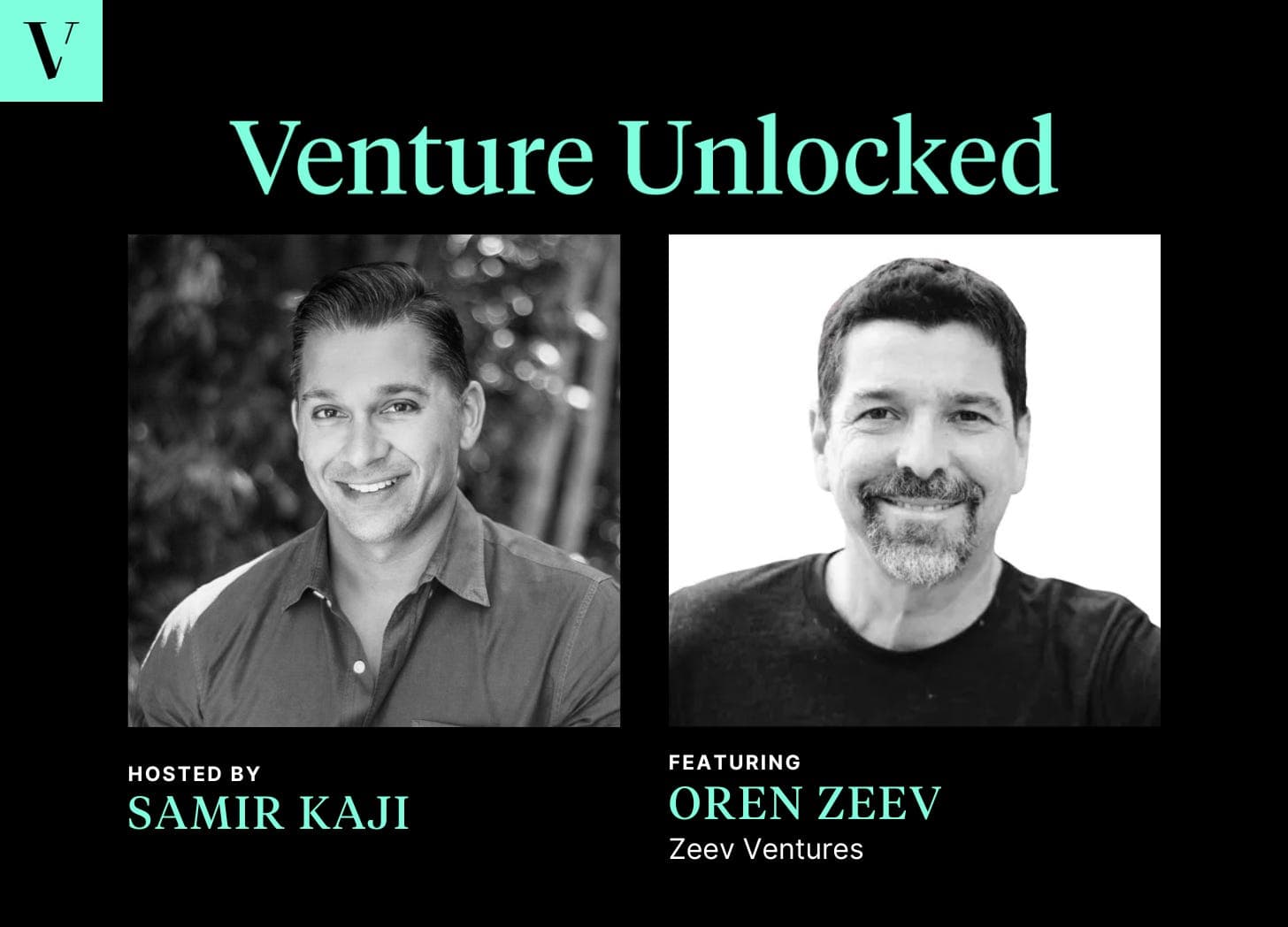
- Podcast Title: Venture Unlocked: The Playbook for Venture Capital Managers
- Host: Samir Kaji
- Guest: Oren Zeev, Founding Partner at Zeev Ventures
- Episode Focus: Oren Zeev’s approach to venture capital, insights on investing, and navigating the current economic landscape.
Episode Overview In this episode, Samir Kaji interviews Oren Zeev, a seasoned venture capitalist with nearly 30 years of experience. Zeev, whose firm manages over $2 billion in assets, discusses his unique position as a solo General Partner (GP) and offers insights into contrarian investing, founder satisfaction, and maintaining relevance in a changing market.
Key Discussions
Background of Oren Zeev
- Career Journey:
- Co-founder of Apax Israel, transitioned to the U.S. market.
- Launched Zeev Ventures post-2008 financial crisis, initially investing his own capital.
- Describes himself as a "One Man Venture Capitalist" combining angel and VC strategies.
Unique Investment Thesis
- Contrarian Approach:
- Maintains a solo-GP model to avoid the bureaucratic inefficiencies of traditional partnerships, allowing for faster decision-making.
- Highlights the importance of leading rounds and being significant in each investment rather than spreading investments thinly (referred to as "Spray and Pray").
Managing Risks and Investment Strategies
- Bias Checks:
- Engages in self-reflection to counter biases developed over his career.
- Consults with a trusted advisor to maintain objectivity in investment decisions.
On Fund Vintage and Follow-Ons
- Fund Vintage Perspective:
- Argues that fund vintage does not significantly impact the quality of investments; emphasizes focusing on the best opportunities available rather than adhering to a rigid fund cycle.
- Follow-On Investments:
- Prefers to lead follow-on rounds when warranted, rather than defaulting to pro-rata participation, allowing for greater flexibility and support for entrepreneurs.
Founder Relations
- Founder Satisfaction:
- Establishes a high Net Promoter Score (NPS) with founders, viewing founder satisfaction as critical for future deal flow and reputation.
- Advocates for transparency with founders regarding follow-on funding and investment strategies.
Navigating Economic Downturns
- Current Market Outlook:
- Discusses the impact of the 2022-2023 economic climate on venture capital, emphasizing that high valuations from 2021 should not dictate current company worth.
- Encourages founders to focus on cash flow and sustainable growth rather than fixating on past valuations.
Long-Term Investment Potential
- Venture Capital as a Good Long-Term Investment:
- Asserts that venture capital remains a strong long-term investment due to continuous technological advances, specifically pointing to AI as a transformative force for industries.
Personal Views on the Industry
- Relevance in VC:
- Stresses the importance of remaining relevant to founders who have alternatives for financing, and the need to evolve with the market.
Key Takeaways
- Solo-GP Model: Oren Zeev’s decision to remain a solo-GP allows for agility and a unique approach that contrasts sharply with traditional VC structures.
- Importance of Founder Relationships: The emphasis on founder satisfaction is seen as vital for long-term success in venture capital.
- Market Cycles: Understanding the cyclical nature of venture capital and the importance of long-term perspectives over short-term performance is crucial for both GPs and LPs.
- Investment Strategy Flexibility: The willingness to adapt investment styles based on current market conditions rather than relying on outdated practices ensures smarter capital deployment.
Episode Conclusion Oren Zeev's insights reveal a contrarian, founder-focused approach to venture capital that prioritizes speed, flexibility, and long-term relationships. The conversation highlights the need for investors to adapt to changing market dynamics while maintaining a clear investment thesis centered on value creation and founder partnership.
For more details on this episode, visit [Venture Unlocked](https://ventureunlocked.substack.com).
Written by AI. May contain mistakes. Listen to the episode to check what was said.
Transcript
Automatic transcript. May contain errors.0:00Welcome back to another episode of Venture Unlocked, the podcast that takes you behind the scenes of the business of venture capital. I'm your host, Samir Khajian. On this week's show, we're pleased to host Oren Zev, founding partner at Zev Ventures. Without a doubt, Oren is one of the titans in venture investing with nearly 30 years of experience and remains one of the most unique. Unlike traditional firms that have achieved scale, Oren remains a solo GP and has such an authentic and refreshing view on venture investing. Today, he manages over $2 billion in assets under management and has backed companies such as Howes, Audible, Chegg, TripActions, and Tipalti, among many others.
0:36This episode was a real treat to record, and we think you'll really enjoy the conversation. Now let's get right into it. I'm absolutely thrilled to have this week's show sponsored by Frank Rimmerman, who serve as home for over 500 VC firms for their tax and audit needs. They're also one of the largest providers of services for the emerging manager community, and as somebody that's worked with them for over 10 years, I can attest to the early commitment they made to MicroVC when it was first getting started. If you're a venture firm in the market for audit and tax, be sure to give them a call. Samir Kaji is the CEO and co-founder of Allocate.
1:12Allocate and Venture Unlocked are independent of each other. Any statements or references made by Samir or his guests regarding third parties, investments, or securities are solely their views and opinions and are not intended as investment advice or an endorsement of such parties or securities by Samir, his guests, or Allocate. allocate or its clients may maintain relationships with or investment positions in guests, third parties or securities mentioned in this podcast. This podcast is for informational purposes only and should not be relied upon as a basis for investment decisions. Oren, it's great to see you.
1:45Thanks for being on the show. Thanks for having me. I'm excited about what we're going to talk about. And we're actually, interestingly enough, on Riverside right now, which you are the first investor and it's a great product that we use. I want to actually start off with a little bit of a history. So you've been in the investment industry for a long time, going back to the mid-90s with Apex, ultimately was there for 12 years. And then you started Zeb Ventures really around the time of the global financial crisis. Tell us a little bit about your history and then what shaped the vision for Zeb back in 2008.
2:20Yeah, when I left Apex 2007, I thought it was done, to be honest. With Venture, I was financially dependent. I just needed to find what's going to motivate me and drive me for the next 40 years. I took a year, more or less, to kind of like figure out what I wanted to pursue next. And I tried a lot of things. Maybe one thing that was worth noting was that I actually taught math in middle school and high school as a math teacher for a couple of years. Around 2008, not around, in 2008, I started increasingly focused on investing. And it was very organic. It wasn't like I made a decision to start Zav Ventures.
3:00In fact, I didn't even call it Zav Ventures back. So it's only like in hindsight that I called Zav Ventures. I just started to invest. I had no interest or appetite to either join another partnership or raise money, to be honest, either. and I just started investing my own money. But I did it because maybe because of my background as a VC, I did it, I behaved as a kind of like a combination of someone who's investing his own money, but also as a VC. Specifically, what I took from my VC career is that you want to lead the rounds, you want to play a real role, you want to be the main, you know, you want to be significant.
3:38You want every investment to count in case of success as opposed to like Spur and Pray, which I didn't find appealing because that was the more prevalent, maybe angel model at the time. And today as well, to write small checks in many companies, that was never appealing to me. So I started to do it on my own. And I typically in those years, every deal probably needed more money than I was able to write myself. So I would underwrite the whole thing and then sign terms for the whole amount. it was typically between 1 and 5 million dollars when I got in sign a term sheet for the whole thing and then take part of it myself and the rest just syndicate to friends, I wasn't even trying to make any money off of it I didn't start an SPV or charge anyone just brought friends and people I thought could be helpful to the companies in question and that I did actually for many years because it was working it wasn't something that wasn't working, I enjoyed it, the companies appreciated it they loved it that's how i did the a round of chegg and the incorporation round of of of trip actions now in the van and the incorporation round of tipalti and the um and many other really good deals by the way not too many because i only did one or two a year so it was again not the um but the hit rate was very very high and everything was pretty much working every now and then i wished i had deeper pockets because i felt that i could be also be more supportive of the companies in later stages as well.
5:10But it wasn't enough for me to really compel me to go and raise the fund. And then, almost randomly, I had a breakfast meeting, or maybe it was lunch, but for sure it was over food, with Peter Thiel at his then house in San Francisco. He moved since. And I didn't really know he was... And we met in the context of some nonprofit that I'm involved with. And then we decided to talk shop a little bit. And I told them what I was doing. And 20 minutes into it, they asked me, why don't you raise a fund? So far, not very surprising because many people ask me the same question. And the answer was the same as I answered everyone else.
5:56Been there, done that, don't need the brain damage. I like it as it is, you know. know and then it surprised me because rather than at that point most people or everyone before typically if they were potential investors they would lps they would say okay if you ever raise a fund let me know he said why don't you let me be your lp and see how it works and so he made it so easy that i just figured why not give it a try took me two minutes to say okay and took another minute to agree on terms basically i offered terms and he agreed that was it that was the extent of the negotiations. And that was a fun one.
6:32I never prepared anything. I never prepared a single slide. I never talked to anyone to join because I really didn't want to make a 10-year commitment. And one of the things with Peter was an understanding that it's an experiment from both sides. He may decide it's not working for him. I may decide it's not working for me. So it wasn't like I was making a 10-year commitment to anything. I really got a chance to test it, to test before I buy into the idea of raising a fund. And that was my first fund in 2015. Six months later, I invested it all in five deals, by the way, so very concentrated. Interestingly, three of which I had been on the board before I raised this fund.
7:12So the idea of cross fund started from the get-go. From the get-go, it was no constraints. Whatever you think makes sense, you can do. I figured, wow, it is working for me because frankly, I haven't changed anything. The look and feel from the founder's perspective is exactly the same also from my perspective nothing has changed i'm making the same calculations the same decisions as if it's my own money that's how i behave it's just that i have better leverage you know more more money i can support the the i can write larger checks i can lead larger deals i can play more significantly in subsequent rounds and i don't have i can still syndicate if i like if i think there's actual value to the company by syndicating to someone who can add value, but I don't have to just to feel around.
7:59So it actually even saves me time. So that was when I decided, okay, the experiment succeeded. And that's it. Since then, every time I raise a fund, I think it's going to last for a while. Because of the market, it always lasts less than I thought. Fast forward, I'm now with over$2 billion under management. The first one was$20 million, by the way. So I'm now$2 billion under management, more than$2 billion, and Fund9, and nothing changed other than the fact that I have a bigger checkbook. But other than that, nothing has changed. We've talked about this a lot, and you've been public in your views, which in many cases are quite unorthodox for the traditional venture prescription, your deal pacing and crossover fund investing, partners, things like that.
8:48And I want to maybe look at the history of you growing to$2 billion but still being a one-person shop. And you were with a partnership, this traditional partnership. And I remember when I started my career, every firm was expected to have a number of GPs that made decisions on behalf of the partnership. And the thought was there was less key man risk, you have multiple views around the table. And then in mid to late 2000s, we saw the first rise of solo GPs. And it was folks like yourself, Mike Maples, Steve Anderson, Aydin Senkut that were called super angels at the time. And many of them over time have evolved to adding a partner, maybe adding a team.
9:33Tell us a little bit about what you notice about operating within a partnership that you felt that had certain structural deficiencies that you didn't want to replicate with the firm you have now. As you know, I'm very committed to it. to keeping doing exactly the same because i have a playbook that is working and i'm and i'm immensely enjoying it and and even as and as importantly the founders really enjoy you know really appreciate it and like it the fact that they don't need to uh deal with the partnership or institution but basically with a person and yet i'm a from from a scale scale perspective of the you know investment side they can get significant support in dollars from um from that investor to me having spent 12 of years in a traditional partnership, I was very, very, very aware of all the suboptimal processes and decisions that are being taken by a partnership because of many, many, I can give so many examples and maybe through the conversation we will give specific examples, but there's always, you know, the partner in question, first of all, the manager of career, first and foremost, a deal that may be a great deal, but is dangerous from a career standpoint, for example, because one or two of the more senior partners kind of hinted that they wouldn't do it because of whatever reason.
10:53Very difficult. It's much easier to do a deal that everyone is applauding you for the deal. So naturally, it gravitates you towards doing deals that are more in the consensus, so less contrarian. And we all know that the best deals are the ones that have some element of contrarian thinking in them. and there are other examples the approach to follow on investing meaning that the easiest path for any partner in any partnership is to do the parada as opposed to try to preempt something and be more aggressive and then have to fight their own partners and they're fighting over the reserve dollars that they have or they're supposed to also support other companies etc etc so but these are just two examples i can give other examples but basically what i realize is that i don't buy into the i guess the notion that a committee makes better decision than an individual in fact i would argue the opposite in this business and you know maybe it's worth giving another it's not even an example it's more like an insight which is that as we all know there are two types of mistakes in this business, mistakes of omission and mistakes of commission.
12:11And let's assume that you have great, very smart partners, and they really highlight things that you didn't think about yourself, because it's not always the case. Sometimes you don't have the brightest partners. But let's assume for the second discussion that you do have smart partners, and they really help you in seeing faults in all sorts of deals that you want to do and prevent you from doing a bunch of deals. they may actually add value by preventing from doing bad deals but they will never cause you to do deals or drive you to do deals that you weren't sure about yourself so they're only helpful in reducing the mistakes of commission but they don't help at all in the in in in in in terms of mistakes of remission in fact they hurt you in terms of remission because it's enough, you know, even if five times they prevent you from doing a bad deal, it's enough that one time they prevented you from doing a great deal.
13:06Whether it's by convincing you or whether just by vetoing it or voting against doesn't even matter. Or even just you don't want to take the risk of doing something, even if you're allowed to, that would be a career risk. That deal that you missed because you had partners may have been potentially 50x or 100x. So it's just very asymmetric. And I think that because of that, even if you have smart partners, and even if most of the time they actually, most of the time, they actually give you good advice, it's enough that one time. Because of them, you behave differently, then it wasn't worth it the whole thing.
13:43One more thing, a huge competitive advantage, I believe, is speed. Naturally, if you don't have anyone that you need to convince or persuade, you don't need to build a case. You don't need to write anything. You don't need to communicate anything. and it can be much faster than anyone else built in. I can make a decision when I do often within an hour, two hours, 24 hours, including Riverside, by the way, which you mentioned before that we're now using the platform. You know, I was having this conversation with an LP the other day about solo versus partnerships. And one of the points that I was making is that partnerships, if not constructed well, can actually create a lot of political bureaucracy and bad decision-making.
14:24And it actually turns into people fighting for their own attribution, their own careers, and looking to do things that may not be in the best interest of the actual returns of the fund. And this person said, yeah, I totally agree with it. But at the same time, the longer an investor is in a seat, that they're going to develop certain biases because of things that's seen in the past, things that unchecked may lead them independently to make a decision that may not be correct in today's world. So it's this whole concept of the map is not the territory. How do you think about checking like the biases that you have and evolving as an investor over time?
15:05You know, I think you want to be intellectually honest, which none of us are, and keep looking at yourself, checking and checking, you know, with yourself. At the end of the day, I don't have a better answer other than what I said before, that it's okay to make mistakes on the deals that you, you know, again, it's the asymmetry of the value of the partnership. But how do I try to look, I really try to look back and reflect and be intellectually honest about it. You know, I don't know that. Well, the other thing is I do have people I consult with. So, and I do have people, obviously I don't think all the wisdom lies within myself, right?
15:45So I do have people I consult with, and specifically there's one person who is my virtual partner because I go with him and I seek his input basically on almost everything that I do. And we talk a lot and he even has carry. He does have carry in the adventures in general, not even deal specific. it. And then there are other people that I seek advice from, obviously, and try to question myself. And it's very important not to, I believe, to stay humble in the sense that you don't know, you don't have the future. You don't know the future. I don't know the future for sure. I mean, sometimes people start thinking that they create the future because they invested it's going to be successful and when you start believing too much in yourself too much this could really lead to uh being careless about your decisions and starting to believe that you can especially after now it's not that dangerous but i think it was dangerous until a year ago because after so many years of such a bull market that every time you make a mistake you don't really get punished and the only mistakes that you feel you made are not investing because every time you invest even if you're wrong about everything, it still somehow sorts itself out.
17:07It's very easy to start developing this feeling that, oh, really, I really have it. You know, I really know what, you know, I really have this intuition what's going to happen and or I really create so much value that the companies I invest in become successful because I invest in. So it's really easy to fall into the trap. So you don't want to fall into the trap of your own BS, let's put it this way. I agree. And, you know, the last 14 years, we've had most of the world being up and to the right, and people have taken any decision, and it's kind of worked out. So over time, that amplifies, you know, self-worth and self-confidence.
17:46You know, you have stayed, you know, I think I've mentioned this to you before, one of the things that's been refreshing is you stayed authentic to know what model works for you. And it hasn't really changed from 20 million in AUM to now 2 million plus. Some of that has actually been done in a way that probably comes in conflict with the traditional LP mentality of what venture should be. And oftentimes, you know, what funds do and fund managers do is they operate and invest their fund based on what they know the LPs will want to hear. And it becomes a little bit of the tail wagging the dog. Let's go through a few of those things because one of the classic things is, okay, you raise a fund every three years because you get vintage or diversification.
18:31And this is somehow important. You raised three funds in one year, you know, just a couple of years ago. What's your overall perspective on why it really doesn't matter and it shouldn't matter for somebody to care about vintage or diversification versus just, you know, what you do, which is invest in the very best entrepreneurs? First, you said before that I've stayed with the same playbook since I raised the first$20 million fund, which is true, but in fact, I've stayed with the same playbook since I started eight years earlier, investing my own money. So it's not since 2015 that I've stayed with the same playbook.
19:06It's actually since 2008, since I started operating post-APEX. My approach, by the way, was not that I had anything in a three-year cycle. My approach was I think that I should be reactive to whatever opportunities that I'm seeing. If I'm seeing great opportunities, I don't want not to invest because I need to make sure that the fund lasts for three years and vice versa. If I don't see great opportunities, then I shouldn't invest at all. I shouldn't try to be on a three-year cycle just because it is convenient for some of the LPs for their own planning. And this vintage diversification thing, I don't buy at all because if you're an LP, first of all, it's an ongoing relationship with an LP.
19:48It's not a one-off thing. I'm not interested in an LP that invests on a one-off basis. If they are in every fund, then they're getting the vintage or the specification that way. If there happens to be a fund that is less good because of the vintage, fine, so be it. By the way, right now I'm not even anticipating it, but even assuming that I do have a fund that's not great, that's okay. hey, you know, if someone, if an LP invests consistently with me, they'll get their vintage diversification. It doesn't have to be within the specific fund. It can be across the funds. We briefly touched on this earlier, but when it comes to follow-ons, if you think about a traditional fund structure, some part of the fund is reserved for follow-ons.
20:33It could be two-thirds, a half, whatever it is. And it's done within the same fund. And most managers will wait for another lead to come, and then they'll do the pro rata for the companies that make sense to do pro rata. And I would argue that over the last few years, pro ratas became a pretty lazy exercise, and it was just easy to do pro rata when a new round came along. And you've taken a very different approach over time. Not only do you do follow-ons, but sometimes you're preempting and leading rounds for companies that you previously invested in, sometimes in a prior fund. And I just love to understand the calculus of how do you think about follow-ons and what is the decision internally in terms of when you lead a round and preempt and take more than your pro rata and then also when you don't do pro rata?
21:23first of all i want to clarify and to make you know to to to that the the ones that are really preempt and put a lot and lead basically because the only way really to put more money than your prorata in a good deal is to lead it because if you wait for someone else to lead it at best you can get your prorata and maybe not even that because maybe the founder is going to ask you hey can you put less than your prorata because there's not enough room so that's still the exception and just because i don't do it it doesn't mean it's not a great company Basically, you know, the criterion has to be that it's a great deal for the new fund.
21:59And the fact that it's a great deal for the new fund is divorced from the fact that I've already invested. The fact that I've already invested in it is the reason why I have this opportunity, why I have the insights, why I have the relationship and all that. So it created the opportunity. But it's not a reason for the investment. I would have to want to do the investment, even if I wasn't an investor from before. So in this decision, I 100 % wear the hat of the new fund. And the founders understand that, and I tell them that, that it's a separate fund and it has to be a great deal versus compared with all the other opportunities for that new fund.
22:40And a subset of that, I have to believe that there are still venture returns because I'm not doing it for 2x or 3x. I have to believe that even if it's late stage, Even if the absolute valuation seems high, I still think that the venture returns are available. Basically, it's very subjective, obviously, but that's basically it. A thing that I think a lot of investors struggle with is when you invest in a company, you do a Series A, Series C, it's almost the expectation that if the company is doing generally pretty well, that you're going to do the follow-on. and in 2021 for example we saw going from a c to series a there was a huge step up in price series a to series b huge step up in price and there wasn't that necessarily that independent analysis of is this still a venture type of return or are my dollars best used here versus somewhere else and some of it's difficult because you have the entrepreneur that you become emotionally tied to as well.
23:39And one of the struggles is when I'm thinking about the following, I want to support the entrepreneur. What are the things that you tell entrepreneurs when they're first taking your money and how you look at supporting them going forward? Because I think a lot of this is about transparency of your approach with the entrepreneur. And management of expectations. Absolutely. First of all, no question that like everyone else, I also overpaid for deals in 2021. And so, you know, I don't want to, and maybe late stage deals that I did in 2021, even if I think they're really good relative to the 2021 vintage, may not in the end yield the venture returns that I expected when I did them.
24:21But I had to expect it when I made investment. And I have to manage the expectations of the founders because the number one thing that I'm trying to optimize for is founder satisfaction with me, okay, or my virtual NPS score. So that is even more important than returns because the returns only apply to that specific investment. But the satisfaction of the founders for me is going to have an implication on how competitive I am in the future, how much access I have to the best deals, etc. Because this is really my marketing. My marketing is what the founders that I backed say about me. So, unfortunately, and I agree that there is a potential friction here.
25:02No question about it. So far, I've been able to manage it very well through transparency because from day one, my model is very clear. I'm very open with it. And I say, listen, there really are two scenarios because I, unlike most investors who 95 % of the time would just do the pro rata in the following round, I actually try not to do my pro-rata, you know, either in the subset of the deals where I have like great conviction, then I would, if you will, go all in and double down and lead the deal and do four times in pro-rata, whatever, or the entire round sometimes. and in other deals I will behave as an early stage VC because in other deals I will probably put some money from the original fund that made the investment at that point typically the amount that will be left in that fund is not going to be very big so the check side is going to be small and from day one I tell founders and they know it that I am radically founder friendly on every in every sense of the word, right?
26:12On everything, you know, whether it's on every decision, strategy, what have you. And in terms of helping them to succeed, the one thing where this founder-friendly doesn't extend to is putting new money from a new fund. Putting new money from a new fund, I have to wear the hat of the new fund, period. And I understand it. And honestly, and then maybe part of it is because they're already self-selected probably for, I would call it emotionally mature founders. Most of them are a little bit older than average, but even the ones who are younger, typically I would, you know, I try to invest in people who I think are grownups and, you know, emotionally mature.
26:55And emotionally mature basically, among other things, is that you can understand the other side and then they can see how it is from the other side and they're fine with it. And they really didn't have a real issue, including companies that failed. And I told them that I'm not going to be able to support them because it's okay. You mentioned a term there that I think has so many definitions by different people, founder friendly. And you and I had this conversation. I don't know. I remember on the phone is maybe three months ago. And I asked you this question because Apex was back in mid nineties, you know, it's 30 years.
27:29And I said, Oren, like, how long do you want to do this? How long are you going to do this? You've been in a great position. You said something along the lines of, I'm going to do this until I'm no longer relevant to founders. And, you know, I thought that was a great answer, but I wanted to ask that follow-up. What do you think it means to be relevant to a founder? I tell you, I think what it means, anyone is relevant to founders who don't have other alternatives for financing. So anyone can be relevant to founders if they don't have other alternatives. To me, the test is, am I relevant to founders who have alternatives?
28:03In other words, am I still, am I competitive? Would the best founders, the founders that I want to invest in, choose me over great alternatives? That, to me, is the test. And the reason they would choose me is, you know, because of the reputation that I have, because the value I can add, etc., etc., etc. So the day that I'm less relevant or not relevant is probably the day where, you know, I'm no longer competitive. Maybe I cannot, maybe I don't get it anymore. Maybe I'm too much out of touch or not as connected as some people who are maybe younger generation. Maybe, maybe that day will happen.
28:44Maybe it won't. But at that point, I don't think I would want to continue to play as a second year player because you can always continue to play because there'll always big founders who take money from you always, you know, but to me, the test is if I look myself in the mirror, am I not kidding, not lying to myself, you know, being brutally honest with myself, am I really the first choice for the people that I ended up backing? You know, obviously I'm not going to be the first choice for everyone, but for the people who I ended up backing, was I really the first choice versus alternatives? And that has to be a very clear yes.
29:22So far, I believe it is a yes. And if it's ever not a yes, then I'll reconsider. You have been a large supporter of some incredible companies, whether it be Sepalty, Trip Actions, Chegg, you mentioned Howes, other companies. And over time, you built a reputation of working with founders in a consistent way that tends to over time amplify itself. You create your founder net promoter score. At the same time, while you're a solo investor, solo GP with your fund, you still have to work with other investors because oftentimes there's a board that has maybe two or three other or four preferred seats on it.
30:01And many of them don't operate in the way you do. They have their own sort of prescriptions in terms of what ventures should be and how to support founders. How do you manage that perhaps natural attention, especially if it's a partner that might be maybe more junior in their career, maybe they are looking at career aspirations and the decision making affects you it affects the founder how do you navigate that i say i think my in general my portfolio and myself have been lucky and obviously it's under slack in terms of the other uh investors that i'm on the board with because for the most part i would say the way i they're behaving in a way that i would expect uh you know board members to uh to behave in and and part of it by the way is because typically especially for the strong companies they have the ability to choose and And typically, I'm the first investor, or at least I'm the first major investor, so I also help them navigate and choose well.
Read the full transcript
30:59It's not as common as one would think. But, for example, I can think now, I'm not going to mention the name, but I can think now of a company that, you know, I feel that there are two late-stage investors there who are wholly unnecessarily giving the founders a lot of, you know, grief and hard time and for no reason whatsoever. The only reason is because they invested at the peak of the market and they overpaid. But that's not the fault of the founders, right? What am I doing? I always side with the founders, you know, period. And so, number one, I always side with the founders. I'm not trying to manage my relationships with other VCs at the expense of the founders.
31:43My loyalty is very clear. And I also try to advise the founders because of my, you know, thanks to my experience, you know, how to navigate it. And, you know, sometimes it's more successful, sometimes it's less. But as I said, I've been more fortunate than I would have thought with the people that I have around the table in most of the companies. The market has changed over the last 14 months. We've seen what happened in 2022 with the rates going up. Venture financing has dropped. And there are a lot of companies that got funded at really high valuations in 2021 that in today's market would be priced very, very differently.
32:20And some of these companies are durable, some are not. you were around during the dot-com bubble investing in you know some of those internet companies that candidly at that time were just vaporware there wasn't really a business there now there are business models but what are you advising i guess founders as they sort of navigate through this next because many of them will have to test the private markets again in 23 24 and they're going to hear a very different story how do you now think about that no company should fail just because they raised at a high valuation. They're going to fail if they fail to find product market fit or make the economics work, et cetera.
32:59But not because they raised, because basically my advice is just fully ignore the valuation that you raised in 2021 is irrelevant. It's not your fault that you're not worth it now. You're not responsible for interest rates. You're not responsible for quantitative easing or whatever happened in the last decade. Take it out of your mind. It doesn't matter that you were worth X in 2021. Make decisions ignoring it. Now, the decision could be, let's run the business to cash flow positive without needing to raise again privately. That's a legitimate decision. It could be the right decision, but it doesn't have to be the right decision.
33:41The decision could also be, yeah, let's continue to focus on growth and raise money when we need to raise money. And whether or not it's a down round doesn't matter, you know, and not even try. And my advice here is if you're not sure you're worth what you were worth in 2021 and you need to raise money now, be proactive about it. Don't hope that the investors are going to surprise you and pay more than, you know, the price of 2021 or more. because what will happen is that if you say nothing and the investor is going to get the pitch even if he likes the company here's what your last valuation is going to be if he doesn't hear anything else from you they're just going to assume that it's not worth wasting time on it because you know um it's just not worth investing time on it and uh you're just going to lose investors that otherwise would have been very uh relevant and interesting so if that's the case just you bring up the elephant in the room and you say, listen, I know that I raised a very high valuation in 2021 and 2020 whatever.
34:45The market's changed I don't care about what I raised in 2021 if this is a down run this is a down run and PM the conversation because down run is much better than in no round and by the way, there's no shame in the down run and it's a psychological thing because some founders feel that if they raise a down round, somehow they failed. And again, as I said, it's not their failure because they're not responsible for interest rates. I sometimes ask them, okay, which public companies do admire? Whatever they say, let's say they say Amazon, say, you know how many down rounds Amazon did yesterday? Every day, every public company does thousands of public downloads, right?
35:28It's meaningless. And Amazon is not worth whatever, Again, I just choose Amazon. It could be any company. Amazon is not worth what it was worth at the peak either. So do you have less admiration for them because of that? No. So just don't think about it. Don't think it as a personal failure. It's not. Most of the time, I'm convincing the founders. I love the framing about the public markets because I do think that in the public markets, we do see markdowns every single day. And of course, it's visible, it's transparent. yet there are so many companies in the public market that have atrophied so much market cap during downturns and then not only rebounded and recovered but eventually were worth 10-15 times what they were worth in the pre-downturn peak and it all comes down to do you have a business model that can stand the test of time.
36:23Speaking about public markets and I guess how they affect the private markets I get this question a lot and I know you've been through multiple cycles of Does this time period resemble the dot-com era or the global financial crisis? We love to draw parallels as humans. I think it's hard to draw a perfect parallel. I think it's one of those things where there is some of the elements that do rhyme, but it's not exactly the same. Maybe you can give us your own perspective on how this particular downturn and this cycle might be more or less different than what we've seen the last two times i'm all in favor of qualitative responses but whenever there's an ability to have quantitative answers it's better right you don't want to ignore it and i think that so i'll try to be quantitative in answering this there is extremely high correlation between the public markets and the private markets And specifically within the public markets, the technology sector, and even specifically within that, the high growth technology public companies.
37:35I would argue that the correlation is, there may be some delays, but the correlation is at the end of the day, close to 100%. Because at the end of the day, the exit route for the private companies is either get bought by a public company in their space or go in public. So either way, they're going to be judged relative to public companies once they get to that stage. So the best proxy or an easy proxy, maybe they're better, but an easy proxy for high growth technology public companies is the NASDAQ index. So if I look at the NASDAQ index in 2000, and I actually prepared this for something else.
38:15I actually have the data. in 2000, from the peak to the bottom, was a 78 % decline in the overall NASDAQ index. And by the way, it took two and a half years from the peak to the bottom. And it took 13 and a half years to get back to that peak. So only in 2014 did we get back to the March 2000 levels. This is the 2000 bubble. In 2008, there was 50 % decline from the peak to the bottom, and it took 15 months to go from the peak to the bottom, and it took three and a half years to get back to the previous peak and then continue to increase. So massive difference between the two in terms of this metric, which I think is by far the best predictor of the behavior in the private market.
39:13Fast forward to today. First of all, we don't know if we hit the bottom. So far, the bottom was in October 22. And if this indeed ends up at the bottom, it will have been 36 % decline and 11 months from the peak to the bottom, if this indeed is the bottom. So if this indeed is the bottom, it's comparable to 2008, even smaller, and definitely not even close to 2000. By the way, today we're 25 % below the peak. So we came up from 36 to 25, from the peak to get back to, from the peak. That's where we are today. So in the future, we could have a deeper bottom, in which case it will get worse. But even if it does get worse, it's much more comparable in terms of the magnitude.
40:08Of course, it's not comparable in terms of the factors that contribute to it and everything else. But in terms of the magnitude of the impact on the valuations, it's close or more comparable to 2000. It's not even close to 2000. People don't remember 2000. It's not close. You know, 2000 companies got obliterated, even great companies, even the best companies, you know, in the high growth. I mean, yes, 78 % decline on average. But this includes companies that are not exactly technology companies. And this includes companies that may be profitable, not growth companies. the high growth, often losing money companies back then, even the best ones, even Amazon.
40:44I think I need to check because I don't have this data, but my guess is it lost at least 95%. At least. So yeah, I think it's not even close to 2000. And even if this gets worse, it's not going to be even close to 2000. So you mentioned 2000. So the Nasdaq was at 5000, went down to about 1200. It took up until 2014 to get back to 5000. What happens during these markets is from an LP investing in private markets, particularly things like venture capital. You have a lot of capital going in really at the tail end of these up cycles. And then when these down cycles and sobriety returns to the market, you have a lot of LPs fleeing the ecosystem, even though this is early stage investing, which has long duration characteristics.
41:31And I'm not talking about the denominator effect. I'm talking about investor psychology. Give us the bull case of why investors that are looking at investing across asset categories should still be excited about investing in venture capital. This industry is cyclical and it's always been cyclical. And this is exactly the reason why it's so cyclical, because there are ups and downs that are being basically derived from the public markets, ups and downs. And every time prices go up, people join because everyone looks like they're making money. And then there is like, as in engineering, it's called LIFO, last in, first out.
42:09Maybe not just in engineering. You know, the last, you know, typically the first out. And you have these tourists, you know, as we call them that, you know, And so all this money is being sucked out of the system, and people are much more deliberate about it and much more conservative with their projections and everything. So all of a sudden, companies become much more efficient, and then the investments posted correction are much better than, obviously, the investments through the correction. now we are now 15 months from because again the peak was in November 21 of the public market so we're now 15 months into it as I said maybe the bottom is behind us if it is it happened in October 22 if it's not then you know we'll see another bottom so maybe behind us maybe not but you cannot really time it as an LP or as a V or as a GP either So I absolutely think this is the best time to be.
43:11Now, the best time versus a year, two, three ago, for sure. It's possible that you're not necessarily counting on a quick rebound, and it may take years. Again, probably, I think it's going to be more similar to the three and a half years that it took in 2008 versus the 13 and a half years that it took. But even if it's more than three and a half years, you cannot exactly time it. the great thing about today is, first of all, there's no question that technology is continuing to eat the world. So the fundamental thesis for venture capital investing in technology companies has not changed at all.
43:47There's also no question that we are, after a very significant correction, whether or not we're at the bottom, we'll see. And I think the other thing that I think is indisputable, that from an LP perspective, any attempt to time the market and be tourists and come in and come out is going to yield way worse results than not investing at all or investing all the time. That's like the worst strategy you can have, you know, to try the timing. So the other thing is that we have a massive wave now of technology that is, which is AI, which looks like it's going to transform every industry. So just like you had in the 90s, you had, in the 80s, you had personal computing.
44:27In the 90s, you had the internet, the web. in the 2000 towards the end, you had smartphones. Maybe in the next decade, the development of the cloud. And now you have, for sure, AI. Maybe you have other things, but for sure you have AI that's going to transform industries. Yes, I see. I think that the direction that technology is going to continue to take value from companies that are not able to adapt 100%. And this is actually a great time. Is it better than a year from the O2? I don't know. But it doesn't matter. And you cannot expect to time it. So that would be my answer. I couldn't agree more.
45:08And I think timing any type of asset class is incredibly difficult, let alone one that resembles long duration assets and simply isn't a normal asset class because there's not an index here. You are really looking at those power outlier winners and, you know, backing managers that can have a higher probability of getting into those 20 or 30 substantial companies every single year. Oren, this has been so much fun. I've really enjoyed the dialogue and hopefully we can do it again sometime. I'm done. Thanks so much for listening to another episode of Venture Unlocked. We really hope you enjoyed our conversation with Oren.
45:48To learn more about him or Zeb Ventures, be sure to go to ventureunlocked.substack.com for detailed notes on the show, as well as my ongoing commentary about the world of venture capital. Venture Unlocked is also available on iTunes or Spotify for download. And while you're there, please leave us a rating and a review as it really helps us out. And don't forget to hit the subscribe button in order to get each and every Venture Unlocked episode as soon as it's released.
46:34Thank you.
From the publisher
Follow me @samirkaji for my thoughts on the venture market, with a focus on the continued evolution of the VC landscape.
We’re pleased to welcome Oren Zeev, Founding Partner at Zeev Ventures.
Without a doubt, Oren is one of the titans in venture investing with nearly 30 years of experience and one of the most unique. Unlike traditional firms that have achieved scale, Oren remains a solo-GP, and has an authentic and refreshing view on venture investing. Today, he manages over $2B in Assets under management and has backed companies such as Houzz, Audible, Chegg, TripActions, and Tipalti, among many others.
About Oren Zeev: Oren calls himself a “One Man Venture Capitalist,” and TechCrunch says he is a hybrid between an Angel Investor and a traditional VC. Prior to founding Zeev Ventures, Oren was a part of the founding team of Apax Israel in 1995. In 2002 moved to the US and co-headed, and later headed, the Technology Practice of Apax and the Silicon Valley office.
He began his career at IBM and got his Bachelors from the Israel Institute of Technology and his MBA from INSEAD.
In this episode we discuss:(02:21) The original thesis behind Zeev Ventures(09:44) Why Oren has avoided growing beyond a solo-GP(15:05) How Oren pushes himself to prevent biases and evolve his thinking over time(18:50) Why fund vintage doesn’t matter(21:24) The reason why Oren can be aggressive with follow-ons(23:59) What type of support can founders expect(27:50) Being relevant to founders as a VC(30:26) Working with other VCs on board(32:47) Advice to companies that had 2021 valuations that may need to raise soon(37:03) Thoughts on this downturn(41:47) Why Venture is still a good long-term investment
I’d love to know what you took away from this conversation with Oren. Follow me @SamirKaji and give me your insights and questions with the hashtag #ventureunlocked. If you’d like to be considered as a guest or have someone you’d like to hear from (GP or LP), drop me a direct message on Twitter.
Podcast Production support provided by Agent Bee
This is a public episode. If you would like to discuss this with other subscribers or get access to bonus episodes, visit ventureunlocked.substack.com