In short
Venture Unlocked: Episode Notes
Podcast Title
Venture Unlocked: The Playbook for Venture Capital Managers
Episode Title
Paul Kwan of General Catalyst on the Importance of Innovation in Creating Global Resilience
Episode Description
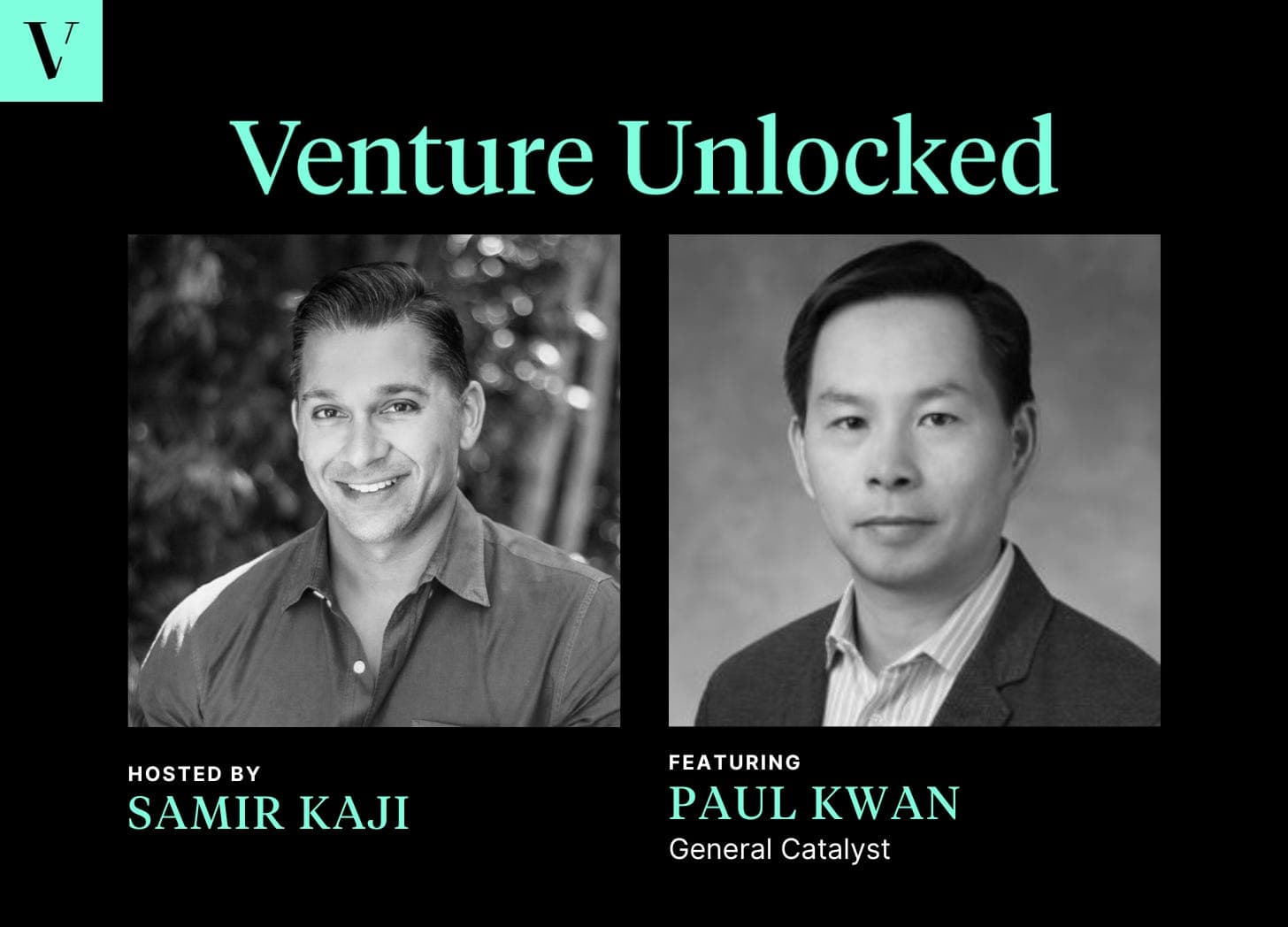
In this episode, Samir Kaji speaks with Paul Kwan, Managing Director at General Catalyst (GC). The discussion focuses on the significance of innovation in building resilient infrastructures in sectors like defense and energy. Kwan shares insights on mission-driven approaches, the evolving landscape of venture capital, and strategies for private companies navigating the current market.
---
Key Participants
- Samir Kaji - Host, CEO & Co-founder of Allocate
- Paul Kwan - Managing Director at General Catalyst
General Catalyst Overview
- Founded in 2000 with nearly $25 billion in assets under management.
- Notable portfolio companies: Stripe, Coinbase, Livongo, Samsara, Gusto.
- Focus on upgrading infrastructure in defense, intelligence, and energy sectors.
---
Key Discussion Points
- Paul Kwan's Journey
- Background in tech influenced by his mother, a computer programmer.
- Career highlights include 22 years at Morgan Stanley, focusing on the global internet and software sectors.
- Transition to venture capital at General Catalyst in 2021.
- Value Creation in Technology
- Sustained Economic Value: Importance of creating long-term value beyond initial public offerings (IPOs).
- Calculus of Value Creation:
- Technology shifts (e.g., cloud, AI).
- Evolution of business models.
- The role of company culture in driving performance.
- Company Culture's Impact on Investment
- Culture as a key factor in investment decisions.
- Importance of establishing a strong culture early in a company’s development.
- Connection between culture and measurable outcomes (e.g., customer satisfaction, employee retention).
- General Catalyst's Mission
- Focus on Responsible Innovation: Investing in sustainable, inclusive technologies that promote societal harmony.
- Development of internal metrics and frameworks to measure impact and success in alignment with their mission.
- Geopolitical and Economic Resilience
- Discussion on the pressing need for resilient systems in light of changing geopolitical tensions and economic conditions.
- Emphasis on the transformation of venture capital to adapt to these challenges.
- Private-to-Private Mergers and Acquisitions (M&A)
- Anticipation of an increase in private-to-private M&A due to market conditions.
- Challenges of merging different company cultures during acquisitions.
- Strategies for structuring deals to navigate valuation issues.
- Future of IPOs and Venture Capital
- Reflection on the current IPO market and what it means for venture capitalists.
- Importance of balancing immediate financial returns with longer-term investment strategies.
- The evolving role of venture capital in supporting sustainable growth in technology sectors.
- Advice for Future Leaders in Tech and Venture Capital
- Relationships are critical in building successful careers.
- Understanding the long-term nature of relationships and their compounding effect over time.
---
Episode Takeaways
- Mission Matters: Companies with a clear and compelling mission can attract top talent and achieve better long-term outcomes.
- Cultural Investment: A strong corporate culture directly impacts performance and should be prioritized in early company development.
- Innovation for Resilience: In the face of geopolitical and economic challenges, innovation in infrastructure is critical for building resilience.
- Evolving Market Dynamics: Venture capitalists must adapt their strategies to navigate fluctuations in market valuations and the IPO landscape.
---
Conclusion
This episode provides valuable insights into how innovation, mission-driven approaches, and company culture play crucial roles in the venture capital landscape. Paul Kwan's perspectives on resilience and the future of investing offer a roadmap for navigating today's complex economic environment.
For detailed notes on the show and ongoing commentary about the world of venture capital, visit [Venture Unlocked](https://ventureunlocked.substack.com).
Written by AI. May contain mistakes. Listen to the episode to check what was said.
Transcript
Automatic transcript. May contain errors.0:00Welcome back to another episode of Venture Unlocked, the podcast that takes you behind the scenes of the business of venture capital. I'm your host, Samir Khaji. On this week's show, we're thrilled to be joined by Paul Kwan, Managing Director at General Catalyst. Founded in 2000, GC has become one of the largest and most recognized firms in the industry, and today has over$13 billion in assets under management, currently managing several products that help finance high-growth technology and life science startups. Since inception, the firm has backed companies such as Stripe, Coinbase, Livongo, Samsara, and Gusto.
0:33Paul leads the global resilience team at GC, which focuses on modernizing our most critical societal systems, including defense and intelligence, industrial and energy. Before joining GC, he spent 22 years at Morgan Stanley, including six years running the bank's global Internet and software business and another six years leading the West Coast team. During our chat, we covered how mission orientation and strong cultures have become so key in building resilient companies, how they think about this inside the GC walls, and what he views as the likely exit outcomes for so many private companies in the years ahead.
1:07Hope you enjoy our episode, and let's get right into it. Samir Khadji is the CEO and co-founder of Allocate. Allocate and Venture Unlocked are independent of each other. Any statements or references made by Samir or his guests regarding third parties, investments, or securities are solely their views and opinions and are not intended as investment advice or an endorsement of such parties or securities by Samir, his guests, or Allocate. Allocate or its clients may maintain relationships with or investment positions in guests, third parties, or securities mentioned in this podcast. This podcast is for informational purposes only and should not be relied upon as a basis for investment decisions.
1:44Hey, Paul, it's great to see you. Thanks for being on. Thanks for having me on. Big fan. I appreciate that. And I'm really excited about this conversation, given your unique background. A good place to start, I think, is walking through your history leading up to starting, I think, at GC in 2021. Maybe talk about why you got interested in tech and in your journey. Growing up, I was really fortunate. My mom was a computer programmer for her whole career, starting on mainframes. in 1970-something at UCLA. So she was really big on you got to be in tech, right? And so I went to college. I did CS and econ.
2:21I was not so good at CS, better at econ. And I knew I wanted to be on Wall Street. So I was really fortunate to get to Wall Street 1996, kind of the client-server wave. I know you talk a lot about the 01. I got there right before 01. There was this thing called Y2K where we thought the whole thing was going to shut down. Got through that. And again, I had the privilege really. At first it was the privilege and then it was the responsibility. This apprenticeship of investment banking where you basically, your job is to help founders and CEOs achieve the most strategic and financial objectives. And once you get past that apprenticeship and you're in that seat, it's incredible responsibility.
3:02And I saw some amazing stuff. Two things that were really, really instrumental in my new career in venture capital that were relevant. One was, you know, I did multiple sectors. So most bankers are focused on one sector. And I remember there was an MD who got laid off one year. On the way out, he said to me, Paul, protect yourself, do two things. So I did internet and software around the world. And luckily, you know, my wife took care of the kids while I traveled the world for a bunch of times. So global internet, global software, anywhere in the world, I would go. I did IPOs on all six inhabited continents.
3:38Antarctica, the only one I'm missing. No tech IPOs on Antarctica. And that just gave me an amazing purview. The other part I didn't really realize until you and I were talking about this just now is I got to GC, General Catalyst. I'd been Haman partnered supporting GC, Haman, David, Joel, and the whole team here. I like to think I had dominant market share covering General Catalyst, all the major exits. Haman said to me one day, you've got an incredible training set of data on what great companies look like. Like I only basically saw great companies. My job was to pick between the not so great and the great.
4:13And that training set of what makes a great company is pretty special, right? I got to see every venture capital firm's IPO, every venture capital firm's major M &A deals. That's something that gave me a great platform. So that's kind of how I tie investment banking 25 years to this new career in venture capital sphere. Yeah, you and I were talking about this, about how things have changed and evolved, both in venture and technology, of course. We've seen these super cycles emerge going from mainframe to personal computing to the internet. You and I started around the same time, so I started my career in tech in 99, so I saw Y2K, of course, was around through 2001.
4:48And a lot of people ask me the question of how would you compare what's happening right now to kind of the post.com era? And before this conversation, we talked about other parallels of what's really happened in the technology industry that we can draw parallels around. And you mentioned this concept of value creation. I think it would be really good to unpack what value creation means. And you talk about great companies. How does that fit into this framework of value creation and how it's evolved over time? It's really how do you create sustained economic value creation, typically for shareholders or in the public markets, right?
5:26It's not enough to get public. It's not enough to kind of have kind of like a one or two year horizon. But how do you compound value in the public markets over time? That's what the great companies have all done. And so when we think about value creation, that's what we're trying to build for, right? Both at GC and others. What allows you to compound value over time is something we think a lot about. And I kind of like to call it the calculus of value creation. What are the inputs? What are the principles by which you can compound value for that business, for that firm? And you do an awesome job kind of keeping the history lessons from 01 and 08 alive here.
6:03You know, it's given how some of the founders weren't even born when we went through all that stuff. But I think what's challenging around playbooks and analogies is that they don't pick up on a bigger trend and bigger calculus, which we think is that the inputs to value creation are expanding over time. Everyone talks about, and I think there's three or four of them. One is technology, right? Technology shifts, cloud, mobile, AI right now. That's obviously well understood. The second layer of value creation we think is business models. How do business models evolve? Obviously, cloud changed a lot of things.
6:36PLG, sales motions, all of that stuff goes into value creation. The third piece of it is people. This is one where it's obvious now, but it wasn't 10 years ago. I learned from Alfred Lin at Zappos about culture. I learned from a company called Rackspace, Graham Weston and team about culture very early. And they were always asking, when will people value companies better because we have a better culture? And it wasn't until the Netflix 2009 culture deck came out that people started talking about culture. And since then, every tech IPO that's gone public has had a page in the roadshow deck or a page in their S1 about culture and people.
7:21When nobody talked about that before. That's a new input to the calculus of value creation. You know, I had a CEO forum yesterday and all four CEOs just talking about culture. You have technology shifts, you have business model shifts, you have culture, and then we have something new we're thinking about. That's the calculus of value creation in my mind. So when you're looking at obviously investing in some companies and you've had this front row seat of these amazing companies, as you mentioned, your job was to spend all your time with these great category leading companies. You took companies public that fit that and you saw this notional evolution of things moving to just business models and numbers to also having this inclusion of culture.
8:09Now, culture is also one of those things that's a little bit amorphous, like what is culture? How does this actually create better outcomes for companies? As an investor, how do you then think about culture as part of your calculus from an investing decision standpoint, given your thesis that great cultures help drive great companies? Yeah, I think the missing link is from the amorphous to the specific is how does that culture, right? That unique culture, that set of behaviors, objectives lead to better performance. And you need to tie them together, right? How does that culture around, let's just say, engineering excellence lead to faster output, better iteration speed, right?
8:52How does a culture around client centricity, people talk about that, how does that lead to underlying metrics around customer satisfaction, NPS, retention. That's, again, these are all well-documented, but that's the missing link to tie your company's unique culture to outputs that drive value creation. Those are the sorts of things we think about, we talk about. Again, it's something that if you don't tie it to the right behaviors that drive performance, then it is quite amorphous. But I think the best companies absolutely think about that and drive the right, whether it's a KPI or output between that behavior to performance.
9:28When we think about this, I mean, in the unique aspect of GC is you do invest across the stack. And I think about it as pre-seed to effectively pre-IPO. And cultures are some things that do evolve within a company over time. When is the right time to really solidify and refine the culture? I often hear you really set up the culture at the very beginning. It's the first 10 hires. Over time, it starts to expand, but it's really that core group of people that create the culture at first. What's your view on that? And then maybe dovetail that into how you evaluate companies, I guess, at the early stage when you're looking at culture as part of the calculus.
10:08It's never too early. I was meeting with a founder just last week and we started talking about it. It's a 10-person company and we spent an hour on it because they said, absolutely, this is what I care a lot about. How do I get this the right way? And I think it's never too early. And again, what is that bespoke culture you're trying going to build, tying it to performance, and then driving consistency and evolution as you add more people to that. That's it. It's just like managing product, managing go-to-market, managing culture. It's nothing more. Back to the calculus and value creation there.
10:39We do try to tie it to something bigger, which is something at General Catalyst we call response innovation. One of the biggest transformations in our platform was when Ken Chenault, the CEO of American Express, joined five years ago, he came and said, what is our culture? What is our values? What is our mission at General Catalyst? And we came up with our mission is to invest in powerful, positive change that endures with a responsible innovation framework, building technology that's intentionally inclusive, sustainable, diverse, and promotes safe and harmonious society. That's what we care about.
11:14Those are our values. And we're driving that in our business. That's our part of our culture. That's the thing we look for in founders we meet. What is that purpose? What is that culture? How are you measuring it? We have our own measurement. We have our own key KCI's, key consequence indicators. And that's all, again, part of what it takes to drive value creation. The world's too competitive now. It's not like the old days. We talk about 2001. I mean, just to riff, finding a company in 2001 was the hard part. Getting information, just finding stuff. Now it's all out there. There's just so much happening.
11:49So how do you differentiate? How do you actually drive value? Yeah, and I'm glad you brought it back to Ashley GC. So you think about some of these unique companies that have been able to succeed with this mission orientation, a strong, very definitive culture of how they operate, what values they live by, and it creates this long-term sustainability. If you think about the number of public companies over the last 25 years, it's almost halved. The inclusion of a company in things like the S &P 500, companies cycle in and out. In venture, it's also very difficult because there's generational succession.
12:29Market externalities that change over time. And maybe unpack a little bit about the culture within GC and Ken coming in and kind of providing that overall sort of like mission orientation. How do you actually track that internally? How do you think that has led to successes within GC and from an investment standpoint? So just to recap, GC, we think of as kind of on chapter three of our journey, founded 2000 in Boston by David and Joel. and Bill from really nothing and perhaps even the last Boston-based VC to get going to becoming the best in Boston, right? Then 2010, you know, Hamant comes out to Silicon Valley, opens his office.
13:13You know, again, we're arguably late to the game in Silicon Valley. And now I think we've established, you know, we're one of the top places and a full stack firm. That's chapter two. Chapter three is Ken coming in and saying, you know, what is our mission? What are those values? And I just want to spend a second on that. Responsile innovation and investing in positive, powerful change that endures, that is the mission. So how do we actually implement that? Well, we wrote a book about it called Intended Consequences. We launched a nonprofit called RILabs.org that now has 60-something members, VC firms and CEOs who are ascribing to that framework.
13:51By the way, this is not about ESG or doing good. Responsile innovation, and I think this is something worth dwelling on, is our belief that the most valuable companies of tomorrow will be those that compound over time. And if you compound over time back to value creation, it's only because society lets you. Going forward, you need to be on the right side of society, in our opinion. And so when we say responsible innovation, building inclusively, building sustainably with intentionality and building for a safe, harmonious society, that's what we believe is being a society and will let you compound and build the most valuable company.
14:31Those two are not divorced. We think you can build responsibly and drive compelling returns. So that's something I just wanted to hit. We thought a lot about that. And then how do we drive that? we're looking for companies and founders who believe in that, who share that mission across multiple sectors, AI, healthcare, consumer, defense, global resilience. And then we measure ourselves. We run that through our workflows. We run that through our teams. We put that in our memos. We hold ourselves accountable. We have key consequence indicators, sort of the equivalent of KRs, but again, for this thesis.
15:08And it's not about us. It's about transforming venture capital. We have, that's why we put the book and the nonprofit. And we talked about transforming venture capital publicly. This is about moving the whole industry towards that. Ultimately, it's about, in our mind, purpose. Like, what is your purpose? And if you can get that right, that's exciting. Well, and this is why you see so many mission statements of these great companies of what they're trying to achieve that goes beyond just the P &L. And I think it's in almost every single listing that we've seen. It's in every major marketing message that companies put out.
15:47And on the VC side, you mentioned something that I think is really interesting, which is GC's on chapter three at this point. And it's gone through an evolution over the last 23 three years. You've sat on the other side, working with companies, working with some of the GC companies. You've also seen this shift of venture capital. And I think at 25 years ago, we're probably dating ourselves pretty materially right now. But at one point, all VC kind of looked the same. It was four partners around a room, investing a pool of capital. And now it's this hugely fragmented market. You have seed and you have crossover, you have multi-stack firms, multi-product.
16:25Yet, you know, in each one of those areas, you have to prove you're actually running a business that is looking to retain some kind of comparative advantage. Maybe you can talk about what you've seen on the venture side. And this kind of may lead into why GC was so attractive to you as part of your entree into VC. The operative point around, you know, running VC as a business is something where we're very focused on. listen, like there's amazing, there are gonna be amazing, you know, venture capitalists across the entire spectrum, right? And that's, that's frankly, what you've been sharing the message on, and everyone's going to have a great angle and great opportunity.
17:03You know, for us, if you want to have the sort of impact we're aspiring to, right back to our purpose, then we do believe you have to take a differentiated approach, it's going to require more capital to transform some of these industries are going after. Healthcare, defense, industrial, fintech. It's going to require longer duration, more creativity, different forms of financing. And to do that, you know, really do need to build a company. For us, it's not the bespoke, artisanal, five people around the table. That's not the level of capability we need to have and achieve our purpose, right? And so that's the evolution of General Catalyst, the products we've introduced, the geographies we're in, the resources we put in place, that is absolutely the enterprise we're building at General Catalyst.
17:53And I think that resonates with people. I think you asked, how does this all impact us in terms of investing in outcomes? And we recently led the Series B in a company called Helsing. Helsing's the leading European defense AI company, amazing company, amazing story, incredible team. Everybody was looking at that company and they chose to work with us. They chose to work with us because of our mission and our purpose, first and foremost. You can talk about all the deal stuff, but really that mission and purpose. That's where that results in the investment differentiation. When you brought up that example, one thing that sparked in my mind is this concept of, when I think about a traditional venture firm, there's really a few things that you're focused on, especially when LPs are investing.
18:38It's the manager's sourcing ability? Do they see the right deals that are aligned with whatever thesis they're running? Do they have the ability to pick the companies that could be these category defining companies? And ultimately, can you win? Once you see a deal, can you win against your peer cohorts? One thing that you mentioned there is they wanted to work with you because of your mission orientation. Do you think that is going to be a major factor within venture going forward in terms of an alignment of mission from founder to venture firm? Or is this something that you think is idiosyncratic and quite unique to how you think about the business relative to the rest of the industry?
19:18I actually think that purpose is gonna be this new input to differentiation value creation. Purpose for a venture capital firm, investment firm, and purpose for a technology company. technology business model people culture and then our purpose like those are going to be your four inputs to the calculus of value creation for either us as a venture capital firm or companies so yeah i think it is going to be critical what do you stand for what are your values you know the world's changing you know we'll talk about global resilience in a bit but there's a new world order like what what are your values and what is your purpose and i absolutely do do believe that because of where we are in the geopolitical environment maybe give an example because you've been around so many of these companies, and you've seen the evolution of these companies to be more purpose-driven, more mission-oriented, having these strong, defined cultures, that may be an example of a company that has embodied this, where you've seen that as one of the major factors for their success.
20:16You know, I'll just pick on Helsing again, because we just talked about it real briefly. I mean, what is Helsing's mission? It's building AI to protect our democracies. Pretty powerful mission. That mission, that purpose allows them to recruit some of the world's best engineers to the team, right? They have 200 plus engineers. They have barely any product managers because the engineers are so incredible at just getting product out and capability out. And then they were able to win in the defense market, something called a programmer record in 22 months from the founding of the company. The previous record was Anderol, which was three years.
20:53So there you have mission, purpose leads to the best team, which leads to winning a big contract faster than anybody else in defense tech startup history. And that's how the loop gets closed. And again, the same thing in climate tech. We have a company called Charm Industrial. Peter Reinhart's running that firmly from Segment. It's decarbonization. Yes, everyone's doing decarbonization, but their stuff works and it's been working. So that mission is like, how do we just reduce the cost and get on it? By 2030, we need this capability. So those sorts of things, to me, are what really stands out in all these situations.
21:35You know, talent acquisition is obviously incredibly important. And yeah, this can be a determining factor, like what type of people you bring on. And, you know, of course, the stronger the mission, the more people can get behind it, more likely you are to get those top caliber people. How has that worked, I guess, at GC? Because GC, obviously, massive platform, a lot of employees across different strategies. How do you use that? And what have you seen in terms of your ability to acquire top talent using this purpose-driven framework that companies use, but you're also now using it at the firm?
22:08It's a journey, to be honest. When we first rolled it out, I think there were several years ago, some people were like, I get it. This is amazing. It gives us purpose. Let's rally behind it. Other people are like, you know what? I'm not so comfortable talking about this. This is not what I do. You can pick any one of the people on your podcast. That's what I do. That's my job. What's amazing and exciting to me, again, what is the purpose? The purpose of Responsile Innovation is to help transform the venture capital industry. Over our time, everyone has gotten behind this responsible innovation thesis, everyone on our team.
22:44And so it's been our own journey. Like, why does it matter? I'm not comfortable talking about this sort of stuff. I just look at deals. And so if we can do it, anybody can. I just make this point. This is not about impact. This is not about like, you know, doing what's good. This is simply believe to create great companies, you have to build the right way and think about all the stakeholders. involved. And this is responsible innovation is a framework to help you think through all the stakeholders. That's it. And to do that early. Well, let's talk a little bit about resilience, and we'll get to the global resilience thesis in a minute.
23:19But I think about this time that we've seen our last two years, and it is a time where resilience is needed. We essentially left a situation where we were 12 years of ZERP, almost 12 years, 10 years, and 10 and a half years, roughly. And everything was up and to the right. And it felt like there wasn't really mission orientation, everything was about how quickly can you grow. And the equivalent to eyeballs in 98, 99 was really just top line growth. And it really didn't matter what the margins were. And things like culture were kind of pushed to the wayside and sacrificed for really how fast can you just grow this company and then have this company raise the next round of the next round and hopefully get through an exit vis-a-vis a SPAC or whatever in 2020 and 21.
24:04What do we have to unlearn as an industry from the ZERP period to really get through this period where companies can be resilient? What fundamental behaviors need to change? The good news is people understand the impact of macroeconomics now. People don't realize when interest rates are so low and they go up on a percentage basis so much, the value, the intrinsic value, the discounted cash flow value, the MBA economic value of an unprofitable tech company drops a lot. I'll give you the stat. So when we went from 0.5 to 1.5 % interest rates, you know, whatever, a year and a half ago, the value of an unprofitable SaaS company mathematically goes down by 30%.
24:50When rates go up by 3%, which is what they did, and more, the value of an unprofitable SaaS company on a DCF basis should go down by 65%. Guess what the public SaaS stocks did? They went down. It's just math. And most people don't quite understand that. Now everyone understands that. That's actually what happens. You have to have a bit of a valuation reset. Look at the IPOs that went out this last month. If you actually knew what the valuations were, they were very, very reasonable. They were discount to the public comps. And that's why they worked. So you have to be willing to understand value goes up, value comes down.
25:25That's just the pure valuation part, which I think a lot of people get hung up on these up rounds and down rounds. Why should that be a big deal? I'm a public stock. I'm down 65%. Why are you complaining? That's one thing. I think the bigger thing for us around global resilience is it's this changing world order. You mentioned interest rates, geopolitical tension. We have not had a major war in a long time. We have not had inflation pressure for a long time. We have not had really a great war, what we call, you know, pure nation threats from people with as much money as us, e.g. China or Russia, really in a long, long time.
Read the full transcript
26:06And so one of our pieces in Harvard Business Review we put out called Transforming Venture Capital, we talk about this, we've had a vacation from history. Like we really have, like the last 30 years, we had a vacation from history. History has a lot of bad things. We've had a vacation from history. And that's what the global resilience thesis is. In the future, in today's world, every country needs to build much more resilient systems, defense, industrial, economic, health, financial, in this new world order. That's the resilience we're thinking about. Each country, obviously each company's resilient, but each sovereign nation needs to build much more resiliency in their capability.
26:48And that's kind of how we think about global resilience as an opportunity. And I think about that. And of course, this goes to this nationalism of actually creating the right infrastructure. And defense is a huge part. And I know, you know, the company you recently did, but it's also companies like Anderol, Shield AI, that also fall into the category, which all seem to be major category defining type of companies. And many of those companies do fall into this pool of unicorns out there. There's today, I think, roughly 1 ,200 global unicorns. And oftentimes, we have discussion with what happens with this huge backlog of unicorns.
27:27Now, some we know, and we've seen companies like Hopin, of course, sell for essentially liquidation value. I think it was like 15 million. No one makes any money. In fact, all the preferred shareholders are pretty much gone as well. There's another group of companies that still could have the potential, even if they have a down round, still have the potential to actually grow into their valuations or grow into some level of valuation where there's a successful exit for the founders, for the employees, for the preferred shareholders. And then there's maybe the top 10 % of the companies that are in great shape and are going to be part of that next wave of IPOs.
28:03The area that I want to focus on maybe is not that top 10%, but the other 90%, you've been on the side of helping companies through M &As and IPOs. what is your prognostication of how this plays out over the next couple of years? You said there's 1 ,200 unicorns. How many publicly listed companies are there on the NYSE and NASDAQ, Samir? So now I'm in charge. How many companies are there? You tell me. I'm guessing 4 ,000 or 5 ,000. There's less than 6 ,000, about 5 ,500. Oh, yeah, on both. On both. On both. Yeah, yeah. And by, right? So the good news is there's just a massive supply-demand imbalance of new companies going on to, you know, from public market investors looking to invest in new companies, 1200 versus 6000 ish.
28:51And you know, we all know technology is transforming all these industries. So to me, that's the most exciting thing. The challenge is you have to get over the down rounds, you have to understand what drives valuation, you know, most of these deals that have gone out recently have structured their IPO to get to an outcome, small float, meaning they sold very little of their stock. Anchor investors were pretty much, you know, a large chunk of the deal was sewn up before they went out. And then extensive, extensive marketing to public side investors to get them comfortable with the story. You know, in many cases, three times prior to their IPO roadshow, I mean, these companies.
29:27So that's what you have to do to get public. But there's a lot to be said for that. You know, just get over the whole down round thing and compound value in the public markets. To your question, what I think is going to be really, really interesting is going to be the real emergence, really for the first time ever, of private to private M &A. You've never had private to private M &A ever because it's hard. What's your stock worth? What's my stock worth? There's never been really like a catalyst to push for that. And because of the environment we're in right now, and we can talk more about it if you if you think this is interesting, I think you're going to see a massive explosion of private to private M &A next year, companies merging for scale, companies merging for capability, and then thus bringing in their IPO or liquidity timing by a couple of years.
30:19And that's going to be very, very powerful. It is interesting to kind of think about that because there are a lot of these companies that might be 50 to a hundred million dollars in recurring revenue, might've raised hundreds of millions of dollars this far and may have been valued between$5 and$15 billion. And if you look at today's market and you comp it against the public comps, and let's just say it's a 5 to 10x, you're looking at these companies that might be worth a half a billion dollars today, which is almost equivalent to maybe their preferences. Are those the type of companies where you will see some of these either painful rounds or private M &As?
30:55Or what is the characteristic of where you think you might see this private to privates? It'd be more like you'd merge for stock and then go public. And so you don't have to deal with a preference stack, which is really, really challenging. It's challenging for a great company to even hire sometimes with a huge preference stack. You know, the savvy executive staffs understand this thing. So how do you get out of that? Well, maybe you need to merge, you know, with the other company, right? Figure it out and then go public sooner because the IPO market is, guess what? It's nine times four revenues.
31:25That's what Javier went public for. You have to kind of sacrifice near-term to build long-term compounding value. I think if people kind of understood that, and that would, again, get us more IPOs, you get more, you know, you're asking about, you know, DPI, solve that issue. But I think that's going to be, you're going to see a huge, huge change. Yeah, there's not been very much. I mean, probably count on my hand, you know, the number of private-to-private M &A deals in tech of note that were done before recent times. So one of the challenges, of course, with M &As, and this kind of ties back to the beginning of our conversation, is this, the notion of how important mission and culture are.
32:07And oftentimes you have two companies that are coming together. And if you think about long-term resilience, the cultures just may fundamentally be different. So doesn't that, in theory, play a huge challenge of creating these, you know merge it's not easy no but but it's if your last round was you know 30x arr and the market's at 9x revenue 2024 you either wait it out or you you can accelerate impact together with somebody and figure it out so yeah there's for sure i mean mna is not easy you know we can do a whole separate podcast on that you know we could have a whole separate you know inside the m &a boardroom podcast not to give you more ideas but it's a whole different topic and but i do think there are many many interesting combinations um the other one the one good thing you have going for you is that if both companies are not huge right if you actually a couple hundred people you can actually merge better because you can actually you know culturally fix it as opposed to like you know big versus small or big on big and it does seem like that that's one of now the options because a lot of these companies, either they go away or they get sold for parts.
33:16They come out the other side of the chasm and they actually turn into great standalone companies or they go through something like this where they do merge with either a public or private company. And one of the things that sometimes does drive more of these acquisitions is when the public markets are healthier, at least from a valuation standpoint for these companies, higher valuation, you can be more acquisitive, is thinking about the number of public companies. You mentioned roughly 6 ,000 companies. We did see, we mentioned those three companies that have gone public more recently. Do you think this will open up the IPO window?
33:51Or what do you think happens with the IPO window, knowing that the Fed has said they're going to keep rates high, maybe do another rate increase or two? What have you seen in the past that might lead you to believe that the IPO window, I I guess, is either open now, is conditionally open, or is still effectively shut? How do you think about the market? The IP window is never actually shut. It's just at what price, at what discount to market pricing do you have to give to get public? It's a little nuance people don't quite fully understand. It's just how much pain are you taking on the discount evaluation?
34:30So it's within your control. And you can see that in, obviously, the most recent examples of those valuations. And so, again, it comes back to what is your goal? What is your purpose, right? Do you want to go build and compound a large company? Then being public, you know, in terms of the operational rigor it brings, in terms of recruiting and capital funding and M &A, that's been obviously the proven path, right? Do you want to get on that sooner or later, right? And obviously, those examples of companies staying private longer. But if you want to have a more robust, vibrant exit market, it's all within our control in many ways.
35:03Either take a bigger discount and go out and obviously you need to prepare the right way and all that stuff predictability and the board and operational excellence or you can do things that are more creative like we just talked about i think just again this is part of like you know these markets change and evolve and i think that's you know you have to kind of be creative on this journey they're not static and the playbook of the of the yesteryear is not the playbook of today and it's funny you know like you know venture capital work with all these amazingly creative, innovative companies, our business itself isn't that amazingly creative or innovative in some ways.
35:40Yeah, I would agree with that. And it is something that oftentimes I joke about is you're backing some of the most innovative people and companies in the world, yet venture is similar to what it was 20, 25 years ago. It hasn't really changed much. The one thing, though, maybe to ask you about is related to some of these companies post-public. If you think about buying Amazon when it went public, Microsoft, Google, so much value creation happened post-IPO. And of course, those companies, I think Amazon went public three years after founding with$15 million in trailing 12-month revenue, where now companies are much, much further along, Stripe, other companies, Airbnb, when it went public.
36:22I'm curious if you think about venture as a category. Sequoia now has this longer-term orientation of we're not going to necessarily look at the IPO as a full exit event. It's a financing event for the company. We still believe in these companies and we're going to hold the stock. What do you think about the overall concept of VCs holding public securities after these companies go public, thinking and really tying it back to this resiliency, long-term resiliency and value creation. That's part of the innovation and creativity and kind of understanding where are the opportunities to really compound and hold.
37:01Samsara, which is a company we were very early investors in, led a couple of the early rounds, one of the fastest growing software companies. And at the IPO, we were a major investor in that IPO book. And you've seen them perform amazingly well in the public markets. In that case, it made a ton of sense. and others that might not. But I think that's another changing part of how you think about investing in these category-defining companies and under what duration. We touched briefly on this, but if you're going to go transform some of these really big industries, it's not going to take five years.
37:38It's going to take a decade. It might take a decade plus back to what's changing around venture capital. And therefore, the horizon could be either you stay private for 10 years plus or you go public and hold samsara transforming industrial operations which is 40 percent of gdp it's not going to take five years or 10 years it's going to take 20 years but that might not be the case for for everyone right and and i think that is a good example of like mission orientation of course you have someone like sanjit who starts the company after selling meraki to cisco and has now created this amazing company and it'll it will be interesting to see how this unlocks over time whether venture firms do hold some of these public stocks.
38:21We've seen Sequoia, we've seen others, and there's a little bit of tension between the LP, wanting distributions, wanting some money back, versus the time bound of some of these companies when they can actually optimize their overall top end of what they're valued at. Paul, this has been really good. Well, one thing I would love to end with is you've been in the tech industry now, and I don't want to date you too much, but it's been almost 30 years. And if you were to go back and tell your 30-year-ago self one piece of advice about technology and venture, what would it be? You know, at different points of my career, I've had different advice, critical advice at different points in that career.
39:05And I think you think about that journey, like, you know, apprenticeship, first couple of jobs, first couple of responsibilities, then kind of leading people, working with people, and then learning new skills. You know, a lot of times, you know, we all talk about like the feedback and getting advice, but you need it at the right time and at the right moment in the career, because there's different inflection points. And so I was very fortunate to have that. And so it's not really a piece of advice here, but I think for people understanding that different points in time in a career, you need different kinds of advice, right?
39:34And that's kind of my blanket statement there. The thing for me was really, you know, relationships, you know, somebody told me once, you know, mid-career, like everyone builds good relationships, but they don't really think about relationships and the duration of relationships, near, long-term, medium-term, and how you think about that. And that was incredible advice for me because, again, just about thinking about product and technology and culture and purpose, relationships, how do you think about that? And what horizon and what purpose and what intentionality was a really powerful comment that this person gave me.
40:11Yeah, especially in this industry where everything we do is long duration. Companies, funds, people, I mean, all of these things are multi-decade. And I think it's probably been one of the most helpful pieces of advice that I received early on, which is you have to view every relationship as a multi-decade type of opportunity. Overtime and does compound. So I think that's a great piece of advice, Paul. Thank you so much for joining us today. It was a lot of fun. Thank you. Appreciate it. Thanks so much for listening to another episode of Venture Unlocked. We really hope you enjoyed our conversation with Paul.
40:49To learn more about him or General Catalyst, be sure to go to ventureunlocked.substack.com for detailed notes on the show, as well as my ongoing commentary about the world of venture capital. Venture Unlocked is also available on iTunes or Spotify for download. And while you're there, please leave us a rating and review as it really helps us out. And don't forget to hit the subscribe button in order to get each and every Ventra Unlocked episode as soon as it's released.
41:39Thank you.
From the publisher
Follow me @samirkaji for my thoughts on the venture market, with a focus on the continued evolution of the VC landscape.
We're excited to welcome Paul Kwan, Managing Director at General Catalyst (GC). Established in 2000, the firm currently has just under $25 billion in assets under management. GC has made a significant mark in the venture capital landscape, funding dynamic technology and life science startups including Stripe, Coinbase, Livongo, Samsara, and Gusto.
Paul is at the helm of GC's Global Resilience team, concentrating on upgrading key societal infrastructures in the defense, intelligence, and industrial sectors. Before his tenure at GC, Paul had an impressive 22-year career at Morgan Stanley, where his roles included leading the global internet and software business and the West Coast team.
Our conversation delves into the importance of mission-driven approaches and robust corporate cultures in building enduring enterprises, GC's internal strategies in these areas, and Paul's insights on the potential exit scenarios for private companies in the coming year. We hope you find this episode insightful. Let's dive in!
About Paul Kwan:Paul Kwan is Managing Director at General Catalyst (GC), where he leads the Global Resilience team, focusing on enhancing critical societal systems in areas like defense, intelligence, and energy. His investments include companies such as Anduril and Samsara.
Paul started on Wall Street during the early days of the internet, later moving to Morgan Stanley’s Menlo Park office. He spent 22 years there, gaining expertise in various roles including leading the bank’s global internet and software business and the West Coast team. He studied computer science at Stanford University.
In this episode, we discuss:
(02:05) Paul's tech journey(03:23) The value of working across multiple sectors and global experiences(05:19) Sustained value creation in tech and the evolving inputs to value creation, including technology, business models, and people(08:30) The importance of company culture in investment decisions and how it ties to performance(10:09) Establishing culture early in a company's journey(12:51) GC's mission of investing in powerful, positive change, and the concept of responsible innovation(14:54) How the changing geopolitical landscape affects investment strategies and the necessity for more resilient systems(18:18) The rise of private-to-private M&A and its potential impacts(22:21) Challenges of merging company cultures(26:50) Investment strategies and the IPO market(31:00) The trend of VCs holding public securities post-IPO and how it aligns with long-term value creation(34:41) Evolution of Venture Capital(36:53) The importance of building and maintaining long-term relationships in the tech industry
I’d love to know what you took away from this conversation with Paul. Follow me @SamirKaji and give me your insights and questions with the hashtag #ventureunlocked. If you’d like to be considered as a guest or have someone you’d like to hear from (GP or LP), drop me a direct message on Twitter.
Podcast Production support provided by Agent Bee
This is a public episode. If you would like to discuss this with other subscribers or get access to bonus episodes, visit ventureunlocked.substack.com