In short
Venture Unlocked Podcast Episode Notes
Episode Title
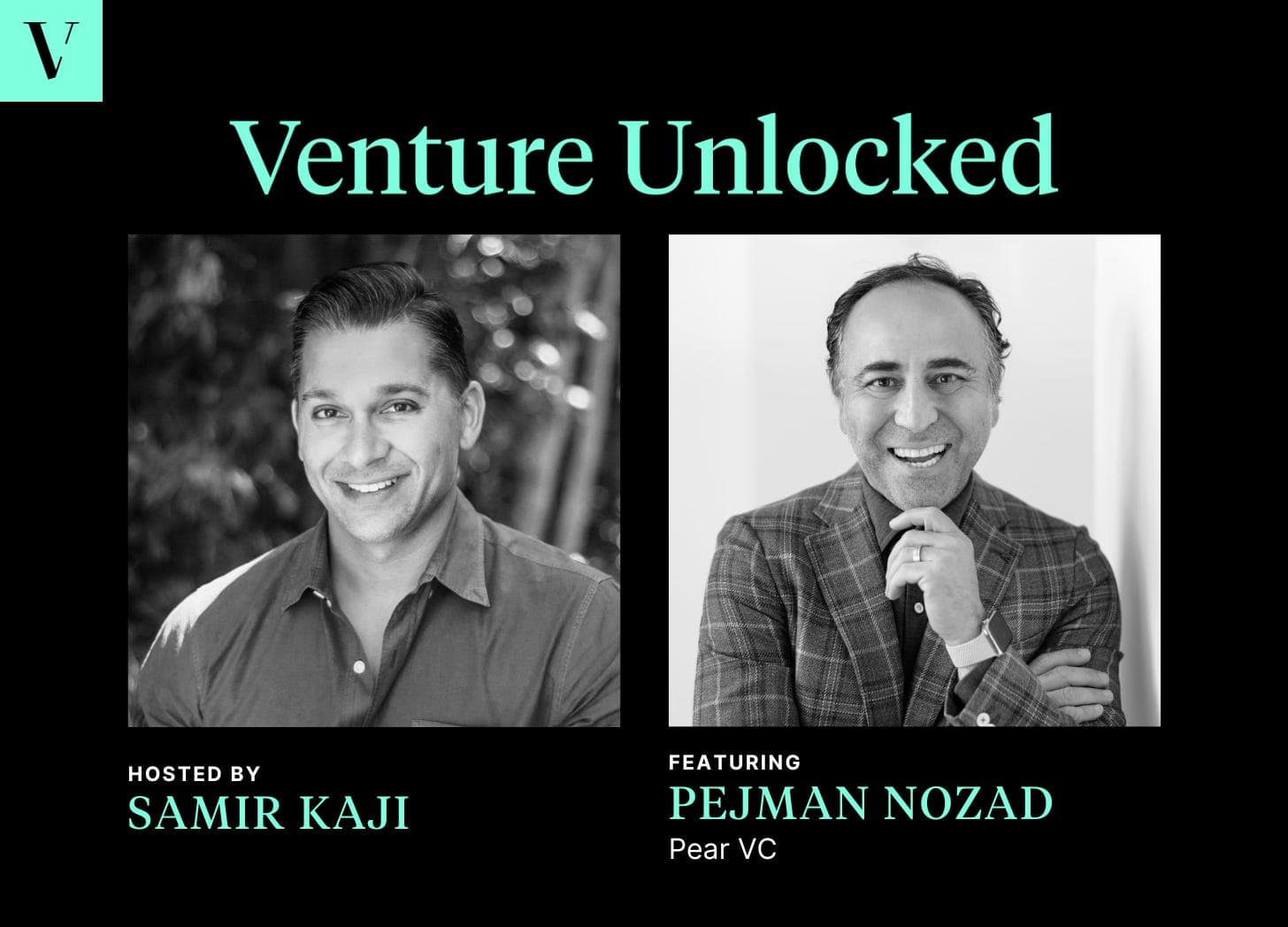
Pejman Nozad of Pear on Building a $800MM+ AUM Firm as an Immigrant Who Sold Persian Rugs Before Going into VC
Summary In this episode of Venture Unlocked, host Samir Kaji converses with Pejman Nozad, the Co-Founder and General Partner of Pear VC, a venture capital firm that has grown to over $800 million in assets under management (AUM). Pejman shares his inspiring journey from an Iranian immigrant with humble beginnings to becoming a prominent figure in the venture capital industry. The conversation touches upon various themes, including the importance of resilience, the evolving landscape of venture capital, and the strategies that have helped Pear VC succeed.
---
Key Topics Discussed
Pejman's Background
- Immigrated from Iran in 1992 with limited resources and faced homelessness.
- Began working at a rug store in Palo Alto, where he met influential Silicon Valley entrepreneurs and venture capitalists.
- Transitioned from selling rugs to angel investing, eventually founding Pear VC with a focus on early-stage investments.
Pear VC's Philosophy and Evolution
- Early-Stage Focus: Pear VC primarily invests in pre-seed and seed-stage companies.
- Belief in Diverse Entrepreneurs: Emphasizes the importance of believing in entrepreneurs from varied backgrounds.
- Adaptation and Innovation: Continuous learning and adaptation are central to Pear's strategy, ensuring they remain relevant and effective.
Investment Strategies
- Sourcing Opportunities: The importance of building a strong network to identify and win deals.
- Performance Measurement: Discussion on how Pear VC aims to deliver high returns consistently, focusing on product-market fit.
- Team Structure: Pear VC employs a team-based approach where no job is beneath anyone, fostering a collaborative environment.
Insights on Successful Entrepreneurs
- Top entrepreneurs are characterized by:
- Focus on their teams and customers.
- A mindset of continuous learning and improvement.
- A commitment to giving back to the community.
Pear VC's Unique Offerings
- Recruiting Services: Established an in-house recruiting agency to assist portfolio companies.
- Female Founders Circle: A program aimed at supporting female entrepreneurs, showcasing Pear VC’s commitment to inclusivity.
---
Lessons and Takeaways
- Resilience and Adaptation: Pejman’s story exemplifies the ability to overcome adversity and adapt to new environments, a critical trait for entrepreneurs.
- Building a Strong Ecosystem: Effective sourcing and support systems are vital for venture capital firms to thrive in a competitive landscape.
- Focus on Value Creation: Understanding the needs of founders and iterating services accordingly is key to long-term success in venture capital.
---
Notable Quotes
- *"The best seed funds consistently deliver high returns."* - Pejman Nozad
- *"You have to become the best in what you do."* - Pejman Nozad
---
Conclusion The episode provides insight into Pejman Nozad's journey in venture capital, sharing valuable lessons on resilience, the importance of community, and the evolving nature of the venture space. It serves as an inspiration for aspiring venture capitalists and entrepreneurs alike.
For more details and resources, visit [Venture Unlocked](https://ventureunlocked.substack.com).
Written by AI. May contain mistakes. Listen to the episode to check what was said.
Transcript
Automatic transcript. May contain errors.0:00Welcome back to another episode of Venture Unlocked, the podcast that takes you behind the scenes of venture capital. I'm your host, Samir Kaji, and on this week's episode, we're thrilled to be joined by Pejman Ozad, co-founder of Peer VC, a really unique pre-seed and seed firm based out of Palo Alto. Today, Peer has scaled to over 800 million in AUM and has built such a powerful engine to help early stage companies. As many regular listeners of the show know, we often like to highlight managers that have different backgrounds and stories leading to their careers in venture capital. I think of all our guests, Pejman best epitomizes how someone can overcome so many obstacles to be successful in the industry, as he not only immigrated from Iran with little to his name, but the catalyst that got him into venture was working at a rug store.
0:43During his time at the rug store, he was able to meet some of Silicon Valley's best VCs and entrepreneurs and use his curiosity and ambition to learn about the industry and ultimately become a startup investor. His story is one of the most remarkable ones in the Valley, and I really think you'll enjoy hearing him tell it. During our chat, we went through his backstory as well as all the learnings he's had as an investor over the last couple decades, and what has gone into building pair to what it is today. I really think you'll enjoy the conversation with Pejman, so let's get right into it. Samir Kaji is the CEO and co-founder of Allocate.
1:17Allocate and Venture Unlocked are independent of each other. Any statements or references made by Samir or his guests regarding third parties, investments, or securities are solely their views and opinions and are not intended as investment advice or an endorsement of such parties or securities by Samir, his guests, or Allocate. Allocate or its clients may maintain relationships with or investment positions in guests, third parties, or securities mentioned in this podcast. This podcast is for informational purposes only and should not be relied upon as a basis for investment decisions. Benjamin, it's so great to see you and thanks for joining us today.
1:51Good morning, Samir. Thanks for having me. I really appreciate it. It's exciting. I was I was looking at my calendar from last week. I was just utterly excited to see you here. And I think before we started, I just want to say congratulations for building Allocate. And it's pretty amazing what you have done and your team in a short period of time, building the brand and the team and the access you're providing. It's just pretty incredible. I appreciate that. And it's actually a great segue because I would say the same to you in terms of the platform you've built. And this is never an overnight success.
2:23It takes a long time. And I do think a great origin point for this conversation is to talk about your story itself, leading into tech and venture. And I was having a talk with a few LPs the other day. And one of the things we mentioned is just emerging managers and some of the folks that have started firms over the last 10 years coming from such different and varying backgrounds. And you epitomize that. So for those that haven't heard the story, I'd love to hear how you got into technology and maybe a little bit of the background that drove you into what you're doing today. I started in 1992 when I arrived here.
2:59So I was actually homeless in 1992 in this town. If you look at the profile picture of my Twitter, it's me sleeping in an attic above a yogurt shop because I was sleeping in my car, I was sleeping outside, and I begged the owner of the yogurt shop to let me sleep in an attic. and I slept there. But something magical happened in that attic that changed my life forever. I pause here and I go back before we continue the story from that attic. I was born and grew up in Iran when I was 10 years old, the revolution happened. And then two years after, the Iran and Iraq war happened for eight years. So I experienced as a teenager the darkest side of humanity.
3:45And for long, my life and everybody in my country was survival, especially if you're a teenager. I remember Iraqi jets were bombing us, just go to school, come home, do homework and wait for them to come. But now I look back, I think it made me stronger to really survive that attic. Survival was the meaning of my teenager life and many people like me. I was a very good soccer player. I played for big clubs in Iran and I went to the German school in Iran so I spoke German the owner of the club asked me to come and translate he started a magazine so I started to translate German to Farsi but I became really good at it I started to write my own articles and you know everybody loved the way I analyzed soccer and all of a sudden they gave me Iran's most popular sports radio talk show and you know at the age of 18 i used to bring the lebron james of my country to my show was just amazing i think i was having imagined at 17 18 you can do these things i um got accepted to the college after two years i decided i have to leave iran my parents left iran before me they went to germany i stayed in iran i served in the army in iran like every male should go and serve in the army but i was very lucky because i was a good soccer player i played for the army soccer team.
5:11I left Iran. I went to Germany. They gave me a scholarship to continue education and play soccer. A few weeks into it, my brother who left Iran before me when he was 15 years old, that's American dream. He was denied visa multiple times. And this was early 90s. It was so hard for Iran to come to the US. Even engineers and doctors and businessmen cannot get to America. He took me one day. I said, why? I don't want to go to America. I don't speak the language. I've got an opportunity here. But he said, just go get a visa, don't go. And I went over there and the woman who was a counselor of the embassy interviewed me for 45 minutes.
5:51And at the end, she said, I remember exactly the words. I don't know why, but I want you to see my country. Give me your passport. So in a very, I don't know, dramatic way, I decided to come to America with no plans. Normally you have some plans to come. So I just arrived in this town in San Carlos because my uncle used to live here. And it was difficult. I left a really kind of a great career in Iran. I left university and Germany. I didn't speak the language. I only had$700. But the biggest problem was I was in love with the girl in Iran. And I thought, okay, I'm going to lose her. So I better call her every day.
6:30So this is 1992. to view there's no whatsapp no internet phone no skype nothing so i had bag of quarters i'm here every day going to this payphone in downtown san carlos and calling here every day i don't know it was like three four dollars per minute which is so expensive so 700 was gone and i didn't know what to do so i found an iranian car dealer and i bought a 1973 chevy for five payments of 150 bucks and I found a job at a car wash in San Jose. So I was driving every day for an hour, washing cars for 10 hours and come back. So again, it was just my life was just washing cars. I think emotionally was the hardest part because I could have left the next day and go back and have a radio talk show or go back to Germany.
7:20But something was telling me just keep going. By the way, I was the best car washer the world has ever seen. I wash cars like nobody else. my English improved I I get I got the job at the yogurt shop which the photo is there and that was a time that I didn't have money I didn't have a home so I I asked him if I stick in an attic this is a real attic the yogurt shop still is there in Redwood City it's above a yogurt shop it was a storage for cops and you know napkins and so on so my life was again survival waking up run the shop till 6 p.m go to college take a shower at the college come back study.
7:58The magical moments was one of the nights I was studying Iceland advertising for the Rutt Gallery in downtown Palo Alto and being Iranian we all grew up in Iran although we don't have much knowledge but we think we know something about Persian carpet so I called the owner who actually was an amazing businessman in Iran and he built an empire one of the biggest industrial family around Amiti family interviewed me actually the government post-revolution did nationalize his asset. So he came, started from scratch in America. Rug Gallery is one of the businesses they had in addition to real estate and some global business.
8:34He interviewed me and then he rejected me right on the spot because he asked me, have you sold rugs, furniture, cars? I said, no. I said, well, you're not the right fit. So I insisted that how can you deny somebody you haven't met? It was a pause and he just, he said, come the next day. And I went over there, he hired me on the spot. Later, he told me that I really liked that you didn't give up and he wanted to meet me. I remember the day he hired me, he took me outside. As you know, you still can walk by the Daniel Ruggs' beautiful, amazing gallery. It's on University Avenue. And he said, you know, listen, at the end of the street is Stanford University.
9:13You can go get PhD in business, but your real PhD in business with me here. So whatever I tell you, do it. So next day I put a suit and tie. I went there to sell rugs. No, no, no, you're not selling rugs. You just bring tea and flip carpets. So for a while, I was flipping carpets until I proved myself. And I ended up selling rugs. And again, I became, I think I'm the best rug salesman. Again, I sold a couple of million dollars worth of rug, which, you know, most of our companies won't achieve that even in their lifetime before they die. But Persian rugs, you know, you come, Seth Pagemon. I bought a home in Menlo Park with my wife.
9:52I'm looking for the dining room rug. And you and I, with your wife, we start to look at rugs. And then ultimately, we bring the rugs to your home. 95 % of transaction happens at people's home. So by going to people's home for a few years, I realized every single customer is either founder of a big tech company, top venture capitalists, even if they are bankers and lawyers that just serve tech community. And I was in awe. Not because they were wealthy. Mostly for me, businesses are you build this and sell it. I never knew that you can build massive companies, create jobs, create wealth based on knowledge.
10:29And I felt that I'm just so lucky to be part of this community. Maybe this is a chance in my lifetime. And I decided I want to be one of them. And I started to ask a lot of questions. This is late 90s. There was no TechCrunch, no YC, none of these things. but I had access to so much knowledge. And these were not my clients, they were my friends also. I was hanging out with them, selling rugs Sunday, having barbecue and asked a lot of questions. How do you give term sheet? What is, I mean, just like, and it was, and I think credit to Silicon Valley, nobody judged me that Iranian guy coming, sending rugs to my home, asking about startups.
11:07I remember, anyway, I don't know if you want to have a question. I pause here, but I can tell you how we started to, But one of the stories I want to tell you, one of the days, a guy came in, very well-dressed, well-spoken. He said, I'm looking for rugs. And we look at rugs together. And I said, Doug Leone, bring the rugs to my home. So I knew who Doug Leone was at that time. So I went to his home and a hard negotiator. But at the end, I said, Doug, I can help Sequoia Capital. He said, how? I have access to so many Iranian PhDs. He said, okay, I come Monday morning to her office, tell me how more.
11:47We ended up putting an event together, senior part of Sequoia Capital. The reason I bring it up was Doug didn't doubt me. That relation and trust led us to both of us invest in Dropbox early on, six, seven years after. but I think that's I actually think this is a DNA of Silicon Valley which is which is I mean tech is a community that there are there they give before they get and then judge people and for me was just astonishing imagine if you're selling rugs in Los Angeles and you go to Steven Spielberg's at the end of selling rugs to Steven Spielberg's by the way Mr. Spielberg I can make movies with you and I think it's just kind of really odd but I did it and then you know I myself and the ownership of medallion rug we started um investing we pulled capital i told him we have this this access so we started to invest in this was at a time that angel investing was really fashionable we started to invest in startups and my god we had such a terrible track record i mean just like so embarrassing how we did it but you know i i learned the world around me one this is If you remember, if you were going late, early 90s, or I mean, late 90s, early 2000, if you want to raise money, Sand Hill Road was your only access.
13:05I mean, you had to go over there. There was not much happening, and you had to know somebody to get you there. I think venture capitalists were not leaving their office. They were not wearing jeans, no T-shirt. It was like Wall Street in the 80s and 70s. I somehow broke that. I brought the entire Sequoia to the rug gallery with founders, Persian music, and people really loved it. And, you know, I think there was, I created a marketplace that at one side was my access to amazing top tier VCs and the other one entrepreneurs who were looking for advice and capital. And in addition to knowing venture capitalists, I knew founders, top VP of engineering of massive big companies and I were bringing them as an advisor.
13:48So the word got out that I have a really good deal flow. And, you know, fast forward, we ended up being the first investor in Dropbox, Lending Club. And I continued to invest in Gusto, Applovin, SoundCloud, some amazing companies, but a lot of scars on my body. And then it came, I made money. I started to invest my own capital, but I realized there's an opportunity to build an institution. And I pause here before I get to a pair. It's a great, fascinating story. And there's so many nuggets to extract from there. But some of the challenges that you had growing up, which really kind of drive, I feel like you enter the world of always finding something challenging to do.
14:32And I was going to ask you, going from an angel, starting a fund, but I want to maybe reverse a little bit and think about all those learnings. You're with Doug in his office at Sequoia, and you're pitching this idea of being this marketplace in a very different way with your community and having the foresight to understand that you had this unique world that you lived in where you were seeing so many people and building these networks. What did you learn, I guess, from folks like Doug and maybe your angel investing that guided you in how you wanted to build Pair when you started in 2012? Doug and a few other people really believed me very early on.
15:11They didn't judge me. And And it taught me that I can believe in future entrepreneurs with similar background and take the risk and believe that everything is possible. And that's kind of genesis and DNA of there today. We partner with founders that are even students and they've gone and built massive big companies like DoorDash. So that was learning from that. But the other one was I learned that if you have a very focused and very well-defined value, you can participate in an industry like venture capital, which is well-guarded. And definition of venture capital is I've always been from Ivy School or computer science background.
15:57But I came up with my own strategy and I felt I can play in this community. For me, I knew this is like playing in NBA, but I won't be Steph Curry, but I can be the best agent. That's how I started it. And I dabbled down on the value of the network I built. Obviously, after 23 years, I learned the business and I built a great team that I learned from them. Whenever I talk to people that are starting new firms, one of the questions is, why are you doing this? Venture capital is building a company, right? So you're starting a firm, which is building a company. And we'll get into how the company has evolved, and I will call it a company over the many years, because I think it has become a true platform, which is launching these new products and services.
16:46But maybe talk about why did you feel like this is what you wanted to do? And how clear was the vision of what pair was going to be at that time? Around 2009 and 10, I was doing professional engineering. I realized founders raised a million dollar i'm an engine investor with a few others there are a couple of firms involved but founders are left alone right after that although many people claiming they do see the investments it was not much help and either they didn't have time or didn't have expertise and i felt there's an opportunity to build an institution to serve founders day zero the question was can i walk to a room full of founders and claim I'm your best partner?
17:34And the answer was no. Although I had a great track record, everybody knew me. I had a really good deal flow. But I knew in order to be a top firm, I need a partner who has built product, shipped product, and built the company. So I reached out to my current partner, Mark Hershenson, and I didn't talk to anybody else. I changed her for four years. I told myself I either built this with Mara or I continued doing angel investing. And Mara and I, we know each other for 23 years. I funded her husband's company, Danger, in the year 2000. And then I was very lucky to invest in Mara's second company in 2003.
18:12I actually syndicated the$2 million round then. And I remember I had to take Mara to people's home in Palo Alto and in offices. It wasn't like today that you go on AngelList and you click and you wire the money. And we had to get checks by hand. But by doing that, I got to know Mar. But she's brilliant, smart, driven, with principles. She's a very good human being. And we became really good friends. So for four years, she said no. And I said, don't start your fourth company. Come and join me until I changed strategy. In 2012, 13, I said, it's okay. Don't need to partner with me. But why don't you come and meet founders with me at Coupa Cafe in downtown Palo Alto?
18:51And she said, okay. I said, you're an entrepreneur. Share some knowledge. So she was coming like 30 minutes a day and then 45 minutes. I think two months down the road, she was full-time meeting entrepreneurs. So I won. So we started to build the firm in 2013 together. We want to build the best seed farm ever existed. And we want to build the firm that outlasts two of us. And we want to help entrepreneurs build massive, long-lasting, profitable companies. Mara and I, we are Bing and Yank. I'm a college dropout. She's a Stanford PhD. She started three companies, successfully sold all three of them.
19:28I actually never worked for a tech company. I think she has 14 patents. I have zero patents, but I have a lot of scars on my body. And I think the respect we have for each other's opinion and the complementary skills really was the foundation of Pair. And then we started 2013 with the$50 million fund, and I can tell you more. But the vision hasn't changed since then. And Stanford Business School teaches a case about us, which we are really honored. Normally, they teach a case about Sequoia and Boeing. There's an email in 2009, I sent Marr, and I said, okay, why don't we get a home and an office looks like a home next to Stanford and bring incredible entrepreneurs, something magical happens.
20:11That hasn't changed. We've expanded the product offering, but that core is the same philosophy. You mentioned something that I want to unpack a little bit further. You said the mission was to become the very best seed fund in the world or seed firm in the world. And I'm curious in what that actually means if you deconstruct that. You can build the best team, best services, but if you don't have the performance, it doesn't mean anything. So for me, the best seed fund is consistently return 5 to 10, 20x every fund. If you can do that, then you belong to history. But, you know, I can build all these services if I cannot fund seed the next category defining companies.
20:53I just don't think you can belong to the best of people. You can play basketball if you're not champion of NBA or you're not Leo Messi, you're not world champion. Yeah. And as you think about that, then from, you know, the standpoint of getting performance, that ties into certain things that are fundamental within a venture firm. It's sourcing opportunities, like being in the right room, having the acumen to be able to pick the right opportunities, given the sample set of companies you're looking at. And then, of course, it is things like you have to win and you have to have a founder choose you and then ultimately, in some way, help the trajectory of the company.
21:30and overtime that creates this flywheel where the probability of returning these great performance outsized returns becomes more highly probable and a function that gets stronger and stronger over time. When you thought about that, because as an angel investor, I feel like when people go from angel investing to starting a firm, being institutional, they realize the bar is much higher. They have to think about all these different things. And to serve the founder and taking a bigger piece of the cap table requires so much more. Maybe you can talk about the key ingredients necessary to driving the performance and maybe look at sourcing and winning as how you built around those two things?
22:09Well, very good question. This is the question. I wake up every morning and think about it the whole day because I think you need to keep thinking about it and improve. It has evolved. Even our name has changed. When we started the firm, Mara said, oh, Pajmon, everybody knows you. So why don't you call it Pajmon, obviously her name. So it was Pejamaar, but we both hated it to have our name at the door. We thought if you want to build a long lasting firm, you want people to feel that this is their firm. So we ended up with Per. That's a different story. I can talk about why we did it. But yes, in order to become a best performing fund, you need one to pick your own strategy.
22:44And I really believe there is not one only strategy that works in venture. You can be Y Combinator. You could be Sequoia. You could be Benchmark. You can take three exceptional firms, but three very different philosophy and strategy, fund sizes, team, and composition. So I think you need to figure out where do you fit the whole ecosystem and can you win as the best firm in whatever you're offering. If you look at the knife of the company from day zero to, let's say, an exit that's an IPO, I believe there are really good firms that they can help entrepreneurs post product market fit. I do believe for zero to product market fit, nobody has become the best firm.
23:31And if I ask you, who is the best pre-seed and seed firm in the world? Maybe there is no answer or maybe there are multiple answers. We are aspired to be that firm. We are not there yet. That's the goal and mission of Pair to become the best pre-seed and seed firm in the world. to fulfill that promise that we can help in early stage get to product market. In order to achieve that mission, we have done a few things. One, we build the investment team. Our investment team have started and sold 10 companies to Cisco, Instacart, Zynga, Yahoo. It's a huge knowledge of starting from scratch, and founders really trust our investment team.
24:08Plus, operators who are coming from Uber and Facebook and Google with over decades. That's one thing. The other one, as you mentioned, we started to think about this zero-to-one journey. You have investment know-how, operations, but what else do you need? Three and a half years ago, we did a survey among our founders, and we asked them, what is the number one thing you need after you're raising the initial capital? And everybody was hiring. Obviously, multi-stage firms, for long, they have their own talent services. I looked around. Most of the pre-seed seed funds don't have a person to help with the hiring or they hire one person and that person mostly access a consultant, which is great.
24:51They're teaching, but nobody hires for them. And Mara and I, we decided to build actually a recruiting agency in-house. I spent 16 months. We hired a search firm. Actually, that search firm fired me because after 29 interviews, they said, okay, we don't have anybody else. But there is a guy who built the entire recruiting platform at Instacart. And he took Instacart from 300 to 3 ,000 people. His name is Matt Pimbom. He doesn't want to go a venture capital firm. I said, okay, this is the guy I should talk to. I met him and it was just very clear, this is the person we need. So I've made it my life mission to recruit him and we did.
25:33So Matt joined us 16 months ago and he spent around three to four months. What does it look like to build a recruiting agency inside the seed firm? And he hired three exceptional senior recruiters. So we have four recruiters in-house on our payroll. that if you come to pair, we hire your people. Since the last 12 months, we hired 70 people for our companies. We did over 1 ,000 founder candidate conversation with 80 % hit rate. It's just incredible. I actually think even if that's what it can offer, we have a line of entrepreneurs coming to our firm to do it. And then we're building the same thing for go-to-market and fundraising software.
26:16So anything you need from zero to one, we're building. So this is in terms of what the team looks like. And one of the evolution happened with the firm, started with Mara and I, now we have a big team. So the firm is generalist, but with the specialist investors. You talked about winning deals. Obviously, brand, background, reputation, how much you help. But founders really want to work with somebody who deeply understands your markets, and that's what we built. So we have Eddie who runs our biotech, Vivian runs Climate, and healthcare. Our pun runs our fintech and our Ash runs our AI and deep tech.
26:56And we have more people and we're adding more people. So in addition to the know-how of building companies, the services we provide, and we have market experts who can help the companies. Then it comes to the sourcing, which I actually think most of the managers who start, they think about it less than anything else, which for me is the most important thing in venture capital. And the reason is if you see the best entrepreneurs and you have the ability to win them, this is a very good job. Otherwise, it's just like very, very hard job. So we spend a lot of time thinking about sourcing and how do you build a differentiated playbook.
27:35And my recommendation to anybody who started a firm or they're building about that is thinking about it in a very, very hard way. And this is beyond hanging out with other VCs and angel investors, going to demo days or going to conferences. That's given. Everybody has that. Where do you have an access that nobody else has? You have to come up with one thing. It doesn't need to be many things, but one thing that you see quality of entrepreneurs before anybody else is really key to build the firm. Yeah, I think that's right. And recently I had somebody on the pod, I think it was Mamoun at Kleiner, where we talked a little bit about sourcing.
Read the full transcript
28:17And one of the things he said is they don't need to see every single deal, but they certainly want to see the deals that fit their thesis and are the most interesting companies and entrepreneurs. And they track it. So when a company gets funded, and it's funded by one of their competitors, and they have not seen it, they look at it and say, well, why didn't we see it? And how do we further refine our sourcing engine to ensure that doesn't happen again? Let me add one thing here. I think when Mara and I started to fundraise Fund One, we went to meet Max Lefcin. He listened to us an hour. He didn't ask any question.
28:54At the end, he said, I believe there are only 15 companies created every year that matter. How can you be in one or two of them? I tell you, for 10 years, I'm thinking about it every day. And then that's how we're building this. And maybe that 15 is like 30, 50, but they're not thousands. And all of these things are hard to know at the time. So you're building these engines to increase the probability of finding those, right? That one company. And you've been at some of those companies. DoorDash is a great example. We can talk about that a little bit later on this conversation. But I do want to talk a little bit about this winning.
29:29And one of the things that I've talked to a lot of people about is creating something that's replicable, that's repeatable, and that creates the brand around it. It allows you to win, allows you to see things. extracting from what you said of helping companies with fundraising, helping companies with talent acquisition. At that zero to one level, just coming from the founder's lens, people are the most important thing, getting the right people that help chart the path of the company. But you as a company also are also hiring, and you've hired a lot of people across so many different capacities.
30:02You've helped so many companies with talent acquisition at the zero to one. How did you think about your own talent acquisition? Perse started with Mar and I. So it was a combination, my network, my access, and Mar's deep expertise in building a company with PhD in engineering, so deep technical person. And then as we were building Perse, we felt we need more help. Like an example, if we were investing fund one in the company and that new company needed an engineer i was calling you other people people at google you know anybody but now we're passing it so we build this infrastructure that provide this help at any given time but when you look at people who have come to pair we have never hired an investor before that doesn't mean they're not good it's just the way we do it is building companies from ground up we need operators and founders who have been at early stages either you started your own or you have been so early with the product that you have that knowledge.
31:05That allows us to win because that's founder's need. So if you couple that expertise and know-how and knowledge about building a company from ground up, add capital, add the services that we have, and add the reputation and background, it just really helps us to win deals plus the market expertise, the knowledge we have. So I just don't think you can pick one thing to win. It has to be a combination of variety of different things. And exactly what you mentioned, all of these things, when you do it for long term, it creates your reputation and brand, which I don't want to say it will be easy, but it makes it easier to win deals.
31:44And then going back, I think we look at, Mara and I, we hire people who think Perry is home for the next decades or so. So people think about venture capital long term. they have the potential to lead this firm post mar and i even when we hire an associate we think okay where is this person in 10 years does she or he has the potential to be a leader here so we always think about this as we're going and i think we build one of the best teams in the valley just fulfilling that it's a very mission driven team we work as a team i might find the company source a company mark close that company and somebody else go help them we just want to win you know It's like a soccer team.
32:26I play soccer. We just want to win. Everybody has a different position. If my team comes and pays one, today you need to sit on the bench. We know you're a captain, but we don't need you. Just cheer for us. I sit on the bench. I still make Persian tea every morning at our office. I bring tea, whatever it takes. I don't think no job is beneath us. Yeah. I love that, the analogy of playing a position, right? You think about some of the best teams in the world. You have individuals that are exceptional at something, and the best coaches can put those people in the right places to succeed. You don't want Steph Curry being a power cord or Shaquille O 'Neal shooting three-pointers, even though he's done a few of those.
33:08I really like that. One thing that always is something I think about when bringing on people, there are certain things that are table stakes. intellect have in this industry, especially, you know, people that are smart, you know, are diamondized and there's so many people, but oftentimes you're looking for something that's even beyond that. Having worked with so many great founders, you know, you look at Drew over at Dropbox and then some of the folks that you've hired, if you were to distill it down into a common defining characteristics of the most successful people, whether at funds or at companies, what have you seen to be that common bond?
33:45There are certain traits that everybody knows deep market understanding understanding the customer and users these are all given but there are few traits that you know beyond that i see in some incredible entrepreneurs which i had the really the privilege to work with them and seeing them in the garage all the way to ipo one is typically you don't see these entrepreneurs happy hour you don't see them in conferences unless it's very very necessary they spend time with their team and their customers users nothing else so that focus is really really important and then make things priority obviously that you know customer matters the most and your team and product if i text drew that drew let's hang out for coffee and tea i might get an answer in a week or two if i tell him well i was with samir and i think he was having trouble with dropbox you know paper like maybe five minutes three minutes he gets back that prioritization comes with the amount focus that they have the best entrepreneurs i have ever worked with their lifetime learner as the company grow they grow you know i remember drew one student asking one of our founders asked him this was like a couple of years before dropbox went public public was a big company i think going public at 10 billion dollars and the founder asked drew um when you started dropbox you were a hacker how did you become a leader of a soon to become public company and he said yes i was a terrible ceo i knew i actually didn't manage anybody in my life but i felt i can be a good ceo in five six seven ten years and i started to ask questions read and read books and by the way drew has this 25 books recommendation that if you search it on google you can see it through house the book recommendation which i uh suggest for any entrepreneurs and even venture capitalists to read it so this ability to learn and be a lifetime learner.
35:44Drew is not only a CEO of a public company, he's on the board of Meta. Think about it. The best entrepreneurs, they show you a future that you have never seen before in a very articulate way that you can create vision. And this is beyond explaining a product or how big you can become, how much revenue you have, things that blows your mind. I always look for those people who come and surprise me. Best entrepreneurs, they give back. I don't mean financially. Obviously, financially, when they become successful, they do it. But throughout the journey, they give back somehow. They spend time with entrepreneurs.
36:20They spend time with whatever they can. They go to public schools, give a talk. They just feel this obligation that I have to give back. And the last thing, I think they're captain of the ship. You're a captain of the ship. You think about your crew and your passengers. And they always think about it. And they're the people who leave last. Yeah. These are all incredible characteristics and something that is very consistent with what I've seen throughout my career. And I want to basically pull on one of those threads, which is being this continuous learner, always adopting, always evolving, always getting better.
36:56And we're sitting here in October of 2023, 10 years roughly, to the moment that you and Mar started and effectively co-captained this ship for the last decade. Maybe let's talk about some of the learnings you've had that have been most impactful and have created these really interesting inflection points in the history of pair. Well, at the beginning was transition being an engine an investor for over a decade to be a venture capitalist. The challenge is when you're an angel investor, you keep investing, you don't think about portfolio construction. When you have a fund and you have a portfolio construction, there are limited number of the companies you invest.
37:36So I started to put pressure on myself, train my mind that if I have a limited number of the companies, how do I pick and choose and let some go, which was difficult from the beginning. So I train myself to think about it. I think the most important thing that helped us to get here is listening to entrepreneurs and founders what they want. And we built the firm for entrepreneurs. We didn't build the firm for what's going on in the market. We didn't build the firm for what LPs think. We listen to the founders and we deliver exactly what they want. At the core of Pair is partnering with incredible entrepreneurs who are building long-lasting companies, but we innovate around that product always.
38:23And if this product works, we put gas in the fire. If it doesn't work, we drop it. We just launched two years ago a program called Female Founders Circle. So we call for top female engineers who are starting companies and we build the community. My partner Vivian is leading it. We did the first one. We got 230 applications. We picked 30. I think 10 or 12 companies came out of it. It's the community of best female engineers who leave their companies starting it. It's speaker series, workshop, mentorship, social events. And it was so successful that it's a thick cohort. This cohort, we got almost 1 ,000 applications.
39:05The companies coming out of it are funded by Sequoia and this and Horowitz, Greylock, Optimal. Pretty incredible. The reason I brought it up is just you were thinking, what are the communities that we think they're going to produce the best entrepreneurs? And we are familiar with it, but we can give back also to them. So given Mars' background as a female entrepreneur, our team and the quality of the people we saw, we built this, which is kind of the magic now. It's the best feeder to our portfolio. So there are so many ways you can innovate around sourcing, helping, marketing. I don't know if you know it or not.
39:41Believe it or not, we have a gelato truck at Pair. It's maybe the best marketing things that we did. I built a gelato truck in Italy. And when we offer gelato, there's a line of entrepreneurs, especially students, come for free gelato. So you can innovate always around things that you want to do. So, and I think, as you mentioned, we treat payer as a company, as a startup, that you have a core product where you can maneuver around and find, but we always listen to them. One thing I want to pull on a little bit further is this concept of a firm being a startup. And as a startup, you want to scale as a firm.
40:16It's a little bit different in many cases in terms of what scale actually means. But if we go back, fund one was$50 million, the most recent set of funds, a little north of$400 million. While it provides you with so many more resources, and this is true of any firm as they grow, they have more people, they have more things they can bring to bear to entrepreneurs, is that as you get bigger, there's more complexity, the math gets harder. And within the LP world, there's the notion that as fund sizes get bigger, there is a reversion to the mean when it comes to overall performance. Curious in how you think about balancing between the scale that allows you to be really meaningful to founders, but also not too big where you lose the nimbleness and the ability to ensure those top end returns.
41:09Our strategy hasn't changed since day one. So we are pre-seed and seed specialists, no matter what size fund we have. So all of our investment checks we write, it's either a pre-seed and seed stage. Obviously, we continue to invest. Typically, every fund we reserve over 55, close to 60 % of Favon. So this fund, which is a lot bigger than the previous fund, which was$160 million, doesn't mean we've got to write checks in Series A, Series B. If you don't know it, you're not good at it. I think we're very good at finding talents, get into product market fit. The reason we raised a bigger fund, I believe we reached our own product market fit after 10 years, which means we have our own brand and philosophy and value in the whole community.
41:59I think we built a sourcing machine that I believe nobody else has at that precedency stage. We built the right team in terms of the investment and services we provide. So we decided that we can do more investments, certainly, and writing bigger check at seed, which we were not able to consistently write. For example, we had this sourcing machine that we saw companies at seed that were raising$4 to$6,$7 million, and we were not able to consistently lead those rounds. But now we can do it, and we have a team involved. It's all about what we have done, but doing more and writing bigger checks for at the seed stage.
42:39and we build other products to fulfill that. One of them is PayRx, which is our boot camp for pre-seed companies. We invest around 20 to 30 pre-seed companies a year, which is$20 ,000,$50 ,000 to$2 million. But rather than investing in 30 companies across the year, we batch them together now, and they have to go through this program, which is you go in it as a soldier, you come out of it as a Navy SEAL. So it's an intense four and a half months. We meet you two, three times a week. You work with a senior partner. You have our go-to-market and talent team behind you, and we have a demo day. So that allows us to scale the help we can do.
43:22One of the questions we always ask, and we have LPs ask that we have so many companies, how do we help them? So we figure out we can build this product that can help companies, attract them. And many people like it because a very small cohort is 10 to 15 companies per cohort 85 more than 85 percent of them raise uh at demo day which is pretty incredible and then you know at our demo day we have over a thousand investors come pay attention only to 10 to 15 teams so that's that's a again an innovation around this investment that you can always do it and we i mean even this product took us long to figure out what is the offering how much money we should invest what is the duration do we do it once a year twice a year So you always learn from entrepreneurs what they need.
44:07Just listening to you, it's so clear how much careful consideration has gone into architecting the overall growth and business model of the firm over time. And this is during, of course, a time where we've seen so many entrants coming into the market scaling, and it's very difficult to get right. You and I have seen so much of the venture universe change. And even in today's market, even though the fundraising market is incredibly tough, there are more entrants coming in the market looking to build great firms. And a question I like to ask my more experienced investors that come on the show is that single piece of advice you'd impart to somebody.
44:47And maybe we take it through the lens of if the 2023 Pajamon was to give a single piece of advice to the Pajamon just getting started in investing, what would that be? Pick one thing that you can become the best in the role of what you do and and then build momentum around it you know i started my career in the right gallery the network i had i never claimed that i can provide product feedback in you know how do you build your cloud technology so i started there but i learned i think i'm a lifetime learner i i still learn i still pay a lot of attention what's going on But I actually think you have to become the best in what you do and pick that strength that you have.
45:33You might be an amazing salesperson and you can build the best go-to-market strategy for early stage teams and then go around and do it. But I think the role of being generalist and not having deep expertise is very, very hard. And I think survival for any fund would be very hard. And I think whatever strategy you have, make sure that you have the ingredients and the stamina to become the best at what you offer to the founders. And you can be in any good companies. And as you mentioned, and I agree that there's not one strategy that works, but pick the one that you can win it. Yeah, it does require brutal self-awareness and self-assessment constantly.
46:15And that can be very tough to do. But I do love the advice of figuring out what your strength is and really leaning into that. And of course, that will evolve over time as you've seen it with the firm. But, Peshwan, just going back to the very beginning of our conversation, I just wanted to also just congratulate you for all of the success in terms of not only growing and scaling the firm, but also helping so many entrepreneurs. So it's been a fun journey to watch, and I really appreciate you being on today. Well, thank you, Samuel, very much. I think you're doing the same thing with Alan Kay.
46:47I appreciate it. This was a great conversation. I actually learned a few things, a few questions you ask. I always go back and think about them, and I'm going to come back to you with more answers. That was great. Thanks so much for listening to another episode of Venture Unlocked. We really hope you enjoyed our conversation with Paige Mon. To learn more about him and Pair VC, be sure to go to VentureUnlocked.substack.com where you'll find detailed notes on the show. Also on download, you can get the episode on Apple Podcasts or Spotify. And while you're there, please leave us a rating and a review as it really helps us out.
47:19And hit the subscribe button in order to get each and every Venture Unlocked episode as soon as it's released.
47:30Thank you.
From the publisher
Follow me @samirkaji for my thoughts on the venture market, with a focus on the continued evolution of the VC landscape.
This week we are thrilled to be joined by Pejman Nozad, Co-Founder and GP of Pear VC. Founded in 2013, Pear has scaled to over $800MM in AUM with a powerful engine to help early-stage companies.
As many regular listeners of the show know, we often like to highlight managers who have different backgrounds and stories leading to their careers in VC. I think of all of our guests, Pejman epitomizes how someone can overcome many obstacles to be successful in the industry as he not only immigrated from Iran with little to his name, but the catalyst that got him into VC was working at a rug store.
We explore Pejman's incredible journey, Pear VC's emphasis on early-stage investments, and the need for innovation in venture capital.
This is an inspiring story for anyone considering venture capital as a career path, and stresses the importance of resilience and overcoming challenges, as well as, the value of continuous learning.
About Pejman Nozad:Pejman Nozad is the Co-Founder of Pear VC and he has made a substantial impact in the tech sector with strategic investments in companies like DoorDash, Dropbox, and many others. His success is recognized through his consistent inclusion in the Forbes Midas List since 2021 and leading the Forbes Midas Seed List in 2023.
Pejman’s path into venture capital was unconventional, starting from humble beginnings as an Iranian immigrant working in a Palo Alto rug store. He was awarded the Ellis Island Medal of Honor in 2014.
In this episode, we discuss:
(2:55) Pejman shares his start in the US
(15:06) The importance of believing in entrepreneurs with diverse backgrounds
(20:37) Why the best seed funds consistently deliver high returns
(22:17) How PearVC has evolved and why it has been so long-lasting
(30:10) No job is beneath anyone at PearVC with its team-based approach
(33:46) Qualities of successful people that go beyond the obvious
(37:18) His transition from angel investor to venture capitalist and the challenges of portfolio construction
(41:09) PearVC's focus on finding talent and reaching product-market fit regardless of the fund's size or stage-focus
(44:59) His advice to new investors at PearVC
I’d love to know what you took away from this conversation with Pejman. Follow me @SamirKaji and give me your insights and questions with the hashtag #ventureunlocked. If you’d like to be considered as a guest or have someone you’d like to hear from (GP or LP), drop me a direct message on Twitter.
Podcast Production support provided by Agent Bee
This is a public episode. If you would like to discuss this with other subscribers or get access to bonus episodes, visit ventureunlocked.substack.com