In short
Venture Unlocked Podcast Notes
Episode Title
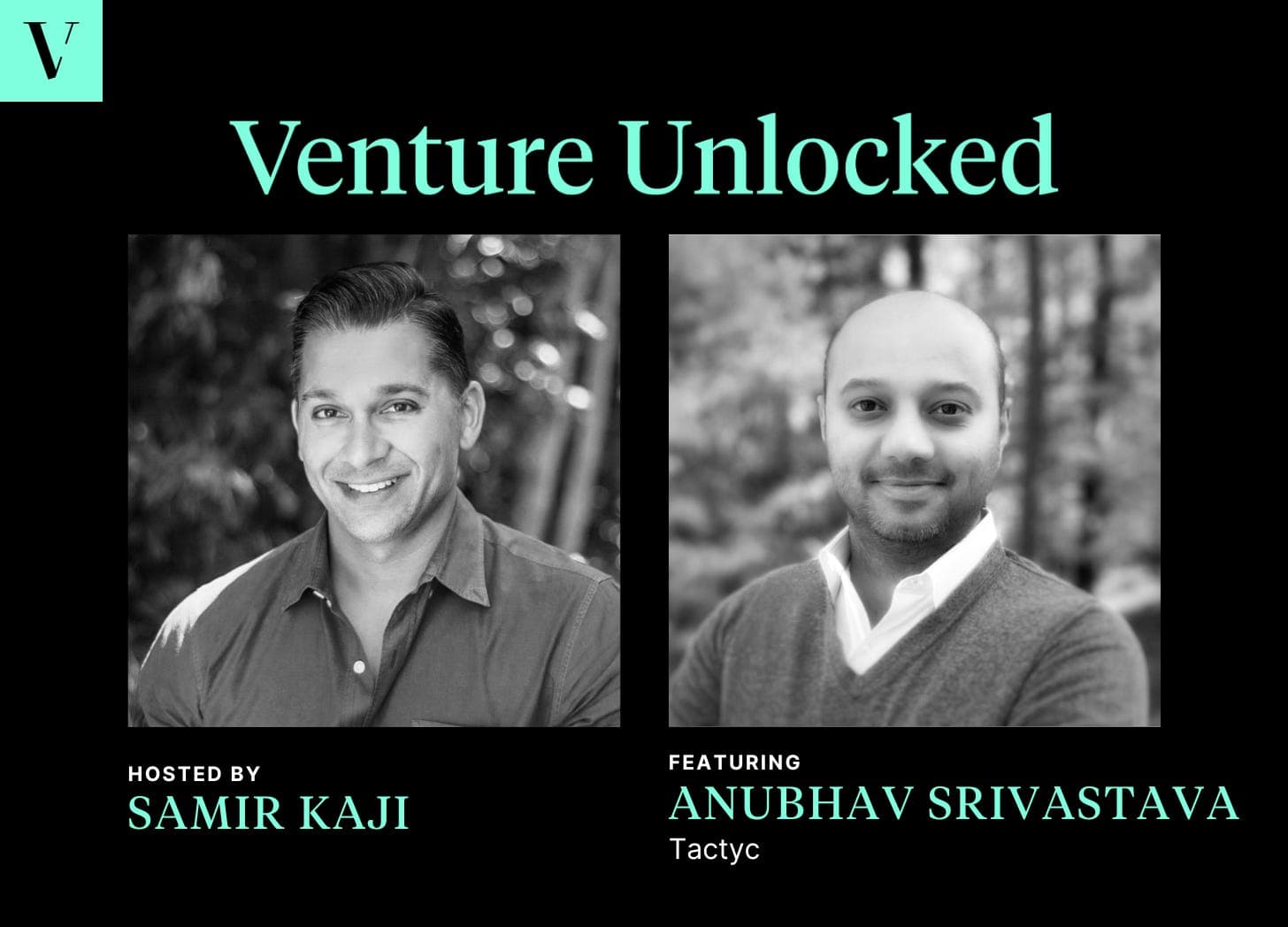
Portfolio Construction Trends and Best Practices with CEO Anubhav Srivastava of Tactyc
Host
Samir Kaji
Guest
Anubhav Srivastava, Founder and CEO of Tactyc
---
Episode Overview In this episode of Venture Unlocked, Samir Kaji discusses portfolio construction in venture capital with Anubhav Srivastava, who shares insights from his experience as the CEO of Tactyc—a platform designed for venture capitalists to efficiently model and manage their portfolios. The conversation focuses on trends in portfolio construction, the challenges faced by emerging managers, and how Tactyc addresses these challenges.
---
Key Points Discussed
Introduction to Tactyc
- Purpose: Tactyc provides a software solution for venture capitalists to create and forecast fund models quickly, moving away from traditional methods like Excel.
- Functionality: Allows users to upload portfolio investments, conduct reserve analysis, and predict future TVPI (Total Value to Paid-In) metrics.
Importance of Portfolio Construction
- Dynamic Analysis: Portfolio construction should be an ongoing process that involves regular updates and revisions based on market changes and company performance rather than a one-time activity.
- Data-Driven Decisions: Successful managers use data to stress test their portfolio models, ensuring these models guide active management choices throughout the fund's lifecycle.
Trends in Venture Capital
- Emerging Managers: Raising funds has become significantly more challenging since late 2021, leading to lower fundraising targets for new managers.
- LP Behavior: Limited Partners (LPs) are increasingly demanding rigorous portfolio analyses and data-driven methodologies from General Partners (GPs).
- Sector Preferences: Multi-sector funds are performing better than single-sector-focused funds, reflecting LPs' desire for diversified sector exposure.
Best Practices in Portfolio Construction
- Reserve Management: GPs need to clearly define their reserve strategies, with common allocations between 35-55% depending on fund size.
- Follow-On Investments: Successful managers often conduct quantitative analyses on follow-on investments, employing metrics such as follow-on MOIC (Multiple on Invested Capital) to guide decisions.
- Avoiding Emotional Bias: Decision-making regarding follow-ons should be based on data rather than personal biases toward founders or sectors.
Common Pitfalls in Fund Management
- Over-Reserving: Many managers miscalculate their reserve needs based on erroneous assumptions about graduation rates from seed to subsequent funding rounds.
- Inflexible Models: Managers often impose too many constraints in their fund models without considering the fluid nature of the market.
Future of Tactyc and VC Landscape
- Vision for Tactyc: Anubhav aims for Tactyc to become the standard tool for VCs, enabling them to implement data-driven workflows efficiently.
- Industry Evolution: The venture capital landscape is expected to evolve significantly, driven by the need for more advanced tools and methodologies.
---
Conclusion The episode concludes with a call for greater transparency and data-driven decision-making within the venture capital ecosystem, emphasizing the importance of adapting to changing market conditions and improving the relationship between GPs and LPs through enhanced communication and reporting.
Additional Resources
- [Tactyc Website](http://tactyc.io)
- [Grasshopper Bank](http://www.grasshopper.bank)
- [Venture Unlocked Substack](https://ventureunlocked.substack.com)
---
Contact Information For insights and queries, follow Samir Kaji on Twitter: [@SamirKaji](https://twitter.com/Samirkaji).
---
End of Notes
Written by AI. May contain mistakes. Listen to the episode to check what was said.
Transcript
Automatic transcript. May contain errors.0:00Welcome back to another episode of Venture Unlocked, the podcast that takes you behind the scenes of the business of venture capital. I'm your host, Samir Khaji, and this week we're joined by Anubhav Srivastava, founder and CEO of Tactic. Tactic is a next generation platform for VCs to build and forecast portfolios. Anyone who's listened to this show before knows that portfolio construction is one of the things I really like talking about. And Anubhav provided his data-driven insights on what he's seeing on how emerging managers are modeling portfolios around things like the number of companies, reserves, recycling, and follow-ons.
0:31We really hope you enjoyed my conversation with him. This episode is being brought to you by Grasshopper Bank. Privately owned and headquartered in New York City, Grasshopper Bank is built to serve the business and innovation economy. As a client-first digital bank, Grasshopper combines technology and years of industry expertise to provide clients with a best-in-class banking experience. Grasshopper's digital solutions are tailored for venture capital and private equity firms, startups, and small businesses. In addition, they also work closely with fintech-focused banking as a service and commercial API banking platforms.
1:06Serving clients globally, Grasshopper provides flexible, firm-focused lending solutions as well as dedicated relationship managers committed to meeting the unique needs of funds and companies alike. Grasshopper is a member of the FDIC and an equal housing lender. For more information, visit the bank's website at www.grasshopper.bank or follow on LinkedIn and Twitter. Samir Kaji is the CEO and co-founder of Allocate. Allocate and Venture Unlock are independent of each other. Any statements or references made by Samir or his guests regarding third parties, investments, or securities are solely their views and opinions and are not intended as investment advice or an endorsement of such parties or securities by Samir, his guests, or Allocate.
1:50Allocate or its clients may maintain relationships with or investment positions in guests, third parties, or securities mentioned in this podcast. This podcast is for informational purposes only and should not be relied upon as a basis for investment decisions. Anubhav, it's so great to see you. And there's so much to talk about in this year, given all the turbulence we've seen in the market. You see a lot of data and work with so many emerging manager. So I'm excited to really dig in to this conversation. But maybe a good place to start is what Tactic is and what really inspired the start of the company.
2:26Thank you. Yeah, I'm a big fan of the podcast and everything you do, Samir. So thank you so much for having me. Tactic is the first forecasting and planning software for VCs. So what that means is if you are looking to raise a fund and you want to do a portfolio construction exercise, you can use Tactic to build a fund model in about 10 minutes. saves you weeks worth of time. It's a market-tested model that you can then share with your LPs. That's just a start, though. After you build a fund model and tactic, you can upload your actual portfolio investments. You can do your standard portfolio management.
2:58But now there's a layer of forecasting on top of it. So we will help you think through reserve analysis, probabilistic investment outcomes. What does your TVPI look like, not just to date, but what it might look like 12 months from now, 36 months from now? What we're really doing is we're disrupting the traditional portfolio management space. Funny enough, VCs invest in the forefront of pretty much every technology out there. But if you look at the VC tech stack on its own, it's incredibly archaic. It hasn't changed in about two decades. And I would say traditional portfolio management tools are, for lack of a better term, mostly bean counting.
3:37They're just tracking what we've done. And I think LPs are demanding a lot more. And I'm sure we'll talk about this. They're demanding a lot more data-driven methodologies. And that's what we're enabling GPs to do. In terms of my own experience, I'm a Wharton MBA, worked on Wall Street for a few years, worked at a VC myself in LA for five years. All of that to say, I probably spend more time than is healthy for anyone to spend in Excel and in spreadsheets. And so this was a pain point I saw. And we had first released Tactic as a general financial modeling tool. but uh the the most popular use case ended up being venture portfolio construction we just we just blew up we had gps reaching out to us saying how do we use your tool to do portfolio construction for my fund and that's what led us to actually pivot into building a tool specifically for gps we we did a study or a survey rather on twitter a while back of what what stack people are using and one thing that was a staple in everybody's stack was excel in fact most of the portfolio management and portfolio construction strategies that we've seen have all been done through like Google Sheets or Excel, and that's how people do it.
4:46Portfolio construction can be very dynamic and it changes. And every time you make an investment, your reserves. Tell us a little bit about some of the problems. You mentioned you were at a venture firm for five years, presumably using one of those rudimentary, archaic ways of doing portfolio construction. What did you see as the major pain point? And why is portfolio construction in your mind so important to do through a tool like this? There's a lot to unpack there. So yes, I did portfolio construction in Excel, like pretty much every GP before me. And there's nothing inherently wrong with that approach.
5:20I just want to be very clear. It doesn't matter what tool you use. You can use Tactic, you can use your Excel. At the end of the day, it's a process that's more important than the tool you use. What I've realized is portfolio construction models were viewed as, one, a necessary evil, like, oh, I just got to get through this because I have to show my LPs this. And then two, once your fund is launched and you've actually started deploying, that Excel model would never see the light of day again. It was just this theoretical exercise that people would just put away. We started working with some incredibly data-driven managers, and we saw that that's not how they viewed the world.
5:55That's not how they used the construction process. So one, they would invest a lot of time stress testing their construction model. So just the process of building a model was much more rigorous. And then two, the construction model actually tied back in with active portfolio management. So one year after your fund is launched, they would actually look back at the construction model and see, OK, how are we tracking to our reserves? How are we tracking to our TVPI? How are we tracking on pacing? And if not, has the market evolved? Are we over-investing, under-investing? And that actually creates this powerful feedback loop where they would then start changing their strategy in response to what the market was saying.
6:32And they would rebuild their construction plan again. So construction was not just the static one-off activity. It was this constantly evolving process that would actually carry through the lifecycle of the fund. We were incredibly impressed by the returns of these managers and the way they had this data-driven workflow. But they had a team of people doing this. This is not possible or this is not practical for most emerging managers to be doing that because you don't have an army of associates running around doing this stuff. So we actually crystallized this exact workflow into Tactic. So you can build that construction plan.
7:05You can then have this feedback loop that ties back together with how should you change your active deployment process? What should your new construction strategy be? And that's what we crystallized in the software so every GP can be empowered. Since you mentioned the empowerment of GPs, I want to shift to maybe the other side of the table and look at the limited partners. Things have obviously changed so much over the last year and a half, really stemming back to November of 2021, when we started to see the first signs of the macro picture having some level of dislocation. And today we're in a world where raising a fund is exponentially harder than it's been a long time.
7:47especially if you're a fund one and fund two. Since you sit in the intersection of LPs and GPs, with the information and the empowerment that you're giving GPs, I'm curious if you've seen any change in the LP behavior as it relates to the type of information they're asking for, especially when it comes to things like portfolio construction. We get feedback from LPs in a variety of ways. I just want to say up front, first of all, we hear it from the GPs themselves. They come back to us saying, hey, my LP is asking for this analysis or this question. How do I answer that with Tactic? And then sometimes we hear from LPs directly who have been given access to Tactic, and then they ask us those questions.
8:27So here's what I'm seeing, and I will say a lot of this is, I would say, generalized, anecdotal, but I'll put it out there. We're seeing, first of all, fundraising velocity is actually not that dissimilar to what it was at the start of the year. Maybe that's specific to Tactic's data set, but just to give you some stats, on average, we see about 70 to 80 new funds being modeled on the platform every month. That number is actually still the same. If anything, it's actually even slightly higher. But the distribution of that is very different. So if you are a first time emerging manager, in January, you might have been thinking about raising maybe, you were contemplating maybe raising$100 million,$70 million.
9:08You are no longer doing that. Now that number has been downsized to, let's say, 40 million, 50 million. And those GPs are resigned to the fact that we're going to be raising for the next couple of years. We're going to try and see through this downturn. On the flip side, if you're an established manager who's on fund two or three and has a reasonable TVPI, if you have a DPI, that's great. But I mean, that's still some ways away. But if you have a reasonable TVPI, you're having an easier time raising funds. So, you know, 83 % of LP capital this year has gone to 7 % of managers. That's a scary statistic.
9:46And so where is that capital going? It's going towards where there is an established track record, where we can back this because they've done this before. We don't want to increase our risk profile. So we're actually seeing a reasonable strength and resiliency when it comes to sort of the established manager on their$200 million,$300 million fund. But it's the emerging manager. That's really where I think the bottom has completely fallen off. And I think there's actually more pain to come at that point. So that's where we see, I would say, it's sort of an interesting story, but there are two different stories that are happening in the market, I think.
10:18you're hitting on this general shift of investors moving to a risk-off posture, and that's across all asset categories within VC. That's resulted in fewer allocations, smaller allocations, and then maybe an inclination toward backing more established managers versus emerging funds, which, of course, we think, and I think you would agree with me, that emerging managers are a critical part of the early-stage funding ecosystem. With all the GPs that you've worked with, have there been any commonalities of the GPs that have been successful raising this climate? And this is, again, a very general anecdotal stat, but I've seen multi-sector GPs fare better than single sector specific.
11:05And that's, I think, maybe coming down from the LPs as well. So if you're focused on a single sector, if that ended up being crypto or blockchain, that's obviously an edge case. But even if you're focused just on, let's say, health tech or just fintech, even those GPs are having a tougher time as opposed to more generalist, diversified GPs. So I think there's a sector play here as well. LPs are looking to diversify which sectors their assets are invested in. Secondly, I think what these LPs are looking for is clarity of execution. And by that, I mean the GP needs to be very clear in terms of what that fund strategy is around reserves, around check sizes.
11:40And let me unpack that a little bit. just in general, when it comes to emerging managers, they fit in sort of two buckets. There's either funds that have less than 15 % reserves or funds that have, I would say, 50, 55 % reserves. Those are the two diametrically opposite spokes that you see when it comes to reserve strategies. If you are a less than$50 million fund, you usually fall into that first bucket. If you're a greater than$50 million, let's say$100 million fund, you kind of tend to fall in the second bucket. Eventually, they're both solving for the same thing, which is a critical point of about 35 to 55 deals.
12:17That seems to be the point, that seems to be the ideal portfolio size people are solving for. And this obviously eventually cascades down into your check sizes. So sub$50 million funds are looking to invest 500k checks into pre-seed or seed companies. They're trying to get to a 5 % watermark of ownership. A$100 million fund is usually looking to get to a 10%, sometimes maybe even 15 % ownerships. All of that to say, GPs need to be very clear in which path they're doing. So we've seen some GPs kind of muddy the waters a little bit. Hey, we're going to be at 35 % reserve with about a 30 % portfolio company, check sizes, somewhere in the middle.
12:56They tend to sort of struggle because then LPs, I think, struggle with where in the risk profile do I put you at? So we're seeing that LPs are demanding sort of clarity of thought in terms of what your strategy looks like around reserves, around check sizes. So then you can, you know, you can execute based on that. Because many of your managers, I would assume that the bulk of the managers, especially the emerging or the entry point is somewhere in the seed spectrum, pre-seed, seed, post-seed, many of them may be modeling something different than what they did earlier this year in terms of valuation.
13:28Now, series B, C, and D, we've seen Cooley's report just came out. You saw massive devaluation, those rounds series a same thing, maybe not to maybe to a lesser extent than the late stage seed. It seems like it really depends. We're still seeing some rounds done at a$25 million note, right? Or a$25 million post money safe. And then you're, you're seeing some that are done in the single digits, depending on, you know, the background of the entrepreneur, the company, the location of the company, What are you seeing trendline-wise in terms of how people are modeling their portfolios in terms of initial valuation at the pre-seed seed level today versus maybe 10 months ago?
14:09So one we're seeing actually, funny enough, initial valuation is one thing, but the other thing we're seeing is liquidation preferences coming back into play. So I think we're seeing more term sheets going out when they prefs, even at the seed stage. And that may be a counter to the valuation. So valuations are definitely coming down. We're definitely seeing in terms of modeling about 15 % to 20 % discounts. Again, this is highly sector specific. We've seen blockchain and crypto on our portfolio sometimes marked down by 60, 80 percent in terms of valuations for what they're seeing, what they expect to be the next 12 months to look like.
14:44But in general, I would say it's about a 15 to 20 percent decrease in valuation. And with LICPREFs coming into play, I think they're looking to offset that valuation risk with a little bit of downside protection. Let's talk about that for a second. So when you say liquidation preferences, not just the 1x, you're talking about a multiple liquidation preference above a 1x? Yeah, we're just starting to see that. I mean, I've had more funds, as a funny thing, I've had more funds ask me about how to deal with liquidation preferences and tactic in the last month than the last 11 months combined. And people are asking not just for 1x, but 2x liquid prep.
15:17So we're starting to see a lot more of that. But if I had to guess, I think that's going to be even more in the next quarter. You know, at the early stages, companies in general shouldn't take more than a 1x. I'd rather take a lower safe or a lower valuation. Yeah, I'm with you. I completely agree with you. Yeah. What else are you seeing, I guess, from a trendline standpoint from a reserves? Because the markets have changed. Now it's not as easy to go from C to Series A, Series A to Series B. oftentimes in these situations, you have companies that are going to have to hit more milestones to get to the next level of capital.
15:51Has there been any changes in terms of either the check sizing or what people are factoring in terms of dilution for companies given the changed environment? A couple of things that we're seeing. First of all, so in tactic, you can actually put a graduation rate on every single deal. So you can say, what's my conviction level that I believe this company is going to go on to the next round? And over time, you can actually come back and change that conviction level based on the company's performance or based on the market. Across the board, conviction levels of these graduation rates have also fallen down by about 20%.
16:27So folks are saying that my companies are going to have a harder time raising that next round. If they were to raise the next round, the round size is probably going to have to be smaller. So that's obviously something you would expect. The other thing we're starting to see is partial exits. So folks are already starting. If you've had some DPI or some reasonable TVPI, I should say, folks are starting to already put into place mechanisms to do a partial exit to realize, convert some of that RVPI into DPI. We're seeing a lot more of that happening. This is obviously happening for funds with vintages in, I would say, 2018, 2019, because you've had a reasonable runway to collect that RVPI.
17:05but that's definitely something we're seeing. Reserve side, we've seen a slowdown of reserve deployment and this may be across the board, but we had a lot of, a lot of our clients have reserve capital for their deals and then they just never did it. They just never quite deployed as much as they wanted to. Now, maybe that's a sign of like, let's just see how the market shakes out. Let's revisit this six months from now and see how much we want to reinvest in. But we've seen a lot of reserve just sitting there and not being deployed. And again, that may be one of those things where that might change next quarter.
17:38They're waiting for a better round. But even in the following side, we've seen a lot of reserve just sitting. It could be a function of the time between rounds being significantly longer than what we saw in 2020 and 21. Certainly where in certain cases, we were seeing rounds that were spaced out no more than six months, feed to series A. And it does seem like we've normalized that to something that we've historically seen closer to 12 to 18 months. That's true. That's true. The other thing I would just, if I can just add one more point there, when it comes to reserve strategy, I think earlier there was a de facto, there was a de facto decision that if we invest in the seed, we are going to follow on in the A, if we are a reserve deploying fund.
18:21That was just meant to be like understood. That's no longer the case. We're now starting to see GPs actually look into what KPIs are we tracking for this company? How does their cash flow, how does their runway look? How does their operating metrics look? How do their ARR look? What is the trend line on that? So taking a deeper look into those actual operating metrics to inform that reserve decision-making process. We didn't see this, I would say, you know, nine months ago even. People were collecting all this data, but they were not acting upon it. And I think now they're actually taking a look at all of this operating KPI data they've collected and using that as a decision-making process for the reserves.
18:56Something I've always been curious about is whether there is an ideal portfolio construction for sub$100 million seed funds. And there's so many different flavors, a lot of companies lower ownership, there's fewer companies with high ownership, there's no reserves, there's high reserves. And I'd love to hear, given all the data that you've seen from the fund managers, have you seen anything that has understanding that we're not talking about DPI, but overall TVPI. Has there been anything that you've observed that has lent itself to higher return performance? So I have a pretty firm opinion on this, and this is based solely on what I've seen in our portfolios work through.
19:42And that is that I think the most important metric a sub$50 million fund should be solving for is the size of your portfolio, number of deals you can do. I think if you're a seed or a pre-seed fund, and if you're looking to make 20 investments, that's too low a number. This is still a power law curve. And so you're still looking for that return the fund. You're still looking for that one or two deals that can make an entire portfolio. And that's just the risk nature is high in the pre-seed seed levels. The only way to spread that risk out is to have a critical mass of the number of deals you can do.
20:14Now, that does not mean that you show your diligence level should be lower, you should be letting more deals in. It doesn't mean that, but it just means that the volume needs to be high enough that it can sustain a portfolio of at least 35 companies. That's what we've seen. If not higher, frankly, closer to 50 companies. Where we have seen concentration and greater ownerships, that's usually a conversation for funds that are larger than 70 million, touching 100 million. That's when you're starting to get into, I want a 10 % ownership, on information rights on all this stuff. But if you're a pre-seed seed fund, you should just be solving for, in my opinion, you should just be solving for number of deals as that gives you the greatest likelihood of actually getting, snagging one or two return the funds.
20:59If you look at a lot of the funds that have been raised the past several years, a large majority have raised a small amount of dollars, meaning that the numbers are high in terms of the new emerging managers, but many are raising these funds that are 5, 10, 15, $20 million, which many would refer as nano funds. With those, it sounds like what you're saying is, if I have this right, more companies, perhaps low ownership, but a little bit more flexibility of being on the cap table without having to be a lead. Is that something that you've seen consistently across? A couple of things that we've seen here.
21:34If you are, as you said, like I said, a nano fund, which let's define that as a sub$15 million fund or$20 million fund. Here's what your strategy looks like today. You are solving for about 25 to 30 investments, which means you're probably going to be doing pre-seed or seed checks of 250k to maybe 500k checks. Follow-on strategy, we've actually seen a couple of things. You could try and do this out of this same vehicle, but we've also seen these opportunity funds come through. We've seen SPVs come through there, where you're saying, you know what, my$15 million nano fund vehicle is only going to be an initial investment vehicle.
22:07As and when these companies raise a follow-on, we're going to do that with SPVs or with an opportunity fund. And that may be a separate conversation, but we've seen this very commonly. And I think that works well. It especially works well if your LP classes are similar. So then you can provide a comprehensive view across both those vehicles. But your check strategy looks 250 to 500K on the initial check size. Follow-on, you're following on about half the time. You're not following on everything. You're following on about 50 % of the time. And your follow-on check size is to maintain your prorata.
22:37That's it. You're following on for the next one round to maintain your pro rata, which ends up being about another 300 to 400k of check for that next round that you're doing. That, by the way, with those parameters, you're probably talking about a 40 % reserve ratio already if you have a reasonably high graduation rate. So it depends, again, on where you're following in the spectrum of pre-seed, seed, and series A. But in general parameters, that's what we've seen. And when you say, just to clarify, when you say 50 % follow-on rate, is it 50 % of the opportunities that have graduated to, let's say, a Series A?
23:12That's correct. What are you finding, I guess, in those scenarios that are driving those decisions to follow-on or not? Now, of course, there's things that you're not aware of that are very qualitative about the company, the performance. Is there anything that you can extract from a valuation standpoint that's driven any level of decision-making on those follow-ons? Great question. And this is something we've worked really hard to quantify this decision-making process. So going back to what I was talking earlier, when we looked at those really successful managers and how they were doing this, first of all, they were taking emotions out of the equation when it comes to the follow-on reserve sizing.
23:49So follow-on decision-making is one of those things where we've seen a lot of non-quantitative factors come into play. Hey, we really like this founder. We really like the team that they're doing. We love this space. so let's just go along with it. That process can sometimes cloud your judgment on whether or not to do the follow-on. So what we've seen, a quantitative workflow, here's what that looks like. One, when that decision point comes, you kind of do another thesis. You do another diligence. Is this company still on track? Is our original thesis intact? If it's not, if the company has pivoted, are we on board with that new thesis?
24:27Is the TAM still big enough? Is the eventual likely exit still big enough. So they still compute what an eventual exit looks like in relation to the new TAM. And if that number pencils out, then there's a second question like, okay, how much should we invest in this follow-on? Should we invest all the way? Should we invest half the way? And that depends on what step up or the valuation of the next round looks like. But the key thing to note is that you want to do another re-evaluation of the company and its potential journey ahead at that point of the follow-on. Around pre-seed and seed, you get a lot of pivots.
Read the full transcript
25:03Tactic was a pivot. Our TAM meaningfully shifted, frankly, from where we started to where we were at the seed stage. And a lot of times, the investor just carry along because they've just been part of it, there's opportunity cost. But to kind of reevaluate what that TAM looks like, and in Tactic, we compute a metric called follow-on MOIC, which is just the return you will get on every future dollar invested into that follow-on, into a new investment. And then that allows you to compare the follow-on more across all of your investments. By way of example, let's say you have an investment in a space company, an investment in a fintech company, and an investment in a health tech company.
25:42Let's say they're all raising follow-ons. Now, that's a pretty difficult thing to do. These are apple to orange comparisons on which one should you follow on. But if you can distill that down to a single number where every company is giving you a number called follow-on moik, which is, here's a return I plan on getting for every dollar invested in following into all of these three companies. So now you have a metric that allows you to do that apples to apples comparison. And that's how you can optimize your reserves to allocate more towards the deals that have a greater follow-on. That's just one of the frameworks, but this is one that at least, and look, it's garbage in, garbage out.
26:14This depends on your model. If your model is wrong, then everything is wrong. But as long as there's a framework, it enables you to at least think through these decisions in a more quantitative manner. What are you seeing your managers indicate in terms of follow-on MOIC hurdles? Because obviously, as you go from seed to series A to series B, your cost dollar averaging up and your MOIC is by definition going to be contracted for every incremental dollar toward a future round. What are some of the follow-on what hurdles you're seeing at seed series a series b yeah so i would say about four to five x on a follow-on moic side that's what they're looking to achieve initial moic is usually much higher that's like a 10x usually sometimes sometimes even higher because that's that's a yeah exactly but follow-on moics you're looking to get to about four to five x and try to retain that yeah i mean you bring up a good point a lot of managers and i'm about to explain this sometimes um sometimes I forget that every follow-on dollar decreases your TVPI.
27:14If it's not a down round, it's going to decrease your TVPI. And so that can overall decrease your fund return as well. And to take that into account in your follow-on strategy is extremely important. So 4 to 5x is what I've seen. And that number, by the way, keeps going down. If you're going from pre-seed to seed, you're tracking to a 5x moic. If you're going from seed to series A, that goes down to 3x. So you want to be careful how often and how long you fall on there. Right. And most seed funds are investing typically through two rounds, sometimes three when it's a fund that's substantially larger than the average.
27:51So we've talked a little bit about all the things that LPs want at the front end, more transparency and understanding of the quality of decision-making of the manager. And one way to do that is how they're thinking about constructing the portfolio, number of companies, ownership, overall enterprise value that needs to be derived by the fund to return. Historically, LPs would underwrite to a three or four X when you're investing in some of these emerging managers. But as we go forward, think about the post-investment. Typically, when you invest in a fund, you're getting a quarterly letter, quarterly financial statements that you download typically from a fund admin.
28:29But there isn't much more than that. And I think at the beginning of this conversation, you talked about portfolio construction as this Excel spreadsheet that was put together at the beginning, shared with the LP, and then that was it. There was no dynamic nature or ongoing feature for the GP to continually work with their LPs. What are you seeing that you're looking to solve? And then how does this maybe align with what you're hearing from LPs in the type of information they want post-investment? So what we're seeing is GPs are, and I would say some GPs, not all GPs, but some GPs are proactively taking a much stronger stance in over-reporting to LPs on how they're going to navigate this down.
29:13So they're actually, as you said, if earlier all they were sending was, you know, here's our care sheets and maybe our letter to the LPs, now it's a much more detailed package where they're actually saying, here's the reserves we've allocated for every deal. Here's the benchmarks we think these companies will hit. And if so, we will deploy these reserves. And so they're taking a much more proactive approach in communicating to LPs that we've got a strategy in terms of how we're going to navigate this downturn. Here's what we think the next 12 months will look like. Here's the number of deals we expect to do in the next 12 months.
29:44And here's our downside scenario as well. Not every GP is doing this. I'll be the first one to say that. But the ones that are doing, they are getting extremely great feedback from the LPs because they're just giving LPs comfort that we're on top of the ball. We know what we're doing. We're going to try and get out of this. In fact, we're going to be opportunistic in terms of getting some great deals along the way. So just sort of improving your LP reporting package with the forecasting element. Forecasting has never been part of LP packages. And there's a good reason for that. A lot of times, GPs don't want to sign up for something that they want to be held down to later on.
30:18And I totally get that. But I think in this market, you don't have to say, I'm going to get to a TVPI 12 months from now and you can hold me to that. It doesn't have to go down to that. But just communicating that here's the number of deals we plan on doing in the next 12 months. Here's the amount of reserves we plan on deploying. And then just giving a health status of all of your companies. Where are they today in terms of their KPI metrics? Which companies do we believe are going to be graduating? Which companies may not? And just kind of giving that overall layer of the land. That I think becomes extremely important.
30:48And we're seeing more and more of that happening. Yeah. And I think more transparency obviously is better, both for the GPs and LPs. And I think for the GPs, constantly thinking about their portfolio construction from a quantitative framework is necessary to remove some of the biases that do come with heuristic decision-making, qualitative decision-making. It may be taking the reverse side of this of, we just talked about things that GPs should do, right? In terms of portfolio construction, reporting to LPs, what have you seen as the biggest mistakes that some of the managers have made? One of the biggest mistakes I think folks do is they, I wouldn't say mistakes, but sometimes they don't quite compute this, is the fact that they over-resolve, actually.
31:32And we've seen this a lot on the seed side. And there's a reason why that happens. In general, in VC land, we always talk about, hey, you should have a 40 % reserve ratio, 45 % reserve ratio. If you were to ask a a manager, what does that mean? They would say, well, if I've got a$50 million fund, that means I'm going to be reserving$20 million in reserves. And if I deploy that initial capital, that's going to be$20 million in reserves. That's not actually true. And the reason for that is graduation rates. That assumes that all of the companies that you invest in are going to graduate and therefore you're going to get to invest that 40 % in there.
32:09In reality, there's about a 40 % graduation rate from pre-seed to seed or seed to series A. So you're actually going to be investing 20%, 40 % times that follow-on reserve that you're doing. All of that to say that people usually forget that there's graduation rates involved and not all of your companies make it to the next round. And you might need a far lower number of reserves than you initially set out to. The way we solve for this is obviously when you're making an investment, you actually probability weight your reserves as well. So you say, okay, well, I assume this company is going to graduate with a 60 % probability.
32:42So if I'm here marking a million dollar for the next round, I'm actually going to reserve 600K for it. And that's the way to kind of do it. But that's a very common mistake we've seen. I would say the other thing is people are usually solving for, we're going to be great stock pickers. So we're going to build a portfolio of about 20 companies. And then sort of coming in with that bias. In fact, that's a very common thread where sometimes in portfolio construction, it's difficult to know what is an input and what's output. So I've had funds who tell me that, look, I'm solving for this. I want a 3x TVPI or a 3.5x TVPI with a 30 % portfolio company.
33:18I want to invest 500k for my check size, and I want a 40 % reserve ratio. And sometimes my answer to that is, I don't know if that's possible, because you've just given me answers to questions that should be, you've given me inputs that really should be outputs. And so having clarity of thought of what goes into a construction model and what comes out is very important. And the best practice and the best recommendations I give to people is that try to have as few constraints as possible. Be as open-minded as you can in terms of what's actually the driver. What can be moved, including your committed capital, including your fund size.
33:52Maybe that itself is a variable. But try and solve for your 40, 45 company portfolios, because that's the number of portfolios your team can support. Try and solve for the benchmark ownership that you're looking to get into, check sizes, and then build up from there into what your results look like, how big of a fund you need. Another area that I think presents a lot of challenges for seed stage emerging managers is how do you get a fund to 100 % invested into companies, maybe even higher, given that if I raise a$20 million fund and charge 2%, management fees, $4 million of the fund will be toward management fees, not even counting other third-party expenses related to the administration of that fund.
34:35And with the long nature of seed stage companies and the hold periods, along with the fact that most seed stage funds are investing only at the seed in series A, so most of the fund gets deployed in the first two to three years, what are you seeing people do? And what's just the normal way people are reconciling this challenge? Yes, absolutely. And that's another great example of a common pitfall we've seen in construction models. So just as a data point, what we see typically is a 20 % to 25 % recycling provision on top of your committed capital. So LPA usually has a provision that says we can invest up to 125 % of the fund, which is a 25 % recycling provision.
35:18Now, when you're modeling this stuff out, it's sometimes, depending on the timing that you're assuming for your exits, it may not be always possible for you to use up that full provision. And a lot of times managers forget that. So when they're coming up with that investable capital calculation, they're over allocating, they're overestimating how much capital they actually have because exits are not going to occur in time. Something we've solved for in tactic by actually taking into account the timing. But the other thing in recycling that's a very common misconception is, and I blame the language here, there's two types of recycling, right?
35:51There's exit recycling and then there's management fee recycling. And management fee recycling is a very misunderstood term because people, the first, a lot of managers have sometimes been confused by the fact that they think, oh, I'm not going to get my fees. Instead, the fees is, you know, it's going to be going back into new investments. That's not technically true because you're still recycling from the same exit proceeds. It's just the amount you're recycling is capped by the fees that you've earned to date. But at the end of the day, you're still collecting your fees. You're just kind of delaying where the recycling is occurring.
36:22So understanding what the difference between a management fee recycling and an exit proceed recycling, I think that's pretty important. Of course, you should consult your counsel for that. But that's a common area where we've seen people sometimes falter. Maybe you can give an example of that. So again, going back to$20 million fund, my annual management, let's just say I'm straight 2%. So$400 ,000 a year. walk us through absent of any exits what it means management fee recycling 400k is what you have owned in year one as your management fees that you've collected today if you now have an exit let's say it's a million dollar exit if you have a management fee recycling provision that means you can recycle 400k from that 1 million proceeds that comes in that does not mean that you're not collecting that 400k in fees.
37:13You're still getting your 400k in fees, but it means that your LP capital that goes back out to LPs, that's going to be reduced by the amount of fees that you've collected to date. That's all that really means. Contrasting that with a straight, regular, vanilla exit recycling, which is really simple, all that says is how much of the exit proceeds can you recycle? That's usually 100%, and you can usually recycle all that$1 million back end. And for what it's worth, I would recommend people always do the exit recycling. It's simpler to understand, easier to follow. But of course, your situations may vary.
37:47But that's it. It's quite simple as that. And over time, year two, you've now earned$800K. So if you have another$1 million in exit, now you can recycle an additional$400K because you've already recycled$400K. But your cap just keeps on moving. Right. I mean, the key here is for fund managers to get to a point where they can deploy at least 100 % if they can into underlying companies. And that can be difficult. I mean, even with this up to 125%, I think very rarely does that actually happen. And it's actually much more common that people fall under 100 % deployed into companies. Yeah, that's true.
38:21We've seen that a lot, actually. In fact, even some of the larger funds, I'm talking like 150,$200 million funds, when we look at their vintages back in 2015, you look back at their how much capital they've deployed, it's far lower than what the recycling provision said that they could do. So yeah, I think a lot of managers sometimes overestimate that investable capital that they actually have. Which is something LPs should keep in consideration as they're thinking about their own hurdles. Because if somebody is only deploying 90 % of the capital, to actually get to that three or four X net of carry, your actual MOIC on the dollars deployed has to be even higher.
38:54Absolutely. Exactly. That's true. Yeah. Just to end this, and this has been great to dig through some of the data that you've observed what does success look like for tactic play this forward maybe three to five years well we want to one empower every manager small or large emerging or established to be able to deploy these data driven workflows at their fund i think this is not going to be a nice to have this is a must-have and i think it's kind of it's going to come down to the lps as well success for me is basically having tactic in the hands of every manager out there and using this is the de facto tool when it comes to planning and setting and reserves and scenario planning your fund.
39:34That's success for me. And we're seeing that already. I think a lot of the clients are coming back to us saying, we've never been as data-driven as we were before. So I think that, to me, that's exactly what I want to hear. I think this is also the first step and I think what's going to happen in the VC industry as a whole. And I think you're part of this as well in terms of what you're doing with Allocate. But you're going to see a lot more tools come out that make things faster, simpler, easier for people to connect to, to plan out their strategies, to launch a fund, to deploy a fund, all of that.
40:06And I think we're at the first wave of that. And I'm sure I would love to hear your thoughts on that as well. But I think this entire VC stack is about to be, it's going to look very different five years from now, I think. We definitely agree. And of course, I've started a company around this notion that the private markets have been far too archaic in the way they've operated relative to the public markets. and that it's tooling, it's inclusiveness, it is visibility and transparency will really factor into this next generation of growth within the industry. And we're excited to see folks like yourself creating easier on-ramps for GPs to be smarter and more thoughtful in creating their funds, which therefore not only help entrepreneurs, but obviously help all the LPs that invest.
40:52So really appreciate the time. Congrats on the success thus far in the partnership and excited to see what you can build in the future. Thank you so much, Tamir. Thanks so much for having me. And yeah, great chat. Thanks so much for listening to another episode of Venture Unlocked. We really hope you enjoyed our conversation with Anabub. To learn more about him or Tactic, be sure to go to VentureUnlocked.substack.com for detailed notes on the show, as well as my ongoing commentary about the world of venture capital. Venture Unlocked is also available on iTunes or Spotify for download. And while you're there, please leave us a rating and a review as it really helps us out.
41:30And don't forget to hit the subscribe button in order to get each and every Venture Unlocked episode as soon as it's released.
41:58Thank you.
42:26Thank you.
42:56Thank you.
43:24Thank you.
From the publisher
Follow me @samirkaji for my thoughts on the venture market, with a focus on the continued evolution of the VC landscape.
I started Venture Unlocked to bring more transparency to firm building by bringing on guests whose unique insights and experts could help venture fund managers, limited partners, and founders with their journeys. This week, we have a special guest in Anubhav Srivastava, Founder and CEO of Tactyc, who saw the pain point managers were having in portfolio construction. Prior to Tactyc, managers often used excel spreadsheets and other methods for forecasting models. Tactyc is a dynamic software dashboard that makes ongoing portfolio modeling easy.
Anyone who has listened to this show knows that portfolio construction is one of my favorite things to talk about, and Anubhav provided his data-driven insights on what he’s seeing on how emerging managers are modeling portfolios around number of companies, reserves, recycling, and follow-ons.
Here is a completed dashboard that shows the Tactyc platform in action. You can also schedule a 1-on-1 demo with Anubhav, Tactyc's founder directly here.
We hope you enjoy my conversation with Anubhav.
A word from our sponsor:
Privately owned and headquartered in New York City, Grasshopper Bank is built to serve the business and innovation economy. As a client-first digital bank, Grasshopper combines the best of banking technology and years of industry expertise to deliver best-in-class experiences with trusted security and unparalleled support. Grasshopper's digital solutions are tailored for venture capital and private equity firms, startups and small businesses, fintech-focused Banking-as-a-Service (BaaS) and commercial API banking platforms, and more.
Serving clients globally, Grasshopper provides flexible, firm-focused lending solutions, as well as a dedicated Relationship Manager committed to meeting the unique needs and strategic focus of your firm across all entities, including funds, general partner and management companies. Grasshopper is a member of the FDIC and an Equal Housing Lender.
For more information, visit the bank's website at www.grasshopper.bank or follow on LinkedIn and Twitter.
About Anubhav Srivastava:Anubhav Srivastava is the Founder and CEO of Tactyc. He is a former bulge-bracket investment banker with extensive experience in M&A and financing transactions. Having spent more time than is healthy with Excel models, the idea for Tactyc was born out of his observations of how he saw people using (and misusing) Excel-based models.
Prior to Tactyc, Anubhav was a Vice President at Evolution Media Capital and started his investment banking career at Deutsche Bank.
Anubhav has an MBA in Finance from the Wharton School of Business and a B.S. in Electrical Engineering from Georgia Institute of Technology.
In this episode we discuss:(02:26) Why Anubhav started Tactyc and what it does(05:10) The reason why using Excel becomes a pain point over time(08:10) How deeper portfolio analysis can give LPs peace of mind(10:55) Who has been more successful in raising over the last year(14:09) Trends of portfolio models in terms of initial valuation at the pre-seed, seed level today versus 2021(16:04) Changes in check sizes and dilution in recent months(18:04) How reserves and follow-ons have changed(19:36) The most important metric for a sub-$50 million fund(21:32) Portfolio strategies for nano-funds(23:32) How successful managers take emotions out of the equation in follow-on investments(26:46) What managers are seeing with follow-on MOIC hurdles(28:59) Why some managers are over-reporting to LPs to navigate this downturn(31:22) The biggest mistakes managers make in portfolio construction reporting(34:57) Understanding the difference between a management fee recycling and exit proceed recycling(36:53) Example of management fee recycling(39:08) What success for Tactyc looks like over the next 5-10 years
I’d love to know what you took away from this conversation with Anubhav. Follow me @SamirKaji and give me your insights and questions with the hashtag #ventureunlocked. If you’d like to be considered as a guest or have someone you’d like to hear from (GP or LP), drop me a direct message on Twitter.
Podcast Production support provided by Agent Bee
This is a public episode. If you would like to discuss this with other subscribers or get access to bonus episodes, visit ventureunlocked.substack.com