In short
Venture Unlocked: Episode Summary
Podcast Overview
- Title: Venture Unlocked
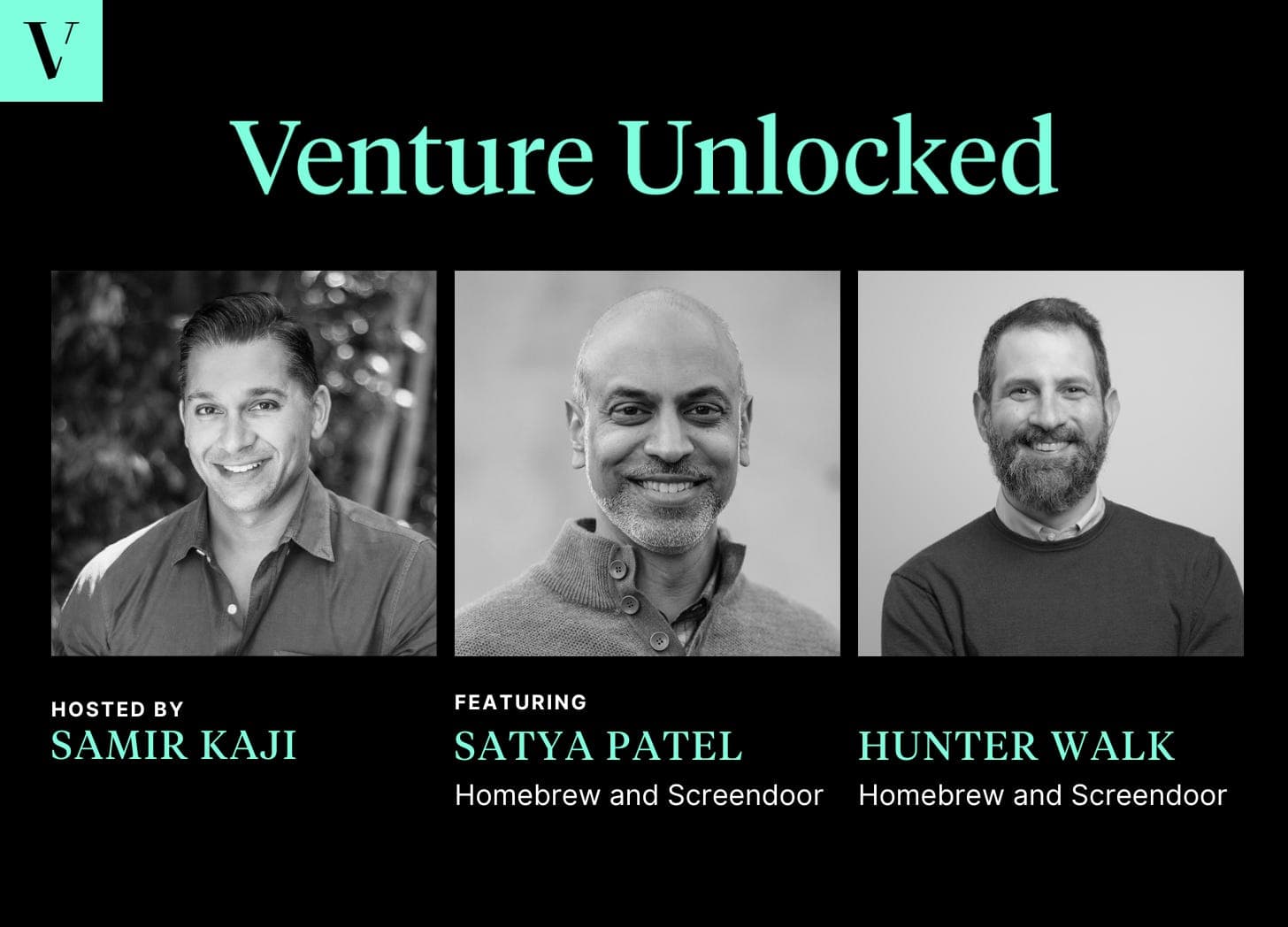
- Host: Samir Kaji
- Description: A podcast dedicated to guiding the operation, scaling, and success of venture capital firms.
- Episode Title: Satya Patel and Hunter Walk on learnings from building Homebrew, moving to an evergreen model, and launching Screendoor VC to back underrepresented fund managers.
Episode Highlights Guests
- Hunter Walk and Satya Patel: Founders of Homebrew, a seed-stage venture capital firm, and Screendoor, a fund of funds supporting underrepresented fund managers.
Key Topics Discussed
- Shift to Evergreen Fund Structure
- Homebrew transitioned from a traditional LP-backed fund to an evergreen structure funded by prior investment proceeds.
- Flexibility to invest without external constraints, allowing them to focus on working closely with founders.
- Challenges of Larger Fund Sizes
- Hunter Walk discusses the constraints and risks associated with managing larger fund sizes, particularly for seed funds.
- Concerns about risk aversion and the pressure to define successful exits in a bull market.
- Market Evolution
- The podcast reflects on how the seed funding market has changed from 2012 to 2021, with a notable increase in seed funds leading to capital becoming a commodity.
- Importance of capital and counsel being separated in the current market landscape.
- Building Screendoor
- Screendoor was created to address the lack of support for underrepresented fund managers and to create a virtuous cycle within the venture capital ecosystem.
- They focus on backing first-time funds started by underrepresented managers to diversify the industry.
Insights on Supporting Founders
- Emphasis on understanding individual contexts of companies rather than applying a one-size-fits-all approach.
- The importance of being a force multiplier on the cap table and alleviating stress for founders during challenging times.
Lessons Learned
- Partnership Strength: The importance of strong partnerships based on shared values and mission.
- Long-term Relationships: Emphasizing relationship-building with founders and LPs over short-term gains.
- Diligence on Misses: Analyzing missed opportunities to improve decision-making and understanding deal flow.
Advice for Emerging Managers
- Key attributes sought in emerging managers include authentic passion for the type of investment they pursue and a commitment to building institutions rather than just funds.
- The significance of having a clear "why" behind their investment strategy to resonate with potential investors.
Key Takeaways
- Flexibility and Authenticity: The ability to operate without external pressures and maintaining authenticity in investment strategy leads to a successful venture capital model.
- Virtuous Cycles: Investing in underrepresented fund managers not only creates opportunities for those individuals but also enriches the entire ecosystem by supporting diverse founders.
- Market Adaptation: The current economic landscape requires a shift in strategy for venture capitalists to remain relevant and effective.
Conclusion This episode of Venture Unlocked offers valuable insights into the evolving venture capital landscape, the importance of strong relationships, and the need to adapt investment strategies in response to market changes. Through their experiences, Hunter Walk and Satya Patel provide a roadmap for both emerging managers and established firms looking to make a meaningful impact in the industry.
Written by AI. May contain mistakes. Listen to the episode to check what was said.
Transcript
Automatic transcript. May contain errors.0:00Welcome back to another episode of Venture Unlocked, the podcast that takes you behind the scenes of the business of venture capital. I'm your host, Samir Kaji, and on this week's show, we're fortunate to be joined by Hunter Wach and Satya Patel, founders of Homebrew, a seed stage firm founded over a decade ago that's backed companies such as Chime, Angelus, and Gusto. In addition, they're also leading up the efforts of Screen Door, a fund-to-funds program focused on supporting underrepresented fund managers by offering both capital and counsel. Satya is coming back on the show for the second time, and it was fun to have Hunter on with him this time.
0:32as we dove deep into their learnings from building homebrew, what they look for when backing fund managers, and their overall view on what makes a great partner for founders. This was a fun one, and we think you'll really enjoy hearing their thoughts. Now let's get right into it. This episode is being brought to you by Grasshopper Bank. Privately owned and headquartered in New York City, Grasshopper Bank is built to serve the business and innovation economy. As a client-first digital bank, Grasshopper combines technology and years of industry expertise to provide clients with a best-in-class banking experience.
1:06Grasshopper's digital solutions are tailored for venture capital and private equity firms, startups, and small businesses. In addition, they also work closely with fintech-focused banking-as-a-service and commercial API banking platforms. Serving clients globally, Grasshopper provides flexible, firm-focused lending solutions as well as dedicated relationship managers committed to meeting the unique needs of funds and companies alike. Grasshopper is a member of the FDIC and an equal housing lender. For more information, visit the bank's website at www.grasshopper.bank or follow on LinkedIn and Twitter.
1:43Samir Khadji is the CEO and co-founder of Allocate. Allocate and Venture Unlocked are independent of each other. Any statements or references made by Samir or his guests regarding third parties, investments, or securities are solely their views and opinions and are not intended as investment advice or an endorsement of such parties or securities by Samir, his guests, or Allocate. Allocate or its clients may maintain relationships with or investment positions in guests, third parties, or securities mentioned in this podcast. This podcast is for informational purposes only and should not be relied upon as a basis for investment decisions.
2:17Guys, thanks for joining us today. So happy to be back here. I think you're the first person that I've had on twice. And Hunter, this is number one for you. So glad to have you as well. A great place for us to start is kind of looking back at homebrew in the 10 years. I do remember, Satya, you and I getting together in a coffee shop back in 2011, 2012 when you were first starting. And what struck me during that conversation was how clear your vision for Homebrew was really around being a great service provider for companies and founders. And you really executed over a 10-year period. About a year ago, you and Hunter made the announcement that you were going to move to an evergreen structure with your own capital, which surprised some people, given the success that you had.
3:10And for many firms during that time, they were going the opposite direction, going larger, raising significantly higher funds. You decided not to do that. Tell us a little bit about the conversation that led to moving to an evergreen structure with your own capital and not raising third-party LP funds anymore. And what really drove that? Yeah, I think it comes down to the reasons that we created Homebrew in the first place and our view of what was happening in the market. And to start with the former, you know, we started Homebrew because we wanted to work closely with founders and help them build the companies that they envisioned, not because we wanted to be venture capitalists.
3:52Venture capitalists, being a venture capitalist was a byproduct of wanting to work with founders. Our orientation has always been around how do we spend the majority of our time working with founding teams who want to work with us to build companies with consequence? And as you might have noticed, I don't mention money there. And the reason for that is, in our minds, money is the cost of entry. It's not the reason for being. And so when we thought about how we wanted to grow Homebrew, we always wanted to orient around having the flexibility to spend our time with founders. and not have to do the institution and firm building that comes along with scale.
4:32So from the beginning, Hunter and I said that it was going to be a partnership of two. And when we wrap things up, the firm winds down. As we thought about whether to grow or not, it became pretty clear that if we wanted to continue to spend our time the way we wanted to spend our time, that growing would make that difficult. Once you manage a fund that's$300 or$400 million, you've got to add partners, add infrastructure, and change the way that you operate the firm. And then importantly, from a strategic standpoint, to address the second point, we really saw some changes in the market that suggested to us that a$100 million fund was likely to be a tweener in the market.
5:12Given the size of seed rounds and the need to have larger ownership as you increase fund size to really compete effectively to lead rounds in today's market, we thought you needed to be larger as a fund. But being larger introduces a lot of constraints and eliminates flexibility in the areas of ownership, check size, collaboration. And all of those things we thought kind of worked against the idea of, hey, we want to spend our time with founders who want to work with us. You know, if we have all these constraints, that becomes more difficult. So the other alternative was to get smaller. we determined that if we were getting smaller to increase our flexibility, the ultimate flexibility would be to only be investing our capital and not be responsible for other people's capital.
6:02Because that would give us the opportunity to experiment and do things in ways which we wouldn't feel great about using other people's capital for, wouldn't be responsible. But with our own capital, we can try all kinds of different things and have ultimate flexibility in how we invest because we're not looking to return a fund with every investment, so to speak. That's kind of how we ended up with this idea that Homebrew Forever should be our own capital 16 months into it now. So far, so good. And since you guys have been also incredibly transparent in your thoughts, Hunter, you've done a ton of blogging, really articulating not only the homebrew way, but your own worldview on venture investing technology.
6:45Satya mentioned that as you get bigger as a fund, there are these new constraints that come in, decides to check you after right, portfolio construction, where you spend your time. But maybe we can double click on that a little bit, because going back to 2021, nearly every firm in the market, given the liquidity rush, was raising bigger funds, both because LP Capital was there, as well as the market had changed where every round size had gotten significantly bigger than when you guys started. From a servicing model standpoint, Hunter, maybe I'd love to hear where do you think the biggest constraints are when fund sizes get bigger and get to that$300 million range for a seed fund?
7:32There's plenty of reasons to prioritize AUM or to sort of have growth as a strategy. There's legitimate reasons for doing that. It just wasn't something that we wanted to focus on. And I think the disconnect for us in this sort of to address your question is, you know, some of it is just math. You start thinking about and having to define and redefine what a successful exit looks like. And I think if not explicitly, at least implicitly, that starts to add questions to your diligence when you're sort of thinking about a company and, you know, what sort of markets are large enough to support large outcomes.
8:15Those things aren't always clear at the beginning, but I think you become potentially more risk-averse or you try to invest in things that you can logically draw a line to a large outcome on. And I don't think that's necessarily the goal of seed investing. The goal of seed investing is to find amazing people working on really large, urgent, and valuable problems, sometimes that can't be expressed as a TAM yet. So I do think getting larger and larger starts to maybe cloud, you know, sort of like what those initial dollars are supposed to be for. They start to force founders into a timeline to their next raise.
8:54You start to focus on, well, in order to sort of figure out whether this is going to be the moonshot trajectory or not, what's the best validation? The best validation is for another investor to come mark this up quickly, as opposed to, you know, what we like to focus on, which is learning and sort of saying, of course, there's, you know, milestones and quantitative outcomes you have to hit that will sort of enable you to raise the next financing. But what you really should be using the seed time for is to clearly state your hypotheses, learn and iterate as quickly as possible as to whether you're correct or not.
9:24And so we just felt like we'd been able to do that through the first decade of Homebrew. and we had this kind of, you know, move to a personal capital model already kind of, I'd call it sort of like under glass with sort of a, you know, open in 2030 kind of instructions on it. And we just sort of smashed that glass case a little bit earlier for the reasons that Satsuki talks about. Some of it also is just time and energy, right? Like we knew we could grow our fund size and likely, quite likely, you know, sort of deploy it successfully, manage it successfully. But when you start to think about where do you spend the time as sort of the key men of the fund, the co-founding GPs, it means we'd be spending more time on growing the team, more time on managing internally, more time on the types of operational issues that are quite important and quite necessary if you're trying to build a multi-generational you know, sort of pyramid structured firm.
10:22But we got into this business primarily to spend time together and spend time with founders. Anything that distracts from those two, we sort of saw as drag on the model, as opposed to, you know, something that was a necessary evil. And so we can have the privilege of sort of trying to stay at the intersection of what I'd call success and happiness. And so large, large funds, I think we could deploy successfully, but I'm not sure we could deploy happily. Going back to the early days, as I mentioned, the vision was so clear from the beginning, the way you work with companies, your approach in terms of doing things that are slightly different from other seed funds, in terms of board meetings, not really caring about those, but spending more time with the entrepreneurs just on a very frequent cadence and really acting as that extended team member.
11:14But as the market evolved, I mean, the market evolved so much from 2012 to 2021, going from maybe 150 seed funds to close to 2300 when you account for a lot of the sub$10 million funds. Along that time, capital became such a commodity because the markets were so hot. We had four rounds of QE during that time. We had interest rates at an all-time low. What did you find, I guess, from an observation standpoint of how the seed environment changed the most? And how did you think about evolution within your model during that time? From my perspective, Samir, you touched on the thing that became the reality over the last decade during this kind of incredible bull run that we have, which is that the perception of capital became that it's a commodity.
12:05But I think we tried to hold true to our belief that while the perception of capital being commodity may be the case, like the reality is like capital is not a commodity, that there's a big difference between being a investor on a cap table and being a investor of record who commits not just capital, but the sweat and reputation to a company. And that there were companies and founders out there would understand that difference. and so while the market changed around us we actually held pretty firm to our belief but it's also true that it became apparent to us that another major change that we believe is going to continue for some time is that this combination of capital and counsel which has kind of been inextricably linked right you needed to provide significant amounts of capital to have influence and for founders to want to have you involved on in the company that has changed materially And so our view is that increasingly in the market, even in kind of today's market, as things have turned down, that capital and council can be separated.
13:16And part of what we want to test with Homebrew Forever is can we have the influence and be helpful in the ways that we want to be, even if we're not always the largest or second largest check in a seed round? And so that's one fundamental change that I think has happened and is going to remain. The second thing that I think changed is that every seed investor in the market, and there were lots of new ones, as you know, over the last half decade, believe that the only thing that matters is just being a part of every great company. And I think that's a strategy that can be effective during a bull run.
13:55But the strategy that has proven to be effective in every market is to be non-consensus and right. And we try to hold firm to that as well. And it certainly probably cost us some money, relatively speaking, in the last decade. But I think over the course of time, it's going to prove to generate outsized returns in any market because we've maintained that ownership matters, that commitment matters, and that focusing on companies and founders and opportunities that are overlooked by others is the best path and the most consistent path. for generating returns that lead the industry. Yeah, I agree with all that, obviously.
14:36The other thing that I think, thankfully, we're having a little bit of a return to normal on is the sort of the velocity of capital raising, raising and being able to raise incredible sums of money ahead of needing that capital. The glass half full is, well, you put it in the bank and you know it's there and you don't have to spend it, blah, blah, blah. But like in actuality, the clock ticks to the next, you know, 12, 18 months that you're supposed to raise. And I think it increases the likelihood that founders are going to use capital to solve problems that capital is not the best, I guess I'd say, sort of resource to utilize.
15:10Capital can't buy you product market fit and fake it in the near term, but it's not a substitute for actually building something your customers want. Capital is not a substitute for culture. Capital is not a substitute for finding one or more scalable, affordable CAC channels. And so I think during our 10 years, especially the back half of that first decade, we saw companies get in trouble as a result of surplus of capital. I don't even mean that in terms of getting out, quote unquote, over their skis on valuation, but just what too much capital incentivizes too early on in a company. So, you know, as a byproduct of people looking for more milestone based and exit multiples that require, you know, concentrated ownership, as opposed to convincing themselves that 50, 100, 200 basis points ownership in a hundred billion dollar company is going to be what returns their fund.
16:07you know, I think the, the, the, the gravity, you know, like you can only argue against physics for so long before kind of gravity pulls you back to earth. And so ultimately I think that's, you know, that's healthy. It's can be a painful transition for investors, for founders, for employees, but you know, maybe we're just the, the, the old men, you know, in the industry, but like, I think it ultimately, it ultimately produced, you know, better, better companies and, and better investors. Yeah, I agree with everything you guys said. And we're coming off this long term period of prosperity that obviously has violently regressed over the last 13 months.
16:43And we are seeing the lack of capital abundance translate to rounds taking longer, smaller rounds, lower valuations, but also founders starting to highly index on people on the cap table that can actually drive outcomes in a positive way. And one of the challenges many investors may have is that they've never been through this type of cycle, given how long that time of prosperity was, and are struggling to figure out what really drives value to companies in a meaningful way. and I've heard you talk about the concept of being a force multiplier, but what advice would you give to investors who have never gone through this on how do you really differentiate and truly help become this force multiplier as an investor on a cap table?
17:34The first rule I think in this kind of environment is do no harm. And for us, I think that in particular, that means like founders are already stressed out and facing a lot of difficult questions and challenges and issues. And so our job is not to put more pressure on them or introduce more stress. It's to help alleviate that by assisting them and guiding them as they work through those challenges and issues. A lot of investors, especially first-time investors, are more concerned about what their TVPI is going to look like if there's a down round or if they lose their money, rather than thinking about what does this founder need in order to help this company be successful.
18:21So that's number one. And then number two is I think it's very easy in a market like today, if you haven't seen a downturn, to give every company the exact same advice. There's too many investors who are like, well, obviously you need to have three years of cash and reduce your headcount by 30%. And it doesn't matter what the actual context of the company is. And I think we work really diligently to figure out what is the opportunity and what are the challenges for this specific company in this time. And every company is its own individual snowflake. And advice has to be oriented around each individual company in its context.
19:01There are some companies that should be taking advantage of the environment because they have clear product market fit and a reasonable balance sheet. There are other companies that don't have product market fit, but have really strong balance sheets and should be managing their burn in order to have the time to find product market fit. There are companies in many different circumstances. And I think the most important thing is to remember what it is that your job is as an investor. And remember that being an investor means that you actually have to pay attention to the context that a company and a founder finds themselves in before trying to help.
19:38Yeah, I think if I, you know, one of my liabilities, if I had tried to do this sort of line of work earlier in my career would have been wanting to, in moments of challenge to companies, you know, move from cap table to org chart, you know, sort of parachute in and solve the problem for them. And I think, you know, what I realized going into this and, you know, have certainly hopefully gotten better at this over the decade is you can only help a company become the best version of what it's going to be. And that requires a lot of different skills, a lot of different dispositions. I think that the two things that, you know, I sort of would hope that we could do with any company that we work with is anything that is accelerates sort of, you know, their learning or progress that involves information from outside of the company coming into the company.
20:26So whether it be how to build a great hiring momentum, culture, reward and retention for your first 20, 50 people, that's why we have a head of talent. And I think we're pretty early in the idea of that's an appropriate role for a seed fund to have, given sort of the importance of people and team early on. You know, finding your first 10 customers, being able to prioritize your roadmap. We're not going to be your VP of product. We're not going to be your VP of sales. But I think anything we can do to move you faster and help you decide, you know, the 80 % of the time you're just doing the best practice, best practices are actually called that for a reason.
20:59But the 20 % of the time that you're going to do something different, you know, innovative or contrarian, making sure that that is worthwhile, that the juice is worth the squeeze and that it's, you know, sort of the right thing to do for your company and supporting founders when they want to do something that's a little bit different. Even if others say, well, you know, Square did this or Stripe did that, you know, well, sometimes that's the right thing for you. And sometimes it isn't. The other thing I think when it comes down to sort of fundraising is I've always thought that, you know, nobody has a crystal ball.
21:28But we've tried to from, you know, right after the round closes, work with our founders to figure out where we think they need to get to to raise the next round of financing. and we've always thought that if we can agree on what those targets look like you know i can never say you're 100 going to fundraise if you hit these but i you know with a degree of confidence you know we are we are 80 confident that that you will be able to attract new financing if you hit these and by the way you know if you can't we're probably still excited to support you here so like it's not an existential crisis for you and what i'd say is that i think and such you can correct me if i'm wrong but i feel like when we've agreed upon those targets and those targets have been hit it's actually sort of, you know, 100 % success rate in companies we've been involved with raising follow-on rounds.
22:13Now, there have been cases where people haven't hit those targets and still been able to successfully fundraise. Rather than say, oh, we're too conservative, I would write that up to the sort of the environment of the last few years. So I think we're still pretty well calibrated for the notion of being able to help them assess what the financial community is looking for. And we've always also thought that like a homebrew investment, if we've invested in something in the seed, they can still be misunderstood by the venture community at the A, that our ability to help them explain their story and find the right investor for them, you know, can overcome this idea that they need to pattern match, quote unquote, by the A.
22:48Now they probably need to pattern match by the B. You know, by that time, they need to be well understood by the venture community. So I think what we've also been able to do and what part of that council looks like is not just, you know, sort of prepping them for their debut, but it's the other side. It's the getting the venture community ready to understand what a homebrew backed company looks like and why, you know, why that's going to be a great opportunity for the right GP, the right firm to back that company next. Part of staying small and modest from a fund size means that like our strategy, even though we've been able to do this occasionally, or, you know, certainly have, you know, led or coalesced bridge rounds when needed, you know, our goal isn't to lead three rounds in a row.
23:33Our goal is to continue to bring on new capital and importantly, new perspectives so that a small but concentrated group of investors can be there for founders when they need them. And so I actually don't think that changes in our new model, even though we're not necessarily the lead investor anymore. We still feel the gravitas and responsibility to make sure that we're de-risking their funding going forward. And frankly, the confidence to believe that if we're involved, no matter what the check size, you know, we can build a funding round for that company around us. If we go back to this concept of counsel, and you have provided counsel both to so many founders, and you continue to do that with smaller check sizes now, but you've also provided a lot of counsel to emerging managers.
24:18And we already articulated the number of new funds that have come to market, many of them during not only the bull run, but had not invested or were in some cases not even in the market as in their careers during the last downturn. Something that you launched fairly recently is a fund of funds platform called Screen Door. I'd love for you to maybe describe what really catalyzed starting this. Screen Door, for those that are listening, focuses on backing underrepresented managers. Tell us the inspiration and what exactly Screen Door is all about. So Hunter and I in our careers have really benefited from others who have opened doors and given us opportunity.
25:06In fact, we're big believers that in technology in particular, we're all standing on the shoulders of giants, right? It's why we named the fund Homebrew as a nod to the old homebrew computer club in the 70s, which was a bunch of computer fanatics getting together to learn about this new technology. And it's where Steve Jobs and Steve Wozniak met. So, you know, we're big believers that we've been fortunate in our careers to have people, you know, reach down and pull us up. But there are entire segments of the population who haven't been able to have that same benefit. In the technology industry, there's been this virtuous cycle where LPs support fund managers, fund managers, back founders, founders hire employees.
25:53Those companies go on to be successful, and that wealth and, importantly, that advice and mentorship flows back into the ecosystem. But for all kinds of reasons, there are huge segments of the population who have not been able to access that virtuous cycle. And so when we were looking at homebrew, and as we talked about, we didn't have plans to grow homebrew ourselves, we saw this kind of history that we had benefited from, but we're looking for ways in order to impact others ourselves without having to grow homebrew. And so the theory of change behind Screen Door and kind of why we created it is that if we can recreate that virtuous cycle for segments of the population that have historically been underrepresented, we can not just change the face of venture capital, but we can change the face of technology, giving more people the opportunity to stand on the shoulders of giants in the ways that we did.
26:52And so, you know, we want to kick off that virtuous cycle by being an LP in first-time funds started by underrepresented managers because it's empirically true that those managers are more likely to back underrepresented founders who are more likely to hire underrepresented employees. And if those companies go on to be successful, and we believe there's tremendous economic opportunity there and belief that those companies will be successful, then those employees and that wealth, the advice of those employees and that wealth will funnel back into the ecosystem. That's why we created Screen Door as kind of a means for us to be able to give back in the way that others have given to us.
27:39Homebrew might have started in 2013, but it really started in 2003 when Satya and I began working together at Google. Screen Door, while we may have launched it in 2021, I think Screen Door actually started in 2013 when we began Homebrew. Because we knew, as you talked about very deliberately from the beginning, what we wanted Homebrew to be and what we didn't want it to be. We wanted our legacy with Homebrew besides sort of living our values in the marketplace. We thought that the legacy was really going to be the companies we were involved in. But everybody, I think, wants to leave their industry better than when they entered it.
28:14And for us, that wasn't going to be turning Homebrew into the next multi-generational, multi-billion dollar AUM kind of firm. It was going to be more the community that we brought to bear and that we could help support. And so Screen Door, along with eight of our industry colleagues, all of whom had played a role in starting their own firms as well, got together to say, let's not just as wealthy GPs sprinkle checks here and there into other early stage managers, largely for information rights and using them as scouts and so on and so forth. like, let's figure out a way to create an economic vehicle that captures the upside of emerging managers that large institutional LPs aren't yet prepared to back because their models, you know, look to put more capital to bear and or, you know, require some track record to analyze, you know, let's figure out how to capture that economic value on our behalf and on the behalf of these LPs.
Read the full transcript
29:08And let's make sure that we're building competitors in some ways, not just collaborators. Let's look to anchor, you know, in many cases, up to 10 % of somebody's fund, an individual or a set of partners who aren't just playing for, you know, a little bit of momentum, you know, 3x, 4x, and then, you know, join a larger firm, but are really looking to build their own institutions. And so, so far, you know, we've backed 11 managers, committed about half of the$90 million that we raised from our LPs. You know, I think when you look at our legacy, like I said, Screen Door is going to outlast Homebrew.
29:45And that's really, really exciting for us. It's the way that hopefully, you know, dozens and dozens of new firms, we can be part, you know, part of their cap table, so to speak. And as Sacha talked about, the separation of capital and council, you know, we give those folks not just a check, but we give them a peer group. We give them access to a group of GPs like ourselves. And And also importantly, our LPs, the Harvards, the Dukes, the princes of the world, they're not just writing a check and going away and saying, you know, please sort rank your portfolio and introduce us to the people who five years from now look like the best.
30:18They're putting, you know, sweat behind spending time with these GPs, you know, from the earliest days because they want to build direct relationships over time as well. I think it's super important, Samir, that, you know, we come from Product Banking Center and I, and we really tried to think about, you know, what's the market need? here and is it clear? And also, can we build something that has impact at scale and with velocity? And we really believe that we're solving a problem for both sides of the market, so to speak. Over the course of building Homebrew, we regularly were approached by GPs who were looking to raise their funds, wanted advice, wanted LP introductions, et cetera.
30:57And over time, more and more of those GPs were coming from underrepresented backgrounds. And the consistent thing we heard from them was there's no shortage of advice for us, but there's absolutely no cap. There was clear kind of market need on the GP side. And then on the LP side, as you know well, large institutional LPs are just structurally unable to spend time with small fund GPs, let alone invest in them. And so we're providing them with a product that allows them to get access to a diversified portfolio of managers that they wouldn't otherwise be able to support. And importantly, start building relationships so that as those managers scale, as some of them inevitably will, those LPs can have direct relationships with those managers over time.
31:46So the thing that has become kind of blindingly obvious over the course of the last year and a half since we launched Green Door is that the demand on both sides of the market is insatiable. And the economic opportunity is incredible. And both sides recognize that. So we have big plans for what ScreenDoor can be. And as Hunter said, we're looking forward to being able to look back and see that ScreenDoor is the legacy that we left behind. I love the effort. And I remember when you guys launched it, we had a quick conversation about it. And both of you know that I've focused on emerging managers for really the majority of my time covering funds and do believe in all the things that you just mentioned, including the opportunity for alpha when you are backing emerging managers, particularly fund one, fund two.
32:40And within the underrepresented area, it does create these new cycles of these virtuous networks that allow more people to benefit from the technology industry. As we have seen in the emerging manager market, there has been more underrepresented individuals than the bigger firms. What tends to happen during times like this when the economy reverses is that there's this perceived or flight to perceived quality. So it becomes even tougher for those fun ones to raise, especially those that come from different walks of life. But I'd love to hear from an LP perspective, when these managers are raising from you or from other LPs, what are some commonalities of the managers that you've backed?
33:31What are you looking for in particular? I think the number one thing that I'd point to is similar to what we look for in founders when we're backing them at Homebrew. At Homebrew, we're looking for a founder market fit and at Screen Door, we're looking for a GP market fit. Is there a clear reason that this GP not just wants to be an investor, but wants to be an investor for a specific type of company or segment of the industry or stage of company that is consistent with their prior experience and will allow them to outperform? And the thing that I would say is consistent amongst the 11 managers that Hunter alluded to that we've backed is that they all have very, very strong rationale for why they want to do what they want to do and where they want to focus and have the experience to back it up.
34:23So that's number one. And the second thing is I think they all have the ambition to not just be investors and not even just be fund managers, but to be firm builders. And so we're really looking to support people who want to build institutions that will impact the industry for a very long period of time and hopefully be successful for a very long period of time. But I'd say those are two things that are filters for us and certainly are consistent amongst the managers we've backed so far. Yeah, and some of these decisions have been tough ones, but we've said no to individuals or groups who we thought had strategies that maybe for a two to three year period could outperform, but whose interest in institution building and or conviction rationale for being an investor, we thought were not well matched against our objectives.
35:21And I couldn't be happier with sort of the group we ended up, we call Screen Door an economic vehicle with a societal mandate. You know, if we just accomplished the economics, but not the societal side, I think we'd be disappointed and surprised because we actually think the societal mandate is going to help drive the outperformance. Vice versa, if we checked a bunch of boxes in terms of GP demographics, but failed to perform economically, it wouldn't just be a disappointment. I think it would be a travesty because it would provide more data or more supporting, quote unquote, supporting evidence to those individuals in our fields who believe the meritocracy is working.
36:02And we just know that's not the case. We know that there's incredibly talented people who have a degree of difficulty in their fundraise or, you know, are fundraising at the same time for a year while they're trying to become managers. It's so different than our experience. We have an incredibly high bar. We had over 500 applications so far for the 11 spots. We say no to orders of magnitude more than people say yes to. But what we want to do for these people that we back who would likely be successful regardless of our support is just give them some places to turn to, to ask some of the questions that we are able to ask, and remove the ankle weights that sometimes can accompany them in getting started.
36:44So try to get them to a first close quickly, get them to their soft cap, their hard cap quickly so that they can switch to being fund managers instead of being fundraisers. Help them think through and understand some of the tradeoffs in portfolio management, the notion of ownership targets, that type of stuff, if they haven't necessarily had institutional investing experience. We're not there to help make anybody a better investor. that's on them. But I think we have a tremendous amount of value to add on becoming a great managing partner and a great firm builder, in addition to a great investor.
37:17So you mentioned both the pairing impact with economic impact. And on the economics, in terms of picking managers that can outperform relative to the peer court and 500 applicants, obviously, is a lot of emerging managers. And you guys have run a firm, you've seen other emerging managers throughout that time. I'm curious if you've seen any type of personality characteristics or any intangibles that you have seen from a pattern standpoint that lead to people being great investors and perhaps being those outperformers. For me, the thing that comes to mind is that the best investors pursue a strategy and an approach that is authentic to themselves.
38:03I think there are lots of strategies and approaches that have been successful and can be successful in the market. And I think when people fail is when they try to be something that they're not. They try to be something that the Twittersphere wants them to be, or they try to be something that is not truly reflective of their experience and their background. And so for me, the thing that makes investors the most successful is when they orient it around the things that are authentic to themselves. And that could mean that they lean into a particular functional strength, a particular domain, particular style.
38:41But whatever it is, it's almost always most successful when it's true to the person who's trying to execute with that approach. People who are successful have some indication of their own product market fit ahead of fundraising. It doesn't necessarily even mean that that's a quote-unquote angel track record or things like that, but it means they're doing something for the startup community. They're doing something for founders that if they asked to write a check alongside that help, they would be welcome into rounds. And so even if somebody doesn't necessarily have a dollar track record, we look at a contribution track record, a network track record.
39:21What is the indication if you were going to draw sort of, you know, some sort of trend line that says this person is of incremental value to the founder community, you know, they've usually proven it in some capacity already. It's kind of simple. Sometimes you're either, you know, as an early stage manager, and most of these folks are early stage, just as a notion of nature of sort of fund size, you're either, you either believe you're going to be investing in things that other people aren't investing in, or you're investing in things that other people are investing in just, you know, earlier, you know, and or with a better hit rate.
39:51And so the, you know, some of the negative signals that we sort of avoided were people who like strategies were very much about just a single alumni network or a single, you know, sort of shadow fund, you know, we're a feeder to, you know, big fund XYZ. Those things all look really good, you know, during the 2020, 2019, 2021 timeframes. I don't think those are durable strategies to build firms. They can be wedges, They can be sort of your, hey, this is why my fund, this is my strategy for my fund one. And then let me tell you what I'm looking to prove so that my fund two, I can broaden or expand to something that I think is a more durable strategy.
40:28But I don't believe, you know, that's a multi-fund, let alone potentially multi-year strategy, despite, you know, what we saw over the last decade. There has to be real consistency between the strategy and portfolio construction that can lead to outsized returns given a particular fund size. I think Mike Maples gets credited with your fund size as your strategy. And we've always been big believers that your strategy should dictate your fund size. And so we spend a lot of time trying to ascertain whether the strategy that a manager has is consistent enough with their fund size to be able to generate outsized returns.
41:11And I think, Samir, as you know, it's not always the case that managers have thought coherently about how a strategy, given their fund size, translates into economic value that exceeds what the market will generate on an average basis. And so it's always one of those things that becomes a nuanced conversation around things like check size and ownership and recycling and reserves. The managers who've thought about that and have a strategy around it, or at least frameworks around it so that they know when they're making exceptions to the rules, seem to do the best over time. You guys know this, but LPs often struggle with evaluating fund ones because of the lack of definable track record.
41:55And even if there is a track that ties back to a prior firm or an angel track record, oftentimes those are heavily discounted because they may or may not be relevant. And a lot of fund one investors are family offices, high net worth investors. When you're evaluating a fund one, what do you think is the most important question to ask the GP? I always think it's the why. You know, we wrote about the why of homebrew and like the why doesn't usually doesn't involve a statement about your return goals. It doesn't necessarily involve nuanced answers to, you know, your growth strategy. it involves sort of why are you doing this versus all the other things you could be doing?
42:37For me, it's the most inspirational answer that you can hear. We ask it of all the founders we back. I much rather work with the trade-offs that come in sort of a mission driven founder, just like I believe in a mission driven VC. Then I do somebody who I feel is purely opportunistic and has calculated sort of the net present value of this career choice versus other things available to them. So for me, you know, it's, it's, it's the why and starting, you know, that's what I would start with. Not surprisingly, I had the same response, which is to ask why you and why do you win? What's the reason that the world wants you to be yet another venture capitalist?
43:17And a lot of that is personal motivation and what that person's mission is. And a lot of it is like, what does the world need and why does that person satisfy that need? So I agree with Hunter, again, not surprisingly, that for us, why has always been the most important thing. And it's probably the one question we would ask and certainly do ask of any manager that we meet. I'd also show them my right bicep that has a homebrew tattoo and ask them if they're as committed as I am. Because if not, you know, get behind me. So in other words, make sure you get a tattoo. Oh, no. I mean, that would disqualify Satya.
43:51So I can't make that the gating factor. Yeah, well, it totally maps back to Satya, your original point about being authentic and understanding exactly why you exist. The world certainly doesn't need another venture firm that doesn't have a clear why behind it. So I really love those thoughts. An area that I'd love to end with is because we're on the topic of helping new managers come into the market and be successful in both helping founders and building great firms. Looking back at the 10 years of Homebrew, I'm sure you had this clear vision, but there were learnings throughout that time. If you were to look back and extract maybe the top two or three learnings that were non-obvious, what would they be?
44:41The number one strength of Homebrew is the partnership that Hunter and I have. And maybe it should be obvious, but I think it can be non-obvious that the amount of investment you make in understanding whether someone is the right partner for you and the partnership has shared mission, values, and interests is fundamental to success. in this business. And I think a lot of partnerships still in this day come together out of convenience because it brings together a set of skills or fundraising ability and not kind of more foundational alignment around the things that I outlined. And so it should be obvious, but I think it still remains a little non-obvious that that's probably the number one decision and number one reason for success is the strength of a partnership.
45:41The second thing I'd say is, and people forget this again, it should be obvious, but I think it's non-obvious is that this is a long-term relationship oriented business, not just on the founder side, but also on the LP side. Someone once asked me after we closed the first fund, like, when are you going to start raising for the second fund? And I was like, we already did. when we started raising the first fund. I think you have to approach, you know, fundraising and LP relationship building in that way. But I also think you have to think about founders, co-investors, you know, your partners and your team in that same way.
46:22And again, it's easy to get caught up in cycles. It's easy to make short-term decisions that might be economically sound. But the willingness to sacrifice economics sometimes, to sacrifice ego, to make the decision that really has long-term satisfaction instead of instant gratification is something that I think is not obvious to people who haven't been in this business very long, but very obvious to people who have invested through cycles or been doing this for some time. Yeah. One for me is how rarely folks sort of diligence their misses. And I don't mean like post-mortem a loss, people do that, you know, or look it back at a, you know, sort of a false, false positive and say, you know, what mistake do we make?
47:14I, we spent a lot of time in the first few years when we'd hear about, you know, and it could be pre-public announcement or very often it was after a tech crunch article or something came out and it was a company where it was like, wait, like, why didn't we see that? You know, either we thought we knew some of the investors or it was in an area that we thought we had, you know, sort of displayed expertise in. And we would go and figure out, we'd track down the founders or get to the founders through an investor we knew or things like that. And very often the founders were generous to spend, you know, 5, 10, 15 minutes on the phone with us, you know, because we basically said, look, we're not trying to get into this deal.
47:48Like, you know, and, you know, and for them, it was kind of novel because they usually get pestered by VCs to, you know, sort of, hey, hey, I hear you're a hot company. When are you investing next? And we're like, we're kind of bummed we didn't get a chance to talk. We, you know, we take a product mindset and would love to learn, you know, like why we didn't. And, you know, it informed sort of our blind spots, places that we thought we had communicated well to the founder community, but still needed to do more work. It helped us understand the nature of dark deal flow, deal flow that never really hits the market and why doesn't it hit the market and that type of stuff.
48:19And I'd say sort of the so that the unintuitive thing that or the thing that fund managers should think about more is that it's not enough. It's not enough just to have a good reputation or be or be liked. Like those are table stakes. but you know for really great opportunities you have to figure out or at least a certain cohort or type of founder or source of deal flow or within a vertical that you have to be one of the top three folks that that founder would prefer to work with that's what's going to put you you know at the beginning of a cycle at the beginning of a trend at the beginning of a fundraising process everything else is kind of like you can write lots of great blog posts about your thesis so and so forth but the end of page like at the end of the day like your portfolio page you know is your thesis and your portfolio page is representative of course of hopefully good decisions that you made about which companies to be involved with but you know founders choose companies not the other way around and so moving for myself from a mentality of oh it's fine just to have like broad general awareness of the ecosystem not everybody has to like you but you know just good name recognition and a broad network to like why would somebody prefer me over other good investors.
49:28And that mentality for Homebrew, I think really helped sort of narrow the types of stuff we look at, because you can't be all things to all people as just a 2GP fund, but also force us to make sure that we had product market fit and that we could articulate that to those sorts of founders who had lots of other wonderful choices and didn't see them all, didn't win them all, but are just so incredibly proud of the companies that we've had the chance to work with, the beginnings of, you know, sort of outcomes and impact that some of those companies are starting to have, and, you know, sort of what the next decade looks like as a lot of those investments mature into their, you know, full power and the newest investments we're making, you know, start to find their stride and become, you know, wonderful contributors to society and hopefully reward themselves, their teams, and their investors with wonderful outcomes as well.
50:20It's great advice, guys, and I've certainly enjoyed over the last decade watching and learning from afar from you guys. And the counsel that you provided founders and two other emerging managers has been immeasurable in terms of impact. And I'm really excited about Screen Door and what you're doing. And I do think the impact both economically and non-economically is quite large and there's a lot to be written and really excited to watch the trajectory. And again, guys, thanks for coming back on and really appreciate it. Thanks for having us. Stay tuned. Big things in store for Screen Door in 2023.
51:24And don't forget to hit the subscribe button in order to get each and every Venture Unlocked episode as soon as it's released.
51:55Thank you.
From the publisher
Follow me @samirkaji for my thoughts on the venture market, with a focus on the continued evolution of the VC landscape.
On this week’s show we’re fortunate to be joined by Hunter Walk and Satya Patel, founders of Homebrew, a seed-stage firm founded over a decade ago that’s backed companies such as Chime, AngelList, and Gusto. Just over a year ago, Homebrew announced that it was moving away from a seed-focused traditional LP-backed fund to an open-ended evergreen structure that is funded from the proceeds of prior investments.
Additionally, they are also leading up efforts of Screendoor, a fund of funds focused on supporting underrepresented fund managers by offering capital and counsel.
Satya is coming back on the show for the second time, and it was fun to have Hunter on with him this time, as we dove deep into their learnings from building homebrew, what they look for when back fund managers, and their view on what makes a great partner for founders.
This was a fun one, and we think you’ll really enjoy hearing their thoughts. Let’s now get right into it!
A word from our sponsor:
Privately owned and headquartered in New York City, Grasshopper Bank is built to serve the business and innovation economy. As a client-first digital bank, Grasshopper combines the best of banking technology and years of industry expertise to deliver best-in-class experiences with trusted security and unparalleled support. Grasshopper's digital solutions are tailored for venture capital and private equity firms, startups and small businesses, fintech-focused Banking-as-a-Service (BaaS) and commercial API banking platforms, and more.
Serving clients globally, Grasshopper provides flexible, firm-focused lending solutions, as well as a dedicated Relationship Manager committed to meeting the unique needs and strategic focus of your firm across all entities, including funds, general partner and management companies. Grasshopper is a member of the FDIC and an Equal Housing Lender.
For more information, visit the bank's website at www.grasshopper.bank or follow on LinkedIn and Twitter.
About Satya Patel:Satya Patel is a Founding Partner of Homebrew and Co-Founder of Screendoor. Prior to Homebrew, he was VP Product at Twitter, building and leading the Product Management and User Services teams. Before Twitter, he was a Partner at Battery Ventures, where he co-led the seed and early-stage investing practices. He joined Google in 2003 and was responsible for AdSense product management and partnerships.
Before heading to Silicon Valley for Google, he worked for DoubleClick, in venture capital, and as a strategy consultant.
He has a BS in Finance and a BS in Psychology from The University of Pennsylvania.
About Hunter Walk:Hunter Walk is a Founding Partner of Homebrew and Co-Founder of Screendoor. Prior to Homebrew, Hunter led consumer product management at YouTube, starting when it was acquired by Google. He originally joined Google in 2003, managing product and sales efforts for AdSense, Google‘s contextual advertising business.
His first job in Silicon Valley was as the founding product and marketing guy at Linden Lab.
Before graduate school, he was a management consultant and also spent a year at Late Night with Conan O‘Brien. He has a BA in History from Vassar and MBA from Stanford University.
In this episode we discuss:(03:32) The decision to move to an evergreen fund structure with Homebrew(07:32) The biggest constraints when early-stage fund sizes balloon(17:34) How to survive a down market and become a force multiplier on a cap table(24:58) The inspiration to start Screendoor(33:33) The type of managers they are looking to back at Screendoor(37:54) Patterns they’ve seen in great investors(42:13) The most important question they ask GPs(44:42) The biggest lessons from their time as investors
I’d love to know what you took away from this conversation with Satya and Hunter. Follow me @SamirKaji and give me your insights and questions with the hashtag #ventureunlocked. If you’d like to be considered as a guest or have someone you’d like to hear from (GP or LP), drop me a direct message on Twitter.
Podcast Production support provided by Agent Bee
This is a public episode. If you would like to discuss this with other subscribers or get access to bonus episodes, visit ventureunlocked.substack.com