In short
Venture Unlocked Podcast Notes
Episode Title
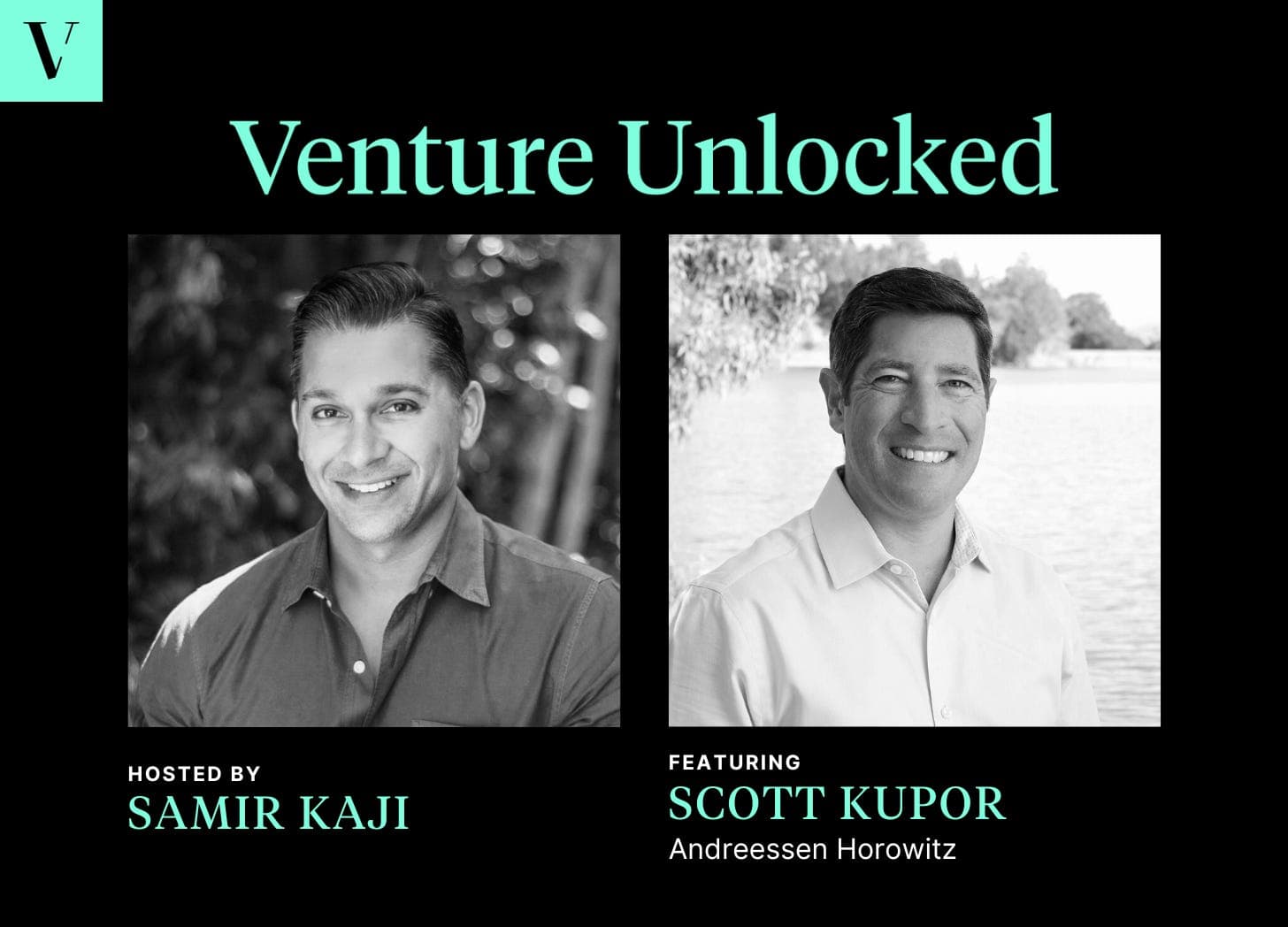
Scott Kupor, Managing Partner of a16z on Building a Lasting Venture Franchise
Host
Samir Kaji
- Over 20 years of experience in venture capital and startups.
Guest
Scott Kupor
- Managing Partner at Andreessen Horowitz (a16z).
- First employee of a16z, instrumental in its growth to over $35 billion in assets under management (AUM).
- Author of the bestselling book *Secrets of Sand Hill Road: Venture Capital and How to Get It*.
---
Episode Summary
In this episode, Scott Kupor discusses the history and evolution of Andreessen Horowitz, detailing its unique approach to venture capital that has helped it thrive in a competitive landscape. He shares insights from his personal journey and key lessons learned from the dot-com bubble and beyond. Key topics include the firm's founding principles, operating model, culture, and advice for new venture managers.
---
Key Discussions
Scott's Journey to a16z
- Began career in the mid-90s post-law school, initially in investment banking focused on healthcare.
- Transitioned to tech due to the rise of the internet and tech IPOs.
- Joined LoudCloud, which later became Opsware, guiding the company through the dot-com bubble.
Founding Principles of a16z
- Market Insight: Noticed the shift from needing significant capital for tech infrastructure to the rise of cloud services (e.g., AWS), which democratized access to technology.
- Founder-Centric Approach: Aimed to support founders as CEOs while providing guidance to help them succeed.
Building the Firm
- Running Like a Startup: Adopted a corporate structure that resembles a startup to maintain agility and innovation.
- Recruitment Focus: Prioritized hiring individuals with startup experience, ensuring the team understood the entrepreneurial journey.
Culture and Values
- Respect for Entrepreneurs: Core value emphasizing the difficulty of building companies and the role investors play in supporting their journey.
- Tangible Practices: Implemented fines for tardiness in meetings with entrepreneurs to reinforce respect and accountability.
- Orientation Programs: New hires undergo orientation that instills cultural values and the firm's mission.
Challenges of Scaling
- Managing culture as the firm grows from a few employees to over 500.
- Maintaining consistency in cultural values and practices.
- Introducing formal reviews to ensure adherence to cultural values.
Current Market Landscape
- Acknowledged the changing venture capital environment due to rising interest rates and economic cycles.
- Maintained optimism regarding the pace of technological innovation and the potential for startups to thrive amidst challenges.
---
Key Takeaways
- Network and Relationships: Importance of networking in career development and venture capital.
- Risk and Opportunity: Emphasized the need to embrace risks and maximize upside in career choices.
- Feedback and Respect: Constructive feedback is crucial, and it should be delivered thoughtfully to maintain respect for founders and their vision.
---
Advice for New Managers
- Establish a clear identity and purpose for the venture firm.
- Build relationships and trust with entrepreneurs before giving feedback.
- Stay aware of market conditions but focus on innovation and talent.
---
Final Thoughts Scott Kupor reflects on his career journey, highlighting the value of relationships and the importance of risk-taking in achieving meaningful success. He emphasizes that the entrepreneurial spirit remains strong, and the future of venture capital will continue to evolve as innovation paves new paths.
---
Additional Resources
- [Secrets of Sand Hill Road: Venture Capital and How to Get It](https://a16z.com/book/secrets-of-sand-hill-road/)
- [Andreessen Horowitz](https://a16z.com)
- Podcast available on [iTunes](https://podcasts.apple.com) and [Spotify](https://spotify.com).
---
Follow-up Listeners are encouraged to share their thoughts and insights from this episode on social media using the hashtag #ventureunlocked and to reach out to Samir Kaji for potential guest suggestions.
---
End of Notes
Written by AI. May contain mistakes. Listen to the episode to check what was said.
Transcript
Automatic transcript. May contain errors.0:00Welcome back to another episode of Venture Unlocked, the podcast that takes you behind the scenes of the business of venture capital. I'm your host, Samir Kaji. And this week's show, we're glad to be joined by Scott Kapoor, managing partner at Andreessen Horowitz. Scott was the first employee of the firm alongside Mark Andreessen and Ben Horowitz, and has been instrumental in the firm's growth to now having north of$30 billion in assets under management. Scott also authored a Wall Street Journal bestselling book called Secrets of Sand Hill Road, Venture Capital and How to Get It, and previously also served as chairman on the board of the NVCA.
0:35In this episode, Scott went through the history of Andreessen Horowitz, the learnings along the way, and building to the multi-product investment company it is today. We think you'll really enjoy hearing his thoughts. Now let's get right into it. I'm absolutely thrilled to have this week's show sponsored by Frank Rimmerman, who serve as home for over 500 VC firms for their tax and audit needs. They're also one of the largest providers of services for the emerging manager community, and as somebody that's worked with them for over 10 years, I can attest to the early commitment they made to Micro VC when it was first getting started.
1:08If you're a venture firm in the market for audit and tax, be sure to give them a call. Samir Kaji is the CEO and co-founder of Allocate. Allocate and Venture Unlocked are independent of each other. Any statements or references made by Samir or his guests regarding third parties, investments, or securities are solely their views and opinions and are not intended as investment advice or an endorsement of such parties or securities by Samir, his guests, or Allocate. Allocate or its clients may maintain relationships with or investment positions in guests, third parties, or securities mentioned in this podcast.
1:41This podcast is for informational purposes only and should not be relied upon as a basis for investment decisions. Hey, Scott, thanks for joining us. Thanks for having me. Glad to be here. It's going to be a fun conversation. So I want to go back and maybe a great place to start is how you got started in tech. And I think about the mid-90s, graduate with a law degree, you go into investment banking. It was a time of mass euphoria, right? So we were at the upswing of the dot-com ultimate bubble, similar to what we've seen maybe the last few years of euphoria within the economy and the tech markets.
2:17Tell us a little bit about those early days, how you really started your career into working with technology companies. As you mentioned, I went to law school and quite frankly, I thought I was going to be a lawyer. That was the plan at least until I realized that, quite frankly, I loved law school more than I liked at least the snippet of practice of law that I saw when I did some summer internships. And so I graduated in 96 and decided, okay, what am I going to do? So as any good person who's gone to law school knows, if you don't want to be a lawyer, go be an investment banker, basically. That was kind of the only other career option left for me.
2:50And I actually started off in the healthcare space, not actually in technology. And in 96, actually, believe it or not, like there was actually an interesting biotech and healthcare market in the capital markets. And then about literally, you know, six months later, essentially, pretty much like that whole market shut down. And all of a sudden, this thing called like IT and tech became really exciting to people. So I went to a firm, Lehman Brothers, actually, originally to do healthcare stuff. And then the way I got into technology was actually a buddy of mine who I knew from college was at Credit Suisse vs.
3:24Boston. And he said, hey, this tech stuff is going gangbusters. We basically need people. And I said, look, I know absolutely nothing about tech. It was the very honest answer. At the time, you may remember this, but ERP was a big buzzword. you know, and I had to go Google. Well, I couldn't Google at the time because I don't even think I knew how to do that. But I had to go figure out what that was when I heard that word for the first time. So that's about how much I knew about technology. But he's like, look, it's no big deal. We literally like are just overflowing with IPOs. We need people who are smart, who can basically help these companies go public.
3:57So that's how I got involved initially in the technology industry. And as I now like to say, which I couldn't say before, I've now been associated with two former investment banks, so Lehman and Credit Suisse. So I swear that I left well, well ahead of any of those problems. But it may not be who people will to follow me in my career, because eventually, you know, some of those firms may disappear, basically. Well, unfortunately, I think I can make the same claim given the state of my past two employers and what we've seen over the last two months. But we'll save that for another time. And instead, let's go back to the early days of your starting tech.
4:30And that was at LoudCloud, which became Opsware. The company started during the height of the dot-com bubble and then went public, navigated some choppy waters. I'm curious just the early days of working with Ben and Mark and what learnings did you extract that helped you then build and really start Andreessen in 2009? It was a really interesting time. I'll give you a little bit of the history. You're right. They started the company in September 99. In November, I got introduced to them actually via one of my former clients that I had taken public. So a guy named Scott Dunlap, who worked for a company, Epiphany, which was, it was kind of a newfangled CRM company is basically how I would describe it.
5:12And I took the company public and then he called me on the day of the IPO. He said, hey, it's been really nice knowing you, by the way, I quit today to go join this company called LoudCloud. You should really meet these guys, Mark and Ben. I was like, okay. You know, I didn't know Ben, to be completely honest, I didn't know Ben at the time. But I was like, wow, like, you want me to meet Mark Andreessen? Like, of course, like, I would be happy to do that. So that's how I got connected with them. I ended up joining the company in January of 2000, four months roughly after the company started. And those early days were still amazing because we were literally at, you know, we didn't know it at the time, of course, but we were in the heat of like the dot-com bubble.
5:43So if you remember your history, again, we don't know it at the time, but Nasdaq peaks at 5 ,000 in about April of 2000, right? So I joined literally like three months before that. And none of us, of course, knew that it was going to go from 5 ,000 to 1 ,000 over 18 months, basically. So those early days were a lot of fun. I'll never forget. So the first thing I got assigned to do was in our business, we had to basically rent data center space from companies like Exodus and others, again, none of which exist anymore. And because we had to build out like a big footprint in data centers so that we could ultimately host applications on behalf of our customers.
6:16And so I got assigned to do that. And we had to sign these very long term contracts and make a lot of these commitments essentially to take down data center space. And that was my first first hint that I was worried about what would happen because I would go to the, you know, I'd go to the team who I was working with and say, okay, like, are we sure that we want to take down, you know, thousands of square feet of data center space and lock ourselves into, you know, three-year, four-year contracts? And I'd never been in a startup before. So they're like, yeah, like, this is what we do, right? Like, the business is going to go like this, so we got to be ready.
6:45So we ended up doing a bunch of that stuff. And of course, I had the pleasure then, you know, two years later of trying to unwind all those contracts as well. But that was my initial kind of foray with Mark and Ben. And it was great. I mean, look, I was a peon in the company, basically. So I kind of got opportunities every now and then to spend time with Mark and Ben. And over the years, obviously, that changed when I started to kind of grow inside the company. But it was great. It was euphoria for a little while. We raised a bunch of money. We built out the whole business. And then you could kind of see as you got to end of 2000 that the first sign for us was a lot of our customers were.com customers.
7:23And basically, at the time, I would spend half of my day basically doing reverse diligence on our customers to figure out would they actually be able to pay our bills or not. And that was kind of when we started to get to the point where it's like, you know, a little bit of our oh shit moment, there's something going on here. But it was a it was an interesting, interesting ride. And, you know, lots of fun along the way. Obviously, Ben wrote about this in his book, The Hard Thing About Hard Things and all the things that went on within Opsware, which, you know, there were some really tough moments where you weren't sure about the durability or viability of the company.
7:54Now, ultimately, the company went on to continue to be viable, bought by HP. And then shortly after that, during the global financial crisis, 2008, 2009, you started in Jason. I would love to maybe go back, you know, 14 years and take us into the room with you, Ben and Mark. Because when you think about venture firms, and back then there were far less venture firms than there are now, but you still want to ask the question of why do you exist and where do you fill a unique gap? So tell us a little bit about the blueprint conversations that you had. What did you want to build? Let me just be totally clear.
8:30Look, 100 % of the credit goes to Mark and Ben, and I've been lucky enough, quite frankly, to be along for the ride. But, you know, the nature of the conversation was really interesting. Basically, here was their thesis was they said, look, first of all, as you know, they were doing angel investing. So the idea of investing wasn't foreign to them. But look, they were certainly not professional investors and they were investing, you know,$25 ,000,$50 ,000 into a bunch of companies here and there. But their kind of key insight was they said, look, we think the industry is shifting in a really profound way that would allow kind of for a new venture firm to enter the market in a way that just hadn't been done before, basically.
9:04And the key insight in their mind was, look, it used to be the case for a lot of the history of venture capital that you needed kind of three, five million dollars to get a business started because you had to go take that money and buy, you know, and this will date me, but you had to go buy servers from some microsystems and you had to buy storage from EMC and networking equipment from Cisco. So before you can even start to build your actual application, you needed venture money, quite frankly, just to build the infrastructure. And, you know, look, their key insight, which is, look, it seems obvious now, was, OK, as we start to see things like Amazon Web Services and compute on demand, the whole financing paradigm for these businesses will change because you now can, you know, rent and pay as you go for that infrastructure as opposed to meeting that amount of money.
9:45And their kind of key insight was, okay, that will then enable a whole new ecosystem of effectively what we now know as the seed market. And then that will kind of create a competitive upset in the current market because traditional venture firms were always used to being first institutional money in. Now you've got a set of seed people who will be upstream of them. And, you know, kind of, you know, anytime you have market dislocations like that, you don't know what happens, but it seems like that could be an interesting opportunity for a new company to come in. So that was kind of the foundational like market insight.
10:15And then their other insight that stemmed from that was they said, okay, look, if that's the case, then money alone is not going to differentiate venture capital firms kind of in the next, you know, 20, 30 year era, even though that was a defining characteristic of the business for a long time in the, you know, from the 1970s on. Their other fundamental premise was, okay, we like this archetype of a founder that wants to be the CEO, but we also recognize that that kind of founder as CEO may not have all the skills that he or she needs to become the long-term CEO for the business. So what if we could create a firm where kind of the whole ethos of the firm was back that phenotype of an individual, but then build a set of relationships and networks and general partners who kind of really could hopefully help guide and help those individuals accomplish their objectives.
11:01So it was kind of the combination of those two things, like this idea of the founder as CEO phenotype being important, coupled with these, you know, quite frankly, like systematic changes that were starting to happen. And, you know, they were pretty prescient in that if you look at it, I think over the last 13, 14 years, that certainly has developed that way. You mentioned a few things that I want to unpack a little bit, and I'll probably date myself too, because I do remember the days where you had to buy servers. I started my career in September of 1999 lending to companies in the dot-com bubble.
11:30And of course, that changed with things like AWS, where it was much easier now to launch a company. But still, at that time, it was still early on. We had just had mobile launch, and it wasn't yet clear how big technology and software was going to accelerate, not only within sort of like the normal sectors, but across all industries and verticals. And I know Mark wrote the now famous article of software's eating the world, which has, of course, proved to be very prescient. But beyond that, I want to go back and think about, at the time you're looking at these different ways of operating a firm, and in the past, firms are all the same, right?
12:08It's like I was in the power position of providing you as an entrepreneur capital. And ultimately, it was a firm that was composed of investment partners, so not people that were acting in certain capacities to help accelerate or alter outcomes of these companies. Was there any inspiration in parallel industries that you drew from? Because it does feel a little bit like what Mike Ovitz, for example, has done at CAA. Yeah, I think there were two kind of key things. One is specifically kind of what Mike Obitz had done at CAA. And for the listeners who aren't aware of Michael, basically, the way the talent industry worked from literally like vaudeville days until early mid-1970s when Michael started the firm was it looked, quite frankly, a lot like the venture capital model.
12:52You had an agent who was kind of the equivalent at the time of what a general partner looked like. And an agent would build his or her own book of business. At that time, it was probably all his, not her. and would basically go to a client and say, great, here's what I can do for you. I can help you get movie deals. I can help you get TV deals, whatever the case may be. But there was kind of this one-to-one personalized relationship between agent and actor. And that was how the business worked. And a firm was a collection of those people. But quite frankly, there wasn't really much of a firm. There was basically individual people building their own books of business.
13:21And Michael's innovation, along with a couple of his other co-founders, was what if you kind of turn that paradigm on its head? And instead of having every agent kind of face off one-on-one and build all their own relationships among, you know, TV and network and studios and all this other stuff. What if you kind of created a platform where the agent was kind of, you know, I'll use the football analogy. The agent was kind of the quarterback and still kind of owned the relationship. But the firm itself basically owned the whole broader set of relationships with radio, TV, books, publishing, you know, all that stuff.
13:53And so when you interface with a client, you actually could say, look, I can bring to bear the entire set of relationships across the firm, not just the Rolodex that I as Michael Ovitz have in these areas. That was the basic theory. And look, it worked. And it turned out CAA at its peak probably had, I don't even know, but 70%, 80 % market share. It was a phenomenon in the industry. The theory that he helped Mark and Ben understand was, OK, could you do a similar thing in the venture model? And so kind of thing number one that we took out of that was, okay, maybe you need to redefine the role of the general partner.
14:27The general partner doesn't necessarily need to do everything. Like the general partner doesn't need to know every CFO out there or every COO or know every potential customer. But what if we basically build what we now call the operating platform where we staff with non-investment people who are responsible for building out and owning those relationships? And then the same analogy that Michael Obitz did, which is as an entrepreneur, then when you face off with us, you have a general partner, of course, who is your primary kind of relationship and probably your board member. But you then get kind of access to the entire network of relationships that is the firm as opposed to just the network of relationships that is that general partner.
15:05I mean, that was the fundamental premise. The other even more simple premise was this concept of a corporate entity as opposed to a general partnership. Now, we are structured from a legal perspective as a partnership. But if you really look inside our firm, we look more like a company. Like we have managers and people have objectives and they have metrics and those all have to roll up. this morning before this podcast, I was on an all hands call. You know, we do things like that. That was the other kind of theory was, could you organize a venture firm almost to look more like an operating business than kind of these, you know, somewhat individual fiefdoms of general partners who all kind of come together at various points in time to, you know, talk about deals and think about the world.
15:45Yeah. And I think that's something that's incredibly clear. I think of Andreason is very much the operating company that happens to write checks and provide services to founders, right? At the end of the day, and you have your shareholders, which are the limited partners that you're delivering, you know, a return for. Fund one was 300 million. It was, you know, raised in 2009. I think 2009 only spot 16 billion was raised by venture firms. Many of them were still very traditional in the way they operated. Now things have changed. And now you've, you've set the foundation where so many firms are now employing portfolio teams and things like that.
16:18But when you look at starting a company, and I always think about companies that successful, you have great TAM and you have market potential, you have good technology, but at the end of the day, you have founder company fit and founder market fit. So when you were starting this, how did you think about your own unique sort of skillset in terms of being able to execute on this model? And then what was that first year in terms of recruiting people? What did you look for? What we thought we could bring to bear was basically a group of people who had been who had gone through the startup and lifecycle company development that our entrepreneurs would do.
16:54And to be totally fair, again, there are plenty of general partners in this industry who obviously have been founders and CEOs of startups. But we decided that that was going to be a core part of our ethos. And, you know, as you may know, even for our first, quite frankly, eight years of existence, we had this very hard rule, which is you could not be a general partner unless you had been a founder and CEO of a company. And we can talk more about, you know, kind of how we've, that's evolved over time. But that was kind of ethos number one was like, could we basically, you know, this, this will sound kind of corny to say it, but, you know, kind of by entrepreneurs for entrepreneurs, you know, maybe it would be a simple way to describe that, which was, okay, if you're an entrepreneur who's serious about building something, we're going to surround you with other entrepreneurs who've gone through that process.
17:33So that was kind of the first kind of theory that we had. And then again, the second theory, which, which, which goes to your question about recruiting was, okay, could we actually build on this kind of, this vision of this operating model, right? So could we have a concept of people who could help with talent and marketing and other things and do it in a way that actually was additive, particularly to that phenotype of the founder who wants to be CEO? So the early hires were, my very first hire actually was a CFO because I was like, okay, I don't even know this thing about capital calls. How does this work?
18:08I'll tell you a funny story since I know some of your audience are LPs. I did our first capital call myself from my personal Gmail account because we hadn't set up the A16C domain. And obviously, in the wake of SVB, you can imagine how many calls I would have gotten today had I done that. But even pre-SVB, I got a call from one particular LP who's like, who are you? Why are you sending me things for your personal email? Are you crazy to think I'm going to wire you money? And I had to ultimately explain to him what my job was and what I was doing. So it was very funny. But that was what what it was at the outset literally was, you know, my job description was go figure out what needs to happen to basically make a venture capital firm work.
18:44So that was kind of a fun introduction to the world of capital calls for me. But so I knew I needed a CFO. That was pretty clear. And then the other early hires were early foundations of these operating teams. So we hired a woman, Shannon Callahan at the time was her name, who, you know, worked for us. She ran HR at Opsware for us. And so we said, look, can you build out kind of basically a talent and a people practices operating platform. We hired another ex-Opsware guy, Frank Chen. And initially, his job was, can you build out, can you kind of create the canonical startup playbook, basically?
19:18So like, what is everything that people need to know to kind of, you know, get off the ground and do stuff? We eventually realized that was not like a great way to focus. And we kind of shifted. But, and then our next two hires were key hires around PR and marketing, and then executive talent. So a guy named Jeff Stump, who's still with us in market when markers. So that was kind of the initial play was and the answer was like what we said to them very clearly when we hired them was, we have no idea what this thing's going to look like. This is truly a startup. But this is our vision, which is could we find ways to help entrepreneurs and build networks around these areas.
19:51But we need smart people who are basically want to go figure this stuff out. And that was probably the sum total of the job description that I gave any of them, you know, when we first hired them. I want to go back to this concept that you mentioned of running the firm like a startup And when I think about startups, I go back to this Reid Hoffman quote of, it's like jumping off a cliff and building a plane on the way down. And presumably, as you've built Andreessen now over the past 14, going on 15 years, there's been key inflection points, learnings that have helped shape the firm to what it is today.
20:22Can you perhaps walk through some of those key learnings and inflection points? Let me give you a couple, I think, that were pretty foundational for the business. Number one was one of the very first investments we did was we were part of the buyout of Skype that came out of eBay and that ultimately, you know, about 18 months later got sold to Microsoft. And this was endemic, actually, of, I think, a broader strategy that we were taking, which was different and important to us in the industry, which was the concept of marketing. And, again, I know that sounds almost funny and silly today, but, you know, if you rewind back to kind of pre-09, generally, venture firms did not do much marketing.
20:56It just really wasn't kind of part of the culture. And, you know, I don't even know the historical reasons for that, but, you know, it is what it is. The kind of lens we brought to our business was we said, OK, look, this is this should be like any other company in a company. you market, you tell the consumer what your brand is, what you stand for. And then, of course, you also have a sales organization, which is kind of, you know, the people who have to do the hand to hand combat, you know, the military analogy we often use was, you know, think of marketing as it's the air cover, right? You drop the bombs and soften up the defenses.
21:25And then, of course, then you send in the ground troops. So as I mentioned, one of our initial hires was a woman named Margaret Windmarkers, who really kind of helped us kind of figure out and drove the whole marketing strategy. That was kind of big inflection point number one. The reason I bring that up in the context of Skype was when we did the deal, you know, we marketed, we, you know, we put out, you know, kind of a blog post announcing why we did Skype. We got a lot of, understandably so, questions from the kind of venture community as to why are you guys doing a buyout with Silver Lake?
21:53The good news is it worked out. And so 18 months later, you should probably know the business got sold to Microsoft. And, you know, it was a financially, it was a great outcome for us. I think it's hard to probably overstate kind of that momentum was incredibly helpful. So we went out there and did something that to, you know, the untrained eye looked different and crazy, maybe in some people's eyes. And it turned out it worked. And so from a marketing perspective, what that really what I think that kind of said to the entrepreneurial community was, you know, this is this team is thinking differently, they're doing things differently, they're not afraid to go out on a limb and do stuff.
22:25And look, maybe it could have worked out differently. Maybe maybe we wouldn't be talking together here 14 years later, if it hadn't worked out in a positive way. But that was kind of number one, I would say that was a big inflection point for us because it was a short time period. Obviously, as you know, you know, from an LP perspective, it enabled us actually just start to return capital to our LPs, you know, literally, I think 18 months after we did our first fund. And so we started to get this kind of momentum flywheel, basically, like the public perception of us was now kind of well known and well understood.
Read the full transcript
22:57And from an LP community perspective, people were thrilled to be able to get, you know, a lot of money back in a small fund early on. And so those things kind of, you know, that was kind of big inflection point number one, I think, for the business. I think the second thing that was in my mind that I'd probably point out, and we can talk more about the CEO change, was when we started to bring on kind of outside general partners. You know, we did that around the time of our second fund. It was kind of tail end of our first fund. We brought one of our also former Opsware people, John O 'Farrell on.
23:29And so while he was an outside person at the time. I don't count him as much as an outsider because he was already, you know, we knew John, you know, for many, many years. But it was kind of, you know, around Fund 2 where we brought on Peter Levine and Jeff Jordan and Scott Weiss, who Scott's no longer kind of with the firm. That was the kind of the next big inflection point was, okay, could we figure out a way to run a venture capital firm now with people who were high profile people who had been former CEOs and founders, had a ton of success throughout their careers? Could we coalesce that group around kind of this, let's call it this organizational governance structure that I mentioned, which is like, we look like a company, even though, for example, those three people had been CEOs in their own right.
24:08They were not the CEOs of this company at the end of the day. They were general partners. But at the end of the day, we had a corporate structure, essentially, that kind of had a different reporting structure and organizational piece to it. So I would say that was kind of the first, the second kind of big kind of change that we had to kind of understand was, how do you give people autonomy in a way that doesn't undermine kind of the broad governance of the company? How do you think about economic incentives? Broad brushes when you think about the economics of this business. We thought about it as a startup company, which is, you know, kind of from the beginning, the founders owned 100 % of the kind of carry pool.
24:41And the theory always was and has been and Mark and Ben have always stuck to this, that they will get diluted over time as we bring on new people, just like in a startup, you know, the founders get diluted as well. So thinking through those things from an organizational and a compensation incentives perspective was probably another really big inflection point for the business. And look, we didn't get it all right, to be completely honest at the time. But I think we ultimately found a way to make it work in the construct of being able to hire and recruit and retain really, really smart people who were domain experts, who also really understood and recognized the business model innovation we were trying to implement.
25:15So what do you think about some of the challenges along the way? Because the organization, it started with the three of you, it's you, Ben and Mark, and now it's north of 500 people. with any company, as you evolve, a lot of things change. The number of products, what you learn along the way, it's also the culture of the organization, which can be really difficult to manage over time. And there are so many cases where the culture of an organization is set forth really at the early days, but over time, it really needs to be closely managed to retain that culture. Talk to us a little bit about how you've been able to maintain culture and the things that you have learned along the way as you scale as an organization?
25:58So let me give you just a couple, at least topics on culture generally in the firm. So look, the foundational cultural value and goal in the organization is very simple. It's respect for entrepreneurs and the entrepreneurial process. And again, to some people, that may sound like motherhood and apple pie, but whenever we do orientation with people and we talk about it, like that is like the foundational thing, which is we recognize building companies is incredibly difficult. We also recognize, we try to recognize very healthily what is our role as a investor and a board member relative to kind of the hard work that entrepreneurs are doing.
26:30So, you know, we really want to make sure we understand that. And you've heard, you know, this has been reported on publicly, but we have some kind of tactics and heuristics to kind of maintain that front and center. So we have this idea of, you know, we fine people$10 a minute if you're late for an entrepreneur meeting, which is, you know, again, like in the scheme of things, obviously nobody's worried about$10. but it does actually create a nice way to reinforce that cultural value in a way that is very tangible and practical for people. And we've got lots of other values that are critical. We do business only in a first-class way.
27:03We take a very long-term view of relationships. So there's a number of things that are critical to the foundations of culture. So as we grew, I would say the key things that we really had to focus on, just like in any operating business, is exactly what you said, which is how do you maintain those? And in particular, how do you bring people on at a time where the business may already be having some success and people didn't realize kind of how you built that success over time and how critical kind of adherence to those cultural values was. One of the things we've always done is we've always had, you know, kind of a formal orientation for people in the firm, just like you would in any other operating company.
27:36And a key part of that is Ben does an hour long presentation with all new hires within typically, hopefully the first 30 days that they're onboarded, where we go through all the cultural values of the firm and help them understand that. And then that's followed by me doing a session with all the new hires around the why and how of our, why do we exist? How does our business work? You know, and how do those cultural values ultimately play out in our business? So kind of that's where you start. Second thing then is kind of as part of our review process, we do reviews for employees twice a year. In addition to performance against objectives, there is a section in the review around kind of adherence and, you know, support of cultural values.
28:14And then I mentioned to you earlier, we had an all hands today. Oftentimes, an all hands is an opportunity for Ben or Mark or anybody to kind of highlight some behavior of an individual or a group or members of the team that is also above and beyond somebody who's really demonstrated and illustrated kind of cultural values in the organization. So I think there's no easy answer to your question. It is like by far the most important thing. I say this all the time to our team members that, look, the crazy part about this business, as you know, is, look, we don't build anything, we don't manufacture anything, we don't sell a product.
28:46At the end of the day, all we sell is, you know, kind of our reputation, and, you know, our kind of concept of respect, and, you know, kind of broad cultural alignment with entrepreneurs. We've been lucky because we've, I think, done a good job on that. And therefore, we've had a positive network effect. But we're also extremely aware that if we screw that up, you can also have, you know, kind of the negative cycle and you can unravel the value of that network effect. So particularly, as you say, as we've grown to 500 people, like I would say the most critical and important thing we have to do is we've got to maintain consistency around those cultural values.
29:18And if we misstep in that area, I think it's extremely hard for us to maintain and ultimately kind of preserve the value of the business. With culture, it's one of those things that obviously you are taking these, you know, different efforts to maintain the culture, work with different people, We'll make sure everyone's rowing the same direction. But it's also something that's often tough to measure. Are there things tangibly that you use to be able to measure? Is that culture that you set up from the early days as the foundation of serving entrepreneurs, is it still the case across the org, especially now that you have so many different offices?
29:54There's not really a headquarters. People are working at home versus in the office all the time. How do you think about that? Yeah, so I think there's two aspects to it. So I do think there are metrics or tactics that we can track and follow that help us get a sense broadly as to what we're doing. So you may know this, but so we survey the concept of net promoter score, right? So we survey both entrepreneurs who we reject in the pitch process, so people who we don't fund. And then, of course, we also survey on a regular basis our engagement with people in the portfolio. So, for example, every time we do a talent engagement with a company, when that talent engagement closes out, they get a quick like transactional survey, which says, hey, you know, how did we do like what we've done better?
30:35And so there are things of that sort, at least that give you not perfect, but I would say like reasonable real time visibility into are we generally on track or are we not on track, basically. And so like those are things that I think you can do at least to help view that. So net promoting score, customer sat, whatever you want to call it, but something that kind of says, okay, basically, are we doing a good job generally or not? That's kind of one way to kind of view the organization. The other is, and this is where, again, I think the organizational components of this matter a lot, is you have to have managers and hire managers who understand that part of their job is to actually review objectives and performance of their individuals, but also to make sure that they are aware of and cognizant of behavior that's either becoming or unbecoming, quite frankly.
31:18And look, you know, obviously managers can't be in the room every time of the day, but we do rely on and we expect our managers and we expect other people in the firm also to kind of, you know, help, you know, quite frankly, make sure that we are adhering to those cultural values. So if somebody is not responsive on email, for example, which, you know, is another, that's another fine way to demonstrate respect for an entrepreneur is do you actually like respond to them in a timely manner? And do you, you know, do what you said you were going to do and follow through? Like, those are things that can be inspected, quite frankly, from a manager who's, you know, paying attention to their teams.
31:51Sometimes like in the early days, quite frankly, I would just like pick up the phone and call an entrepreneur randomly and say, hey, like, how are we doing? Like I saw you did this, you were interacting with this person. And look, that gets harder. And look, it's, you know, practically impossible today, just given the size of the organization. But I think it all goes to, again, this organizational question, which is, have you set up an organizational structure that allows you to kind of monitor and manage the objectives of the organization? And I think you just have to decide that culture is a core objective of the organization.
32:17And 99 % of the credit for this goes to Ben because, you know, he really thinks critically about this stuff and really recognized early on that, you know, kind of ultimately, if we don't have the culture that we think actually aligns with our business objectives, then, you know, we can be as smart as we think we are, but we're not going to be successful ultimately in this business. You touched on everything. So when I think about the organizational ethos that you're really running, and a lot of it is focused on serving the entrepreneur in a way that results in this high NPS. And I love the concept of NPS.
32:47The organization that I came from, First Republic before starting this new company, our main KPI was actually NPS. What do our clients say about us and are they referring us to other people because we've given them a good experience? And there's this overused concept and probably one that has so many different definitions of being founder-friendly. And I'd love to hear maybe the Andreessen view of what does it actually mean to be founder-friendly that then translates to high NPS? Yeah. So let me actually even start at the very beginning with that term, which is that is not a term that we ever use internally, nor that we want to use.
33:27And it's somehow somehow that term has been attached to us. But we don't use it because to us, founder friendly kind of has this connotation, at least in our mind that like, everything you do, you know, what's the right answer? You know, the customer is always right. There's another way to say it, which is and the way that we would describe it more is, as I mentioned, from a cultural perspective is respect for the entrepreneur and respect for the entrepreneurial process. as opposed to saying whatever the entrepreneur says is always right. And we always kind of align our business and our objectives around the entrepreneur.
33:55And so to me, I think how that translates is, which is distinct, I think, from founder friendly is look, we have an obligation and we should give feedback to founders if we see things that, you know, we want to talk about that are different. And that doesn't mean that we don't respect their process and respect what they're doing. In fact, I would argue giving feedback is an ultimate sign of respect because you actually, you know, you care enough to try to help people at least understand your point of view. And by the way, look, we're not, I don't want to pretend at all that we're right all the time or not.
34:22So it's not a question of like, who's right or wrong. But I do think respect for the entrepreneur means, yes, we want to do things that hopefully enable the entrepreneur to accomplish the goals that he or she has. But I think it also therefore has an obligation for us to say, hey, look, if we think we have input, I'll give you an example, you know, if I if they're interviewing for CFO candidates. And, you know, I get a bunch of feedback from the candidates that, hey, like, I didn't think the way the process was run was very good. Like, I think that's my responsibility. And I think that is respectful of me to give that feedback to the CEO and say, hey, look, this is what we're hearing.
34:54And, you know, either it's right or wrong, but like, you should know this stuff. I literally just got off the phone before this call with one of my CEOs. And he had sent me an email actually earlier in the week with some feedback that was constructive feedback that That was something that, you know, a couple of people on our team had done that he thought wasn't like perfectly, you know, in line with his expectations. And sometimes it's unpleasant to hear that, but, you know, that's great. I'm glad that we have that open, honest dialogue. So anyways, that's, I would, I would never use the word founder friendly.
35:22I would use the word again, respect for the entrepreneur and entrepreneur process. And can we build and design the firm around helping maximize the opportunity for a founder CEO to be able to grow into that long-term role and be able to achieve whatever it is that his or her vision of the company is. Like, again, I always laugh, at least when our name gets associated with that term, but that's, I think, the real encapsulation of it for us. When you think about all the different venture firms that have come to market, and I know you've counseled many of these early managers that are on a fund one and fund two, and we've both seen them.
35:55One of the things that they do struggle with, this concept of helping the entrepreneur in a way that still is supportive and is empathetic, but at the same time providing guidance and advice that might create a level of tension. And in the early days of starting, one of the concerns is if I keep doing that, founders may not say great things about me, therefore it might impact my ability to build network effects. What counsel would you give to somebody just starting off? Because with you providing with 20 years of experience, it's an easier thing for a founder to hear, but for somebody just starting off, it might have a very different overall impact.
36:33I would say two things. One is, I think that you do have to, in some way, maybe this is the wrong way to say it, but you have to, I think, earn the right to be able to give feedback. And I think the way you earn that right is either have you experienced something or do you have some knowledge? Can you do something in a way? So I do think it's hard. Obviously, it's hard if you are, you know, whatever, a brand new venture capitalist. And let's just take the most extreme example. Like, this is your first job. You've never done this before. I do think it's a little bit hard for you to give feedback to another entrepreneur just because, like, you know, you haven't had that set of kind of experiences.
37:06So, but I don't, I think the answer is not to like shy away from that and not do it, but I think it's to kind of really work on like, what's the delivery, how to think about it. I was having a conversation, this may be relevant. I was having a conversation with one of our, we call them deal partners. So, which are kind of, you know, people who are aspiring to be a general partner. He was observing at a board meeting and after the board meeting, he was kind of asking me and giving me, asked me some questions about how I was approaching it, why I was asking certain things. And we talked about a bunch of stuff, but I would say one of the tactical things that we talked about was, as opposed to like giving feedback directly or saying something controversial, can you ask a set of questions that at least kind of, you know, raise the issues and then causes the entrepreneur to at least think about those things and be responsive to them as opposed to saying, hey, look, I totally disagree with you.
37:51This doesn't make sense. You know, one way to do it is, look, have you thought about this? Or what if this piece of data said this? How would that change your mind? And so some of it, quite frankly, may just be practice and delivery on this stuff. But I do think the wrong answer is to just shy away from it. But I do think you have to, like, again, come at it from a position of either you have a point of view that you feel comfortable sharing and you have some, like, either background or experience that represents that point of view and or just thinking critically about the manner in which you provide that feedback.
38:21Look, at the end of the day, this business is very simple, which is we provide access to capital to entrepreneurs. And I don't know, 99 % of success at the end of the day is going to depend on whether those entrepreneurs can hire the right people and build the right product and do all those things. And so I want to be very clear to you. I certainly don't think I don't want to overstate by any stretch of the imagination, kind of the the role of the venture capitalist and the success of these things. Look, I think if you can kind of think of your job as if you can kind of politely nudge them in this direction or you can be a sounding board for things or you can do, it's very small, I think, maybe things along the way that you can do.
38:55I certainly think it'd be terrible for us to think of ourselves. And I certainly never think of ourselves as, look, if we're giving you product strategy, I say this to my CEOs all the time. Like, if you're coming to me for product strategy, like, you know, God help us both, basically, because like that's not a good place for us to be. So I think some of it also is, you know, maybe as a younger venture capitalist resisting the urge to think, you know, more about the business than does the entrepreneur and the set of people who literally do this for 80, 100 hours a week. And more kind of think about ways in which you can help either stretch their thinking or, you know, maybe help them see blind spots they may not see.
39:29But, you know, those types of constructive feedback, I think, can be very valuable. Yeah, I think that's great advice. And certainly it's also doing it in a very authentic way. where it really does fit your own sort of DNA and persona. I want to zoom out for a second and think about where we stand right now. You started your career in the mid-90s. I started a few years later than you. And now we've actually gone through three downturns, the dot-com, the GFC, and now what we've seen over the last 18 months. During that time, venture and tech went through this massive super cycle of mobile and cloud, which really enabled this Cambrian explosion of both startups and venture firms.
40:05And within the venture category, things have fragmented from just being a real monolith to institutionalization of seed, multi-strat platforms like yourself, crossover funds now playing within the private markets. And, you know, of course, the last year has seen interest rates rise, which has had a negative impact, both in terms of public valuations, private valuations, and also the overall funding, both of firms and for companies. What is the overall view you have right now? Because it's easy to conflate the role of innovation and the acceleration of innovation with the market cycles. But where are we today?
40:46And do you see any parallels from the past? Let me give you a massive caveat on everything I'll say, which is, you know, I have no idea how to forecast what this world is going to look like. And I also believe that, quite frankly, anybody who tells you they do doesn't understand their own limitations or is trying to kind of BS you. So I'm going to stay very far away from the forecast business because if you can forecast the macro, then I think that's a wonderful thing. But I certainly don't think I can do it. But look, here's my general view on the market is when I look at the micro side of the market, to me, like the thing that I watch is, okay, what is the pace of technological innovation?
41:20And then the other piece that I think about is I view ourselves as being in the talent business. I think our job is basically get in front of all the most interesting people who are doing something in and around, you know, kind of our broad software thesis. And let's listen to them and see what they have to say and be open-minded enough to kind of cause them to make us rethink assumptions we may have about the world. And when I look at those two things, like, I continue to be as optimistic as I've always been, like, I don't see any diminution in the number of like, smart people who want to try new things.
41:49I don't see a million people doing the exact same company and all this kind of B2 stuff, like the amount of inventiveness, like to me is just continues to be phenomenal. And look, we'll see where things like AI and web three and all these things go. But like, the pace of technological innovation and a platform shifts, again, I don't see anything that suggests any of those things are slowing down. So from the pure micro level, you know, look, I'm as excited about being in the tech universe as I've always been. And look, there was a time and, you know, you may remember this, there was a time in the dot com bus where those talent flows did change, right?
42:21There was a time period in the 01 to 03 period where, look, if you could get a job at Cisco or BEA at the time or Oracle, you know, people voted with their feet and said, I don't want to be in this startup ecosystem anymore. Like, I'm not comfortable starting companies. I'm not comfortable with the risk of equity. And so there was kind of, you know, a time period where there was that flight to quality. So we've certainly seen opposite environments than what we've seen today. I don't think we're there at all. And I certainly am very, you know, hopeful that we won't get there. But look, you know, if we saw that, then that would make me more concerned about kind of, you know, the viability, at least in the near term, of kind of the broader opportunity for entrepreneurship.
42:55So I don't worry about any of those things at all. It is the case, as you mentioned, which is, look, the financial environment has changed. The way people value companies has changed. As you also rightly put out, we've been through cycles before. And so it'll change again. And there will be another euphoria at some point in time. I don't know when it will be. But there'll be another 21 again, just like there was another 99 in 2000, just like there was, I don't know, what's the right, 2007 would probably be the closest analog. So we will all forget all the lessons that we're learning now in this business cycle.
43:26So look, I just think fundamentally the way we have to think about our business is, are we finding great entrepreneurs who are doing really interesting, innovative things that we believe can be really important, big, powerful companies over a 8, 10, 12, 15-year period? And as long as that math works, then look, we have to just be smart about managing through business cycles and recognizing and understanding that people are going to value things differently at different points in time. So that's kind of how I think about it. if we get new data that suggests differently, then I reserve the right to change my mind as, as, as Ben has always told me, uh, and I appreciate, um, you know, consistency is not a goal.
44:00The goal is to be right. And so if there's new data that tells us that we're wrong, uh, I don't care about being consistent. I'd much rather be right. But from everything I see again, like, uh, you know, I continue to be super excited about what the future holds and, um, look, we'll get through this business cycle. I have no doubt. And, you know, look, maybe the good news is there will be even better companies that come out of this because, you know, many of the companies now have lived through the idea that, you know, you can't just grow at all costs and you have to think about efficiency and all those great things.
44:27And I think that's actually not a bad thing, quite frankly. I agree with you too. And, you know, market cycles will always happen. I mean, human psychology is undefeated when it comes to both euphoria and then bus. And we'll get through this just as we have before. I think the one secular trend is the role of innovation in redefining how we all live and work. Last question I have for you is just thinking about your career now that's spanned about 25 years. If you were to go back until your 1996, freshly graduated, Scott, a single piece of career advice, what would it be? Yeah, I think the biggest mistake that I have made over time, and I try to help when I talk to people younger than me think about is two things.
45:06One is that I dramatically underestimated the value of networks and relationships in my own career development. The thing that I always like to say, which I did, unfortunately, was that extra hour that you spend in the library to get the A++ instead of the A plus on your exam versus going out to have coffee with somebody and, you know, meeting them. If I had to do my life all over again, like I would absolutely have done that. So to me, that is kind of thing number one. Thing number two, if you'll give me a second one, since you I know you only said one thing, but thing number two to me is I think I have systematically under, I have under risked my career, I guess is maybe the way I would say it.
45:42I get the pleasure of teaching students at the GSB once a year. And what I always tell them is look like you should think about your life as a venture capital investment, which is by going to the GSB or by doing all the things you've done, like you have capped out, you have capped your downside, the chances of you actually being on the street or not having some like, you know, reasonably good financial or professional life, life is like very, very low. And so the question now is like, how do you maximize the upside and upside doesn't necessarily need to be financial upside, it could be whatever you decide you want to do.
46:11That's the thing for me also that I feel like historically over time, I have not had, I have not understood and embraced risk probably in the way that I wish I had. And there's a better way to think about that stuff. Yeah, it goes to this concept of treating yourself as an enterprise or a startup where you're looking for non-linear growth in your career versus being completely linear. Scott, this has been a lot of fun. Really appreciate the great insights. It's great seeing you. And thanks again for being on the show. Great. Thanks, Samir, for having me. Really appreciate it. Thank you so much for listening to another episode of Venture Unlocked.
46:44We really hope you enjoyed our conversation with Scott. To learn more about him orientries in Horwitz, be sure to go to ventureunlocked.substack.com for detailed notes on the show, as well as my ongoing commentary about the world of venture capital. Venture Unlocked is also available on iTunes or Spotify for download. And while you're there, please leave us a rating and a review as it really helps us out. And don't forget to hit the subscribe button in order to get each and every Venture Unlocked episode as soon as it's released.
47:27Thank you.
From the publisher
Follow me @samirkaji for my thoughts on the venture market, with a focus on the continued evolution of the VC landscape.
This week we’re joined by Scott Kupor, Managing Partner at Andreessen Horowitz. Scott was the first employee of the firm alongside Marc Andreessen and Ben Horowitz. He has been instrumental in the firm’s growth to now having north of $35B in AUM. Scott also authored a Wall Street Journal bestselling book called Secrets of Sand Hill Road: Venture Capital and How to Get It, and previously also served as chairman of the board of the NVCA.
Scott goes through the history of a16z and the learnings along the way in building the multi-product investment company it is today.
Frank, Rimerman + Co.’s history is closely intertwined with that of Silicon Valley. With humble beginnings similar to so many start-ups, Frank, Rimerman was formed with a desire to serve the entrepreneurial and venture communities of the Valley and the determination to think outside-the-box.
When it comes to venture funds, we work with almost 500 VC groups from over 20 states across the USA. We have worked with over 400 fund groups during their first year of operations, making us one of the leading providers in the country to emerging managers.
No one wants to be bored at work. That’s why we chose to work with some of the most innovative and creative people – people who are changing the world around us every day. Their excitement fuels our passion and determination to grow and serve this special community.
Frank, Rimerman + Co, Passion Works Here.
About Scott Kupor:Scott Kupor is Managing Partner at Andreessen Horowitz, focused on growth-stage companies building in the bio and healthcare industries, manages the firm's investor relations team, and is responsible for the firm's growth initiatives.
Scott was the first employee at Andreessen Horowitz and managed the firm's growth from $300 million in AUM to more than $30 billion. Prior to joining the firm, Scott worked Hewlett Packard, Opsware, and represented startups through M&A processes.
Scott is the author of the Wall Street Journal bestselling book, Secrets of Sand Hill Road: Venture Capital and How to Get It, and serves on the boards of Cedar, Headway, Foursquare, Labster, Ultima, and SnapLogic. He also served as chairman of the board for the National Venture Capital Association.
Scott earned a bachelor’s degree and a JD from Stanford University.
In this episode, we discuss:(02:24) Scott’s journey to a16z(04:52) Lessons from the dotcom bubble (08:29) Why the original thesis for a16z was so different(12:33) How Mike Ovitz and CAA inspired them(16:44) Early days building the firm and recruiting the team(20:26) Running the firm like a startup(25:58) Challenges of building and maintaining a culture(30:01) Building cohesion with a global workforce and work from home(33:18) What “founder-friendly” means at a16z(36:34) Advice for new managers(40:49) Where we are in the current market cycle(44:59) The advice Scott would give e himself as a new graduate.
I’d love to know what you took away from this conversation with Scott. Follow me @SamirKaji and give me your insights and questions with the hashtag #ventureunlocked. If you’d like to be considered as a guest or have someone you’d like to hear from (GP or LP), drop me a direct message on Twitter.
Podcast Production support provided by Agent Bee
This is a public episode. If you would like to discuss this with other subscribers or get access to bonus episodes, visit ventureunlocked.substack.com