In short
Podcast Summary: Venture Unlocked - Stephanie Palmeri and Melody Koh of NextView Ventures
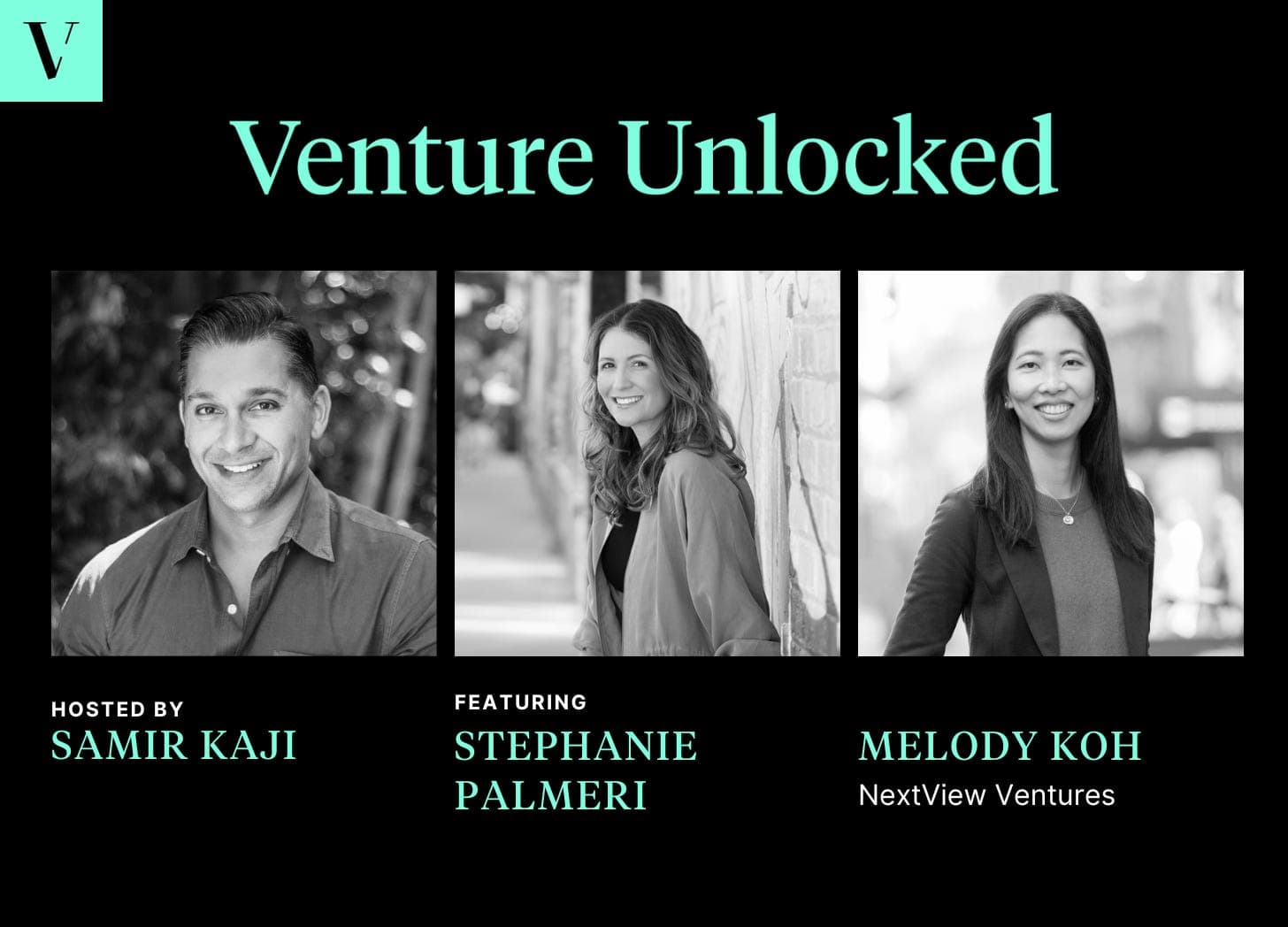
Episode Overview In this episode of Venture Unlocked, host Samir Kaji speaks with Stephanie Palmeri and Melody Koh, partners at NextView Ventures. They discuss various aspects of venture capital including partnership dynamics, the current landscape of seed financing, and strategies for effective remote operations. NextView Ventures recently raised $200 million and has a strong foundation in seed-stage investments across various sectors.
Key Highlights
- NextView Ventures Overview:
- Founded in 2010.
- Raised $200 million for their new fund.
- Invested in over 170 companies at the seed stage, including notable firms like Devoted Health and ThreadUp.
- Partnership Dynamics:
- The firm emphasizes collaboration over individualism, avoiding the "lone wolf" mentality.
- All partners share equal carry, promoting trust and teamwork.
- Firm Culture:
- Regular in-person meetings and offsites are crucial for team cohesion, especially with a distributed workforce across San Francisco, New York, and Boston.
- Monthly team gatherings and quarterly offsites help maintain culture and facilitate strategic discussions.
- Investment Philosophy:
- Focus on supportive relationships with founders, viewing their role as "invited guests" in the founder's journey.
- A commitment to not only provide capital but also emotional and strategic support as companies navigate their growth.
Detailed Discussion Points
- Collaboration vs. Individualism
- Quote: “We don’t want to be a federation of lone wolves.”
- Palmeri emphasized the importance of teamwork, sharing insights and being readily available to help each other and their founders.
- Equal Carry Economics
- Melody Koh explained that carrying economics align motivations and enhance collaboration.
- The culture encourages the sharing of responsibilities and successes, fostering a supportive environment.
- Maintaining Culture with Remote Operations
- Regular in-person meetings (monthly) and quarterly offsites are fundamental for maintaining team cohesion and culture.
- Focus on spending quality time together beyond just meetings.
- Investment Strategy
- NextView focuses on a limited number of investments to provide more dedicated attention to each company.
- The firm prioritizes providing strategic and emotional support to founders, particularly in early-stage development.
- Adapting to Market Conditions
- The conversation shifted to how NextView adapted to the fast-moving investment landscape of 2021.
- In current market conditions, the emphasis is on building strong relationships and allowing more time for thorough due diligence.
- Future Outlook for NextView Ventures
- Both Palmeri and Koh are optimistic about the next decade for NextView, focusing on iteration and adapting to new market realities.
- A commitment to continuously reassess and enhance their approach to supporting founders.
Key Takeaways
- Collaboration and Communication: A strong partnership model based on trust and shared economic incentives leads to better outcomes for both the firm and the startups.
- Founder Relationships: Viewing founders as partners rather than clients fosters a supportive environment conducive to long-term success.
- Evolving Strategies: The importance of adapting to market changes and focusing on sustainable growth metrics rather than quick returns.
- Community Building: Leveraging their extensive network of founders to create a more supportive ecosystem for startups.
Conclusion The episode highlights the unique approach of NextView Ventures in fostering a collaborative, founder-friendly environment while navigating the complexities of venture capital in a rapidly changing market. The insights shared by Palmeri and Koh offer valuable lessons for aspiring venture capitalists and entrepreneurs alike.
For more insights, tune into Venture Unlocked on platforms like iTunes or Spotify, and check out their [Substack](https://ventureunlocked.substack.com?utm_medium=podcast) for detailed show notes.
Written by AI. May contain mistakes. Listen to the episode to check what was said.
Transcript
Automatic transcript. May contain errors.0:00Welcome back to another episode of Venture Unlocked, the podcast that takes you behind the scenes of the business of venture capital. I'm your host, Samir Kaji, and this week on the show, we're joined by Stephanie Palmieri and Melody Co., partners at NextView Ventures. NextView was founded in 2010 and recently raised$200 million for their new set of funds, located in San Francisco, New York, and Boston. The firm invests all across the U.S. and has currently invested in over 170 companies at the seed stage since founding, including companies such as Devoted Health, thread up and attentive. We had a great conversation about how next to you thinks about VC partnerships, what seed and pre-seed investing looks like today, and what they believe it means to be successful in working with founders.
0:42We really hope you enjoy my conversation with Stephanie and Melody, and let's get right into it. Samir Khadji is the CEO and co-founder of Allocate. Allocate and Venture Unlocked are independent of each other. Any statements or references made by Samir or his guests regarding third parties, investments, or securities are solely their views and opinions and are not intended as investment advice or an endorsement of such parties or securities by Samir, his guests, or Allocate. Allocate or its clients may maintain relationships with or investment positions in guests, third parties, or securities mentioned in this podcast.
1:16This podcast is for informational purposes only and should not be relied upon as a basis for investment decisions. Stephanie and Melody, it's so great to have you on the show today. Thanks for joining us. Thanks for having us. Yeah, thanks for having us. So before this chat, I was reading an article that announced the most recent funds. And within that article, there was a quote that stood out to me, and it went something along to the effect of, as a partnership, we don't want to be a federation of lone wolves. And I'd love to maybe start of what does it actually mean in terms of the day-to-day partnership?
1:50And Stephanie, you just joined a year ago. Why did that speak to you? I'm not new to NextU in the sense that I've actually known my partners for the past dozen years in which I've been an early stage seed investor. And one of the biggest reasons why I wanted to join this team was because we function as a team. And I think that's fairly unique within how venture firms operate. And I think one might be able to say like, hey, this is a firm that has offices in Boston, in New York, and now San Francisco. how do you orient yourselves around being a team when you're actually more distributed than most firms, let alone seed firms?
2:29And the reality is we're constantly connected to one another. You know, we have our formal partner meetings and team meetings where we're touching base, but we're constantly sharing insights that we're seeing, ideas we're hearing from founders coming to each other as partners early with problems we're trying to solve on behalf of the companies we're working with. So I think that constant communication and trust in each other that we can come with not just the good news, but also the bad news really creates this foundation where we're there to support each other just as much as we're there to support the founders that we value.
3:02So one of the things that also stood out to me when I was reading the article is this concept of equal carry with all partners. And regardless whether they're a founding partner or somebody like yourself that just joined. Benchmark has been pretty famous for having this type of model, which has worked incredibly well for them. But Melody, you've been with the organization now, I think since 2017. Tell us why this has been so important to align economics with this model of not a single person, but a team and how that works in practice. A lot of times economics drive action, you know, business model drive behavior, right?
3:41So it was really important concept for me when I first joined, uh, next view and just kind of how we operate, because I personally want it to be at a place that is truly collaborative. I think every firm you talk to is like, Oh, we're collaborative and we work together. But I, I firmly believe, um, you know, the economic design drive behavior outcome. Right. So, uh, in reality, you know, when you're truly equal, that really implies a high level of trust, which is a prerequisite so i think that you know smaller firms can do this and larger partnership is you know this is a more difficult thing to do but you know i think really translates into day-to-day of really there is no keeping score of anything and you know it manifests into little things like we do a decent amount of what we call handoff we don't really think about deal attribution when it comes to who's who sourced it a lot of times it's like maybe it's through my relationship, but then stuff is a better fit.
4:40So stuff takes point or stuff comes to Rob and Lee has more capacity. And so Lee takes it. So we do a lot of handoff and then post investment. We also truly think about it as a next few investment. And we try to be careful with the language we use internally. So we try to say things like, Oh, this is a company that I'm point on for us as opposed to, you know, this is not like my company certainly, or this is not. And we try to make sure that from a language perspective, it really is a next few investment. And practically speaking, if you talk to any next few founders, they'll probably say that, oh, Rob is playing, but Melody has done this and Dave has done that.
5:20And because we really, truly try to think that way. I think that hopefully might have a positive outcome and impact on the companies and the founders that we work with. And Samir, if I might add, I think that becomes even more paramount as you think about we're not just making initial investments in seed and pre-seed companies. We're obviously following on to those opportunities, both from the main core fund. But now that we have an opportunity vehicle, we're also investing out of that in existing portfolio companies. So this idea that we're all shared equally around the table in support of these companies, and we all equally want to see the companies we back and the winners we back continue to be winners, that really matters a lot.
6:04Yeah, and we've seen that where firms that have done well through a team first approach are really strong when it comes to aligning around culture, around things like economics. We saw so many firms in the mid 2000s struggle with generational succession, struggle with getting things like economics right. And we saw a lot of people leave in those firms. And these things are easier said than done. And as you get larger, as you get more distributed as a team, there's just more complexities in terms of keeping the culture in that really aligned team first way. NextViewNow has been around for 12 years, let's say.
6:43You've grown as a team. You have many different people in different locations. How do you think about making sure that the culture remains strong and that you remain this team first and not this federation of lone wolves? It's interesting because I think now post-COVID, a lot of firms are distributed, but we actually started that a couple of years before this whole COVID thing, of course, with Steph joining. So I think we had good practice under our belt. And, you know, fast forward to now what we do, you know, the practical thing that we try to make sure we do is that the whole team, not just the five of us, but the whole next few team get together at least once a month in a single location.
7:28And these days we rotate between New York and SF. That is not an equal amount of travel. In fact, Rob, Dave, and Lee end up traveling the most because they're in Boston. And then we really only meet in New York and San Francisco as a whole team. But I think that's like a culturally very important thing. And we make sure that we don't just meet for team meeting and then we go off and do our own stuff. We try to sit down and have team dinner and really make sure we spend in-person time as a whole team. On top of that, we do quarterly offsites. Some of them are a whole team. Some of them are just the partners.
8:06And again, in-person. I mean, these offsites are not really like quote-unquote fun offsites. These are like most of the time in our lawyer's office or whatnot in the conference room and have strategy discussions. But we really try to over-index on spending in-person time and do the travel internally to make sure that culturally we are in sync. And a lot of times, especially for strategic conversations, it's very hard to do on Zoom. And I'll say even little things now that Steph is in a Bay Area, we have a San Francisco office, we have two different time zones. and we try to be conscious of that and make sure that stuff doesn't wake up and with a bunch of slack conversations and decisions already made by east coast folks because east coast wakes up first so even little things like that we're thinking hey if we were to hire someone else onto the next team down the line we want to put more human beings in the west coast so that culturally we're more conscious of the west coast time zone those are large and small things we try to make sure we we are aware in that different locations have equal footing.
9:11And when we think about doing events in New York, we think about doing events in San Francisco, for example. Ultimately goes back to where supportive of each other as, as teammates, as partners. And, and we work together to find solutions that work for everyone on the team. Right. So when I, when I came on board and I knew I'd be traveling back to New York, which for me is a feature, not a bug. I'm from the East coast. I fly bagels back home with me every time I come out. But it was really important to me to not have to take a red eye or to blow up my Sunday. I have young kids at home. So we shifted our partner meetings to start on Tuesdays.
9:49And that means that everybody can have Monday for your own personal meetings. But if I'm going to be traveling to the East Coast, I've got that buffer of time to actually get there and be ready to spend a full day with my team. So, I think those little subtleties matter. And the fact that we're constantly doing these offsites and checking in with each other, we have the ability to kind of adjust. At the end of the day, we're still a small team, right? So, we can make these tweaks as we go. We can learn. We can test. We can experiment. And I'm really impressed with, again, I'm relatively new to this team, but I'm really impressed at which the speed at which we evaluate and iterate feels very startup-like.
10:29So one thing that I'd like to really unpack a little bit more about, we're all evolving as organizations in terms of figuring out how to work both where we are meeting once in a while together, but also through async, through some of these conversations over Zoom and phone calls. But when you do get together, and I had this conversation with a GP, it's actually two GP firm, and they're in different locations. And one of the things that they do is they get together every single quarter, if not more. But there's things that they really heavily index on during those in-person times. So I'd love to hear how do you think about what are the things that are most important and strategic when you are together that really help not only create this culture, but continue to promote this level of being the best within the pre -seed and seed class?
11:21Yeah, I mean, Melody touched on this a little bit at the start, which is we are together as a team once a month by design. And so again, it could be here in San Francisco. It could be in New York where Melody is based out of. It could be somewhere in the middle where we decide to meet more for a kind of remote offsite. Could be in the lawyer's office again if we're doing a retreat of some sort. But the reality is, it's not just about the productive meeting time. It's really about the fact that after that work time together, we're taking the time to spend some personal time together to share a meal, to not have the conversation revolve necessarily around the agenda from the day.
12:08So we come in and we form an agenda over time and we collaborate on what we're going to spend our time on, whether, again, it's just a team meeting and looking at companies together or whether it's more of a formalized offsite where we've got a strategic agenda or more an operational agenda. But at the end of all of that, at the end of the day, we wrap with doing something that feels a lot more personal and the dialogue and the conversation around the table becomes a lot more personal as well. and I think it allows us to build trust and get to know each other as human beings, not just as colleagues.
12:43Beyond that, of course, you are constantly working on building the firm together, not just investing in companies, but on the investing side, you talked a little bit earlier about not having partner by partner attribution and with the partner team right now being five full-time people, one of the things that I think NextView does that's a little bit different from a lot of seed funds is the number of deals per partner is actually fairly small. In many ways, it represents what we typically see of a traditional Series A firm where one partner is doing two to four deals. Typical seed funds, you have one person managing$40 to$100 million, making up to 10 to 15 investments in some cases per year.
13:27Tell us why you've decided to, for a seed fund that's$135 million, have five partners, fewer deals per partners. What does this actually map back to in terms of your overall objectives with the founders you work with? You know, we do seed and pre-seed. And the reality of these companies is that half of the time where we invest is not even launched as a concept stage or pre-launched business. And the founder journey at this earliest stage, pre-product market fit is pretty up and down. We're not yet at the stage where, oh, here's a little machine and that's amp up the volume of output. We're still in a very early phase of designing what that machine looks like.
14:07Our belief is that we want to bias towards having the senior folks on the team to really be able to spend time with the founders. And that's not necessarily just tactical help, although we do a lot of that as well. I think it's really like mental bandwidth and proactiveness when it comes to these are the three companies that are top of mind for me. And every day I wake up, I think about how's each company making progress? What are the founders of each company needs and be able to be proactive. And I think sometimes I explain this to founders like, look, it's a math problem, right? Every investor has a certain number of hours of the day.
14:47And we want to make sure we're designing the firm so that we can provide the level of attention to the small number of founders that each of us work with. So that's kind of the idea and why we bias towards that. And I'll say the other thing is that we just, I think we as human beings enjoy that style of collaboration and working with the founders that we invest in that has kind of really transpired over the years. And I think if you look at that further from sort of more of an LP perspective or shareholder perspective, it also allows us to concentrate where our dollars are going. The output of that is that when we're able to build ownership at the very start by concentrating our dollars, and then we can continue to concentrate those dollars in the companies that we think are going to drive real value for our shareholders or LPs.
15:34Given that backdrop of only doing two to three companies per year, spending a lot of time with each one of those companies versus treating them as call options for the future. I would presume that the diligence and the decision making process is highly involved with the entire partnership, you're spending a lot of time before making those investments, because it is such a impact on your own time from an opportunity cost standpoint, on the companies you do versus the ones you don't. How do you then think about what happened in 2021? So 2021, I feel everybody was moving at hyperspeed, there was so much capital slushing around the system.
16:17And the time to actually make decisions for seed stage pre-seed was actually really quick. Tell us a little bit about how this model worked during times of high velocity and what you're right now seeing within the pre-seed and seed market. Yeah, back in 21, this is before Steph joined, you know, honestly, I think that it was, it was difficult. It was difficult for, I think, not just us, but for many folks who were forced to make a decision in a week or sometimes even less. I would say that there are certain areas that we think a lot about and we have more of a prepared mind. And in those situations, then we can make a pretty quick decision.
16:59Again, because a lot of times we're invested in pre-launch and pre-traction companies. So that's really just about forming an opinion and a judgment on the team and our thoughts around the market. The other style of investment with founders, we've been able to build a relationship for an amount of time before those founders started their formal process. So in those situations, we're also able to make a decision fairly quickly. But I will say that I think there were certain instances where we just couldn't build conviction quickly enough, which I think happened to everybody in that 21 and early 22 timeframe.
17:45And there are probably a few investments that we had to really kind of hustle and accelerate our decision-making and conviction building process faster than we probably feel comfortable with. We always say that when we first meet a founder, so we'll get back to you in a week where our heads are at. And it's either we'll do more work, in which case we tell you kind of the roadmap of the work or we pass if it's not a fit. So we never want to try to sit on it for longer than a week in terms of our internal process, regardless of what the market environment looks like. But I think it is nice now that we can get to know the team better.
18:21We can have more than one meeting. We can actually dig in to the data for companies that are post-launched and have data to look at. So it is a slightly different pace where we're sitting in now in 2023. If I might add, I think everybody benefits from that. It's not just the investors that benefit from having more time. And we're not talking about months, right? We're talking still at Seed. Seed still moves a lot faster than downstream. So we might be talking weeks, but more time, founders also benefit from having more time. And at the end of the day, it's a relationship that's going to be a lasting relationship for many, many years.
18:59And so I think both sides of the table having the opportunity to get to know each other and get to know not just a person, but also a team through a process is really important for everyone. There are challenges to a market when a market slows down and when prices start to come down. But at the same time, there are benefits, I think, that are long-term benefits, like the ability to form stronger opinions and stronger relationships before entering into an investment on both sides. I would agree with that 100%. And I do think that from a founder perspective, we were all moving at this warp speed that we had never seen before.
19:39And you really never got to assess, both as a founder, whether a venture firm was actually right for you from a personality standpoint, ability to alter the outcome of the company. And ultimately, all startups go through peaks and valleys. And you really want somebody that really relates to you and has a similar sort of value set. And we just never had the opportunity in 2021 to have enough time to understand on either side, whether that was going to be the case. And I do think obviously now things have slowed down. Precedency very different from later stage. Later stage has slowed down dramatically.
20:18And even at the Series A, oftentimes it could be a month or greater of the process of meeting versus getting to a term sheet and closing. But when you look at today's market and you're doing pre-seed and seed, we are in a different climate whereby getting that Series A is a little bit harder than before. We were, in many cases, and I'm sure you both saw this, in 21, oftentimes we saw a seed go to a Series A in six months, in nine months, without a lot of tangible progress by the company. And now that Series A market has shifted, the goalposts have moved. How do you now think about investing in companies knowing that the milestones that companies need to meet may be materially different than we've seen in a long time?
21:04I think that is very true right now, Samira. And there's a lot of things to think about. The first is, and I think this is true regardless of the market in which we invest in. And again, we concentrate our investments, but I think we've always had a mindset that companies should be raising when they're at this early of a stage with a goal towards, call it 24 months of runway. I don't think that's a huge internal shift, but the shift here is now for everyone around the table to realize that that runway actually does have to last for 24 months or until you have the traction to show you can graduate to that next level.
21:42I think one factor, you know, in the same way we're talking about how decisions have been made very fast, that was happening at every single stage of venture investing for the last couple of last few years. It goes back again to building these long term relationships. And so I think we are now in a shift where, you know, six to nine months out, a company that we've backed and we've supported at Seed is going to start thinking about building relationships with the firms and the partners who might invest in that company's next round of financing, as opposed to hitting the market to raise prematurely.
22:24So, you know, in a sense, we're going back to a model where building a long-term relationship, being able to show proof points around the company making progress against its milestones, I think will matter more. And again, companies aren't going to necessarily be hitting the market six months after they close the seed round. But those founders will be out meeting investors with a mindset of this is a long term relationship I'm building and I'm just starting a relationship today to build to a raise months, if not a year out. Yeah, I completely agree. And one thing I would just add is, I think in addition to what Steph mentioned in terms of 24 months run when it really needs to show real progress, as opposed to just relying on the hype to push you forward to the next round of financing, I think in this environment, there's probably another level of conscious decision around how do we get to not necessarily profitable, but capital efficient growth.
23:27And in the way that you have to show traction is no longer just, hey, let's burn through a ton of dough and just focus on the top line. It's like, how do we show proof points around unit economics in day five and be able to show growth still at the earliest stage while showcasing your eventual unit economics when the next round of financing is around the corner? Yeah, it's funny. I mean, that's going to be a wake-up call, I think, for a lot of founders who are going out to market in the next year who have raised a pre-seed and then a seed and then another safe and another safe on top of that. And you start to look at where revenue and product is relative to the amount of capital already invested in the company.
24:10And when there's a mismatch there, it becomes quite difficult, I think, for the next level of investor to step in and do kind of that larger price round. Yeah, we're definitely seeing that anecdotally, and I'm sure the data will support that in terms of the number of pre-seed and seed companies that go on to raise a Series A. And it is going to be difficult for those that raise far too much money at too high of a valuation, and maybe even more so difficult for those that never really had a clear lead to help them navigate through the markets. And in today's world, of course, being a good venture firm is even harder.
24:48You know, those rounds, those markups aren't coming as quickly. And I remember reading this quote from Fred Wilson some time back, and he was just thinking about what does it mean to serve the founder community? And he said, as a fund or as a venture firm, our clients are and our customers are the founders, our LPs are the shareholders. and I'd love to get your view on how you think about your founders and are they your clients? And then ultimately, what do you do differently in today's market to make sure that you're serving your founders in a way that really helps them through what could be a very difficult equity climate for the next year or two?
25:27Fred refers to the founders that Union Square works with as customers, at NextView, we think of ourselves as invited guests with the founders that we are supporting. We look at it very much as a privilege to be part of the cap table and to be alongside that founder on their journey. For me personally, I actually got my coaching certification last year. And I did that in part because I very much view the role that I'm in as an investor and and oftentimes a lead investor, as supporting the founders of that company, the founders that we as a firm have backed in making decisions that will help the company as well as the founders of that company be successful.
26:17They're so closely tied together at Seed. I think that mindset, obviously, again, kind of lends itself to concentration of capital. It lends itself to viewing our role as not only to not do harm, but also to be in support of founders getting their vision, their company, their teams to that next level. You know, Samir, you mentioned party round. I remember having this conversation a couple of months ago with a founder that we recently let the seed round for. And we were talking about how to think about syndicate construction. And this founder has had many options. And I told him, I was like, look, think about who's going to give a damn relative to their check size, their model, their fund size.
27:02And I would highly encourage you to prioritize for the folks that is going to give a damn if they must. And again, you know, you have to be smart about thinking about their business model in relation to their fund structure and objective and how they work. But I think that has always been important. And that's kind of how we always bias towards thinking about syndicate partners. But I think in this environment is even more important, both for the company and also making sure that they're like-minded co-investors around the table to roll up the sleeves and do the work together. The other thing is another investment that we recently led, and this founder was doing references on us.
27:47And he called a couple other founders that I've worked with. and he, he told me that one of, he shared the reference results back with me, which was nice. And then he said, you know, one of the founders that said that I was her ride or die in the first two years. And I, I was, it was very nice of her to say that, but I also think that's kind of how we, we ought to think about how we actually do work and present ourselves and, and support founders in that, in that early state journey. So I thought it was kind of interesting, of course very nice of her to say that but given like step set given our model we inherently are concentrated and we can really be there to support the journey and not only just like kind of the strategic advice and things like that but really like emotionally just be there for them and be available if i may i want to double click on this a little bit around this concept of founder experience and i will go to something i'm familiar with which is net promoter score or nps and how that translates within the firm on how you get to high founder NPS, which of course, if you get that right, your sourcing, your winning gets better.
Read the full transcript
29:00And as an LP, a lot of LPs do weigh heavily the references they do with founders that the firm is backed. And we talk about invited guests, but how does that translate into high founder NPS? What are some of the KPIs you think about. The reason we use this invited guest analogy is, you know, you think about dinner party and we're one of the invited guests to the dinner party and the dinner table. And there are a couple of things as a good invited guest you should do, right? One is show up on time, which by the way, sounds very basic, but apparently if you show up on time, a hundred percent of the time, you're outperforming a lot of other investors, you know, like other things like use good table manners, right.
29:45Out of respect of the host's time and effort, right. And show respect for the host and their home and things like help clean up dishes, but don't take over the cooking. Right. So I think those are interesting ways to think about how we should act, you know, like meaning, right. We shouldn't really be cooking. So we're not, we're not the executive chef or the CEO, but we should help clean up the dishes and, and pick up stuff that we can really be high impact at the earliest stage where the founder asks us to roll up our sleeves to be helpful and just identify things that we could really support the founders and the teams and the company.
30:25You know, the other thing, you know, you mentioned kind of founder friendliness. Our job is to really be honest. You know, I think usually when we kick off a relationship, when I personally kick off a relationship with the founder, you know, usually we try to talk about what will contribute to a successful relationship between me and us and the founders. And I usually say that if we can be transparent with each other, then we can cut through the BS and go to work. And we can really get down to the bottom of what we need to get, what we need to do and what we need to get done to get to the next level as a company.
31:00And there's difference between like telling the truth and also like the specific delivery method, right? So you can be artful in terms of your delivery so that you can influence as an investor. But at the end of the day, I think as especially a seed investor, and I think we have the advantage of that because we're not going to lead your next round. So I'm usually very aligned with, you know, we're as seriously preferred, we're as aligned as you possibly can right next to the common, the founder stock. So because of that, we can really be truthful and honest. And I think our job is to really tell the good and the bad, but of course we ought to be very sensitive and artful in terms of how we best deliver that so that to maximize the impact on the receiving end and the results for the company.
31:52At Seed, when we're supporting and backing founders, we're backing them because we have a belief that they have an expertise and a unique vision and ability to execute on the opportunity that they're going after. And really, the founders we're supporting are in the driver's seat. They're the only ones that really can see the full road ahead of them. We're getting information from them. Now, there's times where there's some information asymmetry, where we as investors may actually have a different set of information. And sometimes that information is going to be really valuable, right? And that might be, we've got a host of companies that are in market at any given time fundraising.
32:31So we may have a pulse on what the milestones that a Series A investor is going to want to see. And I think it's a lot of our job to kind of communicate that information back. And at the end of the day, help the founder that we're supporting make sense of what they're seeing and then the data that we're able to share to kind of support their own decision making. That makes a lot of sense. And I appreciate both of you going through this concept of what does it actually mean to drive real value to a founder across many dimensions, including this definition of founder-friendly, which we had this conversation just a few days ago.
33:10And at the end of the day, founder-friendly is doing whatever it takes, in my mind, of helping that company get to the next level, helping all the shareholders, including the founders, be successful. And that sometimes does require that level of brutal honesty when you see something going in a direction that isn't going to help optimize the company's outcome. All of which you said, I agree with, and it certainly resonates with me. You know, as you think about businesses, I also think about not just the businesses you're investing in, which are kind of the pre-seed, seed level, but your own business.
33:47Now that it's been over a decade of NextView. And of course, the firm has evolved with the two of you joining over the last half decade, and Steph, you over the last six months, really. How do you now look at the next 10 years of NextView? The market has reset. The first 10 years were definitely during a period of financial exuberance. The markets have shifted, and who knows how long your rates will be where they are. We'll probably see a reduction at some point. But at the same time, the world is different. The number of venture firms has increased so dramatically over this past decade. How are you thinking about the evolution of NextView and what really gets you excited in terms of the growth of the firm and where you really focus in the 2020s?
34:33Seed investing as an asset class has changed dramatically since NextView was founded. And we're one of the earliest institutional seed funds. When I got started seed investing a dozen years ago, there were maybe 15, 20 institutionalized seed funds in the market. And now if we look around, there are hundreds, if not thousands. So I think one of the big things that's interesting as we kind of enter into a new decade, as we are actually beyond that decade, right? We have a really unique asset in terms of institutional stability, in terms of having backed hundreds of companies and founders over the past dozen years.
35:18And so, you know, as our market has changed, so have we. And I think in this next phase of our firm's life, we get a chance to not only continue to support founders at the earliest stages, but change how we are able to play the game because we've been in the game long enough to have some real data. And we've been in the game long enough to know how this business works in a way where we can assess what's worked for us and what hasn't worked for us and what will work for us in the future over time. And so it's a long winded way of saying, you know, one of the things I'm most excited about, about being part of this team is we're actually constantly thinking about how we're competitive in the market, how our offering to founders that we want to support to companies that we want to support is resonating and how we want to support those companies once they become part of the portfolio.
36:13and how we want to support those founders once they enter into a relationship with us. And so we're constantly rethinking how we go to market and how we support companies. And we do it, I think, in a very, very iterative way. We're currently investing out of our fifth fund. We've been investing as a firm for over a dozen years. And we have a real community of founders that we've worked with over the past dozen years and continue to build that next me family out with the next generations of founders that we hopefully have the opportunity to work with. So I think part of it really gets me excited over the next decade is that how do we connect the dots even more?
36:57Because I think in this post-COVID era, there is a void in kind of a support system, right? I mean, we historically has always had this model of kind of partner-centric approach approach in supporting founders and being there. But we're just, you know, yes, we're very concentrated and we have more bandwidth and we only take on a couple of companies a year, but we're still one person. And I think that in a post COVID hybrid work environment where people are not necessarily co-located, maybe we as a firm can provide even more of that support system or community for our founders going forward. And we do have the assets of really, you know, hundreds of founders we had the opportunity to work with over the past dozen years.
37:44And I think it's something that we're actively thinking about how to do that to really kind of amp up the support for our community going forward. So that I'm pretty excited about. And I think that Steph alluded to it too, that this is a group that is, you know, very disciplined, but not dogmatic and is very open to iterating how we do things, despite folks on the team have 10 plus years of venture investing experience. I think we're above average at like, hey, let's throw everything we know out of the door and rethink some of the stuff that we do, hopefully for the positive in terms of how we work with founders and support them.
38:29And if I'm right at, I mean, that's one of the benefits of the fact that we're doing quarterly off-sites. You know, we're actually coming together on a rate, on a fairly regular cadence relative to, I think, a lot of firms to assess the objectives that we have or the initiatives that we have that we're trying to either test out or maybe bring to market, right? I think that's very different relative to a lot of at least traditional venture institutions. Well, the NextView brand definitely has evolved and grown and become very, very strong in the market. And I really appreciate the two of you coming on and sharing your great insights and really looking forward to the next generation and the next decade of NextView.
39:12So thank you. Samir, thanks so much. This has been really fun. Yeah, no, this is awesome. Thank you. Thanks so much for listening to another episode of Venture Unlocked. We really hope you enjoyed our conversation with Stephanie and Melody. To learn more about them or NextView, be sure to go to VentureUnlocked.substack.com for detailed notes on the show. Venture Unlocked is also available on iTunes or Spotify for download. And while you're there, please leave us a rating and a review as it really helps us out. And don't forget to hit the subscribe button in order to get each and every Venture Unlocked episode as soon as it's released.
40:00Thank you.
From the publisher
Follow me @samirkaji for my thoughts on the venture market, with a focus on the continued evolution of the VC landscape.
We’re joined by Stephanie Palmeri and Melody Koh, Partners at NextView Ventures. Nextview was founded in 2010 and recently raised $200MM for their new set of funds. Located in SF, NY, and Boston, the firm invests all across the US and has invested in over 170 companies at the seed-stage since its founding, including Devoted Health, Thread up, and Attentive. We had a great conversation about how NextView thinks about firm partnerships, what seed and pre-seed investing look like today, and what they believe it means to successfully work with founders.
About Stephanie Palmeri:Stephanie is a Partner at NextView Ventures and is based in San Francisco. She focuses on the power of technology to positively transform how we live, work, learn, play, and care for our planet and each other. Her investments in the “Everyday Economy” have spanned many industries, including social commerce, circular retail, education, digital health, marketplaces, transportation, and finance.
Previously, Stephanie was a partner at Uncork Capital, where she spent a decade investing in dozens of seed stage companies, including Poshmark ($POSH), Clever (aqu. by Kahoot!), Chariot (acq. by Ford), ClassDojo, Carrot Fertility, Hallow, Panorama Education, Phil, Wrapbook, and Wonderschool. Before venture investing, Stephanie worked as a technology consultant and marketer at Accenture, Estee Lauder, and several startups.
Stephanie holds an MBA from Columbia Business School and a BS in Marketing and Management Information Systems, magna cum laude, from Villanova University.
About Melody Koh:Melody is a Partner at NextView Ventures, based in its New York office.
Prior to joining NextView, Melody was Head of Product at Blue Apron (NYSE: APRN). Melody joined Blue Apron as the first product hire when the company was 18 months old with 20 HQ employees. She helped scale the business through hyper-growth (25x in 3.5 years) and to its IPO.
Previously, Melody was a Product Manager at Fab.com leading marketing & analytics products and the founder/CEO of a seed-funded wine subscription e-commerce service. Melody was also a venture investor at Time Warner’s strategic VC group and was one of six inaugural members of First Round Capital’s Product Co-op initiative. Melody began her career as a tech/media M&A investment banking analyst at Evercore Partners.
Melody holds an MBA from the Harvard Business School and the University of Virginia.
In this episode. we discuss:(01:54) Why NextView strives to not be a pack of lone wolves(03:35) How the carry economics of the firm drives a deeper partnership(06:57) Building firm culture with so many locations(11:21) How NextView uses strategic in-person time to remain connected(13:42) The benefits to founders by being more strategic in their investments(16:33) How the NextView model performed in the different market conditions over the last few years(21:04) What the moving goalposts of the market has meant to founders and investors(25:27) The advice they are giving founders to get through this difficult funding cycle(29:18) Why NextView sees themselves as invited guests and why that translates to happy founders(34:31) How they think about the growth and evolution of NextView
I’d love to know what you took away from this conversation with Stephanie and Melody. Follow me @SamirKaji and give me your insights and questions with the hashtag #ventureunlocked. If you’d like to be considered as a guest or have someone you’d like to hear from (GP or LP), drop me a direct message on Twitter.
Podcast Production support provided by Agent Bee
This is a public episode. If you would like to discuss this with other subscribers or get access to bonus episodes, visit ventureunlocked.substack.com