In short
Podcast Episode Summary: Venture Unlocked - Sunil Nagaraj of Ubiquity Ventures
Episode Overview
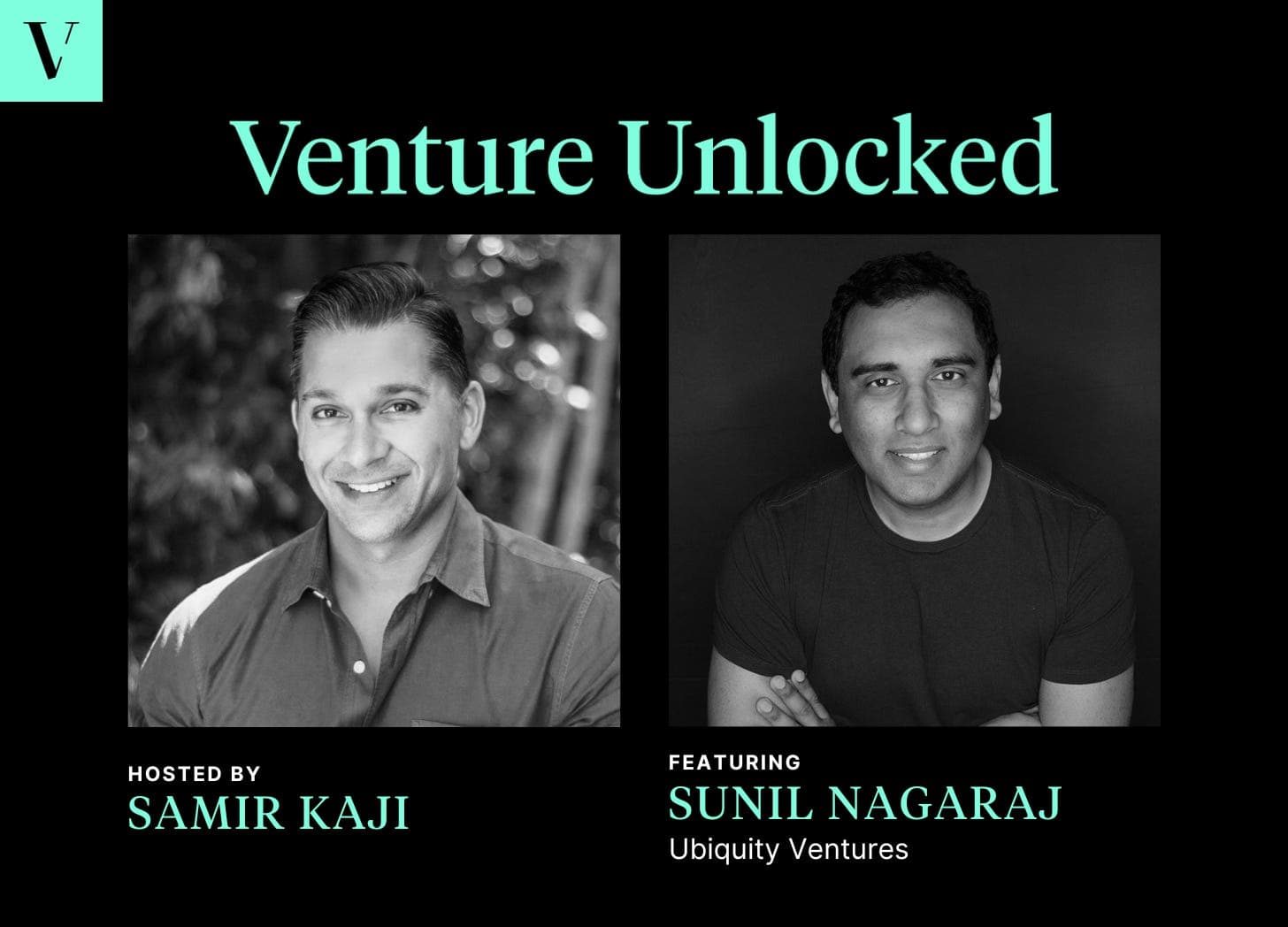
- Podcast Title: Venture Unlocked: The playbook for venture capital managers
- Host: Samir Kaji
- Guest: Sunil Nagaraj, Founder of Ubiquity Ventures
- Episode Title: Sunil Nagaraj of Ubiquity Ventures on the journey of a solo-GP, The Importance of Authenticity, and Navigating Hype Cycles
- Release Date: (not specified in the transcript)
Episode Description In this episode, Samir Kaji interviews Sunil Nagaraj, a solo General Partner (GP) and founder of Ubiquity Ventures, which focuses on backing technical founders in the pre-seed and seed stages. The conversation covers Sunil's career journey, the nuances of operating as a solo GP, the challenges of fundraising, and navigating the current venture capital landscape, particularly in light of recent hype cycles.
Key Themes and Discussions
- Sunil's Career Journey
- Background: Sunil has a diverse background in management consulting, entrepreneurship, and venture capital. He worked at Bain & Company and Bessemer Venture Partners before founding Ubiquity Ventures in 2017.
- Nerdy and Early Thesis: Sunil's investment focus revolves around "nerdy and early" startups, emphasizing deep technical expertise in founders.
- Transition to Solo GP
- Reasons for Going Solo:
- Wanted autonomy and the ability to make nimble decisions.
- Felt the need to create a firm that focuses deeply on a specific sector (software beyond the screen).
- Challenges:
- Building credibility as a solo GP, especially in a venture capital environment where partnerships are common.
- Fundraising experience was tricky and took 18-24 months.
- Fundraising for Ubiquity Ventures
- Initial Fundraising Challenges:
- Sunil lacked prior relationships with Limited Partners (LPs).
- Misunderstood the nature of LP decision-making, initially treating it like a startup fundraising process.
- Key Learning: Building relationships is crucial; LPs are often not as responsive to pressure tactics as startup investors.
- Investment Strategy
- Focus Area: Ubiquity Ventures invests in startups that utilize smart hardware and machine learning to solve real-world problems.
- Typical Investment Stages: Primarily pre-seed and seed, with a focus on technical founders who can code.
- Philosophy: Emphasizes the importance of team dynamics and founder capabilities over purely technical factors.
- Navigating Hype Cycles
- Current Market Observations:
- Generative AI is identified as a significant area of interest but is perceived as overfunded.
- Sunil expresses caution regarding investing during hype cycles, advocating for careful evaluation of opportunities.
- Future Opportunities: Looking for second-order impacts of generative AI rather than initial wave investments.
- Lessons Learned
- Biggest Mistakes:
- Initial investments that overlooked team dynamics leading to failure.
- Missed opportunities due to communication gaps with colleagues regarding the technical value of companies.
- Advice to Founders: Emphasizes the importance of authenticity and maintaining long-term relationships.
Key Takeaways
- Authenticity Matters: Building a reputation and authenticity in venture capital can lead to long-term success.
- Niche Focus: Specializing in a specific sector can lead to deeper insights and stronger investment decisions.
- Adaptability: The ability to navigate hype cycles and market changes requires a balance of caution and opportunism.
Conclusion The episode provides a comprehensive look at Sunil Nagaraj’s journey and insights into the venture capital world, particularly from the perspective of a solo GP. His focus on authenticity, careful investment strategy, and deep technical expertise sets a blueprint for emerging venture capitalists and founders alike.
For more insights, follow the podcast and check out Ubiquity Ventures' work.
Written by AI. May contain mistakes. Listen to the episode to check what was said.
Transcript
Automatic transcript. May contain errors.0:00Welcome back to another episode of Venture Unlocked, the podcast that takes you behind the scenes of the business of venture capital. I'm your host, Samir Kaji, and on this week's show, I'm thrilled to be joined by Sunil Nagaraj, founder of Ubiquiti Ventures. Sunil started Ubiquiti in 2017 to focus on backing technical founders at the pre-seed and seed stages around a thesis he calls nerdy and early. Before starting Ubiquiti, Sunil spent just over six years at Bessemer Venture Partners, and before that was a founder of a startup company, with so many solo GP firms having emerged over the last decade, it was great to have Sunil take us through his lens of what it means to be a solo GP and how he has built and grown ubiquity over the last six and a half years.
0:42This was a very insightful conversation, and I really think you'll enjoy it. So let's get right into it. I'm absolutely thrilled to have this week's show sponsored by Frank Remmerman, who serve as home for over 500 VC firms for their tax and audit needs. They're also one of the largest providers of services for the emerging manager community. And as somebody that's worked with them for over 10 years, I can attest to the early commitment they made to MicroVC when it was first getting started. If you're a venture firm in the market for audit and tax, be sure to give them a call. Samir Kaji is the CEO and co-founder of Allocate.
1:18Allocate and Venture Unlocked are independent of each other. Any statements or references made by Samir or his guests regarding third parties, investments, or securities are solely their views and opinions and are not intended as investment advice or an endorsement of such parties or securities by Samir, his guests, or Allocate. Allocate or its clients may maintain relationships with or investment positions in guests, third parties, or securities mentioned in this podcast. This podcast is for informational purposes only and should not be relied upon as a basis for investment decisions. Sunil, it's so great to see you and thanks for being on the show.
1:53Hi, Samir. Happy to be here. There's so much we have to unpack during this conversation, but I want to go back a little bit. You've had so many experiences in management consulting. You've been an entrepreneur leading a company. You went into venture at a traditional organization, then started your own firm. Talk a little bit about your journey into tech and venture, and then what led up to starting Ubiquity almost six years ago. As many folks who know me will say, I'm a nerd through and through, and that's been true since I was a little kid. My dad was an engineer. I've always been tinkering with technology, coding, fiddling with gadgets, and that continues through to today.
2:29You touched on a few pieces of the puzzle. Going to college, I studied computer science, started the computer science club, loved bringing technical folks together, loved learning out of the newest technologies. And then I did good management consulting. I went to Bain & Company, which is a bit of a left turn. I'll tell you, I did that because I had interned at Microsoft one summer. And somewhere along the way of being in a technical internship at Microsoft, I heard from one of the leaders, Steve Sanofsky. He was talking about how he and Bill Gates had split the company into four P &Ls. And I remember being just stupefied by what the heck was a P &L?
3:02How was somebody technical and important using a word I had that was way over my head? When I went back to school, I immediately accepted an offer to go to Bain & Company Management Consulting. And beefed up on the business skills, beefed up on communication and framing. That was useful. But honestly, nights and weekends, I was coding. I was working on a bunch of different technical projects. This goes back to 2004, 2005, and tried to stay sharp along the way. I went to business school at Harvard. And even there, I was president of the Tech Club, ran the Tech Conference. So just immersing myself in tech and people has always been a big part of the puzzle.
3:33Later, you'll see with Ubiquiti, that's sort of the formula to success on the new venture fund. But back to business school, I moved out in 2009 to the Bay Area. I started an online dating company, as you referenced, being an entrepreneur for a little bit. I wanted to use tech to understand what makes people tick. So I did that for two years, had some backing from Trinity Ventures to bring to market this idea that what you do is more important than what you say. So could you build a dating site that triangulates on who Samir really is? If I had access with your permission to your Facebook, Netflix, Twitter, I could build a picture of who you really are and use machine learning to find you matches.
4:11So did that for two years. Lots of zigs and zags. We can go into that if we want to. But suffice it to say, running a seed stage ML company got me a lot of great experiences and helps me understand my founders that I back today. About half of what I do is back seed stage ML founders. That was ultimately unsuccessful. So failed with Triangulate also helps me understand another important part of the entrepreneurial journey. And it was at that point that I joined Bessemer, the big VC firm in 2011. So you were at Bessemer for, I believe, a little over six years and then decided to branch off to start Ubiquity.
4:41Tell us a little bit about what inspired the shift to running your own firm and also going down the solo route, because I think about all the things up to that point, whether it be at Bain, whether it be at Bessemer, you always had colleagues and partners to work with. why did you decide to go down the solo path? The first part of your question, why would I decide to leave Bessemer? I think it's a similar answer to anyone that starts anything. There's three components. Number one is you actually have learned how to do the job, right? You actually know what you're doing. This could apply to a lemonade stand.
5:12It can apply to starting a venture capital firm, but you've learned how to do the practice. Number two, you have external credibility. You can convince other people you know how to do it. Now, those two sound like that would be sufficient, but with every single person I know that started anything, There's always a third component. And that is a straw that breaks the camel's back. One day you say, I'm sick of this. I'm going to break off. There needs to be some catalyzing moment. For me at Bessemer, I had been working with David Cowan and other senior partners there, had learned the craft, had learned the practice over six years.
5:41I had external credibility because some of my investments had started to do really well. And then at some point I said, you know what? I want to do this a different way. I want to do it my way, which gets to the second part of your question. You know, when I think about Ubiquiti, I think about bringing along the best of Bessemer, but leaving behind the rest. And for me, the shift was to continue being nerdy and in-depth. At Bessemer, we talk about roadmaps. At Ubiquiti, I have exactly one roadmap. But immersing myself in a sector, getting to know everyone and everything about the sector. And that's true for Bessemer with regard to the specific roadmaps.
6:12The parts that I left behind were that Bessemer was multi-office, multi-sector, multi-stage, multi-billion, multi-multi-multi. And I believe that being a jack of all trades is a losing proposition. I think jack of all trades, master of none. And for me and the way that I wanted to perform venture capital and the way I think you can do it most lucratively for my investors, generate the most return, is to go super deep in one area. So one sector, software beyond the screen, we may talk about that in the future here. One stage, right at the beginnings of companies, zero to 12 month old, brand new companies.
6:45And then one person really focused and everything in the Ubiquiti ecosystem goes through one brain. So the number of synergies and learnings and lessons and the speed and agility is really unparalleled compared to a large firm. So there are tradeoffs, big firm, small firm, but I've gone completely the other end with regard to the swinging pendulum. Well, let's talk a little bit about the solo side for a second, because we have seen so many firms over the last decade start off as solo. And then over time, they add partners in some cases as they scale. You've kept to being a solo partnership. And now, you know, you have three funds under your belt.
7:18Tell us some of those trade-offs between working in a partnership and being solo, both from the standpoint of advantages to be able to make decisions more nimbly. That's the one that really stands out to me. But maybe some of the considerations for anyone that's thinking about starting either a career in venture, joining a firm, starting their own. What are some of the things that are challenges of being a solo GP? with regard to starting a new firm you often don't get the opportunity to start a new firm with the big bank for almost anyone starting something new you have to start small and i'm leaving that word vague on purpose you start small and if you want to you grow big over time so what that often means if somebody was doing series b investing at a large firm the nature of raising a new fund is you might have to start with a small fund doing seed not because you want to or because you're good at it because that's just a smaller amount of capital and your investors may be dipping their toe in with you to get going.
8:15So that person who did Series A or Series B who starts a new fund will have to grow into a new fund of their own doing Series A and B, but they start with seed. That is a respectable model. It makes sense. That's not at all what I was doing. Within Bessemer, I was focused on seed. I was the most active seed investor at Bessemer. And I knew when I left, I wanted to start a nimble, nerdy and early seed firm. I call Ubiquity and nerdy and early venture capital firm. And I mean every word of that. What that means, contrary to many, many comments I get on a regular basis, I'm not just starting a fund to eventually grow bigger or eventually become an institution or eventually get there one day.
8:54I'm doing exactly what I want to do right now. I apologize if that sounds sanctimonious, but like on day one, I was doing nerdy and early investing out of a$30 million fund. And that's what I want to continue to do. So my intention was never to grow a team, hire assistants, have a fancy office, build an institution, build an asset manager. I wanted to do exactly this. So the funny part of these two paths here is they both start the same. The first year or two or first fund looked like a small, relatively small fund. But I wanted to stay small. For me, it's very important to be able to invest a million dollars a day of incorporation.
9:29That's about half of what I do. And I love that model and I love that stage. And if I grew too big on dollars or grew too big on team, that would actually get in the way of that. One of the things that often comes up, and I think some of this has gone away over the years, is LPs being, in some ways, a little bit circumspect of backing a solo GP, historically at least. And I think some of that changed as people saw some great solo GPs not only grow and scale themselves, but also produce incredible returns, you know, the upper core teletapid returns. But maybe you can go back to that first fundraise back in 2017.
10:08You were in a unique spot leaving a branded firm that had been known, that had done extraordinarily well. So that gave you a little bit of a tailwind. But tell us a little bit about that fundraise. How did it go? Were there things that surprised you along the way? Summer of 2017, I had been at Bessemer for a little over six years, made the decision, as we talked about with those criteria of kind of knowing what I'm doing, thinking I can convince others and then having a straw to break the camel's back, you know, a kick in the pants. And I decided to launch Ubiquity. I had never in my life met an LP before.
10:41I didn't know how LPs looked or talked. Did they wear sandals or suits? I had no clue. But just like every entrepreneur, I sort of jumped off the cliff and decided to build the airplane on the way down and happy to share that the airplane was constructed. But that first fund took somewhere in the order of 18 to 24 months to raise. It was very tricky to raise this. And this is with a top venture capital track record with the support of my partners from Bessemer, all the partners in my office were LPs on my fund to get me off the ground. It's still just a tricky animal raising a new fund. And I'll tell you about two of the biggest mistakes that I made.
11:18Number one was looking at this fundraise of a new fund the same way that an entrepreneur looks at the fundraise for a startup. So I'll tell you, having been a founder of a startup triangulate and interacting with founders, often the way you raise money is to present a compelling value proposition and then put a lot of pressure on it. Hey, I'm getting a term sheet on Friday. Are you in or out? Hey, I just got my lead. Are you in or out? Now I can tell you're smiling at this because this is the complete opposite of how LPs work. Now for a long time, I thought it's just because LPs could take their time that they do take their time.
11:54Because just to be clear, with an LP, you might be building a relationship for six months, a year, or multiple years in order to unlock an LP commitment into your fund. I've come to appreciate that the reason why it takes so long to unlock LP capital and why a relationship is so important is that limited partners are really much further removed from a fund than a VC is from a startup. So with the startups I backed, we now have about 35 companies in the Ubiquiti portfolio, we're involved constantly with all the key decisions. Every week or month, we're getting an update immersed in the operations.
12:27With an LP that invests in a GP, all of that homework is kind of pushed up front. Once an LP commits to a fund, then there's no more decisions. There's no more changing your mind. There's no more evaluating whether the investments are good or not. You have to keep wiring the money per the 100-page limited partner agreement. And that changes dramatically how the whole investment diligence process works. With a startup, again, I might invest in the seed, do some homework, work with the company. And then I make another decision at the Series A and another decision at the Series B. With an LP, it doesn't work like that.
13:00It's sort of all up front. And so it changes the game. And my initial strategy of putting a lot of pressure on LPs that I was closing next week was somewhere between silly and totally laughable. But it was because I had been immersed with entrepreneurs that I thought it worked the same way. Did you have a certain strategy? I mean, with$30 million, institutional capital may not be a great fit given the size of LP check they have to write. And of course, their processes are longer because in many cases, they're not making a single fund decision, but a multi-fund decision up front. So taking what you said and even extending it, if I'm a big institution and endowment and I invest in fund one, it's because I intend on investing in fund two and probably fund three.
13:39What did you learn about the different types of LPs? Coming into this, completely fresh, having never talked to an LP before, institutions versus family offices. And I think there's a lesson for entrepreneurs in here as well. So as a general partner, as a manager, someone running a fund, I hadn't met any LPs. And so I reached out to any LP I had heard about. And often I would hear about LPs if they were on stage at a conference or if they gave a workshop. Now, those sorts of LPs love venture. That sounds great. But they're full with venture, which was the irony of the whole thing. So I would dive bomb on someone right after a conference and say, I have this fund because this LP just spoke about all the great parts of venture.
14:23But it turns out the nature of LPs, most of them have a certain allocation. And if they love venture, they filled up their one or two or five or 10 slots, these larger LPs. So that was part of the problem. And this could apply to an entrepreneur pitching a VC. If they love a sector, they may have already made their bets in that sector. So you really got to find a very particular phase of LP. So there's the LPs that love venture and they're full. Then on the other end of the spectrum, there's the LPs who don't have any venture. And that's on purpose. They hate venture. Where I found the most success, and I was lucky to have some institutional LPs in Fund One, were the LPs who were activating a program, building a program.
14:58These are keywords. Just like startup salespeople have keywords they listen for in a sales conversation. If you told me you had an LP idea for me, I would ask, are they building their program? Are they growing their program? Shifts in allocation are really helpful for a manager trying to raise money, especially a new manager. So in my first closing of FundOne, I was able to have two institutional LPs, Invesco Calsters and Grids Capital join. Later in my fundraising process, Oklahoma State University joined. And all of these LPs were either growing their allocation or had a dedicated allocation for exactly what I was, which was a spin-out manager doing deep tech.
15:34There's another lesson in there about using the right vernacular, the right words. Same for entrepreneurs. You can describe yourself as a platform company changing the world. But instead, if you say you're a SaaS company with CAC, LTV, Payback, that's the way VCs talk about startups. LPs would talk about a manager not as a technical VC who's got a great track record. They would say he's a spin-out manager from a pedigreed fund that with a new strategy that's sector-specific. That vernacular is not something that was available to me in 2017. Now it's a lot easier to raise money because I can think like LPs.
16:06There's this great quote, you know, think like your boss's boss. I think that applies to almost everyone anywhere. And if you can do that, you can unlock a lot more capital. So in many ways, I was able to pigeonhole my strategy into what LPs were looking for and present it with the right terminology. Let's talk a little bit about the vernacular. You know, you mentioned earlier being this nerd all your life. I'll use that because that's how you described yourself. Your tagline for the firm is nerdy and early or beyond the screen. what does that actually mean in respect to the type of companies you're backing?
16:39And I just heard you say deep tech too. Tell us a little bit about what is the actual strategy? How do you look at companies at the pre-seed level that are highly technical in nature, but may not have any real product market fit, just given the stage you're investing in? Ubiquiti is a nerdy and early venture capital firm investing in software beyond the screen. That's about 10 words, and I've selected every single word on purpose. None of it is just lip service. So nerdy and early, let's dissect that for a second. Nerdy means that I code, the people I back can code, they're technical founders.
17:11I have a nerd crew of 50 helpers called the Ubiquity Extended Team. I have nerd events. We had 100 people learning how to solve Rubik's Cubes. We had a different event where 60 folks were listening to how AlphaGo beat the world's best Go player. So everything about Ubiquity always turns to nerd wherever possible. And I have a blog post about nerd, just to be clear. nerd is someone who's obsessed with something to the point of losing track of time and has to evangelize it. You can be a sailing nerd. You can be a piano nerd. You can be a coding nerd. I mean, it's just somebody with incredible depth is really the key there.
17:39So nerdy and then early. Early means that a third of the companies I back are day of incorporation. Most of the companies I back are one or two employees total, almost always pre-revenue, sometimes pre-product. This is the pre-seed seed stage. So nerdy and early venture capital. And then the second part of my tagline here is software beyond the screen. Now, this is a phrase that I say about 100 times a day. I think it's the single biggest area of the world that is underinvested in right now, rife with opportunity. And I would encourage everyone listening to dig into this area. Let me define it for a second.
18:11Software was on a computer that includes anything from CD-ROMs to SAS. Then software moved, it jumped into our pockets on a small mobile phone with a smaller screen. New companies were made, Facebook, Instagram, et cetera. And now there's been another jump. And the key is if you miss a jump, you lose out a lot of opportunity. So it jumped from the computer to the phone, smaller screen. Now it can jump off of the screen. And I mean that very literally, literally take it off your computer and it lands somewhere. These are all real ubiquity portfolio companies. Software can run on the neck of a dairy cow, in a hospital hallway, in space, in your ears.
18:47So this word ubiquity hopefully makes a lot more sense. It's about ubiquitous software. And for software to run in the real world, navigate, perceive, understand the real world, it usually needs a little bit of smart hardware or a little bit of machine learning. So that's the focus of Ubiquity. My whole world revolves around this idea of bringing software to solve real world physical problems using smart hardware and machine learning. Deep tech is a very quick moniker. It means a lot of things to a lot of people. So I don't use deep tech too often. It often also means kind of an obsession with the technology as opposed to the business case.
19:17So if you leave it up to me, I'd say software beyond the screen is the best title. So you did some of this type of investing at Bessemer. That's where you honed your thesis in terms of the type of entrepreneurs that you gravitated toward, you wanted to back. You had some great successes incredibly early on. Maybe you can tell us a little bit about what did you learn from some of those successes in the type of DNA a founder has to have? You mentioned they have to code. They're building something that's really unique in nature. But is there anything different about somebody that's a beyond the screen entrepreneur versus traditional enterprise or consumer entrepreneur that you found?
19:54Let's take the example of Rocket Lab. This was a space investment that my colleague David Cowan and I led in late 2014. Now, there's a few components to that investment that are generalizable here. Number one is that a lot of deep tech areas, many people think are stupid or are a waste of time or the game's already played out. So many deep tech areas are contrarian. I can't tell you how many people patted me on the head and said, Sunil, that's a cute investment. You probably don't remember Iridium from the 90s where$5 billion was lost. Space is hard. Elon says space is hard, et cetera, et cetera.
20:32As a nerd, I hate generalizations. I want to go down to first principles. And with Rocket Lab, there was a first principle that a lot of their engine actually used an electric motor and C++. So it was a software beyond the screen engine, if you want to say that. I can go into more if you're curious. But the key is you want to go past broad, cliche statements and get to the core of it. Because if you do what everyone else does, you're going to be another kid chasing the soccer ball and not make any money. So deep tech is kind of predicated on being comfortable being different and being able to go deeper.
20:58Now, with the example of Rocket Lab, we had found a founder when we met Peter Beck that was deeply immersed in this field for a decade. And that's true for a lot of deep tech founders. It's relatively rare for a successful deep tech company to have an opportunistic entrepreneur sort of jump onto a sector and figure it out. Most of the founders are immersed because they have a great network in the sector. They understand what's been done, what doesn't work. They built up the skills. And with Peter Beck, he'd been doing this for 10 years, building rockets, suborbital sounding rockets that didn't quite go to orbit around the Earth.
21:33So that's true for most of my founders, actually, that they have five years plus of experience in this specific sector. At the same time, there's a watch out that if somebody is too immersed, maybe let me say if someone's too enamored with the technology, they won't be able to come out of the lab and think about the business. So it's a delicate balance between the two. But Rocket Lab is a great example of that. And that was a company that is now a$4 billion public company. And it was, in my opinion, heavily driven by Peter Beck's deep background and this notion of moving it into the software domain.
22:03Throughout this conversation, we've talked about a number of things that it's very clear you've benefited from being a student of the game, continuously learning. You learned how LPs think. You learned what makes for a successful, let's call it beyond the screen entrepreneur. But the longer you're in venture, you're also going to make a lot of mistakes. You're going to make mistakes on investments. Biases are created over time, whether it's a function of the firm you're with or just what you're seeing. Maybe you can describe a little bit about what you've learned in your 12 years as a VC, more specifically, companies that you've learned either what not to do or what to do, really looking at your biggest misses and biggest wins and what you extracted from those.
22:50If I think back to one of the first investments I made at Bessemer, I was, I think, one year into the job, and I found an incredibly interesting theme, had met a company, coincidentally, that was right on track with that theme. So I got very excited. I pushed on the technical depth of the team, three co-founders. Really quickly, we pushed through an investment, and we invested in this company. I'll leave it a little vague on purpose here. The piece that was on track was there was a little bit of a waiting list. The product worked. It was technical. the founders really knew the sector the piece i didn't spend any time on was the team dynamic and the chemistry of how they work together and little by little over the ensuing years the team broke apart that was one of the earlier lessons and bigger lessons was to be incredibly attuned to team dynamics the way that plays out today i'll give you an example i'll meet somewhere between 500 and a thousand companies a year for about 30 minutes.
Read the full transcript
23:49So it's a pretty broad funnel and I invest in three or four companies. So when I take those first pitches for 30 minutes, one of the most surprising things, you may not believe this happens very often, but you'll have two or three founders, they'll be pitching and they'll be on slide three. And one, and the person in charge goes to slide four. One of the co-founders says, no, no, no, go back to slide three. You know, we're not actually sure what he just said, or we might actually do that still. We haven't totally decided. To me, it's like fingernails on a chalkboard. You know, thinking through like team dynamic, you can hear it if you're paying attention.
24:21You just feel awkward for a second to see the team having a mini fight in the middle of a 30-minute pitch. And my thought is that they can't keep it together in the 30 minutes where they're supposed to be on their best behavior and in concert with one another, that's not going to work long term. So that was one of the misses. And it was really going too deep on tech, not enough on team. You spoke about a miss that you had where you invested in a company that may not have worked out because of this founder issue. But a lot of investors I talk to, they say their biggest misses aren't the deals they do because you only could lose one extra money, but it's the deals that you don't do.
24:54Taking a look back, because you have talked to so many founders, 500 to 1 ,000 a year, extrapolate that over 10, 12 years, 10, 12 ,000 companies that you've probably met over time. Can you look back at a company that you didn't do? And now you look back And not only do you understand that, hey, I missed a really big opportunity, but there was some unique or specific lesson that you took out of it. Yeah, the tricky part to your question is sometimes the game isn't fully played out. So I have some I can think of, but in 2023, those valuations have come down. So it's not clear. I'll give you one example.
25:33So I'm a developer. I code. I know how coding works. I coded at my last startup, Triangulate. I'm immersed in this technology. I've been around it forever. So there's a certain level of intimacy I have with this very particular domain. That's why I used to co-lead developer tools at Bessemer. I met a gal named Edith in maybe 2014, 2015, 2016, something like that. And she was telling me about bringing this very common approach of development to the rest of the world. Now, just that notion of take best practices in development and democratize them is a very common thing. and in particular her idea had to do with feature flags so in code you can turn off parts of your code for certain users based on a little flag so for samir don't show him the green button for sunil do show him the green button i had done this myself i knew startups had done this that i knew engineers that had done this at large companies i thought it was a brilliant idea this was at the seed stage it was i forget the number five million or seven million pre-money valuation they had 100 customers of 50 50 users i don't even know if they were paying and i was enamored with this.
26:36One of the issues was, it's kind of a nuanced issue, but I was a Bessemer at the time and I tried to share this with a couple of my colleagues. And without that domain expertise, I was communicating a different language, right? I think I would say, look how cool it is to be able to insert into Python in runtime feature flags that get pulled in so you can show different code. They were like, what's the CAC? What's the LTV, right? So they were sort of talking right past each other. Now I don't work at a big firm anymore, but my livelihood does depend on convincing follow on later stage firms. So I have a unique responsibility and a unique ability to speak nerd, but also to speak later stage VC, if that makes sense.
27:13So LaunchDarkly, we ended up passing on investing at Bessemer. I think three rounds later, Bessemer did invest at a much higher price. I was no longer at the firm, but I do think a lot about how that could have been a better return had I been a better communicator of the technical value and positioning in the terms. So today, when I help my companies raise, Ubiquiti invests at the seed or pre-seed. About 90 % of the time we raise a series A, it's one of the highest graduation rates in the industry. And part of that is being able to translate a nerdy message into a business message without losing some of the authenticity.
27:44So it was a lost opportunity, a missed opportunity when at my old firm, I wish I'd pushed harder, but it's turned into a valuable lesson under Ubiquiti. While you were bringing that up, one thing that you said earlier around keeping your fund sizes small. And when you're investing a million out of a$30 million fund or a$60 million fund, it's a sizable piece of your fund. But ultimately, those companies will go on and need to raise downstream financing from a series A, from a series B. And certainly, you've gotten better at being able to translate very techie language into why does this make sense from a business perspective.
28:23But one of the things that people have increased their fund size for is that some of these companies can be capital intensive or may not be as well understood by mainstream VC, just because they're highly technical in nature. How did you balance between making sure that your fund size was still small enough so you could stay nimble, write those checks that you thought were right sized, but also large enough that if a company was making progress, but not enough for traditional business-minded VCs or the ones that really focus on things like LTV and CAC, that they had enough capital to sustain without having to raise their round with folks like you supporting them?
29:03Yeah, this is a really good question, Samir. It actually gets to a concern a lot of folks have, which is that doing software beyond the screen companies or deep tech companies has a fundamentally different capital journey, has a fundamentally different capital outlay that they're harder. I'm using air quotes here. And I actually think that's not true. So I believe that the companies I back have the same capital profile as a SaaS company. I believe that they'll need about the same amount of capital at about the same time as a traditional SaaS company. The reason I believe that is that I've gone down to first principles and I know that the number of vendors and tools and techniques you can employ now, 3D printing is one example.
29:44A really rich CM ecosystem is an example. A marketplace of design vendors is an example. There's things in place today that can make taking a satellite, building and launching a satellite to orbit as expensive as building and launching a mobile app. And I'm not in hyperbole at all when I say that. Three, four million dollars in either case could get you a new dating app like I ran before or a new satellite in space. And the vast majority of casual observers to deep tech don't realize that, right? And so they think that it requires a lot more capital. So you were asking me about sizing my fund.
30:15I sized my fund in such a way that I I could work with very early stage entrepreneurs, invest in their first round of funding, and reserve enough for one more round of funding. So very simply, I might do a million or a million and a half at seed and a million or million and a half at series A. And then I'm kind of out of capital. But more important to the spirit of your question is that I think that that million and a half should get them to production or production-like revenue. That might be a million and a half of a$2 million round, but it isn't a$20 million round to turn on the product. Those kind of companies do exist.
30:45I don't fund them, right? That's why I say software beyond the screen. Half of my companies have no hardware. The other half have a little bit of hardware. But the goal is to put handcuffs on myself, kind of box myself in that I'm only investing in the slice of deep tech that's very capital efficient because certain technologies and accelerants are being utilized. As we think about then, let's call it deep tech is a very broad category because we are hearing a lot about areas of deep tech that are really interesting. And you've seen firms like Lux, for example, recently announced their new fund, which is north of a billion.
31:18It certainly seems that more capital is going into these companies. Now, I know you don't focus on deep tech as a single area, but you're really looking at these companies that are led by highly technical founders that are beyond the screen. But where do you see opportunities, I guess, within this space? I mean, one area that seems to be generating, no pun intended, a lot of capital going in is generative AI. And just like every cycle, you have these areas that you have overfunding. Where do you see the opportunity, really? And from an investment standpoint, if you go back to AI for a second, where do you see the most potential?
31:59What's notable in the last few months is that generative AI went from on no one's radar, virtually, to on everyone's radar. And I do definitely agree that it's overfunded and that happened quicker than almost any other sector I've ever seen that happen to. Probably there was a backlog of capital because of the latest downturn and folks were interested in jumping onto something. I do think generative AI is a fundamental paradigm shift. Computers were good at store and retrieve like SQL and that was all of Web2. More recently, they were good at identifying patterns. That would be the first wave of machine learning, discriminators, pattern recognition, which was pretty cool.
32:34You could find the cat in an image. You could find fraudulent transactions. The find was the verb. And now, as you're suggesting, the verb is generate. And we're still in very early days, but the sector has gotten funded really quickly because it almost looks like magic. I love this Arthur C. Clarke quote, anything sufficiently advances in this negotiation over magic. And you see this with a 10-word prompt. You can have an image that's photorealistic that blows everyone out of the water. And so there's been a lot of excitement around this. This also fits a workflow need. there was RPA robotic process automation which was a big category of sort of filling in the holes an investment that I made with my colleague David Cowan Zapier was connecting the glue and now you can have smart connecting glue you can have AI work through processes so that the generative piece is pretty amazing the speed with which AI has been pulled into major mainstream products is also unheard of the fact that generative AI can can come out in alpha and in a month or two be in core Microsoft productivity products.
33:31I've never seen that happen in my life. And that's a really big deal. So predicting where it's going to go next is a little tricky for me right now. I'm amidst it. I'm taking these pitches and trying to take a guess. I don't think the very first order of products, the first wave is going to be a great place to invest because there's so much competition. I'm thinking about the second order impacts and the third order impacts. Once you have this stuff, where do you push it? It's tricky. ML, probably more than any other sector, has had such a nice, elegant collaboration between academia and industry that things move so fast.
34:06And I really mean that. In the span of a month, the whole world can change in ML. So that's exciting, but it's tricky for VCs because we need to have some defensibility and some moats around the investments we make. So I'm still thinking about it right now. I don't have any answer for you in terms of specific way to play generative just yet. How would you compare it in terms of potential size to past large platform innovations? And what I mean by platform innovation, It's PC, the internet, mobile, and cloud, right? All of those gave rise to so many different great companies, big companies being built on top of them.
34:40And I know it's very, very early right now, but if you were to forecast this out five, 10 years, do you see a similar impact as past platforms? Absolutely. I think a little bit coming from the other direction, what do humans do that is great or unique? some of the best humans in the world are great pickers whether that's stocks or a doctor or radiologist so that's the pattern identification that we mentioned earlier and that's where ml is thriving and just needs a lot of training data so that's very much up for grabs and could result in a large market size and then the second piece that we're talking about now generative you know the best humans create great reports create great i was a consultant for three years we create great analysis and side decks that's totally within the realm i was at ted last week and greg brockman who was ironically my very first employee at triangulate he's now head of open ai he was presenting about generating um charts and fixing the charts which is what i did as a 22 year old at being so that's up for grabs so in terms of generative uh between generative and discriminate discriminators and generators let's call them so ml pattern recognition and ml creation that seems to cover a lot.
35:50I might even say most of what high paid jobs in the world do. I share a little bit of visceral worry, you know, how much is up for grabs? How exciting is this? How much of this is going to change our society? I like change. This is going to be a ton of change. But along the way, it should be as many dollars sort of shifting as with the other platforms you mentioned, as with mobile, the advent to mobile, et cetera. So how do you think about investing through, ultimately, there's hype cycles that are always exist. Sometimes hype cycles coincide with a huge market cycle like we did in 2021. You know, before this, we saw a lot of dollars go into things like crypto AR VR in the past.
36:30How do you balance between making investments in an area that you know, over time can be quite large, and there's going to be a massive category defining companies versus getting potentially too caught up and overpaying for a lot of marginal companies. It seems like that's a tension that exists with any type of hype cycle. How do you think about navigating that? It'll probably split all the VCs we know right down the middle, whether you should back the jockey or the horse, back the founder or the market, whether you should. I often say most VCs are kids chasing a soccer ball. I want to maintain my field position, even if it looks stupid and sort of be there when the soccer ball is in the right place, but kind of predict it.
37:11So I think it's a constant tension, a related tension. It's not quite the same, but I'm sure you've heard it as well, as many folks will say you shouldn't care about valuation at the seed stage because if it's Uber or Facebook, you won't care. I'm of the complete opposite opinion. I always care a ton about valuation. So it's related to this idea that if you really believe in the sector, you should get in as many dollars as you can anywhere you can because the rising tide will lift all boats. I tend to be a little more picky and a little more skeptical. Still trying to play it out. I have a few bets in generative already.
37:42Parallel Domain is the leader of creating synthetic data for training autonomous vehicles, autonomous systems. Resemble is the emerging leader in creating synthetic speech, both their developer platforms. But I made those investments in 2018 and 2021. So not in the latest wave. So I'm still waiting and looking for my next generative bet. You mentioned, and we touched on something that I hear a lot. So there are people that say valuation, generally speaking, for the best companies will never matter, right? Because you're buying, in effect, an out-of-the-money call option with super long duration to it.
38:16And given the power law and venture, whether you pay$5 or$15 at the end of the day doesn't make sense, or it doesn't really matter too much. On the other side, it's pure math, right? So if you pay three times as much, it is going to impair the overall return profile of the fund. I mean, there's no two ways of balancing that. But there's kind of this middle ground of valuations matter, but there's time to make exceptions. And you have to know as a venture capitalist when to make an exception on things like valuation. We've seen a lot of firms do really well because they made one or two exceptions where they paid more.
38:51The investment didn't fit sort of the normal criteria. What do you think about that? And are there situations where you've went outside of what your normal zone is in terms of ownership, in terms of dollars, in terms of valuation, where you think it's a critical part of just being a good VC? One of the folks we know, Guy at Grids Capital, will say we should have rules, but we shouldn't be beholden to those rules. They shouldn't be the master of us. My wife's PhD from Berkeley in organizational behavior was about kind of replacing the dangers of replacing human thinking with just a bunch of patterns that are written and writing down rules and giving them too much power in their organization, especially fancy formulas.
39:31So I think it is a delicate balance as to when you stick to your strict rules, when you use them to avoid trouble versus when you bend the rules. I still believe fundamentally that the valuation I invest in every single company matters a lot. I also believe that a priori, you just don't know which company is going to become the next Facebook or Uber. So you can't use that. It's actually relatively sloppy logic to say to justify that, especially in a group think multi-person investment committee. Most of the investments I make are at 3 million, 5 million, 7 million pre-money valuations, so really near the beginnings of companies.
40:04But I've joined a Series A once. It was in a domain I knew really, really well. I knew everyone around, and I had a much higher conviction. It was the opposite of why I think a lot of people stretch. Sometimes people stretch because they feel like the train's leaving the station without them. They heard it's super hot. Another way to divide VCs, which drives this home, again, probably half the VCs we know would say one of these two things. If you told me about a company, and this is real, Samir, if you email me tomorrow and say, hey, I have this company, you want to meet them. Some VCs like me will say, what do they do?
40:36Other VCs will say, how are they doing? What do they do? I want to know what the product is, what the features, what's the screenshot, what are the customers like? Other folks will say, who else is investing? How many MAU monthly active users? How much momentum do they have? And these are just two different kinds of investors. This is at seed, by the way. It's not stage dependent. It's just there's folks who kind of look at things differently. You could think of them as like product nerds and finance nerds or fundamentals versus momentum or something. But I think there's a lot of ways to split folks.
41:03I'm glad those differences exist. It adds because very often we syndicate around with one of the other and it makes for a stronger board group. Maybe since we're just talking about venture, we should zoom out for a moment and take a look at what's happening right now. So the last 18 months, of course, have changed from a macro standpoint and that follows roughly 10 years where everything was up and to the right. The number of venture funds coming to market exploded. I think we counted over 2 ,000. Where things are today, certainly everything has slowed down, especially at growth stages, mid-stages, and to a certain degree, early stages.
41:41So we'd love to get your take on what you're seeing. And then how do you think this plays out over the next few years? Yeah, it's a really important thing to pin down. The trajectory of venture capital, is it overheated or underheated? On one hand, when I raised money, it was March 2010 for Triangulate, my dating startup. I raised$750 ,000 at 2.2 pre-money valuation. It was a great valuation. I was the envy of all my HBS peers for raising at such a high valuation. But tomorrow, if you go to the next YC demo day, the lowest pre-money you'll hear is$20 million pre for a similar stage company. So the world does change.
42:19And it's hard to know whether the world's out of control or we're just Luddites falling behind the times. And I think getting that right is really actually pretty important. On one hand, the adoption of technology, the number of installed users, installed phones is 10 or 100x what it was in the past. on the other hand um there's there's capital flows and investment opportunities that's where the macro stuff you were talking about when interest rates are low investors have other don't have other places to put their money and then there's the lessons from the past i wrote a blog post with bill gross of idea lab and it's called why we must never forget to keep forgetting and i actually think it's kind of important that we forget the lessons from the past you know one of the vignettes in the blog post is if you remembered web van too closely from the 90s you would say oh you know little kid you don't know web van it's it'll never work to do groceries online and then you would miss instacart so there's it's it's a dance um honestly you're asking for my opinion i think right now with the state of technology the number of places that go we don't have enough venture capital we don't have enough startups i think they're in this moment there are more opportunities at the same time i hate the idea of unicorns i hate the idea of the newsletters i read uh connie's newsletter added a section about three four years ago you know very big fundings that wasn't a section like when i joined venture capital in 2011.
43:35It was, did you raise a$5 million series A or$10 million B? And the next thing you know, 2019, 2020, you started to have$150 million. Well, you only raised$150 million. So I'm glad, I think those days are gone for a little while. I like the idea of an emergence of a lot of new technologies, new entrepreneurs, new capital. I just prefer the down to earth fundraisings, $5 million,$10 million,$15 million to get things right before you scale, as opposed to working backwards where you think about how big of a round could it be that masa soft banks his capital can and all that stuff was just crazy and i think i think that's gone for a while and i'm glad yeah i agree with you and i yeah it's very clear that's happening both on the the lp and and on the the fund manager side and it's hard not to be excited about the the future of technology and the proliferation of technology in reshaping you know society so i have a very long-term bull case market cycles are going to come and go.
44:29We will have another 2020, 2021 at some point, but certainly right now things have returned to a level of sobriety we haven't seen for a long time. Ending with a question just maybe more broadly, looking back at your entire career, which has now spanned north of two decades, what's your biggest career learning? If you were to go back and give yourself advice in 99, what piece of advice would you give? The biggest thing that I've learned is that authenticity matters. The world is smaller than it seems. People remember. These are all the same statement, but thinking short-term never really works.
45:08Keith Ferrazzi just has this new word called co-elevation. Lifting up everyone together and lifting up your community and doing that authentically and building up each other is so important. And I see, whether you see benefits or not, you should do it. But I see surprising benefits from 12 years later, someone will say, you know, Sunil, you said that thing to me, or you helped me with that thing that changed the direct trajectory of things and vice versa, right? I'll be able to tell that story to others. So it is, despite 330 million Americans, it is a, in your own little pocket of the world, whether that be in the art domain or in the science domain or in venture capital, being a long-term helpful person for a community and doing that authentically is so valuable.
45:48That's great. And it's a great piece of advice. And I agree. I think that you always have to think about every interaction in the long term. What does it mean for somebody? How do you help people? And I think if you do it consistently, you end up finding a lot of success in your career, whether it's venture, any type of career out there. But Sunil, this has been an incredibly enlightening conversation. Thanks again for joining. And congrats on everything you've built so far. Thank you, Samir. Great to be here again. Thanks so much for listening to another episode of Venture Unlocked. We really hope you enjoyed our conversation with Sunil.
46:21To learn more about him or Ubiquiti Ventures, be sure to go to ventureunlocked.substack.com for detailed notes on the show, as well as my ongoing commentary about the world of venture capital. Venture Unlocked is also available on iTunes or Spotify for download. And while you're there, please leave us a rating and a review, as it really helps us out. And don't forget to hit the subscribe button in order to get each and every Venture Unlocked episode as soon as it's released.
47:11Thank you.
From the publisher
Follow me @samirkaji for my thoughts on the venture market, with a focus on the continued evolution of the VC landscape.
On this week’s show, I’m thrilled to be joined by Sunil Nagaraj, Founder of Ubiquity Ventures. Sunil started Ubiquity in 2017 to focus on backing technical founders at the pre-seed and seed stages around a thesis he calls “nerdy and early.” Before starting Ubiquity, Sunil spent just over 6 years at Bessemer Venture Partners, and began his career as a founder of a startup.
With so many solo-GP firms emerging, Sunil took us through us his lens of a solo-GP, and how he has built and grown ubiquity over the last 7 years.
This was a very insightful conversation and I hope you’ll enjoy it.
About Sunil Nagaraj:Sunil Nagaraj is the Founder and Managing Partner of Ubiquity Ventures, a seed-stage institutional venture capital firm with over $150 million under management and a focus on "software beyond the screen"® startups. This includes B2B technology companies that utilize smart hardware or machine learning to solve business problems outside the reach of computers and smartphones.
Prior to founding Ubiquity Ventures, Sunil spent the better part of a decade with Bessemer Venture Partners where his work included leading the seed rounds of Auth0 (acquired by Okta for $6.5 billion) and Zapier as well as investments in Rocket Lab (NASDAQ: RKLB), Spire (NASDAQ: SPIR), Velo3D (NYSE: VLD), Tile (acquired by Life360), and Twitch (acquired by Amazon for $1 billion). Before investing, Sunil was Founder and CEO of Triangulate, a VC-backed online dating startup using machine learning and behavioral data to improve matching accuracy. He has also worked at Bain & Company, Cisco, and Microsoft.
Sunil holds an MBA from Harvard Business School and a BS in Computer Science from the University of North Carolina at Chapel Hill.
In this episode we discuss:(01:45) Sunil’s journey into tech and investing(04:33) The decision to become a solo GP after spending his career in partnerships and team(09:56) How the first raise for Ubiquity went(13:23) LP segments(19:28) The types of founders that Sunil likes to back(22:25) Biggest lessons learned during his time in VC(24:54) Lessons from his anti-portfolio(28:37) Sizing your fund to be both small and nimble and large enough to write meaningful checks(31:33) The potential for AI(36:25) Navigating the hype cycles in VC(38:43) When to make exceptions in terms of ownership or check size(41:20) What the current VC market is like and how it might evolve(44:28) The advice he would give himself at the start of his career
I’d love to know what you took away from this conversation with Sunil. Follow me @SamirKaji and give me your insights and questions with the hashtag #ventureunlocked. If you’d like to be considered as a guest or have someone you’d like to hear from (GP or LP), drop me a direct message on Twitter.
Podcast Production support provided by Agent Bee
This is a public episode. If you would like to discuss this with other subscribers or get access to bonus episodes, visit ventureunlocked.substack.com