In short
Podcast Episode Notes: The Benchmark Way: Running an Iconic Firm with Victor Lazarte
Overview
- Podcast Title: Venture Unlocked
- Episode Title: The Benchmark Way: Running an Iconic Firm with Victor Lazarte
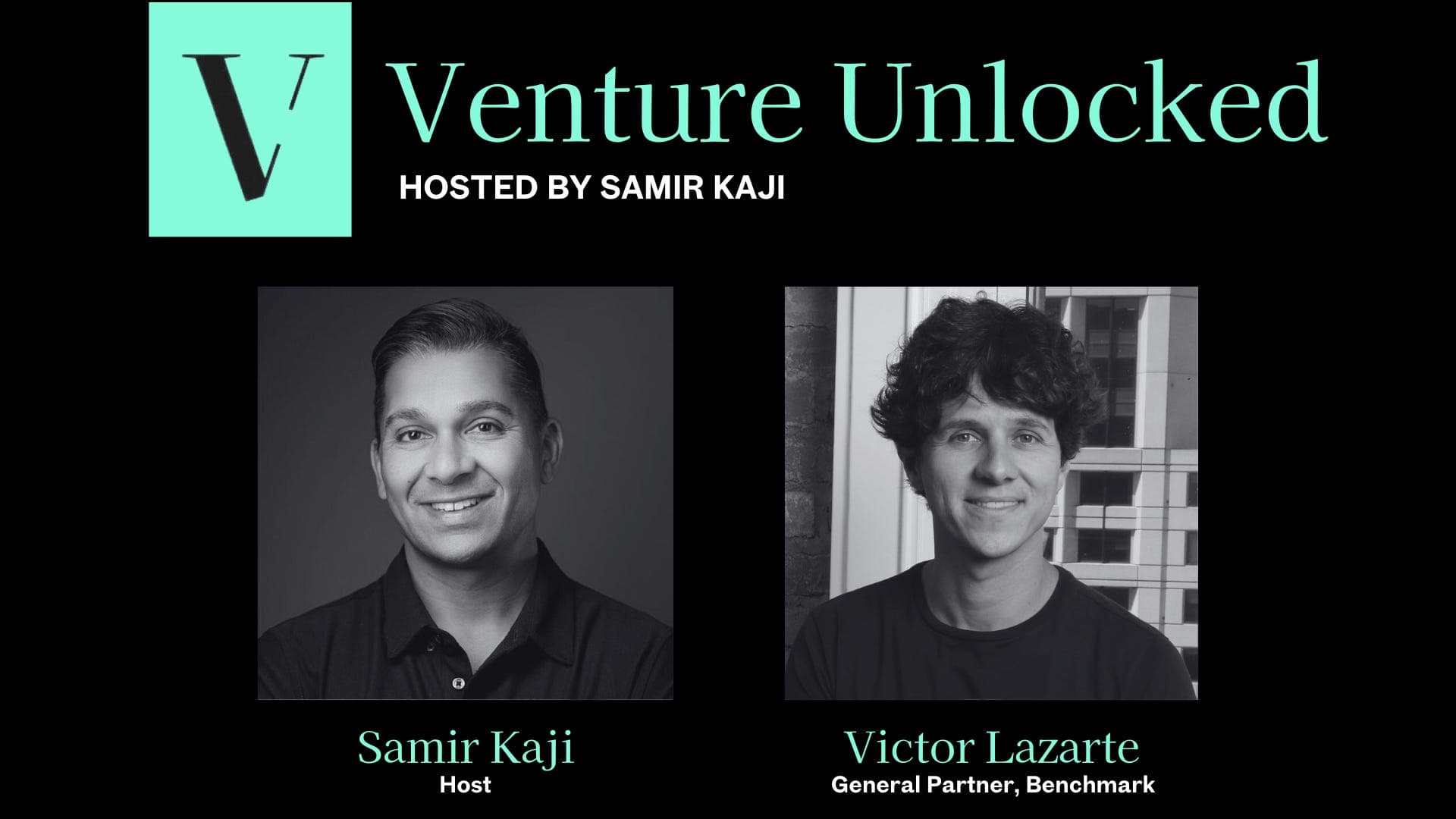
- Host: Samir Kaji
- Release Date: [Insert Date]
- Guest: Victor Lazarte, General Partner at Benchmark
Description In this episode, Victor Lazarte shares insights into Benchmark's unique investment philosophy and company culture following his transition from founder of a billion-dollar mobile gaming company, Wildlife Studios, to a venture capitalist at Benchmark.
---
Key Takeaways
Victor Lazarte's Background
- Victor transitioned from founding Wildlife Studios, a major player in the mobile gaming industry, to becoming a venture capitalist in Silicon Valley.
- His experience as a founder informs his approach to investing, emphasizing deep partnerships with entrepreneurs.
Benchmark's Investment Philosophy
- Partnership Model: Emphasis on equal partnerships among a small group of partners; each partner does only 1-2 deals per year.
- Focused Approach: Benchmark prioritizes time spent with entrepreneurs over the number of deals made.
- Long-Term Commitment: The firm takes a hands-on approach, providing significant support to portfolio companies.
Company Culture
- Decision-Making: Benchmark's unique model encourages vigorous discussions and disagreements among partners to foster better decision-making.
- Emphasis on Relationships: Building deep relationships with entrepreneurs is crucial; this context allows for more effective guidance during critical decision points.
Adaptability to Change
- Victor discusses how Benchmark adapts to changes in the venture capital landscape without compromising its core values.
- The firm leverages its unique position to attract top-tier entrepreneurs in a competitive environment.
Insights on Technology and Venture Capital
- AI Revolution: Lazarte emphasizes the current AI wave, noting that while rapid growth in revenue is observed, it's crucial to identify which technologies are durable.
- Evaluating Startups: Benchmark assesses startups by understanding which AI applications are improving quickly and could lead to significant business outcomes.
---
Discussion Points
Victor's Journey and Wildlife Studios
- Transition from banking to founding Wildlife Studios.
- Bootstrapping the company to success without external investment for years.
- Insights gained from working with Benchmark as an entrepreneur.
Decisions and Disagreements
- Open-Minded Yet Disagreeable: Importance of being both open to ideas and willing to challenge them.
- Building Conviction: How partners support each other in making investment decisions, even in the face of disagreement.
Benchmark's Approach to Venture Capital
- High Stakes: The balance between making fewer but more impactful investments.
- Commitments vs. Deals: Emphasis on viewing investments as commitments to the entrepreneurs rather than mere transactions.
Future of AI and Investment Strategy
- Evaluating potential investments based on the durability of technology.
- Understanding the importance of evaluating rapid advancements in AI and their applications.
---
Conclusion Victor Lazarte's insights highlight the importance of deep partnerships, a founder-focused approach, and the ability to adapt within the ever-evolving landscape of venture capital. His transition from founder to investor showcases a rich perspective on the symbiotic relationship between entrepreneurs and their venture partners.
For further details and a full transcript of this episode, visit [Venture Unlocked](https://ventureunlocked.substack.com?utm_medium=podcast).
---
Timestamps
- 1:29 - Victor's Background and Journey
- 3:59 - Wildlife Studios and Its Growth
- 6:53 - Bootstrapping Success
- 9:48 - Understanding Venture Capital
- 12:17 - Benchmark's Unique Model
- 17:05 - Decision-Making in Venture Capital
- 20:29 - Open-Minded Yet Disagreeable
- 22:20 - Benchmark's Equal Partnership Model
- 25:24 - Dynamic of Disagreement
- 30:38 - Betting on the Jockey
- 34:59 - Adapting to Changing Environments
- 37:14 - Providing Value to Entrepreneurs
- 39:26 - The Current AI Technology Shift
- 42:04 - Identifying Fast-Improving AI Areas
- 44:33 - Final Thoughts and Takeaways
---
Follow the Host
- Samir Kaji on Twitter: [@SamirKaji](https://twitter.com/Samirkaji)
Additional Resources For more insights and guidance on venture capital, subscribe to the Venture Unlocked newsletter at [ventureunlocked.substack.com](https://ventureunlocked.substack.com?utm_medium=podcast).
---
This structured markdown file provides a comprehensive overview of the podcast episode, highlighting key concepts, discussions, and insights shared by Victor Lazarte.
Written by AI. May contain mistakes. Listen to the episode to check what was said.
Transcript
Automatic transcript. May contain errors.0:09Welcome back to another episode of Venture Unlocked, the podcast that unlocks the business of venture capital. I'm your host, Samir Khadji, and on today's show, I sat down with Victor Lazardi, one of the six equal partners of iconic firm Benchmark. Before joining Benchmark in 2023, Victor bootstrapped a company called Wildlife Studios in the gaming market to become a multi-billion dollar mobile gaming company. He ultimately did take capital late in the company's life from Benchmark, where he met Benchmark partner Peter Fenton. As one of the most unique and legendary firms in the venture capital market, it was fun to go deeper on how they operate when it comes down to decision making, building culture, and working with entrepreneurs.
0:46It was a nice peek behind the curtain of such a great firm, and I really hope you enjoy the show. Samir Khadji is the CEO and co-founder of Allocate. Allocate and Venture Unlocked are independent of each other. Any statements or references made by Samir or his guests regarding third-party investments or securities are solely their views and opinions, and are not intended as investment advice or an endorsement of such parties or securities by Samir, his guests, or Allocate. Allocate or its clients may maintain relationships with or investment positions in guests, third parties, or securities mentioned in this podcast.
1:22This podcast is for informational purposes only and should not be relied upon as a basis for investment decisions. Victor, it's so great to see you. It's great to be here, Samir. So you work at one of the most iconic firms of all time. And we'll get your journey in terms of getting from a founder to becoming a VC, picking Benchmark, how Benchmark works. But let's go back to the beginning. In fact, I was looking at your bio and you actually started off in banking, working at J.P. Morgan, which is funny because I was in the banking sector, but ultimately did that for a very short amount of time before being a founder.
1:56But let's go back to your history and maybe talk about your journey into technology. Sure. Yeah, therefore, my banking year, I tried to hide that, but you're too good in finding my secrets. So joke aside, I went into, so I started engineering in college, but being from Brazil, I wasn't really exposed to startups. And even before college and high school, I built websites, a couple of them became popular. So I had this dream of like, I'd love to create digital products and I'd love to create a company. but the whole idea of starting a company was foreign to me and i think that's the power of like silicon valley i think people here they grow up like with amazing examples and they get to know entrepreneurs right and unfortunately i didn't have that so when i graduated i i liked video games and i thought one day i'd love to make a video game company but the reality is like i just didn't have the conviction at that time and i didn't know i was like hey i'm gonna start a video game company why am i gonna make games that are better than nintendo or electronic arts and i didn't have a good enough answer for that right so but it was only when the app stores started to like get traction that's when to me it's like okay games or phones like that that makes sense right but before that i was okay all the smart people that i know like what do they do and it turns out that like banks, they do a really good job at recruiting talented students, right?
3:28So a lot of the smart people that I knew back in Brazil, they went into banking. So I did that. I was in banking for 22 years, and I never thought I'd be a banker that long. And then I got in, but I was working with a lot of technology companies. But talk a little bit about maybe wildlife in terms of the business itself, and how that informed on the folks that you had on the board. You had a benchmark that was on the board that was supportive. How did that inform your decision to go into venture and what type of venture capitalist you are? Yeah. So for wildlife, I think the most important thing to start a company is understand what's happening in the world.
4:08And I don't believe that people meaningfully change the future. I don't think any one person, I don't subscribe to the great man theory and it's like, hey, we have this special individuals that like change history. I actually think that if you're lucky, like what you do, you just bring the future a little bit forward, right? Like you just make the future happen a little bit faster. So the best entrepreneurs that I know, they try to understand, okay, what is the change? What is happening in the world? And like, how can I help this change happen faster, right? And that was definitely the case for me.
4:41In 2011, when I started the company, it was clear people were talking about mobile like the same way that people were talking about AI like I think AI would be like actually considerably bigger than mobile but it was super clear it's like hey you want to do something you've got to do something in mobile because now people have computers in their pockets and they want software for these computers right so that was the wave and it felt quite obvious to me that people will want to play games on their phones and it was obvious back then but very few people were making mobile games right and there were these stories, to me, it's so interesting.
5:15The parallels between AI and mobile are striking. I would hear these stories about these teenagers or these young people that created an app and the app got traction and they were making money. So for example, if you remember, there was the beer app, which was this incredibly simple app that is just like, hey, it was a picture of like a beer cup and you'd tilt your iPhone and like the level of the beer would stay leveled, right? And it was incredibly simple, but the novelty was so interesting. That app was being sold for a dollar and the person that created it made like thousands and thousands of dollars, right?
5:54And I think in the same way, like you're hearing these stories in AI right now. So there's one story that I find particularly interesting from like a year ago. There's this influencer that just created a like a thin wrapper around like chat chp t that allowed people to talk to her so like hey you want to talk to me like there's an ai that is actually me and there's like a very so thin it was like there's a prompt there's like hey respond as if you're me and like i'm an influencer and blah blah blah and i think she was charging a dollar a minute or something like that and she was making like fifty thousand dollars a month right so so you hear this crazy story and of course I was like, this is not durable, but this helps you understand, okay, like what is the big wave?
6:38What's happening right now? For wildlife, that was mobile. And so I decided to go for it and try to raise money, got turned down by everyone. And so I bootstrapped the business. I convinced my brother to start the company with me. And the two of us, like we did everything. Like we coded, we did the graphic design, we did the game design. We didn't have any employees, but we're so lucky to start at a moment in time where people really wanted to play mobile games and people really wanted to play free games, right? I think when you think about the mobile gaming revolution, I think it's actually way more about it being free than it is about the format.
7:14So in-app purchases, like the advent of in-app purchases, like that is the thing that really allows that revolution. And the first game didn't work, but the second one did. And like within months of starting the company, we had like hundreds of thousands of users. and during a nine year period like we just bootstrapped the business and created games that collectively were played by over a billion people and collectively also generated like over a billion dollars in revenue so that was like a very fun journey like being bootstrapped like that from Brazil which is a country that doesn't have a tradition in technology right but then after like after nine years doing that we were thinking like what else like what else can this company be and I was always like fascinated about Silicon Valley.
8:05And it's still like puzzling to me why when you think about the planet, like there's like 8 billion humans and like there's actually very few people in the Bay Area. But if you look like over the past 20 years, like over half of all the interesting companies created in the world have been created in the West Coast of the United States and the majority being in the Bay Area, right? So to me, it was always like, it's insane why so many of the companies got created here. So I was just very curious, very attracted by the place. And I'm a student of the technology industry. And I think there are firms and there's a model that seems to catalyze how technology companies are created.
8:48So I think if you look at, I think the world, the planet is like a big AD test. And there are companies that raise venture capital and there are companies that do not raise venture capital. And it turns out that the companies that raise venture capital they're way more likely to become very successful, right? And I think there are companies that take on board members that are very invested in the company that really want the company to succeed. And there are companies that do not do that. And it turns out that the ones that take a board member that is very involved, they succeed at a higher rate, right?
9:20So I was just super interested by that. And as we were rethinking the model of the company, I decided to move to Silicon Valley and I met with a lot of the great venture capitalists in the Bay Area. And I felt very lucky to have met Peter Fenton, who's now my partner. And talking with him, I was like, listen, the company is doing well. We're very profitable. But we want to do more. We want to be more. And we want to tap into all the knowledge that exists here in Silicon Valley. And I'd love to understand, how do you work with entrepreneurs? What is it that you do? And I think in college, I was an engineering major, but I took a couple classes in finance or something like that.
10:00And I was like, there's this theory like the efficient market hypothesis and you learn how to think about the market like in its very statistic terms and you learn that, okay, there's a bunch of people starting companies. One of them is going to be very successful and it's going to be very valuable. A lot of them will not and like you cannot predict a priori. So you come to Silicon Valley like everything in this place defies that theory. right it's like okay how can one investor like finds like several companies at the earliest stage when there's actually like two people and have these companies go on to be multi-billion dollar companies right like that that just like by itself destroys that this theory and and then so i just though i i was just so interested in learning more about that and and i think to me what attracted me to Benchmark is like, okay, how can you increase the probability of success both in like selecting the right entrepreneurs but also like in supporting them, right?
11:08So I think that was the initial thing that made me very attracted. And one of our partners, like he says, in venture, a lot of people think about making good decisions, but at Benchmark, just as importantly, we think about how to make decisions good. And what this means is like, make good decisions like, hey, choose the right company. Sure, you have to do that. But the other part is like, once you chose a company, make that company good. That part is as important, right? And that was something that was very attractive to me. So you ran this company for effectively nine years before raising a single dollar of outside capital.
11:48You met with a number of investors, obviously had tons of traction at that point. And there are so many firms that I see decks of, and it says, we want to be the next benchmark. We want to be the next USV. And yet a lot of people don't know what it actually means to be the next benchmark. So talk a little bit about what did you see in benchmark? And then I guess from a board standpoint, when you had folks like Peter around the room, what was so different about them versus the other VCs that you worked with? So I think there's a number of good firms out there. And there's a lot of like really smart investors.
12:24So when we're talking, like when I think about, hey, like what makes benchmark difference? Like, hey, like it's not all like they're smarter or like it's not like that. I think it's just a different model. And the model is better in some ways and it's actually worse in many ways. Right. And I think what makes the key thing that makes the model different is a benchmark. The most important thing is how you support the entrepreneur. and the idea is not only we'll partner with the best companies, but once we partner with them, we're going to be the deepest partner to the entrepreneur. So for example, like I invested in the seed round of Brax and I'm their first board member.
13:04And I take a lot of like, so in a few months back, like Pedro, the CEO came to me and he said something that really touched me, which is like, Victor, you've been helping me for like eight years and you're the closest thing that I have to a co-founder outside of the company, right? And to me, that was like, I love that. And the reason I was able to do that is because I just devote way more time to the company than other people. But there's a flip side of that. And the flip side is, if you're going to devote more time to the entrepreneur, that means you're going to make way less deals. So when you look at like venture firms, I think Benchmark is one of the great firms.
13:44and the entire firm, like we make 10 deals a year and we don't even call them deals. Like we call them like commitments, like calling it a deal. Like it just, it doesn't honor like the work that we do. It's like, hey, we make 10 commitments in that year. It's like one or two per partner. Like that's the idea. And also there's a bunch of things that a firm can do that will help the firm be successful. Like there's a bunch of programs, but we choose to not do any of that because if you do that, for example, like if you run an accelerator, like all these things take time. Or like if you have a team, like so a benchmark, we don't have associates, we don't have principals.
14:20And if all these things are helpful, but if you do that, like that's taking the GP's time and like that's time that you're not spending with the entrepreneur. So the idea is you do one or two deals a year, you don't run programs. So your entire time is devoted to the entrepreneur. And the core idea behind it is there's all these things that are helpful and useful to the entrepreneur. Like, hey, I'm going to help you do PR. I'm going to help you. Like, I'm going to have recruiters on staff. I'm going to do like government relationship. All that stuff is helpful. But there's a lot of like service providers out there that can offer that.
14:54And the one thing that you cannot outsource is the relationship with the entrepreneur. Because the best founders, like they don't want to talk to like the service providers. Like they want to talk to the GP. And the interesting thing is it's actually very hard for someone from the outside to add value to a company because the entrepreneur, if you're doing your job right, like your entrepreneur is like smarter than you are and is spending way more time on the problem than you are. So you're not going to come in and like just have this crazy insight. So the way we add value is like every week you're doing, like frankly, like part of it is this boring work that other people could do.
15:33Like you're getting to, like you're doing, you're closing candidates. Like, hey, like we're trying to hire this guy. So hey, like you're having like conversations with this candidate, explaining to them why the vision is amazing, why the entrepreneur is great. And you're doing all this work that frankly, a lot of people could do. But through that, you're getting a lot of context. You're getting a lot of context in the company. And then two or three times a year, the entrepreneur is going to make a very important decision and he will need a thought partner. And he's going to call you because you're the only one that has context.
16:11Like you're the only like outside person that has context on the company, right? So in a way, like all this work that you do, like we can wake out, it's kind of like a tax that you pay for when the really important decision comes along, you're in this position that like, hey, like you're able to help the entrepreneur. Like you're able to be the thought partner that this entrepreneur needs when making that decision. And this compounds very strongly over time. It's like two or three times a year, you make that decision marginally better, over the 10-year journey that it takes to build a company, your company is going to be a lot better.
16:44And your relationship with the entrepreneur will also compound in this way. It's like five years in, it's like, hey, when there's a problem, the entrepreneur has two choices. He's either going to call you and what's going on, or he'll have to call someone else and spend a couple hours explaining all the context that the person needs to be able to help make the decision. What's really interesting, and I'm always fascinated about how business models at firms, the cultural, the ethos supports kind of a true north. And the true north of Benchmark has been doing very few deals, keeping fund sizes fairly small, having an equal partnership, and then ultimately all leading to supporting the entrepreneur in a way that's much deeper than what we often see.
17:29A lot of the brand name firms over the last 10 years have grown bigger. They've added platform teams. And often the entrepreneur is meeting with a platform person or a junior associate or principal, obviously a very different experience. I want to pull the thread on each one of those things. But the first thing that I wanted to kind of pull the thread on a little bit is just decision making. And you mentioned one to two deals that are done per partner per year, which is not a lot, which means you have to have high level of conviction in not only the idea, the TAM, but really the entrepreneur's ability to execute, which at the end of the day, that is everything.
18:03So given your background and your partner's background, you've worked with a lot of operators, you've been operators in some cases. The age-old question is, how do you identify those unique traits and what are those unique traits that you're looking for at the benchmark side? Yeah, so a lot of what we do is better than entrepreneur because many times when you invest, like there's no company. It's so, I ended a couple months ago, like I invested in this company and there was literally no company. Like two people that came together and like, hey, we're thinking about doing this. What do you think?
18:36And you have a conversation. And I personally, that's the type of work that I enjoy most because like you're in, you're talking a lot of the entrepreneur before they start the company and like you help shape the idea, right? So in those cases, like so much of it is, okay, who's the entrepreneur that can build a company? And there's a part of it that's just like pattern recognition. Like you've been around like amazing entrepreneurs for long enough And then when you see a new person, it kind of, oh, this guy kind of looks like all these people that build businesses. And I think that's where having built a business.
19:10So I ran wildlife for like 12, over 12 years, almost 13 years. And then like, I know, like, I know what it takes to like build a company and scale a company. And then it's just trying to like recognize these things in entrepreneurs, right? And then I guess you stop and like you try to just steal, okay, what are these things that we're looking for? There's no like formula. but there are things and i think there's traits that everyone knows and like everyone's looking for so for example like you want someone that is very intense like that that has like amazing work ethic or you want someone that is extremely ambitious and you want to we want someone that that is like obviously intelligent and the way this comes across is someone that has an ability to simplify like takes problems that are very complex and like he's able to like tell you in a way that is like, oh, okay, you took something that was very complex, very hard, and you made it very simple.
20:00So those are all like traits that, sure, you're looking for all of that, but that's kind of like table stakes and like everyone's looking for all of that. But by spending time with a partnership, and I've been at Benchmark for like a year and a half now, you start refining these things and you start looking for things that are less obvious. And there are like two things that I look for that I think are way less obvious and actually very rare, which are the best entrepreneurs, they're very open-minded, but also very disagreeable. And these two things, they very rarely come together because open-minded people, they're typically very nice to spend time with because when you say something and the person is so curious and you want to know, and he wants to understand, oh, why do you think that?
20:47And you're explaining it and like, oh, I'll tell you more. So for example, I invested in this company called Mercor. And very quickly, I knew this is an exceptional entrepreneur. I really want to work with him. And part of what made me think that is he would tell me something. And then I'll tell him, no, I disagree. I think this is actually the opposite of what you said. And so I'll tell you more, Victor. I'll go very deeply and explain in all these different ways. And he was just so curious. And in my head, I said, okay, this guy finally got it. He understood that what I'm saying is right. And then at the end of it, it's like, yeah, no, I think that's all wrong.
21:21And so you're having this thing, it's like, hey, he really wants to understand what you think, but he has no problem disagreeing with you. And as a matter of fact, he actually likes it. He likes the tension that gets created when you think the opposite of what someone else is saying. So I think this coupling of really curious about what someone else thinks, but also enjoying the tension that comes with the disagreements, that rarely comes together, but it's a trait that is common in the best entrepreneurs. It's such an interesting thing because that is a tough balance to have for people. And people often stray away from confrontation and attention, which is often necessary.
22:05And in the VC world, during the time you were running Wildlife, there's this concept of founder friendly. And it was mostly acquiescing with whatever the entrepreneur wanted versus actually having these tough conversations, which are actually necessary to build great companies. And as you kind of think about those traits, I mean, a lot of this is subjective. It's based on your own pattern of recognition. It's your teams and Peter or whoever else is on the team kind of assessing that on the founder during maybe the first meeting, the second meeting, things like that. But how do you then make decisions?
22:38Because there's this concept of Benchmark being the SQL partnership. There are people at the firm that have been there a very long time, people like Peter Fenton, who have invested in amazing companies. And oftentimes what you have is you may have equality when it comes to things like economics. Yeah. But within the voting room, oftentimes there is the appearance of an alpha or two that really starts to make the decisions. And where people around the room, even though they're granted the ability to make decisions, are often looking to appease that alpha. How do you avoid that from happening here?
23:15Yeah. So I think what Benchmark does is our sweet spot is leading Series A. So 90 % of what we do is leading Series A. Of course, there are exceptions. And if there's an amazing company, we'll do whatever wrong. But specifically on the Series A, the sins of omission are much greater than the sins of commission. So if you invest in a company and it doesn't work out, it's not a huge deal. But if you see Google, like if Google comes and pitches and you don't do it, that is a huge deal. And that actually happened at Benchmark. So Google came in and we failed to pursue. Like we failed to see like, hey, this is the company and like we're going to go after it and we're going to do whatever it takes to win it.
24:02And because missing the great one is way worse than doing something that ended up not working. If someone, at Benchmark, if someone really wants to do something, it just does it. So we have this concept. At Benchmark, we have this concept where you have to be interested in what your partner has to say. So you have to listen to him, but you don't have to follow what he says. So if you're very interested, the company has to come in and meet the other partners. But it doesn't matter if the other partners don't like it. You can still pursue the deal and you can still do it. And as a matter of fact, in the last 12 months, there was one company that every single partner except for one thought this is probably not the right investment for us.
24:50But there was one partner that wanted to do it. And it's like, okay, so you go ahead and do it. How does the dynamic go in those situations? It's very funny. It's very interesting. I'd love to maybe act as if we're flying the wall. you're bringing in a deal that may not be universally liked in terms of the entire partnership. You're still doing it. How much do the partners push each other to get to the right answer? And then ultimately, how do you have the conviction to still make the deal, especially as a new partner joining such an iconic group of people? Yeah. So I think that's part of what makes benchmark different.
25:29So you have to have partners that also enjoy some level of disagreement and discomfort, right? So if you have people that are conflicts avoidance, like it wouldn't work at a partnership like Benchmark. Because I think if you have like in other firms, you can have people that are incredibly smart, but are somewhat like conflict averse, but their job is like, hey, I'm going to source something. I'm going to write a beautiful memo. I'm going to surface this. And then there's other people that are going to come in and I'm going to make the decision. And the benchmark, it's, okay, you do the entire work.
26:04You source, you develop your own thesis, and you bring it to the partnership. And sometimes if other people don't want to do it and you want to do it, it's like, okay, you've got to have that conviction. So in a way, you've got to have part of what the thing that we talked about with founders, it's like, hey, you've got to be fine disagreeing with people. And because we're five equal partners, when someone comes and joins Benchmark, we talk about a refounding moment. It's like, hey, we're refounding the firm. Because every single person there, it's an equal partner. And in a way, it's like, hey, it's like a co-founder of the firm.
26:42Because it has not only the rights, but it's expected of them. Like, hey, you're here to shape and to change the firm. So only last week I was spending time with the original founders of Benchmark, who were such iconic figures. And the interesting thing is they were telling us, hey, Victor, we created this firm. And then once we felt that our time here was done, we passed it on. And now this is your firm. And we have no remaining interest in the firm. We have no influence. So like, hey, you're here to re-found the firm. And you're here to like, okay, this is what worked for us. But now you go ahead and you do what works for you.
Read the full transcript
27:28So in a way, the model, which is a phenomenal model, and it's a great model, but it doesn't work for everyone. It works for someone that you need to have some of that founder energy. Some of that, hey, there's a blank canvas here. I'm going to shape it the way that I want. And there's going to be pressure. There's things that I will want to do that people push back on, but I'll just push forward. It's not something that's easy to replicate for a number of reasons. And listening to you speak, one of the things that really kind of stands out to me is this feeling that there's a level of structure, but largely unstructured in the way you run things every single day.
28:10And are there any downsides to the lack of structure? Yeah, for sure. If you think about, it depends a lot on like, what is the thing that you're trying to optimize for, right? And I think what defined benchmark is, in a way, we love the craft of company building and like we love the craft of early stage. And so everything's like optimized for that. It's like, hey, how do we have time just to be with the founder and spend a lot of time building that company? But if you think about benchmark as a business, businesses, they're typically there to like optimize their bottom line, right? And if you think about a venture firm as a business, like, hey, what's the business objective?
28:51Like, hey, maximize bottom line. And benchmark is not maximizing like fees. Like that's not what we're here for. And it's like, hey, what are the downsides? Like there's 10 ways that you can make benchmark difference that would generate a lot more fees, right? But paradoxically, we're a venture firm, but we're not trying to maximize that. And the other thing is like, the model is very dependent on the partners. And I think when you're building a company to the maximum extent possible, what you're trying to do is you want to make the company independent of who's running it or like independent of the employees.
29:31Like you're building systems that create advantages that compound. So there's this like interesting phrase of like, I think it was Warren Buffett that said, like even like a ham sandwich can run Coca-Cola. which is like, hey, the company is just so good that anyone can be there and like the thing is just going to work and it's going to continue working because like there's a brand and people buy Coca-Cola and like there's this distribution agreements and all of that. So it's a beautiful system that just compounds and benchmark is not that. Like benchmark and I think there are venture firms that are like that.
30:00Like, hey, it's a system. It doesn't really matter who's there and it's just going to work and there's not much thinking that needs to go on and it's just going to like increase like the bottom line, the bottom line is going to be bigger and bigger and bigger. Right. And like, I think one way to do that is like, hey, like you just like increase your, and you create a bunch of programs. And I think those things work, but the reality is at the end of the day, there's what is it that you want to do? And I think we want to help create companies, get created, and we want to help amazing founders achieve their potential.
30:33And like, we want to spend time with them. So that's a trade-off that the model has. Well, let's talk a little bit about the ethos because we talked about when you pick companies, you're really betting on the jockey. You're betting on the human being to figure things out over time. And we've seen so many companies over time start off with one idea. Even Brex was a very different idea when they first started and ultimately saw this much bigger opportunity. And Enrique and D 'Adrio and Michael and some of the folks that were there in the early days really transformed this company into one of the largest kind of fintech companies out there.
31:05On the venture side, especially the model you work, it is very partner-driven. it. This is not one where you have 20 partners and there's five different principals and seven associates. So everyone you bring on, it's hypercritical to make sure you get the hire right. So maybe turning the table a little bit, when Benchmark was interviewing you or you were talking to Benchmark about joining, why did they pick you and what were the sort of the traits they were looking for in bringing somebody that would really align with this ethos that is Benchmark and his benchmark has been come to known of? Yeah, I had this long relationship with Peter, right?
31:41Like he was on my board and he had been on my board for like four years. So I think we knew each other really well because again, when a benchmark partner is on your board, like it spends a lot of time with you. So you get the person pretty well. And when he floated the idea, I had been doing games for like 13 years and I love video games and I'm passionate about psychology and technology and gaming is a very good combination of both. But the reality is like after 13 years doing games, like I was ready for my next adventure, right? So I was thinking like, okay, what's next for me? But I wasn't really, like, I wasn't thinking like, hey, like I'm gonna go investing.
32:18Like I didn't talk to any other firms. It was, and to me, like the idea was like, oh, like I'm gonna join a firm and like be an investor. There wasn't like the options that I was thinking about. A lot of what I was thinking about, like, hey, like I'm gonna start another company. Like AI, to me, it felt very much like mobile. What made me create wildlife was mobile. Like mobile got created and like, hey, this is a perfect time to create a company. And then I was just finding myself, spending so much time with AI founders, like learning about the space. They're like, I want to start an AI company, right?
32:50Like that was on my mind. And then, so he floated the idea. And to me, what was appealing is, like as an investor, you get all the variety. Like you see a lot of different stuff and if you're doing early stage the way the benchmark does, it's like, okay, you get the variety, but you still get enough proximity that you're able to derive meaning from helping these companies, right? And I think the thing that they were looking for, in a lot of ways, I don't think I'm the obvious choice. I'm not an investor, right? But I think the thing that appealed to them, it's this deep desire to partner with entrepreneurs, right?
33:31So I had like a few very like close relationships with entrepreneurs. And like, so Brex being one of them were invested, but the reality is like my investment in Brex, it was a downstream consequence of my relationship with the founder because the reality is when the Brex founders, they had their previous company, I was helping them out. And on the previous company, I didn't invest, I didn't get anything, but I spent a ton of time with them because I was like, hey, these kids are super smart and like they're going to create something. I want to help them create something. And then, so I had that, and there was a couple other great entrepreneurs that had a really close relationship with it.
34:06I spent a bunch of time with Dylan from Figma and a few others. So I think for them, it's like, okay, we want someone, and we want to have a balance in the partnership of people that have an investor mind and are able to underwrite businesses and see trends, but also of operators, right? So historically, like Benchmark always had like some operators, some people with the background in investing. And they were like, hey, we want an operator. We want someone that has been a founder. And then the work is to partner very deeply with entrepreneurs and do the very hard job of being able to add meaningful value from the outside.
34:47So I think they saw a combination of those things that made sense. So maybe going to a little bit about all these things we're talking about is how do you support this really interesting model, that benchmark, but it's also the retention of the brand over time as you have partners leaving, new partners joining like yourself, and almost this concept of continuing refining or reforming the firm. But yet, one of the things that often happens with businesses is the environment changes. In venture, we've gone from a few hundred VC firms to thousands of VC firms. Within that, the round sizes have gotten bigger.
35:24The time to exit has gotten longer. And a lot of the firms that you might have viewed as counterparts or peers 10, 15 years ago have gotten much bigger. Benchmark never went that direction. How do you balance between adapting to all these changing circumstances on competition round sizes, but yet keeping to the core? And at what point, or is there a point where it does make sense to maybe shift away from the fund size of the way you operate to really adapt to a new environment? Yeah, this is obviously a question that we think about. And I think we're not married to fund size, like we're not married to anything, any of those things.
36:06But there's a few things we are married to. And you talked about a lot of what has changed in the ecosystem, going from hundreds to thousands of firms and round size would be much bigger. And I think it's very important to understand what's changing in the environments. But perhaps even more important is to understand what is not changing. And the things that are not changing are results in tech companies follow a power law. There's very few companies that matter. And the name of the game is you've got to be able to get into the best companies. This was true 20 years ago, 10 years ago, and it's still true today.
36:45and offering the best value proposition to the entrepreneurs, that will always be a great business model. So for us, it's like, how can we make sure that an entrepreneur that can raise from anyone chooses to raise from us? And the thing that hasn't changed is like entrepreneurs trust entrepreneurs. So if you pick up your phone and you call any founder in the benchmark portfolio and you ask them like, hey, how do you work with your partners? Like you have many VCs on your cap table. Tell me about them. And then what we're going for is like, hey, there's a bunch of VCs. Benchmark is different because they're the ones that they're not doing a ton of things.
37:23Like they're doing like this company. Like they're doing, they're working with you. And I think the way like benchmark doesn't have any structure, doesn't have a lot of process and you pretty much can do anything you want. The only way you get in trouble with benchmark is if we call one of your founders and like, hey, like this person is not adding value. Like this person is not dedicated their time. This person's not doing everything they can to make this company successful. That's how you don't add value. So I think firms have a lot of weapons that they use to win deals. And our way of winning deals is like, hey, call the founder we work with.
37:56And if you pick up the phone and you call Pedro, it's like, hey, who helped you? It's going to be a very easy conversation, right? So for us, a lot of things change. The things that don't change is the game, the important part is you got to be able to win the most competitive deals. And the way you do that is you provide the best service. So all the firms can deploy a lot of capital. That's what we find. For the ones we want to work with, we're going to dedicate more time. We're going to offer great terms. And it should be like a very easy decision for the founder. So maybe ending with talking about the founder ecosystem and some of the things that have changed.
38:39We talked about mobile being this massive paradigm shift that allowed so many companies to build because all of us had supercomputers in our pockets. It wasn't the first technology, major technology S-curve. I mean, we've seen mainframe computing, Internet, semiconductors. Artificial intelligence right now is ubiquitous in everybody's mind. And I think that the change to maybe this sort of S-curve versus the past one is things are moving so quickly. And it's very difficult. and you've seen this, a lot of people that are listening have seen this, companies gone from zero to two, zero to five, even zero to a hundred million dollars in AR almost overnight.
39:16But yet it's really tough to know which ones are durable. How are you guys prosecuting the world of artificial intelligence on what is actually investable today? Yeah, no. So I think that this technology shift is perhaps like the, it's probably the largest, well, it's definitely the largest we've seen so far right and one way you see this is like the incredible revenue ramps so for example like i invested in mercore and and they recently announced their series b and the company so i invested nine months ago on the company 100x the revenue and there's nine months to the number they announced is like 75 million dollar run rate growing at 50 percent month on month.
40:02And you don't see that. You don't see that every day. But one thing that is interesting is not all revenue growth. So in the past, I think if you achieved like$10 million in ARR, okay, you were golden. But right now, I think the change is so fast that just having revenue growth is not enough. You got to understand what's durable and what's not durable. And at our partner meeting, we're seeing so many companies that achieve like$5 million, I think 10 million, but they're probably not going to be around in two years. And one question that we asked ourselves when we look at companies is, if models get 10 times better, is this a better business or a worse business?
40:44A lot of times people that they have this use case, they see all like people are using ChatGPT to make this. I just let's make something up. Like, OK, you're making this like permitting, like you're going to do a remodel in your house and like you need a permit. and like, okay, you're using ChatGPT to like format your permit for me. So you create like this very lightweight wrapper around ChatGPT and like you offer that to people and very quickly that you got a couple million dollars in revenue. But when the next model comes along, like all this little things that you did, they evaporate. Cause like it always gets absorbed by the model, right?
41:20So one question that we asked is like, okay, if models get 10X better, is this a better business or is this a worse business? And I think that question is very clarifying. And if you're very optimistic about AI, you're like, oh, okay, there's all these things that we dream about in science fiction books. And they're all going to exist. So people come in with these very ambitious pitches and like, okay, hey, I'm going to invest in this because the future is going to have all these things. But one thing that I think a lot about is the job of an investor is not to predict the future. It's actually to understand the present.
41:54And so what we look at is where is AI improving the fastest? And that's a much easier task. Understanding where AI is improving the fastest, that's a much easier task than it is to predict the future, right? So literally, you look at the evals and say, hey, in what evals are and in what benchmarks are models getting better the fastest? And then you go and invest in these things, right? And there's a pattern. There's a pattern of where AI is getting better. and the pattern is things where you can evaluate the outcome. So the thing that is getting better the fastest, and I think that's too late for early stage, but the place where it's getting better the fastest, like code, I'm happy that we have exposure to the sector.
42:39But code is the place where AI is getting better the fastest because code is the best place where you produce an outcome and you can test, is this correct or is it not correct? right aside from code there's all this work that the output is language and that you can verify so lawyers doctors there's a there's an exam that you have to take to become a lawyer like there's an exam that you take to become a doctor so like it's the output is words and you can verify that right so like models are getting a lot better it's like those are very good places to invest so for example like two two of the investments that i did are in the video the video space the AI video space.
43:18And there, like, AI is getting better really fast. And then, like, there's also, there are things that are very cool, but they're probably going to take way longer. Like, just to make up some, like, crazy examples, like, okay, in the future, we're going to have robots that are going to cook for us. But that's probably going to take a while. That's probably going to be very slow, right? So to me, like, a very clarifying question is, how do we understand the future? What's changing very fast? Where are the evals getting much better? And those are great places. Yeah, and it's really tough to project out what this looks like two years from now, let alone a year from now, given the speed.
43:54And one of the things that I recently said is like you have these companies that are going from the zero to two to five. There's a lot of curiosity revenue there, people trying things. But the issue is if some smart team can replicate that same exact model within a week, it's probably not very defensible for the long term. And so it's going to be a very interesting time. I think this is probably one of the most interesting times from a technology standpoint. And congrats again, Victor, on both just starting operating such a great company in the gaming space, joining Benchmark, and then really explaining some of the things that go behind the scenes of how you operate as a firm.
44:31And this has been very enjoyable. Thanks for coming on. Thank you so much. Thanks for joining us for another episode of Ventro Unlocked. We really hope you enjoyed our conversation with Victor. To find out more about him or Benchmark, please go to VentureUnlocked.substack.com, where you'll find full show notes and other episodes we've launched.
From the publisher
Today, I sat down with Victor Lazarte, a Benchmark partner who transitioned from founding a billion-dollar mobile gaming company in Brazil to becoming a venture capitalist in Silicon Valley with Benchmark in 2023. Victor shared Benchmark's unique investment philosophy, which focuses on deep, meaningful partnerships with entrepreneurs, with each partner doing only 1-2 deals per year.
We also spoke about the equal partnership Benchmark has, and what that means in practice day to day from a decision making and culture standpoint. This was a fun one so hope you enjoy!
Throughout our conversation, Victor provided a nuanced perspective on company building, technological innovation, and the evolving role of venture capital in bringing transformative ideas to market.
About Victor Lazarte
Victor Lazarte is a General Partner at Benchmark, a renowned venture capital firm focused on early-stage technology investments. With a background in entrepreneurship and investing, Victor brings deep operational expertise and a founder-first mindset to supporting high-growth startups.
Before joining Benchmark, Victor co-founded Wildlife Studios, one of the world’s largest mobile gaming companies, where he helped scale the business to global success. His experience in building and leading companies gives him a unique perspective on product development, scaling operations, and long-term strategy.
Victor is passionate about partnering with visionary founders to build category-defining companies. He holds a degree in engineering and is committed to fostering innovation across industries.
Benchmark is a leading venture capital firm specializing in early-stage technology investments. Known for its hands-on, founder-first approach, Benchmark partners with entrepreneurs to build transformative companies across industries like software, marketplaces, and infrastructure. The firm operates with a unique equal partnership structure, ensuring deep collaboration and long-term commitment to its portfolio companies. With a track record of backing iconic startups such as Uber, Twitter, eBay, and Snap, Benchmark continues to be a trusted partner for ambitious founders looking to scale breakthrough ideas into world-class businesses.
Timestamps:
In this episode, we discuss:
* Victor's Background and Journey (1:29)
* Wildlife Studios and Its Growth (3:59)
* Bootstrapping Success (6:53)
* Understanding Venture Capital (9:48)
* Benchmark's Unique Model (12:17)
* Decision-Making in Venture Capital (17:05)
* Open-Minded Yet Disagreeable (20:29)
* Benchmark's Equal Partnership Model (22:20)
* Dynamic of Disagreement (25:24)
* Betting on the Jockey (30:38)
* Adapting to Changing Environments (34:59)
* Providing Value to Entrepreneurs (37:14)
* The Current AI Technology Shift (39:26)
* Identifying Fast-Improving AI Areas (42:04)
* Final Thoughts and Takeaways (44:33)
I’d love to know what you took away from this conversation with Victor. Follow me @SamirKaji and give me your insights and questions with the hashtag #venture unlocked. If you’d like to be considered as a guest or have someone you’d like to hear from (GP or LP), drop me a direct message on X.
This is a public episode. If you would like to discuss this with other subscribers or get access to bonus episodes, visit ventureunlocked.substack.com