In short
Venture Unlocked: Episode Summary
Episode Title
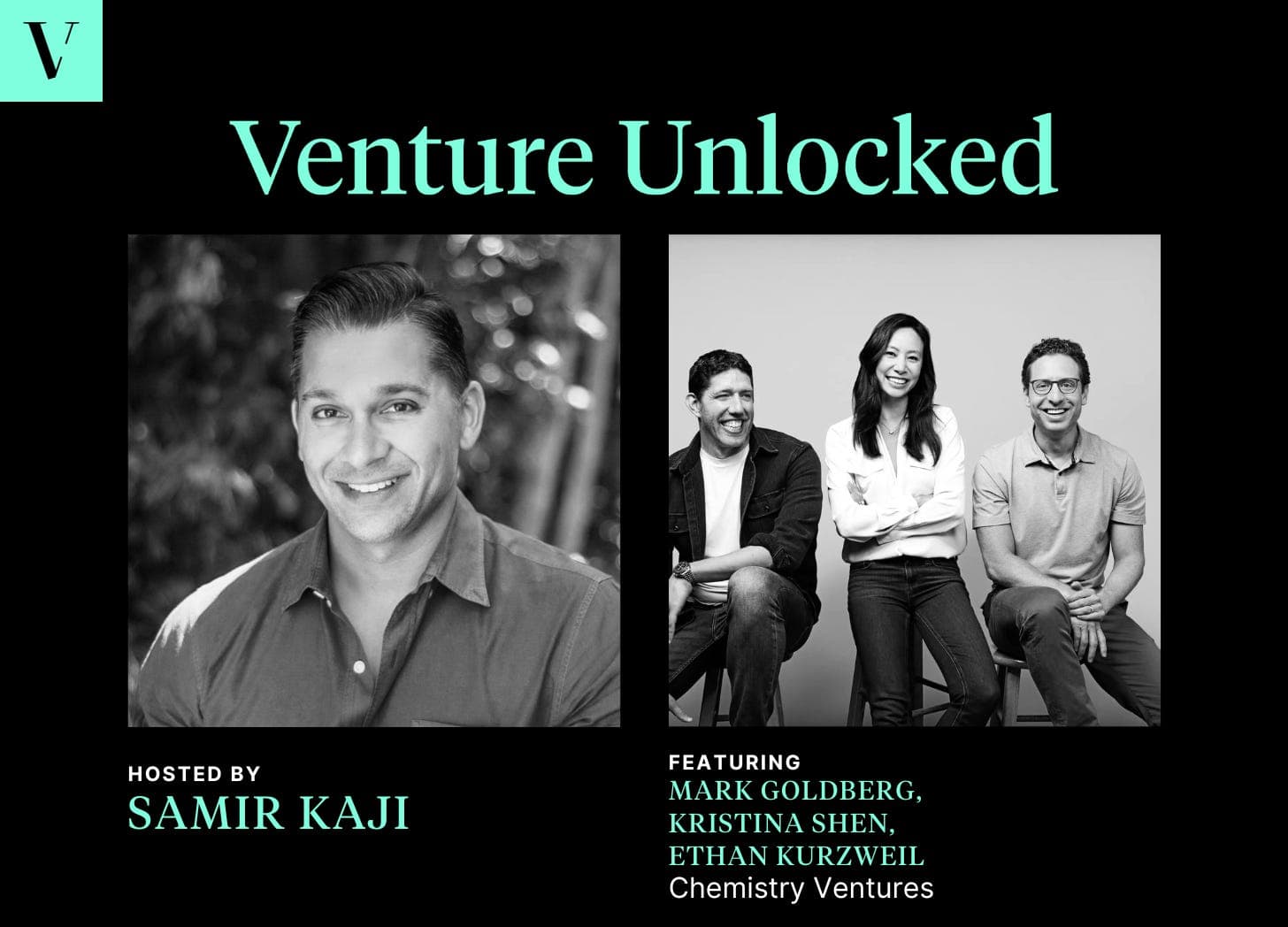
The blueprint for starting a new firm with Chemistry Ventures, including the work needed before choosing your partners and non-consensus decision making.
Hosts & Guests
- Host: Samir Kaji
- Guests:
- Kristina Shen: Co-Founder and Managing Partner at Chemistry Ventures
- Ethan Kurzweil: Co-Founder and Managing Partner at Chemistry Ventures
- Mark Goldberg: Co-Founder and Managing Partner at Chemistry Ventures
Episode Overview
In this episode of *Venture Unlocked*, Samir Kaji interviews the founding team of Chemistry Ventures, a new venture firm with a markedly successful debut fund of $350 million. The discussion revolves around the intricacies of forming a new venture capital firm, particularly in a challenging market environment, emphasizing team dynamics, investment philosophies, and the significance of internal decision-making processes.
Key Topics Discussed
- Importance of Team Chemistry
- Collaboration and Complementarity
- The founding partners, having worked together for years, emphasize the importance of "chemistry" and alignment in values and work ethic.
- They engaged in "co-founder dating," spending significant time discussing their goals and philosophies to ensure a solid partnership foundation.
- Challenges of Building a Firm
- Market Environment: The current landscape for launching a firm is described as one of the toughest in the past decade.
- Unique Value Proposition: They discuss how their venture firm offers a distinct value to early-stage founders compared to larger funds, focusing on personalized approach and deep engagement.
- Differentiation Strategies
- Focus on Early Stage Investing: Chemistry Ventures aims to be a boutique firm that provides tailored support to early-stage companies, contrasting with larger funds that may spread resources thin.
- Experienced Team: They believe their combined experience at blue-chip firms equips them to provide meaningful guidance and support to founders.
- Fundraising Insights
- Selecting Aligned LPs: The team sought Limited Partners (LPs) whose values and ethos align with theirs, ensuring a partnership that benefits both parties.
- Learning from the Fundraising Process: Kristina notes the empathy gained for founders during their first-time fundraising journey, recognizing the challenges and nuances involved.
- Decision-Making Framework
- Single-Trigger Model: The firm adopted a single-trigger decision-making model for investments, allowing any partner to make investments while still encouraging collaborative feedback.
- Follow-On Investment Strategy: Each follow-on investment is treated as a new investment, ensuring that decisions are based on current performance rather than past commitments.
- Non-Consensus Beliefs
- Contrarian Views:
- Kristina believes the importance of personal relationships will outweigh brand dominance in venture capital.
- Mark argues that a small team can outperform larger firms due to agility and focused attention on early-stage companies.
Key Takeaways
- Team Dynamics are Crucial: The strength of a venture firm lies in the relationship and chemistry among its partners.
- Focus on Founder Relationships: Building genuine relationships with founders is essential for success.
- Intelligent Decision-Making: A structured and thoughtful approach to investment decisions can yield better outcomes, particularly in uncertain markets.
- Understanding LP Relationships: Finding LPs who share a vision and values is key to long-term partnerships and success.
Closing Remarks
The episode highlights the thoughtful and strategic approach taken by the founding team of Chemistry Ventures as they navigate the complexities of launching a new venture capital firm. Their commitment to team chemistry, founder relationships, and non-consensus decision-making sets a strong foundation for their new venture.
For more insights and to stay updated on future episodes, listeners are encouraged to subscribe to *Venture Unlocked* on [Substack](https://ventureunlocked.substack.com?utm_medium=podcast).
Written by AI. May contain mistakes. Listen to the episode to check what was said.
Transcript
Automatic transcript. May contain errors.0:00Welcome back to another episode of Venture Unlocked, the podcast that takes you behind the scenes of the business of venture capital. I'm your host, Samir Khadji, and today I'm excited to speak with the founding team of Chemistry Ventures, a brand new venture fund led by Christina Shen, Ethan Kurzweil, and Mark Goldberg, who respectively recently spun out of blue chip firms Andreessen Horowitz, Bessemer, and Index. The firm just announced a significantly oversubscribed $350 million debut fund. As a new entry to the market, I really was curious about asking them their blueprint of building a firm in today's environment, including how they chose to partner up and the work they did beforehand, as well as LP strategies and selection, and what they felt their unique reason was to exist in a highly competitive market.
0:41I think you'll enjoy hearing their thoughts, so let's get right into it now. Samir Kaji is the CEO and co-founder of Allocate. Allocate and Venture Unlocked are independent of each other. Any statements or references made by Samir or his guests regarding third parties, investments, or securities are solely their views and opinions and are not intended as investment advice or an endorsement of such parties or securities by Samir, his guests, or Allocate. Allocate or its clients may maintain relationships with or investment positions in guests, third parties, or securities mentioned in this podcast.
1:14This podcast is for informational purposes only and should not be relied upon as a basis for investment decisions. Well, it's good seeing everybody and I'm excited to do this. First of all, I wanted to congratulate you on the close. Raising a fund one in this environment is always a little bit tricky. There's so many interesting things in terms of how you've built this firm, how you've imagined this firm. And we're going to go through and unpack a lot of those things. The first thing I always think about when people are raising firms is really the team. And at the end of the day, every company, every venture firm is a collection of people.
1:48and when you have more than one person, one of the key things is bringing people together that are complementary, that can work together well and create a franchise. Your firm name is Chemistry. I think about that and I really think about the chemistry of the people, your chemistry with founders. But let's talk a little bit about the inner workings of how do you pick partners. I know all three of you have known each other for a while. Ethan and Christina, you've worked together. But maybe, Christina, talk about how you brought this group together and ultimately, what were the things that got you comfortable with starting an entire franchise together?
2:23Pun intended, chemistry was incredibly important for us. You know, we've all worked together, whether it be in boardrooms, Ethan, myself directly for seven years at Bessemer. But in many ways, we've kind of felt like this was the partnership outside of our existing partnerships for a very long time. We've been training notes on deals, talking about theses for many, many years. And so we say it's been a partnership 10 years in the making. As we were coming together, there were a couple attributes we really cared about. We really cared about, we were working with partners that represented the ethos of being laser focused on the early stage, very collaborative, high hustle were all the components that we thought a lot about.
3:03Even when we were dreaming up the team, we naturally came up with each other's names, which has been a big fun part of it. And when we started having the conversation earlier this year of like, hey, can we be co-founders, can we be partners? You know, it's not enough just to be friends and think highly of each other in the industry. We did co-founder dating. And that was actually a lot of work and time we put together. A couple hundred hours of sharing our ethos on what we wanted chemistry to be. That was kind of like dating where, you know, you leave with 20 questions, you come back and see how we compare.
3:35But I also was just talking about deals all the time to understand our different deal tastes, because it was very important that we felt that the three of us would come together and make each other better in terms of sector coverage, our voice on investment. And that was really what gave us a lot of conviction to jump out in April when a lot of the news hit. One of the things that I think is really important to unpack even further is not just your investing styles or what is the vision of what you want to invest in, the themes, the sectors, the stages, but also the cultural ethos of the firm. I think it has to be incredibly aligned.
4:09And the three of you came from very different places. Christina, you from Andreessen, Ethan, more recently at Bessemer and Mark from Index. How do you think about merging those different cultures? Because you do want to take some of the good things out of those cultures, bring it together. So take us inside. What are the conversations that you guys had for those 200 hours that went into the cultural piece of what you were building is to make sure that there was true alignment and how you thought about things. And you're right. That was like, we didn't know going in if there was going to be, you know, perfect chemistry alignment around us to allow this firm to blossom.
4:46And what gives us so much confidence to go out and, and raise this fund and give our, you know make the promises that we are to founders is just how we kind of meshed our styles and the trainings that we had in the backgrounds that we had and felt like we were sort of taking what we thought was really effective and changing what we thought was less so and kind of customizing it for what we think a more small boutique experience can be for founders in a you know in a firm of our size there was a lot of things that we came into the partnership very very aligned on it was almost kind of uncanny. We did this sort of exercise where we gave ourselves 20 questions and we came back with the answers and we matched them up.
5:26And 17 to the 20 was like almost complete alignment around focus around early stage, having that be the ethos of the firm from the beginning, kind of a default optimistic mindset, you know, going all in with the founders, having kind of a core set of high conviction vets, having excellence be kind of at the core of everything that we do. Like we were all saying those things already. There were some areas that we had to hammer out, of course, where, you know, Index and Bessemer did things differently around deal conviction and, you know, voting processes and how deals get approved and things like that.
5:57And we had to kind of debate them and kind of figure out like what was going to be, what was going to work for us, what was going to be the perfect fit for us. And I think we came to, you know, this may be one example that kind of speaks to your questions, like, how are we going to decide on what investments to make? It's like very core to a venture firm. How do you make decisions? We all felt very comfortable with this model that is borrowed from some firms and is different than other firms. We trust any one of us to pull the trigger on an investment, a single trigger model. But we really wanted to incentivize and ensure that there was a lot of time for the other two, in this case, or if the partnership extends the other partners, to really give rich feedback and kind of pull apart a particular investment opportunity.
6:40And so that's, we sort of structured some of our processes around that. So that's kind of one example, but it took a bunch of debates and kind of debating what had worked well and what hadn't in the past to get to that. Yeah. And 200 hours is a decent amount of time, obviously, to confront these things. And I've worked with a lot of folks that have built actually very longstanding firms that had generational succession, but they had a core ethos that was built in the beginning that kind of carried over, not just for fund one, fund two, but even fund 10, fund 11, fund 12. and one of the things that they told me was when they first started, they had really hard conversations and they confronted the harsh realities of creating a long-term business and having those conversations and sometimes uncomfortable conversations around decision making, economics, all of those things that they found if they didn't do that, that wouldn't have led to long-term growth.
7:32So it totally makes sense in terms of how you did it. And I do want to double click at some point during the conversation on decision making, because there are so many different ways that venture firms interrogate opportunities and make decisions. But I still want to kind of stay on this concept of starting a firm right now. And there's this entire world that we've seen over the last 15 years, we've seen so many new firms come to market. And one of the questions from an LP standpoint that often comes up is, what is your right to exist in today's market where we know power law exists you it's incredibly competitive especially at the series a so how did you think about forget about for the partnership you came together you felt there was good alignment but enough compatibility and complementary skill sets to succeed but when asked what was their right to exist maybe mark i'll start with you because you've obviously you know worked at a firm that has a very much a right to exist with index and maybe that was part of some of the early conversation you all had of where do we fit in?
8:36Yeah, I mean, I love this question. So, I mean, the short answer is we thought there was a product opportunity for founders that didn't exist. And the product that we're bringing is a combination of experience and hustle that we think is very hard to get at the big funds. And I think at the big funds, you kind of get, there's a paradox where the most experienced investors on the team have the least amount of time to spend with early stage founders. Because you have, you know, I just stepped off 19 investments when I was leaving 14 boards. And I think that's light relative to the industry load for people that have been at the big funds for a long time.
9:07So we thought the ability to cross-pollinate experienced investors with different investment voices, different networks, and give them clean slates to play offense just to be all in with founders with that focus was gonna be a really differentiated experience for founders at the early stage. For just to make it a little bit more personal, so when I started at Index Ventures at the end of 2015, early 2016, we were still relatively new in the U.S. market. And, you know, I still remember we didn't have a brand that was a calling card on the U.S. side. In Europe, it was a great calling card. But in the U.S., I would cold email a founder and they would say, you know, market insight, market IVP.
9:43Like people, you know, we weren't really well known. I've been in a position where you have to build a brand, where you have to kind of make a mark. And I think the opportunity is really compelling for us. And I think one of the criteria that helped pull us into this fund was, as Christina described, in our kind of working sessions to decide if we're going to do this, we talked to a lot of founders. And there was this sense, not of founder fatigue with a new fund, but of excitement. Like, yes, something different. Like, please, let's have some kind of fresh folks in the ecosystem. That's what we're bringing to the market with chemistry.
10:18I mean, Samir, just to put a finer point on it, we're working with founders all day long that are kind of like inventing new markets, bringing new product offerings to market. And yes, there have been a lot of new venture funds, but we didn't feel like there was sort of a new offering that was kind of different, that had been brought to market in a long time. And I remember the early days of Vessemer very similarly, or my time at Vessemer, very similarly to Mark's, where I wasn't a super recognized brand yet. And, you know, there was a building opportunity there. And we kind of felt like this moment in venture was crying out for that to the point where we like couldn't put the idea down as much as we tried to pressure test.
10:56Is this going to work right now? How's it going to land? But we felt like this was an idea that like the moment was screaming for. We all had our own ways of getting to conviction and talking to friends, whether it be VCs or family members or founders. And it was the founders that were like, you guys have to do this. because they're like, they want this product in the market. And I actually felt like they were the most raw, raw of like, you guys can do it. You can jump out. We're betting on partners. And that's our bet as a firm is that the partners are going to jumpstart chemistry as a fund. There's a lot of analogies you can draw, but if you think about companies and, you know, ultimately you have your target demographic that you're your ICP that you're going after, you have a product that you hope will achieve product market fit.
11:40In your case, as a venture fund, venture funds at the end of the day, the undifferentiated part of the product is the money. But of course, we know the best founders and the most interesting companies are going to be highly competitive. Therefore, you have to have product market fit for the type of companies you're going after that's differentiates you from your pure set in some meaningful way. And I think about that in all the things that I do on a day-to-day basis. And it's been everything from, we're going going to focus on a certain thesis. We're going to focus on a certain sector. We're going to get really deep.
12:13Or in certain cases, the bigger firms, and I'm not a big fan of like lionizing big funds or small funds and demonizing the other, because these are very different products for different types of groups. But you mentioned something, Mark, around this concept of early stage founders having true partners with real experience behind. And what we've seen in the past with some bigger firms and some even mid-sized firms is like portfolio teams. We have teams that do this and teams that do that. Oftentimes, they are staffed with sometimes mid-level or junior people, so you still don't get that true senior level presence.
12:51What is your view, I guess, on the competitive market when it comes to those bigger firms where you may not get the number one or number two or number three partner, but you get the mid-level partner with an entire portfolio team. How does that product differ from the product that you're providing? First off, we would share your view that there's not categorically one right to exist, a big or a small funder. It's great for founders that there's different products. We think that the product we're building is going to be really exciting, and that's why we're starting chemistry. With respect to portfolio services, I think the fallacy with portfolio services is that it's for founders.
13:28I think that in a lot of ways, portfolio services is for VCs to do what is unscalable and to give them a crutch to be able to deliver beyond what they're capable of doing. And I think if you go talk to founders and you ask them, what is the relationship that means the most to you from an investor? I think most often you're going to hear the advice that I'm getting from the partner with experience is what I want. And that the intermediary between those two people is not always an advantage and is oftentimes a disadvantage. There are very good people working inside of funds at portfolio services.
14:00So this is not a value judgment on anybody in these roles. But what's clear is if you don't have all the context, it can be very difficult to add the right level of value. And that's a core ethos that we bring to building chemistry. For us, it's we don't want to outsource the relationship. We are doing something that we believe is very important. It's the name of our fund to be in the trenches that close with our founders. and we think that's a little bit different than other choices the market has made. And we're excited to kind of see that value proposition resonate. So Samir, when founders have asked, you know, as we've been talking to founders over the past couple of weeks and they ask, do you have portfolio services?
14:36My answer has been an unequivocal, yeah, we do have portfolio services. We're portfolio services. We're providing portfolio services to you. And, you know, you should hold us accountable for that and judge us on that. And we think we'll be the best portfolio services team you could have. I love it. And Christine, obviously, you have experience in terms of a firm that had a huge portfolio services team. There are different flavors and different levels of skill set at these different firms. I really like this concept of thinking about your firm as a company. And when you think about it, one thing that struck me during our conversations over the past several weeks is how intentionally you have been, not just raising this fund of what do we think is going to work?
15:20What's a product market fit? What does chemistry two look like? What is chemistry three? And that speaks to kind of building a franchise. And during this time, you were out there fundraising, telling this story to people in a time where, you know, candidly, raising a first-time fund has been incredibly hard. Dollars seem to gravitate to the firms that you were part of before, with a few exceptions like yourself. Maybe tell me a little bit about what you learned during the fundraising process on the LP side, because at your prior firms, a lot of those funds are just raised, you know, and you are the arbiter of making decisions and obviously making investment decisions, working with the founders.
16:02Maybe Christina, give us a little bit about how you started the fundraise, what went into the planning, and what were some maybe surprises that happened during that raise itself? Well, so I mean, first of all, we feel incredibly fortunate that we were able to raise and kickstart as quickly as we were able to kickstart. A couple of things, I don't know, and Mark and Ethan chimed in as well, but a couple of things were notable in the fundraise. First of all, we were looking for LP partners in the same way that I think founders look for investors, which we were looking for people who are aligned with our ethos, our story, and believe the same things that we believed.
16:37And we very intentionally sized this fund so that a founder's success would be our success as well. People who were nodding their heads in the first meeting, they tended to be the obvious ones that actually wanted to partner with chemistry too. And so we found that actually that was quite prevalent. And we think there's no right answer. Venture is a collection of different products. We think there are different products for different founders and we think there are different LPs for different VC firms. And we found the right LPs for us. But it was the first time raising our funds. So we had a lot of learning lessons.
17:07When we first started, we probably could have been a little better packaged. This was our first time doing it. We were learning a lot. The biggest thing I learned actually was being the first time fundraising. I actually grew so much empathy for the founders that we talked to. And that's something that even as I've spoken to founders in the last couple of weeks, last couple of months has really resonated, which is, you know, it's a hard journey. It's hard to try to in a quick moment, package your story, get people to understand you and, you know, bring people along that journey. But, you know, a couple messages really hit, you know, I think the laser focus on early stage venture was something that really hit.
17:41An experienced team with clean slates because we've had 35 years of venture experience. And I think we've led almost a hundred investments up to this point in about a dozen unicorns that we invested at the early stage. I think that really hit. But starting afresh where we bring that experience and have the time to actually focus on founders really hit. And then pun intended, I think people saw our chemistry. This is a partnership and partnerships last. It's not a couple years. It's not one fund. When LPs were looking at us, they're looking at us for a 10, 20 year journey. What you want to see is a group of people who enjoy working together are very aligned in the same way that we assess founders, right?
18:20Very aligned on what they want to build next and are planning for the future. You said something there that I think is really interesting. So from a founder standpoint, yes, you want partners that are going to be with you for the long term, really understand your ethos. You're going to be there and really push you in ways that help you improve. And these are not short-term partnerships. I mean, a single fund may last 14, 16, 17 years. So you're kind of stuck with people for a while. So you might as well like them and know that they're going to be along with the journey with you, or you can be honest with them.
18:49How did you assess that on the other side? So if somebody is listening to, and I'm an LP that wants to get into interesting funds, what are the things that you forced to rank that you wanted to see from your LPs to say, hey, we want you as a long term partner. That's just for fun one. But as long as we go along this journey, the best meetings we had in our fundraise were the meetings where we walked in. And as soon as we started to give our pitch, the other side would stop us and say, is it kind of like this? And they would tell the pitch to us. And we would just kind of sit there and be like, yeah, that's that's what we're saying.
19:22Like those are the dynamics that we're also seeing. That's why we're doing. And it was very exciting when we would walk into some of these meetings. And that was my favorite conversations from the summer, which was somebody had that thesis and it was the same thesis that we're building the fund around. And you just knew immediately that that connection was going to be there. So I think that was a very fun way where when we kind of walked into LPs that we knew we're on the same page, we knew we were going to have a good conversation. For what it's worth, that was not all our meetings. We had meetings where it was the opposite.
19:52We'd walk in, and if somebody came in and said, explain to me why I should continue investing in the asset class of venture capital. We already knew we were kind of fishing in the wrong pond. But fortunately, we had a bunch of those where it was, oh, yeah, we love venture, but a lot of the venture funds we were in have become asset managers. We're looking for something pure play. We like the idea of experience. We like the idea of a fun one where, of course, there's risk and three people coming together. But man, there's a lot of excitement. If you guys get this right, we can see it being successful.
20:20One other thing to Christina's founder empathy point is we got better at forecasting which boat people were in, where they really liked experienced managers. They really didn't like VC at all. Both of those categories were probably not going to be fits for us. I mean, in some cases, maybe people came around, but we really wanted folks, to Mark's point, that we're aligned anyway on an opportunity for a new founder product, opportunity for a new firm brand that spoke to some of the things that we felt were missing in the industry. Then it came down to, do they believe in us? Do they assess our chemistry to be a lasting one that'll lead to the firm continuing existing?
20:59I think all LPs were assessing that risk of like, are we going to get along well? Are we going to, when things are hard and the moments when they are, are we going to strangle each other or are we going to get stronger through it? And so it's a very hard thing to sort of package in a pitch. I think it came through that like we had we had pressure tested that and kind of every way you possibly can but there's still that unknown of well what's going to happen when x goes wrong or y goes wrong i preface this you know initial question with this is one of the hardest times fundraise you're kind of in a unique subsection of the market where you were able to raise and raise from great people and in a time period that was actually very quick even for normal periods and a lot of it is it harkens back to what you've done in the past, the firms you've been, the track record, and then really your relationships that you built with both founders and some of the folks on the LP side.
21:52We talked a little bit about what you look for in an LP. So that alignment, that cultural ethos, the ability to want to invest over the course of the franchise, but that there's also LP portfolio construction, like how many LPs, the type of LPs, There's endowments, foundations, there's fund of funds. How did you think about, I guess, that piece of the top-down portfolio construction? We learned a lot. I think one thing that was constant throughout the fundraise was we wanted a relatively concentrated LP base so that on the portfolio, once we raised the fund from an investor relations standpoint, it was very manageable.
22:29We didn't want to have so many LPs that we needed to hire somebody to manage that group. We loved the idea of having direct relationships with LPs. And we thought that would be impractical if we had 100 LPs. So about 20 LPs felt like the right balance between not having too much concentration, but also having a concentrated enough group that we could really build some relationships that were meaningful to us. When I say we learned a lot, maybe I'll just speak for myself, because I think Christina and Ethan might have been more sophisticated than me. I came in thinking, oh, the game here is this type of investor is the most sophisticated, whether it's endowments and foundations or this or that.
23:06And I leave with a totally different impression. I left with a sense of there was no correlation in a lot of times between what I perceived prestige of the institution and the quality of the LP at that institution. What really resonated with us was people that were sophisticated, that were independent thinkers, that understood what we were pitching, what the risks were and what we were pitching. And that represented a very broad and diverse set of LPs, which kind of reflects who ended up investing in the fund. And that's something I didn't expect from day one. You know, I've been really focused on the GP part of the job, the investing in founders, not the fundraising side.
23:42So the whole thing was a learning experience for me. But that was one of the big takeaways is kind of great can come, a great LP can come from any bucket and the value of independent thinking being an attribute that I wouldn't have presupposed before we started that has become quite valuable after the fact. You also learn how venture fits into the broader asset allocation universe out there. Like what is the asset class designed to do? This is not stuff I was thinking about every day as a partner at Bessemer, but we kind of got some empathy for LPs and also some just understanding of it. And I think that was a little bit in a backwards way.
24:17Our pitch ended up hitting on that. I think if you want venture exposure, in some cases, it was about sort of like high beta. Like, I want you guys to swing for it and go for those outlier situations, and that's going to be noisy. And I want you to take big risks. Again, I think folks that want early stage venture exposure, that's a little bit the mentality because there's other parts of their portfolio that just have less of a beta component to them. I also think that maybe played in our favor a little bit in that we were saying, look, we're early stage VCs. We're going to go all in. We're going to have a concentrated portfolio and really make each bet count.
Read the full transcript
24:52But we're going to go in at the sort of earliest possible moment we can identify the winners. And so thinking about how does that fit into the, you know, there's growth stage VC, there's buyouts, there's real estate fund, there's all these things. And like, what LP need? Are we uniquely poised to serve? This is an interesting exercise that I think as we got into it, we sort of understood a little bit the considerations more. It's a little bit of the product market fit the other way, right? So because everybody is a little bit different and an endowment versus a pension versus a fund to fund versus a family office versus, you know, sovereign wealth fund, everyone operates differently.
25:27Now, venture tends to be the smallest piece of the overall pie. If you look at, you know, let's say 100 points, venture might be, you know, 5%, 10%, 12 % of their portfolio. And it generally is the area that people are looking to generate alpha. and one of the things that people have realized over the last 25 years, generating alpha is not easy. Getting a 3X net firm, which tends to be kind of the baseline for what people underwrite to, at least from an LP standpoint to GPs or early stage funds, the percentage of 3X funds relative to the entire population when you look at the numbers, it's actually a pretty low number, shockingly.
26:03And if you look at things like Cambridge and PitchBook, the median returns haven't been very good. So you have to figure out some kind of formula that allows you to see the best deals, win those deals when you see them, and of course, have a level of picking acumen. And this goes to then the reality of the world today, which is valuations around sizes are definitely bigger than they were 10 years ago. Now, the exits are likely going to be bigger now as well. But this all comes down to decision making at the time you're making a decision on a company. I've always heard from a lot of really smart VCs that you have to underwrite every company as if it doesn't have the potential to be a fund returner.
26:44And the reason, of course, is you know that there's going to be a fairly wide group of your companies that end up returning a zero to one. It's usually like 40 to 60%. You have some that return like a one to 10x. And then you have those two or three companies that really, really return the vast majority of the fund and are those fund returners. How do you think about at the time of decision? Because you do have the single trigger, but I'm assuming that you still have a shared view of, from an economic standpoint, what do I have to underwrite a company to? So maybe talk to us a little bit about decision-making to get to the point where you can justify, hey, I can tell LPs we're going to get to a 3X or higher.
27:23I mean, I love that you pose a question this way, Samir, because you're so sophisticated in venture math that I almost feel like you described our portfolio construction already, but that is very much how we think about it, which is we are very early stage focused. We need two or three dozen investments in the fund. The venture math has always held that one, two, three, four are the ones that are really going to be the mega returners in terms of how venture math works. We intentionally decided our single trigger decision-making process in order to capture outliers like that. The second you have votes on every single deal, by definition at the early stage, every investment or early stage company is like a little bit hairy.
28:08Not every baby is pretty from day one kind of thing. But you actually want to create a structure where Mark can pound the table and say, you know what? I know there's a weird market. I know it's competitive, but this founder, I see the spark because I've worked with them before. I've seen the talent they've brought on. I love the way they're iterating on the velocity of the product. You know, he can see a spike in something and then lean into his own conviction to say, hey, we have to make this bet. Now, if we were doing growth stage investing, I think we all probably would say we actually all should vote and have a consensus view because the top companies do tend to align more towards there's more things you can look at, like the market size and metrics and all that kind of stuff.
28:54But at the very early stages, we're looking for something spiky. And that something spiky could be the founder, an insight on the product, a unique tailwind in the market, or some unique information that we have that we're going to lean into. And having that single trigger mindset enables you to capture those outliers in order to have the venture type of returns we're looking for. We're also stylistically different, which we like in that, you know, we wanted to sort of capture surface area in different places, both thematically, but also just like styles, because what you saw in a founder company market kind of early on to identify the, you know, the stripes, the data bricks, the, you know, the future sort of, you know, mega outlier returners, there's different vantage points on which you could see that.
29:43And so what we wanted to do was have the best chance of somebody being in a position to catch one of those sparks and kind of capture it and then pound the table with each other, get each other's feedback, but pound the table because we felt that conviction because we saw something in the founder. We saw something in the market. We saw the market opportunity is perfect. This just sort of happened in the way we came together. But as we dug into it, we really liked that feature of our partnership that we all have a little bit of a different style. And I know it's early, so you haven't really done a bunch of deals.
30:16But invariably, what's going to end up happening is there's going to be a deal that one of you sources that you love the founder, you love the market, but it's contrarian. It's a little funky. There's a non-consensus sort of aspect to it. And you're going to bring it to the group and there's going to be probably a good amount of discourse and conversation around it. And ultimately, somebody does have the ability to pull the signal trigger and do it. So then when you think about those meetings, do you view the role of the person bringing the particular deal as trying to convince the other two and providing the color?
30:52Or is it really just around seeing where the blind spots are and then assessing those blind spots to be able to make a decision as an individual. So we're literally going from this podcast to a deal discussion where this will be tested. And I think that the exciting thing we're seeing from only a few weeks in market is that the diversity of views and networks is starting to really pay dividends. And I'll just give you an example. There was a company last week that we flew to New York. Christina was championing and we were at the company taking them to dinner within 24 hours of her conviction level.
31:28and at the end of the dinner, the team said, when do you do partner meetings? Is it like a Monday partner meeting? Like, dude, what are your slots? And we kind of laughed because that was the partner meeting. Like we are all here. We've all now had the right level of exposure. And I think that's what speed and a small partnership can do. Now, after that and our conversations, it's really helpful when Ethan says, I was actually on the board of a competitor seven years ago to that business. And here were a bunch of things that didn't work. And then I can say, actually, one of the co-founders went to college with so-and-so who I know, and I can get some feedback on that to share with you.
32:01So the obligation and the benefit of being in the partnership is being able to surface all these different angles to make the richest set of decision points that you can bring. I think one of the dangers, even in a model where you have a single trigger actual vote, is that we're all collaborative people. And I actually think there's even more of a danger that we can talk each other out of doing good deals. I worry about that. Even though, of course, the letter of our voting mechanism is you can pull the trigger, it's uncomfortable. I don't think it's in anyone's name. We're coming together as a team for a reason because we respect one another and we respect their opinions.
32:35So it's this tight balance of you want to make sure that everybody has the benefit of your perspective. But I think there's a danger that if you throw kind of water, cold water on everybody else's ideas, even in a single trigger model, you could talk yourself out of any interesting deal at the early stage. Yeah, I think especially at the beginning when you're first coming together as a partnership where you want to retain this level of true camaraderie and it does take real trust in each other to be able to have really tough conversations and say, look, no matter what you're telling me, I don't believe in your deal, but I believe in you.
33:07And even more so, once you do the deal, like three, four, five years down the line, if the deal doesn't work, to move away from a culture or any risk of finger pointing, when you came up with that single trigger model of anybody can pull the trigger, we don't need consensus, we don't want the political history of like, you vote for my deal, I'll vote for your deal, and all those things that happen at big firms still. How did you think about like the cons maybe of like making sure that you're, you know, maintaining the peace and then even longer term, there's not a finger pointing culture? The cons fall in two directions.
33:42There's sort of the canonical con, which is like, oh, someone's just going to go rogue and do a bunch of deals that don't work out. And then there's the con that actually I think all of us worry about more than Mark spoke to, which is that because of we're just sort of like collaboration, we're going to end up talking each other out of deals that we should have done. And I mean, I think about my venture career, I think about deals I could have done. Bessemer had a pretty close to a single trigger model that I could have just, and people brought up appropriate levels of concerns. And I psyched myself out of it, you know, because it tested my conviction and I didn't have it.
34:18That's where we go to like the culture that Mark was talking about of like, you know, not trying to convince each other, but trying to, you know, provide inputs that would help someone get to a more compelling conviction. We also have kind of a spirit of pretty raw, honest feedback in our firm that we've talked about and kind of tested in the incubation period, I guess you could say. And that includes like bad deal judgments that we make and trying to like measure those things and help each other make better decisions in the future. It's certainly not to be like, whoa, you know, you did this one deal that didn't work.
34:53We're going to do lots of deals that don't work. But more, hey, what would have led to a better decision? how can we make better decisions in the future? And so that's definitely something we want to be part of our culture, have it not be awkward or controversial to do it and be able to just say what we think each other is missing and even kind of revisit and say it without, not in a gotcha way, but in a spirit of improvement. We've talked a lot about the decision-making at the time of initial investment. You do the C, you do the series A, but within the firm itself, of course, you're reserving for the next round of capital, that Series B for the companies that do break out.
35:31You don't have a lot of data at that point. Maybe you have a couple years of data from when you made the initial investment. And one of the concerns a lot of LPs had, and certainly we saw it in 2021, which is the peak period, is you had contracted periods between like a seed in Series A and Series A and Series B. You don't really have a lot of data points. You had almost no data points to be able to assess if a company was actually working. Now we have a little bit more time. But at the same time, follow-on decision-making is so critical. Which companies do you follow on? How do you make the decisions?
36:02And avoid some of the mistakes that we saw where it was just kind of lazy decision-making. Like we did the A, so we're just going to do our pro rata and the B. And it didn't matter what the step up in valuation or anything. It was, we're going to be founder-friendly because we want to build a brand that we're going to be behind them. How do you think about decision-making on follow-ons? We view every investment, whether it's the initial investment or the fall on as an independent decision. And so we have to underwrite every dollar that an LP provides us. We are underwriting to a high return. And so we treat that the same for the fall on decisions as well.
36:37You know, in very strong bull markets, are there chances that we didn't deploy as much into our winners? Yeah. Occasionally that might happen, but we believe very strongly that we have a fiduciary duty to treat every dollar like it's a great new investment and we'll do that for fall ons too. Any other thoughts on that? Because I do think that it's a great point to think about those following decision making as independent decisions. And what is the risk return you're getting in that kind of series B follow on? At the same time, I also felt like there was this other part of the incentive structure of, if it's a good company that's kind of doing well, you don't want to also not do something because of the signal.
37:19How do you, I guess, weigh that in the decision of follow-ons versus that initial where you don't have any signal potential issues? I mean, I think it's a nice thing about being a new fund is our follow-ons are a new decision for us. It's not, you know, and there's not this sort of expectation of automatic follow-ons that you might have. We looked, and I think you're right, you know, historically in kind of industry averages. And I think you're right. I think there was a lot of follow-on decisions that were made that were outsourcing thinking. And so we have some ideas on structures internally to be able to kind of check ourselves, ensuring someone doesn't go too native, as well as ensuring there's a rigorous decision-making around those things.
38:02But this also comes with kind of an ethos of being an early-stage firm. It's like, that's what we're about. We're about the early stages. The follow-on decision might be a great company, but it doesn't fit our ethos as kind of an early-stage style of investment where we can get outlier returns. And that would be fine. And there's other firms where it is a better fit. So it's not just good company, bad company. It's like, is this incremental dollar fulfilling on the promise of our fund that we have with each other and with our LPs? It definitely is very, very aligned with sort of the LP of you're a fiduciary and you're a money manager.
38:35And you have to make those decisions with how do you optimize the end return for the fund and also balance against sort of supporting the right companies along their journey. we're going to use this pun a lot I think through I think we have throughout this conversation around chemistry and you know it's chemistry with the founders chemistry with the LPs chemistry with each other but at the same time you know I've got to know each one of you and you are you have very different styles different ways of thinking and I think that is a net positive as a partnership to bring these varying views and one of the things that I've noticed in some of the conversations both today and in the past is each of you have a slightly different view of the venture industry and what works.
39:19And I think it's really helpful, I guess, for me to hear what is that one closely held belief each of you have that might be viewed non-consensus in the general venture system or, you know, I can call it an echo chamber because it tends to be an echo chamber. Maybe, Christine, I'll start with you to provide that non-consensus view. I think brand is on the downfall. I think, you know, we were in the last 10 years where venture is all about brand, brand, brands. And I think brand matters when relationships are cold. And I think we're all about building warm relationships and investing in people.
39:53I think the next generation is going to be about personal brands or people or partners and not the humongous brands that maybe we're all aware of. My non-consensis view is venture is not about winning. Certainly there's winnings important. But I think what's going to differentiate us is going to be being a magnet for founders, of course, and less about the winning, but being sort of the magnet where we really get to know founders in a more intimate way than a deal process. And making a set of somewhat contrarian at the time investments that prove right. And, of course, some that don't. But I think that's what's going to differentiate us and stand out.
40:38My non-consensus view would be that a small team of three people can beat a multi-hundred person team. And I think a lot of people would look at that on face value and be like, that's an insane thing to say, like three people versus hundreds of persons institutions. But I fundamentally believe that in my core, having been inside of large organizations. And I think the question is, what is the alignment and what is the energy being put out? And when you've got hundreds of people working on a deal, a company, you get lost in the largeness of that institution and you fall into a tragedy. It's possible to fall into a tragedy of the common situations where everybody's kind of interested, but nobody's success is really tied to it.
41:20When it's three people and you have a small portfolio, every company matters. and that is something that is highly, highly, highly motivating and I think gives you the ability as a small team to outmaneuver a big team. It's a speedboat and a sea of oil tankers. And the reason I think our story is a little unusual is because it's a bit contrarian. It's like the direction has been bigger because the brand and the platform strength. And I don't disagree with kind of the benefits that accrue, but clearly we're betting with our feet on this contrarian point of view, we think a small team, the agility, the ability to innovate, the ability to kind of throw unreasonable amounts of time at portfolio companies is going to build a brand that really endures.
42:00That's great. I love hearing things that are a little bit different in terms of what we hear every single day and what we read about. Again, congrats on the launch of the firm, I didn't say firm, not just fund. And it's been a pleasure, obviously, getting to know each other and having this conversation. So look forward to the continued growth and appreciate you all coming on today. Thanks, Samir. Thanks for your support. Your enthusiasm and support means a lot. Thank you, Samir. It's an absolute pleasure to be here and we're excited about the partnership. Thanks so much for listening to another episode of Venture Unlocked.
42:33I hope you enjoyed our conversation with the team at Chemistry Ventures. To stay updated on future episodes and get the latest venture insights, subscribe to Venture Unlocked at VentureUnlocked.substack.com You can also find us on iTunes and Spotify and don't forget to leave us a rating if you enjoyed the show Thanks again
43:11Thank you.
From the publisher
Follow me @samirkaji for my thoughts on the venture market, with a focus on the continued evolution of the VC landscape.
Today I’m excited to speak with the founding team of Chemistry, a new venture firm led by Kristina Shen, Ethan Kurzweil, and Mark Goldberg, who recently spun-out of blue chip firms Andreessen Horowitz, Bessemer, and Index Ventures, respectively. The firm just announced a significantly oversubscribed $350MM debut fund.
As a new entrant to the market (in the toughest time to start a new firm in over a decade), I wanted to ask them about their blueprint for building a firm, including how they chose to partner up and the work they did beforehand, LP strategies and selection, and what they felt was their unique reason to exist in a highly competitive market.
About Kristina Shen
Kristina Shen is Co-Founder and Managing Partner at Chemistry Ventures, overseeing a $350M fund focused on early-stage software investments.
Formerly a General Partner at Andreessen Horowitz (2019-2024), she led significant investments in Mux, Pave, Wrapbook, and Rutter. Kristina specialized in high-growth startups.
She began her venture career as a Partner at Bessemer Venture Partners (2013-2019), working with companies such as Gainsight, Instructure, and ServiceTitan. Previously, she worked in investment banking at Goldman Sachs and Credit Suisse, focusing on technology sectors.
About Mark Goldberg
Mark Goldberg is Co-Founder and Managing Partner at Chemistry Ventures since, investing in seed and Series A software startups. Previously, a Partner at Index Ventures (2015-2023), he worked with companies such as Plaid, Pilot, Intercom, and Motive, establishing a strong fintech and software portfolio.
Prior to Index, Mark worked at Dropbox in Business Strategy & Operations and Strategic Finance (2013-2015), where he contributed to growth strategies during Dropbox’s scaling phase.
He started his career as an Analyst at Morgan Stanley (2007-2010) before joining Hudson Clean Energy as a Senior Associate. Mark holds an AB in International Relations from Brown University.
About Ethan Kurzweil
Ethan Kurzweil is Co-Founder and Managing Partner at Chemistry Ventures, leading investments at the seed stage for tech-driven startups. He also serves as a board member for companies like Intercom and LaunchDarkly.
Previously, Ethan was a Partner at Bessemer Venture Partners (2008-2024), where he worked with companies such as HashiCorp, Twilio, and Twitch. His focus on software and digital platforms spanned roles as board member and investor, contributing to significant IPOs and acquisitions.
Early in his career, Ethan worked in business development at Linden Lab (creators of Second Life) and served as a Senior Manager in the CEO’s Office at Dow Jones. He holds an MBA from Harvard Business School and an AB in Economics from Stanford University.
In this episode, we discuss:
* (01:43): Importance of Team Chemistry and Partnership Formation
* (03:27): Challenges of Building a Firm in the Current Environment
* (08:00): Unique Value Proposition for Early-Stage Founders
* (10:18): Early-Stage Focus and Differentiation from Large VC Firms
* (16:12): Fundraising Insights and LP Relationship Building
* (19:00): Choosing Aligned LPs and Targeting Long-Term Partnerships
* (27:23): Single-Trigger Investment Decision-Making Model
* (30:12): Balancing Conviction with Collaborative Feedback
* (35:23): Independent Decision-Making for Follow-On Investments
* (39:19): Personal Contrarian Beliefs about the Venture Industry
* (42:18): Closing Remarks on Building a New Venture Franchise
I’d love to know what you took away from this conversation with Kristina, Mark, and Ethan. Follow me @SamirKaji and give me your insights and questions with the hashtag #ventureunlocked. If you’d like to be considered as a guest or have someone you’d like to hear from (GP or LP), drop me a direct message on Twitter.
Podcast Production support provided by Agent Bee
This is a public episode. If you would like to discuss this with other subscribers or get access to bonus episodes, visit ventureunlocked.substack.com