In short
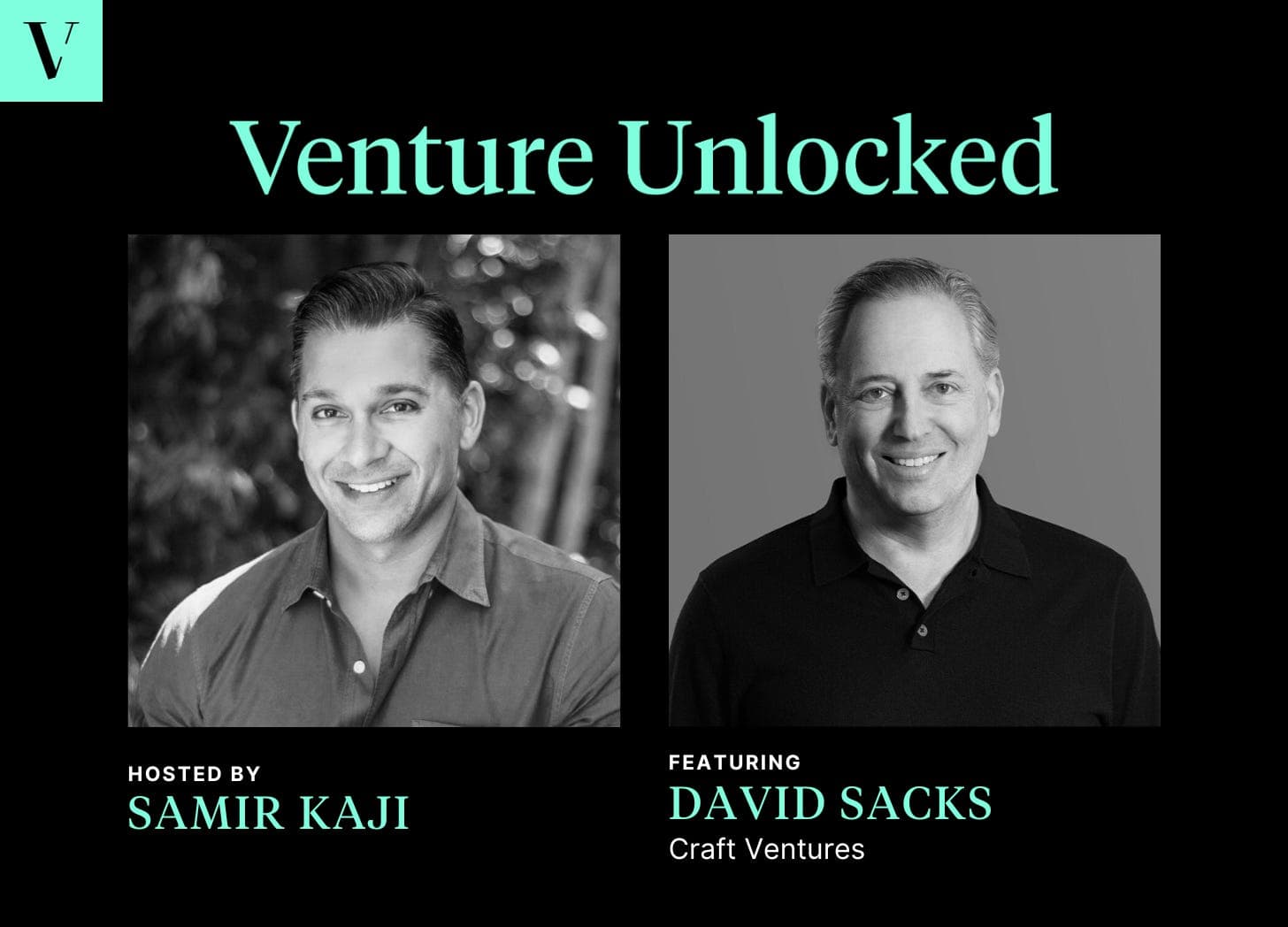
Venture Unlocked Podcast Episode Notes: The Craft of Venture Capital with David Sacks
Podcast Overview Title: Venture Unlocked Host: Samir Kaji Description: A podcast focused on the insights and strategies for managing, operating, and scaling venture capital firms, featuring expert discussions.
Episode Summary In this episode, host Samir Kaji interviews David Sacks, founder and partner of Craft Ventures, a San Francisco-based venture capital firm with over $3 billion in assets under management. David discusses his journey from an entrepreneur at PayPal to a successful venture capitalist, highlighting key insights into the evolution of Craft Ventures, the importance of operational expertise, and the current state of venture capital.
Key Discussions
- David Sacks' Background & Craft Ventures:
- Transitioned from being an entrepreneur to a venture capitalist in 2017.
- Founded Craft Ventures with a focus on SaaS and marketplaces, leveraging his experience with Yammer and PayPal.
- Evolution of Craft Ventures:
- Initial fund raised $350 million; current assets managed at $3.5 billion.
- Emphasis on a strategic focus in fund sizes and team growth aligned with investment strategy.
- VC Market Landscape:
- Shift towards sustainable investment strategies post-2020-2021 market bubble.
- Advice for entrepreneurs: focus on capital efficiency and realistic growth expectations in the current climate.
- Portfolio Construction Strategies:
- Discussion on reserving funds for follow-on investments to maintain ownership stakes.
- The importance of balancing initial check sizes with reserves for future rounds.
- Market Corrections:
- Overview of the venture capital landscape's shift following the correction from the 2021 bubble.
- Predictions for further resets in valuations and funding availability in 2024.
- Firm Culture and Talent Acquisition:
- Importance of a collegial culture and teamwork at Craft Ventures.
- Focus on collective success and providing valuable support to portfolio companies.
Notable Quotes
- “Fund size is fund strategy.” – David Sacks
- “In a bear market, the three metrics that investors care about are growth, burn, and margins.” – David Sacks
Key Takeaways
- Transition to Venture Capital: David’s transition reflects the blend of entrepreneurial experience with investment acumen, crucial for understanding and supporting startups.
- Strategic Focus: Craft Ventures’ emphasis on SaaS and marketplace investments allows for specialized expertise and stronger support for portfolio companies.
- Market Trends: The shift towards sustainable investment practices and fund strategies provides a more disciplined investment environment.
- Future Outlook: A continued reset is expected in valuations, with a focus on the impact of interest rates and market conditions on startup funding.
Conclusion David Sacks shares valuable insights into the dynamics of venture capital, the importance of operational expertise, and the evolving landscape of investment strategies. The conversation emphasizes the need for VCs to adapt to market changes while maintaining focus on value creation for startups.
---
For more insights, visit [Venture Unlocked Substack](https://ventureunlocked.substack.com).
Written by AI. May contain mistakes. Listen to the episode to check what was said.
Transcript
Automatic transcript. May contain errors.0:00Welcome back to another episode of Venture Unlocked, the podcast that takes you behind the scenes of the business of venture capital. I'm your host, Samir Kaji. On this week's episode, we have a conversation with David Sachs, founder and partner of Kraft Ventures. Based in San Francisco, Kraft was founded in 2017 and currently has over$3 billion in assets under management. Across the last three decades, David has been incredibly influential as an investor, entrepreneur, and public thought leader. When starting Kraft, he was able to draw from his deep operating background, having worked as an early leader at PayPal, and then later founding Yammer, which he sold to Microsoft for$1.2 billion.
0:35He is also one of the hosts of the All In Podcast, one of the most listened podcasts in the world. We had a wide-ranging dialogue that took us through the evolution of Kraft Ventures from its initial days to today, the strategic decision-making behind scaling fund sizes and team growth, and his overall views on the current outlook of venture capital. I really hope you enjoy it, so let's get right into the show. If you're a venture investor, then I'm sure you already know about Sidecar, the go-to platform for emerging VCs to manage their SPVs and funds. Sidecar is on a mission to make private markets more accessible, transparent, and liquid by standardizing how investment vehicles are created and executed.
1:13Their powerful and robust software allows VCs to launch SPVs and funds instantaneously, track funding in real time, and offer hassle-free opportunities for early liquidity. Whether you're syndicating your first or 50th deal, Sidecar acts as your silent operating partner, handling all back office functions in a single place. Sidecar always has your back so that you'd never have to worry about chasing subscription documents, loss wires, or late K-1s. Sidecar's responsive and proactive customer support team is there to assist you, helping you build trust with your investors and tackling the challenges of building your firm.
1:47To learn more, visit sidecar.io forward slash venture unlocked. Samir Khadji is the CEO and co-founder of Allocate. Allocate and Venture Unlocked are independent of each other. Any statements or references made by Samir or his guests regarding third parties, investments, or securities are solely their views and opinions and are not intended as investment advice or an endorsement of such parties or securities by Samir, his guests, or Allocate. Allocate or its clients may maintain relationships with or investment positions in guests, third parties, or securities mentioned in this podcast. This podcast is for informational purposes only and should not be relied upon as a basis for investment decisions.
2:28David, thanks so much for being on the show. An area that I think it makes sense to start with is really the inception of Kraft. And I know it's been seven years. And before that, you had a ton of experience at PayPal in the late 90s, early 2000s, and then starting Yammer during the beginning of the GFC. Curious about the white space you saw that inspired you to start Kraft and go full-time and investing in 2017. Samir, thanks for having me on the show. So I had been investing in startups for 20-something years, basically throughout the whole time that I was operating and founding companies. And you're right that around 2017, I decided that I didn't really want to operate companies as a day-to-day job anymore.
3:10And so that gave me capacity to basically take on capital partners. So that was sort of the first thing is just to kind of wrap some structure around what I was already doing from an investing standpoint. In terms of building craft, our philosophy has been to build the kind of firm that we wanted to partner with when we were founding companies and operating companies. And the thing that we've done is really focus on the area that I know best, the area that I was a founder in with Yammer, which is SaaS, and specifically product-led growth models or bottom-up SaaS models. So we've assembled a team that understands SaaS really well on both the investing side and then also on the operating partner side.
3:53We built a pretty robust platform team that helped provide services to assess startups. And the goal is not to do the work for them, but rather to have an expert in every area that can help them get jump started. A lot of our Series A investments are startups that are building on a sales team for the first time. I mean, they may be founders who did the initial sales themselves. We'll help them find the right VP of sales. We have a pretty large recruiting team. We'll partner with them on that. We'll show them kind of how to set up and structure their sales team, their go-to-market team, and so on.
4:27You know, we have kind of experts in a bunch of areas like that. That's basically what we've tried to build is, again, just the VC firm that is the kind of firm that we wish we had as a partner when we were kind of going through this as founders. I think it's a good segue to go through the evolution and the scale of craft. And during these seven years, you've done that fairly significantly, both on fund sizes and team. I think fund one was$350 million. Now you're managing just under$3.5 billion in assets. And I get the question a lot from both GPs and LPs on how do you think about scale? When is the right time to scale fund size, team?
5:05And would love to hear your perspective on how you thought about scaling fund size and the reasons behind it. Sure. Well, I think our first fund was, like I mentioned, an extension of the angel investing that I'd been doing for two decades. And I already had a backlog of companies that I was already involved in and was very optimistic about. And so our first fund was really optionistic. It was kind of multi-stage, multi-strategy. We didn't necessarily focus on just one vertical. We sort of made, I guess you could say, continuation investments in companies I was already involved in. So that was really the first fund.
5:45And then starting with fund two, we started to get serious about having a focus. And the venture capital landscape is obviously very crowded. There's a lot of competition. And so I think it is important to have a strategy and a focus. And we decided to focus on the areas where we ourselves had been founders. So obviously, with SaaS, and specifically bottom-up SaaS is what I had done as a founder, creating one of the kind of pioneering bottom-up SaaS companies with Yammer, which we sold to Microsoft back in 2012. And then the other GP at Kraft, Jeff Flohr, had been the founder of StubHub, and he was an expert in marketplaces.
6:20We decided to really focus on SaaS and marketplaces. And that's what we've basically done at Kraft since then. In terms of your question about fund strategy, there's an old saying that fund size is fund strategy. Because if you take a typical fund size, the first thing you have to do is you kind of have to separate out, okay, there's some percentage for fees and expenses. There's going to be some percentage for reserves that leaves the amount of capital you can have for first checks. And then you might want to divide by a number that you think that gives you an appropriate portfolio size, maybe 20.
6:58So when you do that math, you figure out like, what is the typical check size that you can write? And that's really going to dictate what stage you can play at. I I mean, obviously, if you have$100 million fund, by necessity, that's going to be a seed stage. On the other hand, if you have, say, a$600 million fund, that is going to be much more likely to be a classic Series A, Series B venture fund. Likewise, if you've got a multi-billion dollar fund, you're going to be doing a lot of late-stage investments. So you want to have an alignment between the size of your fund and the stage that you're pursuing.
7:33And then I think, like I said, you want to have a focus for the fund where you think you have a competitive advantage. There is an area there I want to double click on. And you're right. You know, you focused on a certain category, which is what you've done in the past with bottom up SaaS and really SaaS, understanding how to scale SaaS businesses. the area that you know i'm curious about is thinking about as you scaled the fund sizes and knowing that fund two was really this non-extension of just the angel track record but creating sort of this profile around sass and marketplaces how did you think about portfolio construction because as you look at a seed fund versus an early stage fund a lot of seed funds maybe 70 80 percent initial check and seed.
8:18They fall in in a small percentage of those companies and may reserve 20 to 30%. With the bigger funds, oftentimes you have the reverse where 30 to 40 % might be initial in the rest of reserves. How do you think about maximizing ownership at the initial check versus keeping enough in reserves for some of the breakouts? Yeah, it's a good question. I guess if I do anything over again, we probably would have reserved more. We probably didn't reserve enough. We invested more in, you could say, first checks. And we ended up having a lot of markups in fund two. We ended up not having the capacity to take those.
8:56Or later, we raised our first growth fund, and then the growth fund was able to take those allocations. So yeah, we probably should have reserved more than we did. I think the classic rule of thumb is you probably want to reserve about 30 % of the fund for follow-ons. And then fees and expenses, maybe it's roughly 15%. So when you add those things together, you're only investing about half the fund or maybe 60 % of the fund roughly in first checks in companies. And so you do have to take that into account when you pencil out your portfolio construction. And this comes back to the point of overall return profiles.
9:36And one of the things that I know you've talked about and others have talked about is not only has venture potentially gone mainstream, but it has also increased in AM. And if you look at some of the bigger firms, most of the AUM built was over the last five years. Funds were raising more. They were raising at faster cadences. It was 18 months versus the traditional three to four years. Within a fund structure, during the ZERP period, of course, we saw multiples expand. SaaS multiples were, in some cases, depending on the stage of company, 2050x. Public multiples now are at 6x. What is the overall mental model now in terms of returns?
10:19Because ultimately, most venture investors or LPs want to get to a 3x net pretty consistently. Knowing that you're not investing the entire fund because you have fees and expenses that you have to account for, how do you approach a deal today knowing that the multiple compression that we've seen and really the return to normalization is something that's probably the new normal. First, we may want to discuss what happened in 2020 and especially 2021. We basically had an asset super bubble in not just venture, but across capital markets in the United States and really broadly across the world. I mean, starting in 2020 with COVID, you had the Fed and also fiscal policy in Washington to start airdropping money into the economy.
11:08And in combination with lower interest rates or basically zero interest rate policy or ZERP, you saw a huge speculative bubble form in pretty much all risk assets. So it wasn't just venture-backed companies. It was also crypto. There was even real estate. pretty much across the board, the more oriented towards growth or risk the asset was, the bigger the bubble got. And so you saw in venture markets in 2021, 100 times ARR became the rule of thumb for valuation. And that has corrected massively since the correction really started in 2022, but it's kind of continued now. And I think it started stabilizing around Q3, Q4, of last year.
11:58But we basically went through a bubble in 2021. And I think that has huge ramifications for everyone in the ecosystem. I mean, it has huge ramifications for startups that some of them were lucky enough to raise at that peak. But a lot of them, you know, had burn rates that were way out of whack because they assumed they'd always be able to raise money at those valuations forever. And there's had to be a huge reckoning among startups to in terms of right-sizing. I think there's been a huge reckoning at venture funds in terms of pace of capital deployment and valuation. So I think everybody is living through this hangover now to the bubble that happened in 2021.
12:41And we're all kind of adjusting because of that. The interesting thing about the ZERP period was the length of it, which depending on how you counted 11, 12 years, And we had an entire generation of entrepreneurs and investors who had been in the industry for 10 years that had never seen anything but up and to the right. And for companies, the fundamental metrics that people were judged on was top line revenue growth. It was how much capital can you raise to help at least temporarily outmaneuver competitors? And I'm curious, given that you've been through the operating side in really tough times, both with PayPal and then certainly Yammer, how did you help companies and entrepreneurs navigate something that they had never been through before?
13:26Well, the message to entrepreneurs has been really, we started doing portfolio reviews, or rather, we started doing meetings with all of our portfolio company CEOs in February of 2022. And we did another one, I think, in May of 2022. I think we've done three or four of these. We actually ended up posting all of these on YouTube, so you can go find them. But what we started telling our portfolio companies in February of 2022 is there's been a regime change in the capital markets. Capital used to be abundant. It was easy to raise. Valuations were high. We're now seeing a huge change because of interest rate policy.
14:06And with interest rates going up, I mean, in fact, they spiked up from, call it roughly 0 % to 5 % in one year, as the fastest rate tightening cycle we've ever had. Capital availability just really dried up. And what we advise founders is you should really make the capital that you raised last year, if you were lucky enough to raise at the peak, you need to make that last much longer than you thought. This is not an environment in which you're going to be raising capital every 12 to 18 months. This is a kind of situation where you may not raise capital for three or four years. I mean, you should effectively consider that last round that you raised to be two rounds.
14:45We also stress the importance of metrics. Fortunately, Kraft as a firm has always been very metrics focused. And we've published a lot of blogs on the SaaS metrics that matter. We've invented some metrics that we think are a good way to benchmark SaaS startups, metrics like burn multiple. And so we've always been, even during that frothy period in 2020 and 2021, we did not invest in startups that didn't have good metrics. There were a lot of VCs, I think, started investing in companies with no ARR. You'd see deals get done and valuations and the hundreds of millions. And that just always seemed crazy to us.
15:23You know, when we did invest, I mean, one of the things that we do believe is that as a VC, you're largely a price taker. I mean, your job is to find the right companies, is to pick the right companies, but valuations are set as a result of a market process between VCs and founders. And so you have to, the most important thing to decide is which companies you want to be in. And then you're somewhat beholden to where market prices are. And there's no question that entry prices in hindsight were way too high in 2021. But we feel like at least we got into the companies we wanted to be in. So in any event, the advice we started giving founders in 22 is just, it was all about the regime change.
16:06And we talked a lot about this on the All In Pod as this was happening. There's a lot of nuance and some things that I think that are a little bit difficult for people to always understand, which is I think most people overpaid, if not all, in 2021. That was essentially the game on the field. And as you mentioned, almost every investor was a price taker. And it was how do you have a market clearing price in the very best companies that make sense where there's still significant upside? Now, some of those companies will continue to do well. They will raise capital, but there's probably a long tail of companies that raised gobs of capital during that time that might have had some tailwinds.
16:48And we've seen things like Hoppin, of course, that was benefiting from the tailwind of COVID. There's other companies that didn't have those strong fundamentals. How do you see this playing out? We have seen markdowns during 2023. I don't know that they're as ubiquitous across every single firm. And as you know, valuation policies across funds are very different in how they mark down and mark up. But what do you anticipate seeing in 2024 with this logjam of companies that may not be able to be spoon-fed in inside rounds and are going to have to test the capital markets? I think you're going to see in 2024, the, I guess, final piece of the reset that really started in 2022.
17:28And it just takes a long time because startups were able to raise so much money under such good conditions in 2021 that a lot of them haven't needed to go out. And I would say that most founders did listen to the advice that we were giving and obviously was by no means us alone. I think most VCs and certainly all the responsible ones were letting their portfolio companies know how things had changed and were advising them to reduce burn rates. So most founders, I think, listened and reduced their burn in 2022 and 2023. We saw a lot of rifts, you know, headcount reductions at startups. It was pretty much the norm.
18:08And as a result of that, I think a lot of companies have had the runway to not raise for three years. In 2024, we're getting to the end of that runway. And I think most startups that haven't raised in three plus years are probably going to need to. I mean, even if they don't hit the wall and run out of money, they might get to the point where they're six months away or a year away. It's going to be uncomfortable for them not to run a process and raise. So logjam is a pretty good word. There's going to be a clearing through the system of these companies that haven't raised in a long time. And we'll get to ground truth on where their valuation should be.
18:48What is the impact, I guess, then to the venture market itself? Of course, we talked about this earlier in the conversation about the run-up in new firms raising, mega funds getting bigger and bigger. Of course, we've seen some of those funds maybe stabilize their fund sizes, even go a little bit lower. We saw Founders Fund, for example, split their fund from a billionaire to two separate funds. How do you see this playing out? and maybe going into detail, both in the small side of the market with all the seed funds that were raised, but also the potential impact with many of these large funds that have raised, in some cases,$3,$4,$5 billion.
19:27Well, I think the impact has been greatest at the late stages. And the reason for that is because you have to write bigger checks at the late stages and you have to raise bigger funds. And so it's been more impacted. Also, a lot of the liquidity that flooded into the venture markets came from crossover funds. VC firms might derisively call them tourist investors, people from outside the traditional venture industry who came in looking for an arbitrage. If you look at venture capital deployment as an industry, it was about 2010s that decade, call it. it was around 50, 60 billion a year was the amount of venture capital that got invested.
20:09And around 2020 and 2021, it went all the way up to about 200 billion. So again, during this bubble, you had a roughly tripling of the industry. And a lot of that money came from crossover investors, these absolute mega funds that came in. And their logic was as follows. They were looking at the public markets. And they were seeing that public SaaS companies were trading for 35 times ARR. And so they looked at the private markets and they saw, well, wait a second, we can get in to a private SaaS company that's, let's call it roughly tripling year over year, at 100 times ARR. So if we invest at 100 times ARR in one year, then this private company will catch up to the sort of public comp.
20:55And then from there, we'll be compounding and we'll be able to make a lot of money. This is basically just an arbitrage. That whole methodology kind of fell apart when public SaaS companies corrected from, say, this is a high growth multiple corrected from 35 times to eight or nine times. And then the other thing that happened, I think that was very damaging to that formula was that the growth rates also slowed way down. So if you look back in In 2022, the thing that happened in the first half of the year was multiple compression. The thing that started happening in the second half of the year is that virtually every public and private SaaS company started forecasting down.
21:38And we just saw the buying environment for software got much tougher. Buyers just got more discriminating. They started consolidating vendors. They started pushing off purchases. The deal cycles got tougher. Remember, layoffs were happening in a lot of these companies. we really had what I call a full-blown SaaS recession or B2B recession. The overall economy may not have had a recession because the consumer held up. But if you look at what was happening in the B2B world, it was very much a recession. And public SaaS companies were slashing their growth forecasts by about half on average. It just got much tougher to sell.
22:14And I saw that in all of my board meetings is that private SaaS companies were having a much harder time and they started forecasting down to more realistic sales targets. So the growth rates slowed way down. And so you had this double whammy where the multiples were coming down and the growth rates were coming down. And I think that created a crisis for these crossover funds who came in. They were really acting like term sheet generators. You could send them one page of metrics and get a term sheet back the next day at these valuation multiples that in hindsight were completely crazy. But again, they were basing their methodology off an arbitrage to a public exit comp.
22:55So that whole model kind of collapsed. And what you saw, I think, over the past year, two years, is that all of these kind of crossover investors have left the market. And that has created a huge contraction in the availability of growth capital. It's only gone back to the way it used to be. But basically, that bubble got corrected. So that's what's been happening at the growth stage. Now, what's happened at the earlier stage is because you never needed very large fund sizes to have a seed fund, for example, the availability of capital is not reduced as much. I think smart investors are being a little bit pickier and more discriminating about valuations because they know that if there's less growth capital, then growth rounds have been priced much lower.
23:39That means, so if the series C, if the average series C has gone from$500, $600 million valuation to a$200 to$300 million valuation, the series B can't be at$200 anymore. It needs to be at like$80 to$100. And that means the average series A needs to be at$40 to$50, not at$100. And typical seed needs to come down to somewhere in the$10,$15 range. There has been a trickle-down effect and a right-sizing all the way down, but the trickle kind of hits the seed stage last. And we'll talk about it at the seed stage, but going back to the growth stage, and when you mentioned crossover investors, it's the Tigers, the D1s, the Dragoneers, which were coming in and providing massive amounts of capital.
24:18And the product was very different. Tiger's product was, we say out of your way, we'll write you a check. We're not going to sit on the board. And for a lot of founders, that was a really attractive way to get financed with large dollar amounts and valuations that ultimately were fairly non-dilutive to them relative to what we've seen in the past. As those people have vacated, and I'd probably throw in the third whammy, which is the absence of a liquidity market that we saw in 2021, of course, it was SPACs, it was public markets are very friendly to new entrants. But as we got past that, the public markets were looking at a different set of variables outside of just growth.
24:58And so it just became tougher for those companies to even test the public markets. Arguably, many of them should be public companies, and we'll have to figure out what the market clearing price is. But one of the questions that came up, and I think you guys have talked about this before, and I want to dig in a little bit deeper, is the dynamics at the board level for some of these later stage companies. Because as a later stage investor, you may not even have ratchets if the company goes public where you get more shares. And so in some ways, you may not be as incented to take the company public.
25:29You know, you have your preferences versus an early stage investor, the common shareholders being the employees who are sitting behind all these preferences that may want a public offering where you can get liquid or everything converts to common. What are you seeing, I guess, at the board level? You know, I haven't seen a ton of that. I'm, you know, I'm familiar with the problem that you're describing, but I haven't seen a ton of it. I mean, I guess my attitude is that, you know, what I've been preaching since February of 2022 is just that there has been a regime change in the markets. Capital is much scarcer.
26:01Founders need to recognize that. They also need to recognize that the metrics that investors care about have also changed. One of the ways I frame it is that when you're in a boom market, the only three metrics that investors care about are growth, growth, and growth. When you're in a bear market, the three metrics that investors care about are growth, burn, and margins. So it's not that growth stops being important. Growth is always important and attractive to a VC. I mean, ultimately, we're investing in little startups that we want to become big companies. And that can't happen unless they're growing extraordinarily fast.
Read the full transcript
26:37But what happens in a bear market is that you start looking at other things. You also start looking at their burn rate, their capital efficiency, and their margins. And a lot of the companies that you mentioned that were raising gobs of money during that ZIR period. Some of them were negative gross margin businesses. There was no business there. They were just spending tons of money without having a real model. So when you have a correction, investors start getting a lot more discriminating, and they don't just look at growth. They also look at, again, the return on growth, the efficiency of growth.
27:15And if founders haven't developed that muscle or if they've developed bad habits during the Zerp period, they're not going to build a business which is attractive to the public markets. We saw that over the past year or two in the public markets, the SaaS companies that got the highest valuations were the ones that not only had good growth, but were also very capital efficient and were able to turn an operating profit and not burn huge amounts of money. And we've seen over the last couple of years, public companies have started sharpening their pencils and right-sizing. Facebook had one of the best years it's ever had last year in the stock market, mainly on the heels of getting much more efficient about its spending and its employee count.
28:02I think Google's been sharpening its pencil. A lot of companies now are asking tough questions about why do we need to be spending so much money? Why do we need all these employees? And they're kind of getting back to basics. They're getting back to fundamentals around operating efficiency. In any event, founders just need to be aware of that as well. And there are a lot of founders who are buying growth at any cost, and they weren't paying enough attention to metrics like CAC payback, burn multiple. Again, all the metrics that should be a governor on your growth rate, because there's no point buying growth that is not efficient growth.
28:40You know, if the unit economics growth are negative, that doesn't make sense. So, you know, in any event, we've been preaching that now for a couple of years. And that's the thing that I would encourage founders to focus on. In terms of the board dynamic, our advice at the board level has always just been for founders to get realistic as soon as possible and just understand the environment they're operating in. And if that means taking your medicine, just go ahead and take it. Don't waste a lot of time trying to maneuver around the realities. It's better just to accept the realities and move on.
29:14I mean, if that means taking a down round, then, you know, we're fine with that. We'd rather, we're rather a founder just reset and move on as quickly as possible, as opposed to, you know, trying to find machinations to avoid the reality of where their valuation is really at. Yeah, I agree that down rounds are probably overplayed in terms of the negative stigma. It's just what is the market clearing price? And there's probably companies that raised in 2021 or raising now in 24 and are going to have to take a lower valuation, even potentially after growing 2x or 3x from that time period. Going back to where we are right now, we've seen multiples return to what I would consider normalcy.
29:57This return to sobriety is a very good thing. And maybe we see this reset go through the end of 25. And during that time, it's unlikely we see the big crossover funds being there to right checks into almost any company. The question I'd love to kind of get your take on is, does this in any way inform how you look at a Series A or Series B investment, knowing that downstream capital is just going to be fundamentally much harder to get? Well, I think our view is that this is actually a good time to invest. And there's a few reasons for that. First of all, like you said, valuations have returned back to some sort of normality.
30:34and it is possible to invest at reasonable or attractive valuation levels. So that's number one. Number two is that this amount of capital availability has gone down. Like you said, a lot of these kind of crossover tourist investors have left the ecosystem. And I think that pace of deployment has slowed down for most funds. So even if every VC was able to raise their next fund, if they deploy that fund over an average of three years instead of a year and a half, then the amount of capital that's available is going to be reduced by about 50%. So, you know, scarcer capital conditions make for better dealmaking, I think, and more disciplined dealmaking.
31:14Also, you have a lot more time to analyze companies, look at them, you don't get rushed into a process. I just think it's a more normal and better operating environment for everybody. And then I would say the third factor is that we're at the dawn of a new tech wave with AI. And, you know, it's been a while since we had the whole cloud social mobile wave, which started in the early 2000s, and then mobile really broke around 2008, 2009. Whenever you have a new tech platform or tech wave, it, you know, we like to say kind of stalks the pond in terms of opportunities. I think that the pond of opportunities was that had been created by cloud was getting a little bit fished out.
31:58You know, it's always possible for entrepreneurs to find new ideas. But when you have a whole new revolution, you have a whole new platform that gives founders new tools to use to solve problems in the real world, then again, it kind of restocks the pot in terms of opportunity. So I think this is a very good time to invest. I think it's probably the best time to invest that we've seen in the industry since probably 2009, when I think some important mobile companies got started. That being said, we're not racing off to do every series A and series B that we can. We're taking it very slow. We're being very patient.
32:34We want to invest in the best companies. And there is this dynamic in VC where it feels like there's always a rotating bubble. And even though VCs have gotten really pummeled by the popping of the bubble from 2021, it's called the Zert bubble. It feels like there's always a rotating bubble into some micro area, and you just don't want to feel like a follower into some new bubble. So, you know, finding a company that we think is going to be a really important company, but then also where the deal terms make sense relative to its metrics and traction, that's always, it's always difficult to find those companies.
33:15Yeah, and I agree with that sentiment that it is a really interesting time to invest and a good time given the intersection of the returns of sobriety, as well as the potential of a new super cycle to borrow Brad Gerstner's term, artificial intelligence and all the impact it can make, both for the consumer and enterprise. An area that I'd like to shift to is thinking about running companies. And you've done that both working with great people like Peter Thiel over at PayPal, and then starting your own company before the acquisition by Microsoft. And now you've been running this firm for seven years.
33:53And our view has always been running a firm is similar to running a startup in many ways. What are some of the similarities and parallels, or maybe some of the differences between running a venture firm that's an investment firm, and working at a traditional company? Well, I mean, a venture firm is a company, and we think a lot about what our product is, what our competitive differentiation is, how it can be of service to founders. At the end of the day, we want to do the best job we can helping our portfolio companies and our founders, not just to deliver the best returns by helping those companies, but also because our reputation among founders is very important.
34:30So, you know, we've spent a lot of time thinking about, you know, how do we make our product better? And our product is the help and advice that we give to founders. And that's one of the reasons why we've specialized in the areas of SaaS and marketplaces like we have. I think one important difference, though, between a venture firm and a startup is that founders generally don't want to partner with another startup or shouldn't want to. They want to partner with something more stable. I mean, startups are constantly changing. They're constantly pivoting. They're constantly adjusting. If a venture firm does that, that's not a great feeling for its customers.
35:08for its founders. Probably not a great feeling for its LPs either. So I do think that a venture firm has to project stability a lot more than a typical startup does. Again, it's a professional firm and our product is a professional service as opposed to a technology itself. So I think that's the big difference. But we do think about it in terms of how do we deliver the most value to our founders. When you think about that concept, what have you found to be the hardest thing. And at the end of the day, your product and delivering this unique sort of value add that's very specific to these categories of SaaS and marketplaces relies on the people and the people that you bring, the culture, the way you make decisions, and the level of empowerment.
35:55What have you found in terms of the toughest part, I guess, in building the firm, at least from the people and talent acquisition standpoint? Well, I think we do have a strong culture as something we think about a lot. I think that Kraft has a very collegial culture. It's a team effort. I think a lot of venture firms, everyone's kind of a solo operator and there's a lot of sharp elbows. They're kind of competing with each other to get deals through committee. And it's highly political because people sort of trade deals to try and get them approved. We have none of that at Kraft. It really is a team effort.
36:28Nobody is compensated based on their individual deals. They're only compensated based on how the fund does. And you combine that incentive structure with a culture of collegiality, and it really is a team effort. And I think that founders can sense that when they work with us. Everybody at the firm is incentivized to help all of our portfolio companies. And we do bring in experts from all over the firm to help our portfolio companies. So I think founders can feel that when they work with us, they really have all of craft behind them and there's no weird political dynamic and there's no weird lack of transparency.
37:06I think that sometimes when you're dealing with venture firms, as a founder, it's really hard to kind of understand what's going on. You've kind of got your representative from the firm, but you don't really have a good sense of how they're making decisions. That person seems like they're going back to this partnership. It's a bit nebulous. I'd like to think that Kraft doesn't project that at all. We kind of all speak with one voice, and that's very transparent how we operate, and it's predictable because I think, again, founders should want to have predictable partners. So we think about all of those things.
37:39It definitely comes through ostensibly in terms of everything I've seen. And for those that are listening, checking out the YouTube videos that you have done, and I think it was you and Jeff presenting to founders, I think is a great resource. David, this has been a really fun conversation. Really enjoyed it. Thanks again for coming on the show. Yeah, absolutely. Good to be here. Thanks so much for listening to another episode of Venture Unlocked. We really hope you enjoyed it. To learn more about David and Kraft, be sure to go to VentureUnlocked.substack.com, where you'll find detail notes of the show as well as a listing of past episodes.
38:14You'll also find us on Apple or Spotify, where you can subscribe to get all of the latest shows as soon as they're released.
38:24Thank you.
38:51Thank you.
39:21Thank you.
39:51Thank you.
40:21Thank you.
40:51Thank you.
41:21Thank you.
41:51Thank you.
42:21Thank you.
42:51Thank you.
43:21Thank you.
43:51Thank you.
44:21Thank you.
44:51Thank you.
45:21Thank you.
45:51Thank you.
46:21Thank you.
46:51Thank you.
47:21Thank you.
47:51Thank you.
48:21Thank you.
48:51Thank you.
49:21Thank you.
49:51Thank you.
50:21Thank you.
50:51Thank you.
51:21Thank you.
51:51Thank you.
52:21Thank you.
52:51Thank you.
53:21Thank you.
53:51Thank you.
54:21Thank you.
54:51Thank you.
55:22Thank you.
From the publisher
Follow me @samirkaji for my thoughts on the venture market, with a focus on the continued evolution of the VC landscape.
We are thrilled to bring you a conversation with David Sacks, Founder and Partner of Craft Ventures. Based in San Francisco, Craft was founded in 2017 and currently has over 3 billion in assets under management.
Across the last three decades, David has been incredibly influential as an investor, entrepreneur, and public thought leader. When starting Craft, he was able to draw from his deep operating background, having worked as an early leader at PayPal, and then later founding Yammer, which he sold to Microsoft for $1.2 Billion.
He is also one of the hosts of the All In Podcast, one of the most listened podcasts in the world.
We had a wide-ranging dialogue that took us through the evolution of Craft Ventures from its initial days to today, the strategic decision-making behind scaling fund sizes and team growth, and his overall views on the current outlook of venture capital.
If you’re a VC investor, then I’m sure you already know about Sydecar, the go-to platform for emerging VCs to manage their SPVs and funds. Sydecar is on a mission to make private markets more accessible, transparent, and liquid by standardizing how investment vehicles are created and executed. Their powerful software allows VCs to launch SPVs and funds instantaneously, track funding in real time, and offer hassle-free opportunities for early liquidity.
Whether you’re syndicating your first or fiftieth deal, Sydecar acts as your silent operating partner, handling all back-office functions in a single place. Sydecar always has your back, so that you never have to worry about chasing subscription docs, lost wires, or late K-1s.
With all the recent ups and downs in the private markets, the last thing you want to worry about is whether your back office is operating smoothly. Sydecar's responsive and proactive customer support team is there to assist, helping you build trust with your investors and tackle the challenges of building your firm.
Visit sydecar.io/ventureunlocked to learn more.
About David Sacks:David Sacks is Co-Founder and Partner at Craft. He has been a successful founder and investor for over two decades, building and investing in some of the most iconic companies in tech. David has invested in over 20 unicorns, including Affirm, AirBnB, Bird, ClickUp, Eventbrite, Facebook, Houzz, Lyft, OpenDoor, Palantir, Postmates, Reddit, Slack, SpaceX, Twitter, Uber, and Wish.David first got involved in the technology industry in 1999 when he joined early-stage startup Confinity, later renamed PayPal. Serving as the company’s first product leader and then as COO, David built and ran many of the company’s key teams, including product management and design, sales and marketing, business development, international, customer service, fraud operations, and HR. He pivoted the product from beaming money on Palm Pilots to emailing money on the web, and introduced the business model. When the company IPO’d on the Nasdaq in 2002, David was 29 — the median age of the “PayPal Mafia” executives listed on the S-1. PayPal was later acquired by eBay and eventually spun back out into a publicly traded company (under ticker symbol PYPL).David is well-known in Silicon Valley for his product acumen. AngelList’s Naval Ravikant has called David “the world’s best product strategist.” And has received acclaim as one of the Besties on the All In Podcast.
In this episode, we discuss:
(02:56) David Sacks discusses transitioning from being an entrepreneur with experiences at PayPal and Yammer to founding Craft Ventures, emphasizing the focus on SaaS and leveraging operational expertise to support startups.
(04:56) The growth of Craft Ventures from its initial fund to managing $3.5 billion, focusing on SaaS and marketplaces, and how fund size affects strategy
(08:15) Portfolio construction and the strategic shift towards reserving more for follow-ons to maintain company ownership and align fund size with venture focus
(10:10) The VC market's evolution shifting towards sustainable investment strategies following the 2020-2021 bubble and its correction.
(13:39) Advice for entrepreneurs to focus on capital efficiency and realistic growth expectations due to the changing investment landscape
(17:33) Predicting a continued reset in valuations and funding availability in 2024, and how startups can adjust their strategies accordingly
(34:05) Parallels and distinctions between running a venture firm and a startup, emphasizing the importance of creating a stable, transparent environment at Craft Ventures
(36:10) The significance of firm culture and talent acquisition, focusing on collective success and providing transparent, valuable support to portfolio companies
I’d love to know what you took away from this conversation with David. Follow me @SamirKaji and give me your insights and questions with the hashtag #ventureunlocked. If you’d like to be considered as a guest or have someone you’d like to hear from (GP or LP), drop me a direct message on Twitter.
Podcast Production support provided by Agent Bee
This is a public episode. If you would like to discuss this with other subscribers or get access to bonus episodes, visit ventureunlocked.substack.com