In short
Podcast Summary: Venture Unlocked - The Evolution of Building a Legacy Firm at Venrock with Brian Ascher
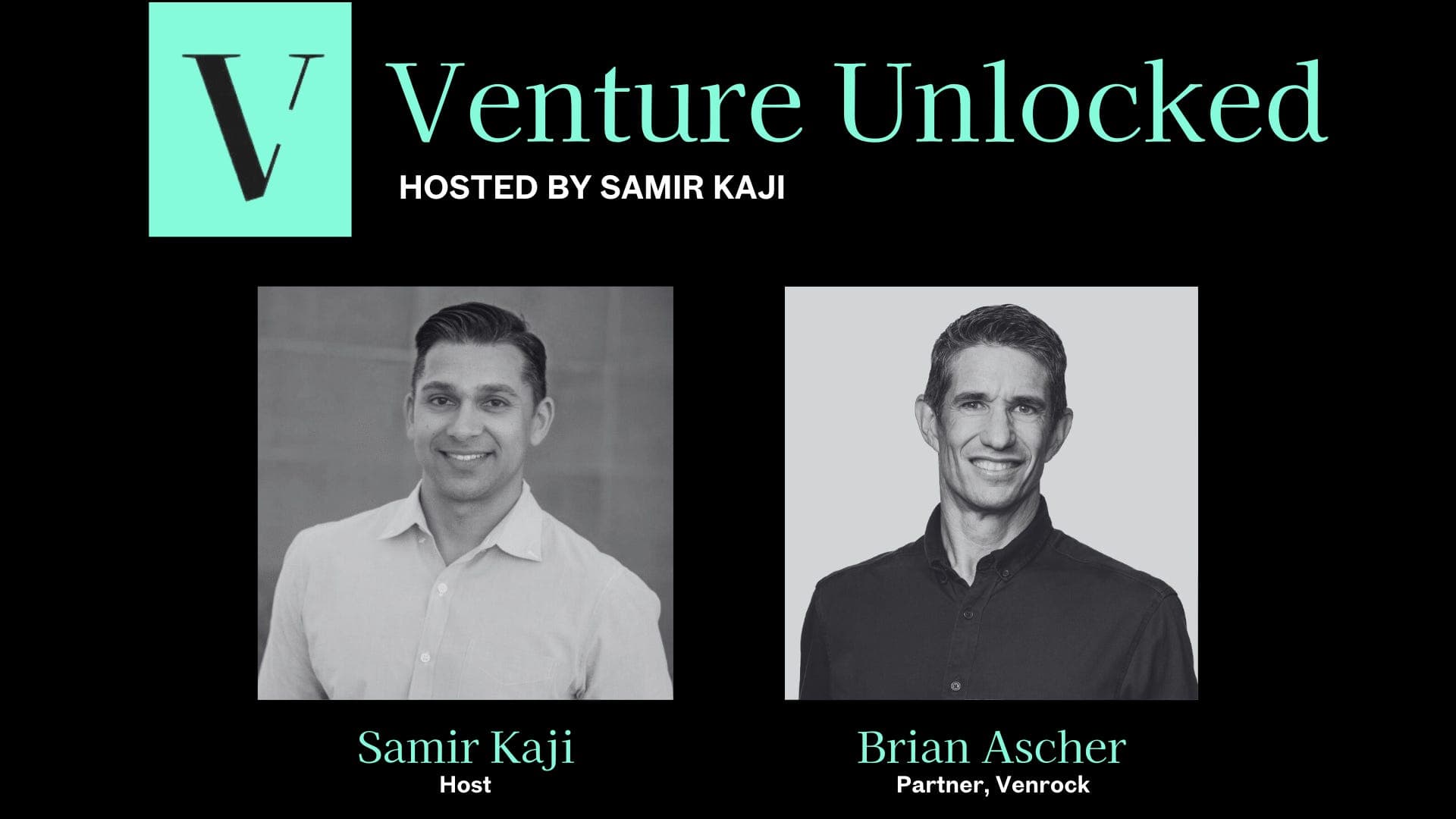
Episode Overview In this episode of Venture Unlocked, host Samir Kaji interviews Brian Ascher, a veteran venture capitalist at Venrock, which has a rich history dating back to 1969 as part of the Rockefeller family office. With nearly three decades in the venture capital industry, Brian shares insights on his career journey, investment strategies, and the evolution of Venrock as it adapts to changes in the venture capital landscape.
Key Details
- Host: Samir Kaji
- Guest: Brian Ascher, Partner at Venrock
- Venrock's History: Founded in 1969, known for significant investments in companies like Apple and Intel.
- Current Fund: Venrock 10, a $650 million fund focused on early-stage technology and healthcare startups.
---
Discussion Topics
- Brian's Career Journey (1:34)
- Transition from product management at Intuit to venture capital.
- Joined Venrock through the Kauffman Fellowship.
- The Evolution of Venture Capital (6:25)
- Insights into the growth of venture capital since the late 90s.
- Impact of the dot-com bubble on the industry.
- Venrock’s Decision-Making Model (10:09)
- The firm operates without a traditional investment committee, favoring a model of empowered accountability.
- Focus on collaboration and open dialogue among team members.
- Balancing Investment Decisions and Team Dynamics (14:42)
- Importance of team dynamics in making investment decisions.
- The role of mentorship and guidance for newer team members.
- Cultural Norms in Venture Capital (22:38)
- Venrock emphasizes a culture of transparency and shared responsibility.
- Discussion on how teamwork influences decision-making and accountability.
- Investment Strategy and Risk Management (25:12)
- Strategies for balancing investments across technology and healthcare sectors.
- Focus on long-term returns over short-term gains.
- Portfolio Construction and Returns (30:22)
- Approach to constructing a portfolio that maximizes the potential for returns.
- Discussion on ownership stakes and investment stages.
- Opportunity Funds vs. Core Funds (33:01)
- Venrock’s stance on not creating separate opportunity funds for growth-stage investments.
- Utilization of an opportunity fund to invest in existing portfolio companies.
- Adapting to AI's Impact on Investment (36:15)
- The rise of AI and its implications within the healthcare and technology sectors.
- Examples of companies leveraging AI for efficiency and growth.
- Advice for Aspiring VCs (41:28)
- Brian shares insights on what aspiring venture capitalists should focus on.
- Importance of recognizing and supporting exceptional entrepreneurs.
- Final Thoughts and Takeaways (43:48)
- Reflection on the importance of maintaining an open mind in venture investing.
- Advice on not rushing to fill capacity with “good” deals instead of waiting for great opportunities.
---
Key Takeaways
- Empowered Accountability: Venrock’s unique decision-making process emphasizes individual responsibility and collective discussion rather than relying on a top-down investment committee.
- Cultural DNA: The foundation of Venrock is built on a culture that prioritizes relationships with entrepreneurs and focuses on long-term innovation rather than just financial returns.
- Adaptability: As the landscape of venture capital changes, maintaining flexibility in strategies while staying true to core values is crucial for long-term success.
- Early Investments in AI: The importance of exploring early-stage investments, particularly in the context of emerging technologies like AI.
---
Conclusion The conversation between Samir Kaji and Brian Ascher provides a deep dive into Venrock’s philosophy and evolution within the venture capital landscape. Brian’s extensive experience highlights the significance of culture, decision-making, and adaptation in sustaining a successful venture firm over decades.
For more insights and episodes, you can subscribe to Venture Unlocked at [ventureunlocked.substack.com](https://ventureunlocked.substack.com?utm_medium=podcast).
Written by AI. May contain mistakes. Listen to the episode to check what was said.
Transcript
Automatic transcript. May contain errors.0:09Welcome back to another episode of Venture Unlocked, the podcast that takes you behind the scenes of the business of venture capital. I'm your host, Samir Khadji, and today we're excited to have Brian Asher on the show from the iconic firm Venrock, which was founded in 1969 as part of the Rockefeller family office. Since then, the firm has invested in companies such as Apple, Intel, Gilead, and Nest. The firm last closed Venrock 10, a$650 million fund focused on early-stage technology and healthcare startups. Brian's someone that's been in the venture industry for nearly 30 years, including the last 26 at Venrock, and it was really fun to go through the history and evolution of the firm, along with her best practices for decision-making, maintaining a competitive edge, and fund-sizing strategy.
0:50I really hope you enjoy our episode with Brian, and let's get right into it. Samir Khadji is the CEO and co-founder of Allocate. Allocate and Venture Unlocked are independent of each other. Any statements or references made by Samir or his guests regarding third-party investments or securities are solely their views and opinions and are not intended as investment advice or an endorsement of such parties or securities by Samir, his guests, or Allocate. Allocate or its clients may maintain relationships with or investment positions in guests, third parties, or securities mentioned in this podcast.
1:27This podcast is for informational purposes only and should not be relied upon as a basis for investment decisions. Brian, it's good seeing you. Thanks for being on the show. Well, thanks so much for having me. It's rare that I find and talk to somebody that's been in the industry for almost three decades, let alone at this same firm, which you've been at now for, what, 26 years. And I think a natural place to start for us is your career going into technology and then ultimately what led to you joining the venture side. I guess the relevant place to start is I got out of business school and I had some interest or a vague notion that venture might be a place I wanted to end up.
2:06I had sorted out in my mind the difference to what I thought was the difference between venture and private equity and hedge funds and all that. But what I heard from the alumni that I visited who were VCs, they said, you should really go work in a tech company first. So I wound up at Intuit when the company was still fairly small, was a product manager for Quicken for a number of years. And after doing that for a number of cycles, I applied to the Kauffman Fellowship, which at the time was in its early days. I think they're now on class 26 or 27, but back then. 29. There you go. Thank you. My gosh, they have a big milestone coming up.
2:44And I got matched with Venrock and have stayed ever since. Fortunate to have had some great mentors. It's both felt like several different lifetimes and also it's gone by in the blink of an eye. The nice thing about venture is it never gets boring. It is always changing. There's always an endless array of things to learn and problems to solve. and interesting new discoveries in venture. So I love it. It's such a privilege. Let's go back a little bit for a second because I do want to go back to that time, 98. Of course, the internet was really becoming this massive area of growth investment. And at the time, we saw a lot of capital being raised by venture firms in 99, 2000.
3:25In fact, there were a lot of firms that formed during those 90s. Venrock was actually, it's 55 years old, which is hard to believe. three years before Kleiner and Sequoia, which were both 1972. But why did you pick Venrock? And then, you know, everyone said, go into the company side. Why did you decide to go on the investing side in 98? Yeah, I think my experience as a product manager led me to feel that venture was going to be a more dynamic, a broader set of experiences. I do love product even to this day, but it was a process of going, drilling to the center of the earth on one product in one market and understanding every nuance of it.
4:07Whereas the exposure I had to venture, albeit I didn't know what I didn't know, seemed like it would be a broad set of industries, multiple different companies, relationships, et cetera. So I was just drawn to that. It's like, if you're intellectually curious, this is like the ultimate buffet table where you could try a little bit of this, a little bit of that. I chose Venron because of a variety of things. One is, I knew is a good firm with a long track record and I was going to have great mentors. But I also believed in their philosophies of how they were putting the entrepreneurs first, LPs first.
4:43The legacy of the Rockefellers really does set a foundation at the firm. You know, you mentioned a 55-year history. I think if you go back to the earliest days of the Rockefellers as really angel investors and having some outside advisors that became the the founders of Enrock, you know, there was a sense of, hey, this is about truly helping entrepreneurs doing incredible things. It's not all about making money. If we create innovative companies and we focus on the right objectives, we'll all make money. But the Rockefellers were definitely not in it, you know, as asset allocators or to make a quick buck.
5:20They really thrived on helping entrepreneurs innovate. That's just been part of Enrock's DNA from the earliest times. And whenever I look at a firm that's been around for that long, and it's very, very difficult to sustain a firm over multiple generations, multiple eras too. And so many firms have really struggled with everything from that generational succession to how do you stay competitive in a market that constantly changes? And when I talk to a lot of the folks that have been on the pod, there's like these different inflection points of a firm that are defining moments and decisions made.
5:58And maybe you can talk, and I know you haven't been there the full 55 years, but at least the last 26 years, because I think so much has changed, both in terms of technology. We've had these massive super cycles with the internet, mobile, cloud, now artificial intelligence, the number of entrants that have come into the market really over the last 15 years. Maybe you can talk about the evolution since you started and maybe touch on some of the big inflection points as you look back. I'll try and weave together the evolution of Venrock with maybe some evolutionary milestones of the industry and also what things have stayed relatively true throughout all this time.
6:37Venrock's prehistory was really the family members investing their own money into founders doing things in aviation, electronics pre-transistor, fun stuff like that. We used to have a timeline of investments going back to 1938, and there's some really fun black and white photos of World War I flying aces starting, you know, airplane companies. You know, if we fast forward to the founding of Venrock, you know, the first time that name went on the door, this was really the early days of modern venture. GPs and LPs, in our case, and several others, there was maybe one LP or an anchor LP and a handful of others.
7:19In that phase, the industry was far less competitive. You could have broad syndicates in all series of investments. You often knew most of the deals that were out fundraising. Liquidity, ironically, was a little more predictable back then because you can go public as a$25 million revenue tech company. That was all leading up to the dot-com bubble when things got really frothy. And it was an interesting time to join the industry because you had just come from some other professional experience or out of business school where traditional laws of economics and business applied. And the longer you existed in the bubble of the late 90s, the more you questioned, well, maybe all that is wrong.
8:11And it's, you know, eyeballs they counter whenever we were telling ourselves back then. Of course, that didn't turn out to be the case. And we had the crash, but it had set the stage for the industry to grow very large, lots of new entrants, lots of innovation. I'd say that was the first wave of firms starting to diverge in their strategies and what they would look like. It was really coming out of that dot-com bust where Venrock started to transition from essentially a family office venture fund where, although the GPs were completely independent, there was still someone in charge who had the trust of the family and made many, if not most, of the important decisions of the firm.
9:00But in the early aughts, there was a sense of, hey, venture has changed forever. It's becoming institutional. Performance is what matters to LPs. It is hard to generate. And we thoughtfully considered what sort of leadership model or partnership model did we really want. And at that point, we decided we wanted a much more transparent and flat model. We viewed it as more of a Knights of the Roundtable kind of construct where everyone would do their best work together, but not have a top-down hierarchy with multiple different titles and an investment committee making the ultimate decisions, etc.
9:42So that model took hold in like 2008. We've been operating that way for quite a while. We're now in a phase of making sure the next generation is in place and thriving. I'd say we're kind of in the third or fourth era of Venrock. And of course, the industry has followed suit and just gotten so much larger, so much more sophisticated, so many more diverse approaches to investing, which I think is all good. And I do definitely want to go into the broader ecosystem, how it's changed, what it means that a go forward basis, given the number of firms and really the fragmentation, which almost appears a little bit like a barbell where you have the mega cap firms that are multi-product, large AUMs, you have the small seat firms, which have now, in many cases, institutionalized in terms of the amount of activity.
10:35And you have your folks like yourself that are in the middle in terms of not as large as those big shops, definitely not seat. And we'll get into that on where Venrock fits in and how you think about being competitive in today's market. But maybe let's drill down into sort of that history of Venrock in terms of, you mentioned, it's nights at the round table, you know, showing up together. How does that work in terms of decision making? Because you do invest out of a single fund into two distinct categories, healthcare and technology, which I remember 25 years ago when I was getting into the business, you had one pool of capital, and then it became very political.
11:12If you do X amount for enterprise? How much do I do for consumer? And it would create some very strange dynamics. So maybe talk a little bit about that. We continue to invest in both healthcare and tech out of one fund because of several different things. And prime among them is we like each other, we respect each other, and we enjoy the intellectual diversity of issues that get brought to the same table. There's certainly a school of thought which says they may move in different cycles. And I think that is true to a degree. And exit markets are closed or tight. It tends to affect all high-risk endeavors.
11:52There are certainly years and entire fund cycles where the mix is different from one cycle to the next. And when we go fundraising and LPs want to have a pie chart that shows what the allocation is going to be, we say, you know, we're really uncomfortable. We know you need this. We're going to give you an estimate. But guaranteed it won't be exactly this because part of the philosophy behind doing both is that every deal needs to compete for the same set of dollars. So there is no sense that, well, since tech is intended to do$250 million worth of investment and we're a little light, we should speed up or we somehow have this capital allocated to us.
12:36Instead, it all depends on what great deals are we seeing and able to win. And those are the deals we do. And if we're a little light in one area, the next to the environment or whatever factor, that's okay. It will balance out in the end, the way it's supposed to be. And there is no back pressure. You know, one of the reasons we haven't taken a franchise, let's say like healthcare IT, where we're really quite strong at and said, oh, let's raise a health, a healthcare IT only fund. it's because we believe there's only so many great deals of any given type out there in the universe, particularly over a two or three year period.
13:16If you raise a whole pool of capital and say, I'm only going to do healthcare IT, then you're probably going to lower your bar at some point to just get the deals done. And that is primary among the reasons why it's all one pool of capital where the best ideas went. The other area is, you know, there is increasing collaboration between the teams. Healthcare IT is an obvious one. It requires a lot of industry expertise, but at the end of the day, they are SaaS companies. Today, they're becoming more and more AI companies. And so having a knowledge of both healthcare systems and even life sciences is very helpful combined with the knowledge of technology and how to build software companies.
13:56One of the dynamics that sometimes comes up just naturally based on human nature is the fact that you're trying to deliver the best return for a limited partner. And that means you have to pick the best ideas regardless of whether it's a technology company, whether it's a healthcare company. And ultimately, over that two to three year timeframe, when you're making net new investments, you as a group are unified in that vision of if it ends up 80 % healthcare, 20 % tech, so be it. Conversely, if it's the other way around, it's fine too. But at the end of the day, you have a lot of folks that are coming up their ranks, people that are principals, maybe junior partners who at the end of the day have some incentives of showing certain things, points on the board, right?
14:39Doing a deal, building their own track record. How do you balance those two things of the unified vision, but also just the human nature of wanting to do deals? So at Venrock, there is no investment committee. We don't believe in the model of three wise elders in the corner who are going to hear a pitch and decide what deal gets done or not. It's really hard to have three people that brilliant that could cover such a broad water front and know better than the person who's put 50 hours into a deal and may actually be an expert in the area based on what they did before venture or the investments they made up until that one.
15:16We really have empowered accountability. and what that means is you come to the table not with your mind made up saying, I want to do this deal. I'm just going to either sell you on it so you vote for it or just inform you and I'm going to do it regardless of what I hear back. You really come to the table recognizing that this group of people with all their various experiences have the greatest interest in making sure we collectively make the best decisions. So I'm going to tell them what I find interesting. I'm going to ask them what they think. What am I missing? What risks do they see? I'm going to be very truthful about the concerns I have.
15:56And then I'm going to get a lot of feedback. You know, it's like the intellectual meat grinder. And then I'm going to go away. I'm going to think about it. I'm going to maybe do some more work. I'm going to be transparent about, well, what risks, you know, have I learned something about or what risks are unknowable at this point? And then we want people to make their own decision so that they never walk around saying, well, I really wanted to do this really great deal, but you knuckleheads didn't like the name or the logo, so we passed. And somehow I should get credit for that deal that didn't actually get done.
16:28Instead, you realize, hey, wait a second, I am empowered to get a deal done. I do have to play by the cultural rules and listen and all that, but it pretty quickly dawns on you, oh my, I better choose carefully because there's no blaming the investment committee. There's no saying, oh, we were all caught up in deal heat and decided together to do this. We think it's a really good thing that someone has a sleepless night thinking about that final decision. It's worked out okay, but it really does require that people buy into the culture of you going to be a truth seeker and be an active listener of what your colleagues think.
17:06And they will never tell you, you know, I scored a seven out of 10. They may not even tell you what I do it or not. It depends on whether you even want to know that. Instead, they're going to point out issues and then you think about them. So that's much more of the model. As far as newer people coming into the business, we have remarkably small numbers of new investors at any given time. So there was no incoming analyst class, associate class, et cetera. So there really is a lot of mentorship available. It's a small number of folks joining the organization in any given year or even fund cycle.
17:42And we want them to get to the point where they could do deals as soon as they're ready, but usually working in pairs and usually getting some good guidance along the way. But really, there's no substitute for putting your neck on the line and doing a deal and then living with the aftermath. So we try to get people up the learning curve relatively officially so they can get to that point. I want to ask a clarifying question around the decision making then. So somebody comes in with a deal, they have conviction, they're tested on those set of assumptions they have on that deal. Does there have to be a consensus driven decision for a deal to get done?
18:21For sure not. You know, there is some subtlety of if you're the brand new person and you bring in a deal and everyone absolutely hates it. But, you know, there's been enough upfront about the culture and you've probably witnessed months, if not quarters or a year or more of how decisions get made. If there is absolutely no other interest in the deal, then you may not do it as a relatively new person. A senior person might have a level of expertise and history of success in a given area that they listen to the feedback and they decide, you know what, some good points, some off-base points. I still really like this.
19:01I want to do it and here's why and then their support. So it is not counting noses or votes. It's sort of critical mass of enthusiasm. And that enthusiasm can be concentrated in one or two people, or it could be a little more broad, but we're definitely not looking for consensus. And the reason is we're trying to be not consensus with the world. It'd be foolish to think we're going to have consensus internally. Like Vinrock's MO is not we're going to go out and win the hot series A deal against Sequoia or Andreessen or name your really great firm. Instead, we'd like to find a deal that is a little bit unusual, a little bit early, maybe non-consensus in any different dimension.
19:46And then hopefully in a couple of years time, it becomes consensus and there's plenty of other people interested, but that is the goal. And so you can't expect that you're going to have consensus internally either. So when you're looking at a lot of these opportunities, which are by definition, maybe a little off the kind of mainstream path where, you know, the big bulge bracket firms are going to use their big balance sheets to be able to, you know, write up the valuation, put a lot of capital, probably not a Venrock deal in those cases. But when you do do a deal, how do you balance, I guess, longer term, you know, after somebody's done a deal where they have high conviction, maybe there's around the room, generally speaking, there's support, but it's, you know, there's a lot of questions on whether this is the right opportunity, where you want to have accountability longer term to assure that, you know, people are coming with the right level of rigor when they make an investment recommendation for the fund, but also not to a point where people are pointing fingers if something doesn't go right.
20:42That comes down to culture and a set of norms and finger pointing, and I told you so, is not acceptable at Venrock. And it's one of the reasons we have that empowered accountability. You can't point the finger back at a group of people and say, you didn't vote for that deal that we should have done. You guys told me you liked it and it worked out badly. So, you know, it's not my fault. Like none of that flies. Something was said to me on a deal that I did where there was, you know, fairly strong, strongly mixed opinions on it. I really liked it. I wanted to do it. And the comment was made right after we decided, you know, I decided, okay, I still want to do it and had the firm's blessing.
21:21So we went ahead and did it. And someone who was strongly skeptical of it said, you know, I just want you to know that a dollar lost in this deal, which I hope doesn't happen, but if it does, is no different than a dollar lost in a deal that we all loved. So like, it's now in the family, we're behind this thing. And I think that is very, very important. The person who, you know, leads a deal and it's going poorly, they don't feel terrible regardless. They don't need the added pressure of a bunch of armchair quarterbacks or Monday morning quarterbacks telling them what should have been done. Because at the end of the day, we all buy into the culture process.
22:01And when a deal gets done, it's with the blessing of the firm. Firms are completely different. Some are very much, we need consensus. We have an IC. There's voting and it needs to, how do you know this is working? Forget about the returns. Obviously, the returns help the companies that you're in. And over a long period of time, you do know, generally speaking, but how do you test over time as you have different people come in that the model itself of decision-making is optimized? Are there things that you do regularly to kind of look back and say, what do we miss? What do we get? And then start to make small iterations and tweaks to the decision-making modeling?
22:37It's really about everyone is required to lean in and have an opinion, offer perspective, offer help on every deal and also in the existing portfolio. So you can tell if someone is tone deaf and just coming in, you know, already had having their mind made up and not listening or hearing about the feedback they get. And that doesn't work well within our culture. It is really one where you are a truth seeker and you can figure that out. Maybe not right away, but, but it does emerge. Who's really open-minded? Who is really balancing the pros and the cons, the risks and the upside of every deal? We don't always get it right.
23:20That's the nature of venture, right? You just need your wins to far outstrip your losses, but it's not an existential issue if you get one wrong. It seems to start with the people coming in and then it's a bunch of cultural norms and pillars that gets this to work. But you said it. I think there's all different styles. There's all different fund strategies. And what works for us may not work for others and vice versa. Yeah. And we've talked a lot about some of the things that have stayed consistent throughout the time, the cultural DNA, how you think about decision making, which now is 17 years doing the very same thing.
23:59Also, what's the same is investing out of the same pool of capital across these two big verticals. But something that did change slightly was the increase in fund size of fund 10, which was raised. Anytime you see that, I know there's a lot of thought that goes into why are we making this evolution of increasing fund size? Candidly, at a time where fundraising has been difficult and a lot of funds have either stayed the same or even dropped given the market downturn, maybe go into sort of the closed doors with us. How did you come up with that? Because I'm sure there was pros and cons and considerations.
24:35The three prior funds for Venrock were all exactly 450 over the course of a decade or that the fund prior was even smaller. And there was a sense that these medium-sized funds, or if you go with Goldilocks and the three bears, the just right size, it was big enough to support a seed or series A all the way through to the end to have the resources you need to be a fund in the big leagues, but not so big that a home run or the winners can't really move the pile or you need too many of them where you need some massive, I guess it would be white swan event to really have a great outsized return. So we felt like 450, 500, that's a number where your really big winners can really move the whole fund.
25:23So why did we go up to 650? Well, we've just come through a period of more than a decade where venture coffers were fairly flush. There was a risk-taking appetite out there. There were late-stage investors growing massive fund sizes, public investors coming private, et cetera. And so you had funds willing to take on early-stage risk earlier and with bigger checkbooks. So you could really raise a Series B on some interesting metrics and vision, but before you've really proven that you're ready to scale, you've figured out your business model, you go to market, all those numbers. During that phase, you know, fundraising was easy and you lead the seed, you lead the A, and then you could really cut back or even step back entirely for the later rounds.
26:13That environment has changed dramatically. And so we now look at it and say, well, you know, the series B may come later because the milestones have to be better and we might have to do the B or most of the B and the C perhaps. So if we're going to carry the the companies earlier until they cross from vision to actual growth and scale, then we need a bigger pool of capital. We're not looking to do any more deals by the numbers. We're not looking to go later. It's still going to be seed in series A, but we want to be prepared to weather the longer winter for these companies. Yeah, which makes a ton of sense, obviously.
26:52I mean, especially in today's environment where the metrics that are needed to be hit by these companies just has to be higher. And you can't just speed up everything like we did in 21, where capital was a cannon, you raise a ton of money, spend them a lot. Top line revenue could grow very quickly, but oftentimes it was at the expense of great unit economics and do you really have product market fit. And so it certainly makes sense from the standpoint of having more reserves. And I want to get your reaction on something. I was talking to an LP, and this actually comes up a lot with limited partners when we talk about the evolving world of venture capital and the fragmentation.
Read the full transcript
27:30So the way they put it, which I agree with, is there's a small cap VCs out there, which by number, there's a lot. These are the seed funds,$50 million,$150 million. I mean, there's early stage kind of mid cap for$400 to$600 million funds. Many of them are specialized on a certain, and examples could be like a ribbit. It could be a forerunner. And then you have, obviously, the very large firms that everyone's heard of. Everyone's heard of Andreessen, Sequoia, General Catalyst, and the like. What the person said is the way they view, and this is a big institutional investor. They said, well, when we invest at the bigger end of the market, we're really looking for venture beta.
28:09and when we look at the smaller end, that's where we shoot for alpha. Historically, when you think about investing in a venture fund, you're looking at, can I get a 3x net as a limited partner or higher with potential for upside? But the thought is, as you get bigger and bigger and bigger, within the funds, your cost dollar averaging up as you do the follow-ons, maybe you take less risk as a fund, but maybe your return starts to narrow in terms of what the potential upside is. how do you think about the return that you're trying to deliver and the impact of bigger and bigger fund sizes to that top end return that used to be the hallmark for the top performing venture funds?
28:50Right. I guess we agree with that LP sentiment that, you know, it is just mathematically easier if you have a more modestly sized fund to move the pile. Again, just the nature of the deals that win versus that don't. I think there's another dimension to it, which is LPs really appreciate if you don't invest your entire fund of any size in a year. And they would like some time diversification. So we're pretty consistent. We don't keep an eye on the clock or the calendar, but it's about three years between funds. And part of that also is if you're keeping a really high bar, like you just shouldn't be making that many investments, that many quick decisions all in the course of nine months or a year.
29:35Now, it can't work. There is the counter argument, which is, you know, you're out there trolling, you got a big net, you're going to catch something in that net and that's going to move the pile. But I think it does make LPs uncomfortable. And for a very time intensive method of doing diligence, being experts in an area, the decision making, like it would just be hard to see us making 35 investments in a year. Like it's going to take a number of years. And I think they also like strategy to remain largely consistent. That doesn't mean stick to the same types of markets you're investing in per se, but keep doing what works unless you really have to change due to environmental reasons, not there's a new flavor of the month I had to do things.
30:21And then when you look at the return model, and of course, you're right, the bigger the fund, the larger a company has to be to return the fund. One of the things I've kind of learned over the time is that when you're looking at a deal, especially at the Series 8, you have to be able to believe that it could be a fund return. It doesn't mean it's going to be a fund return, but you have to sort of think about it. And so you're balancing a number of things like the ownership in the company, the anticipated dilution, the number of companies to make sure you have enough diversification so you get the benefit of the power law of having a few companies get to that level.
30:57Ultimately, initial versus follow-on strategy so you're not overly diluted over time of the big winners. Maybe you can talk a little bit about how you think about optimizing sort of fund construction from a portfolio standpoint to maximize the opportunity to get maybe a 3x on, you know, what ultimately is, you know, fairly decent sized$650 million fund. We're hopefully shooting for more than that. It's not saying, you know, guaranteed or we always get there, but the goal is higher. You know, again, from an investor, you know, each individual investor at Venrock, from a market sector. There is no model that we're trying to fit to.
31:32It sort of works out that the people around the table and the areas of their expertise, you know, are where they're going to do deals more or less. There's little in the way of central planning around the portfolio. It's much more bottoms up. And by virtue of the people and the interaction you're having around the opportunities that are coming to the table week after week, it sort of molds it that way. We are thoughtful about the follow along funds, that's hard. It's hard for everybody to not support a company in trouble because oftentimes even the great companies had their moments where they needed the support.
32:10And then there's also times when, yeah, this isn't going to work. And you got to be clear about, look, there's no more capital after this. It's case by case and it's discipline. But I do want to go back. I want to make it clear that I believe that even the very large multi-stage funds have a tremendous advantage. You can miss a deal in the C, you can miss it in the A, you could be wrong about it in the B, and you could still come in. And you've probably watched that company develop your relationship. I think if there's one thing that I miss or that I'm jealous of, it's that ability to come in at whatever entry point and just make sure that, hey, if there is a great company that we have conviction around, it doesn't matter if we missed it in the seat or the A, we're still going to get in and help.
32:58I think that's really cool. Why did you guys never do, because before this fund, 450, 450, 450, and I remember during 2020, it's early 2021, there was so much risk capital going into the ecosystem. People were raising bigger funds. They were also raising opportunity funds, which allowed them to do that Series C, Series kind of pre-IPO type around. Why did you guys never do an opportunity fund? Well, we never did an opportunity fund in terms of being a growth fund. And we looked at ourselves and said, that's not what we're good at. It's not what we like to do. We like to really partner with entrepreneurs very, very early when the clay is still wet.
33:37Maybe the clay is still in the tub and you're putting on a pedestal. Like that's what we love to do. It's what we get up in the morning for. For us to compete against some of the great you know, growth stage funds out there that are really good on diligence and modeling. And, you know, they can make, you know, 20 customer calls without even the company knowing it. They just have networks of customers to call. Like that's just not us, but we do have an opportunity fund to invest in Venrock companies. And that is where, you know, it's an extension of what we talked about. Why did you raise a larger core fund?
34:13It's because there are times when we think the world is getting it wrong, that it is being mispriced, as in no one's interested or they're pricing it too low. And we know more than an outsider about this company. So that's where our growth fund or Venrock Opportunity Fund can invest. So they will never invest in a deal that is not in the Venrock portfolio, but it follows the same principle of we know it better than anyone else versus trying to do random growth deals. I don't think we'd be good at it. It actually goes back to, you know, a lot of the themes that we've been saying, which is really being self-aware of what you're good at, having consistency, having this kind of three-year cadence between funds that effectively went away for most of that peak period of zero interest rate periods.
35:01And I know some of the funds that did deploy all the capital and large pools of capital within a year. And from an LP standpoint, a lot of LPs are looking and saying, what happened there? But often they agree up anyway. Yeah, right. We won't name them. We won't name them. But one of the things I was going to come back to was we are in a different time right now. I think entry prices to a certain degree outside of AI have started to come down at least A, B, C round. C, certainly not because it's so divorced from the public markets. We haven't seen much shift there. But that also means that the entry price is for sure much higher than they were 10 years ago for a Series A deal, which means that the outcomes have to be bigger because there's limitations on how much ownership you can take.
35:45You're not going to get 40 % ownership at the A, you might get 20%. And then maybe at exit, you're at 12 to 17%, maybe 20 % in some cases. And that kind of means that a single company to return the fund is a$3 to$5 billion enterprise value to be able to return based on that. Right now, what's happening is we have artificial intelligence as this new paradigm that we haven't seen maybe since the likes of mobile and the internet. Maybe this is even larger. But within the areas that you're in, both software and healthcare, AI has real clear applications, still early. But what do you think that does in terms of your modeling of what is actually possible?
36:28Because there's not a lot of$3 to$5 billion companies growing on trees, but maybe AI over a long period of time does change the time and the speed that companies can get to really terminal velocity on revenues and really valuation. Well, there is still a way around the valuation challenge or trap that you mentioned, which is you can go early. You can start at the company formation level. And as you said, that's a place where you can still have outsized ownership, not obnoxious ownership, because the venture model doesn't work, as you said, with 40 % ownership, but you can still, for a relatively small amount of capital at risk, get to an attractive ownership level, and then hopefully they achieve enough traction that others are interested sooner than later.
37:19Where AI is going to really impact some of the sectors that we focus on is margin improvement. Give you an example. Healthcare IT, where you're essentially providing healthcare services, whether it's telemedicine, mental health, data entry into electronic medical records, AI can massively improve the efficiency. And just like pure AI tech companies are selling to traditional businesses to implement into their own business, imagine a startup leveraging the AI to do dramatically or of the manual tasks in an automated fashion. So when it comes to healthcare, I'll give you an example called Suki, which really is using voice recognition on a smartphone or a microphone in the patient exam room to listen to the doctor-patient exchange and then extract the data and enter it appropriately into an electronic medical record.
38:21That is really profound. And the more the AI can do the heavy lifting, the more efficient Suki and their own margins become. Of course, it's only been a few years since like ai became this really frothy and high intensity high velocity area of so much capital going in and everyone reads about open ai raising of course at 150 billion valuation the big llms and typically what happens during these periods and we saw this in the 90s where you had a lot of investment made before all of the infrastructure was ready for the internet at least remember in 2000 maybe 250 million people most people dialing up remember there was a dial up modem.
39:00So you don't need to have fast internet. People aren't really buying on the internet. So for every eBay, Amazon, Google, you had Webvan, you had pets.com, you had eToys and companies like that. What is your view right now on the fact that we are in this kind of period where a lot of companies are being funded? If you have an AI related to your maybe websites.ai, you're getting this crazy valuation. And it does feel a lot like it is very similar to 21. What is the view on what is actually investable right now? And how are you navigating when valuations for many of these companies, even from the beginning, are getting really high, which could come at the sacrifice of getting the returns at the fund level, because those companies have to be so much bigger to be able to return the fund when you're buying in at$100 million pre-money valuation at the A.
39:51We've kind of resisted buying in at those valuations. And again, it comes down to going super early company formation efforts or, you know, seed or even precede the labels become a little blurred and meaningless. But when you're when you're investing in a few people with an idea and, you know, no revenue, no product. Yeah, there are teams that even at that stage would command massive valuations. But there's also really good people out of really good companies with relevant backgrounds where it is a reasonable splitting of the pie at that super early stage. we're focusing there. Even in areas like healthcare IT, where we are very strong and have a great track record, when sectors get hot, prices get bid up.
40:32And one reaction is just go earlier. When you have a new tech that at least appears and very clearly to a lot of people, that it is going to be a big value driver and a good forward. You have these periods of times where it gets frothy. People overestimate the short-term and they underestimate the long-term. I share in the bold case. I also share in some of the concern and maybe circumspection around like paying too much for some of the companies that don't have it. We'll see how this plays out. I want to end with maybe a question that's a little bit more personal to you because you've now done this for 26 years and you've learned a lot.
41:06I think venture is very much the apprenticeship, iterative. You always are learning new things as you go along. But if you look back at yourself Back in 1998, when you're first getting into the business, if there was a single piece of advice you would give your 98 self, what would it be about the art of venture investing and what it takes to really be successful? It's not letting a, you know, fundable deals like a good deal, but maybe not what has the potential to be a great deal fill up your capacity because you can you can be in a hurry to get some deals done because that ultimately is the job.
41:44And it's, you know, for many of us, the most fun part is working with companies that you've already invested in. Every time you do it, you're a little bit less open to buy and open to spend a little extra time with that entrepreneur who is something special. You're that busy. You tend to look for all the flaws in those deals that maybe are a little bit unusual, a little non-consensus, and you might miss some. So it's almost the micro version of the conversation we had about the firm and non-consensus. consensus and, you know, spreading decisions out or, you know, portfolio construction out over, you know, a number of years.
42:21You want to have that capacity, both in terms of your time and your mental energy to really go along with a truly special entrepreneur, because they are very few and far between. Now, of course, the question is, okay, well, how do you know if someone's special or not? I don't have a magic formula for it. It is one of the reasons I believe that AI is not going to take away the jobs of early stage VCs, or at least not in terms of making investment decisions, since there's a lot of judgment and a lot of understanding of people and personalities. Really, if I look back on some of the missed opportunities, it was sort of being in the presence of a great entrepreneur who is telling you a very non-consensus story and feeling like Like you are just resistant, maybe because of the time or you're so busy to really go along and understand it enough to jump in with them.
43:15It's that suspension of belief and not letting those past maybe biases, because we've seen this in venture. The longer you're in it, sometimes you start to characterize a new opportunity, similar to maybe something that didn't work in the past. And you don't take into account everything that's changed. You know, it is a very tough business and you guys have done a great job and you continue to build the firm. Congrats on the fundraising. And Brian, really appreciate you coming on today. Thank you for having me. I enjoyed the conversation. Thanks for tuning in to another episode of Venture Unlocked.
43:49We really hope you found our episode with Brian insightful. To get Venture Unlocked right to your mailbox, please subscribe to Venture Unlocked at ventureunlocked.substack.com for the latest podcasts and my ongoing insights about the world of venture capital. You can also find the Venture Unlocked podcast on iTunes or Spotify. And don't forget to leave a rating as it really helps us.
44:22We'll see you next time.
From the publisher
Follow me @samirkaji for my thoughts on the venture market, with a focus on the continued evolution of the VC landscape.
Today I had the pleasure of speaking with Brian Ascher, a veteran venture capitalist at Venrock, a firm with a storied history dating back to 1969 as part of the Rockefeller family office. Brian, with nearly 30 years in the industry, shared his journey from product management at Intuit to becoming a key partner at Venrock. We dove into the firm's evolution, investment strategies, and decision-making processes, highlighting how Venrock maintains its edge as it evolves.
About Brian Ascher:
Brian Ascher is a Partner at Venrock where he focuses on early-stage investments in enterprise software, SaaS, and consumer internet companies. With a deep passion for partnering with visionary founders, Brian is known for helping businesses scale through strategic growth, operational insights, and innovation.
Since joining Venrock in 1998, Brian has played a pivotal role in numerous successful investments, including Vocera, 6sense, Personal Capital, and Inrix. His expertise spans go-to-market strategies, product positioning, and building high-performing teams.
Topics in this conversation include:
* Brian’s Career Journey (1:34)
* The Evolution of Venture Capital (6:25)
* Venrock’s Decision-Making Model (10:09)
* Balancing Investment Decisions and Team Dynamics (14:42)
* Empowered Accountability in Deal Decisions (20:44)
* Cultural Norms in Venture Capital (22:38)
* Investment Strategy and Risk Management (25:12)
* Portfolio Construction and Returns (30:22)
* Opportunity Funds vs. Core Funds (33:01)
* Adapting to AI's Impact on Investment (36:15)
* Advice for Aspiring VCs (41:28)
* Final Thoughts and Takeaways (43:48)
I’d love to know what you took away from this conversation with Brian Ascher.
Follow me @SamirKaji and give me your insights and questions with the hashtag #ventureunlocked. If you’d like to be considered as a guest or have someone you’d like to hear from (GP or LP), drop me a direct message on X.
This is a public episode. If you would like to discuss this with other subscribers or get access to bonus episodes, visit ventureunlocked.substack.com