In short
Venture Unlocked: The GP of 2030: AI, Automation, and the Future of Capital Formation
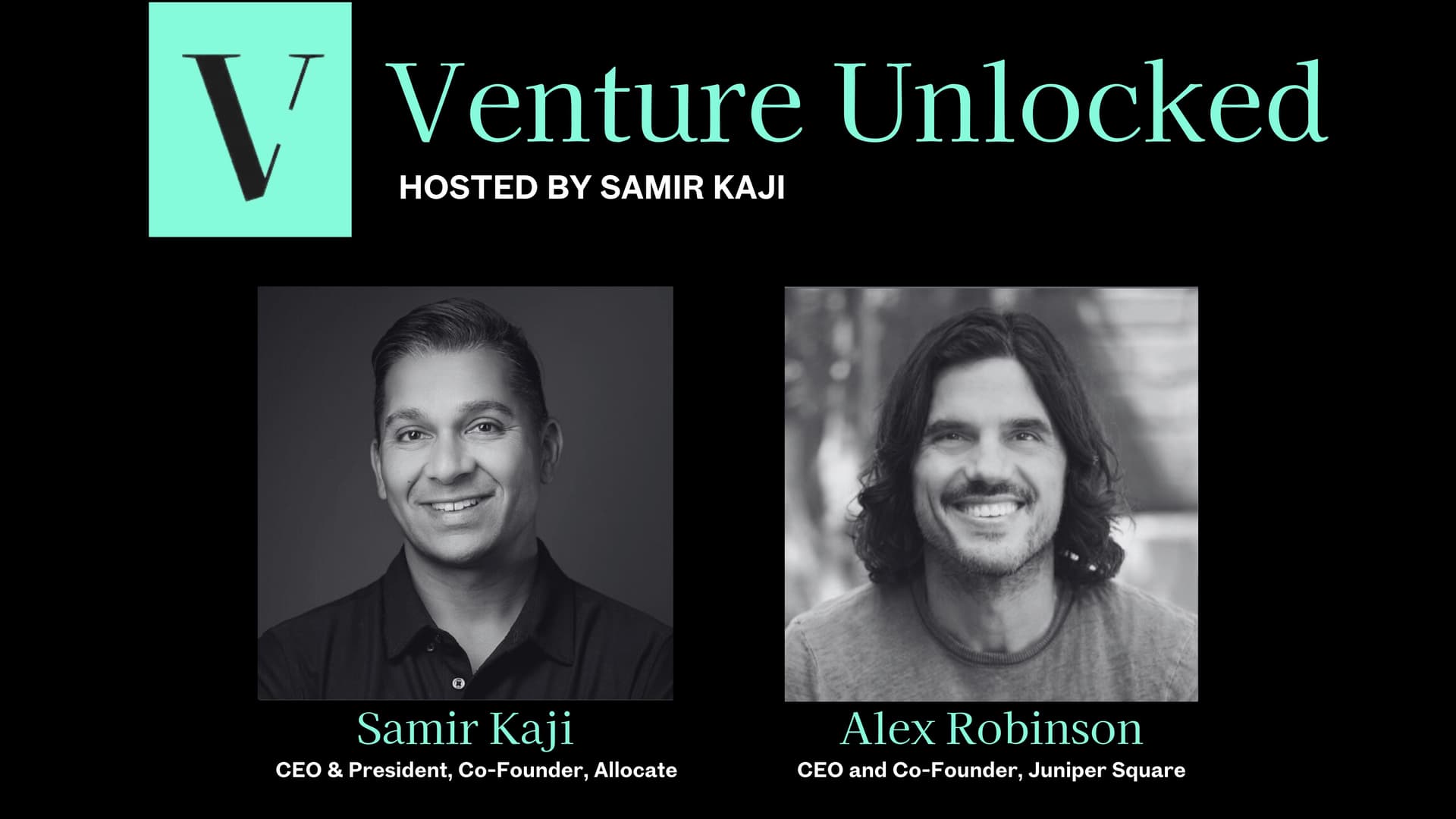
Episode Overview In this episode of "Venture Unlocked," Samir Kaji speaks with Alex Robinson, CEO and Co-Founder of Juniper Square. The discussion centers around the evolution of private markets, the impact of technology and AI on fund administration, and the increasing demand for transparency between General Partners (GPs) and Limited Partners (LPs).
Key Themes
- Transformational Role of Technology: The conversation emphasizes the critical need for GPs to embrace technology to improve efficiency and enhance the investor experience.
- AI in Fund Management: Alex discusses how AI is set to revolutionize workflows and knowledge work in the private capital space, streamlining processes and enhancing decision-making.
- Transparency in Private Markets: The episode highlights the ongoing push for greater transparency between GPs and LPs, discussing the evolution and challenges in this area.
Key Takeaways
- Founding Motivation: Alex shares the inspiration behind Juniper Square, stemming from his own experiences as an LP dealing with outdated processes in private markets.
- Inefficiencies in Private Markets: The discussion identifies significant inefficiencies that exist in private markets, particularly around capital raising and investor experience.
- Technology Adoption: The importance of adopting technology to drive efficiency and reduce transaction costs is emphasized as a critical factor for GPs.
- Role of AI: AI is predicted to have a broad impact on fund operations, including compliance, treasury, and investor relations. It is recognized as a transformative force across knowledge work in the industry.
Important Discussions
- ### Founding Motivation for Juniper Square (2:00)
- Alex shares his experience as an LP and the frustrations with traditional practices in private markets that motivated him to create Juniper Square.
- ### Complexity and Lack of Standardization in Private Markets (11:40)
- The episode discusses the heterogeneity of processes and standards in private markets, making it difficult to create unified solutions.
- ### Impact of Technology on LP Experience (15:34)
- The conversation touches on how technology can enhance the experience for LPs, making data access and reporting more seamless.
- ### AI’s Impact on Private Markets (33:44)
- Alex explores the potential of AI to streamline workflows and enhance both GP and LP experiences in investment management.
- ### The Future of Capital Formation and LP Management (37:49)
- The discussion considers what the GP landscape will look like in 2030, particularly with the integration of AI and automation.
Future Vision
- Alex envisions a future where GPs leverage AI to improve their operations significantly, shifting from manual processes to automated systems that enhance efficiency.
- The conversation concludes with a focus on how firms need to adapt to these technological changes to remain competitive, emphasizing the importance of building relationships in an increasingly automated environment.
Conclusion This episode of "Venture Unlocked" provides insights into the future of venture capital, highlighting the role of technology and AI in transforming private markets. The emphasis on transparency and efficiency underscores the changing dynamics between GPs and LPs as the industry evolves.
Additional Resources
- Listen to more episodes on [Venture Unlocked](https://ventureunlocked.substack.com).
- Follow Samir Kaji for insights on the venture market [@samirkaji](https://x.com/Samirkaji).
---
This structured summary encapsulates the key points and discussions from the episode, providing an accessible reference for listeners interested in the evolving landscape of venture capital and the role of technology within it.
Written by AI. May contain mistakes. Listen to the episode to check what was said.
Transcript
Automatic transcript. May contain errors.0:09Welcome back to another episode of Venture Unlocked, the podcast that takes you behind the scenes of the business of venture capital. In today's episode, I have the pleasure of speaking with fellow fintech founder, Alex Robinson, CEO and co-founder of Juniper Square. Founded in 2014, Juniper Square helps fund managers and LPs manage private investments with a greater transparency and efficiency. Their platform has become the gold standard for thousands of investment firms, enabling seamless fundraising, investor onboarding, and reporting. During our conversation, we talked about the evolution of the private markets and the transformative role of technology and AI and fund administration.
0:45We also discussed the inefficiencies that inspired the company's founding, the challenges of scaling operations for both institutional and individual investors, and the ongoing push for greater transparency in the private markets. Alex also shared his insights on how AI is set to revolutionize knowledge work in the industry, streamline workflows, and enhance the investor experience. Key takeaways include the critical importance of embracing technology to drive efficiency, the growing impact of AI on fund management, and the need for adaptability as the private markets continue to grow and evolve.
1:18Samir Khadji is the CEO and co-founder of Allocate. Allocate and Venture Unlocked are independent of each other. Any statements or references made by Samir or his guests regarding third-party investments or securities are solely their views and opinions and are not intended as investment advice or an endorsement of such parties or securities by Samir, his guests, or Allocate. Allocate or its clients may maintain relationships with or investment positions in guests, third parties, or securities mentioned in this podcast. This podcast is for informational purposes only and should not be relied upon as a basis for investment decisions.
1:56Alex, it's great seeing you. Thanks for having me, Samir. Okay, so from somebody that started a private markets company, I love to talk to entrepreneurs that are also tagging some of the, what I consider inefficiencies and the broken nature of how private markets operate and have operated historically. You started the company 12 years ago. Tell us a little bit about what you saw at the time that really motivated you, inspired you to create the company. Yeah, so the founding moment for Juniper Square was my own experience as an LP, making investments into the private markets ecosystem for the first time, into some venture funds, some real estate funds, some direct real estate deals, very modest check.
2:39I'd made a little bit of money for my second startup, but I didn't come from the industry. And so I naively just brought this expectation to the investing experience as an LP that it was going to be similar to what I had been accustomed to in the public markets. There'd be websites, there'd be links, it would be secure, there'd be a workflow I'd go through. I'd move money digitally. I'd sign paperwork electronically. I just expected a digital account creation process. And instead, a FedEx truck came out to my house with a stack of paperwork, two inches thick that had to be notarized. So I had to go find a local notary.
3:16And I saw that pattern a couple of times and I was like, this is crazy. This is 2013. Everything had moved online. I could do everything with my doctor online. I could buy shoes online, trade stocks online, everything but the private markets universe, which was still literally moving paper around in FedEx trucks. And I got passionate about that problem and sort of started tugging on the thread and saying, wow, okay, actually the private markets universe is huge. It's tens of trillions of dollars of capital worldwide that they're not interest trading efficiently on the NYSE or the NASDAQ with incredible transparent and low cost frictionless trading system, what could be created for the world if you had an efficient market underpinning the world of private markets where modern technology, secure infrastructure, dramatically lower the transaction costs?
4:10And what we saw, what motivated us was, wow, if you could take transaction costs out of the system, if you could make it easier for investors who want to put money into private markets to connect with the GPs who are supplying those investments. You can reduce that cost. Ultimately, you could broaden access. More people could participate in ownership and more people could benefit from everything that private markets was providing. That was our motivating vision for starting the company. That's really what we've been working on since. And with the way we attacked the problem was by being a partner to GPs.
4:42So today we're a partner to almost 2 ,500 GPs across all asset classes, and we help them with technology data and fund administration solutions. But we chose to, instead of trying to build a marketplace or instead of trying to focus on LPs, from day one of the company, we've been very focused on GP as our customer. Yeah. So if you go back to 2013, I mean, there's a few things happening around that time. So you're right. The private markets obviously got bigger. Companies are staying private longer, more funds being raised. I forget what the count is today, but But even during the 2010s, during the Zerp era, we saw tens of thousands of new firms across ask categories, regions kind of form.
5:20But on the other side of the marketplace, let's look at the LP side. So you had this experience as an LP. I did too, starting in 2010, when I was doing these investments in privates. And I'd get these PDF, you know, like envelopes that I had to fill out and subscribe to. And then they would tell me I did a bunch of things wrong. And I'd have to redo them, resign them. It was just a total nightmare. Well, at that time, it was mainly institutional capital that was investing in a lot of these big funds. But there was that start point of the individuals, the family offices, starting to deploy more into the private markets.
5:55How much of that was evident to you as a big sort of meta driver of where you wanted to build it? And was that something that you were building around that more people are going to actually invest that are not institutions in these private market funds, and that you needed to create something that acted as the infralayer? Well, we began our journey by focusing on real estate GPs. So today we serve private credit, private equity, crypto, all natural assets, venture capital, all the private markets asset classes today. But when we first got started, we were laser focused on real estate managers.
6:30And one of the interesting things about real estate is that it has a higher proportion of managers who were already raising through the broker-dealer channel. They were already going direct to high net worth offices. They already had family office relationships in a way that was very different from, say, how your typical VC fund thought about fundraising in 2013 or how a private equity fund did. And so because of our go-to-market strategy and our focus on real estate initially, every new manager that we added, we would onboard all their LPs. Now we have, almost 700 ,000 unique LPs on our portal.
7:07And so we could see this, the lion's share of the capital still came from the large institutions and it still does today. You know what I mean? We're all extremely excited about retail and the wealth channel because of its prospective benefits, not because it's contributing the lion's share or any capital raising today. So we can still see that, look, your typical giant public teacher's pension fund or your typical giant sovereign was still contributing a lion's share of the capital on our platform. But we could see this huge fat middle of sort of family offices, wealthy individuals who were writing multi-million dollar checks to each individual manager, each individual position.
7:49And so we knew there was this very deep kind of like vein that managers were going to be able to tap. And we also knew enough to know the difference between LPs who want to go direct into privates and they want to self-direct their own investments. They want to pick managers and underwrite investment criteria, manage it themselves. And then those who are just going to buy through an advisor. And we could see that the typical kind of like $50 ,000 type of investor who wants to go direct was unlikely to amount to much. And around the time we started the company in 2013, everything that was in vogue at that time was the JOBS Act, which had just passed.
8:31And therefore, all these companies that were getting started around that time period focused on alts were crowdfunding companies by and large, especially that's true in real estate. And the dominant thinking at the time was crowdfunding is going to be the way that alts get democratized and GPs and LPs will just connect directly online. And we could see pretty quickly that was unlikely to be the case because of just both the adverse selection characteristics. And because of this dynamic that I'm talking about, the TAM being very limited of retail investors that have the capacity to self-direct in a meaningful way.
9:03And it's growing. And the amount of wealth capital going into privates has increased over the last, let's say, 10 years, pretty dramatically to a point where now there's some firms out there, be it the Blackstones of the world, they have dedicated teams that just go after the wealth channel. But there still is this fundamental issue for a lot of these managers of if I bring in people that are part of the wealth channel, like maybe individuals, families, friends, and that want to invest these small ticket amounts, the administration can actually be much harder than it is for like that big institution that's writing a$50 million check.
9:38They have a team, they're going to meet the capital calls. For individuals, it's much, much harder. How did you think about solving that problem? Yeah, that is absolutely true. I mean, in certain respects, whether it's a$50 ,000 investor or a$50 million investor, a lot of the administrativia is the same. A lot of the work to manage the position and so forth. And so there is an incentive to within holding all else constant, you want to maximize the check size. So a lot of our investment in technology in the early days was about helping managers. Because we had real estate syndics, it's not that uncommon in real estate that you might have a manager that's grown to say, I don't know, a billion dollars of equity solely by raising capital from thousands of high net worth investors, right?
10:25And networks they've built themselves. So we had customers in the early days that had thousands upon thousands of investors they had to manage. So we had to build the tooling for how do you do a capital call to 2 ,000 people? How do you upload 2 ,000 K1s at the same time? How do you do a waterfall calculation when there's 2 ,000 recipients and so forth? And that kind of problem software is obviously really good at, right? It's like you use the computer to do something 2 ,000 times that the human would have to do at once that the human have to do individually. So a lot of our tech investment in the early days was about helping GPs honestly be indifferent to the capital source, whether it was a complex sovereign wealth fund and all of their complex reporting requirements or the scale requirements of a high net worth investor.
11:10When you look back at kind of the early days, my feeling just having been in this sector now for four years, actually running a company is I continue to be pretty surprised by like the primitive nature of the tools that are still being used today. I can't even imagine what it was back in 2013, but it does feel like a lot of this is still running off like MS, DOS, Windows 95. And I just actually, you know, I think the biggest innovation for some of these groups is just using DocuSign, which is hard to believe, but it's true. Were there anything, any unique insights in the early days that surprised you that were material pain points either for LPs or GPs that going into when you started the company, you didn't really realize?
11:51Well, in the early days, we spent a lot of time trying to answer the question, why has this problem not been solved before? Why is it the case that the private markets are so behind in terms of technology adoption relative to their public markets peers? And we wanted to make sure we had a lot of confidence in our answers to those questions so that we made sure we were starting a company for a good reason and that we were going to be focused on the right problems. And some of it has to do with the role of the regulator in public markets and enforcing data standards, enforcing points of data aggregation and centralization.
12:22But a lot of the technology challenge for any vendor that we've had to deal with over the last decade is just the sheer kind of range and heterogeneity of the way things get done in the private markets. right? So because they're private, because you're not registering the security, luckily with a regulator, you know, your limit on how reporting should work or how the accounting should work or how the waterfall should work or how it's really only limited by what a GP and LP and their attorneys can't come up with to get a deal done. And when you're in that process of raising money and you're meeting with that sovereign wealth fund and they're like, all right, I'll give you a$250 million check, but here's the deal.
13:02Here's my custom reporting template that you're going to have to agree to, you're just going to say yes, right? You're like, get the$250 million commitment. We will figure out the operational details later. Of course, you do that a hundred times and all of a sudden you have a hundred different side letter reporting templates that you have no idea how you're going to satisfy. And so, so much of the problem is how do you build software that delivers the automation benefits across such a heterogeneous space of configuration requirements? where we have 2 ,000 GP, 2 ,500 GPs, almost 40 ,000 funds on Juniper Square.
13:37And so those 40 ,000 funds vary so widely in how they do things. And there's such a long tail of complexity in the way things get done. And a lot of our early kind of design thinking and principles was basically kind of following Intuit and TurboTax as a inspiration here, right? Where Intuit is not under the illusion that they're going to get all 50 states to agree on a common tax code, let alone all the municipalities and all the county and all the relevant jurisdictions. And so you start with the premise that you're just going to have to deal with thousands of different jurisdictions, and the code is going to interact in weird ways.
14:17And then you got to build a software solution that recognizes that complexity. And you focus on that. You don't waste any time trying to get people to agree on standards. And that's how we've approached things in building Juniper Square. And we're very supportive of groups like ILPA and INREV and NREV and reporting standards and all of these groups. And if one day every GP and LP all agree on a common data standard, we would like be singing from the rooftops. We would benefit hugely from that. I just am not a, I'm not, I don't think that's happening anytime soon. So we chose to just sort of build into that complexity and we benefit from that now with scale and time on the problem.
14:52Yeah, I agree with you. I think there's been a lot of groups that have looked to standardize. I mean, the reality is there's so many different reporting. Even the way things are presented, whether it's a partner's capital account statement, a financial statement, a capital, they all look and feel differently. And getting, let's call it, millions of different LPs or thousands of thousands of GPs to report in any way, I think it's going to be very tough to create a normalized, digitized standard to do that. And I think that's probably too far a bridge right now. And I'm not sure that's the biggest issue.
15:20I do think that from a GPLP standpoint, because you have so many more participants on both sides, you have far more managers across the globe right now that are across these asset classes, whether it's real estate, private equity, credit, growth, all these things. And then, of course, you have the Wealth Channel, which adds so many net new LPs that are coming in. Have you seen any tangible difference in terms of managers that are using like Juniper Square, for example, that really create a better LP experience to see things like their data rooms, be able to sign up, be able to get reporting in a nice, elegant way?
15:53Has it helped, you know, sort of, you know, create this level of trust that has allowed fundraising to be faster, quicker? Any data that you can sort of look back on and say using Juniper Square has done X? I mean, I think it's tough to, I mean, you can do all kinds of things to pretend to quantify that if you want. I think if you're being honest, it's a tough thing to quantify. And so what you rely on are proxies, qualitative proxies in terms of customer sentiment, right? So if 98 % of your customers are renewing and they're saying, oh my God, this has totally transformed my ability to deliver a compelling investment experience, you can probably sort of rely on that statement, and having some kernel of truth to that.
16:36Even if you can't say, we have done studies in the past. We absolutely have. Managers on Juniper Square close 44 % faster than managers not on Juniper Square. They're just all bullshit. All that stuff is bullshit. And so the reality is we like to call ourselves a fund operations partner to the GP. You've got the limited partner, you've got the general partner. And then what we're telling our customers is we'll be your fund operations partner, which means we'll help you with fund administration. And within that compliance and treasury and all the whole reporting and all the bundle of stuff in there, But we can also solve your technology problems and we can also solve your data problems.
17:08And so the benefits from that type of approach are either streamlining operations, right? Make it more secure, more efficient, better, enable you to scale faster or scale with the same resources you have, which is a huge benefit that customers report, right? Which is like, I bought Juniper Square, was at 2 billion of AU, and I had three people in the back office. And now I'm at 10 billion of AU, and I still have three people in the back office, right? And I thought it was going to have 30. So scale faster, more efficiently, or enhance the investor experience. It's like one of those three things that is the primary value prop of what we do for customers.
17:43And I think we're regarded as the leader in the LP experience and so much of it. Like when we came to market with our portal in the mid-teens, the dominant paradigm at that time was portals are for PDFs. That is what it is. It's a, you upload a PDF and then the LP downloads the PDF. And we had this product that enabled the GP to show live data to the LP. And that was really radical at the time. This idea that the GP would let the LP see exposure data, performance data, yield, DPI, TVPI, whatever, live in the portal felt scary and risky. but we were again coming at this naively with a public markets view and it's like yeah when you log into charles schwab yes there's a place you can get documents but that's not really where you spend your time you're looking at pages of data that tell you things about your account so we knew that people would want that for the private markets too and so much of the power we do is how do you take 40 000 funds that own hundreds of thousands of underlying assets and spds and all these complex structures wind them up through thousands of managers and then all of the lps on Juniper Square have a single login to all managers, right?
18:48So a central place to manage their portfolio, their contact information, their account details. And we'll build deeper into that over time. Eventually, we don't support all of this yet, but eventually we'll get to a place where you can do a one-click subscription for the LP because you got all the data soared. And so it's managing that tree of complexity from an underlying asset through thousands of managers up to a coherent view for an individual LP. It's actually really hard to do and do well. Yeah, when you think about the convergence, let's call it the convergence of the public and private markets.
19:19Obviously, the private markets are getting bigger, the number of public companies has decreased by basically half, like you had 8 ,000 plus public companies in the US in the 90s. Now there's about 4 ,100 roughly. And so there is a lot of transparency, like I can log into Fidelity or Schwab or Robinhood, and I can see all the details real time, very easy to kind of buy a stock, sell a stock, all those things. And in the private markets, of course, LPs want a lot of transparency. But what surprised me actually when I talked to a lot of GPs over the years is like, sure, we want to give them the reporting, but maybe we don't want to give perfect transparency on things.
19:57Is this something you've seen as well? And has that changed over time in terms of the amount of transparency GPs are willing to drive toward those LPs? It's definitely changed a lot over the 10 or 12 years we've been working on this problem. and it definitely is still very far from where the public markets are. What I would say is that I think the best managers recognize, they can just look to sort of public market standards, look to a Morningstar report on a mutual fund manager, look at the breakout of fees and the gross to net walk and all of that. And I think the best managers recognize, that's sort of where the industry is going.
20:38That's where groups like ILPA are pushing and so forth. And so the best managers are just saying, okay, well, I need to prepare myself for that. I don't need to necessarily lead it, right? I can be led by LPs and I will go where the market needs me to go. And that's sort of what we see, but it's a really wide spectrum, right? I mean, there are still some managers on our platform who are like, I don't want to disclose nothing to my LPs, right? Like I'm going to give them a check when I give them a check and they're going to be happy or not be happy. And then we have other managers that are like, no, if I give one bit of data to one LP, I'm going to give it to all LPs.
21:16And I provide, you know, if you're like in real estate, this is not common in venture, but it's not uncommon in real estate that you're providing the full set of financial statements, the full P &L, along with a whole bunch of operational details on every single underlying asset in the fund. Every building, the rent roll, the lease roll, the, you know, the NOI, the lever to your major LPs. And so I do think the industry has trended a lot towards more transparency since we've been involved with this. I think that the limit is probably not exactly what the public markets looks like because there is a lot of scarcity value to the strategy that is revealed in the investment data.
21:53And there's a lot of overlapping interests in the private markets world that are a little different than the public markets in that one day you might wake up as a GP and find that one of your LPs is now competing with you. Right? And you're like, well, hold on a second. Let me take a look at what I'm providing. Am I reporting to this LP who's now my competitor? And so I think the limit will be what is information that is truly equal to the strategy. Yeah, because there's a lot of investing strategies where they are capacity limited. You know what I mean? Like you can only put$5 billion a year to work in this particular type of trade.
22:34And it's not going to scale to 50 billion or ARBs out if you overscale it. So there's a bunch of those types of pockets all across private markets where they're capacity limited. You can have 50 managers doing that strategy. So keeping that type of detail private, it's a good thing. It's essential to the strategy. That's probably different than I really bury my fees and I don't make it obvious to the LP how to do the math on the gross to net walk. That kind of thing, there's going to be just one way ratchet on pressure. And we are, I think, going to end up with the Morningstar type report where there's a sort of standard framework for how you think about fees.
23:12And so I see it going on two different vectors. Do you see distinctions between asset class and, you know, of course, things like venture, they're generally more sensitive to the underlying companies. Yeah. You don't get the level of reporting of like, how are those companies? Maybe there's some qualitative letter that's written, but it's not like to the extent that I might see in a real estate fund that I'm in. And then, of course, there's a different regulatory standard of like a private equity fund that's an RAA versus a lot of ventures under the VC exemption, which puts them as an exempt reporting advisor, but not a traditional RA that's governed by the SEC.
23:46Anything you can speak to in terms of the differences between asset classes or types of regulatory oversight a manager may have? One thing is, okay, so one is, yes, it varies massively. I mean, it's crazy the difference between the reporting burden on a typical, let's just say like midsize real estate manager and a typical mid-sized venture manager. And it's sort of, if you're a venture manager, it's hard to understand and compare it because you own a minority position in the C-Corps and the C-Corps are their own entities with their own agency, and they may not be willing to disclose financials with you or they get a limited set.
24:24And you have no ability to enforce, I don't know, standard reporting, standard charted accounts and things like that over your companies. Whereas if you are a real estate firm and you wholly own assets in your fund, then those are your assets. There's no one, maybe you have a JV partner or something, but it's yours to define the standard around. So real estate by far and away is the most complex. And I'd say venture is the most simple. And then credit and private equity and other assets and crypto and so forth kind of fall in the middle between those two poles. And then the other trend I would say is like we see a lot of our customers who used to rely on the exemption moving toward registering.
25:00And I think it's just to open up more freedom across investing strategies. So funds can be more multifaceted. I think a lot of the traditional boundaries are kind of breaking down in some areas of the market. So like an example would be a trend toward GP stakes investing more broadly. It's particularly acute in real estate right now, or shifts toward doing like more MEZ and kind of credit type. Secondaries. Secondaries. Yeah. Yeah, it's just like the markets move quickly. And I think managers are increasingly realizing, wait a minute, I want to be able to deploy. I don't want to raise a fund on a really narrow mandate and then have that mandate not be relevant to where the market is at the time.
Read the full transcript
25:41And so that is another trend that we're seeing that very few of our customers in the early days were registered. And I don't know how many hundreds of them are now, but a lot. Yeah. And we're seeing some of that too. Part of this is like there's a lot of it driven by the secondary market, continuation vehicles, being able to get liquid in a market that continues to protract when it comes to illiquidity, especially in things like venture capital where like companies used to go public in the 90s, four or five years. Now it's like 12, 15, 17, 20 years. And getting the liquidity along the way is actually really important.
26:12one of our investors has always told us that as a entrepreneur, you have to have both a microscope on one hand and a telescope on the other microscope, meaning just be laser focused on the next quarter, the quarter after that, what are you trying to ship? Who is your client? Really be hyper focused. But you also have to have a long term lens of where is the world going to go in five to 10 years? Obviously, back in 2013, you had your own worldview. What do you think you guys got most right in terms of your worldview back then versus things that completely surprised you in how the markets evolved over the last 12 years?
26:46Okay, so what did we get right? I think that it was the right call not to start a crowdfunding company in 2013. So the call that we made there was what was going to matter was really going deep and building tools for one side of the market, serving that market very well at very significant scale, and then using that scale to help the marketplace function more efficiently versus going direct to try to build a marketplace. So I think that was the right call. I'm really happy with the decision to start narrowly in real estate and then expand. In real estate, you have open-end funds. You have a lot of complexity that sort of forced us to build a really enterprise-grade product early on in the company's life cycle.
27:26How long did you do that? How long was it real estate only? We founded the company in 2014, and we began expanding into other asset classes in early 2018. So it's about four years of just really narrowly focusing on real estate. And then what did we miss? I think we definitely underestimated, I would say, the scale and enthusiasm for the retail and wealth channel. I mean, it really wasn't our strategy to pursue, to go try to roll up the RA channel, let's say iCapital has done so well, especially M &A. So it wouldn't, I don't think, even if I had full knowledge, I think you got to have to pick a customer and you got to figure out who you're going to serve and who you're going to serve really deeply and really well.
28:14And we want to be the GP's most trusted long-term partner that helps them future-proof their business. I think it's really hard to do that if you are serving 10 other customers that have totally different needs. And so I'm happy with that decision, but I also, I think, underestimated the fervor. And there's an interesting, just on the wealth channel, there's an interesting kind of like signal to noise ratio between the fervor in the market. And then what we actually observe in the fundraising totals and our customers and our data, right? Which is if you strip away kind of, let's say the big six or seven GPs who have masterfully built a kind of a direct to wealth fundraising arm.
28:55So you talked about the expense of this and building these teams. I think Mark Rowan from Apollo's on record saying they spent a billion dollars building out at their team, multi-hundred person team. Blackstone's got a multi-hundred person team and so forth. So if you strip out Blackstone, Apollo, KKR, Starwood, Carlisle, pick your top six or seven. There's such a power law in effect where those six or seven are literally raising like 95 % of all the capital through that channel. And then we have customers that are unbelievable brand names, right? Within their sector, great returns, but they just don't have the brand that say a Blackstone would have that have spent many tens of millions of dollars trying to pursue this channel really unsuccessfully.
29:40And so it's not clear to me that the bulk of managers, I don't envision a future where thousands of managers are directly raising from thousands and thousands of RAAs. And these are products that are sold, not bought. So I similarly don't envision a future where there's like a shelf LPs just go and self-select and start throwing money at managers. And of course you guys are working at this problem at your firm. And so I just underestimated the enthusiasm, I would say, that took hold of the industry over the last few years of kind of the wealth channel. Yeah, it's actually pretty interesting. And you're right, Blackstone, Apollo, Aries, all these groups have employed so many people just to go after the Wall Channel, which by the way, is incredibly fragmented too.
30:26This is not totally go to a place that I know what endowments and foundations, you have 17 ,000 independent wealth advisors, you have private banks, you have family offices, you have high net worth individuals. That is a very hard thing to do without scale of your team. Do you think there's anything that would change that? I think it will be financial product innovation that changes that. I think that just like it doesn't make sense for most investors to pick individual stocks, you just buy the S &P. I think the same thing will be true here, where I think that basically the market will bifurcate into two and there'll be the very large managers that can't afford the brand marketing, the distribution teams.
31:08The other thing is you have to really be multi-strategy because if you're going to bear the cost of distribution, if you're going to do all that work to get your product on the shelf with the advisor, then support them selling it through to their client and do the reporting and do all that, then you might as well have all the products on the shelf. It's really crazy to be like, we just do credit. I'd be like, no, here's our credit product. Here's our real estate product. Here's our core real estate product. Here's the value add product, et cetera. And so you'll have a series of firms and there'll be five or 10 max probably.
31:35And a lot of the folks that are like Toma Bravo and others that are at the hundreds of billions mark, not yet trillion mark are obviously looking at this going, whoa, all right, we need to get big fast and get multi-strategy fast and what they will offer are direct options right and but inevitably there are limits to scale right like you just you cannot deploy a hundred billion dollars as efficiently as you can deploy a billion as efficiently as you can deploy 10 million right like it just doesn't work that way and so what about everybody else like what about the collection of all these incredibly interesting strategy what about the manager that does like whiskey barrel futures you know what i mean and they put up 3x moik and 50 % IRR and they've done it for 10 years or whatever, but you can only deploy a billion dollars a year into that strategy.
32:22Well, individually, none of them are going to be able to access this channel, but collectively in aggregate, the bundle of all of these products can be really interesting. And so I think that there'll be sort of bundling innovation that ultimately bridges this gap where people will be buying registered sort of multi-manager funds that provide liquidity. It's really hard to figure out. You got to deal with the liquidity mismatch. You got to deal with a lot of complexity, but I think that's how it'll get solved. And going back to something, I completely agree. You can't have a marketplace with just a bunch of things.
32:58Most people actually don't know the difference between even brand name managers of like, what's the difference? How do I look? How do I pick? And this is not buying a widget. It's putting sometimes hundreds of thousands, if not millions of dollars, which requires much more education, much more understanding of these things. And candidly, I think that there was a lot of discussion around, oh, well, you can just put things in the marketplace, people are going to do it. And then the adverse selection, like, are these the GPs that you even want? It doesn't work for a number of reasons. I think that as we continue to go forward, there's going to be more managers that come to market, the private markets are going to get bigger, there's going to be derivative strategies.
33:33Now we're seeing things like liquid alternatives that at least allow people to get some type of liquidity earlier, which is opening up some of the wall channel. I think it's a good segue of kind of thinking about the future. And one of the things you and I talked about right before we got on the call here was the use of artificial intelligence. Like how does artificial intelligence really affect workflows across everything, financial service being one of them, but more importantly within the private markets? You have a lot of private market data, for example, that the thousands of funds, you have so many LPs.
34:06How do you think artificial intelligence will impact the flows coming maybe from LPs to GPs, creating more efficiency, transparency, better workflows? Where are the big areas that you think disruption will happen because of artificial intelligence? Well, I think artificial intelligence is coming for everywhere, every area of knowledge work, full stop. And everything a GP does is knowledge work. I think it will impact different GPs differently, different strategies differently. Some investing strategies are very desktop-based. It's work you're doing in Excel. The asset is kind of this thing that is at arm's length that you don't know that much about.
34:47That type of investing is very highly vulnerable to AI disruption. There's other asset classes where like in real estate, you got to go visit assets. The nuance of the asset that you learn in person is extremely critical. The way you get an edge is by having local relationships with brokers and so forth. Or in venture, it's like, do you know that founder? Can you influence that founder? Can you get in the hot deal? It's not about the desktop insight. It's like the work that you do with other humans on the ground to get the actual investment. That's probably the other end of the spectrum, a very slow comparatively to be impacted by AI.
35:21But then other than the investing strategy, everything that is running a GP, doing the compliance, doing the treasury, doing the payables, doing the reporting, doing the compliance, doing the portfolio management, AI will have a transformative impact on every area of that knowledge work. And we're building agents basically to support every facet of work inside of the GP from portfolio data collection to fund administrator oversight to treasury and to investor relations and fundraising. And that's all about basically computers doing the busy work of running a fund better than humans can do it. And then I think where it gets a bit more radical is if you think about like say 2 ,500 customers on our platform.
36:12And one of the things our customers use us for is a CRM for fundraising, for all their investor relationships and everything else. And obviously all of the data for each of our customers is firewalled. It's their data. We don't share data across GPs and so forth. But we do have the ability to work with our customers to develop compelling data products that would benefit everybody. And this hasn't been a huge focus for us historically yet, But I do think this is an area where AI is going to have a big impact. Because if you think about it, every one of our customers is trying to do the same thing.
36:43There's only so many institutional LPs. There's only so many family offices. There's only so many broker dealers, right? And so everybody's trying to build the full and complete list of them. Everybody's trying to understand the latest. Everybody's trying to get in front of them. And so it's a big matchmaking problem. And this kind of problem, I think we're going to see a huge impact from the application of basically unlimited compute and generate AI because I think that it's just fundamentally a matching and a sorting problem. You know what I mean? Where like there's an LP who wants something, there's a GP who has it.
37:16And how do you get them to connect more efficiently? And that's not going to close the deal. It's still got to be a product that's sold just like you don't buy a house just because you found it in your search result on Zillow. You're still going to go tour it, walk it, visit it 20 times. It's going to be the same. If you put on your techno optimist hat for a second, and let's maybe put on your inoculars and say five years out. There's a lot of GPs that are listening to this podcast. And if you think about the world of a GP, obviously the bulk of what you do is invest in companies or positions or whatever the underlying investment thesis is.
37:50That is your bread and butter. But there is that infra part, which is the capital formation, which is raising those funds. And oftentimes it's not just the fund, but it might be co-investments and all these things to form capital to be able to deploy. and then there's LP management. If you look at sort of this techno-optimist view of where AI can play a role in agentically replacing maybe things that are done very manual, what does the GP of 2030 look like and how does it work for capital formation and LP management? Yeah, so let's just take LP management first. So I think every GP will have an agent that's an LP-facing agent.
38:28that is the endlessly patient, cheerful, PhD-level expert on that GP. Their track record, every investment they've made, everything they've written, their philosophy, all the details of the team, what the current exposure in fund two is, what the prospective yield would be if the LP gets capital returned by date X or whatever. Anything the LP could want to know, we'll be able to provide agents for our GPs. They'll stay in control of what information is shared with LPs and how much surface area you want to give these agents exposure to. But I think that will be strongly preferred for almost all of the DD work, the due diligence work that happens today, all the information exchange and everything else that people are fielding low-level associates for and they're taxing all these internal reporting teams.
39:23they'll just be an LP agent, LP facing agent that will take care of all of this for the GP. And the LP can ask a million questions at two o 'clock in the morning if they want. And that means that the GPs are going to have to really shift to thinking about, all right, well, what's the role of the humans in this process? It's absolutely going to be building relationships. These are relationships built on trust where you got to be there in the good times and the bad. Sometimes you got to fund the capital call when you really don't want to as an LP. And I think it will sort of bifurcate into people who have these fundraisers that really know how to turbocharge their productivity with AI and those who don't.
40:01And you'll just need way fewer. You'll just need a handful that really know how to work effectively with AI. Because by the time you're getting to the point of sitting down with another human, there'll be so much work that will have happen by the computer. All of the kind of standard diligence and underwriting and all those types of questions will be driven by the computer. And so I don't actually even know what is so much of what happens today in the trust building process with humans is a proxy for the fact that you can't actually get everything that you want from the data. So I know if you look at how long it's taken self-driving cars to permeate and how early we are in that journey, whatever 12 years in, I think it'll just be this funny thing where the technology will be so advanced, but we'll just be rate limited by our ability to deploy it into the business process and get the change and get people to change behavior.
40:50And so I think that the GPs who win will be those who are really focusing on making sure they have staff and employees that have this kind of mindset of evolving with the AI tooling. And those that will fall behind are those that don't have a ready answer for like, how do you take the latest model innovation incorporated in the business? Yeah. And I think it's really early right now. I mean, it doesn't feel like it with, If you think about OpenAI and Anthrop and all these companies, obviously, you know, have permeate everyday mainstream. Everyone talks about it. I think OpenAI, last I heard, over a billion monthly average users, right?
41:24So it's gotten to a point where it's become ubiquitous, but still very early. And we're seeing the models improve. We're seeing the first level of agents really actually create real value. Of course, we're not even talking about AGI, but potentially in the future, whenever that comes. Do you feel like the disintermediation of the labor market, so think about the labor market today, just broadly,$16 trillion in spend within our world here, which is funds, let's call it just GPs, right? The people that invest, there's associates, there's principals, there's analysts, there's fund accountants, there's the CFOs, there's folks that are on the IR side.
42:02Do you feel any of those roles over the next five years get disintermediated away? Oh, yes. I mean, I would say all of them do. I think what's tricky here is that I'm a firm believer in Jevons Paradox when you just totally open up the dial of time. And the thing about Jevons Paradox is it's a little bit like how we all kind of totally whiffed on the benefits of globalization, sort of thinking about them in the aggregate without really paying attention to the micro pockets of the costs of globalization, right? The disruption to the communities where the factory got outsourced and so forth. And I think the same thing is true here, which is you can say, I am a techno-optimist and I am a believer in Jevons Paradox.
42:46And also, I am up close and personal with the work of many hundreds of fund accountants and all the work of what's going on inside of the back office of a GP. And I could tell you that so much of the work that humans are doing today is very rote pattern matching that will be done better by computer. And so we are going to have to figure out new things for those humans to do. And we will figure it out over time. The whole Jevons paradox thing will come true. It would be my prediction. But I think we're not often, those of us in the techno optimist club, when we're relying on Jevons paradox, we're not properly accounting for the disruption in the interim and how long that retraining takes.
43:24And I mean, I think if there's anything I've learned as a CEO, as our company has grown and we've got close to 800 people now is getting people to change is hard. Getting people to pay attention to what you're saying is hard. And so this idea that we're all as a society going to just like radically retool on the fly and be like, oh, I spent 20 years learning how to do X, but that's thrown out the window and now I just do Y. I think we're underestimating the scale of the challenge. You know what I mean? I think you and I share that. And we're obviously a techno optimist, of course, as entrepreneurs that are looking to create new ways of building for a world we believe in.
44:03It requires a lot of hope and optimism of where things are going to go. Maybe an area to kind of zoom out to end sort of the conversation I like kind of looking forward is that you just closed your new round of capital, which puts you in the unicorn club valued at north of a billion. So congratulations on that. But if you look at the business on a good forward basis, what are the things that or what is the thing that you're most excited about and the thing that you're most nervous about? Probably the same thing. I mean, we're making this kind of like a very big bet, but it's kind of like a two-sided bet.
44:37It's kind of the same bet on the radical transformation potential of really deeply applying technology to fund administration and to fund operations more broadly. And we deeply believe, so this is a very big industry,$50,$100 billion industry plus growing in the mid-teens. That's going to become a lot bigger as the scope expands. We think managers are going to want to focus on investing, relationships, managing capital, raising capital, and more and more will get outsourced. So it's a very big pie already expanding. and we believe very deeply that if you apply technology in the right way, you can sort of have this like win-win scenario, right?
45:20Where you could be the very best place to work for people that do that work. You've got the best tooling, you have the best job experience, they're the most productive, they get to do kind of leading edge work. You can pay them the most because you have the best margins. The best financial profile, you get to keep more of every dollar that you earn relative to any other provider in the industry. And then you can provide the best product to the customer. The CFO can get live access to their data. They can see the workflow happening in real time. And so then what the other side of that is, is applying AI to that.
45:51So we are already working on that problem. We've been working on that problem really since we founded the company. And what AI now provides, we've made this huge bet on AI, is just the ability to radically accelerate the realization of that vision. if for no other reason. If we do nothing else other than just realize a three to five X productivity improvement in our own engineering team, the impact of that over, we already have a scaled almost 200 person engineering organization. So you increase the productivity of that group by three to five X and you sustain that over the next five years and you're doing decades worth of work in a handful of years, even if you do nothing transformative for the customer, which hopefully we will obviously do that too.
46:33So, so we see a bunch of things lining up for us where we feel between, I feel really good about in these vertical application scenarios, someone sitting in between the foundational model companies and the end customer, right? I don't, I wouldn't feel good about being middleware, trying to sort of sit between the foundational models and then companies that own the distribution and the customer. Cause I just like at our company, we're betting on the foundational models, just continuing to improve at an accelerating rate. And so I feel really good about where we're positioned and really excited about the future.
47:07Well, it's been a lot of fun talking about this. Again, congrats on all the growth. We've definitely admired from afar everything you've built and innovated on. Congratulations again, and thanks for being on. Thanks for having me, Samir. It's a great chat. Thanks for listening to another episode of Venture Unlocked. We really hope you enjoyed our conversation with Alex. If you'd like to get Venture Unlocked content straight to your inbox, go to VentureUnlocked.substack.com and sign up. Or go to Apple Podcasts or Spotify and subscribe. Thanks again for listening.
From the publisher
Follow me @samirkaji for my thoughts on the venture market, with a focus on the continued evolution of the VC landscape.
Welcome back to another episode of Venture Unlocked, the podcast that takes you behind the scenes of the business of venture capital.
In this episode, I had the pleasure of speaking with Alex Robinson, CEO and Co-Founder of Juniper Square. We talked about the evolution of private markets and the transformative role of technology and AI in fund administration. We also discussed the inefficiencies that inspired Juniper Square’s founding, the challenges of scaling operations for both institutional and individual investors, and the ongoing push for greater transparency between GPs and LPs. Alex shared insights on how AI is set to revolutionize knowledge work in the industry, streamline workflows, and enhance the investor experience. Key takeaways include the critical importance of embracing technology to drive efficiency, the growing impact of AI on fund management, and the need for adaptability as the private markets continue to evolve.
Thanks for listening to another episode of Venture Unlocked. We hope you enjoyed our conversation with Alex. If you’d like to get Venture Unlocked content straight to your inbox, go to ventureunlocked.substack.com and sign up, or go to Apple Podcasts or Spotify and subscribe. Thanks again for listening
Bio of Guest:
Alex Robinson is the CEO and Co-Founder of Juniper Square, a leading investment management software platform transforming private markets. With a background in engineering and business, Alex previously held product and leadership roles at top technology firms, including Microsoft and Boston Consulting Group. His own experience as a limited partner inspired the creation of Juniper Square in 2014, aiming to modernize and simplify the private investment process. Under his leadership, the company has grown to serve over 2,500 GPs and over 600,000 LPs, managing tens of thousands of investment funds. Alex is recognized as a driving force behind digitizing private markets and expanding investor access through innovation and transparency.
Juniper Square is a leading investment management platform designed to streamline operations for private equity, real estate, and venture capital firms. The platform helps General Partners (GPs) manage fundraising, investor reporting, and fund administration through intuitive, data-rich software. Since its founding in 2014, Juniper Square has become a trusted partner to over 2,500 GPs and supports more than 600,000 Limited Partners (LPs) across more than 40,000 investment funds. By replacing outdated systems with modern, transparent tools, Juniper Square is transforming how private markets operate and expanding access for investors worldwide.
Timestamps:
In this episode, we discuss:
* Founding Motivation for Juniper Square (2:00)
* Early Focus on Real Estate and LP Trends (6:13)
* Complexity and Lack of Standardization in Private Markets (11:40)
* Impact of Technology on LP Experience (15:34)
* Transparency Evolution in Private Markets (19:15)
* Differences Across Asset Classes and Regulation (23:15)
* Strategic Decisions and Market Surprises (26:09)
* Bundling and the Future of Wealth Channel Access (30:43)
* AI’s Impact on Private Markets and Fund Operations (33:44)
* The GP of 2030: AI and Capital Formation (37:49)
* AI and Labor Market Disintermediation (42:07)
* Future Vision and Company Outlook (44:07)
* Final Thoughts and Takeaways (47:07)
I’d love to know what you took away from this conversation with Alex. Follow me @SamirKaji and give me your insights and questions with the hashtag #venture unlocked. If you’d like to be considered as a guest or have someone you’d like to hear from (GP or LP), drop me a direct message on X.
This is a public episode. If you would like to discuss this with other subscribers or get access to bonus episodes, visit ventureunlocked.substack.com