In short
Venture Unlocked Podcast Episode Notes
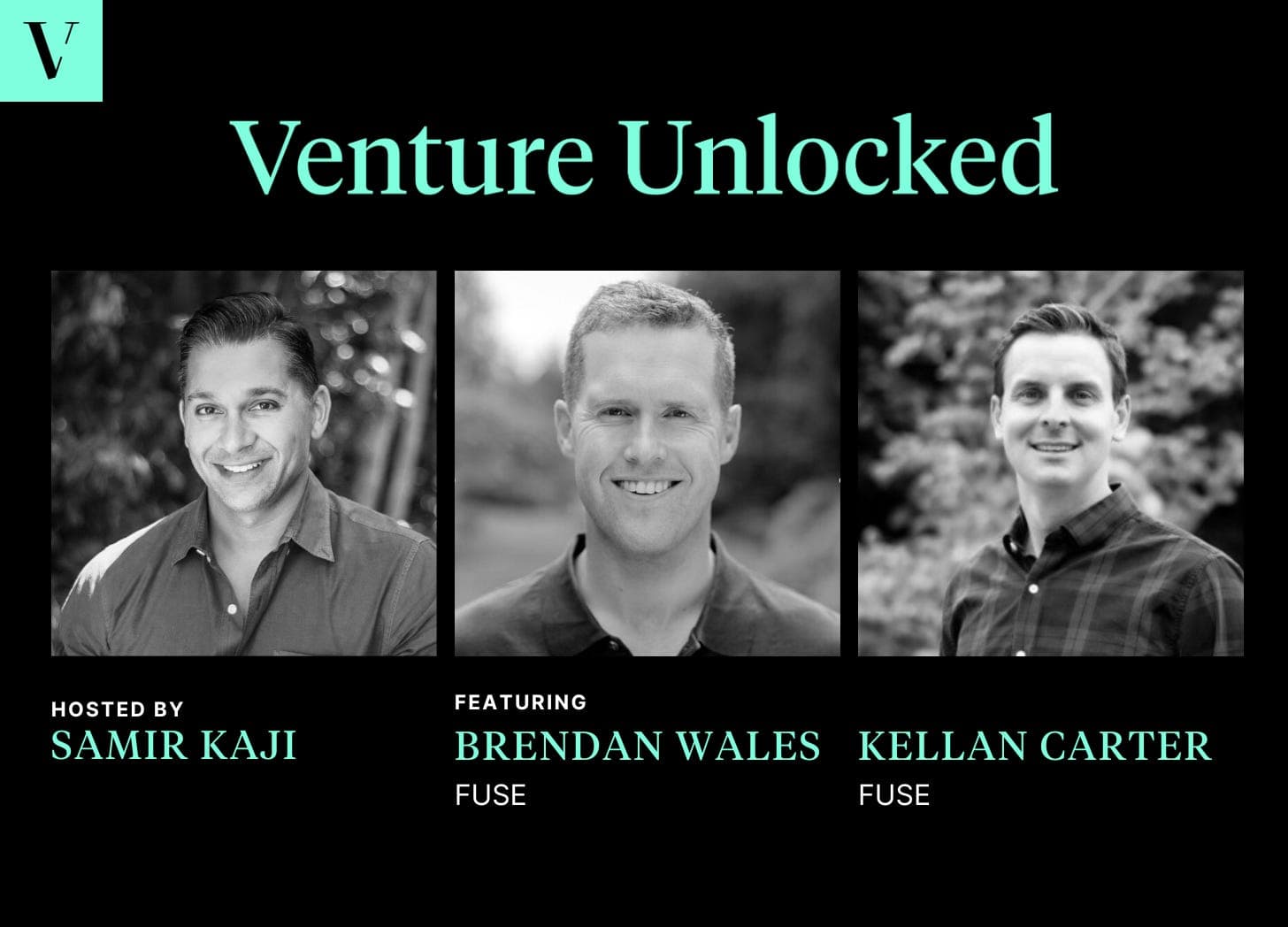
Episode Summary Title: The opportunity outside of Silicon Valley and how to build a strategic LP base with Brendan Wales and Kellan Carter of FUSE Host: Samir Kaji Guests: Brendan Wales and Kellan Carter, Co-Founders and GPs of FUSE Date: [Insert Date Here] Link: [Venture Unlocked](https://ventureunlocked.substack.com?utm_medium=podcast)
In this episode, Samir Kaji engages with Brendan Wales and Kellan Carter, the founders of FUSE, about their experience in venture capital, especially focusing on the unique opportunities outside Silicon Valley, specifically in the Pacific Northwest. They discuss building a strategic Limited Partner (LP) base, raising funds during challenging times, and how to enhance the support given to founders.
---
Key Points Discussed
- Introduction to FUSE
- Founded: 2020
- Focus: Growth of the Pacific Northwest ecosystem.
- Recent Accomplishment: Announced closure of a $250MM Fund 2, increasing total AUM to over $420MM.
- Strategic LP Composition
- Importance of selecting LPs who bring strategic value, not just capital.
- Early focus on local executives and companies as LPs to enhance due diligence and deal sourcing.
- Raising Funds During COVID
- FUSE managed to raise $173 million amidst the pandemic.
- Emphasized the significance of having high-quality, strategic LPs over traditional institutional investors to navigate tough fundraising climates.
- Activating LPs for Competitive Advantage
- Development of a mobile app for LPs to stay engaged with the fund's activities and founders.
- The app allows LPs to listen to founder podcasts and access investment details, fostering stronger connections.
- Collection of Strategic Insights
- Engaging LPs results in better investment outcomes such as introductions to potential customers or hires.
- Feedback loop from LPs aids in understanding market trends and investment strategies.
- Building a Cohesive Team
- The importance of having a balanced team of experienced leaders and energetic newcomers.
- Operational partners brought in to aid portfolio companies in different capacities.
- Defining the Product for Founders
- FUSE aims to provide a nimble, supportive environment comparable to that of larger firms but with personalized attention.
- Focus on building a strong relationship with founders and being an accessible partner.
- Seattle's Position in Technology
- Seattle as an emerging tech hub due to the presence of giants like Microsoft and Amazon.
- The city is positioned for significant growth in AI and cloud technologies.
- Lessons from Fundraising
- Emphasized the importance of patience and maintaining a focus on long-term relationships.
- Building trust and credibility with LPs is critical for future fundraising success.
- Advice for Aspiring Venture Capitalists
- Focus on long-term growth and build relationships with mentors and peers.
- Treat every meeting with startups as a valuable learning opportunity.
---
Key Takeaways
- LP Engagement: The strategic use of LPs can create a unique advantage in sourcing and winning deals.
- Community Focus: A strong local focus can lead to better investments due to the familiarity with the regional ecosystem.
- Patience: Success in venture capital takes time, and relationships need to be cultivated diligently.
---
Conclusion The episode offers valuable insights into the evolving landscape of venture capital outside Silicon Valley, emphasizing the importance of strategic relationships and community engagement. Brendan Wales and Kellan Carter's experiences at FUSE provide a compelling case for the potential of the Pacific Northwest as a thriving venture capital ecosystem.
For more insights, follow Samir Kaji on [Twitter](https://twitter.com/Samirkaji) and check out the complete episode on [Venture Unlocked](https://ventureunlocked.substack.com?utm_medium=podcast).
---
Feel free to modify or expand upon any section to suit your needs!
Written by AI. May contain mistakes. Listen to the episode to check what was said.
Transcript
Automatic transcript. May contain errors.0:00Welcome back to another episode of Venture Unlocked, the podcast that takes you behind the scenes of the business of venture capital. I'm your host, Samir Khaji. On this episode, we have a conversation with Brendan Wales and Kellen Carter, co-founders and GPs of Seattle-based Fuse. The firm was founded in 2020 with a thesis centered around the growth of the Pacific Northwest ecosystem, an area both partners have had substantial experience in, including Kellen's stint at Ignition Partners. Fuse just announced the close of a$250 million fund too, bringing total AUM to just over$420 million. During our chat, we covered a lot of things, including the strategic nature of building the right LP composition and how venture funds should think about their servicing model to founders.
0:40It was a really great conversation and I hope you enjoy it. Samir Kaji is the CEO and co-founder of Allocate. Allocate and Venture Unlocked are independent of each other. Any statements or references made by Samir or his guests regarding third parties, investments, or securities are solely their views and opinions and are not intended as investment advice or an endorsement of such parties or securities by Samir, his guests, or allocate. Allocate or its clients may maintain relationships with or investment positions in guests, third parties, or securities mentioned in this podcast. This podcast is for informational purposes only and should not be relied upon as a basis for investment decisions.
1:18Hey guys, great to see you. Great to see you too. Thanks so much for having us today. Thanks for having us, Samir. Yeah, this will be a fun conversation. I want to go back to actually the start of the firm. It was immaculate timing. It was February of 2020, right during COVID. Kellen, I know you were one of the two co-founders of the firm. Tell us what you saw at the time, having lived in Seattle, and what the opportunity was in creating Fuse. Yeah, it's a really interesting trajectory that you've seen this region have. I first moved here in 2013 when AWS, believe it or not, was small. And I lived on Amazon's campus and lived there for seven years.
1:54And I remember when I first moved there, there were like two restaurants in the entire region. And now, if you look at it today, it's literally a region within an entire city. It's a city within a city. And so the trajectory of this broader Pacific Northwest, especially as a result of the cloud momentum, has been phenomenal. It's been truly phenomenal. It gets better every single year. It gets better every single day. And I think if you look at, you know, the position of Seattle with Microsoft and Amazon and now their leadership roles in AI, I think the future is even brighter than the last decade.
2:29So the setup for us to start Fuse became more and more obvious as we lived here, saw the quality of companies, the volume of companies and the quality of innovation coming out here. It's obviously a little scary, but, you know, hindsight now makes it a no brainer. Yeah. And if you think back during the last decade, we've seen effectively cloud flow through the area. The exit volume has been big, which we'll talk a little bit about the exit volume as well as the amount of local funding in the area. But the first thing I'd love to kind of go back to, so you start the company during COVID, right?
3:02So this is right in the heart of COVID. You raise what ultimately was about$173 million fund, of which the first part of that fund was largely a lot of executives, so very strategic LPs. And the conversation that I have with a lot of GPs is around LP construction, so institutional versus non-institutional. Maybe walk us through that initial thought process of what type of LPs you wanted as part of this, not just from a capital standpoint, but also speak to maybe the strategic angle of some of the LPs? Well, I think the first part of that is how do you get in business so you can start proving that you can do this job?
3:43And so how do you construct something that has edge, that's unique, that's differentiated? And having started in this business when I was 26, I think, Brendan, you started when you were 24, 25. You study firms like Benchmark and Sequoia, and their brands and their platforms continue to compound because they've built phenomenal networks and relationships. So if the next engineer is spinning out of Stripe, they're going to see that opportunity. If the next Airbnb exec is going to start a new marketplace business, Sequoia is going to see that opportunity. So how do we construct the network of a Sequoia 10 or a Benchmark 10, but in a Fuse 1?
4:17And we wanted to do that by having essentially what we think of as a node in one of our partners at every single company, whether it's Outreach or Isertus, or it's Costco, Starbucks, Microsoft, or Amazon. We want to know if somebody's starting a new company. We want to have better diligence, better references. We wanted to be able to lean on our LPs to help us win. And then post-investment, we wanted to have the heft and the platform of a 500-person firm, but the nimbleness of a nine-person firm. And I think it really has landed with especially the entrepreneurs here locally and just a real funny story because the next trick is how do you engage your LPs to just drive better outcomes for everybody, better access, better win percentage in competitive situations, and then, of course, better support post-investment.
5:03And we went to announce our very first investment to a company called Owl. And of course, you're being pretty vulnerable here when you email 500 LPs about why you're excited about a new investment, what you saw in the founders, and of course, here's how the LPs can help. And we get a phone call from a Fortune 50 CFO 15 minutes after sending this blast email, and he said, I need to talk to these founders I have a major problem here. When can I talk to the owl sounders? And that was one of the moments where we realized we had what we think of as product market stint with our LP engagement to just drive better outcomes.
5:37How do you take this black box model that is traditionally venture capital and make it way more engaging, way more open, and engage this LP base to just drive better outcomes for everybody? Maybe you guys can touch a little bit on that last aspect of activating LPs. So I think that the first 60 or$70 million was highly comprised of some of these folks. What was the overall story and ask of them? So typically, when we look at funds, you often will see some of these individuals, high net worth. Sometimes they are people that work at different companies and you see their names on a logo sheet on a deck, but ultimately the activation piece is tough and it's difficult because these people are really busy.
6:24So what is it that Fuse does internally to create this activation layer that's consistent between the founders and the LPs in a way that's valuable, but for both sides? You know, in some ways it benefits us by being one of the few firms here in this incredibly fertile, rich environment. Most of these limited partners, they haven't invested in a venture firm before. For them, it's another private investment, something new, something exciting, and something local. But for us to reach out to them and say, here is what this business is doing that we're investing in, or including them in the process when we're doing due diligence on potential investment, they embrace that.
7:02And it may come surprising to people, but we have hundreds of limited partners. We're very open about that and excited. We'll get 30 to 40 responses every single time from those individuals saying, hey, here's somebody that can help move the ball forward for those businesses. Here's a potential customer. Here's a potential recruit. Though that email communication was working so well, we then launched a mobile app where our LPs can listen to a podcast we did with every founder. They could read the memo that we did. They can see how much we own of that company. And that's a level of transparency that LPs are just not used to.
7:38It's been a screaming success. So we're just doubling down on that communication. Yeah. And just to build on that, we've gotten really good feedback from our LPs. In fact, one of them, we were having coffee and he said, you guys have figured out the best form of collusion I have ever witnessed in investing. I'm like, well, that doesn't sound very positive. Can you unpack that? And he goes, well, you see all the opportunities. You lean on your LPs to help you win when it's competitive, which leads to higher win percentage in competitive situations. And then post-investment, you plug them into this program and this network that is only a significant accelerant in getting them to that next level.
8:18And he said it's just the most obvious but generally less practice venture model to lead to better outcomes. Yeah, it's an interesting way to create a competitive advantage. And we'll get back to creating replicable outcomes fund after fund around sourcing, winning, obviously picking. And it is interesting because venture is a very long feedback cycle and it can take years and years and years to really understand the directional focus of where a particular fund is going to perform. Usually from a quartile ranking, funds don't fall into their final quartile ranking until year six or seven. And so you're creating this immediate feedback loop of what do the LPs actually do?
9:02What are they seeing? And the ability to interact with these companies gives them a sense of the type of companies, not only are you investing, but the progress of these companies, which I think is really interesting. Speaking about LPs just more generally, again, this was during one of the toughest times, I'd say, at least when you started raising capital during COVID. But of course, in the last almost now two years, we've seen a very similar type of phenomenon where it's very tough raising. So I think you've raised fund one, you've raised fund two, both during really tough times. Tell us maybe about what you've learned in raising during those times, both from raising from some of these individuals, as well as raising from some of the traditional institutionals.
9:46I could start on that. I think the biggest thing is embracing the small commitments. Like a lot of folks, they put minimums on who can join the fund. And you need a parallel fund structure in order to be able to do this, to allow more investors into the fund. But embracing that small check, if it's a$50 ,000 commitment from the CRO of a local company, I mean, we're high-fiving, getting excited. you know, that's somebody that can be an advocate for the firm. They could be introducing you to a potential LP when you're going to a new city to go fundraise, whatever it may be. Those are the things that drives forward Fuse.
10:28We're able to get big commitments over time, but those are long sales cycles. And the more people in your community and network that can vouch for you, that's what's going to get those big LP commits over the line. And look, we asked a lot of favors from our LPs, from our fellow GPs, when we're going to a new city to get introduction to a foundation or a family office. And the only way that happens is by being open and constantly communicating with those folks. Yeah, it's amazing how the notion of compounding happens with your LP base. You land a significant executive, at least to their friends that are executive.
11:08You land a very notable institution while you get confidence by proxy with other notable institutions. And so as Brendan put it so eloquently, building a platform that can continue to compound on itself with your LP base is really, really important. And it lets CEOs of Fortune 100 companies joining the fund and being big advocates of ours because people that they know well and trust and have gotten to know us are part of the platform. So this whole compounding platform notion of your LP base has really played out the way we had hoped. And this is something that we've seen fairly new over the last decade, decade and a half, in terms of having high net worth investors that could bring unique value, both as part of insights, but also helping the companies and acting as, in many ways, essentially extensions of the firm.
12:00Yet, at the same time, you want to create long-term stability in the LP base by having some of those institutions that are going to be cross multi-fund investors through cycles. Was there a mix that you were looking to get in terms of the strategic LPs that could really lean in versus the traditional financial investors that you know were at least in for two, maybe three funds so long as you did what you said you were going to do? Fund one, it was 70 % of our capital. We like to be transparent here, very open. 70 % of our capital was from individuals, 30 % from larger groups, whether it be big institutions or wealth managers that pool capital.
12:39Obviously, as you alluded to, there is going to be some attrition rate with the individuals, although we do manage each one very tightly and we want to have the highest retention rate as possible or over 100 % net dollar retention rate on those individuals. Going into fund two, we wanted to shift that, go to the inverse, get to 70 % institutional. And really, we think about that is large family offices and above, really folks committing more than$1 million to the fund with the potential of being much greater over time. And we feel really good about having achieved that in fund too, to have that more stable LP base.
13:15At the same time, we're not going to dramatically increase our fund size over time either. So we're trying to build that LP base that is really that group of folks that are going to be backing$250 million fund sizes over time. So I'd love to maybe unpack that a little bit. So going from 173 to 250 in Fund 2, obviously, you know, changing the LP base mix to being much more institutional in nature, which leads me to believe there was a lot of conversations between Fund 1 and Fund 2, maybe people that couldn't quite get through on Fund 1 but kept close to. But maybe give us some overall examples of how you kept close with people that led them to be comfortable investing in, you know, let's say 2022 and 2023 into fund two at a time where the market had fundamentally shifted.
14:08And we had actually seen so many institutional piece pulling back because of something called the denominator effect. So being well over allocated to privates because their public holdings had gone down so far. How did you get to that mix of 70-30, which if I'm just doing the math of$250 million, you're over$160 million in institutional capital. How did you make that happen during a really tough time? Right when we started the firm, we made a big investment of starting to build relationships. And starting to build relationships over Zoom or Teams was a little weird, but at least it is a starting point.
14:47And then we got on the road when we needed to get on the road. We like traveling together. We think it's really important for people to get to know us who's on our cap tables, for us to really get to know who's on our cap table, but really building relationships. And I think a couple of things that really, really mattered in this fundraise, in what is arguably one of the most difficult fundraising environments is with fund one going into fund two, we did what we said we're going to do in fund one. We stayed true to the Pacific Northwest focus. We stayed disciplined on stage and in category, you know, really focusing on B2B software at a time where crypto deals were getting done at ridiculous valuations at a time where, you know, it was YOLO out there.
15:29And we stayed hyper-focused on the region, on stage, and on category. We built the team. We added three junior folks that are really developing nicely. We added three operating partners, including John Sopier and then Bobby Wagner. And so we built this team that is mixed with gray hair and lots of experience and really useful energy and really focused on their career. And then if you look at the drift from fund size from 173 to 250, all we were solving for was the ability to still write 30 checks into companies per fund, but owning more and being slightly more competitive at the Series A stage where we don't necessarily have to syndicate with another firm that puts you at a disadvantage with the founder that only wants one new investor.
16:15And so it was getting the platform, building the team, doing what you said you were going to do, and now just owning more of the businesses. Nothing else has changed. The only variable that we changed was higher ownership. And so if you're an LP and you like Seattle, you think this is the right team, and you know that this team is going to be doing this for the next 30 years, which hopefully we're blessed to be able to do that. It was a, hey, we got to make the decision in this fund if we're going to continue to partner with these guys at Future Farts. And that was a big part of getting there with a number of institutions that we built relationships with and got excited about this team in the region.
16:49Getting on the road as a team, it was really key for us. As you know, Samir, institutional LPs, they're looking at, hey, is this group of GPs, are they committed to this? Are there any issues that may come up when meeting them in person? Do we see any risks that they're going to break up at some point in time? Are they all perfectly aligned on the strategy? And that's one of our massive strengths. So for us to all get on the road and for those LPs to see us all together, see the excitement, see the energy, but also see the tight, tight focus on the strategy and the plan was the thing that got the bigger checks over the line.
17:25Yeah, that all makes sense. And maybe we can spend a little bit more time on what happened between fund one and fund two and how you got to this new mix of largely institutional investors, of course, in that short timeframe, you're not going to have a lot of performance to show. You're still on the J curve, still deploying into net new companies and doing follow-ons. But as LPs look at it, they're looking at, have you executed on certain things? And one thing that's really stood out during the course of our conversation so far is this view of serving the founder, whether it be the strategic LPs, you as investment people, as well as the operating partners that you've had, people like Bobby Wagner, who played on the Seahawks, or John, of course, as a longtime executives.
18:12Maybe you can go into what an operating partner does, how it creates this holistic value add to the founders, and how you went about picking these particular people. A few items there. First, I wanted to touch on the progression at the firm level between Fund one and fund two. As Kellen mentioned, it's about doing what you said you were going to do as it relates to your particular strategy. There's obviously the geography or geographic focus, but there's also the entry points that we said we were going to focus on. Is there any drifting there in the ownerships that we were focused on? Our pre-money entry point in fund one was$22 million.
18:48Our average ownerships was in the mid-teens. Those are the things that those LPs are looking for. We didn't do anything crazy. We're not investing in companies that$150 million pre at the series a that's just not our strategy or focus the team is everything right we are together in the office every single day as everybody else is sprawled apart like we are tighter and in person together and we operate the firm to get the best side of everybody on the team and that doesn't mean that means we don't have you know one meeting together on tuesdays where everybody's together we separate these things so that we can get the best out of everybody Monday mornings, we're with our associates.
19:28We're talking about every single company that every single person met with. Every company. Every company, right? And there are no stones left unturned here. We have a separate meeting where we talk about the unresponsives, who are the people that haven't returned our emails, right? All of that stuff. People are specializing in these certain things. Then there's the operating partners. And we like to think of them as sort of the rocket boosters to us GPs to get the best out of our portfolio companies. and the three operating partners solve different challenges that we have. John is an iconic business leader here in the Pacific Northwest.
20:01In addition to having been the CFO of Microsoft, he was also on the board of Nike, which is based in Portland. He was on the board of Splunk for a long time. He is this preeminent board member here and really the ultimate CEO whisperer. Then you've got Sockbeer Kanuja, our second operating partner who ran a company that ignition it back. So deep relationship with Sockbeer. and he's working with our portfolio CEOs to solve real deep operational problems. And he's more of a Swiss army knife. He's going into specific companies whenever you're having challenges. And then lastly, Bobby Wagner, who's this iconic football player, eight-time pro bowler, he is the most well-known athlete in Seattle.
20:41And so for us, it's how do we build more of an aura around Fuse? How do we get more people to know about us? And then you obviously, you can't just add an athlete to the team without that athlete individual being focused on startups. This is something he's extremely passionate about. He was, in quotes, an intern at Ignition when he joined the NFL and had John as a mentor of his. And Bobby's joining every single partner meeting too. So it's about getting the best out of everybody. And I think if you think about team, you know, you want the team to be so aligned as Brendan mentioned. I think that's something we're so proud of.
21:15But this team has all known each other for years. Brendan and I have known each other since 2014, Cam and myself since 2015. John dates back to 2009, stop year 2013. Bobby started interning at Ignition in 2017. Every junior person we've hired, it's been a year-long get-to-know-you process because getting the team right and solving for any gaps that we might have is so important. It all starts there. Brendan mentioned these operating partners are major accelerants to the companies that we back. They have experienced unparalleled enterprise, on paralleled marketplace and SMB experience that really covers the gamut of the type of companies that we partnered with here in the Pacific Northwest.
21:55When you think about all of these different people, and of course, as with any organization, the more people that you are working with that are representing, in this case, Fuse, right? So each person, whether it's an operating partner, strategic LP, somebody on the investment team, at the end of the day, it is representing the firm and the brand. It can be really tough from a cultural standpoint to make sure everybody's aligned. Everyone has the same value system. Are there some definable traits that you look for, for any of these people to know that these are the right folks to really represent the Fuse franchise?
22:33Well, first and foremost, it's about responsiveness and being a good partner to potential investments and existing investments. We are not in the boat of just managing a lot of money and not responding to people and any of that. We want to be so, so deep in the weeds in this ecosystem that we feel approachable from anybody. Anybody with an idea or a thought or somebody thinking about spinning out of Microsoft or Amazon or another startup. That openness is really key. There are no egos here. If you can't get on a phone call for 20 minutes with somebody thinking about starting their own company, then we are lost completely as a firm.
23:13And so that's the number one thing. We have to be right there and extremely approachable. And that's the number one thing. And then obviously just bringing a huge amount of energy to the whole process. with an investment period of three to four years, I mean, that flies by, as you know. And so moving at the speed of light on everything, we always say, why do tomorrow? What can be done today? And we really mean that. And we live by it. Our first slide we created, Samir, was our value slide. The very first slide, acronym ready, relentless, engaged, accountable, dedicated, and integrity. And the whole purpose was to align our values around how we want to build this firm, how we want to hire, how we want to treat entrepreneurs.
23:54And in a very simple way, we wanted to design the very best product for founders because you attract the very best founders. And that starts with the team, the LPs, the way we run our processes, as Brendan mentioned, with all the different meetings that we have. Because as you build the very best product for founders, you attract the best founders. And as we all know, venture is an asymmetrical return business. You deliver the best product to LPs in the form of returns. And so it all starts with the team and the values and the urgency that we have as a firm in our culture. When you think about products, and I do like the term products and whether it's defined as a service or in the case that you're providing, it's also capital.
24:32So you're also providing capital. I think the latter can be viewed as highly commoditized for the best and most interesting companies and founders. What is the actual product that you want founders, if they're talking about Fuse, what does that product look like? The urgency and intimacy of a nine-person firm and the heft and scale of a 500-person firm that has your back. And founders like to work with founders. We're founders of our business. That, it's hard to quantify how much that means in a conversation than you're having with the founder that's laying it all out there on the line, because that's what we're doing every single day on behalf of our LPs and on behalf of our founders.
25:11As you think about, and I love the answer. I think it's a great answer of, you know, staying nimble, but yet having the scale to provide value of a much larger firm, given the number of people you have. One thing I'm curious about is as you think about the founders that you're working with, over time, you start to build a brand. And both of you have been at firms before, Brandon and Headline or eVentures before that, the prior name, and then Kellen, of course, Ignition. Over time, there's this advantage that brands can have, whether it be sourcing, winning. Picking takes a long time to determine if you're really good at picking and if there's a replicable model.
25:52But as you think about the product that you're building, where have you seen it benefit views the most? Is it sourcing? Is it winning? Of course, there's the portfolio value that these companies will get, or at least the companies will get from all these people. But where do you see the big benefit, sourcing or winning? Well, six of our 31 investments have been sourced by our LPs, so we are proud of that, and they are highly engaged in adding value there. They do help win, and we lean on them quite a bit when we're trying to win an investment, having a C-level executive from an important company reaching out to that founder.
Read the full transcript
26:28but once we're an investor in a company is where you see it just explode we just invested in this great vertical rpa business called quandary which automates insurance processes one of our lps was one of the top individuals at uipath you know and he can hop on the phone with the ceo and say hey this is where some of the challenges were at uipath here's the opportunity and that ceo like that just wouldn't have been possible for them or if we're looking for a chief marketing officer for one of our companies. We're just two seconds away from calling a CMO from a huge company here locally. And the other thing is like they are, they're a five minute drive from that founder.
27:07They can have coffee with that individual. And these companies, it's all about teams. The CEOs that are the best, they know what the best looks like. And so we need to put our founders in front of what the world-class individuals and operators are. And that's the key. In some ways, Samir, it's like we're really brokering introductions all day long. Yeah, it's amazing how much of our jobs come down to simply introducing people and making connections. Going back to the notion of sourcing and winning for a second, I want to pose the question because this is something that comes up a lot, both with LPs and GPs, on the importance of both, obviously are there, but whether one is more important than the other.
27:48So is it more important to see the best deals or is it much more important to actually win the deals that you do see consistently? And of course, these aren't mutually exclusive. But if you were to look at both of those things and index on one, what do you believe is more important toward venture returns of the two? Well, you can't wait if you don't source. If I can start with step number one, there are certain things that keep us all up at night. But every time Cam's in a meeting, our third founding partner, he's anxious there's a company getting started that he doesn't know about. He says this all the time.
28:22He also says heroes are made in August. And as soon as you assume the best deals are going to walk through your door, you have lost your debt on arrival. And so sourcing is one of the things that I think we do really well. Brendan has brought tremendous discipline from his time at eVentures. We get the power of having a very high EQ, high degree of hustle junior team. and then we get the power of the LP community. And every single annual meeting, we tell our LPs, if you come across something, just assume we haven't seen it yet. Please just operate with that assumption because we would rather see a company 15 times over than not at all.
28:58And so then it leads to, okay, now how do we win if we don't develop the conviction? We are finding the relevant industry leaders within our LP network. We're helping them engage the founder, send emails, place phone calls. Because if they're talking to someone from our LP network or someone from Fuse, they're not talking to someone from the Bay Area, someone from Sequoia or our benchmark. And so it's really trying to grab every half an hour of their time on the calendar, especially before the next week comes and they're in additional partner meetings. And so we've solved those first two steps of sourcing all the way to winning in a fairly streamlined process.
29:33But even right now, we're anxious that something's getting sounded that we don't know about. You know, on that, Samir, you know, I think for us, it's everybody else, the people we compete with, they sort of operate this just-in-time model. They get introduced to a company on a Monday. They do as much diligence through the week. They bring them into the team meeting on the following Monday, and then they have to make a decision for these people that they've known for like seven or eight days. And maybe that's 21 days now since we're out of the low interest rate environment. But for us, it's the complete opposite.
30:07Our whole model is knowing them from day zero. And maybe we invest at day 100 or day 1000. And that means that we're meeting these folks five, six times, or in one circumstance, you know, telling you the founder for 3000 days before we invest it. That's the whole model. I'm not at all. Yeah, that's true. Then being able to when we do pursue a company, it's a little bit it's different, right? They know who we are, we know their business, they know what they're getting. Right. And that just swings the odds in our favor big time. Another important point on that is we've all sourced investments that someone else has taken a lead on.
30:42Our goal is to never have to put together a resume outside of our fused track record for our LPs. And it's really what the founder deserves. It's not Kellan or Brendan or Cam trying to create their personal track record to market to the firm to become a GP or get a new job somewhere else. It's about putting the right person on the right company at the moment in time to give it the highest probability of success. And it's a fused company. It's not an individual GP company. And as you talked about wanting to see companies over and over and tracking and using some level of software, you have your LPs.
31:15And I do agree that ultimately you do want to see the deals that fit your model, your figure thesis. You don't see everything, but certainly you don't want to miss any deals that are right in the areas, whether geo or sector that your model is built around. But that also leads to the question, I'm sure a lot of LPs have asked this of how do you spend your time? Because oftentimes when you have too big of a sourcing funnel, it can create a lot of noise. It's hard. I know you have a six-person investment team. How do you spend your time between first meetings, helping companies? Well, for one, we have natural constraints in our business because we are focused locally.
31:54The pond is only so big. We're meeting, call it 2 ,000 to 2 ,500 companies every single year. and that is the universe. We feel really confident that that universe has some incredible companies and operators there because two of the most important companies in the world are based in this one place, spinning out great technologists. For one, you gotta believe in that. Like we're not gonna just go call a company in another market. That's one of our core principles here, which is like, do not spend any internal resource trying to find companies in another region. That is not what we do. Limits the number of first meetings we're taking, although we feel really good about the quantity.
32:31and it keeps the barometer and bar extremely high. For us, it's about collectively coming together to solve individual problems for the companies. It looks like 40 % to 50 % of each week is finding new investment opportunities, meeting companies, making sure that we are talking to that founder who has the idea and getting to know them early on. 30 % is working with the portfolio. Obviously, the portfolio is getting bigger and bigger, and we have a whole plan around how to make sure that we have capacity as GPs. We put limits to the number of board seats that we're going to be on. We'll go out there and say it.
33:06Us GPs aren't going to be on more than eight boards. You're never going to see us on that. And we're going to have our operating partners and some other folks that are involved with us to solve some of those board seat challenges as we get a little bit bigger. And then look, 15 to 20 % of the time for an emerging manager does go to fundraising and managing LP relationships. If you're not doing that, we're going to have a huge problem in 2026 when we raised Fund 3. And so I'm not going to sugarcoat that and say we don't spend time there. Yeah, that's great. And as we think about that time spend, I want to go back a little bit to the overall constraints that you mentioned.
33:41You mentioned the constraints a little bit from a geographic standpoint. You're meeting 2 ,500 companies. Maybe in a given year, you're doing 6 to 10 companies based on that at seed in Series A. When you think about the Pacific Northwest. And Kellen, this might be a great question for you. I was actually quite surprised when I was looking through the data of, of course, Microsoft and Amazon. They're huge, huge, massive companies, two of the top three or four companies in the world, but also the lack of local funding. So if you think about Seattle, you have these big companies, you have massive amounts of exits, yet the number of funds, the number of local funders from a capital race standpoint is far behind centers like New York and Los Angeles.
34:31Why is that? Why have we seen less of that? And presumably like some of this Bay Area firms do invest there because it's a roughly two-hour plane ride, but why not more local capital? The first reason is it's hard to start a venture firm that has series A scale. And we had a unique situation with the support and the mentorship from our days at Ignition and Headline where the setup was really as good as it could be for us to go build a firm. So we were really lucky there. And then getting people like John and Sopir committed to working with us for over a decade, also very lucky there. I think that there's a really interesting opportunity.
35:12because if you look at a lot of the Bay Area firms, they don't market themselves as local firms, but the reality is they had to go to China or they had to go to London or they had to open up a New York office. And if you look at their returns in the traditional funds, over 70 % of their returns are always up to 101 from Sand Hill to South Park. And while they don't market themselves as Bay Area firms, the reality is that this business is a local business. And so our view was Seattle, while it's only two hours, that's still a five-hour door-to-door trip. It's a full day. You'd rather be able to have your lunch or dinner or drinks with your board member that also lives there that can help you with their talent coattails.
35:51And so our view was that you need a Bay Area style urgency firm, but happens to be local, happens to be focused on this region, and happens to be wanting to go do this for a long time. And as founders, like I mentioned earlier, it's all on the line for us to prove that out. I think that's incredibly insightful in terms of the reason. At the same time, I think that there's so much opportunity in the Pacific Northwest. We've seen some of the companies. You guys were early investors in Iserda, of course, which now a very large, successful company. I'd love to maybe then dig into where you think Seattle is going.
36:31What are the major drivers of both technological and startup growth that you see maybe in the next decade? Because I did see somewhere in your deck that you believe about a trillion dollars worth of value is going to be created over the next decade within the ecosystem. So when I moved to Seattle in 2013, I don't know how much cloud revenue AWS was doing, but it was, I'm sure, less than a billion. And now if you look at the cloud services a decade later, there's probably over$100 billion of revenue alone that gets generated out of Seattle products, whether it's Microsoft, Azure, AWS. And a lot of people don't know this, but the first building you see when you drive onto Amazon's campus on the Mercer Street exit is Google Cloud.
37:11And so the density of cloud and what is now AI talent is putting Seattle in a pole position to take advantage of one of this next great replatformings that I think will arguably, I think we all believe this here at Fuse, arguably be bigger than the cloud because AI products now can touch 7 billion people, whereas cloud technology was really only relevant to millions of people that could actually understand those products. And so I think you're seeing a massive TAM expansion where non-technical people, my 70-year-old mother in Great Falls, Montana, can now go create software code, build products as a result in AI.
37:48Well, much of that innovation, you could almost declare OpenAI as a Seattle company because it's mainly owned by Microsoft. All the advancements with AWS and their AI initiatives that just had a big coming out party last week. And then Google, you're just going to see Seattle in a really attractive position to harness the talent and harness the opportunity that's going to be generated with AI. And Brendan, I know you've been in the Bay Area. What did you see? Obviously, Kellen mentioned some really compelling things about why the Pacific Northwest, but what maybe drew you to fuse when you joined in 2021 around the region itself?
38:24It was the opportunity to run a network effects-based venture firm. How can you have a model where every meeting that we have, whether it be a founder that's thinking about starting a company, a potential recruit to go work at companies, a potential LP that's local, every meeting we have generates value to the firm. There is no wasted time here at Fuse because of the strategy. So that was first off. And there was this business opportunity to do it because there's very little competition. And that ultimately is really important. The thing that I have been blown away by is that enterprise talent here.
39:02The founders that are spinning out of Microsoft and Amazon, they have built the biggest applications on the planet. They are used to operating at extreme scale with billions of users. We have a founder named Anand Subaraj who started a business called Zuper in the field service management space. This individual spent 15 years as a PM at Microsoft. he spins out an enterprise software company focused on enterprise or focused on field service management. This is just very hard for two people to do coming out of Y Combinator who are 24 years old. It's just very unlikely. And so each and every day, that's the talent.
39:39We always joke that the average amount of experience for our founders is 17 years, which is a way of backing into our average age, which is 39. These founders, it's a little bit different, right? They're more experienced. They are used to operating companies at big scale. So that's the thing that gets us out of bed every morning. We're excited about that. Brendan and I have known each other since 2014 and we met on a networking bus up in Napa. Next gen wine tasting. Next gen wine tasting. I think we're the only two state school guys on the bus. That's right. And so we've known each other for a really long time.
40:10I don't know, hosted 50 dinners or so together and co-invested on a service. So we called him before we launched the firm in October of 2019. And then when he came up here and we were giving him the tour of the area. I was basically trying to show him where he was going to live, which was next to my in-laws. But we'd be driving, we'd pass the jewelry store, I'd say, hey, LP, the pizza parlor, LP, you know, UiPath, a bunch of LPs, Microsoft, obviously tons of LPs. And he's like, well, can you go anywhere in this town that doesn't have an LP? I'm like, no, that's why we have to do a really good job.
40:42It's such a great story. And I am excited to see where the Pacific Northwest goes. And we've been, I think in many ways, been in a great place in technology, not having it so concentrated in one area, which historically was the Bay Area. Now, you have so many local pockets of technological talent. You've seen some of the big companies, of course, not only the ones that are local to the region, but the ones that are moving to the region, churning out so many really interesting companies. And I'd make the claim that today is one of the most interesting times to start a company. Certainly a great time to invest.
41:15having some fresh powder to deploy into the region is very exciting. So I really appreciate you guys providing the insight. The last thing I want to end with is a question I ask a lot of my guests, and it's around thinking about your career as a venture capitalist. And both of you have done it for a while now at different capacities, different firms. But if you were to give yourself, when you started in the venture industry, one piece of advice, given all the experience you have now, what would that be? And maybe I'll start with you, Brandon. I'd say focus on the long run, right? It's about being extremely patient.
41:51The nine years I spent that headline, like every single moment there was valuable. And it makes, and same with Kellen and Cam, the time at Ignition, like we really couldn't be doing this without that experience. It would be very hard. I think you'd make small mistakes here and there that make it difficult to raise a lot of capital if you go off-piste a little bit for the skiers out there. Those are the big things. Just be patient, learn the business, work for great GPs that are willing to mentor you. And if you do that and you can maybe find a few good investments over that time, the world is your oyster.
42:30Yeah, I was going to say patience. So thanks for stealing my thunder. I'd say two things is one, work really hard to surround yourself with people that are on the track, that you are really clear that are going to become GPs at their firms. And, you know, you build real relationships with each other over that journey, because it's hard. You know, I think what 90 % of the venture industry turns out every decade. So we were lucky we got close early on in our careers. And then the second piece, as it relates to patients, is you spend so much time meeting new companies, and there's just never really a closing of the loop.
43:03Like you never really realize if you're developing because you haven't made an investment. You've met 500 companies or whatever before you finally do. But you have to really value every meeting that you are lucky to get to see the forefront of innovation, to be in the meeting room, to see the questions that are asked, to see how the evaluation of the company and the founders really gets done by the partners. And if I was going to go back to when I was 26 years old, I would be reading every minute, even though not on the board, I'd be looking at every minutes of every board meeting deck and really just valuing every moment you get to be around somebody like John, who's an incredible mentor.
43:39That's the thing that I wish I probably would have acknowledged earlier on in my career, that every moment is valuable. The notion of patience is one that has largely been forgotten during the Zerp environment where we had the dopamine hits of so many companies raising these big rounds at up rounds, and everyone felt great because your portfolio was marked up. It felt like you had made it. And the reality of the business is it's a very long feedback cycle. The average single fund partnership lasts almost twice as long as the average American marriage. And I do remember back 2013, I had talked to a lot of GPs at the time.
44:18They said, I've never seen a carry check. And it does take time. And each incremental meeting is bills upon each other, not thinking of trying to win the next quarter, but really looking at the long-term, I think is a great point you guys both made. Well, guys, this has been a lot of fun. I really appreciate both of you coming on. Congrats again on the fundraise, the great companies, and really building a very unique network that, as we talk about replicability of fund returns, very difficult to get the people you have and really launch the type of product you have for founders. So thanks for coming on.
44:55Thank you. And thanks for all the support. Thank you, Samir. Thanks so much for listening to another episode of Venture Unlocked. We really hope you enjoyed it. To learn more about Kellen and Brandon, be sure to go to the Venture Unlocked Substack page at VentureUnlocked.substack.com, where you'll find detailed notes of the show, as well as a listing of past episodes and my ongoing commentary on Venture. You'll also find us on Apple or Spotify, where you can subscribe to get all of the latest shows as soon as they're released.
45:28Thank you.
45:58Thank you.
From the publisher
Follow me @samirkaji for my thoughts on the venture market, with a focus on the continued evolution of the VC landscape.
We are excited to bring on Brendan Wales and Kellan Carter, Co-Founders and GPs of FUSE.
Founded in 2020 with a thesis centered around the growth of the Pacific Northwest ecosystem, a geography both of our guests know well. With its just-announced close of a $250MM Fund 2, FUSE has a total AUM of just over $420MM.
During our conversation, we covered the strategic nature of LP composition and how venture funds should think about their servicing model to founders. It was a great conversation and I hope you enjoy it.
About Brendan Wales:Brendan Wales is a Founding Partner at FUSE. Prior to FUSE, Brendan served as a Partner at e.ventures (now Headline) for nine years, where he collaborated with founders of high-impact startups like Shipt (acquired by Target), Fetch Rewards, and Shopmonkey. His earlier career also includes being an early employee at zozi, showcasing his hands-on experience in startup growth.
Brendan studied finance at the University of Georgia.
About Kellan Carter:Kellan Carter is a Founding Partner at FUSE. Previously, as a Partner at IGNITION PARTNERS, he focused on enterprise software investments, contributing significantly to the firm's strategy and growth. His earlier career includes roles in technology sector mergers and acquisitions at Mooreland Partners and structured finance at KPMG Advisory.
Kellan holds a Bachelor of Science in Business Administration with a Finance focus from The University of Montana.
In this episode, we discuss:
(01:22) Start of Fuse and Pacific Northwest Ecosystem
(03:00) Raising Fund During COVID and LP Composition
(06:34) Activating LPs for Strategic Advantage
(09:40) Learning from Raising Funds in Challenging Times
(17:00) Building a Cohesive Team and Operating Partners
(24:33) Defining the Product Offered to Founders
(26:10) Importance of Sourcing and Winning in Venture Capital
(31:42) Seattle's Unique Position in Technology and Startups
(38:25) Personal Advice for Venture Capital Careers
I’d love to know what you took away from this conversation with Brendan and Kellan. Follow me @SamirKaji and give me your insights and questions with the hashtag #ventureunlocked. If you’d like to be considered as a guest or have someone you’d like to hear from (GP or LP), drop me a direct message on Twitter.
Podcast Production support provided by Agent Bee
This is a public episode. If you would like to discuss this with other subscribers or get access to bonus episodes, visit ventureunlocked.substack.com