In short
Podcast Summary: Venture Unlocked - Episode with Zal Bilimoria
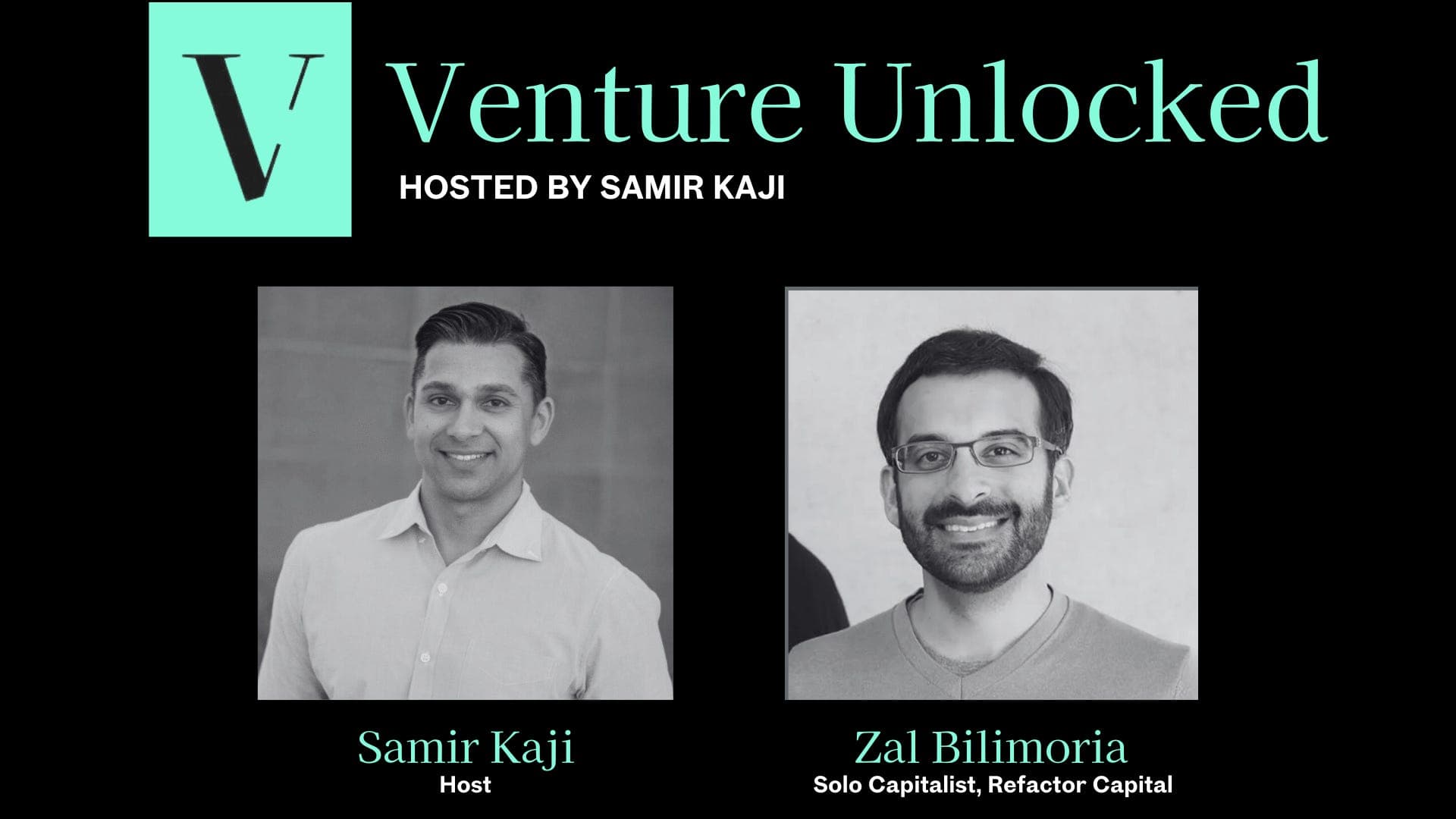
Episode Overview Title: The Solo GP Playbook: Zal Bilimoria on Fundraising, Portfolio Strategy, and Founder Relationships Host: Samir Kaji Guest: Zal Bilimoria, Co-Founder of Refactor Capital Podcast Link: [Venture Unlocked](https://ventureunlocked.substack.com?utm_medium=podcast)
Episode Description In this episode, Samir Kaji interviews Zal Bilimoria, who has transitioned from product management at major tech companies like Microsoft, Google, and Netflix to establishing his own venture firm, Refactor Capital. The discussion explores Zal's unique approach as a solo General Partner (GP), including his strategies for fundraising, constructing a portfolio, and developing relationships with founders.
---
Key Takeaways
- Background of Zal Bilimoria
- Early Life: Grew up in Indiana; developed an interest in tech through a family-owned computer business.
- Career Path: Transitioned from product management at major tech companies (Microsoft, Google, Netflix, LinkedIn) to venture capital at Andreessen Horowitz.
- Transition to Venture Capital
- Move to Andreessen Horowitz: Zal joined to help launch their first bio fund in 2015, gaining exposure to diverse investment areas.
- Starting Refactor Capital: Launched in 2015 with a focus on seed-stage investments in biotech, climate tech, and hard tech.
- Challenges of Being a Solo GP
- Cultural Shift: Transitioned from a team environment at A16Z to the independence of solo practice.
- Key Lessons:
- Importance of treating founders with respect and professionalism.
- Building a brand requires strategic investments in multiple companies to enhance visibility.
- Fundraising Strategy
- Initial Fundraising: Raised a first fund of $50 million and focused on maintaining that size for subsequent funds.
- LP Relationships: Building trust and transparency with Limited Partners (LPs) was critical, especially when moving to solo practice.
- Portfolio Construction and Investment Philosophy
- Investment Strategy: Focused on 20-25 companies per fund, aiming for 10% ownership in each.
- Follow-on Investments: Emphasizes substantial follow-on investments in top-performing companies based on performance data and founder relationships.
- Navigating the VC Landscape
- Market Trends: Observed shifts in seed funding sizes, with an emphasis on maintaining smaller fund sizes to facilitate flexibility and targeted investments.
- Risk Management: Addressed key man risk by obtaining insurance to protect LPs against unforeseen circumstances.
- Advice for Aspiring VC Professionals
- Engagement with Founders: Engage with a wide range of startups to build a robust understanding of what makes a strong founder and investment opportunity.
- Long-Term Vision: Emphasize the importance of a long-term perspective in building both relationships and investment strategies.
---
Detailed Discussion Topics
A. Zal's Early Life and Career
- Background in Tech: His upbringing in a tech-savvy family fostered his interest in product management.
- Tenure at Major Firms: Notable roles at major tech firms, including his pivotal position at Netflix.
B. Starting Refactor Capital
- Motivation for Launching: Identified a gap in focus on biotech and hard tech startups and sought to serve that niche.
- Fund Structure: Discussed the structure of his funds, emphasizing a lean operation model as a solo GP.
C. Portfolio Strategies
- Construction Approaches: Focus on a diversified portfolio while maintaining significant ownership in key investments.
- Follow-On Strategy: Selectively reserve capital for top-performing startups to ensure continued growth support.
D. Insights on the Future of Venture Capital
- Evolving Market Dynamics: Discussion on how market conditions affect investment strategies, particularly in the biotech and climate tech sectors.
- Importance of Founder Relationships: Stressed the value of building strong, trust-based relationships with founders for long-term success.
---
Final Thoughts Zal Bilimoria's journey from product management to becoming a successful solo GP offers valuable insights into the operational and strategic nuances of venture capital. His focus on founder relationships, disciplined portfolio construction, and maintaining a lean operational model serves as a robust framework for aspiring venture capitalists.
For more insights and discussions on venture capital, subscribe to [Venture Unlocked](https://ventureunlocked.substack.com?utm_medium=podcast).
Written by AI. May contain mistakes. Listen to the episode to check what was said.
Transcript
Automatic transcript. May contain errors.0:08Welcome back to another episode of Venture Unlocked, the podcast that takes you behind the scenes of the business of venture capital. I'm your host, Samir Khadji, and today our guest is Zal Bilimoria, co-founder of Refactor Capital. The firm recently closed its fourth fund at$50 million to invest in biotech, climate, and hard tech startups. Zal started his career in product management roles at companies such as Microsoft, Google, Netflix, and LinkedIn, and eventually went to the venture side as a partner at Andreessen Horowitz, where he played a role in launching their first bio fund in 2015. In this week's show, we talk about Zal's transition from product management roles to venture capital, his time at Andreessen Horowitz, and his journey as a solo GP and the number of learnings he's had in building an institutional seed firm.
0:54Let's dive in now. Samir Khadji is the CEO and co-founder of Allocate. Allocate and Venture Unlocked are independent of each other. Any statements or references made by Samir or his guests regarding third-party investments or securities are solely their views and opinions and are not intended as investment advice or an endorsement of such parties or securities by Samir, his guests, or Allocate. Allocate or its clients may maintain relationships with or investment positions in guests, third parties, or securities mentioned in this podcast. This podcast is for informational purposes only and should not be relied upon as a basis for investment decisions.
1:34Zal, it's good seeing you, man. It's so great to have you on the show. Thanks for having me, Samir. It's going to be a lot of fun. You and I were talking a little bit before. We've known each other since you started the firm. Now, almost 10 years ago, it's hard to believe it's been nearly a decade. But I think a good place to start is how you got into venture capital and really kind of going back into being a product manager at these big shops. And then what led into going on the other side of the table and actually investing in companies? I was born and raised in Indiana, about one hour from Chicago.
2:03My parents moved from India like 50 years ago. My dad was a metallurgical engineer. And so a bunch of the steel mills are located at the south end of Lake Michigan, right by Chicago. And so that's where my dad worked for 25 years. But we also had a computer business on the side, a family owned computer business where we built and sold computers. This was back in the late 80s and 90s. And we sold them to people's homes, doctor's offices, companies, school systems. And so, you know, I was conscripted child labor from probably age seven onwards, believe it or not. And so I was building computers in my dad's basement, getting into hardware, software, coding at a very young age.
2:36And so great memories. And many thanks to my dad for kind of pulling me into that in the early days. But Wharton raised there. I went to Penn. I did internships in the two careers that almost every person at Wharton goes into banking and consulting. And I absolutely hated both of them. And I was like, going into my senior year, I'm like, what am I going to do with this Wharton degree? And I was so lucky, Samir, Microsoft had come to campus and was recruiting for product managers at that point, PMs, you know, to help kind of build products and work with commercial parts of the organization to launch them.
3:11They came to campus and they recruited me and that started a 10-year career in product management. And so I got very lucky to go back to my software roots that I had built with my dad and start a career in that space. You think about all the different companies, whether it's Microsoft, Google, LinkedIn. I think LinkedIn was the last shop before you went into venture. What prompted the move into the investing world after being a product manager for a decade? Yeah, I was building these products. I had a really great, great time. I was the first head of mobile at Netflix. I was early on the monetization team at YouTube right after Google had acquired YouTube.
3:45Funnily enough, Hunter Walk was my boss for about a year at YouTube, fellow seed legend. For me, I was building, I think at the time in 2013, the Sales Navigator product at LinkedIn. I was working, one of the features that I was the PM for was InMail, which many of us use and or feel like they're probably getting spammed. But I was looking at it and saw an email from Andreessen Orlitz. And they said they were recruiting partners for the investment team and ideally people that fit my phenotype who had started a company, which I did back in 2010. Not a great story there, but it was a it was a year of effort.
4:20People who had actually built products in their in their journey as PMs. And they later told me that why why were PMs like the phenotype they were looking for? Well, Chris Dixon, Ben Horowitz, even Mark himself, like they were the ultimate PMs, right? They were the mini CEOs of those product organizations that work with the engineers to build and spec products and commercially launch them with the sales organizations and continue to iterate on that loop as you improve the features and the products for the target audience. They felt like the PM would be a really great because that's exactly what you have to do when you evaluate startups.
4:56You have to understand technically the capabilities, but also the commercial go to market. They really started building out this team. And so this was back in 2013. We were deploying A16Z Fund 3 at that time, which was a monolithic$1.5 billion fund. And I had never thought about going into venture to answer your question, but they got me excited about it. I ended up joining and we were investing in everything out of that one fund, seed to growth, consumer to SaaS, but also bio and health, which was kind of a new area that I was getting into. That started my journey into some of those categories.
5:29But yeah, I didn't really thought I was going to get into venture so early. A couple of people actually in venture were like, don't go so early as always. You should go start a company or go be an executive at a startup first because you've been at these big companies, Google, Netflix, and LinkedIn. And you may want to actually go get some startup experience before coming into venture. But I just felt like this was an opportunity that I could not pass up. I got to meet half the firm, half of the A16Z firm. At the time, there's only 50 people. I think today there's 500. conduit. So I got to meet half the firm, most of the GPs.
6:00And I was just like, I've got to be here at this point of time. And you were there for three years before starting Refactor in 2015. How did you know it was the right time to spin out and start your own firm? Obviously, getting to learn from people within the A16Z walls with folks like Ben and Mark and others is great. But venturing out on your own is always tough. It's like, do you have the track record? can you raise capital? How did you know at that moment that going into business for yourself, and I know at that time it was also with David Lee, but how did that all come about and how did you have the overall sort of confidence that it was the right time to do so?
6:37One thing to note is that at that time, I was on the investment team. I was not a general partner, so I was not writing checks. The GPs are the only ones that have the ability to write checks, sit on boards, and lead investments at A16Z. At least that's what it was at the time, and I believe that's how it is right now. It's structured. And they told me during the interview process, so there's probably not gonna be a path for you to be a GP here because they were looking for people who had half billion or billion plus exits to come in and be GPs there. They told me upfront, you're probably gonna spend a few years here.
7:07And at the end of those few years, you're either gonna wanna start a company, you're gonna wanna maybe join one of the companies that you diligenceed and maybe you're a board observer with, or if you wanna go be an investor, we're happy to help you make introductions, et cetera, support you, but you're probably gonna have to do that somewhere else if you want to be a check writer. And I said, okay, that's really good to know. I mean, I knew on the very first day on the job, I mean, it's a Monday partner meeting. I don't know if you've kind of heard about this structure before, but like at the time there was only about 15 of us on the investment team.
7:37So there was eight general partners and seven of us on what we called the deal team. And we were like that monolithic team. So we covered all the stages and all the sectors. And on Mondays, we'd be locked in a room, basically, from like nine to like six or seven o 'clock at night. The morning was the final GP pitch that founders would come and pitch us. Back to back, there'd be like three or four. And that would be the last pitch before we decide on whether we were going to invest or not. We'd break for lunch and we'd come back and we'd have deal review. And deal review was when we would process all of those companies, discuss them in depth, teams, traction, technology, markets, terms.
8:13and that was like just the most amazing educational experience as you can imagine being in VC. And then of course, we'd not only discuss those companies, we would discuss all the other companies that all of us had met since the previous deal review meeting. So after that Monday, obviously I'm exhausted. I come back home. I tell my wife, I'm probably like, I want to do this for the rest of my life. I am exhausted, but this was like the most amazing experience that I had. I knew I wanted to be an investor in that category. And so I think a few years had come up and I was at A16Z. I was getting into digital health, computational biology, synthetic biology.
8:50I helped start the BioFund, which was the first sector-specific fund that A16Z raised in 2015. And then, yeah, I reconnected with David Lee. David and I were at Google 20 years ago. He was running SB Angel with Ron Conway, and he had just left, and he was looking to start a new firm. We ended up chatting and over a few months realizing that we had a lot of similar ideas of how we wanted to treat founders and where we wanted to spend our time investing at the seed stage versus multi-stage or series eight, et cetera. I went and told Mark and Ben that, you know, listen, it was like right before Christmas in December 2015.
9:22I'm like, guys, like I think I found what I want to do. And they're like, oh, yeah, we already know. David's already called us. And we said, yeah, he'd be crazy not to partner with you. And I was like, thank you. That's awesome. So that's started my journey. So one of the things that we've seen, we've seen a lot of people spin out of larger firms. And from a culture standpoint, it's very different being an investment person that is at a big firm where your sole responsibility is investing. When you start a firm, it's really soup to nuts in terms of setting up the fund, thinking about all the things that you historically haven't had to do.
9:56Fundraising, picking service providers, thinking about culture, team, brand. And what things were transferable from your time as a product manager and maybe an Andreessen that you took over and that you kind of learned over the first one to two years that were very transferable? And what were some of the toughest things that you had to learn and adjust to as you started your own firm? Some of the easier things that I was able to transfer, especially from my time at A6D &C, is how we treat founders. And Ron and David at SV Angel had a very, very similar mentality, right? And so the whole thing that you've probably heard about, if you're late to a meeting at A16Z, it's a$10 a minute if you're a partner.
10:35It's$100 a minute if you're a GP. Those are all true, or at least they were at the time. That is extremely important. You want to make sure that you treat founders with respect. You come in and prepare for meetings. I talked about this on a previous podcast years ago, but what we did was we had an NPS score for every investment partner. We had an interaction with a founder, and then we passed on them. They would get an email from us. And, you know, 99 % of the time people are passing, so they probably are really upset and they're kind of disappointed that A16Z is passing. But they get an email and they have one question in it.
11:08It's like, how likely are you to recommend A16Z based on your interaction with Zoll? You know, 1 to 10. As you know, getting anywhere in the 8, 9, 10 range is extremely challenging. We all had our NPS scores and they were published internally. Even the GP has had NPS scores, believe it or not. That was taken extremely seriously. The way that we prepare for those conversations, sometimes I would have 10 pitches a week because I was on the front lines with the deal team, meeting companies for the first time, deciding which ones I wanted to propagate and talk to the GPs about. And so we had to even treat how we write the pass email and the communication around that very carefully, how we could help those founders.
11:45Taking those things that I learned from A16Z and applying that at Refactor, I think is something that I definitely did. I think building a brand is always extremely challenging. I think A16Z had a little bit of an unfair advantage there with Ben and Mark's reputation previously. And so we had to build a new brand and we took that very seriously. And the reason we did and the way we did that is even though you have a$50 million fund, first fund, David and I were the GPs on that first fund. And then he retired a couple of years later when I went solo. We did a lot of what I called, you know, SV Angel style checks, 25K, 50K checks into dozens of companies.
12:21and I was a little worried about that because I had learned at E16Z, like we need ownership to be able to return a fund. Like how are we gonna make this work? And David's like, no, listen, like we're a first time fund. Refactor is just coming up on the map with founders. The more we invest in companies and founders, we're building out that network and we're extending our reach of our platform and our name. And the way that people are gonna be able to work with us, they're gonna tell their friends and their colleagues about us. So, you know, we have about 60 companies in fund one, which is actually pretty a lot for a$50 million seed fund.
12:56But 30 of them are core investments where we are getting our, you know, at the time of five to 10 % ownership target and 30 we had no ownership targets for. And a couple of them ended up actually being unicorns and actually helping drive a lot of returns. But it's a very small amount of capital put into a company. And I want to come back to portfolio construction. It's something that there's so much debate on, you know, big fund sizes and how many companies, where you invest, follow-on versus initial, the ownership versus more companies, as David mentioned, with less ownership. I do want to go through your model and how you've evolved over the years from fund one to fund four.
13:33Before we, though, leave, because we have talked a little bit about David being part of it, he retires two years later, you had always been part of companies and funds that had team structure, partnerships, LinkedIn, Google, obviously big companies. How did you decide to be a solo GP and then ultimately stay that way when all you knew before that was team-oriented businesses? I mean, the short answer is I didn't know. And I spent six months after David told me that, listen, I'm going to retire. We had talked about this when we started Refactor. He's like, maybe maybe fun two, but probably fun three is when I'll probably step back.
14:07So all and you'll need to decide whether you know how big a team you want to build, etc. And then he's like, you know, came back to me in late 1718 and said, you know what, I'm probably going to retire. And you should think about, you know, what you want to do. And I was in a little bit of a shock that I had to make this decision so quickly, you know, so soon after launching Refactor. And I was nervous. So I spent six months talking to a number of my friends and partners and colleagues, and some of them that I thought would be GP candidates. Some of them, a couple of them were actually high net worth LPs of mine who are good friends who wanted to potentially get into venture with me.
14:41But some of these folks had very differing ideas of what they wanted to build. One wanted to build a$500 million multi-stage, multi-sector fund. I said, like, you know, I've seen what that looks like with A16Z. I do not want to compete with A16Z. I think that's going to be a challenge. Others wanted to do, okay, let's do seed, but let's do a$200 million dollar seed fund. I'm like, that's a big seed fund. Like, yeah, we'd have to do fintech. We'd have to do lots of other categories. I'm like, you know, that doesn't really get me excited. I'm not really, you know, stoked about doing just, you know, normal SaaS deals.
15:11I've been spending time in health and bio and increasingly climate tech. And this was back in 2018. And I was like, I am, I am really determined to focus on those categories. And so the more and more I thought about it, if you, you know, recall, there's probably like, you know, 10 steps in the GP marriage process, right? You know, I probably only got to step two or three with anybody. And I even brought them into my office right here in front of me and sat in with pitches with founders. And even the types of questions that people would be asking and how they would think about certain ideas, it led me to believe that maybe this is something that I can do on my own.
15:44And then I went back to David. I was like, I'm thinking about going solo. He's like, duh, you definitely should do this because you love your independence. You love your authority. You know exactly the types of founders that you want to work with. You're a really good picker. You're a type A personality. We talk about how my wife calls me A plus because super maniacal organized in terms of what our portfolio looks like, how I manage my time. I try to make it a priority to be as responsive as I can with our founders. And so all of these things have come up and said, okay, I can control this. and especially if I keep the fund size small and keep the investments in a concentrated basis, I can spend a lot of time with these companies and rinse and repeat the model every few years.
16:28And so I went back to our LPs and some of them bought that idea and some of them, very frankly, did not. Fund two was a very hard fundraise, right? So we went from 50 to 36 million. So I went down in fund two. Luckily, our anchor stayed with us and they have been amazing. It's the Knollwood Investment Advisory Group in Baltimore. more. They are fantastic to work with. I think they're going to work with me hopefully the rest of my career. But the rest of the group, I had to rebuild from fund two onwards. And I'm glad I did because a lot of those folks were, you know, because David had such an amazing track record.
17:01Those were David's LPs. Let's just be very honest. Those are David's LPs. He's the one that convinced them to invest. And he was a very, very good seller at that point. And so I had to be a seller. I had to come in and say, like, this is a round only refactor. This is all that you're investing in. And so I had to rebuild that LP base. And then a couple of years later, went back to the original size of 50 million. All of those folks ended up re-upping for a lot more. And so that fund was done very quickly. And so all in all, I'm so glad that I've been a solo. Yeah, let's go back to some of the fun two discussions, because at that time, I still think 2017, 18, being a solo GP was something very difficult for a lot of institutional investors to really internalize because of the inherent, at least perceived or maybe real in some cases, risk of key man, the inability maybe of the GP to bounce ideas off somebody else that's within their shop to push thinking.
17:54What were some of the biggest pushbacks that you had and how did that frame your thinking in terms of the gaps you had to fill as a solo GP to address some of those concerns as you went from fund two to fund three? Many LPs wanted me to hire people like principals and associates. They wanted me to build up more advisory network. I'm probably one of those rarest OLGPs that have kind of pushed back on that and said, I'm not going to hire anybody. I'm the only full-time employee and have been at Refactor for almost seven years now. A lot of the LPs were a little nervous about that, to be honest. And again, the numbers change as companies raise more capital.
18:32But on average, I do about seven or eight new investments per year. and let's say maybe five are graduating from C to Series A and beyond every year, two or three are shutting down or being acquired. So it's an effective replacement rate of one to one, right? Seven or eight new investments, seven to eight graduation slash shutdowns. I don't take board seats, but I'm very active with the founders, right? I'm a major investor, board observer, you know, I'm leading and co-leading rounds. And so I do spend a lot of time with those businesses, but I kind of pass the baton to the next set of investors at the next round.
19:06I do spend some time with those businesses as they mature, of course, but it's more rare than that. Being able to think about how to convince those LPs and fund two that I was the one to back was really, really challenging. Keyman risk, you brought up that. So I want to make sure I mentioned that. So one thing that Manu Kumar from K9 told me was that you should actually put together a separate insurance policy that if anything happens to you is all the management company is paid some few million bucks. And they can use that. They, meaning the LPs, the LPAC, can use that to either hire a new GP, hire a new team, or figure out how to manage the assets and kind of dissolve the entity over the following years versus kind of pulling additional fee capital from the LPs after you may have passed.
19:55I thought that was brilliant. And once I did that, I felt like it started getting fewer and fewer questions. And then on the principal and associates, It's like, you know, Tim Connors from Pivot North. Like he was the OG solo capitalist, right? You know, he was at USVP in Sequoia for a long time and then spent on his own firm. And like me, I like, he's very consistent, like raising 35 million-ish every few years. Like he's had like top quintile, you know, top 5 % type funds for a long period of time. And he's also from Indiana. So I call him up every once in a while. I called him up six, seven years ago when I was going solo.
20:27I was like, these LPs are telling me I should hire associates and principals and I probably need to hire multiple like one for healthcare, one for bio, one for climate. And I don't really want to manage three people. He's like, Saul, don't do it. I'm like, what do you mean? It's like, well, the very, very best people, they're going to want to be promoted inside. They're going to want to be a GP in your firm. And you have already decided that you want to be a solo GP. So there's going to be internal friction there. Secondly, they're going to want to do investments. And you're going to want to support them.
20:55But when the follow-on check comes on, those principals and associates are going to have an information asymmetry issue where they're going to know more about the companies than you are as the GP because they're going to be the ones that are going to be going to the board meetings and talking to the founders. And then you're going to be in a very tough position on how to decide whether to do the follow on investment or not. And then if you are actually lucky and have like a two year cadence with some of these folks, you're just gonna be hiring and firing people every few years. Like if you really do you really want to be doing that.
21:24So to sum up, I was like, okay, Tim convinced me that I should not hire anybody and stay solo. And you mentioned, you know, Tim, obviously one of the most successful solo GPs out there. Manu, of course, has done incredibly well. There are other folks that have now scaled to Elad, Oren Zav, for example. Oren, you know, has been on the show before and he said, I'm not going to hire anybody. I've, you know, they have two billion over management, but it's still just a one man show and people can't believe it. You know, one of the things I asked him and I wanted to ask you is, are there just inherent things that, you know, obviously the pros are there.
21:57We've talked about some of the pros of being able to manage, not having sort of the overhang of personalities, decision-making, politics, things like that. But, you know, as a one-man person or one-man show in this case, there are resource constraints. How do you balance your views versus somebody that can push your views? What are the things that you do as a solo GP to maybe overcome some of the just inherent challenges of just being solo and having just so much time available to you to be able to do things you need to to run the firm. Yeah, I think, and you mentioned service providers earlier, which I was not able to touch on, but like, you know, we've been, I've been working with Aduro for eight years.
22:37I've been very lucky to have a very strong and consistent team for many, many years. Not only that do they know Refactor, they know me, right? And how I work and what I expect in terms of responsiveness, quality of information and, you know, where they need my help and to get something done and when they can just do things on their own. It's been really great to have them. You know, I've got my tax and audit team. I've got a virtual EA down in California. She's been running my life for nine years. I've never met her before. She worked at a A16Z portfolio company before. You know, she has been great and keeps everything on task in terms of scheduling and some of the other back office stuff that I have to get done, tracking of deals and all that, right?
23:16I feel like I've found all the elements that have, like the stuff that I'm actually not good at and or don't want to do. I found people that helped me with that. And that allows me to spend all of my time with founders. I get to really spend like a significant amount of time meeting new companies and working with my existing portfolio companies. And if I can maximize those two buckets by having the supporting team around me, then I think that actually makes it a lot more worthwhile as a solo to actually understand my time. Because as you know, as a solo also like, you know, I've got two little girls at home during COVID.
Read the full transcript
23:49It was extremely important to be able to have the flexibility of my schedule when their school is shut down, right? When I can like, I had to be at home, even though my office is like six minutes away, my house is six minutes away from my office. Like I had to be home with them to help my wife because of my girls were really young. You know, there's all of this flexibility. Whereas if I was expected to come into an office and like deal with all of this stuff, I think it would have really impacted my personal life and the relationship with my spouse. To be able to have that flexibility is just amazing.
24:19And then when I go deep on a deal and I need to go chase something, I can drop some of the other stuff or like delay things. And my EA can like be like, okay, so I can meet you tomorrow, not today, you know, blah, blah, blah. Like I need to go chase something. And she's great at that. And I can just go and make that happen. Yeah. The other thing that I would mention in your case, which is interesting, you just announced the close of fund four, which is 50 million. The same actually as fund one and fund three, all$50 million vehicles. A lot of people that have gone on to multiple partnerships also scale AUM.
24:49Now there's seed funds that are in some cases$200 to$300 million and sometimes even more. The market has changed. Seed rounds have gotten bigger, but you've kept the fund sizes small at 50. Tell us a little bit about the philosophy of keeping fund sizes at 50. And I've do you say that your expectation is that even on a go forward basis, regardless of the market, you're going to keep the fund sizes really small at that$50 million level? My goal is to raise$50 million every few years for the next 20 or 30 years, as long as founders and LPs are so inclined to support that. And the reason$50 million makes a lot of sense for me is that I invest in about 20 to 25 companies per fund.
25:27So I'm saying seven to eight investments per year over a three-year cycle. And I'm on a very tight three-year cycle. I love that cadence. It works for that replacement rate that I was telling you about before in terms of graduations versus new companies. And it forces me not to have to hire anybody, Samir. It's this magic number that I've realized that if I go to 75 or 100, I'm going to have to write larger checks. I'm going to have to write more checks. I'm going to have to be less collaborative with my seed ecosystem, instead of aiming for 10 % ownership, I might have to strive for 15 % or 20%.
26:03And then I'm going to push out all my other co-lead partners, right? And then I'm not going to get great deal flow. It's going to impact the quality of the companies that I'm going to be able to invest in. If I want to stay as a co-lead slash lead in a round, but still realize that it takes a community of investors to help support a company, this$1 to$2 million entry check in a$50 million fund, repeating that every three years, I think makes a ton of sense. I had, you know, 80 million of interest in this fund this year, fund four of hard commit interest. And I had to turn it away because for one reason, I've been telling people for a long time that I'm going to raise 50 million every few years.
26:43And I wanted to stick to my work. And I went back to the math every time. Oh, are you sure you don't want to go to 60 or 70? And, you know, I think to their credit, like they really pushed me to make sure that this is the right strategy. And so I went back to the math. I was like, no, guys, this changes everything. I have to change a lot of things about Refactor if I was to change this number. Yes, seed valuations have gone up, but I am not chasing, like we were talking about before we started, I'm not chasing most of these big AI deals, right? I'm in hard tech. I'm doing biotech, climate tech.
27:14I'm doing some pretty IP-centric businesses, a couple of founders spinning out of a university with PhDs, with some unique technology. and have a path to actually get to commercialization by the Series A. These are not science projects. These are actual businesses that can actually build products for customers. But I think those investments, I can get my 10 % or pretty close to my 10 % ownership for my$1 to$2 million investment. So long story short, staying solo, being the only full-time employee works with this particular fund size. How did you think about that fund size? Because we have seen, as I mentioned, some of the inflation in terms of the round sizes.
27:54And in the last two and a half years, the market has substantially shifted where that Series A is tougher to get. And in many cases, companies are raising a series of rounds before they get to the Series A, to which the markups are certainly less than what we saw in 19, 20, and 21. How did you think about maintaining the ownership? And it seems to me, at least sitting on my side, there's at least the case to inflate the funds slightly just to make up for the fact that the market has changed, the sizes have changed, and the difficulty of getting the Series A has changed. So how did you balance that analysis versus staying at that$50 million level?
28:34Yes, the market's changed in terms of some of the seed round sizes. But I'll be honest with you, the seed rounds that some of the big multi-stage firms like to call them maybe$10,$15 million seed rounds, those are companies that I never see. I will never see those because they realize, I'm very transparent on Refactor's website. I put my ownership target, I put my check size. So people can decide whether they wanna reach out to me or not, given how much they wanna raise. A, 16, Z, et cetera, they will take the vast majority, if not the entire 10, 15 million seed. But if I look back over the last nine years that I've been running Refactor, including Solugin.
29:13So Solugin is a chemical manufacturing company down in Houston, Texas, where I led the seed round. and now they're a$2 billion company. I've actually, I actually led their seed round and they raised$5.5 million in their seed round, right? And this was in March of 2017 when they were graduating from YC. So seven years ago, seven and a half years ago. I'm seeing basically two types of rounds these days. The one, the$2.5 million pre-seed that's at that 10 post average, maybe less, maybe more, but in that ballpark. Where again, a million dollar check for 10 posts gives me my 10 % ownership. And then I'm also seeing these larger seeds that are like four to, let's call it 7 million in size.
29:57And they're in the 15 to 25 post range. And again, I'm okay writing a$2 million check out of a$50 million fund. Most GPs might think I'm crazy to put 4 % of my fund as an entry check into one investment. But I try to get my ownership up front because some of these Series A's in the last few years have just been, not only in the bubble, but obviously just in the last couple of years still, have been really large. And maintaining my ownership with a prorata check doesn't necessarily make a lot of sense in some of these large rounds, right? Because it's a big chunk of my fund. What is the model then?
30:32You mentioned entry point of 2 million, say 25 companies. If you did all$2 million checks, that would be the entire fund. Of course, that's not the average check that you're writing at the entry point. what is the split between entry and then how much do you reserve typically for follow-on? Yeah. So fund three, you know, has 22 companies. The average check size was about 1.3 million for about nine and a half percent ownership. So I just completed my last investment in that fund a few months ago. So I have the data fresh. About half of my deals, Samir, are pre-seed and half of my deals are seed.
31:05I have the ability to maybe even if it's one and a half million dollars, let's say it floats from 1.3 to 1.5, right? 1.5 million average entry check into 20 to 25 companies. I'm still getting about 30 to 35 million of capital in early, which is very front centric. But as a leader or co-lead, there's an expectation for me to help support those businesses in parada situations and or in bridge situations. Nevermind if they're a rocket ship and I want to be a part of the series A. So the lion's share of my reserves go into usually the top three companies. I don't do automatic pro rata. Those are tough decisions that you have to make as a GP.
31:45But in some cases, like you just have to realize which ones are going to be your winners and you got to plow into those. So if I have an opportunity to get early exits in the fund, I'll obviously have an opportunity to recycle and get closer to that. You know, instead of just having five or $7 million of reserves, I can get closer to$15 million of reserves. Let's talk a little bit about how that all then distills down to sort of the return model. And from an LP standpoint, typically, when you are investing in smaller funds, the return target expectation is, can I get a three to five X plus? With upside, of course, if you get into the right companies, but even getting a three X is not a trivial thing to do.
32:25I think about, you mentioned 10 % ownership, let's use that as the base. to be able to get even a 3x net, you know, it's about a 3.5 to 4x gross, depending on carry and things like that. That's like$175 million coming back to the fund. If you look at the 20 % carry and 3.5x gross to get to a 3x net. And if you own 5 % of ownership, because I think sometimes people underestimate the impact of dilution when you get to A and B, I always say factor in, yeah, At 10%, you're probably going to exit at 5 % for the biggest companies. That's$3.5 billion in enterprise value that the portfolio has to generate to be able to return that type based on an average exit ownership of 5%.
33:08So how do you, when you're looking at a company, every company at least has the potential to be a fund returner and then some potentially. So how does that factor into decision-making at that entry point? You're like inside my brain right now because that's exactly how I think about it. Like I have to believe at the time of investment that the company has a chance to be a fund returner. And that's why 10 % ownership matters. Because to your point, if I'm coming in at 5 % ownership and I have 2 % or 2.5 % of that company at exit, then it's going to have to be a$2 or$3 billion valuation at exit, right?
33:45Which is just obviously that much harder than even getting to a billion, especially in hard tech, in these industries in which I'm investing. It's not AI, right? Or crypto, or there are these crazy, crazy multiples. I have to be very prudent in terms of how I think about deploying that capital into these businesses up front. I believe that after having been doing this now as a VC for 11 years, seeing thousands of founders, I keep trusting my gut instinct more and more every day. And when that founder leaps out at the screen over a Zoom or over a coffee chat, it's because not only have they gone through the idea maze of their technical field, it's because they are commercially gifted.
34:23They know how to attract customers, talent, and investors, those three groups, to their cause. I got to find those folks. And if I find those folks and I have a chance to get 10%, or to be very fair, very close to 10%, which I'm willing to bend a little bit on for the right companies, then it makes a ton of sense for me to go in and have this concentrated view of getting that ownership up front and not leaving a ton on the reserve side, to my point earlier, just because the cost basis of those investments are just too high. We talked a little bit about what are we seeing in the seed market. And there are companies that are still raising at three and 30, four and 40.
35:01In a situation where it is a, let's say, a$30 million post. And if your average check is, let's say, one and a half, that only gets you 5 % in that case. So then you have the decision of if you love the company, do you flex materially and then accept a 5 % ownership knowing that you're going to get dulyted down to two to 3%, the calculus has to be, this can be a$2,$3 billion company, or you check size up and write a$2 or$3 million check, which for a$50 million fund size, then creates a concentration to a certain degree. Which direction do you typically go in and what would you advise? Because there are a lot of investors that are running fund sizes that are really faced with these things.
35:40The other alternative, of course, is just walk away and say it just doesn't fit our model. I've done all three. I've made exceptions where I've taken less ownership, I've walked away and then I've sized up where I need it to be. It's all obviously on a case-by-case basis, depending on the founders, depending on the deal dynamics. I think there's a lot of AI hype right now, as I think most people believe, but there's also a lot of reality. There's some amazing companies getting started in the last couple of years and then the next few years. What I have kind of thought about in the back of my head is if there is an AI element that is strong in a particular company, which very few of my companies have, right?
36:18Because most of them are like, you know, they're biotech or hard tech, or like, they've got some physical nature in which they're actually building in the atoms world rather than in the bits world. If they're in bits, and they're like doing a lot of stuff in AI, and that's where their core technology is, I will lower my ownership threshold. Because I believe that they have a chance to becoming more than a billion dollar outcome. To my point earlier with that math, 10 % down to 5%, 5 % of a billion dollar company is$50 million. That's my fund size. So as you know, better than me, probably the very best venture funds in the top decile category from the last 40 years have at least one fund returner, if not a multiple fund returner, a multiple of a fund returner.
36:59I will make exceptions on the AI case. And then I will also don't mind going to that 2 million. In one case, I went to 2.5 million in the last month. I got my close to 8 % ownership. And so it was a very high priced deal, but I love the company and I felt like it was going to make a huge impact in the world and the sales cycles were going to be relatively de-risked. There was also so much interest in this company from a lot of investors that I felt like the series A and series B had a higher probability getting done. It's a case by case basis, but you have to really believe in the team and their ability to actually have a much higher outcome if you make those exceptions.
37:38Right. And as you make those exceptions with those great companies, there is the opportunity, as you mentioned, to retain ownership, at least in the next round, through doing a follow-on. You brought up something really interesting that you tend to concentrate your follow-ons with those three or four companies. And at that time, there's still very limited data sets in terms of how the company is doing, where it's going to actually end up in terms of the long-term exit of the company. So what is the rubric that you use? I think that there was this time and place where doing a follow-on just became a default mode.
38:11You know, follow-on comes, you do your prorata, and you do it for like 60 % of the companies that actually make it to the Series A. And that was what a lot of people did in 2120 for sure, to a lesser degree. But in many of those cases, those lazy follow-ons actually were not the right decision. But people did it because, you know, at the end of the day, you want to support the founders and you want the founders to say good things about you. So how do you balance all of that and yet make a decision on the following that almost acts like this very independent investment decision that still has to return some kind of multiple?
38:44So two things. One is I think the market has actually helped us decide which ones to invest in because to your point, it may have been 60 % two and a half years ago, three years ago in the bubble in terms of a graduation rate. Now it's probably closer to 10 or 15 % according to Carta and some of the other metrics that have been, some of the benchmarks that have been released recently. And so if you get to a Series A, that in itself is a great early indication of success. And so you should take those companies seriously as a GP because half the companies or more in our portfolio will go to zero or return less than 1x of cost basis.
39:18And Fred Wilson had a great blog post about this this week as well. That's one thing to consider. On the other side, I think you want to make sure that being able to have 10 % ownership and leading and co-leading around, being a board observer, having a significant amount of touch points. I'm probably the first phone call for most of my companies. I get an inside seat into how those founders operate. I get an inside seat at how those businesses are doing and do they actually attract customers, talent, and investors to their cause, my earlier point to you. And so I have maybe one, two, three years of data at that point.
39:54I'm going to use that to my advantage to make that investment decision at the Series A and beyond, right? And so where I feel like if you don't have that connection with founders, you write a 200K check and then you talk to the founder three times between the C check and the Series A, good luck trying to make a decision on that. The other thing that we did see during that timeframe were the graduation rates, as you mentioned, were 60%. I saw some funds that had 70, 80 % graduation rates. Basically, every company getting a Series A was not only upsizing their core funds, but also doing things like independent SPVs to do follow-ons at the B and opportunity funds.
40:31You have not done any opportunity funds in a world where I saw so many seed managers do that in 2019 to 2021. Maybe you can give us a sense of why philosophically you opted not to do it when all of the market tailwinds were leading so many funds to do those kind of funds? It wasn't for lack of interest in my group, although there were certain LPs that were very much in favor of it and certain LPs that were pretty much, you know, diametrically opposed. And so I had to think about how I would deal with that type of differing opinions when raising a fund, an opportunity fund. What I've done is done SPVs and I do SPVs for my top one or two companies every fund.
41:13Most of them have been very, very successful, including for Solugen. Not only did I lead the seed round, I've actually led or co-led three of their six financing rounds, including the latest round, the Series D, of all cases. It was crazy. I was already starting – this was in the March of 22. The stock market was starting its decline after the bubble. The company was going out and raising a$200 million round. They had plenty of interest of people, but nobody wanted to price the round because the investment committees didn't want to look silly in terms of how to price this. Is it a flat round? Is it an up round?
41:49Do we do a down round? And nobody wanted to do that. Even these big growth funds and these crossover funds that were already on the cap table from the Series C didn't want to pull that trigger. And so I land in Houston for the board meeting. I go to the founder's house and we're having dinner. And I was like, listen, I actually raised$20 million for my SPB. My LPs are excited about the business. And then the founder was like, wouldn't it be silly if you guys led the round because nobody else is willing to give me a term sheet? And literally 48 hours later, I am writing a term sheet and co-leading the round with lower carbon.
42:22And as soon as that was done, literally within four days, the round was oversubscribed from all those same people that I just told you about. So they wanted somebody to come in and actually price it and take responsibility for that. I was in a unique position to do that because of my LP. So very grateful that I was able to use my SPV strategy and bend my will so that I can actually say this is going to be one of the defining companies of my career. And I'm willing to take a bet on that. I love the deal by deal carry. It just makes so much more sense than an opportunity fund. I feel like there's so many misaligned incentives with an opportunity fund and a growth fund.
42:58And I think you start getting into some really poor behavior from GPs when they have to deal with some of these decisions. Whereas if this is truly a breakout winner, then yes, I'm going to actually be the pitcher. I'm actually going to pitch my LPs to say, this is one or two companies out of 25 in this fund, or whatever the number is, that I'm going to place my bet on. And they know when I come to them, this is a serious opportunity. Yeah. I do think one of the reasons a lot of people did do the opportunity fund was because LPs in certain cases weren't able to move quick enough to do the deal by deal.
43:34And it just became a fundraising hassle, an administrative hassle. So it was just easier to have a discretionary pool of capital through an opportunity fund. What type of LPs did you find or have you found move the quickest and are able to do it? And are there things that you do in advance of those rounds coming to bear where you have much more certainty of capital, at least when you talk to the founders, of doing something like you did with Solugen? Yeah, I do a lot of pre-pitching, right? And I share a lot of information in my quarterly and annual letters. So they know what's happening with these companies.
44:06And they already probably have an understanding, either very specifically how I write and communicate which ones are going to be those potential one or two, or based on how I've stack ranked some of the opportunities. They know which ones to start thinking about and whether it's going to be a fit for their portfolio and their mandate or not. And to be very honest, out of the eight or nine very large kind of institutional investors that make up 90 % of my fund. There's about four of them that routinely want to be a part of my SPVs. Sometimes some of the other four or five come in, but it's usually those four that are the most interested.
44:41And those are the ones that I actually have also the closest relationship with. And they just know when I bring them one of these opportunities to be ready. And so, yes, it's a delicate balance. How much do I tell the founder to reserve for me? Should I tell them to reserve 10 million or only 3 million? That's a huge delta, right? Because otherwise they're going to have to go fill a$7 million gap in their round. And who are they going to get that from? I have to trade carefully there and not overstep in the sense that maybe an LP will pull out, right? And so, which has happened in the past, right?
45:08Where they've made it, oh, you know, instead of five, let's do two or something like that. And I've had to make some adjustments. Luckily, those were an oversubscribed round, so it didn't necessarily impact the company, but I've learned from those situations. That's great. And I don't want to age the firm, but at the end of next year, it's going to be 10 years in. And you've been now in venture for over a decade. If there was a single piece of advice you'd give your 2013 self as getting into venture, what would that piece of advice be when it comes to investing in startups? The single piece of advice I would give is just make sure you treat founders extremely well.
45:44And by that is like, feel free to take as many pitches, even if they're not in your categories of interest. If you're just getting started and you're building out your network, you're building your reputation, you're building your reps with founders, there's nothing better than you having more cycles with founders so that you can actually base your gut instinct for when you actually find those special people. Take those pitch meetings extremely seriously, be prepared, but understand that obviously 98 % of them are probably not going to be fits, but you are building your own world view as to what types of founders you want to work with.
46:20Because if you're only meeting one or two new companies a week, you're doing yourself a disservice because you're not building your own kind of mental capacity for what's possible and when that special founder comes around. That's great. Lazal, really appreciate you coming on. Congrats on Fund4 and getting that closed and look forward to seeing the continued growth of the firm and the evolution and really appreciate again the insights today. Thanks again, Samir. Great questions and congrats on everything at allocate. It's been awesome to see you guys, what you're doing over there. Thank you so much for listening to another episode of Venture Unlocked.
46:52We really hope you enjoyed our conversation with Zal. To get more venture insights right to your inbox, please subscribe to Venture Unlocked at ventureunlocked.substack.com for the latest podcasts and my ongoing insights about the world of venture capital. You can also find the show on iTunes or Spotify. And don't forget to leave a rating as it really helps us out. Thank you.
From the publisher
Follow me @SamirKaji for my thoughts on the venture market, with a focus on the continued evolution of the VC landscape.
We recently had the pleasure of hosting Zal Bilimoria, Co-Founder of Refactor Capital. Zal has had a fascinating career from building products at Microsoft, Google, Netflix, and LinkedIn to making the leap into being a VC. His story is one of relentless curiosity and a deep passion for technology, something that started early in his life while working in his family’s computer business.
In our discussion, Zal walked us through his transition from product management to venture, his time at Andreessen Horowitz, and what ultimately led him to launch Refactor Capital. As a solo GP, he’s taken a unique approach to investing, navigating the challenges of fundraising while staying laser-focused on backing founders tackling complex, high-impact problems. We covered everything from the evolution of his investing philosophy to the importance of founder relationships and how he thinks about the future of life sciences and technology.
About Zal Bilimoria
Zal Bilimoria is the Founding Partner of Refactor Capital, a venture firm investing at the intersection of life sciences, technology, and sustainability. With a background in both software and healthcare, Zal brings a unique domain expertise and lens to investing. Before launching Refactor, originally with his partner David Lee, he was a partner at Andreessen Horowitz, where he focused on emerging technologies.
This was a fun conversation—if you're interested in what it takes to build a venture firm from scratch, how product thinking translates into investing, or where the future of innovation is headed, this episode is a must-listen.
Timestamps:
Topics in this conversation include:
* Zal's Early Life and Background (2:00)
* Career in Product Management (3:06)
* Starting Refactor Capital (6:03)
* Challenges of Starting a New Firm (9:36)
* Portfolio Construction Strategies (13:12)
* Solo GP Model (18:06)
* Advice on Hiring Associates (20:12)
* Fund Size Philosophy (24:32)
* Investment Entry Points (28:34)
* Return Model Considerations (32:04)
* Understanding Ownership Thresholds (36:31)
* Market Influence on Investments (38:44)
* Navigating Investor Relationships (41:08)
* Quick Decision-Making with LPs (43:25)
* Parting Thoughts and Future Outlook (46:32)
I’d love to know what you took away from this conversation with Zal Bilimoria.
Follow me @SamirKaji and give me your insights and questions with the hashtag #venture unlocked. If you’d like to be considered as a guest or have someone you’d like to hear from (GP or LP), drop me a direct message on X.
This is a public episode. If you would like to discuss this with other subscribers or get access to bonus episodes, visit ventureunlocked.substack.com