In short
Venture Unlocked: Episode Summary
Podcast Title
Venture Unlocked: The Playbook for Venture Capital Managers
Episode Title
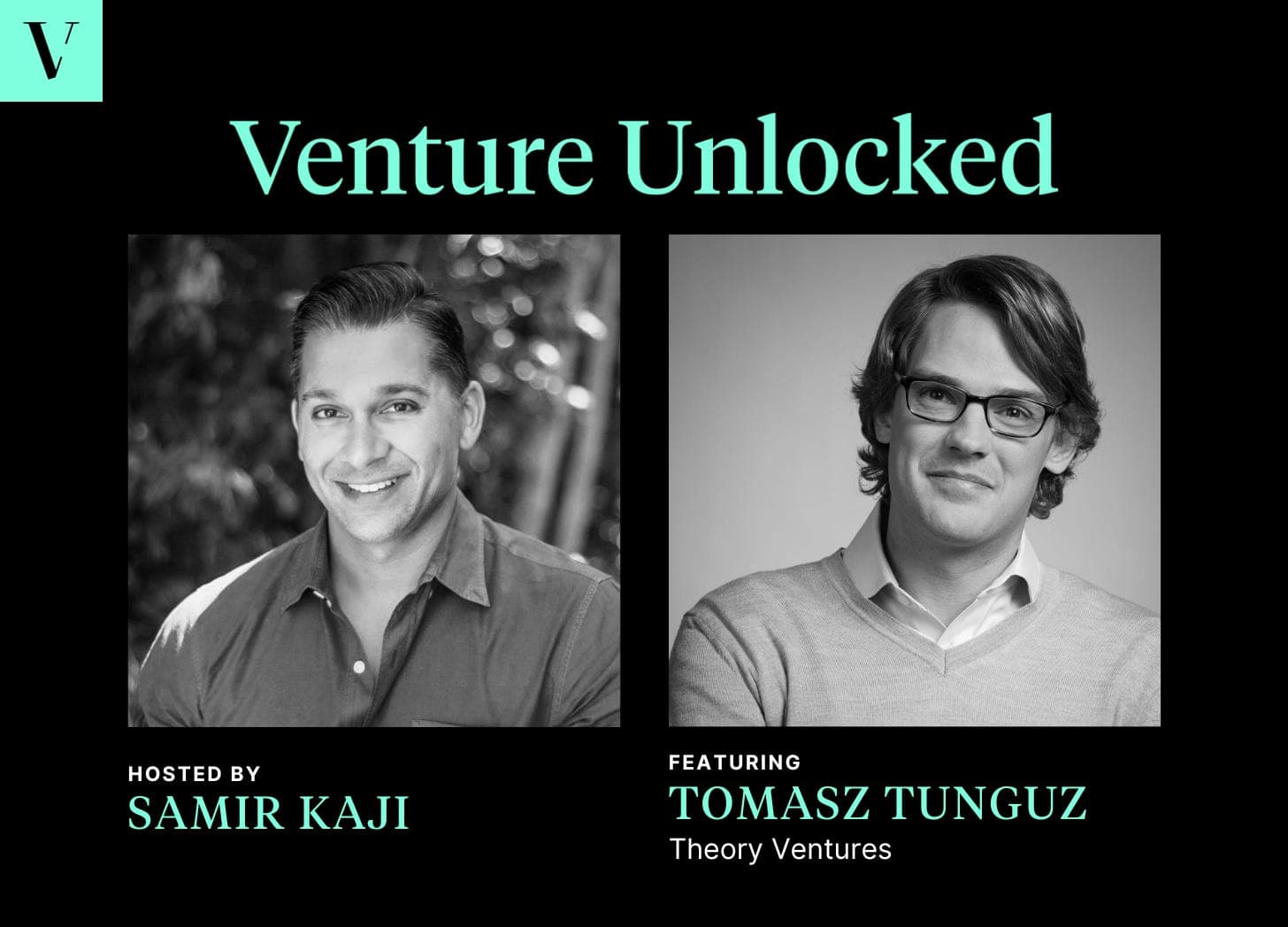
Tomasz Tunguz of Theory Ventures on Strategically Raising a Fund in a Downturn, Why Firms Need a Business Model, and Different Views on Portfolio Construction
Host
Samir Kaji
Guest
Tomasz Tunguz - Founder of Theory Ventures, previously managing director at Redpoint Ventures, with nearly 15 years of experience in venture capital.
Episode Overview
In this episode, Samir Kaji interviews Tomasz Tunguz, discussing various aspects of venture capital, including strategic funding during economic downturns, the necessity of having a business model in venture firms, and insights on portfolio construction.
Key Discussion Points
- Tomasz's Journey to Venture Capital
- Background: Transition from a product manager at Google to venture capitalist at Redpoint Ventures.
- Inspiration: Encounters with venture capitalists sparked interest, leading to a career in VC.
- The Formation of Theory Ventures
- Motivation for Change: Departure from Redpoint in 2022 to create Theory Ventures amidst shifting market dynamics.
- Fundraise Success: Successfully raised a $230 million fund in a challenging economic environment.
- Strategic Fundraising in a Downturn
- Market Conditions: The impact of market corrections on fundraising efforts and LP allocation strategies.
- Building Momentum: Strategies employed to maintain momentum during the fundraising process, including focused communication with potential investors.
- Business Models in Venture Capital
- Importance of Business Models: Discussion on how venture firms must adopt clear business models, particularly in a less liquid environment.
- Mathematical Approach: Using analytical methods and historical data to inform portfolio decisions and investment strategies.
- Portfolio Construction Ideas
- Focus vs. Breadth: Emphasis on a concentrated portfolio versus a broader index approach.
- Investment Philosophy: Fewer investments with higher ownership stakes to achieve desirable returns, which contrasts with traditional wider portfolio strategies.
- Qualitative vs. Quantitative Analysis
- Diligence Process: Balancing quantitative portfolio theory with qualitative assessments of founders and their capacity to lead successful companies.
- Key Qualities in Founders: Selling ability, unique vision, adaptability, and rule-breaking tendencies.
- Future of Venture Capital
- Market Evolution: Predictions for the next decade in venture capital, including potential consolidation and the emergence of non-traditional venture capitalists.
- Long-term Trends: Discussion on the sustainability of venture capital as an asset class and the significance of innovative technologies.
- Advice for Emerging Managers
- Continuous Learning: The importance of adapting and learning in the ever-changing landscape of venture capital.
Key Takeaways
- Business Model Necessity: Venture firms, like startups, need to focus on their business models during uncertain economic times.
- Concentration Strategy: Concentrating investments can yield higher returns, despite the risks associated with fewer portfolio companies.
- Qualitative Insight: Understanding the founders' vision and ability to pivot is crucial for investment success.
Conclusion
Tomasz Tunguz emphasizes that the landscape of venture capital is rapidly changing, and adapting to these changes through strategic thinking, strong business models, and focused investment strategies is vital for success in the coming years.
---
For further insights, follow Samir Kaji on Twitter [@samirkaji](https://twitter.com/Samirkaji) and explore more discussions on the evolving venture capital landscape at [Venture Unlocked](https://ventureunlocked.substack.com?utm_medium=podcast).
Written by AI. May contain mistakes. Listen to the episode to check what was said.
Transcript
Automatic transcript. May contain errors.0:00Welcome back to another episode of Venture Unlocked, the podcast that takes you behind the scenes of the business of venture capital. I'm your host, Samir Kaji, and on this week's show, we're excited to have Tamash Tungus, founder of the newly formed Theory Ventures. Before starting Theory, Tamash spent nearly 15 years at Redpoint Ventures, and earlier, he closed his made-in-fun at$230 million. For those that have followed Tamash's writing, you'll know that he's incredibly analytical and thoughtful in how he approaches all aspects of business. And this conversation was no different as we went deep into topics such as portfolio construction theory, business models and venture capital, and how to be strategic when raising a VC fund.
0:39I think you'll really enjoy this conversation, so let's get right into it.
0:47Samir Khadji is the CEO and co-founder of Allocate. Allocate and Venture Unlock are independent of each other. Any statements or references made by Samir or his guests regarding third parties, investments, or securities are solely their views and opinions and are not intended as investment advice or an endorsement of such parties or securities by Samir, his guests, or Allocate. Allocate or its clients may maintain relationships with or investment positions in guests, third parties, or securities mentioned in this podcast. This podcast is for informational purposes only and should not be relied upon as a basis for investment decisions.
1:22Hey, Tom, it's great to see you. Great to see you too. Thanks so much for inviting me to be on the show. Yeah, this is going to be a lot of fun. So I want to go back into kind of the early days. So going back to the inspiration of why you went on the investor side, you were at Google, you know, you spent a few years there. What inspired you to join Redpoint and go on the investing side of the house? I met a venture capitalist. So I'm not from California. And I remember I was at a party and I met a venture capitalist and I couldn't believe it was a job that people had. And I was so I fell in love with it.
1:52And I remember one day I was my wife and I were living in the Embarcadero and we were walking past a restaurant and there was a VC with a founder and they were shaking hands on a deal. And I had this dream. I was like, wow, I'd really like to do that one day. Wouldn't that be amazing? And then I had a wonderful opportunity. I was recruited by Redpoint out of Google, met a couple of other venture capitalists. Actually, when I was at Google, I was a part of this management rotation program. And as part of that, I got exposure to the board. And so I met a bunch of the venture capitalists on the board.
2:19Wow, this is incredible. when the opportunity came to join Redpoint, I jumped at it because it was a dream from that moment. Yeah, it's hard to believe it's been 15 years since you first started at Redpoint. And now kind of looking back, I'm sure you had so many different experiences and learning as an investor, but it also coincided with such a change in the industry. And also from a macroeconomic standpoint, both with the economy going up and to the right, but also the advent of course, mobile and cloud really driving technology to the level it is right now. But maybe you can go back and think about the things that might have informed what you wanted to build when you left Redpoint in 2022 to start Theory.
3:01I had a wonderful education at Redpoint, really an incredible group of people. The industry while I was there changed enormously. We went from as an asset class,$8 billion to$300 billion over the course of about 10 years. I really love reading the history of great financial firms and that evolution paralleled a lot of what happened in the private equity industry. So you had KKR that spun out, Bear Stearns, and there was a massive growth in the asset class as a result of the junk bond market and maybe QE. You could kind of call QE the junk bond equivalent for us in terms of just the access to liquidity and the formalization of the asset class.
3:38When I decided to start Theory, the idea was, well, the environment has changed radically. And for the first time in a very long time, venture capital firms need to think about their business model. The same thing happened with startups. When there's plentiful liquidity, you don't really need to think about your business model. And just to kind of contrast this, when I first started in venture, the very last slide on every pitch deck before the total amount raised was a P &L and a cash flow statement. And at the bottom, what you would do is you would sum up the cumulative burn and that would be roughly what the startup raised.
4:12That's how the financing amount came to be. But after we printed 30 % more dollars than there had been in existence, that changed. I mean, the last time I've seen it, I can't remember the last time I've seen a P &L or a cash flow statement on a pitch deck. And now it's the auction that governs how much money a startup raises, not sort of the fundamentals of the business. And venture capital has been the same thing where as the asset class grew and there was a lot of interest, the business model, we haven't needed to think about the business model of a venture firm in a very long time. But with the correction that we've seen now, I think, I believe we start, we need to think about it again.
4:49And just the way that founders are needing to be more disciplined around how much money they raise and what's the maximum return on invested capital on a per project basis, venture capitalists are going to be forced to do the same thing. And so the idea behind theory was to use math in order to figure out how, and analysis in order to figure out how to build a high multiple fund. How do you construct a very high multiple fund using math and probabilities, which are some of the disciplines from other areas of high finance that I've read about and have been practiced for a while. You talked a little bit about this.
5:22Venture did change a lot and you had this quantum of capital coming into the market and this whole concept of an auction where an entrepreneur would go out and get a number of bids and typically there was always somebody willing to write a check and it was just how much capital could you raise what was the valuation this also happened on the fund side too there was so much liquidity the low interest rate environment you had qe you had lps that were deploying capital and fund sizes were growing pretty significantly and if you look at particularly 2017 to 2021 That was really the peak of when we saw the greatest increases in fund sizes.
6:002020-21, about$300 billion raised by venture funds. And now we're in a different environment. You raised during a correction, which is 2022. Your first fund,$230 million, which is close. Congrats on getting that done. But you also raised at one of the toughest times. So raising as a solo GP in a market that had corrected. What gave you the inspiration, maybe the courage to go out during a very tough time where a lot of people could have just stayed with the existing firm they were with? You can never time markets, but I really believed in this idea that a superior business model could thrive. I think raising in a downturn tests, one, your mettle as a person, but two, tests the quality of your idea.
6:46Because if you can convince people, even when times are tough, then maybe there's something there. whereas if you're in a market where liquidity is sloshing around then there's less diligence to be done and sort of less scrutiny so if i could convince enough people to raise the fund then there's some merit to it right especially the most some of the most sophisticated investors in the asset class and you got the fund raised down fairly quickly so i think your last day at red point and maybe starting the fund was around late Q3, early Q4 of 2022, held a final close sometime Q1, early Q2 of this year.
7:26Talk to us about the fundraise itself. You're very analytical and I've always seen this through your writing. How much did you think about the fundraise in terms of intentionality around what type of LPs to go after? How did those first 30 to 60 days go? who are you really focusing on? Great question. So I really wanted to focus on institutional LPs because I want to build a long-term firm. And Barry Eggers at Lightspeed, actually, he wrote a post about the ideal construct of an LP base. There's a great LinkedIn post and he's been a great help to me along the way. And so, you know, the way that he thought about it, which I agreed with is it's about a third fund of funds, a third endowments and foundations, And then a third, other kinds of LPs and pension funds and so on.
8:15And so that was the mental model going in. The dynamic that I found when I launched the fundraise was that the stock market crash really caused a lot of LPs to have uncertainty around their asset allocation. And so some LPs, they might allocate 1 % to 2 % to venture. Some LPs might allocate 20 % to 25%. Some are as high as 40%. Fund to funds obviously are 100%. But when you are trying to maintain a portfolio and the public market is down 40 % and your private portfolio hasn't been marked to market yet, you might look 2x over allocated to an asset class when in reality, you're probably in line.
8:56And the other dynamic was that a lot of LPs paused new investments altogether just to understand other parts. I mean, I talked to 1LP and they said, we need four months in order to understand our real estate portfolio before we reallocate to venture because they're investing across asset classes. And so that was the market dynamic when I first kicked off the fundraise was people just trying to understand where they were. And even my pitch didn't matter because it was just much more about what our fund flows look like? What are our requirements in order to get cash flows out? What is our portfolio?
9:33We don't know what our portfolio looks like. We can't make new commits. Well, and this was the big thing. I mean, this has happened before where institutional investors are prone to being subject to the denominator effect, right? So your public portfolio and then your private marks haven't marked a market. The other situation I think is as interest rates rise, your opportunity costs for venture is higher because now you could put money in a three-month treasury and get over 5%. Private credit is yielding more. So sometimes it's not just being over allocated, but it's also people looking at rebalancing their portfolios based on where the rate environment is.
10:10You can't really control those things. You can only live with them. So how did you become successful? I mean, in the early days, so you mentioned fund of funds, of course, they're in the business of allocating capital. Many of them are looking at investing in first time funds, especially spin outs. But what really created the momentum? Was it getting one or two of these big institutionals to really drive? And then ultimately, maybe talk to us about the rest of the fundraise. How many LPs did you ultimately talk to? And what did you find from a pattern standpoint, once they got comfortable with investing in the asset category?
10:47There are a lot of parallels between raising a fund and raising a round for a startup. So the first is you have to have a really good story. Ideally, you have metrics and a track record to prove success. At the highest level, an LP is interested in three things, which is what is the strategy? What category are you in? Where do I put you in a box? The second is, have you had success in the past? And the third is, how will you win in the future? At the highest level, that's what they're interested in. I was fortunate enough to have relationships with institutional LPs and was able to close two anchors committed relatively quickly.
11:20And they provided lots of references on my behalf. And for that, I'm eternally grateful. And then the next part was creating a sense of timeline. What I learned in the process is a close date is completely arbitrary. I mean, completely. And the notion of like a first close and only close is also completely, it's sort of a vanity metric for VCs. One friend of mine, he has a very successful fund. He had 11 closes in his last fund. The second somebody decided to commit, he would just close them. And the reality is like, that's probably a really good way of running the process, but there's sort of this emotional construct of, oh, we were single close.
11:59That doesn't make any sense. It makes no sense. The only reason to have a single close is otherwise you're kind of in the ether and every LP will ask you, when are you closing? When are you closing? When are you closing? and you're trying to sort of shepherd this process along. And so you pick some date where you think you have a reasonable sense of confidence that you will hit that date and you drive the product. And so there was this remarkable dynamic when I announced that I was leaving Redpoint and it came to be that people knew that I was starting a firm. The number of other venture capitalists who reached out and helped me, I was bowled over by the support.
12:33And one of them said to me, you have to run it like a sales process where after three days after you've met an LP, you need to follow up and you need to ask them exactly what they need, what their questions are, how's it going internally, what can you supply them? And I took that advice. So I built a CRM and I ran everybody on a schedule. And anytime there was an update and there was a new commitment, I would email people and say, we're at X percent, now we're at Y percent. This is what's going on within the portfolio. This is what's going on with recruitment. And I took some of the strategies from the blog.
13:05The goal with a blog is just to be in people's inbox on a frequent basis so that I'm top of mind and to show a sense of urgency and progression. And so created effectively a content marketing campaign with LPs just to show them this is what's going on. And like any auction, the closer you get to the conclusion and the greater the scarcity that you're able to engender, the more interest there is. So you have this dynamic where it's like linear, linear, linear, linear, and then you're very, very close to the end. And now all of a sudden there's scarcity. There's just a lot more activity there and people start accelerating their processes.
13:41And so once there's this sense of inevitability, which exists, it's just a byproduct, I think, of human nature, then there's a lot more interest and people are willing to be more flexible. Let me ask you. So you did a single close, I think, right? So single close. When you first started, did you already communicate to people you were doing a single close? I mean, was this something that you were going to do a single close no matter what? Or was it a function of like, you got this momentum, momentum, momentum, and you knew it was inevitable and it just made sense to do a single close? Because I always feel like with single close, you say it, but if you don't actually have the momentum, then you're kind of stuck in between a rock and a hard place of, I want to get into business on one hand and just do a close to start investing versus like the scarcity.
14:28yes, a single close does drive a little bit of urgency from LPs who otherwise can just wait. My perception, as a data point of one, my perception is if you're at 75 to 80 % committed, and then you say there is a single close, that will drive urgency. If you're at 10 to 30 to 40 % committed, and you say there's a single close, it has no sting, no catalyzing power. It's meaningless because there's just so much road to hoe or dirt to hoe. When I went out, I would say, I would say something like people would ask, well, when are you closing? And I would say, we will close on this particular date. And ideally it will be a single close.
15:09And here is where I am. I've closed like X percent of the pipe line and the total value of the pipe of interested investors in order to sales qualified leads in the SaaS parlance was this amount of money. And so the goal was just to show with a relatively small conversion rate, I could get to a single close. The question was not whether or not I would get there, but the timing of the investment decisions on the investment committee is not like that. And it speaks to the authenticity of it. You know, we have seen people at 10%, we're gonna do a single close, you need to get in, the day comes, they're still at 10 or 20%.
15:42And then you actually lose a lot of credibility with prospective investors. And it makes the rest of the fundraise incredibly difficult. Speaking of difficult, fundraising always is difficult. You came from a firm where you weren't always just doing the fundraising. You were part of a broader team. Doing it on your own is very different. You are basically doing everything from portfolio, thesis construction, building the model, the business model, which we'll get into in a second, raising capital. And people are making a bet on you at the end of the day. tell us about some of the common objections people had not toward the macro but toward you and i can think of some that i can probably contemplate came up one is solo gp key man risk the second is you were at a big firm does that really carry over maybe talk to us about some of those common objections and how you overcame them there were people who passed out of hand we don't invest in solo GPs will save you the time and the trouble.
16:39Then I was advised by a handful of LPs that there should be very specific provisions within the LPA of if I should become incapacitated for whatever reason, you would need different things. That turned out, I think, to be less of an issue than I initially thought. I think most of the people who don't invest in solo GPs opted out even before. And so the remainder of the funnel was relatively healthy. There's not really a whole lot that you can do about that objection, unless you talk about the firm that you want to build and the processes that you have in place. And I think as long as, so there's some solo GPs who are very successful and it literally is a single person.
17:22And there are some solo GPs where they have a firm or other people that they plan to build. And in the fullness of time, there will be a bigger organization. So in the first case, the solo GP risk or the key person risk is intrinsic and permanent to that particular firm. And there are some where it's a transient risk. And so what I communicated was, in my case, it would be a transient risk in the fullness of time that there would be other people to manage the firm and we would promote and build a firm. So I think that has waged some. Some said, come back when you have a couple more investors involved in the group.
17:58The other major questions, one was around portfolio construction. So the portfolio construction that I've chosen for fund one is different than most other venture firms. And it's much more highly concentrated. Some very small number of LPs did not believe that was a good portfolio construction and they wanted a much broader index in order to hedge the risk. So some people opted out that didn't believe, one, we could get the ownerships that we were looking for that the model would work or they wanted to see some proof points associated with it. I think the last objection with the firm was really around fund size.
18:37So a lot of people said it's quite a lot of money for an individual person to raise on a single fund. And they just asked me why. And I think what they were trying to get at is venture capital as an asset class, the fund sizes have grown meaningfully. And so was this a first time fund that was a rocket booster in order to build a firm or was it sort of a short term money grab effectively, right? When you're a single person, it's very difficult to communicate authentically your ambitions around building a firm and the reason to have a particular fund size or a particular fee structure. And the more that I was able to show that I was recruiting people or that I had thought through the internal culture, the recruitment processes, who the core people were going to be, and sort of the long-term plans of the firm, the more that concern was dissuaged.
19:30You brought something up earlier around the concept of a venture firm has to have a business model. And one thing that a lot of us have heard is that your fund size is your business model. But maybe in the context of what you meant, what does it mean in your eyes when you say a venture firm has to have a business model? You have a certain number of investing slots within a fund. A venture firm needs to model what the failure rate is and what the multiples will be on the exits and what that ultimate multiple implies for the fund. And when I joined venture, I was really lucky to be attached to the hip of Jeff Yang.
20:08And Jeff had grown up in the venture industry, had a very particular view of the world. He was extremely sophisticated when it came to understanding the macro, which is something that we haven't had to understand in venture capital for a very long time because we've had a 12-year bull market. But now I think it matters. We've seen why. He had a very strong view around building a business model around a venture firm that inspired what we're doing in theory. But I think we haven't really done it, I think, as a business. And so one of the LPs, who's a close friend of mine, he sent me an Excel spreadsheet you know i asked him who have you seen that has done this well and he said it's very few but we have a spreadsheet that we fill out ourselves on diligence so when a firm comes in and they tell us they say we want this many seeds of of this much amount and we want this many a's they'll pop it in and then they've got some distribution for exits based on historical there you create a business model and you can say okay well i need one two billion dollar exit i need one one billion dollar exit and then everything else can return capital and i've achieve my target multiple.
21:14It's very much like a startup in that you're kind of putting an idea on paper. The reality may be quite different ultimately, but at least in your mind, you understand if I look at a business opportunity or an investment opportunity, it looks like this, is this within the model or is it without? You know, one of the companies I work with, the founder, she's incredible. She has this principle when she operates, which is she only, she wants 80 % of the bookings to be within the ideal customer profile. So 80 % of the business has to be our model. And I think about it very similarly with a venture firm, which is there's a financial product that we are structured to offer to founders that is right up the middle.
21:51And we want at least 80 to 90 % of the investments within the fund. Because if we do that, then we have the math on our side. We have the probabilities on our side. And there's fund math, which is irrefutable, right? So you have a$230 million fund. And if I'm just doing the rough back in the envelope math, to get to LPs typically would one is a 3x net or higher, which people throw that out. And I think people probably got a little bit spoiled over the last decade, decade and a half that this is easy. It's a really hard thing to get, particularly when you don't have companies that are reaching these billion dollar valuations.
22:26But at 230, let's say you have to have 800 million plus in liquidity flow back to fund, taking into account the carry, right? To get to 3x net to the limited partner. And the bigger the fund size, obviously, we have seen difficulty in getting to those top end returns. Smaller funds tend to have an easier path. How do you think about the 230 fund size in terms of optimizing, both in terms of, yes, you get the ownership that you need to really generate those returns, but also provide a financial product to the entrepreneurs that made sense in the arena that you wanted to play? If you look over the last 10 years, the biggest driving force in venture capital value creation has been multiple expansion, not revenue growth.
23:10So with the creation of 30 % more dollars, something like 60 to 70 % of the value that's created by venture capitalists has been multiple expansion. Historical forward multiples have been around five and a half times. Snowflake peaked in 21 at 57 times, right? So So you cannot, as a venture capitalist in this decade or the next 10 years, you cannot, I don't think you can predicate your business model on seeing additional multiple expansion anywhere near that scale. So if that's the case, then a business that's at 150 to 200 million of revenue is probably worth around one and a half to 2 billion.
23:4524 months ago, companies that were in single digit million ARR were valued at similar rates. With that fundamental change in the valuation environment, your business model has to reflect that. And so the idea behind theory was in order to be able to generate 3x net plus, we would need significant ownership in the companies that we back. And if we have significant ownership, then the total value of the exit does not have to be so great in order to drive the same multiple. And so we structured both the LP base and the portfolio construction to have that model. Obviously, with fewer companies, you do need to get the ownership to make sense.
24:23But how do you think about that from the context of the competitive landscape? Because the more ownership you're taking, the more likely you are competing with other firms. And we've seen so many firms, even some of the crossover firms go earlier and earlier and earlier, and even as early as seed sometimes, but certainly Series A. So when you're looking at, let's say, 10%, 15 % ownership at that Series A level, you're probably competing with some of the other big firms. How do you actually go about winning the type of deals that you want without having to pay a premium? Because if you pay a premium, that comes at the expense of ownership.
24:59The idea is we win with focus. And the reason we're called theory is because we really like to be thesis driven. So we'll spend a lot of time researching a particular space. and our goal is with that depth to understand the domain better sooner and if we can do that we can be half a step ahead the other part is with a relatively small fund the share of total venture capital exit dollars that we need to capture in order to generate a high multiple fund is small so there's a certain number of venture exit dollars each year and if you have and you know like a 50 billion dollar fund that doesn't exist but if you had a 50 billion dollar fund, you would probably need to have something like 30 to 50 % of all venture exit dollars in order to drive that kind of multiple.
Read the full transcript
25:44The idea behind the theory business model was to have, if we could command one, let's say 1 % of all venture exit dollars over the period that was relevant to us and still be able to drive a high multiple, that's enough to hit our number. What do you think is the number, you know, I mentioned the LP number of 3x net as being sort of the bogey that you should be thinking about from a venture, at least both historically as well as relative to other asset classes. Do you think that's a fair number? I think that number has to increase because your best alternative is now generating 5 % to 5.5 % on a risk-free basis.
26:22And if that's the case, then to justify higher fees and to justify 15-year liquidity, you need higher multiples. And as you said before, the funny thing about private equity, which is there's a study that shows private equity returns are scale-free. It doesn't matter the fund size. You can generate your multiple. It's not the case in venture capital. And so the combination of those two things led me to believe in the strategy where if I could build a position over time and have significant ownership in these businesses and not rely on multiple expansion and have a small fraction of the total exit dollars, we could get to a high multiple.
27:01We could achieve a high multiple fund. When you think about gathering 1 % of sort of the venture outcomes for a given year to get to that multiple, which, you know, if I'm thinking north of three, I'm thinking four or five X as, you know, what you're really looking to achieve. How do you then contrast that with maybe other folks that say, well, in order to get those outliers, you have to have enough surface area. And so at the earliest stages, is you really don't know what these companies are going to look like over time. And therefore, you can do your job in terms of having a thesis, having a point of view, but ultimately picking is very tough to understand who are going to be the outliers.
27:40How do you get comfortable with 12 to 15 companies when a lot of simulations would say 25 to 35 or even more companies at seed in series A is the optimal portfolio to get those outliers? I think at the end of the day, you're making a bet on yourself. and the team and the processes that you put in place. I think that's really, and the diligence and your depth in particular markets. You're right. I think there's another strategy, which is just breadth in a market. And this is not quite a one-to-one analogy, but you can think about like in the public markets, active investing versus passive investing.
28:15In other words, stock picking versus index investing or buying an index. And the way that the small funds need to succeed seed is through better picking. That has to be the strategy. Unless you're adopting like a seed state strategy where you're really, you've got a big blanket. And then the question is going back to the business model, how do you have the ownership, right? You're trading some risk, right? So if you've got a super concentrated strategy, you're accepting a higher degree of volatility and variance in ultimate returns. Because if you've got an amazing winner, then you'll have a very high multiple fund.
28:48And if for whatever reason you can't find, then you've got a very low multiple fund. And then if you have got a very broad portfolio, then you're minimizing the variance on that fund and trying to get to more consistency. And I chose the higher variance. Yeah. I was actually reading an article. I think it was penned back in 2017. I forget the author, but they were running a Monte Carlo on different portfolio sizes within funds. And they found that at 85 companies, you had over 90 % chance of getting a 2x, but a very low chance of getting anything above a 3x. And with smaller portfolio sizes, you know, let's call it 25, 20, maybe even 15 companies, there was much higher variance, both on the top and bottom, i.e.
29:40higher chance that you perform worse than the median, but a much higher chance of being in the top quartile and certainly even beyond that in the top decile. This is something that is debated. And I don't know that there's a single size that fits all, but there's a lot of interesting data around there in terms of supporting different ways to win within the world of venture, especially with small funds. There's lots of proof points, right? I mean, I think there are lots of sub-150, sub$200 million funds. And the multiples that they're able to generate with a single winner on those funds are stunning.
30:19They become legendary funds. The first benchmark fund would be an example of that. The IA vintages are incredible multiples, early bird out of Turkey. USB, lowercase, a number of firms that were able to do it. I really love that model. It speaks to me. Yeah. When you think about that, though, if I have a 40, let's say I'm a seed stage manager, series A manager, and I have 35 to 40 companies, probably not going to be able to spend as much time with these companies just because I'm going to be limited in bandwidth. But also, the opportunity cost of each individual investment is not as great as if I had 12 investments.
30:57And I need to make sure that the companies that I'm doing have a high chance of surviving and one or two still being the power outliers. You talked a little bit about picking and some people are say you can do a great job at picking and great VCs are actually great picking companies even at the Seed and Series A. And other people say, well, you really don't know because it's a bet on the founder, things are gonna iterate. What is your mental model of picking then and diligence in giving that you do have a higher opportunity cost every time you make an investment? Businesses evolve in unpredictable ways.
31:32the markets i've learned markets will change within the course of a couple of months i mean you look at the llm market the way that that and it's just like crypto two years ago you go to sleep in the world you wake up and the world has changed and so you have to know there are some market segments where if you invest in industrial gas supply software that market is unlikely to change over the course of a couple of years, whereas the LLM market will change three or four times entirely before 2023 is done. So I think that's an important consideration. The second thing is it's really critical to think a lot about bet sizing.
32:12There's this great book called Demand for All Markets, and it tells the story of a hedge fund investor in the 1960s and 70s who put up 20 % in that IR for more than 25 years, a guy named Edward Thorpe. And he was commercializing research that came from Claude Shannon, who was the creator of the modern computer, and then a guy named Kelly. What he did really well, and Druckenmiller talks a lot about this too, is you have to figure out how much you want to put given how much risk there is. And there's math behind it, right? So you can use a Kelly formula in order to do that. And And that's an input that we use in order to figure out exactly how much we ought to put into different companies.
32:54And so bet sizing is really important. You can take a lot of risk and have a lot of upside, but you have to make sure that the amount of capital is appropriate to that risk. Let's go a little bit deeper. You're primarily investing and entering in at the C or Series A, maybe a few opportunistic Series Bs. How do you think about both the risk at those different stages and then also the return outcome that you're looking for when you do invest? It's not even a function of like seed or a it's more, is this a formation company? Three people with a deck and a dog. Is this a company that has some material revenue?
33:32And then is this a company whose business model is working? And the question is just size, right? What is the outcome and, and how will they execute? So I think about it that way. And I think about creating different scenarios, probability weighted scenarios that lead to a composite outcome. And you have to track those businesses pretty well and then figure out how to reposition the portfolio as you go. And when I hear you talk, there's a lot of quantitative probabilistic models that you're building. And a lot of this goes into portfolio theory, but obviously at the early stage, there's also that qualitative sitting across from a founder, hearing their vision and making an assessment of, is this somebody that can actually create a large company, can iterate, can go through this learning journey.
34:20What do you look for from a qualitative standpoint when you're investing in a company, I guess, at the earliest stages? So maybe formation stage, three people in a garage. Yeah. The first thing I look for is an ability to sell. Founders are selling every day of their lives. They're selling when they're raising capital, when they're pitching prospects. They're selling when they talk to the press. So in literally every conversation of their lives, they're selling. so an ability to sell. The second thing that you're looking for in a person is a slightly different view of the world, a little bit of a different interpretation of how if things go their way, the world evolves in a slightly different way, which would then give them a product and a timing advantage, maybe a distribution advantage in the market of their own choosing.
35:04And then the last is maybe two things. One is an ability to learn really quickly. As markets change really fast, founders need to be able to reposition. and then the last is have they broken a rule along the way because if you're a founder you can't play by everyone else's games you'll lose you have to redefine the game you have to fight the guerrilla warfare idea the americans versus the the redcoats or choose your example but the idea is you have to kind of bend the rules maybe even break them in order to find an edge and you think about like Facebook and the way they, you know, terms of service that they bent or MySpace terms of service on top of Facebook and YouTube was the same thing or Google with the toolbar deal.
35:50I mean, you have to kind of, you have to find a distribution edge, a distribution angle that Uber makes people uncomfortable in the beginning or is not exactly the way that people have done it in the past. And thereby you give yourself an advantage in the market. I mean, a lot of things that are truly disruptive actually make a lot of people nervous along the way. And you have people that are always going to fight those things at the beginning. And Uber is probably a great example. But it even goes back beyond the Ubers. But you know, look at companies like Airbnb, same thing. Who would have ever thought that people would be willing to let strangers come into the house and stay and all of the risks that come with it.
36:29So you do have to break a little bit of glass on the way there. And I think that also applies for the venture industry to be, you know, we talk about being contrarian. But typically what happens is everyone gravitates to investing with a herd and doing what everyone else is doing. And we had somebody on the podcast recently, Oren Zeb, longtime investor that has his own authentic way of doing it, that most heuristics would suggest that we shouldn't do this. And this is not how it's usually done, but he's defined himself by being willing to take certain risk. And fortunately, I've been has been right over and over in terms of the type of companies and a little bit what you're doing.
37:10Right. So you have your own view of what is a good business model for yourself, raising a fund size, being a solo GP, having the portfolio construction. And yet you still have to when you do raise money, going back to our early part of the conversation, you still have to get people behind that vision, even though it might be contrary to their normal heuristics of making LP investments, where did they bucket you? I mean, there's so many different types of firms. You have the red points like the brand firms. Now we have the growth equity funds, seed funds. You have sector focused funds. Venture is just no longer this monolith that it used to be, but still people want to bucket things in little areas.
37:51How would you describe yourself within the venture industry? So I am a emerging manager in early stage software and infrastructure as a solo GP emerging manager in software. And do you feel people get that? I mean, people say, okay, that makes sense. Or are they putting you in the emerging bucket seed? Because I feel like people still want to drive people toward a certain area so they can do their own peer cohort analyses. That's right. I mean, it makes sense. If you're an LP and you're investing across lots of different asset classes, there will be a roll up across your entire portfolio. And it makes sense to categorize and be smart.
38:29It was unexpected to be called an emerging manager. And I think that label is more to do with how many vintages you manage or your AUM than experience. But there's an advantage also to be called an emerging manager because you're in your own special category. certain LPs of dedicated pools of capital for those groups. And there's also a kinship that arises from EMs, emerging managers, where, like I said before, I was really grateful for all the people who reached out to help and describe, I mean, helped me along the way of putting the theory together. Maybe we can zoom out for a second. Venture has changed so dramatically since 2009 when you started at Redpoint.
39:20Now there's so many different firms and we had all these economic tailwinds which now are no longer in place. What does the next decade of venture look like from your standpoint? We will have a view on crypto and whether or not it's sustained and whether or not, so the way I look at crypto and there are a couple of meaningful innovations, but one is it was a stock market to go public at much earlier stages, just the way that like Chinext is or there are other exchanges in the world. And so is that a thing? Is that an important avenue for liquidity for venture capitalists altogether for early stage businesses?
39:57That will be one. I think that the second thing that we'll really think through is how large is a steady state venture capital asset class? So 82 % of the dollars within the venture industry raised in the last two years are from non-traditional venture capitalists, corporate venture capital, crossover, hedge fund. How sustainable is that? And I wonder whether or not there will be a wave of consolidation in venture capital just the way there was a wave of consolidation in private equity. So in private equity, you started initially with leveraged buyouts, and then there were other financial products across like distressed credit or real estate or whatever it was.
40:33And then there were these acquisitions and mergers and eventual IPOs. I wonder how much of that will parallel the venture capital industry in the next 10 years. I think that'll be an important topic. When you say consolidation, do you mean all of these funds that have come to market over the last 10 years? Some people will join firms. They won't raise their own sort of independent firms. Maybe they partner together. Is that what you mean by consolidation? No doubt that will be the case. I wonder whether or not very large asset managers decide they need to offer a venture capital product to their investors.
41:07So could you see a Blackstone decide or KKR decide they need a venture capital arm just the way they have growth equity and they've got structured credit and real estate and all those kinds of products? And I think that's a potential path given how large venture capital as an asset class has become. It's just another product for those asset managers to offer. So I think there's a strategic questionnaire of whether that will happen. Yeah, it's going to be interesting. And on the other side, you may see some large venture managers go the way of Blackstone and be not only multi-product, but potentially have public offerings.
41:40It's something that we often think the next 10 years of VC, we're going to see as much change as we did the prior 10 years. It's just going to look very different. I completely agree. 15 years, Redpoint, Now Theory, you've been around a lot of companies. is maybe give us the single piece of advice that maybe you've learned along the way of venture, maybe just learned along the way as an investor that sticks with you the most and kind of informs your mental model. You really have to understand what it is that you're investing in at a very deep level. And it was one of my partners at Redpoint who really instilled that into me.
42:17He had this incredible technique of asking on the surface, very basic questions about a business. And, you know, there's this whole like Zen mind, beginner's mind idea where if I start by not knowing anything, I can peel back the onion. And he was able to get consistently to the root questions, the challenges that a business would face. And I think as I become old and gray as a venture capitalist, one of the hardest things to do is to forget the diligence that you've done in categories and how they change. Because what I realized is every five or 10 years category blossoms again it's sort of like um like a desert bloom where a space might might offer literally no opportunities and then all of a sudden there's there's a secular change that starts out very little and uh or very small and and then all of a sudden there are some incredible businesses look at machine learning right or the online marketing space i think even b2c as a whole over the last 10 years has been very quiet now all of a sudden you have these massive dislocations from just one significant technology change.
43:24And so having that open mind, I think is absolutely critical. I've learned that too. I mean, I've spoken to so many investors and also LPs and, you know, I always ask the question, what makes you tick? And the ones that have been really successful are always on this continuous learning journey and kind of realize that just because things were away in the past, doesn't mean that they're going to be like that in the future. And it's eliminating these biases that left unchecked over time can actually be a huge enemy of actually driving good investment decisions and returns. And, you know, as Doug Leone has always said things like, at Sequoia, we have done nothing tomorrow.
44:02And it's this constant thirst of how do we get better every single day? I love that. That's one of the great, wonderful things about Doug Leone. He's always looking to reinvent and challenge and reimagine. world. Which is hard to believe. Somebody that's that successful for that period of time. But Tom, this has been a lot of fun. I really appreciate you coming on the show. And again, congratulations on launching Theory. Excited to follow the path here. Thank you so much. It was a privilege. I appreciate it. Thanks so much for listening to another episode of Venture Unlocked. We really hope you enjoyed our conversation with Tomas.
44:37To learn more about him or Theory Ventures, be sure to go to VentureUnlocked.substack.com for detailed notes on the show as well as my ongoing commentary and analysis about the world of venture capital. Venture Unlocked is also available on iTunes or Spotify for download and while you're there please leave us a rating and a review as it really helps us out. And don't forget to hit the subscribe button in order to get each and every Venture Unlocked episode as soon as it's released.
45:11Thank you.
From the publisher
Follow me @samirkaji for my thoughts on the venture market, with a focus on the continued evolution of the VC landscape.
On this week’s show we’re excited to have Tomasz Tunguz, Founder of newly formed Theory Ventures. Tomasz spent nearly 15 years at Redpoint Ventures, before recently spinning out to start Theory Ventures. Earlier this year, Theory closed a $230MM fund to back early stage entrepreneurs.
Those who have followed Tomasz’s writing, know that he is incredibly analytical and thoughtful in his approach to business. This conversation was no different as we went deep into topics such as portfolio construction theory, business models in VC, and how to be strategic in raising a VC fund.
About Tomas Tunguz:Tomasz Tunguz is a Founder and Managing Director at Theory Ventures. He is an active blogger at tomtunguz.com and is co-author of Winning with Data which explores the cultural changes big data brings to business and shows you how to adapt your organization to leverage data to maximum effect.Before founding Theory, Tomasz was Managing Director at Redpoint Ventures, where he backed many early-stage SaaS, data, and infrastructure founders in his 14-year tenure. He began his career as the product manager for Google’s AdSense social-media products and AdSense internationalization.Tomasz attended Dartmouth College and graduated with a BA in mechanical engineering, a BE in machine learning, and a master’s degree in engineering management.
In this episode we discuss:
(01:42) Why Tomasz joined Redpoint(03:01) The decision to start Theory Ventures (06:32) Raising his first fund during one of the most difficult raise environments in recent history(07:45) What his plan was with the raise(10:47) How Tomasz created and sustained momentum during his raise(16:12) Common objections from LPs and how he overcame them(19:49) What it means for a venture firm to have a business model(23:00) How Theory’s thesis addresses the problem of multiples in the venture market(24:59) Winning deals without paying premiums(26:13) Why the 3x net returns on venture needs to increase to be competitive(27:40) Getting comfortable with a smaller portfolio(31:29) Tomasz’s mental model of picking and diligence with a smaller portfolio(34:30) Qualitative signs he looks for in founders and companies(38:19) Why Tomasz embraces the emerging manager label(39:30) What the next decade of venture looks like(42:07) The best career advice he’s received
I’d love to know what you took away from this conversation with Tomasz. Follow me @SamirKaji and give me your insights and questions with the hashtag #ventureunlocked. If you’d like to be considered as a guest or have someone you’d like to hear from (GP or LP), drop me a direct message on Twitter.
Podcast Production support provided by Agent Bee
This is a public episode. If you would like to discuss this with other subscribers or get access to bonus episodes, visit ventureunlocked.substack.com