In short
Podcast Summary: Venture Unlocked - Episode with Tomasz Tunguz
Episode Details
- Title: Tomasz Tunguz on where we are in the AI S-Curve and the Evolving Investment Landscape
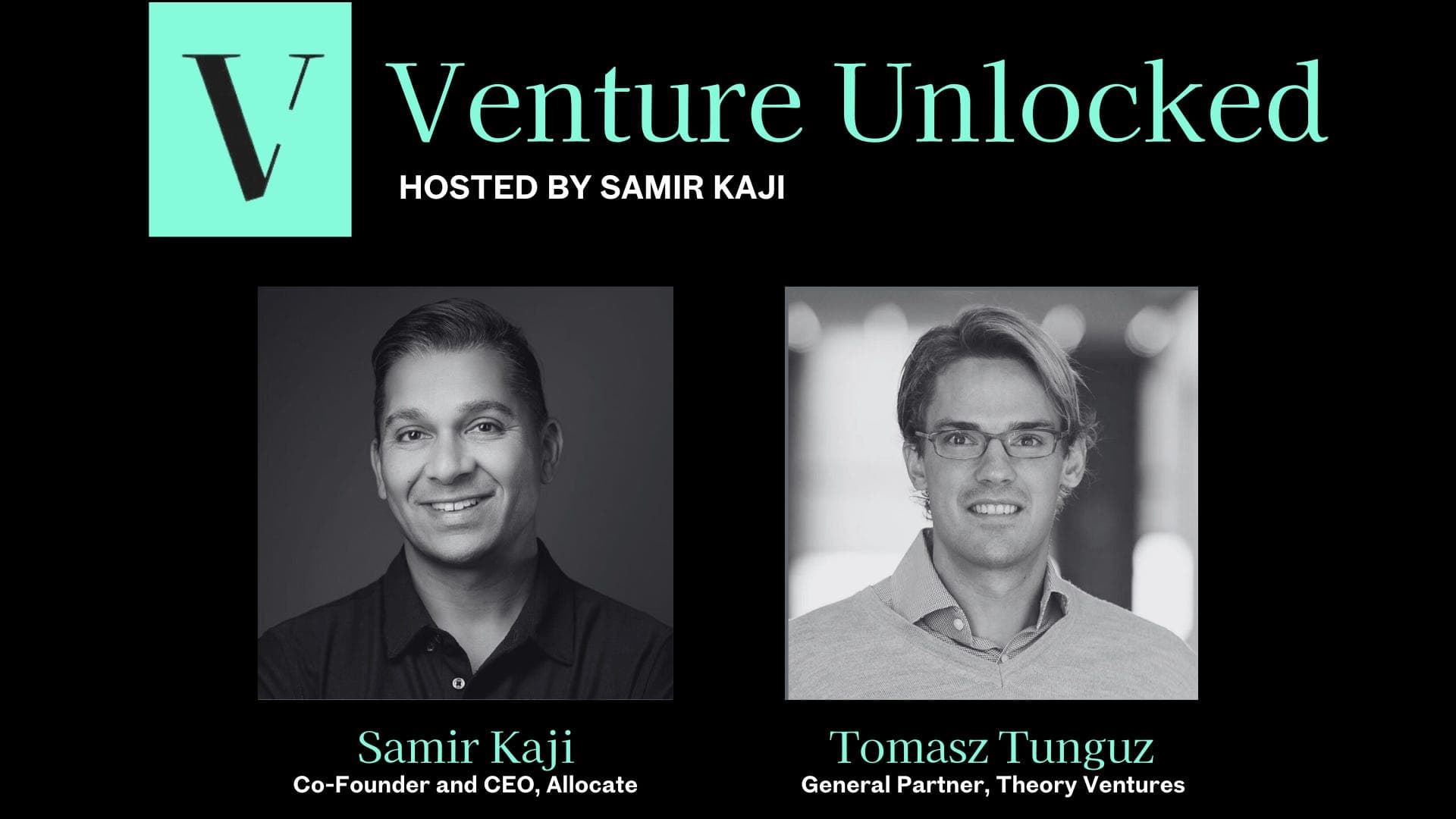
- Host: Samir Kaji
- Guest: Tomasz Tunguz, Founder and General Partner at Theory Ventures
- Duration: [Specify duration if available]
- Release Date: [Specify release date if available]
Podcast Description In this episode, Samir Kaji speaks with Tomasz Tunguz to discuss the transformative impact of artificial intelligence (AI) on venture capital, startups, and everyday life. They delve into various aspects of AI, including the declining costs of training models, the open vs. closed-source debate, and how enterprises are adapting AI technologies.
Key Concepts and Discussions
- AI’s Impact
- Significant Changes: AI is reshaping various industries and the nature of work.
- DeepSeq Announcement: The announcement of DeepSeq illustrates the rapid advancements in AI models and their implications for market dynamics.
- Cost Reduction in AI Training
- Training Costs: Initial training costs for AI models have decreased significantly, with DeepSeq initially estimating $6 million, which was later clarified to reflect a cost reduction.
- Advancements in Reasoning: Recent breakthroughs in AI include models that utilize reasoning and can explain their thought processes, enhancing their effectiveness.
- Open Source vs. Closed Source AI
- Market Dynamics: The shift towards open-source AI models is juxtaposed with existing closed-source models, leading to implications for pricing and access.
- Adoption by Enterprises: Companies might prefer closed-source models for cutting-edge technology while exploring open-source for specific use cases and customization.
- Defensibility of AI Applications
- Workflow Innovation: Successful AI companies focus on redefined workflows that align with how AI enhances productivity rather than merely on the technology itself.
- Importance of Distribution: Building a strong brand and distribution strategy is crucial for AI companies, paralleling past software successes.
- The Evolution of the Labor Market
- Job Replacement vs. Job Creation: AI is predicted to replace unappealing jobs while creating new roles and responsibilities that demand human ingenuity.
- Resilience of the Workforce: Historical context suggests that society adapts, and new forms of employment emerge with technological advancements.
- Perspectives on AGI (Artificial General Intelligence)
- S-Curve Analysis: The podcast discusses the current phase in AI development, suggesting we are entering the fourth inning of a metaphorical baseball game regarding AI evolution.
- Potential Timeline for AGI: Predictions about reaching AGI are fluid and depend on ongoing advancements in AI reasoning and capabilities.
- Concerns and Hopes for AI
- Overregulation Risks: There are concerns about premature regulation stifling innovation in AI.
- Opportunities for Creativity: The host expresses excitement about the potential for AI to enhance creativity and access to knowledge globally.
Conclusion The conversation with Tomasz Tunguz provides a comprehensive look at the current state and future of AI, its implications for venture capital, and the broader market. The episode highlights the transformative nature of AI while balancing excitement for innovation with caution regarding its societal impacts.
Timestamps of Key Discussions
- AI's Impact: 1:18
- Cost Reduction in AI Training: 2:18
- Impact of DeepSeek on Market Dynamics: 5:01
- Open Source vs. Closed Source AI: 10:57
- Enterprise Decision-Making in AI: 13:19
- Defensibility of AI Applications: 17:27
- Efficiency in Growing Companies: 21:01
- The Path to AGI: 25:46
- Impact of AI on Labor Market: 28:58
- Excitement and Concerns About AI: 30:55
- Non-Consensus Views on AI and Final Thoughts: 33:29
Further Engagement Listeners are encouraged to share their insights and questions via social media using the hashtag #ventureunlocked. To stay updated on future episodes, subscribe to the [Venture Unlocked](https://ventureunlocked.substack.com) newsletter.
---
These notes comprehensively summarize the discussions and insights presented in the episode while maintaining a structured format for easy navigation.
Written by AI. May contain mistakes. Listen to the episode to check what was said.
Transcript
Automatic transcript. May contain errors.0:08Thanks for tuning in for another episode of Venture Unlocked. This week, we're joined again by Tamash Tungas, founder and general partner of Theory Ventures, which recently closed a$450 million second fund to invest in early-stage startups around the themes of blockchain, data architecture, and artificial intelligence. We asked him to join again to get his views on where we are in the curve of AI and what we should expect in the years ahead. We covered a lot in a very short amount of time, and I hope you enjoy. Samir Khadji is the CEO and co-founder of Allocate. Allocate and Venture Unlocked are independent of each other.
0:43Any statements or references made by Samir or his guests regarding third-party investments or securities are solely their views and opinions and are not intended as investment advice or an endorsement of such parties or securities by Samir, his guests, or Allocate. Allocate or its clients may maintain relationships with or investment positions in guests, third parties, or securities mentioned in this podcast. This podcast is for informational purposes only and should not be relied upon as a basis for investment decisions. Tom, it's great to see you. Thanks for having me back on the show, Samir.
1:18Well, it's been a while, and I'm excited to talk about the thing that we are all thinking about, and that's the impact of artificial intelligence on our everyday lives, and as an extension into things like how does it affect venture, how does it affect startups that are building. Before we get into that, maybe a good natural place to start is thinking about a more recent event that we saw just several weeks ago, and that was the announcement of DeepSeq. And of course, past that, there was a lot of reaction. NVIDIA dropped about$600 billion in a single day, which was the largest drop of a public company market cap in a single day.
1:57and now that we've you know had a few weeks to really think about it maybe you could start off with what mattered from the announcement and what are the things that were probably over-rotated or over-reacted to yeah i mean i think the the big thing was just the reduction in cost right i think the initially deep seek said it cost six million dollars to train i think we've figured out that's probably not exactly the right number it's probably six million for the final run and a comparable number for other models in the US, probably 10-ish, let's say. So there is a pretty, at least we're comparable there.
2:33Overall, though, there were a couple of big innovations that came out. The first is reasoning, chain of thought reasoning. So this was the first model where if you asked it a question, it would explain to you how it thinks. It would say, I asked it to create a flow chart based on an academic paper. And there was a fork in that chart and was asking itself, do I create one chart or two charts? The user asked for one chart, but there's two experiments within this paper. And so that narration that was one pretty meaningful innovation that I think we'll see in these models. The second major innovation is that the cost of reasoning has plummeted.
3:05So the first iteration of the transformer model, really great word prediction systems, I'm simplifying here. And that's great to get to a certain level of intelligence, but it's not insufficient to get to, let's say, a human level of intelligence. The second part is what's called reasoning. So if an AI hasn't seen a problem before and it's trained just in the first kind of intelligence, it won't be able to solve that problem very well. If it has reasoning, which is a way of exploring, let's say, or being creative or thinking about different ways to solve a problem, it'll be much more effective.
3:38And we had thought that reasoning would take a while. I can't even like entering 2025, we thought we were probably nine, 12, 18 months away from having pretty sophisticated reasoning models. And we'd seen it in some of the most recent open AI models and they were massive and expensive. And here with DeepSeq, now we have really cheap ones and they work really well. And they're two key innovations. The first is a computer taught a computer to do that, not a human. And then the second is since then, and over the weekend, a Stanford researcher released a paper saying, I don't need 800 ,000 examples to teach a computer to reason.
4:14I only need a thousand. And so now the cost for reasoning is continuing to plummet. So I think it's just really accelerated reasoning, and you're seeing massive deflation in reasoning costs. So you talked a little bit about some of maybe the things that came to the surface from engineering and sort of the reduction of things like inference costs and making it more accessible at the end of the day. The other thing that we'll touch on is the fact that it was an open source project versus what we've seen with the large language models being closed. And, you know, if you look at sort of the big ones, you know, XAI with Grok, OpenAI, and then of course Anthropic with Clot, the three of them, including the more recent rounds that have been announced are pending, you know, about almost$400 billion plus.
5:01In fact, it's over$400 billion in total market cap. What is the impact of the findings from DeepSeq on these LLMs? And generally speaking, is it a bearish sort of view that you have on these closed LLMs? Or does this actually make things cheaper and therefore more people will use those enterprise APIs? I think it's mixed. And we don't know the degree to which the positive or the negative impact will be felt. I mean, reduction in inference will massively increase. So I think massively increased consumption. We've seen about 1 ,000x reduction in inference costs over the last two years. we'll probably see another thousand x so you're talking about a million x reduction in inference costs to have the same level of revenue that we see today obviously you would need a million x increase in inference i don't know i mean we have tried to size it i think we'll probably see like a trillion x increase in inference and so maybe there's like a hundred to a thousand x increase in overall inference and say the next two years so jevin's paradox i think is in full force here just the way that we keep adding data to databases or we keep storing more files or the photos that we take become increasingly higher quality.
6:14Inferences are not decreasing anytime soon. And that's a good thing for these model companies. I think there's a bigger strategic question over the longer term, which is it might take$100 million or$200 million to create a foundation level big model. And the time during which I can monetize that model at a premium is measured in weeks, right? I think it's, we published some research where it's somewhere between 40 days to 100 days where a model, when it's released, is state of the art. And the difference between a state of the art model and a non-state of the art model, to your point earlier, Samir, about open source models, is about 100 to a 500X difference in pricing.
6:58So the window is really narrow. So if you're one of those companies, there's one of two responses. The first is state-of-the-art models no longer available via API because DeepSeek, allegedly, we don't know, but basically use the OpenAI API to create a lot of examples and then train the model. And so that's a form of learning that's called distillation. Right. So, you know, you're an expert in a particular field. I ask you a bunch of questions. I get 80 % of your knowledge in an hour. But same idea for computers. The other technique to capture value is to move more into the application layer and say, okay, now we're going to start automating computers, robotic process automation, and we'll continue to innovate on the core models.
7:40But it's clear that our capacity or capability to capture margin within those core models is limited because of the competitive dynamics and the rapid pace of innovation. And so instead, we'll start building applications. I do think, you know, one of the things that we've been talking about is, especially with buyers, the pace of innovation with AI is so fast that it's very difficult for enterprises to keep up. I was chatting with someone yesterday who said, I can't deploy an app because the model changes every three months and then half of it doesn't work anymore. And so I think maybe we'll see a slower pace of innovation as a result of this because enterprises, particularly on the API, want things to remain a bit more stable.
8:21But it's not likely given that every day we wake up and read a new academic paper about some new technique. Yeah, and there's lots to unpack there. And I want to take things, you know, at the atomic level. The first one is this concept of Jevons Paradox, which we've seen in the past with energy or I'm sorry, fuel efficient cars we've seen with coal. And maybe you can go into how that applies to AI for those that are not familiar with, you know, what does it what happens when, you know, this resource becomes. so much cheaper, does it actually reduce demand for compute? Yeah. So, I mean, so Jevin's paradox, the idea is as something decreases in price, particularly the technology, the amount of consumption goes through the roof, right?
9:03So let's take hard drives, right? My first computer was a Mac 2. It adds like 64 KB of RAM. And my computer now that I'm talking to you from is 96 gigs, right? So we're talking like six orders of magnitude difference. And we're just going to continue to use more and more RAM. The same ideas for open AI, and open AI has really talked a lot about this, but as it costs less and less, maybe on every keystroke, there are three machine learning models that are being triggered. And today it's so expensive that there's not even one. And so then there's a huge explosion, like, my phone might be listening to me literally all day long and trying to capture what I do, and then trying to predict the next thing.
9:41Well, that's really expensive today. But if the cost of inference falls a million times, then literally everything that I do at work might be part of an inference or six. And we will see that. I think we have very high degree of confidence that we will see a massive increase in overall inference because once you get used to a computer predicting what you want to do, you don't want to go back to a computer that doesn't. Right. So some of the cost prohibitiveness is going away and that makes it more accessible. Therefore, more people will be using it. Therefore, the demand actually goes up, which may be counterintuitive to some folks at the beginning, therefore kind of the Jevin's paradox.
10:20But then, you know, the other thing that you mentioned is, you know, putting aside closed models for a second, this concept of open source, which has been around for a long time. We've seen that. And, you know, in the case of DeepSeq R1, it was just very clear that some of the techniques they use were actually really interesting in terms of reducing cost to a level. Now people can actually even bring some of those things on-prem. And so maybe give me your sort of view on like open source versus closed source. I hear a lot of different opinions. You know, some people are like open source really is the future of artificial intelligence and how consumers and enterprises in particular will be able to lever artificial intelligence.
10:57Others say, well, probably not. That's not a reasonable way an enterprise would go about it. They still want the support that a closed model can bring. Maybe give us your perspective on how do you see this and what are you hearing in the market? I think there'll be a place for both. So today with standard software, Snowflake, a big cloud data warehouse, it's closed source. Lots of people use it. It's a big publicly traded$50 billion company. And then you have open source databases like Mongo, which is also roughly similar in size. Two different kinds of databases. One is open source. One is closed source.
11:33The advantage to open source is that you understand exactly what's going on inside. So DeepSea, the initial concerns around the deployment of DeepSea, Chinese model, what is it sending back to China? Is the CCP reading everything that we say? And that turned out not to be the case, but there was a filter that if you asked it, the three T's and the F, right, Tiananmen Square and et cetera, all those sensitive topics would not reply. But within six hours, somebody had removed that filter and anyone could deploy a generic, let's call it, deep seek model. So that's the advantage of open source models is you understand exactly what's going on inside the model, you can take it, you can customize it to your needs, a process that we call fine tuning or post training.
12:17And then you can decide like, okay, I really care about video transcription. I'll take an open source model, customize it on the YouTube videos that I want, drive pretty significant performance benefits because I really only care about medical terms in my videos, cut everything else out. Now the model is a lot less expensive. And I've actually developed some IP, which could be important to my enterprise value. And many enterprises think about it that way. They want to create, they've spent billions or whatever, as a category, hundreds of billions on big data and the storage of data. Now people want to see some value.
12:51One avenue to do that is to create these intellectual property products on top of AI using open source. And just kind of go back, because as you kind of look at the open source or it's closed source, I think there's pros and cons of each one. Maybe you can also, as you go through the narrative on this is how would an enterprise decide? What is that decision matrix look like? You mentioned that there's a place for both, but in what place is the right application? I think many companies will start on closed source just to experiment. It's just really easy to call a really great model via API, provided the security is there.
13:30That was a concern for the last 12 months now that's resolved. And then some companies will stay on the closed source models to be literally on the cutting edge. Like the closed source models tend to be the ones that are always the best and the most expensive, but you're on the cutting edge. And so if that's what you want and you want to take advantage of OpenAI cut costs 50 % on one of their models, Google is giving away one of their flash models for free, you have the benefit of these big price cuts. If, on the other hand, you say, we're operating on extremely sensitive data, or we want to create our own intellectual property on our data, we will very likely use closed source.
14:09Sorry, open source. The other reason to use open source is, let's say I want to deploy a model on your phone. Then I'll use an open source model. Right. Right. Right. And that's the ability to, because the reduce sort of costs, now you can have it on premise versus on something like, you know, I'm holding here an iPhone without, you know, the traditional way of having to do it on the cloud. So maybe talk a little bit about just where you're seeing things, forgetting about the foundational models that we've just talked about, but how are enterprises using it at the app layer? So there's so many different verticals, be it healthcare, financial services, so on and so forth that are going to be levering, some type of reasoning model, what are you seeing as sort of the trendline of AI app companies that are truly differentiated?
14:55What are sort of the ingredients? Because I know you're investing at the early stages of many of these companies. Yeah, so Anthropic just released a paper. Half of all AI use is code generation or modification and text generation or summarization. That's what they're seeing at a high level. And within each, I mean, which are the areas that we've seen legal has been caught, You have accounting that's been really hot. You have code generation or migrating code from one version to another. Amazon saved like two and a quarter of a billion dollars using AI to do that. So those are three, like at the highest level, those are the ones where there's the most activity.
15:35We are looking for applications of AI in two categories. The first is AI does work that a human cannot, primarily because of scale. So in the marketing world, let's say we were building a new soda company. We might target five different segments and have different marketing messages for those five different segments. Young parents, children, et cetera. An AI can create a million segments, but a human cannot. So we've invested in a marketing company called AMP that creates a million segments. The other category we're looking for AI is where there are shortages in the labor market. You have three things.
16:14Toil, really unappealing work. Nobody wants to do it. Labor market shortage because nobody wants to do it. Nobody stays in the job. And a hiring manager who's desperate. And at the convergence of those three factors, you have someone who's willing to accept 70 % to 80 % accuracy, which is state-of-the-art for some of these more complex workflows. And so we've invested in a company called Dropzone that automates security analysis. You have lots of different security products. Each one spits out An alert, average enterprise receives 8 ,000 per day. I can tell you it's a boring job for most people.
16:44Some people might get a kick out of it. But a machine is much better suited to reading all of those alerts and figuring out are they important or not. Yeah. Really interesting sort of applications. I think one of the concerns, at least early on sort of the AI wave, is you had a lot of these companies basically acting as wrappers on the big LLMs. And one of the questions is, what is defensibility for these companies? It's not uncommon now to see some of these AI app companies go from zero to a million dollars in AR within months, sometimes even zero to two million. And we've seen companies like Glean get to 100 million really quickly.
17:19What in your mind makes a company truly defensible in the world of creating an AI app? I think it's workflows. It's not the technology. And this parallels to the previous wave of SaaS. there's nothing technically different from Salesforce and an upstart CRM. There's not. They're all just databases with web pages on top. And within the world of AI, I think there's an opportunity to reinvent those workflows because now all of a sudden the work has changed. A salesperson can manage many more leads. A marketing person can produce much more content. A lawyer can review many more contracts. And so the workflows themselves have changed.
18:00So the defensibility comes from identifying which of those workflows have changed and building the software that does that. And then the second part is the distribution. So I think, you know, you read like Mark Benioff's book about the way that he really built Salesforce is about building a brand and building distribution. We think about the very successful companies, the last of the previous generation, many of them had big brands and they're memorable. They're iconic or Slack, for example, everybody remembers Slack when it first came out. Reality is like Slack underneath the hood, internet relay chat.
18:29That technology has been around for 30 years. So the technology itself is not novel. It's the workflow and then the ability to create a brand. How do you think about some of these companies? Because some of the companies do have immediate sort of adoption, right? Like these companies that go from zero to two. And maybe this is incorrect, is that many of those companies, you have a lot of people that are early adopters just trying different things. And they're going to turn off really quickly. So maybe from an investing standpoint, assuming you agree with that, maybe you don't. But if you do agree with that, how do you think about what actually is a company that actually has long-term prospects versus coming out of the gate really fast, having those early doctors who are going to turn out in six months?
19:17It's hard. So I think this is what makes this environment so hard. So let's say in the previous generation, top-test-out growth was one to four. and you were probably looking at a company at the series A or the series B, either at one or at four. In both cases, you had data about how customers behaved for a year. Today, whenever you have an AI company, zero to four million in six months, and you're forced to invest at a much higher, well, you're asked to invest. You might have the opportunity to invest at a much higher valuation without that longitudinal data. So how do you understand, will customers expand?
19:51Are they using it? Will buyer preferences change? Which happened a lot last year. We had companies that grew extremely quickly and then underlying technology changed or prior preferences changed. The durability of the revenue was a major challenge. I think today it's less the case that people's preferences are changing rapidly, although the architectures are still changing really quickly. And you are doing everything you can to understand the competitive dynamics, use the products, talk to buyers about the products and really understand what their long-term plans are. because today, if you're a, I'll make an example of it.
20:28Today, if you're a data leader, you really want to work on Databricks because you want Databricks on your resume to get the next gig. And so what you want to hear from customers is, are you building on top of this AI product? What, how do you think about how this will burnish your resume? Because whenever you make a software purchasing decision, you're betting that you'll be promoted, right? That's one of the things we think about. selling software means selling promotions. And if someone is really believing that they can build on it, then it'll be around for at least two or three years. And then the durability revenue is there.
21:01So then you look at some of these companies that are growing really quickly, they're actually creating a lot of efficiencies for enterprises that are using them. You have to have less people. And right now the venture market, and maybe just zooming out for a second, is much, much bigger in magnitude than it was 10 years ago. You see, I think there was this graphic that the top 30 firms have raised like 75 % of capital or raised 75 % of capital in 2024. And that means a lot of money has to go to work. What is the implication of cash efficient models for startups that can now lever AI without having to hire so many people to do things, whether it's coding, whether it's sales and marketing, whether it's client support?
21:43Or does this break the venture model in your mind? Or how does this evolve over time? I think it's really exciting for the venture model. I mean, there are some businesses that are super capital intensive, right? We talked about the foundation model companies. They will always be capital intensive. Robotics would be another category where there's a lot of investment with significant capital intensity. And then you have at the application layer, some companies are generating material revenues without burning very much at all. the reality is like the return on equity on the second one is obviously much better at some point all of these companies need to sell software and sales is trust right as we know the way that we sell between humans is we develop trust somehow right there's samir is very well regarded within the world of venture capital and so that reputation means something he's able to build trust with other people create a great business that part is not yet automated i do think the, if we think about like the ratios of spending on engineering compared to spending on sales, those ratios will change a lot.
22:44But the reality is like the cost to sell software has increased monotonically over the last five years, 60 % more expensive than it was five years ago. And I don't think that's changing anytime soon. So there will still be significant need for venture dollars on branding, selling, and also software engineering, but the ratios will change. Yeah, and we're still fairly early. I mean, while AI has been around in the current construct of how we can access it, use it, it's still fairly new. And you think about going from co-pilots to agents to eventually true AGI. Where are we in this S-curve? I mean, if you were to kind of sit back and say, are we in the first inning, second inning?
23:22And what do you think are the main things that are going to mark the next, let's say, 12 months? Yeah, so I think let's break it into thirds, just the way that you said, right? So there's the first wave of AI. I think we've completed those three innings. And they're now sort of entering the fourth inning with initial reasoning to trying to figure out how these models work. And a big part of reasoning is chaining these AIs together and making sure they don't make a mistake. Like a brand new intern might go in the wrong direction if you let them work for too long, they end up in left field. So I think that's probably the nature of the second sort of third of the baseball game.
24:01And the third, and that'll probably characterize the next 24 to 36 months, I guess. The third is we don't really understand what's going on inside of these machine learning models. It's kind of like the human brain in that there are neurons. And when I speak, some of these neurons fire. And we're trying to understand in the human brain which neurons fire and how to, you know, if you have a speech impediment, how to fix that. A very similar dynamic within these models where we're trying to understand which of the neurons within the models are firing. What do they mean? How do we translate these six neurons firing into something a human can understand?
24:36And then we'll get to a place where once we do that, then we can program directly those neurons. So just the way that like somebody touches my brain in the right place, my right arm will shoot up. Well, you can do that to a machine learning model too. But it's taken us a really long time in neuroscience to be able to do that. It'll take us a long time to be able to do that with AI. But at that point, I think we'll have, you know, our definition of AGI is computers teaching computers how to learn and improve consistently. And once you get to this, it's called neural programming. Once you get to that level of neural programming, where one AI can look at another AI, understand its mechanics, and then figure out what that student model needs to do and help it improve, well, that's probably a very plausible place to say we have AGI.
25:21Taking the analogy a little bit further. So you mentioned kind of the first third of the baseball game. So that gets us through the first three innings. We're now entering in inning four, five, and six, which likely will be more agentic in nature, you know, years 2025, 26. Are you saying that we'll get to AGI or is it your belief that we get to AGI by, true AGI by 2028? It's all research, right? So nobody knows, right? And so I would have said like at the end of last year, there's no way we get to large scale reasoning in 25. And here we are with like a model that's 3 billion parameters, not 600 billion parameters reasoning.
26:01So I don't think it's a little like drug discovery would be another analogy here where a lot of capital intensity, there's a lot of research to be done. And we're making, I think, and we saw in the data late last summer that we were sort of starting to hit another inflection point with reasoning. I don't know when that third of the baseball game comes around. It's really hard to predict. Yeah, so then obviously that, you know, we're doing our best in prognosticating something that's very difficult given sort of the fluidity of this. But one thing you have to do as an investor and all investors have to do it is, you know, in one hand, look at what's happening right now to be able to invest in companies, but also with the eye of what might happen four or five years from now in terms of where things might go.
Read the full transcript
26:44So, you know, from an investing standpoint, we hear a lot about, you know, valuations and valuations in particular, generally speaking, are much more sober than they were, you know, from 2019, 20 and 21. I think the exception tends to be artificial intelligence or anything around that. Do you believe we're in a investing bubble when it comes to artificial intelligence? Or are there some pockets fundamentally that still are valued at what you would believe to be an appropriate value for the type of company at the stage that there are? No, I think it's, look, there are companies that are trading at incredible multiples.
27:20I think on the whole, they're more the exception than they are the rule. I think the other thing that keeps us investing and excited, even though some of these valuations might be elevated, is about$1.5 trillion worth of software and infrastructure spend today. And if you think about how much a company spends on software, it's about 5 % of revenues on average. AI offers an opportunity to go after labor spend in a pretty meaningful way. And labor spend might be 30 % to 40 % or more of this company. So if you can grab, you know, I mean, you think about this, the market's at least eight times as large going with AI.
28:01So if we can capture some of these software companies like that, security automation can go after that labor spend and charge 15 to 25 % of a human replacement. Market sizes are much larger. There's nuances there. It's not hard. It's not straightforward. But if you can get there, you can, we think we can build much larger businesses. and that keeps us excited to be venture capitalists in this new platform shift. So since you touched on labor, obviously a huge part, and as an economy, I always talk about the unemployment rates, where that's going. What does this mean for the labor market? Assuming that AI continues to, which as we think will continue to progress, it will replace certain roles that in some roles people will not want.
28:45I mean, there's a lot of jobs that were done 100 years ago that if you offer those jobs today, no one would take them. And so people tend to be resilient, but how does this play out over the next three or four years when it comes to the job market itself? There are a couple of different factors here. I think the first is there are a lot, the jobs that we're looking to replace are the ones that at least in theory are not attractive, right? You think about like long haul trucking, not that we've invested there, but the average age of a long haul trucker in the US is 61. Very few people want to get into that career, right?
29:15Security, operations analysis, network analysis. Those kinds of jobs want to be automated. A hundred years ago, there were 4 million human dishwashers in the US and then we created a mechanical dishwasher and now there are very few. So I think that's really the first wave. And the way that it manifests itself in the labor market is, and we see this within our portfolio companies, one of our companies has 10 engineers and next year they'll increase revenue pretty significantly, but they won't increase the staff. And so five years ago, that staff would probably have grown from 10 to 25. So it's not necessarily that the jobs are going away.
29:52It's that the team sizes will probably remain smaller for longer. And so the hiring won't be as significant. There are other places where we will see contraction labor markets. Customer support, I think, is one of those categories where Klarna and others, you can see many people would prefer to talk to an AI because it's just faster and you don't have to wait online. And so you could see some pretty significant reductions, I think, in headcount and departments like that. Engineering, I don't think you see it. Sales, I don't really think you see it. Lawyers, you probably have four or five years before the organizations first figure out the new workflows and then figure out the staffing plans.
30:30And so that will take time. Yeah. Speaking about just, and I want to maybe look out a little bit further and just think about, you know, the things that are really exciting and maybe the things that, you know, we all get nervous about. And I'd love to pick your brain on when it comes to AI, what are you most excited about? And what is the thing that keeps you up at night or that you're nervous about? I'm really excited. I mean, for the first time in 20 years, the way that we work with computers is completely changing. And there's an incredible opportunity for all of us to be very creative in the way that we make presentations or the way that we write blog posts or the way that we prosecute criminal cases.
31:16And that's awesome. I just think as a human to bear witness to the deluge of creativity that we'll see in the next five years, I just, you know, falling out of my chair with excitement. I think the, you know, what keeps me up at night, I do worry that like there's this, I think it was Fei Fei who's kind of talking about don't regulate AI based on science fiction, regulate it based on fact. and it's a little bit like the FAA, right? Like if the FAA had been around right after the Wright brothers had taken off, then we wouldn't have innovated nearly as much. And we flew planes with square windows.
31:52We flew planes with different shaped fuselages. And we figured out, okay, those designs don't work. And so one of my fears is just really aggressive overregulation in the short term. And I think a lot of the times, like if you use the model, they break all the time. I mean, these things are not like we say, sure, AGI, PhD level intelligence, and then you ask it to count the number of R's and the word strawberry and it can't help you. Right. So I think that's the thing that keeps me. I really another parallel there is during the early days of the Internet, there was this period was called Safe Harbor where the startups were basically protected to and given room to innovate.
32:29And, you know, the equivalent here, I'd love to see that happen. And as we see things that shouldn't be or we don't want or prefer not to happen, then let's regulate. Yeah, it is an interesting sort of comment. But by the way, it has a lot of folks on either side of that debate. I'm generally speaking more on the side like you are, which is let's spur innovation and then bring in regulation at the appropriate time. Not too prematurely because I do think it'll stunt how quickly and how much of an impact it makes. You know, final question I have for you is just, I talk to a lot of folks about their views on AI.
33:07And generally speaking, it's fairly consensus in that, yes, it's going to be big, could be bigger than any S curve that we've ever seen, given how powerful and the fact that we have access to real intelligence. But I'd love to hear if you have any non consensus views on artificial intelligence that you believe strongly and that you don't think others would probably agree with. I think as AI comes into the labor markets, we will create much more interesting jobs and work. I think the dominant narrative is that AI will take away a lot of these jobs and it raises questions around like universal basic income.
33:45And what will we do with these like millions of people who don't have work? And I think if anything, again, I'm really excited about the human ingenuity for new ways of building software or completely changing the way that we work with each other. And so I view it as a platform for really getting to that next level of abstraction for work. And I don't think very many people see it that way. I think it's been portrayed as a potentially destabilizing force in society. but you look at the ability for anybody to have an aristotle level tutor the way that alexander the great did literally anywhere in the world can access and you know there's a very famous mathematician named ramanu ajan who was self-taught basically replicated all the principles of calculus deep in india and i just you know it gives me goosebumps talking about that which is like there's all this human potential in the world if only they had access to the right kinds of education.
34:42And here we have a technology that really, that can meld itself to what we want and what we need. And it's hugely inspirational. And it's something that has perfect recall. And there's just no way you or I can read every single paper, every article to remember those things. So I'm with you. I'm incredibly excited. This has been a really fun conversation. And it's great to see you again. And thanks for joining the show for time number two. Love the show, Samir. Thanks again for having me on. Always a pleasure. Thanks for listening to another episode of Venture Unlocked. I hope you enjoyed our conversation with Tomas.
35:12To hear more episodes, go to ventureunlock.substack.com to get episodes straight to your inbox. We're also on Spotify and iTunes. And don't forget to leave us a rating and subscribe. Thanks so much.
From the publisher
Follow me @samirkaji for my thoughts on the venture market, with a focus on the continued evolution of the VC landscape.
Had a great conversation recently with Tomasz Tunguz Founder and General Partner at Theory Ventures. We dug into how AI is reshaping venture capital and everyday life, from the rapid advancements in the space to what it all means for startups and the broader market. We covered everything from the declining cost of training AI models to the open vs. closed-source debate and how enterprises are starting to adopt AI in real ways. A really insightful discussion—hope you enjoy it.
About Tomasz Tunguz
Tomasz Tunguz is the Founder of Theory Ventures, where he invests in early-stage technology companies with a focus on SaaS, data infrastructure, and machine learning. Renowned for his deep analytical insights and data-driven approach to venture capital, Tomasz helps founders navigate growth, product-market fit, and scaling challenges.
Prior to founding Theory Ventures, Tomasz was a Managing Director at Redpoint Ventures, where he led investments in several high-growth software companies. He is widely recognized for his blog on SaaS metrics, startups, and venture capital, which serves as a valuable resource for entrepreneurs and investors alike.
Tomasz holds a degree in Mechanical Engineering and Economics from Dartmouth College. His passion for technology, strategy, and helping companies succeed has made him a respected voice in the venture capital community.
Theory Ventures is an early-stage venture capital firm focused on investing in transformative technology companies across sectors like SaaS, data infrastructure, AI, and machine learning. Founded by Tomasz Tunguz, Theory Ventures combines deep analytical expertise with a founder-first approach, providing hands-on support to help startups achieve product-market fit, scale operations, and drive long-term growth. The firm is committed to backing visionary entrepreneurs who are building the next generation of technology solutions, offering both capital and strategic guidance to turn bold ideas into successful businesses.
Timestamps:
In this episode, we discuss:
* AI's Impact (1:18)
* Cost Reduction in AI Training (2:18)
* Impact of DeepSeek on Market Dynamics (5:01)
* Open Source vs. Closed Source AI (10:57)
* Enterprise Decision-Making in AI (13:19)
* Defensibility of AI Applications (17:27)
* Efficiency in Growing Companies (21:01)
* The Path to AGI (25:46)
* Impact of AI on Labor Market (28:58)
* Excitement and Concerns About AI (30:55)
* Non-Consensus Views on AI and Final Thoughts (33:29)
I’d love to know what you took away from this conversation with Tomasz Tunguz.
Follow me @SamirKaji and give me your insights and questions with the hashtag #ventureunlocked. If you’d like to be considered as a guest or have someone you’d like to hear from (GP or LP), drop me a direct message on X.
This is a public episode. If you would like to discuss this with other subscribers or get access to bonus episodes, visit ventureunlocked.substack.com