In short
Venture Unlocked: Episode Summary
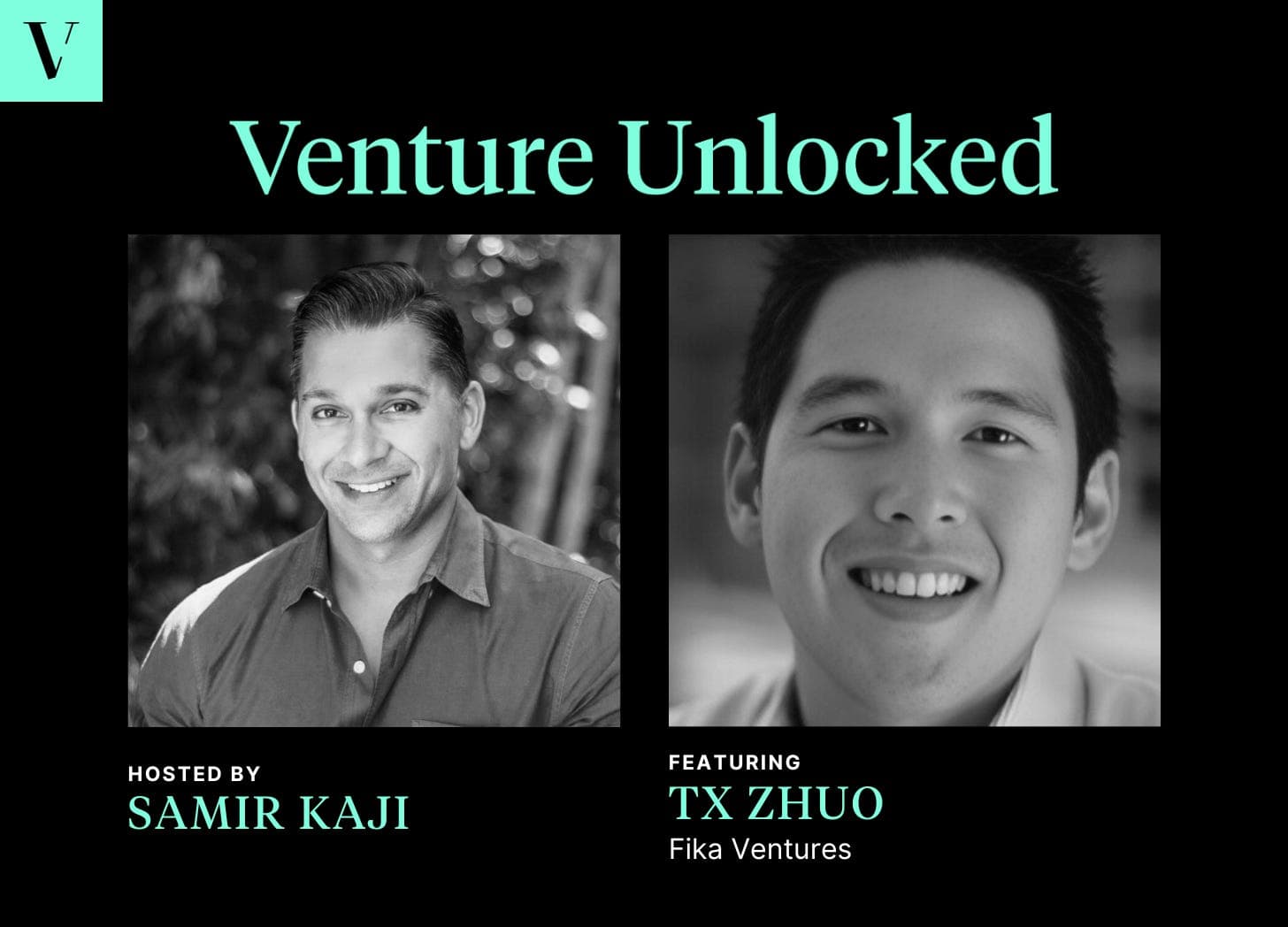
Podcast Information Title: Venture Unlocked: The Playbook for Venture Capital Managers Host: Samir Kaji Guest: TX Zhuo, Co-Founder and General Partner of Fika Ventures Episode Title: TX Zhuo’s of Fika Ventures on Raising a Fund I, Evolving Decision Making Frameworks, and What Founder First Means to Them Listen Here: [Venture Unlocked](https://ventureunlocked.substack.com?utm_medium=podcast)
Key Concepts
- Founder-First Philosophy: Emphasizes support and collaboration with entrepreneurs rather than imposing advice.
- LP Fundraising: The challenges faced while raising the first fund, particularly for first-time fund managers.
- Investment Decision-Making: Innovative frameworks and practices that guide Fika Ventures’ investment strategies.
- Advisor and Support Structures: Utilizing advisors and tailored support for portfolio companies to help them scale effectively.
Episode Highlights
TX Zhuo’s Journey into Venture Capital
- Background: TX Zhuo's career began with an online textbook marketplace during college, which he later sold.
- Professional Experience: Worked at McKinsey, served as CFO at Lit Motors, and held positions at Innovation Endeavors and Karlin Ventures before co-founding Fika Ventures.
- Inception of Fika Ventures: TX aimed to create a more institutional platform to support seed-stage entrepreneurs after learning from his experiences in previous firms.
Challenges in Fundraising
- First Fundraising Experience: TX and his partner Eva pitched to over 700 investors to secure 105 commitments for their first $41 million fund.
- Storytelling Importance: They learned how impactful storytelling could be in conveying their vision and securing investments.
Founder-First Approach
- Communication Style: TX emphasizes a humble, peer-like approach when interacting with founders.
- Expectation Management: Conducting early expectation-setting exercises to build trust, ensuring that founders understand what support they can expect.
- Long-Term Partnerships: Fika prioritizes building relationships and trust with founders, allowing for more open communication about challenges.
Evolving Decision-Making Frameworks
- Investment Pod System: Fika uses a structured voting system and consensus-driven approach within smaller groups to evaluate investment opportunities.
- Radical Transparency: TX discusses the importance of being transparent with LPs about fund performance and challenges, as well as the impact of markdowns on IRR.
Support Structures for Founders
- Advisor Model: Fika has developed a network of 73 advisors to provide functional and domain-specific support to portfolio companies.
- Fika Fellows Program: A program designed to mentor and up-level senior hires within portfolio companies, fostering a growth-oriented environment.
Key Takeaways
- Consistency and Cohesion: The importance of a unified approach within the firm to ensure a consistent experience for entrepreneurs.
- Learning from Mistakes: TX reflects on past missteps in investment decisions and highlights the value of evolving their decision-making processes.
- Ongoing Commitment to Founders: Fika’s commitment to being a supportive partner to founders, ensuring they have access to relevant resources and guidance.
Final Thoughts In this insightful episode, TX Zhuo shares valuable lessons on navigating the venture capital landscape, emphasizing the significance of a founder-first mentality and the importance of building trust with both entrepreneurs and LPs. His experiences illustrate that transparency, a supportive culture, and effective communication are essential for the long-term success of any venture capital firm.
---
For further insights and ongoing commentary from Samir Kaji, follow him on Twitter [@samirkaji](https://twitter.com/Samirkaji) or visit [Venture Unlocked](https://ventureunlocked.substack.com?utm_medium=podcast).
Written by AI. May contain mistakes. Listen to the episode to check what was said.
Transcript
Automatic transcript. May contain errors.0:00Welcome back to another episode of Venture Unlocked, the podcast that takes you behind the scenes of the business of venture capital. I'm your host, Samir Khaji, and today we're joined by TX Show, co-founder and general partner of Fika Ventures. TX's path to venture capital began in college when he accidentally became an entrepreneur, building an online textbook marketplace. After stints at McKinsey and as a CFO as an operating company, he moved to VC by joining Innovation Endeavors, after which he co-founded Carlin Ventures, which was backed by a single-family office. From there, he co-founded Fika Ventures, where today they have a 10-person team and have raised three funds to date.
0:34During the pod, we discussed the culture needed to run a successful VC firm, how they thought about LP fundraising as a first-time fund, and how they think about valuation methodology. Let's get right into the episode now. Samir Khadji is the CEO and co-founder of Allocate. Allocate and Venture Unlocked are independent of each other. Any statements or references made by Samir or his guests regarding third parties, investments, or securities are solely their views and opinions and are not intended as investment advice or an endorsement of such parties or securities by Samir, his guests, or Allocate.
1:08Allocate or its clients may maintain relationships with or investment positions in guests, third parties, or securities mentioned in this podcast. This podcast is for informational purposes only and should not be relied upon as a basis for investment decisions. TX, it's good to see you and thanks for being on the show. Of course. We've been friends for such a long time, and I've been looking forward to this. I know. It's a long time coming for sure. So one of the things I love to do with managers is think about their path to venture capital. And I think you have a really unique one. So maybe, TX, you can go through how did you get into tech and then how did you get into the world of startup investing?
1:47Well, the joke is that I never wanted to be an entrepreneur to begin with. So as the accidental entrepreneur, But halfway through college, we had an unfortunate kind of family incident where my dad was diagnosed with cancer. And my mom said that, hey, you have to earn some money and figure this out quick. So I think the path of least resistance and at that point, a friend and I have been noodling on a couple of ideas was to start a company. We were doing something super simple. We are selling college textbooks online of all things and took some time off college over the course of three and a half years.
2:22build it to about a 20 million run rate business, which we ended up selling. And through the accidental entrepreneurship journey, I got very excited about kind of building a company. The honest truth is that I tried to start a second company, couldn't come up with a great idea. So I thought that Nick's best alternative is to help people around me do the same thing. So then became very excited about venture through my time at business school. Again, and was very lucky to get hooked up with the team at Innovation Endeavors, where I worked through my summers and throughout the school year. After graduation, started a fund called Carlin Ventures based in LA, which was a$30 million early stage fund.
3:01And that was kind of the start to my venture career. So as you think about it, going from Innovation Endeavors to Carlin, to the firm that you co-founded, which is FICA Ventures, now about seven years old, roughly. Tell me what was the inspiration of starting FICA? and what was that blueprint of what you wanted to create as part of this new firm? I think Carlin was a great learning experience for me. I think when I first started as a VC, obviously there's imposter syndrome. I was thinking, hey, my own company, we only got it to 20 million in revenue. So am I really well positioned to help these entrepreneurs?
3:37And I think we took a very humble approach when we started Carlin, that saying that whenever we dealt with the founder, we all were kind of communicating as peers. It never felt like I knew more than the founder, but we're just there to help. And I think four, four and a half years to that Carlin journey, I think I learned that it was great having a family office behind me, supporting me for our first fund. But I really wanted to have some leeway in terms of shaping the vision for the fund and sort of making it a more institutional platform as we grew. So in 2016, a good friend of mine, Eva Ho, and I came together and started Fika.
4:15And our goal was, hey, we really enjoyed being entrepreneurs ourselves. And we want to support people in a similar stage of their journey, that being kind of at the seed stage, work through some of their challenges and really be there as a friend and a peer, help them. I think it's a very fun journey. We both miss it tremendously. And I think to get the same adrenaline kick, it's to help people who are going through the same stage of the entrepreneurship journey. Yeah. I feel like whenever you're starting something, whether it's a company or it's in this case, a firm, a lot of how you structure and think about the overall thesis and how you're going to operate is based on past experiences, both what you've learned as that has worked, but also things that have not worked.
5:01Can you maybe talk about some of the things that you learned that where you made mistakes that helped you think through a better way to actually create a firm and invest in entrepreneurs through Fika? We didn't have formal investors. So the other irony is that I pitched 74 angel investors to invest in my own startup and none of them said yes. So maybe I'm not qualified to be a VC at this point. But a couple of them came on as equity advisors where they were guiding us from time to time. And what I realized that there was a pretty unique distinction about the advice that you would get from these advisors.
5:37I think the ones who are former operators, I think they could contextualize and understand that, hey, we're here to support you and you're the one as the founder spending 24-7 on the company. So you understand the company best and we're here to help you solve problems. Whereas some of these advisors who didn't have similar experiences were coming to us and sort of almost forcing their own advice or decisions on us, which I felt was pretty jarring at that point in time. So when we thought about Carlin and we thought about Fika, I think we wanted to be a platform where we took a founder's first approach.
6:13But I think the principle that even today we abide by is that we try not to be the captains of the ship. We know you're steering the ship, but we're trying to be your deckhands. You're trying to be kind of an extension of your management team and help you with every other problem. So I think my own experience as an entrepreneur getting kind of advice that was good and bad and being able to kind of distinguish who the right advisors will kind of shape my understanding of what FICA should be today. So I want to go back to that founders first or founder friendly, because it means so many different things to different people.
6:44It's been diluted to a certain degree over time. You mentioned this before, innovation endeavors, and then going to Carlin, whereby you had, you know, a single family office that was supporting you. While you had raised capital as an entrepreneur, raising capital as a fund manager is very, very different from an experience standpoint. How did you attack that piece of it? Because obviously, to be founder friendly and invest in companies, you need LP Capital to back you. Maybe talk a little bit about how you approached that first fundraise. It was a very difficult fundraise, being honest with you.
7:17We, again, pitch, again, I can say this today and laugh about it. We pitched probably 700 investors and we got 105 commitments to close a$41 million fund. I think that the first few years, I felt pretty embarrassed about giving those stats, but now I feel that was like trial by fire. And we really understood the founder journey of raising capital ourselves. I think the other realization that I've had now being a VC for this long is that VCs are technically salespeople. We're selling capital or we're selling the dream to a lot of LPs. And I think back in the day, we used to tell the story, I'd say it's all steak, no sizzle.
7:54So I think we were just talking about kind of our prior accomplishments, but not being able to convey that dream to LPs on what we could do with a platform like Fika. And I think that has changed a lot. I think many thanks to a lot of institutional investors who have helped us over the years. But the first one was tough. I think the only way we got it done, and not going to lie, there are moments where we were like, oh, we did our first kind of hundred pitches and we got 4 million in capital. We're like, oh my gosh, Is this really going to be the case? But Eva and I have both been entrepreneurs before.
8:27I think we understood that, hey, the going is going to be very tough in the early days. Not that it gets easier, but that was a challenge that we were up for. So I think we just persevered. I think one thing that we did was we did, we agreed that over the course of eight months, we'll do at least eight LP calls a day. It could be with people we've chatted once or twice with, or it could be a net new prospect, but we weren't going to look at new deals. We weren't going to do anything else. And I think that steadfast focus to closing the fund, which is what I admire in a lot of our entrepreneurs, is what allowed us to get there.
8:58And some might say, oh, my gosh, 105 investors for 41 million. That's not worth your time. But I think we knew that there was a stepping stone to get us to where we were today. So, again, both of us were willing to do it. I remember we did three overnight flights to Singapore and coach. I think that was probably the most painful part of the fund one race. How much of that do you think was related to not going after the right investors or not telling the right story? I think it was a bit of both, right? I think the LP world, and today I understand how it works, is that they're looking for prior track records and credibility.
9:30I think at that point, I think we obviously had managed two funds before that were relatively new. When we raised Figa 1, our first two funds, which was Carlin 1 and Sousa 1, they're both like three-year-old funds. so there are some signals that some of these companies were doing well but really no breakouts if i have to be honest with you so at that point it was a huge bet that lps were making i think what eventually convinced them was again going back to the founder first principle was the glowing references they got from some of our founders uh in addition to the kind of grit and hustle that we showed i think i think eva and i kind of take pride that we we almost have a zero inbox policy.
10:10So when LPs were interacting with us, I think they were, I think, surprised in a positive way by how fast we'd respond with data requests. And some of them were kind enough to take a bet on us. And I think we'll always be grateful to those initial backers of ECA1. Going back to this concept, because you're right, you know, track record at the time, you had some at Carlin, you had some at Innovation, but it was still early, maybe not a ton of realizations and sometimes people look for longer track records but it's also you two coming together for the first time as partners how much of that was a question of it's not just the track record but it's also the team have you worked together what were some of the most difficult questions to answer as part of that first fundraise some of the questions were one although we knew each other as friends we've co-invested before it wasn't like we formally worked together.
11:05And because this was a 50-50 partnership, I think they were very worried that, hey, we wouldn't get along after the first three, six months. And that would be a kind of a huge challenge for LPs. And they were already taking like a first-time fund risk. So for them to get into a first-time fund and have that partnership dynamics that they were uncertain about, that was always a concern for them. And I think the other was, I think some LPs thought that even though Carlin was a single GP fund, we technically had one LP and Sousa had multiple GPs. So could Eva and I really do this on our own without the backing of other partners of or kind of a strong kind of single LP?
11:46That was another question that came up a lot. And then I think the final question that came up is that we were selling them hard on this kind of founder first approach is that's what we want to do. I think the scalability of the strategy and whether that was a true differentiator when you come against kind of the established brands like Sequoia and Dreesen was always a question that we have had to answer. Even today in our most recent fundraise, we've had to talk about these issues and questions. I don't think that will ever go away. I think the only kind of validation we can provide is, hey, go speak to any of our founders.
12:17They can probably validate that we've been fairly helpful to them. And hopefully our win rate through some of these deals kind of illustrate that that's kind of how founders actually feel. One of the things you've probably seen over time now that you've raised, I think, four funds, the three main funds that are opportunity fund, I think you did at some point, is that you're building your portfolio, you have more founders, you also have more LPs, and these are LPs that are relationships. I want to get into what founder first means for a second. But what have you learned in terms of being LP first?
12:50And how do you actually create these and foster these relationships where ultimately some of your early backers are going to be with you multiple times over? Some of the, well, it's, as you know, kind of the performance of the fun follows a rollercoaster in the early years. So there are good days, there are bad days, there are days where like, oh my gosh, like, how do I actually tell my LP that this is actually happening? But I think we've taken pride in radical transparency. So I think over communicating and taking a very conservative approach with LPs. If there's something happening with one of your companies where you maybe don't feel comfortable with the valuation, or you think that might be an impairment to revenue, I think calling some of your main LPs up before they hear about it in the news and saying like, hey, I think this might happen.
13:34I'm not too sure. And the other thing is taking a pretty conservative view. I think we've had instances where we felt like, hey, this company might not survive. We've proactively written them down to zero. And some of the LPs have called us and say, hey, we have other fund managers who haven't done it. Why have you guys done it? We say, hey, we're not 100 % sure, but we feel like we want to take a conservative approach. So I think that financial prudence and over communicating has really, really helped us earn the trust of a lot of our LPs. How tough is that? And I ask that question because I think on one hand, if you see your peers not doing it, and they're out fundraising with better numbers, you're obviously at a position where you're raising, where you've done the markdowns, maybe your numbers don't reflect as much as if you had not done those markdowns.
14:20And there, of course, are some LPs that are actually paid by how the performance is. So if you mark it down, their overall IR goes down. Therefore, they may be measured differently within their organizations. It's funny you mentioned it. I'll come back and answer your question. But I remember we did a sizable markdown at the end of 2022 and not going to mention names, but we had two of our LPs call us and say, like, why do you do this at the end of the year? this actually affects some of my bonus that's going to get paid out next year. And I didn't realize that some LPs were comp based on the IRR for that year.
14:54So I think that was very enlightening to me. But I think fundamentally, there's this intellectual honesty that we believe in. So we're not going to, for the sake of pleasing a few LPs, not make the right changes to our marks, our valuations. But it's always a tough conversation. I think when you're out in market, I think the marks are pretty important. And like you said, when you raise against peers who have higher marks, obviously it's going to hurt you. But I do think the best LPs look at marks as kind of a historical validation of what the fund has done. But I think what's a better predictor of how the fund's going to do in the future?
15:32it's other data points like i think founder references how they're perceived by co-investors how their more recent deals are performing not just from a valuation standpoint but have they hit all their numbers so i think we've been fortunate that we have a pretty sophisticated base of lps who take that extra time to understand what what's really going on in the portfolio and how fika is perceived in the market and again feel very blessed that we're in a position where We've had strong support from our LPs across all our fundraisers, but definitely agree. Still a challenge we're dealing with, but I think honesty is the best policy and that's what we're going to continue to do.
16:09Yeah. And I think in the early days, of course, the numbers don't really mean a lot in the first few years of a fund. It's really around the execution. Are you generating the right type of deal flow? Are you winning the deals that you want to get into? And a lot of that is based on reputation or brand, which at the end of the day does come from what do founders say about you? Why do they pick somebody like Afika over all the different options? So let's talk a little bit about this concept of something I hear you talk about a lot, which is founder first and taking a service provider mentality. But what does that actually mean to you and within the walls of Afika?
16:47It's honestly changed over the years. And I think we were somewhat naive when we first started Afika. I think when we first started Afika, it's like, we can do everything to help a founder. And we're doing everything. We were doing everything from contract negotiations to setting up HubSpot for them. And honestly, as we grew our portfolio now with 85 companies, that wasn't sustainable. But more importantly, we realized that we weren't really enabling these founders. We're giving them a crutch. We weren't teaching them how to do it on their own. So we realized that we had to tweak the business model where now we focus on maybe two or three things that really moved the needle for them.
17:26So I think specifically, we helped them still a lot with customer introductions. We helped them a lot with talent introductions and finding the right fallen investor who can still carry the baton after us and continue to help them in the same way. That's how we really help founders. But I think being clear what we're not going to help them with, but it's not to say that, oh, we're not going to help you and you're left to sink or swim. We're going to give you resources that can help you get there. And I think that's been pretty helpful. The other thing that I think we've done well is that we've earned trust among all our founders.
17:59And I think the way we've done that is being very open about what we're doing. And sometimes we get things wrong. We don't do things right all the time. And being willing to admit to your mistakes and let founders know that, hey, we're humble. We're willing to roll out our sleeves. We're going to work side by side with you. That trust has gone a long way where founders feel like being vulnerable with FICA doesn't mean that we're going to be sharks and kind of use that to our advantage. All it means is that we're going to problem solve together with you and we'll find a quicker path to a resolution.
18:30So I think those steps that we've taken have really allowed us to kind of win a founder's heart, for lack of a better word, and really embrace that founder first mentality. Let's talk a little bit about sort of this, what it means to get a great founder reference. You know, a lot of LPs will call the founders and say, would you take money from them again? Like, what did they do right? How would you improve what they do? And there's a variety of different opinions. But generally speaking, you know, it's around, did they actually do what they said they were going to do? And I always view net promoter score as the delta between expectations and reality.
19:05So in the early days, you were selling all these expectations and you were doing it, but obviously over time, it doesn't scale. So how do you approach the founders today in terms of what the expectation should be when they work with somebody like Afika versus another fund? One good thing is that we try to do even before we set these expectations is whenever we try to win a deal, I think something unique that we do, we offer the list of 150 founders at this point, and a prospective founder can speak to any one of them. We say we'll facilitate interest wherever you want on the list. And what we can assure you is that for better or worse, it's a pretty consistent experience and we're not trying to hide anything.
19:47But once we get into kind of that relationship with the founder, this is kind of like expectation setting exercise that we do week one of the investment to say like, hey, these things are in scope and these things are not in scope. And even for the ones that are in scope, we always try to under promise and over deliver. I think one pet peeve of mine in the venture industries, A lot of VCs will sell you very hard as they're trying to win a deal. The first three or four weeks, there's a very high engagement level. But I think post that initial kind of honeymoon phase, it quickly tapers off. And that creates a very bad experience for the entrepreneur.
20:24I think it sets the wrong expectations. I think it creates that dependency, which is then very hard to take away. So for us, we almost adopt the opposite. it. We try to not tell the entrepreneur that we can do like XYZ and then surprise them over the course of a couple of months and actually kind of deliver, say, three customers to them. The other thing that I think entrepreneurs get very disappointed by is investors who might not invest in follow-on rounds, especially when they need your support. That's something we've tried to be very objective with founders. I think it's very hard, right? When you have a top tier firm coming in for follow-on round, the natural instinct for us is like, hey, let's just do it.
21:04These are good shepherds of capital. I'm sure they will take the company to new heights. But we now document what are the right milestones for each company within 6, 12, and 18 months whenever we first make an investment. And I think our internal compass will say that, hey, if they hit these milestones or come close enough, we don't really care who the follow-on investor is. Sometimes we don't even care if there's a follow-on round. If the company needs capital, we're there for you. But if they've fallen short of those milestones, then we need to have a conversation. And having this objective framework allows founders to kind of really embrace what we're doing here at Fika.
21:40It's not like, hey, this is a flippant decision where we're just trying to not fund you because you're not our favorite child. This is following a rulebook, which we set in place and you've agreed to. So I think establishing that this is a mutually agreed kind of path for you and the company goes a long way in kind of building trust, even though you have to have those hard conversations sometimes about not participating in their rounds. Well, how did you navigate that in 2021? Because I was looking at the data and in many cases, companies are going from the seed where you participate to the next round of capital in less than 12 months.
22:15And there's not a lot demonstrably that can happen with a lot of these companies in terms of objective milestones. And not only were the following rounds happening, but they were happening at high step up in valuations, which of course make the early marks of the seed investment look good, but also presents a really interesting issue for you of if you were objective and milestone based, but there's just not enough time, what did you do during that time? The short answer is not well. I think that was a very, very tough time period for us. And I'll tell you why. I think there are two elements which made it tough, right?
22:49In order to have these tough conversations with founders, you need to have that relationship and build trust. For that to happen, at least in our humble opinion, it involves in-person time. I think you and I have known each other for 10 years, so we can pick up the phone and have those conversations. Some of these founders, we only knew them for six to nine months, and we never met them in person. So to suddenly jump on the phone and say, hey, either we want super prorata, we're not doing it for these reasons, even though we agreed to them, was a very, very difficult conversation. For some of those relationships, it took a couple of months before we could repair them.
23:23And I'm glad to say that most of them have been fixed. And then on the other side of the equation, now I say 6, 12, and 18. Before that, when the venture market was at its regular pace, we only assume a round would happen after 18 to 24 months and not after three months. So we never had those short-term goals when we were looking at a company's progress. And sometimes it's impossible to tell. For some of them that were selling to enterprises, it was unfair to expect their closer customer within the first four months. So we had to make judgment calls based on a very limited data set at that point in time.
24:00And I guess, unfortunately, one of the proxies was like, do we trust the next round's investors? So I would say that that vintage was very, very tough for us for those reasons that we We didn't have enough data points and we didn't feel that our relationships with founders was deep enough for us to have those tough conversations. Yeah. And of course, we've returned to a degree of normalcy. Maybe AI is this exception that is in the ether, which everything is a little bit different within AI. Back to this concept of founder first, right? There's these different variables that you have to juggle.
Read the full transcript
24:31Number one is you do what you say, like you set expectations, you provide value against those expectations consistently. But there's also this other aspect, which some VCs, especially early in the career, are afraid of doing, which is not doing that follow-on investment because it doesn't pen out or giving the founder tough feedback that may be against what the CEO or the founder wants to do. How do you think about founder-friendly and founder-first when you're juggling those different variables so that you do continue to get the right net promoter score with the founders over time, even though you might not be doing the follow-on in some cases?
25:09most founders are actually pretty open to feedback if it's done the right way so i think the underlying expectation that a founder has is like hey has this vc paid enough attention to my business that that i would actually listen to his opinions or her opinions i think that's a big one the big fallacy here is that oh i'm a vc i came in i told a founder something and they got upset with me yes They get upset when it's brought out of context or when the founder has talked about it multiple times and you just haven't been aware that this is happening. So I think earning the right to provide feedback is a big thing for us too.
25:48For the first couple of months, we tend to listen and we try to listen closely to a founder and try to work through issues with them. And at a certain point, I think the equation flips where the founder now will believe in us and know that our intentions are perfectly aligned. I think that's something that's very important too. I think, I don't know what has caused this, but sometimes there's this founder investor conflict where the founders think that we're after different things. But ultimately, the fundamental thing that all of us care about is the success of the company. If the company is successful, all of us win.
26:20So maybe going on a quick tangent, one thing that has been super helpful for founders and not sure whether a lot of VCs do this, we invite almost all our founders to our AGM every year where they get to see our strategy, they get to see our performance. One of my founders actually came up to me this year after the AGM said, now understand why prorata rights are so important to you. Before that, I thought you're just being a hard ass and trying to just ask for this when it wasn't necessary. So I think that appreciation that I think VCs have bosses to and LPs to report to, and we're not trying to be difficult just for the sake of being difficult.
26:59I think there are certain objectives that we're trying to get to as a fund. So understanding that context one and being able to earn a founder's respect by spending enough time with the company allows you to have those tough conversations. And are they still difficult? Obviously, they are. but I think in the heat of the moment, they might escalate. But a founder quickly comes around and says that, hey, these were the right decisions and I really appreciate you for talking with me about some of them. So you're talking a lot about things that are specific to how you run your business. Like you're right, at AGMs, some founders show up but it's more of a presentation of the founder versus all the founders just showing up and learning the business, working with the different LPs or meeting different LPs.
27:44you also are delivering your value add with things that you believe are in scope. So let's talk a little bit about things that you believe are in scope that actually matter to founders and where you've doubled down. What we realized, especially as we grew the portfolio, we started investing in some new sectors that I say we are tangentially familiar with, but didn't have a very deep bench at that point in time, was that founders need as much support they can in the early days. And I would qualify that statement by saying kind of valuable support. So it's not like a random kind of vendor or service provider that you could throw on them, but high quality people that understood one of two things, right?
28:24Either they were good functional experts that could help them with marketing, sales, engineering, or people who had deep domain knowledge that could open doors for them or help them with their go-to-market strategy. So we put together this pretty unique advisor model. So I think now we have about 73 advisors in this program. So all are split. Either they are functional experts or they are deep domain experts within the industries that we focus on. And whenever we make an investment, we actually fund an investment on these advisors' behalf to be on the cap table of the company that we are investing in.
29:00So for the founder, they get almost two free senior advisors or board members who help them on a monthly basis. And that's been a winning strategy. but I think it involves us kind of fronting the cost and it's obviously an investment for the firm, but being willing to invest in your founders and the company upfront, I think it's very meaningful to them and shows them like, hey, these VCs recognize they might not be the experts at everything, but they're trying to fill the gaps by bringing on kind of close advisors that could really help us scale. So that's been a winning model. The second thing that a lot of VCs neglect is that founders need help managing their own senior hires as well.
29:37and up-leveling them. And that takes up quite a lot of a founder's time. I can't tell you how much difference it makes if a founder finds a good VP or product or you're able to mentor that VP or product such that that person can do great work for the company. So we've launched something called the Fika Fellows Program. I give my partner, Artin, full credit for it. We've been running it for eight or nine years now. So once a quarter, we gather a group of either functional leaders within our companies and we invite people from other companies as well within the community and then we'll do workshops we'll do dinners and the whole purpose is to help up level this director or vp level person within the company to give them their own network of people they can turn to whenever they need help and also help them with the biggest challenges that they face so a lot of times these become free flow conversations where it's like oh my gosh like does anyone else struggle with product marketing can we talk about it and then we go into like a one-hour session just doing it, but it's so helpful that one, it's a scalable way for us to kind of crowdsource knowledge and help.
30:40But secondly, it takes this kind of workload off of founders back, right? Now they know that Fika's here not only to help them, but kind of that first layer of senior hires that they've had. So I think those two things have gone a long way with founders. We've done multiple surveys asking founders whether they find this helpful and that continues to be the case. So So if that's the case, we'll continue to do it. But obviously, always looking for new ways to support founders in better ways. A lot of what we're talking about during this conversation is around people. You know, your advisors, it's the folks that work at FICA.
31:11How many people do you have at FICA right now? We have 10 people at FICA. 10 full-time people, but it's also working with the individual founders and figuring out ways to truly provide value based on their unique set of needs in whatever case or whatever sector the company is. when you look at the 73 advisors plus the 10 people that you have full-time, you need them all to buy into the same cultural ethos of being founder first and really leaning into the service model. What are you screening for? We are screening for that service mentality. It's funny, whenever we do interviews with new people, we actually do two things that are pretty interesting.
31:50We let them lead a call with founders. And this is usually like a catch up call with founders to say like, hey, how can we actually help you? And we observe like what they're talking about. And a lot of them, I think they're screening for a couple of things, right? People who are resourceful. I think the best people we've hired, even though they might not know the answer to the question, they can quickly come back and say, well, I know these two people in my network who can answer this tax question for you. Let me get back to you in a couple of days. The other thing we're screening for is that kind of in-person interaction.
32:22So the other thing we do through interviews, we actually invite one of the current Fika founders to come to the office and do a 30-minute coffee with that prospect. And that tells us a lot. Sometimes we sit in the room, sometimes we don't. Sometimes we just gather feedback from the founder. But what we try to uncover is that, is this person excited about working with an early stage company? And I think that we're trying to also screen for the fact that, hey, this is not just an investment associate who just wants to sit behind a computer, but someone who's proactively thinking about building their own network, thinking about how they can be additive, thinking about what problems this company is potentially going to face and sort of having those discussions with the founders and the underpinning of everything.
33:08It's a deep sense of humility as well. At Fika, it's probably one of the kind of unspoken values that we have, but all of us are very humble, willing to learn. And everyone's opinion matters in a room. That's what we care a lot about. And I think taking pride that kind of our founders are always the ones who are going to kind of shape our business and make us successful and always remembering that I think that's pretty important to the whole FICA team. How does that then translate to investing decisions? If everyone has a voice, do you require consensus? Or how do you actually execute on potential opportunities when you know there's opportunity costs to every investment you make within a fund?
33:48One of the early things we learned about us at FICA is that I think we're very cohesive as a team and sometimes I think cohesive to a fault. So when we first started FICA, we required like full consensus in order to do a deal. This is both across partners and associates. And I think one could argue that there might be some biases where there was groupthink after the first person spoke, but still, it's still a very high bar to get a complete consensus vote across the team. But I think over the years, we want to encourage some outlier thinking. So one thing that we've done, we've actually split the investment team.
34:23So there's six on the investment team into what we call investment parts, where each mini part of two focuses on a couple of industries. For example, I lead a part covering financial services and vertical SaaS. And within the part, we'll do enough research before we take the opportunity to the broader team. And at that point, there's a lot of implicit trust among the team that these two people have done the work in order of baseline research and diligence for it to be teed up as an opportunity. At that point, we have a pretty open discussion about the pros and cons. I think something that we do differently too, we decide then to bring a founder in for the final presentation, but the final presentation isn't the final step.
35:05So it's about 75 % of the way there where each team member is then kind of entitled to offer their opinion anonymously and come up with a series of kind of like final questions or concerns that they have. And then the investment team who runs point on that, the two-man or two-person team, will then prosecute these remaining concerns and come up with a recommendation that has to be agreed on by the team. But I think specifically, we all vote with a one to four scale. And I think we need the average score to be above a three, at least one of the partners to vote a four on a deal and no one to veto the deal, which is a one vote.
35:39So it's pretty unique because I feel that sometimes we get forced into doing deals. If you make a snap decision right after the four partners meeting, there are obviously one or two louder voices in the room. And sometimes that kind of drowns out some of the legitimate concerns or questions that you have. So we try to move away from that model. We did that probably the first two years of FICA and we realized, hey, oh my gosh, after investing, you didn't tell us about these two questions that you had. And now these are kind of relevant questions. So try to avoid any biases to the decision-making process.
36:12I think we actually truly believe that kind of this change has made us better pickers in these more recent funds. Do you think for the first three years of FICA, where you had the different model, Can you look back and say that that model of consensus and maybe perhaps that in sending a version of groupthink actually made you miss on a deal that now you look back and say, had we had this new model, we might not have missed? I think so. I think there are a lot of deals that we looked at in the early days, and this kind of even predates Fika. I think we looked at a lot of the great LA deals. I'm almost embarrassed to say the ones that we looked at.
36:52We looked at Honey in the Day more recently. We looked at Boulevard. I think Boulevard was a great example where we had half the team that had strong conviction that wanted to do the deal. And half the team was like, hey, we looked at MindBody and Booker back in the day. You can't make a profitable or scalable business selling to hair salons. And I think that was more of a more flippant statement that was made. And I think given that we couldn't get to full consensus on the deal, we didn't move forward there. But I think that was one example, as we look back, that given two members of team who did strong and deep diligence on dealhead, the conviction we should have made that investment.
37:29The other thing I wanted to ask you, just in terms of like being a venture investor, I feel like it is very much the apprenticeship. And you've talked about some of the things that you've learned from and the internal ethos of continuous learning. If you were to look back at your 2000, let's call it 14, 13 South, and were to impart one piece of advice about venture investing, what would it be? There has to be consistency in the approach. And if I expand that statement even more to Fika, it has to be consistency among the team. And I think you alluded to this, Amir, about the apprenticeship model.
38:04I've had the fortune back in kind of 2014 working alongside our team, who's now my partner here at Fika. So we worked together for 12 years. And one thing that's really showed that I think to succeed as a venture firm, entrepreneurs need to know the type of experience they're going to get with you. I think it's very jarring for an entrepreneur to speak to one partner and then another partner and have a completely different experience. I think that tarnishes the brand of a venture firm. So for us at Fika, I think what that translates to is a very strong apprenticeship model. I think all the partners here at Fika have worked here for at least four or five years.
38:38So fortunately, unfortunately, we haven't done a lateral transfer of a partner into FICA. Not sure we'll ever do that. I think we still need to be open-minded if the right person comes along. But I think that apprenticeship model, I think, gives us a lot of trust where I know that if my partner or teen or John meets a company, the way they interact with a founder is very consistent with FICA values and FICA ethos. So I think one thing that's really stood out now that we're eight years into FICA, it's entrepreneurs now look at us like, hey, I really know what Fika is about. But regardless of who I speak to, even at the associate level, this is what Fika stands for.
39:13This is what I'm going to get. So I think having that consistency solves a lot of communication and branding problems for us. So that's something that our advice, not only on the individual level as an aspiring VC, like, please treat every entrepreneur the same way. Don't change your approach where you're like, okay, one day I'll sprint on a deal. The next day I'll take four weeks to get back to an entrepreneur, just be consistent. Yeah. And it's so funny because we've had so many conversations with limited partners about this and other GPs and even entrepreneurs. And we always ask when we're referencing different firms, what do you think about firm X or firm Y?
39:45And often the response back is, what partner are we talking about? And that speaks to the lack of consistency and style ethos. And I do think the next generation of venture is getting much better in creating more cohesity in terms of how you work as an organization versus a collection of parts. Yep. And I think it also really allows you to specialize, right? I think if you don't trust your own partner to run the firm the same way, then you're always looking over his or her shoulder and saying like, oh my gosh, like, how are you dealing with this deal? For me, it's like our team runs branding and marketing.
40:21John runs a lot of the deal team today. So I can trust that the way they're embracing leadership is very similar to what anyone else at Fika would do. And that allows me to really hone in on what I managed today and try my best to do well at it. That's great. Well, TX, this has been great. Thank you for coming on. I congratulate you for all the success thus far. I know the journey of Fika is still in this first decade, but certainly the brand, the reputation has been tremendous and both lucky enough to have known you for a decade, but also to be one of the portfolio companies so I can speak to the founder friendliness.
40:56You know, really appreciate this and I look forward to seeing the franchise grow. Thanks, Amir. Thanks for having me. Thanks so much for listening to another episode of Venture Unlocked. We really hope you enjoyed our conversation with TX. If you enjoy our content, please subscribe to Venture Unlocked on iTunes or Spotify to get the latest episodes straight to your inbox or sign up to my newsletter at ventureunlocked.substack.com, where I also include my ongoing commentary about the world of venture capital.
From the publisher
Follow me @samirkaji for my thoughts on the venture market, with a focus on the continued evolution of the VC landscape.
We're joined by TX Zhuo, Co-Founder and General Partner of Fika Ventures. His tech career began in college when he started an online textbook marketplace.
After working at McKinsey and as a CFO at an operating company, TX joined Innovation Endeavors. He then co-founded Karlin Ventures, which was backed by a single family office. In 2016, he co-founded Fika Ventures, which now has a 10-person team and has raised three funds.
During the pod, we discussed the culture needed to run a successful VC firm, how they've thought about innovation, LP fundraising as a first-time fund, and how they think about valuation methodology.
About TX Zhuo:TX Zhuo is a General Partner at Fika Ventures, a boutique seed fund in Los Angeles investing in data, AI, and automation technologies. He co-founded Fika Ventures in August 2016 and has been dedicated to solving systemic problems through innovative platforms ever since.
Prior to this, he was the Managing Partner at Karlin Ventures from 2012 to 2016, focusing on early-stage investments in various sectors including education technology, digital media, and healthcare. Before Karlin Ventures, TX worked at Innovation Endeavors from October 2010 to May 2012, managing deal screening and outreach initiatives. He also served as the CFO of Lit Motors, an electric vehicle startup, after his tenure at McKinsey & Company from August 2008 to August 2010, where he contributed to financial services and consumer goods projects. TX's entrepreneurial journey began in college when he founded and successfully sold an online textbook marketplace, EMT Alliance, which had significant sales and a cost-efficient distribution center in India.
He holds an MBA from Stanford Graduate School of Business and a Bachelor's degree in Mathematics and Economics from Wesleyan University.
In this episode we discuss:
(01:32) TX Zhuo’s Path to Venture Capital(03:04) Inspired by his own experiences and wanted to create a more institutional platform with Fika Ventures, focusing on supporting seed-stage entrepreneurs with a peer-like approach(05:12) The importance of being founder-first and not imposing advice, adopting a humble approach when communicating with founders(07:14) The difficulties raising the first fund, pitching to 700 investors to get 105 commitments, and learned the importance of storytelling and perseverance(12:49) Radical transparency and conservative financial prudence with LPs, focusing on over-communicating and being proactive about potential issues(16:14) The need to focus on high-impact areas like customer introductions, talent, and follow-on investors, emphasizing trust and being an extension of the management team(19:22) Why TX conducts an expectation-setting exercise early in the relationship with founders, focusing on under-promising and over-delivering to maintain trust and satisfaction(22:39) Navigating 2021's Rapid Fundraising Environment(25:09) How to handle tough conversations with Founders(27:56) Fika’s unique advisor model the uses 73 advisors to support functional and domain-specific needs, and created the Fika Fellows program to up-level senior hires within portfolio companies(34:15) How Fika uses a pod system for focused research and decision-making, requiring a high bar of consensus and a structured voting system for investment decisions(31:39) Why TX screens for a service mentality and resourcefulness in new hires, ensuring they align with Fika's values and ethos through practical evaluations and interactions with current founders(37:43) TX’s Advice for Aspiring VCs: the importance of consistency in approach and team cohesion, advocating for treating every entrepreneur consistently and building a strong, unified brand(39:13) The importance of a consistent experience for entrepreneurs interacting with Fika, valuing a strong apprenticeship model and internal trust among team members.
I’d love to know what you took away from this conversation with TX. Follow me @SamirKaji and give me your insights and questions with the hashtag #ventureunlocked. If you’d like to be considered as a guest or have someone you’d like to hear from (GP or LP), drop me a direct message on Twitter.
Podcast Production support provided by Agent Bee
This is a public episode. If you would like to discuss this with other subscribers or get access to bonus episodes, visit ventureunlocked.substack.com