In short
Venture Unlocked Podcast Summary
Episode Title
What's Happening at the Seed Stage?
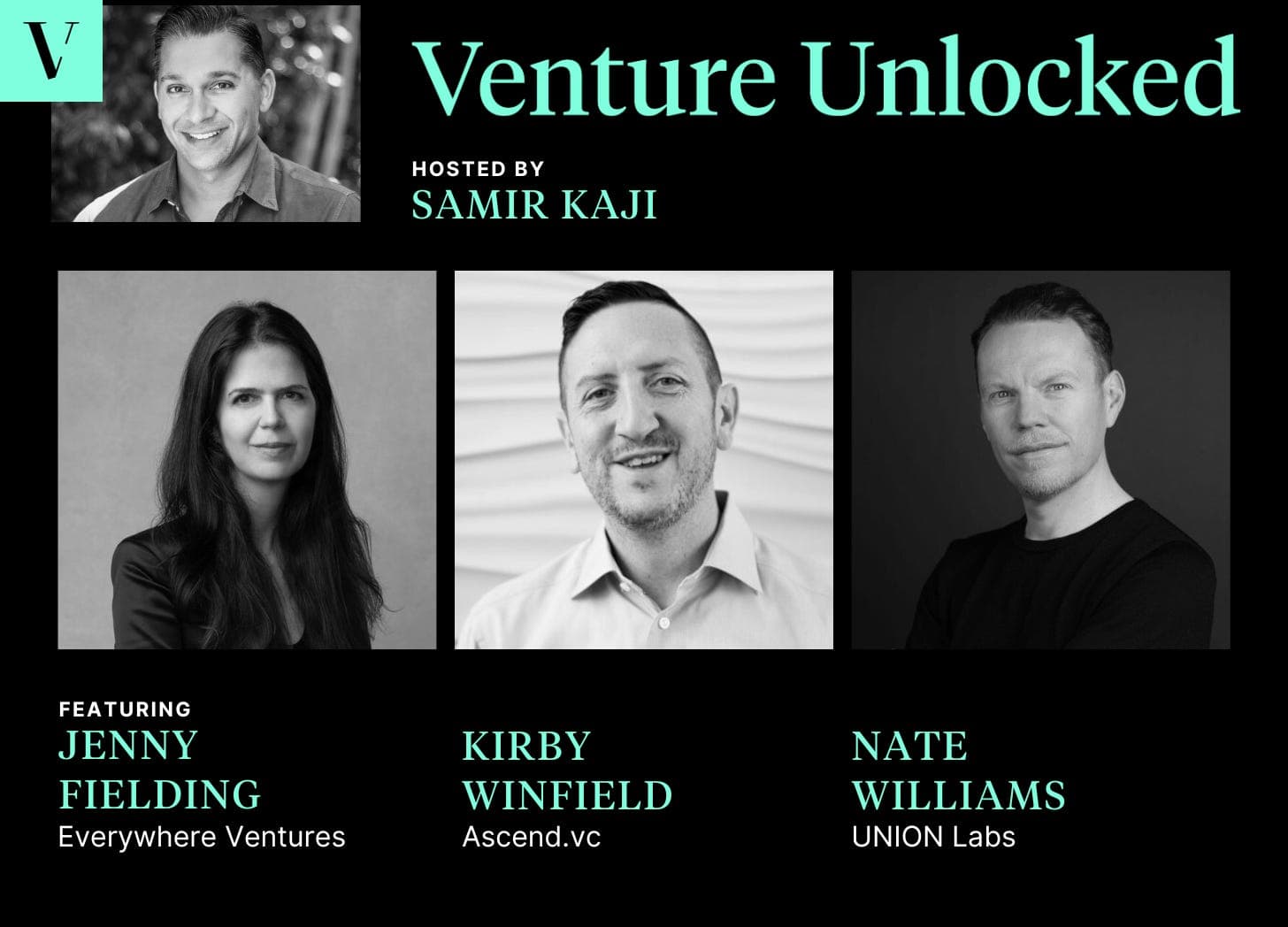
Episode Overview In this episode of Venture Unlocked, host Samir Kaji engages in a roundtable discussion with venture capitalists Jenny Fielding (Everywhere Ventures), Kirby Winfield (Ascend), and Nate Williams (UNION Labs) to explore the current state of seed-stage investing. They discuss how the recent market reset affects decision-making, fund sizing, reserve strategies, and perspectives from Limited Partners (LPs) on seed funds.
Key Participants
- Samir Kaji: Host and expert in venture capital.
- Jenny Fielding: Co-Founder and Managing Partner, Everywhere Ventures; active pre-seed investor.
- Kirby Winfield: Founding General Partner, Ascend.vc; focuses on AI and machine learning investments.
- Nate Williams: Co-Founder and Managing Partner, UNION Labs; specialized in deep tech investing.
Main Topics Discussed
- Market Resets and Challenges for Founders
- Economic Climate: The tech downturn has significantly impacted seed-stage funding.
- Bar to Funding: Increased difficulty for first-time founders, particularly those not in major VC hubs or not in popular sectors like AI.
- Funding Timeline: Rounds that previously took weeks are now taking months.
- Trends in Seed and Pre-seed Rounds
- Round Sizes: Notable increases in pre-seed and seed round sizes; the need for larger rounds to ensure sustainability.
- Valuation Dynamics: Flight to quality investors, with higher valuations for experienced founders, while first-time founders struggle.
- Follow-On Funding: Importance of a founder's ability to raise follow-on capital has become a priority in evaluations.
- Strategies and Adaptations for Investors
- Investment Focus: Emphasis on the need for founders to demonstrate traction and sustainability in their business models before moving to Series A.
- Reserve Strategies: Adjustments in reserve allocations to support startups through to Series A and beyond.
- Historically, 50% reserves were common; now there's a shift towards a more defensive strategy with up to 75% reserves.
- Investor Collaboration: Increased collaboration among investors to support first-time founders.
- Impacts on Limited Partners (LPs)
- LP Expectations: Changes in expectations and strategies from LPs, reflecting a more cautious approach to investments due to market conditions.
- Graduation Rates: Discussion on the declining rates of startups successfully transitioning from seed to Series A, with implications for investment selection.
- Changing Landscape for General Partners (GPs)
- Fundraising Challenges: Emerging managers facing increased difficulty in raising funds compared to previous years.
- Investor Sentiment: Shift in LPs' willingness to invest, with many opting for existing managers over new funds.
Key Takeaways
- The venture capital landscape is experiencing significant shifts, particularly at the seed stage, due to economic pressures and evolving investor expectations.
- Founders must adapt their strategies to focus on sustainable growth and demonstrate clear metrics before seeking further capital.
- Investors are increasingly collaborating to support emerging founders, taking a more active role in helping them navigate the funding landscape.
Conclusion The discussion highlights a complex and evolving seed-stage investment environment, emphasizing the critical need for both investors and founders to adapt to changing market conditions. The insights shared by the panelists provide valuable guidance for navigating the current venture capital landscape.
Further Information For more insights, follow Samir Kaji on [Twitter](https://twitter.com/Samirkaji) and explore additional resources on the [Venture Unlocked Substack](https://ventureunlocked.substack.com).
Written by AI. May contain mistakes. Listen to the episode to check what was said.
Transcript
Automatic transcript. May contain errors.0:00Welcome back to another episode of Venture Unlocked, the podcast that takes you behind the scenes of the business of venture capital. This week, we're doing another special roundtable discussion with a focus on the seed stage market. Joining us are Jenny Fielding of Everywhere Ventures, Kirby Winfield of Asset, and Nate Williams of Union Labs. During our conversation, we spent most of our time discussing how the market reset affects seed stage decision making, fund sizing, and reserve strategies. We also touched on what they are seeing and hearing from LPs that invest in seed funds. Whether you're a founder, GP, or LP, I think you'll find it to be a nice comprehensive discussion that provides a ton of valuable insights into early stage VC.
0:39Let's get into the episode now. If you're a venture investor, then I'm sure you already know about Sidecar, the go-to platform for emerging VCs to manage their SPVs and funds. Sidecar is on a mission to make private markets more accessible, transparent, and liquid by standardizing how investment vehicles are created and executed. Their powerful and robust software allows VCs to launch SPVs and funds instantaneously, track funding in real time, and offer hassle-free opportunities for early liquidity. Whether you're syndicating your first or 50th deal, Sidecar acts as your silent operating partner, handling all back office functions in a single place.
1:17Sidecar always has your back so that you'd never have to worry about chasing subscription documents, lost wires, or late K-1s. Sidecar's responsive and proactive customer support team is there to assist you, helping you build trust with your investors, and tackling the challenges of building your firm. To learn more, visit sidecar.io forward slash venture unlocked. Samir Kaji is the CEO and co-founder of Allocate. Allocate and Venture Unlocked are independent of each other. Any statements or references made by Samir or his guests regarding third parties, investments, or securities are solely their views and opinions and are not intended as investment advice or an endorsement of such parties or securities by Samir, his guests, or Allocate.
2:00Allocate or its clients may maintain relationships with or investment positions in guests, third parties, or securities mentioned in this podcast. This podcast is for informational purposes only and should not be relied upon as a basis for investment decisions. I'm joined by three great seed stage managers that really have the ear to the ground of what's happening in the seed environment. And today really is going to be a really open RIF discussion about seed, what we're seeing, both from the founder perspective as well as the GP perspective. And then we'll end with what LPs are doing. So I want to start off with maybe a statement of what we've seen over the last decade.
2:39So over the 2010s, we saw a lot of emerging managers come into the market. The seed stage part of the industry really explode in terms of the number of deals, the number of funders. And of course, over the last couple of years, we've seen a dramatic change in the environment, both in terms of follow-on financing, the bar that entrepreneurs need to meet to get that follow-on financing, and the number of players that play in seed. So I want to start off with, maybe I'll start with Jenny to start, is what are you seeing on the ground and how have things shifted for you in 2023 versus pre, let's call it 2022 when the world changed?
3:17We're obviously affected by the tech downturn, even at the earliest stages. So while we're still seeing incredible amount of innovation and great companies, I'd say, you know, the bar to get funding at all stages is being impacted. In addition to there being less capital coming in, another trend that we're seeing is what we call this flight to quality, where there's a certain demographic of founder who's able to attract more capital, higher valuations, kind of maybe typical 2020-2021 setup. And that's really providing almost a bifurcation between these two groups of founders. So the first-time founder, maybe the founder that's not in San Francisco, the founder that's not building AI, really struggling.
4:03And it's taking a much longer time for them to close their rounds. And oftentimes, they kind of have to cobble it together. So I'd say, you know, the first trend that we're seeing is there's less capital and we're feeling that, you know, our founders are really feeling that. A round that may have taken a few weeks to get together are now sometimes taking months, literally, to get a million dollars together. When you look at that and say, you know, there's a first-time founder and actually some of the best companies historically were actually started by people that were first-time founders, not just repeat founders, is that because the rounds are taking longer and the funding for those companies is probably less, lower valuations.
4:43Yet you're also against the backdrop of a million dollar round may not get company far enough to get the next round of capital. What does that actually mean for that first time founder? And how are you prosecuting on looking at opportunities that are not those bifurcated second time founders successful? Yeah. So, I mean, we have a rubric of what we're looking for in founders. At the pre-seed, there's really not, there's no metrics. And so we're looking for, you know, the founder characteristics. And so if we can pressure test things like resilience, do we think that they're a fast founder? You know, some of the other data points that we're looking are, we're completely happy to be that first round of capital.
5:22We're happy to lead, set the terms and hopefully, you know, syndicate with other folks. And then what it's meant for us is that we actually have to do more work because we'll develop conviction early. And then we have to kind of call all our friends who are, you know, many on this call and say, hey, you know, we have a lot of conviction in this company, you know, you should take a look. So I think one of the things that we're seeing is that the investors have to step up and really help these first time founders get their rounds together. Now, luckily, there's a lot of capital out there. And it's very collaborative at the early stage, there's really no sharp elbows.
5:55That's a great thing, because the investors can make a real impact on the round. So I'd say that's one of the trends that we're seeing and one of the ways that we can lean in. Yeah, I mean, I think to Jenny's point, at pre-seed two years ago, we were generally expecting a mark within six months. The capital requirements were actually much lower at pre-seed. It was easier to fire quickly and maybe you didn't have to syndicate as much. And that phenomenon is largely gone now. So we have seen even pre-seed round sizes go up Like Jenny, we're looking for friends, often seed friends, to come in, if we're a$500K check, for them to come in with$1.5K, so we know we can get that pre-seed into a seed, which is generally taking a lot longer now.
6:42If I can offer a takeaway, Samir, just real world, is if I think of our mentality at Union two years ago versus today, just in terms of the heuristic by which we look at a founder, two years ago, we were less focused on were they amazing fundraisers because the market was sort of taking care of itself. I would tell you point blank, 100 % real, like I will not invest in someone right now who cannot convince me that they can raise follow on capital because it's too hard. So the basis of union, I've been on venture a lot before, was that we thought in an entrepreneur's journey in the first 12, 24, 36 months, there are two to three crux events every year.
7:26They're either product, team or go to market. And that's where we lean in besides capital to do it. Now I'm adding kind of a third leg to that stool, which is fundraising. And so one of the benefits that Jenny and Kirby, myself have here that we can avail our founders to is we are in market literally every day, every week, every month fundraising with our teams. We're seeing the micro changes from month month and quarter and quarter in terms of valuations and what series A appetite is. And I think this market you asked us to classify it, I would say this is a very turbulent market right now. Like the only constant right now is change.
8:08If we talk about this now in February, I guarantee if we record this in April, it'd be hella different. We have increased the frequency of the AMAs that we host for our founders in our portfolio. And we've also increased the percentage of those that are Series A VCs from the Valley. We're up here in Seattle, primarily. Our founders are kind of known for maybe cooking their steak, but not selling a sizzle. And as things tighten up, we're really, really cognizant. And I'm a former founder who raised venture semi-successfully twice, but also missed Series A twice. And so from painful personal experience, I wish I had more exposure to those investors.
8:50and I was constantly tracking what they were thinking and what they were looking for, where that bar might be, although they will never really tell you where the bar is. And I know we all know it's, you just see it, but there are some numbers that you ought to be hitting. And so we try to expose folks to that, like Native's vet. Let's actually go a little layer deeper, if you don't mind. So Kirby, you mentioned something earlier that, particularly in 2021, I think that most people would consider 2021 to be the peak of the peakiest in terms of activity, and pretty much all asset categories, but certainly venture, is that you had companies that were raising six months after receipt.
9:28So go from seed to series A, often with a step up in valuation that was sometimes 5x plus. Without a lot of tangible progress of the company, there's maybe a nicer narrative, but there wasn't too much. Now it's more that kind of 12, 18, 24 months. And what people are looking for is more than a narrative, but real tangible progress from that C to the series A. So maybe talk a little bit about how you're underwriting that time period because the goalposts do constantly move and goalposts might be different two years from now than what they are today. And then how do you help that? What are you telling founders to do during that timeframe to ensure a higher probability of getting that series A around?
10:08Yeah, we're trying to untrain some of the habits that folks got during that kind of ZERP period, one of which was raise a pre-seed, find a founding engineer and another co-founder and build an alpha and raise a seed or raise a seed, build an alpha, raise an A. Now things have changed. You're not going to get credit for just making product progress or hiring the team or just changing the story a little bit. You need commercial traction. I mean, in almost every case, although we invest in AI and sometimes that's an outlier, but you need commercial traction. At the same time, I've seen people overcorrect.
10:42And try to start selling before they have an ICP or a product that matches a problem or even have really figured out what the problem is that they're trying to solve. And so we always say, look, after I write my check, the last thing I want you to do is grow. Don't grow right now. Even if you have some revenue, please don't grow. take a minute and really dig into your customers and really understand okay optimize for metrics that will get you to non-churning good revenue when you need to go because what what we're solving for here is the amplitude of the of the revenue growth into the egg not the raw number of the revenue i think we see way too many people go out way too fast and all their network because good founders have a network, they can dial a friend, and they can get to a million in ARR.
11:36But is that real revenue? Is that good revenue? Is that revenue going to churn? And did you do that in the first six months after your seed? And now it's plateaued? Because that's a very different million dollars than one that you ramp into in the six months prior to raising your A. And so we're really trying to work with founders to help them shape the revenue to support a growth story that actually matches with what investors are looking for. Yeah. And Jenny, maybe I was going to just point to you a little bit on this particular topic. You know, a lot of the folks that you're funding are likely people that have never actually been through a true economic reset up until this last one, right?
12:14So last one was 14 years ago, 15 years ago, almost. You know, sort of the DNA that was built, whether it's Silicon Valley or just tech in general, was you grow at all costs, you grow really fast. And eventually, you figure out things like economics, insurance, and you have a product. How do you change that? And maybe, you know, you have a few thoughts on what Kirby mentioned, but also, how do you change that behavioral DNA where it's not just about the valuation, how much you raise, you know, and from who it's about building a durable business? Yeah, I started my first company in 2008. So you can do the math of what time that was.
12:50There was no venture capital in New York. There was hardly any capital, right? So it was just a different time. I bootstrapped my business while I had a full-time job at J.P. Morgan, right? And when we had revenue, I quit my job. You don't see that too often. So there's been a whole, as you say, deprogramizing of this generation of founders who kind of right out the bat expect that they can raise capital. That's only a relatively new phenomenon. Many of us had to get to profitability or we had to control our own destiny in the early years as well. So I think there's been a little bit of a swing, maybe too much in that direction.
13:26We want folks to take venture capital when they can use it as rocket fuel. But bootstrapping for the first 18 months is not a bad thing. To Kirby's point, I just wanted to throw in that one of the things that we're trying to coach founders with is the reality is we're seeing sometimes up to five rounds before the Series A, right? So we have the angel, you know, friends and family, we've got the pre-seed, then we have the seed, we have the top-up, we have the post-seed, and then maybe we have the A. So if you go out with that friends and family at a$15 million valuation, where does that leave you, right?
14:03How are you going to have step-ups or get to, you know, grow into that if you're starting so high? So one of the things that we're trying to tell founders is it could take you a number of rounds. We're realistic that it could take four to five rounds to get to an A. And so how do you kind of pressure test your business to figure out, you know, what are those levers that I can get some metrics where I know I'm going to be able to raise because you just can't start with an unreasonable evaluation. So I think that what's happening now with this reset is actually quite healthy. And we can go back to pre-seeds being priced in the, you know, say five to eight size instead of, you know, this kind of 10 to 15, which we started to see, which is really just unhealthy.
14:44This is a finance show. And I know sometimes it's, you know, third rail to talk about seed managers debating finance. But I think something in this current conversation, the seed market that gets missed is the interdependence between the private markets and the public markets. So basically, the product that Jenny and Kirby and I have with our funds is effectively a private market investment product that cascades its way eventually to public markets. And so, Samir, you're a student of finance. You understand this lack of liquidity in the public markets, the IPO window not being open, the lack of DPI.
15:20That type of heuristic discussion with an entrepreneur almost never happens at sea. But now a conversation just to pick on what Jenny was saying to build off that is I have to talk to a founder about the attitude of a series A investor who may not have a crossover fund at series B next to that. So when they're thinking about one of our investments, they're not only thinking about entry price from union, they're thinking about who is the Series B investor or a Series C investor if it's capital intensive to get this out. And so I think that mathematics is extremely, it's not exogenous. It is very important to how these companies are underwritten.
15:59to Jenny's point, what I would say, we're talking to our founders about appropriate stages of capital, appropriate prices when you look at historical data, and also how much miscritic mitigation per dollar, risk mitigation per dollar. If you raise a million and a half dollars in a pre-seed, what metrics actually get accomplished with that million and a half that make the business more likely to be sustainable? And then Jim, one last thing, I want to give a shout out to Charles Hudson at Precursor, I thought he wrote an unbelievable article about changes in the Series A graduation rate. That is reading that anyone in our cohort needs to do.
16:41We're living in a newer world, and this phenomenon, I'm not going to name the seed manager, but they had a 90 % graduation rate. That's probably not likely to happen in the next 36 months. I'm glad you brought up the topic of graduation rates because historically, if you go back to 2014, 15, and I wrote an article, which is way dated now, but in 2015, we look at graduation rates and for even top funds, it was kind of 30 to 50%. It was not what we saw really at the tail end of the ZERP period where many firms were at 70, 80, 90%. And it was because companies could easily raise the next round of capital because of the abundance of supply.
17:23So if you carve back and say, we're going to go back to historical NARS, maybe it's 50 % of the companies then reach that next tipping point of getting that Series A. Obviously, that requires much more risk mitigation at the seed level in terms of company selection, the time you take to really understand those businesses and the capital raise at the pre-seed or seed level to give the companies enough time to grow into the metrics they need to get to, to be able to even have a chance of getting series A financing in today's market. Yeah, maybe the point on that is to understand our ability to affect graduation rate is helping them to focus on two to three North Star metrics that they can knock out in 12 to 24 months.
18:06Looking at issues with go to market propagation or product development, that could be like sort of bad throwing motion that we can help correct. And then Samir, it's always going to be a sliding scale what the graduation rate is. I think a different way that we try to look at a union is to do a four stack rank every quarter, looking at our investments of what are investments that we feel most passionate about that are likely to return the fund and be able to have sort of forced ranking. Because if you assume that fall on capital dollars are finite, you have to make tough decisions. And if you don't run the scenarios ahead of time, when you're forced to making a decision, do you write a second check or third check, you're basically in deep water.
18:51And so one of the things that I would be public, say about our strategy is like union is a two check investor. We invest and try to lead pre-seed rounds, million dollar check, 10 % ownership. And we try to be supportive on a second check to keep our prorata. Third check, there's not a lot of data that supports a third check generates much alpha. And I'd rather have that check freed up to go make a new investment. Part of this as an emerging manager and also as an asset allocator is having a prepared mind of at what price does it make sense to do my pro rata at what, you know, I have a company that's doing quite well right now.
19:28Should I consider taking a secondary to generate some DPI to my investors? So I'll be honest in the circles that I run in, some of these harder conversations, telling the founder to shut it down, seeking an acqua hire, maybe burning slower. Like, hey, you don't have to graduate Harvard Law School in three months. You can actually do it in the three years. That might be okay. These conversations were not being had 24 months ago, period, full stop. We had a funny conversation with our LPs where we started it saying, so just want you to know our average entry valuation has gone up. And everyone on the Zoom turned on their cameras and leaned in and was like, what are you talking about?
20:09This was in 2023. And we said, because our average round, the average round has actually doubled as well, right? So this is another thing that we coach our founders on now is that having 12 months to Kirby's point where we just expect an upround is not realistic. So if you're going to have your financial model built for 24 months, you're going to need more cash. And so obviously, we're going to pay up. So I think that, you know, some of the data that people are quoting on Carta, there's there's some nuance there because although round sizes are going up, that's really factoring into some of the valuations that we're seeing.
20:45So when everyone's saying seed is holding steady, it's like, well, instead of the average round being 2 million, it's 3 million. So I don't know if seed is holding that steady. The one that a lot of people cite is the graph that they had that showed seed series A, series B, series C, I think of series D and beyond. And what they showed is two axes, first axes, the number of deals. And the second one was the valuation. And the last one I looked at was the Q3 report. And it was taking Q3 2023 versus Q1, I believe 2021. And they were just, you know, juxtaposing the two. And what it showed is seed valuations went up, whereas series B, C and D valuations actually decreased pretty dramatically.
21:26And the takeaway from a lot of people just reading the LinkedIn posts and the comments on that was, well, seed is now overcrowded. There's too many people doing it because you have the emerging managers that are doing the small pure play seed funds. You got the big funds. What I'm hearing is that some of this is really a function of one, higher quality entrepreneurs, because a lot of the tourists are leaving. It's not just fun to raise a startup company. It's really, really hard. And it's much harder now from a degree of magnitude standpoint. Second is round sizes are getting bigger to mitigate against what is now a higher follow-on bar for the Series A or even post-seed, if you want to call it that.
22:10Is that a fair statement? And are there other nuances that people should consider when looking at that type of data? The data probably over-represents investments from larger funds. The larger rounds, the longer time. If you are a pedigreed second-time founder raising$3 million out of the gate from foundation, then yes. But for a lot of us who are playing at the pre-seed and writing a$500K check, those aren't the founders that we're always working with. Sometimes we are. when we're working with founders who are raising smaller rounds still, maybe who aren't able to raise from blue-chip VCs out of the gate.
22:51I want to go back to Nate saying they're a two-check investor. We were also a two-check investor in the first fund in 2019 to 21, but the second check was always chasing into the next round with the same risk profile at a higher valuation, actually a strategy that we of course corrected but now that second check in a lot of cases is us having great information about a founder that we've learned to believe in that the market does not have that information that founder has not gotten the commercial traction to raise that more money and we can sit there and say well look we believe in you let us continue to participate and maybe do that at an advantageous valuation.
23:37We're seeing in our fund too now, ownership up to 20 % sometimes on that strategy, which is out of hand for a pre-seed fund, at least in our market, investing in AI. In some cases, it can be a good thing. You mentioned reserves, which is something that I really like to talk about. Nate, you mentioned being a T-Check investor. Going back a few years ago, these rounds from C to series A were six months and the step was really large. And if you actually look back, many of those funds would have actually been better to do almost the entire fund in the initial check versus doing, you know, the follow on, which writes five X higher.
24:15And in many cases, you know, the fallen decisions were objectively probably a little bit lazy for a lot of different managers. It's like they raise, we want to, we're going to do our pro rata and it really didn't matter. Today, it seems like a reserve strategy is much different because as you, and I'd put it in maybe two potential scenarios. One is you invest in a company, you give them 24 months of cash. They then raise that series A, making tangible progress with a valuation step up that's probably much more reasonable with historic norms, where it makes sense to double down on the best companies.
24:50The second is the company does well, but yet hasn't quite hit the or crossed the chasm to be able to raise that Series A. And they need a little bit of extra fuel so that extra reserves gives you an advantage for people that don't have reserves because you can show the company that we will be there in two years if you're still trending, but yet might be just a step away from that Series A. How are you all thinking about the reserve strategy given that backdrop? And again, I'm assuming that that's fairly consistent with what you're saying. The fun one was 50-50 reserves. And fun two is 75-25. And we kind of talk about the 25 being more for bridge and defense.
25:31Whereas the 50-50, you know, that 50 % was really for opportunistically back in the winters. And, you know, I like to think we weren't lazy, but we were certainly playing the game that was on the field from 19 to 21. You know, we did follow into a lot of A's, a lot of which are doing great. But I think the big learning for me as an emerging manager going from fund one to fund two was that, especially at pre-seed, look, my advantage is having that first check in and getting the lowest valuation the company should ever have. If I believe that's the case, and I believe I have the right deal flow and the right picking, then why am I reserving half my fund to chase into later stage stuff?
26:08So I think the big shift for me has gone to looking at reserves much more as sort of defense and opportunistic bridge in deals that aren't getting to A versus following into A. I was just going to say we have the opposite because we're a one-check fund. And the reason we did that was because when we raised, we were getting in at$7 million precedes, and then the next round was pricing at$25. And so it just didn't make sense as a teeny fund to double down. So we want to buy up ownership early. Now, an LP was asking, so what would you do differently in your next fund. I said, well, it kind of depends on the environment.
Read the full transcript
26:42If the environment is still like this, I actually want to do my pre-seed and I want to do my seed because now my step-up's going from seven to 13. And that's actually great. If I love that company, I want to buy up even more. So it's so much of it is market timing. I'm learning. I think that was a point that I was going to make, you know, we're a two GP fund. We bought it, brought in a best practice that Mike Naples and Floodgate use, which is the imposing GP underwrites the prorata decision because they're not sitting on the board in many cases. They have access to the same data, but they could be more objective.
27:15So if I lead a deal, Chris looks at the pro rata. But Jenny, to your point, we did adjust our reserve strategy in the changing market, similar to what you mentioned, Kirby, which is we have access to so much asymmetrical information, right, that other investors won't see. So I can recall a handful of financings where we came in early and said, hey, you're thinking about raising the seed, but we have conviction. Why don't we not do the fundraise? Let's be fair of what a step up may or should be. And let's just get this done, which will get you back to business. And so I think adjusting the reserve strategy and the changing market conditions help.
27:55Now, let's just zoom back. And I just want to smear, shine a light on a different feature, which is entrepreneurs are smart. I think Kirby, you mentioned flight to quality, they shop for investors and they pick the best match of valuation and services. Entrepreneurs make choices. Do they want to be with an investor who's one and done? Do they want to be an investor who has reserves, et cetera? I do think those are conversations we have with founders about what are the things that we do besides the check? A firm that I spent a lot of time with would be homebrew. And I think a lot of folks have accepted homebrew term sheets at lower terms, knowing how awesome Satya and Hunter are.
28:33And so the best entrepreneurs value that experience. Kind of going back on the environment and looking at what we saw and, you know, lazy's probably not a word for everybody, but there was some of that where it was just somebody raises, I'm just going to do it. And the step up in valuation was at a point where if they didn't do it, it was actually minimally diluted, the amount of dilution. But Jenny, to your point of the$7 million going to$13, if you actually don't do it for your best companies, that is pretty dilutive because that$13 million round or$13 million val might be a$4 million round, and you're taking another 20%, 25 % dilution at that level.
29:13So it's really expensive for the entrepreneurs, but also the seed investors. As you then think about some of the go forward, because the things like opportunity funds are largely not going to be accepted. And that was another way people amplified some of the risks they were taking on because they did those series A's at those big step ups without a lot of tangible progress. Plus, they did an opportunity fund to do the B's and C's, which are at even higher valuations, which in today's market look even worse. Are there things that, Nate, from your perspective, since Kirby and we talked a little bit about what you did going from 50, 50, 75, Jenny, you didn't have any reserves.
29:51And maybe now, depending on the environment, you do have some reserves to play defense. Nate, what about you? What are you doing perhaps differently than what you may have done at Union in 2021? If we look at the model by which we underwrote Union Labs 1, the thought was a specialized deep tech portfolio, 22 to 24 bets with high conviction lead over half our deals. So in fund one, we've led or co-led 11 out of 22 deals, average check size, 750K, average ownership, 825 bps. So our average entry price across seed and pre-seed was sub 10 million. In fund two, what we see in the market, similar to your question, is the market is changing.
30:34You still want to make sure you have enough shots on goal. We have more conviction that we think it's important to buy up ownership. So one of the metrics we talked to our LPs about is ownership per dollar invested. So we want to make sure that if we're, you know, if we have 1 % or 10%, we're doing the same thing. We're not modulating our support based on ownership. So we need to make sure in that first check, we get meaningful ownership. Relative to the reserve strategy, I don't think we spoke about this, but since Jenny and Kirby and I were all running startups in the late aughts plus the 2010s, I recall several financings I had as an entrepreneur where there was tranching.
31:11And so that's another thing that I think constraints are important. So So we're more of the mind to have a more conservative reserve strategy in our fund, too, but also account for there will be some startups that need an extra$500K to get to something meaningful. And those additional funding events may have some special situations that allow for us to have insight into the company or to continue to work with them. So I would say our strategy for this upcoming year is, again, focus on leading pre-seed deals. So one dial that we definitely do is we look at the size of a pre-seed round versus a seed round.
31:52And what we've noticed is actually, Jenny, you mentioned this previously, on the Series A conversion, Samir, from seed, the median company was 28 months. but the top quartile company according to crunch base was 12 months so we're talking about a pretty meaningful gap here like it's a gap of 16 months what we really want to make sure is if we're betting on these founders that are moving fast we want to help them get there but if a company like in deep tech is going to take a little bit more time we want to make make them aware that it might be better not to go burning all the bridges and burning all the boats before they get some sign of product market fit.
32:34We've spent a lot of time on this conversation talking about the funding market and some of the things that you have to mitigate, both as a founder, raising a seed to go to a Series A and picking the right partners that can help you get to that next level of traction and get financed by the fallen investors. Then we've also talked about some of the things that you're doing to defend against that, playing more defense, understanding that you have to mitigate a lot of risk at the front end when you're doing these rounds, which could mean a bigger round size. It could be higher selection in terms of who you're backing, of course.
33:08And then, Nate, you brought up something interesting, which is the founder's ability to storytell and be able to raise capital independently is a superpower that you look for. Let's talk a little bit about the funding environment for GPs now. And all of us talk to LPs. I've been in sort of this intersection between having been an LP in a lot of funds. I now run a company. So I went through the fundraising environment going from the C to the Series A and then even taking on a little bit extra capital in 2023. But the fundraising market for GPs has changed dramatically. It did seem in 2017, 18, 19, 20, almost everybody I met was raising a fund.
33:50And I remember in 2000, I think it was 2021, the beginning, the first six months, we had met I think 250 new groups that were raising capital. And it felt easy. Remember, there was no J. Kirk. Companies are raising so quickly. You could raise on numbers because even after two years, people were at like 45 % IRR and you were at a 2.5x and everything looked great. And of course, now things have changed. And LPs have also changed their behavior. Some of it's because liquidity has stopped. Almost$800 billion of liquidity in 2021 through exit$61 billion last year. Second is people have gone risk off as interest rates have risen because now you have risk-free rates going way up.
34:33And the third is everything's kind of falling apart. I need to take a pause from doing this to see how this plays out. There's so much overfunding. From an emerging manager standpoint, over 2 ,500 emerging managers by our account have raised since 2009. A lot are now coming back for fund two, fund three, even a fund one in certain cases. And it does seem like the market has not only become tougher, which it always is tougher, Fund 1, but it's gone longer. And a lot of people are not doing it because the difficulty of raising in this environment is so hard that we're starting to see people that raised a Fund 1 or Fund 2 during the peak period now either quietly quitting or just becoming very open and saying, this is just not for me anymore.
35:18Maybe we can talk a little bit about what you're hearing from LPs. We're halfway through deploying Fund 2, and our Fund 2 is$25 million, and it's almost exclusively high net worth individuals as LPs. So what I'm hearing from those folks, even though the stock market's bounced, they're feeling about half as rich as they felt before. The commercial real estate guy who's pulling down$1.5 million a year isn't doing that right now. We have a heavy representation of technology founders that are LP-based, and similarly, folks' compiles have changed. so i'm kind of actively haircutting my instincts for re-up by 50 i'm also going to probably expand the race because we've built a great strategy we have a great team we've built a brand up here in seattle where i think we're the most active and recognized pre-seed investor in the market and so we want to continue to take advantage of that and press our advantage that means that i'll i'm at the fork in the road as a fund three emerging manager where down this path is more high net worth and down this path is institutional.
36:18And whether that's family office, whether that's fund to funds, whether that's increasingly we're seeing a lot of interest from VCs themselves. I think it's one of the advantages of having a geo-defense strategy is if you carve that out, folks want to have access to the market and you can provide that. But those are the things that I'm starting to contemplate. And I'll let, I think Jenny and Nate maybe are better to speak to the institutional side. Um, well, no, I'm similarly with you, except my capital comes from other founders, not the real estate folks, but the people building. And so if you think of the whole kind of stack being backed up with this liquidity problem, the founders are really feeling that as well.
36:59So when I went out to raise, um, in middle of 2022 was not a delightful time because those founders were saying, well, the secondary markets are closed. We're not sure the fate of our own companies. So love you, Jenny, but I'm going to have to write, you know, half the size check. We really felt it from our LP base, which are other founders. And so we're kind of all suffering there together. And it's going to definitely take, you know, at some point the public markets opening up, companies going public to really get that engine back for our community of LPs for sure. Not to give a big allocate pitch, but if you look at the Cambridge data over the course of the last 15 years, nine out of 10 of the best performing funds every year were emerging managers.
37:40So if you're interested in the venture capital private equity class as an institutional investor, you need to have emerging manager access. That's where a majority of the alpha is generated. So that's a data point. Two other data points, I would just say, relative to like, where else you can spend your money in this market. If you invested in NVIDIA stocks five years ago, you're up 1700%, right? Bitcoin's at 50 ,000 or higher today. So there are different ways to generate alpha in this market. I think that's important. The way that I look at the fundraising market is similar to a founder. We're founding our firms and we're creating new platforms.
38:16And we created these platforms because we felt like something was missing in the venture conversation. And whether a thousand other GPs came to an idea that an applied deep tech fund made sense, that's actually not any of my business. My partner, Chris had conviction of our strategy. We have great backers. Part of the mentality for emerging managers in this market is to really understand what self-sustaining and being a franchise is, because you can have a fund one, you can build a firm, but like emergence is a franchise. Greylock is a franchise. Klein and Perkins is a franchise. And so I think to get there, you need to be very craftful.
38:55And I'm just being intellectually honest here. I think it's a battle we fight every day. Chris and I thinking about short-term strategies to generate maybe better returns or to have a pop versus having the fundamentals to be a firm that 20 years from now, there's some other managing partner who's not named Nate Williams. Relative to fundraising, I would say I had some great mentors and fund ones, people like Brian Jacobs from Emergence, people like Mamouna Hamid from Kleiner, a bunch of folks. And I tried with Chris to be somewhat institutional. So we have single family offices who generated dynastic wealth through industry as one of the legs of our fundraising.
39:37We have financial corporates, which we think provide us insights in alpha, names like Comcast and Schneider Electric. And then we had some institutionals. In this new fundraising environment, you really need to ask yourself, how much time are you willing to spend to get to the dream state? So when emergence raises around, they basically send out the note and they fill it within a couple of days. Well, when you're emerging manager, that's not the case. Being intellectually honest, I think a GP has to ask themselves a couple of questions and apologies for running long. First is what is the minimum viable fund size you need in this vintage to run your strategy?
40:18Because if you're at half your fund size target and you can't run your strategy, why are you doing it? That's number one. Number two is what is your deployment pacing? Because this is a great time to deploy capital, but if you do all your shots in 12 months, that might not be the best way to return capital. We deployed our fund one over 36 months. We think we have a really good selection of companies at very attractive entry prices. So I think that's important. And the third is LP base. You can take some risks. And I'll be honest, corporates are always maligned for being very fickle with re-ups.
40:53And I do think that is a risk in taking any corporate LP. But at the same time, if the difference is waiting in line for a fund to fund who's going to come in and fund five versus running a strategy, all the advice I get from great, smarter people than me, Charles Hudson and Facha and others is run the damn strategy. Maybe one last thing I would just say on this, People are smart. And GPs that I see, despite all the kind of press, these are not carpetbaggers. These are not people who just come to be part of a party. They have a strong belief system. But I do think what's happening, Samir, is there are some very talented people who have real opportunity to do great things.
41:34And if they can go walk into a startup and be CTO of something that gets acquired by OpenAI, or they can be at a big investing platform as a GP versus 100K a year running their own fund, I don't begrudge them for doing that. So I think that's one of the conversations that's not realistic, which is when it made sense for them to raise funds, they did. Now it doesn't, they're not going to do it. It doesn't change my strategy. I'm here in venture for the rest of my career come see me, let's party. Well, but what's the impact for the startups, right? So if they have a GP who walks out, that can have an impact on the startup.
42:10So I do worry a bit there. I think about it all the time, Jenny. That is a heuristic that entrepreneurs have to think about when raising money. When you have discontinuity, even at a Series A fund, you have a GP who underwrites the deal, they move to another platform, your odds of getting that pro rata are way less. You don't have an advocate if you need a bridge, like you're selling the company. So I do think that's a set of questions that should be asked. And I wish founders asked that. It's like, what is your intention with your fund? Because if I'm off building yurts and working on my music career with Curbs, I'm probably not going to be helpful to the founders.
42:47Well, there's a lot of wisdom there. Going back to this, whether it's Satya or whoever provided of that feedback of just being in business. It is required because there are fundamental issues if you think about the LP environment today. So Kirby and Jenny, mainly non-institutional investors, the families, the individuals, the entrepreneurs, for them, DPI is actually really important. So you do need to have some kind of liquidity gate open for them to be able to continue to re-up into highly illiquid strategies where they may not see liquidity for seven, eight, nine years of any material type. The institutions in 2023, they had the denominator effect.
43:27So they were over allocated to privates in general. So they couldn't really do much. A lot of that is abated because the public markets have gone back up. And while we've seen private market markdowns, but at the end of the day, a lot of them are full up into the till in terms of the number of positions they have, the number of managers. And they're more likely in this environment to do re-ups with existing managers or managers that represent buying IBM. If I could provide one parting piece of advice for anyone, get in business and cast as wide as a net as possible to be able to raise. All you need to do is show the level of execution for the next two or three years, because what we're seeing at this point in time is not permanent.
44:08Market cycles, ebb and flow. It's very likely, maybe not in 24, but 25 and 26, we'll start to see liquidity back. Venture will be, again, a really popular asset class as rates will come down. Right now is the time to spend as much time with as many different type of LPs, even between fundraisers. I know everyone's not fundraising here, so it is a really, really critical piece of advice. This has been a lot of fun. Thank you all for coming and shedding so much insight and knowledge about the serious seed market. I look forward to hopefully doing this again sometime. Thanks for having us. This was awesome.
44:44Awesome. Thanks so much. Thanks so much for listening to another episode of Venture Unlocked. We really hope you enjoyed it. To learn more about Jenny, Kirby, or Nate, be sure to go to the Venture Unlocked Substack at VentureUnlocked.substack.com, where you'll find detailed notes of the show. You'll also find us on Apple or Spotify, where you can subscribe to get all of the latest shows as soon as they're released.
From the publisher
Follow me @samirkaji for my thoughts on the venture market, with a focus on the continued evolution of the VC landscape.
This week we're doing another special roundtable discussion with a focus on the seed stage market. Joining us are Jenny Fielding of Everywhere Ventures, Kirby Winfield of Ascend, and Nate Williams of UNION Labs.
This whole conversation was focused on seed stage investing. We spent most of our time discussing how the market reset affects seed-stage decision-making, fund sizing, and reserve strategies. We also touched on what they are seeing and hearing from LPs that invest in seed funds.
If you’re a VC investor, then I’m sure you already know about Sydecar, the go-to platform for emerging VCs to manage their SPVs and funds. Sydecar is on a mission to make private markets more accessible, transparent, and liquid by standardizing how investment vehicles are created and executed. Their powerful software allows VCs to launch SPVs and funds instantaneously, track funding in real time, and offer hassle-free opportunities for early liquidity.
Whether you’re syndicating your first or fiftieth deal, Sydecar acts as your silent operating partner, handling all back-office functions in a single place. Sydecar always has your back, so that you never have to worry about chasing subscription docs, lost wires, or late K-1s.
With all the recent ups and downs in the private markets, the last thing you want to worry about is whether your back office is operating smoothly. Sydecar's responsive and proactive customer support team is there to assist, helping you build trust with your investors and tackle the challenges of building your firm.
Visit sydecar.io/ventureunlocked to learn more.
About Jenny Fielding:Jenny Fielding is the Co-Founder and Managing Partner of Everywhere Ventures. She is one of the most active global pre-seed investors, having invested in 300+ companies as the first money in. Jenny has built a thriving community of 500+ founders and operators who help source, diligence, and invest in the next generation of startups across 3 core verticals: money, health, and work.
Prior to Everywhere, Jenny spent 7.5 years as the Managing Director of Techstars where she invested in a portfolio of companies with a current market cap over $10B. Jenny is a 2x founder, a lawyer by training, and an adjunct professor at Columbia University and Cornell Tech.
About Kirby Winfield:Kirby Winfield is the Founding General Partner at Ascend.vc, the most prolific pre-seed stage venture fund in the Pacific Northwest.
Kirby has been operating and investing in Artificial Intelligence and Machine Learning since the 1990s. His first startup pioneered the use of semantic AI for web search. He advised the Allen Institute of Artificial Intelligence on the launch and growth of its highly regarded Ai2 Incubator program, and has backed 30+ AI startups as a VC.
Early in his career, Kirby was a founding team member and operating executive at back-to-back tech IPOs, with Go2Net and Marchex. He is also a two-time venture capital-backed CEO, with AdXpose (DFJ, Ignition) acquired by comScore, and Dwellable (Maveron, VersionOne) acquired by HomeAway.
About Nate Williams:Nate Williams is the co-Founder and Managing Partner of DeepTech seed fund UNION Labs Ventures and formerly an Entrepreneur-in-Residence (EIR) at Kleiner Perkins focused on opportunities in Climate, PropTech, and Mobility. Nate's track record includes senior leadership experiences executing through startup, growth and turnaround stage culminating in successful exits for 4Home (to Motorola '10), Motorola Mobility (to Google '12), Motorola Home (to ARRIS '13) and August Home (to Assa Abloy '17).
Prior to Kleiner Perkins, Nate was CRO & Head of Platform PM at August Home, Inc. a leader in Smart Home Access where he secured August commercial growth with market leaders and integration partners including Airbnb, Wal-Mart, Amazon, Honeywell, Comcast, and Google/Nest. Nate was also Senior Director of Marketing & Business Development at Google subsidiary Motorola Mobility (following their acquisition of 4Home where he was CMO & Head of Business). Earlier in his career, he was an Analyst in the Digital Home Group of Intel Corp.
Nate earned an MBA from The UCLA-Anderson School of Management and a Bachelors in Communication Science from The University of Connecticut. He is named in several Communications Infrastructure patents, entrepreneurial, and comfortable building cross-functional teams introducing products under significant market uncertainty.
In this episode, we discuss:
(03:09): The challenges first-time founders face, especially in fundraising and navigating the current economic climate
(04:17): Trends in pre-seed and seed round sizes including the reasons behind increases and their impact on startups
(06:52): The importance of a founder's ability to fundraise in the current economic environment is stressed as critical for startup success
(08:21): Venture Capitalists' adjusted expectations for startups progressing from seed to Series A
(11:59): The need for founders to adapt their strategies in response to market changes, moving towards building sustainable businesses
(16:21): The effects of significant valuation step-ups during seed rounds on the investment ecosystem
(20:39): Current trends in seed valuations and round sizes and implications for the startup and investment community
(25:52): How seed investors are adapting their reserve strategies to better support startups through to Series A rounds and beyond
(27:09): The impact of the funding environment on LPs investment decisions and strategies
(34:43): The challenges GPs face in fundraising efforts are explored, including navigating expectations and market conditions
I’d love to know what you took away from this conversation with Jenny, Kirby, and Nate. Follow me @SamirKaji and give me your insights and questions with the hashtag #ventureunlocked. If you’d like to be considered as a guest or have someone you’d like to hear from (GP or LP), drop me a direct message on Twitter.
Podcast Production support provided by Agent Bee
This is a public episode. If you would like to discuss this with other subscribers or get access to bonus episodes, visit ventureunlocked.substack.com