Ask ChatGPT
 Village Global Podcast
1 Oct 2026 · 57m · 23 chapters
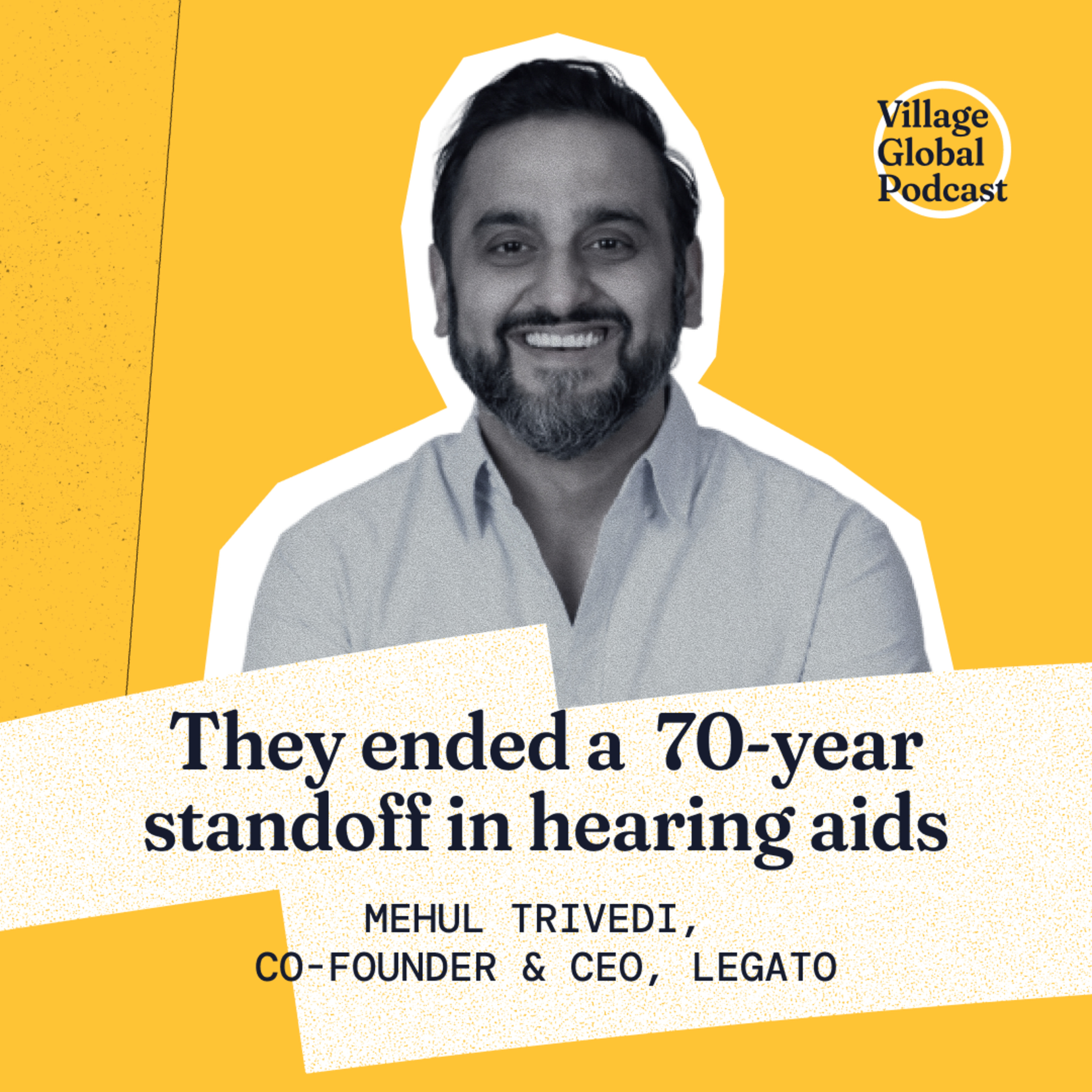
Why the hearing aid industry stopped innovating (regulatory capture, vertical monopolies, comfort/appearance tradeoffs, and “innovator’s dilemma”) and how Legato aims to “no-compromise” hearing by turning prescription-like hearing into stylish, lightweight glasses.
Mehul Trivedi, audio/consumer electronics builder. Worked at Bose, Luxottica, Apple (Core Audio; early iPhone/iPad audio work), and other audio/tech roles. Co-founded Legato with Steve (he ran IP at Bose for 10+ years; also Air Force JAG; EE degree). Trivedi’s focus: audio DSP + making products people love.
Hearing aids are expensive, uncomfortable, and stigmatizing; most users don’t wear them or stop due to retuning/fiddling. Big incumbents can’t easily change form factor; sparse AI enables a cleaner “from-scratch” approach. Legato is designed to be effortless: open/turn on, all-day battery, discreet (no cameras/displays).
HearAdvisor benchmarks reportedly beat OTC and most prescription devices (including in-ear) under ~$5k–$6k; Legato targets noisy restaurants/offices and TV-at-home use.
Written by AI. May contain mistakes.
Learn about the founding of Legato and its vision for addressing hearing loss.
“I've worked at companies like that, right?”
Discover the personal stories and backgrounds that led to the creation of Legato.
“And Legato was kind of a very natural culmination for that.”
Explore the importance of shared values in a successful startup partnership.
“And I think that's a big part of what makes Legato so fun and so satisfying is like getting to do that with somebody who you're just like couldn't be rooting more for and couldn't get more support from.”
Hear how a background in engineering and music shaped the host's career.
“And it's something we thought a lot about when we started is it wasn't just kind of the why of the product and the mission.”
Learn about the host's experience at Apple and the development of iconic products.
“Tell us about that origin story at Stanford and how it got you to where you are today.”
Discover the key moments and projects in the host's career at Bose and Luxottica.
“And at the time, they're basically like Apple and Dolby.”
Learn how an unexpected opportunity led to a career in product development.
“does anybody here, like, you know, who likes to game, right?”
Discover the journey of creating Bose Frames and the satisfaction of impactful projects.
“And the crazy part about your career is that that wasn't the last time you built a product that a lot of people enjoyed.”
Explore the fascination with glasses and their potential in the wearable tech space.
“And so tell us about going to make MetaRay Bands and then deciding that hearing was your next calling.”
Understand the motivation behind the shift from eyewear to hearing aids.
“And how did you decide to go from glasses to hearing aids?”
Examine the barriers to innovation in the hearing aid industry and its implications.
“Can you tell us a little bit about what led the industry to not innovate and what that means to you?”
Learn about the potential of sparse AI in transforming hearing aid technology.
“And the problem is to take that out of your ear and make something that works is incredibly hard.”
Discover how benchmarks and performance standards elevate hearing aid quality.
“I mean, we've had a lot over the last 12, 18 months of development that just kind of jumped out of nowhere because we're doing a lot of stuff that's kind of new.”
Learn about Legato's commitment to creating high-quality hearing aids that blend seamlessly into daily life.
“But it was really critical to us that it was going to be something that, you know, had that effect, right, that it could disappear.”
Discover the characteristics of the ideal customer for hearing assistance and the importance of early intervention.
“Speaking of lanes, who's your ideal user?”
Explore how Legato prioritizes battery life and performance in their hearing aids to enhance user experience.
“It's coming back to that idea of focus, right, is that we knew we needed to be great, and a great hearing aid is one that lasts all day.”
Understand the pricing strategy behind Legato's hearing devices aimed at making them accessible to a wider audience.
“If we want this to be as ubiquitous as addressing your vision, that's something I think that we really want to continue to move towards.”
Gain insights into startup culture and the importance of balance from the founder's experiences.
“Yeah, I think that's kind of what I feel like the most learnings I've had is it's like really – it's not an hour's game.”
Learn about the spontaneous creation of the acapella group Ragappella and its evolution over time.
“Now, switching gears even further back, not only are you a founder multiple times of companies, but you're a co-founder of Ragappella at Stanford.”
Explore how gratitude shapes the desire to create and maintain positivity in challenges.
“And, yeah, I think being able to then bring these things that I cared about together, whether it was school and music or audio and engineering, I think has always been a really fun way to kind of find a lane.”
Discover the significance of unconditional love and support from family figures in one’s life journey.
“And so it's easy to stay positive when you just feel like you're the luckiest person on the planet.”
Understand the importance of having trustworthy investors who align with your values in business.
“Is there anything else that you could be doing that would make your 80-year-old self proud?”
Hear about the future aspirations of Legato in revolutionizing hearing assistance technology.
“And speaking of the journey ahead, can you paint us a picture of Legato five to ten years from now?”

Get the gist, explore an idea or ask about something said.
 Claude
On Village Global Podcast, what are the key points of this episode?
Searching your listeningAutomatic transcript. May contain errors.
0:00I've worked at companies like that, right? Like you come in and be like, by the way, everything we have competitive advantage in and infrastructure and IP doesn't matter anymore. Let's go this direction, right? I'm not going to compromise on what it looks like. I'm not going to compromise on what it feels like. Can I still build something as good or better than in a hearing aid market? And fortunately, the answer was yes.
0:25We started Legato because we really felt that people with hearing loss deserved better. that it shouldn't be a compromise between not being able to hear and connect with the people around you or having to wear something that was uncomfortable and expensive and difficult to use. We really looked and saw that there hadn't been a ton of really great, innovative products coming out, and we thought we could make something that would help people get their hearing back, but do so in a way that was elevated, seamless, and ultimately something they'd be proud to wear. We wanted to build a product that was really no compromise.
0:58We wanted it to be something that was not just a great hearing device, but a great pair of glasses. We ultimately knew that it has to be something that is lightweight, comfortable, stylish, so that you'd wear it every day, like your favorite pair of glasses. But it also needed to work in the environments where traditional hearing products fall over. No matter whether it was a busy restaurant or a noisy office room or just at home watching TV, we wanted something that would be seamless, that would be easy to use, something that was going to work no matter where you put it and it was just going to help you focus on the things that matter, the people and the world around you.
1:31We really felt like it was important to solve this problem because ultimately for so many people, hearing loss is something that just kind of goes untreated, even though the long-term consequences are really quite tragic. Legato frames are really first and foremost a great pair of glasses. We built something that was lightweight and stylish. It's meant to be really comfortable. It's meant to be something that you wear and forget about like you would your everyday pair. What we've done, though, is that we've taken the space in the temple and we've built something that actually performs like a prescription hearing aid.
2:00We can put them on, they turn on when you open them up, and that's really about all there is on your part. The goal is that you wear them and you hear better. It doesn't really have to be much more than that. And so our hope for someone who wears Legato frames for the first time is really that they're blown away by how comfortable they are, by how clear the sound is, by how easy it is to hear people's voice. And then our hope is the second time you wear them, you forget about them entirely. We want something that's totally effortless, that feels as natural and comfortable and discreet as the eyewear you wear every day.
2:29But ultimately, you just leave the day feeling a little bit better connected, a little bit more in the know. We believe that legato is the future of what hearing should look like. Something private, something stylish, something comfortable, and something that ultimately you wear every day, don't think about too much, but just end the day with a little bit more richness in your life. Mabel, welcome. Thank you. Great to be here. Yeah. So tell us about Legato and the mission and all that fun stuff. Yeah. Starting from kind of a little bit of the personal background, like I've been kind of on the audio builder side my whole life and, you know, have always kind of loved this idea of making things, particularly that make sound, that people really love and, you know, help people.
3:10And Legato was kind of a very natural culmination for that. We saw an opportunity for – hearing was a space that was kind of filled with just really terrible products and a lot of people who have a really serious condition around not being able to hear well. And the options that they have for dressing at are pretty weak. And so we – I spent a lot of time at Bose and at Luxottica and even at Apple before that trying to find products that people really wanted to wear and really kind of love to have. And so we thought, well, could we do that in hearing? And the biggest issue with hearing is just that it's stigmatic.
3:48A hearing aid is just not something anybody really wants to wear or be seen wearing. And so we thought, well, glasses are kind of the opposite. Like glasses are actually a corrective instrument that people take pride in and take a – they use that to express their style. They're proud of them. They're excited by them. And so can we take that form factor but actually deliver kind of a hearing product that meaningfully helped folks with loss? And so that was really the impetus for it is Steve and I had met at Bose. And at the time, he was in the hearing division. I was on the consumer audio division.
4:19And we had this moment where we had just kind of launched Bose Frames and we were really excited about it. And the music side of it was awesome. It was exciting. And there was this kind of what are we going to do that could make this something that people wanted to use all day, that would be incredibly valuable. And on the hearing side, he was like, I have this thing that people find incredibly valuable, but how do I get them to actually wear it all day? And so it was kind of this peanut butter and jelly moment. Yeah, brag about Steve, by the way, your co-founder. Oh, man. If there's one kind of pitch I can make around advice to somebody thinking about a startup, it's like the two decisions you're going to make in your life that are going to matter, like finding the right spouse and finding the right co-founder.
4:58First one, definitely the most important. Stona, apologies. Definitely the most important. So, yeah, I like I couldn't have asked for a better kind of partner in this. He is, you know, he's he's brilliant and he's, you know, hardworking. He has all those kind of great qualities of of somebody you want to work with. But I think more than anything, he and I share values. Right. It's it's just a no brainer when it comes to like if we need to figure out like how to do the right thing, what that is like he he serves as that kind of moral compass. And, you know, he's just somebody who I trust completely.
5:35You know, he's got an incredible background. He ran IP at Bose for more than a decade, maybe two, was in the Air Force as a JAG there, got an EE degree to boot, and then knows the hearing industry and is like deeply passionate about hearing and helping people with hearing. And so it's just really fun to work with him because he's so good at what he does. But it's actually just like I'm so excited to be building something with him. Yeah. And I think that's a big part of what makes Legato so fun and so satisfying is like getting to do that with somebody who you're just like couldn't be rooting more for and couldn't get more support from.
6:11He's just – he's great. Yeah. Tell me more about the values that you share because I can think of so many. But ultimately, it's around aligning on a few values that really makes a partnership sing. Yeah. It's a great question. And it's something we thought a lot about when we started is it wasn't just kind of the why of the product and the mission. But really, you know, as a company, I wanted to be and we wanted to be as proud of the way we built the company as the things that we got into customers' hands. And so, you know, I always kind of joked. It's like I want to know that if they ever made a documentary of Legato, it would be something I'd be excited to watch.
6:48Right. Like you've seen what the other side looks like of this kind of Machiavellian, you know, ends, justifies the means. And that really wasn't how we felt at all. I think we've really aligned on we want to prove that you can make great things with good people, right? That it's not this tradeoff between these like cutthroat, you know, 10Xers who are just horrible humans but get the job done, you know, or, you know, having to like mire yourself. Like you can find incredibly talented, passionate people who are kind and thoughtful. And that makes companies work better. Yeah. And that's so – the people we've hired, like I really care about.
7:26I like them as people. They're like – I'd be proud for my kids to spend time with them and establishing that. It's like, well, we want to build a place that people are happy to go, where people feel understood and supported. It's not a I need you to sleep on the floor in the garage and survive on ramen, but it's OK. It will all be worth it if we exit and hit our 10th figure of market cap. Like it was – it's the journey that matters too and finding those kind of like-minded people with those values was something he and I kind of from the get-go were like the no asshole rule was never even stated.
8:02It was just understood. Yeah. That's beautiful. Steve Jobs said at graduation that dots connect backwards, not forwards. Yeah. But you are one of those people for whom the dots really did connect forwards too. You majored in engineering. You also majored in music. Tell us about that origin story at Stanford and how it got you to where you are today. Yeah. Yeah, it's funny. I think in a lot of ways, legato feels like – I kind of joke about this. I think even you and I talked about this where people are like, well, what would you do if it weren't legato? And the honest is I have no idea. I feel like I'm qualified for like exactly one job and one job only.
8:37Skate to one song only. But yeah, for me, I've loved music my whole life, right? courtesy of my dad who we grew up listening to songs in the car over and over again what was your favorite song to sing with dad oh a lot of himy songs yeah um we covered we covered a pretty big gamut we talking like sholey we talking yeah yeah yeah baba kate the hay oh no it works um so we grew up on that and then you know the only shift that happened is like when i started you know when my brother started driving me to work it shifted to like 90s rock and you know nirvana and Pearl Jam, but music's always been a really big part of my life.
9:14The joke, ironically, in our family has always been, you know, my dad was an engineer, and he's been in love with music his whole life. And so for him, when he had kids, he always told my brother, I said, guys, you can do anything you want to do. Like, you don't have to be the doctor, engineer, lawyer. Like, if you want to be creative, you can be creative. You know, I set this up. This is the life I wanted for my family. I have to choose. And then my brother grew up to be a lawyer, and I grew up to be an engineer. What was that for? Neither of you are doctors. Yeah, so I guess that counts. But yeah, so I mean, you know, actually, ironically, you know, he wanted us to learn music and play instruments and play piano.
9:49And I actually really only got into that in high school, like after I had already ignored all the piano lessons and all the singing lessons. But yeah, like once I kind of picked it up, it was just, you know, never look back. Like I loved, I liked playing music. I loved like making the stuff that made the sound actually more than anything. I'm actually, like I said, I can't play guitar very well, but the proudest thing I've done is actually build a guitar. Keep talking about guitars, Michael.
10:16One of my favorite memories in freshman year was you shirtless playing a guitar, actually, in our cafeteria. Thankfully, cameras on phones weren't a thing back then. Exactly, 2001. It's purely an apocryphal story. Yeah, no, I mean, I've always kind of been, like music has always been at the heart of the things that I love to do. And, you know, as I kind of spent time thinking about, like, I always loved to build. And so, you know, in school, like I was an E major, I loved being able to build things. And I loved having that kind of like those tools in the toolkit. And then kind of senior year, I had a little bit of this crisis of like, I love building, but like everything in the pure E side sounds incredibly boring to me.
10:56Like I just, you know, DSP was just too dry and I was never good enough at the math. And so, you know, right around that, I was like, well, you know, where could I put this? And music felt like the obvious place. And so I did my master's actually at Karma. So in the music department, kind of a joint program between EE and music. And that was really where things lit up for me. I was like, oh, like, you know, I really couldn't tell you much about Fourier transforms, but like they get really interesting to me when you talk about how to apply like EQ filters to start doing beat detection or, you know, echoes and, you know, harmonics to make interesting guitar pedals and things like that.
11:28And so, you know, that was really the start of it of just like kind of combining that world of like audio and engineering. And then you were one of the first audio engineers for iPhone 1. Yeah. Yeah, so kind of continuing that theme of being exactly qualified for one thing, I kind of graduated. And I'm like, I really love audio DSP. And at the time, they're basically like Apple and Dolby. And fortunately, one of them gave me a job offer. So, yeah, I went to Apple. And I actually didn't know what I was working on for about the first six months there. Yeah, tell us that story. It's pretty epic. Yeah, it was – I mean so I joined the core audio group and at that time everybody there was like a 10-year-plus vet.
12:10I was the first college person they had ever hired into that group. So they didn't really know what to do with me in the first place and I didn't know what I was doing at all. So I was just kind of minding my time, fixing bugs, doing those things. I was on the software group and I just noticed that these bugs were kind of like increasingly strange to be something that you'd be working on for like a Mac. And so I kind of mentioned that and they were like, don't worry about it. Just focus. I was like, all right, fine. I'll build it. And then eventually they were like, I was like, it's getting harder and harder to actually do this work correctly without knowing what it's for.
12:37And so then, you know, they kind of have the big like you sign the 300 NDAs and you do all this stuff and you get brought in. So, yeah, I was like it was about six months before I knew that I had been working on it. Then we got disclosed and I just couldn't tell anybody else, but I knew what I was working on, which was really amazing. And I think kind of that first foray into – like I still remember that moment of like they announced it and I thought that was great and it was exciting to like know that the product that we were working on had been announced. And then the next – like the front page of CNN was like the iPhone announced, right?
13:06And that was kind of the like – oh, like that was kind of that start of that addiction of building something and just people loving it. And I've always really kind of continued that. It's like you can like a lot of things, but there's very few things that you have this kind of irrational attachment to. And I think companies that do that have always been really fascinating to me. And that's kind of really driven the – Bose and Apple kind of like really defined that, right? Yeah. Is even when they don't work the way you want them, you like – you create this kind of emotional connection. And so that was with the phone and actually I got to be part of the original iPad team as well doing kind of similar work.
13:42You know, kind of fun story in that, too. I was the architect for OpenAI, which was kind of the 3D spatial engine, which I had no business being an architect for. Like, I wasn't qualified to do that. But the funny part was, you know, we were in a meeting and at some point, you know, Scott Forstall had asked, like, okay, well, you know, does anybody here, like, you know, who likes to game, right? And like I mentioned, most of my team was, like, 40 and 50-year-olds at the time. So, like, I just, like, stupidly raised my hand. I'm like, I do. And they're like, great. You're going to work on this.
14:12Because we needed basically what was the dev relations team for folks building a lot of the original games for the first iPhone and the first iOS. And so that's how I got that job. It's just I was the only one who raised my hand. I didn't know any better. And they were like, okay, well, you got to kind of shepherd here and then started to pick that up. But it was awesome. I mean I got to kind of work on some of the earliest pieces there. And the like little demo of Scott playing the game on his phone, the little Star Pilot game. I got to build the audio engine for that. And again, didn't know what I was doing until then.
14:46Didn't know what I was doing when I built it, but just kind of a fun opportunity of like sometimes it's just raising your hand at the right time. Yeah. And the crazy part about your career is that that wasn't the last time you built a product that a lot of people enjoyed. Tell us about Bose and then Luxottica. Yeah. So it was interesting actually. When I left Apple, I started the company. That was a fun experience. And I remember one of our investors at the time had talked about, you know, before you start a company, like it's really important to understand, like, what's your goal here? Like, what is your thing?
15:16And it was interesting, you know, my different co-founders had, like, talked to, like, what would it be for them? And, you know, you kind of covered all of the map, right? Some people, like, want to, you know, start a company worth this amount or make this amount or have so many employees. And for me, it was just from the get-go really simple. Like, I wanted to make something that a million people loved, right? Just coming back to that, doing something that feels magical to people and is just like deeply satisfying to watch somebody enjoy the thing that you've put all this time and energy into.
15:40And then hitting some level of scale that it was like meaningful. And so that was always my thing. And at Noise Toys, we never quite got to that level. But when I was at Bose, we had this idea for Bose Frames when we came in. We had seen this tech for open-ear technology and we loved it. And then we thought, well, form factor is going to be a big deal here. So we put it in the glasses. and, you know, kind of from pencil sketch out to like consumer mass production. Like I got to kind of leave that effort and it was incredibly satisfying. And then there was this moment where like when they built the millions unit off the line, they sent it to me.
16:13Wow. Because I had told them this story, right, about like that was my thing. I was like I want to make something that a million people love. And so I like still to this, like I was just that little moment of it's like, oh, it's all gravy from here, right? It's just like that's what I wanted and it just that was a nice moment. Wow. That's incredible. And so tell us about going to make MetaRay Bands and then deciding that hearing was your next calling. So, you know, I was at Bose and we had built that out. And I, you know, I had started and kind of moved from the R &D group into the concerned electronic side, led the Bose frame stuff.
16:51Then they kind of moved that to open ear and then they brought kind of all of wearables together. And so I led the headphone group there, which was awesome. I mean, it's like I grew up kind of worshiping Bose headphones and speakers. So, like, getting a chance to actually, like, lead that was pretty, you know, eye-opening. Epic. Yeah, exciting. And there was this moment though where I realized that like as exciting as that was, like I couldn't shake the glasses were what would like kind of like keep me up at night. It's just I just thought that form factor was really interesting. There was just nothing great coming out.
17:21And so – And like that's interesting because I don't remember you really wearing glasses. No. I mean this is just kind of the full irony of everything. Like I got LASIK when I was like 25. I've just like excluded myself from my own client population from the get-go. But you've always felt like a resonance with glasses? I've always loved this idea of building products that can disappear. And like glasses to me, not even smart glasses, but just glasses have always been fascinating because people wear them and it means a lot to them. And by and large, you spend most of your time forgetting about them.
17:56Right. And I just thought that was a fascinating concept. And so, you know, at Jawbone, we were building wearables. At Apple, obviously, we had done the phone and we had done the watch. And so kind of wearable technology is always interesting. And glasses were always just a fascinating form factor because in so many ways, all of this movement is towards things that you like hide or things that you like try to replicate. But glasses don't have an equivalent. Like glasses are just glasses. They don't replace a thing that you used to have, right? But they're just – the kind of core essence of them is like, yeah, I wear them and I'm proud of them and I can forget them at the same time.
18:32of it's this really interesting combination of things. And so I just saw that as like a – I think there's something interesting you could do. And particularly when you think about like where they live, right? They live right at the intersection of kind of your primary inputs in audio, which is your ears and then your primary output from your mouth. And so it's like, well, if you're going to build something and you need to be able to communicate to the person and take input from that person, like it's pretty ideal in a lot of ways. And so we always felt like the frames were like a great step in that direction.
19:01still wanted to do more on it. And ultimately that was kind of where I led to the Luxottica side is like they had reached out and they wanted to build out a smart eyewear group. And I was like, I really believe in this space. I don't know how to make something more valuable, but I think that you will and can. And so I came over and started that work and got to lead the teams that were doing a lot of the work with them, collaborating with Meadow on that work as well as the hearing side of what became kind of the Newhouse Audio Glasses. Yeah. Very cool. And how did you decide to go from glasses to hearing aids?
19:37Yeah. So hearing for me has been interesting. I actually – in my master's program, one of my projects for my thesis was cochlear implants and looking at that world. And I've always kind of found it fascinating of – audio I think is interesting in all these ways. And at JobOwn, I had gotten a little bit more of an introduction into the kind of wellness side of the world. And I realized that applying audio to actually help people was a particularly interesting and compelling thing. As we were building, I was just looking at – like I mentioned, when I was at Bose and Steve and I were talking, there was this interesting thing.
20:13If you had this product or idea that was like unquestionably valuable, that people with hearing loss need hearing aids. And when you restore their hearing, there are so many amazing benefits. And it was just held back because not enough people were willing to do it. And so, yeah, I kind of thought about that and I was like, well, if I have this form factor I think is really interesting, but I want to go solve a real problem. Hearing kind of came in. It's like that's the opportunity. It's like solve a real problem and hearing felt like that. I was like, well, this is one of those kind of nice Venn diagrams.
20:44Like I have a form factor that I think is really interesting and I have a problem that I think is really worth solving. And so that kind of felt pretty natural. Yeah, that's awesome. And I know that you've previously said that hearing aids is an industry full of compromises. Yeah. Can you tell us a little bit about what led the industry to not innovate and what that means to you? Yeah. I mean this was something – and Steve had a lot to do with this because he knows this industry so well. But it's fascinating when you look at it. It's a pretty – in a lot of ways, it's a pretty classic regulatory capture problem, right?
21:22You've got up until – for a long time, up until very recently, they were only a prescription device. And so basically all of hearing is kind of covered by five companies, four of them in Denmark. They make the devices, they hire the audiologist, and they run all the clinics, right? So you've kind of got this like vertical monopoly. And the incentive there is really like they're really high margin devices, right? A hearing is$6 ,000 or$7 ,000. And then in order to go, you know, the cut to the audiologist is high. And, you know, they've all kind of settled on this like local maxima, right? They found this form factor that kind of mostly works.
21:56And people, if your hearing loss gets bad enough, they're willing to wear it. And then they've kind of spent the rest of their energies on just like, you know, I'll make some custom silicon. So it kind of sounds a little bit better. And I'll add classifiers so that I can add more different environments where they kind of work. But like the core of it is it's like a tradeoff of like the hearing aid is uncomfortable and it's expensive and it's ugly. And that's because they can't really solve that. It's the only way they can get audio into your ear with any kind of level of effectiveness. And that was kind of when we – it was like, well, that's – you're holding back the whole industry if you're going to force people to do something they fundamentally don't want to do, which is wear a hearing aid.
22:32And the problem is to take that out of your ear and make something that works is incredibly hard. And that was kind of one of those leaps of like classic big company innovator's dilemma, right? Like they got really good at making this like specific thing. And the leap to get out of it to change the form factor is a monster one. And here again, you see kind of a natural technology wave of they've been using a DSP approach, right? So a typical hearing aid is really relying on I want to focus on a really narrow slice of space and I want to then kind of filter for the voice band. Kind of works in this specific environment in a quiet room.
23:04You add noise, you add reverberance, it all kind of goes away. But that's kind of the most you're going to be able to do with a DSP approach. Sparse AI processing gives you an entirely different set of tools, right? So a classifier that can identify speech versus not kind of changes how you want to approach the whole system. You know, tell four companies in Denmark who have been doing something for 70 years the same way, I have a, you know, technology approach that like more or less obsoletes the last 50 years of work you're doing, right? And imagine how well that goes over. Like I've worked at companies like that, right?
23:34Like you come in and be like, by the way, everything we have competitive advantage in and infrastructure and IP doesn't matter anymore. Let's go this direction. Right. So I think you kind of see it. It's just it's been a lot it's been a lot easier for them to kind of just like wipe out that space, pretend it doesn't exist, then to like, you know, engage in like disruptive big change and just kind of adjust the approach across the board. And so for us, you know, we had a clean sheet of paper. And so we just started from, OK, what's possible if I start from a sparse AI system and then go with this like – I'm not going to compromise on what it looks like.
24:07I'm not going to compromise on what it feels like. Can I still build something as good or better than any hearing aid in the market? And fortunately, the answer was yes, right? But it really just takes kind of a foundationally like I have to throw out the previous assumption of like the way you build it. And that's certainly been hard. I mean, we've had a lot over the last 12, 18 months of development that just kind of jumped out of nowhere because we're doing a lot of stuff that's kind of new. And so it's always a little bit trickier and a little bit harder. But also what's really satisfying is that it's really hard to build a product that you genuinely believe doesn't have a tradeoff, right?
24:42And there's a million things that I would continue to improve and want to fix about the current product. But it is fundamentally, in my view, a really great hearing product and a really great pair of glasses. And that's enabled by, I think, kind of technology that disrupts the existing system and then just a willingness to really like look at things from the ground up and rebuild. Yeah. It's pretty incredible. I mean when you think about the tradeoffs that you've managed to escape, tell us a little bit about the benchmarks that aren't just your opinion. It's third-party validated for the quality of Legato audio versus the status quo.
25:19Yeah. Yeah, I mean, that was something we were really proud of is, you know, we, again, kind of coming back to values when Steve and I had talked about, like, what does this need to look like before we chip it, right? And we talked about this. It's got to be great glasses and has to be a great hearing aid. It can't be good. It's got to be great. And so we always knew that, like, we wanted to benchmark against, okay, this needs to hold its own, you know, against anybody in the space. And, you know, we designed ourselves an over-the-counter hearing aid, right, in that kind of price point. So we were like, we feel like we should go toe-to-toe with those.
25:46And then there's kind of the, you know, prescription tier, right? the$6 ,000,$7 ,000 ones tuned by an audiologist, you know, kind of a lot going for it. And we were kind of pleasantly surprised that, like, the theory we ran with worked out a little better than we thought. And so our, you know, HearAdvisor, which is kind of the gold standard for reviewing kind of hearing aids and testing performance across, you know, different environments, different listeners, our results came in and we're actually beating not just all the OTC devices, but almost every prescription device. Even the in-ear ones.
26:16Yes. Yeah. We all, you know, all OTC in-ear devices, you know, any prescription device under$5 ,000 or$6 ,000, like we outperform. And the interesting thing about that is it's not just, you know, in-ear is one thing, right? And being able to move externally. These are also devices that have been tuned by an audiologist, right? Wow. For us, it's, you know, you're talking about a pair of glasses that you basically just open up and turn on, which, again, meant a lot for us because one of the problems you have is if you make, you know, a device that you've got to go and get configured, you've got to go to multiple trips to an audiologist.
26:46You've got to kind of tweak it and fiddle with it. It takes away the magic, right? It's just that much easier to give up on it, which is a big problem with hearing aids. A lot of people – by the time the funnel, you kind of look at 80 percent of people with hearing loss will not wear a hearing aid, right? So you've got like a huge group of people who just aren't even bothering. And then even amongst the people who finally do kind of like sigh and sign up, we've got a massive number of those folks who just stop wearing them, right? And return rates on hearing aids are astronomical because they just can't get used to them.
27:13They don't like them. They don't work well. And they don't want to go back to an audiologist every two months and get it retuned. So we really wanted to solve both of those problems is like get the 80 % of people who won't be seen in one and fix that with the glasses and then get those people who are trying them and just tired of fiddling with them and build something that really kind of like just works. And so we were really excited because like those are, you know, almost foundationally at odds with the idea of something that like maximizes performance. And so we were really happy that we actually kind of brought those together.
27:40It is the easiest to use. It is the nicest looking. and it is, you know, in the highest performing. Do you want to show it off? Yeah. A pair of glasses? Yeah. So, you know, the goal, again, like we mentioned, we wanted it to look and feel like real glasses. So, like, I put them on and, you know, I think I look at yours like mine. And, you know, my goal is to be indistinguishable. Potato, potato. But it was really critical to us that it was going to be something that, you know, had that effect, right, that it could disappear. I always think about it's like the first impression I want somebody to have with the glasses, they put them on, they're like, wow, like I can hear better.
28:14And the second impression is I forgot about these. And, you know, kind of to the idea of compromise, it was an interesting one because what we realized is there's two ways to think about the compromise. In a lot of ways, when we thought about what we wanted to accomplish, we had to be no compromise. Like we wanted to accomplish, you know, being a really great hearing product and being a great pair of glasses. And we wouldn't compromise on being good at one and great at the other, or bad at one and, you know, go to the other. On the other side of that, I think, you know, what you're willing to not do and what you're willing to take out of the product or not put into the product.
28:47And that focus, I think, is fundamentally what enables the first, you know, ability not to compromise on the thing that matters. And so we spent a lot of time of like, you know, we cared about privacy. We cared about discretion. You know, we didn't put cameras. We didn't put displays. Like we really focused on if we're going to make this great at these two things and we have to be like ruthless about cutting anything that doesn't serve that mission. And so we spent, you know, there's a lot of people who have talked through the like million things that you would love for something to do, or, you know, you've got this thing on your head.
29:17What about, you know, adding this feature or that feature, adding this capability? And I think you see this within bigger tech, like, you know, not to soapbox too much, right? But I think there's, there was this shift that feels like where, you know, early 2000s, like in that kind of like Apple heyday, right? It felt like we kept coming out with stuff that people really wanted to use, that solved really interesting problems, iPhones and digital cameras and iPods and watches and GoPros. They solved real problems and they were really good at it. And then it seems like we had this kind of move towards tech kind of saying, you will like this because I need you to use it, right?
29:57Whether it was just the like – you see this with a lot of existing smart glasses. Like it's technology in service of a solution. And we really wanted to go the other direction. Like we wanted to go back to that like let's serve a purpose. Let's solve a really useful problem, focus on solving that problem, and live with that. Like start from there and be happy with it as opposed to kind of like let me start from what I as a business want to put out in the world. I'm excited actually because I think if we can continue to move in that direction, it kind of gives us our lane. of like I want to stay committed to like a ruthless focus on solving problems that our customers actually have and not trying to kind of shove things in there that they like will deal with.
30:40Speaking of lanes, who's your ideal user? Because you have quite a large market to address. Yeah. That's a great question. I mean I think obviously the core of it is somebody who needs hearing assistance, right? In that way, what's interesting is the more you kind of dig into the space, It's not kind of a binary thing of like you have loss or you don't have loss, right? One of the reasons it's so hard to get people to really address hearing is that it's a very gradual thing, right? Age-related hearing loss really starts right around 50 years old and it kind of progresses. And this is part of that like death by 1 ,000 cots, right?
31:16At 50, most people would benefit from a little bit of hearing loss. But again, you look at the solution, you're like, well, I'm not paying$7 ,000 to look 20 years older and deal with this like ridiculous device. And so you just kind of deal with it and then you have all these kind of counterproductive behaviors. If you turn the TV up and you kind of ask people to repeat themselves all the time and you listen to things too loud, it just kind of makes the problem worse. Then eventually you just kind of – you come up with your own coping mechanisms, which are, again, not good for you generally, right?
31:45But also have a broader impact. If you just – you kind of like recede, right? People, you kind of just – There's an impact on mental health. There is. I mean, there's actually a 62 % reduction in dementia and depression risk for people who get hearing loss addressed before the age of 60. And it's because of that. Like that cognitive accuracy is very real. Like when you stop asking somebody to repeat themselves, it's because you're not engaging in the conversation anymore, right? Then you just stop going to the restaurant overall. Then you kind of sit in the corner in the chair and then you start to isolate yourself just kind of as a habit.
32:16And so when we think about that kind of ideal customer, it's really like the earliest we can get, right? How easily and seamlessly can we address the problem when it's still kind of a small thing and get them used to just – I think about this in the context of vision. You get your vision addressed as soon as you can. The idea of not being able to see well enough to get a driver's license and then just going around the world blurry is crazy. And our goal is to really kind of apply that same standard to hearing is like anybody with any level of loss can be helped. and there's huge long-term benefits to it.
32:53And so if we can just make it simple to solve that problem and then you just kind of move about your day, you don't think twice about it, that's really our goal. And our ideal customer is someone who's kind of would be in that range, right? Like they're able to kind of acknowledge that, yeah, this would be something that would help me. They try the glasses, they work. And then you, you know, it's just something you just have in your life and you don't want to live without. Yeah. And, you know, speaking of which, which the battery life on your device is outstanding such that you really don't have to think about it in a way that other solutions like AirPods or something else might not entail.
33:30Tell us more about that. Yeah. It's coming back to that idea of focus, right, is that we knew we needed to be great, and a great hearing aid is one that lasts all day. It doesn't help you to only hear things for a couple hours and then have the rest of your day be silent. But those are tradeoffs, right? Like, you know, putting a ton of processing in there to try to do six other things drains battery, right? And so we really wanted to, okay, let's build something. You know, one of the really nice parts of the approach we take on the sparse AI side is that that processing system is significantly more power efficient than a DSP system.
34:04So we kind of get this nice win of architecturally we have this, you know, kind of favorability for something that's small. And we can still deliver it in something, you know, lightweight and small in size. But, you know, having a battery that gets you through your entire day, being able to hear was really critical for us. And by focusing on the product, just doing that job, we do that really nicely. To your point, you know, a lot of other, you know, kind of consumer side approach here is like, you know, they start with what they've already solved and they see how much you can get with just tacking it on.
34:37And, you know, when you've already got a five-hour battery max for a pair of smart glasses, the hearing assistance is just going to drain that faster, right? Yeah. And so we've kind of seen that value of like being purpose-built really helps us here because you can't solve this problem well enough as an afterthought. Yeah. And tell us about the price. Yeah. So that was another piece for us is that we really wanted to –$6 ,000 for a hearing aid just takes most people out of the market. And we wanted to build something that would go toe-to-toe with all of those folks. But we also realized that if we wanted a mass number of people to adopt it, we also needed to do something there.
35:14And fortunately, like Steve and my background, coming from that consumer electronics side of the world, we designed the product in a way that's like, all right, let's think about this much more from a mass market device. Because hearing loss is a mass market problem. There's a billion and a half people with this problem. So, like, this idea that it needs to be niche and that we should build some kind of ultra-premium, high-priced thing, I think the problem you have right now is you've eliminated people who need the product from the consideration set, right? Whether it's price, whether it's form factor.
35:41And so if we have a form factor that makes it more addressable, we want it to have a price that would also make it more addressable. We also get some benefits because those glasses, they qualify for vision insurance. And, you know, I think one of our long-term goals is really to figure out, like, how do we make this, you know, as accessible as possible, right? If we want this to be as ubiquitous as addressing your vision, that's something I think that we really want to continue to move towards. I want everybody over the age of 50 on the planet to be able to get these and use them and benefit from them.
36:09And so I think that's a big focus for us. That's beautiful. You've started two companies. This is your second company. What advice would you have for founders who are thinking about breaking out for the first time beyond find your Steve? Advice to my former self. Find your Steve is a really like I would get that tattooed on my arm. I think probably the biggest learning or biggest, you know, piece. And I was talking to a friend of mine, Avicel, about, you know, when I was thinking about starting Legato. And I, you know, at the time I had, you know, I was taking time off from Legato. I was like kind of on my own.
36:49We were actually expecting our second kid. And, you know, I was kind of asking what he thought about it. and what it was like if going back into the startup life. And he was like, well, remember, he's like, think about what you bring to the table as a founder, right? And he's like, when you're kind of young and stupid, the thing you have is time. You can just throw hours at a problem. And I realized that that was very much what we did with Noise. We threw hours at the problem. We didn't really have a particularly thoughtful approach. We were just like, we can spend all day coding, so let's just spend all day coding and then see what comes out from it.
37:19And with Legato, I really wanted to think, Well, that's not what makes my entry here valuable. Like what I can bring to the table is kind of insight and wisdom. And really more than anything, what that creates is balance. It's like I don't need to throw out with a problem. And I think had I thought about that a little bit more the first time, right, it's pretty rare that the only thing you can throw at the problem is ours. And it's really tempting to look at every story that you see is the like sleep on the floor, eat ramen, don't sleep, alienate your friends. And honestly, I made a lot of those mistakes.
37:57Like I could have been better. I don't think a single one of those things actually helped the company. I think it's easy to fall into that trap because if you go do that, you're matching these other people and other stories you've heard. So like then whether the outcome is good or bad, you're like, well, I did my best. It's like that wasn't really your best. That was just the most. And so, you know, being really thoughtful about – I think it's absolutely possible to build a great company with a level of balance that you can be proud of and that you can build into the culture. It just requires a little bit more thought.
38:29Like it's very tempting to throw hours at the problem when that's the thing you feel like you have in abundance. But I think, you know, there's usually a better way than that. And I think there's this like kind of network effect of like when you can do that and model that, the teams that you build, the people who are drawn to solve the problem with you and the way that you solve it are also better. Yeah, I think that's kind of what I feel like the most learnings I've had is it's like really – it's not an hour's game. It's not a like martyrdom thing. I think you can do it in a way that still stays consistent with what you want to achieve in your broader life.
39:08It's just really important to understand what that is. Oh, for sure. It's funny. I was talking to a founder earlier today. It's really lovely that you're giving this type of advice because I think people really need to hear it. One needs to be mentally healthy and well-rested, et cetera, to birth positive some visions into the world. and that's actually a strategic benefit that people overlook. I totally agree with you. I remember at one executive retreat, I can't remember exactly where or which one, but there was a moment where we were talking about diversity in the leadership ranks and how we wanted to approach it.
39:54And the CEO would just ask, why don't we look like our customers? Right. Just it's just like a very and everyone kind of looked around like, oh, right. It's like, yeah, that's that's a problem. Like it's hard to build and empathize with people that don't exist around you. But I think in this world, like there's an interesting dimension to this, which is like if you can't be a human in the way that you build and run your company, we're trying to build for people who are pretty fundamentally human. And so, like, you lose that empathy. And so the more you become this like maniacal cyborgian, I don't sleep, I don't eat, I don't think about anything other than this.
40:33All of the people who I want to use these things have a lot of things they care about. They have people they care about. And if I don't care about people and I don't think about people, I really don't understand how I'm going to build something for people. And so, yeah, I totally agree with you. Like that, it shows, right? Like you talk about shipping your org chart. If you've got a bunch of just miserable drones just kind of like slamming away at this problem, are you really going to build something that like sparks joy? Are you going to build something that feels thoughtful and crafted and that allows people to take a moment?
41:09Yeah. Yeah. That's beautiful. I can tell that that intentionality is going to translate into the relationship that you have with customers because there are folks who would build the same product but have in mind, I'm going to turn humans into Iron Man. And you're trying to make humans more human. Man, you should work for our marketing. Yeah. I used to always joke that when we were thinking about this originally, the tagline is Clark Kent had it backwards, right? Porn on the bus, be superhuman. Yeah. I think to your point, actually, not to nerd out on the comic side here, but what I think is interesting about Superman is his desire is actually to be more human, right?
41:49And I think that's an opportunity here. I think you're 100 % right. There's these kind of movie-based threads about trying to be something kind of bigger than that. But I actually think what we could use more of is humans being human and just helping people regain that I think is a much more interesting kind of problem to solve. That's beautiful. Now, switching gears even further back, not only are you a founder multiple times of companies, but you're a co-founder of Ragappella at Stanford. Yeah. Tell us why Ragappella needed to exist when Penmasol already existed. That's a good question. I mean, I guess I never thought about it from a market dynamics perspective.
42:30it was really kind of born out of there were just like four of us that like really liked to sing and there was an itch that we kind of wanted to scratch and it was we were passionate about it and we wanted to you know make something and it didn't exist in the local maxima but um yeah i think it was it was our opportunity like i loved music i loved the music that i had grown up with and i kind of saw an opportunity of it's like okay can we spread that a little bit right um we actually didn't plan to start a group. Like, it was actually just kind of four of us, it wasn't even four of us, it was the three of them who...
43:05Name names, man. Oh, yeah, yeah. Sudeep and Jay and Bobby who were the, you know, original folks, they came in to audition for like a cultural show for Rhythms. Yeah. And they were just like, oh, we want to sing a song. And they're like, you know, if you know Jay, you know, that is just the most natural thing. Like, if you give him 15 minutes of silence, he will start singing, because it's 50 seconds of silence. And they were like, we want to sing. And I don't even know why I was there. I was just in the room. Like I wasn't planning to sing. I wasn't a formal part of anything. But they just started to – they were like, we want to sing a song.
43:36They're like, what are you going to sing? They're like, we don't know. I was like, how are you going to sing? It was like a cappella because none of us play instruments. And so they just kind of started and they were like, oh, I think we need another person. And I was kind of sitting there and I'm like, I mean, I guess I can join you guys because like you can hear the spaces when you're breathing. Maybe a fourth would help. And so I just kind of joined them in the like audition for lack of a better word. And we sang and people seemed to enjoy it. And I guess kind of coming back to that, it was just like it was just fun to do something and watch people enjoy it.
44:00So we did that. And then after that show, Bobby had come and been like, you know, we can start a group here. And I was like, I mean, sure. Why not? I'll sing again. So we kind of then just like decided to do another performance in the spring at Mela and kind of just ran with it from there. Yeah. Yeah. That's pretty cool. I mean it's still going strong, right? It is, yeah. and it's kind of evolved with the times like we started you know we were all male because nobody else would join us and then there was this kind of big push of it's like why are you guys like you know be more good you should do co-ed there's lots of people want to sing they became co-ed which is great and then you know they put out a couple albums actually one of the big kind of movements I had professionally was like when I was in my EE program my senior year I was recording the album for for Ragappella and that was kind of where some of this clicked where I was like Like, you know, all of the fun things that I'm doing in my, like, homework are when I can relate it to some sort of concept that I would then apply in the studio.
45:01Yeah. And so, you know, I kind of ragapels holds a little special place in my heart because I really think a lot of ways it was like kind of catalyzed that shift into the, you know, even if the dots connected forward, right? Some of these things, it's like, how do you connect these two dots? And I think ragapel actually ended up doing a lot of that. And do you think starting ragapel was part of your founder journey as well? I think so. I mean, it was interesting in a couple of ways, right? It was kind of one of those like I didn't think of it as starting an acapella group, right? I didn't think of it as from the outcome of like, well, this would be great if I can like come back and – there's actually the vocal recording studio at Stanford is named after Vivek and I, which is kind of a fun kind of circle back moment after we had kind of sold Noises.
45:43But yeah, it was just kind of like I just found something that I really enjoyed. And when I saw that other people were enjoying it, kind of like, OK, well, let's start from there and then just see where it goes. And, yeah, I think being able to then bring these things that I cared about together, whether it was school and music or audio and engineering, I think has always been a really fun way to kind of find a lane. That's incredible. How do you tap into the positive energy that drives your desire to create for the world when the going gets tough? I mean I think the core of it, I'm deeply grateful.
46:21Like I think about the opportunities I have. I think about just like the way my life has gone and like – I mean I could not have drawn up a better set of parents and a brother to grow up in or like a life story living in the south and growing up kind of all over everywhere, coming out here. I nailed the hardest decision in my life and in my spouse. And like, again, just the absolute best partner you could possibly imagine, you know, two kids that I adore and, you know, cannot get enough of. But I think all of it has just come down to like, I'm so deeply grateful for the community I have around me, the people around me.
47:01And, you know, I've been so lucky to get a chance to do things that I love and have them translate in some way to like continuing to be able to do them. And so a lot of it for me is it's just like I just really love that journey. Like the outcomes have been some good, some not. It doesn't matter to me. Like I can just look back and like I've – so much of my life professionally and personally is just kind of at its core defined by joy. And so it's easy to stay positive when you just feel like you're the luckiest person on the planet. That's beautiful. And at Village, we think of ourselves as network native venture capitalists.
47:35We believe in the power of a village. Is there anybody that you'd like to give a shout out to and gratitude who isn't currently in your life but made a profound impact on your ability to be here and building such beautiful things? I mean the person that comes to mind, I'd have to say my grandmother growing up, my daddy, I think always had a really profound impact. It was interesting. So she only spoke Kajati and I don't speak a word of Kajati. So, you know, I don't know that we ever really had a conversation so much as it was like pointing at things and her just kind of like telling me, you know, like holding my head and stroking my hair and telling me how great it was.
48:15But I think she for so much of my life was just this like always in my corner kind of like definition of like unconditional love and support. I feel like the seminal story for me like I you know when I was at Apple we we launched the like FaceTime for phones right and I remember I we FaceTimed her like she was living with my my family in Kansas and you know we were in Dallas at the time and I like FaceTimed her so the first time she just got to do like a little video chat on the phone and like I still remember this vividly of like it you know she answered like my uncle answered and gave it to her and she saw my face on the phone and she lost it.
48:58Right. And she was just like, like literally like trying to like pet the screen was just like, it's mehuli, it's mehuli, it's mehuli. That was the only thing I could understand was she just kept saying it over and over again. Like she couldn't believe it. And like, I just think about that moment of it's like, I really wish that everybody in the world could have like, everybody needs that type of person, right? That person in your corner, no matter what, who you know, no matter how hard something is, no matter how bad you screw something up, no matter what you do, you've got somebody who can like love you that way.
49:26And I think that has really defined like trying to be that person for as many people as I can and just, again, being grateful for like that is just such a gift. And anything I can do to kind of like make something meaningful out of that and be grateful for that and kind of pay that forward, like I think that's probably drives a lot of the way I like want to treat people in the world. That's really beautiful. Is there anything else that you could be doing that would make your 80-year-old self proud? Oh, man. I can't think of anything I'd be doing that would be more fun. You know, my hope is that, like, at some point I would love to turn more of my energy towards a more kind of proactive, like, I am deeply grateful and turning that into more action of, like, I think I look right now at what I'm doing is, like, I think I can help people.
50:22people, I think there's always more ways to help people, right? And, you know, whether capitalistic or otherwise. And so, yeah, I would love to continue doing that. And I mean, if I really think about it, if I can raise my kids and, you know, my nephew and niece and the people around me, like, if I can know that any little part of that, like, they're such wonderful people, like, if there's even a little part of them that is just a little bit more kind or a little bit more grateful or a little bit more joyful because of like an interaction I had with them or a thing I could teach them or a thing that they saw, you know, in me, like, I think that would be, that would be it.
50:58That's beautiful. So, Mehul, tell us a little bit about, you know, obviously you have to find your Steve, but tell us about the investors along the way that have made your journey worthwhile thus far. Yeah, I think this is one, you know, that again, it's kind of easy to overlook, right? But you talk about kind of quality of investors and it's easy to look at it as like a, who's got the best track record, right? Which is the biggest name on the banner, who's on the Midas list. But I think what we really found is we really kind of extended these of like, we wanted employees and like, we wanted team members that were like an extension of our values and what we cared about.
51:38And I think we very naturally kind of brought that into who we wanted on the investor side. And I've been really happy with that. Like we didn't try to maximize for like valuation or brand name. Like we wanted to find people we really cared about. And obviously like, you know, you and I have known each other forever and that was a big deal. Like I, I trusted you. I liked you as a person, you know, we like to hang out. And, and I think applying that broadly, like that was, you know, our first investor, um, Kit to Glory for NeoTribe, he had invested in, in, uh, uh, noise toys as well. And, you know, all kinds of rollercoaster there, right?
52:11But what I loved about it was, you know, whether it was good news or bad news, like he was always in our corner. He was somebody we trusted, someone we believed in. And so it was kind of a no-brainer for us when we started this that like, you know, when he offered to invest, you know, we jumped at it, right? And I think similarly, like, you know, you and I have been through this already where like, we haven't even launched yet, right? We've had great news about, hey, here, Advisor, just, you know, put us at the top of this list. And then we've got the, by the way, like this chip is not working and we're going to in six months.
52:40But what has never shifted is kind of that belief, that support. And I think that's so incredibly valuable. Again, having an investor team that you're as proud of as the product you build, as the people that you hire, it's a really big deal. And knowing that you can trust them, that it's not this shell game of, well, if I don't show X metric, they're going to vote me out. And, you know, or like as soon as I can get a higher number, I'm going to go after that. Like it really is – it's an extension of what you're trying to build. And so I've been really excited. I'm really happy about that. Like the folks we brought on, I like his people.
53:18And I think that's a big reason why the journey thus far has kind of stayed the way it has. It's like I trust you guys. I trust our broader investment team. And frankly, even as we move forward, I think that's going to be our single biggest metric of like, are these people we want to work with? Are these people we like and care and share values with? That's beautiful. And speaking of the journey ahead, can you paint us a picture of Legato five to ten years from now? Yeah. I mean I look at it as – I want hearing assistants to be as commonplace as vision assistants, right? That the idea of like going to an eye doctor and coming out with glasses is the same as coming out with like hearing glasses.
53:59And I think if we can be that for this one and a half billion people, right, I think we can have a really big impact. I think we can help a lot of people just reconnect with the world around them, their family and their loved ones. And I don't see any reason why that isn't the case, but I certainly five to 10 years from now would love if Legato were like a major catalyst in helping that transformation. I think that there's something really powerful to just finding a problem that a lot of people have and just solving that problem and doing it in a way that is empowering and seamless and innovative.
54:39Yeah. Yeah. Well, there's a strong chance that you're doing more than hearing assistance over time, right? Would you like to talk about that vision? Yeah. You know, I look at it as if we come to our mission of like we want to help people reconnect, right? And so for so many people with hearing loss, that's a function of helping them hear. You know, if you look at that customer or someone who's in their 50s who's, you know, in many ways at the peak of a lot of their, you know, career and personal life and history. But a lot of things that are – they're nervous about maintaining, right? And we see, hey, if we can solve this problem, like we can take this issue that's right now very clinical and very stigmatizing and make it really kind of approachable and simple.
55:24There's a whole slew of these, right? Like when you think about your mental health, your mobility, your memory, and if we've got a device that can last a really long time that's private and discreet, that's really helpful to you in an easy way, I think there's a whole slew of things that we can kind of help them with. And so I'd love to do that, right? Like five, ten years from now, if this is just the glasses you wear and you feel better, right? You can reconnect with the world better. You move better. You remember better. You see better. You hear better. But I think there's a lot of opportunity there.
55:59Very cool. So where can we get Legato glasses? Yeah. So excited to have them out. So legatohearing.com is the site. You can actually go. You can order them straight from there. We can also from there kind of show you. We've got really great kind of eyewear clinics across the country who also have products that you can go in store and get demos. You can find the kind of closest one to you there as well. But yeah, I would love for people to try them out, whether for themselves or relative. Awesome. Well, thank you, Mayhol. Thank you. All right. Appreciate it. Yeah.
56:37Hey, this has been Kaznoka, co-founder of Village Global. Thanks so much for tuning in to the Village Global podcast, where we go deep on all of the biggest topics in tech. If you enjoyed this conversation, please subscribe to our YouTube channel. You can check us out on Spotify, Apple, wherever you get your podcasts. We'd love to see you for the next one. 2
Mehul Trivedi is co-founder and CEO of Legato, a company building glasses that double as prescription-grade hearing aids. Before Legato, he was one of the first audio engineers on the original iPhone, led Bose's wearables and headphone group, and helped build out Luxottica's smart eyewear division, including collaboration on Meta's Ray-Ban smart glasses.
Amrit Rao sits down with Mehul to trace his path from a childhood built around music and engineering at Stanford to building hearing technology hidden inside a pair of glasses people are actually proud to wear. Mehul breaks down why the hearing aid industry has barely innovated in 70 years, a classic case of regulatory capture dominated by a handful of companies, and how Legato's approach using sparse AI processing instead of traditional DSP let the team build a device that outperforms not just over-the-counter hearing aids but most prescription devices under $6,000, according to third-party benchmarks. He shares the story of meeting co-founder Steve at Bose, why finding the right co-founder was one of the two most important decisions of his life, and how the company has tried to build without sacrificing balance or making anyone sleep on the floor eating ramen. The conversation also touches on his time co-founding Stanford's a cappella group Ragapella, the grandmother who shaped how he thinks about unconditional support, and his long-term vision for Legato addressing far more than hearing loss.
Thanks for listening. If you like what you hear, please review us on your favorite podcast platform. Check us out on the web at www.villageglobal.com or get in touch with us on X @villageglobal. Want to get updates from us? Subscribe to get a peek inside the Village. We'll send you reading recommendations, exclusive event invites, and commentary on the latest happenings in Silicon Valley. www.villageglobal.com/signup