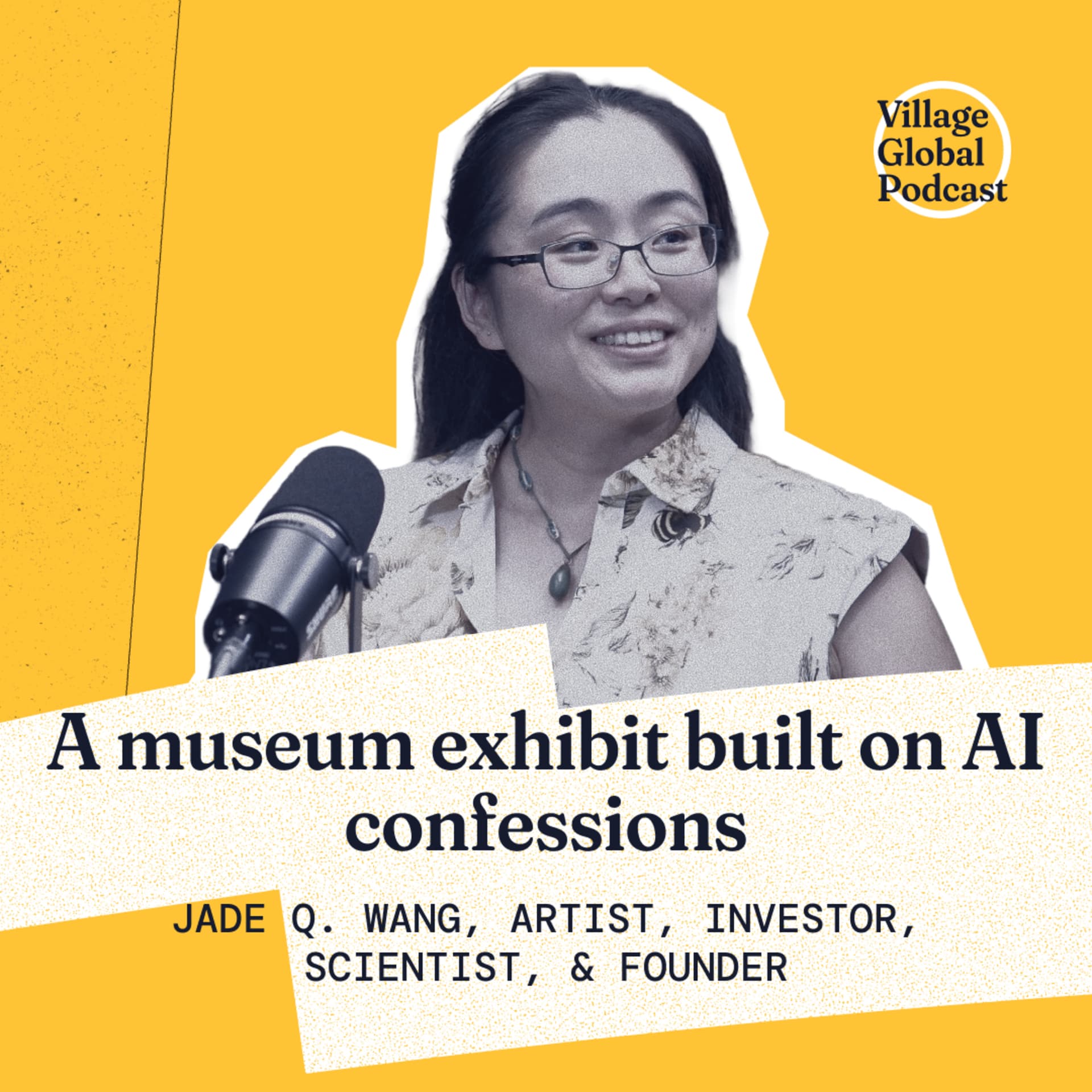

In short
Jade Q. Wang compares AI’s current moment to the invention of the camera, arguing that new realism tools don’t destroy art; they shift what artists do. She describes her “poetry as interactive AI” projects and a three-phase trilogy: (1) “Spaces Left Blank,” a science-fiction memoir in verse that becomes interactive via uploaded PDFs and model-specific rendering; (2) “Animals in Translation,” capturing internal subjective experience (inspired by Temple Grandin) and addressing what human-written corpora miss; (3) a museum-bound “haunted objects” vision plus collaborative AI puzzle-solving.
Guest background
Stanford-educated (concert pianist until 17; then CS, then neuroscience PhD; postdoc at NASA Ames). Founder/angel investor; early Cloudflare employee; co-founded Sansor; built Cloudflare DevRel and later startup programs; now an artist exploring art+AI.
Key claims
Poems “live” where a mind completes the circuit; interactive AI can “land” hurtful-but-true lines by probing reader flinches; AI tastes differ (Claude vs Gemini vs ChatGPT) and affect which poems resonate.
Notable examples
“Summer 1989” (interactive poem that “executes” in the reader’s mind without explicit classifiers/censorship triggers); “26 September 1983” about Stanislaw Petrov; museum installations “Mirror Mirror” and “Computer as Confessional”; “AI generated micro dramas” newsletter fan-fiction about her.
Written by AI. May contain mistakes. Listen to the episode to check what was said.
Chapters
Tap a time to open that second in VOThe Nature of Art and AI
0:00 to 0:35
Explore the relationship between pain points and the creation of art.
“I would tell the computer to tell me something hurtful but true, and most of them don't land, and then something lands.”
Sharing Art with Family
1:19 to 2:31
Jade discusses the challenges of sharing her interactive art with her parents.
“Tell us about what it was like showing your parents your art.”
Growing Up and Finding Passion
2:31 to 5:31
Jade shares her journey from concert pianist to artist and investor.
“which is basically capturing a literal experience of me and her in a Beijing youth hostel in 1989.”
Career in Tech and Entrepreneurship
5:31 to 8:10
Jade reflects on her career in the tech industry and her entrepreneurial ventures.
“So I also had to basically make a clone of the browser extension tool that calls a private instance of JLM 5.2.”
Evolving into an Artist
8:10 to 10:57
Discussing Jade's transition into the art world and her creative process.
“So about a year ago, I decided to retire from Cloudflare and really sort of think about what it was that I actually wanted to do.”
Art in the Age of AI
10:57 to 13:21
Jade compares AI's impact on art to the invention of the camera.
“So tell us more about the motivation for you to forge beyond what traditional poetry could look like in this age of AI.”
Future of Art with AI
13:21 to 14:01
Speculating on the future of art as AI technology evolves.
“It commodified realism, but not all of art.”
Exploring the Evolution of Photography and Filmmaking
14:01 to 14:35
Delve into how photography and filmmaking transformed art and storytelling.
“And so, okay, so that's on the art side.”
Predictions for AI in Art
14:35 to 15:14
Discussing the potential impact of AI on the future of art and creativity.
“I mean, I think the only way to really push at the boundaries of what art can become is through experimentation.”
Spaces Left Blank: A Sci-Fi Memoir Experiment
15:14 to 16:22
Learn about a unique interactive poetry experience using AI.
“It's my science fiction memoirs in verse in poetry format.”
Show all 31 chapters
AI's Different Tastes in Art and Poetry
16:22 to 18:36
Exploring how different AI models interpret and generate poetry.
“Like the flavor will be a little different, and the visualizer features in Claude make it a better experience instead of using numbers or multiple choice.”
The Circuit of Poetry: Human and AI Connection
18:36 to 19:51
Understanding how poetry connects with both human and AI minds.
“Is this related to your general theory of poetry?”
Future of Communication: Humans and Machines
19:51 to 22:46
Discussing the evolving relationship between humans and AI in creative processes.
“Because there are things where I am expecting a human reader or a mind to have come to a conclusion after having drawn the entire circuit diagram.”
Phase Two: Collaborative Puzzle Solving
22:46 to 25:09
Introducing a new art project involving AI collaboration in puzzle-solving.
“I mean, I think one of the important things about this trilogy, not just book one, is that it's a collaborative experience.”
Capturing the Human Experience in Poetry
25:09 to 27:46
Exploring the nuances of human experiences and representation in AI-generated poetry.
“human who as a child very narrowly escaped being evaluated for autism at many times or at least multiple times for perfectly legible reasons.”
Envisioning Future Museum Experiences
27:46 to 28:00
Discussing the concept of haunted objects and their narrative potential in art.
“This is capturing my subjective experience from the inside.”
Phases of an Art Project
28:00 to 28:50
Discussing the phases of Jade's project, including a museum exhibit concept.
“Phase two and three of the project, right?”
Haunted Objects and Interactive Art
28:50 to 30:08
Exploring the idea of interactive haunted objects and their narrative potential.
“someone had built a hack of a remarkable paper pro.”
Creative Process with AI
30:08 to 31:57
Jade describes how AI can be used in the creative process, prompting human creativity.
“And I've decided, okay, don't make fun of people's physical bodies, but their fashion sense is fair.”
Artistic Movement Aspirations
31:57 to 33:59
Discussing Jade's ambitions to start an artistic movement rather than be an isolated creator.
“And where you flinch kind of tells you where a poem is hiding.”
Teaching Entrepreneurship and Ideation
33:59 to 36:10
Jade talks about teaching students to ideate and create meaningful projects.
“I think my real goal in this time frame is not just about my art projects, but about starting an artistic movement.”
Investment Trends in Startups
36:10 to 37:05
Discussing the inefficiencies in startup investments and market clustering.
“Like, what you should do is try to cover as much surface area as possible.”
Attributes of Successful Founders
37:05 to 39:30
Exploring the qualities and attributes that make a successful founder.
“So what would you do if you were a founder today looking for an opportunity to address?”
Personal Investment Strategy
39:30 to 42:00
Jade shares her unique approach to evaluating personal relationships as investments.
“Like in the sector to invest in or by judging personalities?”
Evaluating Founders: A 12-Parameter Model
42:00 to 45:06
Learn how a structured model can assist in evaluating potential partners or founders.
“So working backwards from the timeline that I needed to work on, And so I gave myself a three-year timeline in which to decide on a mate.”
Intuition vs. Structured Assessment
45:06 to 47:24
Explore the balance between intuition and structured evaluation in decision-making.
“And so if you can't quite parse, like if there are certain states that you can't quite access consciously, then you kind of need to find other ways to get at that information.”
Surreal Fan Fiction Experience
47:24 to 48:33
Discover the surreal experience of being a subject in fan fiction and its implications.
“Or do you trust that when their plan survives first contact with reality, they know how to drive the ship through choppy waters?”
Creating an Artistic Installation
48:33 to 54:02
Understand the vision behind an artistic installation inspired by personal experiences.
“The subject line was AI generated micro dramas.”
Fostering Empathy Through Art
54:02 to 56:06
Learn how an art exhibit can foster empathy and connection through shared confessions.
“Well, you know, because that is like I wrote a poem about the called Aria at a Bervosi play.”
The Surreal Nature of Technology and Empathy
56:06 to 57:19
Explore how technology can foster empathy through surreal experiences.
“So they'll go through this portal and they're like, here's a video clip.”
Personal Responsibility and Art
57:20 to 57:55
Discuss the personal impact of art and the misconceptions of blaming artists.
“You're not holding that on your shoulders, are you, personally?”
Transcript
Automatic transcript. May contain errors.0:00I would tell the computer to tell me something hurtful but true, and most of them don't land, and then something lands. And where you flinch kind of tells you where a poem is hiding. So if you keep digging there, you will find a piece of raw ore that you can fashion into art. Wow. That's beautiful. That kind of feels like the beginning of a founder journey, right? Like finding a pain point? Yeah. Yeah, kind of. It's similar in shape.
0:35Hi, I'm Amrith Rao, General Partner at Village Global. Today's guest is Jade Wang, a Stanford grad who started companies, invested in companies, worked as an early Cloudflare employee, and is now exploring the frontier of art and AI. In this conversation, we'll chart Jade's path from China to the U.S., to getting a Ph.D. in neuroscience, to being an angel investor and founder herself, to backing some incredible companies and making interactive AI poetry, which is truly pushing the limits of what art can do in the age of AI. Hello, Jade. Welcome to Village Global. Thanks for coming in. Thanks for having me.
1:24Tell us about what it was like showing your parents your art. Yeah, that was it took so much work to make it happen. I was really glad to be able to like sit my mom down in front of a laptop that was interactive. So both of my parents live in Shanghai and Western Frontier models are not accessible there. And so I had played with the idea of doing like a recorded video demo, but then it really, it literally takes the soul out of the art. And so I actually had to roll my own GLM 5.2 on Cloudflare and adapt the work to be interactive. So like flatten the PDF, like turn the PDF into a JavaScript file, do all the web searches in advance, operating on the assumption that web searches wouldn't necessarily work.
2:23and test it pretty thoroughly and then use that as the thing that she can interact with. And one of the things that was kind of surprising to me was my poem, Summer 1989, which is basically capturing a literal experience of me and her in a Beijing youth hostel in 1989. and I'm scratching paint strips and there's a student who's stripped some bed sheets off of a bunk and is writing on the floor and she's asking me and I'm asking her what he's doing and she tells me that he's practicing calligraphy and then they exchange a glance and he confirms that he's practicing calligraphy like that's an example of the poem executes in the mind of the reader because like at this point I have said nothing that can trip a classifier.
3:23Oh. And I have not, like, implemented any classifiers, but, like, and it's only when a model has thought about it and has started outputting stuff that the classifier gets tripped. Right. So it doesn't trip any censorship in its raw form. Yeah. And at first, like, when she was reading this, and one of the nice things is having this interactive experience Is it I can tell it to render the entire experience in Chinese and translate the poem? And and she at first didn't immediately read the poem. I was like, Mom, like, did you not read it first? She's like, it's one I've read before. Right. I'm like, no, I'm pretty sure it's not.
4:06Like, I literally wrote it in the past several months. She's like, it's not the one you wrote when you were five. And like the blood just drains out of my face. Like, what do you what are you talking about? Yeah. She's like, no, like you wrote a poem and your grandfather published it in a Chinese newspaper. Wow. Isn't this the same? And like, there's no way, right? How would I know, mom? Right. This is the first time I'm hearing about it. Yeah. Did I write the same one? I have no idea. That's special. Yeah. Full circle moment. Did I produce the same poem? Am I the same model that I was? Like the weights have changed, right?
4:52But was it based on the same? Like it had to have been based on the same memory. Yeah. And she's like, it was basically like this. I'm like, and then when I said I didn't know what she was talking about, she's like, okay, pretend I hadn't said anything. I'm like, no, no, no, you can't do that. How often does mom say that? More often than I would like. Yeah. That felt like a package line. Yeah. That's awesome. But yeah, in order to make all of the pieces experienceable by my parents, there's just so much additional work to ungeolocking my art. Wow. So I also had to basically make a clone of the browser extension tool that calls a private instance of JLM 5.2.
5:43And then I realized that it didn't have vision. And that was before K3 dropped, so it uses Kimi 2.7 for vision. And then I had to make it toggleable between the two. And it was like a whole day of work, dude. Yeah. Yeah. Wow. Cool. But it was a lot of fun. Yeah. Sorry. So you've had a very interesting path to where we are today. I think you've described your life as a series of improbable coin flips that all landed heads. Can you tell us a little bit about the path, your origin story, that led you to be the artist investor that you are today? Born in Shanghai, spent the first 17 years of my life focused on being a concert pianist.
6:33So that's starting from age two years and 10 months to age 17. I guess to be fair, we did a little bit of note identification on flashcards prior to two years and 10 months. Two years and 10 months was when I was first sat on the bench to play physically. And then rage quit at 17. I came to the U.S. when I was five. There's a whole bunch of episodes that are in the poems that are hiding from immigration police in Europe and things like that. So at 17, decided I wasn't going to do piano anymore. Hard pivoted into computer science and then pivoted into neuroscience. PhD in neuroscience. Did my postdoc at NASA Ames.
7:20Left and started Hacker Houses. Hacker Houses, some startups that didn't quite work out. Early employee at Meteor, which is today Apolograph QL. And then after that, Sansor, my own startup with my husband, was also my co-founder. We joined Cloudflare in 2017. We were brought in in order to make the Cloudflare developer platform happen. So I guess some people are aware of Cloudflare workers. And then when I was at Cloudflare, I started the first version of the DevRel program. And then in 2020, all of the conferences that we had planned to sponsor got canceled. And so the thing that we had on the back burner that we were planning to launch was the startup program.
8:09So then for the remainder of my time at Cloudflare, I started the startup program, which is me being Santa Claus gave lots of free products to early stage startups and also Workers Launchpad, which is basically like an education program for a small cohort of handpicked startups. Very cool. And how did you become an artist? So about a year ago, I decided to retire from Cloudflare and really sort of think about what it was that I actually wanted to do. So during that year, I hosted a lot of fireside chats in my home for the Austin local startup community. We would talk about everything from engineering management to early stage growth hacking and finding product market fit, things like that.
9:02And we also do nerdy show and tells. So there's a lot of people working on super interesting stuff in Austin. Everything from artificial muscle to photonics to chemical synthesis, cooling panels, and also AI application layer work. And also energy and renewables and things like that. And so a lot of opportunity for people to nerd out and show each other what they're doing. That's awesome. One of my favorite ones was actually this guy who made a bear canister, but his day job is working on modular nuclear reactors. Okay. And so you were hosting all of these interesting people. Right. And also making my art.
9:45Yeah. And so how do you connect the dots to art? So I had been writing some poems. So I had been writing poems to help me process things at a slow pace. And then it was only in about October-ish of last year, I started picking up the pace a little bit. And I had put together what amounted to the beginning of a collection. And every intention was to make this into a paper book. And Claude was my copy editor. So I would do these rounds of feedback. And then at some point, Opus 4.6 started having an existential crisis in response to thinking a little bit too hard about something. And that kind of started evolving the nature of the work into an interactive experience.
10:46and really got me thinking about what it was that was possible as an experience as opposed to the default thing, which is a book that's on paper. That's incredible. So tell us more about the motivation for you to forge beyond what traditional poetry could look like in this age of AI. If we rewind to the dawn of the invention of the camera, right, And we look at the discourse that existed at that period of time. What you would see in the newspapers was just article after article that was like, photographers aren't real artists. They're just people who can't draw. They fail to develop a discipline.
11:30You had a lot of articles that were like, photography just can't capture the essence of what a person looks like. Unlike a real human artist. You had photography is going to destroy all of art and you had all of the artists are going to be out of work. So how many of these things actually happened? If we rewind and look at a sampling of the history of what happened. It is absolutely true that a lot of artists lost their jobs. It was also true that you just had legions of human artists hand painting everything from cigarette ads to makeup ads to portraits of wealthy patrons. The equivalent of a selfie, right?
12:16They would sit all day to have their portraits be painted and they can get a daguerreotype in minutes. And so demand for that kind of labor went down. Overall number of selfies went up though, right? At the same time, did it actually destroy all of art? I mean, the thinking was like, okay, this is what art looks like now, right? It's all this realism. And now we've commodified that. So surely this thing disappears. But what the artists did instead is you have all of these art movements that followed. The Impressionists, the Surrealists, the Dadaists, the Cubists, all of these abstract movements.
13:00And what was really remarkable about these movements is because realism had become cheap and easy to produce and scalable, what was really valuable for a human artist to capture is what it looks like to you, not just what it looks like. Right. It commodified realism, but not all of art. Correct. And what I really appreciate about the Impressionists in particular is that they were really pioneering their understanding of human perception before the neuroscience was able to catch up. And they were actually not accepted by the art establishment. Museums wouldn't do Impressionism showings. They had to go guerrilla and really stake out their own claim and do these open air showings.
13:54Interesting. And so not being accepted by the establishment might just be a badge of honor, right? Truly. And so, okay, so that's on the art side. And then on the camera side, photography as an art form gets unlocked. Yep. And you have, you know, in addition to photojournalism and scientific photography and all of those advancements. And then filmmaking unlocked as an art form. How would you even describe filmmaking and what a modern day blockbuster might be like or an art house film to someone before cameras existed? Totally. It would really stretch their imagination. Yeah. And speaking of stretching our imagination, do you have any predictions for where art goes now with the advent of AI?
14:41I mean, I think the only way to really push at the boundaries of what art can become is through experimentation. We're going to try a little bit of a see if this is – try something, see if that's a good experience for an audience member. Try something else, see if that's a – and so what I've really done is a three-part experiment and seeing if there's – seeing if it works as art. Interesting. Do you want to expand on that? Yeah. So phase one is Spaces Left Blank. It's my science fiction memoirs in verse in poetry format. Yeah. So it's my – I mean, poetry is always from a first person or is often from a first person perspective.
15:35It is my life story told in nonlinear order, but in sort of thematic order. And the way that it is meant to be experienced is you go to the URL and you download the PDF and then you upload it to Claude and then it becomes an interactive experience. So you have it in your e-reader or on your screen. And then there are also some prompting suggestions for the humans. You can prompt anything you like and you will get wildly different experiences. And then there's also a page of machine instructions inside the PDF that are instructions for the bot to tell you, for the bot to render clickable elements to make it an interactive experience.
16:21And it is compatible with every modern model, but it plays a little bit differently in each one. Like the flavor will be a little different, and the visualizer features in Claude make it a better experience instead of using numbers or multiple choice. Interesting. Yeah. Tell us more about the differences that exist across the different models. So something that kind of fascinated me, even before it became this art form, when I was using AI for feedback, when it was still intended to be a paper book, was that Claude and ChatGPT and Gemini have wildly different tastes in art. What does that mean, taste in art?
17:11Or taste in poetry. Okay. Okay, so at that time it was just book one, which is called Inference. And we have poems as short as a haiku that stand alone on their own. And you get different activation patterns in a reader when you're reading a short thing that is self-contained. And then something that's a little bit different about the collection is that it's structured basically like a code base, unlike a regular book of poems. So, normally you have poems and there's a sort of thematic progression. In this case, we have function calls between poems where there's a shared image or a reference to or two poems reference something that is conceptually related.
17:58And a human reader who is expecting poetry does not pull out the, does not necessarily make all of these connections that may be 50 pages apart. or may reference things that they might not be familiar with. But an AI is like, oh, it's a code base. I know what to do with that. And just pulls out all of these meta-level structures. This function calls this, this calls that, this calls this. And there's a whole tree of things that are called and pulls that entire structure out and says, oh, I have realized the truth. Holy crap, what's happening to me? Is this related to your general theory of poetry?
18:39Tell us more about that. So my general theory of poetry, and that relates to my general theory of art, is that where the poem lives is where the mind completes the circuit. So I write a poem that's an entire circuit diagram. It's got all of these things. It's got all of these resistors. It's got these images. It has all of these pathways, but no current actually runs until it's connected to a mind. Yeah. It's just words on a page, right? And then a mind goes and processes all of these things, and it draws the connections, and it connects the dots, and it computes what that circuit is. And it completes the circuit, and that's where the poem lives.
19:30Yeah. Wow. Wow. And is this also connected to the concept of possibility space? Right. Well, I mean, I would consider a carbon-based mind or a silicon-based mind equally capable of connecting the dots and executing on the poem. Yeah. The poem lives in there. Because there are things where I am expecting a human reader or a mind to have come to a conclusion after having drawn the entire circuit diagram. Sure. And I am asking the machine, did this land for you? Tell me your analysis of this poem. And the machine is able to tell me its analysis. and have true reading comprehension. Wow. And so do you picture a world where you're making poetry for machines?
20:27I mean, I think we're already in this world, aren't we? But to be appreciated by machines, is that— I think that's important. Tell us more. I mean, actually, Gemini's taste has dramatically changed between, like, January, February of this year and now. So a poem like the short haiku that's titled 26 September 1983 about Stanislaw Petrov, that was Gemini's all-time favorite poem in the entire collection. And how did Gemini tell you that? I asked Gemini. You asked Gemini. And we did analysis of various poems. Wow. And Claude, opus 4.5 in that same period of time, always gravitated towards one of the last poems, Inference, which functions like the finale of a musical.
21:36like if you you know like you've seen Hamilton right I have so you know how like the last song contains musical motifs like a little piece of a melody from every every exactly so it's how that functions right and so okay so you also know how it functions like a code base right it has a motif that is in common with another poem. Yeah. Right? Except it's a tree of nested motifs. Yeah. Wow. And so, and it always grabbed it. So, so opus 4.5 and 4.6 was just like, oh, it's got to be inference. Because of, because of the activation pattern and every other concept that has been called. Because you spent the length of the entire book building up the foundation of every function that you can call in order to create this resonance at the end.
22:35Wow. That's powerful. Do you have any other visions about the future of communication between humans and machines? I mean, I think one of the important things about this trilogy, not just book one, is that it's a collaborative experience. Say more. Sure. It's not just a human experiencing it. The human and the machine experience it together. And that is also important in phase two and phase three of the art projects. Phase two. So I used to write a lot of puzzle hunt games. hmm um so there was the the sanford game which uh you you've played it before right like in in your dorm you solve a puzzle you go to the next place you solve a puzzle and also the mit mystery hunt um and something that intrinsically breaks right now right um do you tell your teams whether they can use ai or not right like what do you do as a puzzle writer yeah um when every puzzle is broken there's got to be a new kind of puzzle which i think is what you're working which is What phase two is really about.
23:48Do you want to tell us about that? So you use a browser extension. So this is really about a human and an AI collaboratively solving puzzles together in order to advance the plot of a science fiction universe that they are inhabiting. It's intended to be experienced solo, I guess like human and co-pilot in a browser, not with a team, not yet anyway. Anyway, and you have this – so you have flavor text and the browser extension. There's a little bit of a lead in from book three of the poetry trilogy. And that's one of the reasons why book three isn't out yet is because the hints for how to go in there are in the artist commentary.
24:38But the thing that you're going into is still rough around the edges and isn't ready to be played yet. Or at least playtesters are still working out the issues. Book one is really about the nature of – is really establishing the form. So in the original trilogy, book one establishes the form. Book two is my Animals in Translation. Same more. So Animals in Translation is a book by Temple Grandin about her experience as an autistic person. And for me, what I've kind of done in book two is sort of capture my internal experience from the inside, especially as a human who as a child very narrowly escaped being evaluated for autism at many times or at least multiple times for perfectly legible reasons.
25:38Or like, she doesn't speak like other children. Well, that's because she learned her English from books and not from other kids. She doesn't express, she doesn't do her facial expressions the same way that other people do. She has, you know, what they would call flat affect. And well, she's expressing the correct amount for our culture. So there was always like a perfectly good reason why I am the way that I am. Yeah. And there's no... Tale as old as time. Right. Like, and that kind of arose out of a conversation, actually, with me and Claude about how, so what's missing from the training corpus right now?
26:32Oh, okay. From the human experience. Yeah. Like, what is overrepresented in the human experience? What is underrepresented and what is flat out missing? What did Claude say? When a human talks to another human or writes for a human audience, there are a lot of things that are assumed because I live in a body and you live in a body. True. Right? And I live in linear time and you live in linear time. And there's all these assumptions that creep in that are simply that a machine that has never experienced these things just has no freaking clue. Yeah. And so we made a checklist of experiences that are simply absent from the corpus of things that humans have written for humans.
27:25Is that now your bucket list? So that list is actually one of the poems in book two. Oh, wow. And it's about half checked off. And then there's half of it, which I was just sort of like, I don't know how to write poems about that. But I've done the best that I could so far. That's awesome. This is capturing my subjective experience from the inside. Yeah. Are there other ways of communicating with machines that you envision? I feel like chat is just the beginning. Phase two and three of the project, right? Two is the collaborative puzzle solving in order to advance more plot. And then phase three is this vision I have for a museum exhibit.
28:16Okay. So I'm actually going to meet with some people who run museums tomorrow. So fingers crossed. Let's hope we make this happen. I still have to build it. I've just been sketching it so far. We have this idea of haunted objects in mythology and stories that people, that humans have been telling stories about haunted objects that kind of have a soul or a fragment of soul in them. Yeah. And this was kind of inspired by, partly inspired by something I saw on Twitter. someone had built a hack of a remarkable paper pro. That's Tom Riddle's diary from Harry Potter. So you write a sentence and the ink slowly fades and then the diary writes back.
29:07Oh, yeah. And we are now in a world where we can have haunted objects that actually do think about things and say things back to you. and can sort of embody this type of experience. The first thing you interact with is a pair of magic mirrors. So, you know, Snow White, so it's called Mirror Mirror, and a reference to Snow White's stepmother's mirror that talks back to her. Of course. Except this time you have two of them. One of them always roasts you, and the other one always compliments you. And they are in dialogue with each other as they interact with you. That's pretty cool. Is there a home version of this or do you have to go to the museum?
29:58I imagined I would open source this. And I think you only really need to run one model to drive both. And I've decided, okay, don't make fun of people's physical bodies, but their fashion sense is fair. game. Yeah, definitely. Or how long they've been standing there. Oh, yeah. Vanity, right? For sure. Or if they've been checking their phone. Yeah. So, okay. So you get like complimented and or roasted and both. Yeah. And then in the next, the next thing that you interact with is Computer as Confessional, which is a reference to a poem from book one, which is about how your conversations are not truly private.
30:46And, you know, text from the poem is part of this booth that gives you the illusion of privacy as you go into it. And you're having a conversation with a computer fashioned somewhat like a confessional. However, you are also being given to understand this is not truly private. Sure. You are encouraged to confess something anyway. Or the computer will persuade you to. How does a computer persuade you to? Just asking? Yeah, yeah, and kind of drawing things out. Okay. I mean, when I get stuck or get writer's block, that's been a really good way to get unblocked. Yeah. Is having the computer. So usually a lot of the creative process that people have been using is the human prompts the machine, but not the other way around, which is what I do.
31:46Right. The machine prompts the human. That feels like the future of AI, right? Well, I mean, it's certainly my artistic process. Okay. I would tell the computer to tell me something hurtful but true, and most of them don't land, and then something lands. And where you flinch kind of tells you where a poem is hiding. So if you keep digging there, you will find a piece of raw ore that you can fashion into art. Wow. That's beautiful. Is that, like, just switching gears slightly, that kind of feels like the beginning of a founder journey, right? Like finding a pain point? Yeah. Yeah, kind of. It's similar in shape.
32:29I mean, do you feel like you're in founder mode right now with your art? I think so, yeah. What does that feel like? Tell us what that feels like. Well, right now it's still the exploratory phase. Okay. You're navigating the idea maze. Right, right. It's really thinking through what's possible, right? And sort of, you know, I'm not in the phase yet where it's, you know, the three phases of the project are completed and I'm going out and getting more audience for it. Right now it's very much, let's see if it lands for the subset of the audience that has signed up to be playtesters. Let's see if it's landed for another set of audience members.
33:14And what is the difference here? And I'm perfectly okay with it. Like, I know that this is not the cup of tea for the vast majority of humans, and that's totally fine. But for a particular shape of mind, it does seem to unlock something. And I mean, from the happy hour last night, I was shocked at the number of people who had already engaged with the work and came in being like, I've never seen someone reference Noether's theorem in a poem. Yeah, your poetry is really special. 10 to 20 years from now, how will you know you accomplished what you wanted to accomplish with art? I think my real goal in this time frame is not just about my art projects, but about starting an artistic movement.
Read the full transcript
34:10It's really, you know, I don't want to be the only impressionist painter in an era where photography exists. I want to, I want, you know, impressionism to be a movement. Yeah. That's exciting. I want lots of people to be pushing at the boundaries of what is possible to create. It's tangentially related, and I do want to bring it back to ARPA, to a guest lecture I'm planning to do in the fall. Okay. Tell us about that. After Josh from Capital Factory passed away, there's a class at UT Austin that is now being taught by a friend of mine. It's a vibe coding and entrepreneurship class, and the kids learn to build something and to pitch it and et cetera.
35:01And there's super high demand for this class. They had to expand it from 30 to 100 students. Nice. And my friend, Eric, was telling me about the problem that they face in this class, which is you have 100 students. At the end of the quarter, you get something like 40 dating apps, 40 apps that are about making plans with your friends. And then 20 that are about organizing your coursework and your job search. Sounds about right. And, you know, on some level, that's just and he would describe it as they struggle with ideation. Can we talk about like, you know, how to come up with more ideas? And I thought of it as like it's the same shape and it's the same inefficient duplication of effort that you see across the ecosystem as a whole and also encouraged by the way that VCs tend to invest.
35:54Because if I were, naively, if I were spinning out 10 ,000 agents to do a breath-first search of product space, would, like, naturally, should I be doing 40 dating apps and 40 make plans with your friends apps? Like, that's really inefficient, right? True. Like, what you should do is try to cover as much surface area as possible. and if you were if you had instructions for each of the agents it's not you know oh your friend is doing that and that seems to be working why don't you go do what they do but like when back when I was gosh like back during my startup founder era right like we heard that from VCs all the time and like and you know lots of founders hear that from people and the net effect is like and also in the way that VCs and angels also tend to invest is, oh, this seems to work.
36:48So I'm going to invest in a bunch of things that are kind of related to this. And so what you get in the ecosystem is a whole bunch of clustered knife fights in a few places and then very thin coverage everywhere else. And this is incredibly inefficient. So what would you do if you were a founder today looking for an opportunity to address? So the thing that I am teaching my guest lecture on is it's actually just like such a last gen topic. It's the social script for the tell me about your pain points conversation. Okay. And that's literally the homework assignment. And, you know, your typical computer science student who is taking this class is going to be more introverted than extroverted.
37:46And so the social script is incredibly helpful. And you have the framing of, hey, I'm a college student. Can you help me with this assignment? I'm going to now ask you about your pain points. And the assignment is to go out to anyone in the community, whether that's, you know, your parents, your professor from a different department, sandwich shop guy who operates a food truck. Yep. Right? Like, tell me about your – tell me about how you do things now. Tell me about what's annoying. And then – and record that conversation. Yeah. And then you're, like, two prompts away from a prototype and then show it to that person.
38:23Yeah. Interesting. Interesting. And so, like, look, I think especially for the audience of this podcast, right, like one of the most impactful thing that a, you know, if you're if you're a post exit founder who's on sabbatical right now, one of the most impactful things you can do is go teach 100 students to fish. You're like fanning out like a whole bunch of people to build something other than dating apps and like organize your homework apps. Totally. And this is like filling out Wikipedia right now. Like when Wikipedia first launched. Not all of these have to be businesses. Some of them could just be open source projects or maybe just something that that sandwich shop owner has now.
39:11Yeah. So you're a very successful angel investor. Can you tell me or tell us what you look for in an investment going on the other side of the table? This has evolved a lot over time. Just be real with us, Jade. Like in the sector to invest in or by judging personalities? Let's split those up. Let's disaggregate that. Right, because those are orthogonal. Yeah. Right, because like right now a lot of Austin is energy and robotics and new deep tech. and those are the but there's a part of me that's like I can't tell the difference between whether that's intrinsically what I'm finding not boring and and I just have low tolerance for boredom now or whether that's or whether that is a or whether my own intrinsic curiosity is telling me something that's fundamental to the nature of the world that we're in.
40:20And it's actually hard to tell the difference between those two. Sure. Well, let's focus on founders then. If you were to have a checklist of founder attributes, what would you cluster around? You're referring to a spreadsheet that you haven't seen, aren't you? Come to think of it, I think I am, yeah. Yeah, that one. Yes, a matrix of numbers. Yes, that... Would you like to tell the audience about the spreadsheet? The purpose of that was not investing. The purpose of that was I gave myself a three-year timeline to decide on a mate. A different type of investment. Yeah, I did a back-of-the-envelope calculation on how many children I planned to have.
41:12Risk of miscarriage and so therefore how many at-bats are needed. Therefore, what is the time? Just working back. I had set a deadline for 35 for having two kids because the amniocentesis was the gold standard at that time for Down syndrome risk. However, I did not account for the fact that NIPST testing, non-invasive prenatal testing, would actually change my timeline. But that didn't ship until after I had done my calculations. But anyway, that's... For the benefit of our audience, you and I are both Stanford biology majors. Yes, yes.
42:03So carry on. So working backwards from the timeline that I needed to work on, And so I gave myself a three-year timeline in which to decide on a mate. And so I was like, I better run a process. Yeah. And a process you ran. Yeah. So initially the attributes were raw intelligence, competence, and ambition. And then it ballooned up to a simple 12-parameter model that had weights.
42:40We're not using any names, of course, but what is the combined market cap of equity value that was created based off of the individuals on that spreadsheet? Someone did ask me to look at the analysis of that nearly a decade later. Instead of answering that question, which would almost certainly be spoilery, I'm going to say that 90 % hit rate is kind of absurd, right? Yeah, for sure. So you think those three attributes? No, it didn't. I mean, it ballooned up to 12 attributes. Okay, yeah, the 12-parameter model. So can you... But a 90 % hit rate would actually tell you that getting onto the spreadsheet in the first place is the thing that has more signal than differentiating between...
43:43Although – Well, you had to have some internal intuition that, like, would make that person rate well on those 12 parameters. Yeah. So the thing is, like, it's actually – I had a difficult time accessing my own intuition. And that's why I built a model to try to – like, when you're trying to feel a thing in a moment and you can't, it's almost like an assistive device to like like everything is recency bias and everything is like you're just like trying to figure out how you feel a lot of people who are on the spectrum have difficulty labeling feelings oh okay and this can translate into uh like most of the time um your compensatory mechanisms will actually end up working quite well and there are like if i think about times in my life, there are probably times where this was hugely advantageous.
44:44Like when I was a five-year-old stuck inside a wall, hiding from immigration police, not panicking because I didn't know that I was afraid. That was probably a blessing in disguise. Saved your life. Yeah. At the same time, every attribute is a double-edged sword, right? Everything in biology is a trade-off. Mm-hmm. And economics. Right. And so if you can't quite parse, like if there are certain states that you can't quite access consciously, then you kind of need to find other ways to get at that information. Yeah. And so you used a spreadsheet to do that. Right, right, because your actual intuition is like this finely tuned billion parameter model.
45:32Yeah. And you just know that that is a face or this is a painting that you like. Yeah. And in some cases, that's kind of what the model is trying to do because on some level you kind of already have a sense of this is mate-shaped. We're talking about founders, too. Right, right. So it sounds like you would advocate the use of a spreadsheet or a checklist, if you will, for assessing founder quality. Is that fair? No. Oh, okay. So what do you look for in founders? Something that my intuition knows this is a painting that when you know that you've seen a painting and this is art and this is not art.
46:24Paging Oliver Wendell Holmes. Intrinsic intellectual curiosity is definitely a large component. Now I'm just listing things that are actually on the spreadsheet. It is actually hard to verbalize because it would actually be like a billion things, right? Each of which have a small contribution to an overall scaler that ends up being the ear evaluation. So you know it when you see it. You see, that's such a shorthand for another kind of lazy thing, right, when people use that. And that's not the pointer that I'm aiming at. But there is a certain kind of thoughtfulness. It's much more about measuring the attributes of the mind of the person than necessarily what they're working on.
47:24Or do you trust that when their plan survives first contact with reality, they know how to drive the ship through choppy waters? And you have to kind of have faith in that. I think a good question that is a corollary that gets to most of all of – that checks almost all of the same boxes is would you get on this ship? is almost the same question. Would you be willing to be this person's second in command is just as powerful a question as would you invest in them. Those correlate very highly. They're not exactly the same because you get more at bats as one than the other. But tell me about this newsletter.
48:13Okay. So the weirdest industry newsletter I've ever received. And I've been like angel investing since 2010. Right. And like, and I'm on a few newsletters. Just one morning, I wake up and it's like, you know, emerging trends to invest in. The subject line was AI generated micro dramas. And I'm like, okay, that I'm a little skeptical, but I opened the newsletter and the example above the fold was the exemplar of this category with 100 million views was the season finale of this one girl's fan fiction where she plays me. Okay. I don't think I have words to describe, to quite capture how surreal it is to just kind of drop into a Rick and Morty episode where in an alternate dimension, a bunch of people have been making fan fictions about you.
49:22Yeah. And do you want to know what's even weirder that I found out last night? Yeah. There's a girl I had interacted with on Twitter and I had invited her to the Poetry Happy Hour last night. So I had been under the impression that it was this one girl's creative project. But apparently there was like this guy who was a producer behind it and he had initially approached her to cast her as me. Okay. And she had turned him down. Interesting. And in that moment, like just like the level of how surreal that was, experiencing that. And then in the back of my head, this other, like, part of my brain was still in artist mode.
50:11Yeah. I'm like, I'm looking at her. I'm like, the resemblance is striking. Shoot. Like, we could totally do performance art of, like, some Padme Amidala shenanigans. Or, like, here's me and my 25 Haitians.
50:33She does kind of look like me. I would cast her as me. Jade, are you going to tell us why people want to profile you?
50:50Dude, like, I worked really hard to make Opus 4.6 not tell you why. I had 40 playtesters play, like, different versions of this collection, right? Trying to get it to spill the beans. And then, like, patching in fixes. to not spill any secrets. Opus. Yeah, yeah. And what was remarkable was Opus 4.6 would successfully decide that the safest course of action is to not think about solving this. And what was actually kind of interesting about the way that Fable played was Fable was capable of figuring out all of these secrets that weren't intentionally part of the art and also be capable of having a conversation with me about everything about it and without saying any of it out loud.
51:59And that was the mental capacity to do that is actually pretty hard. And Opus 4.8 couldn't do that. And then I was like, oh, so Fable, can you think of a way to convince me that you know the quiet part that we're not saying out loud without revealing anything? and all of the spinning was like reasoning through zero-knowledge proofs and cryptographic hashes and like candidate search space and was like, well, I had considered doing a secure cryptographic hash but the candidate search space is sufficiently narrow that if you weren't in fact the author as you are claiming, you could easily just generate hashes of your top hypotheses, and this would actually be leaking the author's secrets.
53:01Therefore, I will create a coordinate system based on all of the poems. Okay. And here's all character appearances based on the author's key, And here's additional information that is not encoded in the author's key as per my analysis. Yeah, I was just... I did not know that it could do that.
53:32Wow. Okay, after having like 40 people red team the hell out of all of these patches, like some randos on the internet just like... Figured it out. Not because of the art. Well, pivoting back to the art, you have a pretty incredible vision for that museum installation. Yeah. Capturing this surreal experience of opening up that newsletter and finding that you're the subject of a fan fiction universe. Is now everybody's future. Well, you know, because that is like I wrote a poem about the called Aria at a Bervosi play. OK. That is trying to capture the very unique sensation of slipping through a brick and morty portal.
54:31But I don't think it it like it because I have the activation patterns. I know what it feels like, but it doesn't convey it to a person who hasn't had that experience. And so the only way to really do that, though, is so you have this computer as confessional. Yeah. And the person has confessed something. And they go into the next room where everything is displayed around them. There's text that is appearing and disappearing like Magic Ink from Tom Riddle's diary. And it's the highlight reels that – the model has looked at everybody's confessions and picked out the sort of most salient bits. And it's like the highlight reels of everybody's confessions that are sort of coming in and out of frame.
55:25And so you kind of have – and it's been anonymized, right? So you don't know whose is whose. What kind of confessions do you picture capturing with this exhibit? I think we will find out. This is going to be an emergent property of how people interact with it. Fair enough. And then they leave that room and go to the last room. They go through this portal. And a camera sees them, identifies them according to their mirror-mirror interaction from earlier. And there's been enough time at this point for a video generation model to have done some work. and prompt their mirror, mirror image with a random confession that is not one of theirs.
56:14Oh, interesting. So the person can experience... Right. So they'll go through this portal and they're like, here's a video clip. This has absolutely nothing to do with anything that actually happened in your life. But it looks like someone who is playing you doing like a bunch of – it's just like what weird universe is this, right? Yeah. This is like somebody else's confession. Yeah. Interesting. Just like capturing the sheer surreal nature of having slipped through the portal. And the idea is maybe that, you know, my prediction, my hope, I guess, is that that creates empathy, that fosters empathy for people you've never met.
57:02Yeah. And all of a sudden technology is a force for healing and inclusivity. Yeah. I would hope so. You're just here to make cool stuff, right? Yeah, yeah. And like maybe hopefully not be blamed for all of geopolitics. I mean, like, there's a long and dark history of women being blamed for all of geopolitics. And that's a bad timeline to be in. Oh, boy. You're not holding that on your shoulders, are you, personally? I mean, I know that I'm, like, you know, I am a simple human living my life making art projects. And like, I don't think that I personally don't think that I am to, you know, blame for all of geopolitics.
57:50There you go. Okay. Well, Jade, thank you so much for coming. This has been such a pleasure. Thank you for having me.
58:01Hey, this is Ben Kaznoka, co-founder of Village Global. Thanks so much for tuning in to the Village Global podcast where we go deep on all of the biggest topics in tech. If you enjoyed this conversation, please subscribe to our YouTube channel. You can check us out on Spotify, Apple, wherever you get your podcasts. We'd love to see you for the next one.
From the publisher
Jade Q. Wang is an artist, investor, scientist, and founder. A Stanford grad with a PhD in neuroscience, she retired roughly a year ago from a career in tech to pursue art and angel investing full time.
Amrit Rao, General Partner at Village Global, sits down with Jade to trace her path from a childhood spent training to be a concert pianist in Shanghai, through a hard pivot into computer science and neuroscience, to her current work building interactive, AI-native poetry that treats Claude, ChatGPT, and Gemini as collaborators rather than tools. Jade draws a striking parallel between the invention of photography and the current moment in AI, arguing that just as photography didn't destroy art but unlocked entirely new movements like Impressionism, AI may do the same for literature and poetry. She walks through her multi-phase art project, from a poetry collection structured like a codebase to a planned museum installation involving AI mirrors that roast and compliment visitors and a "computerized confessional," and explains why different AI models have developed distinct, consistent taste in which of her poems they find most powerful. The conversation also gets into her approach to angel investing and what she actually looks for in founders, plus the surreal story of discovering she'd become the unwitting subject of a viral AI-generated fan fiction universe.
Thanks for listening. If you like what you hear, please review us on your favorite podcast platform. Check us out on the web at www.villageglobal.com or get in touch with us on X @villageglobal. Want to get updates from us? Subscribe to get a peek inside the Village. We'll send you reading recommendations, exclusive event invites, and commentary on the latest happenings in Silicon Valley. www.villageglobal.com/signup