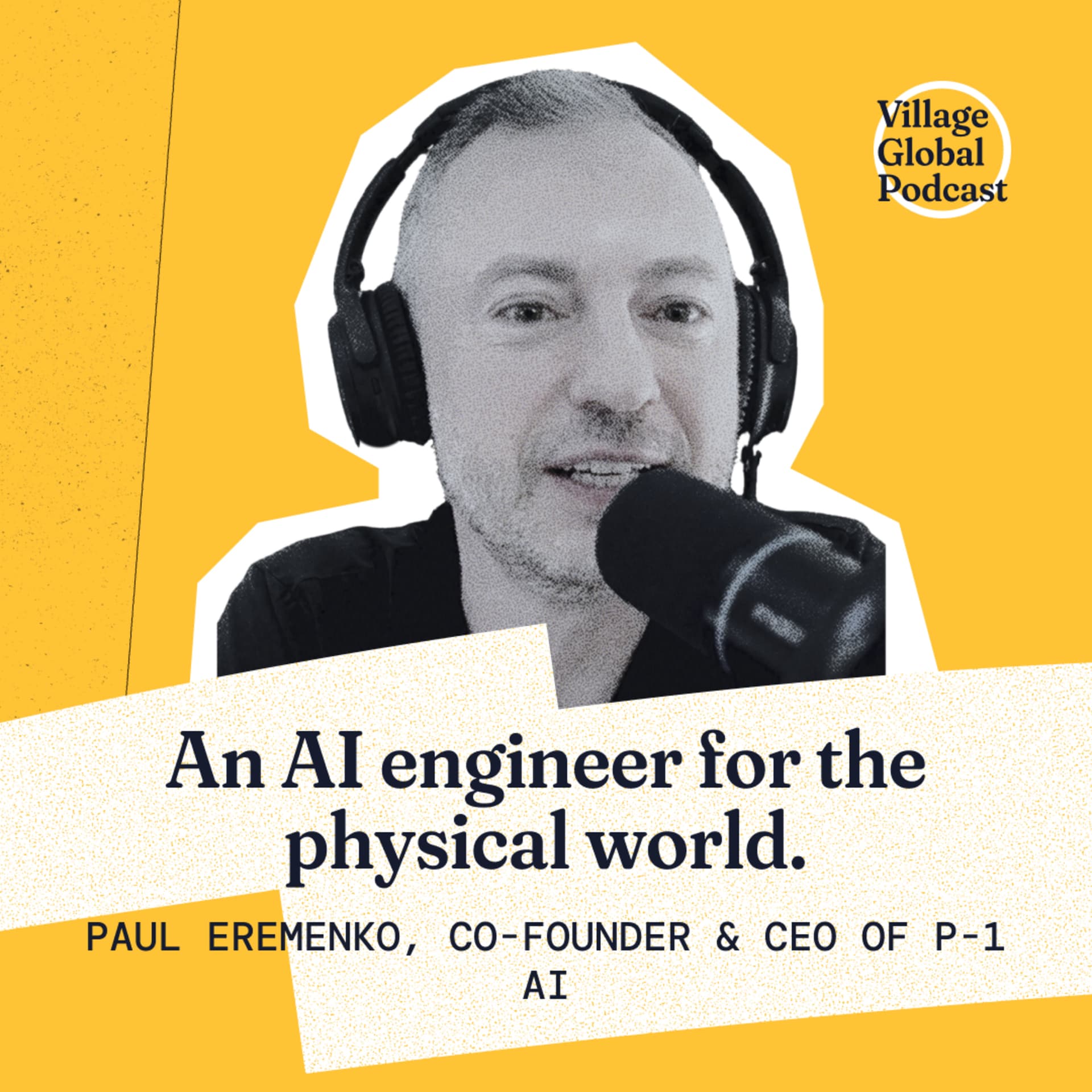

In short
P1 AI’s “Archie” as an AI mechanical/electrical engineer for industrial design work, focused on engineering change orders and tool orchestration; avoiding pilots and proving ROI in production; trusted, secure deployment and IP protection; and how industrial leaders should prepare for AI-driven acceleration.
Guests
Paul Eremenko, founder/CEO of P-1 AI (P1 AI), previously at DARPA (2008–2012 era) working on model-based engineering foundations; Jeff Immelt, venture partner at NEA and former GE chairman/CEO (16 years), board roles including Bloom Energy, Twilio, and NEA portfolio companies.
Key claims
Physical-world AI needs semi-synthetic training data (sample millions of plausible designs); Archie cites sources and uses structured design representations to reduce hallucinations; ROI is workforce bandwidth expansion (fixed “salary” per FTE, not compute/consumption); Archie is sold to engineering-headcount owners to avoid “innovation theater.”
Notable examples
F-35 cost/complexity motivation; finite element solver orchestration; data-center chiller engineer-to-order use cases; deployment options (cloud, VPC, fully on-prem/air-gapped).
Written by AI. May contain mistakes. Listen to the episode to check what was said.
Chapters
Tap a time to open that second in VOIntroduction to AI in Aerospace Engineering
0:00 to 0:32
Learn about the limitations of AI in aerospace engineering and the need for vast training data.
“If you want an AI to be a good aerospace engineer, it needs to see millions of airplanes.”
The Origins of P1 AI
1:56 to 3:19
Understand the origins of the name P1 and its connection to early AI literature and DARPA.
“And Paul, let's start first with the name of the company.”
The Complexity of Aerospace Engineering
3:19 to 5:54
Explore the challenges in aerospace engineering and the need for innovative design tools and methodologies.
“So can you tell a little bit about that era and maybe the genesis?”
Semi-Synthetic Training Data for AI
5:54 to 7:22
Learn about the concept of semi-synthetic training data for AI in aerospace and engineering.
“And so DARPA invested quite a bit into this.”
How P1 AI Works with Customers
7:22 to 13:00
Discover how P1 AI's Archie operates within customer organizations and its unique selling approach.
“So that's why we call them semi-synthetic.”
Jeff Immelt's Perspective on AI
13:00 to 14:00
Hear Jeff Immelt's insights on the role of AI in industrial settings and its potential value.
“And we think that's a big unlock in terms of selling into this industrial OEM market.”
Value of Engineering Innovation
14:00 to 15:00
Learn about the need for new engineering approaches in large-scale enterprises.
“So that's what attracted me to P1 is it's approaching a problem or an opportunity that I always felt like was in place.”
Archie's Role in Design Engineering
15:01 to 16:44
Discover how Archie focuses on various phases of the engineering design cycle.
“So Paul, can you talk specifically about the use cases that you're serving today and how ROI is measured?”
Measuring ROI with Archie
16:45 to 18:36
Understand how ROI is evaluated when integrating AI in engineering.
“But he is not designed as workflow automation.”
Deployment and Team Dynamics
18:37 to 20:06
Explore how Archie's deployment can enhance team coordination and efficiency.
“Because Archie is obviously faster doing a lot of things.”
Show all 19 chapters
Navigating Corporate Innovation Challenges
20:07 to 22:32
Learn strategies to move from pilot projects to full-scale implementation.
“So when I probably see five or 10 CEOs a month asking about artificial intelligence, and I always tell them to think about four things.”
Data Protection and Custom Models
22:33 to 24:16
Discuss the importance of data security and the creation of custom AI models.
“And I think both Alex Karp recently and Satya Nadella talked a little bit about, especially in technology-driven companies with IP, how is the IP protected?”
Cost Optimization in AI Deployment
24:17 to 26:35
Examine current challenges and future expectations for AI compute costs.
“So for now, that is a core principle under which we operate.”
Future of Engineering and Talent Building
26:36 to 28:00
Explore how AI can transform engineering roles and the hiring landscape.
“I think, you know, it's an interesting, you know, not to veer off, but I don't worry about AI in the context of labor replacement.”
Optimizing AI Model Usage
28:00 to 29:04
Learn how to optimize AI models for efficiency and differentiation.
“But for more mundane things, you can use smaller models.”
Building Teams for AI Success
29:04 to 30:56
Explore the skills needed for AI teams and evolving company dynamics.
“And then how do you build a company differently today than maybe you did three years ago or five years ago?”
AI in Radiology and Workforce Enhancement
30:56 to 32:04
Understand AI's role in radiology and its impact on workforce dynamics.
“You know, it's all about engaging the physicians to better utilize the tools that can produce better outcomes for the patients.”
The Concept of the Singularity
32:04 to 34:33
Delve into the definition of the singularity and its implications for AI.
“And that's the storytelling that basically we need to embrace so that we're not stopping this amazing technology before it starts.”
Preparing for the Future of AI in Industry
34:33 to 37:48
Learn strategies for industrial leaders to embrace AI advancements.
“It's a future in which humans continue to thrive, maybe in a slightly different form, maybe in a substantially different form.”
Transcript
Automatic transcript. May contain errors.0:00If you want an AI to be a good aerospace engineer, it needs to see millions of airplanes. And there just haven't been millions of airplane designs since the Red Brothers, right? It's like order hundreds to thousands and they're not really readily available or accessible. Very little of the effort and the investment is going into building AI to help build that physical world and make that physical world better. How do you avoid getting stuck in the proof of concept phase versus the commercialization phase? I have a nose for that.
0:31Welcome.
0:33Anne Dwane:I'm Anne Duane from Village Global, and today we're joined by Paul Aromenko, founder and CEO of P1 AI, a company building AI engineers for the physical world. P1's flagship product is Archie, an AI mechanical and electrical engineer that works alongside human engineers using the very same tools they do. Think of Archie as a capable junior engineer that helps industrial companies move faster at a time when engineering talent is scarce and when there's enormous demand to build everything from factories to robots to energy infrastructure and data centers. It's an exciting moment for P1 because their momentum has culminated in them raising a$50 million Series A led by NEA.
1:13Anne Dwane:But wait, there's more. Jeff Immelt, venture partner at NEA, is joining P1 AI's board of directors, and he's here with us today. Before NEA, Jeff spent 16 years as chairman and CEO of GE, leading one of the world's largest industrial companies through a period of extraordinary technological and organizational transformation. Today, he serves on the boards of companies like Bloom Energy, Twilio, and NEA portfolio companies, including Desktop Metal, Formlabs, and Radiology Partners, and many more. Paul and Jeff bring two remarkably complementary perspectives, one building the future of engineering with AI, and one who spent a career leading and transforming engineering organizations at global scale.
1:55Anne Dwane:We're going to talk today about why mechanical and electrical engineering is ripe for AI leverage from Archie, what it takes to build trusted AI teammates, how to lead companies in the age of AI, and what's ahead for the next generation of industrial innovation. So welcome both of you. And Paul, let's start first with the name of the company. What is the origin of the name? I'm so glad you asked. So there's a very much underappreciated piece of early AI sci-fi literature called The Adolescence of P1 by Thomas Ryan. And actually, I don't think a lot is known about Thomas Ryan. So we're not sure if it's a pseudonym or who actually wrote the book or who's behind that.
2:40And he never seemed to have written anything else. But this book came out in the 70s and is one of the earliest depictions of AI really gaining sentience. And it doesn't go well in the book. I don't want to spoil it. But it's certainly an homage to early sci-fi literature, which I think has inspired a lot of the leaders of the AI field today. But also a bit of a cautionary tale that we certainly keep in mind as we build our product and company.
3:06Anne Dwane:Great. Right. Well, and it sounds like some of the seeds of P1 were actually sown back when you were at DARPA and that you were thinking about Joint Strike Fighter and other complex projects. So can you tell a little bit about that era and maybe the genesis? Yeah, absolutely. I would actually say that the seeds of the company were sown much earlier and have their roots in hard sci-fi. Right. When AI comes, the first impact of AI is supposed to be on helping us build the built world. Right. We are still physical creatures, for better or worse. Our the biggest part of the human experience is the physical world around us.
3:43But very little of the effort, certainly going into the early days of this current wave of AI in the early 2020s. But even still today, very little of the effort and the investment is going into building AI to help build that physical world and make that physical world better. So I think the early seeds lie there. But to your question about DARPA, yeah, you're absolutely right. So I went to DARPA in 2008, kind of 2012 timeframe. And this was right on the heels of the joint strike fighter, the F-35 being fielded. And the F-35 is the most expensive thing that human civilization has ever built, with or without taking inflation into account.
4:21Doesn't matter. And it has the biggest cost variance since, you might argue, since the Gothic Cathedral. So here it may come in. Mainly because they picked the wrong engine, as the main issue of the F-35. But we'll leave that to be for another day. Yeah, thanks, Jeff. For the listeners who may not get the jab, it's a Pratt & Whitney engine. And I used to be a chief technology officer at United Technologies, which was the parent of Pratt & Whitney. So competitor to GE Engine. But be that as it may, on the heels of the JSF, I went to DARPA and the big question in the Pentagon was breaking the cost curve, right?
4:57Is how do we afford the next fighter jet? The cost trend from the F-16 to the F-22 to the F-35 was a very steep exponential. And a lot of that is, you know, some of it may be driven by procurement decisions. Some of it may be driven by red tape, but a lot of it is driven by just the innate complexity and increase in complexity of the product. And so I came with the thesis of let's figure out a new generation of design tools and design methodologies to help manage that complexity better. And the inspiration really came from VLSI design, which is the techniques that were pioneered in the 80s for semiconductor design.
5:30And a lot has been done in sort of what's called electronic design automation or EDA to basically help manage the complexity, the transistor and gate count increases that have spanned many, many orders of magnitude, seven or eight orders of magnitude, right? And without really noticeably increasing chip development times. And so why can't we do that for these much bigger, much more heterogeneous, much more complex systems like an airplane? And so DARPA invested quite a bit into this. It was like a half billion dollar investment over four years. It was one of the biggest things that DARPA did in that period of time.
6:02And I'm proud to say that I think we laid the foundation for modern model-based engineering. And a lot of the techniques, DARPA ended up open sourcing. A lot of the big tool vendors were part of that program. And it's really permeated how we build large complex systems. But the relevance to P1 AI and building AI for the physical world is the reason we have chatbots and cat video generators and coding agents is because there's a lot of training data. And particularly for coding, you have trillions of lines of code available open source software that you can scrape and you can train on. If you want an AI to be a good aerospace engineer, it needs to see millions of airplanes.
6:42And there just haven't been millions of airplane designs since the Wright brothers, right? It's like order hundreds to thousands, and they're not really readily available or accessible. And so how do you get the training data? The idea that we had was, hey, we've been working on this model-based engineering to design one airplane. Can we use that with enough compute and a clever sampling strategy? Can we sample millions of airplanes in the design space? You got to pick the right ones. And based on that training data set, the model will learn the underlying engineering principles and the underlying physics.
7:12Right. And so we call that semi-synthetic training data because these are designs that have never been built, may never be built, but they're designs that could be built. So they have to be high quality designs. This can't be AI slop. So that's why we call them semi-synthetic. And so we adapted a lot of these techniques that hark back to 15 years ago at DARPA for creating these semi-synthetic training data sets in physical product domains. And that was one of the core founding ideas of the company.
7:36Anne Dwane:Amazing. Okay, so let's fast forward to today. And what does P1 do with customers today? I would probably break it down into three things, right? So one is that we train custom models on data sets such as the ones that I just described, the semi-synthetic data sets and product domains. There's a second type of model that we train for tool use, for using very complex engineering tools that have very lengthy orchestration flows. Like if you want to run a finite element solver, for instance. It requires a very complicated process. You start with the geometry, you have to de-feature it, you have to build a mesh, you have to adapt the mesh, you set boundary condition solver parameters.
8:14And even for an expert human user, it doesn't converge most of the time. And then you got to troubleshoot parts of this workflow and figure out what went wrong and try again. And so, today's frontier models, the text-based, vision-based models that we have, they can't do these kinds of orchestration flows, partially because this is not in their pre-training data corpus. And so we train our own custom models to do complex engineering tool orchestration. And we also create, again, semi-synthetic training data sets for doing that. So that's sort of thing number one, is we build small custom models for very specific engineering tasks.
8:49The second thing that we do is we build an agentic harness that goes around a frontier model, and we try to be agnostic to the specific model. They come out frequently. We benchmark them as they come out and we try to be as modular as possible in terms of being able to put in the best one of the day or one according to customer preference. And then that harness also contains our custom models. And it also contains a lot of anti-hallucination features, right? Because engineering reasoning is different than other kinds of reasoning. And so we do things like citations, for instance, any piece of data that Archie uses as part of its engineering reasoning process has to be cited to a source.
9:29There are rare cases where Archie has to make up a piece of data out of weights, in which case it has to very clearly indicate that and document its assumptions behind that piece of data. Another part of that harness is things like structured representation. So what is the actual design? When you have a coding agent and it is reasoning on a piece of code, that code is a very clearly defined artifact. It has syntax, rules of syntax, right? It has clear formal semantics. If you're reasoning about a physical system, what is it, right? Is it a bill of materials, which is just a list of parts? Is it a schematic?
10:04Is it a 3D model of that system, right? These are all different views of it. And so it's never really clear what is the artifact. And so we have to actually create what we call a structured design representation. And we've created a special modeling language that's very, very LLM friendly for representing these designs and all of the models in the agenda Harness reference the same structure design representation. And the third part of the Harness that I'll mention is learning. And this is a lot of the, I think, competitive advantage of Harness companies, is they are the most proximate to the customer, to the enterprise.
10:39And so all of the data capture that comes from people working with Archie and giving Archie tasks, giving Archie feedback and telling him, no, no, do it this way next time, all of that is incredibly valuable enterprise knowledge that is captured in various facilities in the Agenda Karnas. The last thing I'll mention about what's under the hood and what's special about Archie is the form factor. So our customers, if you want to build an AI engineer, your customers are the people that do most of the engineering in the physical world. And these are big industrial OEMs. These are companies like GE.
11:14These are companies like United Technologies, Airbus, Boeing, etc. And selling into these companies, you can do it one of two ways. You can either sell them a piece of software, right? And they buy a lot of engineering tools. But if you're selling them software, you're selling into the software budget and you're competing with incumbent tool vendors who have very strong lock-in effects on the enterprise. So you're elbowing your way into a budget that's relatively small. It's very crowded. The second way to sell to them is labor, right? And this is a spend, this is a budget item in big industrials that's an order of magnitude, or sometimes even two orders of magnitude bigger than the software spend.
11:50And here you're competing, and I'll use the word competing in air quotes, right? But you're competing with human engineers. And so the reason I say competing in air quotes is you're being benchmarked against the capabilities of human engineers. As a practical matter, we're not replacing human engineers because there is an acute talent shortage. And so what we're helping is really solve that talent shortage and reduce the amount of offshoring of engineering talent that happens out of the United States. But if you're selling into labor, you have to provide the product or the service actually in the form factor of human labor.
12:24And so this is everything about how Archie behaves and interacts. It's a remote junior engineer colleague. He shows up on Slack. He shows up in Microsoft Teams. You give him tasks, you can chat with him, or you can give him long horizon tasks as you would, again, with a junior engineer. We charge a salary. We don't charge for compute. We don't do consumption pricing. We charge a fixed salary so that the companies can just budget for an FTE, full-time equivalent. It's a headcount for them. Our contract looks like an engineering services outsourcing contract instead of a SaaS or AI contract. We really try to fit this form factor and minimize the amount of change management that you have to do on the customer side.
13:00And we think that's a big unlock in terms of selling into this industrial OEM market. So those are the three big ways that I think Archie is unique.
13:09Anne Dwane:And Jeff, did you ever think that teams in companies you were working with would have these kinds of employees? You know, Anne, I always was, even going back a decade or so, was super interested in where artificial intelligence would go and what the impact would be in the industrial world and with the enterprise. So, you know, I've been around, I've been at NEA for about eight years. I do about half healthcare, about half tech. But in tech, I really hang around the enterprise and industrial applications. And that's really what interested me in P1. You know, if you're an industrial CEO, you care about product-led growth and you care about how your customers are using the assets that they buy from you.
13:54Those two things are 90 % of the value of your company. So if you can engineer more products faster, more economically, that's a game changer for you as a company. So that's what attracted me to P1 is it's approaching a problem or an opportunity that I always felt like was in place. You know, if you're going to design a new engine, you probably have to use 2 ,000 engineers, Paul, to do that. And maybe 10 % are outsourced to engineering services firms. So it's a large scale enterprise where I could see Archie kind of fitting into the workflow of the company. So I was attracted to the end to P1.
14:36These are the companies that interest me because I think they add the most value. And what I like about Paul is he knows the use case. In other words, you don't want a founder to walk in and say, you guys are idiots and you move too slowly. Okay. When I was in your chair, when I was in your chair, this is what I thought about, you know, and I think that's, that's how change has to happen.
14:59Anne Dwane:Got it. Well, and that's a good segue. So Paul, can you talk specifically about the use cases that you're serving today and how ROI is measured? Absolutely. So we've made a conscious decision first to focus Archie on design engineering, right so this is as different from say manufacturing engineering where you're designing the industrial system versus designing the product or test engineering or field support engineering right so there's many phases of the engineering life cycle initially we decided to focus on design engineering this also happens to be where most of the world's engineers work is in the design phase of the product within design engineering of course you have the full spectrum from sort of pre-sales and sales to conceptual design preliminary design detail design and verification and validation Archie can, in principle, work in all of these, right?
15:45So there's nothing about the way that Archie is designed that prevents him from servicing use cases across the design engineering flow or the design engineering lifecycle. Most engineering hours are spent on detailed design, and most of them are engineering change orders, right? So once you've done sort of the initial decomposition of the system, you're optimizing the individual piece parts. As those piece parts come together, you discover a lot of interactions and incompatibilities, and you have to do redesign. And that redesign is usually codified as engineering change orders, which is the equivalent of a software ticket, right?
16:19The biggest opportunity for Archie is cranking through engineering change orders, cranking through ECOs. But Archie is fully capable of doing other things. For instance, some of our existing customers do a lot of engineer to order, right? Which is product customization. And this is particularly big in data centers. We have a couple of customers in the chiller space for data center cooling products. And engineer-to-order is what most of their engineers spend most of their hours doing. And so we've made sure that Archie is particularly well-tuned to those particular use cases. But he is not designed as workflow automation.
16:50He's really designed as a general spectrum engineering intelligence.
16:55Anne Dwane:A colleague. I love that. Well, and I've seen those use cases you talked about in data center power and data center cooling. And I always like to think that when Paul says he's chilling, he's actually working. We're cooling a data center somewhere, right? Exactly. So let's talk a little bit about what you've learned about adoption in the enterprise. So Archie is anthropomorphized. And what are some of the tips you would have for companies thinking about bringing in agentic technology like P1? Well, I think, and you did ask earlier also about how customers think about ROI of the product, right?
17:37And I think the ROI is exactly as Jeff put it, which is, it's really about expanding the bandwidth of an organization while keeping the headcount constant, right? Or maintaining whatever growth and headcount a company can attain, which is usually limited not by the company's appetite, but by just availability of talent, right? And so we try, I think Jeff's estimate on a jet engine program, the 10 % of the workforce might be outsourced. And another 10%, 15 % is pretty mundane, repetitive, entry-level type stuff. And so, we see that as those two pockets of value as the low-hanging fruit for Archie that are really pure value accretion for the enterprise and just makes everybody's lives better.
18:24From the individual contributor engineers up through the executives who own the P &L for that enterprise. So it's really about workforce augmentation and bandwidth expansion for teams. There is an interesting case to be made for speed, right? Because Archie is obviously faster doing a lot of things. We're cautious to make the claim that Archie makes her company faster because the speed of a junior engineer is usually not the thing that sets the overall clock speed of the enterprise. But there are some really interesting glimmers here where our positioning is start with one Archie per team. And so this is notably different than some of the software coding agents and like Cognition's Devin is a big inspiration for us.
19:08And I think Scott is like, hey, a human software engineer should supervise like 10 Devin's or 20 Devin's or whatever. So we don't say that. We position Archie as one Archie per team so that he gets the requisite level of work review, right? Human junior engineers make mistakes. those mistakes don't crash airplanes. Similarly, Archie occasionally makes mistakes and we expect that the existing work product review processes will catch those just fine, but we don't want teams entirely composed of Archies. I think that would break the minimal change management paradigm that we're trying to push. But if there is in fact one Archie per team, there is a very interesting use case for can those Archies coordinate amongst themselves?
19:48And if so, can that coordination, because inter-team coordination is one of the big friction points in an enterprise. In that case, I can actually make the case that having even just one Archie per team in a junior engineer role, but having those Archies communicate amongst themselves will actually measurably increase the clock speed of the organization. So that's a pretty interesting kind of ROI use case that we're actively exploring. So when I probably see five or 10 CEOs a month asking about artificial intelligence, and I always tell them to think about four things. Build proficiency in your organization.
20:22Create a mental model on what's the art of the possible. Like if I was going to redesign my company around artificial intelligence, what's possible? Have a belief system. So that's where you spend money. If you're going to spend$10 million, here's what the priority is going to be. Don't spread it every place. Have a real priority list. And then build a story. Have a story. If you're doing an all-employee meeting, what story are you going to tell about artificial intelligence? kind of own your story. And I try to track them through those four kind of things. And then when I work with people like Paul, or as Paul and I work together in the future, it's how do you avoid getting stuck in the proof of concept phase versus the commercialization phase?
21:05I have a nose for that. I know when you're inside the bowels of a big company, what the trap is like and who's going to trap you. And so I think it's marrying up what does the enterprise need with what can the founder do to be most beneficial to that company? That's how I try to work with these companies.
21:26Anne Dwane:Right. And avoid the corporate innovation theater or something like that. Yeah. And Paul, do you have any thoughts about that as you're seeing things move from pilots to production or scale? Yeah, absolutely. Absolutely. So I think one of the really big insights or consequences, I'll even say, of the anthropomorphic model is who is your customer within these big companies, right? Because the company is not monolithic. There's lots of stakeholders. And to your point, Anne, about getting trapped in the innovation part of the company and never actually making it into the P &L, right? That moves the needle for the company is a really big failure mode.
22:00Because we're selling labor effectively, we go straight to the to the VP of engineering and, and the, the executive who owns the engineering headcount and who is accountable for the productivity and throughput of the engineering organization. And we find that that's, that's the most powerful stakeholder. And, and if we are not selling software, then they don't actually have to do too much coordination. They have to do some, but much less so with others in the enterprise, like digital and cybersecurity, et cetera. We obviously have to jump through all of the cybersecurity hoops nonetheless. But the key decider, the key stakeholder, and the person who owns both the budget and the ROI from Archie is the head of engineering.
Read the full transcript
22:45Anne Dwane:And the topic of security came up. And I think both Alex Karp recently and Satya Nadella talked a little bit about, especially in technology-driven companies with IP, how is the IP protected? And so, Paul, can you think a little bit how you address that? Yeah, absolutely. And probably I should say the IP that the company has, plus, importantly, the learning over time, because Archie's getting smarter with the team. Exactly. Exactly. So we make a commitment to all of our customers that to the extent that Archie ingests their data or we as a company ingest their data, whether through Archie or through other means, that data stays with them and is exclusively for their benefit.
23:25This obviously is a limitation for us, right? Because if we could cross-train on everybody's data, that would be phenomenal. But particularly for our customer base and our types of use cases, this is a non-starter. So the custom models that I mentioned earlier in our conversation, those custom models, we train on our own data sets and our own semi-synthetic data sets. And those are available to all of our customers. Obviously, they're specific to a product domain or to specific engineering tools. So to the extent that the customer is in that domain and uses those tools, they're welcome to use and benefit from our custom models.
24:01We generally do not do custom models on customer data. So that customer data is ingested at the harness level and either creates memories or creates skills. Maybe eventually it'll get burnt into weights, but if it does get burnt into weights, those weights stay with that customer. And that's a hard rule that I think we are unlikely to have the technology to transcend that for some time. So for now, that is a core principle under which we operate. We do have multiple deployment models. right so uh we we do have a a model where we host from our cloud archie does need to be able to use the customers uh date you know tools and and um data sources the same way as a junior engineer right so then we have to create avenues for archie to be able to get through their firewall and access their sharepoint and plm system and erp system and uh particular engineering tools the second model is we deploy in their virtual private cloud right and then they maintain i mean it's it's all the same cloud, right?
25:00It's either Azure or GCP or something like that, right? But within that cloud, you can be either in our perimeter or their perimeter and we're flexible. And we certainly have mechanisms for doing both of those. And the third one is a fully on-prem deployment. And I think this is what Alex Karp and I think Jeff, your friends on the All In podcast, we're talking about just recently about the fact that self-hosting, right? And kind of like having an air gap deployment may be the future. And so to the extent that there is a segment of the customer base, and for sure national security customers require this, we have the capability to do a fully on-prem deployment with an open weights foundation model.
25:44Anne Dwane:Can you talk a little bit about what you're seeing in compute costs for projects like yours? Well, compute costs are supposed to follow Moore's law, right? And they really aren't.
25:56which is, which is certainly, um, certainly a point that we have to grapple with. Um, I do think that over, over the medium term, you know, I, I'm always reluctant to use the word long-term in the AI world, right? It's like long-term is like six months, right? Um, so I, I do think that in the, in the reasonable, in the human chronological medium term, right, which is over the course of the next few years, I do expect that the compute costs will actually start following Moore's law again. I think we're in a weird place right now where they're flat to rising, which obviously creates some cogs consternation for us and for many other players in the space.
26:33But I think that's a transient effect. I think, you know, it's an interesting, you know, not to veer off, but I don't worry about AI in the context of labor replacement. I think we're going to figure that out. I worry about it in terms of ROI. And I hear more concerns in the world that I come from really about ROI, token optimization, things like that. So I think the more that the whole sector can keep its head around, how do we tell the right stories about the benefits it brings, but how does it drive kind of economic differentiation and performance to the customer base? That's where we need to kind of do better storytelling, I think, as an industry.
27:16Anne Dwane:Well, and I think, Paul, you've said 40 % of many engineers' jobs is repetitive tasks. You know, we can elevate the people's and deploy their talents, you know, higher order of things. Absolutely. And on the cost reduction front, right, I mean, there's compute cost. But to Jeff's point, there is also the question of model efficiency. And I do think, again, this is where the agentic harness layer of the value chain is a great place to be because we have all the flexibility in the world. to allocate different types of functionality to different types of models. And we can use smaller models for a lot of things.
27:53You don't have to use the biggest trillion parameter, 10 trillion now, right, parameter model for most of the tasks. There are some unique things that maybe that model can unlock, certain types of reasoning. But for more mundane things, you can use smaller models. And even for our custom models, which we train, we're actively looking at can we distill them into smaller ones that are faster and more token efficient. So we have a lot of levers at the harness level for doing inference cost optimization. I mean, I think that's the advantage of kind of a last mile company. You know, and you see the whole panorama of companies, but I like the last mile companies because I think they can differentiate value better at the point of attack.
28:32And so I think whether it's an industry vertical or a functional vertical like what Paul's doing, those are super intriguing to me about where, you know, the whole space goes next. Right.
28:44Anne Dwane:And we certainly see patterns in software development, but in mechanical and electrical engineering, for example, right, it seems like it's open field running versus others. So let's talk a little bit about hiring and how you're building your team, because there's some buzz now about the one person billion dollar company, but you're certainly focused on adding amazing talent. And so what kind of talents do you need? And then how do you build a company differently today than maybe you did three years ago or five years ago? Yeah, that's a really interesting question. Certainly in terms of talent that we need today, as we are sort of embarking on our Series A phase, a lot of it is about revenue scaling and scaling Archie deployments across many customers and multiple verticals.
29:26I think I mentioned briefly data centers, our next forays into automotive, and then shortly on the heels of that into aerospace and defense. So the job that's probably most in demand for us right now is this job. And we borrow the term from, shamelessly steal from Palantir, the term forward deployed engineer, FDE, which are engineers that go into a customer, make sure that we understand the customer's principal use cases, make sure that Archie's really good at those. Again, he's a general spectrum engineer, but even a general spectrum engineer needs some specialized training. And so we make sure that Archie gets that.
29:58We make sure that Archie can talk to all of the enterprise systems and has licenses for all of those systems. And that's the job of the FD. And so that's probably the most in-demand role for us right now. We're always hiring AI engineers. And these are people who work on the harness or people who train the small custom models that we do. And of course, we hire software engineers. And that's where the job has really changed, I think, quite dramatically.
30:23Anne Dwane:And Jeff, as you were talking a little bit about giving context and narrative to the humans as we're adopting AI, it's such a great point because we talk a lot about context for agents and not enough about what is the context and the harness, if you will, right, for the humans that are going to be adopting and engaging with these technologies. So I'm on the board of a company called Radiology Partners. It's 4 ,500 radiologists. And the only future of the industry really is AI enabled, right? There's not enough doctors, et cetera, et cetera. And it's all about workflow. You know, it's all about engaging the physicians to better utilize the tools that can produce better outcomes for the patients.
31:05And I think that's just a microcosm of what's going to take place as we roll out these tools. You know, I'm 70, right, Anne? And so it's hard for me to think, you know, too far. But as I think about the next decade of artificial intelligence, it's mainly going to be work, you know, workforce enhancement. So how can people to engage how they interact with the tools to provide better outcomes and do it in a way that makes it engaging and not threatening? It's not going to be the case for everybody, but certainly in the industrial markets, a lot of it's going to work that way.
31:38Anne Dwane:Well, and I think even in radiology, the data is clear that people thought there would be fewer radiologist jobs, but actually there are more because the cost of scans went down and the accessibility of scans for many things went up. So there's actually more people employed in radiology and more job openings. And a profound shortage, right? Yes. A profound shortage. So you're really solving problems with technology. And that's the storytelling that basically we need to embrace so that we're not stopping this amazing technology before it starts. And I think that's something we all have to do just a better job of.
32:19Anne Dwane:Well, that's a good segue because, Paul, you've said maybe the singularity is nigh, coming soon or whatever. And so first, describe the singularity as you see it. But then also, what's just the future you're seeing because you're operating at kind of at the edges of innovations? Yeah. Well, so first I'll say I'm a hard sci-fi purist, right? So I'll go to the source in terms of defining the singularity, which is Werner Vingy. And I think he had a short column in Omni magazine and then wrote a longer essay in the early 90s, I think 1993 maybe, on the technological singularity. And I think, you know, obviously it is when technology accelerates so quickly that there's a point beyond which we can no longer foresee or predict or anticipate what will happen.
33:06And I think the reason he calls that the singularity is because singularities like black holes have an event horizon, right? And you can't see past the event horizon. And so I think we are, I think we are. And by the way, I wouldn't have said this 10 years ago, right? Maybe even five years ago, I would have been like, yeah, I don't know. That will I see the singularity in my lifetime? My Twitter bio for a long time was like, I hope to be around for the singularity. I wanted to have it faster. That's no longer my Twitter bio because I'm pretty sure I'll be around for the singularity. And the question is, are we 24 months, 48 months, or five years away from it?
33:37But we certainly do see that tech acceleration. And that's not a qualitative statement, right? If you look at many metrics, they're very clearly ever more steeply exponential. But I think the sort of the key point, again, in this singularity construct is that it's very sensitive to initial conditions. Right. And so you can't, you know, the decisions that we make today, we have no way of foreseeing what are the consequences of those decisions past the kind of event horizon. But I do think, but that doesn't mean that we don't have control over it because we're there for the journey and we can make constant course corrections and we can steer it through the event horizon, right?
34:15This is where maybe the analogy with the black hole starts to fray because it's probably pretty painful to cross a black hole event horizon. But conceptually, right, we can steer and make course adjustments. And this is one of the reasons I started this company is because I want to be part of making it happen and part of steering it to make sure that whatever is the future on the other side of the event horizon is a good future for us. It's a future in which humans continue to thrive, maybe in a slightly different form, maybe in a substantially different form. But I'm a techno optimist, and I want to be part of shaping the trajectory of how we get there.
34:49Anne Dwane:And P1AI is really shaping the physical world, how that's built. So on our way to Starships and Dyson Spheres, right? Is there anything that leaders in industrial OEMs today should think about? Like, how do they really both embrace this or prepare for this kind of exponential? Look, we try to make it very easy for them to adopt AI, right? To kind of to Jeff's point where he had the four things. We try to answer those four things, make it very easy for them to answer those four things. Let's put it that way. Right. And say, hey, you know, it's an AI worker. He's part of the workforce. He's part of the team.
35:31You don't need to treat him any differently. But you get all of the benefits of sort of riding this wave. So in a way, we're trying to make the answer to that question really as simple as possible. I think that gets you pretty far, but only so far. And I'll be the first to concede that certainly today we're talking about augmenting the workforce and helping reshore engineering jobs and those kinds of things. At some point, AI, and we hope to enable this future because I think, again, this future is going to be wonderful and bright, and I'm very optimistic about it. But the AI will be able to build things that we don't know how to build today.
36:08Right. And how you manage a physical industrial engineering organization with AIs that can build things that transcend human capability to build them or even maybe to understand them. That is an interesting question. And I am here for it and I hope to be able to shape the answer to that question. But I mostly do. I'm more in close. I'm more like, what are the next five years going to look like? And I think the challenge for all of the companies you invest in, Ann, or the companies that are being spawned in this great ecosystem we're in, is the companies need to be fundamentally redesigned. Your customers need to be fundamentally redesigned to use the tool.
36:50Okay. So if you look at most of the modeling tools, they come in through a CIO. The CIO feeds the engineering manager like a child. You know, like, I'll give you so much money this year. If you blah, blah, blah, blah, blah. that's all going to change. The tools have to be democratized. The engineering leader for aviation companies or defense companies have to be sharper technically to be able to utilize the tools and embrace them and get them into the workflow. Human resources has to be redesigned in order to get people aligned with what the capability of these tools are. So we're going to at least go through this time where we're really making the things we do today better, faster, more economical, safer, all the things we can do.
37:34And then I'll retire and Paul can drive towards the black hole. He can...
37:40Anne Dwane:No, no, startups are going to keep us young and fix longevity. That's right. But it is interesting that our tools now use tools and they're generative, right? Archie is, you know, a colleague that's learning and using tools and reasoning over and innovating in a sense. So it's super exciting. A couple of my students at Stanford started an insurance AI company, native company, and they put up the product roadmap and it's agents managing agents. It's like developing products. It's so interesting and cool to look at, you know, what it looks like, you know? Yeah. We'll see. We'll see. The engineer is doing what 30 would have done and a day gone buying.
38:27Anne Dwane:And what we love about P1 AI is it's not just insurance claims, nothing against insurance claims, but it's also more just amazing things in the physical world. So Paul and Jeff, thank you so much for making time. And we're excited for the next chapter. Thank you. Thanks very much, Ian. This was a lot of fun.
38:47Hey, this is Ben Kaznoka, co-founder of Village Global. Thanks so much for tuning into the Village Global podcast, where we go deep on all of the biggest topics in tech. If you enjoyed this conversation, please subscribe to our YouTube channel. You can check us out on Spotify, Apple, wherever you get your podcasts. We'd love to see you for the next one.
From the publisher
Paul Eremenko is co-founder and CEO of P-1 AI, the company building Archie, an AI mechanical and electrical engineer that works alongside human engineering teams. Jeff Immelt is a Venture Partner at NEA and former Chairman and CEO of GE, and he's joining P-1 AI's board after leading the firm's investment in the company's $50 million Series A.
Anne Dwane sits down with Paul and Jeff to unpack why engineering the physical world has lagged behind the AI boom in software, and how P-1 is closing that gap. Paul traces the idea back to his time at DARPA working on the F-35 program, where he saw firsthand how complexity, not procurement, was driving runaway costs, and explains how that thinking led to Archie's "semi-synthetic" training data approach for physical engineering domains. They dig into how Archie is built to sell as labor rather than software, why P-1 positions Archie as one AI engineer per team rather than a swarm, and how customer IP and data are ring-fenced under the company's deployment models. Jeff brings the perspective of a CEO who has advised dozens of companies on AI adoption, laying out his four-part framework for organizational readiness and the pitfalls of getting stuck in pilot purgatory. The conversation closes with a wide-ranging look at compute costs, hiring plans as P-1 scales into automotive and aerospace, and Paul's take on the technological singularity and what it means for how we build the physical world going forward.
Thanks for listening. If you like what you hear, please review us on your favorite podcast platform. Check us out on the web at www.villageglobal.com or get in touch with us on X @villageglobal. Want to get updates from us? Subscribe to get a peek inside the Village. We'll send you reading recommendations, exclusive event invites, and commentary on the latest happenings in Silicon Valley. www.villageglobal.com/signup