Ask ChatGPT
 Village Global Podcast
8 Oct 2026 · 45m · 24 chapters
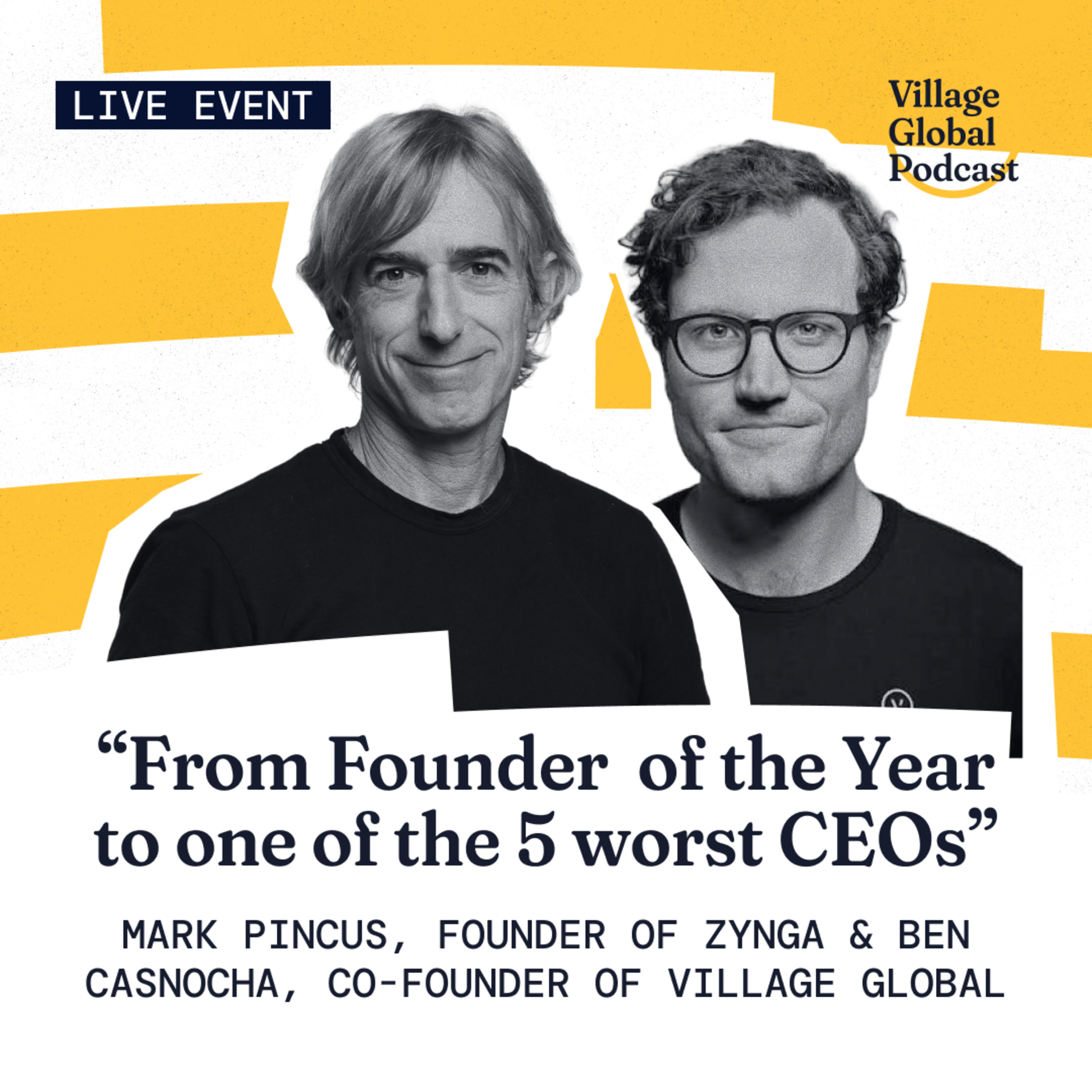
Mark Pincus (Zynga founder) discusses entrepreneurship lessons from failure and “founder mode,” his “Proven Better New” framework (use proven before novel), and what AI can/can’t do—especially around taste and intuition.
Mark Pincus, entrepreneur/investor; founder of Zynga; Stanford-taught product management class; known for experimentation/growth testing. Host: Ben Kesnoga of Village Global. Other speakers include: Louis (Amaryllis Therapeutics founder/advisor to Bing Gordon); Vinke (Serifo founder); Jack Gardner (Kickoff founder).
Instincts are often right, but ideas are usually wrong; “kill hope before hope kills you” (replace hope with conviction); despair/humility can fuel innovation; “founder mode” means courage to go against board/team; AI is strong on “proven” but “terrible at taste/intuition.”
SMSTaxi instinct (right problem, wrong timing/tech); Zynga traffic loss after Facebook algorithm change (lost ~1/3 traffic in a day); Zynga CEO turnaround attempt after being labeled among worst CEOs; Zynga “squeezing the lemon” via heavy experimentation.
Written by AI. May contain mistakes.
Mark Pincus shares insights on the reliability of instincts versus the fallibility of ideas.
“My lived experience of my whole career is that your instincts are probably right more than you know, and your ideas are usually wrong more often than you like.”
Mark reflects on a significant drop in traffic that impacted his reputation as CEO.
“And we lost a third of our traffic in, like, I think, a day.”
The hosts outline the major themes of their conversation, including entrepreneurship and AI.
“Mark is one of the great entrepreneurs in Silicon Valley, also an incredible investor on the side, and full of ideas, just a relentless idea machine.”
Mark discusses the lessons from his book, focusing on instincts, ideas, and the writing process.
“What do you want people to take away from the book?”
Mark introduces the 'Proven Better New' framework for successful innovation.
“And I go into a lot of depth on the book.”
Mark describes the experimental approach he took at Zynga, focusing on metrics and analytics.
“I think, especially if you're doing something consumer, but anything that needs a product market fit, you are probably doing too much new, and you're probably ignoring too much proven.”
Mark shares examples to illustrate the difference between correct instincts and flawed ideas.
“So let's go back to instincts versus ideas.”
Mark recounts an idea from 2003 about ordering taxis via phone that didn't materialize due to tech limitations.
“when the instinct is correct, but the follow-up idea is wrong?”
Mark talks about a recent instinct involving AI and social networking, exploring its potential.
“Have you guys tried instinct AI, the new hotness?”
Mark discusses the reliability of instincts in personal and professional relationships.
“But I didn't have this, and I wanted to do it by text.”
Mark elaborates on the concepts of hope and conviction in entrepreneurship, emphasizing the importance of conviction.
“My partner, Hillary, has had these instincts that have proven far more right than mine.”
Explore the balance between rational and irrational hope in entrepreneurship.
“It is interesting, though, that I think a lot of, like, that's a very nuanced view.”
Learn how moments of despair can lead to innovation and humility in business.
“Let's talk about some of the low moments.”
Understand the struggles of leadership and the impact of external factors on Zynga’s success.
“And by the time I got to Zynga, I'd been so humbled that I did the opposite.”
Discover key lessons learned from influential figures like Zuckerberg and Hoffman.
“A one is a high pass, a three is a fail.”
Delve into Mark's personal journey and relationship with his father.
“And it's made me want to be a better partner.”
Examine what 'founder mode' means and its significance in entrepreneurship.
“And I did it my way, which was exactly like him.”
Discussion about Bing Gordon's influence and insights on business strategy.
“What do you do when your whole executive team doesn't see?”
Mark Pincus reflects on the changing landscape of startup valuations in Silicon Valley.
“of any business models, cost models, revenue models, strategy so that we just don't fuck up and be more efficient with how we think strategically.”
Mark discusses how he would approach building Zynga in today's AI-driven landscape.
“So you were a three-time entrepreneur, had built huge businesses.”
Examine the limitations of AI in creative processes and decision-making.
“was like the Achilles heel of the company that could never scale.”
Discussion on maintaining gratitude and grounding in the pursuit of success.
“Let me just put, Jack Gardner, are you here?”
Learn how experiences at Burning Man and men's leadership training contribute to personal growth and community connection.
“and I hate to sound like the cliche tech bro, but things like going to Burning Man, where I was last week, renew my spirit in people, in mankind.”
Explore Mark's gratitude towards Village Global and the connections formed through investment and support.
“Some of those things have just philosophies have helped me.”

Get the gist, explore an idea or ask about something said.
 Claude
On Village Global Podcast, what are the key points of this episode?
Searching your listeningAutomatic transcript. May contain errors.
0:00My lived experience of my whole career is that your instincts are probably right more than you know, and your ideas are usually wrong more often than you like. And we lost a third of our traffic in, like, I think, a day. So we missed our guidance. You know, it was a public company and we'd been crushing it. And then all of a sudden, and I went from being named founder of the year in the end of 2011 to being named one of the five worst CEOs in America. in 2012.
0:38So good evening, everybody. I'm Ben Kesnoga from Village Global. For those I haven't met, we're really excited to have you here. Another Village Global Luminary Gathering with the one and only Mark Pincus. Mark was actually here seven years ago, this very same room with a bunch of villagers. So welcome back. It's great to have you here. And he's, many of you know, Mark is one of the great entrepreneurs in Silicon Valley, also an incredible investor on the side, and full of ideas, just a relentless idea machine. They're not always the bright ideas. Thanks. I like the honesty. A lot of incredible ideas.
1:12And we're going to today get into some of the themes of his book, which, of course, you all have a copy of, and he'll sign afterwards if you want it. But we're going to talk about entrepreneurship and startups. We'll talk about the journey of being a leader and CEO and some of the ups and downs you faced, some of the lessons learned, as well as talk about AI and the new opportunity landscape. Let's start, Mark, by just covering the high level in the book. What do you want people to take away from the book? Well, first of all, I have so much trouble reading business books that I tried to write the book for people who have, like, a very low tolerance.
1:44So I told Ben I deleted 80 % of what I wrote, and I tried to just make it very fast and readable. So hopefully it's a good drug delivery. And I tried to put enough stories to keep you going, but put valuable content in it. And the story is always helpful when you start sentences like when Zuckerberg and I were getting monthly lunch, when I was demoing to Steve Jobs, when I was meeting with Jeff Bezos. You could have a lot of name drops. There's a lot of good, bold names in the stories. Well, the core points of the book, I created a class at Stanford that's still taught at Stanford Business School on product management.
2:21And there was just two core points that are, I think, that if you don't bother reading the book. By the way, one thing you can do if you don't bother reading the book is you can actually, if you have a digital copy, you can upload it to GPT or Claude. And it works really well. It's like you hired me as your product manager. Or even just the Proven Better New chapter worked amazing. But the two most core points, I guess, are that my lived experience of my whole career is that your instincts are probably right more than you know, and your ideas are usually wrong more often than you like. And so it's like, okay, what do you do with that?
3:02If your instincts, this gut feeling that we have around something is right, even beyond what we think, but the idea that we put on top of that is wrong. And, you know, to get a little Northern California, part of what we have to go through is this death of our ego and we end up killing hope. But because it's our ego that wants to believe that the first idea we have is right or, you know, that it's beautiful when it's not quite there. So that's this core point I'd love to convince you of today if you're not already convinced. And I go into a lot of depth on the book. And then this framework that I didn't create until Zynga, but I had been dancing around it before, of Proven Better New, this idea that it's how do you get in the right innovation zone and how do we change your odds of success?
3:56And I've said, if you use the book the right way, it's like a cheat code, because at the very least, I think, especially if you're doing something consumer, but anything that needs a product market fit, you are probably doing too much new, and you're probably ignoring too much proven. And if you really go deep on it, for a lot of people like me, this has become, Proven Better News has become a religion. Because you start realizing, you're like, oh shit, there's so much around what I'm thinking of that's already been proven, and it's not where I'm trying to innovate. So anything I do off of what's proven is putting my whole project at risk, because now I'm making a bet I didn't mean to make.
4:41And if I'm innovating in this one area, how do I isolate that? Like we're in a lab with white lab coats. How do we just, and we fail for the right reason. Because so many products and companies fail for the wrong reason. Because I mean, how many times have you guys installed a new consumer app, and you're just like, click, click, click, next, skip, skip, skip. And it's sad, because you're like, okay, there's probably a good idea buried in this. Like, I tried this new social network retro from the team that brought you, you know, supposedly Instagram. And I was like, oh, my God, this is it. Like, they're, building the original.
5:18This is the Instagram co-founder's new company? Yeah. I don't know if it's the co-founder, but it was like one of the first people. And I was like, oh, this is kind of sad because there's the number of steps they made me go through before I even got to the innovation. Got it. And so just to, so, and I love, I think it's, it's a great reminder that I think Mark, one of the things that makes your perspective really interesting is you ran Zynga as a laboratory where you were the king of experimentation at Zynga. And you have some stories in the book about these kind of war rooms where it was so metrics and analytic driven and a million different experiments and every week was different experiments and you kind of pioneered a lot of the modern growth hacking frameworks that persist in Silicon Valley today.
6:01But let's take each of these in turn. So let's go back to instincts versus ideas. You write in the book that you believe your instinct is right 95 % of the time, but your idea can be wrong at least 75 % of the time. So what's an example, or break that down for us, when the instinct is correct, but the follow-up idea is wrong? I can give you one from 2003 and one from, like, this week. OK? It's fresh off. So it's not even in the book. I love it. OK. Hot off the presses of being wrong. So 2003, I had this idea that we, I had an instinct that we should be able to order a taxi through our phone. OK?
6:38OK, like you're in the theater, it's raining outside, you're in New York. What if you could just go to SMS Taxi and SMS and you're the one with a car waiting for you outside when everyone else is freezing in the rain, right? Good idea, right? So I had that instinct and that idea. Now, my idea was wrong on so many fronts because I wrote a whole business plan. I mean, I registered SMSTaxi.com. I wrote a business plan. I was like, okay, I'm going to go to the taxi companies. And what's the most successful I could be? And I thought, I think I could get up to a million rides a month. That was the most I could imagine and get paid a dollar per ride.
7:20So I was like, okay, the most successful version of this would be a million dollars a month in revenues. Like, not that good an idea. And going to all these old taxi companies sounded terrible. So I didn't pursue that idea, right? Now, even if I had put more of the right versions of that idea together, the world also wasn't ready for it. We didn't have GPS yet. We didn't have smartphones. So that's an example where I had the right instinct. You identified a problem in the market, but the initial solution that came to mind was not the right one. And there wasn't even a right one in that moment because the technology that ultimately made that possible didn't exist completely yet.
8:00And I'll give you one from this week. Have you guys tried instinct AI, the new hotness? Okay. So I tried it. And I've had this. Who's tried instinct? I'm curious to serve it. We're in Silicon Valley. So there won't be any hands raised in Chicago. So I've had this. I write in the book that I'm all about the social cocktail party. And I'm looking for the cocktail party. And I'm looking for it to happen again. And I've had this instinct that's haunted me for I don't know how many years. But I've worked, tried to work on this for like the last four years that I call the social membrane. And I said, there's got to be a better way for us to do social networking.
8:46The age of AI, you know, why can't we have a dynamic membrane that changes the trust based on our context and changes the amount of attention it wants based on the context? And so if I say, Ben, I'd like to hang out more, Ben's like, yeah, Mark, me too, right? Okay, in a social networking context, it means like, okay, we're friends. That's it. There's nothing else to it. But there's so much more context and intelligence now that's like, okay, Ben and I are both in San Francisco today. Does that mean our agents should tell us? Maybe, maybe not, right? Reid, our mutual very good friend, I found out that he had hosted a one week meditation retreat and I was hurt because I was like, he's one of my close, close friends.
9:42He didn't invite me and I'm really into meditation, right? But he didn't know. And I'm like, wow, this agent's talking could do that. So I've been playing around with this. But I didn't have, I had the one idea of like maybe a social secretary that helps us hang out more. But I didn't have this, and I wanted to do it by text. So I've been working, 18 months ago, I was like, okay, what if I could text Ben and my social secretary and say, hey, I'd love to hang out more. Can my social secretary connect our calendars and look for opportunities? I had this one idea. I don't think it was the right whole idea, but the underlying instinct I know is right.
10:24And instinct AI, it's honestly, it's interestingly called instinct. You know, they're doing it for everything. And then they announced yesterday that your instinct agents can find ways for you. You can have trusted, friendly agents. What do you think of the theory that another mutual friend of ours has that I won't say his name, which is trust your instinct in the negative, but don't necessarily trust in the positive. Meaning if you encounter somebody and you're like, something's off about this person, I don't want to work with them, trust that. But if you have a really positive reaction, continue to question it and diligence it.
11:01Trust but verify. Trust but verify on the positive, but the instinct's very reliable on the negative. How does that land? I don't know that we can make any generalizations. I think the point to me is more that we should all be calibrating our instincts over time and knowing where and when to just really trust our instincts and when not to and when to trust someone else's. My partner, Hillary, has had these instincts that have proven far more right than mine. I'm like, OK, I need to there's places I need to trust her a lot more. And it's been like I don't see this at all. And then I like, oh, shit, she was right.
11:39Just as a side note, are you married to Hillary? No. That's why you say partner. Yes. In the venture business, it's the worst thing ever when people say partner, because I really don't understand. Which means partner, yeah. It means a lot. So you're not married? No, but we have two kids together, and yeah, we're pretty married. Yeah. Do you think you ever will get married? No, neither of us really want to get married. I feel like kids is a bigger commitment anyway. Yeah, got it. Okay, let's get back to killing hope. You said, on theme for marriage, you said kill hope before hope kills you. What do you mean by that?
12:19Well, this goes with this proven better new, which is that we're so full of hope. When we work on new product ideas, this could be the one. It's like your next love. It's like I want this to be it, right?
12:39But we can't will something, nobody can. Zuckerberg can't will something to work either. I mean, as far as I know, nobody, I'm questioning if anyone could will something to be in existence, maybe it's Elon, because it seems like he's self something in the simulation. But other than that, I don't know anyone who can. And so to me, hope is a really dangerous thing that I don't think you should be optimistic, but not full of hope. So distinguish that. Well, what I want to distinguish is hope versus belief. And where does your belief come from? I mean, you could have blind belief. That's actually hope.
13:21Belief that is grounded in conviction. What I want for all of us is conviction. Conviction is knowing. That is a lot better place to be than hope. And conviction is based on whatever it took, whatever data point it took for you to know that this is it, know that this is the right product, or know this is the right person for you. And conviction is great. And there's no single way to get to conviction. There's no single definition. It's different for all of us. but you can get the difference of these concepts. And I just think where we want to get to is conviction-based belief, not, you know, belief-based hope.
14:09Yeah, that's interesting. And I think I would agree with you. It is interesting, though, that I think a lot of, like, that's a very nuanced view. And it feels like a lot of the entrepreneurs and founders that we all know and love are almost, like, radically optimistic. You might even call it irrational hope. to use your terminology. And I wonder, like, how do you, like, when you're in the fight itself and you're in the journey, do you think that kind of nuanced psychology can get you through the dark days? Or do you have to actually hold on to something that's more irrational? It depends on what you're attaching your irrational hope to.
14:43So if your irrational hope is that this instinct is going to play out, this vision I have is the future, and you don't have enough data to know that that vision's right, but you really believe it and you have this instinct, I don't have a problem with that. It's the hope you attach to this shot on goal, to this product. And so often what we have is we build so much hope around this product iteration, this idea, and then we get so attached to it, we don't have the metrics of success or failure and we're looking for anything as a sign of success. And I'm sure we all have friends who have stayed in a relationship too long and you're like...
15:36Raise your hand. Right? And it's kind of similar. It's like, you know where this is going and they've stayed in a relationship with a B plus product or idea. Yeah, so a lot of business leaders and entrepreneurs stay attached to things well beyond the time when they know it's actually a bad idea. Yeah. Yeah. Let's talk about some of the low moments. Because, Mark, you write in the book that some of the best and biggest company-building moments in your career have happened in moments when you have deepest despair, maybe the lowest amount of hope and belief and conviction, and that the happier that you've been in life, the harder it has been for you to achieve greatness.
16:14Yeah. And that's huge if true, because it would suggest that these valleys of despair are actually the fulcrum for innovation. And that's perhaps a sad thing, you know, sad to acknowledge. But unpack that. These days, are you mostly happy or mostly in despair? Luckily. And if you're happy, how do you still innovate because you still have so much drive? Well, luckily, there isn't just, it's not happiness or despair. It's, there's a sense of troughs of despair that we go through as founders and professionally. And for me, it's been being in the abyss, being lost or failing has humbled me. And what I've seen these waves in my career that when I've had my biggest success, I've reached higher and been more ambitious and too ambitious, too full of hope and optimism.
17:25And when I've really just been rubbed in the dirt, I've brought my expectations down. I've been more humble, more curious. And so when I was doing tribe.net, I was full of unbridled ambition. I was like, it started at the same time as LinkedIn. You're one of the first social networks. Yeah, one of the first three social networks. And everything was working, and I just did everything. I was like, I'm going to do everything. I'm going to do LinkedIn. I'm going to have a professional part. I'm going to have a personal social part. I'm going to do Craigslist. was I put everything in except trust. It's like I put every feature in, but the one thing I was missing was trust.
18:11And I failed miserably, and I stuck with that one failing product and idea. And then afterwards, I was in this abyss, and I was not unhappy, but I was lost. And by the time I got to Zynga, I'd been so humbled that I did the opposite. I started with one little project. I was like, I'm just going to make a social poker game. It was very little innovation. And I did the one thing, and I was so happy and excited when the one little thing worked. And then I saw how much more it could lead to. But also, I was so humbled that I didn't give any shits. And you would not have been impressed in 2007 if you ran into me.
19:00And I'm like, I'm making a poker app for the Facebook. Like, really, Mark? Like, do you have no self-respect? Come on. Like, you can do anything. You've had, at that point, I had. That was your fourth company or something, right? It was my fourth company. I was two and one, like, two big successes, one failure. You made tons of money. I made money. High status in the valley. Yeah, yeah. And I was like, come on, you can go do anything, and this is it? You want to make a poker app for the Facebook when everyone's making, like, pokes? So it was, people were embarrassed for me, you know. And so where are you?
19:37Where am I in that art of embarrassment? Go into the Zynga story. You stepped back as CEO at one point in the journey. Was that the lowest point for you? That was, I don't know if it was the lowest of my career. But of the Zynga story. Oh, yeah, yeah, that was the lowest. Did you step back involuntarily or voluntarily? I jokingly but proudly say that I've been fired from every company I've ever worked at, including Zynga, where I had control and I fired myself. So I had control, so they couldn't fire me. Was the company public by then? It was public. We went public in like maybe December of 2011.
20:19and then not a victim in this world, but Facebook decided to turn off our traffic in like April, May of 2012. I mean, they changed the algorithm against us and we lost a third of our traffic in like, I think, a day. So we missed our guidance. You know, it was a public company and we'd been crushing it and then all of a sudden, And I went from being named founder of the year in the end of 2011 to being named one of the five worst CEOs in America in 2012. And so I don't know if anyone else has that distinction but me. One year, when I was at Harvard Business School, the dean sat me down because I had more ones and threes than any student they'd ever measured.
21:12A one is a high pass, a three is a fail. And he's like, if you just didn't have the threes, you'd be a Baker scholar. So I seemed to do that. So the low point was, yeah, in 2013, I felt like I'd let everybody down. We were, like, I don't know, at that point, a$2 or$3 stock. And I just was like, oh, I got this wrong, and I'm going to go hire. I'm going to do the safe thing. I'm going to hire the golden resume of the game industry. this guy who had turned around Xbox and was EA was trying to get him a CEO. And I was like, everyone thanked me for it. And I was like, this job is too hard. I've been, I'm burned out.
21:55I'm not doing it well. Maybe he can do better. And he put in motion this strategy that I blessed and it was wrong. And so I can't blame him. I want to ask about if you're a big learner, you love learning, you've worked with lots of people. And I want to ask, I'm going to name a a few different people in your career and life and would love to hear just a minute on what you've learned from them. Let's start with Zuckerberg, because you spent so much time with him in the key Zynga days. What have you learned from Zuck? What inspires you about him? I don't know if I've ever met anybody more committed to a destiny than him, no matter what.
22:33I also think he's maybe the most multidimensional person I've ever met. You could see him pour his heart out in a way that you would just hug him and love him. Bing Gordon. Bing is... Kleiner Perkins' partner. Bing is just a huge heart. He's incredibly creative, a teacher, a coach. Yeah, and Bing also is multidimensional in an intellectual way. that Bing is, he's been around Jeff Bezos, he was on the board at Amazon, and he has such probably better pattern recognition than anyone I've ever met, and he's able to pull it up at will, like an encyclopedia. And so I got so many Jeff Bezos lessons from Bing.
23:43Reid Hoffman. It's funny, also, like just, the biggest heart is, I don't know if, I mean, people in this room probably know, but I'm not sure the world knows that he's like just the most loyal friend and he's just so driven by friendship. And I'd say, yes, he's brilliant strategist, but the number one thing I've gotten from him is learning the true essence of being a great partner. Makes me loathe here. He just, he's just, the level he goes to to be such a partner to his friends is like amazing. And it's made me want to be a better partner. Your father. My dad, he taught me, well, the way he - You had a journey with him.
24:42I had a real journey with my dad. We ended up really good friends, but my dad taught me leadership. He taught me this concept of a democratic dictatorship, which is how he ran our family and his company. And the thing he hammered into me was control your destiny. Like, he just couldn't understand this Silicon Valley concept, which now it's come full circle, and my dad would be like, yay, founder mode, control. But for most of my career, it was not tolerated. There was no such thing as founders having control. And my dad could not understand this model of bringing in people on your board and not having control.
25:26He just was like, why would you go do this if you didn't have control? But was there some breaking point with you and him where he made you feel like you had to be successful to earn his love or something? or what was the? No, it was almost the opposite. It was like I did not become, by the age of 18, the person that he imagined, his very narrow picture of what I was supposed to be. And so he was ready to break me for that. He's like, I'm pulling you out of college and I'm going to take you back home for a year because I didn't finish raising you right and because I didn't want to be in a fraternity.
26:08and I just wasn't this kind of his vision of a mensch. And he's like, you're gonna be a sad, lonely loner and never successful. But it wasn't so much about achievement. It was like, I wasn't showing up. He was a joiner. He joined everything. Like when I did his, you know, obituary, or when I spoke at his funeral, I was like, this guy, I read, he was like a member of like 50 things. I couldn't even join YPO. First I was like, didn't have revenues in my company, they didn't take me. Then I was like, too busy when I had a company with revenues. Then I was too old. You know, I mean like YPO, his life was YPO.
26:53I just didn't become the person, the exact version he wanted, but then I did become, you know, like, I did become like someone he was really proud of. Proud of you, yeah. Yeah. And I did it my way, which was exactly like him. He did it his way. Let's talk about AI a little bit. It's a less teary topic. Yeah. Does anyone have a burning question or reaction, anything we just talked about, by the way? I will say one other thing, though, about both my dad and these chapters I went through with Zynga. And I can't remember if I talked about it in the book, but I know since the book I've talked so much about my version of founder mode.
27:41And I think to me, yes, there's like having the chance to have your moment and be wrong. I mean, there's so much like the essence to me of the founder mode is like, and I find it funny, all the VCs that are like, There's a small number of entrepreneurs that really deserve founder mode. The rest don't. I'm like, I wish we knew, you know, which ones at the right time. But so, yes, I totally agree. Founder mode is like. Well, define founder mode because this is one of my pet peeves is what are we talking about? The definition, I think, that's been put out in the world, and I'll give you where I would additionally modify it, is like founder mode is like if you guys are founding your own company, you deserve the rope to hang yourself.
28:26Like, you deserve the chance to bet on yourself whether you are right or wrong. You deserve the chance to not be second-guessed, not have to convince a jury of your board or your peers that you're right, and just to say, damn it, we're doing this, I'm taking this hill, I'm going this way, because that's what I believe, and that's why the fuck I'm doing this. To me, that's founder mode. My modification on that is that real founder mode is not just going that way when other people don't see it or agree with it, but it's going against everybody. It's going against your board, your team. And it's in that book about Jeff Bezos, he had a moment where his CFO and no one believed in Prime.
29:17And there was no data support. And he said, well, we're doing it. And that, to me, that's real courage. And that's what I hope for all of you, for all of us, to have faith and conviction in your own instinct and the courage to go and be misunderstood. And by not the outer world, but the inner world of the hardest is going against the people around you. Interesting. And, yeah, it's one that people have a lot of context and know you well. And know what you're doing. Like, they're your team. What do you do when your whole executive team doesn't see? Yeah, it's interesting. I would have, and I know Brian Chesky is the top blurb on the back of your book.
30:00With all due respect to Brian, I understand his definition of founder mode to be micromanage, be in the details, except when you don't want to do that because you want to empower your team. Yes. Which I've never found, like, it's a good thought, but it's the judgment call of when to micromanage and when not to, that's the trick. And that was never elaborated to me in the discussion of founder mode. Just before we move on, any other questions or comments? Louis, I was wondering if, on the Bing Gordon topic, if you had anything to say, since Bing has such an influence on Mark, anything you want to say about Bing's genius?
30:31Because he's quite a compelling guy. And here's the mic behind you. I'm Louis. I'm running Amaryllis Therapeutics. It's a biotech company delivering drugs to the brain. But before that, I had made a game with Pokemon and sold to a crypto company. And then Bing was one of our founding advisors, always a wisdom whisperer. And I mean, I'm not in the league to be able to comment on the type of relationship that Bing and Mark had. But Bing has always been, I resonate with everything you said. that Bing can pull up any business case studies of any business models, cost models, revenue models, strategy so that we just don't fuck up and be more efficient with how we think strategically.
31:14Anything from like negotiating with like smaller players to ultimately Pokemon, Nintendo, and that's been incredible. And he's extremely generous and deeply passionate with what he cares about. And Bing is coming out with a book this fall, I think, or with Penguin books that's - You front run them, that's the key. I know, I got out of it. Get to market first. But he gave me this concept of like, are you dominating your job? And are the people who report to you dominating their job? And I really loved it. And it's like, well, what is it? And it's like, is that qualitative? It's more qualitative than quantitative.
31:50But you kind of know, are you dominating your job? And are the people who report to you dominating their job? And he just, or he said like. It's a good example of like the power of a phrase. Yes. You know what I mean? Like there's no such thing as a new idea. It's all about phrases that stick and lodge in your brain. And there is, Dom is kind of a fresh word. He was like, he gave me these like big aspirations. One of them was, I write in the book about is internet treasure. Like these, he gave me the name, these services we can't remember life before or imagine life without. And I was like, oh, that's my why.
32:26Thank you. Another thing, a very pragmatic one also, is he said, you know you did a good job at an all-hands meeting if people want to go back to work afterwards. If they're so fired up that they're back to their keyboards, which sometimes we got to. It's interesting. As we talk about Mark and Bing, so much of the modern tech economy runs on gamification principles. It is interesting. We all have a lot to learn from the world-class gaming experts on how products get built, no matter what industry you work in. This AI moment, I remember a few years ago we talked about your first Zynga round, was that a$5 million valuation?
33:07$15. $15. Come on, don't insult me. So you were a three-time entrepreneur, had built huge businesses. Yes. One went public. You took a company public in your first round of fine. How big was the round? $5 million. $5 million at 15 pre? Yes. Okay. What is it like for you looking out at Silicon Valley today at the college dropout raising$100 million at 600 pre? What is this moment? How do you make sense of it? It does make sense. And, in fact, I remember being with Sequoia when I was first pitching Sequoia on Zynga. And they said, and then I was asking for 20 pre, not 15. I said, I'm raising, they said, what are you raising?
33:54I said, five at 20 pre. And they said, how do you justify 20 pre? And they really said that in 2007. And I said, look, if you care about the pre money right now, you're not investing in the right company. Because I'm only going to build a multi-billion dollar company or nothing. And if I build a multi-billion dollar company, it just doesn't matter which valuation you came in at. You're going to make a lot. It's a call option. And I was like, I'm a call option. Take it or leave it. And they were all like, okay, that's a good answer. Questions or comments from archives and others but want to give people an opportunity.
34:32Let's go to Vinke over there. Thank you for a very fun and insightful conversation. I'm Vinke. I'm one of the villagers here. I run a company called Serifo. Was curious. What's the one-liner on the company? Sorry. The company is basically automating what McKinsey, BCG, et cetera, do. So a lot of our fellow alumni who are trying to get jobs there for many years. But we're doing it without a lot of Gen AI. So the question I had for you is back in the day, I had a lot of friends who were at Zynga. There was a very nice mix of taste and empiricism. Like you described, the entire company was running on tests.
35:10And I was just wondering if you were to build Zynga today with all of this AI native talk that is all there, like how would you organize the company? Like what would you give to AI and what would you preserve for human judgment? Thank you. And I love that you brought up taste because I think in a lot of ways that intuition and instinct and taste was like the Achilles heel of the company that could never scale. and to a large degree like Bing and I were the kind of taste makers or in the in a lot of cases we were like the core instinct driver and and then what was around me was this incredible testing apparatus but I couldn't I couldn't ever train for that I couldn't hire for that game designers were great at games on and they just they weren't even they weren't able to bring our taste which was what we were doing was something slightly different than just game design and and we'd bring in people who had amazing game design chops but they just they couldn't get what we were doing what i was doing was playing with dimensionality and and i couldn't what i mean by dimensionality is like i was i was trying to to fuck with people, with our players.
36:34Make them believe the virtual is real in one way or another. I wanted to, I was saying this in my Zynga talk today, I wanted adrenaline. And I was like, I don't know how to measure adrenaline. I don't know how to tell people to do it. And so what I would do differently is we overbuilt one muscle, which was the PMing and the testing. And we really, really built it. And we were so good at turning the knobs and driving metrics that in the end, it was what we started calling squeezing the lemon, that the one thing that every PM could do was get more monetization. And a lot of my PMs and data analytics people all went to Facebook.
37:19And so they all became leaders at Facebook. Facebook was not a data company. They didn't like data. They didn't believe in data. They believed in intuition. and then like post IPO, they hired our head of data analytics and then they hired like our CFO and they hired like, there's a lot of Zynga inside Facebook and you can blame me for that. But they, so that muscle doesn't lend itself that well to taste and intuition. What do you think of AI tools today? An AI co-pilot to help you make better decisions? How does it score on the taste? Well, you probably have a lot on this. with what you're building, but I find that it's terrible at taste, terrible at intuition.
38:07It's a lot like Zynga was. So if you upload my book or the Proven Better New chapter, and I think we put on GitHub like a Zynga PM out of it, it will be unbelievable at benchmarking and it proven. And it can do proven like better than we can, like A plus. And it's like, okay, I got that part of the book right, I guess. And it works well with AI. The better it's like, okay. It doesn't, it's not terrible at better. And the new, it's absolutely terrible. And it's, and it's just, it's good news for all of us. It does not seem to, it's, I've used it as a brainstorming partner and I find, but I've got to feed it a lot.
38:58It does a really good job, but then it's kind of like, and I don't mean this badly, I was this too. And I have to like constantly say, well, because it'll tell me about Zynga. It's like, well, what made Zynga work was this, this, this. I'm like, no, you're actually not right. And it constantly wants to give me a probability. Like, I think this was 60%. And I'm like, why are you giving me these probabilities? Interesting. Let me just put, Jack Gardner, are you here? You were going to ask a question earlier, and I meant to call on you about staying grounded and grateful. Do you want to ask that to Mark?
39:31I'm Jack, founder of Kickoff. We are the first platform offering personal training covered by health insurance on a mission to make everyone healthier, happier, and increase longevity. For the non-Mormons of the world. Yes. They need your ass. We're trying to keep up with the world. You can't be a Mormon. This is your next best husband. Yeah, exactly. First convert, if not, buy it. Yeah, yeah. Yeah, so my question is, I guess I'm worried that, you know, a lot of us in here are chasing financial success and just success in general. And I've seen that corrupt. I've seen it give people God complexes and kind of lose grounding with reality and gratitude for basic things.
40:28And I love the journey of building. And I love, you know, building something that people use. But I worry about how to make sure at the end of the day I'm still grounded. like still thankful for the little things and realize that I and a lot of my ideas like you said are totally wrong so curious do you have any thoughts you know in that journey well first I think I I think I talked in the book at some point about this book that's very hard to read because it's translated from Japanese that's become a cult classic in the valley the courage Courage to be Disliked. And who's read this book, Courage to be Disliked?
41:12Not that many. So I'd recommend it, the audio book. And it's very stilted because it's didactic and it's translated from Japanese. But it's based on the philosophy of this guy, Alfred Adler. And I'd really encourage people to look up Alfred Adler, who was also a student of Freud with Jung. and he rejected Freud and Jung. And Alfred Adler said that we get true happiness from feeling useful to a community that we care about. And I gave you the end of the book. The entire book gets to that. And it's feeling useful, not being useful. It's not winning awards, or it's not outwardly signs of success.
42:02and I hate to sound like the cliche tech bro, but things like going to Burning Man, where I was last week, renew my spirit in people, in mankind. The core of what Burning Man, what Larry Harvey meant it to be about, the ethos, because Burning Man, you belong because you do something really useful for somebody else. And it could be one person, and you do something epic for a stranger, and you're like, I like myself, that I would do something so good for someone. Part of it to me is like, that's been part of my journey is like, okay, I want to do things that make me feel useful to communities I care about.
42:49And part of the courage to be disliked is that we've got to be confidently expressing our truest selves, even if that's going to turn off some people who are going to not like us, so that we find our real community. Some of those things have just philosophies have helped me. And then what I would say is, like, you know, I know it's become kind of trendy in the last 10 years. But some of these I I've been working with a life coach for 23 years. But then I went and did Groundbreakers. So things like Hoffman and Groundbreakers, I think, are amazing. Some of the personal growth that we get from, and I've been doing this pretty intense men's work for the last, like, nine months where you're with, like, a group of 80 men.
43:4080 men? Well, I did something called the EMLT, the Embodied Men's Leadership Training, and you're in a group with 80 men with two six-day immersives. And it's great, and they don't know you from anybody, but you're working on your shit together. So I think those things, I think, for me, keep me grounded and being in a place of trying to grow personally. We are at time. Mark, thank you for your support of Village. If you've raised money from Village, you've raised money from Mark because you've invested in all of our funds over many years. And I'm lucky to be the recipient of. Thank you so much.
44:18Let's give it up.
44:38see you for the next one.
Mark Pincus is the founder of Zynga and a Village Global Luminary LP. He took Zynga public after starting it as a social poker game for Facebook, and it was his fourth company, after earlier ventures that included Tribe.net, one of the first social networks.
Ben Casnocha, co-founder of Village Global, sits down with Mark at a Village Global Luminary Gathering to dig into the core ideas of Mark's book. Mark's central claim is that your instincts are probably right more often than you know, while your ideas are usually wrong more often than you'd like. He explains how that led to his "Proven Better New" framework, which came out of a product management class he created at Stanford Business School, and why he thinks most founders do too much "new" and ignore too much "proven." He illustrates with an SMS taxi idea from 2003, before GPS and smartphones existed, and with an instinct he's still chasing today. They also get into the difference between hope and conviction, and why Mark says to kill hope before hope kills you. Mark walks through the lowest point of the Zynga story, when a Facebook algorithm change cost the company about a third of its traffic in a day and he went from Founder of the Year to one of the 5 worst CEOs in America within a year. He shares what he learned from Mark Zuckerberg, Bing Gordon, Reid Hoffman, and his father, gives his own version of founder mode, and explains where AI is strong (proven) and where it's "absolutely terrible" (new, intuition, and taste). The conversation closes with audience questions, including how he'd build Zynga today and how he stays grounded.
Thanks for listening. If you like what you hear, please review us on your favorite podcast platform. Check us out on the web at www.villageglobal.com or get in touch with us on X @villageglobal. Want to get updates from us? Subscribe to get a peek inside the Village. We'll send you reading recommendations, exclusive event invites, and commentary on the latest happenings in Silicon Valley. www.villageglobal.com/signup