
In short
Grow Therapy’s founding and scaling story; how it built an end-to-end mental health marketplace (patients, providers, payers) and how AI fits in therapy without replacing humans.
Guest
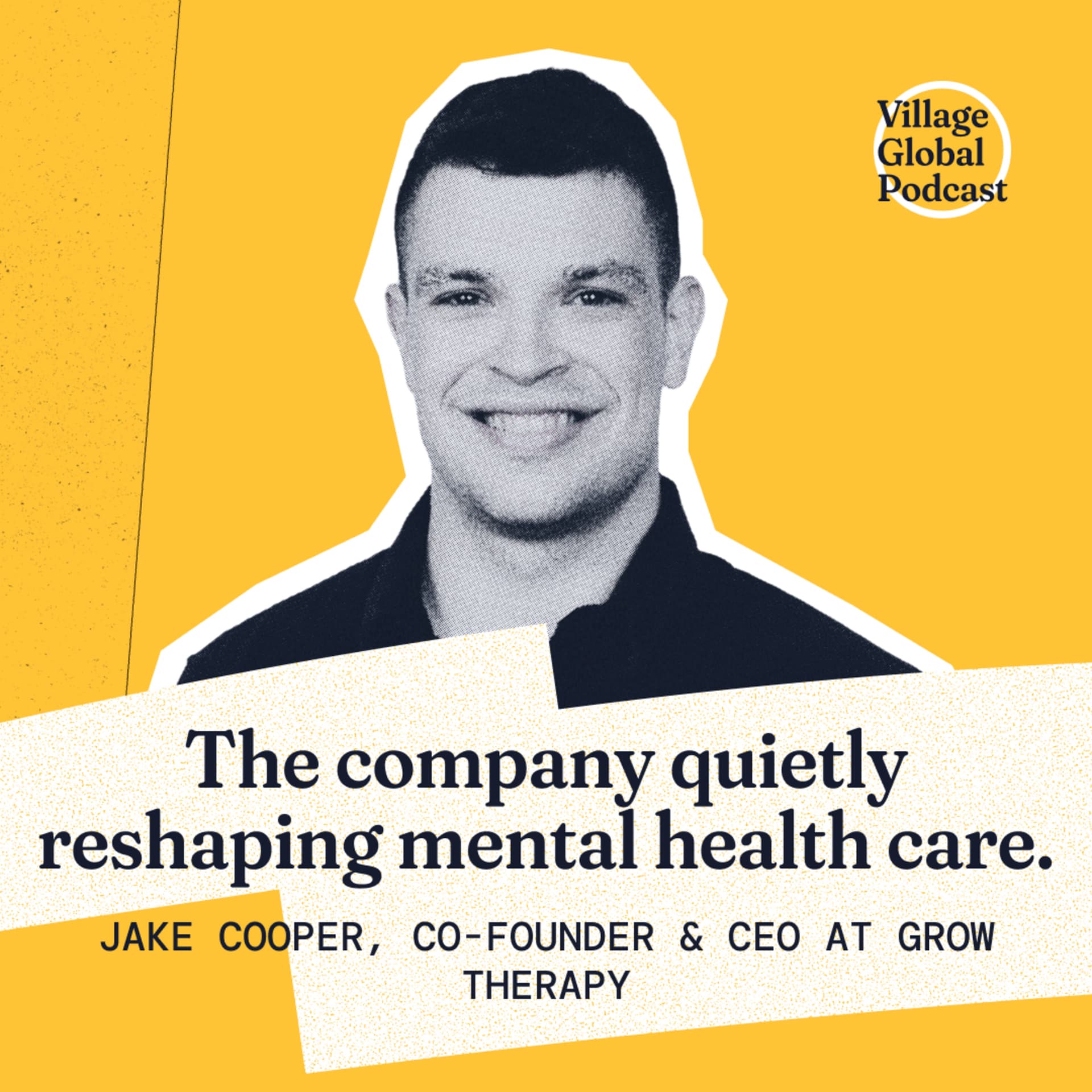
Jake Cooper, co-founder and CEO of Grow Therapy. Background: started small businesses in college (e.g., cleaning, bed rentals, summer storage); previously worked at Blackstone (per a question about day-zero go-to-market). Personal motivation: his sister had severe mental health challenges and died years ago.
Key claims
therapy jobs won’t disappear in 10 years; LLMs are a supplement, not a replacement, for relational, multidimensional problems. Grow serves ~1M visits/month across ~26,000 providers; passed $1B top-line revenue; profitable since year two; ~40% of users use LLMs for health/wellness/relationship advice; 2025 therapy visits up ~7% YoY in America.
Notable examples
started during COVID; built workflows and matching leverage from virtual care; launched provider acquisition via an Indeed-style job ad offering revenue share (50 provider applicants on ~$20 spend). AI coaching tool described as interactive journaling informed by sessions, with provider handoff. Hiring tactics: “double click” into details; manager effectiveness drives retention.
Written by AI. May contain mistakes. Listen to the episode to check what was said.
Chapters
Tap a time to open that second in VOFounding Story of Grow Therapy
1:21 to 4:00
Discover the challenges and motivations behind starting Grow Therapy.
“I was talking to someone who knew him, who knows him well a few days ago, thinking about this conversation.”
Business Model Insights and Iteration
4:00 to 5:51
Understand the unique business model and iterative process at Grow Therapy.
“Was that just you and your co-founders got in a room and thought hard about how all these pieces work together, or did you have to iterate your way to this business?”
Current Scale and Impact
5:51 to 6:13
Learn about the scale of Grow Therapy and its impact on mental health.
“It meant workflows went from pen and paper to digital, which meant that we really had workflow leverage.”
Entrepreneurial Education and Mission
6:13 to 8:50
Explore how Jake's early entrepreneurial experiences shaped his mission.
“some of the financials we will keep private, but in terms of what we've disclosed so far, we passed at the end of last year, a billion dollars of top line revenue.”
Co-founder Dynamics and Relationship Building
8:50 to 12:21
Understand how co-founders collaborate and build trust in their journey.
“But more off the record, you know, my mental health was personal in a deeper way.”
Navigating Challenges and Growth
12:21 to 14:01
Learn about the challenges faced and strategies for growth at Grow Therapy.
“And how did you build, like your co-founders have been there with you and for you during some of these incredible professional milestones and some real personal challenges and milestones.”
Exploring Different Perspectives in Decision-Making
14:01 to 15:00
Learn the importance of understanding premises behind differing viewpoints.
“But, you know, we're always just working backwards from what the right answer is for our company.”
The Power of Curiosity in Conversations
15:01 to 17:03
Discover how curiosity can transform discussions and resolve disagreements.
“And I think that's an incredibly powerful habit.”
Building Strong Teams and Company Culture
17:04 to 18:11
Learn about effective hiring practices and cultivating a positive workplace.
“you know, there's one of the questions over dinner was like, what are areas where you're like irrationally stingy in areas where you're like irrationally generous or over - Splorid.”
Operationalizing Team Alignment in Large Organizations
18:12 to 19:05
Understand how to achieve alignment across various levels of a large company.
“So double click a little bit on the tactics.”
Show all 21 chapters
Effective Interview Strategies for Leadership Roles
19:06 to 21:05
Explore techniques for interviewing potential leaders and assessing their capabilities.
“and objectives at a company department and then team level are useful.”
Assessing Candidates' Depth of Understanding
21:06 to 23:10
Learn how to evaluate candidates' abilities through strategic questioning techniques.
“How many interviews do you do a week, would you say?”
Understanding Motivations and Title Relevance
23:11 to 25:48
Discuss motivations behind job changes and the significance of job titles in interviews.
“So if it's a top-level leader, if it's someone who's in a production-type role, you can say, okay, what's a recent side project that you've done?”
Leveraging AI in Therapy and Business
25:49 to 28:00
Examine how AI can enhance therapy processes and overall business operations.
“you're a prospective customer in a sense of the scale you operate on these different functional areas.”
Therapists and AI: Job Security
28:00 to 28:31
Explore the impact of AI on the job security of mental health therapists.
“You can share with the providers at the end of the session.”
Understanding Human Connection in Therapy
28:31 to 30:27
Discuss the unique human elements in therapy that AI cannot replicate.
“So a couple of stats just to level set on the plane, on where we're at empirically.”
The Role of AI in Mental Health Care
30:27 to 32:55
Learn how AI can complement therapy and improve mental health care delivery.
“So let's say I want to work on my mental health.”
Admired Entrepreneurs and Their Traits
32:55 to 36:21
Jake shares insights on entrepreneurs he admires and their characteristics.
“Our mission is to help everyone in need lead a meaningful life.”
The Benefits of Staying Under the Radar
36:21 to 40:08
Discuss the pros and cons of maintaining a low public profile as a CEO.
“So we talked about this a little bit at dinner, And I think one preface I would have is I don't travel that much, and Manoj is holding down the fort for a lot of the sales.”
Initial Steps in Building Grow Therapy
40:08 to 42:03
Jake outlines the early growth strategy and challenges faced by Grow Therapy.
“I think it's a really interesting form of content where you have, it's engaging, but long form.”
Ed's Inquiry on Mission and LLMs
42:03 to 46:01
Ed asks Jake about how their mission has evolved in relation to LLMs.
“I'm Ed, the CEO and co-founder of Flower.”
Transcript
Automatic transcript. May contain errors.0:00Curious to show of hands for folks here, who has used an LLM essentially as a therapist going back and forth talking about a personal or professional challenge you've had? Okay, so this feels like a trillion dollar question for you, which is, are all these mental health therapists as humans still going to have jobs in 10 years? A hundred percent. So a couple stats just to level set on the plane, on where we're at empirically. 40 % of the folks that receive Carefree Grow, they're using an LM for health, wellness, and relationship advice. Visits in 2025 were up around 7 % year-over-year industry-wide for therapy.
0:39In America? In America, yeah. So how do those things both simultaneously make sense?
0:52we're really excited to have jake uh here with us um many of you probably know uh about the the kind of remarkable success of growth therapy but today we're going to dig in a little bit to the founding story and some of the key lessons learned from jake's journey uh jake is rarely actually does uh interviews conversations appearances speaking gigs he's not very active on social media, extremely humble guy. Encourage everyone to listen carefully to some of the depth of wisdom that he's accumulated these past few years. He's really one of the most talented operators in the tech industry today. I was talking to someone who knew him, who knows him well a few days ago, thinking about this conversation.
1:31And he said, Jake's insights on how to run a business at scale are truly, truly singular. So it's, we're honored and delighted to have you with us, Jake. and why don't we just start to kind of level set with everyone. Tell us the founding story of Grow and give us a sense of your current scale and what the business does. Of course. And first off, thank you for having me. It's great to be here, to meet every one of you guys. I hope it was a very generous introduction. I hope that everyone here can lower their expectations a bit. But of course, yeah, you know, I'd love to tell you that. So just a little bit of background.
2:08I'm Jake, one of the co-founders and CEO of Grow Therapy. I'm actually here with my other two co-founders, Manoj, who's in the audience. Alan just stepped out, but you'll see him around as well. So in terms of how we got started, we started Grow in the middle of COVID because we saw that mental health really wasn't working for the three stakeholders that comprised the industry, patients, providers, and payers. and I saw this firsthand as a patient. I struggled to find a mental health provider who took my insurance, let alone was a good fit. My co-founder, Manoj, saw this from the other side. He was training to become a doctor, looking at psychiatry amongst other areas and just seeing the immense amount of really just operational friction and business building that you need to go through to run a private practice.
3:04and in diving into what we saw was a challenge, we diagnosed it as two things. One, the industry was totally analog and two, it was extremely fragmented, both in terms of its participants, where you had primary care doctors diagnosing folks separate from therapists, separate from psychiatrists, and also in terms of the software and services where you'd have maybe three different directories you list yourself on to get leads. You'd have a different EHR, a different scheduling system. You'd have an independent person hopefully submitting your claims, not always as a biller. And we felt that if we could build an end-to-end system to support every one of these stakeholders, we could advance the most important mission in the world, helping people live happier, healthier, more content lives.
4:00And you had a, there was a business model insight, which by the way, if those who don't track healthcare services has been replicated in many different businesses, and we at Village Global have backed many growth therapy for X companies, some of them are in this room, but the business model insight about how this all comes together as a system was really the, was really the profound and has spawned tons of copycats and imitators. Did that come naturally to you? Was that just you and your co-founders got in a room and thought hard about how all these pieces work together, or did you have to iterate your way to this business?
4:32There was definitely iteration along the way, but I think we took a fairly first-principled approach to start, which was, does it make sense for everyone to independently apply to insurance companies? Does it make sense for everyone to independently build their own revenue cycle management functions? Does it make sense from a discovery standpoint for patients to really find who is a great provider just by asking a couple people that they know versus going to a place that not only aggregates all the different options, but serves as a quality control mechanism. So I think from that perspective, we did anticipate this, the kind of systems level approach we took.
5:18It wasn't possible really to do what we did pre-COVID. COVID drove practice from in-person to virtual, which had huge second-order consequences. It meant that providers could start practices without paying for office space or without having to be in an area that was very population-dense. It meant that matching now had real leverage. If you were matching on a hyper-local basis, you might have five options that you could possibly commute to. Now you had 500 because you can match on a state basis. It meant workflows went from pen and paper to digital, which meant that we really had workflow leverage.
6:00You had a direct access point to patients as well as they'd enter through client portals instead of through a provider's office door. Give us a sense of the current scale, how many patients. So we do around a million visits a month across 26 ,000 providers. some of the financials we will keep private, but in terms of what we've disclosed so far, we passed at the end of last year, a billion dollars of top line revenue. And we've been operating profitably every year since year two, which has enabled us to really double our investment in our team, our product and our expansion. Now, you started a cleaning company in college.
6:43I did. At Duke, that's been passed to new student leaders every year, is my understanding. And you've separately credited that experience of starting the business in college as teaching you more about entrepreneurship than a lot of other things. Like, what was that entrepreneurship education for you? Yeah. So to be clear, this is not something you would quit your day job for. But there's a couple, I think, in college, and I'm sure this is the case for many folks here or potentially at way earlier parts in their life. You know, I met great people. I cared about school and applied there. But the area that I really felt that I learned the most and personally found the most contentment was in starting a few different small businesses.
7:26Cleaning was one. Bed rentals was another. Summer storage, things like that. I think it was bed rentals, summer storage.
7:37I won't get into the details, but basically, I had in many ways been on tracks where progress was very linear and step-by-step. I think high school, colleges like that, I wanted to finance afterwards, and it's, again, like year-by-year progression. I think in starting a company, you really see that the aperture opens in terms of what you're able to do. You're able to work with fantastic people. And some of the early experiences, I mean, even just hiring people for the first time, dealing with situations where things go wrong, dealing with like some interpersonal conflict, if you have to part ways with someone, those were, I would say, more formative experiences than anything I was learning in the classroom.
8:32So you were starting different companies, kind of the classic entrepreneurial instinct, seeing business opportunity. But with Grow, you founded a business that was deeply aligned to a mission that's incredibly inspiring and changing the world of mental health and healthcare. And it's a mission that's personal to you. Share a little bit about why you care so much about this mission. So I mentioned to start that the catalyst for Grow, So from my standpoint was first my own challenge in finding a mental health provider and my co-founders challenge and anticipated challenge and really starting and building up a practice.
9:10And those were the two catalysts. But more off the record, you know, my mental health was personal in a deeper way. I think I am not, I am unfortunately similar to many people I grow and probably many people in this room where I had a family member, in this case, my sister, who really struggled with severe mental health challenges since she was a teen, unfortunately passed away a few years ago. And I think that for us, we have the opportunity on the one hand to, if we do our job well, really change the lives of the people that we touch. And on the other hand, it's a huge responsibility to actually deliver because these are people's lives that we have a degree of impact on and in a small ways can change the trajectory of how they shape out.
10:11Let's talk about you and your co-founders in the early days. So, there's three of you started the business together. How do you divide and conquer and think through that co-founder dynamic? And how has that evolved as the company has scaled? What have you learned through the process of being great co-founders? Yeah. So, I think we have a business model that is inherently vast and complex. I mean, you could have a marketplace as a company. You could have an EHR as a company. You could have revenue cycle management as a company, care, delivery. Those are effectively four different companies. There's other ones.
10:49I think you could name other areas. The rationale for having it all under one roof is there's a real one plus one equals three aspect of being able to own the full infrastructure rails end to end. And what has really enabled us to run at that more expansive scope comprehensively is the relationship that me and my co-founders have had since day one. And I think the simple way of describing how we have operated is on the marketing finance operations side. I've taken more of the lead there. On the partnerships side, that really underpins all of our payer relationships, all of our ecosystem relationships.
11:41In addition to the clinical research side, Manoj has really taken the lead. And then across tech, Alan, who started as an engineer, then was PM as his design job as well, as operator research CTO, cutting across engineering, product design, and data. You know, we've, while those are the general flavors of division, I think just as important as our relatives' skill sets and strengths is the fact that, you know, we're all just operating from how can we make this successful with very low pride of ownership over any given area. So we've kind of traded areas and scopes all throughout. And how did you build, like your co-founders have been there with you and for you during some of these incredible professional milestones and some real personal challenges and milestones.
12:33Like how did you build trust and how do you invest in those relationships so that they can show up for you and you can show up for them at some of these crucible moments? Yeah, it's, I mean, there's some things that you can do deliberately in terms of making time and space to connect. But a lot of it is not so much, oh, we did this off-site or we did this dinner or we have this ritual. It's more that I think we have had—Minoj was the first person I reached out to when I was struggling to find a mental health provider because I just respected the heck out of him. Alan was the first person we both reached out to when we were looking to really—when we saw that, you know, If we go from having this be a services business to really building a platform, we can have a huge impact because he was the person who both professionally and personally we most respected.
13:31I would say the shared value set, we were all friends or connected through others in college. I think a shared value set is probably the most important thing.
13:48And as you've scaled the business, have you had to have sort of difficult conversations with each other or roles had to change? And how do you kind of approach that? Yeah, we've definitely had roles change and scope change. But, you know, we're always just working backwards from what the right answer is for our company. And again, we're operating with low pride of ownership. I think, and this is not just for Manoj, Alan and I, you know, I think it's important to not only have a point of view that you express, but express the premises that underpin that point of view. Because if you say, you know, Ben, you say, you know, we should go right and I say we should go left, like those sound like disagreements, but really if what's more interesting is what are the premises that underpin your point of view and then can you validate or invalidate any of those premises, you can go about it a little bit more methodically to actually figure out the core point of disagreement and then a plan to reconcile it.
14:59Yeah, well, and I will say at dinner last night, I saw that in action in a segment of the conversation in which there was a small disagreement on some topic, although I don't think there was actually really meaningful disagreement, but I actually watched you in real time come back to curiosity and literally ask the question, I'm curious to learn more, I'm curious to learn more, I'm curious to learn more, as kind of a back and forth was unfolding. And I think that's an incredibly powerful habit. And it's one of you have to, so that is something that takes practice because I think all of us, We have strong points of view that's kind of intrinsic to founder archetypes broadly, but I do think that there's real ask questions first value even just to understand someone's frame of thought in terms of how to respond.
15:46So, Jake, you're a master at building teams. Interestingly - I wouldn't necessarily say that. The growth therapy Glassdoor scores are some of the best in the industry. It's kind of fascinating. I think so many of the companies in the category have really shitty employee NPS, but you've recruited some incredible people, you've retained some incredible people, and you've retained NPS even after folks have left. What do you believe on the topic of hiring and team cultivation that many other CEOs do not believe? Yeah. So just a couple of prefaces. I have seen a lot of companies that I do deeply respect that have just terrible glass door reviews.
16:23So just as a preface, I don't know. I wouldn't use that as a singular barometer. I think the hard thing is, and this is like known, is just finding the right person for each role, making hard decisions quickly, and creating a connected and communicative culture where folks are both pushed but also feel appreciated and heard. I think there are tactical things you can do in terms of like to actually operationalize this. Just as an example of one of the things we're talking through over dinner, you know, there's one of the questions over dinner was like, what are areas where you're like irrationally stingy in areas where you're like irrationally generous or over - Splorid.
17:17Splorid excessive. Swag and events, by the way, are two that I've heard from Village Global, which I love. I'm going to be wearing this, whether it's Village Global event or just socially. It's great, great swag. Sequoia event, Village event, you know. It's all, you know, better swiders for sure. I think for us, you know, the areas that we mentioned that I do think make sense to go above and beyond, like severance, like if you're going to depart with someone, even just having to have a new policy where you can do that generously, it's not going to be a super large percentage of your folks in a given year.
18:01you don't want to create malincentives to hold on to someone for a prolonged time. There's ways that even after someone departs, just shooting them a note of appreciation. There's small things like that in, I would say, like inflection point moments that are disproportionately valuable. So how many employees do you have now? 600? 620, 630-ish. So double click a little bit on the tactics. because you said kind of casually, oh, build alignment, make sure everyone's on the same page. But how do you actually do that across such a large organization? Like, what are your communication patterns? How are you pinging people?
18:37Do you guys run on Slack? Is this like all hands every week? Are you emailing? How many directs do you have? Like, what's the operating playbook? Yeah. So this is something where I, you know, I don't feel like an expert in that. I feel like you're kind of learning how to do this a little bit better each day and necessarily so if particularly as you're changing phases, I would say that, or stages, I would say that a couple of things that have worked well for us. I do think that cascading like top line vision and objectives at a company department and then team level are useful. You don't need, I think,
19:25while it's not taken to extreme, it can be very restrictive, but done well, it can just create scaffolding for folks to innovate within their core area in a way that they can articulate ladders back to the core company. When you say, you mean defining the top level objective. Yeah, exactly. But I think candidly, the biggest thing is manager, level effectiveness. If you do MPS surveys, the question that's most correlative with team and employee retention is what they think of their manager. And I think that that is emblematic of the leverage that you have in just having strong leaders. There's the cannon versus cannonball or something like that metaphor of you're mostly right constrained by how many folks can operate with reasonably high degrees of autonomy and direct and empower efforts.
20:26So we've seen, even with the same company planning and the same rituals, just very different outcomes depending on the leader in the functioner seat. Yeah, it reminds me of the phrase, employees join companies and they leave managers. Yeah, exactly. Right. And that's why the manager relationship is so powerful. How do you select for people that are more likely to be the canons or the people that have high throughput and high agency? Like, what do you interview? You mentioned that today. Some days you'll do 40 or 50 interviews, you know, over the course of the week or maybe the day. I'm not doing that many, but I do.
21:07How many interviews do you do a week, would you say? Typical week at Grow? I think, you know, 10 would maybe be like... 10 interviews a week. That would be, I would say around, call it somewhere around there. And what are you asking to try to get at this question of, are they going to be the person that can... Yeah, there's a couple different lines. I think one, you want to understand their motivation. So even if you just step through each layer of, you know, here's the three different steps you've made, what drove you to take the next step to understand, are they running away from something? Are they running towards it?
21:48If they're running towards it, what are they solving for? Are they solving for money? Are they solving for prestige? Are they solving for a learning experience? Are they solving for a specific interest? I think that that is useful. Being able to see if they are actually a doer and can operate at multiple altitudes.
22:07So there's a couple different ways to test this. I think for a leadership level, like even starting with a big strategic question, see how they answer that and say, okay, well, what did you do to advance this? And then they'll give you an answer and then you'll go, okay, well, like what specifically, how did you conceive of this? What were the initial metrics that you looked at? Like, what did you get wrong? What was like, and basically clicking like six layers down, what you will find is, and this is not new advice. I think DoorDash in particular does this. Tony, who I think is one of the best leaders at hiring at scale, does this really well.
22:43We found that to be effective. And the doing it is the double clicking down into the details. So there's a couple of ways you can do this. One, you could give someone like an actual test to do. And the DoorDash test, as an example for people who are launching markets was, here's 25 bucks, you have five hours, go get 200 customers. No one would get 200 customers, but seeing how they would respond to a very amorphous challenge was indicative of their perseverance, creativity. You can't do that with everyone, though. So if it's a top-level leader, if it's someone who's in a production-type role, you can say, okay, what's a recent side project that you've done?
23:23And you basically just click down into that, the decisions they made at each part of the journey. If it's someone who's won a leadership role, who hasn't, there's not a couple side project. You can start a strategic level of something they've taken down, they've taken on and really click a few layers down. But the point of all this is to basically get from the strategic conception to like very tactical execution and seeing their depth of understanding at each different layer. And the folks who aren't really, can't really go that deep, you'll start to lose them at like layer two or three. How long are these interviews when you're double clicking?
24:02Like over what period of time? I think you can do this in interview time versus signal, like goes asymptotic, like relatively quickly. Like I think if you, I'm not sure after like more than five to six, like cumulative hours of interviewing someone, you learn that much more if you use those five to six hours effectively. And this is cumulative. This isn't like one interview. It's like five hours. That would be a long interview. So you're trying to probe someone's motivations. What drives them? Are they running towards something? Do you trust their answers? Because can't people game this a little bit?
24:45They know what you want to hear. I think that you can compare their answers to their actions. And if someone's like, you know, I wanted to work here for the mission. It's like you work at Dunder Mifflin. You make paper. There's no possible way that this is true. If you're like, you know, I don't care about title, but you saw that every step up was a title role, and you're saying, you know, this is a bigger scope, but it's a title down, and they're like, what's my title? Do you actually do that? Because I heard that's what Zuckerberg did earlier days at Facebook, was intentionally give people a lower title than they had the previous job just to test for title obsession.
25:23Yeah, I think it's, so we had probably skewed in the early days in tech, particularly title deflationary, but like on the margin, we try to just do it accurately. I think that there are, we don't have like an extreme tactic there, I would say. Let's talk about AI inside Grow. We have a lot of people here who are building vertical AI applications. you're a prospective customer in a sense of the scale you operate on these different functional areas. You've been thinking a lot about, you were born pre-Chat GPT, and you're on the quest to become an AI native operating business, and you're thinking a lot about what products can transform different parts of your business.
26:10What's your current sense for where you can get the most leverage out of AI? And as you look and pilot different products and vendor pitches, where do you get excited about the potential, and where do you think there might be too much hype? Yeah. On AI native, I do think it's like anything a spectrum, not binary. I think though, so a couple of just high level statements and then I'll answer specifically. We'll click in six lines. I think that's, yeah, we'll click in. I think it's a spectrum, not binary. I think generally speaking, anything that improves distribution or experience, which ultimately feeds back to distribution, will have a greater impact than things that are cost-reductive.
26:51Like there's a limit to how much you can reduce a cost. You're not going to get, it can't go below zero. Whereas for distribution and scale, which we're all in the business of, there's not as much of a limit. So you're saying don't pitch cost savings, pitch greater impact. I think you should pitch what you are delivering. But in terms of areas that are focus areas for us, I think what gets us most excited are things that improve the increasing number of people we serve or improve how we serve them. Now, going one layer deeper, a couple areas that are top of mind for us in particular, matching for us.
27:36So there's certain surface areas where you don't even really need to break existing user paradigms to get the leverage, to get full leverage in the user experience from AI. So in the last area is actually our AI coaching tool, which folks use between their sessions to support care. I would think about this today as in some ways like to interactive journaling where it's informed by the session. You can share with the providers at the end of the session. or you share it with the providers before the next session. You could also set intentions in the session that then you revisit it in between. Chris, a show of hands for folks here.
Read the full transcript
28:14Who has used an LLM essentially as a therapist going back and forth talking about a personal or a professional challenge you've had? Okay, so this feels like a trillion dollar question for you, which is, are all these mental health therapists as humans still gonna have jobs in 10 years? A hundred percent. So a couple of stats just to level set on the plane, on where we're at empirically. You know, 40 % of the folks that receive Carefree Grow will raise their hand if we ask this question. Like they're using an LLM as well? As well. Well, they're using an LLM for health, wellness, and relationship advice.
28:53Visits in 2025 were up around 7 % year-over-year industry-wide for therapy. In America? In America, yeah. So how do those things both simultaneously make sense? Well, it's different use cases. If you think about fields, and again, I'll very high level, what areas do we think will forever stay in the domain of humans? I mean, just speaking very generally, fields that are relational versus functional and fields where the objective is more nebulous versus defined are ones that are just intrinsically better suited for humans and we see that in actual preferences. We also, we haven't seen any change to this as models have.
29:42There was a step function improvement for 4.0 when 4.0 came out, but since then, you're not seeing changes in how folks are using it in a material way. It's still incredibly useful as a supplement. I think that being able to, with no latency, have thoughtfully kind of structure your thinking and interaction, if it's informed with full clinical context and in a system where there's an escalatory pathway, is inherently valuable and can help bend the cost curve in healthcare. We don't see this being net reductive to the fundamentally human aspect of navigating your life. I mean, it seems like one of the key things people get from therapy is the sense of feeling of being heard yeah and someone listening and the question is can that be replicated directive accountability i mean i i think i um i know there's a lot of sweeping statements that um are around in terms of where we will go and i understand them because the pace of progress is is so extreme but like i i for me it's more akin to like you know will you no longer have like a romantic relationship because there'll be an LLM and like it's it's well maybe maybe some people I mean you know you know to each their own but I think it's like very niche like right yeah and I haven't um I haven't other areas that um are like simulative of like romantic context like you know there's there's nothing we're fundamentally wired in a given way as humans.
31:23And I don't see that. I don't see that. That's fair. So let's say I want to work on my mental health. Yeah. What types of questions should I ask the LLM and what questions should I say for the human therapist? Like, where is the comparator? Other than being heard and listening. What an LLM is useful for is if you have an existing directive for it and you are looking to have adherence to that directive, it will help you structure your thoughts. What it is not great for is if you're like, you know, here's this fundamental relationship challenge I'm having that's multidimensional. Like, what should I do here?
32:01Like, there's so much at play there. And in a similar way, as other relational nebulous fields are, if you, everyone here can say, you know, what should I do as CEO for my company? and maybe it can help brainstorm, but it's not an iterate in a closed system with a defined objective where you can go all around, okay, how do you optimize support responses to improve CSAT? It's like closed loop, like low permutation complexity. That's very different from how do I navigate my life. One of the reasons your mission is so amazing is you guys probably more within any other company in America have the ability to shape how mental health care is delivered and you can up-level therapists.
32:51Totally. To have an AI co-pilot and help people much more dramatically. Our mission is to help everyone in need lead a meaningful life. And I think if you think about the way to do that at scale, there's zero sum components of like, how do we offer better value proposition to folks? than our competitors, all that. But I think the very positive some aspects relate to ways in which we can actually make the system of care more effective or may, and a component of that would be helping empower individual providers or providing a kind of triage pathway where you have support in between your sessions that can compliment the directive that you're receiving from care.
33:35And those we see as all expansive or expanding our overall impact as a company. And so if you guys have questions or comments for Jake, I'm going to turn to you in a couple of minutes. Jake, you mentioned Tony from DoorDash. Yeah. Who are other entrepreneurs you admire and even from afar and what do you admire about them?
33:59I think that.
34:06I'm trying to think of ones that are not just totally commonplace. It's tough because the commonplace ones are compelling.
34:27The reason I picked Tony at DoorDash is because I think just the level of operating rigor, is just, which really started with the way that they hire is just extremely high. And they were able to systematize that in a way that is really challenging to do at the scale that they're at. I think there's certainly other folks, I think, for Zuckerberg just operating with like no sunk cost bias whatsoever and the most kind of maximally like expected value type function. And I think those are like... Those on cost bias, is that like moving away from VR? Well, yeah, there's definitely a shoot. How much money do they spend on that?
35:23I think like 100 billion or something. 70 billion. Some ridiculous... You spend 70 billion. It's like, that didn't work. Some ridiculous amount of money. but I think it comes down to if you are always curious and you're operating with intellectual humility and you're thinking on a reasonable time horizon, if those three things are true, then you will not operate with a sunk cost bias. Then you will be open to not having to be right a high percentage of time, knowing that if you, for the ones that high percentage, basically maximizing expected value versus percentage win rate. Like it comes from, I think, those values.
36:07I've never worked at Meta, and there are so many other aspects that you can draw a different point of view on, but those aspects, character-wise, I admire. Why don't you have an EA? So we talked about this a little bit at dinner, And I think one preface I would have is I don't travel that much, and Manoj is holding down the fort for a lot of the sales. So Manoj does your calendar? No, no. Manoj has greater need probably for an EA than I do in many ways, because I think those two things lead to it. but in terms of if most of the meetings I'm having are with candidates or internally, I do think it's a feature, not a bug, that there's a layer of friction to book, and I have a little bit higher control over.
36:58It's harder to get on your calendar. Yes, I have more discretion if he makes it on my calendar, and I think I also have a more immediately direct relationship with folks that I am meeting. I'm not going to live or die on this belief. I think it certainly makes sense for a lot of folks. Well, it is a funny thing. It reminds me of like Sergey Brin. Yeah. There's also like you try to do things that set reasonable precedents. And I think like we have, to be clear, debated at some point, like having a shared EA. But I think we have this like horror story where it's like we get one, then you have like the exec team get one, and then you have like the VP folks get one, and then it's like a bunch of just EA is just like.
37:44like spending it inspiring to take over the company not not doing that but more just like spending so much time just court like coordinating meetings and it's like this is not what we um yeah we're not here to to have meetings we're here to um do incredible work um but yeah it does certainly make sense for some for people in other circumstances and then one more for me then i'll open it up uh everyone's to think about questions for jake um jake you're a fairly private person you're pretty heads down and focused you said you don't travel much you don't give talks much if you google your name on youtube there's literally not a single interview you've given that's on youtube for the last five or six years despite running one of the fastest growing companies in america what's the pro and con of this posture like what do you get from this heads down nature and what are you missing out on yeah um so i would say that um there are pros and cons, I think.
38:43So I think part of this is rational and part of this is just personality style. I think the rational part is, I think just generally speaking, we could have a bigger impact just focusing on the work directly. I do think some of this was probably more personal preference. I'm a bit shy. I don't derive any personal meaning from notoriety. Manoj, Alan, and I, even down to this presentation, are all kind of like... You're enjoying this one, though, right? I'm enjoying this one for sure. This one is fantastic. Completely different. But we're always trying to jokingly volunteer each other for stuff.
39:30It only took us seven years to get you here. I would say that where it has started to have a negative impact, and I am going to try to do a little bit more to change this, is if you Google us, we are greater in scale than we are known. And while that doesn't matter intrinsically, it does matter for recruitment, which is the the main way that we can build, achieve our mission. I do think actually having, even if it's just like one, and I will do one of these publicly, like one podcast type interview. I personally watch a ton of them. I think it's a really interesting form of content where you have, it's engaging, but long form.
40:14So you can get a sense of how someone thinks. And I think it's useful to have even just one of those out for potential folks. Maybe they won't discover you through it, but once they discover you, they'll Google your company and have a better sense of you from it. That's a great line. I might do one podcast. I mean, it's really remarkable. I can't think of another CEO who's at less press. I will eat my broccoli. Questions for Jake. Hi, thank you for sharing your story. Ray Yang, I'm a founder of Termbox. We're building an AI analyst for capital markets. I'm curious about your day zero go-to-market.
40:51get what it was like. Specifically, how do you present value proposition to providers when you don't have patients? And how do you present value proposition to patients when you don't have providers? I'm curious how you solve this problem. I'll tell you exactly what we did. So growth started with a job ad. We posted on Indeed. Do you want to start your own practice? In exchange for a revenue share, we'll partner with you every step of the way. We had 50 providers apply to this job ad that we spent$20 on. That was just a website. I quit my job three days later. Where were you working at the time?
41:28I was at Blackstone at the time, private equity company. And Manoj dropped out of med school pretty much right after that as well. His parents were very supportive. It was one of the funnier stories, and I'm maybe embellishing a bit, but my dad was like, you know, you dropped out of medical school. Like, you guys, you guys don't even have a dot com email address. This is terrible. And then we ended up buying like growth therapy dot com for like five thousand bucks. And he's like, this is better. One time for one more question. Let's go to Ed here. Ed? Yeah. Hi. Thank you, Jake. Incredible story.
42:20I'm Ed, the CEO and co-founder of Flower. We are building the most ergonomic database for agents to use, bar none. I think the question that - Ergonomic meaning comfortable to sit in, all the rest? Ergonomic, yeah. Comfortable. Standing, sitting. Easy to understand. It's just a pure code, no impedance mismatch. It's going to be the easiest database for agents to use. Anyways, I was really inspired by the mission-oriented nature of your company. The fact that the three of you all as founders sort of like had this really strong through line through which everything else was expressed. I'm really curious how the mission has both remained the same, but also how it's changed in the face of, you know, kind of the dual sided, the dual edge nature of LLMs and how they both promote psychosis in a certain respect, but also how there is this sort of ray of light and how they could advance therapies.
43:15I'm really curious if y 'all's mission has changed in that way. Yeah. Great question and great to meet you.
43:25For what it's worth, I don't think capability changes have had, which is how I view LLMs, a direct impact on our mission. We view those as more like inputs for achieving it. I think one evolution that we had over time was for multi-sided marketplaces, it is important that every stakeholder succeeds for the overall mission and system. to succeed. So there's often not direct trade-offs. It's much more common that what's good for one is good for another. There are some instances, though, where there are direct trade-offs, and I think having a priority rank across those stakeholders is valuable. I would say when we started, and again, we weren't patient-facing.
44:18We were, like, as I mentioned, like Psych Today, that was patient's relationship was possibly even more with Psych Today, let alone the individual provider than it was us, it was probably providers, patients, payers, or something in that order. I think today, we kind of flipped a year or two in, particularly when folks started to come to our site directly for care, it really flipped a little bit more to patients, providers, and payers. And to be clear, that is, I think, objectively like the right order. At the end of the day, all participants are here to help support people living more meaningful, healthy, content lives.
45:01But it came with a series of the way that that would manifest in terms of trade-offs, just as an example, for reviews. Like, I think they're very valuable in many aspects. You can imagine some providers were not happy with even the idea, Even if they're rating five stars with the idea that a patient could review them, what if the patient wasn't a reliable narrator? What if it had a real impact on their business? And the way we'd go about this was, one, we'd stick with what we think is right for care, but then, two, we'd go about it in a nuanced way where we had an objective, objection handling process where we'd review every review.
45:40If you raised an objection, we would look into it further. We'd have a response mechanism. So there's ways you can mitigate it, But I think that that's probably the biggest value alignment shift that we had over time. Jake, you've built an incredible company. We're honored to have you in the village. And you're obviously honoring the legacy of your sister and changing the lives of millions of people. So thank you for everything. Of course. Yeah.
46:08Hey, this is Ben Kassnoka, co-founder of Village Global. Thanks so much for tuning in to the Village Global podcast, where we go deep on all of the biggest topics in tech. If you enjoyed this conversation, please subscribe to our YouTube channel. You can check us out on Spotify, Apple, wherever you get your podcasts. We'd love to see you for the next one.
From the publisher
JakeCooper is co-founder and CEO of Grow Therapy, a technology platform that helps mental health providers launch and scale independent, insurance-accepted practices. Since starting the company in the middle of COVID, Jake and his co-founders have scaled Grow Therapy to around a million patient visits a month across 26,000 providers, surpassing $1 billion in annual revenue while operating profitably since year two.Ben Casnocha sits down with Jake to trace Grow Therapy's founding story, from the friction he and his co-founders saw across patients, providers, and payers to the systems-level model that let them scale where others couldn't. They get into how Jake and his co-founders have divided responsibilities and built trust as the company has grown past 600 employees, his contrarian read on hiring and what most CEOs get wrong about spotting high-agency talent, and the deeply personal reason the mission matters to him. The conversation turns to AI, including where Grow Therapy is finding real leverage in matching and provider coaching tools, and Jake's frank take on whether human therapists still have a role as more people turn to LLMs for support between sessions. He also opens up about why he's deliberately stayed out of the public eye, and why that's starting to change.
Thanks for listening. If you like what you hear, please review us on your favorite podcast platform. Check us out on the web at www.villageglobal.com or get in touch with us on X @villageglobal. Want to get updates from us? Subscribe to get a peek inside the Village. We'll send you reading recommendations, exclusive event invites, and commentary on the latest happenings in Silicon Valley. www.villageglobal.com/signup