 Ask ChatGPT


Final Australian-series episode of Voices for Justice focusing on two unresolved NSW cases: the 1996 murder of 37-year-old Margaret Christina Cox and the disappearance/murder of teen Shirley “Cherylee” Nolan Masters (identified as Cheryl Lee) around 2000. The episode also argues—without proof—that witness allegations may connect both cases to convicted child sex offender Frank Abbott.
No guests appear in the transcript. The host is Sarah Turney; research/writing assistance is credited to Brooke Haynes.
Margaret was last seen alive at the Big Oyster service station (Dec 19, 1996) and was found two days later in the Manning River with blunt-force head injuries and sexual assault. Her case had an inquest (2010) and no charges. Shirley/Cherylee was last seen Sept 22, 2000, hitchhiking plans; remains were found Sept 17, 2006 and ruled homicide. The episode highlights witness Iris Northam alleging Abbott had gouge marks, said “oysters,” and that a bandaged woman was Margaret; she also links Abbott to back roads and local markets near where Shirley’s remains were found.
composite sketch; recovered clothing at Mudbishop’s Point Reserve; multiple DNA profiles on Margaret’s underwear (none identified as Abbott); Iris’s “oysters” wound description; Shirley’s hitchhiking; road access evidence near Brimbin Reserve.
Written by AI. May contain mistakes.
Exploring the unresolved cases of two women and the questions they raise.
“My name is Sarah Turney and this is Voices for Justice.”
Detailed account of Margaret Cox's last night and her subsequent disappearance.
“Our first case takes us to Tari, a city on the Manning River in the mid-north coast region of New South Wales on Australia's east coast.”
Overview of the police investigation into Margaret's murder and key discoveries.
“a fisherman found her deceased in the Manning River, floating face down near Mud Bishop's Reserve in the coastal town of Old Bar.”
Discussion of the inquest findings and ongoing mystery surrounding Margaret's case.
“and slowly the things you love begin to find each other.”
Explore the mysterious gouge marks on Frank Abbott and their implications in Margaret's case.
“And she says he had wounds on his arms between his wrist and elbow that she describes as gouge marks.”
Delve into the details surrounding the disappearance and death of Shirley Masters.
“And slowly the things you love begin to find each other.”
Tony recounts the painful journey of discovering his sister's fate and the struggles his family faced with the investigation.
“her remains, and comparing it to people who'd gone missing from that area and had never been found.”
The investigation delves into potential links between Frank Abbott and Shirley's case while discussing unresolved questions about the investigation.
“Star Wars The Mandalorian and Grogu is now streaming on Disney+.”
Explore the unsolved cases of Margaret Cox and Sherrilee Nolan Masters, and the impact on their families.
“the murder and sexual assault of 37-year-old Margaret Cox in 1996, the murder of Shirley Nolan Masters around 2000, and the disappearance of 3-year-old William Tyrrell in 2014 have in common, are as follows.”
A heartfelt plea to share the episode and raise awareness about the victims.
“But as we know, media pressure moves mountains.”
A reflection on the Australian series and ongoing investigations regarding Frank Abbott.
“The studio door is open and our emotional support puppies, Popcorn and Heber, are in the room.”
In-depth discussion on the evidence related to the cases, particularly DNA recovery.
“I just like could not get over the Frank Abbott connection, you guys.”
Honoring the journalists and individuals who contributed to these cold cases.
“They could connect all three of them to somebody except for that last one.”
The hosts express gratitude towards journalists and Iris Northam for their contributions to the cases discussed.
“So please, no matter what you think about all these cases, just know that they are amazing.”
The hosts share a poignant story about Robert Mather's long-unsolved case and its eventual resolution, bringing hope to listeners.
“And you guys, I had to stay in Australia.”

Get the gist, explore an idea or ask about something said.
 Claude
On Voices for Justice, what are the key points of this episode?
Searching your listeningAutomatic transcript. May contain errors.
0:01Cherylee Nowlan Masters: Fall is a vibe. So what's yours? Do you go wild? Or get a little nostalgic? Do you like to cozy up indoors? Or kick it outdoors? Whatever you fall for. Get shoes that get you. We've got the trend. You bring the vibes. DSW, let us surprise you.
0:32Cherylee Nowlan Masters: Fall never arrives all at once. First the air, then the light. And slowly the things you love begin to find each other. A jacket meets a dress. A hoodie slips beneath a blazer. An old cap finds a new scarf. Because you don't simply step into the season. You create it layer by layer until it finally feels like fall. Find fall your way at Ross.
1:02Margaret Cox: Voices for Justice is a podcast that uses adult language and discusses sensitive and potentially triggering topics including violence, abuse, and murder. This podcast may not be appropriate for younger audiences. All parties are innocent until proven guilty in a court of law. Some names have been changed or omitted per their request or for safety purposes. Listener discretion is advised. My name is Sarah Turney and this is Voices for Justice.
1:34Margaret Cox: Today I'm discussing the cases of Margaret Cox and Cheryl Lee Nolan Masters. When I started researching William Tyrrell's disappearance, I didn't expect it to lead me to three other unresolved deaths or to witness accounts raising questions about the same man. But as I was digging in, I and my reporter Brooke kept asking ourselves the same question. Could this be the work of a serial killer? Now, the alleged connections are unproven, but they raise questions that go beyond any one investigation, and certainly beyond any one podcast episode. We've already talked about William Tyrrell and Helen Harrison.
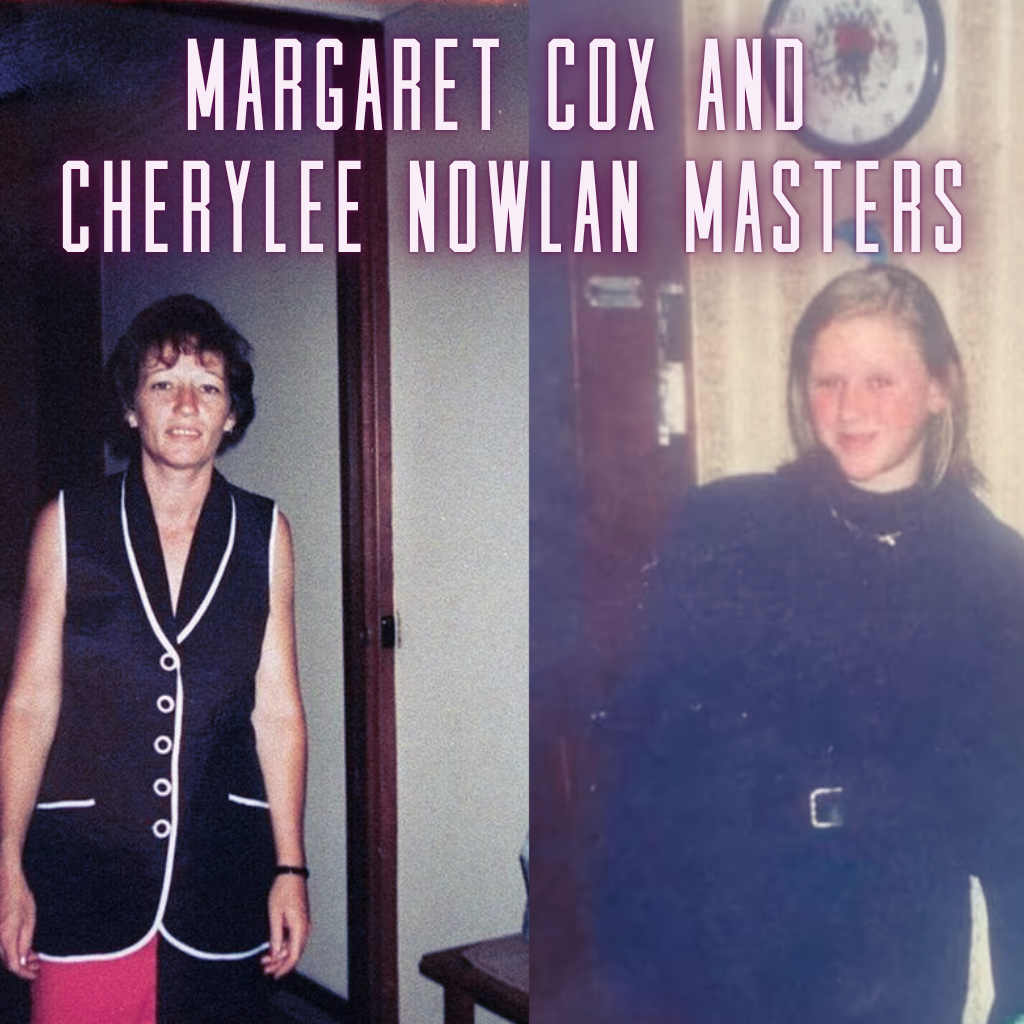
2:13Margaret Cox: Today, in the final episode of what's become this Australian series, I want to introduce you to two more women whose stories I couldn't leave behind. These are the cases of Margaret Cox and Cheryl Lee Nolan Masters.
2:31Margaret Cox: Our first case takes us to Tari, a city on the Manning River in the mid-north coast region of New South Wales on Australia's east coast. It's Thursday, December 19, 1996, and 37-year-old Margaret Christina Cox is going out with friends. Margaret was a mother of three who worked at a local supply company. According to reporting by Nine News, friends described her as a gentle soul. And like we've seen in all of these cases, journalists Dan Box and Nita Young revisited Margaret's case in their podcast, Witness William Tyrrell. They describe Margaret spending the evening with friends, drinking, and visiting at least one club after walking from nearby Cundletown in Datari.
3:14Margaret Cox: Now, accounts do differ about exactly who she was with at each spot throughout the night, but at around 11, Margaret rode back to nearby Cundle Town with several people. The group split up after they got there. Two people went to a nearby caravan park to see a friend, while Margaret walked over to the big oyster service station on the Pacific Highway looking for a cigarette lighter. This was the last place Margaret was seen alive. And what exactly happened at this service station is a bit unclear. An employee said that Margaret was with one or two men. Another witness described her being surrounded by a group of men and screaming.
3:52Margaret Cox: Which is absolutely terrifying because after this, Margaret goes missing. And unfortunately, there's just not a lot of reporting in Margaret's case. So it's unclear when she was reported missing, what investigative measures may have been taken to locate her, or what the public response was, if they knew she was missing at all. And I think part of this is because everything happened so quickly in her case, at least at first. On December 21st, just two days after Margaret was last seen, a fisherman found her deceased in the Manning River, floating face down near Mud Bishop's Reserve in the coastal town of Old Bar.
4:30Margaret Cox: This is about 12 kilometers or 7.5 miles from where she was last seen at the Big Oyster service station. But it is worth noting that the Manning River runs near the service station to where she was found and out to the ocean, so it's unclear if she was placed in the river near this area or if she floated there. What we do know is that she suffered blunt force injuries to her head and had been sexually assaulted. Unfortunately, the autopsy could not establish whether she was alive when she entered the water. But we do have another clue here, because at least some of Margaret's clothing was recovered separately at a picnic area in Mudbishop's Point Reserve near the river.
5:13Margaret Cox: The trouble is, we don't know the condition in which they were found, specifically if they washed ashore or not, but it does seem clear that someone removed her clothing, and they somehow ended up in this picnic area. And at this point, it seems that the New South Wales police was taking this very seriously, because pretty quickly homicide detectives from Newcastle form a task force to investigate her murder. Her clothing is sent off for testing, and they get to work conducting interviews. It's reported that they made thousands of inquiries, and asked anyone with information to come forward. They were specifically interested in speaking to people who had traveled along the highway around the time Margaret was last seen, as well as any fishermen who'd been in the area where Margaret's clothing was recovered.
5:57Margaret Cox: And they do discover something very disturbing. Witnesses state that they heard screaming from a bridge farther upstream on the night Margaret disappeared. So we have witnesses from the service station saying Margaret was with a group of men and screaming. And now we have witnesses saying that they heard screaming again at a different point in the night. But they still didn't know who Margaret was with. So like we see all the time, they start with her inner circle and work their way out. And again, here, I'm sorry guys, we just don't have extremely detailed reporting about this. But we do know that investigators questioned her former boyfriend, and he reportedly had an alibi.
6:34Margaret Cox: And there was someone else that police wanted to speak with. They were working to identify a man believed to have been camping at Mudbishop's Reserve. They also released a composite sketch of him, along with a description of a white four-wheel drive Land Rover associated with him. And it worked. Several people came forward to identify the same man, but I hate to say it, you guys, that's really all we know. We don't know if he was eventually considered or ruled out as a person of interest. The DNA is also a bit unclear. They found four DNA profiles that did not belong to Margaret on her underwear recovered from the picnic area.
7:13Margaret Cox: Three were identified, but investigators haven't told the public who they belong to. and the last set of DNA is reportedly never linked to anyone. Eventually, the task force investigating Margaret's murder along with a few others came to an end in 2004. There was no resolution to Margaret's case, but it was still considered open and active. From here, her case basically sat for another six years until 2010. That's when the New South Wales Police Force posted on social media that it, as well as the deputy coroner, were asking people to come forward with tips and information about Margaret's murder before they held an inquest examining it.
7:54Margaret Cox: That's when a very familiar name comes up in Margaret's case that I've been telling you guys about for weeks now. The man we heard about in relation to the cases of William Tyrrell and Helen Harrison. Of course, that man is none other than Mr. Frank Abbott. This episode of Voices for Justice is sponsored by Shop. To celebrate the all-new Shop.com, Shop is giving away$1 million in Shop cash. Shop has all the stores you love and lets you track every order in one spot. If you're new to Shop.com, the holidays is the perfect time to get started. I've been using it for a while now because I really do like to shop online.
8:34Margaret Cox: I'm always hunting for the best deal, and Shop keeps all those orders for me in one place. That way I'm not digging through my emails trying to track down these shipments. I can just go to my shop account and see everything right there. And now, a thousand shoppers are each going to win$1 ,000 in shop cash, just in time for the holidays. Get gifts for everyone on your list, or get yourself something a little merry and bright. Find exactly what you're looking for at shop.com. From cult favorites to the world's biggest brands, score sweet deals and check out fast, all at shop.com. Enter to win the$1 million Shop Cash giveaway from now until November 1st.
9:11Margaret Cox: Just go to Shop.com. There are so many ways to win. That's Shop.com. Shopping designed around you. No purchase necessary. Restrictions apply. Official rules at Shop.com.
9:28Cherylee Nowlan Masters: Fall never arrives all at once. First the air, then the light. and slowly the things you love begin to find each other. A jacket meets a dress. A hoodie slips beneath a blazer. An old cap finds a new scarf. Because you don't simply step into the season. You create it layer by layer until it finally feels like fall. Find fall your way at Ross.
9:57Margaret Cox: That inquest into Margaret's death was held in 2010, led by Deputy State Coroner Paul McMahon. Now, as a reminder, these inquests in Australian cases basically just examine how a person died and the circumstances surrounding their death. It is not a criminal trial. But we learn a little bit about the investigation into Margaret's case from the reporting on the inquest. Box and Young report that three or four persons of interest were mentioned in the inquest, but we don't know their names or what made them persons of interest. At this point, it seems pretty clear that even after a decade of investigating, they just didn't have much.
10:35Margaret Cox: In the end, McMahon ruled that her cause of death was blunt force injury to the head, inflicted by a person or persons unknown, and that there is not enough evidence available to say who may have killed her or charge a suspect. He also said that he believes an unidentified man, who may or may not have had a relationship with Margaret, was responsible for her murder, and he appealed for that man to come forward with information needed to make a determination in her death. And he adds something here that I think is really important to take note of. He believes it was likely that the perpetrator was local.
11:10Margaret Cox: Because the area where Margaret's clothing was found is far from the main point of town, and there's really no lighting in this area. So basically, if someone went there to dispose of Margaret's body, it would be pitch black, and only someone familiar with the area would be able to navigate it. Though he also couldn't make a finding on Margaret's exact place of death. So really, that's the inquest. We do gleam some information from it, but overall, they don't determine much. Then about another decade goes by without any mention of Margaret's case in the media. That is, of course, until the William Tyrrell inquest.
11:46Margaret Cox: This is when a woman named Iris Northam comes forward to give a statement about Frank Abbott in 2019. I have discussed Frank Abbott extensively throughout my episodes about William Tyrrell and Helen Harrison. He seems to be a common threat in several Australian cases, but as a reminder, Frank Abbott is a convicted child sex offender who was investigated as a person of interest in William's disappearance. Years before that, Abbott stood trial twice for the 1968 murder of 17-year-old Helen Harrison. The first trial ended without a verdict, and he was acquitted at II. But, as he relates to Margaret's case and Iris Northam, Abbott worked for Iris and her husband Ainsley Northam, who goes by Dooley, at their scrapyard in Tari.
12:32Margaret Cox: She testified that she met Frank Abbott because his father was a regular customer at their business. She says that one day around 1989, Abbott's father came in and said his son Frank was looking for a job. According to Iris, he said Frank could do any type of work but had previously been in jail. They give him a chance anyway. And Iris tells Box and Young that initially she didn't have any problems with him. She says they'd ask him to do something and he'd just do it. That he spoke normally and didn't have a bad attitude about work. Basically, everything seemed normal. But she testified that he stopped working for them in 1991 when he was arrested for the murder of Helen Harrison.
13:11Margaret Cox: After Abbott was acquitted in 1995, she says he and Dooley remained friends and would often go to horse races together. but that's not all she said now these statements at williams inquest don't do much for margaret's case because those proceedings just weren't about her but they did catch the interest of dan box and nina young as they were creating the witness william tyrell podcast who thank goodness dig so much deeper into this they requested the files from williams inquest and receive iris's full statement and what they read led them to tracking her down themselves they go to her home in old bar to interview her in person.
13:49Margaret Cox: In her statement, Iris says that the day after Margaret's body was found in the Manning River, she and Dooley were going to an auction. There, they ran into Frank Abbott. And she says he had wounds on his arms between his wrist and elbow that she describes as gouge marks. She says when they asked Abbott what happened, he simply responded, quote, quote, oysters, end quote. Now, I did touch on this recollection briefly in my William Terrell series, but let's dig deeper into what this could mean in relation to Margaret's case. Of course, we know that Margaret was last seen at the Big Oyster Service Station.
14:28Margaret Cox: This is next to a large statue of an oyster to recognize the local oyster industry, and it was significant in the area due to the large number of wild oyster beds nearby. Now, I am from the desert. I am by no means an expert on oysters. But from what we could find in our research, in case anybody else is like me and has no idea how this works, wild oysters have sharp shells. So when somebody tries to retrieve them, they often just get cut on the shells. So if Frank Abbott was actually doing this, cuts would be totally normal. But here's the thing. Iris Northam knows a lot more about wild oysters than I do.
15:04Margaret Cox: She's lived and worked in that area for decades. And she says the marks that she saw on Frank Abbott's arm that day did not look like marks from oysters. She says oyster cuts are usually kind of like slashes, but she describes these wounds as long gouge marks, like someone had dug their fingernails into his skin so hard they ripped flesh. She said, quote, they're more than just random scratches. These were more probably seven or eight marks on the arm, more like finger marks, like something had gouged skin out, end quote. She also described them as, quote, a few days old, as they kind of had a festy look that wounds get before they start to heal, end quote.
15:48Margaret Cox: And there's more. Iris told Box and Young that she and her husband Dooley had another mutual friend named Noel Saunter. They told Noel about seeing Frank and the marks on his arm after Margaret's murder. And according to Iris, Noel responded that before Margaret's murder, he saw a woman at Frank's house with a bandage on her arm. Iris told them, quote, Noel said that he remembered the woman as she had a bandage on one arm, and when he saw the photo of her in the paper after her murder, he recognized that it was the same person, end quote. That person, of course, being Margaret Cox. Now, Iris says that Noel and Dooley did try to tell the police about this, but they just weren't interested and told them they already had a suspect.
16:36Margaret Cox: As we know, no suspect has ever been publicly identified, and no one has ever been charged in Margaret's murder. But this bandage detail does seem to be verified by other sources as well. Articles from the time of Margaret's disappearance say that she had a bandage on her left arm. One report said that she had a serious laceration on her arm, and another says that she had surgery on her arm earlier in December. So of course, Box and Young dig deeper into this after talking to Iris. Now, they can't get Noel or Dooley to talk, but they do speak to Noel Saunter's wife, Yute. She confirmed that she also remembered Noel saying that he saw a woman in Frank's house, and that she had her arm in a sling or wrapped up in a bandage.
17:18Margaret Cox: But she does say that her husband cannot remember who that woman was. So take that for what you will. But I'm not done here. I swear you guys, the connections in all of these cases are just astounding. Now what's even more concerning about this is that Box and Young visited retired detective David Wolno. He was formerly the lead investigator on Margaret's case. They read him Iris' statement, and Wolno told them that he hadn't heard any of that information before then. He also says that he was unaware that Abbott was in the area at that time. Which is so frustrating. But I tell you this because Box and Young learned even more information from an unexpected source.
18:01Margaret Cox: David's wife, June. She was just there at their house during the interview. But it turns out that June Wolno was the nurse who treated Margaret in the hospital the week before she went missing. June tells them that Margaret was being treated for an infection, and that she had a PICC line in. She confirms that when Margaret was discharged, she would have had a bandage on her arm. Now, June worked the night shift, so she says that when she got to work that Thursday night, Margaret was already gone. She believes it's likely that she was discharged that Thursday morning before going out with her friends.
18:33Margaret Cox: So basically, it seems extremely likely that Margaret did have a bandage on her arm on the night she went missing, and that she would likely match the description of the woman that Noel Saunter says he saw at Frank Abbott's house on the day she went missing. But you guys, that's not all. Iris also told Box and Young that Abbott used to go bowling in Tari on Thursday nights. And of course, it was a Thursday when Margaret went missing. The bowling alley he went to was also only about 5 minutes from the big oyster service station where Margaret was last seen. Now of course, this doesn't prove anything.
19:11Margaret Cox: It's only one theory as to why Abbott may have been in the area at the time of Margaret's disappearance. It's very important to note that all of this is based on witness memories from three decades ago, and doesn't prove that Frank knew Margaret. So as I always say, take all of that for what you will. It's also important to note here again that there is DNA in Margaret's case, the four DNA profiles found in her underwear, and of the three that could be identified, none of them belong to Frank Abbott. But there is that fourth profile that's still never been linked to anyone. I also want to circle back to that 1996 composite sketch.
19:49Margaret Cox: While we still don't know exactly what's going on with it, Box and Young do say that they do not believe the man in that sketch was Frank Abbott. Box and Young say that to them, and really to me too, the most concerning part of learning all of this information is that after Iris gave her statement in 2019, police just never followed up. Iris tells Box and Young that she hasn't heard anything from police since 2019. That's when someone from the team investigating Williams' disappearance came to her house to take a statement. She says one of the girls on the team said they'd mention the information about Margaret to the cold case team.
20:25Margaret Cox: And she's not the only one. Yute Saunter says an officer left her a message but never followed up, and that she nor her husband have ever formally spoken to detectives about Margaret Cox or Frank Abbott, despite Noel trying to report the information about Margaret decades ago. So Box and Young go back to the New South Wales Police Department. They ask if the information about Margaret in Iris' statement had been passed on to the cold case unit, and a representative declined to answer. The department would also not confirm if Frank Abbott has ever been questioned as a person of interest in Margaret's case.
21:02Margaret Cox: Really, the only response they got was that the unsolved homicide unit is handling the case. And that is pretty much where Margaret's case is today. But Iris Northam may have connected Frank Abbott to yet another Australian cold case. This episode of Voices for Justice is sponsored by HERS. If you've tried to lose weight more than once and the results just don't stick, you're not the only one. Weight Loss by HERS gives you access to a range of FDA-approved GLP-1 medications, including the Wegovi pill and the Wegovi pen. With Wegovi, you can lose 20 % of your body weight. People lost an average of 14 % body weight at 64 weeks in a clinical trial of Wegovi, alongside diet and exercise.
21:50Margaret Cox: To get started with Wegovi, just go to 4hers.com and complete an online consultation with a licensed provider. They'll determine if a prescription is appropriate for you. And HERS doesn't stop there. Nutrition and lifestyle guidance are a part of the plan. Ready to reach your goals? Visit 4hers.com slash crime to access personalized, affordable care for weight loss, hair, menopause, and more. Individual results may vary, and stopping treatment may result in weight regain. Weight loss by HERS is not available in all 50 states. Wegovi is the registered trademark of Novo Noro Disc AS. To get started and learn more, including important safety information, WECOVI clinical study information and restrictions, visit ForHers.com.
22:37Cherylee Nowlan Masters: Fall never arrives all at once. First the air, then the light. And slowly the things you love begin to find each other. A jacket meets a dress. A hoodie slips beneath a blazer. An old cap finds a new scarf. because you don't simply step into the season. You create it layer by layer until it finally feels like fall. Find fall your way at Ross.
23:06Margaret Cox: In her statement in relation to Williams' inquest, Iris says that there was another young girl who went missing about five years after Margaret Cox's murder. Iris says, quote, I don't remember the girl's name, but her father was Rex Nolan, end quote. And Iris was right. Rex Nolan did have a teenage daughter who went missing. Shirley Masters, also known as Shirley Nolan, was either 17 or 18 years old when she was last seen. Unfortunately, reporting does differ here, and her gravestone doesn't specify her birth date. It's just one of so many missing pieces of information in the public reporting about her case.
23:46Margaret Cox: What I can say for sure is that the last time anyone reported seeing Sherily alive was Wednesday, September 22, 2000, on Albert Street, Antari. That's where she reportedly told friends she planned to hitchhike south down the coast towards Maitland. Now, Sherily's brother, Tony Masters, was interviewed by Dan Box and Nina Young. He says hitchhiking was Sherily's main method of transportation, and that she often asked truck drivers for a lift. So this story seems accurate based on what we know. On October 10, 2000, a missing persons report was filed for Sherily with the police department. Now I think one reason for the delay in reporting her missing were the circumstances of Sherily's life.
24:28Despite her young age, she was very independent, a trait she developed mostly out of necessity.
24:34Margaret Cox: Tony describes her as having slipped through the cracks in the government systems that were supposed to protect her, which he says started long before her disappearance. Tony says that Shirley was in and out of foster care throughout much of her childhood, and that for a time in her mid-teens, roughly 14, 15, 16 years old, she lived in an apartment by herself under the supervision of the New South Wales Department of Community Services. They're now known as VACS. It's the same department that would later be responsible for William Tyrrell. Now, without knowing exactly how old Shirley was when she disappeared, we don't know if she was under the care of the state in September of 2000 or not.
25:12Margaret Cox: If she was 17, she could have still been in state care, but if she was 18, she would have aged out of the system. Tony describes his and Cherilee's childhood to Box and Young, saying, quote, You learn not to trust. If we ever saw the police, we'd run. So I feel like the authorities weren't people she could turn to and trust. So she really had no one. She had herself. And I think that kind of helped a lot to her demise. I just feel like every possible system really let her down. also let the whole family down. End quote. Tony described his sister as having itchy feet, meaning she never wanted to stay in one place for too long.
25:51Margaret Cox: He also described her as a free spirit, who was outgoing and kind. She loved animals, dogs, cats, and horses specifically. I think it's important to note here that he also says Sherrilee had a developmental delay impacting her cognitive function, and that when she was 17, she had the mental capacity of someone who was 13 or 14. But despite this, as I said, she was still very independent. Tony says the last time he saw his sister was in 1998 or 1999, when they were both with their mom and younger sisters in Tamworth. He also says that Shirley was dating a guy named Patrick at the time, but that's really all he knew.
26:32Margaret Cox: We don't know if Shirley was dating Patrick or anyone else when she went missing. In fact, we don't even know for sure where Shirley was living, or who she was living with. Her father, Rex Nolan, and his wife, her stepmother Karen, lived in Tari at the time, and Shirley did stay with them some as a teenager, but that doesn't seem to be the case when she went missing. All I can say for sure is that the last time anyone can confirm that they saw her alive or heard from her was September 22, 2000 in Tari. That's when she said that she planned to hitchhike south. The next movement we see in her case is when her remains are found.
27:10Margaret Cox: On September 17, 2006, nearly six years to the day that she went missing, members of the Australian Defense Force were conducting a military exercise between Tari and Wingham. That's when they found Cherilee in the bush beside an overgrown track. This was a popular dumping area where people would often go to throw trash. Police reportedly spent days at the site uncovering remains and searching for clues. Although her body was badly decomposed, ABC News reported that police found, quote, indications of violence at the crime scene, end quote. But the article doesn't go into detail about what those are.
27:51Margaret Cox: Her death was ruled a homicide, but at this point she hadn't been identified and was considered a Jane Doe. So as police do in Jane Doe cases, they start looking at what information they could tell from her remains, and comparing it to people who'd gone missing from that area and had never been found. Tony Masters says police did reach out to him to collect a DNA sample, then his family just waited. It seems that Shirley's remains were first sent to the Department of Forensic Medicine in Newcastle, then to the U.S. so forensic pathologists in New Orleans could assess the DNA. Finally, around 2008, they identified her as Cheryl Lee.
28:30Margaret Cox: Now as if all of this wasn't horrific enough, Tony says that while his family was glad to have answers, they still couldn't lay his sister to rest yet because her remains were apparently lost after testing. He says it took them years for Shirley's remains to be returned to them, and when they were, they still didn't get much of an explanation as to why, only being told that they were misplaced. On top of that, Tony says his family was never allowed to see a copy of the autopsy, report, or any of the documents from either crime lab detailing the condition of Shirley's remains. They were also never told a cause of death, only that the manner of death was homicide.
29:12Margaret Cox: Now, he says that when his family was finally able to bury her, the funeral director told them that in her professional opinion, she thought Shirley had suffered blunt force trauma to the head, and added that her skull showed signs of impact by an object that could have been hard enough to kill her. But finally, after nearly a decade after Shirley went missing, they knew that she was murdered. So like we've seen in the other cases, they create a strike force to investigate Shirley's murder. But again, Tony says that he had a hard time getting in touch with them, and only spoke to them maybe two times max throughout the entire investigation.
29:48Margaret Cox: He says that when they did speak with him, they were vague. Tony says they could never give him any possible leads or even name someone they were looking into. And when Shirley's family held her memorial service after finally bringing her remains home, Tony says he invited members of the strike force, but they didn't attend. He tells Box and Young, quote, it was a big turnout. A lot of people from Tari were there. We thought they could come and maybe, you know, hear some stories about her. You know, they might hear something that matches up with something they already had, I thought, but they didn't bother coming, end quote.
30:25Margaret Cox: Another person absent from Sherrilee's memorial service was her father, Rex Nolan, who had unfortunately passed away before his daughter's remains were released to the family. A grave marker for Sherrilee placed in the Manning Great Lakes Memorial Garden reads, quote, In loving memory, Sherrilee Nolan Masters, 1981-2000, beloved daughter, granddaughter, sister, and friend. Our carefree wanderer. May your spirit fly high now and always. End quote. Now I do want to note here that the name Masters is in parentheses on Shirley's grave marker. Tony says this is because Shirley's last name was actually Nolan, not Masters.
31:11Margaret Cox: Although the limited documents and articles related to her disappearance and murder all name her as Sherley Masters, and neither is the name listed on the official document listing the coroner's finding in the inquest that was held into Sherley's murder. Box and Young requested the inquest file, but received a statement from the coroner's office saying, quote, archives have not had any luck finding this file after numerous searches, end quote. They received a single-page document of the coroner's findings, which reads, quote, In the inquest into the death of Sherily Masters, I make the following finding.
31:46Margaret Cox: I find that the deceased Sherily Master, between October 1995 and October 2005, at an unknown place in the state of New South Wales, died of an indeterminable cause, in circumstances that I have also not been able to determine. End quote. Now, I didn't misspeak. the official document lists Sherrilee's last name as Master with no S on the end, when we know that her family name was Masters. It also states that she died within a decade-long time frame beginning in 1995, when we know that the last sighting of her was in 2000, and she was by all accounts alive between October 1995 and September 2000.
32:29Margaret Cox: But like you just heard, there was an inquest into her death. Unfortunately, Tony tells Box and Young that his family wasn't kept in the loop about when the inquest would take place, so he wasn't present for it. He also didn't know that as a family member, he was able to submit potential evidence to be considered by the coroner. Since virtually nothing about the investigation into Sherley's disappearance and murder is public knowledge, I have no way to report what theories police have tested, what leads they've followed, who they've named a person of interest in this case, or really anything. I think the obvious assumption from the little that we do know is that she was likely killed by someone she tried to get a ride with while hitchhiking, or somewhere in that process.
33:15Margaret Cox: Again, really the only allegation about what possibly may have happened to Cherilee in any official context known to the public was made by Iris Northam in her statement to the inquest into the disappearance of William Tyrrell. But again, Shirley's name was never mentioned in the inquest proceedings and doesn't appear in Northam's statement itself. In that witness statement, she says that a teenage girl, Rex Nolan's daughter, went missing when she was 14 or 15, about 5 years after Margaret Cox's murder. Iris says that her body was found dumped in the forest off of Brimbin Road. It's a back road connecting Tari to nearby Cundletown.
33:53Margaret Cox: Now, we know that Shirley was at least 17 when she went missing, not 14 or 15. and her body wasn't found directly off Brimben Road. She was found off of a bush track very close to Brimben Reserve. But when asked by Dan Box if the girl she's referring to in the statement is Cherilee Masters, Iris says yes. And the reason I'm being so specific about these locations and roads is because Iris Northam gives us yet another possible connection to none other than Frank Abbott. This episode of Voices for Justice is sponsored by Quince. We all have those pieces in our closet that we reach for time and time again.
34:33Margaret Cox: The jeans that we know that will fit just right, the bag we carry everywhere, and the top that just seems to go with everything. Those are the pieces that are in a permanent place in your wardrobe. And that's exactly what Quince does so well. They make elevated everyday essentials using premium materials. The designs are timeless, thoughtfully crafted, and made to be worn again and again. You guys know I've been talking about Quince for a long time. I have a ton of pieces in my closet, but one new thing I just tried was their Ultraform bike shorts. I needed some new workout gear and I wanted to give them a try.
35:04Margaret Cox: And of course, like everything else I have from Quince, they did not disappoint. They are so soft and they stay in place, which isn't easy to find. So if you're looking for true quality essentials, I definitely recommend Quince. Find the fall pieces you reach for most at Quince. Download the Quince app for app-exclusive offers, or go to quince.com. You get free shipping on your order and 365-day returns, now available in Canada and the UK too. And when Quince asks where you heard about them, please let them know it was Voices for Justice. It's the best way to support the show.
35:39Cherylee Nowlan Masters: Star Wars The Mandalorian and Grogu is now streaming on Disney+. What are you waiting for? Hop on. The must-see galactic adventure comes home on Disney+. This is the way. Our only chance is to work together. I like this kid. Always wear your seatbelt. Star Wars The Mandalorian and Grogu. Now streaming on Disney+. Read PG-13.
36:09Margaret Cox: Box and Young report that in her statement, Iris says that Frank Abbott would often travel back roads were fire trails intended for use by firefighters in case of a bushfire in an effort to avoid police. She says Abbott often drove the back roads through Cundletown on Brimbin Road and used a back road to get from Cedar Party Road to Wingham Road. This leads back to Tari. Now, in the inquest into William's disappearance, they also heard testimony that Abbott often drove unregistered cars and drove without a license. Now, none of these statements support that there was any connection between Frank Abbott and Cheryl Lee.
36:47Margaret Cox: But something Iris said in her interview with Box and Young might. Iris says that Frank Abbott knew Rex and Karen Nolan, Cheryl Lee's dad and stepmother. Apparently they worked at the John Rivers market. She says Abbott also worked there, and that the market itself was held on the second Saturday of each month at the Johns River Community Hall, which was across from where Abbott lived. Now Frank Abbott moved to the small community about 20 miles from Tari in the late 90s. As of 2021, the population of Johns River was 346 people, so I think it goes without saying that this is and was a small community.
37:26Margaret Cox: Tony Masters told Box and Young, quote, Rex and Karen used to go to all the markets. Old bar, Tari. Definitely Johns River was one of the areas they would go to, end quote. Unfortunately, he can't say for sure that Cherley went to the markets with them, because he wasn't living with them at the time. But other people Box and Young spoke to who knew Abbott also say that he was at the market there each month. Which, just like the bowling alley in Margaret's case, doesn't really prove anything. It only creates the potential for there to be a connection. But I'm not done here. The other alleged connection in Cherley's case is between Frank Abbott and the location where her body was found.
38:07Margaret Cox: As I mentioned in Iris' initial statement, she says Shirley was found off Brimben Road, which isn't true, but she was found near Brimben Reserve. So Box and Young decided to test what Iris said and determine if there is a back road between Cundletown and Tari that passes through the area where Shirley's body was found. Initially, they struggled, and even had to interview Iris a second time and have her draw a map, But they did eventually find that at the time of Shirley's disappearance, there was a way to drive through the area where her body was found, although that path isn't drivable anymore.
38:43Margaret Cox: They report that the old Port Macquarie Road starts a few kilometers north of Tari. The place where Shirley's body was found is described in newspapers as a rarely used bush track within a kilometer of where you come off that road. Now initially when they tried to go to the location, they found that the road would have to cross the river, and as it stands, there's no way to drive over it, only a narrow walking bridge. But you guys, they are so good. They managed to find an old document, the 2005 Bremban Reserve Development Plan. This marks Old Port Macquarie Road as crossing the river, and confirms that two-wheel drive vehicle access to the reserve was once available.
39:27Margaret Cox: The document reads, quote, the road reserved for the old Port Macquarie Road continues east across Tommy Owens Creek towards Lansdowne, though this section is overgrown and not suitable for vehicle access, but it was the route of the old road, end quote. Meaning that by 2005, the road was considered impassable, but prior to that, there was a road there. They report that the Australian park system took over management of the land in 1999, and the road becoming impassable was a development that happened in the time between 1999 and 2005. So while once again this doesn't prove anything, it shows that Iris' theory, that Frank Abbott, who was familiar with and often drove back roads, fire trails, and bush tracks in the area, and likely knew Shirley's dad and stepmother may be involved is possible.
40:22Margaret Cox: And to be fair, it's also the only theory that's been publicly suggested by a witness in the last 25 years. Now, following Iris' statements, the New South Wales police have not reached out to Tony Masters or anyone in Sherrilee's family. In fact, Tony tells Box and Young that he hasn't heard anything from the police in years, and he doesn't even know who, if anyone, is actually assigned to Cheralee's case. And I just want to say again that no one is condemning Frank Abbott. What Tony, Box, and Young say that they want is just to encourage the New South Wales Police Department to continue seeking answers to what happened to Cheralee.
41:02Margaret Cox: And of course, Box and Young go back and speak to the officer who was in charge of the detectives from New South Wales who were working in Tari in 2000, and he tells them that he doesn't even remember Sherley's disappearance being reported. We know that it was reported, but it calls into question how much of a priority her case ever was to the police, then or now. So Box and Young bring all of their findings to the New South Wales police and they received a written statement back stating that there is no evidence to suggest that a common offender is responsible for the disappearances. They also declined to answer any further questions, stating, quote, The Margaret Cox and Shirley Masters matters are with the Unsolved Homicide Team, who are also aware of the Helen Harrison matter.
41:49Margaret Cox: Any information that is identified relating to a homicide is assessed and relevant inquiries conducted, end quote. The only things we know for sure, that the murder and sexual assault of 17-year-old Helen Harrison in 1968, the murder and sexual assault of 37-year-old Margaret Cox in 1996, the murder of Shirley Nolan Masters around 2000, and the disappearance of 3-year-old William Tyrrell in 2014 have in common, are as follows. All are unsolved, with families waiting to find out what happened to their loved one. All occurred in New South Wales and are cold cases under the jurisdiction of the New South Wales Police Department.
42:32Margaret Cox: Each occurred near where convicted pedophile Frank Abbott lived at the time. And at least one witness who once knew Abbott well alleges that he can be connected to each of them. Frank Abbott was acquitted of the murder of Helen Harrison, and while investigated as a person of interest in the disappearance of William Tyrrell, has never been charged with any crimes related to William. Abbott has never been named a person of interest in or been charged with any crimes related to the murders of Margaret Cox or Sharalee Nolan Masters. But this is far from over. In 2023, Senator Lydia Thorpe of Victoria addressed the Australian Parliament.
43:14Margaret Cox: She expressed concern with the number of murdered and missing persons cases in New South Wales between 1997 and 2015, noting that most of the victims are women of low socioeconomic status and or members of First Nations, and says some of them have, quote, remarkably similar circumstances, end quote. Thorpe also directly names Margaret Cox in her statement, and she adds, quote, despite the investigating agency, New South Wales Police, publicly speculating that some of these cases may be linked, there has never been a police strike force established to investigate these cases collectively, end quote.
43:54Margaret Cox: I just hope that they'll listen. And that's pretty much where the cases of Margaret Cox and Sherrilee Nolan Masters are today. But I want to circle it back to those impacted by these unsolved crimes the most, their loved ones. Tony Masters told Box and Young, quote, I kind of feel like when people go missing, too many people think they're just a picture on the side of a milk carton. And that's so detached. But when you actually start thinking of them, oh, this is actually somebody that, you know, used to play hopscotch and skip and like playing with dolls and loved animals. And if people actually got to see that this was a person and not just, you know, some kind of wild teenager that deserved what she got, it'd be different.
44:41Margaret Cox: End quote. Which brings me right to our call to action. Please share this episode. The lack of coverage for Margaret and Sherrilee is truly heartbreaking. And it's clear that there are still politicians pushing for answers in addition to countless loved ones. Like I said, this feels so far from over. But as we know, media pressure moves mountains. So please share.
45:15Margaret Cox: As a reminder, Margaret Cox was last seen on December 19, 1996, near the Big Oyster service station on the Pacific Highway in Tari, New South Wales. She reportedly had a bandage on her left arm. Two days later, on December 21, a fisherman found her remains in the Manning River. Sherrilee Nolan Masters was last reported seen on Friday, September 22, 2000, on Albert Street in Tari. She told friends she planned to travel to the Maitland area, reportedly by hitchhiking. Sherrilee was a white teenager, described as approximately 5 feet 3 inches tall, with fair hair, blue eyes, a fair complexion, and a solid build.
45:58Margaret Cox: Nearly six years later, on September 17, 2006, her remains were found near Tari. If you have any information about the murders of Margaret Cox or Shirley Nolan Masters, please contact the New South Wales Police Department or New South Wales Crime Stoppers at 1-800-333-000.
46:23Margaret Cox: But, as always, thank you, I love you, and I'll talk to you next time.
46:33Margaret Cox: Voices for Justice is hosted and produced by me, Sarah Turney, and is a Voices for Justice media original. This episode contains writing and research assistance by Brooke Haynes. If you love what we do here, please don't forget to follow, rate, and review the show on your podcast player. It's an easy and free way to help us and help more people find these cases in need of justice.
46:58Thank you.
47:39Margaret Cox: Welcome to the Secret After Show. The studio door is open and our emotional support puppies, Popcorn and Heber, are in the room. After two weeks away, I am so glad to be bringing you guys some new cases. And I just want to say thank you for being patient with the breaks. I really do love that this show is independent, but it does mean that I have a lot more to do than come in and read a script once a week. High standards and me having my hands in basically every part of production just takes a bit longer sometimes, especially when I'm trying to work in a break for something like my birthday. So again, thank you for understanding.
48:17Margaret Cox: Now this is really the final episode in our Australian series, at least for now. I just like could not get over the Frank Abbott connection, you guys. Again, all the disclaimers, he hasn't been charged with anything right. And I've never done a series on a serial killer, but this feels like so close to that. And I just kind of wanted to go over the facts again. I didn't want to put it at the end of this episode because again, I really like it when people have their own episodes to tell these stories about. But I'm going to do it really quickly, I promise. starting in chronological order of when we covered these cases.
48:56Margaret Cox: Let's start with William. Abbott lived nearby and was investigated. Witnesses described comments suggesting he knew something. And remember that a babysitter testified that a boy told her Abbott had killed William, killed William, sorry, and buried him in a suitcase. And those are just the highlights, you guys. Of course, if you haven't listened to the other episodes, go back because there's so much more. Of course, we know with Helen Harrison, he was tried for her murder twice. Earlier witnesses did allege that he discussed Helen's death and knew where she was buried. Of course, with Margaret Cox, we have Iris Northam reported seeing gouges on his arm after Margaret's death.
49:39Margaret Cox: And there was that allegation that Margaret was at his home. With Cheralee, Iris associated Abbott's with those back roads where Cheralee's remains were found. And there's still that possible connection through Johns River Markets. Again, that is very, very high level, but I just, I don't know. And maybe it could be just a small town thing, right? But I don't see anybody else in these small towns being connected like Frank Abbott. So I don't know, you guys. I don't know. But I will tell you, I wrote a letter to Frank Abbott in prison. I have not heard back yet. I have not heard back. but I will definitely keep you in the loop should he decide to write back.
50:22Margaret Cox: It's funny, I was actually just having this conversation with Courtney from The Final Hours, and we were talking about, like, just, like, bad guys in cases, you know, and she was kind of like, you know, I don't think I could interview somebody like that. And I was like, I can. Like, give me all the bad guys. I will interview every bad guy. I've reached out to a few prisoners in other episodes, specifically Brian Patrick Miller, who is accused of killing Brandy Myers. He's in prison for a different crime, but I haven't heard back. It's like none of these bad guys want to talk, at least to me, but I'm telling you guys, I am willing to try.
50:58Margaret Cox: Now, as we go through the case here, I really like so much was put into this episode because there's just so little reporting about it, but there are a few things that just I wanted to touch on here for you guys. One was like Margaret's clothes being found in the picnic area. Something about this I just like can't get over and I keep asking like was the crime committed there and did they wash ashore right because why would somebody just leave the clothes there to be found? So did they throw them in the ocean? They washed ashore? It's hard to say because the area where she was found we just know like the generic picnic area and it's kind of you guys I'm such a desert city girl so forgive me.
51:40Margaret Cox: like I said, the river flows all the way to the ocean, right? But there's like another island piece of land that's kind of in the way between the picnic area and the ocean. So it's not like a direct route that you could just like throw it into the sea. It would have to kind of navigate around a few things. So that's like really what gets me is like, whoever did this, why leave the clothes there? Maybe they didn't leave the clothes there. I don't know. I don't know. I can't get over where the clothes were found. Let me know what you guys think. and because of the clothes, I went down a rabbit hole of DNA recovery after things are in water, and I did find a study from the National Library of Medicine, and I'm just going to give you guys the oversights here, the overview.
52:28Margaret Cox: I'm sorry, I'm tired. So they found that exposure to tap water for 10 minutes, you could still find complete DNA profiles. If something is submerged in the bathtub for one week, you can still get complete profiles. Now, a pond during winter, I don't know why it's so specific like this, you guys, but this is what they said. A pond during winter for two weeks, a skin cell sample still produced a complete profile. Now, pond and river conditions during summer, most skin cell DNA was lost after four hours. And comparable loss from blood samples took more than one day. So I guess it really depends on like the time of year, the type of water.
53:17Margaret Cox: So very interesting. I will mention, you know, I did have to look this up because I'm just like the worst, you guys. I had to look up because I was like, in December, I know in Australia, it's not cold like it is here in the US, right? So it's like a high of around 80 and a low of around 60 something Fahrenheit in Australia in December. So I don't know. It seems that warmer water tends to degrade this DNA more quickly, but I don't know, you guys. They found the DNA profiles. They could connect all three of them to somebody except for that last one. So like I said, I just went on a deep dive trying to find out information about how DNA degrades in water, and that's part of what I found, which really isn't that helpful in this case, but I wanted to share it with you because I love learning, and I think you guys do too.
54:10Margaret Cox: now the next thing on my list was the mistake in cheryl lee's records you guys with her name the dates of the case it made me so mad and it just proves to me this is my theory the kids in the system just aren't cared for like others they just aren't like i see it time and time again in these cases and it just feels like they're treated completely different and i wish i could find a case that proves me wrong. As far as media discrepancies, I said that in the episode, there were a lot of discrepancies about like very basic information. Now I didn't tell you that actually there was a discrepancy about Margaret Cox's age as well, but I was able to find that in the inquest and find her real age.
54:55Margaret Cox: Sorry, my voice is leaving me again, you guys. I don't know what it is. I think it's because I like cry when I record, and I get so worked up. And I think my voice just like by the end is so done. Now I do with whatever voice I have left, I have to talk about our heroes of this episode, Dan Box and Nina Young. Oh my gosh, you guys. Like I don't like heavily relying on like one or two sources, right? We did use some others in this episode. It wasn't just their work. I always make sure that I have something else to verify. I can never go off one source. It just feels very wrong. But the extra work they did in this case, my gosh, you guys, to go out there and like drive that road to find these old documents, heroes, complete heroes, amazing work.
55:43Margaret Cox: Thank you so much for all the work you've done in all of these cases. And I just like, it's so cool and amazing to see, especially as the family member of somebody who's missing. Like, very rarely will you find journalists like that that go so far above and beyond. So please, no matter what you think about all these cases, just know that they are amazing. And if you do want to support them, I do suggest it. They are amazing journalists, not only through their podcast, but through official news sources in Australia too. These are very high-end, amazing professionals. Now, I also do have to say shout out to Iris.
56:22Margaret Cox: My goodness, Miss Iris Northam, given, you know, all the information about what she knew about Frank Abbott. Again, I cannot tell you for sure that these are all connected, but I can tell you that Iris really, it seems, gave more information than a lot of people over a lot of years in these cases. So thank you to Iris for coming forward and telling people what you know. But on to our segment of hope. And you guys, I had to stay in Australia. Yeah. I want to share a story. It's from Danielle Ford from actually Victoria Police's Police Life magazine. And in the article, it says, in September 1986, Robert Mather called his mother and said he was coming home to Victoria from Western Australia.
57:09Margaret Cox: But his family never heard from him again. More than three decades later, Detective Mick Van Der Hayden noticed there hadn't been much recent activity on Robert's case. He and Detective Michael Fowler decided to take another look. So they got Robert's military dental records and entered them into a national database. Meanwhile, Southern Australian police were adding records of unidentified remains, including some discovered near Seduna in 1995. I'm sorry, I did not look that one up, you guys. But the records produced a match. In May 2021, Robert's identity was confirmed. And that November, his family was finally able to bury him in Victoria.
57:54Margaret Cox: His daughter Haley said, quote, While we still don't know exactly how his life ended, we at least have answers about where he was, end quote. that makes our segment of hope for obvious reasons but also because i just wanted to kind of instill some hope in you that australia can solve cold cases it does happen and i have a lot of hope that all the cases we've featured throughout this entire series will someday have more answers but as always thank you i love you and i'll talk to you next time
58:33Cherylee Nowlan Masters: fall never arrives all at once first the air then the light and slowly the things you love begin to find each other a jacket meets a dress a hoodie slips beneath a blazer an old cap finds a new scarf because you don't simply step into the season you create it layer by layer until it finally feels like fall find fall your way at ross
59:02Cherylee Nowlan Masters: Star Wars The Mandalorian and Grogu is now streaming on Disney+. What are you waiting for? Hop on. The must-see galactic adventure comes home on Disney+. This is the way. Our only chance is to work together. I like this kid. Always wear your seatbelt. Star Wars The Mandalorian and Grogu, now streaming on Disney+. Read PG-13. Thank you.
On December 19, 1996, Margaret Cox was last seen near the Big Oyster service station on the Pacific Highway in Taree, New South Wales.
What happened next would leave her family searching for answers for decades.
Nearly four years later, on September 22, 2000, Cherylee Nowlan Masters was last seen on Albert Street in Taree. She told friends she planned to travel to the Maitland area, but her movements after that remain unclear.
Years later, the investigation into William Tyrrell’s disappearance would bring troubling information about both cases to light that has people wondering if a serial killer could be connected.
If you have any information about Margaret Cox or Cherylee Nowlan Masters, please contact NSW Crime Stoppers at 1800 333 000 within Australia, or submit information online at nsw.crimestoppers.com.au. You do not have to give your name.
For more information about the podcast and the cases discussed, visit VoicesforJusticePodcast.com
For even more content or to further support the show, join the Voices for Justice Patreon.
Follow us on social media:
Twitter: @VFJPod
Instagram: @VoicesforJusticePodcast
TikTok: @VoicesforJusticePodcast
Facebook: @VoicesforJusticePodcast
Voices for Justice is hosted by Sarah Turney
Twitter: @SarahETurney
Instagram: @SarahETurney
TikTok: @SarahETurney
Facebook: @SarahETurney
YouTube: @SarahTurney
The introduction music used in Voices for Justice is Thread of Clouds by Blue Dot Sessions. Outro music is Melancholic Ending by Soft and Furious. The track used for ad transitions is Pinky by Blue Dot Sessions.
Learn more about your ad choices. Visit podcastchoices.com/adchoices