Ask ChatGPT
 Voices for Justice
13 Nov 2026 · 53m · 19 chapters
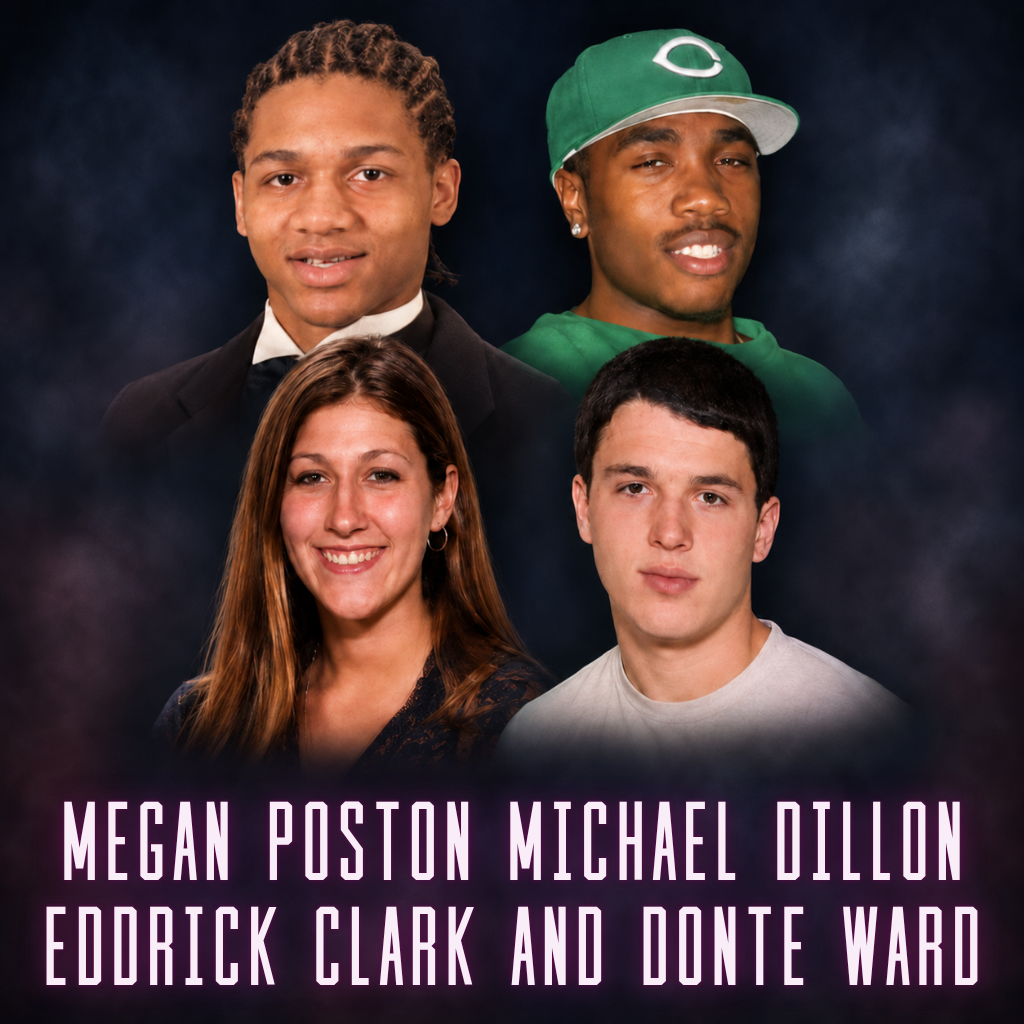
Voices for Justice covers the May 22, 2005 “Prom Night Murders” in Huntington, West Virginia, where 16-year-old Megan Poston, 17-year-old Michael Dillon, 18-year-old Edric Clark, and 19-year-old Dante Ward were shot outside 1410 Charleston Avenue around 4:30 a.m. The episode traces early police theories, later arrests, and why no one has been charged with the teenagers’ homicides. It ends with a 2026 parole update involving Sheralitha “Bunny” Holmes and a new West Virginia cold-case task force.
Megan Poston, Michael Dillon, Edric Clark, and Donté Ward are the victims discussed; the episode is hosted by Sarah Turney (no additional guest interviews are included in the transcript).
Police suspected a drug-related dispute and retaliation; Holmes was convicted for arranging another murder (Wendy Morgan) but not charged for the four teens. Jamal Lerone Ray was convicted only for felon-in-possession after a search tied to witness statements. Parole eligibility for Holmes was delayed until Nov 14, 2026, then denied again.
Holmes’ February 2005 drug arrest included crack and a Russian-made semi-automatic pistol; Shannon Dennis allegedly claimed he drove to the scene and threw the gun into the Ohio River; Ray’s Monte Carlo was reportedly repainted blue and found near his home.
Written by AI. May contain mistakes.
Exploration of the case involving Megan Poston and the tragic events of May 2005.
“My name is Sarah Turney, and this is Voices for Justice.”
Details of the shooting incident that left four teenagers dead.
“This is the case of Megan Poston, Michael Dillon, Edric Clark, and Dante Ward.”
A closer look at the lives of the four victims of the shooting.
“It's Dante's home that they're outside of.”
Discussion of the events leading up to the night of the shooting and prom details.
“Edric Clark and Dante Ward did not attend the prom.”
Overview of the initial investigation and the community's response.
“Megan Poston was born in Huntington on August 30, 1988, to Kenneth Poston Jr.”
Details of the community's mourning and memorial efforts for the victims.
“By Monday, May 23rd, 2005, the families have been living with this for about a day.”
Learn about the interconnected shootings and community response in Huntington.
“and that Megan, Michael, and Edric may have been killed to keep them from identifying the shooter or shooters.”
Follow the investigation's developments, including witness testimonies and legal battles.
“According to the search warrant, police will file later that month.”
Learn about the conflicting testimonies in the case and the implications for justice.
“Those were not included in the application.”
Discover how the community is addressing violence and remembering the victims.
“He ends up getting 34 months in prison, followed by three years of supervised release.”
Understand the trials related to Wendy Morgan and the implications for the original case.
“The appeals court rejects those challenges.”
Hear about the ongoing search for justice for the victims' families.
“The judge recommends mercy, and she receives a life sentence with the possibility of parole.”
Encouragement for listeners to share the case to aid in potential resolutions.
“among the family members at the hearing.”
Learn about the tragic case of four teenagers shot in West Virginia and the call for information.
“Quote, We just wish that somebody would come forward.”
Discover the personal stories of Megan, Michael, Edric, and Dante, the victims of the tragedy.
“You can also call 304-696-4470 and select option 4 for criminal investigations.”
Examine why the case of Dante and the others is underreported in the media.
“When I go to research a case, I also look at like who else covered it.”
Explore the hope for justice in unsolved cases and the impact of societal issues.
“I think especially if Holmes is denied parole again in 2027 or going forward, I don't know.”
Insights from research on the case and potential connections to broader issues.
“And then when I saw today's update, you guys, I was ready to publish this episode, right?”
A segment highlighting a recent case resolution relevant to ongoing investigations.
“I also want to give a shout out to the informants that came forward.”

Get the gist, explore an idea or ask about something said.
 Claude
On Voices for Justice, what are the key points of this episode?
Searching your listeningAutomatic transcript. May contain errors.
0:00Megan Poston: Whoever says saving money is hard doesn't know that new customers who bundle and save with Progressive save hundreds. Because switching your home and auto insurance is better than cutting down on the things you love, like those ice lattes that help you get ready to face the day. So switch your home and auto to Progressive and see if you can save. And keep sipping away. Get your quote today at Progressive.com. Progressive Casualty Insurance Company, affiliates and other insurers. Not available in all states. Most women have been there. Something feels off. You don't feel like yourself, yet your doctor says everything looks fine.
0:34Megan Poston: Spoiler, it's your hormones. Midi is a virtual care platform built for women by women and offers specialized hormone care from trained clinicians. Plus, it's covered by most major insurances. Getting started is easy. You can book your first visit with a clinician right away. It's not you, it's your hormones. Visit joinmidi.com to book your first visit. That's joinmidi.com. Insurance coverage varies. Check with your plan for coverage.
0:59Michael Dillon: Voices for Justice is a podcast that uses adult language and discusses sensitive and potentially triggering topics, including violence, abuse, and murder. This podcast may not be appropriate for younger audiences. All parties are innocent until proven guilty in a court of law. Some names have been changed or omitted per their request or for safety purposes. Listener discretion is advised.
1:23Donté Ward: My name is Sarah Turney, and this is Voices for Justice.
1:32Donté Ward: Today I'm discussing the case of Megan Poston, Michael Dillon, Edric Clark, and Dante Ward.
1:39Michael Dillon: In May 2005, two teenagers in Huntington, West Virginia head to their high school prom. But before the sun comes up, they and two other teenagers are shot and killed outside of a home on Charleston Avenue. At first, police seem to be moving quickly, but the investigation takes a turn that leaves those families with something almost impossible to live with. Investigators saying they believe they know what happened, but can't hold anyone accountable.
2:07Donté Ward: More than 21 years later, new investigators are reviewing the case, and really fighting the clock as the person they believe may be responsible becomes eligible for parole. This is the case of Megan Poston, Michael Dillon, Edric Clark, and Dante Ward.
2:31Donté Ward: It's about 4.30am on Sunday, May 22, 2005 in Huntington, West Virginia,
2:38Michael Dillon: and a 12-year-old girl has just woken up to the sound of gunshots outside of her bedroom. She hears screaming, and a girl's voice pleading, quote,
2:48Donté Ward: Please don't shoot me. Please don't shoot me. Then she hears more gunshots. When she looks outside of her bedroom window, she sees two people lying outside. Her father also hears the gunfire and the pleading. He later describes a burst of shots, a brief pause, and a young woman's voice saying, quote, Please don't kill me. I'm sorry. Then he says he hears two more gunshots. This is happening in the front yard of 1410 Charleston Avenue.
3:23Michael Dillon: It's a house divided into three apartments in Huntington's Fairfield West neighborhood, south of the Ohio River. When police and emergency responders arrive, they find four people who've been shot. Three pass away at the scene. The fourth is transported to Cabell Huntington Hospital, but passes a short time later. The reporting I found does not identify which of the four was taken to the hospital. But we do know that the victims are 16-year-old Megan Poston,
3:50Donté Ward: 17-year-old Michael Dillon, 18-year-old Edric Clark, and 19-year-old Dante Ward. It's obviously just a horrific scene.
4:00Michael Dillon: And for the people responding to the call, the number of victims is overwhelming. Huntington Police Officer Steve Compton sees four people on the ground, more victims than he's ever encountered at one murder scene. EMS responder Chad Ward remembers not wanting to confirm the deaths.
4:17Donté Ward: His supervisor Dave Miller puts an arm around him and says, quote, Come on, we'll do it together. It's Dante's home that they're outside of. He moved into one of the apartments about two months prior.
4:29Michael Dillon: So let's talk about this scene for a second. Dante's home is close to the street with a small grassy front yard and a concrete walkway running along the side. And this is your typical neighborhood where the houses are really close together. Ironically enough, directly across Charleston Avenue is Marshall University's Forensic Science Center. It's a facility where students train and scientists analyze DNA evidence. Charleston is basically the last residential street until you hit the university and businesses, so there's really no privacy to be had at this scene. All of this is happening as the sun is rising, So there are some people who are just waking up for the day and can't help but notice the scene outside.
5:10Michael Dillon: And others who were frantically trying to confirm that their child made it home safely from Huntington High School's prom. See, in addition to the regular prom that lasts just a few hours, Huntington High also does a supervised after-prom lock-in. Basically, it gives kids an alternative to going out and drinking after prom. Instead, they stay at the event, eat, play games, win prizes, that kind of thing. That ended at 5 a.m., just 30 minutes after the gunshots were heard. So I can only imagine the terror these parents felt as they tried to account for their kids coming home from prom. Gary Dillon is one of those parents.
5:48Michael Dillon: Just hours before the shooting, his 17-year-old son Michael went to the prom with 16-year-old Megan Poston. She was a junior at Cabell Midland High School. Their relationship isn't really spelled out in the media, but they posed for photos at the prom, and Megan looked stunning in her orange and yellow strapless dress with her matching corsage. Michael was holding her by the waist from behind in typical prom photo fashion. They were supposed to go to the lock-in afterward, but according to the Cabell County Schools Superintendent, William Smith, neither of their names appeared on their registration sheet, and had they attended, their role was to contact a parent or guardian if a student left before 4.30am.
6:28Michael Dillon: For some reason, it seems Megan and Michael ditched the lock-in after prom.
6:32Donté Ward: So those are two of our four victims. Edric Clark and Dante Ward did not attend the prom.
6:39Michael Dillon: As we know, by 4.30 that morning, all four were at Dante's home. But Gary tells reporters that he has no idea why Michael and Megan were there. That leaves a huge part of the night investigators need to work backward through, where Megan and Michael went after the dance, when they met up with Edric and Dante,
6:57Donté Ward: and who knew the four of them would be together on Charleston Avenue. Meanwhile, of course, word the shooting spreads.
7:05Michael Dillon: Now they have about 100 people gathered near the crime scene, neighbors, friends, and relatives of the victims. According to the Associated Press, one woman, believed to be a victim's mother, is sobbing and breaks through the police tape to reach her child.
7:19Donté Ward: The reporting does not specify who that person was, though. But we do know about Gary Dillon. Around this same time, Michael still isn't home, so he calls the police.
7:30Michael Dillon: That's when he's informed that his son was one of the victims. And as the families begin finding out what happened, two dates make this loss even harder to take in. May 22nd is Edrick's 18th birthday. He was only a legal adult for a few hours before his entire future was stolen from him. The next day, May 23rd, was supposed to be Dante's 20th birthday.
7:57Donté Ward: Their murders will become known as the Prom Night Murders.
8:00Michael Dillon: But before we get into all of that and the investigation, I want you to know who these four people were beyond that name. Megan Poston was born in Huntington on August 30, 1988, to Kenneth Poston Jr. and Sabrina Ashworth Poston. She had two sisters, Stephanie and Jordan. Earlier in 2005, they also welcomed her baby brother, Casey. Megan was a junior at Cabell Midland High School. She was taking a child development class, and she wanted to become a labor and delivery nurse. She'd already had the chance to help bring a baby into the world, her own little brother. According to her mom, when Casey was being born, the doctor was unavailable.
8:42Michael Dillon: The nurse realized the baby was coming and asked Megan to help,
8:45Donté Ward: so Megan helped the nurse deliver him. There was a whole future ahead of her, both in the family she already had and the career she was planning. Michael Dillon was born on November 12, 1987.
8:59Michael Dillon: His parents were Gary Dillon and Teresa Baker Dillon. He had a brother Jeremy and a sister Jennifer. He was a junior at Huntington High School, a member of the football team, and attended Abundant Life Baptist Church. We know less about Edrick and Dante, but Edrick had moved from Cincinnati to South Point, Ohio during the school year. South Point is across the Ohio River from Huntington. He was finishing his senior year at South Point High School, and his graduation was scheduled for the following Sunday. His principal, George York, described him as a wonderful young man who loved music and wanted to become a recording artist.
9:37Michael Dillon: His cousin, Denise Lewis, was among the relatives of the crime scene.
9:41Donté Ward: She told reporters it was his birthday, and that he was supposed to graduate soon. Dante Ward had graduated from Huntington High School in 2003.
9:51Michael Dillon: He was 19 and again living at that apartment on Charleston Avenue. His neighbor, Christy Thomas, told the Associated Press that she didn't know him well, but that he was always social and friendly. We also know he was a son, a brother,
10:05Donté Ward: and that his sister Jasmine would join the other families at memorials for years afterward. So those are the lives that we lost that day.
10:15Michael Dillon: And the murders have been described by law enforcement as the worst killing in at least a generation. But just as investigators and the community were asking themselves who would do something like this and why,
10:28Donté Ward: police announced that they may have the shooter in custody.
10:34Donté Ward: I try to find all the joy I can in my life, and that especially comes out during the holiday season,
10:40Michael Dillon: even down to what I'm wearing. And trust me, I've already started shopping through Quince. If you haven't heard of Quince, they make elevated everyday essentials using premium materials like Mongolian cashmere, organic cotton, and premium stretch denim. They really are the kind of pieces you'd be just as happy gifting as you would be to unwrap. And it's affordable. Their 100 % Mongolian cashmere sweaters start at just$50, but they have so much more than just clothes. I am in love with their candles and also just got the Grande Brow Brow Enhancing Serum by Grande Cosmetics. If you're a millennial like me, you might understand wanting some thicker brows, and I really am seeing great results.
11:16Michael Dillon: It's one of those things I don't usually buy myself that I would love to be gifted. and when it comes to gifting, Quince has leather bags, hotel quality bedding, chef grade cookware and five star luggage. Basically, they have something for everyone on your list. Give the gift of quality this holiday season. Download the Quince app for app exclusive offers or go to quince.com. Get free shipping on your order and 365 day returns. Now available in Canada and the UK too. And when Quince asks where you heard about them, let them know it was Voices for Justice. It's the best way
11:47Donté Ward: to support the show.
11:52Donté Ward: This episode of Voices for Justice is sponsored by Smileset.
11:56Michael Dillon: I had braces and I just went through the Smileset process. I'll be totally honest, I was bad and did not wear my retainer so my teeth shifted. I was a little nervous about going through the Smileset process but it was a lot easier than expected. If you haven't heard of Smileset, they create doctor-prescribed clear aligners done from home for 60 % less than braces. You start with an at-home impression kit and then your aligners are shipped right to you. They also monitor your progress through the Smile Set app, with doctor check-ins available whenever you want them. I'm just about to move on to my second aligner with Smile Set, and I'm already seeing a difference.
12:31Michael Dillon: I'm really excited to see what my teeth look like by the end. So if you've been looking for a more convenient and more affordable option for aligning your teeth, I definitely recommend Smile Set. Listeners of our show get an additional 35 % discount when they go to smileset.com slash justice. With this discount, you can get the smile of your dreams for under$1 ,200. Go to smileset.com slash justice to get started.
12:54Donté Ward: smileset.com slash justice.
13:00Donté Ward: By Monday, May 23rd, 2005, the families have been living with this for about a day.
13:06Michael Dillon: Four teenagers are dead, and police are bringing people in for questioning. Then, Captain Steve Hall makes a statement that sounds like the investigation might already be close to an answer. He says, quote, we may have the shooter in custody.
13:23Donté Ward: Now at this point, police have brought in nine people for questioning, and really all that we
13:27Michael Dillon: know are that five are from Detroit, and that a man and woman are later released after police determine they are not involved. But again, Captain Hall is saying that the person who fired the shots might be among them, and he also says, quote, I'm not sure we do or we don't.
13:44Donté Ward: We just don't know. We've seen this before in other cases. Police haven't announced that they've identified the shooter,
13:53Michael Dillon: but they seem to be teasing it. They also announce a theory about why they may have been attacked. Captain Hall tells reporters that Dante may have been the intended target, and that Megan, Michael, and Edric may have been killed to keep them from identifying the shooter or shooters. Police are also looking at an earlier shooting involving Dante. Hall says that Dante was shot earlier in the hand or arm in February, about three months before his death. But no charges were filed in that shooting. And again, while we get this detail, we do get more vague answers from Hall. He says it's unclear whether the two incidents are connected.
14:31Donté Ward: And that's really all the public knows at this point. On Monday evening, hundreds of people returned to Charleston Avenue.
14:39Michael Dillon: Friends and relatives leave flowers where each of the four victims fell. And the Associated Press really describes this beautiful moment that I want to share with you. It seems that at this time, there was a lot of heavy rain and wind moving through, so everyone's huddled at this scene using their umbrellas. Then suddenly, a bright rainbow appears, and people in the crowd cheer. A 39-year-old resident named Damon Corr holds a candle from his top-floor apartment, while people below sing and pray. He tells reporters he's lived there for a decade. He remembers when his biggest concerns were speeding cars and finding a parking space.
15:15Michael Dillon: Now, he says he feels like a prisoner in his own home. But this is a community who comes together,
15:21Donté Ward: and toward the end of the vigil, the crowd sings happy birthday to Dante. By Tuesday, May 24th, the numbers police give reporters have changed.
15:32Michael Dillon: Hall now says 15 people were questioned on Monday, and 8 were arrested on unrelated charges. He also says that they have information that the people responsible are from Detroit, and that there was some kind of dispute with Dante. But again, he keeps it vague. He tells the Associated Press that it could be drug-related, domestic, or something else.
15:53Donté Ward: Basically, they just don't know yet.
15:55Michael Dillon: In this same reporting, Hall points to another case. Two men from Detroit have been charged in the fatal shooting of a 31-year-old Huntington woman the previous year. And we get another detail here. a Detroit police spokesperson said that no one from the department has been contacted by West Virginia law enforcement about this shooting. So it doesn't appear that there's cooperation here, at least not yet. But what does seem clear is that much of the attention is turning to Detroit. Now, geography is important to this theory, so let's talk through it. Huntington is a city of roughly 50 ,000 people.
16:30Michael Dillon: It's in the area where West Virginia, Ohio, and Kentucky meet. And while this area is 5 plus hours away from Detroit, Michigan, they believe drug dealers are coming from that area down to this area to sell. And this isn't just a rogue theory from one officer. Mayor David Fellington says that the city attracts criminals from Detroit. And Joseph Cicerelli, an FBI supervisor in Charleston, tells the Associated Press that dealers can make more money in Huntington or Charleston because there's less competition. And while they're in this area, they have access to cheaper,
17:03Donté Ward: more readily available guns to resell in Michigan. So while it is five plus hours away,
17:10Michael Dillon: they believe that it's this entire ecosystem fueling drugs and illegal gun sales. But Peggy Brown, who chairs Marshall University's criminal justice department, points to something else. Cuts to Huntington's police budget.
17:23Donté Ward: She argues that people see an available market and a lower risk of arrest. At this point, the department has about 75 sworn officers. Those officers are now dealing with four deaths at one scene, interviews with people from different states, and a community demanding answers. And while reporters are trying to follow the names, the interviews,
17:45Michael Dillon: and the changing totals, the families have funerals to arrange. We don't have details for all of them, but we do know that Michael's funeral is held on May 28th, six days after the shooting. He's buried at Woodmere Memorial Park,
17:59Donté Ward: and members of his football team are listed as honorary pallbearers. Despite all the teasing in the media,
18:07Michael Dillon: the first week passes without anyone being charged in the murders. But then, on June 3rd, there's an arrest in Detroit that brings a name into this investigation. That name is Sheraletha Holmes, but people call her Bunny. Like I said, she's from Detroit, but she also has a home on Charleston Avenue in Huntington,
18:27Donté Ward: just a few houses down from Dante's. Now, the way that she really enters this investigation, as far as we know,
18:35Michael Dillon: is by actually calling the Huntington police herself. She said she was receiving threats, and according to FBI Special Agent Paul Source, she also told them that she was planning on returning to Detroit. So two Huntington detectives travel there to follow up,
18:50Donté Ward: and Holmes is arrested at her mother's home on a federal drug warrant. To understand why there's a warrant, we have to go back to February 18th before the murders.
19:01Michael Dillon: According to a federal complaint described by the Detroit News, Huntington police arrested Holmes at the 8th Avenue bar. Officers reported finding 7.2 grams of crack cocaine, 24 individually wrapped rocks, a counterfeit bill, and a Russian-made semi-automatic pistol. Now, Holmes was initially charged in West Virginia and posted a$25 ,000 cash bond. But then, on May 25th, three days after the murders, federal authorities issued a new warrant, charging her with possession with intent to distribute crack cocaine based on that same February arrest. So, when they followed up about the threats on June 3rd, she was arrested.
19:41Michael Dillon: On June 6th, Holmes has her bond hearing. The judge is deciding whether she can be released while the drug case moves forward. and whether she has to return to West Virginia. But the reason I'm telling you any of this is because during that hearing, the topic turns to the murders. According to reporting by the Detroit News, Agent Source testifies that three confidential informants told West Virginia investigators about a dispute between Holmes and Dante. They said Dante had taken money, marijuana, or both from her, and that she planned to bring people from Detroit to deal with it. Assistant U.S.
20:18Michael Dillon: Attorney Steven Robinson says those informants connected Holmes either to participating in the killings or arranging Dante's murder. He describes the three other victims as just being in the wrong place at the wrong time. But Holmes denies it.
20:32Donté Ward: As she's led from court, she says, quote, it's all a lie. Now, Source also answers a question about the pistol seized from her in February.
20:41Michael Dillon: It's still in police custody, so they are able to rule out that gun as the murder weapon. So this is really a bombshell in this case. But Source also acknowledges that the police have received other tips, though what those tips are, or really any other possible theory in this case, is never presented by police. In the end, they basically say that they're just not ready to charge Holmes with these murders. So Magistrate Judge R. Stephen Wallen orders her back to West Virginia for the cocaine charge, but allows her to remain free on a$50 ,000 personal bond. And Robinson objects here, but the judge remains firm.
21:19Donté Ward: He says that while he does have serious reservations, he's still going to allow the release. So these four families now have a name publicly linked to the case, an alleged motive, and an FBI agent describing information from three informants. What they don't have is a murder charge. But people are still talking.
21:41Michael Dillon: On July 5th, Detective R. Knight with the Huntington PD receives a tip. It looks like a man has been talking about the shooting,
21:49Donté Ward: and claiming he helped the person responsible get away. This episode of Voices for Justice is brought to you by HERS.
21:58Michael Dillon: If you've tried to lose weight more than once and the results just don't stick, you're not the only one. Weight Loss by HERS gives you access to a range of FDA-approved GLP-1 medications, including the Wegovy pill and the Wegovy pen. To get started with Wegovy, just go to ForHERS.com and complete an online consultation with a licensed provider. They will determine if a prescription is appropriate. And HERS doesn't stop there. Nutrition and lifestyle guidance are a part of the plan. Ready to reach your goals? Visit 4hers.com slash crime to access personalized affordable care for weight loss, hair, menopause, and more.
22:34Michael Dillon: Individual results may vary, and stopping treatment may result in weight regain. Weight loss by HERS is not available in all 50 states. Wegovi is the registered trademark of Novo Noro Disc AS. To get started and learn more, including important safety information, Wegovi clinical study information, and restrictions, visit 4hers.com.
22:58Donté Ward: This episode of Voices for Justice is brought to you by Chewy.
23:01Michael Dillon: If you're a pet parent like me, you know about Chewy. And you know that when they say that they have everything you need to keep your pet happy and healthy, they're not messing around. To keep them happy, Chewy has over 100 ,000 products from all the brands my pets love at prices I love. To keep them healthy, Chewy offers pet prescriptions, pet insurance, telehealth vet visits, and is rolling out vet clinics across the country. I live by Chewy's auto-ship feature. I really do. Every single month, I get the dog's food, and I make sure to add in things like treats or toys depending on what they need that month.
23:33Michael Dillon: I even get their supplements from Chewy. It saves me a lot of time and money to just streamline everything. For life with pets, there's Chewy, and right now you can save$20 on your first order and get free shipping by going to chewpannions.chewy.com slash sarahetourney. That's chewpannions.chewy.com slash sarahetourney to save$20 on your first order with free shipping. Chewpanions.chewy.com slash Sarah E. Turney. Minimum purchase required. New customers only. Terms and conditions apply.
24:03Donté Ward: See site for complete details.
24:08Donté Ward: The man mentioned in that July 5th tip is Shannon Dennis.
24:12Michael Dillon: According to the search warrant, police will file later that month. A witness tells Detective Knight that Dennis has been bragging about driving a vehicle to and from the murder scene. The witness also says Dennis claimed he threw the murder weapon into the Ohio River. And again, the tips just keep coming in, because nine days later on July 14th, a witness gives police information about someone known as T or Trouble. And according to that warrant, that person has allegedly said that he killed the four victims over a drug debt owed by Dante. Then on July 22nd, Detective Hunter makes a traffic stop in the 1600 block of 9th Avenue.
24:52Michael Dillon: During that stop, he identifies T as a man named Jamal Douglas. His legal name is Jamal Lerone Ray. I'm gonna call him Ray from here on, because both names appear in the investigation and the court documents. So there's a lot going on kind of at the same time right now, so stick with me. Three days after that, on July 25th, Shannon Dennis speaks directly with detectives. According to the warrant, Dennis voluntarily tells them that he saw Ray kill Megan, Michael, Edrick, and Dante. He also admits to helping Ray flee the scene and throwing the gun in the Ohio River, just like the witness said. He says the car they left in was a white 1987 Chevrolet Monte Carlo with a gray interior, and police have a report that connects Ray to a car matching that description.
25:39Michael Dillon: On July 14th, the same day that they got the tip about tea, Ray was involved in an accident while driving a 1987 white Monte Carlo. And by the time investigators prepare the search warrant, they find that car parked outside of Ray's home on Marshall Avenue. But it's not white anymore. It's been painted blue. So police now have a witness identifying a particular car, a police report showing Ray driving that car, and the car is literally outside of his home, now in a different color. So, on July 26, the day after Dennis' statement, Sergeant Rocky Johnson applies for a warrant for Ray's home. Now, this application actually describes the alleged dispute involving Holmes, too.
26:22Michael Dillon: According to the application, Holmes acknowledged that marijuana had been taken from her home on Charleston Avenue. Investigators also outlined their belief that Dante was shot in retaliation for taking it. But back to the search. They're looking for guns and ammunition, clothing, shoes, fibers, blood, anything belonging to the victims. They also want drugs and paraphernalia, drug transaction records, money, cell phones, bills, newspaper articles about the killings, documents showing who lives there, and photos of Ray and his associates. So Sergeant Johnson takes all of this, puts it in the application, and delivers it to Cabell County Circuit Judge David Pancake at his home.
27:03Michael Dillon: There, Judge Pancake signs it. And unfortunately, we don't have a ton of information about what came out of this search, but we do know that they find a pistol and a rifle. Because Ray does have a prior felony conviction and can't legally possess those guns, federal prosecutors charge him with being a felon in possession. So once again, an investigation into four murders has led to a separate criminal case. But that case is going to show us something that the early coverage didn't, that not everyone was telling police the same story. See, Ray challenges the search of his home. On December 15, 2005, a federal judge begins a hearing about whether the guns can be used against him.
27:43Michael Dillon: After the defense raises concerns about the warrant application, the judge gives Ray's lawyers more time to get ready for a hearing focused on whether police misled the judge who authorized the search. That hearing takes place on February 6, 2006. Part of Ray's challenge involves two statements from Shannon Dennis' estranged wife, Allison Dennis. Those were not included in the application. According to the later appeals decision, Allison had told investigators that Shannon was a liar and lied about everything. But she also said that he'd been with her on the day of the murders until she went to sleep.
28:17Michael Dillon: Those are obviously pretty significant statements when Shannon is the person claiming he witnessed the shooting. But Allison's account has a complication of its own. The court says that in that same interview, She also told investigators that she wasn't really certain Shannon had been with her that day, because they'd been separated for a while. During cross-examination at that hearing, she said that they'd split up because of his drug use.
28:41Donté Ward: So a few things are happening here.
28:43Michael Dillon: Her statement does not establish an alibi for him, and it does show that there was information challenging the account police used to get the warrant. And the federal judge acknowledges that much of the information investigators got in the weeks after the murders was inconsistent or contradictory. But in the end, the judge does not find that the police lied about what Dennis told them, or intentionally misled the judge who signed the warrant. Basically, Ray is not getting out of this charge, so he enters a conditional guilty plea. That means he pleads guilty to the firearm possession charge while keeping the right to appeal the search ruling.
29:18Donté Ward: He ends up getting 34 months in prison, followed by three years of supervised release. But of course, for the families, this still is not a prosecution for their children's murders.
29:31Michael Dillon: And as the first anniversary arrives in 2006, people in Huntington begin building a way to keep the four victims in the community's memory. The Day of Hope brings families and neighbors together for remembrance, prayer, food, community services, and work against violence. The Cabell County Substance Abuse Prevention Partnership also forms that year. Then in February 2007, All Saints Church buys the house at 1410 Charleston Avenue for$10 ,000. They turn it into Hope House. The plan is to create this community space where local teenagers can get mentoring and learn life skills, while also still serving as a memorial to Megan, Michael, Edrick, and Dante.
30:12Michael Dillon: The church says that they want to use the property to support other young people in the neighborhood, rather than leave it known as only the place where four lives were taken.
30:21Donté Ward: It's not justice, but it is one form of healing. Meanwhile, Ray's appeal continues. On July 24, 2007, the U.S.
30:32Michael Dillon: Court of Appeals for the Fourth Circuit upholds the search. And here we get even more details about this case. Ray argues that the information didn't sufficiently connect evidence of the murders to his home, that police had left out important information, and that the seizure of the guns was improper. His defense also questioned why Sergeant Johnson took the application to a circuit judge at his home instead of an off-duty magistrate. The appeals court rejects those challenges. It says the choice of judge does not invalidate the warrant as long as the judge is neutral. And it finds that there was enough information to justify searching Ray's home.
31:09Michael Dillon: They list Dennis' statement, information from a separate witness, the accident report, and the suspected getaway car parked outside. The court also says police could seize the guns during the lawful search
31:21Donté Ward: because they knew Ray was a convicted felon, even though Dennis had said that the murder weapon was in the river. As for Allison's statements, the court agrees that the omissions don't invalidate the warrant.
31:33Michael Dillon: Her account of Shannon's whereabouts was inconsistent, and the other information supporting the search still mattered. In these court documents, the judges recognized that Dennis might have an interest in shifting blame. They also recognized that by describing his own role, he admitted involvement in something extremely serious. Unfortunately, this opinion doesn't identify either recovered gun as the murder weapon, or report any type of ballistic match. We also don't have any information about them trying to or recovering the murder weapon from the Ohio River. And although judges have heard some of the concerns about Dennis' credibility, their decision doesn't tell us why prosecutors haven't brought a murder charge.
32:15Michael Dillon: It doesn't give us all of his interviews, any benefit he might have received, or the complete evidence police gathered.
32:22Donté Ward: So the firearm conviction stands, and we still don't have any murder charges. Then in 2008, Sheralitha Holmes goes on trial for arranging a killing. But again, not for the deaths of Megan, Michael, Edrick, or Dante.
32:39Michael Dillon: The victim in this case was Wendy Morgan, the 31-year-old woman I told you about earlier who was killed in Huntington in 2004. According to the testimony later reviewed by West Virginia's highest court, Holmes sold drugs from her Huntington home. Wendy used a room there for drug use and sex work. Witnesses said that Wendy took drugs and money from the house, and that Holmes wanted someone to retaliate. About a month after the theft, Wendy was shot and killed by Sedil Harper and Rafael Harris, two men involved in Holmes' drug operation. At the trial, a witness named Larry Clark says he heard Holmes tell Harper and other associates to do something after the theft.
33:19Michael Dillon: He also says she offered him$1 ,500 to kill Wendy. Wendy's mother, aunt, and a friend testify that Wendy expressed her fear that Holmes would have her killed.
33:30Donté Ward: And Holmes does take the stand. She admits to selling drugs, but denies ordering Wendy's murder. And here, the four murders come up again.
33:40Michael Dillon: During cross-examination, Larry Clark makes another statement. He says he has no doubt Holmes ordered Wendy's murder, and no doubt that she ordered the deaths of the four other young people in town. And this causes a huge uproar in the courtroom. The judge strikes the answer and tells the jury to disregard it.
33:59Donté Ward: The defense asks for a mistrial, and the judge denies the request. In the end, the jury convicts Holmes of first-degree murder as an accessory before the fact in Wendy's case.
34:11Michael Dillon: The judge recommends mercy, and she receives a life sentence with the possibility of parole. The alleged motive is painfully familiar, retaliation after drugs or money were taken. That's exactly what she's accused of doing for at least Dante. So Holmes has been convicted of arranging Wendy's murder. Ray has been convicted of illegally possessing guns. Two criminal cases have moved through the court,
34:35Donté Ward: while four families are still waiting for theirs.
34:41Eddrick Clark: Hi, I'm Karen Slaughter. If you love untangling mysteries and uncovering the truth behind what really happened, I think you'll love the good daughter. Charlie, go! Sam! Now my best-selling novel is finally coming to life, and I got to write every episode.
34:57Donté Ward: You should have died in them woods.
34:58Michael Dillon: Your father should have been a better shot.
35:00Eddrick Clark: Starring Rose Byrne, Megan Fahey, and Brendan Gleeson. From page to screen, don't miss The Good Daughter, now streaming only on Peacock.
35:08Megan Poston: I'm here, Charlie, and I'm not going away.
35:11Eddrick Clark: We're all here, it's family. We're all here, it's family. Presence for the ones you love and love.
35:26Michael Dillon: In May 2015, as the 10th anniversary approaches, the Herald-Dispatch looks at what's changed in Huntington since the murders. The Reverend Reginald Hill says the shooting forced people to recognize that the violence wasn't only a Fairfield West problem. Michael's mother, Teresa, wishes the city had confronted its drug problem before her son was killed. By this point, Huntington police has grown from about 75 sworn officers at the time of the shooting to more than 110. The city has also developed neighborhood enforcement efforts, prevention programs, and more addiction treatment. Police Chief Joe Cicerelli, who had been an FBI agent in West Virginia in 2005, describes the murders as a turning point for Huntington.
36:10Michael Dillon: In 2017, Teresa makes an appeal to a particular group of people. Anyone who was involved with the drug world back then knows something about the murders and has since entered recovery. She hopes that changing their own life might also lead them to tell police what they know.
36:26Donté Ward: But the case just sits.
36:28Michael Dillon: Then in March 2025, almost 20 years after the murders, Holmes appears before the parole board in Wendy Morgan's case. According to reporting by WSAZ, Holmes continues to deny that killing Wendy was her idea. Asked whether she encouraged the killing, she says she was not wrong to speak up during conversations she describes as joking. and the parole board grants her release. She's expected to leave prison in April. But before the planned release, Cabell County prosecutors challenge whether Holmes is even eligible for parole yet. So this planned release has stopped and a hearing is set to figure all this out.
37:07Michael Dillon: In the end, Judge Chad Lovejoy rules that she is not eligible for parole until November 2026. Specifically, November 14th, 2026, two days after this episode airs. It's part of why I chose to cover this case, because this is still impacting these families. Edrick's mother, Joan Clark, is among the family members at the hearing. She again says that she just wants justice for her child. Almost 20 years after Edrick was killed, she's still going to court, still listening for something that might move this case forward, but of course, as we know, the court is there to address someone else's case. The next month brings the 20th anniversary.
37:47Michael Dillon: In WSAZ's coverage, Joan describes May 22nd as her Memorial Day. It began as her son's birthday, now it's also the day he was killed, before he ever saw the sun come up as an 18-year-old. She continues bringing friends and family together to remember him, but she admits that after 20 years of talking about this,
38:07Donté Ward: She's running out of words. She just wants justice. Megan's mother, Sabrina, has her own way of marking that morning.
38:16Michael Dillon: The house on Charleston Avenue has since been torn down, but the tree near where Megan was found is still there. Every May 22nd, at about 4.30 in the morning, Sabrina returns with a candle, a rose, and a photograph of her daughter. She also has a voicemail from Megan that she refuses to delete. When she talks about what she misses most, it's not some distant milestone. It's hearing Megan tell her she loves her. Quote,
38:43Donté Ward: Missing her say, I love you, mommy, is the hardest thing. These families have kept showing up in different ways.
38:52Michael Dillon: Teresa has asked people to come forward. Joanne has gone to the memorials and hearings. Sabrina has returned to that tree every year. And Dante's sister Jasmine has stood with the other families
39:02Donté Ward: as they remembered the four young people they lost. And the local media hasn't given up either.
39:09Michael Dillon: In WSAZ's 20th anniversary coverage, investigators Paul Hunter and Ryan Bentley push back against the idea that nothing is happening in this case. They say investigators still discuss it and describe one missing piece that could make all the difference in bringing charges. Now, they don't publicly identify what that piece is. They don't say if they have a new DNA result, a recovered murder weapon, or a witness ready to testify.
39:34Donté Ward: They just say it's open and active. Then in 2026, there is a development that could bring more people and resources into this work.
39:44Michael Dillon: West Virginia passes House Bill 4799 that creates a cold case task force within the state police. That law took effect on June 11th, and it allows the task force to work with local and federal agencies without taking control away from the department that already has the case. And on October 29, 2026, State Senator Mike Wolfel announces that the task force has formally opened an investigation into the prom night murders. It's one of the task force's first cases. Lieutenant Paul Dick, who was named West Virginia State Trooper of the Year of 2026, leads the task force. This is such a promising new development.
40:24Michael Dillon: And again, part of the reason I wanted to cover this case right now, but there's still a lot that we haven't been told, a lot we don't know. We don't have the complete account of what happened after the prom, why they were even at Dante's house, or how the shooter approached or left. We still don't have any answers about the Monte Carlo or the gun. We also don't have the complete forensic findings from the yard, the victims, the car, or Ray's home. We don't know the shot count, caliber evidence, positions of the victims, DNA, fingerprints, or any link between the
40:58Donté Ward: recovered guns and the murders. And we don't know what a grand jury may have heard, or prosecutors' full explanation for not bringing homicide charges.
41:08Michael Dillon: But again, this new task force does have an opportunity to work through those gaps with access we don't have. And time really is of the essence here. Because I have a brand new update I had to come back in and record just for this episode. On the day this episode airs, November 12, 2026, Holmes has officially been denied parole. She will not be getting out on November 14th, but she is eligible again in November of 2027. If she had any part in the murders of Megan, Michael, Edrick, or Dante, investigators need to prove that before she's released. That way she doesn't have the chance to harm another person.
41:48Michael Dillon: And of course, so that these families can get some semblance of answers or justice. As of recording this episode, police have not presented any other theory for these murders. Teresa Dillon said it plainly in her 2017 appeal nearly a decade ago now. Quote, We just wish that somebody would come forward. And Gary Dillon's plea has been simple from the beginning.
42:13Donté Ward: Quote, I just hope the police get the monster that did this to those babies. Which brings me right to our call to action.
42:23Michael Dillon: Please share this case. For a crime this shocking, I don't think it gets nearly the attention it deserves in true crime. Four teenagers with their full lives ahead of them shot dead in the streets of West Virginia. Megan wanted to help deliver babies, and had already helped her little brother come into the world. Michael was a football player whose father was waiting for him to come home. Edric wanted to make music and should have been graduating a week later. Dante was a son, a brother, and a young man whose friends sang outside of his home on the birthday he didn't live to celebrate. You don't have to solve this case to help.
42:59Michael Dillon: Sharing it may reach someone who knew one of them, lived nearby, or heard something they didn't understand at the time.
43:05Donté Ward: Or just someone who stayed silent but may be ready to speak now.
43:15As a reminder, 16-year-old Megan Poston, 17-year-old Michael Dillon, 18-year-old Edric Clark,
43:23Michael Dillon: and 19-year-old Dante Ward were shot and killed at about 4.30 a.m. on Sunday, May 22, 2005. The shooting happened in the front yard of 1410 Charleston Avenue, outside of Dante's home in Huntington, West Virginia. Anyone with information is asked to contact the Huntington Police Department anonymous tip line at 304-696-4444. You can also call 304-696-4470 and select option 4 for criminal investigations. But as always, thank you, I love you, and I'll talk to you next time. Voices for Justice is hosted and produced by me, Sarah Turney, and is a Voices for Justice media original. If you love what we do here, please don't forget to follow, rate, and review the show on your podcast player.
44:17Michael Dillon: It's an easy and free way to help us and help more people find these cases in need of justice.
44:34Thank you.
45:09Donté Ward: Welcome to the Secret After Show.
45:11Michael Dillon: The studio door is open and our emotional support puppies, Popcorn and Heber, are in the room. Let's go right into the case. The first thing I have on my list is why this case hasn't been covered. When I go to research a case, I also look at like who else covered it. And with this one, you guys, it's almost nobody. And I think I know why. It's the same reason why when sex workers go missing or when they're murdered, they don't get coverage, right? I think once people hear that anyone may have been involved in a crime like they allege Dante was, even though that's never been proven, they just stop caring.
45:50Michael Dillon: Also, when it's linked to like a larger societal issue like drugs, I think it's just less compelling for a true crime audience. It's not your typical man approaching somebody in an alley or a scorned lover getting revenge. It really is more ordinary and easier to explain. But I guess my argument is a quadruple homicide deserves coverage. I don't know, I guess I think about that a lot, right? Why do people pick up the stories they do, especially in true crime podcasting or YouTube, where I ate more independent content. And I think I do have a soft spot for those cases that haven't been covered.
46:28Michael Dillon: When I started this journey in true crime, my sister's name was not known. Almost nobody had talked about her case, not the mainstream media and not independent podcasters or YouTube. YouTubers, you know what I'm saying. So I guess when I see an unsolved homicide of four teenagers, for teenagers, you guys. I just can't understand why more people don't care. So please, please share this case. I think especially if Holmes is denied parole again in 2027 or going forward, I don't know. I guess that's my hope, right? That if she continues to be denied parole, it might give people the courage to really speak out.
47:11Michael Dillon: And I will say, you guys, right now, I am recording this after show in November of 2026. I just did the update for you guys. She's in there for at least another year. So if you know something about this case, now is the time to speak up. I think now is truly the time that you'd be most protected if that happens, right? If they can get this conviction, if she did it, right? Now's the time to speak up so that they have a whole year to bring these charges forward. Next, I wanted to talk about how there really are no other suspects or theories in this case mentioned by anybody, you guys. Not the families, not the police, nobody.
47:51Michael Dillon: It's just these cases where it seems very clear what happened, but there's no charge. They are so frustrating. But I do think that there was some validity to the statements we heard in the episode, right? Like, I think, and I know, to be totally honest, right? I had a very crazy teenagehood. So I can tell you that when people go through a recovery, as I've seen many of my friends do, they do change. So again, I guess I just have hope that somebody will come forward and do the right thing. And I do want to say that in my research for all of this, it came out around 2016. Huntington, Virginia has since been called the overdose capital of America.
48:33Michael Dillon: It looks like people began dying from drug abuse at eight times the national average around that time. So it's just insane. And then when I saw today's update, you guys, I was ready to publish this episode, right? I do. I was planning to record the after show today. I like to keep it current because of things just like this. Imagine I put out this episode without the update that happened today, that Holmes was rejected her parole request, I guess. I don't know. It's just crazy how things like that happen. And when I was looking at this case and I realized that she was up for parole. I was like, oh my gosh, this is so timely.
49:13Michael Dillon: I've got to get this out. You know what I mean? Like now is the time while the media is still centered on her and potentially this case, even though I haven't seen any coverage from today. Now, one last random thing I had on my list that doesn't really apply to this case. I just, I don't know. There's things I find in research that I'm like, that's interesting and I'd like to share with you guys, but they don't really fit into the episode. I have to tell you that in 2008, so three years after the murders, Mayor David Fellington, I had to look up the pronunciation for his name because it's very strange, Fellington, I swear that's how they say it.
49:49Michael Dillon: And this is how I found it. I was looking up the pronunciation for his last name, and I got that from a 2008 video because that year his wife called 911 alleging domestic violence. I don't know, you guys. I'm not saying it's connected. I'm not saying that it's in any way related to this case. But, you know, when we look at the demographics of this area, right, this being the, what do they call it, the overdose capital of America, you have the mayor now with this domestic violence allegation. I think it's interesting to talk about, even if I can't link it back to anything. And I will say for the record that the charges were dropped against Mayor Fallington.
50:31Michael Dillon: Just an interesting little tidbit, I guess. Now on to media discrepancies. Not much. You know, like I explained in the episode, there were some conflicting statements from law enforcement that I pointed out. But like I keep telling you guys, with a lack of coverage comes a lack of discrepancies. Plus, I will say that this is an episode where a lot of my source material was court documents and transcripts. So it just kind of is what it is. But on to our segment of hope, I put the four families for showing up for all of their loved ones in different ways. I also want to give a shout out to the informants that came forward.
51:10Michael Dillon: Shout out to you for at least helping make some type of movement in this case, I guess, or at least allow investigators to gather information. And then also the local journalists who keep coming back to this case, because again, I don't understand how it's not everywhere, but Huntington, West Virginia certainly remembers.
51:33Donté Ward: But let's go on to our segment of hope. This comes from WKRN from Nashville, written by Alicia Patton.
51:43Michael Dillon: And it's from November 9, 2026. The title reads, Nearly 40 years later, Nashville police identify woman found buried in basement. The article reads, A woman found buried in the basement of a Nashville home nearly 40 years ago has been identified through forensic genetic genealogy. According to the Metro Nashville Police Department, two women were murdered and found buried in shallow graves in the basement of a home along Charlotte Avenue in 1987. Authorities added, it is believed the women were killed two years before their remains were located. And the reason I picked this is because of this part right here, and it feels so relevant to this case.
52:26Michael Dillon: James Schaefer reportedly admitted to the killings and received two life sentences. In 2004, he died in prison. So this is like technically a solved case, right? In 2025, authorities identified one of the victims as 32-year-old Sheila Cummings from Elgin, Illinois. Looks like they did that by obtaining DNA samples from the cold case victim's daughters. But the identity of the second woman, who Schaefer referred to as little bit, I don't know why, remained a mystery. So it looks like James Schaefer reportedly, like I said, admitted to these killings, got two life sentences, and then died in 2004 and never named these victims.
53:11Michael Dillon: In 2025, we get one of the victims, 23-year-old Sheila Cummings, and then on Monday, November 9, 2026, the MNPD confirmed that they had positively identified the second victim as Tony L. Gordon of Nashville. Officials say she was 31 years old when she was killed. Officials said Gordon's family members believe that she moved out of state and lost contact with them. And we gotta give our flowers. Several agencies, including DNA, Investigative Solutions, Bodhi Technology, and the National Missing and Unidentified Person System, NamUs, The medical examiner's office and the Tennessee Bureau of Investigation all collaborated to identify both women.
53:56Michael Dillon: It also says no additional details were immediately released. But I think that this makes our segment of hope for obvious reason. It's like, I think, one of the worst situations to be in as a family member of true crime, right? Where you're like, you feel so close to justice, right? In this case, this man was literally arrested and got two life sentences, and they still hadn't identified the victims. But even decades later, they are still working for those victims, and I think that that's really, really amazing. And I just have to hold out hope that we'll also get a solve in this case. But as always, thank you, I love you, and I'll talk to you next time.
54:38Megan Poston: Whoever says saving money is hard doesn't know that new customers who bundle and save with Progressive save hundreds. Because switching your home and auto insurance is better than cutting down on the things you love, like those ice lattes that help you get ready to face the day. So switch your home and auto to Progressive and see if you can save. And keep sipping away. Get your quote today at Progressive.com. Progressive Casualty Insurance Company, affiliates and other insurers. Not available in all states.
55:06Eddrick Clark: Great meeting. Who took notes? Anyone? With Monday Notetaker, the meeting ends and the plan already exists. Action items, owners, deadlines. Go to monday.com, the AI workspace platform.
On prom night in 2005, four teenagers, Megan Poston, Michael Dillon, Eddrick Clark, and Donté Ward, were shot and killed on a residential street in Huntington, West Virginia. Police seemed to be closing in quickly, witnesses claimed they knew what happened, and investigators identified people they believed were connected to the crime. Yet no one was ever held accountable.
More than twenty-one years later, new investigators are reviewing the case and a person who may hold critical answers could soon be released from prison. For four grieving families, the question is no longer just who was responsible, but how a case surrounded by allegations, fear, and people willing to talk was allowed to remain unsolved for so long.
For more information about the podcast and the cases discussed, visit VoicesforJusticePodcast.com
For even more content or to further support the show, join the Voices for Justice Patreon.
Follow us on social media:
Twitter: @VFJPod
Instagram: @VoicesforJusticePodcast
TikTok: @VoicesforJusticePodcast
Facebook: @VoicesforJusticePodcast
Voices for Justice is hosted by Sarah Turney
Twitter: @SarahETurney
Instagram: @SarahETurney
TikTok: @SarahETurney
Facebook: @SarahETurney
YouTube: @SarahTurney
The introduction music used in Voices for Justice is Thread of Clouds by Blue Dot Sessions. Outro music is Melancholic Ending by Soft and Furious. The track used for ad transitions is Pinky by Blue Dot Sessions.
Learn more about your ad choices. Visit podcastchoices.com/adchoices