 Ask ChatGPT


The episode examines ICE shootings and deaths of immigrants, focusing on the Houston killing of 52-year-old Lorenzo Salgado Araujo and comparing it to another ICE-related shooting in Maine. It argues that official narratives about vehicle “weaponization” and officer danger often conflict with video and witness accounts, and calls for independent investigation.
Aurelis Hernandez, a Washington Post reporter based in San Antonio, has covered immigration enforcement changes, deportation court cases, border wall expansion, and individual immigrant stories.
Video shows a chase-like encounter and ICE vehicles cutting off the van, but not the alleged ramming/collision damage. Witnesses and detained men dispute ICE’s account. The family wants clarity and accountability; local investigations are difficult due to federal immunity.
Lorenzo’s sons’ accounts; detained van passengers’ statements (“eso es mentira”); ICE shooting of a 26-year-old in Maine; claims of “quiet” deportation surges using databases and traffic stops.
Written by AI. May contain mistakes.
Aurelis Hernandez discusses the context surrounding Lorenzo Salgado Araujo's death.
“Washington Post reporter Aurelis Hernandez lives in San Antonio.”
Exploration of Araujo's life and the impact of his death on the community.
“But for the last week, she's been 200 miles away.”
A detailed account of the events leading up to Araujo's death and witness testimonies.
“Vanguard Marketing Corporation Distributor.”
A detailed account of the events leading up to Araujo's death and witness testimonies.
“We've talked about what the video can show us right now of what happened with Lorenzo Salgado Orojo.”
Learn about the eyewitness accounts regarding the ICE shooting incident in Houston.
“Well, so I got in contact with an attorney here in Houston who had stepped forward and said that he was representing at least two of the three men who were in detention.”
Explore the environment of ICE enforcement and its impact on immigrant communities.
“They told their attorney that they do not and don't intend to.”
Discuss the recurring theme of federal shootings involving immigrants and ongoing investigations.
“when I learned about this case is the fact that it's another federal shooting of an immigrant where the person being shot at is in a car.”
Learn about the personal experiences of families affected by immigration enforcement and their quest for justice.
“This is a state that has thrown its full weight behind the immigration deportation program of the Trump administration.”

Get the gist, explore an idea or ask about something said.
 Claude
On What Next | Daily News and Analysis, what are the key points of this episode?
Searching your listeningAutomatic transcript. May contain errors.
0:02As a fitness coach, my active psoriatic arthritis can slow me down. With SkyRizzy, Rizzin' Kizumab RZA, I'm treating my skin and joint symptoms so I can keep moving. SkyRizzy, a prescription-only injection for adults, helps me move with less joint pain, stiffness, swelling, and fatigue. And for those who have plaque psoriasis, 90 % clearer skin is possible. With SkyRizzy, there's no daily dosing. It's just four doses a year after two starter doses. Don't use if allergic to SkyRizzy. Serious allergic reactions, increased infections, or lower ability to fight them may occur. Before treatment, get checked for infections and tuberculosis.
0:37Tell your doctor about any flu-like symptoms or vaccines. Thanks to SkyRizzy, there's nothing like clearer skin and better movement. And that means everything.
0:50Ask your doctor about SkyRizzy. Visit SkyRizzy.com or call 1-866-SKY-Rizzy to learn more.
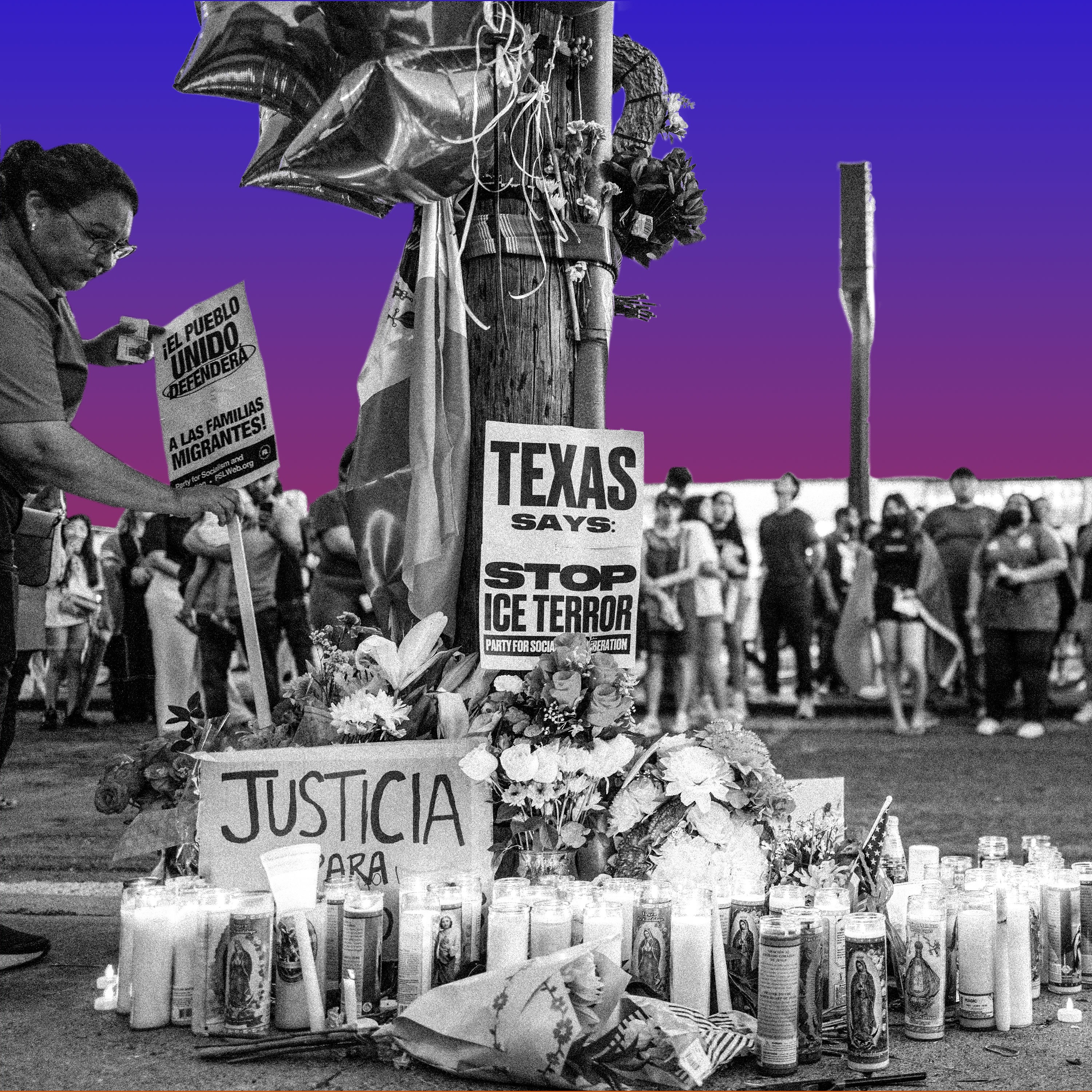
1:42Arelis Hernández: Washington Post reporter Aurelis Hernandez lives in San Antonio. But for the last week, she's been 200 miles away. in Houston. I came to Houston after Mr. Lorenzo Salgado Araujo was shot to death in a community that's one of the oldest Mexican-American communities in Houston. It's called Magnolia Park, right? Magnolia Park on Houston's East End, yes. Where'd you go first? I went to the scene. I saw the growing memorial that was there for Mr. Salgado Araujo, and then I went about trying to witnesses. For the last couple of years, Arellis has been covering the way immigration enforcement has changed in this country.
2:29Arelis Hernández: She's covered the way courts are flooded with deportation cases and the expansion of the president's border wall. She also tells the individual stories of immigrants themselves. A Nigerian nun detained on her way to church. Two teenage basketball players who got arrested while waiting for the bus to school. A Haitian woman who was released from custody and then froze to death. But the case of 52-year-old Lorenzo Salgado Araujo, killed last Tuesday while driving to a job site, stood out because it was brazen and because his sons have been so open about their loss. I want to tell you about my dad.
3:14Arelis Hernández: This is Lorenzo's son, Rinaldo. I saw a video posted on Facebook that he had been shot. I recognized him immediately. Not from his appearance, but from his voice, crying for help as he lay on the street, bleeding out. Salgado Araljo's family has been open about something else, too. Wanting a full investigation. Araljo was already doing that, going door to door, piecing together one video after another. I was like, okay, this building, this home has a camera and like the auto mechanic shop, the gas station, the chiropractor's office, the herbal shop, which didn't have a camera, but very nice people who were there.
4:01Just trying, you know, making the case to them that we have a team that's sophisticated enough to sort of take all that data and try to clarify. And, you know, they themselves gave it over with the understanding that, you know, they want answers.
4:16Arelis Hernández: There's been about a week to gather up video evidence. Looking just at the tape, what do we know? Looking strictly at the tape, we can see what looked like a chase. We see what looked like a white van startled or at least spooked by these aggressively driven unmarked vehicles that came around the corner. and around them to try and cut him off. What we don't see, the gap that exists right now in the video evidence, is those seconds when the gunshots were fired. The feds have said, or they said initially, that Mr. Salgado Araujo rammed their vehicle. Is there any evidence of that in the video? From what we could see, which isn't much, that doesn't appear to be any kind of, you know, collision damage to the white van.
5:10Now, the ICE agents were driving black vehicles, so it's a little harder to tell, again, with the sort of grainy footage and the distance that we had from them. But so far, we haven't seen that.
5:22Arelis Hernández: There is video evidence of Mr. Salgado Araujo in a whole lot of pain after being shot, right? Indeed. A bystander video that appeared to have been posted to Facebook first of people driving by and hearing him moaning. And at least one witness told my colleague that he was saying, me están matando. They are killing me. On Monday, ICE agents shot another person, this time in Maine. Like Salgado Araujo, the victim was not the target of a warrant. And like Salgado Araujo, ICE initially claimed the person tried to weaponize their vehicle against officers. They walked that back, issuing a statement later saying only that the officer had, quote, feared for public safety when he shot a 26-year-old in front of his wife and three-year-old daughter.
6:19Arelis Hernández: Today on the show, immigration officials have killed two people in under a week. Who's going to find out what happened? I'm Mary Harris. You're listening to What Next. Stick around.
6:39This episode is brought to you by Moo Moo. If you're an investor, you might have questions. You hear about a big IPO or you watch the market go up and down. And you might think to yourself, what is going on there? So if you want to do your homework, but you don't have time to read it all, you might want to look into Moo Moo. Moomoo is an all-in-one investing and trading platform that brings market data, research analysis, and professional-grade trading tools together in one place. It's used by a community of more than 31 million traders worldwide, with a parent company listed on NASDAQ. One account covers stocks, ETFs, options, crypto, IPOs, and prediction markets, with 150-plus built-in analysis tools.
7:21And Forbes named Moomoo one of the best brokerage accounts for stock trading in 2026. and TradingView named Moomoo best stock broker in North America in its broker awards in 2024 and 2025. Right now, Moomoo is offering its new users up to$1 ,000 in NVIDIA stock, plus 8.1 % APY on uninvested cash for a limited time. And if you deposit$100, you get up to$200 in trading vouchers. Go to start.moomoo.com slash whatnext to learn more and get started with Moomoo. That is start.moo.moo.com slash whatnext. Regulatory fees, exchange fees, and index option contract fees may apply. Fees are subject to change.
8:07Today's show is brought to you by Vanguard. To all the financial advisors listening, let's talk bonds for a minute. Capturing value in fixed income isn't easy. Bond markets are massive, murky, and let's be real, lots of firms throw a couple of flashy funds your way and call it a day. But not Vanguard. Vanguard bonds are institutional quality. Institutional quality is not a tagline. It is a commitment to your clients. It means top grade products across the board. The lineup includes over 80 bond funds. They are actively managed by a 200 person global squad of sector specialists, analysts, traders.
8:40Lots of firms love to highlight their star portfolio managers. Like it's all about that one brilliant mind making the magic happen. Vanguard's philosophy is a little different. They believe the best active strategy should not be locked away with one person. They should be shared across the team, which is why every client benefits from the collective brainpower they've got, not just one individual's take. The bond market's complex and it's not something one person or small team can realistically keep up with. Vanguard has been in the game a long time. Their scale gives them serious edge. They're able to invest across all kinds of sectors, maturities, and geographies, which means they can spot and act on opportunities others could miss.
9:18So if you're looking to give your clients consistent results year in, year out, go see the record for yourself at Vanguard.com slash audio. That's Vanguard.com slash audio. All investing is subject to risk. Vanguard Marketing Corporation Distributor.
9:40As a fitness coach, my active psoriatic arthritis can slow me down. With SkyRizzy, Rizzen Kizumab RZA, I'm treating my skin and joint symptoms so I can keep moving. SkyRizzy, a prescription-only injection for adults, helps me move with less joint pain, stiffness, swelling, and fatigue. And for those who have plaque psoriasis, 90 % clearer skin is possible. With SkyRizzy, there's no daily dosing. It's just four doses a year after two starter doses. Don't use if allergic to SkyRizzy. Serious allergic reactions, increased infections, or lower ability to fight them may occur. Before treatment, get checked for infections and tuberculosis.
10:15Tell your doctor about any flu-like symptoms or vaccines. Thanks to SkyRizzy, there's nothing like clearer skin and better movement. And that means everything.
10:28Ask your doctor about SkyRizzy. Visit SkyRizzy.com or call 1-866-SKYRizzy to learn more.
10:43Arelis Hernández: We've talked about what the video can show us right now of what happened with Lorenzo Salgado Orojo. Can you introduce me to him as a person? I know you spent the last week or so really trying to, like, flesh out who he is. And I think that's important because he didn't have a criminal record or anything like that, right? As far as we know, according to his sons, who've been very eloquent about telling their dad's story, Lorenzo Salgado Araujo was a 52-year-old Mexican national who loved the Chivas soccer team on Guadalajara. He was a home builder. He had a business framing houses, which is sort of the early steps for development, and was working at a construction site north in the Houston northern suburbs, which is where you usually found him.
11:34He was driving the van around to pick up other workers, right? take them to a job site? Right, right. Including one of them being his brother, Victor Salgado, who's now in nice attention. But I mean, this is a man, by all accounts, very private, wanting to live a very quiet life, enjoyed the simple things, you know, kissing his wife in the morning and eating her hearty breakfast, sitting on his porch in the afternoons after a long day of work and petting his dog and listening to music. Apparently was ecstatic about the Mexican national soccer team and devastated by their recent loss. You know, this was a guy who anyone who's grown up in, you know, Latino immigrant communities knows.
12:17He came here when he was 17 and he was undocumented, right? He was undocumented. He'd been here for about 35 years, raised three sons, two of which have graduated college, one that's still in college. And was, as far as we know, we don't know, sort of like the mechanics or the details of it had started a process for legalization, which is not easy in this country. If you've been undocumented that long in this country, there are very few pathways for you to try and gain legal status. And under the Trump administration, it's only gotten harder. He had a plan, right?
12:54Arelis Hernández: Like he knew about the risks of being detained by ICE and with his family had made a plan like, here's what I'll do if I encounter agents? What was that plan? Well, according to Ronaldo Sangado, his eldest, they as a family had talked about it, that, you know, if he happened to be encountered by ICE, that he would, you know, comply with all instructions and not fight back and simply surrender to their custody and that his sons would work hard to get him out. And one of the rules was like, sign no documents until you're able to call us. Right. Consistent with sort of the know your rights orientations given to thousands, if not millions of immigrants in this country.
13:36Arelis Hernández: Hmm. What have you learned about what happened in that white van from the other people who were inside it? Because my understanding is that those people were actually pretty hard to track down in the days after the shooting. They were detained. There are even reports that the government had asked them to self-deport and had been offering them papers to do that. Well, so I got in contact with an attorney here in Houston who had stepped forward and said that he was representing at least two of the three men who were in detention. And I got in touch with the attorney and he shared with me both oral and written statements that the three men had made about what happened.
14:20But the words that stick out to me written in sort of this loopy script was eso es mentira. That is a lie. And he was referring to ICE claiming that they were about to be run over in the eyes of the man who wrote that, Jose Trinidad Rojas. And no point, you know, to his recollection, of course, was any ICE agent in any kind of danger of being run over just by the sequence of things that happened. And so this is this is a story to tell is that, you know, they were overtaken or by this vehicle that was trying to cut them off.
14:58Arelis Hernández: And this you can see in the video, the ICE vehicle does cut them off. And you can imagine how as a driver or passenger, you would be alarmed by that. Right. The witnesses didn't exactly use the word spooked, but that's what it looks like. And that's what they described in subsequent sentences that, you know, they tried to to get away. I want to offer your listeners some context. Like this is a barrio, right? There's poverty. There are problems that come with being the barrio. And one of those is the possibility of a carjacking or a robbery. It's happened before. It's just part of life in this part of Houston or just in any big city.
15:37And these were unmarked cars. These were unmarked cars. And these are construction workers where their tools are their livelihood. Right. So he tries to get away. Mr. Salgado Raojo, and is subsequently sort of turned around and being told by the passengers of van, go this way, go that. And then, you know, when they turn on Canal Street, Canal Street is undergoing some road paving right now. So there's like a lot of construction equipment right there. What the witnesses said is that when they turn on that road, they were going no more than five miles per hour. And at some point they heard their first gunshot.
16:16And you can see in the video that the ICE agents at that point, once he turns the other way back on Canal Street and you see sort of the slow approach to the van, that at some point those agents had jumped out of the vehicle and ran on the sidewalk towards the white van. And at some point, a shot rang out. And what the men said was that the agent yelled for them to stop. And by then, you know, Salgado Arajo was already sort of attempting to stop the vehicle. But that as soon as the agent said stop, the shot rang out. There was very little time between sort of the commands that were being given and when the firearm unloaded.
17:02Yeah.
17:03Arelis Hernández: Yeah. There's video that shows that Sagara Arajo, he was shackled even while he was bleeding, right? Yes. I mean, to be fair, that is sort of common practice. Not so much for ISAGE, but law enforcement to, you know, to shackle and sort of alleviate whatever potential danger might be presented. And those three men, to be clear, again, it is common practice that once an immigrant is taken into or, you know, a non-citizen is taken into custody at an ICE detention center, they do push deportation, self-deportation papers. That's like super, super common. They do try to, you know, encourage them, if not intimidate them into bypassing whatever court process and just go home.
17:53And a lot of people do because it sucks to be at a detention center. Did any of these men consider it? As far as I know, no. They told their attorney that they do not and don't intend to. These are men who've been here for more than two decades, all of them, and have children, American children.
18:08Arelis Hernández: You know, over the last month or so, I've heard a lot about a quiet immigration surge. Right before the July 4th holiday, ICE reportedly detained like 10 ,000 people over five days. But I don't feel like I've seen that in the way I did, I don't know, nine months ago in Chicago or back in the winter in Minneapolis. I have to say, hearing about this death in Houston, it really made me wonder if a quiet deportation surge is even possible. What do you think? So quiet is relative, right? And I think it's very much used in this context compared to sort of the gnome era of immigration enforcement. Christian Oden, the former DHS secretary, where you had Greg Bovino sort of walking the streets of Chicago, declaring his presence.
19:13I was in New Orleans when inside an immigrant's house, when he happened to drive by and make a scene right outside these people's home, about 300 feet from the door. And that wasn't quiet. And now in sort of the Mullen era, Marquise Mullen, the new DHS secretary at the helm, you have what is a more subdued operation. And by subdued, again, tactically, right? Like they're not parading in the streets. They're working with local law enforcement. They're setting up traffic checkpoints. They are using state driver's license data and car data and stopping cars registered to people who fit their databases, right?
19:55They've built these massive databases of people who they suspect to be non-citizens without permission for being in the country. And I guess that's quiet to some people. We've been sort of delineating them as just, you know, different set of tactics that is designed in some ways not to capture attention, but to be sort of ruthlessly efficient. The pattern is that we've seen an increase in death, right? Not just on the streets during these arrests. I think there's a report of another ice-involved shooting this morning. In Maine. In Maine, right, exactly. I haven't gotten all the details on that yet.
20:33But we see an increase in violence, and it's not just on the streets, it's happening in the detention centers as well. So the pattern is death.
20:43Arelis Hernández: When we come back, it turns out this pattern of death is looking similar no matter where it happens. We'll explain.
21:19to toe, and many were even 100 % plaque-free. People also saw significant improvement in psoriasis symptoms of pain, redness, itching, and burning. Don't use if allergic to SkyRizzy. Serious allergic reactions, increased infections, or lower ability to fight them may occur. Before treatment, get checked for infections and tuberculosis. Tell your doctor about any flu-like symptoms or vaccines. Now there's nothing on my skin, thanks to SkyRizzy, and that means everything. Ask your doctor about SkyRizzy, the number one dermatologist prescribed biologic and psoriasis. Visit skyrizi.com or call 1-866-SKY-RIZI to learn more.
21:56Arelis Hernández: Hi, I'm Angie Hicks, co-founder of Angie. When you use Angie for your home projects, you know all your jobs will be done well. Roof repair? Done well. Kitchen sink install? Done well. Deck upgrades? Done well. Electrical upgrade? Done well. Angie's been connecting homeowners with skilled pros for nearly 30 years, so we know the difference between done and done well. Angie, the one you trust to find the ones you trust. Find a pro for your project at Angie.com.
22:32Arelis Hernández: Something I couldn't stop thinking about when I learned about this case is the fact that it's another federal shooting of an immigrant where the person being shot at is in a car. This seems to be something that keeps happening. Immigration officials shoot at someone in a car. They often then claim the car was being weaponized against them. But we've seen in case after case that those charges of weaponization of the vehicle, they're often dismissed after they actually get in front of a judge. It was just interesting for me to see another one of these cases like that. Did that stand out to you as well?
23:26Arelis Hernández: Well, yeah. And it's the number one reason why folks in this community and the family are so adamant about an independent investigation. because when video evidence or witness statements have emerged, they've almost always contradicted the narrative that DHS has outlined publicly about, you know, the circumstances of the shooting or the fatal encounter. You know, the details matter, right? And that's why we're looking into them and trying to discern, you know, This tactically is something that it makes it easier for ICE agents to do their work by encountering people on the streets because they know, like people know that they can't come into their homes, right?
24:12Like without a judicial warrant. And, you know, people know that if I lock myself in my house that, you know, an ICE agent can't get me. But when I'm on the street, that might be the opportunity where ICE can affect those types of arrests without sort of the couturement of, you know, having an award signed by a judge.
24:33Arelis Hernández: That's an interesting idea, though, like this sort of like the idea of the castle doctrine that you have to let you are safe in your home or in certain spaces where people can't come in. But then in the car, it's different because the car moves, because the other person might have a car, because the car is dangerous. The car goes fast. You know what I mean? Like there are all sorts of other elements there that make it easier for the government to get inside those spaces or get you out of them. Right. And I mean, what we could be sort of the the number of these types of events and the conflicting accounts of how they occur, you know, is very could very much just be a consequence of the added pressure that ICE agents feel to reach a certain number of arrests of the pressure of reaching these arrests and trying to find a creative ways to get at the people that they're looking for short of entering a business or entering a home, you know, with Fourth Amendment protections.
25:35So, yeah, it makes sense that these confrontations are happening with motor vehicles in public spaces. Yeah.
25:47Arelis Hernández: You mentioned that the family here and plenty of just everyday observers want some kind of independent investigation, local investigation, not a federal investigation. Where does that stand at this point? Because I know initially in Houston, what the people in charge were saying was we don't have the standing to investigate here. And then that changed. So where does that stand? Yes. Houston Mayor John Whitmire initially said that, you know, there really wasn't a role for the local authorities to play here. And then as the week went on and pressure built, Harris County District Attorney Sean Tear, I'm sorry, I don't remember how he says his name, basically committed resources in his office to at least attempt an independent investigation.
26:37It looks like it's gotten more full throated since then. I believe the DA met with the three men in detention, for example, alongside Congresswoman Sylvia Garcia. So it looks like there are being steps taken. But the public should keep in mind, it is very hard to bring charges against a federal officer. Hennepin County officials in Minnesota see that and understand that.
27:00Arelis Hernández: Yeah, I was thinking about how in Minneapolis, we haven't seen charges against the people who killed Alex Preddy or Renee Good. No, because they don't have access to the evidence that is all in the custody of federal authorities. And that's the point I think that Mayor Whitmire was trying to make, though rather unsuccessfully, because now they are pushing to do their own separate investigation. It is not true that local authorities can't hold federal officers accountable, but it is incredibly difficult to win that case in court or to bring it even in federal court or in local court because of, you know, the immunity protections.
27:39But also, you know, if if those actions were taken were considered reasonable within the official duties of an agent or a federal officer, well, then like that's it. That's sort of the end of it.
27:54Arelis Hernández: I imagine the Texas of it all is complicating, too, because, you know, in Minneapolis, there's just different people in charge, people who may have, they may feel more comfortable going after the federal government. Yeah, no, the politics matter. This is a state that has thrown its full weight behind the immigration deportation program of the Trump administration. They have made it law for sheriffs and local agencies to work alongside ICE in executing that mission. The politics are sticky on this, and Houston is largely a Democratic city with Democratic leaders. And that has been a pain point of politics in the state for a while, of big cities and their Democratic leaders, in large part working in opposition, sometimes in direct confrontation with the governor, the Republican governor and the Republican legislature.
28:52Arelis Hernández: How is Lorenzo Salgado Arrojo's family doing in all this? It's striking to me, a couple of things stand out to me. First, I think part of the reason we're hearing so much about this case is that Mr. Salgado Arrojo's family is incredibly plain spoken and willing to be open about what they're experiencing. And what they're experiencing sounds legitimately terrible in all sorts of ways. The horror of having your loved one killed. And then the everyday horror of, you know, the most recent thing I heard was that they haven't received their father's effects at all, you know, from the government. And so they just feel like they're continuously
29:39Arelis Hernández: having these offensive experiences with the government, but they must know that there are limits to what the government can get for them in this situation? Like, what do they want to happen? What do they see as their goal at this point, do you think? You know, for them, the goal is clarity. You know, Ronaldo Salgado is a former teacher, a current teacher. He knows he's very media savvy. He understands how and have seen how these cases play out in other cities and other communities. And I think he's being very deliberate and very intentional and very careful to protect both the privacy of his family while also advocating for accountability.
30:30Arelis Hernández: What do you mean when you say that? What do you see about the way he's speaking that stands out to you? Well, he prepares remarks, for one, and he's very clear about the message that he wants to send. So like every interview that I've seen, he's been very consistent on the points that he wants to hit about his family and his father. He was a very shy individual who never wanted to cause any harm. He just wanted to get in his van, go to work, and come back to eat a nice meal. He's deliberate, right? Like in the way that you and I who understand how, you know, narratives are formed and media works, want to be very, very clear that this is a story about my dad and I'm going to own the story about my dad.
31:17And this is who he is. And countervail that against the statements coming out of DHS, the illegal alien Mexican man, all of these terms. He's very deliberately, I think, trying to make sure that the public understands that he was a human being.
31:37Arelis Hernández: It sounds like in some ways what you're saying is what you see in him is a stomach to fight. The FBI, of course, says they're investigating whether or not his dad was assaulting the officer who killed him, right? That is the purview, as I understand the parameters of their investigations, that they're investigating an assault on a federal officer. They clarified in a statement to me that they are not investigating the shooting, per se. I wonder what you're going to be watching to happen next in Houston, but then maybe also elsewhere. Like you flagged the fact that as we're talking, we've just learned about another shooting, an immigration enforcement official in Maine, a car involved.
32:22So certainly what's happened in Houston, it seems like it's part of something bigger that's going on at this moment. Right. And the thing is, I want to be clear that like locally in these communities, like people in every community that I've been, which has been many in the past 18 months where these things have been happening, the locals are getting it. Like there are, you know, multicultural alliances that are in coalitions that are being built. People are looking out for their neighbors and they're building their own strength and power. Right. And Ronaldo Salgado in particular, you know, has shown himself to be someone who can articulate his family's story eloquently, but also the story of his community.
33:13It sounds like you think we're going to hear a lot more from him. I do. I do. And I do think that communities across this country are getting really tired of this. I mean, I had a call from a woman who I've been tracking forever. And she was an immigrant and she was in northern Mexico for a long time. She's originally from Colombia, came here for looking for asylum and had her asylum appointment. Donald Trump was sworn in and she lost her appointment in her chance center, the United States in claim asylum. And so I've stayed in touch with her over several years or more than a year now. And she's back in her home country because she decided in watching, she called me specifically about the shooting.
34:02She's like, that's not a country where people like me can be safe anymore. Like things are going too badly in the United States for us to desire to be there.
34:14Arelis Hernández: Aurelis, I'm really grateful for your time and your care in reporting these stories. Thanks for coming on the show. Thank you for having me. Appreciate the questions. Aurelis Hernandez is a reporter at the Washington Post. And that's our show. What Next is produced by Rob Gunther, Evan Campbell, Madeline Thames-Ducharme, and Patrick Fort. Paige Osborne is the senior supervising producer of What Next and What Next TBD. Mia Lobel is the executive producer of podcasts here at Slate. Ben Richmond is the senior director of podcast operations. And I'm Mary Harris. Go track me down on Blue Sky. I'm Matt Mary Harris.
34:50Thanks for listening. Catch you back here next time.
35:17As a fitness coach, my active psoriatic arthritis can slow me down. With SkyRizzy, Rizzen Kizumab RZA, I'm treating my skin and joint symptoms so I can keep moving. SkyRizzy, a prescription-only injection for adults, helps me move with less joint pain, stiffness, swelling, and fatigue. And for those who have plaque psoriasis, 90 % clearer skin is possible. With SkyRizzy, there's no daily dosing. It's just four doses a year after two starter doses. Don't use if allergic to SkyRizzy. Serious allergic reactions, increased infections, or lower ability to fight them may occur. Before treatment, get checked for infections and tuberculosis.
35:53Tell your doctor about any flu-like symptoms or vaccines. Thanks to SkyRizzy, there's nothing like clearer skin and better movement. And that means everything.
36:05Ask your doctor about SkyRizzy. Visit SkyRizzy.com or call 1-866-SKYRizzy to learn more.
36:15Hey, it's Paige DeSorbo from Giggly Squad. everyone is always looking for a new way to make some extra cash. But sometimes the easiest place to start is your own closet with a little help from Depop. Think about how many clothes you have that you love, but you just don't wear anymore on Depop. It's quick and easy to list those pieces. There's no selling fees. And suddenly those clothes have a chance to find someone who actually wants them. And the best part you're making room for whatever you're into next, make money on Depop with no selling fees and find what you want for less. This message is brought to you by Depop.
As the killing of Lorenzo Salgado Araujo in Houston demonstrates, ICE’s deportation surge is continuing—and so is the violence.
Guest: Arelis Hernández, reporter at the Washington Post covering the U.S. southern border, immigration, Texas and beyond.
Want more What Next? Subscribe to Slate Plus to access ad-free listening to the whole What Next family and across all your favorite Slate podcasts. Subscribe today on Apple Podcasts by clicking “Try Free” at the top of our show page. Sign up now at slate.com/whatnextplus to get access wherever you listen.
Podcast production by Rob Gunther, Evan Campbell, Madeline Thames-Ducharme and Patrick Fort.
Paige Osburn is the senior supervising producer of What Next and What Next TBD.
Hosted on Acast. See acast.com/privacy for more information.