Ask ChatGPT

 What Next | Daily News and Analysis
28 Aug 2026 · 7m · 3 chapters
“Off-the-Record” vacation advice from Slate’s What Next?—the “parallel play vacation,” where friends travel together but only coordinate a few shared touchpoints (e.g., a group dinner time) and otherwise pursue their own interests to avoid resentment and forced activities.
Luke Winky, Slate writer and “vacation expert,” wrote a Slate how-to on parallel play after a trip to France with about 12 friends; Rob Gunther, senior producer of What Next? (hosts).
forcing everyone to do the same sights (e.g., Notre Dame/Louvre) can ruin the trip if some people don’t want to go; parallel play reduces “slow resentment.”
Luke’s Normandy solo trip to D-Day sites; France weekend with open-ended plans for a friend’s 35th birthday; discussion of FOMO and backing out of group-suggested activities.
Written by AI. May contain mistakes.
Discussion on a new vacation style allowing friends to enjoy solo activities while on a trip together.
“You are a vacation expert And I say this because you just wrote a pretty definitive how-to vacation for Slate.”
Explores the challenges and benefits of group travel dynamics and the potential for personal enjoyment.
“That is the essence of the parallel play vacation.”
Insights into the joys and freedoms of solo travel, highlighting personal experiences.
“I think that has a lot of reasons for why I get like this because I'm always going on giant vacations.”

Get the gist, explore an idea or ask about something said.
 Claude
On What Next | Daily News and Analysis, what are the key points of this episode?
Searching your listeningAutomatic transcript. May contain errors.
0:02Happy Friday, Slatesters. It's What Next? Senior producer Rob Gunther here. It is Friday, which means it's the time that we go off the record just for you, our Slate Plus friends and neighbors. And if you're not a Slate Plus subscriber, you get to hear the first five minutes only before we ask you to subscribe to Slate Plus. We spend our weeks getting answers from experts on the biggest stories out there from the trade war with Canada to the actual war war with Iran. And sometimes, you know, after a week of these heavy stories, it's nice to just get away. Step away from the phone, from the computer, get some sunshine, maybe take a swim.
0:36And of course, it's late August. We're all itching to get in those last days of vacation before school starts or whenever. And I wanted to bring in our fellow Slatester, our colleague, writer, Luke Winky. Luke, thank you for coming. It's always a delight. Rob, always a pleasure. Good to be back. So Luke, I wanted to talk to you. You are a vacation expert And I say this because you just wrote a pretty definitive how-to vacation for Slate. And I wanted to talk about it because I think you have something here that I had not considered before. You have something new to offer the group vacation. Tell me what you are proposing.
1:16I did, yes. So a couple, like about a month ago, I met a bunch of friends, went to France for, I was there for basically the weekend. Again, it was me and like 12 other people. And after coming back, I decided to write about what I've coined the parallel play vacation, which the easiest way I think to express what this is, is what if you went on vacation with a bunch of friends and nobody really planned anything at all except for like a couple like core things like, OK, we're going to meet for dinner with a big group like at 7 p.m. here. But outside of that, do whatever you want during the day.
1:50So you essentially like have a solo trip with your friends in Paris. It's like, okay, actually, I'm going to do a trip to Paris where maybe I'll just see my friends a couple of times during the trip rather than, you know, dragging them to the Louvre at like eight in the morning and only some people want to go and other people are kind of grouchy about it. And it just becomes a whole, it becomes a whole to do. That is the essence of the parallel play vacation. Traveling with friends, but still doing whatever you want. Traveling with friends as if you are in daycare because that's where parallel play comes from.
2:22Like I'm a dad of young kids. Yeah. And it means kids, they sit around, they play next to each other, but they don't know yet how to play with each other. And if you take that kid's blocks, he's going to have a tantrum. Exactly. Luke, I think this is revolutionary. And I mean that in the absolute definition of the word revolution. I imagine great things on the horizon, but not after some blood might be shed. I mean, how is this received by the members of your group? You know, it's funny. the trip we went we went on like it was sort of pitched this way going forward like it was for like a a dear friend of mine's 35th birthday and she was like um hey guess what like uh i'm not like friday and saturday are kind of wide open you guys do whatever you want to do and i think that um i think we're all receptive to that i do think that like you you you could lead to like some bruised egos if you are the kind of person who's like no i actually want all 11 of my friends to come to Louvre with me that day in the morning, and I want all 11 of my friends to wait in line for Notre Dame with me.
3:23Or I should say Notre Dame, since we're talking about the church, not the university. But, like, you just kind of have to get over that. And also, most importantly, the reason why the parallel play vacation is so good, and the reason why doing this other way is not so good, is that, okay, yeah, great, you force all 11 of your friends to go to Notre Dame, but guess what? But some of those people don't want to be there. And that's going to ruin the whole thing. There's nothing worse than trudging around. Or nothing worse than you being enthusiastic about something on a vacation and clearly being aware that the rest of the group is tired or not that into it or like building a slow resentment towards you.
4:02So if you just let that go and be like, you know what? We're going to Notre Dame with the two people here that also really want to go. And you just are unburdened by all those responsibilities. And life is good. Maybe it'll just be you. Ooh, that's where my bruised ego would come in because I have like incredible FOMO. I'm from a giant family. I think that has a lot of reasons for why I get like this because I'm always going on giant vacations. There's no such thing as a small vacation. But like when I was reading your article, I was imagining, okay, say I want to do this activity and propose it as a parallel play type of activity.
4:36My immediate fear is that I'm going to be standing in the circle, in the middle of the circle of the whole groups because of course, in my imagination, I'm the center of the attention here. And I propose this activity and everybody says, no, no, that sounds cool. But you go off and do it by yourself. And at that point, I'm like, oh, damn, like I really box myself in here. I have to go do this thing by myself. Is it like, can I back out if I back out to people realize that I'm not good at making plans? This is probably like a me problem though, right? No, I mean, like, I think that's I think that part is fair.
5:03But I mean, Rob, have you ever traveled solo? I have had not a ton of solo travel. I don't think. No, no. Yeah. Good point. So like, I mean, an extension of the story I wrote is like a week before I met everyone in Paris. I was I was up in Normandy by myself. And there was an open invitation of like, hey, if you guys want to roll to Normandy with me and travel some some some some D-Day sites and, you know, look at all the the craters, how long the coastlines and remember the war. You're more than welcome. And normally took me up on that. But like that, I think there's there's some there's some beauty in that, too.
5:37If you like you like there is the essence of the parallel play vacation is like this idea that you get to do whatever you want on vacation. And that is kind of at its apex when you're by yourself. Like, yes, it can get a little lonely. That's you like you look at your rest of the stores or your friends down in Paris, like having Aperol spritzes while you're looking at, you know, German bunkers. However, I think that's where you feel the glory of it the most because you just wake up every day and you decide, what do I want to do today? It's like, maybe I'm going to go to this museum and maybe after 20 minutes, I'm going to tap out.
6:08I don't have to ask anyone's permission. It's all up to me. So I think, yes, some of the pitfalls of the Parallel Play vacation are at its apex when you're by yourself. However, some of its treasures can be found there too.
6:23Luke Winkie: That's it for now. And if you want to hear the rest of this episode, the way to do it is to subscribe to Slate Plus. Unlock Slate Plus now by going to slate.com forward slash whatnextplus.
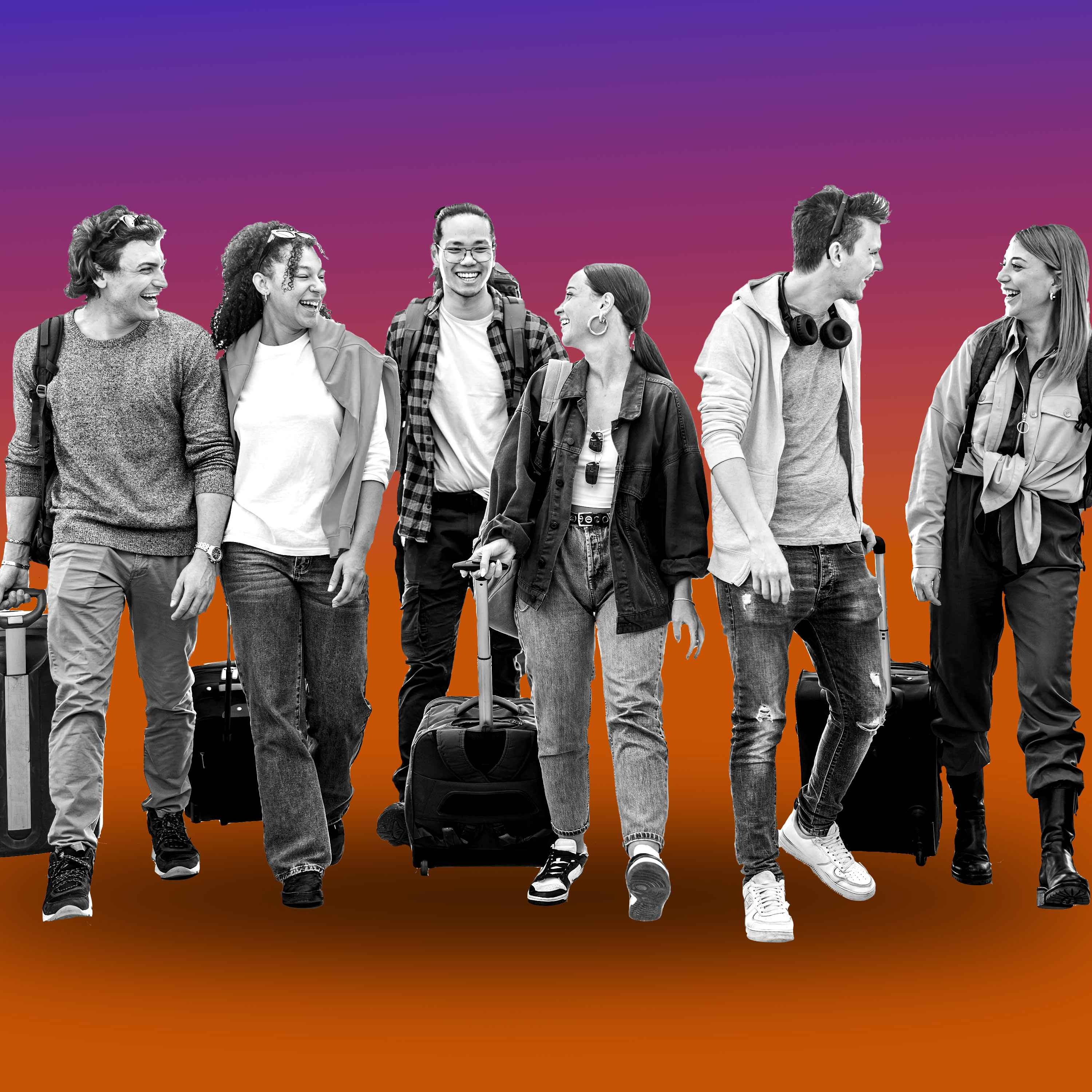
The idea of a big ol’ group of friends taking a vacation sounds so fun…in theory. In practice, though, the museum friends and the beach friends are forming opposing factions, and the vegetarian friend is hovering between malnourishment and total banishment. But these problems have one elegant solution: the parallel play vacation.
Guest: Luke Winkie, Slate staff writer and author of “There’s Only One Palatable Way to Travel With Friends.”
This episode is member-exclusive. Listen to it now by subscribing to Slate Plus. By joining, not only will you unlock exclusive episodes of What Next —you’ll also access ad-free listening across all your favorite Slate podcasts. You can subscribe directly from the What Next show page on Apple Podcasts and Spotify. Or, visit slate.com/whatnextplus to get access wherever you listen.
Podcast production by Rob Gunther, Evan Campbell, Madeline Thames-Ducharme and Patrick Fort.
Paige Osburn is the senior supervising producer of What Next and What Next TBD.
Hosted on Acast. See acast.com/privacy for more information.