Ask ChatGPT

 What Next | Daily News and Analysis
6 Jul 2026 · 25m · 8 chapters
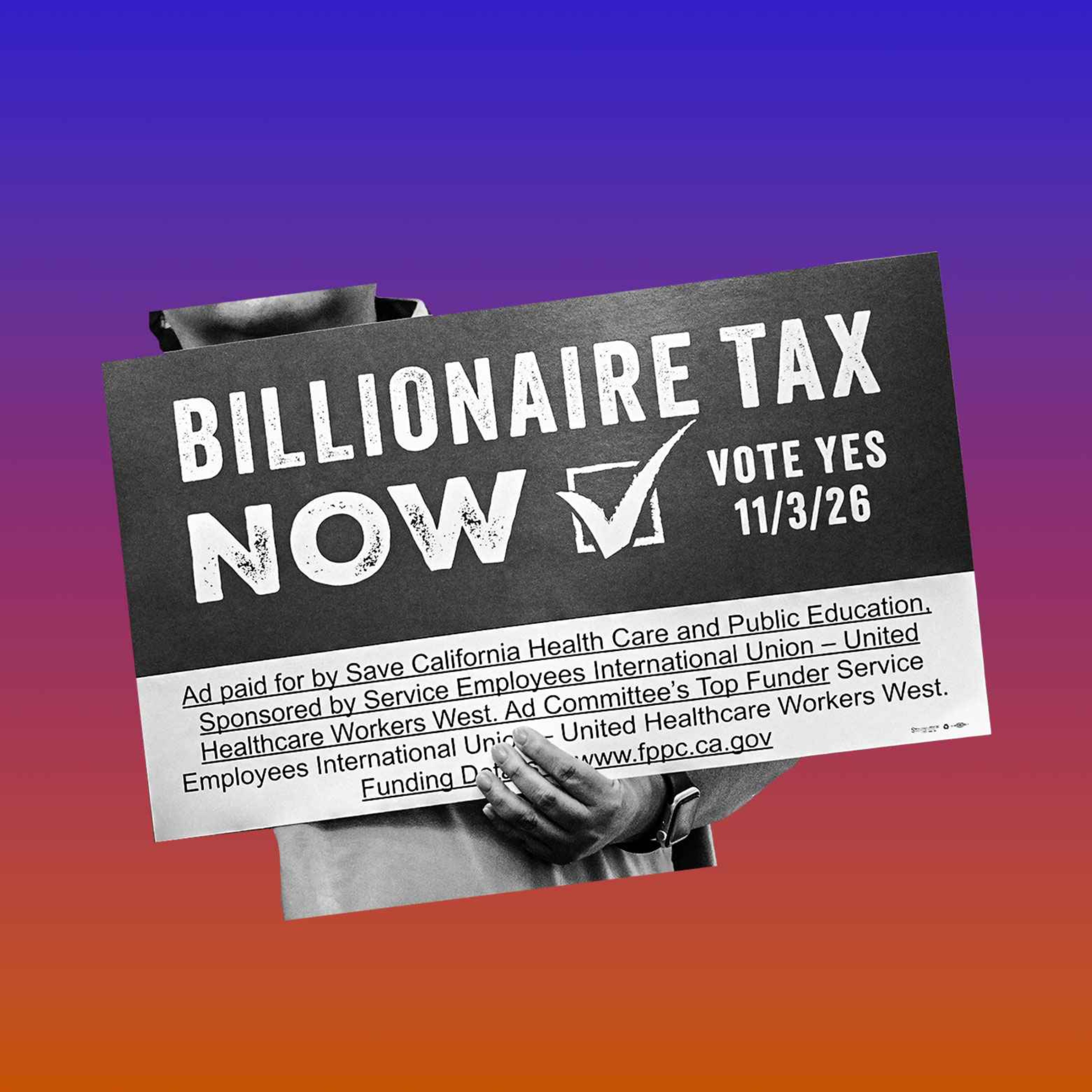
A debate over California’s proposed one-time 5% billionaire wealth tax to fund health care as coverage and budgets face cuts, including how it would work, why Governor Gavin Newsom opposes it, and how billionaire-backed “countermeasures” might respond.
Dave Regan, president of SEIU UHW (one of the largest U.S. healthcare unions). He argues the union pushed the measure via ballot initiatives and says rank-and-file members—70% women and 70% people of color—voted 131–2 to place it on the ballot. Host Mary Harris interviews him.
The tax is an asset/wealth tax (not income), targeting publicly traded stock holdings whose values are visible daily. Regan says it would raise money to close health-care funding gaps and prevent job losses and coverage cuts. He claims enforcement is straightforward and that Newsom lacks a real alternative, while billionaires are funding opposition.
Mentions Google founders (Larry Page, Sergey Brin), Mark Zuckerberg, and Larry Ellison; Brin reportedly spends time in Nevada and funds opposition. Regan cites Trump/Congress Medicaid cuts and says California’s health care is a federal-state partnership.
Written by AI. May contain mistakes.
Discussion on Dave Regan and his fight for a billionaire tax in California.
“I'm going to start with kind of a mean question, but I think you can handle it.”
Exploration of the implications of the proposed tax on billionaires.
“You have really freaked billionaires out.”
Dave shares stories about interactions with billionaires regarding the tax.
“I've actually I've talked to a couple of them.”
Discussion on the unique approach of using ballot measures for leverage.
“Today on the show, the case for a California wealth tax.”
Learn about the tactics union leaders use to influence policy through ballot measures.
“My understanding is that some economists and lawyers have basically been looking for a way to tax wealth for a long time.”
Discover how union leaders deal with public perception and pushback.
“And I'm just fortunate to, you know, be the leader of the organization.”
Explore the critiques and implications of the proposed billionaire tax in California.
“One of the critiques of your tax proposal is that it might not actually raise that much money and it might drive people from the state.”
Discussing the implications of a proposed billionaire tax in California and its potential ripple effects.
“And we're going to get called a lot of names and they're going to spend a lot of money.”

Get the gist, explore an idea or ask about something said.
 Claude
On What Next | Daily News and Analysis, what are the key points of this episode?
Searching your listeningAutomatic transcript. May contain errors.
0:00Dave Regan: I'm Jake Stouck, co-founder and CEO of Serval. We built Serval to automate the IT work that slows companies down. Onboarding, password resets, access to applications, my laptop stopped working. While employees wait for help, their real work is put on hold. IT desperately wants to automate this work, and that's why they need Serval. You just tell Serval what you want to automate in plain English, and it's built. No drag-and-drop workflows, no expensive consultants. Employees get unblocked and IT teams go from drowning in tickets to building what actually matters. With Serval, IT becomes the AI engine powering the entire company.
0:39Dave Regan: This is a new way to run IT. We guarantee you'll automate 50 % of all tickets and we'll prove it to you in a free four-week pilot. Go to serval.com slash tickets. That's S-E-R-V-A-L dot com slash tickets. Do you snore? Did somebody hand you a CPAP and did you quietly stop using it? The mask that never quite seals? The hose tugging at you every time you roll over? A machine sitting abandoned in a closet? Excite OSA works a different way. It treats a root cause instead of managing the noise and you use it while you're awake. 20 minutes a day while the coffee brews, while you set your fantasy lineup, an FDA-cleared prescription device for primary snoring and mild obstructive sleep apnea.
1:30Then you go to bed like a person, nothing strapped on, nothing plugged in. In clinical studies, 90 % of patients saw a reduction in snoring. No sleep study required. Prescribed online, shipped to your door. ExciteOSA at springsleep.com slash sleep20. Code sleep20 for 20 % off. ExciteOSA is an FDA-cleared prescription-only device for primary snoring and mild obstructive sleep apnea. Not for everyone. Individual results vary. Risks and benefits at springsleep.com.
2:17I'm going to start with kind of a mean question, but I think you can handle it. Okay. Are you a shakedown artist?
2:30No, absolutely not. This is a guy named Dave Regan. Dave leads one of the largest healthcare unions in the country, UHW. And he's just taken on this big fight, campaigning for a one-time tax on billionaires that Californians are going to vote on come November. That's where this whole shakedown artist allegation comes from. You know, it's obviously weird to hear those kinds of things. And what I keep coming back to is when you're trying to accomplish things or solve problems for ordinary people, there's this pejorative language that everybody uses. You know, sometimes I think if the union called itself a hedge fund, nobody would say those kinds of things about us.
3:32You have really freaked billionaires out. Like, I was just looking around for videotape how the billionaire's tax has been talked about. And it's really hair on fire time for rich people in California. I get the sense maybe you relish that, though. You know, so the juvenile delinquent in me kind of gets a kick out of that, you know. But the reason for that is it's just crazy. And particularly in California that's home to more billionaires than any other state in the country. And not just garden variety billionaires, but these huge billionaires, people like the Google founders and the Oracle founder, Larry Ellison, and others, Mark Zuckerberg.
4:23Life is really good for the billionaires in California, and life is not so good for everybody else, particularly when we look at what's going to happen to the health care system. What's going to happen to the California health care system is cuts. Lots of cuts. Many of them baked into last year's One Big Beautiful Bill Act. Dave worries the caregivers he represents are going to lose their jobs while patients foot bigger bills. He's trying to solve that with his 5 % tax. Almost all the money it collects would go towards plugging health care related funding gaps. But when we spoke last week, Dave told me he's had to fight to even get it in front of voters.
5:06Honestly, we were surprised at how little interest there was in Governor Newsom and actually solving the problem. And we believe it is totally fair and totally reasonable that the people who have far and away the most or the most fortunate people in California, the billionaires should pay a one-time 5 % tax so that all of those things don't happen. Well, Governor Newsom would say, I can't have my state be the one place in the U.S. where billionaires are getting taxed. That just means people are going to leave. That's not fair. Well, he does say that, and I think the governor is wrong. But some billionaires say they're already leaving.
5:51Google's founders, Larry Page and Sergey Brin are among them. Brin says he's spending more time on the Nevada side of Lake Tahoe. He's also funding opposition to Dave's ballot initiative. Any of these billionaires ever found your cell phone number and just called you and been like, listen? Oh, they have. I've actually I've talked to a couple of them. You know, I got invited to a billionaire mansion in Beverly Hills. And in the course of the conversation, the billionaire told me that he spends over a million dollars a year to do his taxes. He dropped all these names of celebrities. He told me how he knows Jeff Bezos and Jeff Bezos bought a mansion in Beverly Hills for one hundred and sixty million dollars.
6:39And then he put one hundred million more into it. And then he wants to tell me how it's unfair if we have to have a one time tax on the billionaires. What did you say to him? You know, you didn't even offer me a cup of coffee and you're a billionaire, right? I should at least get a cup of coffee for, you know, driving over here to see you. Well, I'm shocked they wouldn't want to make a deal with you. You have used ballot measures in the past to make deals that were advantageous to your members. Do you know what I'm saying? Like, they could come at you with some ideas. I'm sure they could. And I wish they had.
7:12But I think they listened to Governor Newsom, who promised them very publicly this was not going to be on the ballot. You know, this is a group of people who are used to getting everything they want all the time, no questions asked. You're saying they owe us. They owe California. They need to be part of the community. They need to do their fair share. Today on the show, the case for a California wealth tax. From the guy trying to sell you on it, I'm Mary Harris. You're listening to What Next. Stick around.
7:59This episode is brought to you by Moo Moo. If you're an investor, you might have questions. You hear about a big IPO or you watch the market go up and down, and you might think to yourself, what is going on there? So if you want to do your homework, but you don't have time to read it all, you might want to look into Moomoo. Moomoo is an all-in-one investing and trading platform that brings market data, research analysis, and professional-grade trading tools together in one place. It's used by a community of more than 31 million traders worldwide with a parent company listed on NASDAQ. One account covers stocks, ETFs, options, crypto, IPOs, and prediction markets with 150 plus built-in analysis tools.
8:41And Forbes named Moomoo one of the best brokerage accounts for stock trading in 2026. And TradingView named Moomoo best stock broker in North America in its broker awards in 2024 and 2025. Right now, Moomoo is offering its new users up to$1 ,000 in NVIDIA stock plus 8.1 % APY on uninvested cash for a limited time. And if you deposit 100 bucks, you get up to$200 in trading vouchers. Go to start.mumoo.com slash whatnext to learn more and get started with MUMU. That is start.mumoo.com slash whatnext. Regulatory fees, exchange fees, and index option contract fees may apply. Fees are subject to change.
9:26Today's show is brought to you by Vanguard. To all the financial advisors listening, let's talk bonds for a minute. Capturing value in fixed income isn't easy. Bond markets are massive, murky, and let's be real, lots of firms throw a couple of flashy funds your way and call it a day, but not Vanguard. Vanguard bonds are institutional quality. Institutional quality is not a tagline. It is a commitment to your clients. It means top grade products across the board. The lineup includes over 80 bond funds. They are actively managed by a 200-person global squad of sector specialists, analysts, traders.
10:00Lots of firms love to highlight their star portfolio managers, like it's all about that one brilliant mind making the magic happen. Vanguard's philosophy is a little different. They believe the best active strategy should not be locked away with one person. They should be shared across the team, which is why every client benefits from the collective brainpower they've got, not just one individual's take. The bond market's complex and it's not something one person or small team can realistically keep up with. Vanguard has been in the game a long time. Their scale gives them serious edge. They're able to invest across all kinds of sectors, maturities, and geographies, which means they can spot and act on opportunities others could miss.
10:38So if you're looking to give your clients consistent results year in, year out, go see the record for yourself at vanguard.com slash audio. That's vanguard.com slash audio. All investing is subject to risk. Vanguard Marketing Corporation Distributor.
11:18and lines moving. Call 1-800-GRAINGER, click grainger.com, or just stop by. Grainger, for the ones who get it done.
11:32So my listeners are from all over the place, so they may not have heard what you're up to in California. I just want to do some basic work explaining the tax that will be on the ballot so people understand. About the tax, first of all, it is a wealth tax, not a tax on income, a tax on wealth. That makes it unique, I believe, and that it is taxing things like stocks, things that are not typically taxed, but contribute a lot to making someone wealthy. Is that correct? And why that approach? That's absolutely true, that it is a first-of-its-kind wealth tax. Another way to think about it is that it's an asset tax.
12:12It's not an income tax. So let's take somebody, you know, like Mark Zuckerberg, Larry Page, Sergey Brin, who are worth in excess of$200 billion. They don't take salaries to speak of from their companies. They're paid in stock. and the tax system that we have, you and I pay income tax and that's the vast majority, that's what we have in this world. When you're at this level of billionaire wealth, you don't rely on a paycheck, you rely on your assets and your portfolio growing over time. And in 2019, the 200 plus billionaires in California had wealth of about$700 billion. Today, it's$2.2 trillion.
13:02They've seen a$1.5 trillion increase in their portfolios. And all of that is insulated from the tax system. They can give all that money to their heirs. They don't pay taxes on it. And so we have a system that lots of people rightfully think overtaxes regular people, and it undertaxes the wealthiest among us. So when you're confronted with a problem like we're confronted with in California, how do we replace this enormous amount of funding for our health care system, hospitals, clinics, basic coverage for people? there's limited places you can go to get those kinds of resources. And so it's obvious to us that the most fortunate and the wealthiest people in the country should pay a one-time 5 % tax and then let's figure out a permanent solution to this so that tens of millions of people don't suffer and literally die.
14:00Not millions of people, but thousands of people will lose their lives if we let this happen. My understanding is that some economists and lawyers have basically been looking for a way to tax wealth for a long time. And they realized California has this ballot measure situation where you can put things on the ballot. And you, as a union leader, have kind of become known as the ballot measure guy. You like putting ballot measures on there. You believe it gives you leverage with people in power. Can you explain this? Because I think most people think of union leaders as like lobbyists. They're going and trying to get bills passed.
14:39This is a different approach and it's something that you seem to like a lot. Well, we do in our organization. We like it a lot and we use it a lot. And the reason that there there was a$15 minimum wage passed in California 10 years ago was because we qualified it for the ballot. The reason we now have a$25 an hour minimum wage for health care workers in California is because we qualified it for the ballot. Yeah, I think that the approach of doing ballot initiatives is interesting because with union power more globally not being as strong as it historically was, I think it allows your power as a union leader to be greater.
15:23It's also kind of an extreme version of what union leaders do best, which is basically make themselves huge pains in the ass to management and people in charge. um but it also means you're very aggressive you're not you are sometimes working in concert with people uh in the government but you're also punching them in the nose and you've gotten a lot of uh you've you've gotten attention for that i will say like you've been called a lone warrior who fights by any means necessary. There have been accusations of you sort of assaulting a process server. I think those were not pursued. But it's like people say you're aggressive.
16:08Is that a problem at all? You know, it's not a problem in the grand scheme of things. Is it irritating when people lie about you? Yes. You know, does it bother me when people make things up and, you know, misstate the facts and everything else. Of course it does. But, you know, we're living in a country, everybody knows this, we're living in a society where regular people have been on the losing end of political decisions for more than 50 years regularly. We've seen our tax system get inverted. Working people pay higher effective tax rates than billionaires do. the standard of living for most Americans has been stagnant or is declining when you adjusted for inflation and the hours that people are working.
17:04And that just means that we have serious problems we have to solve. And, you know, if doing that means that people are going to call you names, well, then people are going to call you names. But, you know, I also I should say, too, I am I am the president of a large health care workers union. And I just think it's worth noting this was not a hard decision. I did not make this decision. The executive board of UHW made this decision. And the vote was 131 to 2 to put the billionaire tax on the ballot. These are rank and file health care workers. 70 % of them are women. 70 % of them are people of color.
17:46That's who made the decision. And I'm just fortunate to, you know, be the leader of the organization. But it's like what your mother told you back when. If they're not calling you names, you're not doing anything that's really that effective. So we get called a lot of names. But we'll take that with higher minimum wages, with Medicaid expansion around the country, with a$25 an hour health care minimum wage. Statewide in California, by the way, doesn't just benefit union members. It benefits all health care workers. And we did that and we're proud of it. And we can put up with some name calling.
18:24We'll be right back after a quick break.
18:33Do you snore? Did somebody hand you a CPAP and did you quietly stop using it? The mask that never quite seals? The hose tugging at you every time you roll over? A machine sitting abandoned in a closet? Excite OSA works a different way. It treats a root cause instead of managing the noise and you use it while you're awake. 20 minutes a day, while the coffee brews, while you set your fantasy lineup. An FDA-cleared prescription device for primary snoring and mild obstructive sleep apnea. Then you go to bed like a person. Nothing strapped on, nothing plugged in. In clinical studies, 90 % of patients saw a reduction in snoring.
19:17No sleep study required. Prescribed online, shipped to your door. Excite OSA at springsleep.com slash sleep20. Code sleep20 for 20 % off. Excite OSA is an FDA-cleared prescription-only device for primary snoring and mild obstructive sleep apnea. Not for everyone. Individual results vary. Risks and benefits at springsleep.com.
19:45Dave Regan: When you're running a growing business, the right systems can unlock your full sales potential and make fulfilling every order effortless. Switch to ShipStation before peak season so you're prepped and ready before the rush hits. ShipStation connects Shopify, Amazon, TikTok Shop, and over 200 more marketplaces with one platform that does it all. You can manage orders, sync inventory, track returns, all automatically. Everything your operation needs, all in one place. Upgrade your shipping operations to stress-proof your biggest sales days and capture every bit of potential revenue. Go to ShipStation.com and use code AUDIO and get 30 days free.
20:19One of the critiques of your tax proposal is that it might not actually raise that much money and it might drive people from the state. I think one critique could be that a one-time tax is not sustaining and that this tax is really focused on health care workers, potentially to the detriment of other workers in the state. Like unions representing teachers and police officers are among those that have come out against this tax, fearing like a longer term hit if billionaires leave. How do you make that the case for your tax to people who maybe would have been your allies previously but aren't in this fight?
21:00Yeah, I think we have to start with the facts. And with all due respect to the teachers and the police, they are misrepresenting the facts and they know it. So let's go back to why are we doing this tax? We're doing this tax because President Trump and the United States Congress took the biggest chunk out of the American health care system in history, a trillion dollars over 10 years. They didn't cut law enforcement. They didn't cut education. They cut health care, specifically Medicaid. So when you see something like that done to a program that's the largest health insurance program in the country.
21:40It covers over 80 million people. You have to fix that. Well, those groups don't really rely on federal funding the way that health care workers do, right? I mean, education and police are mostly funded locally. That's true. But what we're asking people to do here, Medicaid and the health care system in California is a federal state partnership. That's the problem we are fixing. And the teachers, for instance, are putting they have something on the ballot this year that's going to extend a tax that's a status quo tax that does not expire until the year 2030. It's an income tax. And we're for that.
22:19We think people should support that. But it doesn't make sense that we're not going to fix the problem that's much larger and is happening now and is happening to more people. So we're not taking anything and we're not proposing to take anything from anybody else. We're proposing that we fix a problem that, you know, happened when when President Trump and the Congress passed the one big, beautiful bill. Can I just say how strange it is that you are advocating for this tax to fill a budget hole that California has and the California governor is fighting against it? I mean, it's just it is really strange to me, like when I started reading about it.
22:58No, it's bizarre. But like but the fact that it's bizarre tells you something. So why is Governor Newsom opposed to this? And by the way, I have said publicly, I met with Governor Newsom right before Christmas after we had filed this. And I said to him, you know, he asked that we withdraw this from the ballot. And I said, Governor, we are trying to solve a problem. We are trying to solve the health care problem. Three and a half million people on coverage, 20 million on prices, 150 ,000 workers closing hospitals and emergency rooms. He says, I agree with that problem. So I said, well, governor, if we don't do this, what is your solution?
23:41And he literally said, I don't have a solution. He said that. And it's true. But what's going on, and everybody knows this, is Governor Newsom is running for president. And Governor Newsom needs the enormous wealth of the billionaires, particularly in the big tech sector, to fund his presidential aspirations. And we should say Governor Newsom just in the last week has come out with his own idea of taxing billionaires federally, which is clearly in contrast to what you are proposing here, which is something at the state level. You know, there is something else, though, that I see that I think of as a problem with this wealth tax, which is that a wealth tax, which is totally new in this way, it's going to create a major enforcement issue.
24:30If this thing passes, these billionaires are not going to just fork their money over to the state. They're going to sue. And it's going to take tons of time and tons of manpower to fight. I just don't think it's like unlocking a bank account for your members. Is the state of California prepared to have that fight, given that right now your governor is fighting this? And do you see that problem? I'm going to try to address all the points. First thing is, this is for the majority of Californians. This is not for UHW members. We're healthcare workers, but three and a half million people are going to lose healthcare coverage and over 20 million people are already paying more.
25:12This is not about our members. This is about the common good. Second thing, enforcement is actually very simple. The thing you need to know and understand about the billionaire wealth is that 70 percent of the two point two trillion dollars that these 250 people have is in publicly traded stocks and equities. You mean like we know where it is. We know and we know what it sold for as of four o 'clock at the close of the markets every single day. It is completely above board. That's you know, it's over a trillion and a half dollars. The prices are printed. You can't hide that. Well, but also the value fluctuates, right?
25:52You know, the stock market goes up and down. So that's a whole other side of this. It's no different than what we do now that you pay your tax. Your income fluctuates every year. And as of December 31, the clock stops and you pay taxes based on the income. You know, if you work more overtime in a given year, you pay more. The point is the wealth of billionaires is completely visible to all of us. There are only 250 of these people. But the billionaires are smart too. Like they are running counter ballot measures. Yes, they are. That if they pass would nullify yours. And it's going to be a race to November to see which of these ballot measures wins and what happens at the end of the day.
26:34This is going to be a bitter fight, I predict. I predict there will be so much money spent on advertising in your state. Are you ready for that? Well, I don't think you can ever really be ready for it, but we're as ready as we can be. Here's the thing about the so-called countermeasures. We call them the revengements. You know, these are the amendments that are just born of revenge. And the revengements, one of them has no impact on the billionaire tax. So they only have one thing that really could affect and not necessarily nullify, but let's say it nullifies. Under California law, whoever gets the most votes wins.
27:15So even if both pass, whichever one gets the most votes trumps the one, so to speak, that didn't get as many votes. So our job is to get more votes for the billionaire tax than the billionaires get for the revengements. And that's what we're going to do. And the great thing about the billionaire tax is the more people learn about it, the more more supportive they are. And support is already at a large majority. They're going to spend, I don't know, half a billion dollars, 750 million, or maybe a billion dollars again. They'll spend more money than anybody's ever spent on anything. But all of that attention, we have to turn and, you know, and just make the obvious case that if they're not calling you names, you're not doing anything serious.
28:01And we're going to get called a lot of names and they're going to spend a lot of money. And at the end of the day, do we want people to have health care and hospitals and emergency rooms and clinics to stay open? We think most Californians do. And look, we're not naive. We're going to get carpet bombed by these guys. We know that. But we're looking forward to it and we're going to have a righteous discussion.
28:31So is this just the beginning? Like if this passes in California, do you think other places, other billionaires are on notice? I think they're already on notice. And I think whatever happens in the campaign that already people are saying, you know what, this is a solution that makes sense because the health care problem in California exists in the other 49 states, too. We have pressing social needs. And so I think we've already unleashed that. And I think other places are going to look at it and they should because it's fair, it's reasonable. And at the end of the day, working people and middle class people pay higher effective tax rates than do billionaires.
29:17You know, I mean, you've said a lot of times this is a one-time tax, which is true. I think what the billionaire's fear is like, this gets through, it's not a one-time tax. People are coming back for more. Well, you know, that's how I think regular people feel, too. So just two weeks ago in Los Angeles County, the establishment Democrats put on the ballot a half cent sales tax increase to take the sales tax in Los Angeles County to 10 and a quarter percent, in part to fill the hole because of these cuts from President Trump's bill. and everybody's for taxing regular people. And then somehow we, you know, we lose our voice when it's time to say, what do the billionaires have to put in to do this?
30:06Look, the billionaires pay less than I do and you do and all those folks in LA County that are now gonna have a 10 and a quarter percent sales tax. As a percentage. Yes, which is the only thing that matters, right? Would you rather pay 1 % of$100 billion or pay 35 % of$80 ,000. There's no comparison here. And so I just think we got to be, you know, we got to be honest about that. We left the Gilded Age behind 20 years ago. And we're now into the super Gilded Age here. And this is just about basic fairness. Billionaires are not victims and they need to stop acting like they're victims. That is weird.
30:55And that is offensive to all of the folks who actually are working for paychecks and, you know, and trying to struggle in a very unaffordable economy. Dave, I'm really grateful for your time. Thanks for coming on the show. No problem. Thank you, Mary. Dave Regan is the president of SEIU UHW in California.
31:50And that's our show. Thank you.
32:22you need when you need it so you can help keep budgets balanced and lines moving call 1-800 grainger click ranger.com or just stop by grainger for the ones who get it done
32:35Dave Regan: flowing ad budget on metrics that look great till the cfo sees them that's bull spend and marketers are calling it out in dashboard confessions i remember telling my boss it'll be good for the brand when leads were slow yeah it it wasn't cut the bowl spend linkedin lets you target by company job title and more advertise on linkedin spend 250 on your first campaign and get a 250 credit go to linkedin.com slash campaign terms and conditions apply
Union leader Dave Regan has spent decades wielding California’s ballot system against the healthcare industry. Now, he’s the man behind California’s billionaire tax — a one-time, 5 percent tax proposal that has “unleashed a political earthquake” and pissed off everyone from Elon Musk to Gavin Newsom.
Guest: Dave Regan, president of SEIU-United Healthcare Workers West (SEIU-UHW)
Want more What Next? Subscribe to Slate Plus to access ad-free listening to the whole What Next family and across all your favorite Slate podcasts. Subscribe today on Apple Podcasts by clicking “Try Free” at the top of our show page. Sign up now at slate.com/whatnextplus to get access wherever you listen.
Podcast production by Rob Gunther, Evan Campbell, Madeline Thames-Ducharme and Patrick Fort.
Paige Osburn is the senior supervising producer of What Next and What Next TBD.
Hosted on Acast. See acast.com/privacy for more information.