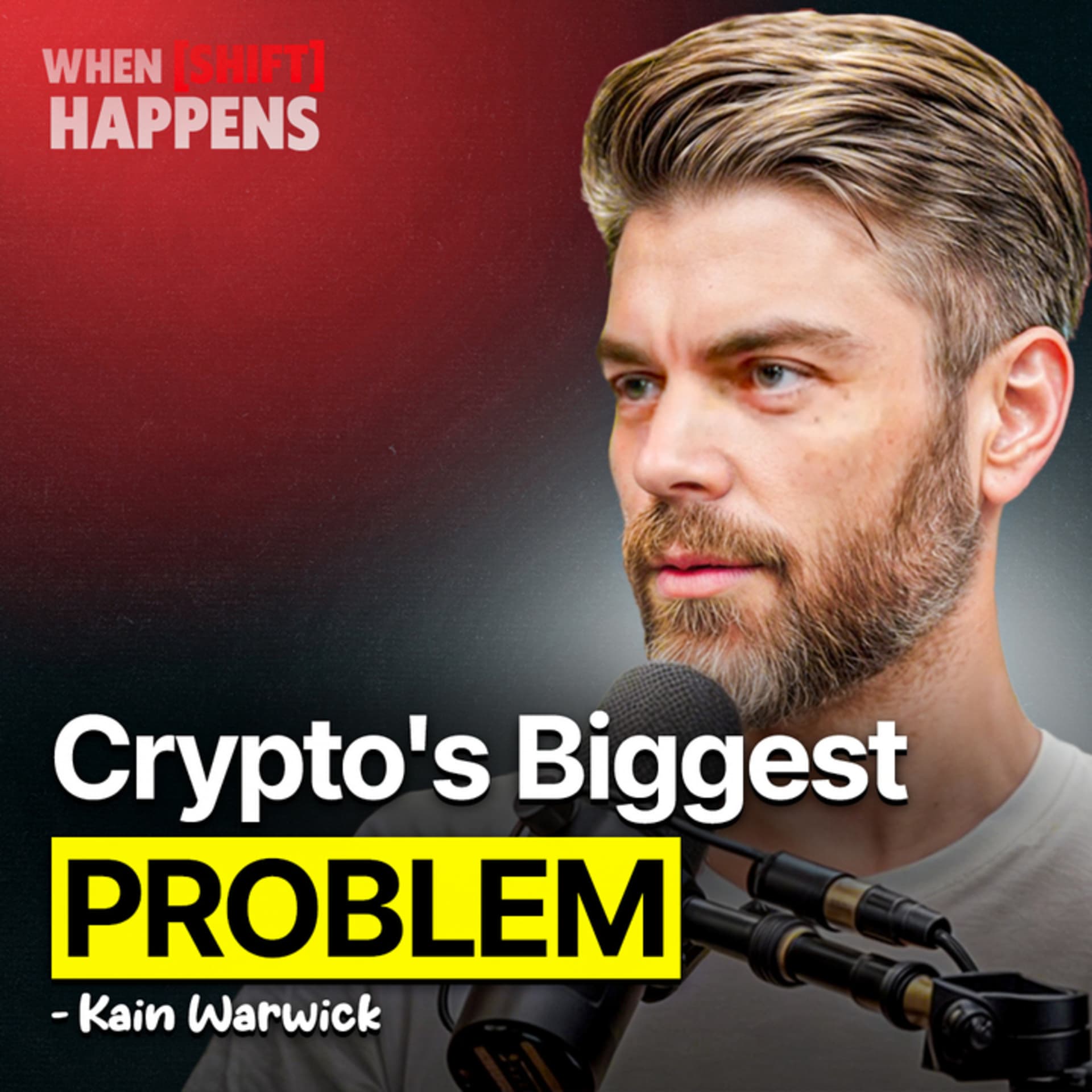

In short
When Shift Happens Podcast - Episode E106: Infinex Founder: Why Crypto Is BROKEN in 2025 (beware of this)
Podcast Overview
- Host: Kevin
- Guest: Kain Warwick, co-founder and former CEO of Synthetix, currently building Infinex.
- Theme: The episode discusses the structural problems within the crypto industry, personal struggles with addiction, and the potential future of crypto.
Key Themes & Discussions
Personal Background of Kain Warwick
- Kain shares his journey from Synthetix to Infinex.
- Overcame personal struggles with addiction.
- Importance of being present with family after recovery.
- Now travels with family, emphasizing the value of togetherness.
Structural Problems in Crypto
- DeFi's Broken Incentives: Kain argues that the current incentives within DeFi do not encourage widespread adoption and often lead to only enthusiasts using the platforms.
- Market Structure Issues: The crypto market is described as "broken," with an emphasis on inadequate equilibrium that prevents innovation and growth.
- Celebrity Coins and Clout Chasing: Discussion on the rise of celebrity coins and the implications of clout in crypto.
Fixing Crypto's Problems
- Kain believes that Infinex aims to address these issues and is designed for mass adoption by making crypto accessible to non-enthusiasts.
- Token vs. Tokenless Protocols: The conversation contrasts traditional token-based systems with potential new structures like Infinex that aim to be more user-friendly.
Kain's Predictions for the Future
- He predicts a turbulent period for crypto in the next 12 months, driven by macroeconomic factors and regulatory environments.
- Concerns about governing bodies that may seek to undermine financial freedom through oppressive policies.
Important Takeaways
- Entrepreneurial Traits: Successful crypto founders often share common personality traits, including resilience and the ability to question assumptions.
- Addiction and Recovery: Kain discusses the dual struggle of managing addiction while building businesses, emphasizing that recovery led to greater self-awareness and empathy.
- Community and Education: The need for better education on crypto regulations and the importance of community to enhance understanding and trust in DeFi.
Conclusion Kain's commitment to improving the crypto landscape through Infinex is anchored in his personal journey and a desire to rectify past mistakes in the industry. He expresses hope for a future where crypto technology fosters financial freedom rather than oppression.
---
Episode Details
- Trailer Start: 0:00
- Partnerships Mention: 1:31
- Introduction of Kain Warwick: 5:56
- Discussion on DeFi and Crypto Market: 52:43
- Concluding Remarks: 1:39:03
---
Follow Kain Warwick
- Twitter: [Kain Warwick](https://x.com/kaiynne)
- Infinex App: [Infinex App](https://x.com/infinex_app)
- Website: [Infinex](https://infinex.xyz/)
Follow Kevin & When Shift Happens
- Twitter: [KevinWSHPod](https://x.com/KevinWSHPod)
- Instagram: [KevinWShPod](https://www.instagram.com/kevinwshpod/)
- Website: [When Shift Happens](https://www.podpage.com/when-shift-happens/)
Written by AI. May contain mistakes. Listen to the episode to check what was said.
Transcript
Automatic transcript. May contain errors.0:00We spent so much time, so much blood, sweat and tears building all of this stuff. It's deeply unsatisfying to me that it's not being used. We just got stuck with the wrong incentives pushing in the wrong direction. And my intent is to just grind my way through them. Kane Warren, co-founder and CEO of Infinix, the crypto everything app. Your one-stop shop to store, use and trade over 1 ,000 crypto assets. Across any chain with just a few clicks. I'm someone who helped to create a lot of the dumb ideas that are keeping us trapped. If you've been thinking the world is flat, then one day you wake up and you see a satellite and you're like, wait a second.
0:35You're like, oh shit, everything that I thought was wrong. But I certainly feel I have an obligation to fix my mistake. Is Infinex your answer to the disaster that happened two years ago? Absolutely. What is Infinex? Infinex is a better way to do crypto. Do you think the people who blew up last cycle are coming back? I think, you know, drug use for me was numbing. I didn't have coping mechanisms to deal with my emotions. People would ask me sometimes, they're like, you have been literally on drugs for 36 hours straight. And you did that for decades, but you managed to build businesses. Yeah. Where do you find your happiness now that this is over?
1:10I am happy when I'm occupied. When I have a hard thing to do, it's deeply satisfying to me. You need to feel like you're being productive and working towards a goal, otherwise you feel useless, meaningless. And when you lose drive as an entrepreneur, it's a pain in the end, right? Of course. And I think one of the things that caused me to lose motivation in synthetics is...
1:54This conversation is supported by Jupiter, the most used decentralized trading platform on Solana and the largest DAO in the world. Sui, a scalable layer one blockchain that's fast, secure and affordable, built by previous Facebook developers and that delivers the benefits of Web3 with the ease of Web2. And Mantle, an Ethereum layer two that built two products I particularly like. FBTC, which enables you to borrow and lend Bitcoin in DeFi and METH or METH. One of the largest ETH liquid-staking protocols that, by the way, just launched its token called Cook. So you came here with your entire family?
2:32Yeah, yeah. I travel with my family now. Always? Always, yeah. When did you make this change? We started, I started traveling with my wife probably two years ago. I think when I got sober, especially early on, I didn't travel at all. So I took, I think, almost a year off from traveling. But if I had to travel for some reason, then I traveled with her because I didn't trust myself. I didn't trust myself to go off on a bender somewhere. Couldn't balance. Yeah, yeah. And now, the last time that I traveled without my family was actually Brussels, which was a last-minute trip. Um, and before that, we'd, you know, really tried to travel together all the time.
3:23Um, and, you know, I said, look, uh, you know, it's a short trip. It's a long way going to Europe. It's going to be four days. Um, and my wife sort of made the call. She was like, look, I don't think it makes sense to bring the kids. So I left, I get to Brussels, um, and she was talking to the kids and, and they were like, we would have preferred to go, you know, they're seven and five. Right. but they're very, very strong opinions, particularly about NFTs. And, and, you know, my daughter was like, you should have asked us, you know, we would have said we're happy to go. And they're really good travelers.
3:57So it would have been fine. Anyway. So after that, on top of that, I get to Brussels and there's chocolate everywhere. And my wife loves chocolate and there's waffles everywhere. And my daughter loves waffles. And I was like, I made a huge mistake. Like, I should have just brought these guys with me. Anyway, so after that, when I got home, the kids did really miss me. I hadn't been away from them for such a long time. And so we just made a call. We're like, okay, it's all future travel. We travel together. What is your mission? It's a good question. My mission today is to fix... Fix is not even the right word.
4:39to take DeFi and on-chain platforms to the next level? Why? It's a good question. I feel like there's a personal reason. The personal reason is that we spent so much time, so much blood, sweat, and tears building all of this stuff. It's deeply unsatisfying to me that it's not being used. It's only being used by enthusiasts. It's amazing technology, and it would be very sad if it was stuck in this little bubble of enthusiasts and didn't get out to the wider world and have a larger impact. I think that crypto is an enabling technology and that enabling technologies need mass adoption to really change things and to really have the impact that they can.
5:27And we got stuck somewhere in DeFi, right? We just got stuck with the wrong incentives, pushing in the wrong direction. And we weren't able to cross that chasm into the real world, into mainstream adoption. And so taking a break from DeFi and looking at it from first principles, I've kind of realized some of the issues. And my intent is to just grind my way through them. so you want to take defy to the next level and you think you're able to do it who are you i'm someone who helped to create a lot of the dumb ideas that are keeping us trapped right um i was a part of memeing into existence a lot of this dumb stuff right and so you know not only when it clicks into place for me and i realized oh that was actually really dumb right I know how we got there.
6:29If you've been thinking the world is flat, but not just walking around thinking the world is flat, but you were the one of the people that was out there measuring the sky and getting lasers and proving that the world was flat. And then one day you wake up and you see a satellite and you're like, wait a second. And you're like, oh shit, everything that I thought was wrong. A, you probably feel, and I certainly feel, you know like i have an obligation to fix my mistakes right and go out and tell people hey guys we got it wrong the world's not flat it's actually around and here's why um and so you know i i feel obligated to do that um but i also feel like i'm in a fairly privileged position having been deep in the insanity of defy that i can think my way through how to communicate this in a different way to to break out of this uh this little bubble that we've creative ourselves.
7:21That's interesting. Because if I tell people, hey, Kane came on the podcast, they would say, oh man, he's one of the most successful founders in the space. But you just told me that you invented a lot of these dumb ideas. Does that mean that you don't consider yourself successful? I consider myself successful in stage one, right? And I didn't realize that there was a stage two. I've talked about this before. And it's funny, I need to almost go back and listen to some of my other podcasts because there was a moment in time, I feel like in after DeFi summer, where I started to have this epiphany and it never really crystallized.
8:09Like I started to realize something was wrong. And for whatever reason, I, I, you know, either rejected it or didn't pursue it. I didn't, I didn't keep picking at it until I understood what was wrong, but I knew that something was wrong. Um, I knew that we were pursuing a strategy that was off somehow. I just couldn't quite see through it. Um, you know, maybe it was a life drug use or something and too much partying, right? But I couldn't cut my way through it. And having taken a break, I feel like I can see through it. And here's the thing. It's not that bootstrapping something and getting it from nothing to, you know, zero to one, right, is not valuable.
8:55And sometimes it has to happen. Like it actually has to happen that way. There's a path dependency to it, right? You need to go for enthusiasts first and you need to build things that are directionally wrong. Otherwise, if we had started with crypto and Ethereum launches in 2015, we build the first smart contracts and they're for mass adoption, it doesn't work. Webvan didn't work in the 90s because you didn't have all the infrastructure around it, right? You need mobile phones. There's things that were missing, there's infrastructure that was missing. And so that mass adoption didn't work, right?
9:29But other things did. other things on the internet did. And so there is some element of path dependency, I think, to this process where you need to address the audience that exists at the time. And we've addressed that audience. The problem is we've been addressing that audience over and over and over because of bad incentives for the last two years. You know, Dijan Spartan's prophecy of like the three-year DeFi bear market, he was right. He saw this. He saw this. He was like, you guys are idiots and this is just a giant circle jerk and you're not going to go anywhere. And we were like, I think we know what we're doing, right?
10:08But we actually didn't and we got stuck. Dear When Shift Happens family, the following message is probably the single most important thing you should take away from today's podcast. If you're serious about your crypto investing journey, please take some time to learn how to self-custody your assets to make sure that nobody can take your coins away, ever. If you don't learn how to be your own bank, it is very likely that one day you will lose all your hard-earned crypto. The safest way to hold your crypto is in a cold storage that we also call hardware wallet. Hardware wallets are not complicated and they give you peace of mind.
10:41I personally use a hardware wallet called Treasure. It is open source, very easy to use, and the first hardware wallet created ever. As we like to say it in crypto, not your keys, not your coin. You can order your treasure wallet with a 10 % discount by following the link in the description down below and by using the promo code WSH10. And now back to the episode. You talked about the wrong kind of incentive, right? It's almost a sort of political problem. If I think about a big organization, crypto or non-crypto, you have the kind of employees, right? who will accept maybe the founder CEO, obviously, but the employees will think about themselves first instead of the big picture.
11:24And in crypto, it's the same, right? So one of the reasons before you said, I don't really know why I didn't really want to see the reality is probably because we are all, I mean, there is this incentive of thinking for yourself first because it works better, right? Of course. Instead of the big picture. Yeah. And so, and then the problem is, quite a few of the founders who think for themselves and make a lot of money don't even have the incentive anymore to come back and do the hard work. Yeah. You see through it, but you have both means and opportunity, but maybe not the motive, right? And so a lot of people have asked me, why am I doing this again?
12:07That's my next question. What is it that motivates you? But before I get into that, and maybe this is going to go too philosophical, so you can cut this out, right? We're getting philosophical in this podcast a lot. Okay. So this is a very existential thing to think about, right? But I think about this a lot. Let's imagine that humans are the only sentient species in the universe, right? Which I don't agree with, but let's imagine for a second that that is the case, right? We're the first, maybe, and only, right? For whatever reason, we're early. We made it through some great filter or multiple great filters, and we're here today and we're sentient, right?
12:45Maybe we kill ourselves, but maybe we don't. If we don't kill ourselves, right, and we somehow in 50 years, 100 years, achieve immortality, and we are able to live forever, right? There were billions upon billions of people that through sheer luck died. and then some generation reaches escape velocity, right? Now, there's an argument that like, that's tragic. Like that's deeply tragic, right? But it's the only way. You can't, people have to be sort of sacrificed to this path. Now, you might say that immortality is not something to strive for or whatever. Regardless, if that's the direction we're going, right?
13:32We will get to a point where we've achieved the ability to stave off death indefinitely, but at the cost of billions upon billions of people. And I think that there are a lot of things in life that are like that. I mean, that's a very deeply existential one. But there's technologies where a lot of people needed to go through a lot of rug pulls to get us out of this gravity well of DeFi. A lot of bad shit had to happen. A lot of hacks had to happen. Think about all the people that have been killed by the DPRK, right? And, you know, like total protocols blown up, all of this stuff, right? That's inevitable.
14:13There's no way to get to critical mass of DeFi until you go through that, right? And it sucks that some people have to suffer, but you wouldn't say it's not worth doing. You wouldn't say, you know, the future, the post-hacks, post-chaotic early period of DeFi, the bootstrapping phase of DeFi, in its own way is beautiful, right? You get through that and then you reach mass adoption and it all works. You wouldn't, you sort of throw it all away for having gone through that period, even though that period was dark, right? And I think that that's the case for a lot of things. There's always a dark period at the start of something where there's a lot of pain and suffering.
14:52You're crawling over broken glass to get out of this gravity well, and then you reach escape velocity and, you know, things get better, or maybe you go into another phase, right? And it's another, you know, it's a different form of crawling over broken glass. Talking about the hurt people, I mean, I think if you've been in space for a couple of years, I think everyone's got hurt quite a bit, right? I was definitely one of those who got really hurt by the DeFi. I mean, I had Dokun on the podcast. I was a big Luna bull and I watched several million dollars turn into five dollars in two days, two years and a half ago.
15:30But still here. So you're here to watch you bring us to the next level. Yeah, yeah. I mean, you know, it's tough, right? Like everyone, you know, I've had some crazy, crazy things. I've managed to avoid major hacks through a bit of luck. Probably a little bit of rotating very quickly out of things, you know, going into a farm or some protocol and pulling it out. Most of the time I just sat in ETH. And so I didn't have a need to be sitting in ETH inside. you know, some weird farm. Um, again, a lot of luck, I think, um, in that I've had some self-imposed dumb things that I've done. Um, you know, but yeah, I've, I've missed, I missed a lot of that stuff.
16:13It's funny. Um, I was talking to someone about this, uh, this week. Um, sometimes, you know, too much, uh, you know, so I faded wifi, um, because in the old days there were, you know, there was a cabal, right? For sure. Um, and we knew everyone's addresses right there were there were people i won't name them right who knew everyone's address because you couldn't hide back then there's no tornado cache there's no way we knew through triangulation let's call it right what everyone was doing in the space every major person we knew what their hidden wallets were their second hidden wallet the one that they didn't think anyone knew about um and there were a group of us and so you know wi-fi faded i was like i'm not gonna farm that because there's people that are farming and dumping and I think they're just going to dump it into oblivion.
17:02But at the same time, you know, so I faded that and got my face ripped off, right? I think I FOMO'd in at like 20K or 30K or something like that. Maybe even higher, it could have been 50K. But at the same time, it helped me to avoid some bad stuff. So, you know, pluses and minuses. Yeah, absolutely. So you have this huge fire in the belly. I recorded a conversation with Kia Wang from AllianceDAO a couple of weeks ago. He told me that he's looking for two main threats to discover the crypto founders of tomorrow. The first one is a high degree of autism because it helps you think independently. The second one is some sort of childhood trauma because it gives you a chip on the shoulder, makes you want to prove something.
17:51Can you relate to one or both of these traits? It's funny.
17:59There's lots of different types of autism, I think. Autism spectrum disorder manifests in many different ways. It's not a, I wouldn't say, a homogenous group of people. There's certain traits that are obvious, that are more classical, let's say, autistic traits. um and so i've got uh a couple of people in in our team um you know who and i joke about weaponized autism sometimes right and um they're like yeah i'm not 100 sure that you're autistic right and i'm like sure um but uh but it's funny i did um uh genetic testing uh about a year ago um and And, you know, obviously, like, I studied genetics for a while before I dropped out of university, right?
18:43So I don't profess to be an expert. But one of the interesting things is, you know, this sort of correlation, right? Like there's, you know, clusters of genes and, you know, they do different tests, measurements, etc. And it's like, you know, there's no guarantee that your genes will express in a certain way, right? But, you know, they might have eight gene sites, right? And so they'll look at the number of those gene sites that correlate with something. and they'll be like, okay, you're in the 0th percentile or 100th percentile in terms of, you know, number of sites that, and there's three different autism spectrum clusters that they test.
19:18And I was in the 100th percentile for all of them. Now, the funny thing is, right, like you could easily talk to me and be like, oh, he seems personable, whatever, like, you know, he seems like a normal guy. I mean, I don't know if you'd say normal, right? I seem like a bit of a lunatic, But I think what's funny is that childhood trauma, right, the second of the two things that you asked about, can also express itself in many different ways, right? So I have four brothers in my family, and we had a very chaotic upbringing, to say the least, right? And all four of us are very different in our own ways, right?
20:04handle trauma in different ways, cope with trauma in different ways. And so I think one of the things that I learned when I was growing up, especially, you know, we traveled a lot because my dad was a tennis player. So I was always in different environments, right? And I learned early on to sort of mimic my environment, right? And learned how to, I guess, maybe fly under the radar a little bit, right? And so I think that one of the things that it's why I'm a fairly good salesperson as well. You know, when I first started doing sales when I was like 18, I was on a computer floor. And I remember the managers at the time were like, oh, you're actually pretty good at selling things.
20:46And I think one of the reasons for that is I was able to kind of through brute force sort of mirror the other person and like work out. And it was only later as I was reading like sales tactics and things that I realized some of the things I did naturally. And I think one of the reasons for that is if you're in a chaotic environment, you want to control your environment. And so one of the ways you control your environment is you need to be hypervigilant to what the people around you are doing. right um and that hyper vigilance can manifest in different ways but for me it manifests in like being very careful to mirror and be aware of the emotional and mental state of the person around me which can come across as like natural but it's very much brute force um the the way that i do it would you say that you're a sort of chameleon like yeah just to the i can adjust There's a situation.
21:42Yeah. Now, you know, there's ways that you could say like, okay, that's, you know, like, there's the dark triad of traits, right? And, you know, people who are chameleon-like can do it in different ways. Like sometimes it's very, in a very psychopathic way, right? For me, I've always found it easy to find some element of a person or an interest that they have that's interesting to me. I'll find some shared thing, right? Curiosity, right? Yeah, a little bit of curiosity. Like, okay, this person cares about this particular thing, and I'll find that thing and zero in on it. And that kind of helps to build rapport.
22:24If you have a genuine interest in something, you know, if you're interested, you know, my wife loves horse riding, right? I'm not really interested in horse riding. My grandfather was a racehorse trainer, right? So I know about horses, but I'm not really interested in it, but I can find something, right? But, you know, she would say, I don't show enough interest in horses for her liking, but, you know, I can find something, but I'll be able to usually find something that I'm curious about, that someone else is curious about to create some kind of shared interest, because I'm curious about a lot of things.
22:56And so, you know, I think, again, that is also something that is like a trained trait in myself that I've like trained over time. Because again, being in control of one's environment, if you are in a chaotic environment, is incredibly important. It's an existential thing. You do not want your environment to be out of control. You want to have as much control of your environment as possible. so your dad was a tennis player your wife loves horse riding and you're deep into free diving yeah why so i grew up as a swimmer um not as a tennis player my first uh sort of 10 years of sport um were really focused on swimming um i love the water uh you know i grew up in florida we were in the pool all the time.
23:49And so I love the water. I love being underwater. I feel very comfortable in the water. I love the ocean. Uh, and so, you know, I always loved, uh, doing underwater swimming, um, you know, in a pool, like underwater as many laps as possible. Um, and you know, I learned different to take meeks, et cetera. And I knew about freediving, but I'd never done it before. Um, and I went to Mexico a few years ago and there's an Aussie guy who's a free diving structure that dives in the cenotes. And so, uh, somehow, um, someone that I was with was like, let's go do it. Um, you know, we should, we should go and do this.
24:25It's a really cool experience. Like you haven't seen the cenotes, like I'm doing it. And so I was like, all right, it's my first time. Um, and I just fell in love with it. I, I, I love it was, you know, everything that I love. Right. Um, plus there's an edge to it as well. Right. You know, you dive 40 meters down and you got to get back up. Um, so there's a, there's a level of discipline that's required and, and, you know, control of your body and mind that is very important in freediving. What happens in your body and mind when you're 40 meter underwater? I mean, oxygen. I think, I think a couple of things happen.
25:03Um, there's a high, at least for me, this is, this is my experience of free diving is there's a fairly high variance of the experience in terms of how much, how stressful it is. Um, there are dives, which are zero stress, just so smooth. You know, I'll be, I hit free fall at 20 meters, let's call it. Right. And I just feel really good. My body feels good. I feel relaxed. Um, everything's going smoothly. Um, and you know, you hit the bottom turn around come back up it's all good um doesn't require much uh sort of control or or you know control of my mind right it's very smooth dive then there's dives where i'm like okay i push this a little bit hard right and on the way back up like that it takes a bit of willpower to keep myself calm there's there's a little bit of control that's required and so different dives have different experiences and there's a little bit of thrill in that as well where I'm like, okay, I push this.
26:03I push this a little bit. What's the difference between a stressful and a non-stressful? Where does the stress come from? For someone who loves to control the environment. Yeah, I think the stress comes from probably being a little bit out of control, right? You know, and I've never blacked out. I think I will eventually, all free divers do, right? You push enough and eventually I will black out. I've been close a couple of times, but I've never pushed myself far enough to black out. I've got a pretty good breath hold. Luckily, my breath hold is better than my diving technique. So there's sort of two components.
26:39You need a long breath hold but you also need very good equalization especially when you get very deep. You've got a tiny little pocket of air to equalize your ears and so you need very good technique with like where your tongue placement is and it's a lot of focus. There's a lot of things happening. It seems like there's not much but there's a lot of things happening and so you need... I need to keep, as I'm diving, I need to keep my mind on my technique and on the right thing at the right moment. Not to think too far ahead to the turn, not to forget about something. And so there's a lot going on.
27:15And again, you know, if I get out of sequence or distracted, which can happen, then the dive can become a bit harder. You said every pre-diver backs out. Yeah. What happens if you black out? What will happen when? The day you black out? The day I black out, yeah. I mean, sorry, I shouldn't say every freediver blacks out. Like, I think probably every elite freediver blacks out, right? And, you know, I wouldn't say I'm an elite freediver, but I'm getting close to the edge. Like, 50 meters is, like, you know, probably the edge, I would say, of elite freediving, right? In terms of, you know, what you would compare to, like, a runner or something like that, right?
Read the full transcript
27:55Like, very few people are at that level. It takes years of training to get to that level. So, you know, if I went for a 50 meter dive today, I probably wouldn't black out, but it would also be hard for me to get that deep because of equalization. If I went for a 50 meter dive and I messed it up and that can happen and I got to the bottom and I was too slow or I was out of sequence and I had lost some air or, you know, you push air out and lost some air into my mask or something like that. and I've got to come up 50 meters and I push too long, then usually you get to about 10 meters. This is what typically happens.
28:36The diver will get to about 10 meters and it's a shallow water blackout. So you're just hypoxic and your brain shuts off. You don't die straight away. You've got people that are there, they bring you to the surface, they blow in your face, try and wake you up, and then you wake up. You hope. You said try. Try to wake you up. You hope. Yeah. You have a wife and how many kids? Two kids, yeah. So let me ask you, does it make sense? It's a good question. The reason I'm asking that is, and then your answer obviously, is because I want to get to a topic that you told me. you question key assumptions very often, right?
29:29You lock in some period of time in the morning to throw out all your main assumptions. So the first one I'm going to ask you is that, right? If you're single, I mean, you have probably parents and the family, right? Yeah. It's bad. I would say it's kind of less bad, but it's still not great. But now you have a wife and two kids that you even take everywhere on traveling with you, right? Yeah. So does it make sense? Does it make sense to free dive? I think the, and again, I couldn't give you the exact statistics, right? Like I'm fairly sure of this, at least the most recent stats that I've seen.
30:12No divers ever died in a competition because you've got safety divers around. You know, lots of free divers have died. They typically die in training due to an accident or something that happens in training or they're training someone and something goes wrong. So, you know, there are many free divers who have died either, you know, doing some dive where they were safe doing. But in a competition, when, you know, there's trained divers around, it's fairly safe activity. And again, you know, I've done hundreds of dives and I haven't blacked out. Um, that's why I say it's probably inevitable that I will, if I keep pushing.
30:52Um, I think today with my breath hold, it's probably somewhere around 60 meters. It's a question of whether I can get to 60 meters, you know, cause the, the technique that you need from an equalization perspective to get down that deep is very hard to master. And so I might not be able to get to 60 meters, in which case my breath hold will always be enough, but maybe you have a bad day, you know, maybe I have a bad day one time. And so, um, but my view on risk is it's hard to draw a clear, I mean, you know, probably riskier, honestly, uh, than, than blacking out, um, is, you know, uh, having a shark just take you or something.
31:33right um you know uh i was diving in fiji uh about six months ago and there's two meter gray reef shark that was very interested in what we were doing um and i got to about 35 meters and it went straight for like coming straight at me like not not to bite me necessarily but like i think you see a shark and it's like a dog you see a happy dog and you see a happy shark is chill just swimming around the difference between a happy dog and an angry dog you couldn't tell very easily um and i could tell this was an angry shark i was not happy about where where i was um and uh and so i boarded the dive and i came back up and i was like okay that's the only time i've ever been in the water with a shark and i've been you know around a lot of sharks where i was like this thing is like gonna bite me like i was like it was pretty crazy um and so uh so i we swam back up and, uh, and we moved about 200 meters away and it followed us.
32:31And I was like, all right, I'm done. Like, I'm not going to keep diving with this thing. It just, you know, it's really, and that area, they do a lot of spearfishing and, you know, the sharks obviously, you know, thought we were spearfishing and thought I'd fish. It was, you know, it was like, Hey, I want to eat something. Um, and, uh, anyway, so we started pulling the rope up and, um, the instructor I was with started pulling the rope up and the shark followed the rope all the way up to about a meter. And he was like, that's it. I'm out of here. And he was a Fijian guy and he's like super chill about the water.
33:00And he was like, no, this shark's crazy. I'm getting out of here. Um, so, uh, you know, like something like that could happen. Um, you know, you get caught in a current or whatever. I was diving, um, uh, that same week and there was a crazy current that just came through and I was, I was, um, uh, attached to the rope, um, but the rope went sideways and I was like 25 meters down and you know, you could get swept off and lose your bearings or whatever. So it's not, it's not the safest sport in the world. Um, it's funny before we had kids, my wife and I, um, both went, uh, skydiving and we were sort of like, we'll do skydiving before we have kids and then we're done.
33:40Like I think since, yeah, yeah, do it and get it done. Yeah, exactly. Yeah. So I don't know. I don't know. Um, you know, I don't know. I don't know what my kids would say, if they had a if they had a choice in the matter if they would prefer me not to free dive if they free dive with me in my pool my daughter is a very good free diver she can do like 30 meters underwater not deep but sideways let's get back to this question of assumption right because it's so interesting sure you told me whatever feels the most obvious assumption is the best candidate to ask is this still a good idea? Why do you do this?
34:25I think the most obvious thing, the most consensus thing, is the most dangerous, typically. That's my experience. Because a thing that hasn't been questioned that has really crystallized and become deeply embedded in your thinking and your model of the world, if it's even slightly off, there's a lot of things attached to that. And if it's wrong, bad shit's going to happen. And so trying to identify that thing, and most of the time it's like, no, no, it's fine. It's actually okay, right? Like, the world's round. It's okay. But if the world weren't round, if like if legit the world were flat right um we would have be having a bad time right now like if we would need to make some big changes to how we do things right um and so you know the deeper some belief or thought process or model is embedded in your mental model of the world um uh i think you know that's the the candidate that makes sense to question and again you might cycle through, you know, in the morning when I do this exercise, I might cycle through 20 things.
35:46It's like, yep, fine, fine. World's still around. It's all good. You know? Um, but then I'll hit something that I'm like, huh, I haven't thought of that for a while. Just some node in my mental model of the world. And I'll be like, I wonder why I haven't thought about that for a while. And typically it's because it's so deeply embedded that didn't even occur to me that that could be not valid right like and so um i'll find myself going huh and then there's a little spike where i'm like interesting okay like why why haven't i thought about that you know in this exercise as i've been trying to invalidate assumptions like why hasn't that popped up for a while what's what's that attached to that's causing it to not pop up on my radar for scrutiny right um and Do you have an example?
36:35The last time you felt like that? I don't have an example of the last time, but I have an example of one of the most important times. One of the most important times was in the Haven days when I was trying to work out how we got people to do what we wanted them to do. I was trying to work out, like, what is the incentive to get people to do this thing, this activity, right? Right. Tokens are a coordination game. It's why they're so powerful. It's why I think projects that don't have tokens really struggle in a token filled world. Right. You know, there was a time in the past where there weren't many tokens and the tokens that arose were able to very rapidly gain attention and market share and, you know, drive growth in a way that tokenless projects weren't.
37:22Now we live in a token filled world. There's many tokens and the token noise floor is really high. But back then it was like, okay, you know, we have a token. We're trying to incentivize people to do the thing by holding the token. That's very passive, just holding the token. Like you don't have to do anything. You just hold it and you hope that something happens in the future. We're not really getting that flywheel going. And so I was like, there's something to that. And I was like trying to tease it out. And I'm like, well, you know, we sold all the tokens. We got some tokens in the treasury, but we need those for future, you know uh funding or whatever like this everyone's got the tokens they're distributed it's done and i was like that's not a satisfying answer like there's something else here and i kept digging and digging digging i was like wait a second who's to say that we should have a finite number of tokens who's to say there should be a fixed supply right and i thought more about and I was like, why do we even have fixed supply tokens?
38:25What is driving that? And I think the answer, especially in the early days, is it was the ERC-20 default. One of the first things it says to you if you go to start an ERC-20 is what's the total supply? And it's a fixed number. You got to put it in. You got to know it's 10 or it's a thousand or billion or 10 billion, right? But it's fixed. And so there was this idea, well, you know, the benefit of tokens, so they're non-inflationary, right? And this comes from like Bitcoin maximalism. Absolutely, yeah. 21 million, right? The meme of 21 million is a powerful meme. So it was like, okay, we've got 21 million Bitcoins and there never can be more, right?
39:07The interesting thing about that, and this is when I started digging into it, is there's actually always more. There's the block reward. There's actually not 21 million Bitcoins in the world, right? I don't know what the number is today. It's 17 million or something like that, 18 million. That's actually funny. haven't thought about that in a while, but there's some number of millions of Bitcoin actually in the world. And then there's the potential Bitcoins, but it tapers off to zero. Eventually the block rewards end in whenever it is 2120 or something like that. Then we got to live on the network, you know, on the fees.
39:40Right. But there's this kind of inflation. Right. And as I started digging into it, I'm like, this is dumb. ERC20 is being fixed supply is dumb. that the idea that you mint all the tokens, send them out into the world. And I was like, we have a thing that we need people to do. What if we make more tokens and pay them the tokens? Because at the end of the day, however many tokens you have, the ownership of the network is fixed. You can only own 100 % of the network. That is a mathematical constraint, right? Everything else is some kind of numbers game, right? And so if we have 100 tokens and you have 50 and I have 50, and we're sort of sitting there looking at each other being like, who's going to do this thing, right?
40:20And it's neither of us. We've got a problem, right? But if all of a sudden we say, hey, let's print another 100 tokens and now we put them on the table and now they're up for grabs and we're going to play a game, right? And whoever plays the game better gets those other 100 tokens. And now you play the game better and you got 150 tokens and I got 50. That's good. That's good for the network. The better player has the tokens. They're going to keep playing the game. And all of a sudden we've got this loop And it's like, wait a second, let's just make more tokens and pay them to the holders. We all own the network.
40:52It doesn't hurt us. We're paying the tokens to the people who are doing the better thing, the good thing. And so we created this hyperinflationary token, which kicked off this renaissance of yield farming, token incentives and all kinds of crazy stuff. and a lot of that came from live peer it came from bitcoin it came from even uh at the time um uh people forget about this exchange um it was like uh f coin um uh that was doing um transaction mining right um uh which you know transaction mining was just wash trading basically right you just wash trade um and so you know there were all these little dots of stuff that was around And as I was questioning this assumption of fixed supply, those dots were pinging off in the world.
41:42And I was like, I've got to connect these somehow. But there was something that was unsatisfying about that answer of like, it's just that many tokens. And that's what we do and move on with your life. Right. And I could have easily and I did many days, I'm sure go. It's fine. We have 100 million tokens. But that process of questioning assumptions and digging in and digging in and keeping returning to the same question, even though it's painful, the more entrenched the idea is, the deeper it is. Oftentimes, if you shift it a little bit, a lot of stuff unlocks. You said protocols or companies that don't have a token are struggling?
42:23I think they can struggle. They can struggle for attention. Because I had Jesse Pollack on this podcast. And I asked him, basically, the three protocols that have the most mindshare and make the most money. Pumpfun, Polymarket, Bayes. Don't have a token. Yep. and I ask him, do you think this is a coincidence? And then he said no and he explained why. What's your thoughts on that? I think it's sort of, let's call it adverse selection, right? And what I mean by that is things will these days launch tokens late, right? And so if you have new things, let's say there's 100 new things, there's a little bit of selection bias or survivorship bias.
43:34If we're looking at the three successful ones, there were 100 things that were tokenless, and we've got the three successful tokenless ones that most likely will all launch tokens. right um but the other 97 that are languishing in obscurity or have died or whatever right um uh some of those probably could have been successful with the token right so i think those are maybe the exceptions to that um but also and i think this is important um there is an expectation of future tokens, right, from base and pump fun and, you know, whatever, right, that that drives the awareness. But, but the reason why I say these are the exceptions is each of them for their own reasons are independently successful, we're able to be so successful that they're unavoidable, right?
44:28Pump fun, you know, captured so much mindshare, right? Whether you like the mechanism or not, it was an incredibly powerful loop that worked even without token incentives. Now, there's an argument of it works without token incentives because it is a giant token incentive factory, right? It just prints more tokens every day. So this is, you know, they each have their own idiosyncratic reasons why they didn't need a token necessarily, right? Like PumpFun is just infinite token printing constantly, right? So that one, I think you can say, okay, A, there's an expectation of future tokens, but there's also the fact that it is constant token generation.
45:06Polymarket is an exception in the sense that I think everyone has known that prediction markets are one of the most powerful use cases of crypto, right? And Polymarket and Shane in particular, you know, who I know very well. Um, and, and I've talked to him a lot about this. He's someone with like ultra high conviction, his conviction never wavered, right? There were moments where like 99.9 % of founders would have just been like, put a bullet in my head, like end the pain, right? This guy just kept crawling over broken glass. And of course there were moments where he was probably pissed at the world, right?
45:52Um, you know, like why is, why does this need to be so hard? Right. Um, but he never stopped. He just kept grinding and kept grinding. And, you know, I think that there's probably, if you run a hundred simulations and they launch a token earlier, there's probably an argument for they would have gotten more attention and more traction, but it probably would have been worse for the protocol. And then base, I think is an exception because it's Coinbase. They have so much attention. They don't need a token. but even still even still balance of probabilities you're like come on the base token's gotta be coming right um you know and if they never launch a token well then we all look like idiots but i guarantee you there's a lot of people out there they're like all things being equal i think i'll go and use aerodrome instead of velodrome because like a base token probably right so so i think i think there's exceptions there's exceptions and reasons but if you are just a new protocol with that doesn't have Coinbase behind you or some cracked out founder that's like going to grind for infinity, right?
47:01Or, you know, you didn't stumble on this incredibly powerful incentive loop that PumpFun did. All things being equal, two protocols taking on the same market, one with a token, one without a token, the one with a token will find it easier to get early traction.
47:24What's your most contrarian crypto take today? There are a few.
47:34It's hard to have truly contrarian takes in crypto, I think, because there's always going to be 10 % of people that are also being contrarian. And, you know, so it feels like you're sort of in the 10th percentile and the other 90 % are over here, right? So it doesn't feel like there's really anything that's like ultra contrarian or like no one believes this, right? So, you know, some things that I think I would say I'm outside the majority on are probably like celebrity coins. I think celebrity coins, I think people, maybe to generalize this, right? I think people in crypto are so quick to cloud chase that if they feel like there's any opportunity to score points, they will do it, right?
48:25Particularly when they feel like there's someone in the majority, like a Vitalik, let's say, right? That they can simp for, where they're like, Vitalik doesn't like celebrity coins, I'm all in. I'm gonna start shouting from the rooftops how bad celebrities are. We should round them all up and shoot them, right? And I think that that, you know, then you've got people on the other side and, you know, again, you could argue that those people are financially motivated to say like celeb coins are good, right? But my view is it's an attention game. And so if someone has come in from another industry, a much more competitive industry most likely, right?
49:06If you're a musician and you've somehow reached escape velocity in the music industry, I'm sorry, you're going to run rings around a bunch of crypto bros. You just are, right? That industry is so much more competitive, so much more efficient. It is so hard to get cut through in the music industry. You know about it, right? Yeah, I know. And this isn't cope for me. I did okay, but at no point was I even close to getting a record deal or something. And we worked hard. So my success in the music industry versus my success in the crypto industry, very different outcomes. right? And, you know, maybe I'm just better at crypto than music, who knows, right?
49:51But maybe I'm better at music than crypto. That would be a dark sort of thought for crypto, right? That like, I couldn't succeed in music, but I came over here and I was like, ah, actually, this is much easier, right? And so, you know, my view is that someone who has managed to get cut through in an industry that is so hard to make it, right? That person knows how to get attention. And if they come over to crypto and they engage with it in good faith, and it's hard to tell straight away, right? It's going to take a bit of time. So you should probably have some reservations. Like don't, you know, bet your life on them, right?
50:29But don't shit on them either. Yeah, don't shit on them. Just give them a chance, yeah. Give them a chance. Why are you punishing someone for their success in other industries? That's fucked up. That makes no sense to me, right? Like at least be agnostic. Just because three other people in the previous week turned up and were grifters, if everyone who was a grifter was going to disqualify everyone in crypto from being allowed to do business, we'd be in a bad place, right? Like there are grifters in the world. If that disqualifies all crypto people because people are grifting in crypto, then shut the place down, right?
51:03So for me, it's like, you know, you can't judge one celebrity because some other celebrity is a piece of shit. That's not fair, right? You should let them, you know, approach things, you know, their own way. And again, you know, if they rug you, okay, fine. But like at the end of the day, the idea that no celebrity will ever pivot to crypto, right? Or no singer or no comedian, like get a comedian over here. Like get a good comedian to pivot to crypto. That is going to be fun. That person, like you think we're good at trolling? A good comedian is going to absolutely rip our faces off when it comes to trolling on crypto Twitter, right?
51:44So there are people I think that are very good at getting attention, very funny, whatever. Like the first crypto comedian pivot, I'm there for it, right? That person is going to crush. I'm buying that person's meme coin all day long, like all day. So, you know, I just think you need to take it on its merits. And at the end of the day, people who are good at the attention game are going to be good in crypto or music or sports or whatever it is, right? And, you know, people who are clout chasing, trying to simp for, you know, Vitalik or whoever is anti, you know, celeb coins or whatever. They're just trying to score points.
52:21So you have to just ignore it, right? And be like, eh, that's not a valid opinion in my mind, right? Like you're just clout chasing. Vitalik's opinion, I take seriously. I think he's wrong, right? He's not clout chasing. There's no one he's simping for. He just doesn't like them, right? I just think he's wrong. It's okay. Vitalik can be wrong sometimes.
52:43Something else that's really wrong. according to you, but according to, I think now, the majority of the people in the space, is the market structure. Right, you said the market structure right now is broken and the incentives are fucked up. Why? We are in an inadequate equilibrium right now. And that's a specific phrase that was coined by um eliza yudkowski uh who you know people may or may not appreciate uh his ai takes but i think his rationalist takes are um quite valid and and you know he has um a book that he wrote called inadequate equilibria that talks about the fact that the world can somehow move itself into bad shape sometimes right through incentives right the incentive structure is wrong and you can get these very powerful equilibria that emerge.
53:46And if you find yourself in an equilibrium that is inadequate, it can be a prison. It's very hard to break out of it. The only way to break out of it is someone who has some significant power inside of this prison or outside of the prison who can come and shift the incentives, break the incentives. But the existing players cannot, definitionally cannot break the incentives. They're responding to the existing incentives and there's an incentive loop that's keeping them in this prison, right? And that's where we are today. So you have someone, and I'm going to stop using this example and find a different example, but you have projects, good projects,
54:34Eigenlayer, let's say, right? Um, you know, they invent some really cool meta, this points meta, right. Um, and they invent that meta because they're very smart people, right. And they're trying to find a way out of this equilibrium that we're stuck in and they know it's bad, right. But they also know that they only have a certain amount of power. Right. And this is, this is very insightful. And again, this is inferential for me. Like I haven't talked to them about this. I don't know how they exactly think about it. But whether they know it or not, I think that there is an awareness of the fact that the existing structure is broken, right?
55:11But they don't have a choice. They have to play a certain part in the game. And the part in the game that they play is their new infrastructure, which is novel and exciting. And the only way to raise for new novel infrastructure today, because of regulatory incentives and capital formation incentives and market structural incentives and founder incentives is you go out and do a seed round. You do it at a price that is very cheap, right? Relatively, right? And you do it at a price that if you're the good project, it's so cheap that it is impossible to say no to. Let's call it$50 million, right?
55:55And everyone who sees it goes, this is cool. We're not idiots. Like angels and VCs, we know a good project when we see it. Eigenlayer turns up and people go, this is a good project. But they have to raise it a 50 mil seat or 30 mil seat or whatever it is, or 100 mil seat. Something that is going to be orders of magnitude less than what the network value will be when it launches. And we know it. That is a positive EV bet all day long. Now, I'm not saying go out and spray and pray on every random project that crosses your desk. But if you have any kind of filter and any kind of deal flow, you see an eigenlayer and you go, okay, I'm going for that.
56:33I'm going to put as much as I can get into it. Here's the interesting thing, though. You can't get much. You can't get much because the price is too cheap at 50 mil. They're only raising 5 mil. There's$100 million worth of bids into that 5 mil. And so now it gets divvied up. And now that round's done. And then they go and do some stuff. People get more excited. And then they come back to the market six months later, maybe nine months later, and they say, hey, we're raising series A, right? This is not how the market is supposed to work. They still have all the money. They're fine. They didn't run out of money, right?
57:06But they're forced to come back to the market, right? And they had to wait longer because they can't go to the market step one and say, we're raising 200 out of 200 mil val because everyone will say no, right? Because they wanted it at the 50 mil val. It It doesn't matter how good the project is. They will say no. And the reason why they'll say no is because they can't allow that to happen. Now, in bull markets, bear markets, the number shifts, right? It might go from 10 mil to 100. You know, there was a project that raised a 320 mil seed round last cycle at the absolute picotop, right? So, you know, there's some range, right?
57:40But they have to do it at a price that's too cheap, right? They can't push it to 200. So now they come out, they do the series A. Okay, they raise 20 mil, let's say. maybe 30 right um now there's a bit more room and recent comes in paradigm framework electric multi-coin whoever they throw two three five million dollar check there's still only room for like four people right and then we're done so a couple of leads five million each a couple of million dollar checks some angels at 250 done right at that point there are probably more people inside the project, humans, right? That have exposure to that project than outside, right?
58:23You know, each of those funds have some LPs or whatever. Maybe they've got 10 LPs, 20 LPs each one. There's like a hundred people that have exposure to the project and it's raised 20,$30 million across two rounds, right? And now if you're lucky, they'll come six months later and do a pre-TGE, but maybe not. Maybe they just go bank straight to TGE, right? Okay, so what is the price of the TGE? 5 billion we've gone 3 orders of magnitude from where they were a year and a half before or whatever right there's 80 people in the world who got to participate in that price discovery the 3 orders of magnitude of price discovery from 50 mil to 5 billion right and we go sorry 2 orders of magnitude and we go 3 orders is when you go from 30 to 30 billion so we go 100x from in a year right and no one gets exposure to that and then everyone's got to buy it on market at a 5-10 billion FDB or whatever and then it's down only until everyone utterly capitulates and it finds a bottom sometime in the future right that is insane that is so broken, but the project cannot do anything about it.
59:46They cannot change it. They're trapped. And the VCs can't do anything about it either because if they tried to, there's a bunch of other VCs that will jump in and be like, Oh, come over here. Right. If they tried to convince the project to do it in some different way or whatever, and then you've got a regulatory overlay, which says, you know, you can only sell tokens to these 50 people in the world. Right. Um, and so we have this equilibrium that is fucked, put it mildly, and we can't break out of it, right? And everyone's just playing that same game. Now, the Eigenlayer guys are smart. They're like, okay, so we can't do anything about this.
1:00:27What if we create points that aren't tokens? They're just points, right? We got to give points to people, we're going to get them to do stuff. And we want to incentivize them so that we can give them more tokens, right? Because we know that we need to get tokens in the hands of people that care about the project so they invent points and like everything in crypto it gets way out of hand way too quickly right and now all of a sudden they've got whatever it is 10 billion of tvl or some crazy number i don't even know what it got the peak it got to right like billions in tvl right and everyone's like okay i'm getting 100 yield here this is what's happening right and it's like well hey wait a second um how many tokens is it going to take at what FDV, right, for you to have 100 % yield over the course of a year, right?
1:01:12That's a lot, right? It's not going to work out. And so you can, the writing's on the wall, like this is all going to end in pain, right? And then they go, okay, we're just going to extend this a little bit longer. And now the APY implied is going even lower, right? And you get to a point where all of a sudden you got a bunch of disillusioned people that have been farming for ages. They thought they had a high APY. They get a bunch of tokens and the cost base is effectively zero, right and now this is a psychological thing because the cost basis was not zero the cost basis was the opportunity cost of what they could have done with the money but they didn't there's no price on the token there was a cost to it in opportunity cost but no price if they bought the token at a dollar they got a cost basis they're probably not going to capitulate and sell it below a dollar immediately right instead they're like this cost me zero at 80 cents okay i'm going to sell it at 60 40 20 10 zero right they'll sell it all the way down And so you create this perverse incentive for people to come in and farm this thing mercilessly and dump it.
1:02:09And that's the only way they can get access to tokens. Meanwhile, the people who actually cared about the project are sitting there going, well, like I had five grand to put in, you know, so I was 0.001 % of the FTV because there are a bunch of funds that put in$5 billion, right, to farm this thing. So I get nothing. I'm sitting here grinding and discord talking about on Twitter or whatever. and no one wins. But we have a solution to this. The solution is let people buy tokens. Like, this is not rocket science. Ethereum. Just let people buy tokens with Bitcoin. Easy. Now, there's some people who don't like that solution for reasons, right?
1:02:54I would argue they don't like it for reasons of control mainly. Not for reasons of that they give. The reasons they give, I think, are a smokescreen. And so we're in this situation where someone outside of the system or with sufficient power or sufficient insanity inside the system needs to break the meta, right? Because otherwise we're going to be sitting here stuck in this prison forever. Someone called Cain. Well, other people, right? Like, you know, but, but like, this was my view, right? Like I don't, I try not to do the same dumb thing that everyone is doing. If I know it's dumb, I'm happy to do the same dumb thing.
1:03:38If I don't know it's dumb. In fact, I'll be the first one in the pool, right? If there's a dumb thing and everyone's running to do it and I don't realize it's dumb, I'm there, right? But as soon as I realize that this is actually a dumb thing, then we need to switch. We need to find something else. So how are you fixing this problem with Infinix? So the way that we tried to fix this problem is to create a game like Points, right, that lets people get access to buying the token.
1:04:11I think it's hard today to say, hey, everyone, here's a contract or not even a contract is a multi-sig, send me a bunch of Bitcoin, right? And I'll send you some tokens. I don't think anyone thinks that that's a reasonable strategy. year, right? But I think that if you say, hey, we've got this points scheme, right? We've got this access process that you can go through, right? In order to farm access to this thing, you need to give something, right? And in exchange for that, you'll get a ticket to participate. Then, you know, maybe that's sufficient. Maybe that's sufficient to constrain the active participants in that scheme in that game to people who genuinely understand what they're participating in right no one's no one's out there saying hey you know grandpa mary or grandma mary or whatever right grandpa joe um you know come and buy this token uh but we'll see what is infinex if you had to explain it to your mother infinex is a better way to do crypto why so my mother has a Binance account.
1:05:23She bought a couple of Bitcoin from me, I don't know, four or five years ago. And I had to put them in a Binance account for her. Where else could I put them? I didn't trust her to have a seat for his private key, even a hardware wallet, right? I'm like, go and set up a Binance account and she has a passport, she can log into it. She's fine. So please don't try and spearfish my mother. I would not appreciate that, anyone listening. But she's got a couple of Bitcoin in Binance.
1:05:59And that has worked for her. But she's not able to really do anything with that, let's say. She's not able to participate in DeFi or get yield on it or borrow against that Bitcoin or whatever. And I wouldn't suggest that she should or does. But she's kind of sitting on a ticking time bomb, right? There have been moments in time where we've been like, is Binance going to blow up, right? And I promise you, if Binance blows up, she's coming straight to me and saying, where's my Bitcoin? So it's in my best interest as a very direct incentive just for my mother to get her into a non-custodial platform where I can comfortably say she'll have access to it for the next five or 10 years.
1:06:48She's a long-term holder. She's a Bitcoin maxi, I guess. Bitcoin and GameFi, weirdly. I wonder how that happened. But so she just needs the same place to put her Bitcoin. And maybe she wants to get some meal on it, maybe not. It doesn't really matter. But I think that if Infinex is the best place for her, then there's a large cohort of users that we can address that we can't address right now in DeFi. What does the holy grail look like for Infinex? The holy grail for Infinex looks like at the peak of next cycle, at the peak of FOMO, when new users are falling out of the sky, all of us collectively say to our second cousins and our roommate from college or whatever, hey, I hear you, you want to buy some Bitcoin?
1:07:37go and set up an Ipnex account. Is Infinex your answer to the disaster that happened two years ago? Absolutely. Do you think these people who got, who lost everything, you said before, right? If my mom, if Byron blows up, my mom comes to me and say, where the fuck is my Bitcoin, right? Exactly, yeah. Not only she comes to you and she's mad at you, but probably if a decent chunk of her money is in Bitcoin, because she's a big believer, it's what happens to a lot of people who come into the space, right? she's not going to come back. Exactly. I mean, she'll probably come back because she gets made whole, but if she didn't get made whole, then yeah, she probably doesn't come back.
1:08:18Do you think the people who blew up last cycle are coming back? I think there's a lot of people who got blown up last cycle who will never come back. Now, what percentage of them? I don't know. You know, I think there's a lot of people who are on FTX, but on other things and had, you know, their exposure spread out, right? Or who were too deep in the space, you know, like it's their career and, you know, maybe they lost 80 % of their net worth on FTX, but they got to rebuild, right? I think that there's kind of two groups of people, the people that were lifers already, and it didn't matter whether it was FTX or whatever, you know, and then now they're hoping, you know, waiting for the bankruptcy process to play out.
1:09:00But I think there were a lot of people who, it wasn't 100 % of their net worth, it was 1 % of their net worth, but they were like, this place is a nightmare. I'm out of here. And maybe even those ones, it's worse, right? The ones that were not lifers that just had some crypto, you know, maybe it was meaningful money. 1 % of your net worth, it's not nothing, right? You get a hundred grand and a hundred, and you know, a thousand of, a thousand dollars worth of crypto. That's meaningful to you and that blows up and it's locked for four or five years or whatever. you're probably not going to be happy about that.
1:09:35We have a dog and a pengu on this table. So let me ask you a question about NFTs. The question, this assumption that you throw out. NFTs were a big thing last cycle. Right now, people are not sure. Do NFTs still make sense?
1:10:00NFTs make sense. because humans are humans, right? Humans love collecting things. Humans love scarcity. The only way, and it's the same reason why I say this is not the last cycle, and I said it last cycle as well, right? If your thesis is that crypto is over, then you have to have an explanation for what happened to human beings that caused them to materially change in their behavior in that period globally. You have to have a credible ant, like, did we, did COVID turn us all into non-speculators? Like, no, probably not. Unless the COVID vaccine took out the speculative part of our brain, right, somehow.
1:10:48You know, maybe it's WeGovie or something is going to turn us all into, you know, drones, right, that don't like gambling. Whatever it is, right? Until you remove speculation from humans, we will always have cycles. I just read reminiscences of a stock operator. It's the craziest book I've ever read. Like, go back to the turn of the last century, right? 1800s into the early 1900s, same shit. Humans are humans, right? So my theory is humans will continue to behave like humans. and until that, until I have a good reason to believe that that's changed, like cycles will keep happening. Absolutely.
1:11:32Every, like when I talk to these people who think like, it's the life cycle, it's the life cycle. For me, I just simplify everything, which is for me, crypto is a 24-7 casino that anyone can access anywhere at any time. And people are all gambling addicts, at least a little bit, right? Yeah. and this is probably not going to change. Yeah, it's probably not going to have this cycle. Yeah, people like... And it's the same reason why, you know, the super cycle is also a bit retarded, honestly. Like this idea that it's up only forever, that's not how humans work. You're sort of postulating that humans have become all of a sudden linear.
1:12:12We're not linear things, right? That's not how we work. We pile into things and then we retreat, right? the idea that you know we're going to magically just have a linear movement up and to the right you know nice smooth growth is madness that's not what's going to happen we have a blow off top and then we're going to rebuild and we're going to do it all again you said people love to collect things right you had a CryptoPunk profile picture that we switch to a Pudgy penguin why um probably i was i was simping for luca i think is probably the main reason um i still have the crypto punk i didn't sell it it's actually not even uh my pudgy penguin arguably it's my son's pudgy penguin um you might say i'm maybe his authorized custodian and so i have the licensing rights i didn't actually ask him funnily enough if i could borrow his uh his pfp um he probably would say no.
1:13:12So that's why I didn't ask. Um, so yeah, my, my daughter and my son both have a few pudgies, um, that they bought back in, I guess, 2021. Um, I was scrolling through open C and my daughter was like, that's cute. And I was like, Oh, do you want to get a pudgy penguin? I think they were like sub one ETH at that time. Um, and, uh, so I gave them some ETH and I was like, all right, this can be your like seed ETH to get you in the ecosystem. Turns out she's a She's a good trader. She bought some pudgies and she's very, very well up on her pudgie purchases. She's a good free diver and a good trader.
1:13:47Yes, exactly. Unlike me, I'm not a good trader, so I don't know where those genes came from, the good trading genes. Maybe women, they were better at. I think she just saw something that looked cool and she was like, that's cute. And she was right. The only thing that survived, the left curve. Yeah, she was like, it's cute. The cute penguin.
1:14:09You made a ton of money over the last few years. What's your relationship with money? Yeah, that's a good question. My relationship with money two years ago was not good, I would say, in the sense that I'd always had constraints in my life, mainly work. right um and uh i got to a point where i didn't need to work which i never really felt before not for financial reasons at least right um i feel like i need to work for reasons of uh you know keeping my brain occupied um but i was like look i can do whatever i want now right and so um what was for you that kind of milestone or target that you needed to achieve to it wasn't a It wasn't a financial milestone, funnily enough.
1:15:03It was Synthetix kind of becoming decentralized enough where it was fine without me. And so I never got paid to work at Synthetix. I got tokens in the beginning and I never took a salary. So I was like, well, no one's paying me to be here. I've got my tokens. Why am I here? I might go and do something else. now the problem is there's something else that i decided to do is like fly around the world and get fucked up um which in my mind i was like i've earned it right i've been grinding hard and you know why not let's go to some parties right and go to a forest in poland and do drugs for four days like what's what's wrong with that um and so yeah i kind of detached myself from reality a little bit um which is not good um the first time it happens no i'd always had a very tense equilibrium with drug addiction to the point where I didn't even know I was a drug addict, right?
1:16:00I'd always had work addiction, drug addiction, and they kind of were in this pitched battle with each other, but they kept each other in check. You told me you started when you were 14. Yeah. Taking drugs that you were switching, right? Drugs for decades. Yeah. What do you think you were looking for in drugs that you couldn't find in real life? I mean, numbing, you know, drug use for me was numbing, Numbing from what? Numbing from thinking, numbing from anything. You know, I didn't have coping mechanisms to deal with my emotions. And so I pushed my emotions down and that doesn't work, right? They bubble up, but it works okay if you're on opiates for five years, right?
1:16:45You can kind of keep it tamped down. um and then you know i was like okay well i can't just take opiates all the time i gotta switch this up right and you know there was a there was a strategy there like in my addiction right like to not to trick myself into thinking that well i i stopped taking opiates now i do this drug right and so i can't be a drug addict because i just switch up drugs like this you know like they're totally different drugs able to stop yeah yeah i mean when i when i was in rehab um my my therapist was like you know you do you have to do all these exercises right i had to i had to do an exercise um which was drug interactions because a lot of people they have this concept like fusing right where you know you always drink and then you always do cocaine right or you you always do cocaine and then you always take, you know, Ambien or something and they, they become fused together.
1:17:46Um, and then I was like, I got you on this one. And, and this chart is insane. So I did a chart from when I was like 14 years old, when I first started smoking pot, um, to when I went to rehab and the chart is like the intensity of drug use and which different drugs, right? And I'm a bit, you know, aspy, right? So I created this beautiful chart with like all the drugs on one side time over there. And there's just lines everywhere. And it's just pure chaos. And I looked at it. And I was like, hey, you know, I was a little bit impressed. I was like, okay, this is a pretty impressive, right? But there's like amphetamines, and then alcohol, and alcohol drops off.
1:18:28And it's like cocaine, and then cocaine drops off. And it's, you know, barbiturates. And then like, it was just madness, like absolute madness, the whole time up and down and up and down and up and down. And it was, but the interesting thing is if you added up the columns of intensity, it was always a 12. So it was like cocaine was an eight and alcohol was a three and then cocaine drops to a three and opiates are not like, it was just like always, always like just absolute maxed out. Um, and my therapist was like, look, you know, know, we get a lot of people in here who are deep in addiction, right?
1:19:06For, you know, different things, heroin addicts, right? Um, uh, meth addicts, deep, deep meth addicts. Like, you know, one guy turned up and he slept for a week and a half, didn't get out of bed. He was on a meth bender for like two weeks before he turned up in rehab. Right. Um, and, uh, but he was like, listen, like you're one of the few people that I've ever seen with this level of switching up things and different. He's like, you know, we see people who like uppers. We see people like downers. We don't, we rarely see people who like uppers and downers and some combination thereof. Um, and it was just madness.
1:19:45The idea that I could have told myself that, um, I just like drugs. It was just a drug person. It was like a hobby that I had or something. Right. Um, in hindsight is in pure insanity. Somehow I never scratched that assumption. Some had like, somehow there was an assumption you know i did eventually when i got to rehab it took five weeks in rehab for me to be like and i finally one day woke up and i was like maybe i can't do drugs anymore like maybe i actually can't do this anymore and that was a that was maybe one of the most important assumptions that i've ever questioned of like this assumption that i'm a drug person and of course i'll keep doing drugs i i questioned i was like maybe i can never do drugs again, which is, which was wild for me.
1:20:30What was the final straw that made you realize, Hey, I need to check into rehab. I, I think my family had been getting more and more frustrated. Um, I, I wasn't present even when I was present, you know, I was, I was, I was at home, you know, I'd be at home for a month and I'd go away for two weeks, go to a conference, whatever, travel around, go to a, you know, some festival or something like that. Um, and I wasn't present even when I was there. And I was cooking my brain. You know, one of the funniest things in rehab is we had this session, you know, they do all of these sessions where it's like, you know, two hours symposium on something, right?
1:21:09And I knew everything about every drug, every drug interaction, dosage, like half-lives of every drug. You know what I didn't know? The side effects of drugs, like the actual impact that drugs had on my brain. And they sat us there. And your organs in general. They sat us there for two hours and they were like, this is what is wrong with your brain. And I was like, holy shit, this never even occurred to me. Like, which is insane. Like, the level of delusion that I was able to maintain to think. And you know what I used to say? Because people would ask me sometimes. They're like, you have been literally on drugs for 36 hours straight.
1:21:49Are you not worried about that? And I was like, listen, listen, I'm sure there's some downside to this. I'm sure. But it's worth it. Literally, my rationalization was like, whatever the consequences are, it's worth it. I'm willing to pay them because I need this. not and again I wouldn't have said I need it I would have said this is who I am I do drugs I do drugs for 36 hours straight I go to a forest and I take crazy like research chemicals because MDMA is not enough so I need to take like 6ABP or something that you know has some weird half-life or whatever right like that it's not enough just to do regular old MDMA right like that's not powerful enough.
1:22:33I'm going to take a 36-hour dose of some crazy research chemical and consequences be damned because this is who I am. And you did that for decades? For decades. But you managed to build businesses and a function. How is that possible? Well, this is part of the lie that I told myself, right? I'm like, I can't be a drug addict. Look, I'm doing fine. Yeah. So, the interesting thing to me in Infinex is the whole Infinex arc started after I stopped doing drugs. I was six months in to rehab, six months into recovery. Uh, and that's when I was like, I think I needed to do this thing. Right. Um, you know, at first I wasn't ready to commit.
1:23:19And, and so, you know, I had a co-founder who kind of helped get things kicked off. Um, and that first six months I was fragile, like so fragile. My medicine had been taken away. Like, I don't think that anyone who hasn't been like a multi-decade drug addict could really understand how painful it was. Like it was so painful for me. Like every moment it was like my skin had been ripped off and I was just, my nerve endings were just exposed to the world because I had no coping strategy. My coping strategy was like drink, do drugs, like whatever. Right. Um, and, and so, you know, six months, like my brain was on fire, it was melted and I could feel it reconfiguring itself.
1:24:08Right. I could feel it. And like in a bad way and in a way that I was like becoming more aware of the world in like a very painful way. And it took honestly like a year, maybe more than a year to even get to some level of stability where I could like function in the world. So, you know, it was a, it was a, it was an incredible time, but the interesting thing is that now I sit here and, you know, this, this is crazy, but like I have a level of understanding and empathy for other people that I never had in synthetics. And, you know, who knows? Let's see if that works out for me, right? I think it's valuable.
1:24:47I think it's information that's valuable, right? And one thing, this is crazy. So about a year in, I'd be having a conversation. It'll be a hard conversation with someone, right? And in synthetics, you have to have hard, in any startup, you have to have hard conversations with people. So I would sometimes, and I can be a little bit cutting if I want to be, right? And a bit dickish at times. I mean, you've seen my Twitter, right? And so, you know, I would say something and I would get this weird buzzing in my forehead. I was like, am I dying? Like, what is that? Like, what's wrong with my brain?
1:25:19Like, why is there buzzing in my brain? And I'd be like, and then I'd think about what I said. And I'd realize that what I said was actually over the line for that person at that time. And, you know, it might not have been upsetting for you to hear, but it was for them. And I was feeling the fact that I had crossed a line. I was feeling, and I was like, what is this feeling? But now it's actually super helpful. I can feel it. If I say something that's across the line or that's a bit too cutting or a bit harsh or a bit direct, I notice it now. Or if I'm about to sort of enter into a tense situation, I feel it much more.
1:26:00Even getting on stage. I didn't used to feel things. I was just hungover. You know, I'd turn up and get on stage and be like, whatever, say some shit and get off stage. Right now I'm like, oh, okay. This is actually important. My body is telling me that this is an important thing and I need to be paying attention to it. I didn't have that feeling. I didn't, I just was disconnected completely. Self-awareness. Yeah. I mean, they say, right, wisdom comes through pain. And usually people who went through the most pain have the most wisdom.
1:26:30You said, this was me, right? This was part of me. This was my person. And it was probably where you were
1:26:40finding some sort of happiness.
1:26:45where do you find your happiness now that this is over? In better places, I think. You know, I mean, like exercise, spending time with my kids. And you're like, again, I spend time with my kids. I'm present now. I'm not always present. I'm not perfect, right? You know, sometimes I take them to the park and I'm like stressed about something. And I'm not present because I'm stressed and I'm thinking about something else, right? But there are other times where I take them to the park and I'm there. I'm 100 % present and I was never 100 % present. And so my level of engagement with the world around me is just different.
1:27:23You know, I feel things for good and ill, right? I feel when I do something wrong. I feel when I hurt someone and I feel when someone appreciates something, you know, I say something nice or I'm like, wow, that was actually really impressive. I used to say that stuff all the time too. Like you do something good at synthetic. So I was like, wow, that guy just killed it. Like, that's a genius idea. Where do you come up with that? But I didn't feel the person's appreciation of that. I was like, and onto the next thing, you know? Um, now I'm like, okay, that resonated, that landed, that person actually, it was impactful for them.
1:27:54Um, and so funnily enough, it's synthetics. One thing that, um, Jordan would always have to do my co-founder is remind me to compliment people because I have this bad habit of like, okay, we did that thing. let's move on to the next thing. Like forget, you know, like, okay, what's the next job, right? And he would be like, listen, like, you know, Jackson is just up all night for three days to finish that thing. You just deployed him. We're like, okay, cool. What's next? Like, maybe give the guy a pat on the back. And I was like, oh yeah, okay, sorry, my bad. I should do that. And now it's much more obvious to me.
1:28:28You know, I feel that I see someone do good work or go over and above or try really hard, whether they're successful or not, I see that. And, um, it's much more easy for me now today to remember, I'm still not perfect at, I still have, I get a bit blinkered, but, um, it's, it's much easier for me, um, to, to notice things and, and, you know, uh, have some empathy for, for, you know, how that person might be feeling. Are you happy?
1:29:00i'm certainly happier um i don't know if i know what happy is honestly um i'm happier um i am happy when i'm occupied um i'm and i do i think it's happy is the wrong word i'm satisfied when I'm occupied. When I have a hard thing to do, it's deeply satisfying to me. Now, the reality is that's probably coming from a place of darkness a little bit, right? I think Naval says, I mean, a lot of people when I ask them, are you happy? They say, I'm not happy, I'm fulfilled, right? Because I'm working toward goals. I think Naval Ravikant says happiness is peace in motion. So basically, when you feel at peace and you're doing almost nothing and you're just able like to feel like that which is extremely hard right yeah especially for high achievers yeah you need to feel like you're being productive and working towards a goal otherwise you feel useless useless meaningless and then that's when you start to do all this shit that you talked about before right and it's it's a thing that happens a lot in the crypto space it's bringing bull runs for me i was doing i mean definitely not at your level but last cycle too printing too much money doing nothing and then you start to think have another data scientist company not in crypto and i was thinking that it's doing really well but i was thinking 30 40 50k a month profit by doing an hour for per week why am i even doing that i can just do nothing right and make much more in crypto of course yeah and then you start to lose drive yeah and when you lose drive as an entrepreneur it's a pain of the end of course yeah it's funny someone asked me like and I think you asked the question, but someone asked me this week, they said, what's motivating you right now?
1:30:51And I think one of the things that caused me to lose motivation in synthetics is, you know, I had a chip on my shoulder as a founder, right? A lot of people said, you can't do this. Synthetics won't work. Haven won't work, right? And so that fuels me. you know i have a tank of skepticism that i maintain right um and you know i enjoy ripping people's faces off right um there were a lot of people that faded haven at 20 cents right they were like this is nonsense it's just a pump and dump it's gonna go to zero whatever right um and i you know i know what it feels like to miss something viscerally i know what that feels like And I know those people were up at night watching the Haven chart, you know, watching synthetics go to$3,$5 thinking like, oh man, I talked to this guy at 20 cents.
1:31:43Like that's painful. It's viscerally painful for a trader, for an investor in crypto. And so I've got a little tank. The problem is I think I got to a point with synthetics where it was empty. The tank was empty. I'd ripped all the faces off. Like there was nothing left. Right. And so, you know, I needed some kind of intrinsic motivation or whatever, but also we'd done the thing. So it was like whoever had faded me, whether it was financially or mechanism design or like on the product side, like we'd kind of done all the things. But as I said at the beginning, it was still unsatisfying because not enough people were using it.
1:32:17But that felt like a macro problem, right? It didn't feel like a me problem. Like no one was using anything. We're still a bunch of enthusiasts and, you know, we're in a down market. And so I was like, that's kind of everyone's problem, right? What's been amazing about this last, say, three months with Infinex is my fuel barrel is full again, right? That chip on my shoulder, I've got a whole list of names. I got a whole list of faces, and I'm like one by one ready to just rip them right off, right? And so, you know, that's dark motivation. It just is. But it's who I am. And I know that about myself.
1:33:01So, you know, like every time someone's like, yeah, this is dumb. I don't get it. I'm like, okay, okay. Just write the name down. Got a little list. Put it in my fuel bucket. It reminds me of Gary V. was just saying, I think it was about like his prediction 2009 or 10 about the future of social media and all that stuff and people were telling him he was dumb and he was bookmarking everyone and then a couple of years later he was just saying, just going back and saying when he had achieved, right, the thing, he was just going back and saying, what now, bitch? What now, bitch? And Luke's spending like ages.
1:33:41He was like, that's what the entrepreneur does, right? Yeah, exactly. That's what the entrepreneur does. Of course. yeah I need to prove people wrong I've got screenshots I've got some funny screenshots there's going to be some funny tweets in a year or two years or whatever when we take down centralized exchanges people are going to look pretty fucking stupid I need to form more into anything next no excuse what's your biggest prediction for the next 12 months? I think we're at the cusp of a very dangerous period I think there are a lot of things that are coming together that are out of our control.
1:34:23Macro things are out of our control. Monetary policy is not in our control. And the way that those things play out, and it's easy now. Everyone's like, oh, I told you all to sell as soon as interest rates started going up, right? Go back and read Twitter from then. like it was not consensus reality that like interest rates were gonna have an impact on crypto right like there were people that were like oh it could go up right um won't have an impact at all who knows right like covid didn't kill us why should interest you know like the idea that everyone everyone knew sell interest rates you know uh and and so the idea that you should be buying interest rates going down like that's probably a little bit more consensus now But if it doesn't work out, I promise you people will whitewash history pretty quickly and they'll scrub Twitter of all of their, you know, things that they're like buy everything, you know, immediately.
1:35:17Right. So there is a certain view of the world that I think some people have where they want control. They want power. Right. And it's expressed in different political ideologies in different ways. Right. Right. Um, the dangerous one in my mind is the sort of tacit control, right? Um, this kind of manufacturing of consent, uh, that's dangerous, right? Cause it's expressed in a very subtle way. Um, and it's one thing, you know, someone rolls some tanks out and says, Hey, I'm going to take the place over. At least, you know what the fuck they're doing, right? Someone who's like censoring you in the background and, you know, playing, uh, playing word games and, and, you know, psyopsing you into believing that you're going to be given more freedom, that person's a thousand times more dangerous.
1:36:15And so, uh, you know, the thing that, that I'm, I'm fearful about, and this is like, I sat there with, with some friends of mine, um, I think, you know, two or three years ago having dinner and we like hand on heart, we're like, we have not done a good job of educating regulators. We need to do better. We're trying to build DeFi. DeFi is amazing. It's amazing technology. We need to get out there and educate regulators on why this is better. And thankfully, one of us at the table, at least, put his money where his mouth was and actually stepped up and started doing that. And it's been very successful, right?
1:36:49I didn't as much. I'll put my hand up and say I just went and partied for a while, right? But the impact of that has been quite high. But the problem was we came back together like a year later and we're like, funny story. It turns out actually they just want to kill us. It's not an education problem. We tried to educate them and they were like, no, no, we know who you are and we want you dead. Like the person who wants to kill an enabling technology that lowers barriers to entry and creates more financial freedom, that person is fucking dangerous. That person needs to be stopped. And so you've got a regime in place today that is actively trying to stop financial freedom.
1:37:34I'm sorry, I can't get behind that. Financial freedom is too important to just go, yeah, cost of doing business. like you know we want i don't know fucking some you know ideological win in whatever it is some other political dimension so we got to take financial repression that's a bad trade it's just a fucking bad trade like markets will be the thing that takes us out of this right capitalism has been the thing that has driven us out of so many problems, you give control of finance to a bunch of people who are power hungry, you're going to be in a bad fucking spot. So, uh, you know, look, I, I, I hope that we go in a different direction.
1:38:25Um, but I think at the end of the day, the U S thankfully, as much as they can put chilling effects on certainly, uh, U S progress and, you know, the worst case is they just cut themselves off from the world. They literally isolate themselves from the rest of the world. And that's bad because it's a huge market and it's an important market, but the world will move on. Like if we get to the point where it's like, okay, these guys have just walled the place up and said, don't come here, fine. Bitcoin and crypto is a financial cockroach. Can't kill a grid. Thank you so much for doing this, Cain. that was amazing and thank you I would say thank you even more for the space for you know despite having been super successful coming back and trying to make the space a better place and taking us to the next light dimension because there's a lot of people who didn't do so when they could have I think some of them will be back I hope
1:39:35they'll be looking at you and thinking I need to do something maybe let's see and Rune and Robo like you know I think some of us are addicted to the game right and you know after a certain amount of time it gets a bit boring so I hope some of them will be back thank you so much thank you it was fun
1:40:01you
From the publisher
In this episode, I sit down with Kain Warwick, co-founder and former CEO of Synthetix who's now building Infinex, the crypto everything app. After stepping away from Synthetix and overcoming his struggles with addiction, Kain shares raw insights about DeFi's broken incentives and his mission to fix crypto's biggest structural problems. This episode covers: • Traits of Successful Crypto Founders • Why Crypto's Market Structure is Broken • Celebrity Coins & Clout Chasing • Do NFTs Still Make Sense? • Fixing Crypto Market Incentives • Why Some Founders Quit • Is Freediving Worth the Risk? • Building Businesses Amid Addiction • Prediction for the Next 12 Months? & much more! __________________________________ PARTNERS 💳 Trezor is the safest cold storage wallets for crypto security and financial independence. Buy your Trezor Wallet: https://affil.trezor.io/aff_c?offer_id=133&aff_id=35356 🚀 Jupiter is the most used Decentralized Exchange in Crypto and the largest DEX by volume on Solana. https://jup.ag/ 💧Sui is a first-of-its-kind Layer 1 blockchain and smart contract platform designed to make digital asset ownership fast, private, secure, and accessible. https://sui.io/ 🤖 SwissBorg is Europe’s top trusted crypto app offering user-centric investment platforms and DeFi asset management with reliability and innovation. Sign up with this link and earn up to €100 : https://join.swissborg.com/r/kevinH6E7 ♾ Coinsilium provides vital funding and expert advice to Web3 and AI-powered early-stage technology companies. https://www.coinsilium.com 🔘 Mantle Network enhances dApp development with Ethereum's security, low fees, and quick transactions through innovative layer-2 technology. Users can stake ETH for mETH, contributing to a transparent, community-driven ecosystem governed by $MNT token holders, fostering innovation and collaboration. https://www.mantle.xyz __________________________________ FOLLOW KAIN WARWICK • Twitter: https://x.com/kaiynne • Twitter: https://x.com/infinex_app • Website: https://infinex.xyz/ FOLLOW KEVIN & WHEN SHIFT HAPPENS👇 Twitter (X): https://x.com/KevinWSHPod Instagram: https://www.instagram.com/kevinwshpod/ TikTok: https://www.tiktok.com/@kevinfollonier_ Linkedin: https://www.linkedin.com/in/kevinfollonier/ Website: https://www.podpage.com/when-shift-happens/ __________________________________ DISCLAIMER The info contained herein is for informational purposes only. Nothing herein shall be construed to be financial, legal, or tax advice. The content of this video is solely the opinions of the speakers who are not a licensed financial advisor or registered investment advisor. Trading cryptocurrencies poses considerable risk of loss. The speakers do not guarantee any particular outcome. #Entrepreneurship #Crypto #news __________________________________ 0:00 Trailer 1:31 Partnerships 2:31 Traveling With My Family 4:25 Taking DeFi to the Next Level 5:56 Who is Kain Warwick? 7:22 Stage One Success, Stage Two Realization 10:10 Trezor Partnership 11:03 Why Some Founders Quit 17:25 Traits of Successful Crypto Founders 23:22 Freediving: Passion and Discipline 29:03 Is Freediving Worth the Risk? 34:04 The Danger of Consensus Thinking 42:16 Tokens vs. Tokenless Protocols 47:24 Celebrity Coins & Clout Chasing 52:43 Why Crypto's Market Structure is Broken 1:03:49 Fixing Crypto Market Incentives 1:05:13 What is Infinex? 1:08:18 Lifelong Believers vs. Casual Investors 1:09:35 Do NFTs Still Make Sense? 1:12:35 The Pudgy Penguin Effect 1:14:10 Life Beyond Financial Milestones 1:15:45 Dealing with Drug Addiction 1:22:41 Building Businesses Amid Addiction 1:26:20 Happiness After Addiction 1:28:56 Happiness and Fulfillment 1:34:04 Prediction for the Next 12 Months? 1:39:03 Concluding Remarks


