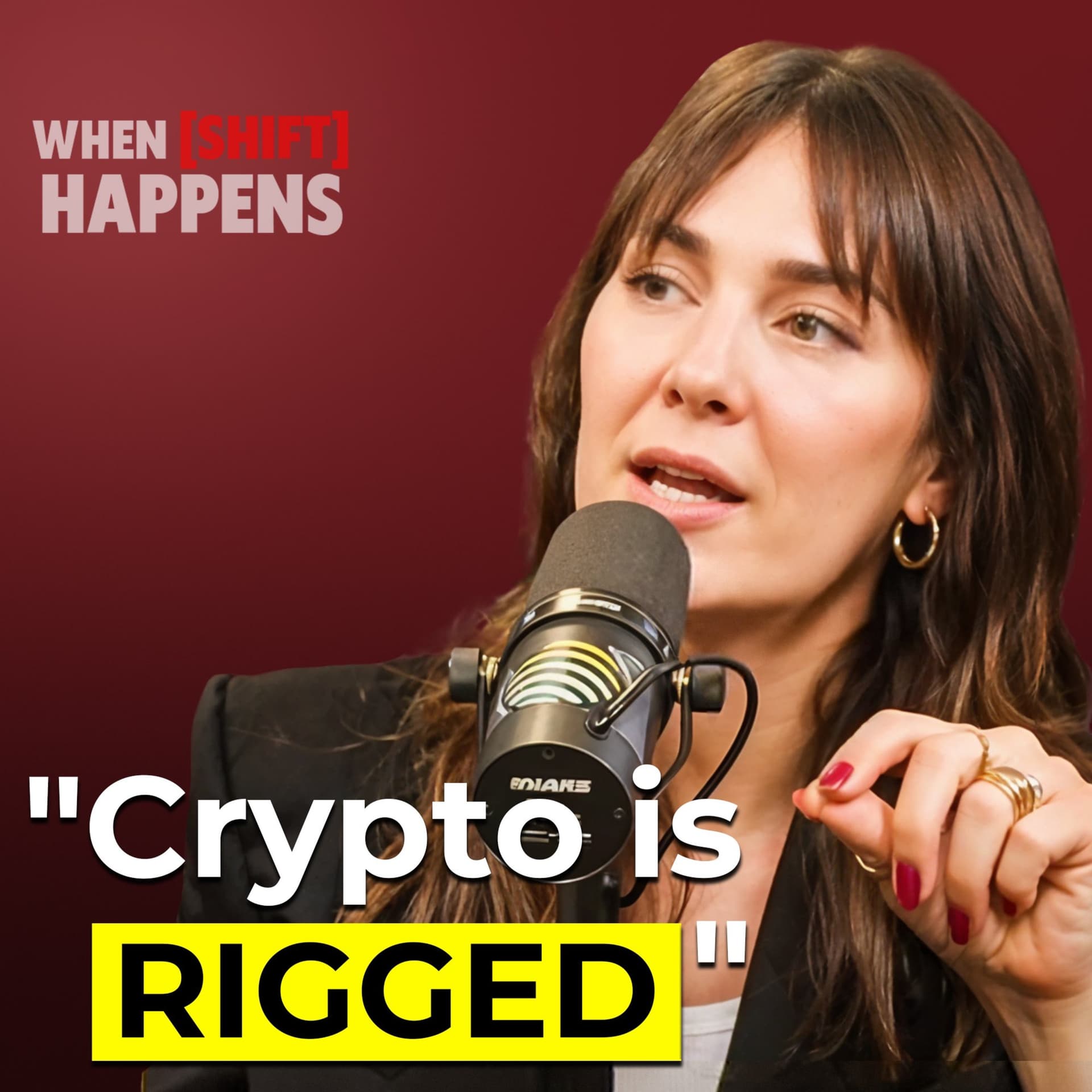

In short
When Shift Happens Podcast - Episode E109 Summary
Episode Overview Title: E109: Meltem Demirors: Why Speculation Drives Crypto (And How To Win The Game) Host: Kevin Follonier Guest: Meltem Demirors Description: In this episode, Meltem Demirors shares her insights on speculation in the cryptocurrency market, discussing how it fuels the industry and impacts various aspects from memecoins to billion-dollar protocols.
---
Key Concepts Discussed
Speculation in Crypto
- Fundamental to Growth: Speculation is viewed as essential for the survival and growth of the cryptocurrency market. Meltem argues that it is not merely a side effect but the core driving force.
- Historical Context: She draws parallels to past speculative bubbles (like railroads and the internet) and suggests that speculation leads to innovation and eventual legitimate use cases.
Market Dynamics
- Price Drives Price: Meltem emphasizes that in crypto, the price movement itself often drives further price movements, creating cycles of hype and investment.
- Market Manipulation: The nuances of market behavior, including how certain tokens gain traction despite lacking a solid foundation, are discussed.
Psychological Factors
- Greed as a Feature: The desire for wealth and status can propel individuals into the cryptocurrency space, and Meltem argues that this greed is a natural part of human behavior.
Infrastructure and Innovation
- Importance of Infrastructure: Meltem discusses infrastructure in both digital and physical realms, noting that it is foundational to the development of new applications and protocols in crypto.
- Emerging Technologies: She touches on how advancements in AI and energy technologies can shape the future of crypto and related industries.
Key Takeaways
- Speculation is Inevitable: It is a part of human nature and should be embraced rather than vilified. Many successful projects are born from speculative fervor.
- Adapting to Market Changes: Investors need to remain flexible and responsive to shifts in market dynamics and speculative trends.
- Personal Sovereignty: Meltem advocates for the practical application of self-sovereignty principles in personal life, aligning with the ethos of crypto.
Episode Highlights
- Introduction to Meltem Demirors: Background on her journey in crypto and her current roles.
- Discussion on Ether Rocks and Memecoins: Meltem highlights the absurdity and cultural significance of these phenomena in the crypto space.
- View on Future Predictions: Meltem suggests an "up-only" trend for the next 12 months, reflecting optimism in the market.
Conclusion In this episode, Meltem Demirors articulates her belief that speculation is not only a fundamental aspect of the cryptocurrency market but also a necessary element for future innovation and growth. The conversation serves as both an educational piece for those new to crypto and a reflective commentary on the industry's current state and future trajectory.
---
Recommendations
- Follow Meltem Demirors:
- [Twitter](https://x.com/Melt_Dem)
- [Website](https://www.cruciblecap.xyz)
- Follow Kevin & When Shift Happens:
- [Twitter](https://x.com/KevinWSHPod)
- [Instagram](https://www.instagram.com/kevinwshpod/)
- [LinkedIn](https://www.linkedin.com/in/kevinfollonier/)
---
Chapters
- Trailer
- Introduction (Who is Meltem Demirors?)
- Speculation in Crypto
- Psychological Aspects of Investing
- Market Dynamics and Infrastructure
- Future Predictions and Closing Thoughts
---
This summary captures the essence of the podcast episode, focusing on the discussions around speculation, market dynamics, and the philosophical underpinnings of crypto investing.
Written by AI. May contain mistakes. Listen to the episode to check what was said.
Transcript
Automatic transcript. May contain errors.0:28I got rich from speculation. has been such a great place to spend the last nine years of my life because there's so many disciplines you touch on. There's the philosophical side to it, economics, there's technology and the rabbit hole goes really deep. Absolutely. 2015, Bitcoin ran to$1 ,200 and then cratered to like $1 ,20. Joining the Bitcoin when Bitcoin had just gone down 80, 90 percent and you see so many people coming in. That was really inspiring. One of the things that caught my attention was the Ether rocks and dick butts i think i bought my ether rock for nine eight which was like 35 000 the first thing you bought was for 35k and it was a jpeg of a rock um i'm just a girl
1:11so you're really early in this uh bitcoin way and now the goal is to be early in something else that a lot of people don't even think about it to be honest first i was like what the and second i was like she's smart so instead of saying what the i should ask what does she understand that i don't do you want to hear something crazy i want i think everybody wants okay so 75 of you that watch this channel frequently do not subscribe if you like this show and think it provides value to you in your crypto investing journey can you please please please do me a favor and subscribe to this channel hit the like button and leave a comment below it helps this channel more than you can imagine the bigger the channel the bigger the guests and the better the conversation.
1:54Thank you. This conversation is supported by Jupiter, the most used decentralized trading platform on Solana and the largest DAO in the world. Bitwise Asset Management, the crypto specialist asset manager with more than$10 billion in client assets and more than 30 crypto solutions across ETFs, index funds, alpha strategies, staking, and more. Three, a scalable layer one blockchain that's fast, secure, and affordable, built by previous Facebook developers and that delivers the benefits of Web3 with the ease of Web2. And Mantle, an Ethereum layer 2 that builds two products I particularly like. FBTC, which enables you to borrow and lend Bitcoin in DeFi and METH, or METH, one of the largest ETH liquid-staking protocols in crypto.
2:40Is it your good angle, right angle? Every angle's good, baby. Ah, so... No, because often women are like very conscious about what was the right angle you know i just like i wasn't really into um i've always been like a brains person so i never really worried about how i looked and then i became like a public persona yeah and now i'm dealing with the fact that like my first six years in crypto i like didn't wear makeup i like to do it and i looked like a turtle it's like i need to figure out how to delete myself off the internet pre-2021 because pre-2021 i just didn't care about my appearance what made you change um because you might just not care right hey i think aesthetic is incredibly important and aesthetic is everything like if you believe in god which i don't know if i believe in god but if you believe in like holiness and divinity then you should be aesthetic maxing it's the highest ROI activity that's true like if you're honest to yourself that's true right the first thing you see is like the first as a judgment yeah absolutely absolutely pretty privilege is real I really like it and I want people to assume like I'm dumb because people look at me and they're like look at this dumb hoe like I'm gonna reminds me of one of the tweets I saw the other day where you said I let men explain me the yen yeah it's a little carry train right it's a little treat for them the boys need love too i'm like yes please excite i was once at a dinner i was sitting next to someone i won't name him um and he didn't know i worked in crypto right it was just like a social dinner in london um that stani from ave had organized right it's like we're at a social club it's fun it's sexy whatever i'm sitting next to this guy he has no idea i work in crypto and um and I don't bring it up I never bring it up because it's like not interesting and nobody wants to sit next to that person at dinner who just talks about Bitcoin the whole time that's what this guy did and he was like have you ever heard of Bitcoin and I was like no I haven't I'm like I like I've read about it but I don't and I thought he would get the joke but he didn't and so for two hours this guy is explaining Bitcoin to me how well not not terribly well but it's really like it's sweet and he was really enjoying it so i'm like who am i to to stop this like he's having a mansplaining me on bitcoin no but it was like he was really it was cute right and i just i had at no point did i feel like it was a good moment to sort of stop him so just let him keep going it's not a malicious thing anyway so for dessert everyone such as places and he sat next to someone who i guess was like telling him about me was like oh did you have a good conversation with melton you know she's and she's and he comes up to me after the dessert course and he goes i just want you to know you're an and he's like why did you let me make a fool of myself i'm like you were having fun like yeah i mean if he's really in bitcoin and he should kind of know you.
5:54Poor Barney, right? No, no, no, no. It's not even that. It was just, I thought it was really cute. So sometimes I like to ask people things that I know the answer to just because it makes them feel good, you know? So good luck for me. I'm the one asking the questions today. So I'm not going to... Yeah, but I might ask you to explain something to me. I'd be like, oh, Kevin, would you please like... I don't know what that is. I mean, I know your trick. I know your trick since I read that tweet actually and I loved a lot and there was a lot of engagement so people understand the witty side. I'm very, I'm funny, I think.
6:30I'm just a funny, strange person. You have funny and strange. Strange, yeah. Why? I think that I like things, I like a very specific set of things. Like you asked me what my hobbies are. Yeah. Crypto, the history of capital markets, science fiction, vintage furniture, that's it bushcrafting like survival camping it's that's it i don't that's it that's as far as it goes so you can do survival camping but you can also look very good and wear super nice shoes uh during a podcast show show us the shoes yeah it's fun it's fun actually it makes me feel good so anyways just like that guy explaining bitcoin that felt good for him this feels good for me so for people like that guy who don't know who you are i don't like this phrasing though like i'm no but i'm just a random person right why should anyone know anything so you're a random person yeah i think so we all are right like when you're in a social setting i think when people come in and they're like i'm so and so i think that's it's cringe it's insufferable yeah yeah terrible yeah or even like i go to a lot of events i used to go to a lot more events now i don't go to so many events but i will again now that i have my new firm right i always find it so strange because people will come up to you at events and i'm sure people who watch your show will come up to you and they're like i feel it's more and more but only nerds they're like but i find it so interesting socially because they're like oh my god hey kevin and i'm like hi my name is melton what's your name like it's so nice to meet you like what is this fucking weird social and like just be normal it's strange so for someone who doesn't know you and who asks you who are you yeah what do you answer um i'm just a girl you don't know in the only word i'm just a girl i'm just a girl
8:38you're a girl but you have a huge fire in the belly right yes where does it come from i think um people are motivated by different things right i think the framework that most people use like people care about money people care about fame people care about power right those are like typically the three kind of drivers i think for me ever since i was a kid it's been knowledge. I just like knowing things, not for any other purpose that that's fun for me. And that's why I think crypto has been such a great place to spend the last nine years of my life, because there's so many disciplines you touch on.
9:20There's a philosophical side to it. There's obviously economics, there's technology, there's all of these different disciplines. And the rabbit hole goes really deep. So for me, I think the motivation has always been, And I like to know things. But more than that, I think investing is fun because it's the exercise of trying to translate knowledge into alpha. And there's a scorecard. 100%. And I like the scorecard. I'm competitive. Mostly with myself, but also with the market. And I'm like, can I catch things before they catch fire? 100%. I remember being at school and doing pretty well there, but I was always thinking it's so rational, right?
10:07The grading system that I can never show that I'm the best because it's kind of like too rational, right? Or sometimes some classes actually are very rational. It's more like the teacher likes you or not, right? And then I discovered with investing actually and entrepreneurship, building businesses. I was like, this is actually the way for me to express whether my opinion about the world and whether I'm right or wrong. And I might be completely wrong, but at least I have a way to kind of differentiate myself from the masses, right? As you know, what's fun about crypto is it's not just about being intellectually right.
10:43I talk to a lot of founders and they spend a lot of time talking to me about the specifics of the technical specifications or the technical differentiation of their product or their protocol. and that's really not the most important thing. I think we are currently in an era of crypto and we've always sort of been in this sort of meta but I think we're now just starting to understand it. It's about, and this is why I joke, like I'm an aspiring cult leader and I want to invest in founders who are aspiring cult leaders because it's really about not just your ability to build something that is technically innovative and brings new features to market but it's also about your ability to create narratives and to capture attention and to compete for capital, right?
11:29To compete for TVL, to compete for transaction volume. This is really important. And I think that's something that many, there are a lot of investors I really respect. I think they are intellectually like leagues and leagues above and beyond me, but that's not the game we're playing. That's a portion of it, but it's not all it is. So I think the ability to understand these social dynamics and how trends form. And this is why I love like cults, right? And Bitcoin is a religion more so than anything else, a religion and a social movement. Yeah. I was talking with the Kiao Wang the other day from Alliance and we were talking about what Charlie Munger brought to the Warren Buffett approach.
12:13Warren Buffett was very fundamental investing. and then Charlie Munger was much more kind of like almost growth investing. He was saying and the whole thing, the whole thesis was everybody saying in crypto, alt season is coming, alt season is coming, right? But then Kearo was saying, actually, it's very different now because the fundamental catalysts for alt season basically are that you need to have a limited amount of tokens and you need to have a lot of liquidity. Right now we have none of both, right? Yeah. for the moment. And we have too many tokens. We have low liquidity, right? Because the other thing that's fundamentally shifted is market microstructure with the introduction of the ETFs.
12:55A lot of the new inflows coming in are going into ETFs and that capital is not going elsewhere. Whereas in prior cycles, I think you had more of this sort of circularity of capital where capital would flow into Bitcoin and Bitcoin would appreciate in value. People would go further out on the risk curve, right? now that's not how it's still going to happen i think but not to the same degree uh and i think one of the sort of dichotomies that we don't talk about enough is with the financialization of crypto and everyone talks about oh the institutions are coming like they're not coming to buy your shit coins my friend my brother in christ they are not coming to buy your shit coins uh and so i just think that many people are sort of detached from that very fundamental reality absolutely so it's going to be much more of a barbell right i think there will be an extreme sort of um sort of it'll be binary outcomes it's either a zero or it's a one right and if it's a zero that means that your project will go public go go live launch mainnet issue token and it will trade below your last round fdv which in my view is kind of a zero or you'll catch fire and there will be very few who sort of reach that escape velocity.
14:13And so now my focus is figuring out what are those things going to be? Dear When Shift Happens family, the following message is probably the single most important thing you should take away from today's podcast. If you're serious about your crypto investing journey, please take some time to learn how to self-custody your assets to make sure that nobody can take your coins away ever. If you don't learn how to be your own bank, it is very likely that one day you will lose all your hard-earned crypto. The safest way to hold your crypto is in a cold storage that we also call hardware wallet. Hardware wallets are not complicated and they give you peace of mind.
14:49I personally use a hardware wallet called Treasure. It is open source, very easy to use, and the first hardware wallet created ever. As we like to say in crypto, not your keys, not your coin. You can order your Treasure wallet with a 10 % discount by following the link in the description down below and by using the promo code WSH10. And now back to the episode. And you're saying that this is not fully, but a huge part of the ones we're going to want is attention, right? That's a lot of it. And price drives price. Everyone thinks narrative drives price, but it's price drives price, which I think has, and it's this way in all markets, right?
15:33And I think as we look at public equities, volatility in public equities is way up since the pandemic. And why is that? I think much of the investing community has shifted from this sort of a closed subscription-based research-driven model where you relied on stock pickers and analysts at large financial institutions, hedge funds, specialist firms for intelligence and insights. Now you go on X and there's all of this free information from world-class analysts who are deep experts in a lot of different domains right there's fx twitter there's commodities twitter there's crypto twitter there's equities twitter there's now even uh you know all of these twitter gurus who invest in small businesses like car washes and whatever you're looking for there's so much expertise and so much information out there and i think it has made a lot of the rest of um finance much more trend driven much more sort of narrative and meta-driven and resulted in a lot more inherent volatility.
16:37And crypto supercharged that, right? Big hot ball of money. You have 24-7, 365, instant liquidity. Is this a good or bad thing? There is no good or bad. It just is. There is no... I am not in the business of judging good or bad. I'm in the business of deploying capital. So it's not about good or bad. It's about this is. and as a result of this is, this is how allocators, investors, whether you're a retail investor, a semi-professional investor or professional investor, this is how you adapt to what it is, right? I think we need to disabuse ourselves of this idea of good or bad. There is no good or bad.
17:18The market decides what's good or bad with price. The good or bad is more like the way kind of our parents would think about things, right? If you think about, for example, robots, Right. Elon Musk said recently, there'll be a humanoid robot for every person on earth. Plus robots working in the industry, which means there will be a market for 20 billion humanoid robots. My mother probably would say, this, this looks weird. This is not a good thing. Right. Or just social media. Right. Sure. This is bad. Like people are too addicted. There is proof that people feel bad about it, more suicide, et cetera.
17:59Right. But at the end of the day, what can you do about it? But take it as it is, right? And adapt. And again... But that's the arc of human progress.
18:15It is, yeah. You go through. It just is. We face the same thing in Bitcoin, right? When I started working in Bitcoin, I was convinced it was a question of if, of when, right? Not if, but when. Bitcoin is absolutely going to be a force that radically reshapes capital markets, financial system, global economies. It was just for me a question of when. It's like, OK, I'm perfectly happy to be in the struggle for as long as it takes because I know it will happen. I felt very convinced of that. I think a lot of people were in the if stage, right? They did not feel convinced. Same thing with what I'm doing now.
19:00I know it's going to happen. It's no longer a question of if. I've seen enough to know this is going to happen. It's just a question of when. And can I be in the game long enough so that when it happens, I win, right? And winning is different to different people, of course, right? It goes back to what drives you. Some people, it's very much about money. Some people just really want to be right. you see this all the time I see people engaging on Twitter and they're so combative and I'm like yeah yeah relax a little bit actually I read the there is actually some scientific study that say that there is the the heat that you get from being right is actually much higher than the heat that you get from making money yeah right just being right like hey I was right and but What's the prize?
19:48What's the prize? Probably pride. I don't know. Maybe insecurity where you're just like, I don't know. I just think it's fun. Like for me, that's how I'm wired. For me, it's fun. I'm just like, yeah. Fuck yeah. Like that's all right. Before we talk about your thesis, right? For the future. It's not a thesis. It's a direction. What's the difference between a thesis and direction? I think thesis is very like a definitive sort of, I don't know, I shy away from the word thesis. I just think it's overused or when people say like principles first or first principles, thesis driven, it's become so overused that it's meaningless.
20:35I have a directional heading, but there's a lot of uncertainty around that directional heading. So I think remaining intellectually flexible is important. I think thesis is a bit rigid for how early things still are and how unformed things still are. So no first principles, no thesis. We're staying away from those words. So before we talk about this direction, let's understand how you got fascinated by the world of Bitcoin and blockchain. What's your crypto aha moment? When did you understand like this is because you said before, this was clear to me, right? Early on. Yeah, I think the aha moment for me was when I sent a Bitcoin transaction.
21:24I was like, how? Why did you love? I almost felt like I was doing something naughty, you know? You're like, how? This is crazy. But why did you send the Bitcoin transaction initially? Like, how would you even have the idea? Yeah. So it was 20 late 2012. I was working in China at the time. I was working in on an acquisition of a mining equipment manufacturer. Very sexy stuff I used to do. And I was talking to my brother and I wanted to, you know, I had to send money for something. And I was like, I don't know what to do. And he's like, oh, Bitcoin. And I was like, what's a Bitcoin? He's like, oh, oh boy.
22:07and then I started reading about Bitcoin and then I figured out how to get some Bitcoin and then I sent some Bitcoin and I just thought it was one of the wildest things I'd ever experienced but it didn't really I'll be very honest it didn't really click for me immediately I then did other things went to graduate school and then Bitcoin started growing and growing since 2013 Coinbase comes out 2014 circle right i was in grad school in boston so obviously a lot of people talked about circle and then i had the good fortune of being at mit and there were a lot of people at mit who were really focused on bitcoin at the time so dan ellitzer who now runs nascent jeremy rubin who has been you know a bitcoin dev and i think a really sort of prominent figure in the bitcoin ecosystem um there was uh gavin andreason who was the maintainer of the bitcoin core repo who took that over from Satoshi.
23:03He was also based in Boston. Circle was based in Boston. Fidelity is headquartered in Boston. Abby Johnson, who owns Fidelity, runs Fidelity, she got into Bitcoin very early, started mining Bitcoin early on. So there was just, it was being exposed to the idea, being at a point in my life where I wanted to try new things, but also being exposed to a really interesting group of people who are all talking about thinking about bitcoin yeah and then i took a took a jump and that's what what made you take the jump take the leap i'll be really honest i was very bored i was very bored i was like the thought of going and spending the rest of my life working in corporate finance was very depressing i think a lot of people feel like that still today probably most likely right I was like if I'm going to go back to doing powerpoints and I sell models for the rest of my life what's the point and that's not a criticism I just think grow up and you get older you just learn things about yourself and I was like okay as I learn more about myself and what I like I am learning that maybe some of these skills I've acquired and these things I'm doing are not really aligned with what makes me feel alive right But I didn't know that.
24:27I didn't even know about startups until I was in my mid-20s. I worked in the oil industry. I was hanging out in pipeyards in the Yukon in January. It was negative 40 degrees Fahrenheit outside. You have to plug your car in when you go to bed at night. That's the environment I was hanging out in. It was a bit different, I would say, than what was going on in Silicon Valley and in other entrepreneurial ecosystems. What's your first experience in crypto then when you said I jumped? I joined DCG. 2015, beginning, right? Yeah. I was actually hired by Second Market, which was Barry's prior form. Yeah, but I met Ryan Selkis first through Dan Elitzer, actually.
25:10Ryan Selkis was supposed to be in our grad school class, but he decided to stay in Bitcoin and work on Bitcoin and he built the blog 2BitIdiot. The Bitcoin lore goes very deep. You have to remember, this is... like the days of Gox and the Silk Road, right? So when I decided, and then through Ryan, I met Barry, they were starting DCG. It's like, okay, I think I have some really specific skills I can bring to the table here, having worked in very corporate environments, right? These are two much more entrepreneurial, sort of like startup guys. And then I was like, okay, let's do this. And we did it.
25:55What's something you learned at DC that you could never have learned anywhere else? So many things. I think I built first and foremost, there was something really special about Bitcoin, like 2015 era Bitcoin, because Bitcoin has sort of gone through this crazy boom, right? Right. 2011, 2012 is still very early. Some of the first products were things like Satoshi Dice, which is Eric Forhees's company in 2011. I think he started it. You know, you had Gox. There were just a small number of companies. Coinbase really was the first big venture backed company. That was YC Spring Summer 2013. There weren't a lot of Bitcoin companies around.
26:41And then Gox happened. The Silk Road happened. right? Bitcoin ran to$1 ,200 and then cratered to like$120. There was this really big existential sort of question about the future of Bitcoin. And so joining the Bitcoin industry, which at the time was very small, joining the Bitcoin ecosystem, community, industry, whatever you want to call it, at a point in time when two really catastrophic things had just happened. and when Bitcoin had just gone, you know, prices down 80, 90 percent, sentiment's really bad. And you see so many people coming in and building companies in this space and more convinced than ever that they're right about Bitcoin.
27:29That was really inspiring. It was also really hard. Lived through the block size wars as well. And that was a really interesting experience. I learned about the power of communities from that because that's when you had these different factions in Bitcoin really competing for control, trying to dictate sort of what is the future of Bitcoin. And, you know, UASF, user-activated soft fork was sort of the force that won out. I learned a lot. I learned, I gained a lot of respect for founders, particularly founders in Bitcoin, just the challenges they went through there's you know the bsa operation choke point not being able to get banking um regulatory pressure so many different attacks and different vectors the surface area of risk working in bitcoin was insane right there's constant cyber security risk there's constant personal security there's all of these insane risks that are really difficult to mitigate And then on top of that, there's just the psychological challenge of dealing with an underlying asset that's extremely volatile.
28:42Just on the top of that. Yeah. As a cherry on the cake. But I do think there is like this really, today when I see people from the early days of DCG, and I'm really proud of what we did. We built a really amazing community of founders and brought them together in different ways with a lot of in-person events, but also just introducing people to one another trying to build synergies in the portfolio we were building. I think it's nice running into people now. They've been really successful. Their companies have been successful. They were right. They were right about Bitcoin. And it's just nice running into them and being able to go back to that time and just like, wow, we did it.
29:26And different people did different things. but what I love about Bitcoin and what I think still makes Bitcoin so special is such a big component of it is driven by volunteers right and just people on the internet like we named a global reserve currency into existence yeah over the span of a decade on the internet that's just pretty crazy yeah and that's just pretty wild it was pretty profound and obviously had the support of investors and, you know, others who really supported Bitcoin on its journey to becoming what it is today. But what I like about a crypto, which is why I sort of detest it when people are like, oh, you know, I've been in crypto since 2013, or I've been in crypto since this state.
30:13Nobody cares, right? And it's because there are so many different ways for people to contribute to the growth of Bitcoin as protocol, Bitcoin as an asset class, Bitcoin as a social movement slash religion. And there's a lot of different types of people who have built businesses of all kinds, whether those are more services oriented businesses, media or content businesses, or, you know, exchanges, financial services, businesses, whatever it is, there's so many people who've built really great businesses that are also complementary to the growth of Bitcoin. So that's really, I think, really, really cool to see.
30:48So you're really early in this Bitcoin wave, right? And now the goal is to be early in something else that a lot of people don't even think about it. To be honest, I spent quite some time researching and I hurt my brain on your direction, right? Because I was like, otherwise I'm going to arrive there. I'm going to understand nothing of what you're talking about. I'm going to look dumb. But hold on. It's just every time when you look at something the first time, it's a new concept, right? So I was like, oh, now I understand it better. So I'm able to ask questions that make sense, right? Yeah. But I think it's actually quite intuitive and it goes back to Bitcoin.
31:29If you think about what Bitcoin is, right? Money is a way to transport value across space and time, right? And I think one of the things that this AI boom is bringing about is a renewed conversation about what it is we're actually trying to do with technology. And I think all technology and money as a technology is just an abstraction of thermoeconomics. When I say thermoeconomics, this is like a fancy way of talking about thermodynamics, which is a fancy way of saying there are only two things that are sort of foundational to life on planet Earth and I presume elsewhere in the universe. And that's energy and matter.
32:14Right. So Bitcoin did something really unique in that it created thermoeconomic money. Right. So created money that was anchored to the laws of thermodynamics in the sense that in order to operate the Bitcoin protocol, you need energy and you need matter atoms in the form of a chip. Right. A specialized semiconductor, the ASIC. And so Bitcoin is interesting and cool, I think, because it anchors back to these core laws of the reality that we live in, which is thermodynamics. right now I think there's sort of this renewed focus with the AI boom if we look at what's driving value in markets right now it's compute and compute again it's about access to energy and access to semiconductors right those are really sort of your your core levers and around that there are a lot of other levers when I think about these levers that you can sort of work around, build businesses around.
33:18There's technical innovation, right? There are clearly some limitations to technical innovation, but new sources of energy, new sources of generation, new models for distribution and transmission on the semiconductor side, right? New models for semiconductors, whether it's photonics, which is using lasers instead of doing a traditional transistor-based chip. There's now even companies like Extropic, right, that are doing some derivative of biocomputing but there are these technological innovations on the energy and atom side and there are also technological innovations in sort of this osi model or this networking architecture which is like the hardware layer the networking layer transport layer and then the application layer right so and crypto has been a lot of innovation as sort of the the transport layer and the um application layer and i was starting to see people going further into the stock, we're starting to see new generation of like FPGAs that are specialized for a specific type of crypto computing, i.e.
34:16zero knowledge proofs. So first lever is technical innovation. Second lever is operating leverage, right? And this is where how do you optimize the way you operate assets, infrastructure that could be, you know, companies in the managed services space. There are a lot of companies like the Alchemies of the world, the Infuras, Blockdaemons, etc., that are in the sort of managed services operating leverage space. It's tooling that makes it easier for people to run nodes, operators, validators, whatever it may be. And then there's the third lever, which is, I think, the most interesting and probably the most explored design space in crypto, which is financial engineering.
34:56So those are kind of the three levers that you have. Like if you sort of reduce everything down, right, and you take out all the fancy words like thesis and principles first or first principles. I don't even know how to say it, honestly. There's those three levers, technical innovation, operating leverage, and financial engineering. And it was the same in the oil field, right? Like this is where my experience in living through those days of commodities and fundamental technological shifts in the oil industry through the introduction of fracking, which was a technology innovation. It resulted in fundamental changes in operating models for oil and gas companies.
Read the full transcript
35:33And then the facilitation of a futures market, a derivatives market for commodities, particularly oil, that took off in the 2000s with electronic trading, allowed commodities to become a more defined asset class with broader participation and then introduce these new financial instruments. and it just resulted in this amazing exponential explosion in the volume of activity, financial activity, happening in the oil trading space in particular. But that also sort of filtered back and made new technical innovation possible and then allowed for different kinds of operating leverage. So these three levers kind of all work together.
36:10I'm trying to be very simplistic here. I think for me, frameworks are really helpful and there's a lot you can learn from history, right? So like informative. It won't be exactly the same, but I think there's more commonality than not. So I basically broke down the whole thing into kind of frameworks, right? To make people, so people can understand the thing better, right? The first one is infrastructure, right? Which is a big focus for you. What is infrastructure? That's question number one. We throw around the word infrastructure a lot. It means different things to different people. uh one of the i think this is also one of the funny sort of challenges in in crypto like there are no canonical definitions and when i say canonical it's sort of like widely accepted truths like global truths versus localized truths right so i think one of the challenges is i'll say infrastructure and you'll say infrastructure and we're speaking about two very different things or I'll say deepen, you'll say deepen.
37:14And we're thinking of two very different things. So I think this is one of the challenges of working in an industry where there is no sort of formal body that sort of decides, like, here's the canonical definition. The market decides the canonical definition, which I think is also cool, right? Like whatever becomes the most financially successful, that is going to be the definition. So you operate in a framework where there is no concrete definition for infrastructure, but you find it... No, sorry, I'm just saying infrastructure is a confusing term. Okay, but you have... My definition of infrastructure, it breaks down into two categories.
37:49There's physical infrastructure and digital infrastructure. Right, and infrastructure is basically the scaffolding that people build things on. So it's protocols. It's frameworks that people use to build. It's about, to me, infrastructure is about standardization. Right, so standardization in terms of that technical innovation is standardization in terms of the models people are using to optimize how they operate these different assets, whether it's digital or physical infrastructure. And then it's also standardization of the financial primitives that we're going to use for this financial engineering, right?
38:20So a lot of these DeFi building blocks are infrastructure for capital markets. Does that make sense? It does. The only thing I would say is for, I think, many people who are not a bit strange, as you said, right, that you are, it's not very sexy, right, to think about that. But for you, it is. It's extremely sexy. How is it not sexy? Why is it sexy for you to talk about that and to focus on that for the next 10 to 20 years? Because it's foundational to everything else. Everything else that you interact with, like this, right? This beautiful pudgy penguin. This one's quite cool. It has a katana.
39:04Sick. This pudgy penguin, right? How does this Pudgy Penguin exist? Absolutely. ERC-721, which is the NFT token standard. That's foundational in making this possible. Then there's financial market infrastructure. You have the OpenSea contract, which allows you to trade these things. Then you have lending protocols that allow you to use these as collateral. So infrastructure, I think, is very sexy and is required to make things like this possible. Which is interesting and comes back to what you said before, because when you said you showed the project Penguin, you talk about infrastructure, you talk about all the digital infrastructure.
39:47And me, the first idea was the physical one that enabled you to build this actual toy, right? Yeah. I mean, I don't know how this was produced, right? That's not my expertise. I know where my limits I know where my competence begins we just know it's cute and we love the penguins this is kind of badass I want a katana I want to walk around with a katana on my back I think that would be a good look for me maybe hard to get through TSA with a katana not easy but you found a parking lot to come here so you can find solutions to anything I don't want to talk about it Yeah. So I think that's maybe my articulation of infrastructure.
40:36It's like, what are all of the underlying components that make it possible for this to exist? and then as there's sort of this recursive relationship um and i think fred wilson wrote a really great blog post on this and other people have written about it but i think fred wilson's blog post is sort of referred to as like i don't know the holy grail here but there's this ongoing conversation that happens in crypto like why are that they're not more consumer applications right where the applications where the applications it's like well first the infrastructure has to get built. And so when new infrastructure gets built, it unlocks new applications, right?
41:12Without ERC 721, we would have not had this. So new infrastructure innovations happen, and then new applications can get built. And there's sort of this recurring cycle. Infrastructure gets overcapitalized, then people build new applications, those applications get overcapitalized. And so that's sort of the cycle. Now, the way I translate this to what I'm excited about is this is not just happening in the digital realm, there is currently a massive shift underway in the deep tech and physical infrastructure space. For a very long time, if you were doing anything in the hardware or physical infrastructure space, nobody wanted to invest.
41:50Unless you were spent out of a corporate or you had some sort of unique access to capital at low cost, it's very, very difficult to capitalize a hardware startup. And I will go out on a limb and say, over the last decade, Bitcoin has done more for hardware investing than any other tech sector because Bitcoin catalyzed a$100 billion dedicated semiconductor and data center boom. I think you also said that Ethereum is one of the reasons why Nvidia was so successful in 2017. Yeah, in 2017 Nvidia sort of soared past Intel and others because of this massive demand for GPUs driven by Ethereum proof of work mining.
42:30Same thing in 2020, 2021 with Seagate, solid state drives, SSDs. They were impossible to find. Price skyrocketed. Blockbuster year for revenues for Seagate primarily, who produces SSDs, solid state drives, for people farming Chia Filecoin and other proof of space and time protocols. So what's interesting is people think of crypto as purely digital tech. but crypto has had a massive impact on the world of atoms on the world of semiconductors and data centers right and we're seeing this now Bitcoin data centers are really good at one thing because of the unique economics of Bitcoin as a digital commodity you can never make more Bitcoin per block right there is a fixed block reward what does that mean you have to get really good at optimizing your operating cost which means lowest cost of electricity possible, efficient operations.
43:25And that could mean immersion cooling. It could mean a multitude of things. But because Bitcoin data centers have gotten so good at minimizing OPEX operating expenditures and finding really low cost power, those Bitcoin data centers now in a lot of instances are really optimal for GPU deployments for AI. So I really think there's this interesting relationship where we think of crypto as happening like purely online, but crypto has had a massive impact on our physical world, on physical infrastructure. And now there is a new wave of investing that's happening in Silicon Valley and beyond, where I think investors are recognizing that it's time for a new era of hardware and physical infrastructure that is going to be needed to unleash a new category of software companies.
44:13Over the last 15 years, really, the dominant focus has been investing in software and bits and bytes. But I think we're now starting to see that we need new hardware, new chips, new energy generation, new models for robotics, like all of these interesting categories that historically have been really unattractive to investors are now becoming really compelling and really attractive because I think crypto and these early beginnings of AI are showing tremendous upside lift, right? Tremendous multiple expansion. I have two points based on what you just said. The first one is what you just said, right?
44:49In the last 15 years, we invested in bits and bytes. 2010? Yeah. Most of the biggest market cap companies were commodities, right? Yeah, oil and gas companies. Oil and gas. And now it's technology, right? So it feels like... Who is the number one company? NVIDIA. NVIDIA, yeah. It wasn't even on the chart a year ago. Yeah. Yeah. Yeah. So you're getting back to... It's crazy. That's one of my favorite charts. And this is why I'm such a weirdo. This is why I said strange. It's like, normal people don't think that's exciting. I think it's so exciting and so fascinating. Something wrong with us. I've accepted it.
45:33So you think that in 2038 or 2040, right, in another 15 years, we're getting back to... Bits and bites. Sure. One of the big questions is whether or not those cycles will compress and go faster and faster. I don't know. I actually think there is... And this is where I think history becomes really interesting. I have tremendous respect for people like Balaji Sunavasan, who just have such an amazing grasp of human history. his knowledge on this is just mine is not so profound i would not say it's my strong suit but i do think there is a rate uh like a limiting factors to how fast humans can integrate technological change so one of the frameworks that people use is the s-curve right of adoption where you kind of have like this slow build slow base build slow build and then there is a moment where things just sort of have this exponential uplift and that sort of parabolic part of the s-curve happens.
46:32One of the fun things I like to think about is has that moment happened for crypto yet? I don't think it has. And I think what will actually unlock that parabolic moment for crypto is the AI economy, AI agents, the agentic economy. Can you explain why? Because I think humans struggle to interact with public private key cryptography. Like interacting with crypto is quite hard. Why do so many people go through the UX hurdles and the friction of interacting with crypto it's because there's a bunch of early adopters kind of like weirdos out there who think it's fun and cool interesting whatever there's also a lot of people who are opportunistic you're like oh i can make money so they go through all this friction because there's just opportunity i think ai agents right they will have no problem interacting with public private key cryptography and things in the realm of crypto because it will be very easy for them right they operate off of code.
47:27And so I think that's an interesting thing. I like to have these like weird conversations with founders. Like we don't actually talk about the companies really all that much. Sometimes we end up spending a lot of time just talking about what does the world need to look like for what you're building to be incredibly successful, which I think is an interesting way for me to understand how other people view the world, which influences my thinking as well. right it's it's always really constructive and i think um i was having this conversation with a founder a couple of weeks ago we're sort of debating about it and it's has crypto even had that exponential growth moment yet have we even reached like a reasonable point of adoption because today the primary interface that people use to interact with crypto is a centralized exchange exchanges yeah exactly that's it so i don't think i don't think we've had that moment yet Which is kind of wild to think about.
48:20No, completely agree. And even when people kind of throw these numbers of we have that many users, if you're very critical, which you should be, there's so many people with so many addresses, right? Like even the number of users, the hundreds of millions of... Or you can say, okay, maybe they hold some coins, but what for? Probably kind of gambling, right? Or making money, right? Which... Which is a great use case. Which, exactly. It leads us to something I really want to talk about today, speculation, right?
48:55Which is very interesting because before you said crypto is this kind of like online thing, but that actually had a massive impact on this kind of new new direction and offline thesis, right? And the hardware, right? But crypto itself, so Bitcoin and ETH fueled hardware, right? But crypto itself is fueled by speculation, which a lot of people, when they come into crypto or they look at this thing kind of from far away, they think it's, you know, scammy or weird or doesn't make sense, etc. Right? You have a very different take on that. You say speculation is the fuel that makes the future possible.
49:34Absolutely. Why is greed so important in any nascent market to help it take it to the next level? I think a useful framework, again, here is Carlotta Perez wrote a great book called Technological Revolutions and Financial Bubbles. That is about this pattern that emerges. Anytime there's new technology, it tends to be overcapitalized because it happened with, I think the analogy she uses in her book is railroads, right? Railroads emerge. There was this crazy boom to invest in railroads through stock offerings. offerings. And so 90 % plus of these stock offerings went to zero very quickly. There were a lot of scams, a lot of Ponzi's.
50:16But then there was this fundamental shift because railroads became a dominant mode of transportation. They unlocked all sorts of new commerce. All of a sudden, you know, all of these new things were possible, created new industries, etc. Like led to this massive industrialization. So it took just a long period of time. And there was a very heated sort of financial speculation bubble that happened around that innovation. We saw it again with the internet. Everyone loves talking about the dot-com boom as sort of the prime example here, like pets.com and a lot of the internet bubble. Same thing happened, I think, with enterprise SaaS.
50:52We look at some of the valuations that people are investing in enterprise SaaS and you're like, wow, that's interesting. And same thing happened with crypto. And crypto has gone through a few waves of intense and fervent speculation. We saw it with ICOs. We saw it with DeFi. We're seeing it now, I think, with like L2s and all of this protocol innovation. There's so many, many, many protocols that are being capitalized at really lofty valuations, ambitious valuations, I should say, and they have to grow into those. And then there are going to be just like a small handful of winners that make it through that speculative bubble.
51:28And those are going to win really big and that's sort of just a recurring pattern what i don't like sometimes and i'm not going to name names before you ask me one of the things that aggravates me is you will have people in crypto who have made a lot of wealth and who have gained power and influence because of this speculation right because they've been on the right side of the trade and had a right call and they will come out and say oh well speculation is not a real use case speculation is bad we shouldn't have speculation and i'm like you are here because of speculation i don't understand the i don't know if people feel moral guilt or they feel that that somehow uh reduces the legitimacy of crypto or their legitimacy as an investor but that is just a foundational part of any industry and so i don't understand the moral grandstanding and i'm like do you just embrace embrace like it's not good it's not bad it's what it is it is and the more intellectually dishonest you are about it the scammer your crypto looks just be intellectually honest about it it's not a bad thing like it just this is it is how humans work It's how we make bets on the future, right?
52:49It's just part of human nature, but people get so, I don't know, they get very weird about it. And we're like, oh, well, the speculation's over and now we're doing real use cases. And the real use case is something like helium, which I love helium, right? I think they have done a really great job showcasing the potential of deep in. But helium's been around for seven years as a token. Prior to that, you know, it was this Series C company and there's zero shade here. But again, helium has been through seven years of intense sort of ups and downs. And a lot of the reason why it's survived for so long and had enough capital to figure out the model and get to a point where they're able to actually create real production value is because of the speculation.
53:35And that's not a criticism, right? Same thing for a lot of other protocols. but I think it's funny when people say that I'm like the reason a lot of these projects have been around so long and have had the runway they need to figure out the model and build the supply side then man side and build things that work is because of the speculative fervor and again not a criticism like zero shade here but I just find it so strange honestly so I embrace speculation If anyone wants to pitch me about speculation, I'm very happy to listen. And I think, again, the market decides what is right. Mr. Market decides.
54:16So you could have the technically most brilliant non-speculative use case, but if the market values it at zero, what do you have? And the market decided that we needed frog coins and dog coins. Because frog coins and dog coins don't have VCs. and maybe people are a little bit tired of the moralizing where vcs are like yes i got rich from speculation it worked out for me but now nobody else can have speculation i think people were just tired of some of the dynamics of the low flow high fdb paradigm and on the top of that they're fun they're fun they're fun yeah i own some dog coins i mean talking about that i have to talk about that now right there's a It was last cycle, but like that's how, I mean, I was following what you were doing, but one of the things that caught my attention was the ether rocks and dick butts, right?
55:11I was just thinking. I have a little pudgies, but my favorite NFTs are, yes, the rocks and dick butts. And my first, I mean, like everyone, you know, when you go through, for example, NFT is a good one. In the beginning, you're like, what the fuck is that, right? Yeah. And then you need to hurt your brain. Maybe if you're a bit more weird Like you need to less hurt your brain But you probably need to hurt your brain in the beginning To understand what the hell this is, right? Yeah Oh, my brain hurts often So basically I was just looking at what you were doing And talking about these ether rocks I mean, then they went crazy, right?
55:43And then the dick butt And I was like First I was like, what the fuck? And second I was like She's smart So instead of saying what the fuck I should ask, why? Why does she understand that I don't? I think and I get this question a lot and people were real people are still really mad about ether rocks and crypto dick butts they make people viscerally angry I think it's awesome but I think it's hilarious what I thought was really interesting so I learned about ether rocks I don't even recall how but I learned about ether rocks randomly and I remember texting a good friend of mind being like, should I buy a used Honda Civic or an Ether Rock?
56:22Just explain for those who don't know what an Ether Rock is. Okay, so an Ether Rock is an NFT like this beautiful fudgy penguin. But an Ether Rock is one of the very, very early NFTs. I believe the project was created in 2017. And like CryptoPunks, Ether Rocks have their own marketplace. So you manage your Ether Rock through the Rock Manager console, which is a very funny ux it's like very clunky there's a hundred ether rocks um the nft itself the artwork it is a free clip art of a rock so it's a png file that is like when you google rock png it's just a clip art it's free it's free on some website and the dev basically took it and each ether rock and there's been extensive analysis of ether rocks each one is a slightly different shade there's gray rocks blue rocks red rocks brown rocks the grays are the most common the blues are a bit more rare the reds are very rare each rock has a number so some people like to buy specific rock numbers a friend of mine after I bought my ether rock and then rock pilled him bought rock 21 another friend bought rock number 8 and 88 because 8s are good luck in in certain cultures so it's quite fun um there are some people who own multiple rocks i know a triple rocker somebody who owns three rocks which is like quite an accomplishment but i bought my ether rock and i was like this is really that was my first nft was the ether rock first nft that i had actually gone out and and bought right i'd been like airdroff some whatever but i was like i'm gonna go in on ether rocks and figure out what's going on so the first interview you bought was for 35k and it was a JPEG of a rock.
58:10Okay. And then I... No, no, but like it's so interesting. But then I saw this group of people. I was like, okay, I'm going to get other people I know who I think are really interesting and have a unique view on markets. I'm going to get them to buy Ether Rocks. It's like I went in, you know, Arthur Hayes from BitMEX is a good friend of mine. I was like, hey, Arthur, you should get an Ether Rock. I talked to Kayne Warwick from Synthetic. I was like, you really need an Ether Rock. I was just like, Ether Rock should be status symbol. There are 10 ,000 punks and punks are status symbol. I just don't vibe with punks.
58:44Personal sort of aesthetic thing. To me, the rock is much funnier because it's so absurd, right? And there's only a hundred of them. Yes. And it's like crypto data is basically, right? It's like performance art, really. And I think it takes that absurdity of crypto to a very much an extreme it's so absurd and so ridiculous and the best part about it was was we got together a group of people who owned rocks we called it stonehenge very exclusive group a lot of great people in it we threw an insane party the best story about the ether rock party we flew in jamie jones and lee burridge and had them do a back-to-back in a 700 person club with only 150 people in it and there were people outside during nft nyc like with their punks on their phone they're like do you know who i am like i own 10 punks and we were like bitch this is an ether rock party so someone at the door actually spent two million dollars on an ether rock to get into the party wow which is just so crazy to me that i think it goes back to this idea people want to be a part of something exclusive um the rocks themselves are so absurd there have been so many derivatives of ether rocks and then the media headlines like financial media was outraged and To them, Ether Rock somehow represented the excesses of crypto.
1:00:04I just thought it was very funny performance art. And I think committing to the bit is very important. Everyone's like, oh, you should be more professional. And I'm like, I'm a clown. I work in crypto. I don't think you understand. This is what we do. And at its core, what's... No, but I mean, first, it's amazing for advertisement, right? because people get so pissed off and everybody talks about it. They get so angry. And second, you talk about excess, right? And if I remember well, I don't remember the exact sentence I saw before on your telegram. The path to success comes with many excess, something like that.
1:00:42Oh, this is a... It's filled with excess. Yes, this is a William Blake quote, which we're all over the map and cultural reference. This is really wild. William Blake, 1800s poet, he said, the path to wisdom is paved with excess. To wisdom. And then the second part of the quote is because you never know what is enough until you've had too much. And I actually think Ether Rocks in many ways are emblematic of just crypto culture. And Ether Rocks happen to be, and dick butts, by the way, they're silly and they're funny. Just because, you know, something is a intellectual sort of like, oh, we have a white paper and that's why this token.
1:01:21Like people will go on these 30 thread sort of tweet storms. that's effectively like advertising for something like an ether rock but just because it has a white paper and some very light like sprinkling of intellectual pseudo-intellectualism on top of it they'll be like yes this is a two billion dollar protocol i'm like there's very little difference between an ether rock and and this and so i do think it's very important to sort of take a step back and again be just be real i think meme coins are also kind of a similar expression they're absurd and preposterous but what's the difference between you know some protocols that have very little tvl very low trading volume effectively fully subsidized um uh network infrastructure right like all the nodes are fully subsidized that's there's no fee paying demand for block space there's no activity and these things have multi-billion dollar valuations like yeah Yeah, absolutely.
1:02:23Yeah, the difference might just be meme coins have more attention. At least some of them have much more attention than the protocol. At least they're funny. That's my thing with Ether Rocksley. At least they're funny and they're fun and I don't know. It's entertainment value. And I think again, the thing I think sometimes with crypto that's frustrating is people try to be so serious. I'm like that all of this is a little bit funny. I mean, if you think about where Bitcoin started, like we were buying drugs on the internet people. true there's a great meme there's a great meme that's um everyone's seen this meme i feel like it's the guy setting up uh the dominoes and each one gets successively bigger and there's one where the first domino is buying buying drugs on the internet and the last domino is uh toppling the global financial system and that's and that's true yeah but what do you think this is always a fun question what is you meet an alien and you have to explain memes to them what meme do you show them what internet meme do you show them
1:03:36I mean, my favorite one is the, I don't know his name, but it's the guy with the cup, the old guy that is being reused. For example, in crypto, applied to crypto, but it could be applied to anything else, right? I'm 24 years old and I'm a crypto trader. And then you see the guy with this cup and he's just old and I don't remember his name. Actually, I had Ray Chan on the podcast. I love Ray. The man gag. Ray is amazing. He owns Crypto Dick Buts, by the way. Ray has a whole vibe. Yeah, he's great. And he said he talks about this dude, actually, that he met. I want to see the name. I actually don't know this one.
1:04:16Of course. The guy who is like... Can you show me? I don't know if I can... Maybe I'll show you later, because I don't know if I can find it easily. But he's just a guy with the cup. And this is the meme you're using to explain memes to aliens. Okay, meme. What would I search? Meme guy with cup old? Old, yeah. Okay. I would be doing... You know that. Oh, this one. Yeah, I just don't... Yeah. For me, like that's the ultimate meme. Wait, hold on. Because you can use it. How do I show that? Wait, can you put it in front of me? I feel like we need to share this with everyone. This guy. Yeah, this guy.
1:04:52For me, this guy is being used and reused for so many things, right? It's like one of the best memes. Yeah. I also like the house on fire one, the like dog cartoon, sipping a cup of coffee at a table while the house is on fire. And they're like, this is fun. Of course. But I do think for me, the domino meme where it's, you know, the first domino is by drugs on the internet, the last domino is like toppling the global financial system. I think it sort of goes back to in crypto, there can be profoundly unserious things that are actually quite serious and quite monumental. So yeah, I think it's good to have a healthy sense of humor.
1:05:29At least it makes the journey more fun. And it probably also, this meme that you say is probably like a really amazing way to show that we think that, you know, you were born in Switzerland. You think that everything works. Government work. You pay taxes. Everything is working, right? But actually things work way less than what we think, right? And so therefore, you should take yourself much less seriously and just realize that, hey, like everything is the word is too complex for one person to understand it. Right. I think the most profound moment is when you meet someone who you really look up to and you realize they have no idea what's going on.
1:06:14Like they are just as clueless and figuring it out in the same way that you are. I mean, one of the one of the examples for that is. the teachers when you grew up at school and then you grew up with google right later on your eyes you start to google everything and you realize oh had i had google i mean today being a teacher must be much harder in a classroom because kids have internet right they could just ask anything whereas you would just take the teachers or even your own parents as an authority and they would very easily say things sometimes that they have no clue about just to look like they know something right?
1:06:50I didn't grow up like this because my father is a scientist and I grew up when I was a child I really wanted an encyclopedia set this is pre-internet I only use my computer to play doom if you remember the doom on the floppy disk that's like where we're at with home computers I was playing doom on a floppy disk but I had an encyclopedia botanica set and I got in trouble a lot because I would stay up at night under the covers with the flashlight reading Encyclopedia Britannica. This is why I say I'm like a bit of a strange bird in this way because I wanted to know things. So I grew up in a very annoying household where we spent a lot of time learning things and knowing things.
1:07:36Yeah. I was imbued with distrust of authority from a young age. It's like, but is that actually true?
1:07:48so you're building a new firm right investing firm called crucible capital it's my third time on the roller coaster but this time i'm doing it my way so let's see how that works out are you doing that alone i'm a solo gp yes so obviously DCG was an incredible journey from 2015 to 2018. For all of his faults, I do think Barry Silber is extremely smart. And he was very convinced about Bitcoin very early on and turned many people into converts. Great experience, really fascinating. Coin shares for five and a half years, worked with some of the smartest people who likewise, a lot of conviction in Bitcoin, staked a lot of their own capital, their own reputations on Bitcoin.
1:08:43And this time around, it's like, okay. Now's the time. Let's try. Let's do this. And I had, you know, it's so interesting in 2011, sorry, in 2021, a lot of people approached me and they were like, when are you going to spin out and do your own firm? And people have always been, and I never really quite felt like I knew what the thing was going to be. And I've been talking about this energy compute crypto sort of concept for some time, but I didn't really see the picture clearly, maybe until December of last year. And then the picture started becoming clearer. And then I still didn't really know how I wanted to express what I was seeing, right?
1:09:25Because there are a lot of different ways to sort of express your beliefs, your conviction around what the world will look like a decade from now. And then I feel very lucky that I've had the opportunity over the last nine years in crypto to work with some really phenomenal people, really smart, really just intelligent, ambitious, risk-loving people. And a few of those people that I had worked with, interacted with, reached out to me um and they're like i know you're gonna start a firm you might not know it yet but i know you're going to and i want to back you and so as starting that way and in particular i have to give a huge shout out to um the laser digital team at numura they were really encouraging and i didn't even have a name or a thesis or really i didn't even have anything written down on paper and they were like yes we want to and i think that was a huge um i think that's really helpful especially when you're doing something new like it's always scary doing anything is new is scary um and people seem to think like vc is this easy job it's really scary and really hard actually i like it but it also scares the crap out of me and then um i had another really close friend i know for a number of years who had been in crypto a long time had been really successful and he was like it's go time like let's do this i'm with you so i think um that's that's really how it started.
1:10:51And then I was like, okay, it's go time. And the go time started in like late March, early April. Yeah. So. You tweeted recently, building anything is incredibly hard. The sheer amount of inertia required to give a life to something. Anything is massive. Cheers to the builders and the doers. It's fucking hard. Keep going. It's really hard. Especially in crypto. Yeah. what's something since you started that you did not expect would be as hard I think anytime you are raising money whether it's for a company a project a fund whatever it may be anytime you have to go out and ask people to bet on you and then not only to bet on you right people I think in our industry and just in venture in general people celebrate the fundraise and like the fundraise is actually the start of absolutely the hard part right you get to that point like raising capital is hard getting people bought in is hard getting them over the finish line getting everyone to wire their money and then all of a sudden you're sitting on this pile of money and there are these expectations right and all of a sudden you're like oh like now i have to go and do this thing and as you go through that process there I think just the and especially for me as a solo GP like I'm lucky in that I do feel very fortunate in that I have a lot of friends who are GPs solo GPs I have people who've built businesses I have so many founders I've worked with over the years who I still talk to all the time I'm close with and friendly with the founders I'm talking to now and backing now right we're going through similar journeys but in different ways just every moment when you feel really tired when your brain hurts when you just like you're like god this is so much and then there's more and it just keeps coming and you just you have to take a moment to be like so i become a really quite like boring person i go to bed early i got an aura ring because i'm not sleeping well so i'm like trying to get better at sleeping um it's not going well so really uh this morning all of the bars on like the little app were all red.
1:13:05It's basically like you suck at sleeping. Now I know where you relate. Got at it. I went to the gym this I woke up early this morning. I think that's a great thing. But you really have to manage your psychology. I think as I've gotten older like understanding respecting my physical health and just also understanding that investing is creative right like particularly investing in nascent industries is a creative endeavor. so finding ways to refill and recharge my battery by doing things that are completely unrelated without feeling like an imposter like hey I'm not working right now but I'm doing something that's actually beneficial for my decision making do you want to hear something crazy I want I think everybody wants my calendar is empty empty I don't like having a lot of things on my calendar like last week I had three days where my calendar was like that nightmare calendar you know like every half hour is fully booked anxiety those days give me anxiety I really find I like to have an open calendar and that doesn't mean I'm not constantly talking to people or on the phone but now so much communication also happens outside of calls I talk to a lot of people on telegram I'm like in twitter dms with people you know I had a conversation with someone And the other day I'm like Instagram DMs.
1:14:26It's just the conversation's happening so many different places. Yesterday I went out for like a quick walk and I rang someone up. I was like, hey, do you want to just do quick FaceTime and talk through this thing? I was talking to a founder about valuation. We don't have a call schedule, but I just like being free and available because I think it gives you more room for creativity and sort of that serendipity that I think is really so important in early stage investing. Absolutely. I think having busyness is kind of this curse. And I find when I'm overscheduled, I get very depleted. There's so many people reaching out to me.
1:14:59They're like, hey, we should meet up. And I'm like, for what? Like, for what? I so appreciate you thinking of me. Irrespectfully, like, I would much prefer to use that time to not have a meeting with you because I already know you. And I am not going to be a client. I'm not investing. like I'm happy to have a zoom or a phone like here's my cell phone I just give people my phone number like call me we can just have a chat and catch up but I don't think it's or like people who live in I'm like we both live in New York we're both in New York regularly like we could just meet here I would prefer to use my timing to meet people I haven't met before see people I haven't seen in some time um but also meet new people right and then I feel like outside of the conference then we can have a focused conversation probably the week after you know I'll have a week of just like lots of follow-ups and next steps but I just find it so funny people are obsessed with like meeting and I'm like I don't need to fly to you know Brussels to meet with you we could just meet at the coffee shop down the street from where we both live I also don't know how much time I really want to spend with you like I have a family I have friends like other things I would like to spend time on you know and that's not a criticism but I do think an important part of building something is giving yourself space to be expansive I think one of the things I noticed in 2021 when my whole life was crypto like I was on the circuit I was going to all the conferences doing all the going to all the events all the parties um I was so stupid I made bad decisions I made bad investing decisions.
1:16:43My state of mind was bad because I wasn't sleeping. My health was bad. I just made a lot of, in hindsight, dumb decisions because I didn't have the space and time to think rationally. And I was in this sort of space where I had blinders on because everyone around me was saying the same things, doing the same things. And it's very easy to get caught up in that. So again, I've just, it's important to sort of take a step away. I actually really like having dinner with non-crypto people. Like I have some friends who work in commodities or FX trading, clean tech. They're adjacent to what I'm focused on, but I find it really constructive to get their view of the world, to understand what they're excited about, to run ideas by them, get their input, to see if I can explain things happening in my world to them.
1:17:34And if they're like I don't know what you just said I'm like I need to do some work here I do think that's important because if we want crypto to be this phenomenon that we all believe it's going to be then at some point we have to actually start spending time with people outside of crypto absolutely oh I couldn't agree more I'm actually I had a funny I had a funny conversation with someone I was like I got my boomer po app this morning I went on LinkedIn you know it's like boomer status. Like, I like using LinkedIn. I go to non-crypto conferences now and it's really refreshing. I think the exact same.
1:18:11And one of the things I did for this interview was, I mean, this conversation was, I went on your LinkedIn profile and I saw that your bio, I like energy compute and crypto is actually more up to date than the Twitter one. And I was like, I think LinkedIn is great. Like, the algo I think is great. Like the whole thing is, so everybody in crypto eating this shit whatever i don't think here's okay i'm gonna give you alpha linkedin is a cesspool like the content on linkedin is so bad because it's content oriented towards people who like read a guide on marketing and they're like oh i'm gonna do content it's bad it's all really bad so if you have anything even remotely cogent to say about something going on in crypto um and i like making slides, which is also boomer activity.
1:19:01But I think I like visual things and just frameworks that I can look at that help me understand things. So I like just rip a quick slide and I put it on LinkedIn with some explanation and very high ROI activity. Absolutely. For me, I just post these daily clips on every platform, right? From this podcast, everywhere. It's like a content machine. On LinkedIn, I had some guys. You are a content machine. I mean, I'm trying to build a content machine because you have to, right? If you do podcasting, that's how people consume, like short clips, etc. On LinkedIn, I had multiple people contacting me for even to interview the co-founder of YouTube from LinkedIn, right?
1:19:40A guy who built the NFT project that got the co-founder of YouTube into Web3 and like a few other big people. I'm like, I'm getting noticed there because no one in crypto gives a fuck about LinkedIn, right? Or the ones who do our marketing, you know, like something insane. I honestly just think, again, is like water rises to meet its level, right? So I think a lot of times people are very skeptical and dismissive of non-crypto things. But it's actually amazing if you just give people an opportunity and you kind of meet them where they're at and you show them what it is that's going on. That's why I like giving talks.
1:20:22My talks tend to be like very slide framework research oriented because I think it's really constructive. And what I always appreciate is people will reach out to me afterwards and they'll be like, thank you, because I add that something clicked for me. And I feel like we don't spend enough time trying to figure out if what we're saying, what we're doing, what we're showing people is clicking, because I don't think it really clicks sometimes. And you have to try a lot of different permutations. right i feel like i've been giving the same talk for the last five years all permutations of the same conversation and then if i figure out okay this thing sticks these things are not really working okay i'm gonna go back and reconfigure and i have a lot of people who are very direct with me which is helpful the big thing actually be very candid that i'm now trying to figure out i feel like um there is no good playbook for content and crypto right now everyone has a podcast no offense but like there are a lot of podcasts every venture firm has a podcast i'm just like god the world does not need another vc podcast um newsletters like that's a lot of pressure and also there's so many of i don't know that people even really open them so i'm trying to figure out what is a good way to get ideas out there that's like the clips are nice because it's very low effort required on the part of the viewer it's a minute of commitment is a three seconds 30 seconds I mean, it depends, depends which platform, but I, I, absolutely.
1:21:51And that's how you get people consume the podcast first through the, I mean, the YouTube game is a different game, right? Thumbnail and title, and then you can reach audiences. I know nothing about that. I'm stupid at YouTube. But all the rest is just these clips that you just pump every day that almost, you give no choice. It's like the person who drives and see McDonald's, McDonald's, McDonald's. At some point they're going to start looking, right? I do love McDonald's. And because you've been there all the time, right? It's consistent. It is. When you're driving, you don't know what you're going to get.
1:22:23If you stop somewhere, like sometimes you have a really good experience, sometimes you have a really bad experience. McDonald's, it's never good. It's never bad. It just is. The Big Mac is very good. What's your order at McDonald's? Are you a Big Mac? Big Mac. I'm a Big Mac kind of guy, yeah. Oh, and I'm a two cheeseburger meal. Or sometimes that's too much. And then it's a quarter pounder with extra pickles. yeah but they're still all closed for me the the people i don't understand are the ones who pick up like the freaking fish or filet or like something that's kind of like rib yeah or or or the wrap or the salad i'm like why would you go to mcdonald they don't like wraps and salads anymore menu has been consolidated because labor is so expensive right supply chain is so expensive so mcdonald's menu has gotten much smaller they don't even pretend to be healthy anymore they're Like you are eating a hamburger.
1:23:09You're eating a hamburger. You have five choices. You get fried chicken. You get, and it's not even chicken. It's like fried slop. You get a burger. That's it. I mean, actually, as a consumer, that's what you want when you arrive somewhere. You're like, I don't want to have to go to an entire menu. I didn't grow up in America. You didn't grow up in America. I grew up in Nederland in the Netherlands. You grew up in Switzerland. Okay. In the Netherlands, when you go to a restaurant, okay, the menu is like this it's one page and there's like three appetizers there's two or three entrees there's like a chicken a meat and a fish choice and then there's like two desserts and that's the menu and you look at it and you're like okay boom boom easy okay in america my first dining experience in america um i was nine years old and my dad we're in chicago we took a family trip because my dad was trying to like slow roll the idea of relocating to the states okay so in chicago and my dad takes us to cheesecake factory okay the cheesecake factory they bring you a binder the menu is a binder and i'm sitting there and i'm just like i this is terrifying it's too many choices the paradox choice but it's all slop it's all like frozen cisco food that's reheated you know in the back.
1:24:32It's so funny that you say that because in 2006 was my first time in the US with my family and I discovered Cheesecake Factory. Yeah, what did you think? I thought it was amazing. Really? Because I was like, I love cheesecake. All these burgers, they were so huge first time. Everything's so huge. I'm like, I want to bring Cheesecake Factory to Europe, right? And then I checked online. I mean, first, I was probably 2006, 14 years old, so they wouldn't be like, fuck off. But second, there was already someone doing it, right? So I was like, and the other thing I discovered in the US was Abercrombie and Fish 2006.
1:24:59six and i was like i want to bring abercrombie and fish to europe abercrombie was cool because everyone was so hot it was so cool everyone was hot the store was really dark you could not see what you were buying the store was so dark it was actually you know the 2000s were an incredible time in human history the 2000 like the 90s amazing i moved to america in the the 90s amazing unparalleled era to be a child in America, 1990s. 2000s, just wild. Absolutely wild. Now everything's very sanitized. Everything's very like pre-packaged, sanitized. And then the algorithm, right, has made everything this.
1:25:40I don't know what I really dislike. And this is, again, why I don't have stuff on my calendar. I'm not really into like trendy things because I feel like the algorithm them. I used to just travel, right? And I'd go somewhere I'd never been before. And I just wander like I didn't have a plan. I didn't have a map. I didn't have a list of stuff. You just go wander and like figure stuff out. And then you'd write it down. And then your friend would be like, oh, I'm going to go here. And you're like, oh, and I went, you know, you go here and you walk down this alleyway. And there's this great little shop and they just sell gloves.
1:26:12I don't know, something random. And it was great. Or there's this little cafe here. And they have this really lovely owner and you should ask him about but but but it was an experience and adventure now because of instagram everyone has all these expectations and everyone wants to get the photo to put it on their social that they've been there and everything has just become so the same and commodified and i find it very tiring yeah it's very tough i couldn't agree more with that anyways neither here nor there cheesecake factory overwhelming you loved it i was horrified and then the food came out i remember i was so overwhelmed by the menu i don't know what anything is like in the netherlands the food is appalling right like no offense to the dutch but the dutch kitchen's not known for its deliciousness it's quite practical it's like fish here's some fish asparagus um but i was like what do i order and i was like i asked the waiter and he was like all the meatloafs are top seller i'm gonna get meatloaf i don't know what meatloaf is the meatloaf arrives it's literally the size of a book yeah that's true that's that's why i found it awesome because i was a guy who was always hungry as fuck so i was like it's so much even the burgers are like like this is burger paradise right comical how big it is i was i was i still i haven't been back to the cheesecake factory in a while but it's it's an experience I don't want to but we have to wrap up okay
1:27:45when's the last time on your show that you talked about the Cheesecake Factory never but we often talk about a lot of things that are non-crypto related that's one of the goals actually I had so many other questions on so many things but next time let's do quick one answers we can do three quick one word answers or one sentence go what do you have
1:28:11do you have kids no comment
1:28:22do you have kids i feel like asking a crypto person that nobody should answer that question your personal life is your personal life be safe good opsec i actually had the ask raul pal this question and he said no and then he explained why so that's why i never asked specific question about specific people it's more like to understand why if yes or if if not how did you change your life etc i asked annabelle huang from amber as a woman who is very successful i asked her what you're gonna say no comment no comment i have no comment i always have no comment about my family or my personal life. That's for me and not for anyone else.
1:29:03You told me the other day, I think, if I understood well, that you got your house off the grid. I'm working on taking my house off the grid, yeah. So I buried a 3 ,500 gallon propane tank in my yard. I have a generator. I'm running off of well waters. I have a well and I have two ponds, a one acre pond and a slightly smaller pond that can store water. I have like a year's supply of beans and other legumes. And then I'm now working on a solar and battery installation that are going to be on the solar installation will be on the glow network. And then the battery installation will be on daylight network, which are two decentralized energy generation protocols.
1:29:42So I'm taking my house off the grid. I recently just picked up a really beautiful Beretta 1301 tactical. I've been dreaming of that for a while. I got it in a custom bronze finish. Like I'm very into personal resilience. I think it's very important. Why? Why? Yeah, why is self sovereignty so important? Because that's what we keep talking about in crypto. And I think it's important if you talk about it, if you invest in it, you have to actually do those things. Like how am I as an investor going to sit here and tell the world, oh yeah, like, you know, daylight is an amazing protocol. It's so easy to use.
1:30:16But if I don't do any of those things myself. Yeah. More the talk. yeah you you must you must i've always done that i have lost countless bitcoin doing that but i think it is i just it doesn't make sense to me i talk to investors who like have never even used metamask and i'm like doesn't make sense yeah listen to each their own for me personally like very important i also think if we talk about self-sovereignty it's the reason i have my house in new hampshire like it's the reason i spend a lot of time there we talk about self sovereignty why don't you actually try some self-sovereignty it's fucking hard it takes planning it takes effort it takes a lot of maintenance it's important to know how to do these things and all these crypto bros like they no offense not to stereotype but i talked to these people who were like oh yeah like bitcoin's all about self-sovereignty and i'm like what have you done in your life other than gone a computer and push some buttons to express your self-sovereignty what what actions what steps have you taken and i think you can tell a lot about someone's character and their the fiber of their being like larping is one thing go and be about it and then come back to me and tell me what that's like it's very important to me i think to actually adhere to the principles that you're preaching and it's it becomes very apparent when people say one thing but then live their life a completely different way the last one for today what's your biggest prediction for the next 12 months?
1:31:44Biggest prediction? Up only. Why? No, it's you said short. Done. Up only. Beautiful. Up only. Thank you so much for doing that. That was awesome. Thanks.
From the publisher
In this episode, I sit down with one of crypto's most insightful investors, Meltem Demirors, to uncover the truth about what really drives the crypto markets — speculation.
Meltem shares her unfiltered thoughts on how speculation isn't just a side-effect of crypto — it’s the fuel that keeps it alive.
From memecoins and NFTs to billion-dollar protocols, we dive into the speculative cycles that shape the industry, who benefits the most, and why greed is actually a feature — not a bug.
Topics this video covers: crypto investing, cryptocurrency, Bitcoin, Ethereum, memecoins, NFT speculation, DeFi, blockchain technology, altcoins, crypto market cycles, crypto bubbles, Web3, crypto trading, crypto VC, decentralized finance, crypto wealth, speculative investing, crypto bull run, market manipulation, crypto greed, crypto hype, NFT investing, crypto scams, Ethereum NFTs, Solana memecoins, crypto speculation, how to get rich in crypto
__________________________________
PARTNERS
💳 Trezor is the safest cold storage wallets for crypto security and financial independence.Buy your Trezor Wallet (use PROMO Code from the video for a 10% discount):
https://trezor.io/?transaction_id=1026f18ed46409e495c6db4bff90ab&offer_id=133&affiliate_id=35356
🚀 Jupiter is the most used Decentralized Exchange in Crypto and the largest DEX by volume on Solana.
https://jup.ag/
🌱 Bitwise Asset Management is the crypto specialist asset manager with more than $10 billion client assets and more than 30 crypto solutions across ETFs, index funds, alpha strategies, staking, and more.
💧Sui is a first-of-its-kind Layer 1 blockchain and smart contract platform designed to make digital asset ownership fast, private, secure, and accessible.
https://sui.io/
🤖 SwissBorg is Europe’s top trusted crypto app offering user-centric investment platforms and DeFi asset management with reliability and innovation.
Sign up with this link and earn up to €100 : https://join.swissborg.com/r/kevinH6E7
♾ Coinsilium provides vital funding and expert advice to Web3 and AI-powered early-stage technology companies.
https://www.coinsilium.com
🔘 Mantle Network enhances dApp development with Ethereum's security, low fees, and quick transactions through innovative layer-2 technology.
https://www.mantle.xyz
__________________________________
FOLLOW MELTEM DEMIRORS
• Twitter: https://x.com/Melt_Dem
• Website: https://www.cruciblecap.xyz
FOLLOW KEVIN & WHEN SHIFT HAPPENS👇
Twitter (X): https://x.com/KevinWSHPod
Instagram: https://www.instagram.com/kevinwshpod/
Linkedin: https://www.linkedin.com/in/kevinfollonier/
__________________________________
DISCLAIMER
The info contained herein is for informational purposes only. Nothing herein shall be construed to be financial, legal, or tax advice. The content of this video is solely the opinions of the speakers who are not a licensed financial advisor or registered investment advisor. Trading cryptocurrencies poses considerable risk of loss. The speakers do not guarantee any particular outcome
__________________________________
Chapters
0:00 Trailer
1:33 Please Subscribe
1:55 Jupiter
2:03 Bitwise
2:16 Sui
2:26 Mantle
2:41 Aesthetic Maxing
6:29 Who is Meltem Demirors?
8:39 How Crypto Became My Religion
12:05 Price Drives Price
14:19 Trezor
15:11 Price Drives Price
17:22 Bitcoin: Not If, But When
20:06 Thesis VS Direction
20:59 Crypto World Fascination
23:33 Taking the Leap into Crypto
24:51 First Experience in Crypto
25:55 Bitcoin's Early Days
30:48 Thermoeconomics: The Core Behind Bitcoin
36:24 What is Infrastructure?
44:45 AI Agents and Crypto's Future
54:55 EtherRocks: Crypto's Absurd Art
1:02:53 Explaining Memes to Aliens
1:07:49 Building Crucible Capital
1:10:59 Why Building in Crypto Is Hard
1:17:09 Crypto Needs Outsiders
1:17:56 The Power of LinkedIn
1:21:05 The Crypto Content Dilemma
1:22:30 The Wild 2000s & Choice Chaos
1:29:03 Self Sovereignty Importance
1:33:41 Prediction for the Next 12 Months


