
In short
When Shift Happens Podcast Episode E124 Summary
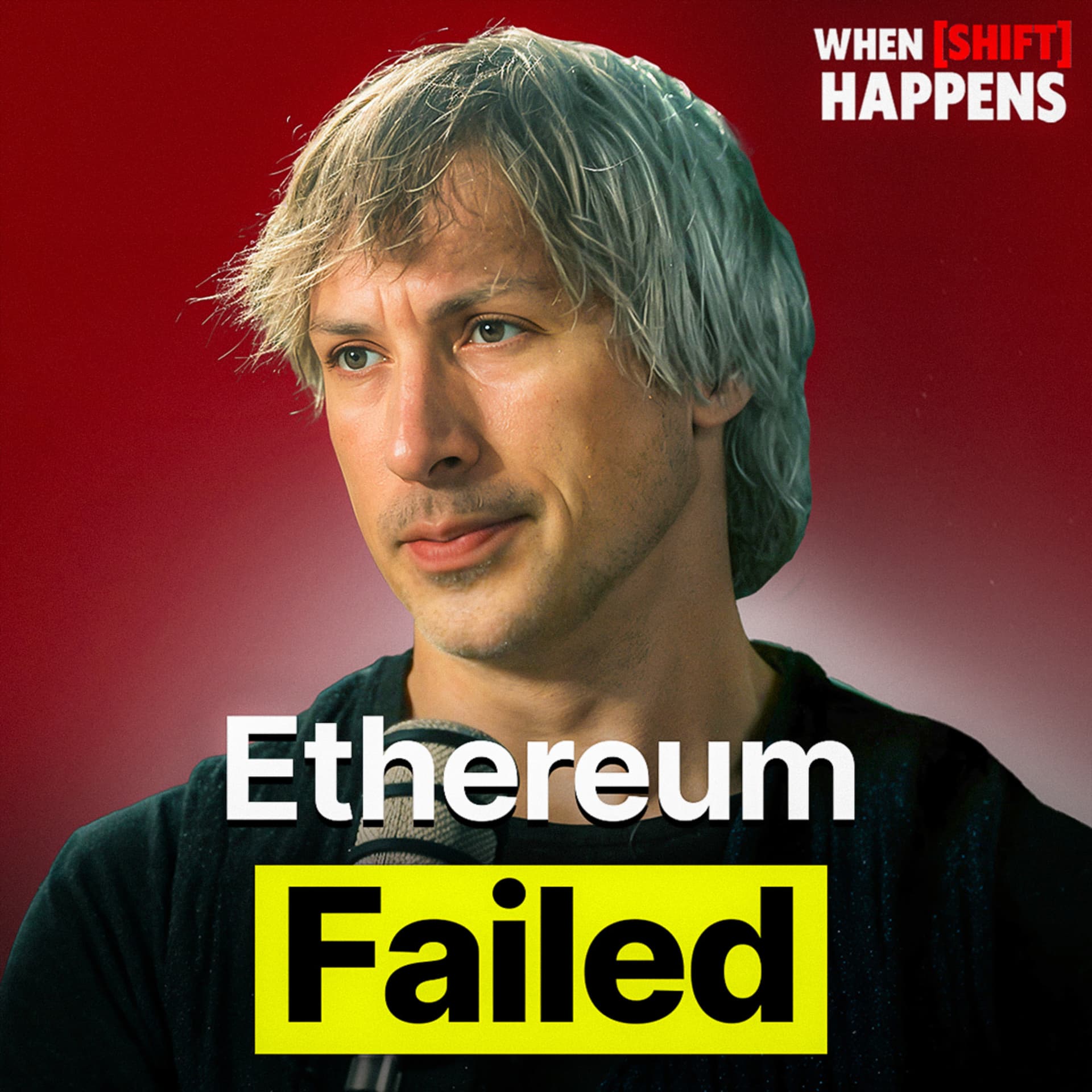
Overview In this episode, Gavin Wood, co-founder of Ethereum and founder of Polkadot, discusses the failures of the crypto industry, particularly focusing on Ethereum's approach to Layer 2 solutions and the broader implications for the future of crypto.
Key Themes
- Failure of Crypto's Original Mission
- Gavin expresses that crypto has strayed from its foundational ideals, resulting in a shift towards mainstream banking practices.
- He identifies the rise of meme coins and ineffective Layer 2 solutions as symptoms of this failure.
- Ethereum's Layer 2 Approach
- Criticism of Ethereum's Layer 2 (L2) strategies, which he argues lack a theoretical foundation, merely responding to market pressures from influential projects.
- Gavin labels this approach as a significant misstep, exacerbating existing issues within the Ethereum ecosystem.
- Self-Custody and Sovereignty
- Emphasis on the importance of self-custody in crypto, highlighting Trezor as a preferred solution for securing assets.
- Discussion around the notion of self-sovereignty relates to governance and individual responsibility.
- Critique of Governance Models
- Gavin critiques blockchain governance, stating that it is often opaque and ineffective.
- He compares decentralized autonomous organizations (DAOs) with traditional governance, arguing that DAOs can offer better alignment of interests.
- Future of Networks and Collaboration
- The need for crypto networks to work together rather than compete, overcoming tribalism that can hinder growth and adoption.
- Importance of Curiosity and Adaptation
- Gavin stresses the need for curiosity in both personal and professional life, believing that adaptability is key to success in a rapidly evolving landscape.
Detailed Insights Ethereum's Issues
- Inadequate Strategy: Gavin argues that Ethereum's execution of Layer 2 solutions has faltered due to a lack of coherent philosophy and has succumbed to political pressures from established L2 projects.
- Consequences: This misalignment threatens Ethereum’s overall utility and could potentially lead to its obsolescence in favor of more effective systems.
Self-Custody and Decentralization
- Personal Responsibility: Gavin advocates for individuals to take charge of their digital assets, arguing that understanding how to self-custody is crucial to protecting one's wealth.
Governance Problems
- Current Model Flaws: Gavin points out that many governance models in crypto don’t adequately empower participants or ensure accountability, leading to mismanagement and inefficiency.
- DAOs as a Solution: He sees potential in DAOs offering more democratic and participatory governance structures, although they too face challenges.
Collaboration over Competition
- Network Cooperation: Gavin highlights the necessity for different crypto networks to collaborate, suggesting that competition can lead to inefficient use of resources and missed opportunities for collective growth.
Curiosity and Adaptation
- Key to Happiness: Gavin shares his belief that maintaining a sense of curiosity and the ability to adapt are essential for personal fulfillment and professional success in the tech space.
Conclusion Gavin Wood’s reflections on the current state of crypto reveal a critical perspective on its evolution, emphasizing the need for thoughtful governance, effective collaboration, and a return to foundational principles of decentralization and trustlessness. As crypto continues to develop, the industry must prioritize innovation over the superficial attraction of quick profits, ensuring it remains true to its core ethos.
Recommendations
- Stay Informed: Follow developments in crypto governance and Layer 2 solutions to understand their implications better.
- Engage with the Community: Participate in dialogues and forums to share ideas and collaborate on innovative projects.
- Prioritize Self-Custody: Learn about self-custody tools and practices to secure personal crypto assets effectively.
Written by AI. May contain mistakes. Listen to the episode to check what was said.
Transcript
Automatic transcript. May contain errors.0:00In crypto, there will be winners and losers, but one thing I can definitely say is those that are capable of rationally changing their course are much less likely to be losers. If we want to maximize the chances of not being a loser, then we have to be adaptive. Does that mean that Bitcoin is at risk? Dr. Gavin Wood is the co-founder of Ethereum. Creator of the EVM and Solidity. And the founder of Polkadot. A protocol securing and connecting sovereign blockchains known as parachains. Accessing crypto is a weird thing. It's more about Sparkle and Dogecoin. For me, success, I want to see utility.
0:34I don't want to see just vapid nonsense. And parachains are able to do useful stuff. Are parachains and Layer 2s the same thing? Turning Ethereum into just a roll-up compromises the product proposition of Ethereum. Product pieces of Polkadot was to essentially sort of beat it as own game. And I think to a large extent, we did. As crypto failed. Going down the path to obsolescence and assimilation into the establishment that it was created as a backstop against, yes, definitely. To say it's failed implies that it's over and we have to evaluate it. Is Ethereum layer 2 approach an execution failed?
1:11Yeah, I mean obviously. Why? It didn't have any theory behind it. It was just a response to large individual projects that didn't want to see their reason to be collapse. Is Jam good for the Polkadot ecosystem and for DOT, the Polkadot token? I think...
1:3369 % of the people who watch this podcast have not subscribed. If you enjoy this show, if it provides value to you in one way, shape, or form, can I please ask you a little favor? Can you click that subscribe button, give this video a like, and leave a comment down below? It helps this show more than you can imagine. My goal is to bring the absolute biggest and brightest people on this channel. And the best way to get there is to have all of us rally together and build the When Shift Happens family. Thank you. This conversation is supported by Jupiter, the most used decentralized trading platform on Solana and the largest DAO in the world.
2:06Castcard, my go-to card to spend my stable coins directly with my Apple Pay to buy anything, food, coffee, or plane tickets without having to use a bank ever again. Bitwise Asset Management, the crypto specialist asset manager with more than$10 billion in client assets and more than 30 crypto solutions across ETFs, index funds, alpha strategies, staking and more. 3. A scalable layer 1 blockchain that's fast, secure and affordable, built by previous Facebook developers and that delivers the benefits of Web3 with the ease of Web2.
2:54It's actually the card of a project called Cast that enables you to spend your stable coins. So it's kind of like a stable coin bank. Very useful. I use it a lot, actually. I mean, I live my life in crypto. It seems less long than you, but I live my life in crypto, so this is very helpful. Don't have to go through the off-ramping. Well, they do it for you. What's the charge? How much do they take from you? That's a very good question. So I think they're using the visa rate. So basically, from what I understood, if you spend USD, it's close to zero. But any other currency, it's 2%, 0.5 % for them, 1.5 % for visa, which is pretty expensive, but they have this, I mean, like most protocols kind of starting, they have this point system where I think it's about 6 % to 10 % cashback.
3:44So basically you kind of like save on that, provided that the token when it launches keep a valuation that is what they're kind of advertising to calculate the rate. Six to 10 % cash back. Yeah. But given in their token. In the token. Yeah, of course. Of course. It would be beautiful to be in cash, but it's given in the token based on a valuation, I think of the new round that they're raising at, five or 600 million valuation. And hopefully the token launches, it does well. And the dollar value stays the same. Right. For the cashback. I mean, it's a, it feels like a, a, what's it? Impossible, like motion machine.
4:36Where does the 6 to 10 % cashback come from beyond speculation on the token? Like what is the tokens? I mean, the main point of the token is that they get 0.5 % in foreign, foreign spends. is there anything else in the token i'm not too sure yet to be honest about how the token the tokenomics uh i'm not sure i'm not sure if it's out yet but uh i mean i would say like as a with i would say the product is extremely useful because it's very simple you just spend right it's just spend your stable coins done nothing else and so for the moment i just use it a lot to spend my stable coins and then hopefully the token does well.
5:18But I would say from something I wrote a couple of days ago was, I don't have a problem paying a fee. You asked before, I mean, 2 % is a lot, right? Obviously, and I told the founder and he says he knows, but it's because Visa gives a certain rate and it's probably gonna get better through time. But if you have something that is really useful and making your life better, you don't mind paying fees, which is the complete opposite of all these protocols incentivizing people with points and farming and all that stuff. Actually, I don't care about the farming token. I care about if this makes my life so much easier and I don't have to go and off-ramp my stable coins or my crypto, which is such a pain and nightmare and they ask so many questions, then I'll pay a fee and I'll be happy with it.
6:05And I think we don't have enough projects in crypto that make things simpler where you're just like, I don't care about paying 1 % or 2 % as long as my life is easier. That's true. I mean, if it's a delivering utility, this is certainly, this can be worth paying for. Although you have to offer apps still, right? You have to offer apps to stables. It's funny. I was talking with Raoul Pal. This, what are we today? Monday. So last week I was in Dubai and I recorded a conversation with Raoul and he said, stable coins? Why? who has stable coins so basically similar mindset i mean the thing is they are banks at the end of the day there'll be usdc is a bank usdt is is now becoming a bank like you know they're all just ultra regulated centralized banks that's very true i mean i would argue that's one of the thing that makes them more trustworthy for normal people like not like the very crypto punk mindset but for sure for sure it's uh yeah i know plenty of normal people that have had their accounts blocked it doesn't just affect crypto cypherpunks this happened a lot with uh tech founders too right yeah but i mean i know i know literally normal people that just happened to have you know bought a bit of ether in 2014 in 2019 which was not 2014 i got banned from revolut which now offers crypto because I was sending too much money to Coinbase, right?
7:38From Revolut to Coinbase. And too much money was like 10 ,000 pounds. And it was 2019. So I'm still banned. I'm banned forever. I mean, it's crazy, but this is what regulation means. That's the unfortunate thing. And as more and more of crypto becomes regulated and sings the right tune while they're doing it, Essentially, this is the destruction of what crypto stands for. This is just the assimilation of at least part of crypto into a traditional banking establishment. What's the right balance? I mean, if you want mass adoption. It depends. This is always difficult because it's like, what do the people want?
8:28but you know what i want is less trust more truth i don't want to have to rely on arbitrary opaque oftentimes whimsical decisions made behind closed doors to affect my life yeah but that's what that's what regulation means unfortunately that's what i've that's what i've experienced that's what i've seen others experience and that's what um you know philosophically it does not protect against that's what that's what it does that's what it means if you trust others realistically they will they will be able to screw you over and then as as much if you don't know these others and if they have any reason to screw you over they will screw this was the basis of the web 3 manifesto right this is the basis of that document i wrote it's like one of the first lines it says you have to accept that in a world where you know we all trust these opaque arbitrary I'd organizations individuals and they will screw us over they will screw you over if they can marginally benefit from that there's no accountability is there still a word or possibility where your vision believes?
9:49Again, it depends what people want. And I think as increasing amounts of traditional, like not traditional even, post-war global order crumble, people may very well change their tune and want something that is less based on the trust of institutions that really do not have the best interests at heart. what happens to you if we get to this world where that's not the one that you envisioned are you living am i living i don't know somewhere i hope are you living leaving oh i'm leaving yeah um um i don't know look i mean a lot a big part of this is um for me is curiosity right always has been it's what sort of got me into a theory in the first first and I think the curiosity for me at least it's still there but it's you know curiosity and satisfying curiosity is very different to leading a project so I'm not sure if I would I would say I would lead if I even do but I would but would it mean my curiosity has gone no probably not you know in my in my opinion this is still a very interesting space um and you know my curiosity is not yet satisfied dear when shift happens family the following message is probably the single most important thing you should take away from today's podcast if you're serious about your crypto investing journey please take some time to learn how to self-custody your assets to make sure that nobody can take your coins away ever if you don't learn how to be your own bank, it is very likely that one day you will lose all your hard-earned crypto.
11:43The safest way to hold your crypto is in a cold storage that we also call hardware wallet. Hardware wallets are not complicated and they give you peace of mind. I personally use a hardware wallet called Treasure. It is open source, very easy to use, and the first hardware wallet created ever. As we like to say in crypto, not your keys, not your coin. You can order your Treasure wallet with a 10 % discount by following the link in the description down below and by using the promo code WSH10. And now back to the episode. If you had to explain what it is you do and why you do it to someone who's never heard the words sovereignty or Web3 before, what would you say?
12:24It would be a hard question. That would be a hard thing to explain. And I would have to sort of, you know, One liner is less requirement on them to trust other people to live their lives benevolently and more of an ability for them to see firsthand the aspects that they need in order to live their lives benevolently. So it's less trust, more truth, right? And I would take that further if I had the time, I don't know if I did, but if I were to have the time and I wanted more of an explanation, then I would really try to help them understand that it's foolish to believe that society is some sort of, a free society cannot be one that has arbitrary, unaccountable actors that you have to interact with.
13:26in order to conduct your life in any meaningful way. That is not a free society. That is simply a form of authoritarianism. And if that is what they think society is, if that is how they expect to live their life, then they must accept that they are living in an authoritarian system. Now, might be that they are happy living in that authoritarian system, might be. And it might be that over time, their opinion changes as that system becomes more and more arbitrary, less and less reliable, less economically stable or economically viable. But what I think we cannot avoid is that this kind of way of living life is an authoritarian one.
14:18It's an authoritarian environment. And I think it's a much better thing to be living in a free society than an authoritarian society. You're a huge proponent of self-sovereignty. That's exactly what we're talking about. Why? Why do you think that it's much better to live in a free world than an authoritarian world? Because there's probably many other people who first don't even ask themselves the question, or second actually because they don't, most people don't like to take accountability. So to do like, I'd rather give this power to other people, even if you think about retirement, all these things, right?
14:59Most people, I would say, don't take charge. Sure. I think they're idiots. I think they're fools. I think they are gambling with their own, and to some extent, to the extent that society is governed by the ignorant majority. everyone else's futures.
15:25Democracy only works if individuals take note of their surroundings, of their environment, of the way of life, of how they live, and of what their leaders do, of how their government conducts itself. It fails quite fast, we will see, I expect, if people ignore that. And people, I believe, have been ignoring that for quite a long time. I have little time for such people. Was the moment in your life that made you realize, no one is coming for us, or no one is coming for me, and I need to take charge? I've generally had a pretty, I don't know why, but I've generally had a pretty strong distrust of authorities like i've not generally found authorities have acted gone out of their way to act in my interest i've had good teachers you know and to the extent in the western world as a kid teachers are pretty top on the list of authorities uh my parents were never particularly like bad to me or anything but so i don't i can't really explain it i guess it's just maybe it's a you know, an outlook I was largely born with.
16:41But I saw no great reason for people I don't know to act in my, to go out of the way to act in my favor. Why would I? I don't know. I still don't know. That's a very rational way of thinking, actually. Therefore, why would I trust a system that implicitly assumes this? It's funny you mentioned teachers, because that's directly what I thought when I was asking this question. And I also, also all my life was thinking like, I don't know, this person is in front of me. They never left school. And yet they're teaching me about business and life stuff, but they don't have any credibility. And I felt that all my life.
17:24And then I was thinking, that's why when I discovered Bitcoin, I mean, much later than you, late 2018, and I read the Bitcoin standard by Safedin Amus. I just, it just made sense directly because the reason I started building businesses 10 years ago was I don't trust anything works, right? So you can probably do everything a bit better. And then this Bitcoin Standard book just opened my eyes. It was actually, if you were kind of like, I don't want to say anti-system, but you don't trust any system when you read that, it makes so much sense. And you're like, I love that. Someone who understands me.
18:00Indeed. I haven't read the book, but I vibe with your conclusions from it. He explains to more, I would say, less technical people and more normal people like me why Bitcoin makes so much sense, basically. And he explained, I think 80 % of the book is not about Bitcoin, it's about the evolution of money. What's hard money? What's sound money? What's unsound money? And why did we go from feather to stones and silver to gold, etc. And why every time it didn't really work. and then why Bitcoin makes sense. So yeah, when I read that, I was like, man, this is, I feel like I'm part of these people. Now I feel like I met some people by reading that who also don't trust anything.
18:47What are the most basic requirements that must be met for an individual to become self-sovereign? I mean, in principle, it is the ability to have control over one's own destiny, right?
19:04I would say, I mean...
19:13I'm not sure if it's a black and white thing. I think it's more of an attitude. There will be some people that will never be able to reasonably become self-sovereign. I mean, maybe any of us. Just because of the environment they live in. The fact that, you know, they'll be shot if they're in North Korea and you want to become self sovereign, good luck. So I think really it's more of an attitude, more of something that one either aims for or one doesn't.
19:48Oscar Wilde quote, we're all in the gutter, but some of us are looking to the stars, right? I don't think any of us will truly attain Perfect self-sovereignty, but some of us will push to try to get it Especially when there is low-hanging fruit and there is some low-hanging fruit these days for example use crypto All right, I mean if you must use stable coins But like, you know be aware that this isn't very self-sovereign, right? Probably the rules governing stable coins are a little bit less arbitrary at the moment than those governing banks. You are a bit more, you have a slightly greater credible belief that you will be able to spend your stable coins than you do if you have your money in banks.
20:45But I think, you know, it's still not that credible. And I think we, you know, Bitcoin, fine um other cryptos interesting um each with their own merits i suppose you know be aware of uh of those cryptos um and any potential like set of authorities that could have arbitrary uh control over the cryptos that you might not know about and i mean there's a lot of centralized cryptos right dino cryptos decentralized name only right where it's um you know holding these cryptos and believing that you have self-sovereignty over some of your economic power is bullshit right it's as bullshit as putting your money at a bank and believing the same thing but i do believe there is still low-hanging fruit i believe there are cryptos i mean bitcoin is a classic one right where it's like yeah there's a there's a protocol that specifies a fixed maximum supply you have a pretty reasonable idea over the uh wealth distribution within um within it in that you there isn't probably isn't a founder that you know an active founder that holds vast quantities of it um what else can you do i guess move to a country that you know respects sovereign rights as best as possible as good as well as possible or start your own fucking country um you know find a militia that want to uphold rule of law come up with some rule of law that makes sense for you and the people you want to live around and yeah, find some land and go for it.
22:24I mean, you know, it's an age old idea, particularly in crypto. But yeah, I think there is some appetite for that, increased appetite for this that I see these days. I see like free cities, ideas popping up all over the place. America particularly has some, has a few of these projects now in various degrees of development. And we see a little bit of this also in other places in the world, especially those that are not that free in and of themselves. Dubai springs to mind where you've got like, you know, sort of a bit of a hybrid system going on where foreigners have some, you know, the government has set up kind of some support desks for foreigners that are having trouble with maybe arbitrary decisions being made that they feel are unfair.
23:13or just incompetent operatives within the civil service or whatever. So I think there is some desire for this. And I don't think self-sovereignty has much... Self-sovereignty is about escaping arbitrariness. It's not about living outside of rules. There are rules that we have to live with, rules of physics, right? rules of economics. These are non-negotiable, largely. I mean, in crypto, you can try and run away from the rules of economics for a while, but they will catch up to you eventually. Terra Luna will happen to you eventually, right? If your tokenomics are not sustainable. Cryptography, right?
24:02But more rules. Maths, right? There are rules that you are going to be required to live by. Self-sovereignty doesn't mean having no rules. It means knowing what those rules are, understanding them, and not being placed under an arbitra, an arbiter that you don't know, right? Not being placed under arbitrary decisions, not being placed under
24:31whimsical authorities. That's a big difference. You mentioned a bunch of individuals who are pushing for that. You and your friend Ed Hess are part of a group of 50 to 60 founders who gather every year to ideate on sovereignty, I think in Patagonia. What's one of the wildest or most exciting ideas that has emerged from those gatherings? I can't really say. My memory is quite foggy from the gatherings. But I think on the face of it, the ideas are pretty sort of sensible. I mean, they make sense to me anyway. I think the nation states that I'm most familiar with are based on nonsense aggregated over, if not many decades, centuries.
25:31Oftentimes based on a lot of arbitrary behavior by individuals or organizations of individuals, religion in some cases, with a lot of fossilized laws that make no sense but are still on the law books and occasionally enforced if the whim of the present government decides. I think there needs to be a dramatic rethink of the social contract in this modern age. An age becoming ever more distant from the society that most of these laws were created for. I mean, you know, the internet, I mean, so media, like TV, changed it dramatically. The internet changed it further dramatically. AI continues to change it further dramatically.
26:36And, you know, we are living one's life in society today, particularly Western society, is almost unrecognizable, I would say, from living one's life in Western society, in my grandmother's grandfather's time. Almost unrecognizable. And yet, somehow, it's still, I think, to some extent anyway, people's expectations that the laws should remain, or the social contract should remain more or less the same. I don't see this. And I think this is the basis of those discussions that we have, right, in Patagonia. It's like, can we rethink the social contract to something that is relevant, given what technology is now around?
27:27You mentioned before, start your own country. What's your thoughts on the work of Balaji Suinwezen regarding the network states? I wasn't aware of work. I know the book. I don't know if there's doing much specifically in order to make the book more of a reality than it's already being made. I mean, you know, I think the concept is a interesting one. I don't know, you know, I know it in passing. So I wouldn't want to go into, I couldn't discuss it in detail. But from what discussions I've had around the concept, you know, I'm kind of ambivalent. I think it's kind of sensible. We have the internet, We have increasingly self-sovereign systems on the internet, systems that transcend national, international sovereignty.
28:35At the end of the day, a large amount of sovereignty can only be secured by physical security, physical means, territory, in a word. Like there is Even one of the I would argue I don't know if this is One of his examples But I would argue like the Catholic Church As an obvious example Of a network state Pretty you know An old one But Even the Catholic Church Felt the need to have a bit of territory Right not very much and certainly not very many compared to the number of citizens it has in its sort of network state i think this is sensible and i think i think if we do hope to create sort of network states that go beyond what we kind of have at the moment which is daos and crypto
29:39um then we need to sort of get real on the idea of of having a um a territory on which which upholds the rules that the members of the network state wish to hold themselves to. So you would still qualify Solana, Ethereum, Polkadot as sort of network states? Well, I don't know. I didn't invent the term. So I'm not sure if they do under what the book and the sort of the requirements set out in the book. But for me, and this might be apocryphal, if that's the word I mean, I would say that a network state can start with as little as a crypto. I think it's only a very weak network state, but the fact that Bitcoin introduces rules for those who sort of opt into Bitcoin to follow and respect and the fact that if you disregard the rules, for example, by hacking your client to make it show more money than you really have, then you are in effect excommunicating yourself from Bitcoin because a hacked client will not synchronize with the network.
31:00So it's a very weak network state, but it is, I would say, in my mind, it passes that lowest threshold. And then as we get more and more sophisticated means of, well, sophisticated rule systems, and sophisticated means even of adapting those rule systems over time, the concept of membership, like explicit membership, then we sort of flesh out more and more of the organs of this sort of network state, create a more sophisticated network state. But ultimately, in my mind, it's still, like it doesn't necessarily have to be a state that literally everyone in the network state lives and this i say i say is not important this is probably a key difference between a network state and a regular state but i would still say that uh people want to live some i want to live somewhere that i feel i belong right and how do i end up you know there's a few there's a you things that you know make me feel i belong somewhere one of them's to do with food and drink and others to do with language um and others to do with friends where my friends and family are but one of the big um big big things i would say for me at least and i suspect for other people is um you know the overall um social contract that you're taking part in like the rules of society both those that are written down and those that are just part of unwritten expectations that you have of other people and that other people have of you.
32:41And I think it's a very strong thing, a strong desire, a strong driver to want to belong somewhere. And you can't really do this, at least not in the physical sense, which I would argue is like most of it, if there is no territory for you to potentially go. Let's remove maybe the state part and talk about networks, crypto networks. How do we overcome, because you mentioned before, you said the goal is freedom. We're getting with all this regulation into a world where there's probably less and less of that. And probably one of the ways that we can potentially still get there is having these different networks work together instead of competing with each other.
33:35The current problem we have today is that there's competition between Solana, Polkadot, Ethereum. They're competing for the same users, the same liquidity, the same developers. How do you overcome that to get to the next level where these networks work with one another to grow the pie? This is very, very hard. This is a hard problem.
34:08So, in principle, I believe it's solvable, but the inertia to get to the solution is immense. Because, like, we have turned what should be a technical solution, what would be ideally a technical solution, into, like, a football league. With everyone having their own team colors and some people ready to tooth and nail fight with the other team after the match. And extract blood.
Read the full transcript
34:48This is not a conducive environment for working together and trying to enlarge the pie for everyone.
34:59What are we left with? Possibilities, consolidation, hard to imagine in crypto.
35:14Founders trying to somehow come together again, kind of hard to imagine. founders are under immense pressure to perform according to their protocol's adherence. Anything that looks like they're collaborating, quote unquote, with the enemy could be construed as weakness. Is there anything like that happening now? Some potential collaboration behind the scenes? Not behind the scenes, only what you see, right? So there are projects that are tacitly using other projects, technologies. You know, it's not all bad vibes, but it's nonetheless is very hard. It's very, very hard, especially when it makes, when it calls the token's own sovereignty into question.
36:05Essentially, we have these different football teams. And who's ever heard of a football team merger? I mean, I haven't. I don't think it exists. Not yet. Right?
36:24Technically speaking, like in terms of technology, I think it's a solvable problem. The way I would solve it is separate the network from the token and have, thank you, have both tokens be, or have all tokens that reside on the network, be capable of being used for all things. So the tokens retain their individual identity, and potentially even some of their tokenomics.
36:59Yet, they are, to a large extent, fungible at a floating market rate. This is sort of not unlike how existing currencies work for nation states. The main difference is that people would be free to sort of move around the different nation states frictionlessly and take the basket of currencies with them and have everything just be sort of automatically switched according to what makes most sense when they actually need to spend.
37:40And I am vaguely thinking about this. This is an interesting problem to me. Seems to me a very hard one.
37:51And this has direct relevance for PokéDot. I mean, at the moment there are two distinct currencies within the PokéDot ecosystem, PokéDot and Kusama, right? Separate networks, separate currencies. and it would be cool for these to be more closely aligned like it would be cool if they were not in principle sort of competing currencies and it would be i think a really good um demonstration of this and you know if i think that it's very interesting to imagine um i mean i get asked this a lot right i get asked oh there's a new protocol jam are you gonna have a new currency right now And the answer, of course, is like, no.
38:36It's a protocol upgrade for PokerDot. But it does make me think. It's like, is this something people want? Why are they asking? Are they wanting a yes to this? I have a question linked to that later, obviously. So my feeling is, well, you know, before I consider that too deeply, I would want to think, I would want to have a plan for how, multiple different L1, if you want, base layer currencies would work, would cooperate with each other and not just become inevitable competitors, right? Different football teams. And this is, yeah, this is something that's, you know, on the back of my mind. I think about it sometimes.
39:28We talked about networks, network states, nation states, and the key to a network or an organization to function or dysfunction is obviously governance. Blockchain governance today is often opaque, even in giants like Ethereum. What's the root problem and how can we fix it?
39:53So governance is an interesting one. What is governance? It's essentially how a system or the mechanism by which a system evolves over time, how a system can change itself over time. You don't need governance if the system is never expected to change. So Bitcoin, there are some in the Bitcoin ecosystem that argue Bitcoin needs no governance because what Satoshi Nakamoto introduced those years ago was perfect. He wrote a paper on it. It's perfect paper. It doesn't need to be changed. It is what it is. Let it be. Now, I don't think that anything any human produces is perfect. And therefore, I think everything should probably, if we want it to be successful in the long run, provide some means for it to evolve.
40:46I mean, there are some things that come close to perfection, right? The mocha, coffee thing from Italy. This is pretty classic design, right? What else? The Eames lounge chair. Very good. Classic design, right? There's a few things that have really hit this local optimum, but not many. And you've got to be pretty fucking self-centered to think that you have managed to create something that is at this local optimum. I'm not. And therefore, I think it's best to play on the safe side and make something that can actually evolve over time be flexible. So then we have to create governance, which is a whole crazy bag of worms that is difficult to do well, I would say.
41:42It's an unsolved problem. It's an unsolved problem in human society. It has been unsolved for many millennia. how do we manage it well you you know at least with polka dot it's like let's try and codify how the system should decide to evolve over time and autonomously enforce that um and this is you know this is the polka dot i mean it's called various things open go of the polka dot dow um but it's this is the basis of polka dot polka dot's governance and it's why polka dot has governance really i mean there's a few other things like having a treasury and so forth but um by far the most important thing is controlling how the polka dot how the polka protocol evolves over time the polka network i should really say evolves over the time and ensuring that it can evolve autonomously.
42:45I would say this is an opinionated decision. I think it's a good one.
43:01But it is opinionated. And there are those in other ecosystems that think differently. I had a chat with Vitalik that we met several years ago now, before Polkadot launched. We talked a bit about this. I think it was in Singapore on a local forum or local panel. and the uh the opinion presented to me was that um you know governance shouldn't be on chain it should be behind sort of closed doors and pretty arbitrary and rough consensus and all of these you know woolly phrases and words um that was That was the view that he presented to me. I mean, this is going back seven years, so I wouldn't want to represent it as his view now.
43:54And this didn't make sense to me. In my mind, we have a rules-based system. Now, we might not know the optimum means of deciding what those new rules should be. But at least if we codify them, there's a sort of default that we can measure and experiment with. We can't do that if we don't codify them. Like, we will only get to some sensible end point if we make the first step, you know, if we start by trying to codify how the rules should alter over time. And we can't just, you know, ignore the problem. The problem exists, whether we like it or not. And centralizing this and putting it under a very opaque, sort of closed framework, and pretending that it's got a name and a theory behind it, I don't buy this at all.
45:05And I even reference this quite strongly in the fellowship manifesto, this idea of papal governance, where there's the sort of unelected pope, or non-popularly elected pope that basically decrees things, but does so largely with listening to their cardinals. I think at the moment it doesn't matter so much but I think in the future it might matter a lot do you think a decentralized autonomous organization DAO can truly work truly I mean that's a hard one because it depends how you define work but can it work as well as the best alternative that we have absolutely absolutely why Why? Because the best alternative that we have is just a crappy DAO.
46:08It's just a vague DAO, right? It's a DAO that can break, that can be corrupted, that can disregard its own rules quite easily. Well, yeah, that's a crappy DAO. A DAO is just a rules-based system, a rules-based collective. So we have a bunch of individuals. They hold themselves to some rules, some laws of interaction. and how they'll decide to administer, presumably, some collective resources or some collective privilege.
46:43There are all sorts of different sort of human structures that we evolve over time, whether it's small company, corporate, militaristic, government style. There's a lot of different types of these things. But at the end of the day, they're all just rules-based systems. And they're with varying degrees of adherence to those rules. And usually these rules-based systems break over time if those rules are not adhered to. That's usually the risk. The risk is not that the rules are bad. The rules are the things that have evolved over decades or centuries in order to be good. The thing that's bad is that people don't actually honor the rules.
47:33Now, this is not entirely the full story. Of course, if you go to places like Germany, they honor the rules a lot as part of the culture, very strong culture of honoring rules. But oftentimes, the rules are suboptimal. And so you end up with people honoring rules that are not sensible.
48:00But there are excellent examples of countries that have the same rule honoring, but also have optimized rules. Like actually, the rules change according to the circumstances of the world, according to new technologies, right? Switzerland is a good example of this. And I think that's largely because Switzerland is a much more heavily decentralized country. Therefore, it's a lot easier for the people that the rules affect to go through the feedback loop and change the rules than it is in a much larger, more centralized country where the effective levels of accountability are much greater. and that feedback loop is much more remote, much longer.
48:50The rules don't change so much, if at all, and you end up with people that still honor the rules but they're just dumb rules.
49:02Still, if we assume that, I mean, I think we can, that systems can evolve over time, those rules-based systems evolve over time intentionally like they do in sensible places, then what we really want is a way that we can ensure that all of the various components of the machine, of the human machine, follow the rules. And that's basically just what DAOs give us. They remove the arbitrary nature, the authoritarian nature that our kind of half-assed rules-based systems have in the real world. So no, I absolutely believe DAOs are just a better version of existing human organizations in exactly the same way that I believe that cryptocurrencies are, to a large extent, just a better version of existing human currencies.
50:04I've been thinking about the Swiss example quite a lot because I'm Swiss. and it works and I've been thinking why does it work and I feel like it's because Swiss people in the culture are very reasonable but I don't feel like a lot of people in this world are very reasonable there was an example once many years ago where Swiss people were voting whether to have six weeks of holidays per year instead of five and then Swiss people voted against that and then the french people would come and say how the what's wrong with you guys right and you can see it's because they're very reasonable and they understand they understand the the consequences of like long-term decision making right which for me as a swiss person i'm still always like even in that that specific case i was really impressed i'm thinking like these people are i don't really know how it's working it's probably just because people are very reasonable right i think it's not just that i think it's also that people take a um they have a stake in society so they're able to think on both sides both their individual advantages to to this which you know presumably you would on the individual side you would want the six weeks um but also on the social side to this and on the social side maybe five weeks is better because you know there's a lot of you know people will do more work and it'll be more i don't know internationally competitive and the economy will be better and you know it's it's i think you have to have stake in the society of sort of true belief of shared fate for you to make sensible decisions and you know what we do this in polka voting that means people who are more locked in to the repercussions of their decision have a greater voice.
52:06I think this is crucial. I think one of the big things that's missing from a lot of democracies beyond, you know, this short account, this short feedback loop, so basically localism, is a very indifferent attitude towards wider society, right? It's like people don't really want to look after their country anymore, their society anymore. And I think because they no longer identify with it to a large extent. Probably because most don't work. It's probably easier to identify to your own country when you realize, hey, it's working, or at least it's working better than the other ones, than if you feel like you're getting screwed by taxes or there's no safety or you're basically struggling every day.
52:53Yeah. The social contract is really crumbling in many Western societies. I think this is a big problem with, you know, if you expect democracy to work, you've got to uphold the social contract. If you don't uphold the social contract, democracy ain't going to work anymore. Behind every organization, even if it's decentralized, they're humans. At the end of the day, humans are greedy, self-interested. Most think short-term and some are corrupt. How do you prevent a DAO from becoming corrupted and infested with short-term thinkers that could work with each other in a manner that ruins the overall long-term goals of the organization?
53:38This is basic game theory, right?
53:43In essence, you design the game in order to utilize what you know about the players, what you know about the participants, to achieve what it is that you want the system to be. So to achieve the system goals. Now, this is a difficult problem, but it's one that game theorists tackle routinely. We know that players are selfish, greedy, oftentimes thinking on a very limited time horizon. And so we design games, we design the rules of the system to take advantage of those things that we know or that we believe, right? And as I said, one of the very simple examples of how Polkadot does this with its governance is it introduces a concept of conviction voting, which weights votes according to how long the participant is locking themselves into those repercussions for.
54:50The longer you lock yourself into the system, the more voting weight you get. So it's not really a democracy.
54:58It's not even really corporate governance. In that case, what is it staking? How long have you been staking your token for? Or what's the concrete example of how you... It's literally the lock. So you place a lock on your own tokens such that they cannot be moved to any other address. Can't be sold. for a particular period of time. So it could be up to, I don't know, a year and a half or two years or something. And if you go for the maximum limit, then you get five times as many votes. Six times, I can't remember exactly. As if you do it just for, I think, a month or a week, depending on which network you're on, because Sama is different to Polkadot.
55:38And if you don't want to lock your tokens at all, you still get a voice, but it's a very small. It's like a tenth of what you get if you lock your tokens up for the minimum period. So it's really about,
55:51you have to understand the participants and what drives the participants, absolutely. And what drives the participants can be totally different to what it is that you want to achieve from the system. But by setting the rules cleverly, you can use, it's kind of like the wind, it's like sailing. The wind might not be blowing in the direction you want the boat to go, But by being very clever with how you position the sail, you can take the energy from the wind and go in whatever direction you want. You might not go as fast as the wind is blowing, but you will still always go in the direction that you want to go.
56:30And to use this, you have the, what's the effect called? I forget now, but it's the same one that wings and planes use. Bernoulli. Bernoulli. Bernoulli principle. Bernoulli principle. And in game theory, we have various other principles that we can utilize in order to take the wind of human decision making, individual human decision making, and turn it into the motion of a stable, well-aligned, long-term system. On the governance side, would you say that Polkadot is a success?
57:15um it's mixed it's a mixed success i would say it's not a i would not say it's a failure i would say it's um and some excellent data was collected in order to understand um the limitations of the present design for open gov and to understand how we might alter that design in order to get to improve decision making but it's always going to be
57:50we must always compare it to the alternatives
57:55and I don't believe there is a better alternative yet I mean I'm not I haven't done a literature review of all current governance systems in crypto and real life. But from what I know, there is no better governance system that achieves the goals that we need to achieve, one of which, of course, is that it's not centralized, that it's not based around a single organization or leadership. Without strong governance, this Android system collapsed into chaos if you could wave a magic wand and fix one thing about how polka.works today what would it be?
58:59I would make it entirely shielded. What does that mean? Stick everything in ZK. So put everything, make everything totally anonymous. At the moment, Polkadot is entirely open. Like when I vote, I do so with my account, like my public, the account has all my funds in. And it's easy enough for people to track exactly what any particular individual is doing, as they just look at the different accounts and sort of see what that account is doing and the various different things.
59:51This has repercussions. this has repercussions which affect the game theory in difficult to predict ways and that's unfortunate when we vote in a democracy in the western world we vote anonymously this is crucial um we don't do that in polka dot that's a problem it's a difficult problem to fix because um polka dots uh governance is quite sophisticated and quite particular. And the more sophisticated a particular logical systems get in ZK, the harder it is to generate and verify proofs. But nonetheless, as a long-term goal, I think it's a reasonable one. And maybe it's something that we'll see collaboration with some other projects on.
1:00:43I understand the logic of being anonymous and the advantages, but there is also advantages of being transparent. For example, people know what people are doing versus I would argue, maybe it's too naive, but I would argue if it's anonymous, people can come together. People with a lot of weight can come together without other people knowing it and it's not really decentralized anymore but people don't know it because it's anonymous. Yeah. So I think I see what you're saying.
1:01:28If I understand correctly, you are asserting that there may be particular individuals in a system that control a large amount of or wield a heavy influence. and it is what you would like or what you think is good for the system is if those if it is known which individuals have heavy influence over the decision making um and the reality is that um no no system provides this no system um western democracies don't provide this because it's impossible to measure beyond polling, beyond the vote itself. It's impossible to measure who has influence in any even time, right? There was once upon a time we could maybe look at newspaper readership numbers and have a bit of a guess as to which, you know, or news channels or political shows.
1:02:35But really, it's very difficult to measure. measure in any accurate fashion. It's not possible to measure generally in crypto, not because the systems are shielded, not because they're behind ZK, got very little to do with that, just because they're pseudonymous. Like no one knows if there is a single person in Ethereum that like, you know, in the crowd sale, maybe had a few million to spare and decided to buy up 50 % of that crowd sale ETH and now controls vast amounts of this multi-hundred billion dollar economy. It's impossible to say, but it's not unrealistic. There were definite Bitcoin millionaires in 2014 close to the Ethereum project.
1:03:37It's not unrealistic at all. zk doesn't help like zk didn't they don't need zk yeah um but zk does help the lesser the the sort of smaller participants and it does help certain apparatus of governance for example fellowship governance right the technical fellowship. Without ZK, it's possible to see who votes for an upgrade and who doesn't. And these are verified identities. And if the upgrade ultimately turns out to fall foul of a particular nation state, they could go after the individuals that voted. Now, in theory, they might go after all of the individuals who could vote if it's under ZK. But this quickly becomes a yak shaving exercise as we increase the number of individuals that get some sort of say.
1:04:42It makes it a lot harder for this attack to happen.
1:04:50Now, I'm not necessarily against introducing rules that would identify individuals and attach, you know, say a quadratic multiplier to their voting weight, thereby reducing the possibility of individuals influencing an outcome too much. Now this is something that a community would have to agree upon, right? How much is too much? And should it be quadratic weighted at all, or should it just be a requirement to disclose? I don't think it's helpful in any voting to identify the individuals. I think this is not helpful. I think it can be helpful to identify that there are individuals with substantial influence over the outcome and potentially reduce that influence.
1:05:56Potentially. Not sure about that. This is only going to be possible with proof of personhood. So you first have to have some sort of sensible Web3 proof of personhood before you can embark on this. Just using account identifiers is quite easy to work around with a bit of scripting knowledge.
1:06:30and once you have proof of personhood I think the solution is pretty easy and it's just about finding an agreement between the participants in the system we talked about a few hard problems what's one of the absolute hardest problems that every network founder faces
1:06:56I mean I don't know there's a few
1:07:03poker always played it very sort of safe with regulations and regulatory authorities opting to have a opting to listen to them where they were clear about what it was that they wanted and having a rich discourse when it maybe wasn't so clear and trying to find a path forward sort of together of course that was in the old days everything's a little bit different now so i think there is there is that and i think other founders may be i mean i i think i'm a very different personality to to many other founders. I think if I had gone down the same route that they had gone down, I would not get nearly as good a sleep as I do.
1:07:58You sleep well? I think pretty well. I mean, I've got a like one and a half year old, so not always super well, but that has little to do with regulatory authorities. Another one, of course, is trying to please everyone. And there are a lot of different people with different desires. And sometimes, you know, oftentimes, you have to decide who it is that you're going to please and who it is that you're not going to please.
1:08:48and
1:09:01sometimes insofar as found net you know these network founders are retain substantial leadership you have to be quite clear about what the mission is and what the mission isn't like what are the goals what are the non-goals
1:09:20and i think this is this can be very difficult this can be very difficult because you know that there are some people that not much gonna like what it is that you have to say if it is the way that it is i was on the plane coming here and i saw the there's a it was in emirates and there was the documentary on vitalik you're actually in there and it talks about the beginning of ethereum and this moment of do we do non-for-profit or do we build a company right and the arguments and that's probably one of the these big things where there's this massive disconnect between the people who are involved and at some point there's a decision being made that's not gonna make everyone happy obviously i recently talked to anatoly yakovenko the founder of solana on this podcast he told me i suck at management i hate managing people how much do you relate to this 100 110 i mean i don't get me wrong i've got a great a couple of great teams around me that I work with daily
1:10:36for the two sort of projects that I'm involved with Jam and Crew for Personhood but the wider I don't view this as management and I'm not really even managing them in both cases there is sort of someone else that looks after the sort of day-to-day. I just do work. I'm just someone who is productive. I find that it is a really hard problem, and I never really understood management. I really haven't. I still don't. I'm lost. I'm lost in management. I know what I like. right i know what i want to achieve myself and insofar as i find people that share a passion for doing that then i work well with them but i think that's not what management's about and yeah i'm happy to let others who are obviously you know have a better grasp of this than I do that task.
1:11:57You created a fellowship for Polkadot's development after your departure. Why do you think about your departure from Polkadot? Well, I mean, my departure was from CEO of Parity. And the reason that I stepped down as CEO of Parity was in part because of that last question. and it was in part so I could do more work with Polkadot.
1:12:31Creating the fellowship gave me a clear, I don't know, means role within Polkadot
1:12:47that meant I could, in some sense, transition from CEO of Parity to, you know, Grand Architect of Polkadot, like into the DAO.
1:13:06and you know this this was very good I like this this was you know better dog fooding but you know very good very good for me and I think also good for polka dot how do you measure good for polka dot I mean how do measure good for me and good for polka dot well good for me in that I felt that I was doing something that I was capable of, that I was creating value.
1:13:42Good for Polkadot meant that simply the parity could, so parity is a key force within the Polkadot ecosystem polka dot is stronger if there is not no such i mean a key force also double-sided sword it's also a key risk polka dot is stronger without key risks and the more that i was by being ceo of parity i was in essence enforcing and buttressing this key risk um and by moving away from parity being one of several in moved away from parity but into polka dot into the dao um i believe it gave it it gave polka dot a better manifestation of itself rather than have polka dot in essence use parity as its manifestation or accidentally use parity is it manifestation?
1:14:46So I think this is better for Polkadot. Whether it's better for parity is a different question. Maybe, maybe not. But for me and Polkadot, I think it was. How do you personally handle the tension created between your vision for Polkadot and the decisions of a decentralized governance? The moment you leave and you're not the CEO anymore, things might not always go the way that you envisioned. How do you deal with that? Well, I'm not the CEO of Polkadot as it stands. And not being the CEO of Parity shouldn't make any difference. Right? In theory. Parity doesn't exert. I mean. Parity has a limited influence over Polkadot's direction.
1:15:36Substantial, but limited.
1:15:41And it's quantifiable. through open gov you can quantify precisely how much influence parity has
1:15:52it is not an authority over polka dot and with jam that will be underlined there will be many different technical teams that are all capable of upholding the jam network parity will be one of one of many um as for open gof yeah there are sometimes decisions it makes that i think are not particularly sensible but i mean where where i have a strong opinion i usually do i usually vote and a lot of the time i accept that i don't have that much i mean certainly i have in the past I accept that I don't have that much of a clue over, you know, promotion, how to promote a cryptocurrency. Like, I don't know how to do this.
1:16:40I'm not an expert in crypto promotion. Yeah, I never have been. And I hope I will never have to be. It is just not something that I find I want to do or be.
1:17:02Insofar as it coincides with teaching and musing and being curious and researching, I'm happy to do stuff that results in a similar effect to, you know, promotion. But promoting for promotion's sake, no. And there are a lot of the, at least more tenuous,
1:17:43controversial spends on OpenGov centered around promotion. And there are other things that are centered around team management. It's like there is a team that wants to do X, Y, and Z, and they want some money for doing that. And again, I'm not a manager. I don't really want to be a manager. And you know what? I'm not the only person that has a stake in polka dot. So I'm happy to sit some of these decisions out.
1:18:12And if people are upset at that, then they probably need to go to a more authoritarian protocol. Because I refuse to be the authority that sits in the background or even the foreground and makes all of these fucking decisions. It's not my job. I am one of many. Bitcoin has Satoshi. Ethereum has Vitalik. Serena has Anatoli. One way or another, whether you like it or not, Polkadot has Gavin. You said, I had some help from your friend Ed on this one. You said networks should not have charismatic founders. I want to challenge that. how can a network rise to the top and stay at the top without not only a charismatic leader but also a cult leader hey i mean you don't have to but i think there's clear examples of um non-charismatic leaders at the top right bitcoin doesn't have a charismatic leader but it's still a cult ah okay that's different For me, cult is even higher than...
1:19:26So there is the charisma and then there is the cult, which is like even stronger.
1:19:33I think... I think Satoshi Nakamoto, as an example, demonstrates it's possible to be a cult leader without... Or even a cult figure without being in any way charismatic. But you think this can be reproduced? Yeah, sure. Why not? I mean, I don't know. I don't want to name any names because that's a bit harsh. But I see some other examples in crypto that have non-charismatic leaders that have somehow managed to attain a bit of a cult following.
1:20:13And I would say quite honestly that Satoshi Nakamoto is It doesn't even really come into leadership, right? The proposal was put forward The Bitcoin white paper and some source code And then he bowed out That's not really leadership Right? It's Yeah, maybe people wrote some comic books about him And, you know, there's a bit of a sort of cult thing. But I don't see that many... I think people follow Satoshi Nakamoto and respect him as a cult figure only in so much as they respect Bitcoin. It's just a vehicle for that. Now, if people want to respect Polkadot by respecting Gavin Wood, fine. I don't really care.
1:21:02I mean, I care if they start, you know, kneeling at me in conferences or whatever. but like that's that's too weird but uh you know as long as it's like you know polite and doesn't make me feel uncomfortable then it's like yeah sure whatever but i honestly think that if a protocol is about the leader not about the protocol itself like if people follow a protocol because of a leader, not the protocol itself, we're back into football team territory. And this is the biggest, this in my opinion, is the biggest thing that will prevent crypto to peacefully consolidate into something sensible. Yeah? There'll just be fights.
1:21:47Like if the charismatic leaders create, in essence, competing. Echo chambers, yeah. Well, yeah. But yeah, echo chambers in that they kind of, I look upon systems as kind of biological cells, right? Social systems. I find it's quite often quite helpful to sort of see analogues in biology. And social systems will tend to create what I kind of call a sort of social cell wall, right? It's kind of like you're in or you're out. And then there will be some kind of means of making decisions, oftentimes authoritarian, right? The thing that guides this is sort of DNA of the cell.
1:22:31and we have in crypto an accidental cell wall which is the currency the token right it's like if you hold it you're in if you don't you're out and people hold themselves to this they don't want to support a crypto that they don't hold if they have for some reason they don't hold it they automatically don't support it if they do hold it they automatically do support it right they don't they don't have to think about it. Which is kind of sad because this is arbitrary. This isn't rational decision-making, this is arbitrary decision-making. And insofar as they look toward a leader within this sort of cell, this social cell, to make the decisions, we haven't really progressed beyond what we had before Bitcoin, right?
1:23:22Arbitry leadership and blind sheep following them. Well, that's not what I want to... I don't want people, you know, putting my... using my picture to represent this particularly. I don't think this is sensible. I don't think this is... So to the extent that I can fight for, look at the protocol, not the founder of the protocol, I will. I don't want to be that leader. Like, you know, I see tech leaders out there that obviously do. Well, that's not me. How do you envision Polkadot evolving without you? OpenGov, the fellowship.
1:24:01And how would it, what would it do? I don't know. And in some sense, I don't, I don't like, I don't care. I kind of do care that it makes good decisions without me. but I don't I wouldn't sort of prejudice it by by saying what it is that I think those decisions should be and to some extent I don't know what they should be like I don't it's not like I have a big long list of everything polka dot should do and be in my head um like I don't a lot of things I have to sort of decide um based on you know the changing environment and that's as it should be. Like, Polkadot was always meant to be flexible and adaptive because it doesn't have a founder that believes they are.
1:24:51Their imagination and vision is perfect and all-encompassing and accurate and precise and comprehensive, right? And any founder that says that they do is probably bullshitting or delusional. Yeah. So it should be adaptive. And I don't know what it should adapt because firstly, I don't know. I don't have all questions answered. And secondly, I don't know the future. And it will inevitably have to adapt to some changing environments. One of the big changes was the alteration in the US, not regime, administration. And this had a pretty dramatic effect on crypto. And certainly people's attitude, I think, towards crypto.
1:25:52We saw a sort of similar sea change when China brought in controls against crypto. and a large part of the crypto market was kind of if not locked out certainly put off and we'll no doubt see changes um in the coming years that will alter the environment crypto lives in and lives under um and crypto will have to there'll be winners and losers but But one thing we can definitely say is that those that are capable of sensibly and rationally changing their course in these changing times are much less likely to be losers than those who cannot. There will be some accidental winners, for sure. If we want to maximize the chances of not being a loser, then we have to be adaptive.
1:26:55We have to be, to some extent, rationally adaptive as well. Does that mean that Bitcoin is at risk?
1:27:04If the sole purpose of Bitcoin is to not change? I don't.
1:27:13Long term, yes. What's long term? Difficult to say. And we must remember that for a currency, like banking, like gold, a huge part of it is its pre-existing acceptance and assumption by at least the rich parts of the population. So insofar as Bitcoin has achieved that over other protocols, over other currencies, it's not at risk. And as long as it can defend that place in people's minds, it's not at risk. But that's a very special spot, right? Default currency, right? There cannot be that many default currencies. One that, you know, gold to some extent achieved. And even gold, we must remember, now it looks pretty sensible to be holding, right?
1:28:18It's gone up a decent amount in the last year or so. But there was a time not that long ago where everyone was like, oh, gold. So such a, you know, it's old news. It's gone. It's had its day, right? We move beyond gold. Yeah. For like 2010, 2020. Precisely. Brown's bottom. Yeah. and um i think we i think we are slowly moving beyond banks in our minds in our collective minds as being the places that are most trusted to store our wealth uh or administer our wealth but it is look after our wealth i think slowly this is changing when i think at least for myself where would i want my wealth to be if you know widespread conflict breaks out in the world and uh i don't i mean there was once upon a time switzerland would be an answer on many people's lips this is this to some extent i think is again a little bit of a passé, particularly since Switzerland gave up a lot of its sovereignty to the, you know, sort of Western coalition of whatever, the post-war financial order, international order, states, America being the leader of it.
1:29:56but also Europe seems very keen on preserving this. And in doing so, sort of got rid of its anonymity laws, got rid of a lot of its privacy laws, punched a hole in them. And I think these days, I wouldn't want to move away entirely from banks as someone with a bit of wealth, but I don't think I would want to put all of it in banks by a long stretch.
1:30:30And I think if that's, maybe I'm a bit of a trailblazer on this, but I think I'd be surprised if there are, if this is not a relatively widespread belief that comes in over the next generation or so. And I think it's the same concept as gold, right? It's like there is a feel like there's a reason people like the idea of having a bar of gold under the bed. It's like it's something that, you know, to some extent they can count on. They can trust. It's not even trust, right? It's like or if it is trust, it's a very, very, very diffuse trust. because there isn't a human organization that in principle has control over their assets now.
1:31:23The gold is there, it's under the bed, and they have a strong, rational, credible belief that it is exchangeable for goods and services across the world in and of itself. And to the extent that cryptocurrency can sort of be digital gold, I think we are, as humans, starting to move beyond banks. You mentioned Switzerland and Swiss banks. before and some people in the last few years have been saying that bitcoin is a swiss bank account in your pocket and i think this makes more and more as you say sense to new generation i've definitely feel like that and i feel like the new generations is going to become very very logical for them like i don't see how it doesn't i i agree um i think it's i think we are We're getting there.
1:32:16The question in my mind is, you know, to what extent? There's a lot of different points on the spectrum, right? There is the stable coins At one end right where it's it's basically a bank. It's just that your bank account is administered on chain But it's still the bank that holds your your money they can arbitrarily block your account right it's still an it's still an arbitrary authority that's in that's in principle in charge of your will um versus on the other end i don't know i guess bitcoin maybe is probably the best example of something that is least likely you know least likely to arbitrarily change because there's a lot of inertia behind the protocol.
1:33:06And there is also the most amount of time that it's been around for and not changed significantly. Like it's stabilized, it's matured. And where you fall on this spectrum, I don't know. Like, I don't know where the next generation will zero in at. and maybe they'll just go into meme coins or some other bullshit. I don't know. You mentioned before, you said, I don't want to be marketing a coin. Promoting. Promoting. So I have a question on tech versus marketing. Okay. The VHS versus Betamax war was a key moment in consumer electronic history. Not the first time I've had this brought up to me. I have some help here from your dear friend.
1:34:03Oh, yes.
1:34:07And this story resulted in VHS dominance despite Betamax initially being the superior technology. Betamax developed by Sony offered better video and audio quality. But VHS released by JVC was ultimately favored for its longer recording time, lower production costs, and wider adoption by film studios and rental stores. Overall, VHS had an inferior technology, but one due to better marketing and distribution. One of your core beliefs is that the best tech must win. Is it possible that the best tech does not win in crypto? No. And why? Why? Why? I will... So this example, so firstly, there's a couple of holes in it.
1:34:58The first hole is it wasn't necessarily the better technology. It might have been a more sophisticated technology, but there were legitimate advantages to using VHS. As you said, longer recording time and cheaper production costs. These are legitimate advantages. These are things that technology, good technology, should provide. Yet for Betamax, they didn't provide that. Their technology may have been more sophisticated, but it didn't help the product achieve what was needed to be achieved. Now, I don't think that better technology equals more sophisticated technology.
1:35:47So that's the first thing. the second thing is vhs fell to dvd dvd was obviously the better technology right um it's not that oh so many people are using vhs now will never change from vhs now people upgraded they just upgraded once it was clear that the difference the upgrade difference was enough a time came when the technology was better enough that the upgrade made sense. And I mean, this is the case for computers, but on a much smaller timescale, right? So people upgraded from an 8-bit computer, like a Sinclair Spectrum or a Commodore 64, to a 16-bit computer, like an Amiga 500 or an Atari, to a 32-bit computer or games console, like a 1200 or a PC, to a 64-bit one, and so on.
1:36:52It's like upgrade cycles are not necessarily once in a generation. They can be quite often. Now, within the same cycle, it may indeed be the case that one,
1:37:11that a technology comes a little bit later such that the earlier one sort of gains enough share to sort of push the later, push that one out. But it can also go the other way. And you only have to look at games consoles to get an idea of when this can happen, right? The Dreamcast launched a little bit before the PlayStation with Sega believing that by launching earlier, they would get that initial market traction and put Sony at a disadvantage. But in reality, Sony, the PlayStation, through simply being better technology, right? I mean, a better product, you can also say, but a product enabled by better technology actually became way outsold the Dreamcast and dashed Sega's chances of ever doing hardware again.
1:38:07The third thing I'll say is that marketing is a lot of different things. I went to business. I studied business at school. I wasn't very good at it, but I studied it. And one of the things that we learned was marketing is, I think it's the three Ps. price product promotion yeah um
1:38:36in crypto marketing is often mixed up with promotion now i'm not that interested in promotion i don't understand promotion i really don't and i think actually not that many people do it's a really tough one to understand how to promote your product it's basically communication but you have to have a really good idea about who your audience is. So I try to focus on the other two. And the other two, to some extent, are technologically enabled, right? Technology enables low price. Technology enables certain features in a product that wouldn't otherwise be possible. I'll give you an example. In Polkadot, by focusing on technology and creating parachains, We can have high security, but also provide a vast transaction throughput that retains its bandwidth, its throughput, regardless of what else is happening on Polkadot, regardless of any of the other parachains activities.
1:39:46And this is not something that is very easy to achieve. And you already see, like on Solana, if, for example, a certain well-known US figure launches a meme coin, it can have a detrimental impact on doing anything else on Solana at the time. The same happens on Ethereum, right? In the old days, if you did an ICO, you had to be very careful about what time you picked to do the ICO because if you accidentally had it overlapping with another ICO, then you'd kind of screw yourself potentially.
1:40:27these are things to be cognizant of now sometimes we pick sometimes you have to make a judgment call over what elements of a product you want to prioritize and what elements of price you want to whether you prioritize price over product and what parts of the product you want to prioritize and sometimes you make the wrong call because you don't understand where things are going or because to set off down that line of technology, you're not going to have anything to show for it for like two, three years because it's a significant investment. And you don't know exactly what people are going to be after two to three years time.
1:40:59So generally, it's best to stay flexible and try to do the things that you believe other people are going to have greater difficulty in doing than yourself. Understand your own core competencies. And that's that's largely the spot that i come from um it's do it's solve the tough problems because the tough problems are the things that will need solving anyway and there's surely a product in there like if you solve a tough problem you're going to open up a number of different product directions like it's not that believe it's not that like creating um you know polka dots parachains and and elves right this this system by which you know we can have dramatically huge amounts of of trust-free computation and bandwidth um it's not that this was a necessarily a great product in and of itself and i think there is some argument that that it did enable directly certain um certain products but um did immediately and directly create certain product or make possible certain products but i think as a base layer as a as an as an enabling technology there are all sorts of other products that it can potentially enable.
1:42:16I'll give you an example.
1:42:23The concept of doing laser, like creating consumer lasers, this is something that, you know, was pretty niche,
1:42:40up until the 80s. And then Philips came out with a CD. And it, on the back of that, enabled a very important piece of technology, a very important product. The same technology, a few years later, 10 years later, enabled a second product. I mean, more or less the same technology. They had to change the color of the laser, but basically the same technology. Enabled DVDs. I went on to enable Super Audio CDs. Went on to enable Blu-rays. Went on to enable... Before then, these mad Laserdisc things, like vinyls, CD vinyls, but had an MPEG-1 film on. And this all comes basically from understanding how to shine, how to create cheap lasers and shine a laser at a metal surface with holes in and measure back whether there's a hole there or not.
1:43:41Very, very, all of this stuff, this was solved for the CD and reused time and time and time again for other products. Changing the form factor a little, making it bigger or changing the laser color or making the holes smaller, but basically the same technology. Well, that's kind of what the sort of theory is with Polkadot. It's like, we've done the hard thing now. We've made the first CD. Now we can tweak things to make great products with this technology. But we can't make the great products, at least not the products that we think are ultimately people are going to need. If not, if they don't even know they want it, they're going to need it.
1:44:26until we've made this enabling technology.
1:44:34Now you've got, in America, there's a bit of a different mindset, right? America, Silicon Valley, very Silicon Valley, sort of dominated. And the mindset is much more incremental. And it's like, focus on what people want right now. If people want Facebook for dogs, build Facebook for dogs. It doesn't matter if it's not that valuable to humanity. It doesn't matter if it's going to be superseded by something else in 12 months time. Give people their SOMA. Develop what people say they want, what you believe people are going to pay money for right now. And I mean, that's fine, but it's not, this isn't what excites me.
1:45:19um i'm not yeah i think i would have quit long i quit quit this industry long ago if that were if that were the task that i would have to do just basically give people the next 12 months product like the next facebook for dogs you talked about facebook for dogs and before you said maybe the next generation will store their wealth in bitcoin or maybe in some bullshit meme coin. If you had 100 lives, is there at least one of those 100 lives in which you'd understand why a fart coin has real long-lasting monetary value attached to it? Because in the world of internet, fun and stupidity drives attention and attention drives liquidity.
1:46:10Has real long-lasting monetary value attached to it because in the world of internet, fun and stupidity drive attention and attention drives liquidity?
1:46:33So I think it is important for stuff to be fun. I don't know how important it is for stuff to be stupid, but you know i can certainly see that um part of fun is goofiness and this is especially important in a world that is as fucked as ours right now it doesn't take much to look to look at like you don't have to look around yourself so so much to see despair and darkness and malice and hatred, right? It's becoming kind of the norm. The hope that was the sort of suffused society, or at least sort of my society, in the 90s with the fall of the Berlin Wall and the Iron Curtain and freedom being given to so many people and being relatively bloodless and da-da-da.
1:47:39This is kind of gone, right? This is generational gap material, right? And what we're dealing with now is just, for want of a better word, kind of hopelessness and resignation. And I can see why fun and goofiness, it's a type, it's a form of escapism. I do not believe this is the basis of a particularly sensible global financial framework. I mean, maybe, you know, the markets kind of disagree with me on this, but at the moment. But I don't. I mean, I think it's a society losing touch with reality. And I do not think it's, I think it's a bad omen for sure. I think it's a bit understandable and I'm, you know, doing my best to sort of rationalize it.
1:48:50but I do think there is some nugget of of of a lesson in here and that is make sure your products are easily engageable with make sure they're fun and make sure they're on the right level for the participants and this is a little bit something that we're sort of taking to heart with the polka dot app but i think it's um it's particularly something that we will that that i'm thinking about how uh and sort of comparing to and um uh kind of cross-referencing with for the individual the individuality the proof of personhood um um app um because i think this is really where we can make something that teaches I guess the meme coiners a thing or two.
1:49:51You like the tech so let's talk about the tech. You're the co-founder of Ethereum, the creator of the Solidity Language and the Ethereum Virtual Machine and you're also the founder of Polkadot So you're probably one of the best persons to answer my tech questions on Ethereum and Polkadot. Ethereum has something called roll-ups or layer twos. Layer twos have led the entire Ethereum ecosystem into a sort of existential crisis, especially because layer twos extract value from the layer one. Polkadot version one or 1.0 has something called parachains. are parachains and layer tools the same thing we are starting to try and coalesce the terminology in part to try to help people properly frame polka dot parachains is a is at risk of being a jargon term like something that just is a black hole in terms of semantics, in terms of meaning.
1:50:59Mainly because it only applies within the polka dot world, which is a relatively sort of provincial area of the industry. They are different, or rather they're implemented in different ways. And I think conceptually they're very sort of different um there's a different intention behind them polka dot is uh its primary purpose is to be is the host roll-ups right host these l2s if you like these power chains um that was the product proposition of polka dot um it's actually less the product proposition of jam and one of the few reasons that i could see for making jam a sort of different thing to polka dot would be because the product proposition is different polka dot's product was parachains um and as polka dot evolves it evolves with parachain the parachains are evolving but they're still very parad it's still very centered around parachains jam is not jam doesn't make any mention of PowerChains within its protocol specification.
1:52:18And my concern with that would just be that it would be easy for people to disregard Jam on the basis of the assumption that it doesn't change any aspect of the core Polkadot product, which is PowerChains. anyway compared to ethereum um the l2s extract value from the l1 in ethereum's case in large part because the l1 is not about being purely a roll-up host ethereum is a smart contract chain it aims to host smart contracts that do all sorts of things dexes and nfts and bullshit meme coins and all the rest of it
1:53:06by moving these things into the L2, turning Ethereum into just a roll-up chain, it compromises the product proposition of Ethereum. I mean, it alters it. And in principle, it may like ethereum is not a particularly well optimized roll-up chain i think um last time i checked um if the roll-ups are all zk roll-ups then at present with the current sort of gas meter gas stuff i think it can host about 40 45 roll-ups um and maybe that can change down the line, maybe it can host a few more. And this is one aspect of rollups I should hasten to say. It doesn't do availability. So basically it manages the correctness of computation, but it doesn't handle any of the sort of data availability stuff.
1:54:20From the get-go, Polkadot tried to create the best, like I could see this already was, the writing was on the wall, right? I could see this already happening in the Ethereum ecosystem, or we theorized that this was already going to happen. And so the purpose of, or the product thesis of Polkadot was to essentially sort of beat it as own game and come up with a much better version of this product. And I think to a large extent, we did.
1:55:01The...
1:55:07Thank you. Or at least, no, I think to a large extent we did. Now, I think Ethereum had a significant advantage through First Mover, right? And it had a significant advantage through market capitalization. And I think it also, there were a few other sort of, it's not like, I mean, you know, Polkadot had its own smart contract language, yet it didn't have its own smart contract chain. Ethereum sort of did sort of have its own smart contract chain because the L1 could host smart contracts. Polkadot, it never did that. And so there was a, I think,
1:55:52these were the three things that Ethereum sort of had that Polkadot didn't have. And in the last case, this is something that we've sort of hastened to change with the Polkadot hub. So introduce a Polkadot native smart contract environment that works fast. And I think this is something that Solana realized quite early on. It was like, ignore roll-ups. Polkadot's got that covered, right? Zeroing on the smart contract. Hub, vibe, just basically. This is for smart contracts. We're going to process 10 times as many smart contract transactions as Ethereum. Move your stuff here and then do a lot of promotion.
1:56:37I think, and that's fine, but as I've spoke about at length, that's not a long-term thing, right? That's a give them what they want for the next 12 months thing. Long-term computation has to be distributed. There's no other way of doing it. You have to scale out. You can't scale up to use Silicon Valley's own term.
1:57:06adages against it and i think um one of the other key sort of tech differences the distinctions that i'd make between what polka dot's power chains are and what ethereum's l2s are is that because polka dot provides a custom made parrot like roll-up um chain like the polka dot um relay chain It's able to very quickly and efficiently transmit messages between its constituent chains. Ethereum, because it didn't really do this, like it's sort of an accidental roll-up chain, it's really a smart contract chain that's just being used or abused to host roll-ups, it doesn't have this functionality and it's going to be hard to retrofit it.
1:58:06And I think this also is a key difference, in large part because it forces its L2s into silos. So they become less, they inadvertently extract more value from the L1, because the L1 can't provide it with the connectivity to the other L2s. So basically that value disappears into one avenue, one L2, and it's kind of stuck there. In Polkadot, dot that disappeared, dot that goes into, I don't know, Acala, is still immediately transferable into Moonbeam. So the capital flows a lot easier between the L2s and take four days for the capital to get from A to B. And this, I think, is a crucial difference.
1:58:56So you're saying you theorized or anticipated the future problems that Ethereum would have? with layer twos and then you came up with this concept of parachains. Would you say that the concept of Polkadot parachains was a success?
1:59:19I would say the product, the parachains product
1:59:29um had a or has some significant has demonstrable value in the market and i think it's something that people are willing to uh take a punt on and pay money for and i would draw attention to those projects that i've been that i know have been um heavily uh lobbied with very large checks from other L1 chains to join their ecosystem and that have refused on the basis that what they want to achieve is simply not possible, that they care about the platform they're on and the technological possibilities that platform gives.
2:00:17I don't think that's true across the board. And I think there are plenty of people coming to crypto that don't care that much about their product, that look upon it as a reasonably easy way of making a bit of extra cash, and are happy to take 30 mil up front in order to sign on the dotted line, for example. A little bit of extra cash. right and it's uh it you know it's this is this is unfortunately promotion this is what counts as promotion in this industry and it's kind of it's a bit sick in my in my mind it's like you know but it i guess to some extent it works it's not generally the way that that we roll in polka dot we try to actually provide what we believe is the right technology and we try to find the teams and the and the um the products that are to be built on polka dot on the basis of those that are actually going to use polka dot that need polka dot yeah because there are many that don't if you want to launch a meme coin you don't need polka dot right i mean you can probably do it without screwing up the rest of Polkadot, if it's a big one, more than you can without screwing up the rest of Solana when launching it.
2:01:54But for the people that launch meme coins, I guess they don't really care about what's going on in the rest of the network. So it doesn't really matter for them. But no, I think the parachains product in and of itself has shown substantial success. Unfortunately, success in crypto is a weird thing, right? It's more about fart coin levels. That's what most people in crypto, when they hear the word success they think oh fart like success like fart coin and dogecoin right um but i i i think uh you know for me success is a bit more of a um traditional sort of um Warren Buffett kind of mindset. I want to see utility.
2:02:51I want to see meat and bones. Like I don't want to see just vapid nonsense. Like, and if, you know, it's not why I'm here to build vapid nonsense. Like I'm not, I'm okay with people building vapid nonsense on my stuff, but like that's not what I'm going to design the systems for. And parachains are able to do useful stuff. If you look at what frequency is doing with the decentralized social network graph, if you look at what Mythos is doing with in-game assets, these are things that you just can't... They're replacing centralized services that are doing what people consider useful things, legitimately like holding virtual assets, holding the ownership of virtual assets that can be used in game.
2:03:57Borderline maybe. It's still like fun and games, but still, I think it's reasonable. It's a major industry and it's not it's a mature industry as well um decentralized social network graph it's doing something that would otherwise be handled on centralized servers um social networking again mature use case so yeah i would i would definitely argue that the parachains product is being put to substantial use and cannot you know can be rightly regarded as a success not in the fart coin way necessarily but in the Warren Buffett way what's a better alternative to the parachain model I think there are some things that are just you know they belong on their own chain they they don't need to interrupt interact with other data systems nearly so much as they need to interact with themselves They are very particular sort of domain specific systems or logic.
2:05:01I think it's, in these cases, it's perfectly reasonable to have a power chain. And maybe you're going to attach one core to it, and you're going to attach half a core to it, maybe you're going to attach 12 cores to it, right? Depending on how much throughput you need. And this is like Polkadot can totally do this, right? And this is a super exciting product for when this, what we call, I think we're calling it multi-core elastic scaling, fixed factor scaling. We've got a few different names for a few different products, but the basic concept is make your chain run faster, do more transactions, just pay for the extra cores when you need them.
2:05:45this turns polka dot from uh this completes the polka dot two transition and it in my mind can unlock um can be a significant factor in unlocking polka dot sort of tokenomics right the dot tokenomics are it's all about paying for parachains i mean you've got the staking and the governance but these are sort of self-serving things. Parachains is actually a particular, has strict utility, right? Outside external utility. But at the moment, it's problematic because we only have, we have like, I don't know, 45 cores and 45 parachains. It's like, and parachains can only use one core because the technology hasn't been launched yet that allows them to use multiple cores if they want to.
2:06:33And so basically the price, even though it's a market, the price tends towards zero because no one needs an extra core. There's only 45 possible purchasers. They only want one core. Like the supply is 45, the demand is 45. The price therefore tends to zero, tends to the threshold amount.
2:06:58But when we get an elastic supply, sorry, an elastic demand, the demand is theoretically elastic, right? There are chains out there that would love to pay more money, more dot, and have more cores, make their chains go faster. They exist. We know they exist. We talk to them. And they're willing to pay quite a lot more money, right? For them, it's, you know, they want to get more users. They want to process more transactions. They want to have cheaper transactions. And so they're willing to basically put up that money. But at the moment, they can't. It hasn't been unlocked yet. Technology can unlock it.
2:07:36Technology basically says, once we make this upgrade, you can use 10 cores if you want. Pay 10 times. Well, that's the thing. It's not clear it'll be 10 times as much, right? Because the supply is still fixed, but we're unleashing the demand. And that, in my opinion, is going to be a very interesting turn in dot tokenomics. When is that happening? Like I don't know in the next few is like a month or two away I don't know like this summer slash early autumn, but it's so it's it's around the corner the technology has already been deployed on West end the testnet and I think it is Currently in the process of being deployed on Kusama and then once it's there and operating okay It moves to poker but I think it's it's in the know in a small number of months like I was I think I said one to two I think I said one or two months in a slightly flip and tone a month ago.
2:08:36It's not far off. It's not my department, so I can't really comment much more, but if you want to tune in to the fellowship monthly calls, then there's an update on it every month. The ... ...
2:08:58... ... ...
2:09:02Jam is a little different. Jam doesn't have parachains. For Jam, the product is, it's sort of a stripped away the parachains product. And it has a rarer product, like a product that's like, in some sense, like it's less refined. It's less specific. It's less refined. but it opens up a vast amount more flexibility and already one of those pieces one of those sort of pieces of flexibility that was showing is we did you know a month or two back with a doom demo right this this idea of basically running any kind of code on chain not just blockchain code not just an l2 roll-up but like a regular pc executable i mean run windows on chain if you want that sort of thing.
2:09:55And this becomes very interesting, I would say. This, for me, as a curious person, as a curious dev, opens up a lot of avenues that I would want to experiment with. You're building Jam, joint-accumulate machine. We briefly explained Jam during our last conversation. Let's do it again. Can you explain Jam? Simply no jargon. Not really, no. I need you to be honest. I can't, no. And there's a reason why I can't. Jam is not a consumer-facing product. It's not a product like Fartcoin, right? And it's not intended to be. If you want a kind of-ish example of what Jam is without jargon, it's a little bit like taking Polkadot's technology and kind of crossing it with the Ethereum smart contracts, much more accessible sort of environment.
2:11:05When you mean accessible, you mean more developers from different backgrounds and different coding languages can come and join and build something? well ethereum didn't have really many different coding languages but ethereum was accessible because you could basically you didn't have to pay so much and you could send the transactions to the chain right and ethereum would process it you don't have to pay so much you could deploy a smart contract right and just sort of sit there and then if you left it for a year and then came back you could still send this transaction to it and do stuff with it um so it was accessible in that you didn't have to kind of be a parachain team, which is a substantial sort of technical investment, right?
2:11:45We've made it a lot easier than it was, but it's still a technical investment. You still have to, you know, creating a parachain is a non-trivial thing to do compared to creating a smart contract, which is relatively easy. Jam aims to move it back into the... So it takes Polkadot technology, but it averts the need to do your own chains, to create and deploy and maintain your own blockchain. Instead, you can use it much more like how you would use Ethereum. So you can easily just deploy code and it'll be there and just sort of sit there and then you can kind of use it. Now, there are some very key differences with exactly how you can use it that make it strictly more powerful than Ethereum, like a lot more powerful than Ethereum.
2:12:37But then I have to get into the technical details of how computers work, which isn't maybe so good. I'm going to end up having to use jargon, or at least technical terms. But at a basic level, it's Polkadot, but it can be used or interacted with in a much more ethereum like way but it comes with all the power and punch of poker in fact more so right it's it's quite a bit more i think it's like oh i don't know the numbers are substantial anyway eight to 60x more powerful than poker is right and oh like crazy amounts more powerful than ethereum is like a quadrillion gas was like a billion times more million a billion times more powerful something like that anyway very very much more powerful why why bother trying to make it so much more powerful when all people want to do is launch fart coin um well because if you have a crappy system people do crappy things the system implies the use case right ethereum was less crappy or well was to some extent like you know it had some um
2:14:08some flexibility some kind of power over what you could use it for more so than bitcoin so bitcoin what do you see on bitcoin well people used it for holding bitcoins and then they were used colored coins these kind of like early meme coin nft things um and that was about all they did well they used they had multi-six as well that was about all they did on bitcoin now theoretically you could use bitcoin for doing other stuff as well for doing a number of different um like um sort of smart contracts but people never did because it was so much of a pain in the ass like it was really not designed for that and it showed then ethereum came along and it was more designed for doing these like name coin style things like you have name registries you can have nfts you can have dexes right and we see a bunch of these sort of um things crop up on on ethereum but the use case is still quite limited right that ethereum is not directly usable for an awful lot of stuff you could probably name the major use cases on like 10 fingers and you probably enumerate them.
2:15:18There's not that much that happens of any significance on Ethereum. And then why not? Well, because it's too hard. Like it's not designed for that. It's not powerful enough. They're limited in terms of block gas limits. And then before long, you have to use something that uses Ethereum, right? So you use eigenlayer, for example. You put all of your actual logic off-chain on Eigenlayer. And then Eigenlayer uses all of its cunning stuff in order to just have Ethereum check it. And Ethereum, at the end of the day, all it's doing is a bit of CK work. Same with kind of L2 roll-ups. Ethereum ends up not doing the work itself, but just checking.
2:16:07This isn't necessarily so good for Ethereum.
2:16:12it's not necessarily such a great long-term plan for a thing and i think this was brought up quite recently in like in the last few months in the ethereum community it's like guys do we really want all of the value producing stuff to happen inside of an l2 that is not using eth as its token and uh yeah the answer was quite resoundingly maybe we don't want that actually And I think, you know, what we do with Jam is try to bring everything back to the L1. Like, really try to put everything in the quote-unquote L1. All that logic. And impart that. But allow us to scale to ridiculous levels. And in doing so, unlock use cases.
2:17:03Use cases that just aren't imaginable on Ethereum. Use cases that were similarly unimaginable on Bitcoin, but Ethereum kind of managed to own. Do you have an example? Oh, like DEX. You couldn't have a DEX, a modern DEX on Bitcoin. On Ethereum, it's trivial. But what could Jam do? This is hard because until you've got the system, you're playing around with it, It's like really difficult to imagine what it is that you could do with it. But as a simple like mad example, like you'd run Linux on it. Like run Linux on chain. It's like run a regular operating system. What does that mean? I don't really know.
2:17:49But like it sounds, it's crazy. But it could do. Like we have enough compute power to do this. You can run. So one of the things that I think is under...
2:18:05Like we've demonstrated you can run a game on-chain, right? Doom. And it runs through the game and it does all the computation that's needed and it has all of the data that sort of gets flipped in and mutated and moved back out again. And it also exports a feed of uncompressed video frames that you can watch in real time. And there's some lack, right? Some latency, but you can... The blockchain can output video frames at a sufficient rate that you can watch it without glitches in real time. And as I said, that's without compression. It doesn't use much CPU, much core within Jam. This might... I'm not sure...
2:18:46I mean, I'm kind of wondering if this might have some interesting repercussions within the sort of gaming world. Maybe moving... Maybe combining games with economic signaling. This could have an interesting impact. It might have to be combined with some cunning sort of L2 thing that can sequence stuff. Because with games, there's an awful lot of the importance is latency. So players want to see what other players have done and react to that. and the faster that they can see and react, the more, at least for some games, the more interesting the game is. But not necessarily for all games. Card games, types of real-time strategy or types of strategy games aren't so relevant.
2:19:37Like you can play Settlers and you don't really need to, you know, this game, Settlers of Catan. And you don't really need to have like, you know, millisecond by millisecond interactions with other players. It's not, that's not important. so i think um it would be interesting to try to imagine how um we might combine the worlds of crypto and gaming and it might very well be that you need sophisticated logic in order to do that in any sensible way um but i you know i'm i don't know i have to build it and play with it and then i can give you a better answer but i do know that it's a categorically different amount of computation that we're playing with different amount of storage that we're playing with it's like a different computer it's basically like spending your days uh messing around on like uh an amiga 500 sort of 16-bit computer and then someone then just giving you a pc and it's like this is 32-bit it's got 10 times the amount of memory and it's got a hard disk instead of floppy disk and it's got a floating point unit and it's like this is a just a fundamentally different beast to play on.
2:20:46I don't know what you can do on this that you can't do on that, but I am certain there is some. You mentioned before people from the community, from the Polkadot community, asking whether Jam would have a token or not. Is Jam good for the Polkadot ecosystem and for DOT, the Polkadot token? Yeah, I don't know. I would have hoped to say absolutely yes but um you know i look at ethereum right and it's like is it is the eth2 thing good for ethereum well since ethereum has sort of restated its commitment to doing quote-unquote native roll-ups and actually you know making ethereum good like increasing its throughput all the rest of it the price hasn't done very much it wasn't that apparently that That mental shift shared within the Ethereum technical community wasn't enough to make significant movements in the market.
2:21:44Quite the opposite. It's only gone down since then. It kind of marked the top of ETH BTC, actually.
2:21:53Uh-huh. So it's like, I don't know if it's good. Like, I mean, in my mind, it shows that, you know, the technical leadership behind Polkadot knows what it's doing, has a plan, and has a pretty impressive product that they're going to deliver in the not-too-distant future. I would say it's, like, pretty good for Polkadot. I don't know. Apparently, I'm out of touch. Love the honesty. I think it's very important. Has Ethereum layer 2 approach and execution failed? Ethereum 2 execution? Layer 2 approach. Layer 2 approach. Yeah, I mean, obviously. I mean, it's a terrible approach. Why? It was because it didn't have any philosophy behind it.
2:22:52It didn't have any theory behind it. It was just a response to large, influential, individual projects that didn't want to see their reason-to-be collapse because the layer one got good enough that there was no need for layer twos. It was an unfortunate decision by an unfortunate mind virus that somehow implanted itself within Ethereum's leadership. But you know it's it was in my mind nonsensical from from day one And it was just the it was just just the fact that there were it was pandering to incumbent
2:23:46Lobbyists in my point in my mind. That's how I explain it. I can't can't see this is like something that It's a big mistake right a really big mistake it was a year a years long uh decision that has now been reversed so it seems to me that this i can't believe that ethereum lacked the intellect the aggregated intellect to see this I can only explain it in political terms. There's two forces, one of which was dominant, the L2 masters, and one of which was non-dominant. And they were trying to work their way around the L2 masters. And finally, someone seems to have realized, guys, maybe not. So the L2 masters have invested years and a lot of money into that and had enough power to kind of take over or impose their views.
2:25:01That's the only way I can explain it to myself. And, you know, I talked to a couple of people who are footprint in the Ethereum ecosystem, and that's their opinion as well. It makes sense to me, but I don't know. I'm not a fly on the wall. I don't know what the conversations were. And I don't know. I do know that L2 leaders have their own token investors that want to see their token do well at the cost of Ethereum. Like these guys are not, you know, you don't have to hold more ETH than you do Matic. They will have their own masters. And, you know, it's a cutthroat industry. so why would they act in ethereum's best interests no they'll lobby for their own interests um i would obviously expect that now the thing is what the ethereum leadership needs to do is and i say this as someone that has some not insignificant um eth reserves uh eth holdings what the ethereum leadership needs to do is understand this and act accordingly.
2:26:13I think maybe slowly that's happening. But no, it was a misstep and it was a long, in my mind, obvious misstep. I read a very interesting tweet that you reacted to. I took just a chunk of it. Crypto didn't liberate anything. It just strapped a token to every soul and called it progress. I've entered to a friend, they said that's not crypto, that's money. Money corrupts everything it touches. And yeah, maybe that's the problem. As time passes, the case of crypto critique becomes clearer and clearer. We need more criticism and self reflection. The direction is wrong. Has crypto failed? Yep. Has it failed?
2:27:10I think it's not over yet.
2:27:16Is it in part going down the path to obsolescence and assimilation into the establishment that it was created as a backstop against? Yes, definitely. Have individuals that wield influence within crypto made bad decisions over the direction of their projects? Yes. Do we see self-interest trumping anything that we might consider sort of cypherpunk ideals? Yes, a lot. do we see corners being cut to the point that it no longer makes sense to call this stuff properly kind of crypto yes it's not over i think to say it's failed implies that you know it's over and we have to evaluate it um these things were always there was always this in the industry right if you go back to like 2013 right there was there was still like bullshit coins out there one of them somehow survived and flourished few of them but those in particular
2:28:46but i mean it's it's not that you know there isn't a uh there isn't self-interest it's not that money was never not its mischievous self i think it's just that um if we look at what firstly there are those that have been around in the crypto ecosystem for 10 plus years left terrace is one of them right he used to i actually hired him into um f dev when we were building ethereum like in 2014 i believe um and he i mean yeah he's been around a long time and it's you expect to see as a dev you expect to see you know you build things of the order of maybe i mean it It could be a couple-day hackathon.
2:29:31And at the most, maybe you spend a year, year and a half coding something, right? There's very few people that are on projects that take longer than a year and a half to sort of see something from it. That's, you know, a time horizon is generally that or less. There are one or two I could name, like Donald Newth doing tech for 10 years, but they're few and far between. and we've been in this industry for 10 plus years now and if we look at what it is that we've built it's not it doesn't measure up to how we wanted to the products that we wanted to build and their and the impact we wanted to have back then now in part that's not our fault I mean that it's easy as a coder to underestimate how hard something is to build we're not building bridges coding is more akin to research than it is to architecture a lot of people misunderstand this
2:30:42the the other thing is it takes society to want the products or indeed need the products. Now, there are some products that the society has figured out it needed, right? And I mean, I think Bitcoin and I think Tron is a very good example of this. Like people realized they needed stable coins. Yeah. Right? They were a great alternative to banks, right? And early on it was, you know, you sent remittances by Bitcoin, right? And this was a good alternative to Western Union. These days, it seems that it's moving into USDT on Tron. I mean, you know, I think it's kind of dumb that it's on Tron, that fees are ridiculous.
2:31:26But, you know, it is what it is. And it's like, at least it's achieving some utility. And I think it's easy to become disheartened when you look and you see, of all the things that we've managed to achieve over 10 years, there's a handful of things that appear to be useful. You can either reasonably or just about squint your eyes and see that they're useful. And then the rest is just like fart coins. Yeah, it's easy to become disheartened. And I can see where it comes from. You commented on this last week. I see a similar shift in this industry. So there are some whose direction has remained largely unchanged for a decade.
2:32:13lessons no doubt learned along the way but core principles unwavering a desire not just to do great engineering for joyous products useful to many but to achieve true decentralization and build systems that stand the test of time if the majority of the people or many of the people who joined crypto 10 12 13 years ago with the right ethos have now left the industry because they became too rich how on earth do we get this industry back on the right track i suppose others will come i mean i don't know why did i come curiosity right it wasn't because i wasn't like
2:33:00anything special like i didn't like there's no reason to believe it was i didn't join crypto So because, or at least not solely because, everyone else in crypto was so fucking cool or was so cypherpunk-ish, right? They were then. Not at the time that I decided to join anyway. I eventually met some cool people, but many of them I recruited myself.
2:33:33I don't see it as being an existential threat.
2:33:40at all. No, I think in many respects, it needs some fresh blood. It needs some new perspectives, new imaginations. Because you know what? It's the same. It's what I was saying with Jam. Jam enables vast amounts more stuff right it's like a new type of computer you can do categorically orders of like different you can solve different problems on it orders orders of magnitude more computational storage but what does it mean or how how are we supposed to use this if everyone that is going to use it grew up with bitcoin and ethereum and views blockchain and crypto as this this stuff Eventually, we're just going to have really, really fast NFTs.
2:34:38Well, who the fuck cares? It's not important. We do not get anywhere by just having faster versions of what we already have. Not really. It's the old Betamax problem, right? We need to bring people in that are going to do new stuff. They're going to use the facilitating technology to unlock new use cases, to imagine and develop new use cases. The technology facilitates that, it unlocks that, but it doesn't mean that all, that people that are used to the existing stuff are instantly going to be able to use this. It kind of, it's a bit of a sort of generational thing, right? They kind of have to be kind of wholly new to the thing.
2:35:23And then you kind of just show them, look, you can write regular C++ code, compile it, and it just kind of runs. And then you go, oh, so I can just run anything on this magic internet supercomputer yes that's what jam is magic internet super computer oh there you go that's your answer from before magic internet supercomputer um and it's like you know people uh you don't if i took an ethereum coder and i said oh jam's a magic internet supercomputer i try to explain in terms of pokemon ethereum they would probably just go, oh, so I can run a DEX that can process 100 ,000 transactions a second instead of 1 ,000 transactions.
2:36:05It's like, yeah, but that's not what it's about. And I think
2:36:15we shouldn't therefore be worried about any kind of exodus. Kind of the opposite.
2:36:24it's by those that have been in the ecosystem of the industry thus far leaving that kind of room is made. Thought like mindshare, mindspace, thought leadership is made for space and it is made for new joiners. So it's actually a good thing. I think it's a bad thing at least. I don't think it's a bad thing. I think it's a necessary thing as well. What's the single most important thing to you in life? Didn't I answer this last time? Single most important thing to me. Health, I guess. Health is pretty important to me. My kids are pretty important to me. My friends. My freedom. I don't know. There's a few different bits that are important.
2:37:16Not sure if I could name one of them. I guess health. Where did you realize that? that health was important. Yeah.
2:37:25I don't think I realize it in a truly, you know,
2:37:32I don't know. I think it's always been there, right? My mom was sort of health conscious and instilled that into me as a kid. but it's in my mind health and and happiness and and family life and all this stuff it's a mix like you one of them isn't so you know if you pull them apart they're not so useful kind of on their own um and i think it's therefore important to um to ensure that you get the things sort of prioritized so you don't sort of having worn over any of the others they're all important i'll tell you i say one thing though money is a mixed blessing mixed mixed last time you said money is a fool's game this sounds more optimistic this sounds more optimistic so I think making it like specifically chasing wealth is a fool's game but once you have some wealth it's a mixed blessing why mixed?
2:38:59becomes a burden but it can also unlock certain doors but sometimes those doors they're just kind of red herrings in life and they're just a waste of time so yeah it's it's it's a mixed blessing what's the what's some example of burdens that wealth brings well you have to look after the wealth for a start you don't want to lose it Well, indeed. I mean, if you can totally, the less the wealth matters to you, like the more you're mentally capable of just disregarding it, the less of a hold it has over you and the less of a problem it is, the less of that downside, that burden it has. I think it's still there for most people.
2:39:47We have a sort of innate desire to like, you know, preserve our wealth, preserve our possessions. Yeah, like I said, and some doors that it unlocks in life are not necessarily doors that are going to give you happiness. For example? Oh.
2:40:11Well, for example, you might, suppose you buy a country home, right? And you think, all right, I'm going to live classic country home, English aristocrat. I'm going to have a butler and a maid and a kitchen staff and cleaning and all of this stuff. I'm going to live the life. Just like on that show, Downton Abbey. Well, this comes at a cost, right? It comes at a big cost. It comes at a cost of privacy. You have to burden yourself. You now have one place that you kind of feel that you should be as opposed to anywhere else. And sometimes maybe you want to be somewhere else, but you kind of feel bad because you're running this show over at your country house.
2:40:58And there's no point spending all that money if you don't want to be there. Sunken loss fallacy. and so we it's this is a sort of dumb example but it is one that i've kind of a little bit come across i've a little bit of experience with this
2:41:23um and it can impact how uh how enjoyable life is how free you feel
2:41:33and it can kind of like in a like I don't I never really worked a sort of nine till five I mean I did for a year or something a nine till five job where I sort of rocked it at nine o 'clock on the dot because if you a minute late then they get really pissed off and then work for eight hours or whatever and then shove off at 5.30 you do this and I did it and I felt time was slipping away from me it's like I didn't
2:42:10I became a kind of a servant to the to the lifestyle kind of the lifestyle lived me I didn't live the lifestyle didn't like that which is why I quit
2:42:29I wanted more control over my immediate sort of day-to-day life. I didn't want to have to rock up at nine shove off at 5.30 always be here right and to this day I don't in parity we don't there's no concept of doing this right if people want to go to the office they totally can but we are totally remote work first I believe and we also don't have fixed office hours right I believe people should have control over this to the extent that society can provide it with them provide them with it and I think if you have money you can become sort of lifestyle like a lifestyle starts dominating you and you believe that you know well you have money and therefore you should have this lifestyle but that's how that's maybe how you get into it but before long it will kind of eat you up and you kind of make a prison for yourself i actually came across one guy he was uh his name is haim and he uh he made a bit of you know he made a lot of money in the um web 2 boom around the sort of 2001 time um what's a lot of money I don't know for sure because he never told me but I do know he has a one of his many one of his one of several possessions is an apartment building worth 25 million so and this is something that he could just leave and not and not think about right so I think I think it's certainly eight figures maybe nine and um yeah he for a while he lived this kind of well this lifestyle kind of lived him um and in the end he um he bought a boat uh and went off he just now just lives on the boat with his uh with his wife and they just sort of sail around and this for for them is just like far better than the old side they literally sold everything they don't own like any homes um they don't hold uh i mean i guess they have some some investments but it's like a kind of hands-off thing it's not like he was telling me he had like this family office and he had like various number a little army of employees that would like do all of this investments and and manage all of this stuff, and manage all the properties, and manage all, yeah.
2:45:18And it was like, no. One day he just decided this is just way too much stress. The lifestyle is living me. And he went off, sold everything, went off on a brick. He didn't sell quite everything. There's still this apartment, but he was trying to sell that. It's a difficult one to sell. I recently read the 48 Laws of Power by Robert Greene. the book in a nutshell talks about the fact that every human has a dark side so i'd like to ask you what's the deepest and dark darkest side of yours that you have to deal with and have learned to control to master life uh i don't know i guess it's something around
2:46:09Injustice Like if I see injustice particularly injustice towards people that I have some that I kind of identify with on some level
2:46:23Then it's very difficult For me Does it mean you're very empathetic? Yeah, maybe. But I think it's a form of empathy. Because it is a little bit limited to peoples that I identify. And it doesn't necessarily have to be a really obvious or immediate identification. but I think there's I wouldn't go as far as to say you know I live all the world's problems I don't but
2:47:10And obviously the closer it gets to home the less the injustice needs to be for me to feel the same Same thing for it to bother me as much and And you know, I actually saw a news interview with a guy called Rory Stewart. He was a British parliamentarian who challenged Boris Johnson several years ago to the prime ministerial office. He lost, obviously. Anyway, I saw one of his interviews and he got into the Afghan war, the Iraqi war, with, you know, in the Bush era. And asked if it was a reasonable course of action. He said, he answered, ought follows can. That's not a phrase I had heard very much.
2:48:18What does that mean? It means you should not do something unless you are able to do something. You should not go about forcing a solution if you cannot be confident that you are able to actually solve it. And in this case, he specifically referenced perhaps Iraq had a problematic government. Like perhaps Iraqis deserved a better government and more for a freer society and all the rest of it. But the thing is, the US-led coalition was foolish to believe, if indeed it did believe, that it could impose a better government than the current situation. or a better state of affairs, right? And including all of the bloodshed that came about, all the corruption that came about, all of everything.
2:49:41And his argument was that no one could reasonably have believed that it was possible, that you could confidently, credibly rationalize being able to create a better state of affairs over a sensible period of time by invading like this this act of war did not and could never have rationally credibly have believed to have been a sensible course of action in order to deliver a better situation for the Iraqi people. And there is a, I don't, I forget which philosopher, it's an old Western philosopher that came up with this principle. But this is a basic principle for political action, like for the action of a collective.
2:50:37Collective should not act with force unless it can reasonably credibly believe that that force can solve the problem it pertains to solve. So one ought to do something only if one can do that thing. Can't use force if you're not sure that it's possible to use force to solve the problem.
2:51:05Like, can I fix this phone with my hammer? if the answer is yes then you sure you ought to do that if the answer is no then you ought not to do that um and i think that's that's a uh that's what helped me deal with this um feeling of sort of responsibility and duty and um you know sort of sadness and bother that came from seeing injustice in the world because an awful lot of it i can't fix like i've i've in fact i don't think any of it i can really fix then what i can fix probably what i'm doing right now is the fastest way to to fix it uh the most most the strongest way i could possibly fix it um and yeah that runs from all levels um from like widespread you know the genocide and ethnic cleansing that's going on all the way down to my kids being unable to see their father.
2:52:09Tell me something about your life that can take with me for the next half of my life.
2:52:17What would you want to do with the thing that I tell you?
2:52:23I think what everyone wants to do which is be happy. Well be happy. I think happiness is primarily found in a healthy degree of curiosity and keeping Keeping yourself to having fun whilst doing it. I think curiosity is crucial.
2:53:03And yeah, not holding yourself to too high of a level of seriousness. I mean, I don't also think that doing the Elon Musk thing and making literally a joke out of, sorry, a joke out of literally everything is particularly sensible either. But I think having some attitude of, you know, being curious, but having fun is the secret to happiness. Thank you, Gavin, for another fascinating conversation. Thank you, Kevin. And thank you for staying true to the true crypto ethos and values. We need more Gavins in our industry. Well, thank you very much. Yes, some younger ones untainted by the last 10 years would be ideal.
2:53:47Amazing. Thank you. Cool. Cheers, Kevin.
2:53:52Bye.
From the publisher
Gavin Wood, co-founder of Ethereum, reveals why he believes crypto has fundamentally failed its original mission.
The man who helped build the world's second-largest cryptocurrency doesn't hold back about what went wrong.
From Ethereum's controversial Layer 2 approach to the rise of meaningless meme coins, Gavin explains how the industry lost its way.
__________________________________
PARTNERS
🚀 Jupiter is the most used Decentralized Exchange in Crypto and the largest DEX by volume on Solana: https://jup.ag/
💳 KAST is a global financial platform that enables users to manage and spend stablecoins and cryptocurrencies using a Visa Card or Apple Pay. Available in over 100 countries: https://kastfinance.app.link/SHIFT
🔓 Trezor is the safest cold storage wallets for crypto security and financial independence.Buy your Trezor Wallet (use PROMO Code from the video for a 10% discount): https://trezor.io/?transaction_id=1026f18ed46409e495c6db4bff90ab&offer_id=133&affiliate_id=35356
🌱 Bitwise Asset Management is the crypto specialist asset manager with more than $10 billion client assets and more than 30 crypto solutions across ETFs, index funds, alpha strategies, staking, and more.https://bitwiseinvestments.com/
💧Sui is a first-of-its-kind Layer 1 blockchain and smart contract platform designed to make digital asset ownership fast, private, secure, and accessible.https://sui.io/
🔘 Mantle Network enhances dApp development with Ethereum's security, low fees, and quick transactions through innovative layer-2 technology. Users can stake ETH for mETH, contributing to a transparent, community-driven ecosystem governed by $MNT token holders, fostering innovation and collaboration.https://www.mantle.xyz
★ Forza! is Coinsilium's Gibraltar-based Bitcoin treasury company. Coinsilium’s shares are traded on the Aquis Stock Exchange (AQUIS:COIN) and on the OTCQB in the US (OTCQB:CINGF). Find out more at https://www.coinsilium.com/
__________________________________
FOLLOW GAVIN WOOD
• Twitter: https://x.com/gavofyork
• Instagram: https://www.instagram.com/official.gavofyork
• LinkedIn: https://www.linkedin.com/in/gavin-wood-88843316/
• Website: https://gavwood.com/
__________________________________
DISCLAIMER
The info contained herein is for informational purposes only. Nothing herein shall be construed to be financial, legal, or tax advice. The content of this video is solely the opinions of the speakers who are not a licensed financial advisor or registered investment advisor.
Trading cryptocurrencies poses considerable risk of loss. The speakers do not guarantee any particular outcome.
#Entrepreneurship #Crypto #news
__________________________________
0:00 Introduction
1:32 Please Subscribe
1:59 Partnerships
2:40 Spending Crypto with Kast
6:26 Stablecoins Are Just Banks
7:26 Regulation Destroys Web3 Vision
11:20 Self Custody with Trezor
14:27 Self-Sovereignty or Societal Collapse
15:59 Why I Stopped Trusting Systems
18:46 Attaining Self-Sovereignty
24:33 Rethinking the Social Contract
27:27 Network States Need Territory
33:09 Can Networks Work Together?
39:28 Why Blockchain Governance Is Broken
45:41 DAOs Are Just Better Governments
53:10 Turning Greed Into Alignment
56:07 Polkadot’s Mixed Governance Results
58:25 Polkadot’s Transparency Problem
1:11:57 From CEO To Architect
1:13:21 Defining Good for Polkadot
1:14:56 Letting Go Of Control
1:23:53 Polkadot Without Gavin Wood
1:26:58 Bitcoin as Digital Gold
1:31:44 Bitcoin: Swiss Bank In Pocket
1:33:33 Does Best Tech Always Win?
1:49:51 Ethereum L2s vs Polkadot Parachains
2:04:34 Multi-Core Elastic Scaling
2:10:08 JAM vs. Ethereum Explained
2:20:51 Is JAM Good For Polkadot?
2:22:33 Ethereum’s Layer Two Mistake
2:24:48 The L2 Power Grab
2:26:25 Has Crypto Failed?
2:32:02 Rebuilding Crypto’s Core Ethos
2:36:51 The Mixed Blessing Of Wealth
2:45:35 Dealing With Injustice
2:52:10 Curiosity Fuels Joyful Living
2:53:27 Concluding Remarks


