
In short
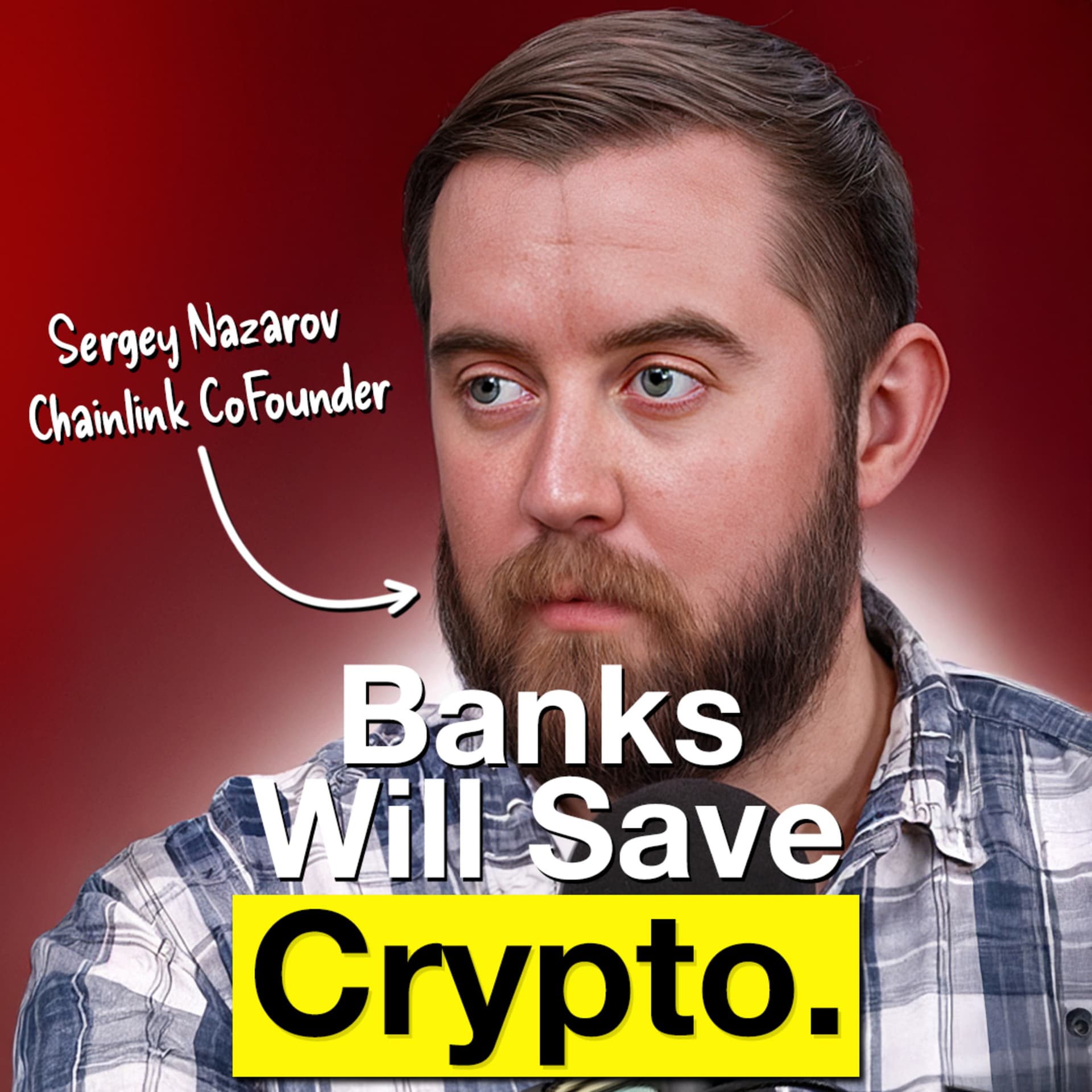
Podcast Notes: E135 - Chainlink CoFounder: Why Crypto Needs Wall Street to Go Mainstream
Episode Overview In this episode, Sergey Nazarov, co-founder and CEO of Chainlink, discusses the current state of cryptocurrency, the importance of traditional finance (TradFi), and how Chainlink plays a crucial role in bridging the gap between crypto and traditional banking. The conversation covers various topics including the future of DeFi, the importance of guaranteed transactions, and the relationship between crypto and Wall Street.
Key Points and Discussions
Introduction
- Host emphasizes the goal of creating a safe space for real conversations in the crypto space.
- Sergey Nazarov’s introduction as the co-founder of Chainlink, powering 80% of decentralized finance (DeFi).
Current State of Crypto
- Growth Wall: Crypto has hit a growth wall and needs traditional finance (with trillions of dollars) to go mainstream.
- Crypto vs. TradFi: Banks perceived as enemies but can be allies in growing crypto.
- Market Potential: Current retail crypto penetration is limited; most future growth will come from TradFi.
DeFi's Importance
- Killer Use Case: DeFi was Chainlink's initial killer use case, which provided traction for further innovations.
- Self-Custody: Emphasis on the necessity of self-custody in crypto through hardware wallets like Trezor.
Chainlink's Functionality
- Oracles: Explanation of oracles and their necessity in connecting real-world data to blockchain transactions.
- Smart Contracts: Chainlink’s role in powering smart contracts and ensuring mathematically guaranteed transactions.
- Mathematical Guarantees: Discussion of deterministic vs. probabilistic systems in finance.
Philosophical Insights
- Happiness vs. Growth: Sergey argues that personal growth, rather than happiness, should be the focus. Happiness can lead to anxiety; growth comes from overcoming challenges.
- Truth: Discussion on defining truth in the context of objectivity and subjectivity in data verification.
Public Good and Community
- Public Good: The aspiration for crypto networks to become essential utilities within society.
- Community Engagement: The importance of the Chainlink community, known as the “Link Marines,” and their role in supporting the network and its standards.
Challenges in Building Infrastructure
- Coordination Problems: The difficulties of getting thousands of people to work together efficiently, especially in a rapidly evolving ecosystem.
- Partnerships with TradFi: Chainlink’s recent collaborations with institutions like Mastercard to facilitate crypto transactions.
Future of Chainlink and Crypto
- Expanding Influence: Chainlink's ambition to dominate both DeFi and TradFi sectors by providing secure, reliable systems.
- Emerging Technologies: The potential of hyper-automation through AI and blockchain to reduce reliance on human error in financial systems.
Conclusion
- Sergey emphasizes the importance of building something that becomes a public good and the potential for Chainlink to transform how society conducts its transactions. The episode ends with a motivational note about facing challenges and growing through them.
Key Takeaways
- Traditional finance is essential for the mainstream adoption of cryptocurrency.
- Chainlink's role in securing transactions and providing guaranteed data is crucial.
- Personal growth is more important than the pursuit of happiness.
- The Chainlink community is vital for its success and sustainability.
- Embracing challenges and refining ideas is key to innovation and success in any field.
---
This summary captures the essence of the podcast episode, emphasizing the key discussions, insights, and takeaways to provide a clear understanding of the conversation and its implications for the future of cryptocurrency and traditional finance.
Written by AI. May contain mistakes. Listen to the episode to check what was said.
Transcript
Automatic transcript. May contain errors.0:00If you went into certain cities in Europe in the 16th, 17th, 1800s, the nicest building would be the bank. If you walk into my building and you give me your money, the likelihood that I will return your money to you upon your request is high. That's a probabilistic world. What I'm talking about is a deterministic world. Mathematically guaranteed relationships, mathematically guaranteed transactions, mathematically guaranteed ownership. Really, if I could get everything mathematically guaranteed, I would. Is there one thing that would not make sense to be deterministic over probabilistic? Sergey Nazaro, the co-founder of Chainlink.
0:31The leading network that connects blockchains to real world data. His work is powering everything. From DeFi to global finance. Where does this fire in the belly come from? A lot of the people that I know that are successful, they have been in the state of poverty. The phrase necessity is the mother of invention. So I've always liked that phrase. What's one of the absolute hardest problems that every network founder faces? It's getting a first killer use case. That's the hardest thing. For Chainlink, that was DeFi. And then that gave us the traction, the legitimacy to build all the other use cases.
0:59Can you explain decentralized finance to a 13-year-old? When you have a relationship with a bank, they control your money and whether or not you can have it. When you have something called decentralized finance, you control your money. Some people believe you're a Satoshi Nakamoto. I think it's because I was really early in this industry. I think that isn't even a single person. I think it's a group of people. You're not Satoshi. Are you a genius? So, how can crypto networks become a public good if Ethereum has Vitalik, Solana has Anatoly, Polkadot has Gavin, and Chainlink has Sergey?
2:00Thank you. Thank you. This conversation is supported by Jupiter, the most used decentralized trading platform on Solana and the largest DAO in the world. Bitwise Asset Management, the crypto specialist asset manager with more than$10 billion in client assets and more than 30 crypto solutions across ETFs, index funds, alpha strategies, staking and more. 3. A scalable layer 1 blockchain that's fast, secure, and affordable, built by previous Facebook developers, and that delivers the benefits of Web3 with the ease of Web2. And Mantle, an Ethereum layer 2 that builds two products I particularly like.
2:38FBTC, which enables you to borrow and lend Bitcoin in DeFi, and METH, one of the largest ETH liquid-staking protocols in crypto. To support this show, please check the sponsors' links in the description down below. how are you doing i'm uh like overwhelmed by the amount of stuff going on but uh it's uh it's good it's like a good it's a good type of uh overwhelmed it's a good problem to have i guess so yes that's how i think about it yeah but i'm just i'm just like my brain's just catching up where am i right now from like all the stuff even the stuff that happened when i was coming over here what's that stuff what's the biggest thing that occupies your mind right now it's actually how to get all the uh trad fi people onto chains and onto chain link that's that's kind of where everything's going because that's where all the money is that's that's what's what's going to drive our industry because our industry is driven by net new capital and there's another you know three four trillion in retail capital.
3:44But if you look at the penetration of crypto into the retail world, in developed economies, in emerging markets, depending on the country, it's already relatively high. So I don't think that the retail community is going to take crypto past 10 trillion. But when you look at TradFi in capital markets, that's hundreds of trillions. And where you want to be in this industry is you want to be at the place where the net new capital is coming in through. That's kind of always the thing that however people feel about it is the thing that drives the industry or where it goes. How contradicting is this with the original crypto ethos that brought you into the space more than 10 years ago?
4:32So the original ethos that brought me into the space actually is why I went to a bunch of Bitcoin meetups and I met a bunch of people that are libertarian and I kind of knew what libertarianism was. This was about like 2010, 11, something like that. But I didn't really meet a lot of people that were into that, that were libertarian themselves. And so I started talking to them and I kind of understood that this was very aligned with my views. And so I kind of became more and more libertarian and agreed with them. But the thing with being libertarian is maybe a bit confused sometimes with people doing what they want to do versus what you want them to do.
5:13So people think libertarian approach to society and to life and to how things should work is about being anti-establishment. It's actually about choice. So if somebody wants to put 100 % of their wealth in Bitcoin, that's a completely reasonable, that's a choice. That's the thing. And if they want to have private key control over that, that's a choice they should have. And if they want to take that Bitcoin and quote unquote ape into some lending market and repackage that and get a bunch of meme coin yield on top of it and do 50 other things, that has risk, but that's their choice. And so that's what, in my opinion, our industry does is it provides all of these choices for how to control value, for how to have relationships between entities, between peers in ways that didn't exist before.
6:09and what the capital markets and the TradFi world provide is just a new dimension of choice. But that dimension of choice, interestingly enough, has so much capital behind it that I think our industry is going to end up embracing it. And really the choice that most people in our industry make is I want Bitcoin to become more valuable, right? So that's kind of really their fundamental choice. And that's why BlackRock, before it starts pumping liquidity into the Bitcoin market, is not a good thing. Everyone's really anti-BlackRock in the industry a couple of years ago. And then a month after they understand that BlackRock and Larry Fink are the thing that's going to help them float the Bitcoin price to new levels, they're very positive.
6:57It's like the best thing ever is Larry Fink and BlackRock. And so that signals that the choice that was really made was that they want the value of Bitcoin to go higher. So that's also a reasonable choice. That's their choice. That's kind of their position on the thing. The people that want cryptocurrencies and blockchains to kind of remove the need for institutions completely, there's actually very few people that even understand what that means. And most of them that even understand what that means, if you ask them, hey, look, you know, Bitcoin could go to a million bucks with the help of institutions, or we could get rid of all the institutions, but Bitcoin is at 10 ,000 bucks.
7:43Which would you prefer? My guess is that 90 % plus are going to go, you know, I'll take the Bitcoin at a million bucks and I'll figure out the institution thing soon after. I'll just let's just do that next right after that one. So and that's also their choice. They can have that choice. The problem is not that there are institutions. The problem is that there is some kind of level of control that eliminates the ability for people to have reasonable economic and personal choices. That's the thing that I think makes sense. And actually, that's what blockchains do even for the TradFi world. Because in the TradFi world, people don't always understand all the nuances there, but there is a limitation of choice there as well.
8:29It's like, how do I know things about my counterparty, the person, the entity that I'm dealing with? How do I know it's solvent? How do I know that it'll fulfill its obligations? Like in the 2008 derivatives related crisis, where a lot of the derivatives weren't settled and paid out. That's a serious problem. If we can put a bunch of information on chain, and I can provide you with a choice to know everything that you could ever want to know about your counterparty, and therefore manage your risk better, then great. The system has given you that better choice. I think that's really what this will do.
9:03It'll just give a whole bunch of people a bunch of new choices, a different level of control. It's not necessary to eliminate you know entire categories of how the world works unless that part of the world is is is controlling things in a way that eliminates people's choice and you have that in some really like authoritarian parts of the world and that's where i think crypto will have a very uh freeing kind of effect but in the vast majority of the developed world it'll just create more choice among a large amount of choices already, if that adds up for you. Dear When Shift Happens family, the following message is probably the single most important thing you should take away from today's podcast.
9:50If you're serious about your crypto investing journey, please take some time to learn how to self-custody your assets to make sure that nobody can take your coins away, ever. If you don't learn how to be your own bank, it is very likely that one day you will lose all your hard-earned crypto. The safest way to hold your crypto is in a cold storage that we also call hardware wallet. Hardware wallets are not complicated and they give you peace of mind. I personally use a hardware wallet called Treasure. It is open source, very easy to use and the first hardware wallet created ever. As we like to say it in crypto, not your keys, not your coin.
10:24You can order your Treasure wallet with a 10 % discount by following the link in the description down below and by using the promo code WSH10. Now back to the episode. if you had to explain what it is you do and why you do it to someone who's never heard of the words sovereignty blockchain web 3 Bitcoin before or would you say so I would say we connect many valuable systems to make transactions work well and in line with what we just said kind of provide people new choices about how they can manage their money, interact with each other online, prove things about the real world to each other instead of relying on the news.
11:14That's what I would say. Like it doesn't, our system actually, it powers a lot of smart contracts and tokens because those systems rely heavily on the guarantees of a system like ours, proving things to them. But realistically, our system, the Chainlink network and its standards can prove and connect all kinds of systems. So for example, the Chainlink network can prove whether a number of weather events happen. And it can prove whether that happened to a smart contract or it can prove it to a server. But what that's doing is that's providing certain secure connectivity and proof. And it's basically enabling a transaction.
11:55If you think about the world in like a transactional model, most of people's daily interactions are some form of transaction, basically. Transaction of my information in return for your information. That's like a conversation, right? You learned something from me, I learned something from you. Transaction in the sense of we have some work relationship, I'm giving you labor, you're giving me capital. So really, I think it's like a reimagining of how transactions work is what our system does. And it does that on the basis of mathematical guarantees. So the big difference between the way our system does things and the traditional world does it is that you get mathematically guaranteed results rather than people guaranteed results.
12:45And that's the very big difference. And that mathematically guaranteed result is actually useful on a chain, but I think it's also very useful outside of a chain. It's a guarantee, right? It's a guarantee that we verified something in a way that it's not going to be manipulated. Similarly to how when a blockchain verifies a transaction in a block, it's guaranteeing you that that transaction is going to get in and work, right? So that's what, I know you asked me not to say, I'm past the answer to the thing now. So the blockchains, they verify blocks of transactions. Our system verifies all the stuff outside of a blockchain.
13:26And so when you combine those two things, you get these next generation smart contracts like DeFi, which Chainlink powers the vast majority of smart contracts in DeFi. You get decentralized smart contract based crop insurance. you get derivatives, you get a whole bunch of great stuff that wasn't gonna work that way before. Like before the way it would have worked is a person could decide what they wanna do. And you don't have much say. What's the problem with that? What do you tell your friend who lives in New York and uses either the banking, like the normal banking system or uses these kind of like neobanks to just you know venmo cash app to just send money around or i use a transfer wise right wise to send money abroad it's pretty cheap it's super fast i'm happy with that well first of all i tell almost everybody as little as i can that's that's one thing just actually answer your question like a weird way but if i compare the system to transfer wise or if i compare uh blockchains as a settlement layer i think the difference is is you have a better middleman in these cross-border transfer apps relative to the correspondent banking system.
14:48So the correspondent banking system takes a lot of fees, takes a lot of time. That's what people usually compare it to. But at the end of the day, you still have a company that could misbehave. One good example that you might be familiar with is a company called Wirecard. So Wirecard was this very exciting, actually exactly what you said, payments fintech. I think it was the leading payments company in Germany. And it ended up manipulating its auditors for an extended period of time. And that manipulation of their auditors basically made it so that even though you had money in the system, you woke up one day and And that money wasn't there anymore because it got stolen by Wirecard, basically.
15:38And they were able to game the auditors. So how would that look in a mathematically guaranteed system? Well, in a mathematically guaranteed system, you wouldn't have auditors going and having conversations about what do you have, what don't you have. You'd have something like proof of reserves, right? So you'd have a system that verifies in a near real-time basis, what is the capital inside of this thing, whether it's for a stable coin or a payments network, that's what I'm talking about. So in that world, you wouldn't have had Bertie Manoff. You wouldn't have had the Lehman bankruptcy and the inability to settle all those derivatives.
16:19You wouldn't have had FTX. Like if FTX had proof of reserves, you wouldn't have had that issue because it would have proven what's there you wouldn't have had a proof you wouldn't have had silicon valley bank if you had something called proof of composition so proof of reserves shows you that something is there proof of composition shows you what's there so the problem with silicon valley bank for example was that you didn't you knew they had treasuries but you didn't know the vintage or the yield of treasury relative to their other obligations right so all of these things do a really good job at creating a brand and that's that's that's like a very long time thing if you went into gold mining towns or if you went into certain cities in europe in the 16 17 1800s the nicest building would be the bank it would be the the building with like the biggest arches and the biggest columns it would be and the reason for that it's a brand right it's like i'm very secure i can afford huge columns if you walk into into my building and you give me your money the likelihood that i will return your money to you upon your request is high right but but you know then there were a bunch of bank runs and and bankruptcies also through you know throughout time then you had the fdic merge and regulators and all this random stuff but it still happens see that's uh that's a probabilistic world.
17:47So there's a probability there. What I'm talking about is a deterministic world. So what I'm talking about is a world that's guaranteed to mathematically operate in a certain way. And that good example is your Bitcoin private key. So your Bitcoin private key will, according to the laws of mathematics and cryptography and those mathematically guaranteed rules, it will always execute a transaction for you under those rules. There could be a million people who don't want that transaction to go through, it's going to go through. As long as you have the private key and you enter the transaction and you put it on the chain, right?
18:30So there's no person making decisions there. That's mathematically guaranteed. And I personally think that mathematically guaranteed relationships, mathematically guaranteed transactions, mathematically guaranteed ownership, mathematically guaranteed insurance, mathematically guaranteed, really if I could get everything mathematically guaranteed, I would. So I, yeah. What's an example of something that you think, I mean, you just said, if I could get everything mathematically guaranteed, I would. Is there one thing that would not make sense to be deterministic over probabilistic?
19:10That's a good question. I've never gotten that question. Is there something that I wouldn't want to be mathematically guaranteed? Nope. In all my agreements, I want the agreements to be fulfilled. So if I could get every agreement that I ever make with anybody to be mathematically guaranteed, I think that's always kind of superior. That's always a superior state to be in, is to have a mathematically guaranteed agreement. uh for example i was a few minutes late for us to meet up right now you know imagine if that wasn't possible if people could never be late because it was you know somehow was mathematically guaranteed they'd be on time if you had that choice you know would you would you rather or they always be i would i would choose always on time you know so i would i would do that that i mean that's actually one of the reasons i really believe in this stuff i think people have been existing in a probabilistic world so long, they don't understand that there's this alternative.
20:12Most people still don't understand. Like if you ask them, what's the difference between a Bitcoin and a bank account? They'll say something about digital gold and something about deflationary token schedule, something. But they won't mention private keys and direct control right which which is i i would say one of the if i would say it's maybe the main innovation is that you you can have direct control over something there's a system of transaction operating over there and you have direct control a bank account in your buckets i mean it's not exactly it's not it's a bitcoin account it's a bitcoin account in your pocket uh i i don't know i mean if it's 100 if 100 of everything you have is in bitcoin then then it becomes a bank account i don't know exactly who's doing that but you know they're right so far so maybe maybe that's what everyone should do i don't who are you where am i i'm sergey from chain link at least for the last approximately eight years sergey from chain link chain link all day long all day and all night yep basically wake up thinking about chain link go to sleep thinking about chain link how much how much do you sleep not enough not enough less and less now with everything going on some people actually can run on very low sleep so little sleep i mean i can't definitely but me either so i gotta i gotta work on that for sure there's a common pattern across most of the very successful people i interview on these podcasts they have something that happened in their life that gave them a chip on the shoulder and made them really hungry where does this fire in the belly come from
22:10i mean i think there there's a lot of truth in the in the phrase necessity is the mother of invention so i've always i've always liked uh like that phrase and really generally speaking a lot of the people that i know that are successful they have been in like a state of poverty at some point in their lives and so that's kind of the the experience that i had because my family immigrated to the u.s from russia in the 90s with, let's say, not a lot. And so everybody was working a lot. I started working pretty early in my life. And that type of thing gives you an appreciation, let's say, for opportunity.
23:02So there are people who don't have to work, and there are people who are fine just continuing down a certain path.
23:15and when I kind of really understood it a little bit actually was when I started reading more and more philosophy, specifically like Marx and some of these economic writers, that they explained how capitalism works. And so the opportunity in capitalism is to make something. so historically in the past throughout history you wouldn't really have much opportunity to make things you have to work for someone who owned the means of production so they own own the means to produce the the farmed food or you know the textile mill or something and so the ability to create a means of production the ability to create the thing that creates value was actually a very limited opportunity to, you know, very limited group of people.
24:14You couldn't do what people can do in the US and a few other countries where you can create something valuable. Like you couldn't sit down as an individual engineer and code. And now as an individual engineer, you don't even need to code. You just, you talk to the AI and you do some weird vibe coding stuff, right? So the ability to create things is uh is the type of opportunity that is kind of like i think still shockingly overlooked by many people but basically if you're if you're if you're pretty poor and you understand how capitalism works i think you pretty quickly arrive to the idea hey you know i better create something valuable and make sure that it and it continues to provide a lot of value and that's kind of a unique opportunity.
25:05So I think that's kind of the set of logical basic thoughts that I thought through. And then when you actually start creating things, I think what happens is you start weighing the benefit of that thing, both from like a commercial point of view and from a societal point of view. At least some people will weigh the societal thing. And the societal thing is a very kind of purpose generating thing, actually. So that kind of comes a little bit later. Initially, I think what you're doing is you're thinking, how do I get somewhere? And so when I got into this industry, I was initially a Bitcoin miner.
25:55This was like 2010, 11, these years when the difficulty was much lower and when there weren't any other coins. So all you could do is be a Bitcoin miner. And I didn't even really understand Bitcoin. I was just mining it and kind of looking into it and trying to understand. And I thought that Bitcoin was it. But then there were other chains. And so I kind of started to understand that this thing could create these mathematical relationships. Because when I got into the industry, the only mathematically guaranteed relationship that you could have was Bitcoin. Like, I have a Bitcoin, I can send you a Bitcoin, you have a Bitcoin, you can send me a Bitcoin.
26:33That's it. That was the whole scope of what all of this could do. But when I realized that you could expand that to other things, I actually really liked the version of the world that that could create. And that's where I think a lot of people that work on things, they talk about something that you're interested or passionate about, being a valuable force in your life and in your thinking. And I never really understood that. But then when I realized this, that's the first time I understood it, right? Because I was looking at something and I was like, well if this thing can can do all this stuff then society or or the world can work this way and that that when when you when you see that for the first time and you look around and you're like well who's doing this that's possible then who's doing it and you see nobody you're like you're telling me nobody's doing this you're telling me nobody's like making defy happen you're telling like from an Oracle point of view or like an infra point of view, you're telling me nobody's going to enable the next generation of these smart contracts.
27:47At that point, you go like, wow, well, I better really do that because it's an exciting thing. So it's, yeah, it kind of comes to that, I think, later on. That's now the main thing actually for me is is a kind of, I view it as my one opportunity in my life, I think, to make a big dent on how the world works. Like I don't know if I'm going to get another chance in my life to have an impact on something that'll actually change how things work. And we've already done that with Chainlink, like powering the majority of DeFi. DeFi was like 10, 15 teams when we started at sub 100 million as an industry, then it grew to thousands of teams with over 200 billion, and us continually powering the majority, vast majority of that.
28:42So that was actually pretty exciting too, right, to see your system that you helped build with others power this kind of cool revolutionary thing. Frankly, once you go through that, once you experience something like that, you're kind of hooked on that. And so what I'm trying to do and what a lot of people in the team and in the community I think are trying to do is they're just trying to do that again and again and again and be part of making something that accelerates another big boom like that. And it's a great model because if you can accelerate a thing like the DeFi summer, or the DeFi boom, or you can accelerate the cap markets in our industry, or you can accelerate blockchain gaming as an infrastructure, then you do something really valuable.
29:37You help people build cool things that make the world better. And you have fun doing it because it's pretty exciting to do that. There are these periods in between where you have to work a lot and people don't really understand always what you're doing. but in my opinion i found that if people don't understand what you're doing it usually means it's it can be a it can be a valuable thing yeah probably actually true you mentioned the philosophy that actually helped you a lot you studied philosophy at nyu yeah and you have a small slightly hidden section in your linkedin bio called my pers my perspective on daily life is based on a few philosophical codes i want to dig into we must stand upright ourselves, not be set up.
30:29Yeah, yeah. So that's where Marcus Aurelius. So that's a kind of quote about doing things yourself. I think there's another, well, no, there's not another part of that quote. There's quotes around that stuff where it's like, you need to solve your own problems type of thing. And there's other, not parts of that quote, but other parts in that section or somewhere around there where it's like, you're going to wake up today and you're going to be met with ingratitude. You're going to be met with all kinds of bad things. And so basically for me, what that quote means is that no one's coming to help you.
31:03So a lot of people, I think they go through life, they think someone's coming to help them. Someone is coming, like some personal relationship or some romantic relationship or some business relationship. Someone's coming to help. Someone's coming to make it work for you. and that's not going to happen. What's the moment that you realized that no one is coming to save or help? What's the moment I realized no one's coming to save or help? Okay, let me think back the moment. The moment maybe possibly was when I was five years old and my bike got stolen by a guy I let ride it. And I really liked that bike.
31:42I'm still looking for him, by the way. But basically, I think that That and a collection of similar moments in that four or five-year-old timeline was probably the point at which I realized that no one's really going to be helping me out. So either you help yourself out or you're going to have a hard life. Yeah. And a lot of people have a hard life because they trust the government, take care of them, of their retirement, of their health. They trust the systems, which is why we're here today, actually, because we trust the systems less. Wow. We're here today because Bitcoin went through$2 ,000 because a bunch of money in Asia wanted to get out and buy Bitcoin.
32:34That's why I think we're here. That's what our industry is built on. It's built on money and capital flows. there's an ideological component to our industry that's very real. And I think that's going to end up happening. But I don't think that ideological component on its own gets our industry very far. I think the value, the technical value that our industry provides, like when the Bitcoin price went to 30 bucks and when it went to 2000 bucks, it was because there's a group of people that looked at it and saw that it was a payment method and a value transfer method that was unique and different.
Read the full transcript
33:17And those people, the vast majority of them had no idea about any of these ideological things. And personally, I think that the vast majority of people that use blockchain technology even today, like you have this whole thing in our industry where it's like, there's all these people seeking to make money in some chain somewhere. I'm like, yeah, that's what financial technology does. Financial technology enables people to make money in certain ways. So I think institutions and them getting replaced, in my experience with institutions, people's conspiracy theories about institutions assume a level of competence that simply does not exist.
34:03like i i have dealt with many institutions makes sense and i've i've i've seen some theories about those institutions and then i go to the institutions and i deal with the people in institutions and i meet all the seniors sometimes very senior people in institutions and unless unless these people like have split personality disorder and when they go to sleep another guy wakes up and like does a whole bunch of stuff at night and then goes to sleep and wait they wake up and then unless there's two two different like psychosis things going on in their mind um i mean most institutions frankly just want to exist so the people that work there can have a nine-to-five job many of them are really not not planning things the the people the people that make the institutions problematic are actually the ones that find inefficiencies from the existence of the institutions and then they exploit them.
35:02So they find a way where the institution says it's doing its job, but they can't actually do their job. And then they find a way to exploit that. That's like fraud. So the people that actually make institutions not work, really, are the people who find a loophole to exploit them. That's a good example is like, you know, Bertie Madoff's a good example, right? So there's like an institutional system that gives people certain assumptions about, you know, the solvency of his thing. And he exploits holes in that model. And then he's able to steal that money because he's able to convince people that the institution or the institution convinces people that like the auditor or the regulator or whoever convinces people that it works.
35:57That's actually usually where I see the problems happen for people from institutions is that someone has exploited them for the purposes of taking other people's money. And then the institution gets really angry and like wakes up for 10 minutes. and all the people in the institution go like, holy shit, this is really painful. People are really upset. We got to pass new laws. And then they pass new laws and the new laws lay around the old laws. And that results in this kind of regulatory slowdown, which was going to happen to our industry before the new administration in the US. but now i i don't think it's going to happen as much so the real the real downside of institutions for me is that they actually over protect people they overly make regulations because like you had one or two failures a good example for the crypto industry that people can relate to is like ftx right so ftx happens or terra happens and the institutional world massively over indexes on that and everything slows down massively right but what you actually want you want the institutional world to say to legitimize us you what what we all want really if we want you know bitcoin to do well and if we want our industry to do well is we want institutions like BlackRock, like others of that size to legitimize our industry.
37:41That's what we really want. We want to get into a productive, collaborative relationship with institutions because actually that's the path to mainstream adoption because then the institutions are not just supporting the alternative to crypto and blockchains, which are the banks and the existing thing. They're actually putting our industry on a level playing field. And if we get on a level playing field with the traditional world, then we'll absolutely win, in my opinion. And people don't also realize what winning looks like. What winning looks like is what happened with the internet. So what winning looks like is that the banks and the asset managers become part of our industry.
38:33It's not that our industry destroys them. Some of them who don't get on board, they might not do well. There are plenty of companies that when the internet came around, they didn't get on board. Many of them don't exist anymore. They got replaced. But there are companies that got on board with the internet and they're doing even better because of it. Right? So that's what we want, in my opinion. If one does not know to what port one is sailing, no wind is favorable. Yeah, that one's about priorities. So I feel like I'm giving a lot of unsolicited advice. Okay, I kind of solicited, I guess. I don't know.
39:24Yeah, so goals. Goals are important. Priorities are important. If you don't have goals and priorities, someone else is going to give you goals and priorities. And the other part of that quote is that let's say you get really lucky. Let's say there's this awesome opportunity in front of you. but you haven't prioritized doing that. And so it can come and go because even if it gets right in front of you, you're not going to grab it. You're going to let it go. It's going to go right by because you're not thinking about it. It's also about how the mind works. If you start thinking about something, if you start thinking about blue Toyotas, you just say blue Toyota to yourself like 20 times, you'll notice a bunch more Toyotas.
40:19And if you see a blue Toyota, you're going to remember it. It's just like what you're thinking about. So what happens with people that set goals is that they look for the opportunities. So their mind kind of gets turned on. And so when the wind is blowing in the right direction and you know where you're sailing in that quote, it just happens kind of naturally. But if you're not looking for the opportunity, it could literally just be standing in front of you. And it doesn't matter because you're not looking for it because you haven't decided what's important. So that's important. That's a really good one.
41:03Last one. every new beginning comes from some other beginning's end. I don't remember that. Is that Emerson or who is that? Seneca. That's Seneca. The same as the previous one, actually. Yeah, so the every new beginning. I mean, that's just kind of a hopeful thing, right? Like one door closes, another door opens. Since that's from Seneca, Like the Stoics are very good at helping you deal with hardship. So that's a really good one if there's hardship. So let's say something didn't work out. Well, you know, the bright side is you don't got to spend your time on that anymore. You can spend your time on something else.
41:49Maybe that thing's going to end up better. And personally, I've actually found that sometimes, sometimes, not always to be true. There were things I was working on, total waste of time. like earlier, earlier in my life and they didn't work out. And the important thing with that, with that is to just make sure they don't work out sooner. How do you do that?
42:14I, I don't know. I mean, I think you just have a certain standard for deciding if something's working out. And, and that standard, by the way, that standard doesn't mean quitting on doing things, sometimes people get confused about that. They get confused by like, I'm not going to do startups because a startup didn't work out. That's not the same thing. It's like this thing, this product or this idea or this direction didn't work out. But that doesn't mean that there aren't 50 other directions where you shouldn't be building something new and exciting and useful. That makes sense. So that's what I would say.
42:52Which is hard to do because there is this kind of sunk cost, right? That you do all this investment in time. I mean, it depends if you're starting completely again or if you're basically pivoting or changing the direction of the thing. But I think what prevents most of the people to probably make the tougher decision on a job, a startup, a relationship is that.
43:17This guy, he's good. This guy's good. He's going to survive this guy. this guy's survivor i can tell i can tell already he went through a bunch of hardship and he was like this is one of the sergey is not gonna stop me from around he's not afraid of me at all um he's like i've seen a million of you guys you're not even that good at this i'm not particularly afraid of you um
43:48yeah so I think the thing with that is you have to choose a general direction so I've seen people switch directions between industries like they make a iPhone app and then they make a you know flower delivery company and then they make a dry clear this isn't a real example, but like it's just very different. So I think it's important to choose a direction and then do things in that direction. So I chose the direction of these cryptographically guaranteed things and built a lot of different stuff. We built Cryptomail, which was the first blockchain email service. We built a secure asset exchange.
44:32We built smartcontract.com. We built the chain link. But it was always in this kind of direction of cryptographically guaranteed messages or cryptographically guaranteed exchange or cryptographically guaranteed transactions or now cryptographically guaranteed verifications via oracles. So that is an example of a direction. And the direction is really kind of, I would say, an industry choice. So it's, I want to work in car industry or I want to work in the AI industry or I want to, you know, I want to be part of this industry. I want to be part of this. That is an example of a more permanent choice in my, or a choice that you should do over two to five years unless you figure out that that whole industry is not good.
45:25But once you choose a direction in industry, then in my opinion, you should try to find something in there if that's exciting to you what one of the worst things to do in my opinion is to choose an industry that you don't like with like people you don't like or problems you don't like or a market you you know the the market dynamics are not are not something you want to be involved in i remember going all these bitcoin meetups early on and then meetups for other coins and tokens and uh you know before they were called app coins and i like the people there I like the people I like the problems they were talking about I like the things they were trying to solve for and I mean I could see that this thing had a lot of value and it was going to make a lot of sense from like an economic and a product value point of view but I also just liked the ethos of the people and I just like the industry that makes it a lot easier Yeah, that makes it a lot easier when you believe in the direction.
46:34I think Naval Ravikant says something like, the most important thing is not who you work with, but what you work on. Obviously, who you work with is very important, but you could be, I mean, again, like the industry, you could do something that's not necessarily that great. If the industry is doing well, you're much more likely to be successful, at least in the short term, right? and to be motivated and maybe to find your way into something that works better afterwards. Yeah, there's a good post from Marc Andreessen, I think, that I always liked when I was younger. It's called The Only Thing That Matters.
47:12I think that's the name of the post. And it compares the importance of market versus product versus team. And it says that market is actually the most important factor because a growing market will define what a good product is. and it will pull it out of the team. So if the team is moderately competent and they've stumbled into a market where they can provide value, then the market will essentially pull the product out of the team. And what they have to do is they have to be receptive to making sure that that happens, which I found to be true. There's a lot of teams that are in really shit markets with relatively well-built products.
47:55They just won't go anywhere. This industry, fantastic market. Fantastic. Yeah, absolutely. Fantastic market. And it sounds, for example, when you're in this industry, it sounds so logical, right? But I mean, I built a data analytics company before, but it was on the consulting side then. Now I realize the difference. Like the blockchain is, I mean, the blockchain crypto is like this kind of endlessly forgiving industry where - As long as it keeps growing. that that's that's the nuance that some people that have been around here so long might not i think many of them understand but this industry is a great industry as long as it keeps growing that's this this thing has to keep growing that's why we need traditional finance well that's that's why you need liquidity and capital from wherever you can get it and so my basic question is where's coming from guys like and and then every some people might tell me hey it's coming from the retail user and i'm like yeah yeah you're right like maybe the more the industry can double from that i can see that maybe even triple from that i could see that but but then i look at the penetration rates of like people like if we go outside right now we talk to 10 people i think seven out of the 10 people will know what bitcoin is not more that's not the same situation five years ago ten years ago right so and and and and then they're like well there's a lot of other markets there's a lot of other ones okay there's a lot of other ones we go talk to ten people three you'll know five will know how many will know so it has to come from somewhere and so this is where I think this BlackRock effect is just going to happen in mass for the TradFi community.
49:48And I think people are now starting to slowly understand that the ability to deal with TradFi, the ability to get the biggest banks, the biggest asset managers to pump their clients' money and their clients' liquidity into digital assets, into tokenized funds, into whatever on-chain thing the client wants is the next frontier of this growth. And everyone in our industry gets behind growth. That's what everyone gets behind. The ideological thing, I'm behind that and our community is behind that. That's a great thing. And that's something that's going to happen as a result of that growth. That growth doesn't happen, then this thing wasn't true.
50:35Like this thing didn't work out. But it's actually the growth that'll solidify all of these ways of doing things into the real world. Absolutely. Very practical. Very practical take. Can you explain decentralized finance to a 13-year-old?
50:57um
51:01I could go younger or older I'm not sure I could do teenagers to a child I don't know by the time you're teenagers the attention span seems very low now only teenagers teenagers and afterwards let's say a child that doesn't use social media I can do that Can I take that? A child or an adult who doesn't use social media. Can I explain it to that? Let's take that. Okay, sounds good.
51:38So when you have a relationship with a bank, they control your money and whether or not you can have it. When you have something called decentralized finance, you control your money. and the thing that you use for what a bank does just gives you a service, just provides a certain service to you. Like it gives you a return on your money or it securely allows you to interact with it for certain key things that you want to do, like move it around or some other things, but it doesn't control it. So the difference is whether you want to put your money in a bank run by a bunch of people you don't know, and that can do crazy stuff with it, which happens a lot, or if you want to control your money and put it in a system that can only behave in certain very specific ways.
52:29And that's the big difference in risk. And I personally think that once everyone understands this difference and once there's a few more bank failures, which unfortunately I think we're going towards with the global economic crisis that's to come and the kind of devaluation of fiat currency, a whole bunch of other fun stuff that's going to be happening, unfortunately, then the relationship that I just described will be quite valuable. Like go ask somebody who lost their money from some kind of bank failure or something. Are you interested in this feature? They'll be like, yeah, it's the best feature I ever heard of.
53:14Like how do I get that? So that's, you know, that's what I think we're going towards. Because, yeah, the world's not going to, I don't see how the world can be more stable. Like everything is just becoming unbelievably unstable now. People are doubting fiat currency. There's multiple wars. Even within society, people are, you know, freaking out about their different opinions on, you know, is this the color green or is this the color purple? what color is it who knows like let's let's go crazy what's the color man that's important like let's do it guys time to gear up on this one um so you know things are not going to get more stable here unfortunately that's not going to happen as it gets more unstable people want control so our industry gives them control you mentioned is this color green or is it purple How do you define truth?
54:15How do I define truth? Well, there's a little bit of a problem with that because you have objectivity, then you have like subjectivity. Subjectivity is kind of, you know, my perception, your perception. So there's a subjective version of truth where we all agree to call this green, therefore it's green. but can you objectively mathematically prove what green is? These are very complicated questions, usually without good answers. Interestingly enough, the project of the Stoics, some of the people I quoted, was to use mathematics to prove certain ethical truths. and over the entrance to their platonic kind of school, you had something about how math will prove things or math will tell you the truth or something like that.
55:13So people have been looking for a mathematically guaranteed way to prove things for quite a while. Even blockchains, just to be clear, that's node operators that cryptographically run an agreed-upon protocol. all. But even that blockchain transaction is an agreed upon truth. It's just like a very cryptographically guaranteed agreed upon truth that it becomes very, very hard for you to roll back or disagree with. So it becomes essentially like mathematically guaranteed. Objective truth. That's a really complicated topic. I looked into that topic and it is very, very complicated. to truly define what objectivity means.
56:04And for that type of thing, you probably have to talk to mathematicians and physicists because they're the closest on that one and they don't even agree. So I think there's a lot of subjective truth and we can make a system where we agree on what a truth would be. That's partly what our system does is it actually allows you to set conditions and to say, we pre-agree that if these five weather stations all say that it rained, then it rained. And so we've agreed upon, pre-agreed upon a subjective truth about that. Right. And then we've said, okay, we will connect that Oracle network with a smart contract.
56:54and we will allow that to control value because that's our agreed upon truth. So Oracle Networks and Chainlink are a way, I would say the leading way right now, to agree upon a definition of truth. But it's agreed upon, right? And the only people who need to agree upon that truth, by the way, are the counterparties. So if you're the insurance company and I'm the farmer and you show me, hey, I'm going to verify rainfall against these five different data systems and then I have this smart contract that's going to pay you out according to that, then we've agreed. We've agreed what truth is in this context.
57:33And there needs to be a system that will enforce that. Whether it's for a derivatives transaction, whether it's for DeFi lending, you know, that's kind of what Chainlink does. And that's what you call definitive truth. which one is this what you call definitive truth the concept of definitive truth you define truth and then you you automate it through these smart contracts i think there's another word before definitive i don't remember what it is that's a term we we've used in a little in a little while but yeah that's i think it's like uh cryptographically defined truth or something But basically, yeah, that's the idea.
58:16The idea is that you and me can sit down and we can define what the truth is between us. And then we can codify it. But we don't codify it in a blockchain because a blockchain can't verify things for us outside of itself. So a blockchain can verify the code we put into it in a very specific language. And it can verify private key signatures like I signed and you signed. And it can verify that. and then if those two signatures hit a smart contract that says, if I get two signatures, then I'll do something, you can do that. But it can't verify something between two chains. It can't verify an identity.
58:52It can't verify a market price. It can't verify the weather. It can't verify anything outside of itself. So Chainlink is the system where you codify what you're going to verify. And then you use that verification to trigger value and other key things on chains, basically. You said that I read somewhere, transparency creates accountability. Can you explain? Yeah, so if I have a banking system and the banking system is going to prove to you what it's solvent every year through an audit, then you have a year. There's a year in which something can go wrong. And if I can get through that audit and kind of manipulate it, I'll get two years.
59:44I'll do that two years in a row. I can do three years. There's a lot of weird shit that could happen in that time span. On the other hand, let's say you have an Oracle network verifying what your reserves are for a stablecoin, for example. and the Oracle network has a way to stop any minting of any new stable coins if the reserves aren't there. Well, how quickly can it do it? well I could do it every second well now you went from a few years to a second and I mean I think it's probably pretty hard to do a lot of crazy shit in one second so generally speaking that's that's that's that's a great example of you know coming to you know kind of defined truth that in this case would be proof of reserves and saying, I'm going to prove the reserves of my stablecoin or my tokenized fund or asset or whatever, and I'm going to prove that to you every second.
1:00:47And now I would feel good about that. I would feel better about that thing than I feel about something somewhere that's getting audited once a year, like a Bernie Madoff or a Wirecard or something, or Enron or these things. Absolutely. And you mentioned before, I mean, for these audits, right, once a year. And it's not only, you mentioned a couple of examples, frauds, complete frauds, right? Straight up frauds. But you also talked about the fact that people and institutions, especially at scale, are not necessarily competent, do we say that? Competent, yeah. So it's not necessarily only, hey, how do we prevent a bunch of frauds from happening?
1:01:32It's also So when things become too big or when people are being set at roles that they're not competent, this can have massive. I mean, we saw the example recently with credit issues, for example. Right. Yeah. It's not necessarily it's not necessarily without having to go into conspiration theories that some people did wrong things on purpose. but you just have this huge organization that just don't know what's going on anymore. And because there's no transparency. Yeah, because it's not automated, right? You have all these people making decisions. Sometimes people make really malicious decisions like Wirecard or Bernie Madoff.
1:02:16And sometimes in my opinion, some of these things are so poorly run that they just fail. And here's the thing, right? They never look poorly run. Silicon Valley Bank didn't look poorly run until it went into receivership and you had like someone had to buy it out. Credit Suisse didn't seem poorly run until UBS had to rescue it. Which UBS had to be rescued by the Swiss Confederation in 2008. So it's the same shit happening over and over again. Yeah, look, and I don't have anything against these institutions. Like I think these institutions are following a pattern of many institutions. I'm just saying that there's, the thing I was saying before was that there's a lot of people who are saying that there's a lot of institutions conspiring against them.
1:03:05And many of the institutions are unable to do their day-to-day work and just operate. And so what I think we should do is we should take blockchains and smart contracts and Oracle networks and AI, should combine all this stuff, and we should create a state of hyper-automation. But that hyper automation has to be really reliable. So for example, we have AI Oracle networks where we eliminate significant amounts of hallucinations, where you run the AI model in multiple nodes, you compare their results, and you discard the results that deviate from a certain quorum or consensus, right? So what our industry is really good at doing is generating consensus and proving that something happened in a really reliable way, whether that's a blockchain transaction with a blockchain, whether that's an Oracle network report or input and a verification of something else.
1:04:03AI is going to be really useful for that, but we're really just going into this world of hyperautomation. And mathematically and technically driven hyper automation is in many, many ways, much more reliable than people. And that's what will solve a lot of these problems. Like back to these points, if you could prove on a real time basis, what the holdings of Silicon Valley Bank were, that wouldn't have happened. If you could prove what the solvency and the reserves and the capital conditions of Wirecard was would have been impossible to happen. So it actually protects you against both. It protects you against the malicious, you know, institutional bad actor, which is not as common as people think.
1:04:55People think that's really common. That's actually not that common because, you know, we think about this a lot from the point of view of stopping it, right? And how do you build systems to make that not possible? And then the much more common one is that the institution just was not good enough to mitigate a risk and they didn't share information internally or externally. I think it's Balaji who was, I mean, he was, he just understand things very early on before most people. And he talked about the banking crisis. Actually, during the banking crisis, when he did his$1 million bet on Bitcoin, I think it was just purely to make people realize, hey the banking system is fucked right and he was saying every institution is is a underwater and so if we had this system or a lot right so the question is I mean we don't need we don't need an answer but people trust right people trust this big building people trust this suit people trust this nice car of the banker and so on and so forth but now if we apply all these systems that chaining is developing and other people are developing in the crypto world to to the traditional finance world, probably we're gonna see a lot more of these malfunctions or problems than we imagine or that we could even think or guess.
1:06:20I mean, I think we're unfortunately, we're going towards something a little bit different. I think what we're gonna find is that there is no lender of last resort. So the people that have been bailing out all these banks. Let's imagine that governments need to get bailed out. There's nobody above governments. So I think what we're arriving to now, unfortunately for the vast majority of society, with the exception of a few people that are able to foresee and prepare and get in a position to to relate to this risk in the right way is basically fiat currency and central bank and kind of government levels of solvency are gonna be coming more and more into question.
1:07:13So the amount of people that are now discussing the US debt, the amount of people that are understanding what the ratio of debt to GDP means, the amount of people that are understanding understanding how you get out of this through economic growth and that maybe the AI-driven economic growth is one of the few things that could do it, but then that'll lead to mass unemployment and that'll lead to its own kind of economic decline and reset. Basically, I think banking-related crisis is going to be the least of people's problems. And there is also going to be that crisis um there's there's going to be like i think a crisis of faith in basically almost everything and and and that's when cryptographically guaranteed things assets ownership control will be very valuable what's your timeline on that I'm not good at predicting that but at the rate things are accelerating I'd be surprised if that didn't happen before 2030 I think before 2030 you know, I mean how much money can you print?
1:08:34How much debt to GDP ratio are people willing to deal with? like how much unemployment are people willing to deal with how much inflation are people willing to deal with i don't think they're they're willing to deal with that much more could be wrong about that i don't understand how the jet debt to gdp ratio is where it is for for for most most things right now and i i think what we're coming to is there's like this hundred year experiment now more or less about 100 years maybe 80 90 years depending how you count it of of getting getting away from gold as uh as something that fundamentally backs things basically starting from you know the great depression so this this has basically just been this nice big experiment of like fiat money talking about system you mentioned a couple of smart contracts before.
1:09:34Can you explain smart contracts to an adult who doesn't use social media? An adult who doesn't use social media? We can find one of those. I still have hope. That makes one of us. Sorry, I'm just kidding. Let me think. What am I explaining to this adult who doesn't use social media? Smart contracts. Simply no jargon.
1:10:05Smart contracts are mathematical guarantees about what you own and your relationship with others. So instead of you trusting some system somewhere, you give the rights for something to work relative to you to the smart contract and it will always, in a guaranteed way, execute what you agreed to with it. So if you and me make a smart contract that under a certain condition you get paid or I get paid, it'll happen 100 % of the time regardless of what you and me want to do. Once we enter into it, it's not based on the legal system. It's not based on me and you wanting to do it. It's not based on anyone in anywhere deciding whether it happens.
1:10:50It's mathematically guaranteed. It's guaranteed that's going to happen. What's the biggest problem with smart contracts today? That they don't connect outside, which is the problem we work on. What is an Oracle? Explain simply, no jargon. An Oracle connects the smart contracts to all the stuff outside that they need to work with in order to do valuable things. Can you give me an example of stuff outside? I mean, before you mentioned the weather and entrances. I mean, market prices, connectivity between chains, connection to traditional financial systems, all this type of stuff.
1:11:34You're the founder and CEO of Chainlink. I'm the co-founder. Co-founder and CEO of Chainlink, Chainlink Labs. I'm the co-founder and CEO of Chainlink Labs. What is Chainlink? Explain simply. no jargon i like that too much works we're trying to we're trying to educate the masses and the people who don't understand crypto well makes sense um no jar is smart contracts a jargon term i mean we define it now so it's fine it's fine okay good chainlink is a platform for enabling next generation smart contracts that connect all of the world's transactions into a single internet of contracts where you and me can mathematically guarantee our relationship.
1:12:29Whether that's a banking relationship, whether that's a trading relationship, whether that's a insurance relationship, whether it's a purchase of concert tickets. So Chainlink is the platform that enables that to work for these advanced smart contract use cases. Without Chainlink, you can't build these advanced smart contracts. And basically you're stuck with just making tokens that don't do much. You started Chainlink eight years ago, 2017? Yep, in 2017. What's something that still frustrates you after building Chainlink for eight years?
1:13:13That you can't automate people. You have to deal with people. People are the most difficult thing to deal with. I'm a big fan of automation. but the most complicated thing about building anything really is is is going to end up being dealing with people that's that's really what it boils down to like if you have thousands of people if you have hundreds of people if you have users if you have all these folks so i don't think that's that's going to change that's a weird answer no no it's not but it leads me to another question I'm not sure you're going to answer too because I completely agree on the people side I run businesses very small businesses but it's a fucking nightmare it's a nightmare and it comes from I can't wait till I just have to deal with AI and all these people all these people can just deal with AI and then if the AI gives me a solid like 20-30 years where it just doesn't try to kill all the people like that'll be a decent that'll be a decent thing that's going to be great I'm looking forward to that.
1:14:27If it's so hard to deal with people, how do you manage personal relationships? Where do you find the patients?
1:14:40My view is that many people don't have clear and accurate information. usually when people have the same information they will after like cycling it on it enough they'll come to the same conclusion some people will cycle very quickly and some people will cycle very slowly but if you spend enough time and you and me have the same information eventually we will cycle to the same conclusion the problem is that there's information kind of asymmetries between people because of their uh educational differences because of their access to information uh sometimes people discount information because of biases so they receive the information but they don't really receive the information because of biases basically and and that's actually the problem that's usually the problem right is that you can explain something to people once and they forget or you explain it twice and they have a bias and you know they hear something else or maybe you didn't have the right information but but my experience really is that once you really clearly logically lay out a choice as a rational economic actor, which is basically what economics is about, everyone makes the same choice.
1:16:12That's what economics is about, actually. Like this example I gave you of, I have control over something versus I don't have control over something. If you really, really define that in hyper clear terms, and all the banks in the world are failing, what are the majority of people going to do? They're going to find a way where they can manage things in a way that they reduce that risk. Like once you and me get on the same page about that scenario and the relevant information and the relevant assumptions, the answer is pretty obvious. The answer is this, right? And why don't people have that perspective?
1:16:49Well, they haven't considered all that information, right? Either no one's talked to them about it or they haven't taken time to do that, but they don't think it's relevant or whatever collection of things, you see? But that's the world that we're building for, I think, in our industry, is the world where systems outside our industry are unreliable, and people will choose our industry as the reliable set of systems. And that's a good example. When you think about it, that makes perfect sense, at least to me, I think to you. And I've had that conversation with many, many people over the years. And what I've noticed is once you're sharing the same information, everyone's like, obviously, why would I want to take risk on a counterparty if all the counterparties are blown up all around me?
1:17:38I don't need more risk in my life. I'm fine without it. I'll take this thing. So this thing that's cryptographically guaranteed. So that's what's difficult right because people show up and they and they and they go on social media or they go wherever they go and they like they go crazy they lose their shit they just go crazy it's like they they have these ideas and and if you sit down with them and you were to take all this time which i don't do i don't do this shit but like some people do right and they like dissect their ideas they go like okay why do you believe this why do you believe that and what's your assumption here and what's your assumption there sometimes what you really find is like there is no information like they don't have information they don't have a reason for an assumption so i i think that the difficult thing with people is is how they relate to information and their own theories and that's what creates most of the problems is is people have this different information like someone thinks something's good someone thinks something's bad or they're using different words that's an example of a huge information asymmetry that happens all the time like i'm saying a word and you're saying a word we mean the same thing but your word is different from my word and i think you're saying something different than me you and i you think i'm saying something different than you it's just it's just a crazy information asymmetry right and now we're arguing even though we're saying the same thing that's the most difficult thing and so you know that's that's it what's your biggest achievement with chain link today?
1:19:18Making the DeFi boom happen. That's what made Chainlink Chainlink in the beginning, is that there was this industry, 10 or 15 teams, less than 100 million in TVL. These teams were running around trying to solve the Oracle problem, which in that case was verification of market data into their smart contracts. And basically, that's an example of a fantastic market, pulling a problem out of us. There was literally nobody making what's called Oracle networks. We basically invented that. There were people that had individual private oracles where you would trust them to run the oracle for you. But then you're ceding control to them, which is not the point of DeFi.
1:20:06The point of DeFi is that you're getting guaranteed that the DeFi contract can't manipulate. or kind of deviate in a variable way from what it's supposed to do, right? So it can't deviate. And for a DeFi contract to give you that guarantee, that means the Oracle doesn't deviate and the contract doesn't deviate. But there were no Oracle networks. There were blockchain networks that guaranteed the reliability of the contract, but there was nothing like an Oracle network, which is what we in the chain link community invented. and so it was fantastic right it was just amazing like you you literally went from 10 15 teams to hundreds to thousands of teams you went from uh something less than 100 million dollars as an industry to 200 billion that's unbelievable growth like if you compare that to the size of certain industries like the gaming industry i don't know i don't remember how much it is i think it's two to three hundred billion the whole gaming the whole gaming industry yeah all gaming two to three Everything.
1:21:12Online casinos, poker, AAA titles, MMOs, everything. Mind-blowing. That industry, how long did it take to get gaming to 200, 300 billion? It took like decades. DeFi went from less than 100 million to 200 billion in like three years. Crazy, crazy speed. And so then me and our community are just trying to keep up with demand. So it's this insane situation where we end up launching over a thousand Oracle networks. So if you think about that, think about that in the context of blockchain networks and L2s. Let's imagine that each L2 in a family of chains or each L3 in some family of chains is a network.
1:22:00And we launched over a thousand networks on production. And those thousand plus networks powered that industry to over 200 billion. But then what we had to do is we had to figure out what else do Oracle networks do. So that was an amazing, fantastic achievement. And I'm deeply grateful to our community, deeply grateful to all the DeFi users that work with us. It's amazing to be part of having something like that happen and grow like that. That was just, it's amazing and it's addictive and it's just like the best feeling to be part of making something big like that happen. That was fantastic. And so then I think we in the Chainlink community and myself and a number of other key people got hooked on that.
1:22:50And then we were like, let's do it again. And then we did it partly with random numbers for NFTs and gaming. then we did it with cross-chain computation, these other capabilities we have. Now we're on the process of doing it in the TradFi Capital Markets community. And what I'm hoping to see there is huge amounts of liquidity coming into our industry with the help of all these different chain link services. But that's what a lot of successful things are built on, really. They're built on these huge industry growing successes. But the DeFi community and Chainlink in the history of DeFi in the early days, I think will be inexorably linked now.
1:23:34And I'm really grateful for having the opportunity to be part of that. What's your biggest problem at Chainlink today?
1:23:56I mean, Chainlink has as a community and as a number of companies in Chainlink Labs itself, it's gotten to be a lot of people that all have to work together. And it comes down to this information asymmetry and coordination problem of basically how do thousands of people end up working together in an efficient way where everyone's always working on the right thing in the right order. Because Chainlink does so many different things now. It does cross-chain, it does data, it does identity, it does compliance, it does legacy systems integration, it does like so many things. There's going to be more things.
1:24:32And all of these things need to work together and there's more things that need to happen beyond that, right? So it's almost controlling, not controlling, or it's almost making sure that the evolution of Chainlink can happen in a thoughtful way. I mean, it's a lot easier when you have fewer people coming together to make a solution. And this is really the problem of all big ecosystems and companies and groups of companies in an ecosystem. It's them working together to do something that is consistently useful and valuable. But I think the Chainlink ecosystem does this really, really well, actually.
1:25:14But it's always going to be a problem. This is going to be the biggest problem. For example, in the case of MasterCard, that was actually a collaboration between MasterCard, ZeroHash, Shift4, Uniswap, and Swapper, which is a Chainlink ecosystem company. And all those companies had to work together using Chainlink to coordinate the transaction from the MasterCard side back onto the on-chain side to get a token from a DEX, right? And that's only possible when all those people can work together because otherwise that implementation can't exist because it has to have all these groups working together.
1:25:55And so that's the challenging thing. It's actually getting an ecosystem of these different groups to work together well and to provide value together. Chainlink announced a partnership with MasterCard. what does that sort of partnership concretely mean for Chainlink, for crypto, and for the world? So what it shows is actually that the MasterCard payment network that has over three and a half billion cardholders can now on production live allow those cardholders to buy a token directly from their MasterCard purchase. So they actually don't need an intermediary anymore to buy that token. Before you would have had somebody, you have to make an account somewhere and you have to like have a relationship with something and you deal with them for the MasterCard payment.
1:26:50Now the MasterCard directly buys the token through a system of transactions and verifications and those transactions and verifications are now basically your intermediary. but that is a mathematically guaranteed intermediary. Does that make sense? Yeah. You're mathematically guaranteeing that once your MasterCard transaction reaches a certain point, it will result in a blockchain-based event, which will exchange, well, initially you exchange the MasterCard transaction for a stable coin. The stable coin is then programmatically sent to a DEX in which it exchanges the stable coin for the token, and then the token is sent to your wallet.
1:27:33But that's a mathematically guaranteed flow directly from your MasterCard relationship going through a certain amount of steps, but mathematically guaranteed steps. And so that's a big deal for two reasons. It smooths out the user experience and the speed with which a MasterCard user, which is 3.5 billion users, which is what I was talking about before, like go and find me something else that can give you access to 3.5 billion users, other than a few messaging apps in China, you're not going to find much, right? So it's pretty significant, A, that something with that big of a user base wants to do this.
1:28:14It's pretty significant that we can technically make it work in this cryptographically guaranteed way. And I think it's also significant because this is a pattern that'll then be seen by all the other institutions similar to MasterCard. And they'll be like, wow, I got to do that. I got to get involved. Because I have to get my users interacting with crypto and blockchains as well. And that's what I was speaking about in the beginning of this thing, where it's like, if I go to you and I explain to you with clear information, what would what do you find valuable if your preferences are you know the growth of this industry what do you find valuable is more users with more capital so so great news here's 3.5 billion users with huge amounts of capital that can now you know deal with crypto in a very efficient secure reliable way for them and that's what chain link is just going to be doing and the Chainlink community is going to be doing again and again and again and again, whether that's institutional users, whether that's retail users through the credit cards, whether that's other payment systems, whether that's data sources that are needed to make those transactions work, whether it's identity systems.
1:29:35Chainlink's role is really to enable all of this now. And the more it enables, I think the more our industry can grow. The one boot that got me down the Bitcoin rabbit hole is called the Bitcoin standard by SafeDynamos. What is the chain link standard? Sure. So the chain link standard is a set of protocols to solve these different problems that I've defined for you. It's basically the ability to connect data into blockchains, connect identity into blockchains, connect blockchains between each other, connect blockchains to payment systems like MasterCard. In the internet, you have certain standards like TCP, IP, SSL, HTTPS, HTTP, all these different standards.
1:30:24These standards are the underlying agreed upon ways for transactions to work. And what Chainlink does is it creates these standards for the blockchain industry. so if my chain and your chain want to communicate what's the standard way to do that if your defi protocol needs a piece of data and i need to know that the way your protocol is using data is secure for me to put money into your defi protocol what's that what's the standard way to do that if i need to prove my identity to you for in your protocol for your protocol to be able to accept my money from my chain to your chain what's the standardized way that everyone says is legally correct is reliable to prove that identity to you right and and standards are generally things that people don't want to deal with what standards are the type of thing that when they're working people aren't thinking about them so so in the internet for example nobody thinks about tcpip nobody's like do i use this version of tcpip or that version of tcpip does my server support the right version of tcpip it's not a problem right you spin up a server on Google Cloud, I spin up a server on AWS, we connect them, no problem, right?
1:31:40But in our industry, it's this crazy thing, right? It's like bridge hacks and all this wacky stuff. In the normal world, I want to pipe data into a server, into some computation, solve problem. In our industry, other than Chainlink, people still experience Oracle hacks. why are these problems even something that like should they shouldn't exist and that's what the standards do so the standards say like look if you want to deal with data here's how you do it if you want to go across chain here's how you do it if you want to prove identity here's how you do it if you want to comply with certain regulations on accounting or proving other things on chain like proof of reserves here's how you do it and the value of that is that when people see you do it that way, it's no longer a question for them.
1:32:30And so Chainlink right now powers the majority of DeFi. So that standard in DeFi has been widely adopted. Now that standard is getting adopted in TradFi. And if DeFi and TradFi adopt the same standard for how they connect between chains, for how they prove things to each other about the value of something through price, through how they prove identity, through all these, you know, critical problems that blockchains don't solve, but that they need to have solved in order for transactions to happen. If both DeFi and TradFi are on the same standard, then actually the seamless merging of DeFi and TradFi just happens.
1:33:08Because if I'm a client of some big bank and your DeFi protocol is now able to meet my compliance requirements, I as a client of that big bank can send$100 million into your a DeFi protocol because you're connected to CCIP. My bank is connected to CCIP. Your protocol accepts identity proofs from the Chainlink kind of identity standard. And my bank can send my identity proofs over to you in that way. Your asset is valued against Chainlink data feeds or streams. And the bank that I have my value in is willing to accept that your contract works correctly enough to provide me value without me having to call them up and ask them, you know, why the thing I bought isn't accurately reflected in its value because the price is correct, right?
1:34:00And so that's it, right? My ability to transact with you as a DeFi protocol just became unbelievably easy. And now what happens is my liquidity from this institution flows to you, the DeFi protocol. and now you're very happy right because your DeFi protocol just got a hundred million dollars from a single user whereas before a retail user used to get a dollar or a thousand dollars but now you got a hundred million dollars from one user and see this is what I mean about information if you go to people in DeFi and you ask them and you explain all this they'll be faced with a dilemma they'll be like i've been talking about getting rid of the banks but on the other hand if you know a bank user wants to give me a hundred million dollars you know give me the fucking money i'm okay with that i'm i'm feeling good about that and and how many of those users did you say you have you have four trillion dollars oh that's interesting so you're telling me that if you if your users send me a very small percentage of what they have i'll become like the leading d5 protocol in my in my subset of d5 i see well i think maybe we should talk more and find a way to get you know a portion of that 4 trillion into my d5 protocol so you see this is where this is going this is this is an inevitable thing as as as long as you know the money is over there and this place is driven by money and you know the money's definitely over there and this place over here is definitely driven by money so you know that's the idea chain link has a market share of 80 percent over 80 percent on ethereum uh majority of decentralized finance space and you mentioned now that you're i'm not sure it's the right word but uh taking over the entire traditional finance world That's the red word.
1:36:02How does Chainlink take over the entire traditional finance world? By providing secure, reliable systems that allow people to get the market sooner and generate value for them and their clients. That's it. So the secure and reliable guarantees that Chainlink provides, no other similar system provides. They just don't provide. We can go through every single system and we can explain. This system got hacked for 300 million. This system has no private key security at all. It's probably going to get hacked soon. This system has these other six problems. And actually, the individual independent audits of these systems keep finding the same thing.
1:36:43Basically, in their audits, they're like, oh, your system has these risks. Here's Chainlink CCIP, doesn't have any of these risks. And the DeFi protocols, some of them you know move quickly and sometimes they don't realize this but the tried fight people they really realize this and they really care about this so the first thing is secure reliable systems the second thing is providing value to these institutions and what is what does that mean well it means it means two things it means they can get to market quickly and you can get to market with limited complexity. How does that look? Well, Chainlink's ready to go.
1:37:25Chainlink's already connected into a bunch of your counterparty's chains. Chainlink's already connected into the data sources that you want to use as a traditional financial institution. Chainlink is connected into your identity systems and sources. Chainlink is connected into your messaging system for Swift messages or whatever else you want to do. So Chainlink is ready to go. Now, by the way, everything I just said, there is no other platform right now that does all that. You can find an Oracle somewhere that'll give you some data unreliably. You can find some Oracle somewhere that'll give you some cross-chain, probably in a very insecure way.
1:38:04You can find some, or you can cook up some Oracle that might connect you to an identity system. There is no platform where you can do all of those things. And even if you combined all three of those things, your counterparty would probably have a very big problem with one or two of them because they wouldn't want to trust it. So your challenge is how do I build a highly reliable TradFi transaction? How do I build that TradFi transaction in an efficient way for me, which means I want it all in one platform? And then how do I show that TradFi flow, workflow, back to my counterparty so that they're willing to accept it?
1:38:47And so Chainlink is the only thing that does that. And so you're going to get to market, you're going to be secure and reliable, and you're going to be able to build it all in one system. The really crazy thing is the Chainlink runtime environment. So the Chainlink runtime environment is a super next level thing that, you know, if that works, then it's going to be pretty mind-blowing because developers are going to go from building these advanced smart contracts over the course of like months or weeks to days or hours, which is the type of thing that Ethereum did for the early days of smart contracts.
1:39:23But now the smart contracts have become so unbelievably complicated that you can't really build a smart contract on any one chain. You have to build a smart contract across multiple chains, with multiple oracles connecting it to multiple systems. And the CRE is going to really simplify that, I think. At least that's what we're seriously pushing for now. And there's already a number of institutions using the CRE, some of which we've announced with. So it's pretty serious stuff. So the idea is not only to be extremely strong on the technological side, but now that we, if we're very practical, thinking okay where is the where the flow is coming traditional finance how do we get these people in we need someone in that case chain link to almost build you might not like the comparison but some people say aws of crypto of web3 but or i would i would go further and say microsoft and why would i say microsoft because they're everywhere they're everywhere and so if if uh and some people might not like Microsoft might say it's old school, whatever.
1:40:34But like if someone makes a decision in a big institution, they're probably going to go with Microsoft because it's everywhere. They won't get fired for it. And because they're everywhere already and because they are integrated with a lot of different things. And so we need someone in crypto is building that to bring this traditional finance people with a traditional mindset into our world. Yeah, I think a lot of that sounds right. I would look at it more from the point of view of like Linux and the ability to have an open source standard that everyone uses. But the difference is that it's like a collection of Linux and SSL, the HTTPS kind of security, and TCP IP.
1:41:13So it's actually a combination of all those things. And then there's a lot of value that can be created by building all kinds of infrastructure and services on top of those standards. So the way to think about it is that Chainlink is first and foremost the set of standards. It's a set of protocols to define how this happens. And that's where there's this very big network effect, right? Where if you and me adopt this protocol and then someone else adopts it, now there's three people using it. So now someone else can work with three people. The fourth one adopts it. There's four people now. And so there's this growing and growing network effect where every incremental additional adopter of the standard makes the standard more valuable.
1:41:53Whether that's the data standard, whether that's the cross-chain standard, whether that's the identity standard, and the standards will get adopted more and more because these standards can work together. So for example, in the identity side, we have something called CCID, the cross-chain ID. So the CCID is a way to move identity information cross-chain. But you couldn't make that work unless you had CCIP, which is the cross-chain interoperability protocol. And then after you move the identity, you still need data, right? So the protocols can made to work together in very useful ways the adoption of the protocols and the standard grows and then you get into this world that you describe of like the microsoft or the aws where someone is building infrastructure on those standards some of that infrastructure is built by chain labs some of that infrastructure is built by teams like space and time in the in the chain link ecosystem some of that infrastructure in the mastercard example was built by Swapper.
1:42:52That's a Chainlink ecosystem company, for example. So there's other companies now building that infrastructure on those standards. And every additional company that builds the infrastructure and a service on those standards drives more and more adoption of the standards, right? And that's where I think Chainlink is going to excel and where my answer to your question about making that ecosystem grow and work together. But we're doing that, right? We have Space and Time, Swapper, a lot of other great ecosystem companies that are successfully building on top of the Chainlink protocol and achieving real things with real users, like achieving real outcomes with real institutions, not to mention the DeFi community, where that happens regularly.
1:43:35So that's really how I would think about the Chainlink standard and Chainlink. And then what happens is that the revenue from all that flows in to those services and the standard because you have to pay some amount of money to use the official standard and to have it implemented correctly.
1:43:59You mentioned a bunch of times the Chainlink community that you're very grateful. I am very grateful, yes. Chainlink has one of the most vibrant communities in crypto that we call the Link Marines. Yes. How did all these people come together to rally behind the Chainlink mission when, in your own words, the details of what Chainlink is doing aren't particularly sexy because it's back-end tech that end users will never notice?
1:44:32I think we got really lucky is basically what happened. I think people understood what we were doing because we were the first ones to ever do it. Like I said, we invented Oracle Networks. And there was enough people in the crypto community that understood that without what we were doing, you weren't going to get DeFi to grow. You weren't going to get these next waves of innovation in our industry. And basically, we got lucky that, you know, there are a bunch of these people. They're understanding what we do because they understand the significance of it. They understand that we're the only ones doing it.
1:45:09We were the only ones doing it, I think, for a year or a year and a half after launch. So anyone who was interested in what we were doing, like genuinely interested, they would just naturally join the Chainlink community. And then I think we delivered on a lot of things. So we delivered on making DeFi go to the next level. We delivered on providing random numbers to the NFT trend and the blockchain gaming trend. We delivered on a number of things after that. and that ability to deliver as a community and as a protocol and as a standard and as a set of a set of infrastructures gave people excitement about this being a real thing that it wasn't just an idea and a lot of people put in huge amounts of effort myself and many others to to deliver on that.
1:45:57And so that's the subset of the community that kind of delivered on making DeFi grow and providing those and launching those thousand plus Oracle networks. But then there's another subset of the community that did a lot of education, explained the value of Oracle's, explained why the security of Oracle's is important. And a lot of their explanations and views were validated because that ended up being true. Because a bunch of other people that didn't use Chainlink got hacked. And so what you arrived at was you arrived at a group of people that, you know, want to see the crypto industry grow, want to see DeFi succeed, understand that Chainlink plays a critical role in that, understand that Chainlink is properly securing the majority of DeFi even to this day, are excited about that, want to be part of that, and want to help in whatever way they can, whether that's educating people, whether that's helping build, whether that's building a service on top of Chainlink, like Space and Time or Swapper or others.
1:46:58And all of those people have a unique and valuable and important contribution that they're making to the standard, right? Some of them are explaining how the standard works and why the security and reliability of the standard is important. Some of them are helping build the standard. Some of them are building pieces of infrastructure and services on top of the standard and making it easier to consume for specific use cases that now are in this standard which feeds the network effect of that as a standard and so i'm i'm extremely lucky because something like this you know it can't it can't be done by by just a small group of people like you need a community of people to do all those things and uh to resist the naysayers and and to kind of push it forward.
1:47:46So that is something I'm extremely grateful for. I myself have not spent a ton of time, you know, informing or speaking with the community that much. And my reason for that is because I don't really think that that's the way in which I can add value. So me speaking to the community every single day is not really the thing that I think will provide the biggest value. I think the way that I can provide value is giving feedback on certain key technical things, meeting and working with certain key users like MasterCard and with people in the ecosystem to make sure that everyone is working well to get things moving in the right direction.
1:48:37And so I'm just optimizing for spending time on the things that matter versus the things that don't. So I'm, I'm, I'm even, I'm even more lucky in that sense is that in that I think the community sees that and they, and they see that there's a lot of people working on the things that actually matter instead of spending all this time kind of talking to them about stuff. so i'm very very lucky and grateful thank you yeah that was my next one what's your message to the link marines but i think i think you answered what's one of the absolute hardest problems that every network founder faces network founder you mean as in like building an uh a blockchain network oracle network it's it's getting a first killer use case that that's the hardest things the thing to do because you can you can build like for for chain link that was defy and then that gave us the the traction and and the and the legitimacy and the excitement to build all the other use cases for for ethereum I think it was ICOs and token sales as a concept because the ICO boom kind of, you know, made it worthwhile to go on Ethereum and launch a token.
1:50:03And that was very difficult in other places and it was very doable on Ethereum. I think in other chains, it's meme coins or some amount of derivatives trading activity but building a platform is great and you can kind of say I have a platform and then you can put up a sign and say open for open grand opening and you can have this view of like I will build it and they will come and really what what people come to a platform for is is the value it provides for use cases and so that's the hardest thing like you can build a platform that does a ton of stuff and and that stuff could be technically cool but it might just not provide value to anybody and so if there is no killer use case for your platform in the beginning your platform is just is just going to remain a set of interesting ideas So that's what you need.
1:51:07You need that initial killer use case. And Chainlink got that through DeFi, which is actually why we're so immensely grateful and supportive of DeFi. Like we actually do a lot of work to help DeFi in many ways. We're doing a lot of work in D.C. We have all kinds of conversations about DeFi with a lot of really important folks because we want to make sure that it fits into the new regulatory regime in a way that it can interact with banks and institutions and that it doesn't have a ton of regulatory and other problems. So it's not even, I think, fully seen or known everything we do for the DeFi community.
1:51:47But even though I've been spending a lot of time talking about institutions and all that liquidity, it doesn't seem that way, but that's also something that we're doing to benefit DeFi because that liquidity will flow into DeFi. right? So I would say that Chainlink will be kind of inexorably linked with DeFi as a trend and as an industry. And it will support that industry. It will help make sure that certain things about it work well. From a technical point of view, it'll, as a community, act to make sure that if the DeFi industry needs an identity solution to work with banks, it'll have it. If it needs a good cross-chain solution to reliably move across chains, it'll have it.
1:52:33This is, I think, still at the core of the ethos and the thing that Chainlink is excited about. Even if the DeFi industry grew to$200,$250 billion and didn't grow beyond, we are still all in the Chainlink community, I think, very hyper-excited about DeFi and making sure that it's protected from bad regulations, making sure it has reliable systems. So it could seem that we're like really thinking about TradFi. And I am, I'm thinking about TradFi, the vast majority of my mental energy and time. But that's because that is going to be very good for DeFi. So I'm very grateful to the Chainlink community and to the DeFi community for, you know, working with Chainlink, giving feedback.
1:53:21and in many ways, the DeFi community became part of the Chainlink community. And so kind of we, I would say, the DeFi community and the Chainlink community built this infrastructure together. So that killer use case, everyone will remember that killer use case if they make a platform. Like I think for Twilio, it was Uber and for other ones, it's others, but that's what you have to have. If you don't have that killer use case, that's going to use something from your platform, like massively up and to the right, you gotta find that thing. I read somewhere that you said, I think the pinnacle or pinnacle, I don't know if we say that in English, the absolute fucking pinnacle of success for somebody building this type of infrastructure is that they build something that becomes a public good that is important to how society functions properly.
1:54:17How can crypto networks become a public good if Ethereum has Vitalik, Solana has Anatoli, Polkadot has Gavin, and Chainlink has Sergey?
1:54:32I mean, because those things don't depend on us. Those things can operate without those people. They can operate and be successful and have high-quality technical guarantees and mathematical guarantees. whether or not those people are involved that's that's the that's the answer like i'm not i'm not sitting around at this point reviewing all the research and and making sure like everything is perfect with with every aspect of the product chain link frankly does too many things for me to just even be able to do that so the the answer is you you make something so valuable that there's enough people that want to maintain it and want to reliably make it work and it becomes so valuable that society decides that it's a critical kind of utility that has to exist.
1:55:24And I do think blockchains and Oracle networks are like that. I think we'll reach a point where so much of society's value, so much of society's transactions, so much of society's relationships are controlled through smart contracts and blockchains that it'll be a utility. It'll have to have regulated conditions for how it works because you don't have anything that affects society that much that doesn't have certain legal conditions and regulated conditions. The important thing is that those regulations are permissive enough to allow innovation and allow permissionless innovation and allow DeFi and allow all those things to happen while making sure that they are not so non-existent that the whole industry becomes way too risky for anyone to put their money into.
1:56:23So you kind of have to have this balance where people feel comfortable that a Terra or an FTX won't happen. But at the same time, there's not too much regulation. We want our industry to be the way society works. If we all had the same information, if we had all the information I have, my view is that everyone in our industry would want all of this technology to become like a utility that society doesn't function without. And it's regulated very lightly, but just enough so that everyone is comfortable with it being the way society operates. And that's what mainstream adoption is, right? Because people will say, I want mainstream adoption.
1:57:13Like, okay, great. What are the preconditions for mainstream adoption? This is a real precondition. There's other preconditions like security, reliability, a better user experience, you know, ways to have direct control over things that aren't such a crazy user experience. But this is definitely one of the key preconditions. I mentioned Ethereum as Vitalik, Solana as Anatoly, Polkadot as Gavin, Chainlink as gay and i left out bitcoin who has satoshi some people believe you are satoshi nakamoto why i don't know why i i i i think it's because i was really early in this industry and i had i was i was messaging about stuff and i was just like super early and so people just tried to make some conspiracy theory i think that's i think that's all it is personally I think that that isn't even a single person I think it's a group of people and I think some of those people aren't alive anymore so I think it's a group of people some of them aren't alive the ones that are alive they don't want to be associated with this I don't think anyone has access to those keys if I had to guess so I think there's a bunch of these different theories but I'm not I'm not.
1:58:41I was talking with the founder of Jupiter, Meow, two weeks ago, and we were talking about a lot of things. And one of them was we were talking about Satoshi, and he was saying, how can your ego be so low or so controlled that if you created something like Bitcoin, you never come out? Why would you want that? Why would you want people to bother you about it? I I whoever whoever you're talking to I I I think they think that like having a bunch of people want to talk to you is a good thing. Having a bunch of people want to talk to you is not a good thing. I have a bunch of people that want to talk to me and I really appreciate that they want to talk to me.
1:59:34And it's really nice that they're interested in what I'm doing. And I wish I had the time to talk to all of them, but I don't. And so I have to like prioritize the stuff I'm able to do versus talking to all of these people. But even for me, in my relatively like small corner of the world in my relatively small part of of this whole thing which is our industry it's overwhelming when people want to talk to you this much so i i think any person if they were to really think about it do i want a bunch of people wanting to talk to me because they think i'm this person the answer is no i don't want these people to talk to me i appreciate you taking some time to talk to me my pleasure Thomas Edison this is on your LinkedIn Thomas Edison Edison said genius is 1 % inspiration and 99 % perspiration yep you're not Satoshi are you a genius I mean I don't know I don't know about that I'm not I'm not sure it depends how you define that probably under most definitions probably not why do you have this quote on your LinkedIn so ideas are important but people overrate their ideas and the impact that having an idea will have on success.
2:00:53And what that code basically means is that execution is the most important thing. And that's true. But I don't want to discount the idea. So the idea is important. You have to have the right idea. You have to have the right priorities. You have to have the right direction. You have to have that. But it isn't like a binary thing where you have the idea and you're done or you work on a bad idea and it's going to work out great. You need both. But really what happens is that a lot of the times the idea is going to morph. So I think the quote is inspiration. So I think for me, when I look at that quote, it's like, okay, you had a good idea.
2:01:41Now you're going to have to refine that idea and you do that through in this quote perspiration but in in other quotes or other ideas execution right so you had a good initial idea like the initial idea i would have is this bitcoin thing seems really cool if i could just apply what bitcoin does to a lot of other situations that would be really cool that's a good idea but you know that needs a lot of refinement And I've been refining that for, you know, approaching 15 years now. It's probably still some more refining to be done. So that's what that means. Yeah, it makes me think about all these people who I would say before starting their first company or before I would say they will never start a company.
2:02:33But they say, oh, I have this idea, but I don't want to share it with you. And that's the one thing that they don't understand. man, actually, I mean, you are actually nice by saying the idea is very important, but obviously the rest is much more. I would even say like the idea, yeah, it needs to be a decent idea, but it's almost worth nothing without the execution, right? And that's what all these people don't understand when they come and they say, I have an amazing idea. And I'm like, okay, what do you want to do? I can't talk about it now. I'm gonna wait a bit more time. I think what almost everyone finds when they go and they start doing it, for the vast majority of these ideas, is that it needs a lot of refinement.
2:03:10Like they thought that everyone's going to like purple pasta. Like purple pasta is so cool. Everyone's going to want to eat purple pasta. And I'm like, okay, that's interesting. You seem excited about pasta. You want to go into that. Why don't you go figure that out? Like why don't you go and talk to somebody who buys that and see what they say? And maybe you're right. Like maybe they do, but there'll be like 50 more problems to solve, right? so I think it's the refinement of this idea and the effort of doing that and the fundamental problem that people have which I understand and can lead to depression is depressing I've had these kind of things myself is that you know you're wrong or you're right about some part of it but not another part and you get discouraged so this is where not caring so much what other people think and and not getting discouraged is very important because you can have a great idea and then and then the process of refining it if you get discouraged you could have you could have refined it for another couple of months and it actually could have been great but you got discouraged because somebody said something and you know maybe they were right and you just had to do a tweak but you got discouraged so that's that's the big challenge i feel people face is this discouragement what's an example in your journey where you got discouraged or so discouraged that you went into depression well i sure i want to exactly talk about depression but um an example of that well basically every time i had to switch what i was doing so when you when you had to do that hard hard hard pivot to something but it's in the same industry it's just like okay i'm not going to do blockchain messaging anymore no crypto mail let's do secure asset exchange okay secure asset exchange didn't work out let's do smart contract dot com okay smart contract.com didn't work out let's go to the next thing right every time you have to do that you have to kind of admit a level of failure and then you have to stop and ask yourself like what did i learn from this then you have to stop and ask yourself you know what am i going to do next and and that's a that's a painful process if if if people were to were to think about with me about like what the key factor in that process is i think the key factor is not caring what other people think so the thing that i've noticed is the people who are very
2:05:56sensitive to what other people think are the ones who quit the most because when they fail the cost of failure for them is very high because now they're they're thinking like oh my god i have to go back and tell my family i failed and oh my god i have to tell my friends that i failed and oh my god i have to tell whoever that i failed oh my god i have to tell this and every time they think about that it's like this horrible thing someone's gonna know that I fail and and what I basically learned is I don't give a shit someone is you know that I failed but someone who probably doesn't even care that I feel he's gonna know that I failed I mean they might care and they might tell you they care and they might even insult you and they might do a whole bunch of stuff that might all happen the thing is that you don't care mm-hmm yeah like after enough of these depressing things this is what noticed i noticed that like the less like i eventually just wouldn't even tell people what i'm what i'm working on they'd be like what are you doing i'm like look it doesn't matter what i'm doing let's talk about something more interesting let's talk about you you know what are you into because i i didn't i didn't even want to like have these conversations and and and once you and even the people that knew what i was doing if they were like oh i don't think that'll work like okay thank you so much i'm gonna go back to doing what i'm doing right kind of worrying what people think when they don't have a very informed point of view is really the thing that messes with you the most and and and then the nuance there is you have to make sure that you don't ignore the people that do know what they're talking about so if somebody's like a world-renowned computer scientist they come up to me and start talking me about something i shut up and i start listening because they're world-renowned computer scientists and i'm i'm gonna i'm gonna learn something really valuable from this person like almost almost without fail um but you just have to be very careful about that that's the thing i by the way i see getting the most people is the is they is they go out there and they tell everybody what they're doing and then and then when it fails the failure is like this monumental thing and then they gotta they they gotta explain it to others i just wouldn't even explain it i'd just be like what do you what are you doing i'm doing crypto stuff or actually what i would do i would tell them a crazy story so they would leave me alone i would be like when when i started doing stuff they'd be like what do you what are you working on and i would tell them do you know what Bitcoin is and they're like and then many people would say it's that drug thing.
2:08:34And I'd be like, yeah, that's it. That's it. That's right. That's the thing. Like like when they would because they would just I'm a drug dealer. OK, done. I wouldn't say I'm a drug dealer. It's not that's the thing related to the drugs. And I would look at that and be like, is there any point of me even like am I going to like what's the point of me explaining this to you? Because other people would do that. They would like go into it. I'd be like, yeah, that's it. And you lose so much time and energy just trying to explain things or argue with other people for sure. Yeah, I just don't argue with them and I just avoid all this negativity unless I'm looking at them and I'm like, okay, you know something.
2:09:14I should talk to you. But there's just so much negativity and confusion and all this shit and managing that and avoiding that is important. and and and a lot of people they have this they they have the thing where they're like well let me hear everyone's perspective if you hear everybody's perspective your head's going to explode you you want to hear you want to hear the perspective of the hyper educated hyper predictive hyper you know informed people and and that's what you want you you don't want to like here 50 ,000 negative views that have nothing to do with what's going to actually happen.
2:09:54You're going to you're going to blow through a ton of time and get depressed. Like, what's the point? Are you happy? I'm not really optimizing for happiness. I've heard that answer before. I kind of put it that way. Yeah. I've heard people saying that. So how optimizing for happiness is a little bit of a difficult thing. And Nietzsche, you know, really helped me out with this big time. and I recommend people read Nietzsche, but with like a reader, like something that can help explain, AI can probably help explain. So the problem with seeking happiness, it's a little bit of an elusive thing. And what people do when they start hyper-focusing on, am I happy or not, is they get into this like anxiety-inducing circular logic of like, I'm not happy because i'm not happy something's very wrong here i'm unhappy oh my god i'm unhappy i'm not happy holy i'm not happy oh my god you know and and just massive anxiety right and then they start taking depression medication because something someone somewhere told them that a being happy is like the point of life and b that they're entitled to happiness which is the most fascinating idea on earth for me it's just like a happiness is the goal of your life be someone somewhere the government or your parents or someone is supposed to be providing you this massive happiness and like if both of if those two things aren't happening something's wrong by the way none of that is true like the point of life in my opinion is not to go be really happy and by the way even if it was nobody owes you any happiness nobody's gonna give you any happiness like your parents don't know you you being happy your teachers don't know you your boss doesn't know you being happy society doesn't owe you happiness like this idea that people are entitled to happiness is this unbelievable confusion between the concept that they have rights so they've confused the concept of like economic rights and the right to speak freely with the idea that somehow they have happiness right and that something owes them this.
2:12:11So this is just fantastically damaging to so many people. This is what I think leads to this crazy amount of depressive state and over-medication, which then leads to huge hormonal imbalances, which then good luck correcting those. But basically, the thing I'm in it for is growth, personal growth that's that's what i think people should be should should be looking for and it's a funny thing where once you once you once you go after personal growth your view on a lot of things change so like is is going through certain amounts of suffering for the sake of personal growth worth it yeah you know it is worth it oh my god i'm unhappy wow look at this I'm unhappy, but I'm experiencing large amounts of growth.
2:13:04Okay. That's a good deal. I'm happy. I'm fine with that deal. That's a good deal. I'm comfortable with it. And so now you don't have this problem of like constantly recursively looping on like, am I happy today? Did the people in my life make me happy? Did the society deliver me the happiness that I somehow how fantastically think I'm owed? Did my friends and family provide me the happiness? Or did they make me unhappy? Oh no, they made me unhappy. Maybe I should jettison them. Holy shit, let's maybe think about how to jettison all the things that make you unhappy. You know, fantastic idea there.
2:13:43Let's jettison all the things that make you unhappy. Actually, the things that make you unhappy provide the friction that's gonna polish you into a worthwhile person. like the question is is the suffering that you're going to go through worth it like there's there's there's the type of suffering where it's just painful suffering it's not leading to growth it's just like you're dealing with someone just fucking painful like you're not learning anything you're not gaining anything this is never going to go anywhere just fucking pain this suffering not so much thank you that you can keep good luck see you soon and you know you walk the other way the the the thing where you're working with someone and you're having a dialogue and you're disagreeing and you're like thinking through a problem or like a user or or some institution says to you i don't need this shit and now you got to spend five years running around with these people through like two or three cycles of employees that get fired and hired to finally get them to the point where it like it makes sense that's worth it a because you get the outcome b because you know how to do that and so what what you get is you get an ability to deal with the world and its suffering in an effective way you're not constantly recursively obsessed and inducing your own anxiety about like do i feel happy who may be unhappy oh my god um and by the way while you're doing all this you're you're improving right and and and then you learn the skill of also how to improve and and this is really i think the pattern of of of most successful people that i know is that the people that when they got hit with like a problem it was like oh man this is so uncomfortable like i gotta deal with this shit like oh i gotta deal with these people i got to deal with this problem oh my god i got to deal with this ah you know uh this isn't really compatible with my happiness now i'm not gonna do it and what they gave up on was a better version of themselves that's what they lost what they lost is being a person that knows how to deal with that that's what they lost they lost whatever they were going to get from dealing with it.
2:16:06But really the most important thing they lost is being someone who knows how to deal with it. And they're not getting that. And so the next time they're going to be in that situation, they're going to fail again. It's going to suck for them massively. And then that situation, chances are it's going to happen again. And they're going to fail again. They're going to have that pain. So really the best thing is when you encounter this situation, just go through it. learn how to go through it the next time you encounter it you go through it again you don't have the pain and you know how to do it that's the thing people should do that's the good thing and then you'll have all this great um overcoming and growth you know read Nietzsche and he'll explain it to you and it'll be very nice I'm a big fan of that I feel good about that thank you so much Sergey for being so real and so passionate sure my pleasure that was an amazing conversation Thank you.
From the publisher
Sergey Nazarov, co-founder and CEO of Chainlink, explains why crypto has hit a growth wall and how traditional finance holds the key to its explosive future.
From powering 80% of DeFi to building bridges for Wall Street's trillions, Sergey reveals why banks aren't crypto's enemy… they're its savior.
__________________________________
PARTNERS
🚀 Jupiter is the most used Decentralized Exchange in Crypto and the largest DEX by volume on Solana: https://jup.ag/
💳 KAST is a global financial platform that enables users to manage and spend stablecoins and cryptocurrencies using a Visa Card or Apple Pay. Available in over 100 countries: https://kastfinance.app.link/SHIFT
🔓 Trezor is the safest cold storage wallets for crypto security and financial independence.
Buy your Trezor Wallet (use PROMO Code from the video for a 10% discount): https://trezor.io/?transaction_id=1026f18ed46409e495c6db4bff90ab&offer_id=133&affiliate_id=35356
🌱 Bitwise Asset Management is the crypto specialist asset manager with more than $10 billion client assets and more than 30 crypto solutions across ETFs, index funds, alpha strategies, staking, and more.
https://bitwiseinvestments.com/
💧Sui is a first-of-its-kind Layer 1 blockchain and smart contract platform designed to make digital asset ownership fast, private, secure, and accessible.
🔘 Mantle Network enhances dApp development with Ethereum's security, low fees, and quick transactions through innovative layer-2 technology. Users can stake ETH for mETH, contributing to a transparent, community-driven ecosystem governed by $MNT token holders, fostering innovation and collaboration.
https://www.mantle.xyz
★ Forza! is Coinsilium's Gibraltar-based Bitcoin treasury company. Coinsilium’s shares are traded on the Aquis Stock Exchange (AQUIS:COIN) and on the OTCQB in the US (OTCQB:CINGF).
Find out more at https://www.coinsilium.com/
__________________________________
Follow Sergey Nazarov
• Twitter: https://x.com/SergeyNazarov
• Twitter: https://x.com/chainlink
• Website: https://chain.link/
FOLLOW KEVIN & WHEN SHIFT HAPPENS👇
Twitter (X): https://x.com/KevinWSHPod
Instagram: https://www.instagram.com/kevinwshpod/
Linkedin: https://www.linkedin.com/in/kevinfollonier/
__________________________________
DISCLAIMER
The info contained herein is for informational purposes only. Nothing herein shall be construed to be financial, legal, or tax advice. The content of this video is solely the opinions of the speakers who are not a licensed financial advisor or registered investment advisor. Trading cryptocurrencies poses considerable risk of loss. The speakers do not guarantee any particular outcome.
#Entrepreneurship #Crypto #news
__________________________________
0:00 - Introduction
1:37 - Subscribe
2:02 - Sponsors
2:52 - Where Crypto Is Headed
4:24 - Libertarian POV & More Choice
9:42 - Self Custody with Trezor
10:37 - How Chainlink Really Works
14:02 - Why This Over Other Transfers
18:55 - Deterministic vs Probablistic
21:06 - Who is Sergey
21:47 - Hunger For Success
25:50 - When Sergey Got Into Crypto
30:05 - No One Is Coming To Save You
37:27 - What Winning Is Like
39:06 - Choosing Priorities
41:03 - Every New Beginning Quote
42:10 - How To Pivot vs Quit
47:05 - Favorite Post From Sergey
50:50 - DeFi Explained To A Child
54:05 How Do You Define Truth
57:48 - Definitive Truth
1:03:13 - Hyper Automation
1:09:31 - Smart Contracts Explained
1:11:05 - What Is An Oracle
1:11:51 - What Is Chainlink
1:19:15 - Biggest Achievement With Chainlink
1:23:41 - Biggest Problem With Chainlink
1:26:08 - Chainlink X Mastercard Collaboration
1:29:47 - The Chainlink Standard
1:35:45 - How Chainlink Takes Over TradFi
1:38:57 - Chainlink Runtime Environment
1:54:00 - Crypto as Public Good
1:57:39 - Sergey Is Satoshi Nakomoto
1:58:43 - Satoshi Is Anonymous
2:04:37 - A Point Of Discouragement
2:10:00 - I Don’t Optimize For Happiness
2:12:28 - Growth Over Happiness Philosophy


