
In short
When Shift Happens Podcast - Episode 55: Swissborg Co-Founder: "We Chose Community Over VC Money"
Episode Overview In this episode, Anthony Lesoismier-Geniaux, co-founder and CSO of Swissborg, shares insights into the company's unique approach to funding, growth, and community engagement in the cryptocurrency space. The discussion centers on themes of community-driven values, the pitfalls of traditional venture capital (VC) funding, and the importance of personal growth and self-awareness in both entrepreneurship and investing.
Key Themes and Insights
- Community-Driven Approach
- Funding Model: Swissborg raised over $75 million from its community rather than relying on traditional VC funding. This model emphasizes transparency and community engagement.
- Profitability: The company has become profitable while focusing on user-centric values, contrasting with many crypto companies that heavily rely on VC funding.
- Critique of Silicon Valley Culture
- "Think Big" Mentality: Anthony criticizes the pervasive "think big" culture in Silicon Valley that often leads to unsustainable business practices.
- Cockiness vs Humility: He discusses the dangers of overconfidence in entrepreneurs, suggesting that humility and self-awareness are essential for long-term success.
- Resilience in Crisis
- Avoiding VC Pressure: Swissborg's independence from VC funding helped it remain resilient during market downturns, such as the 2022 collapse affecting many crypto firms.
- Reflection on Failures: Anthony stresses the importance of learning from failures and the need to embrace change as an entrepreneur.
- Investment Philosophy
- Zero vs Positive Sum Game: He explains the difference between zero-sum games (where one party's gain is another's loss) and positive-sum games (where all parties can benefit). He advocates for a focus on collaborative and constructive investments.
- Storytelling in Investing: Anthony emphasizes that effective storytelling can drive investment decisions, encouraging a deeper connection between investors and the projects they support.
- Personal Growth and Self-Discovery
- Journey of Self-Discovery: Anthony shares his personal journey, including challenges with loneliness and the quest for purpose beyond material success.
- Holistic Health: He advocates for a holistic approach to health, combining traditional and alternative medicine, including the use of practices like meditation and mindfulness.
Key Takeaways
- Community Engagement Over VC: Swissborg's success highlights the potential of community-driven business models in the crypto sector.
- Focus on Values: Companies must prioritize core values and transparency to build trust and loyalty among users.
- Resilience Through Crisis: The ability to adapt and embrace change is crucial for navigating the volatile crypto landscape.
- Redefining Success: Moving away from a narrow focus on monetary gain towards a broader understanding of value creation can enhance personal and business outcomes.
Engaging Discussions
- Epic Failures and Lessons Learned: Anthony reflects on the lessons learned from failures and how they have shaped him as a leader.
- The Power of Vulnerability: The importance of acknowledging one's vulnerabilities and the journey toward self-acceptance is emphasized throughout the discussion.
- Innovative Investment Strategies: The episode discusses how crypto can serve as a catalyst for changing traditional investment paradigms, encouraging a culture of innovation and community-building.
Conclusion The episode underscores the significance of community in the crypto space and challenges conventional thinking about funding and investment. Anthony's insights on personal growth, resilience, and the evolving nature of finance offer a refreshing perspective for entrepreneurs and investors alike.
---
Sponsor Information
- Coinsilium: Provides vital funding and expert advice to Web3 and AI-powered early-stage technology companies. [Visit Coinsilium](https://www.coinsilium.com)
- Byzant: A Web3 social network ecosystem for creatives. [Learn more about Byzant](https://bastionwallet.io/)
- SwissBorg: Europe’s top trusted crypto app offering user-centric investment platforms and DeFi asset management. [Explore SwissBorg](https://swissborg.com/)
Follow Anthony & Swissborg
- [YouTube Channel](https://www.youtube.com/channel/UC_Jyx7gJXh3yHFxZSJIlIhQ)
- [Swissborg Website](https://swissborg.com/)
- [Twitter](https://twitter.com/swissborg)
- [Anthony's Twitter](https://twitter.com/AnthoLGSB)
Follow When Shift Happens
- [Website](https://www.when-shift-happens.co/)
- [Instagram](https://www.instagram.com/kevinffollonier/)
- [TikTok](https://www.tiktok.com/@kevinfollonier)
- [LinkedIn](https://www.linkedin.com/in/kevinfollonier/)
- [Twitter](https://twitter.com/yieldlabs)
Chapter Markers
- 0:00 Meet Anthony
- 3:17 Society's Strength and Weakness
- 9:34 Money and Success
- 10:47 Knowledge and Experience
- 15:10 Self-Discovery Journey
- 18:23 Embracing Change
- 29:52 Cockiness vs. Humility
- 33:49 Relationship Commitment
- 37:45 Self-Reflection Importance
- 46:26 Crypto Risks and Rewards
- 49:25 Swissborg's Crypto Success
- 53:30 Loyalty in Business
- 55:27 VC Impact on Decisions
- 1:14:39 Chasing Crypto Yields
- 1:21:50 Economics of Free Riders
- 1:23:28 Zero vs. Positive Sum Game
- 1:31:34 Storytelling in Investing
- 1:59:22 Responsibility in Health/Finance
---
This markdown serves as a comprehensive summary of the episode, capturing its essence while making it accessible for readers who wish to understand the core discussions and insights shared.
Written by AI. May contain mistakes. Listen to the episode to check what was said.
Transcript
Automatic transcript. May contain errors.0:00So we worked very hard for two months and then we released the program that was called the smart deal and we were the first to give full transparency. No one was able to do that. In three months, we go from launching the product with zero money to one and a half billion. Anthony Le Soamier, the French entrepreneur and co-founder of SwissBorg, with over one million smart users actively investing in crypto assets. SwissBorg, I am so excited. You are expanding beyond the European borders. I grew up in France. I have a talent for math, so I ended up doing an engineering school. I work in Paris. Paris has amazing personalities.
0:35And then after five years, I went to London. To the core of what finance is, we started the company six years ago. In crypto, in an instant, I move money from Bitcoin to Ethereum to any other platform. If I have stocks, I can't transfer my stocks as simply as that. I need to sell my stocks, make a deposit transfer. It's painful. Trading is a zero-sum game. When you make money, someone loses on the other side. When you lose money, someone makes money on the other side. What makes the difference is you lose the connection with yourself. You start to have a family, a house, a mortgage. And by the time you realize that you're in a place that you don't want to be, beside all the money you make, very quickly, you're going to come back to normality.
1:10You just go up in your standard of life, all the recognition you have with the title. But inside, nothing has changed. You're trapped. Everyone is obsessed about money. But if I give you a lot of money, you're going to experience things that you can never experience at a materialistic level. People who seem to have done well on the kind of materialistic side of life and business investing. then you realize that the whole amount of money will make up for things that you have deep inside of yourself. And I have all the titles. I had an amazing life, I was going out and etc. But I started to feel very lonely inside.
1:43Why?
1:54Perfect. So I watch this, you know, you browse YouTube randomly, and then I find this appealing title, I click, the guy says, I went to the hyperbolic time chamber in Bali, and it is my story. So if you are a fan of Dragon Ball Z, right, what the anime guys do, what the personalities do is before they have a big fight, they need to train their kamehameha, they go to this very special chamber. or actually if you spend one day because the time uh there is a dilatation of time somehow then you spend one year but in the real world it's only one day and you train yourself so you you get out and you're super superhero and there's a lot of good things that happen there and actually there is a guy that he used this concept in bali so you go between men it's only about men so i think there is uh 20 rooms and it's a beautiful place and you train every day you do workshop and you connect a cycle of men exchanging things together uh to to rise as a you know as human it's true that all the things that we do are very virtual these days and they say this is something that truly resonates with me say uh hard times create strong man strong man creates good time and good time to create weak man so then the cycle repeats And he said, I think maybe we live in a society where we're too comfortable and men become a little bit weak.
3:24And in some sense, I think it's maybe I don't totally agree. I think there is a true polarization where we see extreme entertainment, you know, and this type of, I would say, sign of not strength. And then you have an extremely strong personality. So he's trying to replicate what? Hard times? in this place? I think what you say essentially is you can't be inspired if you only watch your screen. You need to be in the presence of a very strong personality. And this is this exchange, this true exchange at the very core of being with people, not breaking the cycle of being with people all the time that will maybe sometimes help you to overcome some of the struggle that you have.
4:13and then you reconnect as well to some sense of there is not a blue pill. You're not going to watch a video and it's going to change your life. You have to experience. So you go there for four months, no, one month up to four months and then you spend time, you train every day. There is, you know, there is food, good food. You meet people, there was a Bitcoin guy, there was a trainer, there was a guy that was managing stars in Hollywood. a different background and you met together and you share your struggles as well because part of the internet society never shared the struggles they never really shared the path we only discussed what's the outcome of the destination but the most interesting part is the path so it's sort of a spiritual place it's a manhood club kind of you know you go altogether they are bullcups most of the time and uh and they change i think the again the the the message is just to say can we can we connect beyond the screens and be together and exchange at this level have you heard of the hoffman method uh the guy that is on youtube the that is talking about health and stuff yeah so basically because i've heard that like in the last month you know these things that you don't know exist and then you hear them once and then you see them everywhere or you hear them everywhere so So basically I have two friends who told me about that.
5:39And one is actually a VC in crypto. And he was telling me, you know, like you go through these good times that create weak men and lives in Dubai, lives the big life, you know, kind of loses himself here, especially like doing the bull run. And then despite, you know, buying a Patek or whatever, all the kind of things that you might or might not do. but like I'd say if you're maybe kind of younger and maybe you come from like a background where you didn't have much money, you're kind of more inclined to do that kind of things, at least in the beginning. And he realized that he was just not happy basically.
6:16And I remember him like sending me a picture of his Patek and be like, Hey, look, my Patek. And I was like, I'm super happy for you. It's deserved. Congrats, you know, but like deep inside, he had this thing where he had to kind of like show it to his friends because he didn't feel happy. And then he realized and, And then when the tough times came, which is the bear market, he went on to do this, you know, Hoffman method. I think it's one week thing in the UK. And it's kind of a center like that too. And you meet a bunch of like-minded people who seem to have done well on the kind of materialistic, you know, side of life and, you know, business or investing.
6:55but then you realize that everybody's the same and that no amount of money will kind of make up for insecurities or things that you have deep inside of yourself. Absolutely. I think the normal mistake that I see in the world is everyone is obsessed about money but if I give you a lot of money right you're gonna you're gonna experience things that you could never experience at the materialistic level. You're gonna buy a Ferrari, a watch, you're going to go to the restaurant actually I'm sure you know this guy is called Dan Brazilian or something like that Dan Mizrian yeah of course the king of Instagram exactly but you know it's the paroxysm of materialism but sometimes once you say you know I'm turning to spirituality why because if you go to the fucking best restaurant once you're going to be amazing it's going to be amazing you're going to have such a good experience second time it's good third time that's good but 10 times it's become the normal dish, right?
7:57So you say there is something linear with any materialistic experience. There is the first excitement but then it becomes very casual. So if I give you a lot of money without any purpose, I just give you and over to you and it can happen if you invest in the coin, in crypto, for example, very quickly, much quicker than anywhere else. You can experience all these things but they're not going to solve your intrinsic problem, the problem that is in yourself, right? So very quickly, you're going to go back to normality. You just, you know, go up in your standard of life. But inside, nothing has changed.
8:33And the likelihood that the money that you accumulate this way, you're going to gamble it again because then you want to reconnect with this thing of saying, okay, maybe that's my purpose. You want to feel something. Yeah. I think there is a study that says that people who won the lottery, like a lot of money, they're kind of like, the happiness that they get from getting that much money that quickly lasts about six months to a year. And then after six months to a year, even if they didn't lose everything, right? For either that they kept some or most of it, they returned back to their baseline of happiness.
9:12And then they realize, oh man, actually like this thing that was, you know, a million or 10 million a hundred million I was chasing all my life and I got like that quickly is actually not the thing that's going to solve anything because I get back to the previous baseline happiness level that I had before even receiving that money. Yeah. So ultimately, I guess the way I see this disposal to be solved is you have to have a sense of purpose. And if you're smart, you make a small decision, the path that gets you to a purposeful life will make you money and not many struggle. That's the thing, right?
9:51So money should be seen as a consequence of a goal that is much higher than money as a consequence. And just to finish on that, you know, as I told you before, we went on life together, I help as well some entrepreneurs sharing the journey that I have and with this concept with someone that say collect memories not money, not figures, on the numbers. I think that's summed up very well my philosophy of life. Do you think that's your purpose right now? Or do you think you have a bigger purpose than that? To help entrepreneurs? Yeah, I think ultimately I'm very optimistic on the human nature. And I think we all have an immense potential.
10:35And I believe there is a different stage to unlock this potential. and one of them is to meet people that inspire you. I don't think necessarily they give you the knowledge. I'm a strong believer that knowledge only comes with experience. But sometimes you read a book and this gives you the motivation to experience. It doesn't give you the knowledge. There's this famous movie that is called Goodwill, I think, something like this with Robbie Williams. And it's with Matt Damon as well. He's a genius and et cetera. And they have a very high philosophical discussion and it's very tense sometimes. And the guy, Matt Damon, is an orphan.
11:15He's a mathematician in Harvard, right? Exactly, exactly. He's like a troublemaker. Exactly. But actually, it was a cleaner at Harvard or some kind of university, but he solved all the math problems. And he met the psychologist and he's helping him because he's an orphan. He has a lot of scares into his life. And he said, look, it's not because I read Oliver Twist that I know what it is to be an orphan. I can have an idea and give me a concept, but I would never know because I had never experienced that. I have loving parents. I think that's what life is about, is books hopefully do not push you to do very, very strong experiences such as being an orphan, but they push you or discussion, they push you to experience.
11:59And then with the experience comes the knowledge, but not the opposite. And yeah, I think that's how I feel the distance sometimes is people read things and they think they know and they do not know. Because it's much easier to read something than to do something. And it's less scary because you don't risk failing anything if you just read about the concepts. And also it's what we do all our life when we go, we follow the traditional path, which is I go to university, I mean, school and university. You're just there reading stuff and that you can't really question because like the entire system, that's an interesting one actually, because you know, we're taught all the economics from like Milton Friedman, which we both know is very different from Austrian economics.
12:46That's the philosophy that's followed by Bitcoin. But we're being taught all these things and we kind of like don't even think about them or don't question them. and the philosophy classes, which when you mature, you realize, man, that's the kind of classes I should have spent more time on to question and think and understand where things come from. I found it lame, you know, like when I was 20 or 21, I was like, what is this? And also they make you read all these very ancient texts that in English, I don't even understand anything. Right. But like, what does that mean? Like, is this some sort of like a mental masturbation or you know like something like that where when actually it's something that would be so helpful for life right absolutely absolutely yeah i think your readings connect as well with where you are with your life but coming back to school you know i think the the great things with school is what is what do you learn with uh non-plan uh experiences such as the interaction that you have with the with the friends that you met there right uh sometimes you of the teacher is not about what they teach you as such, right, with the specific class, but is an inspiring persona for yourself, right?
14:02It gives you this energy, is a role model. That's an interesting one. Have you ever felt inspired by a professor? Because for me, for example, I was never. I was always the little, I don't want to say, a motherfucker who is like, you spend all your life at school, right? You became a professor because you didn't even get out of school or in university, like in my masters I had done before between bachelor and master had done maybe two internships, overall six months of experience. I literally had more, I mean the same, if not more experience as my professor who yes, had done a PhD in Harvard or, but like, I was like, I can't respect someone back to what we said before, who didn't do the thing, you know, it's more like theory.
14:46And so So for me, it was always very difficult to like, actually, I don't want to say I disrespected them, but I was like, why should I listen to someone who never left university when, and I knew I wanted to build businesses, right? So who inspired you? Makes sense. You know, I did an engineering school. So who inspired you? But let's start. Who are you? Right? Cool. Because my co-founders were like, oh man, you need to ask them who they are. We do these nice trailers in the beginning where you have the presentation, but people want to know who you are maybe before we go deep into conversations.
15:24So tell us who you are, and then we'll go through your early life story. And we'll end up at some point in the school topic. Okay. Interesting, because when I was listening to your podcast, I said, I never asked who these guys are. So I said, maybe it's on purpose, because they say, okay, do your research. we're going to jump right into it. So for me, it's more, for me, it's more, we do the trailer in the beginning and then I make the assumption that people read just the first line of the description, right? Because I think people, yeah, right. But he's been telling me a couple of times, ask them who they are.
16:03Because then it's also better even for the trailer and everything. So basically, there we go. I'm changing things a bit. I'm tweaking things a bit. That's perfect. So I'm Anthony. I'm 38 years old, recently. I'm a co-founder at SwissBorg. So what is SwissBorg? It's a wealth management, crypto wealth management company. Based in Switzerland, we started the company six years ago. So it's not a long time, but it's a long time in crypto and still standing strong. We have a million users. I'm French and I've been a citizen of the world since my very young age. Where are you from in France? So my mom lives in Cannes, in south of France.
16:45Very good place. You grew up there? Actually, I grew up all over France because my mom was working for the government. She had promotion. Very smart women. And then we traveled all over France. Yeah. So your mom was the breadwinner? Yes. Of the family. Very interesting, actually. Especially if you think about even kind of older generation, our greatest generation. how was it at home basically to have two parents they're still together no okay so how was it to have two parents and the mother is basically the the person who is kind of leading the house yeah i mean it's it's uh i think as uh i don't know how you grew up as a as a boy but i think the father they give you like a bar to met and i guess they are your first kind of teacher or master and you you can you confront yourself with the dad it gives you at least that was my experience and it gives you an objective to overcome so I want to be better than my dad and it's true that uh I mean my dad didn't work that much uh and I think uh from the very you know when you're young especially when you're a teenager you have a very strong opinion so there's a bunch of his personality that he didn't connect it with because I wanted to be a strong man.
18:04I think, you know, man needs to, to lead the family and needs to be, you know, the center of the family, the support system didn't happen. So I was a little bit rebellious toward my father. But as I grew up and I, you know, I managed to be more successful in my materialistic life, then there is part of my father that was more a spiritual person, if you want, that I connected with. Yeah. Do you know why he never kind of deemed as important as you to make money and work hard? Yeah, it's hard to say because I'll be honest, I lost my father recently. And I didn't have the very, very, let's say, strong connection with my father.
18:53but it's still something it's still a milestone in a sense for someone to lose one of his parents it creates something it shapes a different energy in yourself but look the way I see life is first of all we have all different beliefs I think in this society sometimes we don't celebrate diversity enough so sometimes you have to embrace diversity because it can teach you something about yourself so most of the time as human we we position ourselves as teacher i know better than you are you need to listen to me but actually i find that it was the first part of my life but i find that the second part of my life is i i save more of my energy and i say could it be the student what is it for me to learn and when you turn this perspective it truly changed the way you approach life so it helped me in my sense but to come back to your initial question i think he didn't connect or if you compare life to a kind of video games where there is different level for some reason he had you know a very difficult childhood and teenager life and he gets stuck there i think that's my speculation because we never exchanged to the point where i knew for fact you know there was the that was the case but there's something that started that he stays stuck in one level and then you never beat the bus to get to the next level There's something really compelling in what you just said before, which is kind of this idea that we all have our program and we see things only according to our program.
20:28And especially when we're younger and we're less kind of like open minded, which is good sometimes because you want to have a strong opinion because that's what leads you to the next level. And maybe at some point realizing, oh, actually, I was kind of wrong there. But really the fact that as quickly as possible, I mean, as quickly you can kind of understand that you are, everybody's run through a program and we see things with our own perception. And it's not because someone else is doing something differently or doing something differently than the society tells you that it's wrong. For example, it's not because your dad is not, you know, working super hard that he doesn't have a reason to do so, that he might even, he could be happy doing so, right?
21:10And I think like the more you go through experiences, both like personal in losing people or losing money, or actually in the bad times that you start to like think differently and realize that actually there is another way to think about life and that you, we all kind of follow this kind of blueprint set by society. And it's very unlikely to lead us to kind of enlightenment or happiness. Yeah, yeah. I think society guide us into a very binary life where I'm in chase for an outcome. And if the outcome doesn't come, then I was wrong. But ultimately, there is so many factors that are going to actually play on the outcome.
21:58But most of the time is luck, right? And some people will say, I was a visionary. The funny thing is, is I'm crypto, right? and sometimes people say oh you're such a visionary you were so early into crypto how did you guess that this technology and say look most of the people are outsiders they feel so fucking rejected by society that to survive they have to find an alternative it's not really being visionary it was an exit plan for them to feel alive again right and and the coincidence is now it become this hyper finance escape for fiat currency. It's coincidence. It's nothing about being visionary.
22:37So how do you go from being a kid growing up in France with your mother kind of moving around
22:48to basically being a visionary or being lucky, right? Or kind of like, because we always say luck is when preparation meets opportunity. what's the what's the journey there yeah look so i grew up in france uh i has a talent for math somehow uh and my mom sees it because you know there is still an exchange with teacher and i was a true boy like i didn't care about too much about you know being successful at at school but my mom always pushed me because she's a mom she cares So I ended up doing an engineering school. And then after five years of studying engineer, I said, what would I want to do with my life?
23:34And I wanted titles. I wanted to chase something exciting. And I went to finance for 10 years. I worked in Paris. In Paris, I had the chance to meet amazing person, amazing personalities. But it was not exciting enough. So then I went to London to the core of what finance is. and I have all the title. I had an amazing life. I was going out and et cetera. But I started to feel very, very lonely inside, you know, truly inside. When you remove all the layers of how much external approval that I get because, you know, I have a beautiful house. I have a job with a nice title. People say, oh, you're so lucky to work in finance.
24:15But inside you feel very lonely and you feel more and more distant with yourself. Why? I didn't connect with the people that I was working with. I didn't connect to the way we were operating on a daily basis. I think I had a very naive vision of what business is and what finance is when you operate at such a micro level. And the way I always see finance was, to me, was a beautiful tools for collaboration. I don't have the competence to do a podcast. I give you my money. then you can use this money to work on podcasts and make podcasts successful. And when you think about it, we need entrepreneurs to help to shape the reality of tomorrow, right?
25:04Money, basically, finance and money is kind of like a voting, right? You have a limited amount of it and you say, I'm going to vote on this person or this industry because I want this to grow because I believe in that, right? Yeah, I see the Swiss side of yours, but in a more shamanic side, I think to me is the biggest tools for manifestation. You have time. That's the only unit that you have as human. That's the only thing that belongs to you. Most of the time, you're going to exchange this time for money. And then the way you decide to spend this money, which is indirectly your time, is going to manifest the future.
25:40If you, I don't know, 15 years ago, I called my mom and I said, mom, there was no cell phone. but let's assume that was some cell phone. Mom, I'm going to yoga tonight. She would say, why do you go to a cult? But then because of the work of a very hard entrepreneur, they help to change, to flip the perception. And now if you don't do a yoga class for a month, it's not good. So I think that's why to me is what we decide to do with our money. There is the selfish goal of having more money, but ultimately when you look at finance, if we give all our money to Elon Musk, maybe we're going to quit this planet and we're going to leave to Mars but if we choose to invest in someone else then we say fuck Mars we love this planet, we want to keep it so that's the way So you're saying you felt empty do you think it's because the other people there didn't share the same values as you or you think probably a good chunk of them were similar as you but it's just that the environment that's being created there just doesn't match what it is to be a human.
26:48I think the system washes you. Again, I truly believe that there is a divine spark in every human being, right? We're not designed to do bad things. It's just what is called entropy. Entropy manifests at any level. And what makes the difference is the time that is necessary for you to realize how you lose the connection with yourself. Because things accumulate. You start to have a family. You start to have a house, a mortgage, right? And all accumulate. And by the time you realize that maybe you're in a place that you don't want to be, beside all the money you make, all the recognition you have with the title, how much the company tell you you're wonderful, you're trapped.
27:35why do you think the society is built that way that's the biggest question so then there is a look i'm look at all these things from a from a different lens perspective i read different authors people that are very conspiracists other that that you know are very materialistic i think ultimately is life is a game so there is a need for a very very strong process only to help some to overcome the challenges because the life tries to comprehend itself. And it shouldn't be easy. Otherwise, the game is boring and there's very little chance that life in itself will learn something. So my definition of life is we're all units of understanding for life.
28:23So we all come from the same source and we're particular. That needs to overcome different challenges. and if the challenges are too easy, life, the source doesn't learn anything. That's the poesy I want to believe because otherwise you get to the happy to all of say, is it government manipulating us and et cetera? The matrix. Yeah, exactly. And even if it's true, it doesn't make people happy, I think, at the end when they go too far. So my poesy is there is a reason, right? And you have to trust that this is a good reason. Is there a strong belief of the concept of destiny in your poesy? Yeah, I believe in destiny.
29:07I believe that there is a specific reason why you're here. And I think what we call suffering is how much you distance yourself from your path. But when you reconnect to this path, then this is when you're in synchronicity, happiness. I think that's the way it is. And it's normal as human that you need to, you have this very clear path that is for yourself. And then you have to distance yourself because it's, you know, it's, you have to play with it until you find out. So destiny brought you to London to do finance and kind of lose your soul there. And then? Yeah. You know, Steve Jobs say it's hard to make sense of things as they happen.
29:52But when you look retrospectively, you say that was right. I wouldn't have this path was necessary so look if I want to be honest before I create Seussburg there was moment where I said why why did I make all these choices didn't make me happy they take me a place where you know I felt a little bit like not happy inside and I say you when you're at school everyone say you have so much talent and look where you are right now but reality is life needed to teach me something for me to become myself a version myself because I was not myself in London. I was chasing something else. So what should people do?
30:29Let's say you're in your mid-20s and you really feel like you have this potential, you're doing good grades or maybe not, but you really feel like you have this inner potential to do great things, but you're not at the right place and you know it.
Read the full transcript
30:47How should you go about it? Are you patient with yourself and think like things are going to come do you just say i'm going to try to do three things at the same time and see the one that i'm most passionate about or maybe the one that fails and i keep the other two how do you go about it and how did you go about it yeah it's a good question i don't have a pre-built answer i'm going to explain why i think in life and it's true in business it's true in everything it's how you do you change the perspective so if you do a business if you design a system that helps people to change the perspective about something so we talk about yoga, we can talk about ice bath then you are in business when it is with yourself, when you need to change your path and you clearly have identified because it's not that difficult you wake up, you feel shit, there's nothing that changed that and you feel most of the time miserable it's a clear sign, something is wrong and needs to be fixed So this awareness is enough in itself to know that something needs to be changed.
31:54But there is resistance. And this resistance is, I'm going to lose my job. I'm never going to find another job. Maybe I don't have the best pay, but I still pay the expense, you know, all this type of things. So I think what you need to do is really to change the perspective of how do you see these limiting factors. so then when it's come to practicing this change of perspective some people will read books some people have to try things so they they they find the inspiration to change this perspective by doing something else at the same time some people will speak to someone else some some people will do i don't know they they go intensely into sport for example or triathlon iron man and all these crazy things ultimately you need to find an additional source of energy to change your perspective.
32:45The way I operate for myself is I felt very bad in London at some point. And then I went, I said, okay, I'm going to use all my free time instead of going out partying. I'm going to spend a lot of my free time doing entrepreneur things. So I went to startup weekend, go back as often as I can to my mom's place, meeting friends that were entrepreneurs. And this is how I think it changed my perspective of saying, okay, if I reconnect with these things, Because even if I lose everything that I have from a materialistic perspective, I know I'm going to feel energized every morning. And that at some point that what matters the most because I convinced myself is going to be the case.
33:24It was okay. It was not easy, but it truly happened. Because the happiness will come from basically waking up driven in the morning and working towards a goal that matters to you versus all the external stuff that you think matters, but no one cares about because they're all struggling in their own life. People just have time to take care about their own business, basically in their own life. Yeah. And you have to embrace cycles as well because you are going to change. Then the first month is going to be amazing. And then you go back to true reality. So you have to really think, again, there is no blue pills.
34:04That's a good one, actually, because, I mean, we both know what happened in crypto last year. And I told you already, like I was a big Luna holder. I mean, obviously I had other cryptos, but we had Dokun on the podcast, and then you get to do this echo chamber. And I got massively wrecked on Luna. And after that, obviously you go through like the whole, I mean, I've been building businesses since I'm 23. So like the combination of all these things, like kind of like worked out really well, but at some point you have like a big failure. It was not my first big failure, but it was a really big one.
34:37and you start to think, am I stupid? Was it all just luck? Et cetera, et cetera, right? And then you start to think, it's that moment where you're like, should I just stop everything I've done until now because I'm a fucking idiot? Or should I just like take some time to like love myself? Like even if not everything is good, like this cycle you're talking about and think about what are the good things I've done and how can I basically leverage that to like build the next thing? And this podcast is exactly that. actually. It's, oh, we've had some really big guests. Some are in jail, some are not.
35:12We are like a decent sized community. I can take this thing to the next level. So my decision right then was like, I'm going to basically focus on three activities for six months, like nonstop work on three businesses and then see like what fails and what kind of picks up. And then a year later, like you're basically interviewing like the biggest people in the space and all. And it's just that, right and it's just for me was more be kind to yourself and then like just disappear from like social life for six months in the bear market right and try three things and you know you're gonna hurt yourself right because it's gonna be tough but i'm but some good stuff might get out of it and you have like this gut feeling of like this is what i need to do yeah yeah look to me the the process of evolving as human, you have to go through phase of surrender.
36:05Because we, you know, strong personality, they, you know, they become very strong and life has to recall you. No, man, it's, you can't be that strong. This leads us perfectly to the, I mean, we'll get back to the, you know, how you went from like traditional finance to Swiss work. But before that, it leads us perfectly to something we were talking about the other day, which is cockiness. Founder and investor cockiness, because we've all been through that, right? Absolutely. Do you have some examples of cockiness in your life and what you learned from that? Yeah, in my personal life, I have the tendency where people say, oh, you're too humble, and it's true.
36:51Maybe at some aspect, but I'm very confident and visual at the same time.
36:59So when it comes to cockiness, yeah, I think more in my personal life, at a level of relationship, and especially with women, how a man should be, you know, how much I know everything and you don't know anything because I went through all the process. I'm a successful entrepreneur and, you know, all these things. I think sometimes again it's you push all your science and you don't leave a place for feedback to learn something and inside you feel it you feel it like I think it's sometimes what I call cockiness is it's very important to have value and this should be your intangible no one should jeopardize or change your value but then sometimes you extend what you believe is your value to something that is just cocky It's just an opinion and trying to push in the science to someone.
37:54And then you feel a little bit bad about it, but your ego says, no, you shouldn't feel bad because you define your thing. Do you have some examples about that? Yeah. About what your values are, how you deviated from your values because of cockiness and how it ended up? Yeah. I mean, I'm not sure it's the perfect example, but look, when it was the bull market, I met someone. I was, you know, single. Everything was good. The king of the world. And I was not looking really for anyone, but, you know, it's again, things come at an expected moment and you have to embrace them both ways. That's the difficult part.
38:33So then we spent two years together. We're living together. And now we're talking about kids. I'm 38 years old. I believe in a strong family model. It's more than time to have a family. And she say, look, if you want to have kids, I need to be married. And then I said, look, I don't need society to define my love. I don't need to, if I give you a kid, to me, that's the biggest commitment that I can give to anyone. And I don't like this idea that I need to get married and, you know, and then society will give me a paper that gives a kind of testimony of my love. I don't need this shit. And it was very hard.
39:14I was very hard with this. Why do you believe so? So is it because if things go wrong, you're more in trouble as a man? Or it's more like something that... Or maybe, oh, my parents divorced, so I don't believe in marriage. To me, it's more... I don't like when... I don't like the concept of establishment that I'm going to behave because I'm married. I want to behave because I'm a man and I'm embracing my word. my word in itself like saying i love you i'm are you going to be the wife of my kid in itself has so much uh power and i don't need anyone else to tell me that but it's because i was only focusing on this part of marriage of getting married is oh it's society it's a piece of paper and i think by and i leave very very little place for feedback and it was very tense in our relationship because of that but then you know you you work on yourself you work on your cockiness and you start to accept the other person perspective and you try to project yourself and you say it's not about the paper it's about there's an energy coming out from being married me as a woman i feel like i'm protected i feel you are going to embrace more uh being there and you're going to be one percent committed and then i let these ideas came to me and i do realize that actually yes if i truly honest with myself maybe i was 90 90 in but there was still one person that in my unconsciousness was saying if things goes wrong i always have an exit uh door and then you know now i i propose we're going to get married this year at the end of the year and uh and now since I went to the process, I can say it's different.
41:04What made you change your mind? I think the acceptance of saying there is someone that I truly love and being in a partnership as well is embracing other convictions beyond your own limitation. And I never thought as much about waiting or about being married that she does. So there is something for me there, right? And I take time. I went for two days by myself, reflecting, not trying to force any thinking process, just to see how I felt inside with my body, with the energy, with this idea. And I said, look, you have to embrace the experience because only experience gives knowledge. And if... Good one.
41:46And yeah, and I did it and I can tell. Yeah, it changed. Now you feel like the real man that you were thinking when you were a kid, right? You're like, oh, I don't want to be like my dad. I want to be like the real man who's taking care of the household and protect everyone. And part of the deal, or you're probably going to feel even more that if you're actually married, then it's kind of official towards everyone that you are the man of the household, right? Yeah, yeah. No, it's definitely good. We talked about founder's cockiness and counter-cyclicality. Investor's and founder cockiness. Do you want to develop on that?
42:27Yeah. Again, coming back to this idea of cockiness, the challenge of entrepreneurs. So I think we need to differentiate three categories. So there is an entrepreneur, there is an investor that actually invests with their money, and there is an investor that invests the money with someone else. I think it's very, very important because when we talk about VCs, there is a different type of VCs. There is a VC where people are employees of the company, it's not their money. so then they respond to a different um programmation and and you know mindset but for for entrepreneurs when you are the top of the bull market when everyone wants to when your token is at the top of the top and when everyone wants to throw money at you is i think it's the place where you need to you have all the reason to be extremely confident but this is the time where you need to create space for feedback did you manage to do that yourself well I think so to be honest because I'm very hands-on with the team so I work very hard on the operation and SwissBorg has always been a contender in itself we never played the biggest the biggest league we've always been very loyal to our model very familial model and and of course there is always a better way to incorporate white feedback.
43:48I'm not saying that the feedback hits me right away, but when I see resistance, I'm very sensible to how people, even when you connect to the camera, I see their body language, how they react, their energy level. And I'm trying to understand. And sometimes it's difficult because when you're a leader, there is a place where you need to overcome the, I would say, the standard thinking process and say no i reject this i i hear you but i disagree with how you see things and you have to trust me and there's a fine line between uh bringing a team out of their comfort zone because this is your role and for that you need to overcome that limitation and being cocky and just not taking feedback when it's very necessary and you are in delusional mode because you need to be a little bit delusional sometimes in a good way to bring your team out of the comfort zone but you need to be receptive to the feedback that comes out from this experience not to burn yourself so what you were saying is the message the other day when we talked about that was if we talk about founders right founders cockiness the moment you should take feedback is the moment where everything is going amazingly well.
45:03And it's the moment, actually, you don't even want to listen to anyone because you are more likely to be cocky, right? And then when everything crashes, because you have these cycles in crypto, in life in general, you're more likely to be looking for external validation because you feel like shit, right? But that's the moment you should not listen too much to people because that's when you should kind of follow your guts and make your own decisions. Absolutely. And when you make, even when you listen to very successful people that really, really went through the later of success, they hardly teach you something very precise.
45:41They invite you to connect to yourself. They give you a framework for you to reflect on yourself, but they hardly push the science because they know how difficult it is to find yourself, to find your logic. different path lead to the same destination. So yeah, when you are down, when it's a bear market, it's true that I think this is the moment where you need, and you're very much open to feedback because you want, you know, there's something wrong you want to fix, but this is the moment where you need to reconnect to the fundamentals, values, things like this. And from the investor side, it's very similar too.
46:17Like if I take my own example with the Luna one, it's a really good one. Like I thought I was not cocky, but I was cocky. Definitely. Like, cause that's, you're basically dismissing anyone who is basically telling you, ah, you know, UST could go to zero. Yes, there is a risk of this spiral, but like the thing is so big, it's too big to fail, blah, blah, blah. You're kind of coping because you were not there early, all this stuff. Right. So when you are doing amazingly well and it's, yeah, you might have like, you know, felt or smelled something good early on. But as you said before, there is a big part that is luck, right?
46:52That's very important to recognize. But when you are doing really well, that's when you should listen to people. And I mean, when things are too good to be true, basically. You should listen to people and almost be a bit, how do you say that? Contrarian. So contrarian in that side, obviously, but like almost be, I don't know the word. Anyway, so listen to people and think like, okay, I should be more careful. Whereas when you are in the bottom or like it's a bear market, people will tell you, don't buy this shit. It's going to zero, et cetera. Like that's the moment you say, I don't listen to you guys.
47:32I'm just going to do my own thing. And it's exactly the same as basically being a founder, right? Exactly. But on the investor side. What about the being investing for others part? Because you said like it's kind of the third one to think about. I think the people that invest for the others, they are more copy traders in a sense because look, I have friends in banks, for example. They manage very wealthy people. And sometimes we discuss their performance and their portfolio. What do you have? Do you have Tesla? Do you have Bitcoin? This type of discussion. And they show me their portfolio and say, it's very boring.
48:10They say, yes. They say, do you apply the same logic for your own money? No, never. so that's the when you when you go to the institutional world you understand there is a bunch of rules people fight to keep their job they don't fight to to make the best investment the sad part is they possess a lot of energy of the world because pension fund insurance company money so all the money that we as individuals we spend and we give up to some people to manage actually end up being managed by part of these people and then it connects to what we say on the first place, which is we manifest together a future.
48:46And then there is all this, oh, let's do ESG and label and stuff. But actually, when you look at even the VC world, the place for innovation and changing things is very little. There is a thousand apps that look like Revolut. Why? Because the guy is trying to keep his job. So he's never going to back a crazy idea or an individual is going to back an idea that actually fit the model. And that's a little bit the shame of what we see in the investment world. What's the problem of venture capital? That's another theme I wanted to talk about. So let's go about it. SwissBorg has no VC money, right? That's true.
49:28Why? Let's just go through. You go from London in investment bank and then to the SwissBorg story. and then we talk about basically how you grew Swiss Borg without VC money. And then we get to the VC topic. Sure, sure. Because that's a very interesting one. So I quit London, go back to my mom's sofa. So, but it was, it was not hard at the beginning, to be honest. How old were you when you went back to your mom's sofa? 28. Okay. I think we all do that at some point. I was 26, went back to my parents for like a year. Was it 28? Or 29. Anyway. So, yeah. so I'm there you know I run every morning this type of things and etc and I'm very much focusing on a new company so create a company with someone from school it lasts for five years four years success down classic entrepreneurship story I learn a lot about myself I don't make money but I learn a lot about myself and four years after I'm back to my mom so far and in the company because we create a company the company is then by another company what was the company doing?
50:41pretty much the same as SwissBlock but with no crypto so we were running investment strategy for retail because 10 years ago it was not that easy to so sort of robot advisor long term diversified low fees index funds for retail people type of with some alternative strategy as well went back to my mom's place and there was one guy in the company uh that so we create a company the company is purchased and um and in the company that purchases there is a guy called andrew that's now that is now working for swissball so that's the first story and uh and the guy calls me and he say how did you follow dash because dash is the next next bitcoin and i was always very skeptical about bitcoin because i come from uh an investment background so i say this stuff is going to be regulated, it's going to crash.
51:34And, you know, at some point Bitcoin crashed because of China saying, oh, we're going to ban Bitcoin. So I never really get any interest into digging deeper. I went to the surface level, face value is never going to be regulated, it's never going to work, right? As simple as that. And the funny thing is when I was with my company, I went to conference in Berlin about finance. and I don't know how I end up into a small room with a small guy, a small committee and a guy doing conference. And he had at that time a crypto exchange. And it went to me because we were so little people at the end of the conference, maybe because I was the youngest and he was pitching me his idea.
52:14I couldn't understand anything. So I completely ditched the idea. But anyway, so Andrew calls me and he says, you have to look at Dash Dash, it's the next Bitcoin. I said, okay, okay, I'll have a look at it. So that's the first time I connect to CoinMarketCap in my life. And then I tried to buy Dash and it was impossible. So I gave up. 2015, 16? 2016, end of 2016, yeah. I gave up. And then he called me one week after and he said, did you buy it? Because the price has doubled. I said, okay, bear with me. I want to know how to buy this. I look into this. I'll take it seriously. So I remember I went to this website that was called lightbit.ue, based out of Netherlands.
53:00So you send the money from your bank account, and then you wait for three days. You hope. And you hope. And then you receive some Dash and buy Litecoin. Ethereum was$4 or$3 back then, so I started to buy some Ethereum. I didn't have much money, so I'm not a massive Ethereum holder. Yeah, so I went for the full speculation, and then it becomes a game, right? You start to connect every day to CoinMarketCap. Beginning of the addiction. Beginning of the addiction. And then I want to understand. I say, why does it move? I understand stocks. There is an expectation of revenues and stuff. But what's the drill here?
53:38And then I start to look at Ethereum and etc. And then I go to the rabbit hole and I find it magic. So at that time, I had the chance to have a very good friend of mine, Cyrus, the CEO of a founder that is in Switzerland. How did you meet? We met when we were 18 years old. Doing what? Just partying. Where? Through France. The first time we met, I think it was in Monaco. Nice. It was a nice club. Yeah. So that's the funny fact. We don't come from a rich family. It was just, you know, a thing to do when we were in south of France. Yeah, he was on the podcast and the first thing he was saying, he was, I'm a nouveau pauvre.
54:16Yeah. Yeah, yeah. Yeah, okay. And it was in Switzerland. In Switzerland, that was the bedrock of crypto back then. The Firmware Foundation was newly installed there. And there was an ecosystem that just was popping massively. Regulation was there. There was a bunch of positive things. And then I remember Melonport, which is now Enzyme, released their first white paper, raised two million instantly to a crowd fund. So it was ICO. And yeah, and then we went to meetups and then we went to the crazy idea of saying, okay, that's... So you were going with Cyrus to meetups? Cyrus to meetups. And then long story short, a year after we raised 50 million through an ICO.
55:062018 early, right? Just before the crash. Just before the crash. To the bear market. To the bear market, yeah. And then, you know, we... So we raised a lot of money. 50 million and then we start to hire big team and then we start to develop the technology you never raised from vcs yeah so we never raised from vc because to be honest no vc will have backed us back then then come 2020 2021 2022 so we start to make bigger amount of revenue 150 million so of course when you look at companies such as bitpanda that are in europe they they are very much with vc valuation of 4 billion there is a lot of money we didn't play this game because we were obsessed by making the business and as well the token successful and i never really connect with vc because there are these i don't again i don't want to use label because VC is a single label to describe a very large spectrum of people.
56:09But let's say in the vast majority, I don't agree with the way they invest. And as a consequence, I have a hard time to, because I don't agree with the way they operate. I have a hard time to pitch them the company. As simple as that. They don't connect with what I, the way I see value into SwissBorg, they don't see it the same way because we basically don't look at the same metrics. What do you look at? I'm extremely obsessed with loyalty. I think, again, it's as well, I think it corresponds to the vision that I have for the world, where technology, the barrier to entry to create technology is going to just go down.
56:49Yeah, it's going down massively. I was listening to a video from Hawaii Combinator, for example, and when the guy is starting his company on the internet, he said, I spent$40 million, and I raised$50, I spent 40 million into infrastructure and server. Most probably today the cost would be 100K to operate the same platform. Just the reality of any development. So I think we are going to end up in a world where developing any platform is going to go down, AI, a bunch of reasons why. So what will be left is brand and loyalty and communities. That is going to be the value of any business. so if you just create a platform that is there that is you know simple but has no emotional connection with their community especially in crypto where i can't transfer my bitcoin right away it's completely changed the game think of the game of web to companies i'm creating a revolute there is barrier to entry for any competitors to come because if i have an account with revolute i have their credit card if i have stocks i can't transfer my stocks as simply as that i need to sell my stocks, make a deposit back to another bank account transfer.
58:01It's painful. In crypto, in an instant, I move money from Bitcoin to Ethereum to any other platform. So you have to find for a different paradigm. And reality is the VC they have and not updated their mindset. And the result of that is you see stupid valuation, massive fall down. And ultimately, that's the money of the people. It's not their money. you said the bc model is failing one person why it's just it's it it is not connected they don't know how to measure value the new value we haven't and and i complain them it's just that we haven't even the the scientists or the economists of this world they only measure value by money so let me give you an example to illustrate that you take two countries right one is selling encyclopedias and the other has Wikipedia judged by GDP because I'm selling encyclopedia I'm more wealthy Wikipedia is free or it's not free there is an exchange of data but it's not truly incorporated into GDP unless there is some monetary exchange at some point so would you say that because you have encyclopedia you're more evolved than you have Wikipedia no, obviously not But we don't, as a society, we have failed to reinvent models that truly measure what is value.
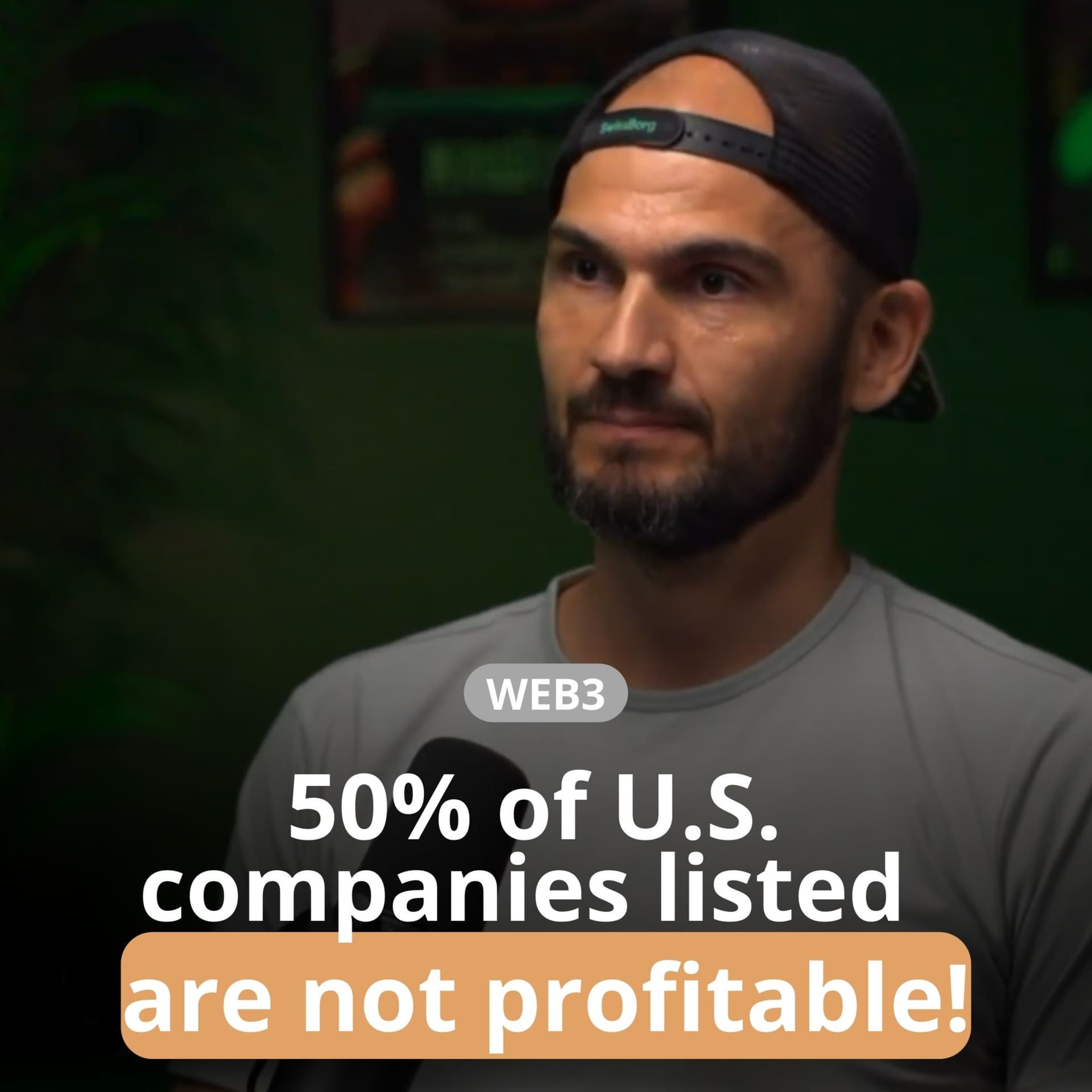
59:25And value is much more than money these days. Do you have examples of... kind of the tech wave and how some VCs behave that was that validates what you're saying. Yeah, the first example is, I think we discussed in length about it, is in the US, 50 % of the companies are not profitable and they are listed. Are not profitable and listed. And listed, right? Yeah, sorry. Why is that? Because there is, I'm a VC, right? I'm doing my Excel spreadsheets and I say, okay, if they do this much revenue. The entrepreneur is like, I can't see the entrepreneur. It's like the token economics. I'm going to solve my business by doing token economics.
1:00:16No, it doesn't happen this way. It's part of it, but it's not the entire reason why you want to have a crypto startup. So I do my little spreadsheet and I say, okay, if I push these guys to make this much revenue, even if they lost all the money that we invest, then I know I can sell these stocks to someone else because I'm not interested in into forging a good business I'm interested into my turnover and then you know I give to another VC that give to another VC and at some point the last VC is stuck he said okay I can't this the business is so big I could not sell to anyone else right so now I need to do an IPO because this guy doesn't understand anything so I think that was a pivotal moment into the IP world and it came with snapshot because before snapshot it was unbelievable it was not conceivable to list a company and have in the prospectus this company does not earn money and might never earn money right and the guy tried they say we have snapshot we're investing all our money we need to get back money somewhere because now the business is too big no one wants to in the institutional world no one wants to buy it you know it's not making money okay let's try to ipo will the regulators will accept will the public will accept because ultimately it's demand and they try and it was accepted what happened ipo and it works right the the stocks goes down and it goes up and and why is that why is that even possible that's good question so now we when you look you have to question yourself what's the role of the regulation what's the role of the establishment to let such things happen because what does it create is a blueprint to say oh now it went once so now we opened an entire new world to list any companies that will not be profitable so our only way we say but don't worry we're going to acquire this one and this one and this one and this one and this one and never worked so now we end up in the society where 50 of the company listed into the American stock exchange, NASDAQ and the others, are not profitable and most probably will never be.
1:02:35So become, you know, people make fun of meme of crypto, but meme already exists into the traditional world because if you can't make money as a business, it's just a meme. So there's many things that need to be fixed into the way we operate our financial model, monetary policy, but VC has a lot of responsibility as well with the way we design value into the world. And then we measure with accounting model, right? And we say, oh, if you make this much revenue, this is your valuation, even though you lose money. And we never debase the injection of money that was made. And we end up doing business that does not really make sense.
1:03:18The best example that we have recently is WeWork. WeWork is a great story. It's a great story. Wow. Yeah. So I think the role is to come back to more fundamental values. But maybe kind of like thinking or brainstorming out loud about what happened and why it's possible. Basically, you had like crazy amount of money printing, which continues to happen and will continue to happen. Very low interest rate. So investors not really knowing where to put money, putting money into growth, VC, startups. And then there's the VC game. You know, what's the VC game? It's, oh, I do a serious seed. And then I tried to get some other VCs, as you said, like buy a bit higher.
1:03:58And then, you know, in series A, and then you have the series B, and then you have the series D. And then at some point there's a snapshot example where how is that even possible that they go public if they even say that it might never be profitable because Wall Street makes money. It's the ultimate kind of winner every time, because every time there's an IPO, they make money. And probably it's so strong their lobby that they can probably go to the regulators and like one way or another make this pass. And then who gets dumped on the retails? As usual, right? Exactly. So. Yeah. Let's be fair as well.
1:04:36I think entrepreneurs, they have a big responsibility here as well. Because what I'm saying is not easy. The reality is you should accept money as long as it's aligned with your value as well as an entrepreneur. so I think it needs to be a two stream ways right as and it's hard right it's like when you have an interview you pitch very hard to have the job and sometimes I say to the guy okay you pitch me very well I'm going to pitch you now because you need to be in the conscious process of not forgetting it's two way stream right you're gonna you need to to pitch you of course that's the game you need to pitch me maybe more than I need to pitch you but you need to project yourself into the job because we need to grow out of this experience together.
1:05:23And entrepreneurs, they need to be courageous and say, yes, that's cool that I play this game where I create this company. I become a little bit the guy that the VC use, but I'm accepted to be used because I'm going to make a lot of money. And you end up doing something completely different from what you end up in the first place. You just look at your spreadsheet. That's the only reason that drives your business. and maybe you miss the point, which is the human adventure as well. You know, I know people, they've sold their company because they were in this money game and they sold that for a bigger amount of money with all 50, 100 millions.
1:06:03And now they are in endless search for a purpose. They never find anything. They need to go to this Kamehameha center in Bali. Exactly. They need to listen to this podcast and go to this Kamehameha Center. So look, I don't necessarily like the guy, Marc Jucarbeil. I'm actually very not sure, but I read his biography, obviously. He's one of the biggest entrepreneurs of this decade, of this past 20 years. And, you know, he was 23, and Yahoo wanted to buy Facebook for 4 billion, right? And the VC came to him and said, look, you're going to be the most young billionaire in the world, right? You should accept because it was saying no.
1:06:49And imagine the pressure, the VC pressure, the early employee that say, are you fucking crazy? Four billion is a lot of money. You should accept. But because that's the game. VC doesn't breed winner to have company forever. They bring guys to be either IPO or purchased by a bigger group. That's it. And one of the guys say, come to him and say, look, Mark, you're going to have one billion. you can do everything that you want all the crazy ideas that you have in your life you can make it happen and you look at the guy and say but maybe Facebook is my best idea and I will have never a better idea than Facebook and I'm not selling it because of that I think the story there is he was talking about a few really hard moments in Facebook story and how even his key executives that he trusted so much left him in those moments because they couldn't understand why the dude would not sell and they wouldn't basically cash in now.
1:07:50And I think you have to respect him for that because he played very well the game, let everyone think he was, you know, well, someone like anyone else, money will buy him. And he played the game very well, collect all the money to make this vision happen. And they say, no, guys, I'm here to stay. And that, I think we, then we can discuss about Facebook, you know how good it is or not but for me it doesn't matter we need more entrepreneurs that are not ready that can change their perspective and say if i don't take the money from the vc world i find something else and i think that's something that we've done very well with swissball we came in a very honest manner with the community and it only create loyalty and trust we raise uh so we raised 50 million we raised this year 24 million across um 50 sorry 17 000 one seven thousand people across the globe at the worst of the worst of the bear market because people see that we we deserve to exist at least to have a counterparty an imbalance of power into the crypto world they are going to make money they made money with the token maybe it's not going to happen as quick as if you go for something else but i guess with money we can look at money say one million is called one million but the way you make this money for me matters a lot We talked about before about the VC game that is kind of incentivizing entrepreneurs the wrong way and founders the wrong way.
1:09:22And last time we also talked about why SwissBorg is still alive. And you basically explain me why, because I asked you how, what's one of the key reasons? I mean, obviously you said, I think you were the one who's kind of like doing sort of risk management and some sort of key decision in SwissBorg about what you use as products and not. And like, do you increase your interest rates or yields when the competitors in 2022, they're all much higher because you see, you know, the AUM going down a lot. Yeah. So explain us kind of what happened and why SwissBorg is still alive. Yeah. When all the kind of competitors or even much bigger companies in the lending space and the kind of, you know, SeFi exchanges, most of them went bust.
1:10:14And how it's linked to basically VC money. Yeah, it's a very good link. look the I think as human right as long as we the reality can accommodate our short term reality in a good way we have a capacity for acceptance that sometimes is too much the best example that we have is slavery it's an extreme example now these days we say beside the fact that maybe it exists in some part of the world still to this day, but for most of the people, that would be not acceptable. But there is a time of history where it was acceptable. There was something that was accepted. Why? Because it accommodates some of the people to say, but it's normal.
1:11:01So if you see someone having a slave and you are in a position where you can possess one, then you would say, okay, the other guy said that it seems that it's nice. Let's do the same right. And you don't ever question the reality. And that's what saves us from, I think from the VC. The fact that we are not backed by VC saved SwissBlock, to be honest, because when you look at what happened, so let's go back in history. It's 2020. We launched the app a year before. The market was not great. And it's the end of 2020. The market started to be like these days. It reminds me what happened today. It reminds me so much of what happened at the end of 2020.
1:11:45That's why we came both here. We showed up with a big smile on our face. Yes, exactly. So what happened is Bitcoin breakup. You know, there is a movement. People have been building for two years as well. The same as now, right? Very tough. We are out of, I mean, we are at the end of the very tough bear market. Only people with a mission are staying. They've built very hard. And we start to see the fruits of this building. and it manifests into DeFi. So what happened as a result is the market become more teamstick. At SwissBorg, because we've been there for now more than three years at that time, we start to identify, oh, the biggest opportunity is going to be manifested into DeFi.
1:12:312020 summer, right? Yeah, 2020. And then we understand as well that people love passive income. There is an elegance to it because it gives you this predictability. Bitcoin for me is a beautiful asset. Ethereum is a beautiful asset. But to accept the stress on the very short term daily, if you don't have the discipline, it's very hard for most of the people because they already struggle with their life. They don't want an extra source of stress. So passive income, I put money every day. I receive a very, very accurate amount of money I can predict. it's a very good entry point for anyone that is trying to invest, right?
1:13:16So we understand that and we say we need to build a passive income product. Most of the other competitors, so Celsius, I don't know, you name them, Voyager, BlockFi, all these guys, they understand the same, but what they do is they use crypto as a payment or as an asset to invest into traditional finance, into traditional credit, finance, leverage stuff, right? with CISBO we say we don't want to play this game because even though we are a centralized exchange it's for UX purpose it's in terms of adoption it's not because we believe in the old school way we believe in transparency so can we build a passive income program that is actually truly built out of DeFi so we worked very hard for two months and then we released the program that was called the Smart Deals and we were the first to give full transparency.
1:14:11So you go to the blog, you know exactly where the money is invested, etc. No one was able to do that. And it's the beginning of DeFi, so the yields are just amazing. And in three months, we go from zero, from launching the product with zero money to one and a half billion, a little bit less. In assets under management for this product. Yeah. So it becomes a massive success. and there's a ripple effect into the entire SwissBorg environment. The token goes up, it goes from 10 cents to one and a half dollars. So everything is blossoming. But of course, it's the beginning of DeFi. So then the DeFi start to normalize and go back to more normal yields.
1:14:51So for example, at some point on USDC, we have 40 % yield, which was crazy. Paid in USDC? Paid in USDC. Okay. So it was amazing, right? It was making the buzz and it was transparent. So it's not like, oh, it's a promotion or something fancy. No, you can verify it by yourself. And then gradually, but because we do all the tasks of analyzing the smart contract, managing the funds, paying the gas fees that was extreme at some point. So if you have a small amount of money, you can't do it yourself. So that was a great market fit. Then the USDC started to go down, down, down, down. So we go back to the range of 8 % to 6%.
1:15:32and the other that are still at 15 % because they see the opportunity. So Nexo, Celsius. Yeah, Nexo is in a different place because they see it here. They use traditional finance, but they have a great model because they didn't collapse. But the other guy, Voyager, Celsius, you know, FTX, all these guys, they offer a crazy amount of money. And we don't play the game. We play the game with transparency. And we try to educate people by saying, But people say in their foyer, you guys, you are great, but you don't know what you're doing anymore. Because others offer better yields. So we'll take our money and go to the others.
1:16:11Like they're chasing yields. So then we, from one and a half billion, we go back to 300 million, something like this. Because there are still people that understand, they understand the thing. How do you feel at that moment? Because you are the one making the decisions. And how internally did you justify to your co-founders? because even though you don't have VC pressure, there's people in there who say, hey, we had 1.5 billion. Now it's 200 or 300 million. Like what the fuck are you doing and what are we doing, right? The others, they're still offering higher yields. How do you justify that? Yeah, it's difficult.
1:16:44I think the team has great confidence in what I'm doing. And when I say it's not possible, we're going to put the company in jeopardy and risk that we don't want because it becomes very asymmetrical, meaning when things normalize that's what we live with uh government bonds at the moment but it's another story is it becomes you take so much risk to get the extra percent that you know it's it's not gonna end up well so internally it was not a lot of uh headwinds or fight there is questions there is you know of course the people that are uh distant they are in business and they receive offer from you know we had the offer from celsius three hour capital there was pressure internally for sure right sometimes to go but what do they offer exactly at that moment they say give us the the money we give you 12 30 you can offer to your to your user that they call clients always and and you know and they say we're in business we want everyone else why you guys have so much resistance so of course as an individual i question myself a lot so i start to go and i I start to imagine, okay, maybe I can do future arbitrage, but then it requires a different level of complexity at the operational level.
1:18:02It was a little bit of a shitty time for me because I was spending so much time trying to figure out. But yeah, I get a lot of knowledge as well. But at that time, I think the point of the discussion is beside the malpractice of all this other company, I think if we had VC internally, they would have pushed us. They say, you guys fucked up all the money I invest. You have to change your game. You don't understand. So they would have not trusted us enough. They would have trusted the other guy. Because look at the other guy. They were all shiny title. I've come from Citibank. I come from this. I've done all these things.
1:18:41Our valuation is$4 billion,$5 billion,$30 billion. You have to match the curve. You guys don't follow. So you would have had to play the game? like the others if you had VC money. That's the crazy part. Technically, no, because there will be very unlikely that the other VC will possess a majority stake in the company. But when you feel the pressure of your community, maybe internally as well, you can divide people, maybe we'll have made the choice. I'm not too sure. But I'm going to tell you something that I noticed, and that's the part that gives me even more confidence. I start to look at the people that were managing the DeFi money into the other companies, right?
1:19:21That were making decisions. And I look at these people and most of the people that were coming from Google, Facebook, or payment company. Because let's be honest, the investment, so what we call the wealth tech, so the company that actually invests the money of the people into finance, they are very new. The fintech world is majorly populated with payment company. So if I create a payment system and I say, okay, I'm doing this euro payment, whatever. If I have 10 or a million clients, it's going to be the fucking same. So my game is to put the technology together and then scale it as fast as I can to scale the market.
1:20:08When you do investment, there is not a linear. So of course, when you do payment, you need to improve your technology. But there is a very rational path how you scale. You scale the business, you scale the technology, you make more money. When you invest, there is not such a thing as linearity. Maybe you make 10 % when you have 10K to invest, but when you have 1 million, you can't invest the same, right? And the same way when you trade derivatives. So nothing that you can do with investment is linear. But everything that was on paper, that was scaled by these guys, was seen as linear. So now you hire someone from a payment company and say, scale my business.
1:20:47Because that's what VC do. They go out there, they do their shopping with companies that have scaled before. They go to the Revolut guy and say, okay, this guy has a boss. I'm going to hire this guy, make him boss in the company. That's how I'm going to attract him. And say, scale my business. But you can't scale investment. Because investment at every step acts differently. You don't manage 1 billion the same way you manage 10 million and et cetera. And when I look at that, I say, okay, these guys are going to scale the business like it was a payment company business and they're going to fail.
1:21:20And that's what happens. And it's very painful because as a business, as a very, I think, very strong business such as SwissBorg with very, very strong value, we suffered because we didn't play the game as the others who will lose a lot of users. And we didn't get them back because they lose all their money with the other. And then we suffer a bear market with a lot of bad talk about what centralized exchanges are, while they are very different in nature. I want to introduce a concept here, free rider. So the other day we talked about that, and I was looking for, in French we say passagers clandestins.
1:21:57Basically the free rider concept in economics, and it's completely linked to both investors thinking short term and businesses thinking short term, right? which doesn't benefit the kind of greater picture. So a free rider is someone who wants others to pay for a public good, but plans to use the good for themselves. If many people act as free riders, the public good may never be provided. Markets often have a difficult time producing public goods because free riders attempt to use the public good without paying for it. And this is exactly what happens in crypto. I mean, in markets in general, but crypto is kind of exacerbated, right?
1:22:38Because you will always have these people who know that this thing is a Ponzi, or this thing is a Ponzi, but I participate because I'm short-term thinking and I'm smarter than the others, right? And you apply both for like the VC game where they might just understand the whole game, but if I'm early enough, see deal, you know? Whether in crypto or in traditional market, I can sell to the deal, you know, series A or series B, I can kind of like unload. or the investors, right? And you talked about the other day, you said like something that is so important for you as a person, but also for SwissBorg as kind of like your values is this notion of kind of public good, right?
1:23:20And building long-term thinking into people. And it's completely linked also to the concept of zero sum game and positive sum game. Absolutely. Absolutely. Which we often say trading is a zero sum game. When you make money, someone loses on the other side. When you lose money, someone makes money on the other side, right? Whereas investing is kind of more of a positive sum game. Absolutely. It is. Which I have to, and I had this discussion with the other day with a friend, is investing really a positive sum game? In theory, yes, but then I'll let you like deal upon that. But in practice, when you look at what happened last year, I am 50 years old.
1:24:05I think this Bitcoin and ETH thing, I think this crypto thing is going somewhere. I buy every week. Just Bitcoin and ETH or just Bitcoin because I don't really understand. But I know, you know, I want to accumulate that over long term dollar cost average, which is how do I outperform the markets in general in any kind of market? I just do that, right? And then I keep this Bitcoin in because, you know, cold wallet, like I'm 50 years old. What the fuck is that? Like I'm going to keep my money in this FTX thing or this Celsius thing that is backed by, you know, hundreds of millions and pension funds.
1:24:39So I'm basically doing the right thing. I'm investing. I don't try to trade. I have a long-term thinking. I vote with my money and then I still get destroyed. So can you elaborate on kind of this free rider concept and then the positive sum game versus the zero sum game and how we can, and I don't think it's even possible, at least not in the short term, but how do you convert greedy humans into long-term thinkers? Yeah. Very good question. Look, I'm going to start by the last question. There is something fundamental that we need to change in finance. 90 % of the information, or maybe even 99%, I don't know, it doesn't matter, but the information in finance is related to price or is a derivative of price.
1:25:35Price, market gap, volatility, everything is linked to a price. But finance is human. It's entrepreneurs that fight very hard to create more value in the world. And arguably, if you look at the past thousand years, we have created more value as a consequence of collaborating together. Because again, finance is a tool of collaboration. That's it. It's directing your time, which is the only unit that you have, to a collective that is going to leverage this time to create more value, a better world. But that's not the information by which we measure the success of finance. We look at price every day, right?
1:26:16First thing that you do, and I do the same, let's be honest. What do you do when you wake up in the morning? Yeah, I do prices.
1:26:25So we are overwhelmed by prices. When you look at Twitter, for example, I think, so going back to the work of what fintech needs to focus on is to change the experience that people have with their investment and start by reinventing the way we are inspired to take action when we invest. Because the way we're inspired is by price. what the price of Bitcoin? We didn't say what achieved Bitcoin in the past 10 years, right? We always say... Do you think it's possible to think that way before you've made it? You were saying in the beginning, I'm doing well, I did really well. And at that point, I can start to have a real purpose, especially around that money, which is I want to back up tech entrepreneurs or that kind of entrepreneurs because that's going to give me a better sense of purpose.
1:27:11And I feel like I'm doing the right thing. But most people are not in that spot. Yeah. Yeah. Look, it's a journey. So it's not going to happen overnight. And we use this example is you will come most probably, if I believe I'm going to convert people by saying Bitcoin is an insurance policy for the collapse of fiat currency, which is absolutely true. I think it shouldn't be an option for people to have Bitcoin these days because there is a non-null probability that the fiat system would collapse by itself one way or another. So you should see that as an insurance policy. Do I want to pay an insurance for my car?
1:27:50No, but I've still doing it in case shit happens. But if you lead this way, it's very unlikely you're going to convert as much people as if you tell them, oh, you're going to buy a Ferrari if you invest in Bitcoin tomorrow. And it's fine, to be honest. But then if in the way you have an infrastructure that helped them to reconnect of what is Bitcoin and they come for the money but they stay with the philosophy, it's a big win. So the first thing that we need to change is not necessarily too much but we need to change the discovery process by which we invest. Because right now it's very much, I look at the chart most of the people don't understand and comprehend the chart, they don't even understand what the market gap is, which we end up in crazy valuation that doesn't make sense.
1:28:36And it's fine because people that just look at the price and that they're trying to figure out whether the price, if it's good or not. The price is 10 cents. No, the price is one cent and it's going to go to a dollar. That's 100x. Exactly. It's going to go to one. And it's going to go to Bitcoin price. You know, there was a narrative, I think, that is still valid these days. And you can't blame people for that. That's difficult to understand all these very technical terms. But where there is a massive opportunity is to reinvent the way we discover investment. I think the guy that is the closest to change that, And it's very funny because even before Elon Musk made the move on Twitter, internally we had this speech of saying, we need to go crazy with the app and change this price mechanism because that's not the good way.
1:29:23It's not that it's not the good way, but that's the biggest challenge that we have in front of us as a fintech. We can do it like everyone else and making just money or we can really try to change the game. When you look at Twitter, and of course, it's an isolated community, but I think he is the closest to change the discovering process because I think the perfect UX experience to invest now is, I listen to your podcast, I trust you. I go to your Twitter channel and you say, I met this project, I really love this project, and then there is a buy button. I don't even need to look at the chart.
1:29:55I say, I trust this guy, identify to his value, what he's saying seems to be fine, I'm investing. and then I can look at much P &L I'm making but my entry point is so much different by looking just at the chart and that's the biggest challenge I think the investment world has in front of us because now it's an open world and I think as a result this is going to create more a different perspective when it comes to investment maybe we're going to try to invent different metrics for success and judging what is value that an investment creates. And I guess the metaverse will play a massive role as well because now imagine that instead of looking at the chart, you have your VR Googles.
1:30:40And then the first time you want to interact or you want to inquire about investing into a project, you go to a room and you meet virtually someone that tells you his experience with the project and tell you why he invests in the first place. Because the discovery process of what finance is and it's the most difficult for fintech to capture is the the decision of investing rarely happen in the app it happened before discussion with your friends looking at an article and etc and rarely up inspired to take action you to take action they inspire you to take action when you say i have earned this much or this much but they only inspire you to from no idea to get to an idea and there is plenty of cards on the table and that's where the biggest challenge of the fintech is these days.
1:31:32So people want to hear a story basically. Yeah, we come from, the best way is to tell a story and when you anchor to the story, it will help you to overcome the challenge of seeing the price dropping and then this is how you change your perspective. You see an opportunity now and it completely detach you from the noise and sticking to what you believe is value, is your value. And so to change what you say, what we discuss is it's imperative to help people to see value beyond the price. And what Bitcoin has been doing, right, as a ripple effect of having a price that is arguably the most asymmetric investment classes of all time, best investment of all time, what they do see as a collateral value has created a generation of entrepreneurs, a free entrepreneur that helped to challenge the traditional model of Silicon Valley and all these things.
1:32:29And it's very good. And this in itself, even if Bitcoin has to die tomorrow, in itself has so much value. This is competing to another thing we talked about, which is the think big culture. That you really don't fake it until you make it culture and think big culture that you really don't believe in. basically. And you said something that was really interesting, which was, I mean, how should a founder start their business? You know, should you think super big or what should you do? And it's going to be linked to like how people discover, you know, a project or buy something and kind of like reshaping their way of thinking around price and other way of discovering a project, right?
1:33:16You said you need to start with the smallest iteration that can help you create your community. I need to build a product to get my first community member. Can you elaborate on that? Absolutely.
1:33:32For me, the biggest engine of motivation for an entrepreneur or the spark come from frustration. You know, you have to create a product for yourself. It needs to start there because you need to went through the journey, discover something about the world, about the statu quo that frustrates you and create out of it something. I think the worst business, and that's why, you know, the dropshipping and etc. I know it's very successful. They sell you a methodology to make money. And to be honest, that's not entrepreneurship. So not the fact of dropping yourself, but actually selling courses, right?
1:34:11That's what you're talking about. Not necessarily selling courses, but what I'm saying is, if the spark of you being an entrepreneur is say, oh, I'm going to use all these tools to make money, but it's completely disconnected from a frustration or something that you really change. It's basically making money for making money. Yeah, for example, if you, I don't know, if you start to sell a microphone, but you have no connection whatsoever to microphone just because you see an opportunity, it might work, but most of the time, first of all, it's going to fail. It's funny you say that because we had Lucanets, the owner of Pudgy Penguin on the podcast, And he was saying how when he was 18, he was basically selling this fake gold chain through Instagram influencers.
1:34:52So that's kind of, I mean, kind of, but just for the sake of making money. And he made like millions of dollars in like when he was 18, just doing that. And now he's much more into this thinking of like building something that's much bigger and that makes much more sense and kind of like joining the mindset. Look, I don't disregard that. I think it's because I guess it's up to everyone to make their own decision and not being so easily played out. You know, a lot of people criticize the ICO time. ICO time was great. You invest money, you get wrecked. It was your own decision. Now you get everything I need to go through.
1:35:32Because the worst thing that can happen is when you invest through a financial advisor and you delegate your decision, then you lose money and you blame him. It was still your decision intimately. So I'm very much aligned with respecting people. When I respect people, I give them full power. But then it comes with the responsibility. Because I respect you. I'm not trying to babysit you. But yeah, playing a trick. I mean, of course, you're young and etc. But true entrepreneurship is trying to bring something to the world. It's trying to change something in the world. That's the way I define it.
1:36:05So you're trying to solve the problem, basically. Yeah. And so you don't know how big the problem is. that's the thing and you don't know how much time it's gonna it's gonna take for this problem to exist but if you have the confidence then you're gonna go on the journey but they show this journey should not be motivated on the first place by making a billion a billion in itself is i think we we need to look at money as external positive external positivities from doing something great it's so funny i was i had a discussion yesterday evening with a friend of mine here in dubai who is launching a kind of super app for kind of private conciergeria.
1:36:40And I was exactly saying that. I was exactly saying, he was like, hey, where do you start this business that you have? And oh, where do you start this podcast? Like you want to make money, right? And I was like, no, man. Like, I mean, obviously, yes, you need to be sustainable and profitable. But the drive is never, I was telling him, if the drive is the money, you will never, you will never last the journey and all the tough moments that you encounter. And because you don't have the kind of belief, you know, like you, whereas if you have this thing in your gut feeling or you're trying to solve a problem or kind of like you're basically working on a mission that makes a tough sense to you, then in all these moments where it's shit, you know, and I remember Cyrus telling me about the bear market of 2018 and 19 and he was like oh man like if you think about the great depression of 1929 like this is like 10 times again we're worse and we're laughing about that right and it's really that it's as simple as that it's yes you need to build a profitable business and make money but that's not the main drive it cannot be it cannot be and and don't get me wrong i'm not saying making money is wrong.
1:37:52I think it's great. But it should be more accepted that if you do something great and you learn all the technique of entrepreneur and you put everything into motion, it will come eventually. You look at Wim Hof, you know, it came with this very genuine mission of saying, I need to help people that struggle with traditional medicine to overcome the disease that they have or the mental health. And he didn't even want to monetize it. His kids apparently pushed him to do so. And it's fine. Again, it's not bad to make money. But I think it's not going to lead you where you want to be if you lead an idea with money.
1:38:33That's it. Because, yeah, I don't think it exists. Can you elaborate on the Wim Hof story? And then based on that, talk about how crypto can accelerate a movement, right? Yeah. and change people's mind because you said real innovation is when you change perception before we talked about that and then we can move on to like probably the last topic for today because it's soon time health yeah kind of like going down the rabbit hole of like traditional western medicine versus what you learned when you went to india yeah so we move we move yeah so we discussed that before the podcast sometimes you're trying to help someone to see an idea and it's difficult because you speak a technical language there is barrier so using great example help to overcome the limitation of language let's say that someone can connect to what is the idea of the idea so I was explaining to someone again that is doing a crypto startup what is the beauty of crypto and how does it really shape a new wave of entrepreneurship and product adoption and you know go-to-market strategy and say look at Wimov.
1:39:53Wimov 10 years ago came to a thousand percent let's let's assume he collect he gather a thousand percent into the same space show them a ice bath and say you have to jump on it because it's going to help you with your health you can bet that 99 percent of the person will say no and maybe one person will we will say yes why because this person will be very much identify himself with remove most probably will have a trauma will have failed with traditional medicine will have something that he really struggled to create and because you identify yourself with this other person then you follow him into his invitation to experience something new because the traditional thinking process would be to say if i jump into a cold bath i'm going to die i'm going to have heart attack or interocution you know all the things that traditional medicine will tell us so actually we're at the one person then the same one is let's say 80 % similar to Wimov, 20 % different.
1:40:57And then he met someone else. This 20 % that is different from Wimov is going to inspire the other person and et cetera. And then you reach global adoption with time. But it takes time. 10 years in that case. 10 years, yeah. I mean, it's still more accepted, the cold bath thing. But like there's still probably a lot of people would say, maybe it's good, but I'll never do it. Yeah. Now, how crypto can change the game? you go back to 10 years thousand percent one guy say i'm going to jump then you say for the one that i'm not convinced now i'm going to give you tokens so we move token yeah the we move token whatever it is you're going to get something out of trying the experiences then most probably now you're going to instead of one person you're going to be 20 or 20 because some people say fuck yes, I want to try because now they're challenged, you know, and I want to earn something out of it.
1:41:53And even if they come for the greediness of earning something, maybe in the process of trying, they find something else. They learn something about themselves because maybe the guy starts his drum, he starts to speak his voodoo stuff because he's very charismatic. That's the product. That's an entrepreneur. And then he brings these people into his world. So the beauty of crypto is now I don't need to pitch only about the product. I can actually speak your language because everyone wants more money. Everyone wants more fun. Everyone wants to be challenged to do something crazy, but don't want to do it for free.
1:42:27I can speak this world for a second, bring you to my world. And this is where the work of an entrepreneur start is then I need to connect you to my world and help you to disconnect to where you come in the first place. And crypto create this. They can incentivize you. Of course, you can farm me and do the farming that we see that is completely purposeless. But if you do that the right way, you can create an incentive and you can honor the people that tried the first, right? They are very important. I think what we say very often with Cyrus is say, you can remember what Uber is, the taxi. You can remember they have done an IPO, but you cannot remember the first taxi driver that actually use Uber.
1:43:14But this guy was so useful. It is actually part of the reason why this guy was IPO, because they use massive this data. It's funny because when we did the interview with Cyrus, we were not doing a lot of content and reels and short clips, but we did one, and he was exactly talking about the Uber driver. I see. We used this one. That you incentivize for being very early on there, and that basically deserves to share the success of the company that he contributed for in the beginning, right? So back to basics. So basically crypto accelerates the timeline. That's kind of like the takeaway. Because it can hack a little bit the system of, oh, you speak my brain language, you're going to give me a token or something of a value I'm going to experience.
1:44:04And then that's the work of an entrepreneur. Now they hack, they curb the time that is necessary for someone to accept an idea you curb that and if you have a true intent a good product you're going to convert much more and then it helps to accelerate because sometimes you know look at some kid when you are a kid sometimes your parent force you to do some things right and you do out of force but you find something about yourself actually you're grateful with time so i think it's uh it's uh it's education for for adults crypto is help you to force yourself to do something to find this extra push where actually you can find an outcome that is very pleasant.
1:44:45You talked about Wim Hof, who did an amazing work at changing people's mind and perception on health. And it's also a process you've been through, maybe not through ice bath, but you're saying you grew up in France. So the classic thing in the Western world in general is I have a headache or a physical pain or I'm sick. I go to the doctor, they give me some pills to treat the symptoms without ever thinking about the underlying causes, right? And you told me that you've been through this journey where you did that for a very long time. You had this very mechanical approach to your body and mind and then you went to India.
1:45:28What happened there? yeah it's a good question so first I again I guess there is key moments such as going to India where you create a space for yourself where you you start to reflect of what happened in your past but the information is is already there so when I was a kid my parents had a difficult relationship and I was always sick always had flu stuff constantly sick so my mom always get me to doctor i was taking a lot of antibiotics antibiotics i was doing the summer time where your vacation i was going to special center and stuff and it was crazy right it was the rhythm of my young child was a lot of sickness and there is an acceptance they say oh this kid is sick that's what it is he's born like this uh then you grew up you're a teenager you detach yourself you emotionally detach you touch yourself from the parent less sick.
1:46:24Then you get out of home, doesn't have any sickness for a very long period of time. For seven years, I didn't even see a doctor at all. Right. A little bit of flu up, shot of ginger, back on business. And then I went to India. It was very random because it was the end of the year. and I said, how am I going to celebrate the New Year's Eve? And it was always the same, going out with friends, drinking alcohol, getting shit-faced and go over a holiday and stuff. And they said, okay, this year I want to try something different. So I go to, I look at Bali and Thailand and all this place and I don't find anything that inspired me.
1:47:13And then I remember, I don't know, all of a sudden I'm in my room in the night looking desperately to find a place where I can have yoga and stuff. And I remember this book that I read from a French author. And it's a guy that worked in New York, is a lawyer in finance. So IPO lawyer and this stuff is making a lot of money. His father died and he created an emotional I don't know, something. Response and trauma. Trauma in himself. And he said, actually, I'm not happy with my life. he quit everything and he goes to India and travels for three months so then in his book it's called I can't remember he's just telling the story he's staying in different ashrams which is this place where you have a guru and you meditate and stuff and he's counting the different places and there is one that he's telling about that is Osho which is a good mix between being very into your energy meditation and the night you party you party it's not like your body crazy but there is this balance where they say you have to nurture the buddha and yourself and the other part that is the most ecstatic self which need to enjoy life as well in every every length of life so i say okay that's that's this one is fun because i don't want to be in something that i don't speak for 20 days i want to be in between so i book my ticket to india and i get there and then you And surprisingly enough, I met very successful people in the world.
1:48:45I met people that are the most famous TV presenter in Belgium. All these things. And you connect with them. And it's a very interesting experience. And at the time I reflect and I say, you think a lot about your childhood. Of course, a bunch of things that who we are is very much influenced by our parents. and that realizes and it's actually a little bit of dualities it's fine to blame your parents it's fine because you're angry and you have all the right to be and at the meantime and that's the kid the kid is angry and he's all the right to be and the adults is as well in understanding that they try their best they did the best that they can and you need to accept that and you need to embrace that and this duality helps you to manage better the relationship that you have with yourself and stop this oh my parents didn't give me that or that and that and you overcome this challenge and you say that's fine that's you know there's a learning to make out of it and what i did realize at this moment i think is actually the reason why my kids the i was as a kid very sick is because i was emotionally connected to the drama that was happening between my parents then it clicked in my mind and I say, actually, we have this very, very mechanical relationship with my body.
1:50:07But my body is just a signal to indicate that something in my mind needs to be fixed. Right. And when you're an entrepreneur, it's like being a very high sports person. It's very physical. You're going to exhaust yourself. You work very hard. You can outwork yourself. And raising this awareness where your body tells you, okay, your mind tells you you need need to keep going, but your body tells you actually it's a win if you rest for a few hours or one day and you disconnect. This is very important, I think, to survive the entrepreneurship. There is many burnout into the I never burnout. I'm lucky.
1:50:47But in the entrepreneurship story, there's so many burnout. We never talk about these things, but it happens very often. That's a good one. The one of the previous guests I had, we talked about he did three burnouts and he was a massive to be successful money wise and everything. So how can holistic medicine help?
1:51:10How does it work? Why does it work? I'm asking that because I don't know why, but I'm a massive believer to have been doing that for many years. Biohacking, taking herbs. I even did the, I'm a Reiki master. Like I did all these things because I think I had really bad health issues for three years and the doctors didn't find anything and they actually didn't even care like oh sorry you have this syndrome and then i went through like water fasts nine days biohacking taking herbs a lot of different things eating you know paleo diet everything to to heal and then it worked so well i went all down the the nootropics rabbit hole so like how do you take you know mushrooms to kind of like become smarter and like more focused actually i'm on nootropics right now i have to say every time before podcast i take something that makes me like in the in the flow in the flowing and i think is absolutely amazing both to to kind of recover from like really bad traumas or you know like regenerate neuroplasticity if you had like bad accidents or or if you feel amazing how do you build an edge to be like an even better entrepreneur so what's that special about holistic medicine look the doctor in you is gonna answer I really don't want to come across with a special recipe because I truly believe it's to everyone else to find a recipe.
1:52:32And I think everything is an artifact that actually helps you as a human to focus on part of yourself that gives you what you need. But it's already there. You take a mushroom. It's not the mushroom that gives you access to your special power. They are there. It just gives you a rhythm that guides you inside to this power. But you can find everything from yourself. I truly believe there is a way for any human to unlock naturally all this power. It's just it's more difficult, you know, and I believe that the mushrooms or even us as human, we carry an heritage, a legacy. And if for thousands of years people believe this mushroom can give me this access, you know, it's it's it vehiculates in everyone else.
1:53:21right but it's there yeah because all this stuff is thousands of years like in Chinese Ayurveda or Chinese medicine is 5 ,000 years that people have been using these non-traditional ways of healing themselves and if it's been working there's a reason right and so that you listen to Wimov that you listen to I maybe you know this guy Joey Dispenza yeah I read this book superhuman or many Many, many other people, I think ultimately they give different methodology that leads to the same conclusion. There is this mystical part of who we are as human. Jodie Spencer called that the unified field where we can connect and basically anything.
1:54:08So if you find a way for yourself to connect to this unified field. And the crazy thing is not woo woo stuff anymore. This guy document, they have heavy scientists doing the research and they show so many amazing stuff and so many amazing results with this stuff. But actually, there is something that is beyond our own comprehension. Alan Watts would say, we can feel it, but we cannot think about it because we don't have the language. It's there. It's just we can't talk about it. We can't think about it. But it's there. And if you find any methodology to connect to it, I think you can accomplish, health-wise, amazing stuff.
1:54:50And even the CIA, right, has this secret program that was called the Superhuman. And I tried these things. I think I heard, I never read this stuff, but I have friends that told me they read this book where the guy is actually crushing himself from a mountain and then he's thinking and he's recovering all his body, his bones, and it's crazy. Yeah. And one really interesting one is in that category that a lot of people don't believe in is, and that I think is amazing is, for example, acupuncture. Like, I mean, some people will say, oh, it doesn't work on me. Maybe they've been once like a psychologist, you will go once, you go to the wrong one and you don't find the right person for you.
1:55:32But like literally by putting your needles in your meridians, like you can... get a lot of help for anxiety, depression, jet lag, stress, anything like, I don't know, hair loss, I think erectile dysfunction, all this stuff, like basically, which, and if you ask an acupuncturist, why does it work? They will not be able to answer, but it fucking works. Like, I'm sorry, I'm an adult addict. I do a lot of acupuncture. It works. Like, so it's really amazing. But just to finish on that, it starts with the belief. If you have mental resistance, it's not your time. So I think sometimes life as well gives you a very hard time.
1:56:16like your experience but then you're in a position of acceptance and that's why we have to balance the way we say life it's so hard, life is hard with me maybe trying to teach you something and the less you listen the harder they will try to teach you that's how life functions yeah if you don't basically the pain is not big enough and when the pain will be big enough you will do changes and kind of accept more things and try more things out I want you to notice. Yeah. You said that some people close to you had cancers and went on this kind of like holistic journey, even more, even a bit deeper with the use of psychedelics, shaman, and they feel much better or it helped them cure.
1:57:06You want to develop on that? Yeah, absolutely. I mean, again, it's not my experience. So it's what I witnessed. but the amazing stuff is they try very hard with traditional medicine maybe it's not for them I'm not saying again it's the solution to every miracle but then they come they went to a stage where they say I need to try something else because ultimately I keep giving up on my power of decision I'm trusting a doctor to solve my problem and I went to an operation two years ago and I think when you are of course you're in a very vulnerable position but I was keep telling myself if at any moment of the process you don't feel it quit because you can't say to the doctor that's your responsibility that's yours to feel in agreement into you should never surrender this responsibility that you have you yourself to trust the process this is your responsibility and then the doctor the doctor is a facilitator but ultimately needs to be your decision if If there is any moment you don't feel it's the right thing to do, you have to find something else.
1:58:15But the result that we see with these people that have cancer and went to more alternative medicine is completely reminiscence. So something clicked, something happened. Again, we have a very hard time to explain. We have speculation. Everything is speculation in the world. We can't even explain what's the origin of our creation. We cannot explain why you're here, how we came to it. We have all speculation. So from this moment, I come from a scientific background. So from a long time, I said, if you can prove it, it doesn't exist. And then I felt that none of me didn't make me happy. And it was wrong because we can't explain the origin of the creation of human earth.
1:58:58Nothing. We have theory, but they can't be for fact. They can't be for sure. So everything else is speculation. So if you find something that helps you to unlock something that gives you a reminiscence or truly change, you have to embrace it. It's not, it's true. I feel like there is more acceptance, but it's still, yeah, pointed out that's something bad. Yeah. And I think that's a really great way to end today's conversation, which is you need to take responsibility for your current health, your current situations, you cannot outsource your health or your finances to someone else because not only, for example, in finance, they might have different incentives that are not aligned to yours.
1:59:45And that could be the, you know, we could go down the rabbit hole of like how this works, but we're not going to go there today. But even the health one, they have a, for example, a doctor will have a very limited time to see you, 10 minutes. And then like they need to make a decision because there's an entire system. and even the entire system, like the financial system, might be kind of not in your favor, which is what happened to me. You gave me a medicine that is actually destroying me completely instead of helping me out, right? So you can't outsource anything. You are the person who is responsible for yourself.
2:00:15And if you don't understand that, you're going to have a real hard time in your life. And obviously, you can't control most of the things that happen, but like the things you can control, you want to take control of and take responsibility because that's what's going to make the difference between you and you being free basically and most of the other people who are questioning themselves and who are the you when you were in London after 10 years in traditional finance yeah and there's period of time where you lost and you feel a victim and it's fine when I listen to the video or motivation video sometimes is I feel it's still down to binary.
2:00:54We need to accept there is a period in between. I truly believe you should never feel a victim, but there is a journey to get there because that's not what society, that's not what programmation and education teach you. There is always an external responsibility. There is law where I completely forget about the moral code that exists between men, right? And women, obviously, but there is a process to inverse the curve of programmation. And it's fine. If you're in between, if you have still resistance, oh, this guy say you shouldn't be a victim, but look at my life. It doesn't know what my life is about.
2:01:32It's okay. It takes time to get to this stage. But yeah, we should, by definition, you should aim for. We should change by saying you shouldn't feel a victim. You should aim to be at a place that one day you don't feel as a victim because your life will start. Thank you so much for doing this man. Thank you. It was a pleasure. Thank you man. Good stuff.
From the publisher
Anthony Lesoismier-Geniaux is the Co-Founder & CSO of Swissborg, one of the Biggest Crypto Companies in Europe with over 1 million users and a valuation of more than 220 million CHF.
Anthony is also a deep thinker and a super genuine and humble man.
With his friends Cyrus and Alex Fazel, he started Swissborg in 2016 by following a very different funding route than the traditional VC approach: focusing on community-driven values and transparency. This approach has paid big time: Swissborg has built a profitable company and has successfully raised over $75 million from their community!
Key topics:
- Why « Think big » Silicon Valley culture is bullshit
- How having no VC money saved Swissborg from the 2022 collapse
- Tokens for Startup growth on steroids
- Money and Success
- How cockiness will kill you, every time
- Embracing Change
- Crypto Risks and Rewards
- Zero vs. Positive sum-game
- Why Narrative and Storytelling matter so much in investing
This episode release marks the beginning of our partnership with Swissborg & Byzant Web3 Social Network.
Watch our previous episode with Cyrus Fazel, the Co-Founder & CEO at Swissborg:
https://www.youtube.com/watch?v=lrVElBHenqw
------------
Sponsor:
-♾ Coinsilium provides vital funding and expert advice to Web3 and AI-powered early-stage technology companies.
https://www.coinsilium.com
-👾 Byzant is a Web3 social network ecosystem for creatives. Get ready to create, connect and collaborate using Byzant's suite of user-friendly tools and decentralized applications.
https://bastionwallet.io/
-🤖 SwissBorg is Europe’s top trusted crypto app offering user-centric investment platforms and DeFi asset management with reliability and innovation.
https://swissborg.com/
------------
Follow Anthony & Swissborg
https://www.youtube.com/channel/UC_Jyx7gJXh3yHFxZSJIlIhQ
https://swissborg.com/
https://twitter.com/swissborg
https://twitter.com/AnthoLGSB
Follow When Shift Happens:
Website: https://www.when-shift-happens.co/
Instagram: https://www.instagram.com/kevinffollonier/
Tiktok: https://www.tiktok.com/@kevinfollonier
Linkedin: https://www.linkedin.com/in/kevinfollonier/
Twitter (X): https://twitter.com/yieldlabs
------------
Chapters
0:00 Meet Anthony
03:17 Society's Strength and Weakness
09:34 Money and Success
10:47 Knowledge and Experience
15:10 Self-Discovery Journey
18:23 Embracing Change
29:52 Cockiness vs. Humility
33:49 Relationship Commitment
37:45 Self-Reflection Importance
46:26 Crypto Risks and Rewards
49:25 Swissborg's Crypto Success
53:30 Loyalty in Business
55:27 VC Impact on Decisions
01:14:39 Chasing Crypto Yields
01:21:50 Economics of Free Riders
01:23:28 Zero vs. Positive Sum Game
01:31:34 Storytelling in Investing
01:59:22 Responsibility in Health/Finance


