Ask ChatGPT

 Where Should We Begin? with Esther Perel
9 Nov 2026 · 51m · 16 chapters
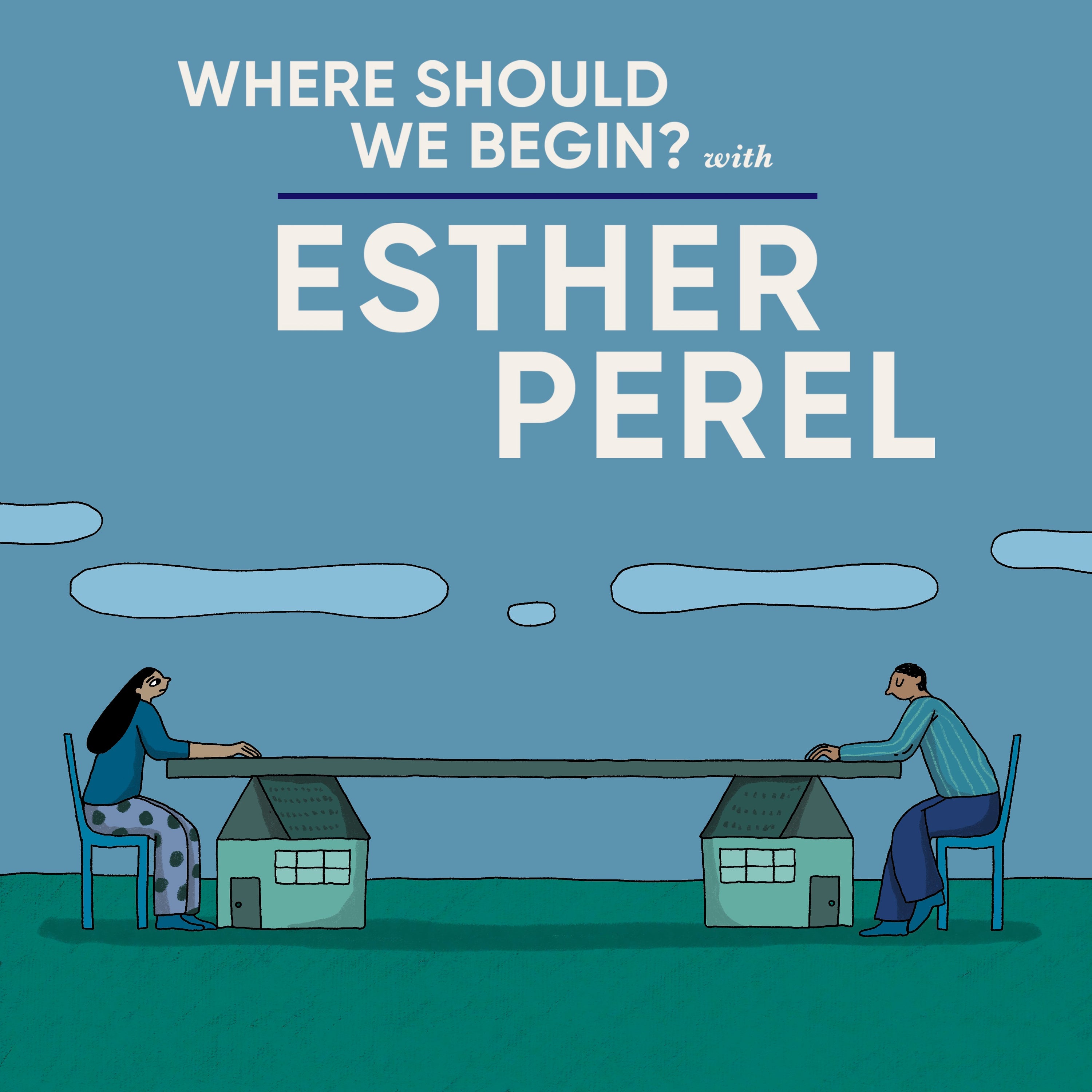
A couples therapy session about ending a 40-year marriage without divorce—seeking legal/economic stability and co-parenting structure while emotionally disengaging to stop a long pattern of volatile, reactive communication.
Two long-term partners in their 60s who met in college and have been together ~40 years. They both agree to separate but disagree on what “separation” means (businesslike/platonic vs. friendship/connection). They previously explored ethical non-monogamy (swinging/sex parties) and planned to attend Burning Man.
Their conflict wasn’t primarily about cultural differences (one partner is Chinese-American; the other is from a Midwestern white Michigan background) but about similar attachment reactivity, mind-reading expectations, and adversarial “processing” that escalated into emotional bullying/yelling/violent energy. One partner says an agreement not to process relationship issues during Burning Man was repeatedly broken, leading her to end the partnership. The other wants kindness and eventual friendship, but tries to “bring her into the arena” during talks, which she experiences as pressure.
“If you loved me, you would…” sentences; yelling and “bullying behavior”; Burning Man agreement; 300 miles of distance reducing conflict; conversations devolving from logistics into emotional arguments; “conscious uncoupling” and a “quadrant to uncouple” framework.
Written by AI. May contain mistakes.
Discussing the complexities of remaining married while desiring separation.
“We've been together with one another since we were 21.”
Exploring the impact of cultural backgrounds on relationship dynamics.
“And she was so beautiful and so intellectual and so sophisticated compared to how I was a good Midwestern boy from Michigan.”
Examining communication issues and their effects on relationships.
“and all the negatives that bring as well, territorialism, insecurity, jealousy, all that kind of thing.”
Reflecting on the moments leading to the decision to separate.
“And we had gotten to the point when she finally said, I've had enough where we could barely even talk with one another.”
Discussing the emotional pain and grief associated with ending a relationship.
“It's the end of a big lifetime relationship.”
The discussion centers on the pain of loss and the complexities of changing relationships.
“There's moments where it's just incredibly painful and it's an exercise in pain and just breathing through the pain.”
The couple navigates the complexities of their relationship post-separation, addressing boundaries and emotional distance.
“But I guess we do it always a little differently.”
Explore how personal relationships intertwine with business interests.
“Isn't that what a relationship is, is that you have your personality, I have my personality.”
Understand the challenges of maintaining emotional distance while married.
“where is the hook on which I can say something that is provocative enough for you to then react to me?”
Discuss the importance of acknowledging regrets in a long-term relationship.
“But you're not on the same plane at this moment.”
Learn about the structural elements necessary for a successful separation.
“to have any conversation because otherwise you won't be able to maintain the structure.”
Reflect on valuing shared history while transitioning to new identities.
“Trust that you are really looking out for the well-being of both of you.”
Explore the complexities of forming new friendships post-separation.
“I would just hope at some point Given our life interactions with one another, that it would be, you know, honoring some part of that with some level of friendship that's greater than a business colleague.”
Delve into the different ways partners express and suppress emotions.
“Honestly, I wish I had learned about nervous system work earlier.”
Explore the complexities of emotional expression and manipulation in a long-term relationship.
“But what I'm hearing that stands out from you is that you live in a paradox between, on the one hand, you know, I am not emotionally expressive.”
Discuss the process of closure after a breakup and the importance of communication.
“And did you actually get any of what you came for that you may or may not have said?”

Get the gist, explore an idea or ask about something said.
 Claude
On Where Should We Begin? with Esther Perel, what are the key points of this episode?
Searching your listeningAutomatic transcript. May contain errors.
0:01None of the voices in this series are ongoing patients of Esther Perel. Each episode of Where Should We Begin is a one-time counseling session. For the purposes of maintaining confidentiality, names and some identifiable characteristics have been removed. But their voices and their stories are real.
0:25When is the end of the day and you're settled into the couch looking for your evening watch? You're not looking for homework the movie. You're looking for comfort, excitement, or something in between. Whether you're craving something familiar or in the mood to discover something new, Amazon Prime has what you need, from screen to doorstep. Because it's not just about genres or endless content. It's about finding the thing that matches how you're feeling, whatever the mood. From streaming to fast shipping, it's on Prime. If you listen to Where Should We Begin, you know that relationships are undergoing a massive cultural shift.
1:05We've never been more connected and we have never felt more disconnected. We crave understanding, collective experience. We want to be seen, but we're optimizing for isolation. I believe that the only way to improve our relationships is to remember the basics of being together. This is why I'm inviting you to join me for an immersive experience, my international tour, Strangers, Friends, and Lovers, where we reawaken the social animal within us all, transform strangers into friends, and maybe even friends into lovers. Tickets are selling fast. Get yours now at estherperel.com slash tour.
1:50We've been together with one another since we were 21. It was bad for 10 years, but really bad the last five years. That has culminated into her saying she wanted out of the marriage. So I came up with the idea of let's just stay married but live separate lives. So we've worked hard to have the level of success financially, and we want to preserve it as much as possible. So the question is, how do we do that? We're staying married, yet I'm trying to unwind the attachments that we have with each other. So legally, do we bind ourselves together even more? We're still so connected, but I'm trying not to be connected.
2:37They met in college and have been together for 40 years. They were both in their 60s and they are in a transition where she decided to leave the marriage. But what they really want at this moment is to be separated, to live separately, to be emotionally apart, but to maintain the structure of what marriage as an institution provides to a family, legally, economically, trust-wise, etc. What becomes very quickly clear is that while they both agree that they want separation without divorce, they both have a different understanding of what that involves and what the nature of their ongoing relationship with each other has to be.
3:26Will it be just a sharing of a business or will it actually be a platonic relationship more resembling a friendship? And they want very different things. So let's listen.
3:42I wanted to lead as big a life as possible. And she was so beautiful and so intellectual and so sophisticated compared to how I was a good Midwestern boy from Michigan. And I was born in a very white community. And so I wanted to experience something outside of my white existence. And where are you from? I was born in the States. I'm Chinese. Both my parents were born in China. So he had a kind of exotic fantasy about you. Yes. And what about you? So, yeah, I was always attracted to the white boys. I think it was just interesting, the other, different than I am. And me too. This curiosity and attraction to otherness, to difference.
4:39Yes. did it translate into your relationship? Meaning, were you able to accept difference of opinions, difference of experience, difference of perception? Right. No. Okay. To be honest, especially in my 20s, I was still very much wedded to that 1950s romantic model of relationships and all the negatives that bring as well, territorialism, insecurity, jealousy, all that kind of thing. And it was very hard on her. And then it didn't help that I went to law school on top of it all to further cement the ability to argue effectively and forcefully. Are you a litigator? Yes. And you litigate in your marriage as well?
5:36Yes. I'm sure. I just looked at her face. I got the answer. That was funny. Pause. Yes. You're pausing? Of course. Of course. What a pity, right? Yeah. You go to look for difference. You go to look for other. And then you constantly battle their difference. You know, in our dynamic, the way we would communicate with each other, it felt very unhealthy. The earliest part of our relationship, there were a lot of sentences like, if you loved me, you would. I shouldn't have to ask you. All of them said bye. At least you recognize the authorship. Of course. Yeah, and versions of that continued for quite a while.
6:23You know, I shouldn't have to ask. You should just know to do. You just fill in the blank, whatever it is. and I thought that that was okay. And then over as I got older, I'm like, I can't read other people's minds. If a person is resistant to asking for what they want, why does it turn into my, like, there's something wrong with me because I can't read a person's mind. Like, I disagree with that. I'm like, I'm not able to give you what you are asking for if you're yelling at me. Yelling at me is not an okay way to talk to me. That's bullying behavior. Then you understood that and you stopped yelling so much.
7:11Well, I came from a very explosive family. My mother had abuse in her background and then she passed it on to her kids, me and my siblings. And we were walking on eggshells through most of our childhood. and then the law in America, it's all about that adversarial system. And so that's also a bad influence. So I think I was ultimately mostly good, supportive, loving, caring. But when we had issues, I was more prone to going violent in my voice. There had never been any physical violence on my part, but it's a big energy coming at you when I'm angry. I've spent a lifetime trying to deal with that anger, but I heard her.
8:01I saw it and I did change in the way I spoke to her. Ironically, she then became more angry and violent and explosive in reverse. And we had gotten to the point when she finally said, I've had enough where we could barely even talk with one another. Anything said, we just off to the races. And it was almost like your siblings where they still push your buttons from when you were 12 to when you're 60. We grew up together and it's almost that type of familiarity. It's too much familiarity. It's too much reactivity. Yeah. That's not the same as familiarity. Okay, too much reactivity. There is a common phrase that differences attract.
8:56But what differences are we talking about? You know, they highlight the cultural, the religious, the racial differences. And those are indeed factual differences. But when we look at how they approach relational dynamics, how they approach attachment, they are actually quite similar. They are both highly reactive, they are often quite enmeshed, they have often personalized the behavior of the other onto themselves, and in that sense they may not be nearly as different. So there is a bit of an illusion that the external difference, the outward difference, will actually seep into the psychological layers, but that's not necessarily what happens.
9:45When she finally said I had enough, there was no way that we could have communicated effectively out of it other than the path we've taken. Is that why we're here? I chose to end the relationship. How long ago? It was in September 2024. Okay. So that's almost two years. It's the end of a big lifetime relationship. It's huge. Yes. I chose to end the relationship because? Because we had made an agreement. We were going to Burning Man. And we agreed with our couples therapist at the time that if any issues came up relationship-wise, that we agreed we were not going to process it with each other and that we weren't going to get into any kind of relationship conversation.
10:43Because you had a tendency to over-process? We both do. But the agreement was not just, we're not doing this right now. And it happened three times within that 10 days of Burning Man. So I thought, well, I'm done. I'm done being in partnership. I don't want to keep working at the relationship. I don't want to be together anymore. I want to separate and live independent lives. You know, there was a whole conversation about whether we stay married or get divorced. But I didn't want to be in partnership. Okay. One more. Okay. Just so I understand. Because if you say, you know, we had agreed we wouldn't talk about us, and he broke the agreement and I was pissed off.
11:36I had enough. And that's when I decided to end the relationship. It sounds light. So what did that settle on? What was the sedimentation? What was the strength of the relationship? And what has done you under? We wanted the same things. We wanted to have adventures. We wanted to have kids. We were always on the same page. And then, I mean, before we had kids, actually, we had started exploring, I mean, I call it now ethical non-monogamy. But at first we were just swingers, joined at sex parties. And that was great. It was totally fun. So we had always wanted to do the same thing. And all through that were the, how come you don't want this?
12:26How come you don't act this? Why do you do this? How come I can't just do this? It was kind of a very fighty relationship, but we would always then come back together because we really loved each other. We felt really connected. And then over time, you know, we all change. So why are we here? Why did you apply? Because I would hope that we could continue to love from afar, but in a more platonic friendly way to manage and handle our finances and our family how do we handle the third act of our lives with some grace and love for one another it's not what I want it's incredibly painful every day without our partnership.
13:28It's not what I had envisioned and I didn't like being separated but I can see and I understood why she did it and I want her to be her happiest self. And if that means not being with me, I understand that. It's not what I want but I understand it. And so if it's her choice in these remaining years. I want to make them as good as possible as we exit. There's moments where it's just incredibly painful and it's an exercise in pain and just breathing through the pain. The pain is the loss? Yeah. Like I'm looking at this and it's beautiful and I'm wondering where the fuck did we screw this whole thing up?
14:16Well, I don't think I know how we screwed it up. It's not the issue. It's like... The grief about having done so. Probably that, for sure. But it's also, I like to look to what could be and what we had thought we were going to be in this time in our lives, and it's not that. And now it's 180 degrees in a different direction. And coming to terms with that reality, right? But you feel you're the only one grieving? No, no. So to me, I was excited and nervous to come to this therapy because I really have not heard her inner thoughts in two years. I don't know exactly where she's been or what's going on in her life.
15:04I'm hearing it newly as well. Do you want to know if she gets sad sometimes like you? If she misses you like you do?
15:18so I learned a long time ago with her you never ask a question you don't want to hear because she'll tell you and it may not be what you want or imagine so I'm afraid right because sometimes when we have these questions I always ask do you want to know the answer to your question Right, right, right. Or do you want her to know that you have the question? Which is a very, very normal human question to have. I ache to you too. I miss us in certain moments. Of course, I don't miss the low-intensity warfare that we lived in for decades. to you. I have found memories to you. But you may not want to know the answer, but you want her to know that you have that thought.
16:22I would love to know all that. I just have felt that it's so new in this new relationship that she's fairly locked down and reserved and I don't know if she would like or appreciate the question. If I would like or appreciate you asking me. Yeah. I mean, I sense that you would like to know you don't ask me. You know, it's a lot to end a lifelong relationship by choice. I just didn't want to keep having the same interactions anymore, and I didn't think we were making progress. Well, I mean, I didn't like the separation, but I learned to respect it afterwards and believe in it. I get it. Do you admire her ability to make the decision?
17:25So I'm proud that she has. You are. Yeah.
17:32Oh, yeah. I fully support your desire to make your life for yourself. Again, even if it's without me. I appreciate that. I mean, I chose it because I had to. Because it was not livable for me anymore. Yeah.
18:06so as I listen to him again now I'm trying to understand the various meanings that this word I admire her for leaving me for having made that decision for doing something that was right for her even if that involves my not being in her life what does this word admiration stand for here and I'm wondering if on some level there is a sense that she was able to finally leave him in a way that he was not able to ever leave his mom and to disengage from his mom and to actually make a choice that would be, for him, away from the conflict, away from the chronic criticism, bickering, put-downs, aggressions.
18:50So that's one way to think about admiration. I said, are you proud of her? But I could have asked also, is there a part of you that feels that you deserve this? that she actually was able to finally say enough is enough stop because of how you were acting that she was able to extricate herself and that you have not and you were not able with her either you would have continued this for a long time so sometimes one listens to a session again and it's like oh I didn't really go enough into this direction I could have deepened a little more here I'm not really sure actually what he meant there and that's the beauty usually of having another session the week after which on where should we begin I only meet the couples once so it will remain a question mark for me and I guess for you
19:50we have to take a brief break So stay with us and let's see where this goes
20:02Support for Where Should We Begin comes from Quince I have said that I would never give someone a standard fruit basket Because if I'm going to give someone fruit I would rather go to a fantastic market for the best piece of fruit Similarly, if I were to give someone a sweater I would trade any ordinary sweater for 100 % Mongolian cashmere from Queens. Queens has high-quality gifts for all of your loved ones, including supple bedding, well-crafted leather bags, chef-grade cookware, and more. I really love the cashmere from Queens. It's soft, and I like having pieces that I can just throw on and feel comfortable in.
20:39And I have to say, their cashmere scarves and wraps make wonderful gifts. I love giving people something that feels special and luxurious, and that I know they'll actually use. Give the gift of quality this holiday season. Download the Queen's app for app-exclusive offers or go to quince.com. Get free shipping on your order and 365-day returns. Now available in Canada and the UK too. And when Queen's asks where you heard about them, let them know it was Where Should We Begin? It's the best way to support the show.
21:13Support for Where Should We Begin comes from Article. The most stylish homes aren't built around the latest trends. They come together over time with thoughtfully chosen pieces that reflect your personality and will feel like you for years to come. That's the idea behind Articul's curated collection of mid-century modern, coastal and Scandi-inspired furniture. I've been eyeing the perforated table lamp in brass. I think lighting is so important when it comes to making a room feel warm, cozy and inviting. and I really love the brass finish and I could see it on a side table in my own living room adding a little coziness to the space.
21:52Article also offers fast, affordable shipping across the US and Canada with options for professional assembly if you prefer a hands-off experience. Article is offering our listeners$50 off your first purchase of$100 or more. To claim, visit article.com slash begin and the discount will be automatically applied at checkout. That's article.com slash begin for$50 off your first purchase of$100 or more.
22:26Support for Where Should We Begin comes from MidiHealth. Sometimes we chase treatments for symptoms that seem unrelated. Headaches, fatigue, insomnia. But when you're going through perimenopause and menopause, they're often part of the same hormonal story. And you don't have to quietly push through. MIDE can help. MIDE helps women connect to clinicians who can actually connect the dots to help make sense of what you're going through. That way, you can clear out the separate what's going on with me Google searchers and get real expert advice in one place. Built by women who've been there themselves, MIDE is virtual care exclusively for women's hormonal health and it's covered by most insurance plans.
23:07You don't have to let your symptoms become the new normal. MIDE can help you feel seen, be heard, and finally get a treatment that actually helps. Your symptoms have answers. Visit JoinMidi.com right now to book your first visit today. That's JoinMidi.com to book your first visit. JoinMidi.com. Insurance coverage varies. Check with your plan for coverage. you can decide in what ways you will stay in each other's life right and wish them well and have a family gathering come together for the holidays the story isn't over the story is changing right and it is transitioning it's not easy staying married in a divorce-compelled society.
24:06But I guess we do it always a little differently. Like I always talk about doing it the 19th century way where, you know, Ben Franklin was on the continent and his wife was in America for 40 years. They didn't see each other, but they were married and I'm sure they had some relationship with one another. What would that look like concretely? When you envision, what is your vision? Of course, I would love to have the relationship back again, but on new terms. But she clearly doesn't feel that way. So then the next best for me is that we at least treat each other with love and consideration and respect.
24:52And is that happening? No, not completely. It's gotten a lot better in the last three months. Some of it is because we have 300 miles of distance between each other and we don't hear or talk to each other from a week or two on. I mean, for me, it's been an ongoing process. I want to keep our conversations about factual things that are logistical or something having to do with the kids because we're staying married. So technically, we have all this together. You know, when you send me a text asking me about something, there are times when I get irritated. So I have to pause before I just fire back whatever my initial response is.
25:40So what kind of relationship do you want to have with me? We are kind and respectful when we're dealing with, you know, our kids and whatever's going on with them. And then, you know, all our assets and liabilities. Like, it's like we have a business, and we are co-owners of a business. But the relationship is dealing with the facts and the logistics and the emotional stuff. I don't want that to be part of my everyday interaction with you. So you just, you don't want to know what's going on with me. You just want to have a business relationship is if we were business colleagues at the office and that you don't really have a much deeper connection or friendship with me other than the business of the day, the specifics of the facts and the figures and the money.
26:42That's the only kind of relationship that you want to have with me. to be happy and do what you want to do. But I don't need to be participating in an intimate way with helping you to realize that because you're living your life. And I don't want to be in an intimate partnership with you anymore. Not even a friendship. I'm not sure that I have the space right now to be a friend. It's really been very soon. It's not even been two years. I have to take care of myself because that's all I've got. I don't want to know what's going on in your emotional life. I had a lot of it. I had a little too much of what was going on in your emotional life.
27:22Like, I felt very responsible for a lot of it. But I don't really have space for that right now. Because it's a lot. It's a really heavy load. And I want to be free to do what I want to do. And I don't want to do that. But you've always been free to do whatever you want to do. I am going to disagree with that because I did not have that experience. I had a different experience. I very much had the experience that it was my responsibility to deal with your emotional state. But don't you think I had to deal with your emotional state as well, too? I didn't say that. I'm not saying that. I'm not saying that.
27:58But isn't that what you do in a relationship? Isn't that what a relationship is, is that you have your personality, I have my personality. We try to accommodate as much as possible. Here is what's happening. What actually happened under the hood? She says, I want us to congregate around our joint business. That's all I want. He experiences her as distancing. He then brings her back and says, what kind of relationship do you actually want? She just said it. But he wants her in the arena with him. She then says, again, the business. I don't want to know your personal life, your emotional life. I felt too responsible for it.
28:43I want to feel free. What does he do? He grabs the one sentence that he can disagree with. You've always been free. So now she gets the hook. You've always been free. So she can begin to say, that's not how I saw it. That's not how I felt it. That's maybe your perception. It's not my experience. And what does he then say? Ping pong. Let's go symmetric that I did the same. Me too. You think I didn't have to deal with your emotional reality? So, and then she says, that is not what I said, because he speaks as if this is implied. And then he says, but isn't that what a relationship is or should be?
29:20And at that moment, if I didn't stop it, they were off on the races. It just was the same conversation again. But the dynamic of the conversation is, how can I bring you into the arena? where is the hook on which I can say something that is provocative enough for you to then react to me? And we will then have accomplished one thing. I'm still not alone and you're still with me. We're in negative heat and bad friction, but we are together.
29:57If I understand what you want is to stay legally married, to preserve the stability of your family, of your economic reality, of your legal rights as married people. You know, there are about a thousand laws in America in your favor when you're married. So you want to preserve the structure, but you do not want to put the emotional relationship in the center of it or at all anymore. and that demands disengaging. You won't be separated if you don't disengage and the kind of conversation you just began, you are completely back in what you have been doing for way too long. It's like a mouth to the light, irresistible, an instant.
30:52That conversation, first of all, you've had it multiple times, but also if you really do not want to engage, don't he will try because you're not in the same place you say I want just a structure because I don't know how to disentangle myself from our fusional style without a more imposed distance and separateness for me and you continue to imagine what you both have enjoyed we share so much we have such shared visions can we become friends and she says maybe maybe not not now i can't think about it and you say every day gets worse for me i'm more unhappy every day and you haven't said but what i imagined you're saying i'm happier every day so i don't think i said that i was more and more unhappy every day that's how i heard it okay what did you say it's painful i'm going through the process.
31:57That's okay. There's nothing negative about it. But you're not on the same plane at this moment. When she says no, you're not listening to the no. You're listening to, is there still a hook somewhere? And then you fall for it. Yeah, I don't want to keep doing that. But you did. You know you did. Yeah. That's why I stopped you because it doesn't take much, which is what you said. We could barely have a conversation. Well, this was going to be one of these barely a conversation. I could let you go on for a few more minutes, but for what? For what? The most you can probably say is it hurts to hear you say that rather than argue with the veracity of it or how much you think you gave her all the freedom.
32:49nothing is black and white here. You've had an amazing relationship and it's been quite volatile and quite enmeshed. And instead of I did and you didn't, if you really want that kindness that you talk about or that friendship that you talk about, it starts with what I appreciate, what I thank you for, What I take with me, what I wish I had done differently, it's a quadrant to uncouple. It's what you're asking. How do we uncouple? We maintain the structure legally, economically, family, but find a way to actually be able to have any conversation because otherwise you won't be able to maintain the structure.
33:40Every conversation about something meant to be factual would devolve within a split second into another emotional argument. That's for the emotional part of the relationship. For the larger structural question, what is it that you want to keep? And what is it that you want to let go of? I hear homes, finances, legalities, which depends on a lot of trust. Implicitly. Trust that you are really looking out for the well-being of both of you. Right. And that's exactly what I want to do. So can we go to the framework a little bit so that it starts to feel a little more organized for both of you? Sure.
34:30Forty years, as you say, is a lifetime. What do you take with you? What is it that you have cherished, valued, learned, received? Forty years. A lot. I mean, we've had a great relationship. We did all sorts of amazing things together. We've made a lot of friends through all those experiences and had great adventures. Two amazing kids. They're great. They're good humans. So I appreciate that. It's huge. I just, you know, we got to where we got. People talk about a lifetime. You can put a period. It doesn't have to be undermined by then bringing in the other side. Let it be.
35:24You've been a great love emotionally and physically and intellectually. You've challenged me in all sorts of ways to be a better, more intelligent, more sophisticated, more adventurous person. You've been a willing partner in crime to go on all these great adventures. And now it's the new adventure. We always said that we could make our relationship any way we wanted to. That's right. It's just a new relationship. Right. I would just hope at some point
36:07Given our life interactions with one another, that it would be, you know, honoring some part of that with some level of friendship that's greater than a business colleague. I would hope that we could at least get to that point where we're not so triggered that we could have that plutonic love for one another. I understand. I can do it. I don't know when I'm going to be ready to do it. I understand that.
36:51What do I wish I had done differently?
36:56Oh, there's, you know, so many regrets. Obviously, my insecurities. I wish I had a better, greater handle on it. And it's just taken me too long. What are we talking about? Self-worth, my own feeling of my place in the world. and I've been saddled with that my entire life and I've been trying to resolve that and unfortunately you've taken the brunt of that. What did you do? Oh, I was verbally abusive and manipulative and whiny and aggressive and demanding and all that stemmed from my deep insecurity. You recognized it as such or you blamed her? No, I recognized it as such. All along? Well, no, not in my 20s and probably not into my 30s, but by my 40s and 50s, yes.
38:01By my 60s for sure. So. Yep. Yeah. Honestly, I wish I had learned about nervous system work earlier. It would have helped me a lot to learn that or better communication skills. What did you do that you would have done differently if you had learned this? I would have hoped that I could have gotten to that self-work of, why do I say these things that are harmful? I mean, I'm a nitpicky person, so I'm critical. You know, that tone of being judgy and contemptuous and... The joke in our community was that she's just silently judging you, right? Yeah. A judgy person with a person who struggles with self-worth, that's quite a match.
38:58Yeah, it was a tall order, wasn't it, to try to overcome and to make work. What has happened to your circle of friends and to your family? We have a lot of overlapping friends, actually. It's almost as if we're starting new friend groups, although we have some very close friends. But your new friend groups are separate. Yeah, I have other friend groups that he's not part of. I joined a car club. A car club. And I have a four-wheel drive expedition RV that I plan to start driving around the world in. And I want to see as much of this earth as I can. I'm still able to do it. So I have a question.
39:42That kind of sharing, in or out? Meaning, am I interested or? Is it still part of what we include? Oh. And what do we preserve? Yeah. What remains common and joint and what remains separate? Just the sharing of the information. I think that sounds great. You've always wanted to do that. You love to adventure. So I'm glad that it is your priority for you. Well, I wanted to travel before I met you. But I'll be honest, I'm afraid to ask you what's going on in your life. Because I want to be respectful to your process. And so I don't ask you what you're doing in your life. Yeah. I mean, I understand.
40:34But I prefer to do the processing of it on my own. I'm hung up about autonomy these days. I hear. But it's not just these days. Yeah, I mean, I've always been super private, yeah. And I was watching this conversation and thinking, is this what they wanted to be able to do when they were in an intimate relationship with each other? I think we did. You know, 90 % of our relationship was really great, and we were really successful at it, right? And that last 5 % was bad. It was really bad. But it took up more and more. At the end, yeah, it was all-consuming. And as I look back on it, you had 40 years of inertia to overcome, to break out of the orbit.
41:30And so it got really bad at the end. What I also hear is we got to such a level of reactivity and volatility, and neither of us knew how to stop it. We didn't know how to create a little bit of space. We tried, but we couldn't. Right. I know that I tried. Was I good at it? No, it was all very new to me to learn a communication style I didn't grow up with. But I couldn't get there just on my own. I tried really hard. Yeah. But what I'm hearing that stands out from you is that you live in a paradox between, on the one hand, you know, I am not emotionally expressive. I do not have that vocabulary handy to me.
42:24He explodes. He does all kinds of what you call emotional bullying. On the other end, I feel everything in my body, sensation and all. I boil inside and I don't know what to do with it. So I may not use the words, I may not be aware of feelings, but I'm certainly aware of sensations, which is the precursor to feelings.
42:55Yeah. And to add to that, I experienced the need to shut down that valve as the first step in being able to extricate myself from this bond and bind. Hence, I don't want to tell you much. This is her saying it to me. Yeah, yeah, yeah, yeah. Yeah, yeah. This is me channeling her. and I'm looking at her face to see if I'm on track. It was really interesting by the end because we had really switched roles and she became the emotional bully, if you ask me, and the volatile one and I became more and more calm about it. It's probably too little too late but I was always seeking to try to be a better and loving partner with you and more communicative with you and I've always felt that you were trying to do that as well too.
43:57That's a very beautiful statement you just made. I just want you to hold that for a moment. It's a really honorable, it's very easy to trash a relationship when you leave. To want to turn it into something bad to justify the decision. Oh, yeah. It's much harder to leave something that had so much good.
44:27We've had many sessions on the podcast that talk about ending relationships. And often where one person is more determined, more clear, or more closed off as a way to create separateness on the way to hopefully developing true autonomy. this session also has one person who feels that the ending needs to be more severe and the other person hoping that actually by having a separation without divorce it would also yield a friendship a connection a where are you at what's happening in your life a chum something that she's utterly not interested because all of that gets very quickly subsumed under a massive set of emotional manipulations meant to keep the other person from actually having their own separate lives.
45:27And neither of them probably wanted this to end this way, especially if they talk about the 90 % of a glorious relationship and the 5 % that poisoned everything. But this 5 % began to completely erode whatever else had existed to the point where she fled. As I said in the beginning of the session, Burning Man was not the reason why she left. His pursuing her to talk, to process, to engage, to become the reason and the responsible one for his emotional distress was what she was really trying to escape from. But it wasn't just his doing. I want to be very clear about that too. 40 years together demands a real co-creation.
46:21We have to take a brief break. Stay with us.
46:28Support for Where Should We Begin comes from Shopify. If you have an idea for a business, the first step can be the hardest one to take. Shopify makes it easier. Shopify's pre-built website themes and AI site builder make it easy to launch a beautiful, professional-looking store without ever touching a line of code. Shopify's mobile app lets you run your store from anywhere, from tracking inventory to customer support to handling payments and more. You also get your own AI e-commerce expert, Sidekick, that can help you manage almost any business task with a single prompt, including holiday discounts.
47:07Shopify powers millions of businesses worldwide, from household names to small businesses just getting started. Launching before Black Friday means you can take advantage of the extra online traffic. If you're ready to launch your business before Black Friday, go to shopify.com slash Esther to start your free trial. That's shopify.com slash Esther. Go to shopify.com slash Esther today to hear your first...
47:36Support for Where Should We Begin? comes from MidiHealth. What's happening inside your own body is incredibly personal, almost by definition. But how you respond and react to internal changes can have an outward effect on those closest to you. When your body is changing, it's understandable that your relationships can change too. And menopause and the symptoms that accompany it is no different. Many of the conversations around menopause in my office center around the experience of the loss of libido, spontaneous arousal with a feeling that many women describe as flatness or numbness or dullness or changes in orgasm or changes in responsiveness.
48:18So how to stay connected to one's own erotic self while transitioning from perimenopause into menopause is a conversation to be had both with professionals and with our partners. And with MIDE, you can connect with a clinician who understands these symptoms and can help you find the treatment that you need. Billed by women who've been there themselves, Midi is virtual care exclusively for women's hormonal health. And yes, it is covered by most major insurance plans. Midi is here to help women feel seen, heard and finally get a treatment that actually helps. Your symptoms have answers. Visit joinmidi.com right now to book your first visit today.
49:00That's joinmidi.com to book your first visit. Joinmidi.com. Insurance coverage varies. Check with your plan for coverage.
49:12Support for Where Should We Begin comes from Skylight. Everyone is so busy these days, even the kids. That's why you need a Skylight. It's an all-in-one digital smart calendar that syncs seamlessly with Google Calendar, Apple Calendar, Outlook, and more. You can manage events, chores, and grocery lists while assigning colors for each of your family members. Jessie has used a Skylight frame. I have used a Skylight frame. And I will say it makes quick changes very easy. I have traditionally always been someone who liked a paper calendar. Once you write it in pen, it's there forever, even if it's wrong.
49:52And the Skylight is just cleaner and has a lot more flexibility. Families are better when they're working together. Right now, Skylight is offering our listeners$30 off their 15-inch calendars by going to myskylight.com slash Esther. Go to myskylight.com slash Esther for$30 off your 15-inch calendar. That's M-Y-S-K-Y-L-I-G-H-T dot com slash Esther.
50:26I'm going to ask you the same question again at the end of the session. Why are we here? Why are we here? And did you actually get any of what you came for that you may or may not have said? I came to have this exact conversation because we literally have not had any discussion to allow us to even talk with one another. Meaning that having a conversation without exploding at each other. Conversation about where we're at in a relationship, where she really stands so I understand, where do we go from there, and what is the game plan from now on? And we literally have not had that conversation for two years, part of which is because it was not possible for us to have that conversation alone alone because i didn't do much i know but i said it's everything because of your gravitas and then of your space to allow us to have the civil conversation in our best behavior but also being called when it's starting to go south, and then to have a mature adult discussion about this, and to pick up the pieces and move forward about how we're going to navigate this new relationship that we have with one another.
51:56You have two verbs. I understand, and it hurts badly.
52:07Right? And that's life. You don't have to philosophize. You can just feel it. No, it is. So. You have two verbs.
52:20Do you know? Well, to feel it. And not to owe it. Not to owe it. Can you explain? Yes. I think you said it yourself in the beginning. I was completely immersed in his internal world he told me what I should be feeling, was not feeling could be feeling, should respond to his feeling and I could never do it right on top of it so I'm learning to know, to identify, to name and to hold it for myself yeah Yeah. I have been a part of this unit. Both of you have been a part of this relationship very, very deeply, very rooted. And I think that for both of you, the disengaging and the dissolving is a root canal.
53:21And I think the word friend and friendship, if something good happens, just say, I'm very touched by this. So this moves me. Or that last night at the dinner table, it was just beautiful. Highlight the experience and don't go looking for the title. The title will come when the story has been told. Right now, you want a title without a story. Yeah. Why did you come? Why did I come? Yeah. What did we do here? And was it useful? Very useful. And I'll be honest. No, I don't expect anything else. You know, right when we broke up, I wanted to skip over the denial, anger. I want to skip over and get to bargaining and acceptance.
54:15It's like, let's do a conscious uncoupling. Let's, you know, come to an agreement how we're going to unstructure our lives. But I was delusional. I mean, I was thinking that I could skip over the other things that were really important to process, which I'm continuing to process. So I knew there was a potential that this could be similar to, as you say, appreciation, gratitude for our relationship. And I'm going to admit, there is the part of me is still very ungenerous. Where I'm like, I don't really want to do that. There was a part of me who was like, I'm not ready to do that yet. You don't need to do more than what you just did.
55:04You don't have to come back to this. No. This is a way of stepping across a threshold and marking a transition. You don't have to do this again. Or not in the near future. You don't. Yeah, I feel that way. What you had to say, you said it quite nicely and kindly. If there is more, you can always write, you know, short and to the point. No using that as an opportunity to rehash the whole relationship and everything. Yeah. Yeah, I wouldn't. I do not feel that need either. Okay. I don't want to do that. I think you said plenty. Mm-hmm. It was beautiful. Good. Mm-hmm. Take a deep breath.
56:23Eric Newsom, Destry Sibley, Sabrina Farhi, Kristen Muller, and Julian Hatt. Original music and additional production by Paul Schneider. And the executive producers of Where Should We Begin are Esther Perel and Jesse Baker. We'd also like to thank Courtney Hamilton, Mary Alice Miller, and Jack Saul.
56:46Life can be messy and complicated, especially during the holidays. One thing that isn't? Switching to the Simplicity Plan from Verizon. It's one plan, one price. Just$30 a line per month for you or the whole family. Make the simple choice this season. Switch to Verizon and shop their best holiday deals today. Shop Black Friday appliance savings and get up to an extra$1 ,250 off select appliance purchases like GE Profile. Plus, free delivery on appliance purchases of$398 or more. Make life easier with the fridge that doubles as your personal kitchen assistant. Or upgrade your laundry room with the ultra-fresh vent system plus front load washer.
57:24So your clothes stay fresh after every single wash. Shop Black Friday appliance savings with fast free delivery at The Home Depot. Offer value November 4th through December 2nd at participating stores and at homedepot.com. U.S. only. See store online for details.
After a nearly forty-year relationship, they've decided to split. But given the many laws in America that favor married couples, they've decided to try an unconventional arrangement: living 300 miles apart but remaining legally married. They come to Esther wondering how, after decades of emotional enmeshment, they can disentangle their romantic connection while continuing to function like business partners. Esther helps them move into their next phase of life by coaching them past long-held relational patterns so that they can instead offer each other gratitude, regret, and distance.
Producer’s Note: When our anonymous guests do a session with Esther for the podcast, it is an act of generosity for everyone who listens. These sessions are meant not only to support the people in the room with Esther, but all of us who learn from their stories. Our stories have many chapters, and what you hear is just one moment in someone’s journey. So even though the sessions are anonymous, please remember that real people are behind them and they may be reading your comments.
Relationships are undergoing a massive cultural shift. We've never been more connected, and we've never felt more disconnected. We crave understanding and collective experience. We want to be seen but we're optimizing for isolation. Esther believes that the only way to improve our relationships is to remember the basics of being together. This is why she's inviting you to join her for an immersive experience: her international tour, Strangers, Friends, and Lovers. Tickets are selling fast. Get yours now at estherperel.com/tour.
Also, please join me on Entre Nous, my new home on Substack for anyone who wants to live, love, and work with more connection and imagination. I invite you to sign up and become a free or paid member at estherperel.substack.com
Learn more about your ad choices. Visit podcastchoices.com/adchoices