 Wild Ideas Worth Living
13 Oct 2026 · 30m

 Add vo to ChatGPT or Claude to ask about everything you hear
vo listened to this episode to put together the overview and transcript, so there may be the odd mistake.
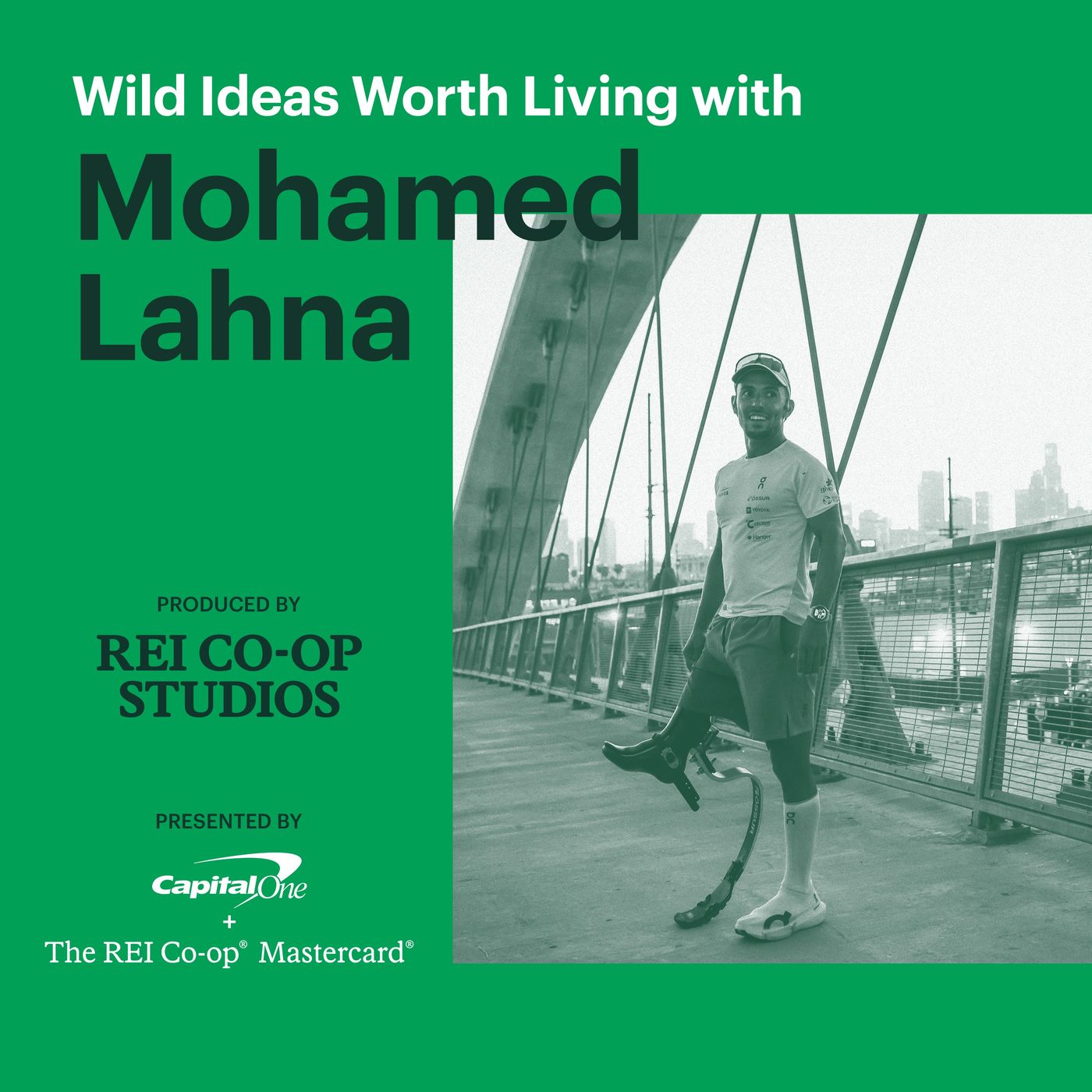
Para-athlete Mohamed Lahna completes a self-designed 3,300-mile cross-country triathlon in 47 days: 28.5-mile swim around Manhattan, 3,000-mile bike from New York to Las Vegas, then a 350-mile run to Venice Beach through the Mojave Desert. He describes prosthesis challenges, daily skin cleaning/disinfection, lidocaine use, and crutch use when needed, plus the fundraising impact for Save the Children and the Challenged Athletes Foundation.
Mohamed Lahna (born in Casablanca, Morocco) was born without a femur in his right leg and with a broken left shoulder at birth; he grew up using crutches, learned to run/bike in his 20s, and became a top para-triathlete (bronze Rio 2016, silver Paris 2024). He was inspired by Paralympian swimmer Jalal Biar.
The run was the hardest; he had to stop every two miles to clean and disinfect the prosthetic contact area; building a racing wheelchair himself taught him to take the first imperfect step; education support from Save the Children shaped his life.
vomiting during the choppy Manhattan swim; eating 4–5 meals a day to avoid weight loss; a stranger donating $3 at a gas station; Marathon des Sables in 2013 where he finished six days using crutches.
0:02Mohamed Lahna: Hey everyone, I'm stoked to share that Camp Monsters, the spine-chilling podcast from REI Co-op Studios, is back for Season 8. Camp Monsters dives into eerie encounters with creatures lurking in some of the wildest corners of North America. This season, you'll hear stories of unexplainable happenings on Goat Island, heart-racing encounters in the suburbs of Maryland, and other strange tales from the woods. It's the perfect podcast to set the mood for spooky season. So grab some friends, gather around the fire, and tune in to Camp Monsters, wherever you listen to podcasts.
0:45Mohamed Lahna: On July 29th, 2026, para-athlete Mohamed Lana crossed the finish line of the biggest wild idea that he'd ever dreamt up, a triathlon across America. Though he'd been competing in triathlons for almost two decades, Mohamed had never done such a long event before. To be honest, he wasn't even sure a project like this was possible for him. Mohamed was born in Morocco without a femur in his right leg, and he spent much of his life getting around on crutches. Eventually, through perseverance, a love for the outdoors, and a little bit of serendipity, Mohamed learned how to run and bike when he was in his 20s.
1:23Mohamed Lahna: Since then, he's become one of the most remarkable para-athletes in the world, with one of the most inspiring stories I've ever heard. I'm Shelby Stanger, and this is Wild Ideas Worth Living, an REI Co-op Studios production presented by Capital One and the REI Co-op MasterCard.
1:44Mohamed Lahna: Mohamed has done some pretty wild things in his life. He swam across the Strait of Gibraltar, ran across the Moroccan desert, and brought home medals in multiple Paralympic Games. His most recent project was self-designed. It consisted of a 28-mile swim around Manhattan Island, a 3 ,000-mile bike ride from New York to Las Vegas, finishing with a 350-mile run to Venice Beach, California. He completed this challenge in 47 days, raising over$150 ,000 for Save the Children and the Challenged Athletes Foundation. Muhammad Lana, welcome to Wild Ideas Worth Living. You just completed one of the most insane wild ideas, 3 ,300-mile cross-country triathlon in 47 days.
2:35Mohamed Lahna: You just finished a couple days ago. There's so much I have to talk to you about. Thank you for having me. I'm so excited to be here. What was it like to finish this huge triathlon? Being able finally to cross the finish line after all this work is just such a relief that a big challenge like this, finally, I made it because there is a lot of uncertainty, especially on the run. Running with the prosthesis for 300 miles in the desert, in the Mojave Desert, was very, very challenging. Some days I had to use crutches to get started. We had to stop every two miles to clean the leg, wipe it, disinfect it and start over.
3:15But it's such a relief that it's over.
3:19Mohamed Lahna: Yeah, but this was a wild idea. You had to overcome some serious adversity. You didn't even really start running or doing triathlon until age 20. But I think for people to understand your journey, we got to go back. You weren't born here. You didn't have like the easiest start. So talk to me a little bit about kind of your childhood and how you even eventually got into triathlon at age 20, because I imagine young Muhammad never thought this was possible. No, never. So I was born in Casablanca, Morocco, in a very modest neighborhood back then. I think things have changed a lot now. But back then in this neighborhood, like when it's time for the mother to give birth, they just call this specific special woman that knows how to deliver a baby.
4:11So they called her to help me, bring me out to this world. And it was not easy. I was breached. I came with legs first and then one leg is longer than the other one. And my left arm got stuck. so she had to break my left shoulder to bring me out and save my life and my mom was telling me like even though your shoulder was broken we were just looking at the legs why they're so different and yeah that was a big shock for the family they took me to all the doctors tried to figure out what to do and all the doctors said take your your kid home and just take care of him so they did my mom like she never went to school she didn't know how to read or write and my dad was a taxi driver and they just did their best to raise me and it took me a while to adjust because sometimes kids like call you with your disability and sometimes I would go home crying and my mom would just send me back you need to learn how to to be rough and this is this is the real world so yeah I grew up I started playing soccer with crutches I got really good at it.
5:20And then one day my dad was taking somebody to his destination in his taxi. And this guy has a disability. And it turned out that he was a Paralympic swimmer. Basically, so far, he's the only Paralympic swimmer in Morocco who won a Paralympic medal in swimming.
5:39Mohamed Lahna: I just got teary-eyed. I don't know why. I just made him emotional today. But that's amazing. Like what fate in serendipity that that happened, that that guy was in your dad's car. Yeah, crazy. So, and the crazy, the crazy part of that, he said, I want to see your kid. So he brought him home first. And I remember that moment very clearly. I was so shy. Instead of taking him home, like he just like drove in the taxi to your house? Yes. And my dad came home with this stranger. He was a very tall guy. and I was hiding behind my mom and he said, come say hi. And I remember I like, like shake his hand.
6:20He has these massive hands and he was tall. And he told me, do you want to go to the swimming pool? I had never seen a swimming pool before. So I think a couple of weeks later he came and he took me to the swimming pool. And this is like, I remember every detail of this day because this is the first time I smelled the chlorine of a swimming pool.
6:45Mohamed Lahna: Whenever he was in town, that Paralympian named Jalal Biar would take Muhammad to the pool and give him a swimming lesson. That experience made a mark on Muhammad, especially because he was already an active kid. He loved playing soccer and spending time outside, although his parents wanted him to focus more on school. They eventually secured him a spot at a school for students with physical disabilities. You went to a school where all the other kids had a physical disability of some kind. What was that like for you? Well, this is why I'm doing this, because somebody back then, a long time ago, donated to Save the Children, to fund the school that affected hundreds of kids.
7:28Back then in the 90s, where in our society back then, like families, they didn't expect much from kids with disabilities. So nothing is required from him. So they will not go through education. And for me, like that was a good place to have a good foundation for education for the future. And my parents was like so like into it. Like this is a priority for you. There is no question. And like going back in time, I reflect on that, how important to save the children. and they do this across the world in war zones, in the US, also some rural areas where they support kids for their education. So they do an amazing work around the world and the impact they have on the world is huge.
8:20So this is why I'm trying to give back to Save the Children because there is a lot of kids around the world who don't have access to school. And yeah, I feel like education is very important, even though I just want to play outside.
8:33Mohamed Lahna: Yeah, but you, I mean, at this school, you played outside as you could. And it wasn't weird because all the other kids figured out a way to play outside as they could too, I'm guessing. Yeah. Oh, yeah. 100%. You had all sorts of disabilities and at noon break or between a recess, like soccer, every day, every day, nonstop. Besides playing outside at school, Muhammad didn't participate in any organized sports. Instead, he focused on studying and getting good grades. It wasn't until years later, when Muhammad was in his mid-20s, that he discovered endurance sports were even a possibility for him.
9:19Mohamed Lahna: So at what point did you start competing in sports and realize like, Hmm. Maybe I could actually do this. Yeah. So at the age of 24 year old, I got my first prosthesis with an articulation with the knee. And that for me, like changed my life because now I can ride a bike for the first time at the age of 24. You were 24 when you got your first prosthesis? That's crazy. Crazy. So you never had ridden a bike before. Was that hard? Was it scary? It was, I, it was like scary, but I was excited because it was exciting for me, freedom. And like, you know, just feeling the wind blowing on your face for the first time while biking.
10:15It was amazing. And I was working as a graphic designer back then. And then my prosthetist, who's from France but lives in Morocco, also loves cycling. So we started doing a lot of mountain biking. I'm not kidding. Our office work locations were close to each other. Friday around 5 p.m., he will pull next to my workplace with loaded car, camping gear, and we will drive three hours to this place, camp there and do mountain biking for the weekend, come back. And we did that like for years just together and I got to visit like a lot of parts in Morocco that I never visited before and if you add camping experience to it and just you know go and spend the weekends in the Atlas Mountains or go in the Sahara Desert like it just I was I was like that first phase was really awesome it was more about enjoying nature and just having fun and later on you met more people I heard about triathlon and I got curious about triathlon because I, I did some swimming and now I cycle, uh, but I had to figure out a way for running.
11:31But my doctor, because I'm missing the hip joint, uh, and there is no way you can run with, without the hip joint, without the femur. Uh, so we said, let's figure out, find the racing wheelchair. So I don't know if you saw those racing wheelchair, uh, they're very like, There are two wheels in the back and small wheel in the front. They're very fast. And we couldn't, it was too expensive for me to get one. And with my prosthetist, he was looking in France to see used one for cheap. We couldn't find anyone. And after two years, he said, why we don't make it ourselves? Like literally like this, we were just sitting.
12:10And I looked at him. I was skeptical. Like, I don't think we can do that. But I didn't believe in that. I just like, I wanted to be polite because he wanted to help me. And yeah, he was working full time. I was working full time. And every day, like after work, we will meet in his like lab where he, like he has a lot of tools. He bought like a welding like tool. And then I started to learn how to weld and buying just pieces of metal scrap. And like we spent a month working on this project and we made one actually. And that moment was a critical moment for me because it taught me a big lesson. Instead of waiting for things to happen or come fall off the sky, you need to do that first step, even though it's not perfect.
13:03So this wheelchair was so heavy. Like basically, I don't know, 10 times the weight of a regular wheelchair or something like that. And every time I do like a kilometer or two kilometer with that, something will break and we have to fix it again. But I was so happy. I was over the moon that we're able to do this. There is so many lessons from this story for me and for people. It was not perfect. I started using it. I didn't have space at home. So I will go to his place where he works and I will take it before work for a spin for half an hour and then come back and then go to work. And I did that for six months.
13:45And his boss saw this, saw this whole thing, the project, the training. And then one day he brought a wheelchair, a real one, because he contacted one of the sponsors and they paid for a real one. And it's like, wow, that's crazy. It's like a brand new one. I have both of them in front of me.
14:10Mohamed Lahna: Armed with his new racing wheelchair, Mohamed entered a paratriathlon in Tunisia. But when he learned the rules wouldn't allow him to use both an upright bicycle and his wheelchair for the 5K run, he made a bold decision. He would complete the entire race on crutches. It was absolutely grueling, but Muhammad loved it. Before long, he was traveling around the world to participate in more endurance events. At one triathlon, Muhammad met another athlete born with the same condition he had. His encounter with her changed everything. Even without a hip socket, he learned it would be possible to run with a prosthetic leg.
14:48Mohamed Lahna: He'd never known that this was even an option for him. But Mohamed quickly applied for a grant to get his first ever running blade. It was November or December of 2011 when I first started running. And it was very, very hard, very challenging. I was out of breath, like running like just two blocks. And how did it feel against your socket? Like, because sometimes they rub and it hurts. Oh, yeah. That's, we were prepared for that. You're going to get blisters. You're going to get chafing. That's normal. But just like, I was very active, but still trying to run for the first time. It was a different beast.
15:29Very difficult. It took time. My wife was with me, like, for the first steps. And like, I was just suffering.
15:38Mohamed Lahna: While it was incredibly painful at first, Mohamed kept running. Once he adjusted to the blade, he started training for something specific, a famous multi-stage race in Morocco called Marathon des Sables. This race is known as one of the most difficult ultra-marathons in the world, where for six days straight, athletes run a marathon a day through the scorching Saharan desert. When Mohamed registered for the event, he had never run farther than three miles.
16:14Mohamed Lahna: You went from no running to being like, I'm going to do six marathons. Yeah, I went like 2013. I was on the start line. Yeah, so I'd never done a half marathon or anything. I just went straight to it. It was a bad idea. But anyway, I remember at 7 a.m. in the middle of nowhere with like a thousand people that have this start line and ACDC blasting in the middle of the desert. It's just like a Mad Max scene going on here. All right, let's go. And I brought a pair of crutches with me just in case if something breaks. Basically, you have this local people with their camel and they are the last people to go.
16:57It's like the sweepers. And basically, if they pass you, you're out of the race. Like you are the last one, basically. You need to either pick up the pace or that's it. Call it a day. And I say, I'm going to finish day one. Too much confidence. And within like six, seven miles, I turn around and I can see them behind me. Because the blade is narrower compared to the foot and it will dig into the sand every time.
17:22Mohamed Lahna: Yeah. That blade isn't made for sand at all. No, no. Huh. So every day you have three or four checkpoints. And I said, at least I'm going to go to the first checkpoint. So I pulled my crutches and I started going. I said, I'm going to go to the next checkpoint. I'm not going to stop here. And then I kept going to the next checkpoint. I went there, got water again. I went to the next checkpoint. I was basically the last one to finish that day. I was so tired. I didn't have time to eat. I had a bar and fell asleep. and then woke up the second day. I said, you know what? I'm going to do the same thing again.
17:59Checkpoint to checkpoint, checkpoint to checkpoint, just with crutches. So basically, if you follow the marathon, people get a lot of blisters in their feet because of the sand and the rubbing. And you see them nighttime, like lining up in the medical tents for blisters for their feet. And for me, I will have my leg, my left leg, and also my hands from the crutches like with blisters. and they would band-aid like a boxer every day, try to put as much cushion on my hands as possible. And yeah, I kept doing that until I finished. It was crazy.
18:41Mohamed Lahna: I thought you were going to say you only did six miles and you peaced out. You did the whole thing on crutches? I kept going, the whole thing on crutches. and every day I finish my confidence keep growing and the funny thing is that so I was with this with all the Moroccan team and they're all like they know the race and they are fast and by the last day when they saw me said we're going to be honest with you when we saw you the first day we thought you're not gonna last one day and and you here you are like that's crazy but for me I was not I was just trying to see how far I can go and yeah day by day checkpoint by checkpoint that's it
19:32Mohamed Lahna: After the Marathon des Sables Mohamed went back to training for the triathlon competing in the Ironman World Championship in Hawaii and the Norseman Extreme Triathlon in Norway in 2014 Then, when the Olympic Committee announced that triathlon would officially be a Paralympic sport in the 2016 Olympics, Mohamed knew he wanted to participate. He spent the next couple of years training for this pursuit and ended up taking home bronze in the 2016 Paralympics in Rio. He kept at it and then won silver in the 2024 Paralympic Games. But in the back of his mind, he had a bigger wild idea brewing. a triathlon that would take them across the United States.
20:26Mohamed Lahna: We talk a lot on this show about the training and gear you need to go after a wild idea. With the REI Co-op MasterCard, everyday purchases can support your wild ideas and turn them into limitless possibilities. Trail miles, summit views, and that family ski trip you plan to take this winter. Here's how it works. Card members earn 5 % in card rewards on every purchase at REI and 1.5 % on everything else. Groceries, gas, your morning coffee, it all adds up. And the best part? You can redeem card rewards as soon as you earn them. That means more rewards put towards those trail runners you've been eyeing.
21:07Mohamed Lahna: It's quick and easy to see if you're pre-approved with no risk to your credit score. To learn more about the REI Co-op MasterCard, go to REI.com slash MasterCard dash podcast. That's REI.com slash MasterCard dash podcast. Terms apply.
21:30Mohamed Lahna: Calling all trail enthusiasts. I've got some exciting news for REI Co-op members. REI has partnered with AllTrails to make it easier than ever to explore the great outdoors with exclusive member pricing. AllTrails is the app for discovering, planning, and navigating trails with premium features like offline maps, custom routes, and more. Got your attention? REI members can now get AllTrails Plus for just$25 a year or AllTrails Peak for$50 a year. That's more than 30 % off, and you can only get it through the co-op. So whether you're discovering new trails or planning your next adventure, this new member benefit makes it easier to get outside.
22:11Mohamed Lahna: To learn more and unlock your member pricing, visit alltrails.com slash REI. That's A-L-L-T-R-A-I-L-S dot com slash REI.
22:30Mohamed Lahna: After years as a competitive para-athlete, Mohamed Lana designed a triathlon that would take him across the United States. He would start by swimming 28.5 miles around Manhattan, then bike 3 ,000 miles from New York to Las Vegas. For the final stage, he'd run 350 miles from Vegas to Venice Beach, California. Along the way, Mohamed raised money for a couple of organizations that have been very influential in his life, Save the Children and the Challenged Athletes Foundation. On June 13, 2026, after two years of training, Mohamed began the first leg of his triathlon, swimming around Manhattan. The swim started at 6 p.m.
23:17and finished around 2 or 3 a.m. next day. The New York Open Water Organization does a good job. They have a crew, they have a kayaker with you, they have a boat in front of you, they manage traffic and everything. But where we started, it was so choppy, the swim was so high. And somehow, within half an hour, my stomach turned and I started vomiting in the water. and because we had like an observer on the boats, I didn't say anything because I don't want to get pulled of the water. I just kept swimming and I kept vomiting like for the next three hours. Like I had nothing in my stomach. But after that, things calmed down.
23:56The water calmed down. I just went with it and it was fine. It was not that bad.
24:05Mohamed Lahna: Muhammad finished the swim at 3 a.m. and he had about 10 hours to recover before getting on his bike and heading west. His wife and two kids piled into an RV and followed him across the entire country. Mohamed also had a support crew in the form of his two friends, Ryan and Marty. So Ryan and Marty, they're both riders from the Bay Area and they came to volunteer and Ryan was riding with me and Marty was behind us driving the support car and their boats were just the ideal people for this job. I mean, going from East to Las Vegas on the bike, we met a lot of nice people, just amazing people everywhere.
24:54I remember this guy, we were stopping at this gas station and we start talking about what we're doing. We're going from this, we're doing this for charity, for Save the Children and Challenge Athlete Foundation. And you can see that guy didn't have much with him. We had three bucks and he said, can I donate this to the charity? And it just like, it breaks my heart. Like, yeah, so we took it and we added it to the donation and put his name. And it's just like, people are very nice and people who invite us to meals and just very, very nice people across the country. Very nice.
25:29Mohamed Lahna: How many miles a day did you ride then? Like what was your schedule? On the bike, like the longest was 130 and the lowest was like 75, something like that. But on average was 100, 110 on average, yeah. And you just ate on the bike the whole time and then you'd come home and just eat a huge meal? oh yeah i ate a lot so for me i cycle with one leg uh the whole time so my left my right side is just attached to the bike it doesn't have any propulsion or any uh power added to the bike uh the only thing that is different is i use a lot of upper body uh when cycling with one leg because you don't have balance on on with the other leg so i use my my arms and my my my core to make keep the bike straight because there is too much power on one one side wow so i cycle with one leg and uh like ryan with me who was so surprised how much food like i'm smaller than him i would eat like four to five meals a day uh i remember when like we first day in colorado springs and I was so hungry and we found this restaurant and the owner like cooked for us and I had like a burrito breakfast, fresh toast and a burger in one meal and like plus like soda and stuff like that because I was so hungry and just like every day I would eat a lot because I didn't want to lose any weight on the bike because I knew on the run I can't have food in my stomach.
27:08I know I will lose weight on the run. So I had to like put as much weight as possible on me on the bike. So every ice cream place, french fries and ice cream, every burger place, like we ate like crazy.
27:26Mohamed Lahna: After cycling from New York to Vegas, Muhammad ditched his bike and started the final leg of his triathlon. This last part, the 350-mile run, was by far the most challenging. The only viable route took him through the Mojave Desert, where the rocky, sandy terrain made every mile, especially demanding on his prosthetic. What was the run like? I mean, at this point, you're probably exhausted. Your day, like, how many days had you been on the road? Maybe like 30 by this time? 30 days. Yeah. 30 days. Okay. Yeah. 30 days. I was worried about the run because I know how challenging, even like when I went during my daily regular training for sprint triathlon, once a while I would get blisters from running and that's not even running a lot.
28:20So I knew that I would get blisters and that was the main concern because if you get blisters, then there is like other stuff that grows infection fever and all that stuff and if that like get to fever then you're in in a bad in a bad situation uh and then i had to stop every two miles like literally for the the whole 300 miles wipe my leg clean my like the area where it touched the prosthesis uh put numbing cream lidocaine because uh this way i don't feel the pain and then put uh like a body glide or any other cream um to help like reduce friction and chafing so we had to do that every two miles uh and some days like i will put my leg and i can't press on it for one step.
29:16And we just, I had to work a little bit. If it's not, I will use crutches to keep moving. I just need to start moving, let the blood flow, wait for the lidocaine to have its effect, to numb the skin, and then I will get going.
29:33Mohamed Lahna: The run was much more challenging than Mohamed anticipated, and he wasn't sure he would be able to complete the triathlon, but step by step, he kept with it. After 47 days on July 29th, 2026, Mohamed made his way to the finish line in Venice Beach, Los Angeles, where there was an entire crew cheering him on.
29:58Mohamed Lahna: Eventually, you get to Los Angeles. Yeah. What's that like, like seeing the finish line, knowing you're going to finish. So we had this group who came two miles before the finish to run with me the last two miles. And my team, they all know me. I didn't cry the whole time. And I broke down that moment because what is this? Like we still have two miles to go and all this happening. I mean, it was an amazing day to finish and have all them there running with me the last two miles. And yeah, finishing this journey. I mean, this challenge is finished, but the cause of raising funds for Save the Children and the Challenge Athlete Foundation still continues.
30:45We are at 70 percent, close to 70 percent. So I'm still trying to continue to 100 percent. So I'll keep going. The fundraising page is still open all the way until we hit 100 percent of our goal.
31:02Mohamed Lahna: so far Muhammad has raised almost$175 ,000 for both Save the Children and for the Challenged Athletes Foundation they're still working towards their fundraising goal we'll put a link in the show notes if you want to contribute to keep in touch with Muhammad directly you can find him on Instagram at Muhammad Lana that's M-O-H-A-M-E-D L-A-H-N-A You can also check out his website, mohammedlana.com. Wild Ideas Worth Living is part of the REI Podcast Network. It's hosted by me, Shelby Stanger, produced by Annie Fassler, Sylvia Thomas, and Sam Pierce Knitsberg of Puddle Creative. Our senior producer is Jenny Barber.
31:49Mohamed Lahna: Our executive producers are Paolo Motila and Joe Crosby. Thank you again to our partner, Capital One and the REI Co-op MasterCard. As always, we love it when you follow the show, take time to rate it, and write a review wherever you listen. And remember, some of the best adventures happen when you follow your wildest ideas.
Mohamed Lahna is a Paralympic medalist, endurance athlete, and one of the world's most accomplished para-triathletes. Born without a femur in his right leg, he didn't begin running or cycling until his twenties. On July 29, 2026, he completed a self-designed triathlon across America: a 28 mile swim around Manhattan, a 3,000 mile bike ride from New York to Las Vegas, and a 350 mile run to Venice Beach. He completed the journey in 47 days while raising more than $150,000 for Save the Children and the Challenged Athletes Foundation.
Connect with Mohamed:
Listen to REI’s Camp Monsters podcast!
Thank you to our sponsors:
Hosted by Simplecast, an AdsWizz company. See pcm.adswizz.com for information about our collection and use of personal data for advertising.
Scan the code with your iPhone camera
Listen in the app.