Ask ChatGPT

 Wild Ideas Worth Living
24 Jun 2025 · 27m · 12 chapters
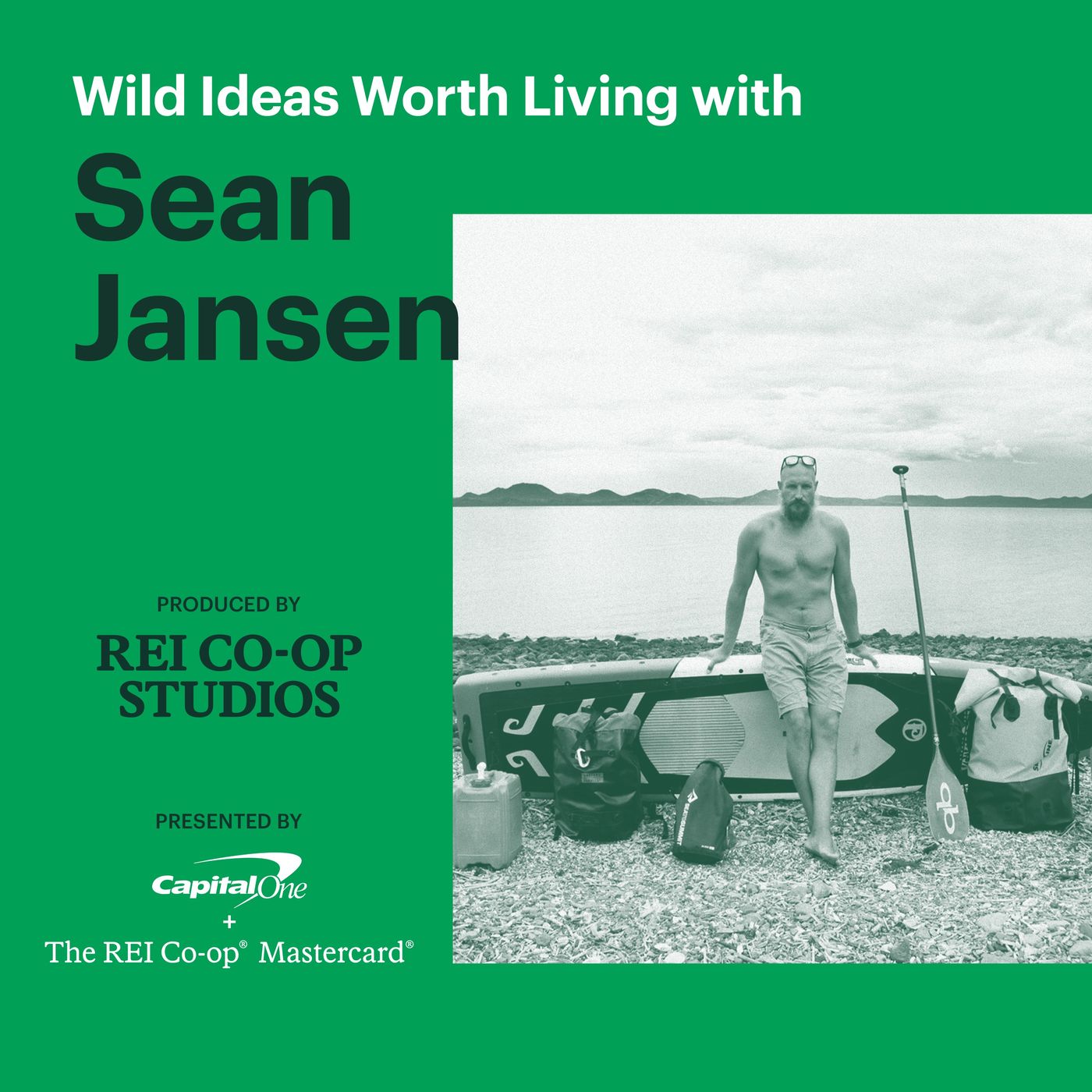
Sean Jansen’s 2022–2023 stand-up paddle journey down Mexico’s Baja Peninsula (about 1,005 miles), using the trip to support vaquita conservation and to rebuild his sobriety after alcoholism.
Lifelong San Clemente, California surfer (started surfing around age 12; SUP since early teens). He learned SUP from neighbor Rob Rojas. After nearly losing memory cards on a Cabo trip due to drinking, he pursued sobriety through meditation, trail running, and time outdoors.
He paddled solo, relied on a desalination pump for drinking water, and navigated using printed Google Earth 20-mile sections. He first attempted in Oct 2022, but intense winds and an earthquake forced him to stop; a second attempt ended mentally, leading to recovery. He finished in Dec 2023 after 123 days.
Bull shark “bluff charge” near Cabo Pulmo; dozens of shooting stars; days forced onto beaches by wind; final landing at Land’s End in Cabo San Lucas. He shared vaquita awareness via social posts and wrote Paddling with Porpoise, donating proceeds to conservation.
Written by AI. May contain mistakes.
Explore Sean's childhood experiences and his deep-rooted connection to the ocean.
“If you've ever been on a stand-up paddleboard, also known as an SUP, you know that it's hard to go anywhere fast.”
Learn how Sean was introduced to stand-up paddling and his immediate passion for it.
“Every excuse I could to ditch soccer practice and surf, I took.”
Understand the motivation behind Sean's journey and the personal battles he faced.
“And usually there's something that pushes somebody to go say one day like, oh, I'm going to go paddle a thousand miles.”
Explore the meticulous planning that went into Sean's journey along the Baja Peninsula.
“In essence, you decide to through hike, but through paddle, the Baja Peninsula.”
Learn about the obstacles Sean faced during his first attempt to paddle Baja.
“I knew what kind of grocery store was in this location.”
Discover how Sean prioritized his mental health and recovery after setbacks.
“Less than six months later, Sean returned to the exact place where he'd ended his first attempt and started paddling again.”
Explore Sean's insights on preparing for the next leg of his journey and the challenges ahead.
“He doubled down on meditation, started trail running again, and started eating healthier.”
Learn about Sean's preparation for his stand-up paddleboarding journey, including gear, food, and hydration strategies.
“When Sean Jansen decided to stand up paddle down the coast of the Baja Peninsula, he wasn't sure what the journey would have in store for him.”
Discover Sean's daily routine while paddling, including his morning rituals and paddling strategies.
“other week, whatever it was, I would buy carne asada or cooked chicken or my luxury was vegetables because I didn't have a vegetable for a week at a time.”
Sean shares intense stories about his encounters with wildlife, including a bull shark and the challenges he faced at sea.
“But I had it so dialed that if I got on the water by roughly 530, 545, I could hit 20 miles by noon.”
Explore the emotional highs and lows Sean experienced as he completed his challenging journey down the Baja Peninsula.
“I said a way more dramatic curse word than crap.”
Sean reflects on the anticlimactic nature of finishing his journey and the impact it had on him.
“So a funny little part of my story is that whole last week of the trip, I was emotional almost every day.”

Get the gist, explore an idea or ask about something said.
 Claude
On Wild Ideas Worth Living, what are the key points of this episode?
Searching your listeningAutomatic transcript. May contain errors.
0:05In 2022, lifelong surfer and adventurer Sean Jansen set out to stand up paddle over a thousand miles along the coast of the Baja Peninsula in Mexico. He strapped his camping gear, food, and camera to his board and made his way south. Sean's wild idea was about more than just traveling down this beautiful coastline. He was on a mission to raise awareness about an endangered sea animal and overcome some personal battles along the way. I'm Shelby Stanger, and this is Wild Ideas Worth Living, an REI Co-op Studios production presented by Capital One and the REI Co-op MasterCard.
0:50If you've ever been on a stand-up paddleboard, also known as an SUP, you know that it's hard to go anywhere fast. SUPs can only move about half the speed of a canoe or a kayak, and even the slightest bit of wind can make it really difficult to balance. When Sean Jansen set out to SUP over 1 ,000 miles, he felt pretty comfortable on the board. He'd been surfing and paddleboarding since he was young. Sean Jansen, welcome to Wild Ideas Worth Living. You have a wild idea that I love. I'm excited to talk to you about it.
1:26Sean Jansen: I'm really humbled to be here, Shelby, because I have listened to this show for years, and never in a million years did I think I was going to be here talking to you. Oh, that's so sweet. Let's start with your background. You grew up around the ocean, I'm guessing. You're from Orange County, California, San Clemente. Did you grow up surfing, lifeguarding? Yeah, I grew up as a diehard surfer. I started standing up on my boogie board when I was like six or seven, and then my mom got me a surfboard for my 12th birthday. I'm born and raised San Clemente. So I grew up, I was very fortunate. I was able to like run down to my local beach and just go surf.
2:02Sean Jansen: And I was on the surf team. I was even on the soccer team as well, but I would surf in between soccer practice. So the ocean was always something that was there for me. And that's kind of what started the spark of going down into Baja because San Clemente is only about an hour's drive from Tijuana. And of course I would hang out with the older crew in San Clemente that surfed. And they would always talk about these mythical waves on the Baja Peninsula. And I was so infatuated with the idea that eventually a buddy of mine's dad decided to take a bunch of us down there at the age of 17. And I couldn't believe how wild the Baja Peninsula really is.
2:42Sean Jansen: There's cactus, there's roads that are half paved, half not, A lot of the roads are dirt roads. And it was so magical to be able to practice your adorable little two years of Spanish in high school and go down there and try to buy gas or buy a taco. And I never felt uncomfortable. There's a lot of stigma with Mexico. And Mexico has been my second home since I was 17 and I'm 36 now. And so there was just a lot of educational points in my childhood with Baja that I am extremely grateful for. I love your story also really quickly. I learned to surf when I was 12. I played soccer. Every excuse I could to ditch soccer practice and surf, I took.
3:24There just wasn't a lot of opportunities for girls to surf. There's way more in soccer back then. But I completely relate to your story. It's really cool. And I also found Stand Up Paddling when it came out. I loved it. But I'm curious how you found it.
3:39Sean Jansen: Well, so I was very lucky in that I graduated high school in 2007. And my neighbor next door, I need to give him credit and I need to drop his name. His name's Rob Rojas. And he's kind of a household name in the paddling world. He started stand-up paddling and I started noticing him strapping these things on top of his car. And I was so curious, but I was like, what is that thing? There was a family trip he did where I was house sitting for him because he was out of town. And he's like, all right, Sean, if you want, you could borrow my stand-up paddleboard. And I totally did. And I took it out right out of my local beach there.
4:13Sean Jansen: And I was like, whoa, this is really cool. And I was still a diehard surfer. And I knew that conundrum between surfers and paddlers. Like whenever you see a kayak out in the ocean, you're like shaking your head. Like, what are you doing? But it's a vehicle to get from place to place. It's like a bike on the water. One thousand percent. And that very first day, I vividly remember this. I was like, I want to I want to do an overnight trip in these. Like that was my first thought. It wasn't about I didn't want to go surfing. I was like, how do I connect the dots doing an overnight or somewhere? And I took to it like a duck to water.
4:43Sean Jansen: I stood up right away. I didn't have any balance issues because I grew up as a surfer. How did you decide to do this crazy wild idea? Like, I've interviewed enough adventurers at this point in my life. And usually there's something that pushes somebody to go say one day like, oh, I'm going to go paddle a thousand miles. Well, so I conceptualized this trip while I was dealing with a monumental personal battle. And that battle for me was alcoholism. I knew at the time that I had an, I had a problem with it and I was trying my best to get sober. And what had happened was I had just returned from a trip to Baja where I was a photographer for a friend's wedding down in Cabo.
5:28Sean Jansen: And my alcoholism got so bad on that trip that I nearly lost the memory cards for my buddy's wedding on the beach that night because of how drunk I was. And I remember returning from that trip going, okay, Sean, you can't keep doing this. As Sean made a plan to get sober, he set a goal to SUP along the entire Baja Peninsula. He started looking at maps and researching the coastline. Sean would paddle down the Gulf of California, also known as the Sea of Cortez. It's a sliver of ocean between Baja and mainland Mexico. As he studied the area, Sean learned about a kind of porpoise called a vaquita that lives in the Sea of Cortez.
6:10It's a small animal, about four feet long, with a short nose, almost like it ran into a wall. The vaquita is endangered. When Sean first heard of them, there were only about ten left in the world. He decided that the recovery of this animal would be the mission for his paddle. But before Sean could even think about the logistics of this trip, he needed to get sober. He started meditating, trail running, and getting outside as much as possible. It took some time, but eventually, after two years of sobriety, the reality of his wild ideas started coming into focus. In essence, you decide to through hike, but through paddle, the Baja Peninsula.
6:53When you said this idea out loud, I mean, you're such a wild guy anyway. was everybody like, okay, yeah, Sean's going to go do this? Or did you get any pushback?
7:03Sean Jansen: Well, so I didn't tell anyone. I called my mom on October 9th from a beach in San Felipe going, Hey, by the way, I'm going to go paddle Baja, you know, and it's because, and I love my mom to death. I'm not going to try to shoot her down, but she is, I know everyone says mom's worry, but my mom takes it to the nth level. And a big part of my sobriety journey was I had to temporarily block people because I associated them with my alcoholic past. And so I was kind of a loner, you know, going up into this Baja trip. I had a very small core group of people. I had one friend that knew what I was doing.
7:43Sean Jansen: And it's simply because she was going to be my guardian angel. Like I had a little Garmin and reach GPS. So I would text her every single day. I gave her a map of Baja. So she knew exactly where I was at that last text. She put a pin there and was like, okay, if I don't check in the next day, she knew exactly what beach I was last at. So aside from her, no one knew what I was doing. You know, I did it completely alone. I was solo for this entire endeavor. No one drove down the coast to meet up with me. It turned into a very spiritual trip for me. Like I needed to do it. I needed to prove to myself that my sobriety wasn't for nothing and try to do something bigger than me.
8:22So no one knows about it except for a couple of people because you're smart and you have safety involved. But what is planning like?
8:29Sean Jansen: I had a very small handful of overnight SEP trips in Yellowstone National Park that I've done. So I had that experience. On an inflatable stand-up paddleboard? On an inflatable, yep. Okay. So I knew what dry bags I wanted to bring. So the only research I needed to do was on my portable desalinator, which was a, essentially it's a water pump, but it turns seawater into fresh water. And I wasn't gonna do the trip without one because Baja is a desert environment. There are no freshwater streams. So it's not like I could just pick up a standard backpacking water filter and stick it in a river because there are none.
9:06Sean Jansen: So that was a huge challenge gear-wise. But aside from that, it was all about knowing where I can get food and where I can get water again. And luckily, with nearly 20 years of Baja experience under my belt, just on road trips, I kind of knew where these towns were. I knew what to expect. I knew what kind of grocery store was in this location. And I would able to, I could time it out. I think my longest carry was 10 days, which ended up being almost two weeks because wind wouldn't let me paddle down the coast. Um, so I had to be smart about knowing where I can resupply. Um, so the only research I really did was I would zoom in on Google earth on 20 mile sections of coast, take a picture of that.
9:51Sean Jansen: And then I knew where a beach was that I can camp out or how far this destination was, how far that destination was because I researched Baja maps and none of them had the bathymetry, bathymetry being, you know, showing the bottom seafloor and the depths and stuff. I'm sure there's one that exists, but I couldn't find it in the time leading up to my trip. So I had to personally, and this was very environmentally unfriendly, but I had to print out big Google Earth images on pieces of paper that were 20-mile sections of the coast and have a stack of them. And that's how I literally navigated the coast.
10:27And then you had to keep them dry.
10:29Sean Jansen: And then I had to keep them dry.
10:35When Sean set off in October of 2022, he had every intention of doing all 1 ,005 miles in one fell swoop. But the Sea of Cortez had other plans. Within the first two weeks, about one-fifth of the way down the coast, Sean hit some intense winds. One night, while he was sleeping on the beach, he even experienced an earthquake. The epicenter was only about 30 miles from his tent. He was committed to continuing and made slow progress, but the winds were getting stronger, forcing Sean to stay put for days at a time. After another two weeks of battling the elements, it was clear that Sean needed to stop.
11:15He decided to get off the water and come back when the conditions were calmer. Less than six months later, Sean returned to the exact place where he'd ended his first attempt and started paddling again. But something still didn't feel right.
11:33Sean Jansen: The second part of the trip was the most difficult. And what I mean by that is it wasn't difficult conditions-wise, but mentally I was a train wreck. something something was wrong I remember putting my board back on the water really excited to get back out there but my stomach and my gut had a feeling that I can't describe like it I wasn't sick I wasn't getting nauseous I wasn't you know any of that but like it was one of those gut feelings where your heart's like in your throat and it just feels like that awkward moment where someone makes fun of you. Like there's like that deep guttural emptiness, like it feels empty.
12:19Sean Jansen: And so that's when I know something's off. And, you know, I've learned through this process that your gut is your second brain. And sometimes it's even smarter than your brain brain. But because I'm stubborn, I was just like, I'm going to put my head down and keep going because I have a forecast of five days of no wind. Like I'm going for it. And so I paddled for those five days. And then I get to one of these beaches that I've literally seen from the road and arguably the beach that inspired the trip because I would see these waters and these waters are so stunningly beautiful. And for reference, this area is called Bahia Concepcion.
12:55Sean Jansen: It's a very famous little area of Baja. And like, you know, anyone that's been there knows that you see these beaches and they're jaw dropping. Like this is where the postcards are of Baja. And I get there and I'm miserable. And even worse than that though, is for the first time in my two and a half years of being sober, I wanted a drink for whatever reason. So I called this amazing friend of mine, I actually jokingly call him dad. And I met him on the trip. Like I didn't know him before and he knew what I was doing and he understood. He's like, all right, Sean, I'll come pick you up and no worries.
13:28Sean Jansen: You can get back to your car that's stored in Cabos and Lucas and just come back in October again. Sean never totally understood what happened on that second attempt, but he went home and prioritized his recovery and mental health. He doubled down on meditation, started trail running again, and started eating healthier. His efforts paid off. In October of 2023, Sean set out for the third time to finish the final leg of his trip.
14:13When Sean Jansen decided to stand up paddle down the coast of the Baja Peninsula, he wasn't sure what the journey would have in store for him. Sean grew up as a surfer and had spent plenty of time hiking and trail running, so he felt pretty at peace in nature. What he hadn't done was an SUP trip longer than a couple of days. This trip, which took several months and covered more than a thousand miles, was a totally different beast. For one, stand-up paddling is a pretty exposed sport, and to carry hundreds of pounds of gear on top of a board is really difficult. Secondly, the area that Sean was traversing had very little fresh water, which made cooking and staying hydrated quite difficult.
14:57Tell me what your gear is. Give me your board and everything that you take with you. From the food to the water and how much it weighs. Yeah.
15:06Sean Jansen: What worked out really wonderfully was the same inflatable board I used on my Yellowstone trips prior, that same company had that exact board that was modified a little bit beefier and gnarlier, but it was a hardboard. This board not only had all of the tie downs that I needed to strap gear onto, it could hold 512 pounds. I'm not a small dude. I'm six foot and 200 pounds as it is. And then I also had to carry up to nine gallons of fresh water with me at a time. So if you think about that, I think a gallon of water weighs eight pounds. yeah that's heavy 70 to 80 pounds of water at a time including my 200 pound but and then I had my camping gear I had my fishing gear I had I was a mouthful when I paddled up into towns people just gawk at me and go like what on earth is this guy doing so your camping gear is tent sleep pad yep so the same principle with an overnight stand-up paddle trip goes with it like a backpacking trip.
16:10Sean Jansen: The lighter you are, the better and faster you are. I knew what ultralight gear was. Like I had a one man, big Agnes ultralight tent. I had a 15 degree, really small light sleeping bag. I had the Thermarest Z light sleeping pad. Like it weighs nothing, but it takes up space. And then my stove system was, I had a jet boil zip and all I used it for was coffee because I didn't have the luxury of fresh water. I was drinking a gallon and a half to two gallons of water a day. So if you think about that, you can't spare 16 ounces for instant mashed potatoes or top ramen or whatever it was. So my food was very unsexy.
16:51Sean Jansen: You know, like I had cold burritos, I would eat tortillas, I'd eat peanut butter. So when I got to a town once a week, once every other week, whatever it was, I would buy carne asada or cooked chicken or my luxury was vegetables because I didn't have a vegetable for a week at a time. But that would only be for the one or two nights instantly leaving town, and then it's right back to cold burritos and peanut butter. So that was the basics of what made up the front dry bag. And I had two dry bags for this trip. What was a typical day like, like sun up to sun down? What is Sean doing every day? So Sean is an early bird.
17:31Sean Jansen: So one thing that I'm still addicted to that I'm not looking to give up anytime soon is coffee. And I don't mess around with instant coffee in the backcountry. I bring a Jetboil. It's got a French press adapter. But more importantly than that, I refuse to rush my coffee time. I like to sit there quietly, enjoy it. And so what I would do is I'd wake up at four o 'clock in the morning religiously every single day, well before sunrise. And before even coffee time starts, it's always meditation. I do 10 minutes of meditation first thing in the morning, no matter what, even to this day, meditation might be the reason I'm sober.
18:05Sean Jansen: So I don't, I don't take that lightly. I'd wake up at four, meditation, coffee. And what I would do with coffee though, is I would just sit somewhere in the sand with it, leaning back against a dry bag and enjoy one of the greatest underrated features of the Baja desert. And that is the night sky. And I kind of knew going into the day how my day was going to go. And what I mean by that is I'm not a religious person, but I'm extremely spiritual. If I saw a shooting star that morning, I was going to have a great day. I was going to go crush 20 miles down the coast and it was going to be an awesome day.
18:40Sean Jansen: But if I didn't see a shooting star, it was going to be hell on earth. And ironically, that is exactly how it went for that trip. There was that many shooting stars? I would see dozens every morning. Wow. Wow. So that was my morning routine. Then I would pack up, get on the water kind of before sunrise. I'd actually get on the water with my headlamp on and I would paddle for maybe one to three miles before the sun even rose above the ocean surface. And then I would try to go as far as I can. But by like 11 or noon, the winds would often kick up pretty strong and I would be forced into a beach.
19:18Sean Jansen: But I had it so dialed that if I got on the water by roughly 530, 545, I could hit 20 miles by noon. My biggest day was 26 miles. My shortest day, aside from zero, was six. And that six-mile day, I stopped on purpose because I've never seen a beach so beautiful. I had to stop.
19:38The coastline of the Baja Peninsula is absolutely stunning. But there's a lot of stark cliffs and rocky shores. Depending on the current or the winds, it was sometimes pretty dangerous for Sean to get to land. Over the course of his journey, there were several days where Sean was laid over on beaches or in small towns because of weather. Besides that, he also had some intense interactions with sea life. So I'm really curious, like you, you encountered a lot of things. Hurricane, crazy winds. I imagine sharks. Like what was the scariest thing you encountered during your paddle?
20:18Sean Jansen: Of course, probably the most famous was in Yellowstone. We call when a bear charges at you and turns away, we call it a bluff charge. I had that equivalent with a bull shark down in Cabo Pulmo, which was about 60 miles from the very end of the trip. I am three days away from finishing this trip and I'm paddling in water and out of my periphery, I see this brown object. Now, I've seen thousands of these brown objects on my paddle trip, and it just turns out to be a rock. But this rock was moving. And I look over, and all this happened within like a two-second window. But I see this bull shark torpedoing at me.
20:59Sean Jansen: And like I said, this lasted probably two seconds. I look over, I see it, and then all I knew what to do was just crouch down and try to be, I'm like, okay, brace for impact. Here it goes. and at the very last minute, inches from my board, it turns and the tail splashes water all over me, all over the deck of my board, whole nine yards and disappears into the blue or so I thought. And so I'm sitting there kind of frozen going like, holy cow, did that just happen? I remember my reaction. I said a way more dramatic curse word than crap. Um, but I, I just, I couldn't believe it didn't hit me. And so it darted into the blue and I was like, I didn't know what to do.
21:38Sean Jansen: I'm out to sea a little bit. It's kind of rocking seas. It's not super calm. And so I needed to like focus, but the nearest beach was a 20 minute paddle away. Like I was nowhere near a safe point to come to the beach and try to like wrap my head around what just happened and kind of regain my focus. So I just keep paddling and I kind of felt like things weren't done. The hairs are still standing up on the back of my neck. Like it's, so I start scanning the environment back and forth and I'm not seeing anything. The water's quite deep in this area. Like I can't see the bottom, but then I eventually found the courage about 30 seconds later to turn 180 degrees around and look at my tail.
22:17Sean Jansen: And this bull shark is six inches from the tail of my board. And it's just following me. And I'm just like, Oh my God, like what is going on? And, um, I didn't know what to do other than to keep paddling. Cause this is the same shark that kind of bluff charged me a little bit ago. and now it's following me. And I don't know. So you weren't gonna like just take your paddle and try to get its nose or? It was, I thought about it, but the drawback is the seas were not calm. Like I had to focus on my balance and me trying to pivot and poke the thing while fighting two to three foot waves. Like I have, there was way greater risk of falling in the water.
22:54Sean Jansen: And this is not a body of water you wanna fall into right now. All I knew to do was just keep paddling. And it eventually, I found the courage again about a minute later to turn around and it was gone. So I can't figure out why it didn't just hit me. It had every right to. I've seen plenty of videos of these bull sharks doing this. And through my research on bull sharks, out of all the shark species in the ocean, they have the highest level of testosterone. So it had every excuse to ram the side of my board and hit me, launch me out of the water, whatever it wanted to do, and it didn't.
23:31There were a lot of standout moments during Sean's time on the water. From encountering that bull shark and seeing tons of shooting stars, to maneuvering through challenging winds and eating lots and lots of cold burritos. Finally, on December 14th, 2023, after a total of 123 days on the water, Sean completed his journey.
23:58What was finishing like? Was there anybody there? Were you alone? What was going through your head?
24:04Sean Jansen: I was alone. So a funny little part of my story is that whole last week of the trip, I was emotional almost every day. Like I would get teary eyed leading up to it. And the very last morning, I'll never forget it. You know, I'm somehow I was able to find a beach in the middle between two gargantuan resorts, you know, and Cabo San Lucas is like, I call it the Las Vegas of Mexico. It's very Americanized. It's very, you know, Cancun-esque. But I get to Land's End, which is the famous arch, the very, very tip of Baja in Cabo San Lucas. And it was a very empty feeling. I wasn't emotional. I, of course, threw my hands to the sky.
24:48Sean Jansen: I had a friend that I met up the coast, about 100 miles up the coast. And she knew someone that lived in Cabo that could go out there and take a picture of me at the very end. So I was very grateful for that person. Um, but I, you know, that the end experience was for lack of a better word, it was kind of lame because it wasn't, I wasn't alone. Like it's a very touristic feature at the very, very end. Like it was, there was hundreds of people there. So it wasn't, it wasn't like a romantic finish, dare I say, but you know, in saying that, I don't know if I would have it any other way. Like that's, that's Land End, that's Cabo, you know, that's what it is.
25:27i'm kind of smiling because like that's such a typical wild idea like you do all this prep you get so emotional you almost die millions of times like you have these cathartic moments you see shooting stars you almost right before the end don't make it and then like you get to the end and you're like that's it and yet you're totally changed for years to come afterwards but like God, those endings are so anticlimactic and it's just, it's tricky, especially if you're doing them totally on your own.
26:10Throughout Sean's trip, he shared as much information as he could about the vaquita porpoise. He posted on Facebook groups for locals as well as on his own Instagram. Sean also wrote a book about his journey called Paddling with Porpoise, with all the proceeds going towards conservation efforts. You can find a link to buy the book in our show notes or on Sean's website, jansenjournals.com. That's J-A-N-S-E-N journals.com. You can also follow Sean on Instagram at jansen underscore journals. Wild Ideas Worth Living is part of the REI Podcast Network. It's hosted by me, Shelby Stanger, produced by Annie Fassler, Sylvia Thomas, and Sam Pierce-Knitzberg of Puddle Creative.
26:54Our senior producers are Jenny Barber and Hannah Boyd. Our executive producers are Paolo Motula and Joe Crosby. As always, we love it when you follow the show, take time to rate it, and write a review wherever you listen. And remember, some of the best adventures happen when you follow your wildest ideas. Thank you.
Sean Jansen, a lifelong surfer and adventurer, standup paddled over 1,000 miles along the coast of Mexico’s Baja Peninsula with his camping gear, food, and camera strapped to his board. His goal was to document the journey and raise awareness about the vaquita, an endangered porpoise native to the region.
Connect with Sean:
Thank you to our sponsors:
Hosted by Simplecast, an AdsWizz company. See pcm.adswizz.com for information about our collection and use of personal data for advertising.