Ask ChatGPT
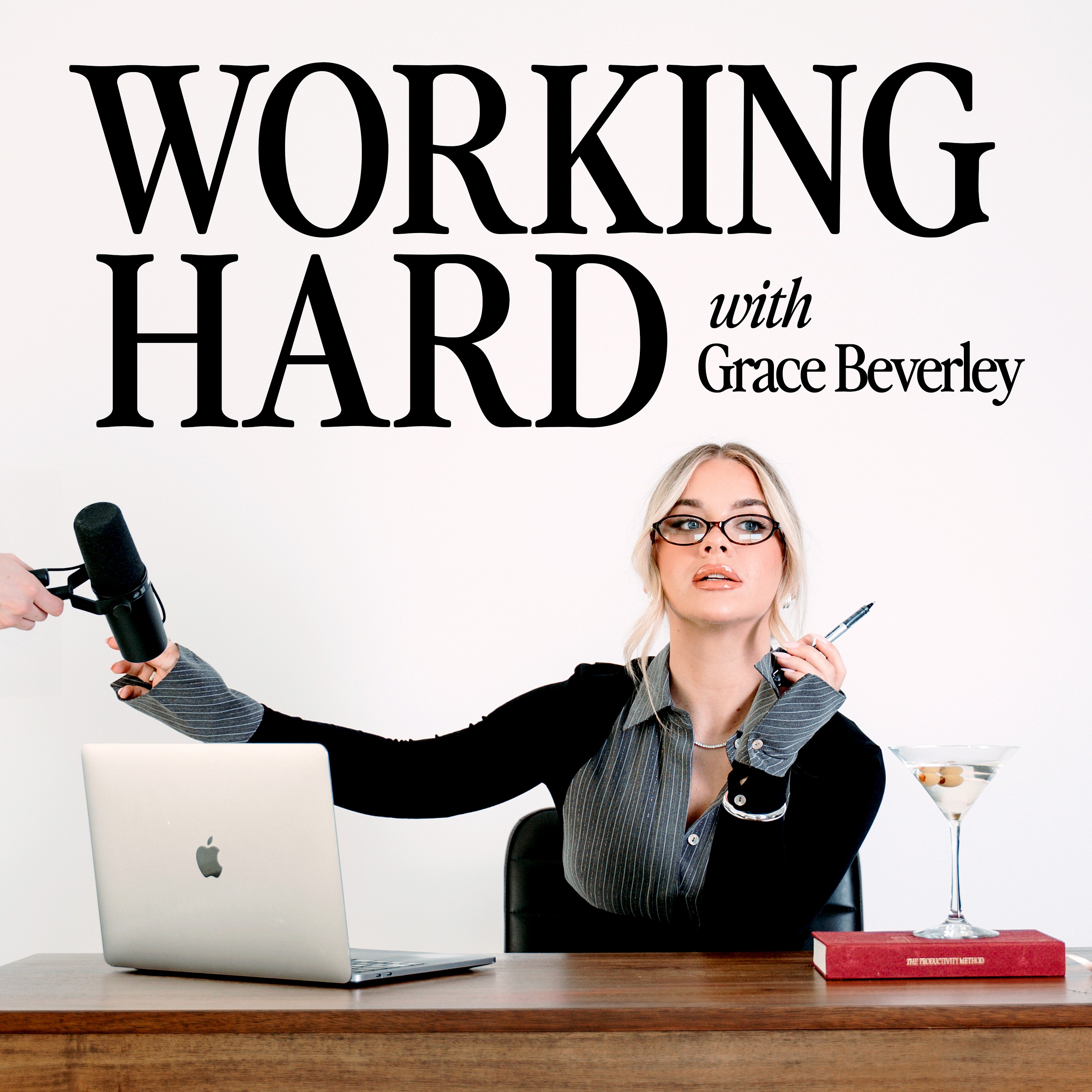
 Working Hard with Grace Beverley
13 May 2024 · 46m
In this episode of "Working Hard," host Grace Beverley interviews Robin Sharma, a renowned leadership expert and bestselling author of "The 5am Club." Sharma discusses the significance of habits over genetics in achieving success, shares insights on productivity, and emphasizes the need for balance between work and rest.
Written by AI. May contain mistakes.

Get the gist, explore an idea or ask about something said.
 Claude
On Working Hard with Grace Beverley, what are the key points of this episode?
Searching your listeningAutomatic transcript. May contain errors.
0:07Robin Sharma is one of the world's most famous leadership experts. He is, as you probably know, an internationally best-selling author who has sold over 25 million books in more than 92 languages, making him one of the most widely read authors alive. His most famous is The 5am Club, which you've probably heard of, a book that pioneered so many ideas I love about routine and productivity and making different routines work for you and finding the one that specifically works best for you. He has over 7 million followers on social media and has worked with the world's most successful individuals, from billionaires to sports stars and pop icons to royalty, as well as companies like Nike and NASA.
0:49In many ways, Robin is kind of one of the godfathers of self-help writing. So I'm really, really excited to sit down with him and kind of cut through those theories that we've all heard so much about to get some real actionable advice that we can all use every day, no matter whether something like the 5am club works for you or if it's something different, actually being able to really cut through these theories and see what you can get into your every day that will improve your life and get to the point where you are really improving your life and yourself every single day.
1:21Before we get into the episode, if you could just go to the podcast on Spotify and give us a rating, you can choose the rating, but let's be honest, a higher rating really helps us get amazing guests. I know it's not probably something that you think about following and rating the podcast, but it makes a huge difference to what we're able to do. So thank you so much and I hope you really enjoy the episode.
1:43Thank you so much for joining me. Such a pleasure, Grace. I am very, very excited for this conversation. I feel like I've, I mean, I've read your work for a long, long time. So I just want to dive straight into exactly that and how you got to where you are now. But firstly, I'd like to ask you if you feel like currently you are more working hard or hardly working. Well, I'm on this book tour and I've been on the road for about six weeks so far. So I have to be honest and say I'm definitely working. I've got book tour voice. But I'm meeting amazing new people. And I'm meeting some of my readers who've been with me on the journey.
2:20And I'm seeing wonderful cities. So I'm super grateful. So working hard but enjoying it. Working hard but enjoying it. My work is my oxygen. I really love it. I have no intention of retire. I want to pass out on a stage hopefully when I'm 101. I love what I do. It's really a great blessing. And then I love the times, you know, in the book I say rest is not a luxury, it's a necessity. So I love the seasons where I enjoy the fruits of my labor and where I get to, I live in an old farmhouse, so kind of walk the property a little bit and do not much of anything. So I like both. I think that what you said just there about seasons is something that I love to think about as well.
3:00And thinking about life in seasons and sometimes it's going to be a time where you're 90 % work and you're not being great with your... Does it ever feel like you're a marketing professional just speaking into the void? But with LinkedIn ads, you can know you're reaching the right decision makers, a network of 130 million of them, in fact. You can even target buyers by job title, industry, company, seniority, skills, and did I say job title? See how you can avoid the void and reach the right buyers with LinkedIn ads. Spend$250 on your first campaign and get a free$250 credit for the next one. Get started at linkedin.com slash campaign.
3:38Terms and conditions apply. At Capella University, learning online doesn't mean learning alone. You'll get support from people who care about your success, like your enrollment specialist who gets to know you and the goals you'd like to achieve. You'll also get a designated academic coach who's with you throughout your entire program. Plus, career coaches are available to help you navigate your professional goals. A different future is closer than you think with Capella University. Learn more at capella.edu.
4:37but actually being able to know that these are in seasons and you can have these different seasons concentrating on different things. I totally agree with you. John Lennon said, time you enjoy wasting is not wasted time. And so rest without elite performance without deep recovery is an empty victory. And that actually comes from science and a lot of research and some of the work from the Energy Project to give credit where it's due. They found that the most productive people, I know you've got the productivity method, and congratulations and all that you're doing, Grace. If you look at the most creative people, the most productive people, these people understand that there is a time to produce.
5:16I almost see it like the farmers. There's the harvest. But you don't get the harvest without the fallow season. So I think both seasons are incredibly important. I think we live in a world where we feel guilty if we're taking time off and resting, but that's often when we become more interesting people. It's definitely when we get to enjoy the fruits of our labor. But also when we're not working is when our greatest ideas are incubating. I could not agree more. And I always say, I always, always say that you cannot have rest without productivity and you cannot have productivity without rest. They're two sides of the same coin.
5:49You can't, you know, self-care sometimes is meeting that deadline that you said you were going to meet and you're actually not close to meeting it. And at the same time, you know, productivity is sometimes resting. Like sometimes the most productive thing you can do is take a day off because you really need that. And I think that is so incredibly important to like fix into your life. Like you need to build in that rest. I also think that nowadays with social media and a constant news cycle, we're not allowing ourselves enough time to be bored. And we know on a kind of neuroscience basis, we need to be bored.
6:24Like we need times where we are building in boredom into our day, whether that is through meditation or whether that is through a walk or whatever it might be, and not constantly consuming this information, because that is a type of labor as well. Sure. In the wealth money can't buy, so it's based on eight forms of wealth, as you know. And one of the forms of wealth is your craft. To see your work as a craft and pursuing mastery is a currency worth celebrating. And one of the things I talk about is a zero device day, to your point about the importance of rest. One day a week for 24 hours, zero digital.
7:00And that's when you rest or you go to a new restaurant or you go to an art gallery because you can't inspire others if you're well if inspiration is de-inspired. But I think at least one day off taking a digital Sabbath where you enjoy life is incredibly powerful. There's another chapter called Go Ghost for a Year. Now, this is for the people who really want to rest. And what I suggest is take one year of your life, go to the place you've always wanted to go to. Go to Medellin. Go to Tokyo. Go live in Vietnam. And leave your phone at home. And I'm joking a bit, but leave your phone at home. And take five classics like Catcher in the Rye and Hope for the Flowers and the Giving Tree and Siddhartha.
7:44And get to know yourself again. And have new conversations and think about your values because a lot of people are spending their finest hours chasing a mountain only to realize after maybe a few years they've climbed the wrong mountain. I think that's incredibly valuable. I think also part of that is being able to take that piece of advice and action it to different extents. I think some people will listen to that and say, I've got kids, I can't take a year off. I'm the primary caregiver or I'm the primary earner or whatever it might be. How would you advise that type of rest and that type of recuperation and building that into your life without necessarily being able to go somewhere for a year?
8:23It's a great question. And I would say to, you don't have to go ghost for a year. If you can't go ghost for a year, go for six months. If you can't go ghost for six months, go for a month. Can't go ghost for a month, go ghost for a day. So how do you get the deep renewal in a day? Well, starting your morning routine is incredibly important. I wrote a book called The 5am Club. Start your day with MVP, meditation, visualization, and prayer. That's a great way to get some rest and renew and some self-care. Start your day with some journaling. I have five morning questions I ask myself almost every morning.
8:56What am I grateful for? Number two, where am I winning? So I'll build momentum and energy. Number three, what do I want to let go of? So I don't become a resentment collector. Number four, what does my ideal day ahead look like? Because clarity breeds mastery. And number five, what needs to be said about me at the end? So you'll live to the point. And then more rest ideas or tools or techniques. I call it the second wind workout. If you believe exercise is a great way to recharge, then why would you do it only once a day? The 60-minute student, put down your phone every night, read for an hour.
9:38And then a great way to refuel is get rid of the energy vampires and clean out your social circle, because I think you can change the world or be around toxic people, not around both. No, 100%. All of those different kind of techniques, I think that's what's important. It's about finding what's right for you. It's about finding what recharges you. I think what you said about those five questions in the morning, not only are they really valuable questions, but I think honing in on something like, what am I winning at at the moment? Giving yourself this kind of evidence that you can succeed again and again and again and that you are succeeding, I think, is something that I've found so valuable.
10:12I think we build confidence over time based on looking at our wins, based on looking at proving ourselves in like a kind of positive bias. I think a lot of us tend towards a negative bias, especially when we're not feeling our best. So understanding how we can start the day putting ourselves in a positive bias towards, you know, this is going to be a great day or this is what I'm currently doing really well. Not about necessarily just completely ignoring the rest of it, but also just being able to start your day on the right foot. Totally. As you know, one of the features of the human brain is a negativity bias.
10:45and served us well thousands of years ago when we would have to scan the environment to make sure we weren't eaten by predators, kidnapped by warring tribes, or die of starvation. Well, now here we are in the modern age, and what happens, we're still scanning the environment looking for threats, which you're right, it doesn't serve our energy, it doesn't serve our confidence, it doesn't serve our creativity, productivity, or longevity. So the gratefulness is the antidote to fear. Gratefulness is the antidote to fear. So starting your day off celebrating some wins retrains and reprograms your brain to find the victories, even if they're little victories.
11:23And as you're right, you're right. When you celebrate the little victories, it creates energy. It creates momentum because I know a lot of entrepreneurs follow you and productive types and creative types from around the world. No one will believe in you until you believe in you. And then when you start believing in you, the world starts believing in you. So I think it's mission critical to protect your mighty mountain, to protect your Mount Evers, to protect your vision. And the very nature of any great vision is disruptive. People think it's crazy or you can't do it. Like the greatest visions frighten the status quo.
12:05And yet those are the very visions that disrupt markets and change the world. So anything we can do to protect our inspiration, to protect our self-confidence, even another great, I think, key principle is remembering that hard is easy and easy is hard. So our society says, do easy things, you'll have a great life. I think that's not correct. I think the consistent doing of difficult things, read the hard books, have the hard work out, start the hard business, have the difficult conversation in your intimate relationship and you get an easier relationship and ease your life. It's so true. And I think that when I had a big career change at one point, when I realized that what I was doing wasn't necessarily what I wanted to be doing, not in kind of end goal, you know, I was doing well, but I actually just felt that I was not every day doing things that challenged me and therefore made me happy.
12:59I realized I was the type of person who values really being challenged. And I think we all do to a certain extent. We, you know we talk about a flow state being a high level of skill and a high level of being challenged you want to be at a point where you feel like you're challenged but you also feel capable of overcoming that challenge that we as humans know is both the most productive and also the most fulfilling state to be in and I remember realizing I was like I'm never in a flow state because none of my work is challenging me at the point that I am also highly skilled at and I think that understanding that hard things do not necessarily take away from your life.
13:39And don't get me wrong, there will be hard things that are awful and everyone would wish would never happen. But actually understanding the place for hard things in your life, I think is so important. I think, I'll stop talking in a second. But podcast, Grace, it's your podcast. You can talk the whole time. But I answered a Q &A on Instagram the other day. And someone said, do I give up this work from home job for an in-office five a days a week job that is much more suited to my skill set and what I enjoy? And I was like, did you just hear yourself? Like, why does just because it's work from home in this moment, like, why does that make it so much better to you?
14:17Is it because, you know, I understand the commuting costs, but is it like, is it because you feel like it is actively better not to have any time more than needs to be spent towards your work working, when actually, if you're going to enjoy that work more, if it's going to be more aligned with your goals, if it's going to be something that fulfills you and you find interesting, I really believe understanding where challenge can come into your life and improve your life is so important. Often the times or the people who we see that have everything but are often quite miserable, it's this lack of small challenges that we can overcome.
14:53I hear you. And I would actually say, you said we can do hard things and also have a good life. I would actually say when you do difficult things, that's how you have a rich life. So I think the easy, I'm not, again, I've never subscribed to the hustle and grind culture. The 5am Club mentioned the twin cycles. My books for years have been saying, take rest, enjoy life, have a great family life, et cetera, and work hard. But I think it's really important to set yourself challenges. You talk about flow state you know the father of flow state was Mihaly Csikszentmihalyi of University of Chicago I think doing things that challenge you but don't overdo it puts you in a flow as you mentioned I also think genius and flow loves solitude and I think that is one of the biggest opportunities in the wealth money can't buy one of the forms of wealth is adventure and getting away from the world and the noise of the world so you can hear the signal is so powerful.
15:51One of the chapters is find your own personal golden eye. So Ian Fleming, who created their James Bond novels, understood that genius loves isolation. We do the best work when we're alone. And we're talking about flow state. So flow comes from being alone. And what he did was he bought this seaside cottage in Jamaica that he called Goldeneye. And he was so monomaniacally focused on not being distracted. He told the people taking care of the flowers, when they would walk across his view, he said, please don't do that because it would break him out of flow state. And I think it's really important we find our own Goldeneye.
16:28It could be we take some time and rent a little seaside cottage. If we can't rent a seaside cottage, we find a quiet stack in a library or we get away from the world. I mean, even something as simple as 24 hours without the phone, I have a tactic called the two-phone protocol. One phone is your fully loaded phone. You've got your food ordering apps and your social media, etc., etc. Then you've got a secondary phone, which is your stripped-down Spartan phone, because I think it's important to be lost from the world regularly. And when you work or when you go for a walk, you carry that Spartan phone, so there's no attraction to being interrupted, and you can start to get back into flow and start to enjoy life.
17:11I mean, we forget, you know, that all we have is today. And it sounds like a platitude, but it's not. No one knows what tomorrow is going to bring. And yet many of us are postponing enjoying life or finding the riches of family or the simple wonders and daily graces of each day because we're so attracted to being online. And I think we're losing a lot of time from that. No, I can definitely see that. Before we come on to speak more about the new book, I'd love to know where this kind of original fascination with studying what makes people successful or what success looks like to different people, these kind of narratives that tie your books together, where did that initial kind of fascination or interest come from?
17:58Well, I think we're all born with a series of interests. I think we're hardwired for certain inclinations. And I think when you look at the masters, and I'm certainly not saying I'm a master, but you look at the people with superpowers, these are people who had these natural-born interests. And for whatever reason, maybe the right mentor, maybe destiny, maybe luck, they actually focused on their interests and polished them through practice until they got to a point where the world said, oh, you're gifted and you're a genius. So I've always just had a natural instinct in what makes the great ones great.
18:37I've always been interested in the great artists, movement makers, Mandela, Mother Teresa, Jean-Michel Basquiat, Hedy Lamarr. I've just been fascinated what makes the great ones great. And I think I also have to give credit to my father, who's going to be 87 in June. We're here in New York, but I was just in Toronto, my hometown. I was blessed to have dinner with my mom and dad. And my dad filled our home. He was a family physician for 54 years, community doctor. And he filled our home with personal development books way before personal development books were mainstream. So I grew up on meditation and the philosophy and the shortness of life and the stoic philosophers and positive thinking and emotional healing.
19:29I grew up with those things and great biographies and autobiographies. So that also really, really helped me find fascination in this world. No, absolutely. And what were the first few conclusions you drew from the similarities between these types of people or between the types of success that you were studying and seeing. Genius is less about genetics and more about your habits. Secondly, do not confuse busy with productivity and do not confuse movement with progress. Number three, the great ones are minimalists versus maximalists. So I think one of the traps so many of us fall into right now, We are busy being busy chasing every shiny toy versus stripping away complexity and getting monomaniacally focused on that.
20:23In our business, let's say, what I call in the Wealth Money Can't Buy, your Project X. That one Taj Mahal, that one Sistine Chapel ceiling, that one Beethoven's Moonlight Sonata. I don't know if I'm being clear. We have a tendency right now to push a thousand pieces of content out in the world or so many apps. and say yes to every opportunity as entrepreneurs and creators. The great ones have the courage, wisdom, and discipline to say, here's my Mount Everest, and I'm going to exercise the courage to say no to every other opportunity so I can make something so beautiful it will mesmerize all witnesses and stand the test of time.
21:06And I think that's a very important point. So the great ones are minimalist versus maximalist. The great ones are careless of the opinions of others. Great lives. They are so sure of what they are doing, even if they're the only person who gets it, that when someone criticizes them, they don't feed the trolls and they understand that critics are nothing more than deteriorated dreamers and everyone has an opinion and they trust their own opinion. Steve Jobs, for example, when he was at Apple, had an executive named Bud Tribble. And Bud Tribble was the one who coined the firm the reality distortion field.
21:45And so you'd hear through the grapevine, oh, this is what Steve was concocting, a new idea. And no one believed it until they were in Steve's presence. And he almost hypnotized them and pulled them into a reality distortion field to show them what was possible because he so believed in it. And all the great lives, that's what it is, whether it's their written masterpiece, whether it's running a marathon, whatever it is. They had a deep, heartfelt, cellular belief in their idea, and they could get it done. No, I think that's incredibly valuable. I also have a feeling that all of those things are, especially the last two, so being minimalist and focused versus maximalist and also kind of what you've just talked about, I feel like all of those things are made harder by social media.
22:38I think that the minimalist versus maximalist, it's really when there's so many announcements, this kind of constant announcement culture, there's so much going on. You see the sum total of all 900 people you're following, their output every day versus thinking about, okay, well, that person hasn't said anything else for the past month or whatever it might be. we see this kind of constant cycle and I think that it's really easy to fixate on quantity over quality especially in your own life and how that looks for you and how that looks for your achievements and I think it sacrifices focus a lot of the time on top of that I think you know being so sure of your own opinion that yes you can take criticism you can take other opinions but you it doesn't necessarily rattle your own you have this kind of undeniable self-belief in what you're doing.
23:28I think both of those things are made quite a lot harder by social media. Well, I'm not going to knock social media. You're doing extremely well on social media from what I saw, Grace. And social media has really served us well. I absolutely love social media. I mean, we live in a world right now where you can distribute one video and change the world. Through social media, I can interact with the people who read my books. It's such a blessing. I can leave them voice notes. I can honestly thank them for reading my books or send them some encouragement. So I think technology is an amazing servant, and it's just a tragic God.
24:17And I think that's the real issue. Not setting some red lines, not setting structures. In my work, I have the 20-20-20 formula for 5 a.m. club routine. I have the five great hours rule. So that is basically, I think any entrepreneur only needs to work five hours, five deeply focused, undistracted hours after that, you've done your work. You've done your work. Go on a mountain bike ride. Go get a gelato. Go to an art gallery. The thing is most people take 10 hours to do what they can do in two hours if they were focused. And so I think installing the right habits, the right boundaries, the right systems, and then practicing them to the point of what researchers call automaticity, so it becomes a part of your lifestyle, so that digital doesn't invade your days.
25:18Then you actually have a much freer life. I think digital media is so wonderful to scale and serve the world. You just have to use it as a tool very carefully, because otherwise we can become addicted to it. Many people are. And if we want to go deeper, it's because there are a lot of lonely people and a lot of people have these holes within themselves. And so they're looking for outer validation to fill their inner holes. Why don't we heal those inner holes? Then we won't have this compulsion to be checking the feed so many times. No, I completely agree. So it's less about demonizing social media as a whole, which I completely agree.
25:53I mean, I would be very hypocritical to be demonizing social media in a kind of blanket term. I completely agree with you, the important thing is setting appropriate boundaries and understanding your priorities and not allowing the number one priority to just be scrolling, scrolling, scrolling, because on a dopamine basis, that's very hard to break out of. So it's understanding where your boundaries are so that you aren't compromising your own standard of living based on this inability to kind of get out of that. I would actually say, we should think more about that. when we start thinking about the shortness of life i mean one of the last chapters in the wealth money can't buy talks about the wealth of life we don't celebrate that right our culture says if you have a lot of money you're wealthy but if you are intimate with your mortality one of the chapters is live your last day first if you start living your last day first If you started, if you actually had one of the chapters, it's called Have a Living Funeral.
26:57If you actually had a living funeral, you went and bought a chocolate cake, you invited all your friends and family, you heard what they want to, how they feel about you. You actually said to them how you feel about them. And you put your mortality and the shortness of your days front and center every day. Maybe even by just like a little meditation first thing in the morning. You would be fooling around all day. Human beings as a species are great postponers, especially when we're young. I've got some years under my belt now. There's a philosophy I have called the 25 summers philosophy. If I'm lucky, I have 25 more summers left on the planet.
27:41So I live to the point right now. So I think connecting to the shortness of life is incredibly powerful. There's a story of Eugene O. Kelly. And he was the worldwide CEO of KPMG, the accounting behemoth. And he went to his doctor to get the results of a routine medical exam. And the doctor came back with an expression on his face that you never want to see. And he was told he had 90 days left to live. He had an inoperable brain tumor. True, true story. And sadly, roughly 90 days later, he did die. But confronted with the fact he had 90 days left to live, he started doing some deep thinking. You know what he realized, Grace?
28:28In all those years as a corporate titan, he had never taken his wife to lunch. He'd missed Christmas concerts with his daughter. He had never taken long walks in Central Park with some of his best friends. In his last 90 days, he decided to focus on what was most important, and he re-engineered his life to be what he called a perfect moment creator. So I think that's the value of connecting with the shortness of life. You start to look for perfect moments, and you actually create them versus playing with your phone all day. Absolutely. And how do we action that kind of last 90 days in a world where we also probably need to work quite hard?
29:06You know, costs of living are higher than ever. we need to make sure, you know, we're providing for our family or our future or getting to where we want to get to. How do we simultaneously make progress in that direction and also create these perfect moments that allow us to make sure we're constantly living in a way where, you know, we have that intimacy with mortality because we know we're living our lives right? Well, we all have a background ambient noise that we're going to die. And that's what often keeps us playing small and from doing the things we want to do, fear of rejection, fear of death.
29:44The world is a scary place for most people because of this secret quiet noise in the background. I'm not saying you spend the whole day looking for perfect moments. Of course, there's a cost of living crisis, there's hyperinflation, there's pandemics, there's wars, there's social polarization, there's climate change. I'll be the first person to acknowledge all of those things. I'm simply saying, find a perfect moment even if it's just one moment in the day. I mean, I'm on this book tour. I've been on the road for many weeks. Each day starts early with media and podcasts. Thank you for having me on your amazing podcast.
30:21I know how many people believe in you and trust you. And congratulations on all you've done in business and with different brands that you've worked with and, like I said, the productivity method and your companies. So there's a lot going on for me right now. I talked to my partner, Elle, this morning, and she told me what's going on at the farmhouse, and I miss home. But, you know, the other morning, two days ago, was the global book launch of The Wealth Money Can't Buy, released in 50 countries. And it was a very busy, heady day. But, you know, the next morning, before I caught a plane in New York, I sat in the darkness.
31:03I sat alone in my hotel room, and I just savored. Any good positive psychologist will tell you one of the things that happy people do is they savor. And so I didn't spend the day in perfect moments. We all have bills to pay, to your point. But I just took two minutes in the darkness where I went, this is it. Like, this is what we've worked for, and this is it. you don't want to always be striving so much you miss out on on the process of living
31:56Go to Upwork.com now and find your freelance expert. That's U-P-W-O-R-K dot com. Post a job for free and get started today. Have you ever loved your HR or payroll software? Didn't think so. Deal changes that. It's one global AI-native platform for HR, IT, and payroll, built in-house and backed by 2 ,000-plus experts in 130-plus countries. It keeps you compliant, it scales as you grow, and it's actually nice to use. Book your demo at deal.com slash serious. That's D-E-E-L dot com slash serious. Hey, I'm Dr. Z and I'm a neurosurgeon. So that means long hours, early rounds, late nights, and everything in between.
32:38And through it all, I wear figs. They're comfortable when it counts and functional when I need them the most. So where do you wear your figs? On shift, on call, on the couch in the break room listening to this podcast? Wherever it is, they fit right in. And now listeners of this podcast can get 15 % off their first order. Just head to wearfigs.com and use code FIGSRX at checkout. That's wearfigs.com, code FIGSRX. Yeah, I think it's this, it's about cultivating this ability to enjoy on the everyday, even if it isn't the end goal. And also for each, it might be a micro achievement. It might be a big achievement.
33:21I think we have this constant tendency to move the goalposts again and again and again. And it's, you know, it's a good thing to some extent because that's what keeps you pushing. That's what keeps you not settling. That's what keeps you getting to the next level in your career, in your life, in your finances, whatever it might be. But at the same time, being able to be kind of conscious of what you also are doing right and what you have achieved and what you should be celebrating as to your point every single day to some extent. And I think that that is so valuable and that kind of being able to touch base with yourself and really recognize that every day I think is incredibly important.
34:04And I humbly suggest that's the value of the framework the book is based on, the eight forms of wealth. No one's saying all day long, sit in a quiet room and look for perfect moments. The eight forms of wealth. Our society has programmed us, chase a mountaintop to make lots of money and then you're rich. Well, I've mentored for over 15 years celebrated billionaires, sports superstars, entertainment, royalty, movement makers. I can tell you a lot of those people from personal experience are cash rich and they're life poor. A lot of people have a lot of money and that's all they have. So the eight forms of wealth, the first one, personal development, that's a currency.
34:47If you are each day a little bit developing and building intimacy with your gifts and your talents, that's a form of wealth. The second form of wealth, your wellness. I know you believe so much in wellness. If you don't have your health, you have no wealth whatsoever. I was once at an event. Someone handed me a piece of paper. It said, help is the crown on the old person's head that only the old person can see. Third form of wealth, family. Family is really often we, I don't know what you think, but often we take the people we love the most for granted until we lose them. So the eight forms of wealth is a decision matrix or a framework for your richest life.
35:28And it involves things like productivity. I agree with you. I think I'm happiest when I feel I'm moving things forward. We could talk about the dopamine release. We could talk about norepinephrine and all this. I think we're meant to progress. But it's when we spend too much time on one thing and forget these eight forms of wealth that I think we run into trouble. So tell me what the eight forms of wealth are. The first one is growth. I don't think a lot of people say, congratulations, Grace. You're meditating and you're working on yourself. You're journaling and you're healing. You're a very rich woman.
36:02But it is. I mean, to get to know your primal genius makes you a rich person. Second one is wellness. To be taking care of your good health. There's lots of chapters in the book on how to do that, like breathe like a samurai, practice the naked sunbathing rule, take a bath in the forest, which is really about forest bathing, shinrin yoku, as the Japanese call it. But without good health, nothing matters. You want to increase your income and your impact, get super fit. Third form of wealth, your family life, your friendship life. I mean, to neglect that, there's no point in living in a beautiful mansion, but living there You're all alone.
36:42Fourth form of wealth is your craft. I almost think that hard work right now has a bad reputation. And I think seeing your work, no matter if you're a barista, you're a grave digger, you're an astronaut, you're an entrepreneur, I mean, all work has dignity. Have you ever been in a coffee shop or walked into a clothing store? Seven people are checked out. They're on their phones. But there's that one person who still has so much pride. They look you in the eye. They're present. They care. They want to deliver value. So seeing your work as a chance to pursue mastery is a currency money can't buy.
37:20The fifth form of wealth, I want to acknowledge the fifth form of wealth is money. Money is a form of wealth. Puts food on the family table, gives you freedom, allows you not to be backed into a corner to make decisions you don't want to do. Sixth form of wealth is your social circle. You want to be around people whose lives you want to be living. Seventh is adventure. Eighth, one of the most important is service. And one element of service is just being a gift giver versus a taker. Help seeing anyone in need or never missing an opportunity to make someone's life better. I mean, I love the way you look at it.
37:56And I love the way that it's, you know, money in there is number six, is it? Five. Five, sorry. Money in there is number five. And knowing that obviously no one's going to say money isn't a form of wealth. Of course we're not. But actually being able to process and put into words what the rest of those forms of wealth that are going to be what the difference is between you being incredibly financially wealthy and also feeling incredibly demotivated, lonely, unhappy, all of these different things that we actually often do see from wealth, financial wealth. I think bringing that into the conversation and into the everyday is incredibly valuable.
38:42I want to bring it really into the everyday in the fact that obviously your kind of original huge success came from the 5am club and came from this book that you wrote that has had, I mean, I don't think anyone will listen to this podcast that hasn't heard of that book. I want to talk a little bit first about the concept behind the 5am club, because I think that's important before we go into any deeper questions. Could you, for anyone who might have heard of it but not read it, could you take us through what that concept is? It's pretty simple. It's the way you begin your day sets up the way your day unfolds.
39:21The Spartan warriors, Grace, they have a great saying, sweat more in training and you'll bleed less in war. So the idea behind the 5 a.m. Club book is a formula in there called the 20-20-20 formula based on 5 o 'clock to 6 o 'clock. It's a morning routine that's helped millions of people be not only more productive but more peaceful. I was at a book signing the other night, and I was very deeply moved. There was a woman from Michigan, and she said she was homeless a year ago. Homeless a year ago. She was maybe 25 years old. And she said she read the 5 a.m. Club. She's followed the morning routine.
39:59She's now an entrepreneur. She's writing a book. She has a podcast. And I just think it's such a powerful method. So it's about taking some time at the beginning of your day to run the protocol because we live in a world where a lot of people get up and they are chasing their day. And we know for hundreds and thousands of years, many of the great saints, many of the great artists, many of the great painters, many of the great athletes, what do they do? They get up with the sun while the rest of the world is asleep in this age of dramatic distraction, and they find some time to build themselves.
40:36And not only your mindset, but in my work, I call them the four interior empires, mindset, heart, set, health, set, and soul set. Because your relationship with your money and your family and your work and your life, it all comes from your relationship with yourself. And so from five to six in the morning, the 5 a.m. club is you give an hour to build your relationship with yourself. What's more important than making yourself stronger? And so for someone who might be listening to this who thinks, I could never get up at 5 a.m., what would you say to them? I would say, first of all, your beliefs become your self-fulfilling prophecy.
41:21And if you don't think you could get up at 5 a.m., and you don't think you can find true love, you don't think you could be best in the world at what you do, you don't think you can find financial freedom, you don't think you can change the world, then you're not going to do the work required to get all those things done. So your beliefs are powerful. Secondly, give it a test. Test it out. It's like saying, I'm not going to try new food. you might just miss your new favorite food. And then the third thing is I'm not here to preach to anyone. If someone wants, I hear this a lot, Grace, well, I'm a night owl.
42:01Then be a night owl. Be a night owl. Do what works for you. But millions of people are getting up at 5 a.m. and have joined this 5 a.m. club movement. And every day I hear people, it's helping their health and productivity, et cetera, et cetera. And I'm just reporting the truth. And if I was to say one thing that has helped me so much in my life, it's getting up early. It's one of the best things I've done. I get up. I do MVP, meditation, visualization, and prayer. Then I have my espresso. I write in a journal. I work out. And my days are fundamentally different. And when I don't do my morning routine, my days are just fundamentally, they just feel fundamentally different.
42:42So would you say you think someone needs to wake up at 5 a.m. or the equivalent to be successful? No. There are many people who don't get up at 5 a.m. who are successful. I don't like them very much. I'm just joking. But of course, someone said there's many doorways into the mansion of heaven. And there's many routines that are going to work. But a strong early morning routine is absolutely one of the battle-tested and science-based ways to get more done and have a very rich life. But there are other ways to do it. And if someone doesn't want to get up at 5 a.m., that's fine. Yeah, what I think is so important about that is understanding that, you know, yes, there are different things that will work for different people.
43:29I think where it becomes unhelpful is where because you think something won't work for you, you won't try that or any other things. And I feel like that's the mentality we have to get ourselves out of. it's the as you say you know if you say you can't do it then you can't like that's as you say it's a self-fulfilling prophecy but it's the ability to constantly try new things and refine and get closer and closer and closer to what your you know what your 5am club might be it you know it could be that you do that and that's absolutely life-changing and i've seen the millions of people that that's been so life-changing for it's about not necessarily i see so much of this online especially with self-help it's looking at a self-help thing and just saying no that would never work for me rather than actually having this kind of open-minded approach to okay never try it then you know never go ahead never you know never see if that works for you just for one week but actually knowing that if you do try it this or anything else you could say okay well this little part of it didn't work for me or 5 30 is so much easier for me or you know whatever it might be but understanding that you can tweak that more and more and more to get closer to what is your version of your kind of perfect moment, your perfect life, your most productive life, your one where you're in touch with all of those different forms of wealth.
44:54Yes, I'd say a few things. I agree with you. I hear you. Number one, I'd say the illusion of safety is always more dangerous than the heartbreak of regret. So often we don't embrace the 5 a.m. club or a pre-sleep ritual or a productivity method, it's not because it doesn't work. It's because we're scared to let go of the safe harbor of the known and step into new possibilities. It's frightening. Second thing I'd say, all change is hard at first, messy in the middle, gorgeous at the end. I'm not going to sit here and say, wiring in the habit of getting up at 5 a.m. or any of the things I teach in The Wealth, Money, Can't Buy or any of my books, that it's easy.
45:39Deep change is meant to be hard. And if it wasn't hard, it wouldn't be worth it. Third thing I'd say, you have a gift. And I have a gift. And we all have a gift. And it sounds like I'm going to say, let's all hold hands and sing kumbaya. We all have gifts. And all I'm saying is the human brain has a gift called neuroplasticity. So anyone who says, well, I can't change. I can't start the walk that will lead to a marathon. I can't leave a toxic relationship that's not serving me for something that is more that I deserve. Anyone who says, no, I can't leave this job that's a dead end and launch my own business that'll change the world, I would humbly and respectfully say we can change.
46:21That's what neuroplasticity is. It's the human brain's ability to adapt and grow according to new conditions and new circumstances. We're all meant to change. We can do it. I think the real key is either we say no, as you're suggesting, we're closed, or we don't give it long enough. According to the research of University College London, it takes about 66 days to wire in a new habit to the point of automaticity, which just means it becomes easier to do the new habit than not to do the new habit. Most of us will hear a podcast, read a book, we'll try it for three or four days. It gets hurt, and then it's like, I want my mommy, I want my daddy.
47:04But that's like someone who says, I want to be a chess champion or a top athlete. Well, I practiced for five days. I didn't get the gold medal. I'm going to stop. Absolutely. I couldn't agree more. Before we finish, because you've been dropping so many good pieces of advice, I'd love to know what is the best piece of advice that you have ever been given? Well, I think of my mom. You know, I talk a lot about my dad, and my mom always goes, like, why don't you talk about me more? So I'm trying to prove that. She's a force of nature, and she's wise. So she said something to me once. She said, what's yours is yours and can never be taken away from you.
47:51And if it's not for you, then don't worry if you don't get it. So I like that. What's yours is yours. I found that in relationships. If it's for you, the relationship, then it's yours. And if not, then it wasn't meant to be. Why would you worry about it? And the second piece of advice, when I was, say, 21, I had a mentor, and he said, Robin, run your own race. Run your own race. In this age of digital comparison, run your own race. To be true to yourself and to find success according to your own scoreboard, that's the wealth money can't buy. That's victory. That's true success. Well, I think that is the perfect place to end.
48:35Thank you so much. I feel like there's been gold dust dropped everywhere. I feel like everyone will be wanting to read the new book. Thank you so much for giving us your time. It's been great to chat.
48:59Your receipt did. The sausage from muffin with egg extra value meal includes a hash brown and a small coffee for just$5. Only at McDonald's for a limited time. Prices and participation may vary. At Capella University, learning online doesn't mean learning alone. You'll get support from people who care about your success. Like your enrollment specialist who gets to know you and the goals you'd like to achieve. You'll also get a designated academic coach who's with you throughout your entire program. Plus, career coaches are available to help you navigate your professional goals. A different future is closer than you think with Capella University.
49:39Learn more at capella.edu. Hey, I'm Dr. Z and I'm a neurosurgeon. So that means long hours, early rounds, late nights, and everything in between. And through it all, I wear figs. They're comfortable when it counts and functional when I need them the most. So where do you wear your figs? On shift, on call, on the couch in the break room listening to this podcast? Wherever it is, they fit right in. And now listeners of this podcast can get 15 % off their first order. Just head to wearfigs.com and use code FIGSRX at checkout. That's wearfigs.com, code FIGSRX.
Robin Sharma is one of the world’s most famous leadership experts. He’s an internationally bestselling author of books such as The 5am Club and The Leader Who Had No Title. He’s sold over 25 million books in more than 92 languages; making him one of the most widely read authors alive.
He has over 7 million followers on social media, and has worked with the world’s most successful individuals, from billionaires to sports stars & pop icons to royalty as well as companies like Nike and NASA.
+
ROBIN'S LINKS
Instagram: https://www.instagram.com/robinsharma/
The Wealth Money Can't Buy: https://www.waterstones.com/book/the-wealth-money-cant-buy/robin-sharma/9781846048296
The 5am Club: https://www.amazon.co.uk/5-AM-Club-Robin-Sharma/dp/0008312834
+
MY LINKS: https://gracebeverley.komi.io/
Hosted on Acast. See acast.com/privacy for more information.