Ask ChatGPT
 Working Hard with Grace Beverley
18 May 2026 · 19m · 8 chapters
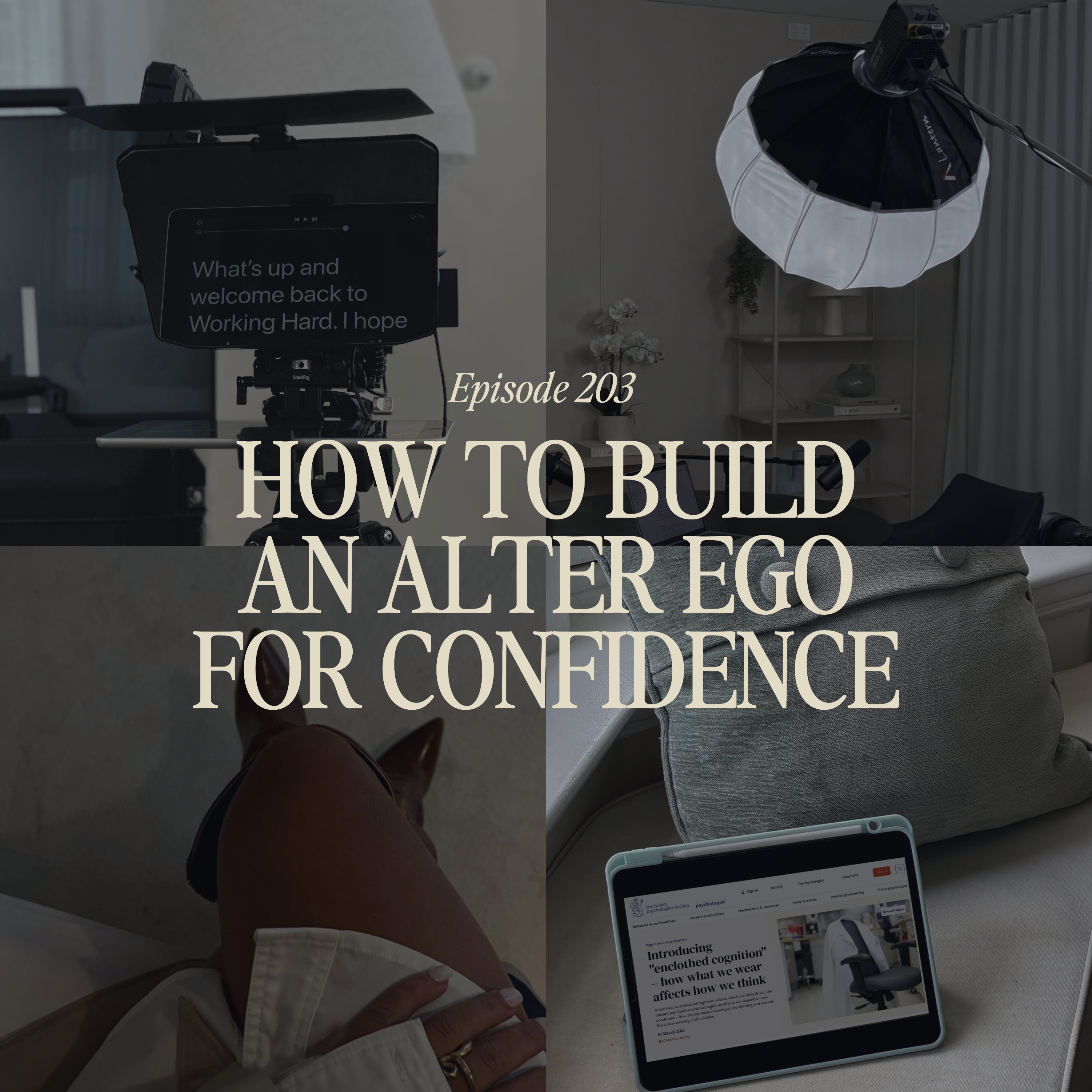
How to build an alter ego to boost confidence in intimidating, high-pressure situations, using psychology research (self-distancing, enclosed cognition) and a practical 3-step creation method.
Abby Foster (earlier episode; described using an alter ego for scary situations—more grounded, less apologetic). Heather Elkinton (leadership expert; discusses applying alter-ego strategy in workplace meetings).
Confidence is state- and context-dependent, not a fixed trait. Alter egos work by creating psychological distance from anxious self-states and by pairing identity cues with behavior. The goal isn’t to be fake, but to use scaffolding until the traits become your baseline.
Speech/task studies using “I” vs third-person self-talk; white-coat study (doctor vs painter) improving attention; leadership boardroom reframing (voice/age/northern identity as strengths) and a mantra: “May I say the things that someone in this room needs to hear?”
Written by AI. May contain mistakes.
Grace discusses the concept of alter egos and their impact on confidence.
“On our episode with Abby Foster earlier this year, she talked about having an alter ego specifically for scary situations.”
Explore the psychological research supporting the use of alter egos.
“So I thought today we could break down the science behind alter egos, why they actually work and how to create one in a way that doesn't feel weird and won't mean you're not being yourself.”
Learn how self-distancing can improve emotional regulation and performance.
“And so the idea is that having an alter ego is simply about consciously choosing which version of you is going to lead at any given moment.”
Discover how clothing and identity affect cognitive performance.
“You're stepping outside of the anxious storyline, which is the normal place you inhabit, and you are starting to access a broader, more capable identity that already exists within you.”
Grace challenges the misconception of confidence as a fixed trait.
“And when you apply this to confidence, that to me is when it makes most sense.”
Step-by-step guidance on how to develop a personal alter ego.
“and this is what I found based on Todd's book and my other research.”
Discover how to use your alter ego to overcome self-doubt and enhance confidence in professional settings.
“So I spoke to leadership expert Heather Elkinton about how we can bring this strategy into our meetings at work.”
Understand how to transition into your best self without losing authenticity.
“And I definitely went into those situations just imagining how people thought that I should be and then just really trying to be that.”

Get the gist, explore an idea or ask about something said.
 Claude
On Working Hard with Grace Beverley, what are the key points of this episode?
Searching your listeningAutomatic transcript. May contain errors.
0:00Business is booming, but you know what really helped? Zero. The accounting platform for small businesses. I used to think spreadsheets were just part of it. Ugh. But real-time cash flow? Wow. Invoices that chase themselves? Even better. Books that automate? That's a big one. And I can keep track from my phone while I get the job done. No spreadsheet in sight. What a life. Do right by yourself and your business and search Xero for your free trial. Conditions apply. While every other channel is fighting for your customer's attention, podcasts are where they've already given it. No one accidentally listens to a podcast for 45 minutes.
0:38They choose to be here. They trust the voice in their ears. And when that voice talks about your brand, it doesn't sound like advertising. It sounds like a recommendation from a friend. Acast gives you that trust at scale. Digital precision, post-read authenticity, and performance data that proves it worked. Don't fight for attention. Buy it with Acast. Learn more by visiting ACAST.com slash advertise.
1:17Grace Beverley: What is up? I'm Grace Beverly and welcome back to Working Hard, the podcast shape guidebook on how to improve your own life and achieve what you actually dreamed of doing. Because life's too short for boring podcasts and bad advice. What is up and welcome back to Working Hard. On our episode with Abby Foster earlier this year, she talked about having an alter ego specifically for scary situations. And she said that when she has to walk into intimidating rooms or do something that feels bigger than her, she steps into this slightly different version of herself and that person is more grounded. They are more confident.
1:51Grace Beverley: They are less apologetic. Well, first of all, I really love this idea, but I've also started to see it more places or see how people are using this in more places. So I did what I always do and I went down a research rabbit hole and it turns out that there's actually a lot of science behind the idea of strategically accessing parts of yourself through an alter ego. So I went on a googling spree and I found this amazing book called The Alter Ego Effect about exactly that and that led to me putting this episode together because it is so interesting and such a good book And I think we could all learn a lot from the things mentioned in it.
2:28Grace Beverley: So I thought today we could break down the science behind alter egos, why they actually work and how to create one in a way that doesn't feel weird and won't mean you're not being yourself. Before we get into it, please make sure you follow this podcast wherever you are listening to it on. A lot of research goes into these solo episodes to make them the best they can possibly be. And you following the podcast means we can keep these episodes totally free for you to listen to every single week. So thank you.
2:56Grace Beverley: Before we get into the science, I want to start by zooming out for a second. Todd Herman makes a really important point in his book, The Alter Ego Effect. He says that for decades, we basically ignored the fact that alter egos are a natural part of the human condition because we already play roles all the time. Like, you're not the same version of yourself with your best friend as you are in a important meeting at work. You are not the same version of yourself at home in pajamas as you are presenting in front of a team. You might play the role of a CEO or a mum or a manager or the joker in your friendship group.
3:30Grace Beverley: And psychologists call this self-complexity. We all have multiple self-states that we are used to playing, which I found really interesting because it's so true when you think about it, you're like, oh yeah, like I put on different versions of myself. And the problem is that we often let our most insecure or historically conditioned self run high pressure moments because you drift back to who you used to be and also who you're most comfortable being, even if that comfort isn't the best thing for yourself. And so the idea is that having an alter ego is simply about consciously choosing which version of you is going to lead at any given moment.
4:04Grace Beverley: When I started properly looking into whether this alter ego idea was just like a nice little mindset trick or something with actual evidence behind it, I kept coming back to one concept over and over again in the research, which is something called self-distancing. This idea of self-distancing has been studied extensively by psychologist Ethan Cross at the University of Michigan. And the basic premise is that when we step slightly outside of ourselves, either by imagining observing ourselves from a distance or by referring to ourselves in the third person, we actually regulate our emotions more effectively and perform better under stress.
4:39Grace Beverley: And in one set of studies, participants were actually asked to give a speech or complete a stressful task while either talking themselves through it using I language, so I can do this, or by using their own name in third person. So, for example, Grace can handle this. The group who used their own name showed lower emotional reactivity, more composed body language and stronger performance. That tiny little linguistic shift, which almost kind of seems silly when you think about it on the surface, created just enough psychological space for them to access their reasoning brain rather than being hijacked by anxiety.
5:13Grace Beverley: And what really fascinated me about this is that it aligned so closely with what Abby was describing without using the academic language for it. When she says that when she steps into her alter ego before walking into intimidating rooms, what she is actually doing from a cognitive perspective is creating distance from the version of herself that feels small and unsure. She's basically interrupting the default narrative. An alter ego essentially becomes a structured form of self-distancing. You're stepping outside of the anxious storyline, which is the normal place you inhabit, and you are starting to access a broader, more capable identity that already exists within you.
5:51Grace Beverley: And there's another piece of research that I found really compelling as well. I will stop down the rabbit hole in a second. We'll start talking about it more. But I just found this also interesting and I love seeing how things are psychologically backed so that I can start to use them in my everyday and understand like the science behind why it's working for me. So this is something called enclosed cognition. This term comes from a 2012 study by Adam and Galinsky where participants were asked to wear a white coat and complete attention-based tasks. For some participants, the coat was described as a doctor's lab coat, symbolising like intelligence and precision, while for others it was described as a painter's coat.
6:26Grace Beverley: The coat was physically completely identical, but the group who believed they were wearing a doctor's coat performed significantly better on sustained attention tasks. I guess this is because they are almost taking on the role of a doctor that they assume to be productive and efficient and good at concentrating on things. So the brain responds to symbols. So when you attach a story or an identity to something, your behavior begins to align with that narrative. This is why uniforms actually psychologically matter and why rituals matter and why certain environments can make us feel more focused or more capable without us kind of consciously understanding why.
7:04Grace Beverley: So when we talk about creating an alter ego, what we are really talking about is intentionally attaching like meaning to a chosen identity and allowing our behavior to then organize around that. And when you apply this to confidence, that to me is when it makes most sense. So one of the biggest myths I think we internalize is that confidence is a fixed trait, that some people are born with it and some people are not. And that if you feel inconsistent about confidence, then you simply must not have it. But actually that's not true. research suggests something much more nuanced, which is that confidence is highly state dependent and context dependent.
7:44Grace Beverley: So you can be extraordinarily confident in one domain of your life and completely unsure in another, or you can be articulate and decisive with your team and then suddenly apologetic and hesitant in a personal relationship. This is something I've seen happen with so many friends, like so many incredibly capable women, when then maybe it comes to being in a personal relationship, being unable to articulate how they really feel, or the other way around, being really good at that, and then they get in front of a managerial environment, and suddenly they are quaking in their very boots. And I feel like this is where it becomes so personal for most of us, because many of our identity scripts were formed so early in our formative years.
8:25Grace Beverley: Like, if you were the shy one at school, or the overachiever, or the people pleaser, or the one who was praised for being easy and agreeable rather than bold and opinionated, then your nervous system learned very quickly that shrinking was safe. Like that was your safe space. That was who you are. And those scripts don't disappear just because you intellectually know better. They actually sit in the background and they activate in high pressure situations. Todd Herman, the guy we talked about before who wrote The Alter Ego Effect, he writes specifically about this in the book. And he talks about separating yourself from the history that holds you back, which I thought was really powerful.
9:00Grace Beverley: like I really understand that. So when you consciously step into a chosen role, you are giving yourself permission to act without dragging every old narrative that you hold about yourself into the room with you. So I obviously started looking at how I might go about creating my own alter ego for situations that make me scared or that make me feel less confident or that make me feel less like myself, even if I can bring myself to show up in an amazing way in another situation. and this is what I found based on Todd's book and my other research. The first thing I did and this is what I would really recommend that you do as well right at the beginning was I physically wrote down the situations where I tend to wobble.
9:40Grace Beverley: So I tried to do this very specifically. Is it like pitching ideas in meetings? Is it posting online? Is it walking into networking events? Is it talking to men? Is it going on dates? Is it being confronted with positions of authority? Because your alter ego should essentially be built for a specific role that you want to play. And once you know what roles maybe you don't naturally play well yourself, you can mitigate that with alter ego roles. So once you have your context and the things you wobble with, the next step is to write down the traits required to handle that situation well. and I want you to be extremely literal at this point.
10:20Grace Beverley: Do you need decisiveness? Do you need calm eye contact? Do you need slower speech? Do you need less apologising? Do you need to take up more physical space? The point of writing these things down is that you are telling your brain exactly what to access under pressure. Then what you're going to do is choose an anchor and this is the part that activates the science of self-distancing we spoke about earlier. So an anchor is basically a cue that signals to your brain that you are stepping into that chosen role. It could be a name if that feels helpful, but it could also just as easily be like a specific blazer that you wear for presentations, a particular ring you twist before speaking, or even a sentence you say quietly to yourself before walking into the room.
11:04Grace Beverley: The more consistently you pair that anchor with the identity you are cultivating, the stronger the neural association becomes. You are effectively training your brain to recognize when this cue appears, this is how I behave. So then after this point comes visualization and I know that that can sound fluffy but the neuroscience behind it is actually very solid. Rather than vaguely imagining success, you want to mentally rehearse yourself acting in alignment with those written traits. So picture yourself speaking clearly, you're not rushing, you're holding your ground when someone interrupts. If you need evidence that this visualization actually works, go and listen to my episode with visualization expert Maya Rochura.
11:46Grace Beverley: I'll link it in the description box because that episode honestly took me from being like a visualization skeptic to a fan of visualization in certain situations. And then this is the bit that I think people forget. You have to let your alter ego evolve. The goal is not to like permanently outsource your confidence to an alter ego, even if you need to do that for quite a long time, or even if you need to do that in particularly scary situations. The goal is to use it as scaffolding while you build the traits into your identity baseline. And then over time, if you keep showing up in those situations and accessing that like chosen version of yourself, the distance between you and that alter ego should shrink because you are becoming that person in those situations.
12:28Grace Beverley: That is how you now act in those situations. And eventually you might not need the name or the blazer or the phrase anymore because that behavior feels integrated and at that point the alter ego has done its job and I think when you approach it like this it stops feeling like some kind of like cringe idea and feels more like a helpful tool to help you become the person you dream of becoming it is essentially fake it till you make it like in all of these situations you are essentially faking being the person who would deal with this situation well until you are that person and you will become them because you start acting like that and you realize it's a lot easier to do than you originally thought.
13:07Business is booming, but you know what really helped? Zero. The accounting platform for small businesses. I used to think spreadsheets were just part of it, but real-time cash flow? Wow. Invoices that chase themselves? Even better. Books that automate? That's a big one. And I can keep track from my phone while I get the job done. No spreadsheet insight. What a life. Do right by yourself and your business and search Xero for your free trial. Conditions apply. Do you keep hearing podcast ads like this one, for example, but always wonder how you actually get involved with them for your own brand or organization?
13:46Well, it's easier than you think. We're Acast and we give you the platform to do it all yourself. Browse thousands of popular podcasts, choose the shows that match your perfect audience, set your budget and launch. And if you want a hand, our podcast specialists are there to help you launch with confidence. This is podcast advertising without barriers. Get started at acast.com slash advertise.
14:14Grace Beverley: Okay, so you know, I always want to bring an expert into these episodes. So I spoke to leadership expert Heather Elkinton about how we can bring this strategy into our meetings at work. So when I first stepped into senior roles at work, I remember sitting in boardrooms, meeting rooms, surrounded by executives who had been doing this for 20, 30 years. You know, they're really senior to me. And I would look around the room thinking, oh, my God, I'm not as articulate as these people. I'm not as confident as them. I don't sound like them. And it was that internal narrative that really held me back because what I was doing in that moment was comparing my current kind of expression of who I was to someone else's more polished version of themselves.
14:58And then just deciding in that moment that I wasn't ready. All the things I felt really insecure about, so my voice, my age, you know, I was a lot younger than people in those rooms. I really had to reframe those as not necessarily weaknesses, but my superpowers. I was in those rooms, importantly, because I was younger. I was in those rooms, importantly, because just things like I'm Northern, you know, a lot of people in the room were Southern and we needed that representation of the North. And so I really had to reframe all of the things I felt the most vulnerable about into my superpowers and really tap into that.
15:33What I came to realize over the next few years is just that it was never a capability issue. So all the insecurities I felt in leadership was never because I couldn't do it. It was just that I couldn't kind of access these thoughts, the ideas, the standards that I held. And if you've ever been in a meeting room where you're in the situation where someone says something, asks a question, asks for your ideas or opinions, and you find yourself kind of stumped, you know what you need to say, but it's really hard to get that thing out in the open. It's that, that's where we have this kind of mismatch in.
16:06it's not a capability issue it's just accessing those thoughts and having the ability to say them out loud and that's where I think this idea of alter ego is really interesting because it's almost like accessing a version of yourself that overcomes the stories that we tell ourselves and it becomes really powerful I think alter ego as well is a bit misunderstood because it's not necessarily about being fake and becoming someone else and a different persona you know in that situation of me sat in those meeting rooms there was no world in which I needed to become the other people or mimic the other people it's just consciously kind of stepping into a version of me that already exists but I wasn't necessarily using and if you think about it we are never a fixed person anyway there's a version of us I'm sure when you're with your friends when you're relaxed and confident and then situations maybe where you feel really passionate about something and you get more direct and more certain like these different versions already exist but when we walk into these like high pressure meetings or difficult conversations we suddenly shrink we maybe hesitate we might soften things over explain ourselves but it is never because you can't do it it's not because the words aren't there it's because the stories you've been telling yourself for such a long time is i need to learn the confidence or i need to learn how to have these difficult conversations but I promise all of that is already inside of you.
17:29You already know what to say, you just need to step into this version of you who tells yourself that you can say it and you do have the confidence to say it. Something I encourage as kind of a practical step of exactly how to do this is before these key moments, so before a difficult conversation or a big presentation, you kind of walk into a room where it maybe feels intimidating, instead of asking yourself what are the exact words I need to say that give this impression that I am the perfect leader or the perfect person at work. Instead of saying that, I repeat to myself before I go on these stages or before I go in these meetings, the mantra I have is, may I say the things that someone in this room needs to hear?
18:09And it really takes it away from being about me and about me being perfect and into how do I deliver the kind feedback? How do I help someone, like help someone on the other end? And I think it's interesting that the word ego, like we're talking about ego here, you know, having that alter ego, that is it. It's removing that ego from yourself to say, if you step on a stage, if you deliver a presentation, it's not about you necessarily. For me, it's about who I'm helping, who in that room I really need to get this information to, to help them. If I'm having a difficult conversation, whether it's with a friend or with a colleague, how do I just give them the feedback in order to help them and really removing that sense of ego away from you?
18:49And then over time, when we do this, when we practice this, something really interesting happens, which is that alter ego stops feeling like the alternate version of you. It stops feeling like an act and it just becomes you. And so for me, especially in leadership, it was never, ever about becoming a different person. I maybe convinced myself at the beginning that I needed to be a different person, but I know in hindsight, it was never about that. It was just about removing all the limits that I'd placed on myself and really giving myself permission to show up and be completely myself but just a more powerful version in the moments that mattered.
19:25Grace Beverley: I think the more I read on this topic the more I started thinking about my own journey as a business owner and online because if I'm honest I think I've been doing a version of this for years without necessarily labeling it as an alter ego like when I first started public speaking I would feel absolutely terrified about how I would show up and the way I would get my points across and the way I'd be able to really articulate myself or come across authoritative or come across interesting in whatever way. And I definitely went into those situations just imagining how people thought that I should be and then just really trying to be that.
20:00Grace Beverley: And I think that, again, it's just a great version of fake it till you make it. And I feel like that is the biggest takeaway for me from all of this research. It's about intentionally selecting the version of you that is most useful for a situation or any situation in front of you, I guess. And then practicing being that person until she feels less like a stretch and more like your baseline. Because again, if you are being that person, each time you show up to a pitch or each time you show up to a meeting or each time you show up to a date, you will become that person when you show up in those situations.
20:30Grace Beverley: And that's not about being inauthentic. It's about being able to put your best foot forward and stopping being held back by so many formative experiences that might have shown you you weren't safe or weren't good at those things. And when you approach it like that, you get to stop obsessing over whether you are confident enough and you get to start asking the much more productive question, which is not for other people, but which version of me for myself is going to get me further in this situation. So that is all for today's episode on alter egos and the science of confidence. I genuinely hope it has given you a slightly more grounded research backed way of thinking about something that can maybe otherwise sound a little bit theatrical.
21:06Grace Beverley: But if you do create your own alter ego, or actually if you've been using one without necessarily realizing it, I would love to hear about it. We talk about all of these things over on Working Hard Pod on Instagram. And I'll also be sending some interesting things about this out in the newsletter this week. So I hope you really enjoyed the episode. And as always, I will see you next Monday. Business is booming, but you know what really helped? Xero, the accounting platform for small businesses. I used to think unpaid bills were just part of it. But batch payments? Wow. Automated accounts payable?
21:40Even better. All in one place? That's a big one. And I can keep track from my phone while I get the job done. No bills in sight. What a life. Do right by yourself and your business and search XERO for your free trial. Conditions apply. Do you keep hearing podcast ads, like this one for example, but always wonder how you actually get involved with them for your own brand or organization? Well, it's easier than you think. We're Acast, and we give you the platform to do it all yourself. Browse thousands of popular podcasts, choose the shows that match your perfect audience, set your budget, and launch.
22:17And if you want a hand, our podcast specialists are there to help you launch with confidence. This is podcast advertising without barriers. Get started at acast.com slash advertise.
An episode like old times: I found a theory, and became obsessed with it!
So let's break down the science behind alter egos, why they actually work, and how to create one in a way that doesn’t feel weird and won’t mean you lose yourself. I hope you find it useful!
+
SIGN UP TO THE WORKING HARD NEWSLETTER: https://graceb.myflodesk.com/k0sfhlac34
+
HEATHER ELKINGTON
Instagram: https://www.instagram.com/leadershipheather/?hl=en
Fresh Leadership World: https://www.freshleadershipworld.com/
Her book, Your Boss Era: https://www.penguin.co.uk/books/468055/your-boss-era-by-elkington-heather/9781529146967
+
FOLLOW THE PODCAST
Instagram: https://www.instagram.com/workinghardpod/
TikTok: https://www.tiktok.com/@workinghardpodcast
+
DILEMMA SUBMISSION
If you'd like to submit any dilemmas to the podcast to be answered in the bonus episodes, please send them to [email protected] with the subject beginning DILEMMAS or DM us @workinghardpod on Instagram!
+
MY LINKS: https://gracebeverley.komi.io/
+
RETROGRADE, SHREDDY, TALA and THE PRODUCTIVITY METHOD are my own businesses, therefore any mention of them - whilst not being a sponsorship - is monetarily endorsed. As usual, sponsorships do not change my opinions nor my honesty, but I will always disclaim to make sure motives are clear 😊
Hosted on Acast. See acast.com/privacy for more information.