Ask ChatGPT

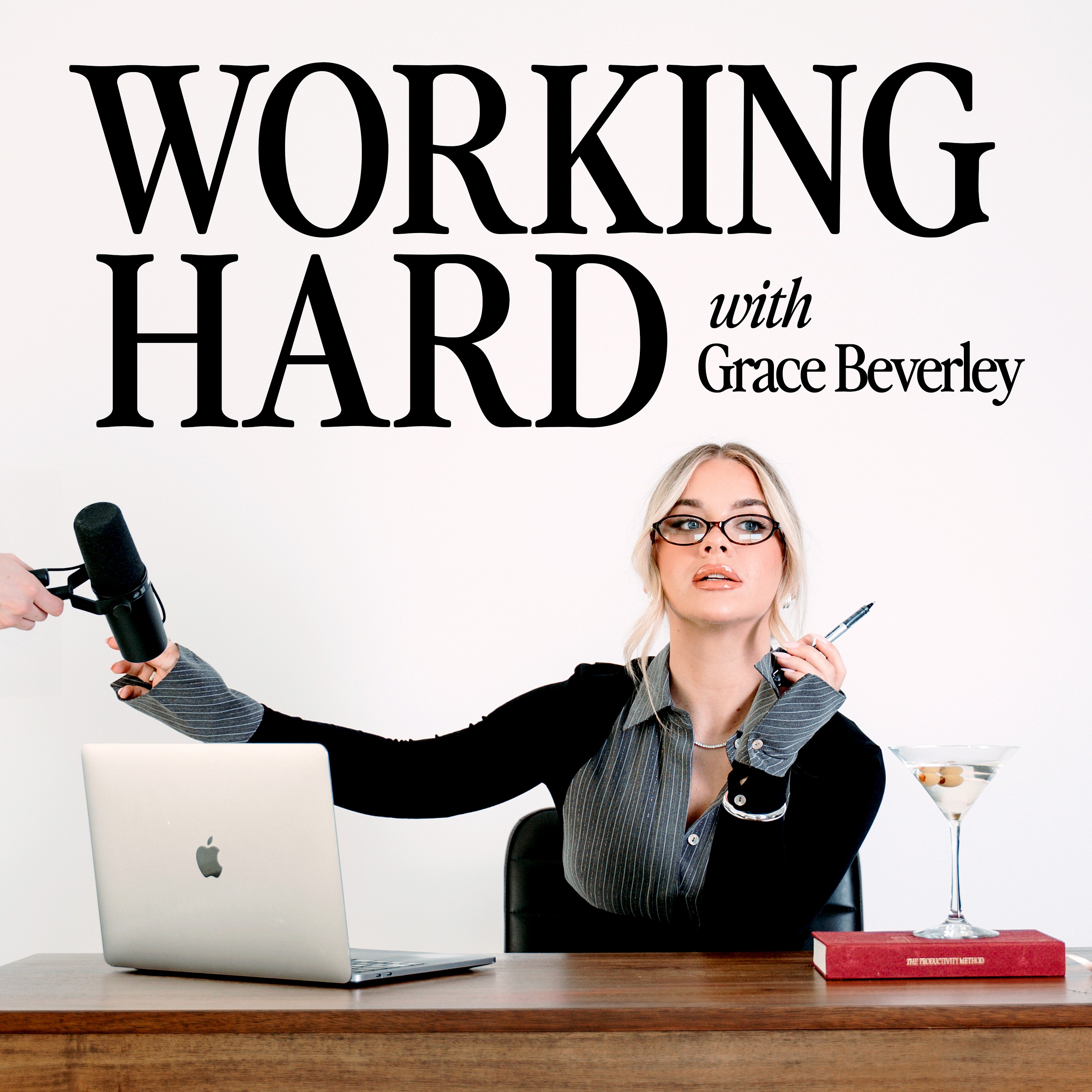
 Working Hard with Grace Beverley
29 Jun 2026 · 13m · 6 chapters

A mid-year reset for people who feel they’ve fallen off their New Year goals. The host argues slumps aren’t failure; they’re a mismatch between January plans and real life, and the fix is a short, step-by-step calendar-based audit and adjustment.
No guests appear in the transcript (the episode is presented as a solo segment by Grace Beverly, with earlier mentions of “Nick and Jack” and a prior guest, Sade’s Arry, but they are not participating here).
Shame spirals are unhelpful; compare goals vs calendar to find the disconnect; don’t build an “ideal week” that ignores error—plan three non-negotiables; run the plan as a 7-day experiment and adjust.
Morning workouts failing because of late bedtimes; gym frequency reduced from 5x/week to 2x/week; Thursday evenings too exhausted for hard tasks; “forgot water once” analogy for avoiding self-shame.
Written by AI. May contain mistakes.
Grace Beverly introduces the podcast and the episode's focus.
“I'm Grace Beverly and welcome back to Working Hard, the podcast shape guidebook on how to improve your own life and achieve what you actually dreamed of doing.”
Grace discusses the feelings associated with the mid-year slump.
“Because life's too short for boring podcasts and bad advice.”
Grace shares steps to get back on track during the mid-year slump.
“Because realistically, the mid-year slump is what happens when your January plan meets your actual real life.”
Grace explains how to audit your goals and assess your progress.
“Like this is designed to make you feel more in control of this time of year.”
Grace discusses how to create a realistic weekly routine to meet goals.
“Learn more by visiting acast.com slash advertise.”
Learn effective strategies to regain momentum and adjust your goals mid-year.
“I think sometimes people underestimate the power of just like one good week and one intentionally good week as well.”

Get the gist, explore an idea or ask about something said.
 Claude
On Working Hard with Grace Beverley, what are the key points of this episode?
Searching your listeningAutomatic transcript. May contain errors.
0:00Hey, Yetis. This is Nick and Jack from the Best One Yet podcast. Now, the last company we worked at, they used Paylocity and everything just worked. It wasn't until launching our own media business, this show, that we realized how rare that is. Because Paylocity is one delicious burrito of operational needs. They roll up HR, finance, and IT seamlessly into one delicious bite. When everything wraps together like that all at once, your workforce, your tech stack, your business, you don't need more tools, you don't even need cilantro. You need one solution. And that is why Paylocity built a single platform to connect HR, finance, and IT with AI-driven insights and automated workflows that simplify the complex and power what's next.
0:36Or as we call it, a delicious operational burrito. Yes, we do. Experience a one place for all your HCM needs, besties. So start now at paylocity.com slash one. Paylocity.com slash O-N-E. Quick question. When was the last time a display ad changed your mind? Now think about the last time a friend told you about something they loved. Different feeling, right? That's how podcast advertising works. A host who's built real trust with their audience talks about your brand in their own words, in their own voice. It doesn't interrupt the experience. It's part of it. With Acast, you can access the world's largest podcast marketplace.
1:15Choose the right shows, the right audiences, the right format. Then watch the data tell you it worked. You're not buying impressions. You're buying influence. Learn more by visiting acast.com slash advertise.
1:42Grace Beverley: What is up? I'm Grace Beverly and welcome back to Working Hard, the podcast shape guidebook on how to improve your own life and achieve what you actually dreamed of doing. Because life's too short for boring podcasts and bad advice. What is up and welcome back to Working Hard. I hope you're all good. Today's episode is for anyone who like started the year feeling very organized and possibly even slightly insufferable about their goals. You might have even listened to our full New Year's series. Now it's mid-year and you are in a big fat slump. So I want to tell you first and foremost, I know the feeling.
2:15Grace Beverley: You had like the planner, you had the routine, you had the vision, maybe even a waking up at 5am phase and now it is June and you're wondering what actually happened. And I think what makes this worse is the shame so many of us have around it, that guilt of knowing what you said you wanted and feeling like you're not really following through on it in the way that you imagined and then continuing to spiral because you're in this negative headspace and negative feedback loop again and again and again about yourself. So I wanted to do a proper mid-year reset episode for anyone that's maybe edging into that direction because there's actually no point me doing a whole new year reset series if we are not going to follow up with realistic plans when it gets to this point.
2:55Grace Beverley: Because realistically, the mid-year slump is what happens when your January plan meets your actual real life. And your real life is always gonna win. Like your real life is the reality of what's actually happening. You will have had a lot happen since January, some of which you could never have predicted. and it is not failure to have real life happen to you. It just, I guess, is about how you respond and react to that. And I have a few steps I always turn to to help me get back on track when this happens to me. But before we get into it, why don't you give this podcast a follow on whatever platform you are listening to it on now?
3:29Grace Beverley: I always want to keep these resources completely free as it always has been. And following on whatever app you're listening to it on is the best thing you can possibly do to help us stay that way.
3:43Grace Beverley: Okay, let's start with some context. The reason I wanted to do this episode is because as a culture, we talk a lot about starting the year strong and we even talk about ending the year strong. Like, I start to see a lot of stuff around September, October about like Q4 and that final year push and all of that's great, but I don't think we really talk about what happens in the middle or what happens after those initial goals. And I think I'm personally very guilty of that. Like, I really can be. By the middle of the year, that emotional boost you get from January and from the excitement of like this new year, new me or imagining the type of person you're gonna be has completely worn off.
4:18Grace Beverley: And what you're left with is your actual behavior, your habits, your energy levels, which is why most people either try to start again from scratch or just give up and say like, I'll try again next year or just put their head in the sand. And I feel like what I've learned is that neither of those options are actually particularly helpful. What actually works is stepping back and figuring out what specifically isn't working and then adjusting from there. So today I'm gonna take you through how to do that. It's a literal step-by-step because I feel like if you follow this, you cannot avoid getting back on track.
4:50Grace Beverley: Like this is designed to make you feel more in control of this time of year. We're not talking weeks of work here. You can set aside a day, a morning, even an hour. And I promise this will make your second half of the year better. Okay, step one is to work out where you are at. I don't know about you, but when I'm in a slump, sometimes the hardest thing to do is to work out why or you have like some reasons as to why it might be or this one big thing that feels like it's taking over your whole life but it might not be the reason why every single goal isn't necessarily where it needs to be and when you're tired or you're unmotivated it is so easy to spiral and to think that you've fallen off everything when in reality it's like one or two things.
5:30Grace Beverley: So the first thing I do is I go to my diary and I block out some time to get myself back on track and this seems like a small thing but even taking a morning or an hour to dedicate solely to yourself is the epitome of self-care. Like yes, watching maths and a day on the sofa is stunning but I am a firm believer that some days the kindest thing you can do for yourself is to take the time to plan, to reset, to keep the promises you made to yourself. That is self-care. So once you've got that time booked in, my first step is to do an audit on how things are actually going. Sometimes I will take myself to a cafe or on a walk first and I'll get out my planner or my laptop and I will ritualize it a little bit and I will do these three things.
6:11Grace Beverley: So number one, I will look back at what I said I wanted at the start of the year. Then I'll go through my calendar and look at what I've actually been doing. So like if I said I wanted to live this life with like this many times a gym a week and like this many times seeing my friends and this much time spent applying to new jobs or on my career or whatever it might be and then you're looking at what you've actually done just like that side by side is a good wake-up call like it's a good wake-up call it's also a good general reality check of like what's able to fit in your life and then the important part of this is you are going to work out why those two things don't match and that third part is where all the answers are for example if I've said I want to work out regularly and I haven't been I will look at when I plan to do it whether it was like even clear in my calendar and why it didn't happen.
6:57Grace Beverley: So for example you could have put it in your calendar to work out before work every single day and realistically I don't know you like seeing your friends in the evenings on weekdays so you're not going to do that. If you're going to work out it has to be after work. Whatever it might be you have to work out that disconnect. There have been so many times where I've told myself that I am going to work out in the morning and then over time that has gradually fallen off like it's not become part of my routine and I just get annoyed with myself and I tell myself that I need more discipline when actually if I'm honest I go to bed too late at those times like I'm not going to enjoy a 5am workout I'm setting myself up to fail and the issue there some of the time is discipline some of the time it is if it is the fact that this would never work in your schedule like it just doesn't work it doesn't make sense these two things don't go together it is not discipline it is that the plan that you made did not work for you in the first place it's the same with anything to do with work.
7:54Grace Beverley: If I've said I want to make progress on something and it hasn't moved it's almost always because it doesn't exist in my calendar anywhere or I've not put blocks in to work towards it or made any space for it in my week which sounds obvious but I think we massively overestimate how much we'll just find time for things. You're never going to just find time for things. It's either in your calendar or it's not in your calendar and I stopped doing this years ago and I'm so glad I did because now I really know if I'm doing something like if it's in my goals it has to be in my calendar those two things have to coexist if they don't it literally doesn't matter it's never going to happen and I want to be clear that this step is not about putting any more shame on yourself and going further into that like slump spiral because particularly as women we're really good at that and it's not actually helpful like if you're putting shame on yourself so you'll be a better person those two things are mutually exclusive it's much more productive to understand why something's not working and to make it work by changing something than to just shame yourself.
8:53Grace Beverley: Shaming is getting nowhere. Like sometimes you need a little bit of a wake-up call around things like discipline but that does not mean that you need to just be like telling yourself you're a terrible person over and over. And if you do find things that you do for a few days and then drop off, I always remember when I had Sade's Arry on the podcast in January and she said something I loved which was if you forgot to drink enough water for one day you wouldn't just like shame yourself and never drink water again. So why do we do that with everything else. I like to work on the basis that if you know what you're not doing you can actually act on it which brings us to step two.
9:27Grace Beverley: Once you've figured out where things are slipping the next step is not to create like a perfect new routine that you cannot sustain. We've already talked about this. It is to make your week feel doable again just with the goals that you want to add in. I would have a little look at the original goals you set. I would have a little look at what they should maybe look like now. Like if you decided suddenly in January we're going to go to the gym five times a week when you don't even go two times now let's edit let's let's edit let's make it more realistic then you're going to actually put it into your week and make it doable and this is where I think a lot of advice goes slightly wrong because it encourages you to design your ideal week which is usually based on like your most productive your most well-rested your most highly disciplined imaginary self which is not helpful on a random Wednesday when you're tired and your life is busy and you feel a bit shit about your work and you can't control things like There's going to be at least one day of every week where things go slightly awry and that is probably a given.
10:24Grace Beverley: Therefore your ideal week has to take this into account. It has to have room for error. So what I do instead is I open up my actual calendar and I pick three non-negotiables that would make the week feel like a win. It might be something like getting two workouts in, doing a few focus work blocks on one specific project or cooking at home a little bit more and then I schedule those in properly which means I will plan them around my real energy not my ideal energy. So for example if I know I'm always exhausted on Thursday evenings after a full meeting day I'm not putting my hardest tasks or a workout in there like I've had a stressful day the past two days I could see from my calendar my days were going to be stressful.
11:04Grace Beverley: Did I work out those two days? No like it just wasn't in my calendar. It is in my calendar for other times this week but it was not going to be helpful to be in those two days because that is where I was going to fall off. that is when I was then going to shame myself, all of this. And this sounds very simple but if you easily slip into ambitious and like trying to do everything mode, like me, it is actually a very hard task. This feels like fighting against your own head but I'm a firm believer that good calendar management will completely change your life but it is a skill to manage to get to a point where you have a calendar that works without burning you out, without over promising to others or feeling constantly behind.
11:40Grace Beverley: If you're a calendar management novice, I actually recorded a bonus episode back in January on exactly how I structure my calendar right down to the details on how I like color code it and block everything in, which I will link in the description if you want to give that a listen. But essentially your aim is to design your week to be doable again. And then you need to obviously be testing it out, which brings me on to step three. While every other channel is fighting for your customers' attention, podcasts are where they've already given it. No one accidentally listens to a podcast for 45 minutes.
12:12They choose to be here. They trust the voice in their ears. And when that voice talks about your brand, it doesn't sound like advertising. It sounds like a recommendation from a friend. Acast gives you that trust at scale. Digital precision, post-read authenticity, and performance data that proves it worked. Don't fight for attention. Buy it with Acast. Learn more by visiting acast.com slash advertise.
13:01Grace Beverley: whatever it might be, you are gonna test this week and then you are gonna adjust it based on what happens. What I've learned is that this like ideal calendar is never right the first time. I have like weirdly in like January 2016 of my calendar, I have my ideal week worked out, including workouts, including two evenings out on weeknights, including like all of these different things. I have it ideal there. And that has taken a long time to refine, to genuinely be what it should be, like the ideal calendar. This is a working document. It is not a finished product. So instead of expecting yourself to stick to it perfectly, the goal is to run it a little bit like an experiment.
13:39Grace Beverley: You wanna set yourself a seven day reset and try the week as you planned it. Because of this, you will see what holds, you will see what doesn't, and much more importantly, you will see why they don't work. And this testing and adjusting is where you start to build a calendar that actually works for you, rather than one that you are constantly trying to keep up with. Seven days of repeated habits is usually enough for me at least to get back into things and start feeling that dopamine hit of keeping promises to myself. I think sometimes people underestimate the power of just like one good week and one intentionally good week as well.
14:13Grace Beverley: I think you need to remember how good that feels. So that is my slightly more realistic and very unsexy way of getting out of a mid-year slump and actually getting yourself on track to reach your goals. If you are feeling a bit off track please remember you haven't ruined your year, you have just reach the point where your original plan needs adjusting and that is just living like that is just life you are much better off adapting and moving forward than just ignoring this also if you need a really good recommendation to keep you feeling motivated as we reach the halfway mark I've spoken about this book before but I would really recommend reading Atomic Habits by James Clear it explains so clearly how your life doesn't change in the big moments but in the everyday management of what you are actually doing this is one of the first things that really motivated me and really helped me understand like how to get the life I want.
14:57Grace Beverley: And I would really recommend reading it if you haven't already. One of the quotes I absolutely loved from it is never expect to fail, but always plan for it. The fastest way to get back on track is to know what to do when you're off it. And I feel like that is pretty much exactly what we need to hear. But I will see you next week. And I am wishing us all everything we dreamed of in the second half of this year. And that is all for now. Bye. While every other channel is fighting for your customers' attention, podcasts are where they've already given it. No one accidentally listens to a podcast for 45 minutes.
15:28They choose to be here. They trust the voice in their ears. And when that voice talks about your brand, it doesn't sound like advertising. It sounds like a recommendation from a friend. Acast gives you that trust at scale. Digital precision, post-read authenticity, and performance data that proves it worked. Don't fight for attention. Buy it with Acast. Learn more by visiting acast.com slash advertise. you
Today’s episode is for anyone who started the year feeling very organised and possibly even slightly insufferable about their goals, you might have even listened to our full new year series and is now mid-year and in a big fat slump.
We're going to get you out of it here & now!
In the episode I mentioned my calendar management bonus episode, it's here if you want to listen: https://shows.acast.com/working-hard-hardly-working/episodes/how-to-build-your-2026-hot-girl-calendar
+
SIGN UP TO THE WORKING HARD NEWSLETTER: https://graceb.myflodesk.com/k0sfhlac34
+
FOLLOW THE PODCAST
Instagram: https://www.instagram.com/workinghardpod/?hl=en
TikTok: https://www.tiktok.com/@workinghardpodcast
+
DILEMMA SUBMISSION
If you'd like to submit any dilemmas to the podcast to be answered in the bonus episodes, please send them to [email protected] with the subject beginning DILEMMAS or DM us @workinghardpod on instagram!
+
MY LINKS: https://gracebeverley.komi.io/
+
RETROGRADE, SHREDDY, TALA and THE PRODUCTIVITY METHOD are my own businesses, therefore any mention of them - whilst not being a sponsorship - is monetarily endorsed. As usual, sponsorships do not change my opinions nor my honesty, but I will always disclaim to make sure motives are clear 😊
Hosted on Acast. See acast.com/privacy for more information.